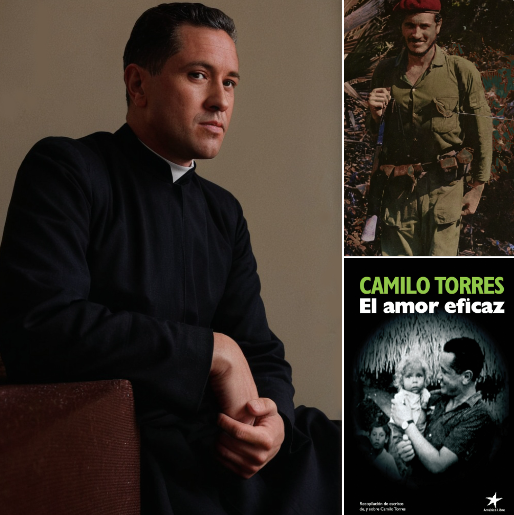
カミーロ・トレス・レストレポ
Camilo Torres Restrepo,
1929-1966
☆
カミロ・トーレス・レストレポ[Camilo Torres
Restrepo](1929年2月3日 -
1966年2月15日)は、アルヘミロという戦時名でも知られるコロンビアのカトリック系政治指導者、革命家、ゲリラ、司祭、作家であり、国民解放軍
(ELN)の指導者であった。彼は生涯、革命的社会主義とカトリックを調和させようとし、そのイデオロギーは「カミリズム」として知られるようになった。
このイデオロギーは、後の解放の神学運動に大きな影響を与え[1][2][3]、モントネロスにも採用された。[4]
コロンビア国立大学の教員として、1960年にオルランド・ファルス・ボルダ、エドゥアルド・ウマニャ・ルナ、マリア・クリスティーナ・サラサール、バー
ジニア・グティエレス・デ・ピネダ、カルロス・エスカランテ、ダリオ・ボテロ、トマス・ドゥカイといった知識人たちとともに社会学部を共同設立した。
[5]
当時、彼はいくつかの学生運動や政治運動に関わっていたため、多くの支持者を獲得する一方で、特にコロンビア政府や教会自体から多くの批判者も生んだ。彼
の急進的な政治活動に対する圧力が高まったため、トーレスは世俗化(聖職からの離職)を申請し、それが認められた(ただし、彼は信仰を放棄することはな
く、敬虔なカトリック教徒であり続けた)。
トーレスは社会主義組織「統一戦線」を設立したが、これはわずか1ヶ月で終焉を迎えた。統一戦線の失敗後、彼はコロンビアのマルクス・レーニン主義組織
ELN(民族解放軍)に加わった。主に下級メンバーとして活動し、カトリックの観点から精神的支援と啓発を提供した。ELNの指導者となった後、ゲリラが
コロンビア軍パトロール隊を待ち伏せ攻撃した最初の戦闘で戦死した[6][7]。死後、カミロ・トーレスはELNの公式な殉教者とされた。1987年、組
織は「カミリスタ連合 - 国民解放軍」と改名された[8][9][10]。
トーレスは、「もしイエスが今日生きていたら、彼はゲリラ兵になっていただろう」という引用で最もよく知られているかもしれない。[11]
マスコミから共産主義者というレッテルを貼られたにもかかわらず、トーレスは、少なくとも彼の人生のほとんどの間、そのレッテルを拒否し、共通の目標のた
めに共産主義者たちと戦うことはあっても、共産主義者たちと同列に扱われることは望まないと宣言した。また、彼は反共産主義者ではないとも宣言した。
[12]
カミロ・トーレスは、カトリックの聖職者であるヘルダー・カマラやデス・ウィルソンと並んで、解放の神学の歴史において最も重要な人物の一人である。彼
は、社会主義者のルイス・ビジャール・ボルダ、コロンビアの作家ガブリエル・ガルシア・マルケス、解放の神学の先駆者グスタボ・グティエレスと親交があっ
た。[13]
1970年、ドミニカ共和国では、カトリック聖職者や大学生らによる革命組織「カミロ・トレス革命司令部(CORECATO)」が結成された。
| Camilo Torres
Restrepo (3 February 1929 – 15 February 1966), also known by his nom de
guerre Argemiro, was a Colombian Catholic political leader,
revolutionary, guerilla, priest, author and a leader of the National
Liberation Army (ELN). During his life, he attempted to reconcile
revolutionary socialism and Catholicism, an ideology which became known
as Camilism. This ideology would significantly influence the later
liberation theology movement,[1][2][3] as well as being adopted by the
Montoneros.[4] As part of the academic staff of the National University of Colombia, he was a co-founder of the Sociology Faculty together with Orlando Fals Borda, as well as some intellectuals such as Eduardo Umaña Luna, María Cristina Salazar, Virginia Gutiérrez de Pineda, Carlos Escalante, Darío Botero and Tomás Ducay, in 1960.[5] His involvement in several student and political movements during the time won him a large following as well as many detractors, especially from the Colombian government and the Church itself. Due to the growing pressure to back down from his radical politics, Torres requested to be and was laicized (although he never abandoned his faith and he remained a devout Catholic). Torres founded the socialist United Front, which lasted only a month. After the failure of the United Front, he joined the Marxist-Leninist ELN in Colombia. He mostly served as a low-ranking member of the movement, to which he also provided spiritual assistance and inspiration from a Catholic point of view. After becoming a leader of the ELN, he was killed in his first combat engagement when the guerrillas ambushed a Colombian military patrol.[6][7] After his death, Camilo Torres was made an official martyr of the ELN. In 1987, the organization was renamed the Camilista Union - National Liberation Army.[8][9][10] Torres is perhaps best known for the quote: "If Jesus were alive today, He would be a guerrillero".[11] Despite being labelled a communist by the press, Torres, for at least the majority of his life, rejected that label, declaring instead that while he would fight with the communists for common goals, he did not want to be identified with the communists. He also declared that he was not an anti-communist.[12] Camilo Torres, along with the Catholic clergymen Helder Camara and Des Wilson, is one of the most important figures in the history of liberation theology. He was a friend of fellow socialist Luis Villar Borda, Colombian writer Gabriel García Márquez and liberation theology pioneer Gustavo Gutierrez.[13] In the Dominican Republic in 1970, a revolutionary group that included Catholic clergy and university students formed CORECATO (Comando Revolucionario Camilo Torres; "Camilo Torres Revolutionary Command"). |
カミロ・トーレス・レストレポ[Camilo Torres
Restrepo](1929年2月3日 -
1966年2月15日)は、アルヘミロという戦時名でも知られるコロンビアのカトリック系政治指導者、革命家、ゲリラ、司祭、作家であり、国民解放軍
(ELN)の指導者であった。彼は生涯、革命的社会主義とカトリックを調和させようとし、そのイデオロギーは「カミリズム」として知られるようになった。
このイデオロギーは、後の解放の神学運動に大きな影響を与え[1][2][3]、モントネロスにも採用された。[4] コロンビア国立大学の教員として、1960年にオルランド・ファルス・ボルダ、エドゥアルド・ウマニャ・ルナ、マリア・クリスティーナ・サラサール、バー ジニア・グティエレス・デ・ピネダ、カルロス・エスカランテ、ダリオ・ボテロ、トマス・ドゥカイといった知識人たちとともに社会学部を共同設立した。 [5] 当時、彼はいくつかの学生運動や政治運動に関わっていたため、多くの支持者を獲得する一方で、特にコロンビア政府や教会自体から多くの批判者も生んだ。彼 の急進的な政治活動に対する圧力が高まったため、トーレスは世俗化(聖職からの離職)を申請し、それが認められた(ただし、彼は信仰を放棄することはな く、敬虔なカトリック教徒であり続けた)。 トーレスは社会主義組織「統一戦線」を設立したが、これはわずか1ヶ月で終焉を迎えた。統一戦線の失敗後、彼はコロンビアのマルクス・レーニン主義組織 ELN(民族解放軍)に加わった。主に下級メンバーとして活動し、カトリックの観点から精神的支援と啓発を提供した。ELNの指導者となった後、ゲリラが コロンビア軍パトロール隊を待ち伏せ攻撃した最初の戦闘で戦死した[6][7]。死後、カミロ・トーレスはELNの公式な殉教者とされた。1987年、組 織は「カミリスタ連合 - 国民解放軍」と改名された[8][9][10]。 トーレスは、「もしイエスが今日生きていたら、彼はゲリラ兵になっていただろう」という引用で最もよく知られているかもしれない。[11] マスコミから共産主義者というレッテルを貼られたにもかかわらず、トーレスは、少なくとも彼の人生のほとんどの間、そのレッテルを拒否し、共通の目標のた めに共産主義者たちと戦うことはあっても、共産主義者たちと同列に扱われることは望まないと宣言した。また、彼は反共産主義者ではないとも宣言した。 [12] カミロ・トーレスは、カトリックの聖職者であるヘルダー・カマラやデス・ウィルソンと並んで、解放の神学の歴史において最も重要な人物の一人である。彼 は、社会主義者のルイス・ビジャール・ボルダ、コロンビアの作家ガブリエル・ガルシア・マルケス、解放の神学の先駆者グスタボ・グティエレスと親交があっ た。[13] 1970年、ドミニカ共和国では、カトリック聖職者や大学生らによる革命組織「カミロ・トレス革命司令部(CORECATO)」が結成された。 |
| Biography Childhood and education 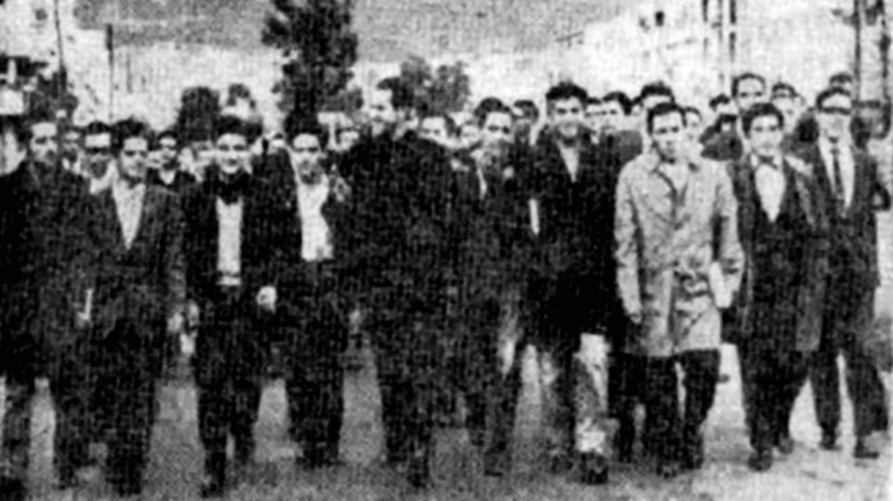 Camilo Torres (center, looking sideways) marching with students Jorge Camilo Torres Restrepo was born on 3 February 1929 in Bogotá into a well-to-do family of the liberal bourgeoisie. His mother Isabel told him the story of Father Cuco (Juan de la Cruz Gaviria), a liberal businessman who financed the military campaigns against the conservatives in the civil wars of the 19th century. His parents took him to Europe when he was only two years old.[14] He returned to the country in 1934. Three years later, in 1937, the couple separated, leaving Camilo and his brother Fernando at their mother's side. Expelled for his criticism of the teachers at the traditional Colegio Mayor de Nuestra Señora del Rosario, he finished his baccalaureate at the Liceo de Cervantes in 1946 where he met and became friends with Luis Villar Borda and Ricardo Samper. His sister Gerda Westendorp Restrepo, daughter of Isabel Restrepo's first marriage, was a medical student (the first woman in Colombia to pursue a university degree). Her brother Fernando devoted himself to medicine like his father and older half-sister, and settled in the United States. He was close to Camilo although their professions caused them to see each other sporadically. Camilo Torres entered the Faculty of Law at the Universidad Nacional de Colombia, where he would meet again with Villar Borda, and only studied there for the first semester. During this brief period Camilo and Luis edited the university page of the Bogota newspaper La Razón, and on some occasions wrote criticisms against some university magazines that they considered radical. Influenced by the social ideas of two French Dominican priests, Nielly and Blanchet, whom he met through the father of his girlfriend Teresa Montalvo, daughter of a prestigious Bogota family, the idea of becoming a priest began to take hold of Camilo, and to make this decision, he withdrew to meditate in the eastern plains. After breaking up with his girlfriend and despite the reluctance of his mother and father, Camilo entered the Conciliar Seminary of Bogotá of the Archdiocese of Bogotá (in agreement with his parents to avoid entering the Dominican Seminary of Chiquinquirá which was in poor condition) where he remained for seven years, during which time he began to take an interest in social realities. |
伝記 幼少期と教育 カミロ・トーレス(中央、横を向いている)が学生たちと共にデモ行進する様子 ホルヘ・カミロ・トーレス・レストレポは1929年2月3日、ボゴタの裕福なリベラルブルジョワジーの家庭に生まれた。母イサベルは、19世紀の内戦で保 守派に対する軍事作戦に資金を提供したリベラル派実業家、クコ神父(フアン・デ・ラ・クルス・ガビリア)の話を彼に語った。 両親は彼がわずか2歳の時に彼をヨーロッパに連れて行った[14]。彼は1934年に帰国した。3年後の1937年、両親は別居し、カミロと弟フェルナン ドは母親と共に暮らすことになった。伝統校コレヒオ・マヨール・デ・ヌエストラ・セニョーラ・デル・ロサリオで教師を批判したため退学処分となり、 1946年にリセオ・デ・セルバンテスでバカロレア(高校卒業資格)を取得した。そこでルイス・ビジャール・ボルダやリカルド・サンペルと知り合い、友人 となった。 姉のゲルダ・ウェステンドルプ・レストレポは、イサベル・レストレポの最初の結婚で生まれた娘であり、医学部生だった(コロンビアで大学学位を取得した最 初の女性である)。弟のフェルナンドは父や異母姉と同様に医学の道に進み、アメリカに定住した。二人は親しかったが、職業の違いから会う機会はまばらだっ た。 カミロ・トーレスはコロンビア国立大学法学部に入学し、そこで再びビジャール・ボルダと出会ったが、在学は最初の学期のみであった。この短い期間、カミロ とルイスはボゴタの新聞『ラ・ラソン』の大学欄を編集し、過激とみなした大学雑誌に対して批判記事を執筆することもあった。 恋人テレサ・モンタルボの父親を通じて知り合った二人のフランス人ドミニコ会司祭、ニエリとブランシェの社会思想に影響を受け、司祭になる考えがカミロの 心に芽生え始めた。この決断を下すため、彼は東部平原に篭って瞑想した。恋人との別れを経て、両親の反対を押し切り、ボゴタ大司教区付属のボゴタ合同神学 校に入学した(両親の同意を得て、劣悪な環境のチキンキラ修道院付属神学校への入学を回避した)。7年間在籍する中で、彼は次第に社会の実情に関心を持ち 始めた。 |
| Priesthood and academic life Poverty and social injustice attracted his attention and, together with his fellow disciple Gustavo Pérez, he created a social studies circle that functioned even after Torres was ordained a priest in 1954 under the direction of Jonatan Gómez. Camilo started social activities in the neighbourhoods surrounding the Conciliar Seminary, which were populated by displaced families from the countryside. In 1955, in order to specialize, Torres travelled to Belgium, to study for a few more years at the Catholic University of Louvain. The first months were very difficult for the Bogota priest because of the cold climate, Belgian food and the conditions of the boarding house where he lived with Gustavo; for this reason, at the end of the first semester, he moved with his mother to a flat. With a group of Colombian students at the university, he founded the ECISE (Equipo Colombiano de Investigación Socioeconómica) and came into contact with Christian Democracy, the Christian trade union movement and Algerian resistance groups in Paris. He founded the Bogota, Paris and London sections of ECISE. In 1957 he met Marguerite-Marie 'Guitemie' Olivieri, a Frenchwoman of Corso origin and bourgeois daughter of a doctor like Torres, who was to become his closest friend and secretary, and who by then was living in a poor neighbourhood of Paris, accompanying the pieds noirs in sabotage work against the French regime that was being imposed by force in Algeria.[15] In turn, Torres met Villar Borda again in Berlin and spent holidays in Belgrade where he unsuccessfully wanted to exercise his priesthood, or failing that in Prague. In 1958, the Belgian university awarded him the degree of sociologist. His doctoral thesis, Una aproximación estadística a la realidad socioeconómica de Bogotá, a pioneering work in urban sociology in Latin America, was published in 1987 under the title La proletarización de Bogotá. 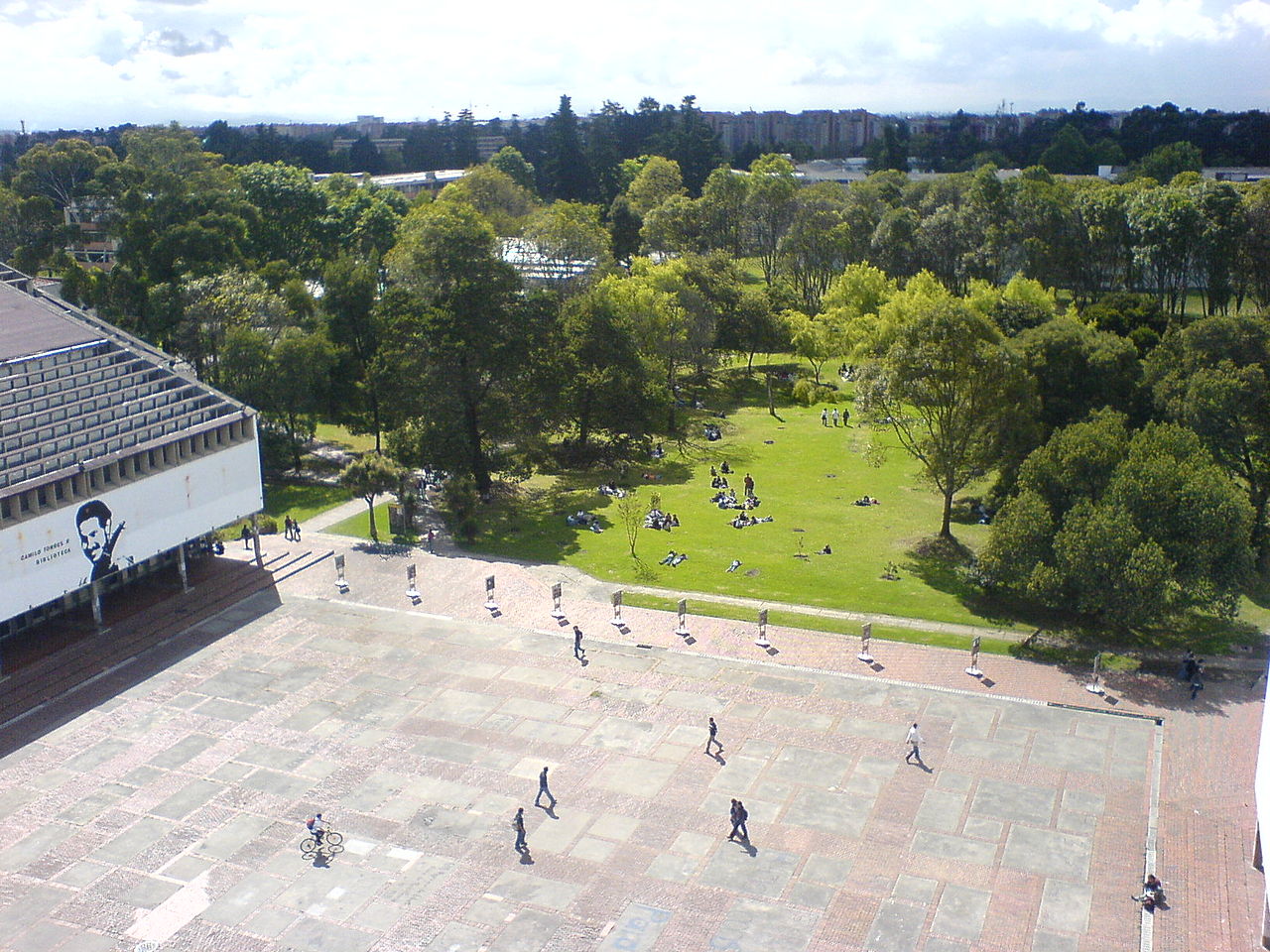 Wall painting homage to Camilo Torres located at the National University of Colombia. While studying, Torres also studied Marxism after being given a permission to do so by the Cardinal Crisanto Luque Sánchez. He was also exposed to the worker-priest movement; according to Walter J. Broderick, "Camilo came in on the tail-end of it and was enormously affected by the spirit of commitment to the working masses which this movement had aroused in the more generous elements of the French and Belgian clergy". The impact was profound, and Camilo would accompany a local priest, who adhered to the worker-priest movement, to the poor districts. Broderick recalls that Camilo "became engaged in activities with flesh and blood people. He rarely missed a chance to help out at weekends in a parish of coal miners not far from Louvain, and would go back to his books pondering on what he had seen and heard: the hardships of the miners’ lives, their pastor's anguish for them and his efforts to improve their lot. For the pastor of this mining town was a firm convert to the Priest Worker Movement."[16] After witnessing the poverty of Belgian miners, and under the influence of the worker-priest movement and Marxism, Camilo became embarrassed at his own luxury, and decided to sell his car and live as humbly as possible. After Camilo informed his mother of his decision, she chastized him; Camilo responded that his 'bourgeois' status was preventing him from establishing a "real contact" with the workers, whom he came to see as the embodiment of "the person of Jesus".[17] Torres also stayed in touch with his friends from Colombia through letters, who informed him of dissemination of communist guerrillas and movements in Colombia; Camilo's friend Miguel wrote to him: "In my free time I'm working with the workers, finally...! They have many needs of all kinds and we are going to see how we can organise them to solve them. [...] On the subject of the country [...] I can add that the guerrillas seem to be fuelled by communism, which has gained ground even against the president."[18] Camilo Torres' fascination with Marxism led him to visit the Soviet Union at the time and praise Joseph Stalin. Camilo's friend who became a communist, Jaime Díaz, praised Camilo for going to Moscow and "praying at the miraculous tomb of our father Stalin".[18] In 1959, when he returned to Colombia, Camilo felt compelled to actively support the cause of the poor and the working class. That year he was appointed auxiliary chaplain of the National University of Colombia, in Bogotá. The following year, in 1960, he participated along with Orlando Fals Borda, Carlos Escalante, Eduardo Umaña Luna, María Cristina Salazar, Darío Botero Uribe, Virginia Gutiérrez de Pineda and Tomás Ducay, among others, in the founding of the first faculty of Sociology in Latin America (today a department) of the Universidad Nacional de Colombia, where he was a professor and was close to and popular with the students. He was a founding member and president of the Movimiento Universitario de Promoción Comunal (MUNIPROC). With the creation of the Juntas de Acción Comunal (JAC),[19] promoted by the government of Alberto Lleras Camargo, from Law 9 of 1958, Torres recognises in it the possibility of decentralising political power and giving possibilities of empowerment to grassroots communities. Together with teachers and students, he carried out community action programmes in working-class neighbourhoods in Bogotá. Torres was also the organiser of the IX Congress of the Latin American Sociological Association. MUNIPROC's work led to the founding of the first Junta de Acción Comunal (JAC) in Tunjuelito, at that time a working class enclave in the south of Bogotá, where he had been working continuously for several years. In 1963, he chaired the first National Congress of Sociology, also held in Tunjuelito (Bogotá), and presented the study "La violencia y los cambios socio-culturales en las áreas rurales colombianas" (Violence and socio-cultural changes in rural areas of Colombia). Torres was also a member of the technical committee of the agrarian reform founded by the Colombian Institute of Agrarian Reform (INCORA), where he represented the most reformist position of the Board of Directors, which was divided between the Conservative and Liberal parties, typical of the National Front but considered by Torres an inefficient entity in the face of the needs of the Colombian countryside. In his career as a member of the Board, the episode of the project to set up an Agrarian School in Yopal (Casanare) and the difficulties presented by the then director of INCORA Enrique Peñalosa Camargo (liberal, father of the former mayor of Bogotá Enrique Peñalosa Londoño) and Álvaro Gómez Hurtado (conservative, son of former president Laureano Gómez) stand out. During this period of his life he was interested in founding a farm-school in Yopal (Casanare), as part of the rural action programme that he encouraged in the region and which would go on to achieve other organisational successes; on the board of the Incora, he sparked off a controversy over the application of the law of extinction of ownership restricted to uncultivated lands, which brought him into conflict with Álvaro Gómez Hurtado, also a member of that body and head of the "Laureanist" group of the Conservative Party. Because of the resonance of this conflict, some conservative bishops wrote to the Cardinal to request his dismissal from the board. Invited to Peru, he gave courses and lectures on the subject of agrarian reform and social change. His view of the Latin American situation is not flattering, as he expresses it in a letter from Lima. He writes: Lima is not Peru. There are six million pure Indians who consider the other four million as strangers. I have been very frustrated to be able to establish nothing but a tourist relationship with the Indians. This is the truest and weakest base of the Latin American revolution. Their social situation is appalling. However, the purges continue in Brazil. Those who think are punished. Reaction is beginning to walk all over our continent as if the majorities did not exist. Until when! We progressives are very intelligent. We speak very well. We are popular. When we are together we are really nice. But reaction moves one of its powerful fingers and paralyses us! We cannot go on without organisation and equal arms, at least.[20] In 1962, the year in which the Second Vatican Council was initiated by Pope John XXIII, Torres was one of the first priests to offer a Mass facing forward and in Spanish, when by then the Mass was offered facing backwards and in Latin. Between 8 and 9 June of that year, under pressure from Cardinal Luis Concha Córdoba, after entering, together with other professors, into contradictions with the rector, by honouring at mass the students killed after a demonstration repressed by the National Police and by opposing the expulsion of other students, he was forced to resign from all his activities at the National University of Colombia, being transferred to the Church of La Veracruz in Bogotá as coadjutor;[21][20] assistant to the parish priest with only confession and baptismal functions. This unleashed a strong depression in Torres, who wanted to be close to the people. Shortly before, the Colombian Communist Youth (JUCO) had proposed Torres as rector of the University to a possible shortlist of three but Torres politely declined the offer for fear of tarnishing his name. In 1964, Concha would later relieve Torres as coadjutor, only admiring Torres as a sociologist, allowing him to become an associate professor in the Faculty of Sociology. He was in turn appointed dean of the Institute of Social Administration of the Escuela Superior de Administración Pública (ESAP) and promoted to member of the Board of Directors of INCORA. The Unidad de Acción Rural de Yopal (UARY) was inaugurated on 1 March 1964, after overcoming the bureaucratic obstacles of the Ministry of Agriculture, which allowed him to work at the grassroots with the peasants of the capital of the plains. He combined this with the struggles in the junta, especially with the conservative politician who was a staunch defender of the interests of the landowners. He first considered creating a guerrilla group together with Álvaro Marroquín, a student at the National University and member of the JUCO. Torres in turn considered INCORA a deficient entity to attend to the needs of the Colombian peasantry, especially in informal education for their organization in search of an agrarian reform different to that proposed by INCORA.[22] |
司祭職と学問生活 貧困と社会的不公正が彼の関心を引いた。彼は同志のグスタボ・ペレスと共に社会科学サークルを創設した。このサークルは、1954年にトーレスが司祭に叙 階された後も、ホナタン・ゴメスの指導のもとで活動を続けた。カミロは、コンシリアル神学校周辺の地域で社会活動を始めた。この地域には、田舎から移住し てきた家族が住んでいた。 1955年、専門知識を深めるため、トーレスはベルギーに渡り、ルーヴァン・カトリック大学でさらに数年学ぶことにした。最初の数ヶ月は、寒冷な気候、ベ ルギーの食事、そしてグスタボと共同生活を送った下宿の環境が原因で、ボゴタ出身の司祭にとって非常に困難なものだった。このため、最初の学期の終わり に、彼は母親と共にアパートへ引っ越した。大学で出会ったコロンビア人学生グループと共に、彼はECISE(コロンビア社会経済調査チーム)を設立し、キ リスト教民主主義、キリスト教労働組合運動、パリのアルジェリア抵抗組織と接触した。彼はECISEのボゴタ、パリ、ロンドン支部を設立した。1957 年、彼はマルグリット=マリー・「ギテミ」・オリヴィエリと出会った。彼女はコルソ出身のフランス人で、トーレス同様医師の娘であるブルジョワ階級の女性 であり、後に彼の最も親しい友人兼秘書となる人物だ。当時彼女はパリの貧民街に住み、アルジェリアに武力で押し付けられていたフランス政権に対する破壊工 作でピエ・ノワール(アルジェリア帰還フランス人)を支援していた。[15] 一方トーレスはベルリンで再びビジャール・ボルダと再会し、ベオグラードで休暇を過ごした。そこで司祭職を行使しようとしたが失敗し、次にプラハで試み た。1958年、ベルギーの大学から社会学の学位を授与された。彼の博士論文「ボゴタの社会経済的現実に関する統計的アプローチ」は、ラテンアメリカの都 市社会学における先駆的な研究であり、1987年に「ボゴタのプロレタリア化」というタイトルで出版された。 コロンビア国立大学にある、カミロ・トレスに敬意を表して描かれた壁画。 トレスは、クリサント・ルケ・サンチェス枢機卿の許可を得て、学業と並行してマルクス主義も学んだ。また、労働者司祭運動にも触れた。ウォルター・J・ブ ロデリックによれば、「カミロはその運動の終盤に参加し、この運動がフランスとベルギーの聖職者たちのより寛大な要素に呼び起こした、労働者大衆への献身 の精神に多大な影響を受けた」という。その影響は深く、カミロは労働者司祭運動に賛同する地元の司祭に同行して、貧しい地区を訪れた。ブロデリックは、カ ミロが「生身の人間たちとの活動に従事するようになった」と回想している。彼は、ルーヴァンからそう遠くない炭鉱夫たちの教区で、週末に手伝う機会をほと んど逃さず、そして、自分の本に戻って、自分が見聞きしたことを熟考した。炭鉱夫たちの生活の苦難、彼らに対する牧師の苦悩、そして彼らの境遇を改善しよ うとする牧師の努力についてである。この炭鉱町の司祭は、労働者司祭運動の確固たる信奉者だったのだ。」[16] ベルギーの炭鉱労働者の貧困を目の当たりにし、労働者司祭運動とマルクス主義の影響を受けたカミロは、自身の贅沢に恥じ入るようになり、車を売り払って可 能な限り質素に暮らすことを決意した。カミロがこの決意を母に伝えると、母は彼を叱責した。カミロは「ブルジョワ」としての立場が、労働者との「真の接 触」を妨げていると反論した。彼は労働者を「イエスの人格」の体現者と見なすようになっていたのだ。[17] トルレスはまた、コロンビアの友人たちと手紙で連絡を取り合っていた。友人たちはコロンビアにおける共産主義ゲリラと運動の広がりを彼に知らせた。カミロ の友人ミゲルはこう書き送った。「暇を見つけては労働者たちと活動しているよ、ついに…!彼らはあらゆる面で多くの必要を抱えていて、それを解決するため にどう組織化できるか模索中だ。[...] 国の状況については[...] ゲリラは共産主義に支えられているようで、大統領に対しても勢力を伸ばしている」 [18] カミロ・トーレスはマルクス主義に魅了され、当時ソ連を訪問してヨシフ・スターリンを称賛した。共産主義者となったカミロの友人ハイメ・ディアスは、カミ ロがモスクワへ赴き「我らの父スターリンの奇跡の墓前で祈りを捧げた」ことを称賛した。[18] 1959年、コロンビアに戻ったカミロは、貧しい人々や労働者階級の運動を積極的に支援すべきだと強く感じた。その年、彼はボゴタにあるコロンビア国立大 学の副牧師に任命された。翌1960年には、オルランド・ファルス・ボルダ、 カルロス・エスカランテ、エドゥアルド・ウマニャ・ルナ、マリア・クリスティーナ・サラザール、ダリオ・ボテロ・ウリベ、バージニア・グティエレス・デ・ ピネダ、トマス・ドゥカイらとともに、ラテンアメリカ初の社会学学部(現在の学科)をコロンビア国立大学に設立した。彼は同大学の教授であり、学生たちに 親しまれ、人気があった。彼は、大学共同体推進運動(MUNIPROC)の創設メンバーであり、その会長も務めた。1958年の法律9号に基づき、アルベ ルト・ジェラス・カマルゴ政権が推進した共同体行動委員会(JAC)[19] の創設により、トーレスは、政治権力を分散し、草の根コミュニティにエンパワーメントの可能性を与えることができると認識した。教師や学生と共に、ボゴタ の労働者階級地区で地域活動プログラムを実施した。また、第9回ラテンアメリカ社会学会大会の主催者でもあった。 MUNIPROCの活動は、当時ボゴタ南部の労働者階級地区であったトゥンヘリートに初の地域活動委員会(JAC)を設立するきっかけとなった。彼は数年 にわたり同地で継続的に活動していた。1963年には、同じくトゥンフエリート(ボゴタ)で開催された第1回全国社会学会議の議長を務め、「コロンビア農 村地域における暴力と社会文化的変化」という研究を発表した。トーレスはまた、コロンビア農地改革研究所(INCORA)が設立した農地改革技術委員会の メンバーでもあった。同委員会では、保守党と自由党に分かれた理事会の中で最も改革的な立場を代表していた。これは国民戦線に典型的な構成だったが、トー レスはコロンビアの農村部のニーズに対して非効率な組織だと考えていた。理事としての経歴では、ヨパル(カサナレ州)に農業学校を設立する計画と、当時の INCORA所長エンリケ・ペニャロサ・カマルゴ(自由党、元ボゴタ市長エンリケ・ペニャロサ・ロンドニョの父)およびアルバロ・ゴメス・ウルタド(保守 党、元大統領ラウレアノ・ゴメスの息子)が示した困難が特筆される。 この時期、彼はカサナレ州ヨパルに農場学校を設立することに関心を持ち、地域で推進した農村活動プログラムの一環として、その後他の組織的成功を収めるこ とになる。インコラ理事会では、未耕作地に限定した所有権消滅法の適用を巡る論争を引き起こし、同理事会メンバーであり保守党「ラウレアニスト」派の首脳 であるアルバロ・ゴメス・ウルタドと対立した。この対立の反響から、保守派の司教数名が枢機卿に書簡を送り、理事会からの解任を要請した。ペルーに招かれ た彼は、農地改革と社会変革をテーマに講義や講演を行った。リマからの書簡で表明されているように、彼のラテンアメリカ情勢に対する見解は決して好意的で はない。彼はこう記している: リマはペルー全体ではない。六百万の純粋なインディオが、残る四百万を異邦人と見なしている。インディオたちと観光関係以上のものを築けず、私は非常に苛 立っている。これがラテンアメリカ革命の最も真実であり、最も脆弱な基盤だ。彼らの社会的状況は悲惨である。しかしブラジルでは粛清が続いている。考える 者は罰せられる。反動勢力が我々の大陸を踏み荒らし始めている。まるで多数派が存在しないかのように。いつまで続くのか!我々進歩派は非常に聡明だ。雄弁 に語る。我々は人気がある。集まれば実に愉快だ。だが反動勢力がその強大な指一本動かすだけで、我々は麻痺する!組織と少なくとも対等な武器なしでは、こ れ以上進めないのだ。[20] 1962年、教皇ヨハネ23世によって第二バチカン公会議が開始された年、トーレスは当時すでに後ろ向きでラテン語で行われていたミサを、初めて正面向き でスペイン語で捧げた司祭の一人であった。同年6月8日から9日にかけて、ルイス・コンチャ・コルドバ枢機卿の圧力のもと、他の教授たちと共に学長と対立 した。その原因は、国家警察によるデモ弾圧で死亡した学生たちをミサで追悼したこと、そして他の学生たちの退学処分に反対したことだった。彼はコロンビア 国立大学での全ての職務を辞任させられ、ボゴタのラ・ベラクルス教会に補佐司祭として異動となった。[21][20] 司祭補佐として、告解と洗礼の職務のみを担うことになった。これは民衆に寄り添いたいと願うトーレスに強い鬱病を引き起こした。その直前に、コロンビア共 産主義青年団(JUCO)はトーレスを学長候補の最終3名リストに推挙したが、トーレスは自身の名を汚すことを恐れ、丁重に辞退していた。 1964年、コンチャが補佐司祭職を継承した。彼は社会学者としてのトーレスを高く評価し、社会学部准教授への就任を認めた。トーレスはさらに高等行政学校(ESAP)社会行政学部長に任命され、INCORA理事会の理事に昇格した。 1964年3月1日、農業省の官僚的障害を乗り越え、イオパル農村行動連合(UARY)が発足した。これにより平原の首都の農民たちと草の根レベルで活動 できるようになった。彼はこれを、特に地主の利益を頑なに守る保守派政治家との闘争を含む、評議会内での活動と両立させた。彼は最初に、国立大学の学生で JUCOのメンバーであるアルバロ・マロキンと共にゲリラ組織の創設を考えた。トーレスはまた、INCORAをコロンビアの農民のニーズ、特に INCORAが提案するものと異なる農地改革を求める組織化のための非公式教育に対応するには不十分な組織と見なしていた。[22] |
| Entering politics The Cuban Revolution, which impacted every country in the Americas, caught Torres' attention after he returned to Colombia from Europe. In 1965, the Movimiento Revolucionario Libera (MRL) went into decline after its split following the presidential elections of 1962. The 1964 parliamentary elections were marked by an enormous abstention, in which Torres concluded that the traditional parties; Liberal and Conservative, were abandoned by public opinion, so he considered creating a new instrument that would bring together the "Non-aligned" in politics; unions, guilds, associations, students and workers, to confront the decadent traditional parties, although for the time being calling for abstentionism. Torres also tried unsuccessfully to act as a mediator between the peasants and the National Army to prevent the attack on the so-called Independent Republic of Marquetalia, which was his first contact with the Colombian Communist Party.[20][23][24] The American-sponsored attempt to overthrow the Cuban regime rallied socialist guerrillas and revolutionary student movements across the Latin America, and it exposed Torres to the ideas of anti-imperialism.[25] At the time, he identified as progressive Catholic and wasn't afraid to raise topics such as poverty and unstable political situation of Colombia. His light-hearted manners made his masses appeal to a wider public, even including atheists.[25] This also marked the time of his rapid radicalization. Torres argued that the Catholic Church is devoted to charity and fighting social inequality, crediting the Church with introducing revolutionary changes to society such as the abolition of slavery and democratic valorization of the human being.[26] However, he believed that in order to truly realise the concept of Christian charity, a total change of power structures was needed, as the hitherto structures were responsible for social and economical inequality and poverty: These structures will not change without pressure being exerted by the masses, and that pressure will be violent or nonviolent according to the attitude adopted by the minority governing classes. There is nothing to be afraid of, for in a society which needs structural change, genuine authority is earned by revolutionary commitment, and that commitment, for the Christian, should be a commitment out of charity. The moral authority thus gained will give the Christian the right to demand concessions the day the Marxists come to power.[25] He pointed out that the ones who were in the forefront of the fight to change structures were Marxists, and this brought him to the conclusion that collaborating with the Marxists was a necessity. At the same time, he discussed the Marxist thought in his writings - he criticised vanguardism, attacking Lenin's concept of "the revolution by the elite", insisting that a revolution can only be carried out by ordinary people instead. He regarded Marxist humanism as a product of Christian humanist movement, and argued that Marxist principles stem from Christianity itself.[26] He began to admire socialists for fighting for a better society, and believed that Catholics should support their efforts: The revolutionaries are so few, and we progressive Catholics are also very few. Historically there was only one mistake the Christian could make: to refuse to act.[25] In 1964, the Cardinal Luis Concha Córdoba informed the national public opinion that no priest could collaborate in the socioeconomic study commission that had been set up to intervene in the case of Marquetalia, Tolima; this commission, of which Camilo Torres was a member, was trying to evaluate the situation in that region and at the same time to prevent a military solution to the conflict. An attempt is being made to stop a peasant movement that has declared the area an "independent republic".[25] In the absence of support and guarantees, the rest of the commission was forced to back down - bombings and military occupation of the region followed, leading to the withdrawal of the peasant militias that would later form the guerrilla movement known as the Revolutionary Armed Forces of Colombia.[20] At least in its first period, the FARC had the backing of the Colombian Communist Party. Later the same year, Torres came into closer contact with groups that agreed with the armed revolution or were already committed to it. He was sympathetic to these groups and his solidarity with them grew stronger and stronger. The Cuban-oriented guerrilla group, the National Liberation Army was founded on 4 July 1964, and made its public appearance with the seizure of the town of Simacota in Santander on 7 January 1965.[20] Camilo considered it extremely important to connect with this insurgent group and he managed to do so through his urban networks. In 1965, his activities as head of the Institute of Social Administration of the ESAP began to be strongly criticised for their political bias. Faced with the failure of some intellectuals who had undertaken to write articles and papers for a publication aimed at making the situation of Colombian society visible from the perspective of the social sciences, Camilo drafted a political platform open to debate by different groups of intellectuals, students and workers, in which he proposed the union of the popular class to socially renovate the country.[25] This document was widely disseminated during his travels around the country and, thanks to the discussion it was subjected to during this tour, became the platform of the United Front of the Colombian People, the political movement that Camilo promoted as an alternative for the transformation of society in Colombia.[20] |
政治への参入 キューバ革命はアメリカ大陸の全ての国に影響を与えたが、ヨーロッパからコロンビアに戻った後、トーレスの関心を引いた。1965年、革命自由運動 (MRL)は1962年の大統領選挙後の分裂を経て衰退した。1964年の議会選挙は膨大な棄権率を特徴とし、トーレスは自由党と保守党という伝統政党が 世論に見放されたと結論づけた。そこで彼は、政治における「非同盟勢力」―労働組合、ギルド、協会、学生、労働者―を結集し、衰退した伝統政党に対抗する 新たな手段の創設を検討した。ただし当面は棄権運動を呼びかける方針であった。トーレスはまた、農民と国軍の間で仲介役を務め、いわゆるマルケタリア独立 共和国への攻撃を阻止しようとしたが失敗した。これが彼とコロンビア共産党との最初の接触となった[20][23][24]。 アメリカが支援したキューバ政権打倒の試みは、ラテンアメリカ全域で社会主義ゲリラや革命的学生運動を奮起させ、トーレスに反帝国主義思想を認識させた [25]。当時彼は進歩的なカトリック信徒を自認し、貧困やコロンビアの不安定な政治情勢といった問題を臆さず提起した。その気さくな人柄は、無神論者を 含む幅広い大衆への訴求力を生んだ[25]。これは彼の急激な急進化の時期でもあった。トーレスはカトリック教会が慈善活動と社会的不平等との闘いに専心 していると主張し、奴隷制廃止や人間の民主的価値評価といった社会への革命的変革を教会がもたらしたと評価した[26]。しかし彼は、キリスト教的慈善の 概念を真に実現するには、権力構造の完全な変革が必要だと信じていた。これまでの構造こそが社会・経済的不平等と貧困の原因だったからだ: これらの構造は、大衆による圧力が加えられなければ変化しない。その圧力は、支配する少数階級が取る態度に応じて、暴力的なものか非暴力的なものとなる。 恐れることは何もない。構造的変革を必要とする社会において、真の権威は革命的献身によって獲得される。そしてキリスト教徒にとって、その献身は慈善に基 づく献身であるべきだ。こうして得られた道徳的権威は、マルクス主義者が権力を握った日に、キリスト教徒が譲歩を要求する権利を与えるだろう。[25] 彼は構造変革の闘いの最前線に立つのはマルクス主義者だと指摘し、それゆえマルクス主義者との協力が不可欠だと結論づけた。同時に著作でマルクス主義思想 を論じ、先鋒主義を批判し、レーニンの「エリートによる革命」概念を攻撃し、革命はむしろ一般大衆によってのみ遂行され得ると主張した。彼はマルクス主義 的人間主義をキリスト教的人間主義運動の産物と見なし、マルクス主義の原理はキリスト教そのものに由来すると論じた。[26] より良い社会を求めて戦う社会主義者たちを称賛し始め、カトリック教徒は彼らの努力を支持すべきだと信じた: 革命家はごく少数であり、我々進歩的なカトリック教徒もまた非常に少ない。歴史的にキリスト教徒が犯し得る過ちはただ一つ――行動を拒むことだった。[25] 1964年、ルイス・コンチャ・コルドーバ枢機卿は、トリマ州マルケタリア事件への介入のために設置された社会経済調査委員会に、司祭が協力することはで きないと国民に発表した。カミロ・トーレスがメンバーであったこの委員会は、同地域の状況を評価すると同時に、紛争への軍事的解決を阻止しようとしてい た。この地域を「独立共和国」と宣言した農民運動を阻止しようとする動きがあったのだ。[25] 支援と保証が得られない中、委員会の他のメンバーは撤退を余儀なくされた。その後、爆撃と軍事占領が行われ、農民民兵は撤退した。彼らは後にコロンビア革 命軍(FARC)として知られるゲリラ運動を形成することになる。[20] 少なくとも初期段階において、FARCはコロンビア共産党の支援を受けていた。 同年後半、トーレスは武装革命に賛同する、あるいは既にそれに取り組んでいたグループとより緊密な接触を持つようになった。彼はこれらのグループに共感 し、彼らへの連帯感はますます強まっていった。キューバ指向のゲリラ組織「国民解放軍」は1964年7月4日に結成され、1965年1月7日にサンタン デール県のシマコタ町を占拠して公の場に姿を現した[20]。カミーロはこの反乱組織との連携を極めて重要視し、都市部のネットワークを通じてこれを実現 した。 1965年、ESAP社会行政研究所所長としての彼の活動は、政治的偏向を理由に強く批判され始めた。社会科学の視点からコロンビア社会の状況を可視化す ることを目的とした出版物向けに記事や論文を執筆することを約束した一部の知識人たちの失敗に直面し、カミーロは異なる知識人・学生・労働者グループによ る議論に開かれた政治的綱領を起草した。その中で彼は、国民を社会的に刷新するために大衆階級の団結を提案した。 [25] この文書は彼の全国巡回中に広く配布され、このツアーで議論された結果、カミーロがコロンビア社会変革の代替案として推進した政治運動「コロンビア人民統一戦線」の綱領となった。[20] |
The United Front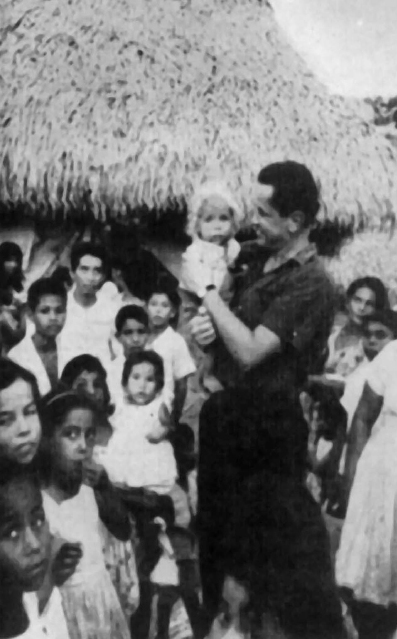 Camilo Torres with Colombian peasant children The National Front regime led Camilo Torres in January 1964 to found the Frente Unido del Pueblo; a movement in opposition to the coalition of the traditional parties. Torres went to the home of Marroquín and his partner María Arango to seek contacts with the Communist Party. A meeting with the goal to create a political platform was held, with the participation of the MOEC, the MRL Youth, the JUCO and some student groups from the Universidad de los Andes. However, the hierarchs of the Colombian Church sought to make Torres travel to Leuven, with the ESAP offering to cover the travel costs. However, a meeting in homage to Torres held by the students of the National University dissuaded Torres from travelling. Although Torres was not yet politically active and had no clear political discourse, he was already quite popular. Torres sought to bring together all the opposition of the time (Anapo, MRL and Colombian Communist Party); however, he didn't declare himself a Marxist due to the atheism of the ideology, but related several points to Catholicism itself instead.[27] In June 1965, at his request, Torres was reduced to the lay state by his ecclesiastical superior, Cardinal Concha;[28] at the same time he was removed from his post at ESAP and once again had disagreements with Concha, who offered him and his coadjutor bishop Rubén Isaza the post of director of sociology department in the Archbishopric of Bogotá with the mediation of the then priest Ernesto Umaña de Brigard. Torres turned down the offer, seeing that the position was to prevent him from intervening in politics as well as presenting the socio-political platform in Medellín, which was the reason why he had previously been removed from his position at the ESAP. Concha argued that the platform went against Catholic ideals and that priests should be apolitical in order to dissociate themselves from Catholicism's ambiguous and traditional relationship with the Conservative Party. Torres met with Concha, who vehemently opposed Torres' entry into politics. Umaña then met with Torres and offered him an ecclesiastical post, but Torres requested a dispensation so that he could devote himself to politics and avoid problems with the ecclesiastical authority. Torres gave his last Mass on 27 June 1965 in the Church of San Diego in Bogotá. Torres then travelled to Lima, returning to Bogotá on 3 July to be received by his mother and a crowd of young people. According to Torres' mother, before his laicization, Camilo had been visited by some politicians and was told that, if he wrote to Rome that he would lead his flock to the existing political parties and away from the Guerilla movement, he would become a Cardinal. He rejected by saying "I'm not for sale, amigos."[12] The platform of his movement sought to address the needs of rural and urban areas, to eliminate the restricted democracy of the National Front at all costs, and the participation of the Church in liberation theology. However, the National Front lacked a clear political platform, despite being close to and sympathetic to the revolutionary left; they also had their own newspaper, headed by Pedro Acosta, of the same name, which was only distributed three times a week from 26 August 1965, printed in the workshops of the Antares publishing house and owned by Torres' friend Gonzalo Canal Ramírez. Despite the growing popularity of the United Front, Torres decided to contact Fabio Vásquez Castaño through student leader Jaime Arenas on 6 July 1965, who had previously led the strike at the Universidad Industrial de Santander. The United Front lasted from August to September 1965 (one month) after breaking with Christian Democracy for imposing a guerrilla line. His decision to resort to armed struggle was taken in the case of Jorge Eliécer Gaitán and expressed to Gloria Gaitán, daughter of the assassinated leader, who offered asylum to Torres, who gradually went underground. Despite this, Torres led a peaceful march with his students in Medellín and was arrested with his demonstrators, all university students, and held at the Asociación Sindical Antioqueña. He would later be intercepted in Ventaquemada on his way to Tunja, and in Bogotá he would also be detained after police repression of a demonstration by the Frente Unido. On 7 January 1966, Torres announced his incorporation into the ELN. |
統一戦線 カミーロ・トーレスとコロンビアの農民の子どもたち 1964年1月、国民戦線政権はカミーロ・トーレスを率いて、伝統政党連合に対抗する運動「人民統一戦線」を創設した。トーレスは共産党との接触を図るた め、マロキンとそのパートナーであるマリア・アランゴの自宅を訪れた。政治的基盤構築を目的とした会合が開催され、MOEC、MRL青年部、JUCO、ア ンデス大学の学生団体数団体が参加した。しかしコロンビア教会の指導層は、ESAPが旅費を負担することを条件に、トーレスをルーヴェンへ派遣しようとし た。ところが国立大学の学生たちがトーレスを称える集会を開いたことで、彼は渡航を断念した。トーレスは当時まだ政治活動に積極的ではなく明確な政治的言 説も持たなかったが、すでにかなりの人気を博していた。 トーレスは当時の全野党勢力(アナポ、MRL、コロンビア共産党)の結集を図った。ただし、マルクス主義の無神論的イデオロギーから自らをマルクス主義者 と宣言せず、むしろカトリック教義自体との共通点を幾つか指摘した[27]。1965年6月、トーレスの要請により、教会の長であるコンチャ枢機卿によっ て彼は平信徒の身分に降格された。[28] 同時にESAPの職も解かれ、再びコンチャ枢機卿と対立した。当時司祭だったエルネスト・ウマニャ・デ・ブリガードの仲介により、コンチャ枢機卿はトーレ スと補佐司教ルベン・イササにボゴタ大司教区社会学部部長のポストを提示した。トーレスはこの申し出を拒否した。その職位は、彼が政治に介入することを阻 止し、メデジンで社会政治的綱領を発表することを妨げるためのものであり、それが以前にESAPの職位から解任された理由であったからだ。コンチャは、そ の綱領がカトリックの理想に反し、司祭はカトリックと保守党との曖昧で伝統的な関係を断ち切るために非政治的であるべきだと主張した。トーレスはコンチャ と面会したが、彼はトーレスの政治進出に激しく反対した。その後ウマニャがトーレスと会い、教会職を提示したが、トーレスは政治活動に専念し教会当局との トラブルを避けるため、免職を申請した。1965年6月27日、トーレスはボゴタのサンディエゴ教会で最後のミサを執り行った。その後リマへ渡ったトーレ スは、7月3日にボゴタへ戻り、母と若者たちの群衆に迎えられた。 トーレスの母によれば、世俗化前にカミロは政治家数名から接触を受け、「ローマへ書簡を送り、信徒をゲリラ運動から離脱させ既存政党へ導く」と約束すれば枢機卿に任命されると告げられたという。彼は「俺は売れないぜ、友達よ」と言ってこれを拒否した[12]。 彼の運動の綱領は、農村部と都市部のニーズに対応すること、国民戦線の制限された民主主義を何としても排除すること、そして解放の神学における教会の参加 を目的としていた。しかし国民戦線は、革命的左派に近接し共感を示していたにもかかわらず、明確な政治綱領を欠いていた。またペドロ・アコスタが編集長を 務める同名の新聞を発行していたが、これは1965年8月26日から週3回のみ配布され、トーレスの友人ゴンサロ・カナル・ラミレスが所有するアンタレス 出版社の印刷所で印刷されていた。統一戦線の人気が高まる中、トーレスは1965年7月6日、学生指導者ハイメ・アレナスを通じてファビオ・バスケス・カ スタニョに接触を決断した。彼は以前、サンタンデール工業大学でストライキを主導していた人物である。統一戦線は1965年8月から9月(1か月間)続い たが、ゲリラ路線を強要したキリスト教民主主義派との決裂で終焉を迎えた。武装闘争に訴える決断はホルヘ・エリエセル・ガイタン事件を契機に下され、暗殺 された指導者の娘グロリア・ガイタンに伝えられた。グロリアはトーレスに亡命の道を提供し、トーレスは次第に地下活動へと移行した。それにもかかわらず、 トーレスはメデジンで学生たちと共に平和的な行進を主導し、デモ参加者全員(全員が大学生)と共に逮捕され、アンティオキア労働組合連合に拘束された。そ の後、トゥンハへ向かう途中ベンタクエマダで拘束され、ボゴタでは統一戦線のデモに対する警察の弾圧後に再び拘束された。1966年1月7日、トーレスは ELNへの加入を表明した。 |
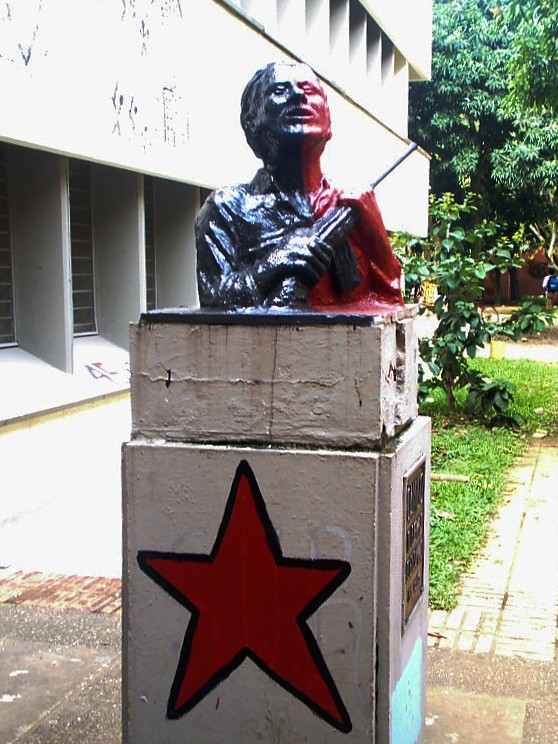 Mural paying homage to Camilo Torres located at the National University of Colombia. Catholic guerrilla In the guerrilla, Torres was mentored and advised by Jaime Arenas, chosen by Fabio Vásquez, also to keep him away from progressive currents. Shortly before joining the ELN, General Gustavo Rojas Pinilla, leader of the ANAPO, had recommended Torres not to join any guerrilla group, since as a priest he had no experience in handling weapons to confront the army, so he suggested that he continue in political life since he admired his work with the needy classes, something that Torres disregarded considering the advice as a threat. On joining the ELN, under the nom de guerre of Argemiro, the identity of Torres, who was mistaken for a foreigner, was unknown for the moment within the guerrillas, but his identity was later revealed to the guerrillas. As he explained in his "Message to the Christians" published in the first issue of Frente Unido, he realised that the "effective means for the well-being of the majorities ... are not going to be sought by the minorities" and "will not be sought by the privileged minorities in power, because generally these effective means oblige the minorities to sacrifice their privileges", Torres concluded that "it is therefore necessary to take power away from the privileged minorities to give it to the poor majorities" and that "the Revolution is not only permitted but obligatory for Christians who see in it the only effective and ample way of realising love for all".[29] This is how Camilo Torres justified his decision in 1965 to quit his job as a teacher and priest and join the guerrilla, more precisely the National Liberation Army (ELN), although he had previously been interested in joining the Revolutionary Armed Forces of Colombia (FARC) due to his peasant background.[30] I have left the privileges and duties of the clergy, but I have not ceased to be a priest. I believe that I have given myself up to the Revolution out of love of neighbour. I have stopped saying mass to realise this love of neighbour, in the temporal, economic and social fields. When my neighbour has nothing against me, when I have achieved the Revolution, I will offer mass again, if God allows me to do so. I believe that in this way I follow the command of Christ: "If you bring your offering to the altar and there remember that your brother has something against you, leave your offering there before the altar, and go and be reconciled with your brother first, and then come and present your offering" (Saint Matthew V, 23-24). — Camilo Torres, "Mensaje a los cristianos", Frente Unido, no. 1, 26/08/1965, Bogotá.[29] In the ELN, Torres mostly participated as a low-ranking member and provided spiritual and ideological assistance from a Catholic point of view. However, his performance as a guerrilla was poor as he was not used to the arduous training (being assisted by a comrade) and to carrying a rifle, so he was barely given a pistol and was emphasised for his role of spiritual and ideological assistance as well as being a good cook. Torres also served as a doctor for the guerrillas, both physically and "spiritually".[31] He taught the Gospel to rural children and translated texts by Mao Zedong, Vladimir Lenin and Fidel Castro. He also organized a "forest church", where he hung a portrait of Castro next to the crucifix.[31] Before his death, he became a leader of the ELN.[32] He also emerged as the "main ideologue of the group".[33] Under his influence, the ELN not only explicitly embraced Catholicism and imbued it with Marxism-Leninism, but also reorganized itself to resemble the structure of the early Catholic Church: Father Torres became one of the chief ideologues of the ELN, having already been in contact while still in civilian life with the group’s leaders via diverse university student fronts. Father Torres imbued the armed group with further ideological and practical underpinnings that combined Marxism-Leninism with Christian teachings and have, to date, influenced the group’s behaviour and modus operandi. [...] The ELN soon became a sort of federation, not with a topdown control structure but rather a multi-cephalous organisation with a collective decision-making process. The reason behind such a structure was to replicate the arrangement of the early Catholic Church of the I to III centuries AD, with a “synodal” assembly in which to discuss issues at a strategic level and also to allow local churches to selfgovern.[34] He died in his first combat experience, when the ELN ambushed a patrol of the National Army. The National Army specifically targeted Torres, and he was brutally beaten at the time of his death.[35] It was also revealed that he was shot at a point-blank range.[36] Another report of his death is that he was shot while picking up the weapons of a fallen guerilla comrade.[12] After his death, Camilo Torres became an official martyr of the ELN. |
コロンビア国立大学にあるカミロ・トーレスへの敬意を表した壁画?(銅像)。 カトリック系ゲリラ ゲリラ活動中、トーレスはハイメ・アレナスに指導と助言を受けた。アレナスはファビオ・バスケスによって選ばれた人物であり、トーレスを進歩的な潮流から 遠ざける役割も担っていた。ELN加入直前、ANAPO指導者グスタボ・ロハス・ピニージャ将軍は、司祭であるトーレスに軍隊と対峙する武器の扱いの経験 がないとして、いかなるゲリラ組織にも加入しないよう勧告した。彼は貧困層への奉仕活動を称賛しつつ、政治活動への継続を提案したが、トーレスはこの助言 を脅威と受け止め無視した。エルンにアルヘミロの戦時名で加入した際、外国人と思われたトーレスの正体はゲリラ内では一時不明だったが、後に正体が明らか になった。 『フレンテ・ウニド』創刊号に掲載された「キリスト教徒へのメッセージ」で述べたように、彼は「大多数の幸福のための効果的な手段は... は少数派によって追求されることはない」と「権力を持つ特権的少数派によって追求されることはない。なぜなら、こうした効果的な手段は概して少数派に特権 の犠牲を強いるからだ」と結論づけた。トーレスは「したがって、特権的少数派から権力を奪い、貧しい多数派に与える必要がある」と主張し、「革命は、すべ ての人への愛を実現する唯一の効果的かつ広範な道と見るキリスト教徒にとって、許されるだけでなく義務である」と述べた。[29] カミロ・トーレスはこうして、1965年に教師兼司祭の職を辞しゲリラ、具体的には国民解放軍(ELN)に加わる決断を正当化した。彼は農民出身ゆえに当 初はコロンビア革命軍(FARC)への参加に関心を持っていたものの。[30] 私は聖職者の特権と義務を捨てたが、司祭であることをやめたわけではない。隣人愛から革命に身を捧げたと信じている。この隣人愛を、世俗的・経済的・社会 的な領域で実現するために、ミサを捧げることを止めたのだ。隣人が私に恨みを抱かなくなり、革命を達成した時、神が許せば再びミサを捧げるつもりだ。この 道こそがキリストの教えに従うことだと信じる。「もし祭壇に供え物を捧げようとして、そこで兄弟があなたに対して何か恨みを持っていることを思い出したな ら、供え物を祭壇の前に置いたまま、まず兄弟と和解しなさい。それから戻って供え物を捧げなさい」(聖マタイによる福音書5章23-24節)。 —カミロ・トーレス「キリスト教徒へのメッセージ」『フレンテ・ウニド』第1号、1965年8月26日、ボゴタ。[29] ELNでは、トーレスは主に下級メンバーとして参加し、カトリックの観点から精神的・イデオロギー的な支援を提供した。しかし、過酷な訓練(同志の補助を 受けながら)や小銃の携行に慣れていなかったため、ゲリラとしての能力は低く、ほとんど拳銃しか与えられず、精神的・イデオロギー的な支援の役割と優れた 料理人としての能力が重視された。トーレスはゲリラの医師としても活動し、身体的・精神的両面で治療を行った。[31] 彼は農村の子どもたちに福音書を教え、毛沢東、ウラジーミル・レーニン、フィデル・カストロの著作を翻訳した。また「森の教会」を組織し、十字架の横にカストロの肖像画を掲げた。[31] 死の前にはELNの指導者となった。[32] 彼はまた「組織の主要なイデオロギー家」として台頭した[33]。彼の影響下で、ELNはカトリックを明示的に受け入れマルクス・レーニン主義を融合させただけでなく、初期カトリック教会の構造に倣って組織再編を行った。 トーレス神父は、民間人時代に様々な学生運動組織を通じて既にELN指導部と接触していた経緯から、同組織の主要なイデオロギー家の一人となった。トーレ ス神父は武装組織に、マルクス・レーニン主義とキリスト教の教えを融合させたさらなるイデオロギー的・実践的基盤を注入した。これは今日に至るまで組織の 行動様式と活動手法に影響を与えている。[...] ELNは間もなく、トップダウン型の統制構造ではなく、集団意思決定プロセスを備えた多頭制組織という、一種の連合体へと変貌した。この構造の背景には、 紀元1~3世紀の初期カトリック教会の体制を模倣する意図があった。すなわち「教会会議」形式で戦略的課題を議論しつつ、地方教会に自治権を認める仕組み である[34]。 彼は初の実戦経験で命を落とした。ELNが国家軍パトロール隊を待ち伏せ攻撃した際のことだ。国家軍は特にトーレスを狙っており、彼は死亡時に残酷に殴打 された[35]。また至近距離で射殺されたことも明らかになった[36]。別の死亡報告では、倒れたゲリラ同志の武器を拾おうとした際に射殺されたとされ る[12]。死後、カミロ・トーレスはELNの公式殉教者となった。 |
| Death Torres died on 15 February 1966 in Patio Cemento, after combat with troops of the Fifth Brigade from Bucaramanga, led by Colonel Álvaro Valencia Tovar, who, ironically years earlier, was his childhood friend.[37] The National Army hid the body in a strategic location separate from the other mass graves and the location was not revealed to the public.[38] A symbolic funeral took place in the church of San Diego and a symbolic burial was held. A mass was also held in the grounds of the National University. Shortly after Torres's death, 'Guitemie' Olivieri, despite being linked to the ELN, was persecuted by the Colombian authorities and was helped by Junior Fajardo and Rita Restrepo de Agudelo to obtain political asylum, first in Panama, then in Mexico, where she married ex-priest Óscar Maldonado, finally in Cuba and then in France. Years later, Valencia Tovar, now retired as a general, wrote the book El final de Camilo, in which he clarified details of the death of Camilo Torres. According to Valencia Tovar, Torres was buried in a detailed place, and they prepared the procedures to hand over the remains to the family. His older brother, doctor Fernando Torres Restrepo, who lived in the United States, was informed about the fate of his brother. In addition, General Álvaro Valencia Tovar himself revealed in an interview[39] to the magazine Semana that the body of Camilo Torres was exhumed three years after his burial, his remains were placed in an urn and transported to Bucaramanga where, through the efforts of the general himself, the Military Pantheon of the Fifth Brigade of the National Army was created and the first remains to occupy a place in that pantheon were those of Camilo Torres, although he did not reveal their exact location, leaving the retired general's statements in doubt among the ELN high command. In January 2016, the President of Colombia, Juan Manuel Santos, instructed the Colombian National Army to begin the process of searching for and exhuming his remains, in a gesture to accelerate the start of the peace talks with the ELN guerrilla group.[40] In 2026, the ELN announced that Torres' body has been found.[41][42] President Gustavo Petro subsequently announced that Torres' body would be "respected and laid to rest with honors."[43] |
死 トーレスは1966年2月15日、パティーオ・セメントで死亡した。死因はブカラマンガの第5旅団部隊との戦闘によるもので、この部隊はアルヴァロ・バレ ンシア・トバル大佐が指揮していた。皮肉なことに、トバル大佐は数年前までトーレスの幼なじみであった[37]。国家軍は遺体を他の集団墓地とは別の戦略 的な場所に隠し、その場所は公に明かされなかった。[38] 象徴的な葬儀がサン・ディエゴ教会で行われ、象徴的な埋葬が執り行われた。国立大学の構内でもミサが捧げられた。 トーレスの死後間もなく、ELN(民族解放軍)との関与が疑われた「グイテミエ」・オリビエリはコロンビア当局の迫害を受け、フンディオ・ファハルドとリ タ・レストレポ・デ・アグデロの支援により政治亡命を果たした。最初はパナマ、次にメキシコ(元司祭オスカル・マルドナドと結婚)、最終的にはキューバを 経てフランスに落ち着いた。 数年後、退役将軍となったバレンシア・トバルは著書『エル・フィナル・デ・カミーヨ』でカミーヨ・トーレスの死の詳細を明らかにした。バレンシア・トバル によれば、トーレスは特定された場所に埋葬され、遺族への遺体引き渡し手続きが準備された。米国在住の兄である医師フェルナンド・トーレス・レストレポに は弟の死が通知された。 さらに、アルヴァロ・バレンシア・トバル将軍自身が雑誌『セマナ』のインタビュー[39]で明かしたところによれば、カミーロ・トーレスの遺体は埋葬から 3年後に掘り起こされ、遺骨は骨壷に納められてブカラマンガへ運ばれた。そこで将軍自身の尽力により、 国家軍第5旅団軍事霊廟が創設され、その霊廟に最初に安置された遺骨がカミーロ・トーレスのものだと明かした。ただし遺骨の正確な位置は明らかにせず、退 役将軍の発言はELN最高司令部内で疑念を残した。 2016年1月、コロンビアのフアン・マヌエル・サントス大統領は、ELNゲリラ組織との和平交渉開始を加速させる姿勢を示すため、コロンビア国軍に対し 遺体の捜索・発掘作業を開始するよう指示した[40]。2026年、ELNはトーレスの遺体が発見されたと発表した。[41][42] その後、グスタボ・ペトロ大統領はトーレスの遺体を「敬意をもって扱い、栄誉をもって埋葬する」と発表した。[43] |
| Political ideology Main article: Camilism In his early years of political activity, Camilo Torres identified as a progressive Catholic and denounced the Leninist idea of a vanguard,[26] a view which he later changed, influenced by the Cuban Revolution and Fidel Castro.[44] Additionally, he praised Joseph Stalin and reportedly prayed at his tomb.[18] Despite being labelled a communist, Torres rejected that label for at least the majority of his life, while also declaring that he is not an anti-communist.[12] Torres advocated for a "new Christianity" where the Catholic Church takes a more active role in the reformation of society.[45] He believed that: The Church's temporary defects should not scandalize us. The Church is human. What is important is to believe that she is also divine and that if we Christians fulfill our obligation to love our neighbor, we are strengthening the Church.[46] Torres desired a revolution where poor majorities would seize power from the privileged minorities, believing that: The Revolution, therefore, is the way to achieve a government that feeds the hungry, clothes the naked, teaches the ignorant, carries out works of charity, of love for one's neighbor, not only occasionally and temporarily, not only for a few, but for the majority of our neighbors. For this reason the Revolution is not only permitted but obligatory for Christians who see in it the only effective and broad way of achieving love for all . It is true that "there is no authority except from God" (St. Paul, Rom. XIII, 1). But St. Thomas says that the concrete attribution of authority is made by the people. He also believed that, if those minorities did not offer violent resistance, this revolution could be peaceful.[46] Camilo Torres' political programme was read by Catholic bishop Joseph Blomjous and was found to contain no contradictions to Papal encyclicals.[47] In September 1965, Torres wrote: My duty as a priest is to do everything possible to bring people to God, and the most effective way to do this is to ensure that people serve the people according to their conscience. I do not seek to agitate my communist brothers, trying to persuade them to accept Christian teaching and practice church cult. But I demand that all people act according to their conscience.[31] After his death, Torres' political ideology, known as Camilism, would be adopted by the Montoneros. |
政治的イデオロギー 主な項目:カミリズム カミーロ・トーレスは政治活動の初期には進歩的なカトリック教徒を自認し、レーニン主義の先鋒隊思想を非難していた[26]。しかし後にキューバ革命と フィデル・カストロの影響を受け、この見解を変えた[44]。さらに彼はヨシフ・スターリンを称賛し、その墓前で祈りを捧げたとも伝えられている。 [18] 共産主義者とレッテルを貼られたにもかかわらず、トーレスはそのレッテルを少なくとも生涯の大部分において拒否し、同時に自分は反共主義者ではないとも宣 言した。[12] トーレスはカトリック教会が社会改革においてより積極的な役割を担う「新たなキリスト教」を提唱した[45]。彼はこう信じていた: 教会の一時的な欠陥に我々は動揺すべきではない。教会は人間的な存在だ。重要なのは、教会が同時に神聖な存在であると信じること、そして我々キリスト教徒が隣人を愛する義務を果たすことで教会を強化しているのだと理解することだ。[46] トーレスは、貧しい多数派が特権的な少数派から権力を奪取する革命を望み、こう信じていた: したがって革命とは、飢えた者に食を与え、裸の者に衣を与え、無知な者に教えを与え、慈善と隣人愛の業を遂行する政府を実現する手段である。それは一時 的・偶発的に、また少数のためではなく、我々の隣人の大多数のために行われるべきだ。このため革命は、キリスト教徒にとって許されるだけでなく義務であ る。なぜなら、万人に愛をもたらす唯一の効果的かつ広範な手段だからだ。「権威は神から与えられる」(聖パウロ、ローマ人への手紙13:1)のは事実だ。 しかし聖トマスは、権威の具体的な付与は民衆によるものだと述べている。 彼はまた、もし少数派が暴力的な抵抗を示さなければ、この革命は平和的に実現し得ると信じていた。[46] カミロ・トーレスの政治綱領はカトリック司教ジョセフ・ブロムジョウスによって読まれ、教皇回勅との矛盾は認められなかった。[47] 1965年9月、トーレスはこう記した: 司祭としての私の義務は、人々を神へと導くために可能な限りのことを行うことだ。そしてその最も効果的な方法は、人々が良心に従って人々に奉仕することを 保証することである。私は共産主義者の兄弟たちを扇動し、キリスト教の教えを受け入れ教会儀式を実践するよう説得しようとはしない。しかし、全ての人々が 良心に従って行動することを要求する。[31] 死後、トーレスのイデオロギー「カミリズム」はモントネロスによって継承されることになる。 |
| Recognitions and legacy Tributes at universities The main theater of the University of Antioquia bears the name of "Comandante Camilo Torres Restrepo" Popular Theater. One of the main buildings of the Industrial University of Santander has the name "Camilo Torres Building", on one of its exterior walls you can see a large mural with his face accompanied by a phrase he wrote. At the University of Valle, in the Cali Headquarters, there is a tribute bust, and his face is painted on several university buildings. At KU Leuven in Belgium, a large residence student hall has the name of "Camilo Torres". Songs Uruguayan singer-songwriter Daniel Viglietti wrote "Cruz de Luz" in 1967, a song about Camilo Torres, which was popularized by Chilean singer-songwriter Víctor Jara. Also the Cuban singer-songwriter Carlos Puebla wrote a song about Camilo titled "Camilo Torres".The song "Cura y Guerrillero" by the Mexican singer-songwriter José de Molina is dedicated to Camilo Torres and other priests who continue to fight for the same ideals. 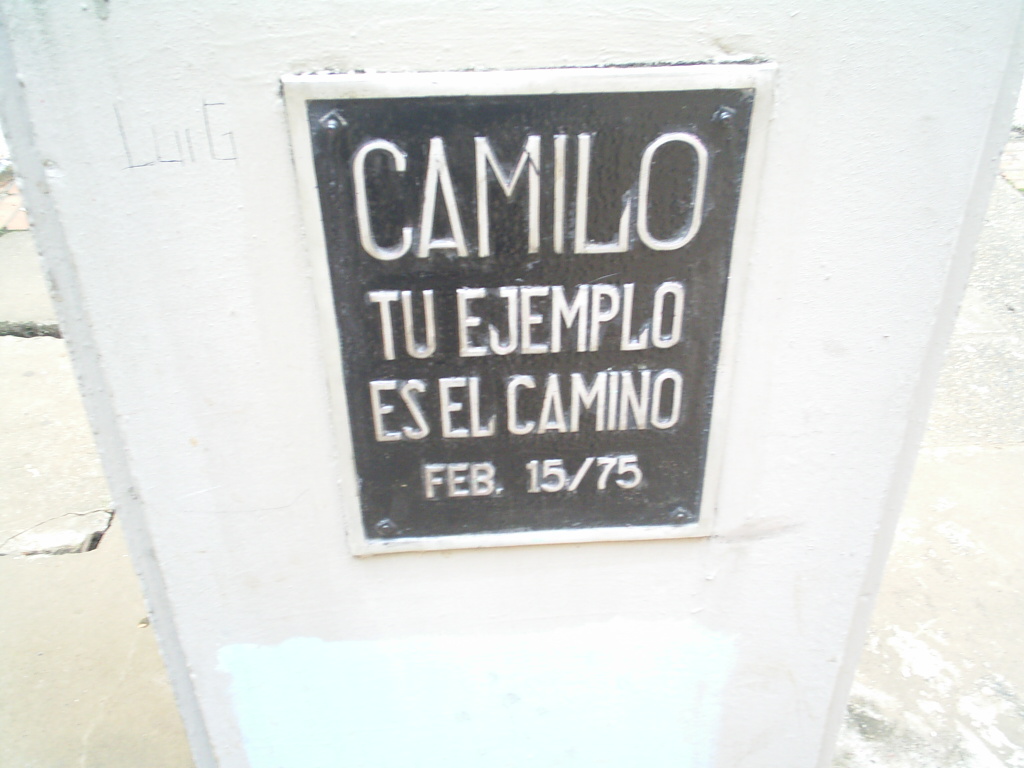 Legend in bust of Camilo Torres at the University of Valle, Cali headquarters Tributes in Latin America The ELN was, in 1987, renamed the Camilista Union - National Liberation Army.[10] The Camilo Torres Muralist Units, close to the Christian Left party of Chile, worked during the military dictatorship of Augusto Pinochet, making murals against the regime, distinguished by their cheerful designs, less abstract than those used by the Ramona Parra Brigade of the Chilean Communist Party.[48] Fidel Castro was aware of Father Torres and spoke about him, stating that Camilo "is a symbol of the revolutionary unity which should inspire the movement of the peoples in Latin America."[35] |
称賛と遺産 大学における追悼 アンティオキア大学のメイン劇場は「カミーロ・トーレス・レストレポ司令官」人民劇場と名付けられている。 サンタンデール工業大学の主要な建物の一つは「カミーロ・トーレス棟」と名付けられており、外壁には彼の肖像と彼が記した言葉が刻まれた大きな壁画が見られる。 バジェ大学カリ本部には追悼の胸像が設置され、複数の大学施設には彼の肖像が描かれている。 ベルギーのルーヴェン・カトリック大学では、大規模な学生寮が「カミーロ・トーレス」の名を冠している。 歌 ウルグアイのシンガーソングライター、ダニエル・ヴィリェッティは1967年にカミーロ・トーレスを題材にした「光の十字架」を作曲した。この曲はチリの シンガーソングライター、ビクトル・ハラによって広く知られるようになった。またキューバのシンガーソングライター、カルロス・プエブラもカミーロを題材 にした「カミーロ・トーレス」という曲を作った。メキシコのシンガーソングライター、ホセ・デ・モリーナの曲「司祭でありゲリラ兵」は、カミーロ・トーレ スと、同じ理想のために戦い続ける他の司祭たちに捧げられている。 カリ本部のバジェ大学にあるカミーロ・トーレスの胸像の説明文 ラテンアメリカにおける追悼 1987年、ELNはカミリスト連合 - 国民解放軍と改名された。[10] チリのキリスト教左派政党に近いカミーロ・トーレス壁画部隊は、アウグスト・ピノチェト軍事独裁政権下で活動し、政権批判の壁画を描いた。その作品は明るいデザインが特徴で、チリ共産党のラモナ・パラ旅団が用いたものより抽象性が低かった。[48] フィデル・カストロはカミーロ・トーレス神父の存在を知っており、彼について「カミーロはラテンアメリカ諸国民の運動を鼓舞すべき革命的団結の象徴である」と述べた。[35] |
| Christian communism Catholic communism Catholicism and socialism Catholic worker movement Catholic social teaching |
キリスト教共産主義 カトリック共産主義 カトリックと社会主義 カトリック労働者運動 カトリック社会教説 |
| References 01. Cancino, Hugo (2013-10-09). "Los Cristianos Revolucionarios en América Latina. En la senda de Camilo Torres: El caso chileno, 1966-1970". Sociedad y Discurso (in Spanish) (24). doi:10.5278/ojs..v0i24.921. ISSN 1601-1686. COHA (2009-04-01). "Camilo Torres: Prayer Can't Solve Poverty Alone". COHA. Retrieved 2025-11-05. Pérez-Bustillo, Camilo (2016-02-12). "Pope Francis, Mexico, and the Legacies of Liberation Theology and Camilo Torres". Truthout. Retrieved 2025-11-05. Hodges, Donald Clark (1976). Argentina 1943 - 1976: the national revolution and resistance. Albuquerque: Univ. of New Mexico Pr. ISBN 978-0-8263-0422-3. "A 51 años de la muerte de Camilo Torres: "Insistamos en lo que nos une y prescindamos de lo que nos separa" (51 years after the death of Camilo Torres: "Let us insist on what unites us and do without what separates us")". Desinformémonos (in Spanish). Colombia. 15 February 2017. Retrieved 27 June 2022. Bushnell, "Camilo Torres Restrepo", 259. SDS Regional Newsletter, Mar. 8, 1966, Vol. 1, no. 8 [1] Winter 1966 MFU Catalog [2] digitalcommons.du.edu https://digitalcommons.du.edu/cgi/viewcontent.cgi?referer=&httpsredir=1&article=1083&context=etd. Retrieved 2026-01-14. {{cite web}}: Missing or empty |title= (help) "Landmine Monitor Report 2000 - Americas: Signatories". www.hrw.org. Retrieved 2026-01-14. 10. "Library:25 Years of Struggle". Revolupedia. 2026-01-20. Retrieved 2026-01-27. Jiménez, Fiorella López (2011). "If Jesus Were Alive Today, He Would be a Guerrillero": The Impact of Liberation Theology Movements in Latin American Politics. Lake Forest College. Λαϊκή Ενότητα, Επανάσταση και άλλα κείμενα [Popular Unity, Revolution and More Texts]. Athens: Μνήμη. 1974. Cellini, Jacobo. Universalism and Liberation: Italian Catholic Culture and the Idea of International Community (1963-1978). "Biografía política de Camilo Torres" (in Spanish). Retrieved 30 September 2022. "Confidente de Camilo" (in Spanish). Retrieved 30 September 2022. Broderick, Joe (1975). Camilo Torres: A Biography of the Priest-guerrillero. Doubleday. pp. 72–76. ISBN 0385087101. Broderick, Joe (1975). Camilo Torres: A Biography of the Priest-guerrillero. Doubleday. p. 77. ISBN 0385087101. Paucar Bedoya, Laura Manuela (2020). "Ideologías de la Guerra Fría en la Iglesia latinoamericana (A través de cartas a Camilo Torres, 1954-1962)" (PDF). Quirón: Revista de estudiantes de Historia (in Spanish). 6 (12). Universidad Nacional de Colombia: 57. ISSN 2422-0795. Y en otra misiva sugiere incluso que Camilo Torres estuvo en Moscú "rezando ante la milagrosa tumba de nuestro padre Stalin". Lo que mostraría además la circulación de ideas comunistas y sus conceptos. [And in another letter he even suggests that Camilo Torres was in Moscow "praying at the miraculous tomb of our father Stalin." This would further demonstrate the circulation of communist ideas and concepts.] "Camilo Torres: Centro de Pensamiento Camilo Torres Restrepo" (in Spanish). Archived from the original on 11 December 2019. Retrieved 30 September 2022. 20. Martínez Morales, Darío (January 2011). "Camilo Torres Restrepo, cristianismo y violencia". Theologica Xaveriana (in Spanish). 61 (171): 131–167. Retrieved 30 September 2022. "Camilo Torres Restrepo 1929-1966" (in Spanish). Retrieved 30 September 2022. Broderick, Walter (1996). Camilo Torres Restrepo (PDF) (in Spanish). Planeta Colombiana. ISBN 9586145026. Levine, Daniel (1996). Camillo Torres: Fe, Política y Violencia (PDF) (in Spanish). University of Michigan. "El cura guerrillero" (in Spanish). 11 December 1980. Retrieved 30 September 2022. Broderick, Joe (1975). Camilo Torres: A Biography of the Priest-guerrillero. Doubleday. ISBN 0385087101. Gabbas, Marco (2021). "Camilo Torres, Liberation Theology, and Marxism" (PDF). Short Essays and Comments. Corvinus University of Budapest. "Camilo Torres Restrepo" (in Spanish). Retrieved 30 September 2022. Informa, Colombia (16 February 2024). "Camilo Torres Restrepo: Priest, revolutionary, and guerrilla fighter". Peoples Dispatch. "Camilo Torres Restrepo (1929-1966)". www.filosofia.org (in Spanish). Retrieved 2021-01-16. 30. "Proclamation to the Colombian people by Camilo Torres". Cedema. Retrieved 2022-01-20. "ТЕОЛОГИЯ ОСВОБОЖДЕНИЯ Бог и революция" (PDF). Ситуация (in Russian). 19: 3. 2007. Affecting the Conflict: Mediations of the Colombian War in Contemporary Art and Film. Delgado, Jorge Eduardo (2024). "A History of Colombia's National Liberation Army (ELN)". In Scott N. Romaniuk; Animesh Roul; Amparo Pamela Fabe; János Besenyő (eds.). Handbook of Terrorist and Insurgent Groups: A Global Survey of Threats, Tactics, and Characteristics. CRC Press. p. 366. doi:10.4324/9780429426063. ISBN 978-0-429-42606-3. The first priest to join the ELN was soon to become the main ideologue of the group, Father Camilo Torres, who, by accepting armed violence as a righteous path to fight oppression, set an example for other socialist-leaning priests who soon convinced themselves of the inevitability of armed revolution in order to achieve social change (Broderick, 1987, p. 35). Delgado, Jorge Eduardo (2024). "A History of Colombia's National Liberation Army (ELN)". In Scott N. Romaniuk; Animesh Roul; Amparo Pamela Fabe; János Besenyő (eds.). Handbook of Terrorist and Insurgent Groups: A Global Survey of Threats, Tactics, and Characteristics. CRC Press. p. 367. doi:10.4324/9780429426063. ISBN 978-0-429-42606-3. Theisen, Gerald (1974). "The Case of Camilo Torres Restrepo". Journal of Church and State. 16 (2). Oxford University Press: 301–315. doi:10.1093/jcs/16.2.301. JSTOR 23914573. Delgado, Jorge Eduardo (2024). "A History of Colombia's National Liberation Army (ELN)". In Scott N. Romaniuk; Animesh Roul; Amparo Pamela Fabe; János Besenyő (eds.). Handbook of Terrorist and Insurgent Groups: A Global Survey of Threats, Tactics, and Characteristics. CRC Press. p. 368. doi:10.4324/9780429426063. ISBN 978-0-429-42606-3. Martín, Andrés González (2021). "General Valencia's diagnosis". Thucydides' Exhortation (PDF). p. 9. "El Espectador: Los restos de Camilo". Cedema (in Spanish). Archived from the original on 2009-03-02. Retrieved 2022-01-20. Semana (2007-04-21). "General, are you finally going to reveal what happened to the body of Camilo Torres?". Semana.com (in Spanish). Retrieved 2021-02-08. 40. "Where is the body of Camilo Torres, the Colombian guerrilla priest compared to Che Guevara?". BBC News World. 2016-02-15. Retrieved 2021-02-08. "CAMILO SIEMPRE PRESENTE – ELN VOCES" (in Spanish). 2026-01-23. https://x.gd/fUiFk Retrieved 2026-01-23. Freixes, Josep (2026-01-23). "Body of Colombian Guerrillero Priest Camilo Torres Discovered". Colombia One: News from Colombia and the World. Retrieved 2026-01-24. Petro, Gustavo (23 January 2026). . Retrieved 5 February 2026. {{cite web}}: Missing or empty |title= (help) Guzman. Camilo Torres. pp. 16–18. "Camilo Torres Restrepo, "As a Colombian, as a Sociologist, as a Christian, and as a Priest, I Am a Revolutionary"". cowlatinamerica.voices.wooster.edu. Retrieved 2025-03-05. "Camilo Torres (1965): Mensaje a los cristianos". www.marxists.org. Retrieved 2025-03-05. Broderick, Walter J. Camilo Torres: a biography of the priest-guerillo. "..UNIDADES MURALISTAS CAMILO TORRES." Archived from the original on 2012-06-29. Retrieved 2023-09-16. |
参考文献 01. Cancino, Hugo (2013-10-09). 「ラテンアメリカの革命的なキリスト教徒たち。カミロ・トレスの足跡をたどって:チリの事例、1966-1970年」. Sociedad y Discurso (スペイン語) (24). doi:10.5278/ojs..v0i24.921. ISSN 1601-1686. COHA (2009-04-01). 「カミーロ・トーレス:祈りだけでは貧困は解決できない」. COHA. 2025-11-05 取得。 ペレス・ブスティージョ、カミロ (2016-02-12). 「教皇フランシスコ、メキシコ、そして解放神学とカミロ・トーレスの遺産」. Truthout. 2025-11-05 取得. ホッジス、ドナルド・クラーク (1976). 『アルゼンチン 1943 - 1976: 国民革命と抵抗運動』. アルバカーキ:ニューメキシコ大学出版。ISBN 978-0-8263-0422-3。 「カミロ・トレスの死から 51 年:「私たちを結びつけるものを主張し、私たちを分断するものは排除しよう」」。Desinformémonos (スペイン語)。コロンビア。2017年2月15日。2022年6月27日取得。 ブッシュネル、「カミロ・トレス・レストレポ」、259。 SDS Regional Newsletter、1966年3月8日、第1巻、第8号[1] 1966年冬 MFUカタログ [2] digitalcommons.du.edu https://digitalcommons.du.edu/cgi/viewcontent.cgi?referer=&httpsredir=1&article=1083&context=etd. 2026-01-14 取得。{{cite web}}: Missing or empty |title= (help) 「地雷モニター報告書 2000 - アメリカ大陸:署名国」。www.hrw.org。2026-01-14 取得。 10. 「図書館:25 年間の闘争」。Revolupedia。2026-01-20。2026-01-27 取得。 Jiménez, Fiorella López (2011). 「もしイエスが今日生きていたら、彼はゲリラだっただろう」:ラテンアメリカ政治における解放神学運動の影響。レイクフォレスト大学。 Λαϊκή Ενότητα, Επανάσταση και άλλα κείμενα [大衆の団結、革命、その他の文章]。アテネ:Μνήμη。1974年。 チェッリーニ、ハコボ。『普遍主義と解放:イタリアのカトリック文化と国際共同体という思想(1963-1978)』。 「カミロ・トレスの政治的経歴」(スペイン語)。2022年9月30日取得。 「カミロの腹心」(スペイン語)。2022年9月30日取得。 ブロデリック、ジョー(1975)。カミロ・トレス:司祭でありゲリラであった男の伝記。ダブルデイ。72-76ページ。ISBN 0385087101。 ブロデリック、ジョー(1975)。カミロ・トレス:司祭でありゲリラであった男の伝記。ダブルデイ。77ページ。ISBN 0385087101。 パウカル・ベドヤ、ローラ・マヌエラ(2020)。「ラテンアメリカ教会における冷戦イデオロギー(カミロ・トレスへの手紙、1954-1962)」 (PDF)。キロン:歴史学生誌(スペイン語)。6 (12)。コロンビア国立大学:57。ISSN 2422-0795。また、別の書簡では、カミロ・トレスがモスクワで「我らの父スターリンの奇跡の墓前で祈っていた」とさえ示唆している。これは、共産 主義の思想や概念が広まっていたことをさらに示すものである。[And in another letter he even suggests that Camilo Torres was in Moscow 「praying at the miraculous tomb of our father Stalin.」 This would further demonstrate the circulation of communist ideas and concepts.] 「カミロ・トレス:カミロ・トレス・レストレポ思想センター」(スペイン語)。2019年12月11日にオリジナルからアーカイブ。2022年9月30日に取得。 20. マルティネス・モラレス、ダリオ(2011年1月)。「カミロ・トレス・レストレポ、キリスト教と暴力」。Theologica Xaveriana(スペイン語)。61 (171): 131–167。2022年9月30日取得。 「カミロ・トレス・レストレポ 1929-1966」(スペイン語)。2022年9月30日取得。 ブロデリック、ウォルター(1996)。カミロ・トレス・レストレポ(PDF)(スペイン語)。プラネタ・コロンビアナ。ISBN 9586145026。 レバイン、ダニエル(1996)。カミロ・トレス:信仰、政治、暴力(PDF)(スペイン語)。ミシガン大学。 「ゲリラの司祭」(スペイン語)。1980年12月11日。2022年9月30日取得。 ブロデリック、ジョー(1975)。カミロ・トレス:司祭ゲリラの伝記。ダブルデイ。ISBN 0385087101。 ガッバス、マルコ(2021)。「カミロ・トレス、解放神学、そしてマルクス主義」(PDF)。短編エッセイと解説。ブダペスト・コルヴィナス大学。 「カミロ・トレス・レストレポ」(スペイン語)。2022年9月30日取得。 インフォルマ、コロンビア(2024年2月16日)。「カミロ・トレス・レストレポ:司祭、革命家、ゲリラ戦士」。ピープルズ・ディスパッチ。 「カミロ・トレス・レストレポ(1929-1966)」。www.filosofia.org(スペイン語)。2021年1月16日取得。 30. 「カミロ・トレスによるコロンビア国民への宣言」。Cedema。2022年1月20日取得。 「解放の神学 神と革命」 (PDF)。Ситуация (ロシア語)。19: 3. 2007年。 紛争への影響:現代美術と映画におけるコロンビア戦争の媒介。 デルガド、ホルヘ・エドゥアルド (2024). 「コロンビア民族解放軍(ELN)の歴史」. スコット・N・ロマニウク、アニメッシュ・ロール、アンパロ・パメラ・ファベ、ヤーノシュ・ベシェニョ(編)。テロリストおよび反乱グループハンドブッ ク:脅威、戦術、特徴に関する世界的な調査。CRC Press。366ページ。doi:10.4324/9780429426063。ISBN 978-0-429-42606-3。ELN に最初に参加した司祭は、すぐにこのグループの主要なイデオロギー者となったカミロ・トレス神父であった。彼は、抑圧と闘うための正当な手段として武力に よる暴力を受け入れることで、社会変革を達成するためには武力革命が避けられないとすぐに確信した他の社会主義傾向の司祭たちに手本を示した (Broderick, 1987, p. 35)。 デルガド、ホルヘ・エドゥアルド(2024)。「コロンビア国民解放軍(ELN)の歴史」。スコット・N・ロマニウク、アニメシュ・ロール、アンパロ・パ メラ・ファベ、ヤノシュ・ベシェニョ(編)。『テロリストおよび反乱組織ハンドブック:脅威、戦術、特徴に関する世界的な調査』。CRCプレス。367 ページ。doi:10.4324/9780429426063。ISBN 978-0-429-42606-3。 Theisen, Gerald (1974). 「カミロ・トレス・レストレポの事件」『Journal of Church and State』16 (2)。Oxford University Press: 301–315。doi:10.1093/jcs/16.2.301. JSTOR 23914573. Delgado, Jorge Eduardo (2024). 「コロンビア国民解放軍(ELN)の歴史」. Scott N. Romaniuk; Animesh Roul; Amparo Pamela Fabe; János Besenyő (eds.) 編. テロリストおよび反乱グループハンドブック:脅威、戦術、特徴に関する世界的な調査。CRC Press。p. 368。doi:10.4324/9780429426063。ISBN 978-0-429-42606-3。 Martín, Andrés González (2021). 「バレンシア将軍の診断」. Thucydides' Exhortation (PDF). p. 9. 「エル・エスペクタドール:カミロの遺体」. Cedema (スペイン語). 2009年3月2日にオリジナルからアーカイブ。2022年1月20日に取得。 セマナ (2007-04-21). 「将軍、カミロ・トレスの遺体がどうなったのか、ついに明らかにするつもりか?」。セマナ・ドットコム (スペイン語)。2021-02-08 取得。 40. 「チェ・ゲバラに例えられるコロンビアのゲリラ司祭、カミロ・トレスの遺体はどこにあるのか?」。BBCニュースワールド。2016-02-15。2021-02-08に取得。 「カミロは永遠に生き続ける – ELN VOCES」(スペイン語)。2026-01-23。https://x.gd/fUiFk. 2026年1月23日取得。 Freixes, Josep (2026-01-23). 「コロンビアのゲリラ司祭カミロ・トレスの遺体が発見される」. Colombia One: News from Colombia and the World. 2026年1月24日取得。 ペトロ、グスタボ(2026年1月23日)。2026年2月5日取得。{{cite web}}: Missing or empty |title= (help) グズマン。カミロ・トレス。16-18ページ。 「カミロ・トレス・レストレポ、『コロンビア人として、社会学者として、キリスト教徒として、そして司祭として、私は革命家である』」。cowlatinamerica.voices.wooster.edu。2025年3月5日取得。 「カミロ・トレス(1965年):キリスト教徒へのメッセージ」。www.marxists.org。2025-03-05 取得。 Broderick, Walter J. Camilo Torres: a biography of the priest-guerillo。 「..UNIDADES MURALISTAS CAMILO TORRES。」 2012-06-29 オリジナルからアーカイブ。2023-09-16 取得。 |
| Further reading Broderick, Walter J. Camilo Torres: A Biography of the Priest-Guerrillero 1975. Guzmán, Germán. Camilo Torres. translated by John D. Ring. 1969. Levine, Daniel H. "Camilo Torres: fe, política y violencia." Sociedad y Religión: Sociología, Antropología e Historia de la Religión en el Cono Sur 21.34-35 (2011): 59-91. Martínez Morales, Darío. "Camilo Torres Restrepo: cristianismo e violência." Theologica Xaveriana 61.171 (2011): 131-167. |
さらに読む ブロデリック、ウォルター・J. 『カミーロ・トーレス:司祭でありゲリラであった男の伝記』1975年。 グスマン、ゲルマン。『カミーロ・トーレス』ジョン・D・リング訳。1969年。 レバイン、ダニエル・H. 「カミロ・トレス:信仰、政治、暴力」『社会と宗教:南米南部における社会学、人類学、宗教史』21.34-35 (2011): 59-91。 マルティネス・モラレス、ダリオ。「カミロ・トレス・レストレポ:キリスト教と暴力」『Theologica Xaveriana』61.171 (2011): 131-167。 |
| https://en.wikipedia.org/wiki/Camilo_Torres_Restrepo |
☆カミーロ主義=カミリズム=カミリスモ(Camilism/)
| Camilism,[1]
Camilismo[2][3][4][5], Thought of Camilo[6] or Revolutionary
Christianity[7] is a Catholic revolutionary socialist political
ideology based on the doctrine and legacy of Colombian Catholic priest
and revolutionary Camilo Torres Restrepo. Camilism is considered a fusion of Christian and Marxist thought, grouped along movements such as Christians for Socialism and the Sandinistas.[8] Camilism was also adopted by the Montoneros.[1] |
カミリズム[1]、カミリズム[2][3][4][5]、カミロ思想[6]、あるいは革命的キリスト教[7]は、コロンビアのカトリック司祭であり革命家であったカミロ・トーレス・レストレポの教義と遺産に基づく、カトリック革命的社会主義のイデオロギーである。 カミリズムはキリスト教思想とマルクス主義思想の融合と見なされ、社会主義のためのキリスト教徒やサンディニスタ運動などのグループに分類される[8]。またカミリズムはモントネロスにも採用された[1]。 |
| History In his early years of political activity, Torres identified as a progressive Catholic and attacked the Leninist idea of a vanguard, a view he would later change, influenced by the Cuban Revolution and Fidel Castro.[9] Despite being labelled a communist, Torres, for at least the majority of his life, rejected that label, while also declaring that he is not an anti-communist.[10] In 1964, shortly before forming the United Front, Torres called for a catalogue of reformist and developmentalist programs to improve the socioeconomic situation; his views from back then were considered "liberal-socialist". However, by 1965, Torres concluded "that only profound social, political and economic change, rather than gradual reform and "development," could provide the solution to Colombia's problems."[11] Inspired by Camilo Torres, Bolivian students were the first to declare themselves Camilistas.[12] The Montoneros also adopted this ideology.[1] |
歴史 政治活動の初期、トーレスは進歩的なカトリック教徒を自認し、レーニン主義の先鋒隊思想を批判した。この見解は後にキューバ革命とフィデル・カストロの影 響で変化する[9]。共産主義者とレッテルを貼られながらも、トーレスは少なくとも生涯の大半においてそのレッテルを拒否し、同時に反共産主義者でもない ことを宣言した[10]。 1964年、統一戦線結成直前にトーレスは社会経済状況改善のため、一連の改革主義的・発展主義的プログラムを提唱した。当時の彼の見解は「リベラル社会 主義」と評された。しかし1965年までにトーレスは「漸進的改革や『発展』ではなく、根本的な社会的・政治的・経済的変革のみがコロンビアの問題解決を もたらす」と結論づけた[11]。 カミーロ・トーレスに触発され、ボリビアの学生たちが最初に自らをカミリストと宣言した[12]。モントネロスもこのイデオロギーを採用した[1]。 |
| Ideology Camilo Torres Restrepo believed in a "new Christianity" where the Roman Catholic Church takes an active role in the reformation of society.[13] Additionally, he praised Joseph Stalin and reportedly prayed at his tomb.[14] Although he praised Stalin, Torres was not a communist, even openly stating that[15]: The Colombian clergy is certainly not guilty of Communism. Communism holds a philosophical system incompatible with Christianity, although in its socio-economic aspirations most of its postulates do not conflict with Christian faith. Despite not being a communist and not wanting to be identified with communists, Torres was vocal about working with them for common goals[16]: I am prepared to fight together with the Communists for our common goals: against the oligarchy and United States domination; for the winning of power by the people. I do not want to be identified with the Communists and, hence, I have always sought to work together not only with them but with all independent revolutionaries and revolutionaries of other convictions. That the large newspapers persist in saying that I am a Communist is of no importance. I prefer to follow the voice of my own conscience and not to submit to pressures from the oligarchy. I prefer to live according to the standards of the apostles of the church and not the standards of the apostles of our ruling class. John XXIII allowed me to join in united actions with the Communists when he declared the following in his encyclical Pacem in terris: "It must be borne in mind, furthermore, that neither can false philosophical teachings regarding the nature, origin, and destiny of the universe and of man be identified with historical movements that have economic, social, cultural, or political ends, not even when these movements have originated from those teachings and have drawn and still draw inspiration therefrom." Torres also openly admitted that his 1965 United Front is revolutionary and socialist[11]: The platform [manifesto] of struggle of the United Front of the People can be realised only after the people have taken power. Its only novelty consists in its seeking the common points of the revolution without entering into religious or party differences. It can be accepted by Catholics and non-Catholics, by poor Liberals and poor Conservatives, by the revolutionary elements of the NML, the Communist, ANAPO, and Christian Democratic parties, and especially by the revolutionary elements of the non-aligned in these groups. However, it is necessary to explain that this platform leans toward the establishment of a socialist state, that is, "socialist" understood only in a technical and positive sense, not in the ideological sense. We offer practical, not theoretical, socialism. Torres desired a revolution where the poor majorities would seize power from the privileged minorities, believing that: The Revolution, therefore, is the way to achieve a government that feeds the hungry, clothes the naked, teaches the ignorant, carries out works of charity, of love for one's neighbor, not only occasionally and temporarily, not only for a few, but for the majority of our neighbors. For this reason the Revolution is not only permitted but obligatory for Christians who see in it the only effective and broad way of achieving love for all . It is true that "there is no authority except from God" (St. Paul, Rom. XIII, 1). But St. Thomas says that the concrete attribution of authority is made by the people.[17] He also believed that: The Church's temporary defects should not scandalize us. The Church is human. What is important is to believe that she is also divine and that if we Christians fulfill our obligation to love our neighbor, we are strengthening the Church Torres also stated that, if those minorities did not offer violent resistance, this revolution could be peaceful. He also rejected a notion that "trade unionists are the oligarchs of the working class."[18] Camilo's ideology can be considered a precursor or predecessor of liberation theology, since Torres' doctrine is very similar to it.[19][20][21][7] Camilo's most significant contributions to Christian Revolutionary speech in Latin America are the following: His proposal of rethinking the traditional leftist position that used imported ideological positions as the starting point. The position that armed revolution was a legitimate way for Christians to fulfil the duty of helping the poor. His position that the revolution led to a process of unity of the people, of Christians and Marxists, who would unite in the struggle.[7] Another aspect of Camilism-Revolutionary Christianity is its rejection of stage-based conceptions of revolution, which assert that before the socialist revolution there is a need for a bourgeois-democratic revolution. Camilism was influenced by the orientation of the Cubans and Che Guevara's thesis on the construction of the new man in Cuba. Torres also argued that the Catholic Church's doctrine of just war provided the moral justification for a violent revolution, stating that: The followers [of the United Front], when planning the take-over of political power necessarily have to make a tactical decision - to follow through to the ultimate consequences and use whatever means the oligarchy leaves open to seize power. This attitude has no great ideological consequences because the church itself has established the conditions for a just war. Violence is not excluded from the Christian ethic, because if Christianity is concerned with eliminating the serious evils which we suffer and with saving us from the continuous violence in which we live without possible solution, the ethic is to be violent once and for all in order to destroy the violence which the economic minorities exercise against the people.[11] Camilo Torres was also an advocate of the expropriation of church property, declaring during an interview that[16]: I am fervent partisan to the expropriation of Church property even in the case that no revolution might occur. Camilo also declared that[16]: Colombian society is, in its majority, a Catholic society in the sense that it complies with external rites (baptism, confession, Communion, marriage, burial Mass, extreme unction, processions, novenae, scapulars, first Fridays). Within Colombian society there are many who love their fellow man, with that love manifest in self-surrender, although they deny that they are Catholics or, at least, deny that they belong to the Church—the Church being understood as the ecclesiastical structure. If the pastoral program is concentrated on maintaining this situation, it may not be possible to build or extend the Kingdom of God. If the priority of love above all is accepted, and if preaching is preferred over the celebration of rites, the hierarchy will have to undertake a missionary pastoral program. Pastoral mission requires that the quality rather than the quantity of Catholics be emphasized, and that more insistence be placed on personal conviction than on the usual pressures of family and society. The exclusive teaching of Catholicism in the schools must be abandoned, pluralism must be accepted, and freedom of speech must be permitted in the classroom. Both children and adults must be led in Bible study. Emphasis must be placed more on love as surrender of self than on professed faith and religious observances, and the preaching of the Gospel must be stressed above the celebration of rites. Steps must be taken to eliminate social and psychological factors that stand in the way of a conscientious and personal involvement in the Church on the part of those who want to love and surrender themselves to others; among these factors are the economic power of the Church and the political power of the Church. This power resides formally in laws and in the Concordat, and informally in clericalism (intromission, the desire to dominate in the temporal plane). |
イデオロギー カミロ・トーレス・レストレポは、ローマ・カトリック教会が社会の改革に積極的な役割を果たす「新しいキリスト教」を信じていた[13]。さらに彼はヨシフ・スターリンを称賛し、その墓前で祈りを捧げたとも伝えられている[14]。 スターリンを称賛したとはいえ、トーレスは共産主義者ではなかった。むしろ公然とこう述べている[15]: コロンビアの聖職者が共産主義の罪を犯すことは決してない。共産主義はキリスト教と相容れない哲学体系を持つが、その社会経済的志向の多くはキリスト教の信仰と矛盾しない。 共産主義者ではなく、共産主義者と同一視されることを望まなかったにもかかわらず、トーレスは共通の目標のために彼らと協力することを公言していた[16]: 私は共産主義者と共に戦う用意がある。共通の目標——寡頭政治と米国の支配への対抗、人民による権力掌握——のためにだ。共産主義者と同一視されることを 望まないため、私は常に彼らだけでなく、あらゆる独立した革命家や異なる信念を持つ革命家とも協力しようとしてきた。大新聞が私を共産主義者だと主張し続 けることは重要ではない。私はむしろ自らの良心の声に従い、寡頭政治からの圧力に屈しないことを選ぶ。むしろ教会の使徒たちの規範に従って生き、支配階級 の使徒たちの規範に従うことを選ばない。ヨハネ23世は回勅『平和の土壌』でこう宣言したとき、私が共産主義者との共同行動に参加することを認めたのだ。 「さらに留意すべきは、宇宙と人間の本質・起源・運命に関する誤った哲学的教説が、経済的・社会的・文化的・政治的目的を持つ歴史的運動と同一視されるべ きではないということである。たとえそれらの運動がそうした教説から発生し、今もなおそこから霊感を得ている場合であっても」 トーレスはまた、自身の1965年統一戦線が革命的かつ社会主義的であることを公然と認めている[11]: 人民統一戦線の闘争綱領[宣言]は、人民が権力を掌握した後にのみ実現可能である。その唯一の新奇性は、宗教的・党派的差異に踏み込まずに革命の共通点を 探求する点にある。カトリック教徒と非カトリック教徒、貧しい自由党員と貧しい保守党員、NML(民族解放運動)、共産党、ANAPO(アラブ民族解放機 構)、キリスト教民主党の革命的要素、特にこれらのグループ内の非同盟派の革命的要素によって受け入れられる。ただし、この綱領が社会主義国家の樹立、す なわち技術的・肯定的意味でのみ理解される「社会主義」の確立に向かうものであることを説明する必要がある。我々が提唱するのは理論的な社会主義ではな く、実践的な社会主義である。 トーレスは、貧しい多数派が特権的な少数派から権力を奪取する革命を望んでいた。彼はこう信じていた: したがって革命とは、飢えた者に食を与え、裸の者に衣を与え、無知な者に教えを与え、慈善と隣人愛の実践を遂行する政府を実現する手段である。それは一時 的・偶発的なものではなく、少数のためではなく、我々の隣人の大多数のためのものとなる。このため革命は、キリスト教徒にとって許されるだけでなく義務で ある。なぜなら革命こそが、すべての人への愛を実現する唯一の効果的かつ広範な道だからだ。「権威は神から与えられたもの以外には存在しない」(聖パウ ロ、ローマ人への手紙13:1)のは事実だ。しかし聖トマスは、権威の具体的な付与は民衆によってなされると述べている[17]。 彼はまたこうも信じていた: 教会の暫定的な欠陥に驚いてはならない。教会は人間的な存在だ。重要なのは、教会が同時に神聖な存在であり、我々キリスト教徒が隣人愛の義務を果たすことで教会を強化していると信じることである トーレスはまた、少数派が暴力的な抵抗を示さなければ、この革命は平和的に実現し得ると述べた。 彼はさらに「労働組合員は労働者階級の寡頭支配者である」という見解を退けた[18]。 カミロの思想は解放の神学の先駆者あるいは前身と見なせる。トーレスの教義は解放の神学と極めて類似しているからだ。[19][20][21][7] カミロがラテンアメリカのキリスト教革命思想に与えた最も重要な貢献は以下の通りである: 輸入されたイデオロギー的立場を出発点とする伝統的左翼の立場を再考するよう提案したこと。 武装革命がキリスト教徒が貧しい人々を助ける義務を果たすための正当な手段であるという立場。 革命が、闘争において団結するキリスト教徒とマルクス主義者という民衆の統一プロセスへと導くという彼の立場。[7] カミリズム=革命的キリスト教のもう一つの側面は、社会主義革命の前にブルジョア民主主義革命が必要だと主張する段階的革命観を拒否することだ。カミリズムはキューバの路線と、チェ・ゲバラのキューバにおける新人類構築に関する論文の影響を受けている。 トーレスはまた、カトリック教会の正義の戦争教義が暴力革命の道徳的正当性を提供すると主張し、次のように述べている: 統一戦線の支持者たちは、政治権力の掌握を計画する際に必然的に戦術的決断を下さねばならない——最終的な結果まで突き進み、権力を掌握するために寡頭政 治が開いたあらゆる手段を用いることだ。この態度は大きなイデオロギー的帰結を持たない。なぜなら教会自体が正義の戦争の条件を確立しているからだ。キリ スト教倫理は暴力を排除しない。なぜならキリスト教が、我々が苦悩する深刻な悪を消去し、解決不可能な暴力に満ちた現状から我々を救うことを目的とするな らば、経済的少数派が民衆に対して行使する暴力を根絶するため、倫理は一度きりの暴力を行使することを求めるからだ。[11] カミーロ・トーレスは教会財産の没収も主張し、インタビューでこう宣言した[16]: 私は革命が起こらぬ場合であっても、教会財産の没収を熱烈に支持する。 カミロはまたこう宣言した[16]: コロンビア社会は、その大部分においてカトリック社会である。つまり、外的な儀式(洗礼、告解、聖体拝領、結婚、葬儀ミサ、終油の秘蹟、行列、九日祭、ス カプラ、第一金曜日)を遵守する意味においてである。コロンビア社会には、自らを捧げる愛をもって隣人を愛する者が多い。彼らはカトリック信徒であること を否定するか、少なくとも教会(教会組織としての教会)に属することを否定している。牧会プログラムがこの状況の維持に集中するなら、神の王国を築き広げ ることは不可能かもしれない。愛を何よりも優先し、儀式の執行よりも説教を重視するならば、聖職者層は宣教的牧会プログラムを推進せねばならない。牧会的 使命は、カトリック信者の量より質を重視し、家族や社会の慣習的圧力よりも個人的な確信を強く求めることを要求する。学校におけるカトリック教義の排他的 な教育は放棄され、多元主義を受け入れ、教室での言論の自由が認められねばならない。子供も大人も聖書研究に導かれるべきだ。公言された信仰や宗教的儀式 よりも、自己を捧げる愛に重点が置かれ、儀式の執行よりも福音の説教が強調されねばならない。他者を愛し自らを捧げたいと願う者たちが、良心的に教会に関 わり個人的に参加することを妨げる社会的・心理的要因を排除する措置を取る必要がある。そうした要因には、教会の経済的権力と政治的権力が含まれる。この 権力は、形式的には法律やコンコルダートに、非公式には聖職者主義(世俗的領域への介入、支配欲)に根ざしている。 |
| Official church stance Camilo Torres' political programme was read by Catholic bishop Joseph Blomjous and was found to contain no contradictions to Papal encyclicals.[22] |
公式な教会の立場 カミロ・トーレスの政治プログラムはカトリック司教ジョセフ・ブロムジョウスによって読まれ、教皇回勅との矛盾は認められなかった。[22] |
| Camilist groups Active Camilista Union - National Liberation Army  Defunct United Front Montoneros Movimiento Camilo Torres[23] Polo democratico[24] |
カミリスト団体 活動中 カミリスト連合 - 国民解放軍 解散 統一戦線 モントネロス カミロ・トーレス運動[23] 民主ポラ[24] |
| Guevarismo Fidelismo Tendencia Revolucionaria Latin American liberation theology |
ゲバラ主義(Guevarismo) フィデル主義 革命的傾向 ラテンアメリカ解放神学 |
| References 01. Hodges, Donald Clark (1976). Argentina 1943 - 1976: the national revolution and resistance. Albuquerque: Univ. of New Mexico Pr. ISBN 978-0-8263-0422-3. editorial, Colectivo (2016-08-09). ""Más que un cura guerrillero": estrenan documental sobre vigencia del camilismo". Lanzas y Letras (in Spanish). Retrieved 2025-04-03. Picarella, Lucia (2019-05-26). "Camilo Torres Restrepo: Political struggle, Sociology and Praxis". Culture e Studi del Sociale. 4 (1): 63–76. ISSN 2531-3975. "El pensamiento de Camilo y el camilismo". AlCarajo.org (in Spanish). 2021-09-20. Retrieved 2025-04-03. Espectador, El (2020-04-13). "ELESPECTADOR.COM". ELESPECTADOR.COM (in Spanish). Retrieved 2025-04-03. "Library:25 Years of Struggle". Revolupedia. 2026-01-20. Retrieved 2026-01-27. Cancino, Hugo (2013-10-09). "Los Cristianos Revolucionarios en América Latina. En la senda de Camilo Torres: El caso chileno, 1966-1970". Sociedad y Discurso (in Spanish) (24). doi:10.5278/ojs..v0i24.921. ISSN 1601-1686. Löwy, Michael (1993). "Marxism and Christianity in Latin America". Latin American Perspectives. 20 (4). Translated by Claudia Pompan: 28–42. doi:10.1177/0094582x930200040. Guzman. Camilo Torres. pp. 16–18. 10. Λαϊκή Ενότητα, Επανάσταση και άλλα κείμενα [Popular Unity, Revolution and More Texts]. Athens: Μνήμη. 1974. Topping, Simon. Che Guevara and revolutionary Christianity in Latin America (PDF). "Serémos como el Che": Chilean elenos, Bolivia and the cause of Latinoamericanismo, 1967-1970. "Camilo Torres Restrepo, "As a Colombian, as a Sociologist, as a Christian, and as a Priest, I Am a Revolutionary"". cowlatinamerica.voices.wooster.edu. Retrieved 2025-04-03. Paucar Bedoya, Laura Manuela. Ideologías de la Guerra Fría en la Iglesia latinoamericana (A través de cartas a Camilo Torres, 1954-1962) (in Spanish). Revolutionary Writings. HERDER AND HERDER. 1969. Gerassi, John (1971). Revolutionary Priest, The Complete Writings and Messages of Camilo Torres. "Camilo Torres (1965): Mensaje a los cristianos". www.marxists.org. Retrieved 2025-04-03. "Camilo Torres (1965):". www.marxists.org. Retrieved 2025-04-03. "Camilo Torres: Prayer Can't Solve Poverty Alone". COHA. 2009-04-01. Retrieved 2025-04-03. 20. "The Colombian Catholic Church's Quest for Legitimacy in the Colombian Armed Conflict". Pérez-Bustillo, Camilo (2016-02-12). "Pope Francis, Mexico, and the Legacies of Liberation Theology and Camilo Torres". Truthout. Retrieved 2025-04-03. Broderick, Walter J. Camilo Torres: a biography of the priest-guerillo. Nouvelle, Terre (2020-02-05). "CHILE: Christmas Declaration of the Movimiento Camilo Torres (1967)". New Earth. Retrieved 2025-04-04. 24. admin (2016-03-01). "Camilo Torres, el héroe que perdimos" (in Spanish). Retrieved 2025-04-03. |
参考文献 01. ホッジズ、ドナルド・クラーク (1976). 『アルゼンチン 1943-1976:国民革命と抵抗運動』. アルバカーキ:ニューメキシコ大学出版局. ISBN 978-0-8263-0422-3. 編集委員会 (2016-08-09). 「『単なるゲリラ司祭以上の存在』:カミロ主義の現代的意義を扱ったドキュメンタリーが公開」. 『槍と文字』 (スペイン語). 2025-04-03 閲覧. ピカレラ, ルシア (2019-05-26). 「カミロ・トーレス・レストレポ:政治闘争、社会学、実践」。『文化と社会科学』4巻1号:63–76頁。ISSN 2531-3975。 「カミロの思想とカミリズム」。AlCarajo.org(スペイン語)。2021年9月20日。2025年4月3日閲覧。 エスペクタドール紙 (2020年4月13日). 「ELESPECTADOR.COM」. ELESPECTADOR.COM (スペイン語). 2025年4月3日閲覧. 「ライブラリ:闘争の25年」. レボルペディア. 2026年1月20日. 2026年1月27日閲覧. カンシーノ、ウーゴ(2013年10月9日)。「ラテンアメリカの革命的キリスト教徒。カミーロ・トーレスの道を歩んで:チリの場合、1966-1970 年」。『社会と言説』(スペイン語)(24)。doi:10.5278/ojs..v0i24.921。ISSN 1601-1686. ローウィ、マイケル(1993年)。「ラテンアメリカにおけるマルクス主義とキリスト教」。『ラテンアメリカ・パースペクティブス』20巻4号。クラウディア・ポンパン訳:28–42頁。doi:10.1177/0094582x930200040。 グスマン. カミロ・トーレス. pp. 16–18. 10. Λαϊκή Ενότητα, Επανάσταση και άλλα κείμενα [人民統一、革命、その他の文書]. アテネ: Μνήμη. 1974. トッピング, サイモン. チェ・ゲバラとラテンアメリカにおける革命的キリスト教 (PDF). 「我々はチェのようになるだろう」:チリのエレノス、ボリビア、そしてラティーノアメリカニズムの理念、1967-1970年。 「カミーロ・トーレス・レストレポ、『コロンビア人として、社会学者として、キリスト教徒として、そして司祭として、私は革命家である』」。cowlatinamerica.voices.wooster.edu。2025年4月3日取得。 パウカル・ベドヤ、ローラ・マヌエラ。『ラテンアメリカ教会における冷戦イデオロギー(カミーロ・トーレスへの書簡を通して、1954-1962年)』(スペイン語)。 革命的著作集。ヘルダー・アンド・ヘルダー社。1969年。 ゲラッシ、ジョン(1971)。『革命の司祭、カミーロ・トーレスの全著作とメッセージ』。 「カミロ・トーレス(1965年):キリスト教徒へのメッセージ」www.marxists.org。2025年4月3日閲覧。 「カミロ・トーレス(1965年):」www.marxists.org。2025年4月3日閲覧。 「カミロ・トーレス:祈りだけでは貧困は解決できない」COHA。2009-04-01. 2025-04-03 閲覧。 20. 「コロンビア武力紛争におけるコロンビアカトリック教会の正当性追求」 ペレス=ブスティージョ、カミロ (2016-02-12). 「教皇フランシスコ、メキシコ、解放の神学とカミロ・トーレスの遺産」 Truthout. 2025-04-03 取得. ブロデリック, ウォルター・J. 『カミーロ・トーレス:司祭ゲリラの伝記』 ヌーヴェル, テール (2020-02-05). 「チリ:カミーロ・トーレス運動のクリスマス宣言(1967年)」. New Earth. 2025-04-04 取得. 24. admin (2016-03-01). 「カミーロ・トーレス、我々が失った英雄」 (スペイン語). 2025-04-03 閲覧。 |
| https://en.wikipedia.org/wiki/Camilism |
リ ンク
文 献
そ の他の情報
CC
Copyleft,
CC, Mitzub'ixi Quq Chi'j, 1996-2099