カトリック教会/カソリック教会
Catholic Church
☆カトリック教会[The Catholic Church]
(ラテン語: Ecclesia
Catholica)は、一般にローマ・カトリック教会として知られ[注1]、世界最大のキリスト教派である。2025年時点で、全世界に約12億
7000万から14億1000万の洗礼を受けた信徒がいると推定される[4][5][8]。世界で最も長く継続的に機能している機関の一つであり、西洋文
明の発展において形成的な役割を果たしてきた。[9][10][11][12]
教会は24の自立法(自律的)教会——ラテン教会と23の東方カトリック教会——から成り、これらは合わせて約3,500の司教区と教区を包含し、司教に
よって統治されている。[13] ローマの司教である教皇は、教会の最高司牧者としての役割を果たす。[14]
カトリック教義はニカイア信条に根ざしている。教会は、自らが「唯一、聖なる、カトリック(普遍的)かつ使徒的」な教会であり、イエス・キリストが大宣教
命令において設立したと教える。[15][16][注2]
また、司教たちは使徒たちの後継者であり、教皇はキリストが特別な牧会の役割を託した聖ペトロの後継者であると説く。[19]
使徒的信仰は聖書と聖伝を通じて伝えられ、教会の教導権である教導職によって真正に解釈されるとする。[20]
カトリックの典礼生活には、ローマ典礼やラテン教会の他の典礼に加え、東方カトリック教会の多様な典礼伝統が含まれる。修道会、修道共同体、第三会、信徒
運動は、カトリック教内における幅広い神学的・霊的表現に貢献している。[21] [22]
教会の七つの秘跡の中で、聖体拝領は礼拝の中心的な行為と見なされ、ミサの中で祝われる。[23]
カトリック教徒は、司祭による奉献を通して、パンとワインがキリストの体と血に変わると信じている。聖母マリアは神の母、天の女王として崇敬され、無原罪
の御宿り、終生の処女性、被昇天といった教義や、数多くの敬虔な実践を通じて称えられる。[24]
カトリックの社会教説は、肉体と精神の慈悲の業を通じて、貧者、病者、社会的弱者への配慮を強調する。カトリック教会は世界中に数万の教育・医療機関を運
営し、非政府組織としては最大の教育・健康提供者である。[25] また、多様な慈善団体や人道支援組織を支援している。[26] [27]
カトリック教会は西洋の哲学、文化、芸術、文学、音楽、法[28]、科学[12]に多大な影響を与えてきた。宣教活動、移民、ディアスポラ、改宗を通じて
カトリック共同体は世界中に存在し、現在ではカトリック教徒の大半がグローバル・サウス(アフリカ、アジア、ラテンアメリカの人口増加と、ヨーロッパ・北
米の一部における世俗化によって形作られた人口動態の変化)に居住している。
カトリック教会と東方正教会の関係は、数世紀にわたり徐々に悪化した。1054年の相互破門が象徴的な転換点としてしばしば引用されるが、現代の研究で
は、教皇権威をめぐる意見の相違を含む、持続的な神学的・文化的・政治的対立の中で、第四回十字軍によって固められた長い過程の結果として、決定的な決裂
が生じたと見なされている。[29]
それ以前にも、エフェソス公会議(431年)後の東方教会との分裂、カルケドン公会議(451年)後の東方正教会との分裂が、主にキリスト論をめぐる論争
によって生じていた。東方カトリック教会(現在の信徒数は約1800万人)は、様々な歴史的経緯のもとで教皇との共感を保ち続けた、あるいは後に回復した
東方キリスト教共同体で構成されている。
16世紀のプロテスタント宗教改革は新たなキリスト教伝統の出現をもたらし、カトリックの反宗教改革を促した。20世紀後半以降、教会は性に関する教義、
聖職者の独身制、中絶問題、女性の聖職者叙階禁止、聖職者による性的虐待事件への対応などについて、持続的な批判の対象となっている。[30]
ローマ教区は教皇の直接統治下にあり、教皇の地方管轄権を構成する。一方、ローマ教皇庁(ローマの座)はカトリック教会の中央統治機関として機能する。そ
の行政機構であるローマ教皇庁は、ローマ市内に囲まれた独立都市国家であるバチカン市国に拠点を置く。ここでは教皇が国家元首であり、選挙による絶対君主
として機能する。
| The Catholic Church
(Latin: Ecclesia Catholica), commonly known as the Roman Catholic
Church,[note 1] is the largest Christian denomination, with an
estimated 1.27 to 1.41 billion baptized members worldwide as of
2025.[4][5][8] One of the world's oldest continuously functioning
institutions, it has played a formative role in the development of
Western civilization.[9][10][11][12] The Church consists of 24 sui
iuris (autonomous) churches—the Latin Church and 23 Eastern Catholic
Churches—which together encompass nearly 3,500 dioceses and eparchies
governed by bishops.[13] The pope, as bishop of Rome, serves as the
Church's chief pastor.[14] Catholic doctrine is rooted in the Nicene Creed. The Church teaches that it is the "one, holy, catholic and apostolic Church" founded by Jesus Christ in the Great Commission;[15][16][note 2] that its bishops are the successors of the apostles; and that the pope is the successor of Saint Peter, to whom Christ entrusted a unique pastoral role.[19] It holds that the apostolic faith is transmitted through Scripture and sacred tradition, interpreted authentically by the magisterium, the Church's teaching authority.[20] Catholic liturgical life includes the Roman Rite and other rites of the Latin Church, along with the diverse liturgical traditions of the Eastern Catholic Churches. Religious orders, monastic communities, third orders, and lay movements contribute to a wide range of theological and spiritual expressions within Catholicism.[21][22] Among the Church's seven sacraments, the Eucharist is regarded as the central act of worship and is celebrated in the Mass.[23] Catholics believe that through consecration by a priest, the bread and wine become the body and blood of Christ. The Virgin Mary is venerated as the Mother of God and Queen of Heaven, and is honored through doctrines such as the Immaculate Conception, perpetual virginity, and Assumption, as well as through numerous devotional practices.[24] Catholic social teaching emphasizes care for the poor, the sick, and the marginalized through the corporal and spiritual works of mercy. The Church operates tens of thousands of educational and medical institutions worldwide and is the largest non-governmental provider of education and health care.[25] It also supports a wide array of charitable and humanitarian organizations.[26][27] The Catholic Church has exerted significant influence on Western philosophy, culture, art, literature, music, law,[28] and science.[12] Catholic communities are present worldwide through missions, migration, diaspora, and conversion, with a majority of Catholics now residing in the Global South—a demographic shift shaped by population growth in Africa, Asia, and Latin America and by secularization in parts of Europe and North America. Relations between the Church and the Eastern Orthodox Church deteriorated gradually over many centuries. Although the mutual excommunications of 1054 are often cited as a symbolic turning point, modern scholarship views the definitive rupture as the result of a long process solidified by the Fourth Crusade, amid enduring theological, cultural, and political disputes, including disagreements over papal authority.[29] Earlier separations occurred with the Church of the East after the Council of Ephesus (431) and with the Oriental Orthodox Churches following the Council of Chalcedon (451), primarily over Christological controversies. The Eastern Catholic Churches—today numbering roughly 18 million members—comprise Eastern Christian communities that remained in or later entered communion with the pope under varying historical circumstances. The Protestant Reformation of the 16th century led to the emergence of new Christian traditions and prompted the Catholic Counter-Reformation. Since the late 20th century, the Church has been the subject of sustained criticism concerning its teachings on sexuality, clerical celibacy, and abortion, as well as its prohibition of the ordination of women and its handling of cases of clerical sexual abuse.[30] The Diocese of Rome, governed directly by the pope, constitutes his local jurisdiction, while the Holy See—the See of Rome—serves as the central governing authority of the Catholic Church. Its administrative apparatus, the Roman Curia, is based in Vatican City, an independent city-state enclaved within Rome, where the pope is head of state and functions as an elective absolute monarch. |
カトリック教会[The Catholic Church](ラテン語: Ecclesia
Catholica)は、一般にローマ・カトリック教会として知られ[注1]、世界最大のキリスト教派である。2025年時点で、全世界に約12億
7000万から14億1000万の洗礼を受けた信徒がいると推定される[4][5][8]。世界で最も長く継続的に機能している機関の一つであり、西洋文
明の発展において形成的な役割を果たしてきた。[9][10][11][12]
教会は24の自立法(自律的)教会——ラテン教会と23の東方カトリック教会——から成り、これらは合わせて約3,500の司教区と教区を包含し、司教に
よって統治されている。[13] ローマの司教である教皇は、教会の最高司牧者としての役割を果たす。[14] カトリック教義はニカイア信条に根ざしている。教会は、自らが「唯一、聖なる、カトリック(普遍的)かつ使徒的」な教会であり、イエス・キリストが大宣教 命令において設立したと教える。[15][16][注2] また、司教たちは使徒たちの後継者であり、教皇はキリストが特別な牧会の役割を託した聖ペトロの後継者であると説く。[19] 使徒的信仰は聖書と聖伝を通じて伝えられ、教会の教導権である教導職によって真正に解釈されるとする。[20] カトリックの典礼生活には、ローマ典礼やラテン教会の他の典礼に加え、東方カトリック教会の多様な典礼伝統が含まれる。修道会、修道共同体、第三会、信徒 運動は、カトリック教内における幅広い神学的・霊的表現に貢献している。[21] [22] 教会の七つの秘跡の中で、聖体拝領は礼拝の中心的な行為と見なされ、ミサの中で祝われる。[23] カトリック教徒は、司祭による奉献を通して、パンとワインがキリストの体と血に変わると信じている。聖母マリアは神の母、天の女王として崇敬され、無原罪 の御宿り、終生の処女性、被昇天といった教義や、数多くの敬虔な実践を通じて称えられる。[24] カトリックの社会教説は、肉体と精神の慈悲の業を通じて、貧者、病者、社会的弱者への配慮を強調する。カトリック教会は世界中に数万の教育・医療機関を運 営し、非政府組織としては最大の教育・健康提供者である。[25] また、多様な慈善団体や人道支援組織を支援している。[26] [27] カトリック教会は西洋の哲学、文化、芸術、文学、音楽、法[28]、科学[12]に多大な影響を与えてきた。宣教活動、移民、ディアスポラ、改宗を通じて カトリック共同体は世界中に存在し、現在ではカトリック教徒の大半がグローバル・サウス(アフリカ、アジア、ラテンアメリカの人口増加と、ヨーロッパ・北 米の一部における世俗化によって形作られた人口動態の変化)に居住している。 カトリック教会と東方正教会の関係は、数世紀にわたり徐々に悪化した。1054年の相互破門が象徴的な転換点としてしばしば引用されるが、現代の研究で は、教皇権威をめぐる意見の相違を含む、持続的な神学的・文化的・政治的対立の中で、第四回十字軍によって固められた長い過程の結果として、決定的な決裂 が生じたと見なされている。[29] それ以前にも、エフェソス公会議(431年)後の東方教会との分裂、カルケドン公会議(451年)後の東方正教会との分裂が、主にキリスト論をめぐる論争 によって生じていた。東方カトリック教会(現在の信徒数は約1800万人)は、様々な歴史的経緯のもとで教皇との共感を保ち続けた、あるいは後に回復した 東方キリスト教共同体で構成されている。 16世紀のプロテスタント宗教改革は新たなキリスト教伝統の出現をもたらし、カトリックの反宗教改革を促した。20世紀後半以降、教会は性に関する教義、 聖職者の独身制、中絶問題、女性の聖職者叙階禁止、聖職者による性的虐待事件への対応などについて、持続的な批判の対象となっている。[30] ローマ教区は教皇の直接統治下にあり、教皇の地方管轄権を構成する。一方、ローマ教皇庁(ローマの座)はカトリック教会の中央統治機関として機能する。そ の行政機構であるローマ教皇庁は、ローマ市内に囲まれた独立都市国家であるバチカン市国に拠点を置く。ここでは教皇が国家元首であり、選挙による絶対君主 として機能する。 |
| Name Further information: Catholic (term) and Roman Catholic (term) 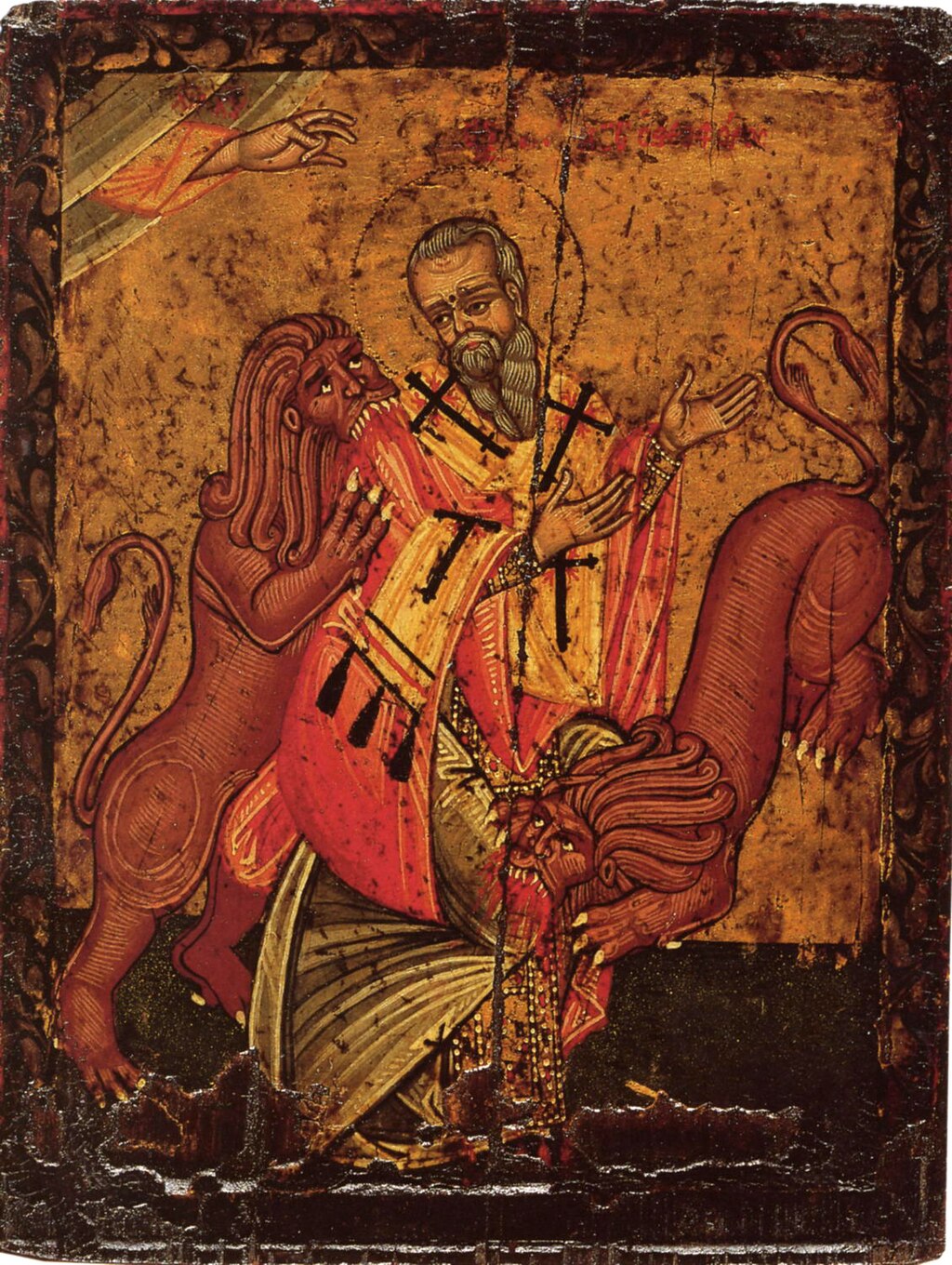 The first use of the term "Catholic Church", meaning "universal church", was by the church father Saint Ignatius of Antioch in his Letter to the Smyrnaeans in c. 110 AD.[31] Ignatius of Antioch also is credited with the first recorded use of the term Christianity ten years earlier, in c. 100 AD.[32] He died in Rome, with his relics located in San Clemente al Laterano. Catholic (from Greek: καθολικός, romanized: katholikos, lit. 'universal') is first attested as an adjective used to describe the church in the early second century.[33] The first known use of the phrase "the catholic church" (Greek: καθολικὴ ἐκκλησία, romanized: katholikḕ ekklēsía) appears in a letter written around AD 100 by Ignatius of Antioch to the Smyrnaeans,[note 3] which reads: "Wheresoever the bishop shall appear, there let the people be, even as where Jesus may be, there is the universal [katholike] Church."[34] In the Catechetical Lectures (c. 350) of Cyril of Jerusalem, the name "Catholic Church" was used to distinguish it from other groups that also called themselves "the church".[34][35] The "Catholic" notion was further emphasized in the edict De fide catolica, issued in 380 by Theodosius I, the last emperor to rule over both the eastern and western halves of the Roman Empire, when he established the state church of the Roman Empire.[36] Since the East–West Schism of 1054, the Eastern Orthodox Church has taken the adjective "Orthodox" as its distinctive epithet; its official name continues to be the "Orthodox Catholic Church".[37] The Latin Church was described as "Catholic", with that description also denoting those in communion with the Holy See after the Protestant Reformation of the 16th century, when those who ceased to be in communion became known as Protestants.[38][39] While the "Roman Church" has been used to describe the pope's Diocese of Rome since the Fall of the Western Roman Empire and into the Early Middle Ages (6th–10th century), "Roman Catholic Church" has been applied to the whole church in the English language since the Protestant Reformation in the late 16th century.[40] Further, some refer to the Latin Church as "Roman Catholic" in distinction from the Eastern Catholic churches.[41] "Roman Catholic" has occasionally appeared in documents produced by the Holy See,[note 4] and has been used by certain national episcopal conferences and local dioceses.[note 5] The name "Catholic Church" for the whole church is used in the Catechism of the Catholic Church (1990) and the Code of Canon Law (1983). "Catholic Church" is also used in the documents of the Second Vatican Council (1962–1965),[42] the First Vatican Council (1869–1870),[43] the Council of Trent (1545–1563)[44] and numerous other official documents.[45][46] |
名称 補足情報:カトリック(用語)およびローマ・カトリック(用語) 「カトリック教会」という用語が「普遍的な教会」を意味して初めて使われたのは、教父であるアンティオキアの聖イグナティウスが紀元110年頃に書いた 『スミルナ人への手紙』である[31]。また、イグナティウスは10年前の紀元100年頃に「キリスト教」という用語を初めて記録に残した人物としても知 られる。[32] 彼はローマで死去し、その遺骨はラテラノの聖クレメンテ教会に安置されている。 カトリック(ギリシャ語: καθολικός、ローマ字表記: katholikos、直訳: 『普遍的な』)という形容詞が教会を指す言葉として初めて確認されるのは、2世紀初頭のことである。[33] 「カトリック教会」(ギリシャ語: καθολικὴ ἐκκλησία、ローマ字表記: katholikḕ ekklēsía)という語句の最初の使用例は、紀元100年頃にアンティオキアのイグナティオスがスミルナ人への手紙[注3]に記した次の文に見られ る。「司教が現れるところには、民衆も集まるがよい。あたかもイエスが存在するところに、普遍的[カトリケ]教会が存在するのと同様である。」[34] エルサレムのキリロスの『教理講話』(約350年)では、「カトリック教会」という名称が、自らを「教会」と称する他の集団と区別するために用いられた。 [34][35] 「カトリック」という概念は、380年にテオドシウス1世がローマ帝国の国教を定めた際に発布した勅令『カトリック信仰について』でさらに強調された。テ オドシウス1世はローマ帝国の東西両半部を統治した最後の皇帝である。[36] 1054年の東西教会分裂以降、東方正教会は「正統」という形容詞を自らの特徴的な称号として採用した。その正式名称は現在も「正統カトリック教会」であ る。[37] ラテン教会は「カトリック」と称され、この呼称は16世紀のプロテスタント宗教改革後もローマ教皇庁と共にある者を指す。改革により共にある関係を断った 者たちはプロテスタントと呼ばれるようになった。[38] [39] 「ローマ教会」という呼称は、西ローマ帝国崩壊後から中世初期(6~10世紀)にかけて教皇のローマ教区を指すのに用いられてきた。一方「ローマ・カト リック教会」は、16世紀後半のプロテスタント宗教改革以降、英語圏において教会全体を指す呼称として用いられてきた。[40] さらに、東方カトリック教会と区別するため、ラテン教会を「ローマ・カトリック」と呼ぶ者もいる。[41] 「ローマ・カトリック」という呼称は、聖座が作成した文書に時折登場し[注4]、特定の国家司教協議会や地方教区でも使用されてきた。[注5] 教会全体を指す名称として「カトリック教会」は、『カトリック教会のカテキズム』(1990年)および『カノン法典』(1983年)で使用されている。 「カトリック教会」という呼称は、第二バチカン公会議(1962–1965年)[42]、第一バチカン公会議(1869–1870年)[43]、トリエン ト公会議(1545–1563年)[44]、その他多数の公式文書[45][46]においても用いられている。 |
| History Main article: History of the Catholic Church For a chronological guide, see Timeline of the Catholic Church. Further information: Historiography of early Christianity See also: History of Catholic theology Apostolic era and papacy Main article: Apostolic Age Painting a haloed Jesus Christ passing keys to a kneeling man. 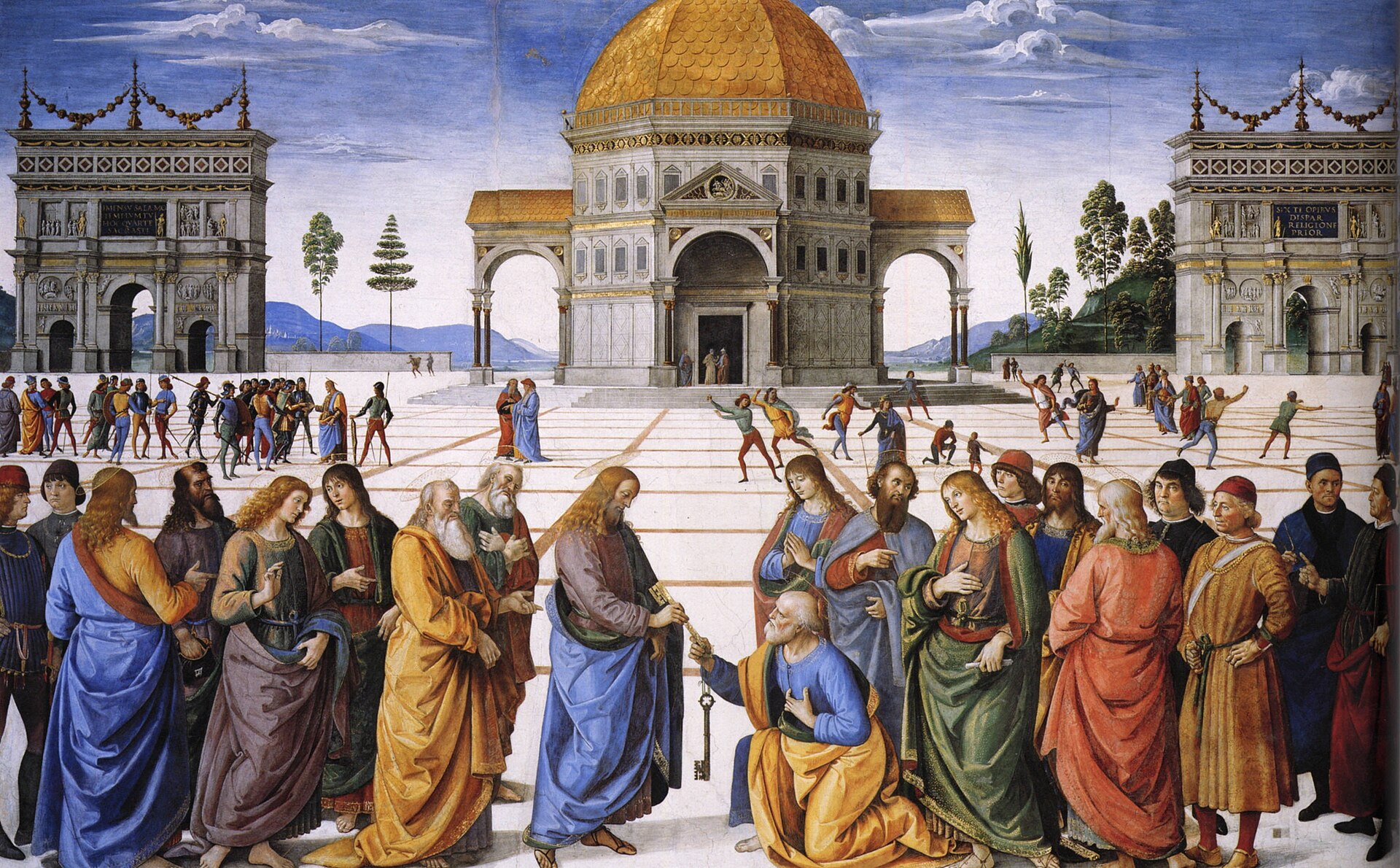 A c. 1481–1482 fresco by Pietro Perugino in the Sistine Chapel showing Jesus giving the keys of heaven to Saint Peter 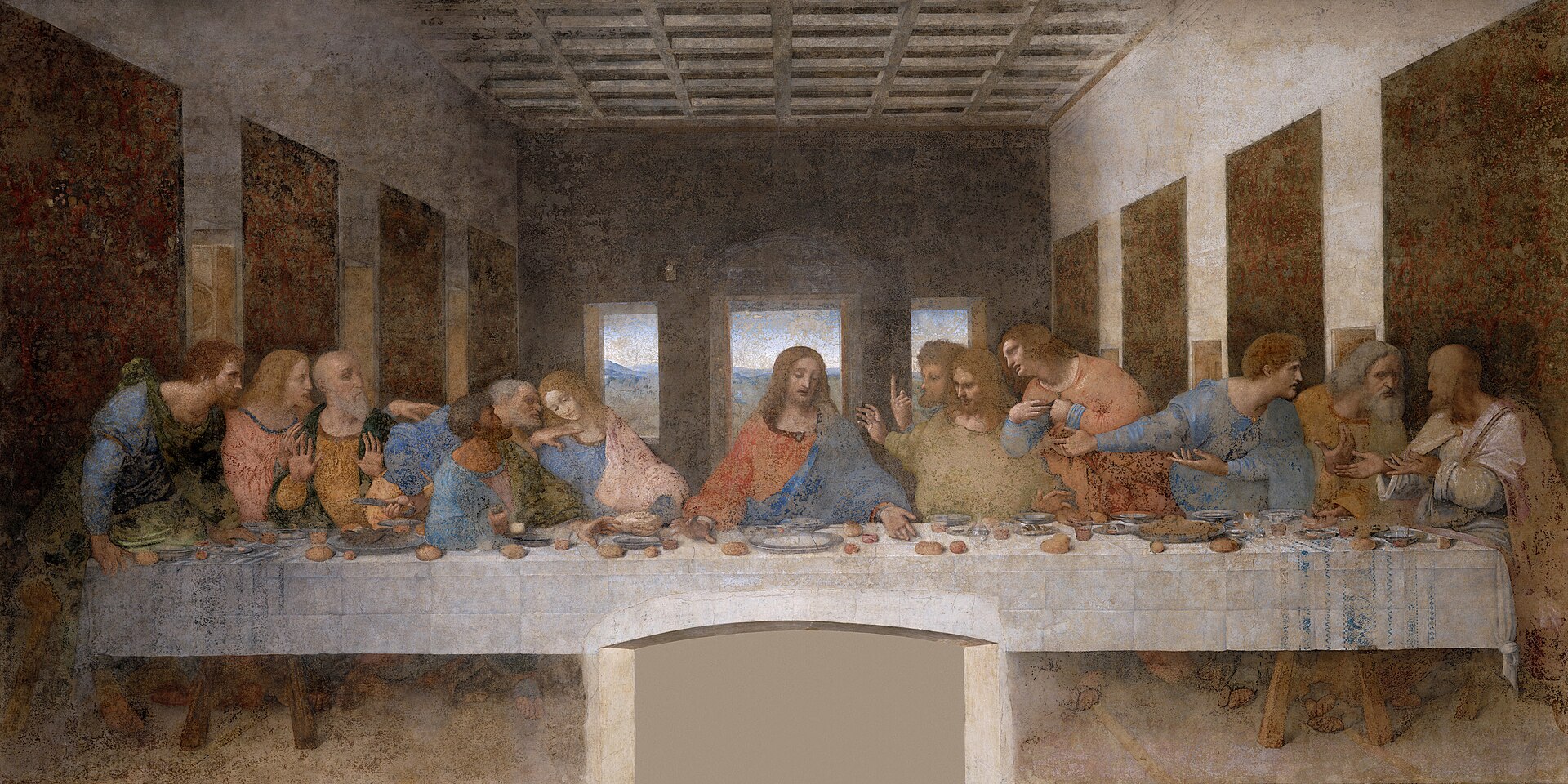 The Last Supper in the Santa Maria delle Grazie Church in Milan, Italy, a late 1490s mural painting by Leonardo da Vinci, depicting the Last Supper of Jesus and his twelve apostles, depicts the final meal of Jesus before his crucifixion and death. The New Testament, particularly the Gospels, records Jesus' activities and teaching, his appointment of the Twelve Apostles, and his Great Commission to them, instructing them to continue his work.[47][48] The Acts of Apostles recounts the founding of the Christian Church and the spread of its message throughout the Roman Empire.[49] The Catholic Church teaches that its public ministry began on Pentecost, which occurred fifty days after the date on which Christ is believed to have risen from the dead.[50] At Pentecost, the apostles are held to have received the Holy Spirit, preparing them for their mission of leading the Church.[51][52] The Catholic Church further teaches that the college of bishops, led by the bishop of Rome, is the successor to the apostles.[53] In the account of the Confession of Peter found in the Gospel of Matthew, Christ designates Peter as the "rock" upon which his Church will be built.[54][55] The Catholic Church considers the bishop of Rome, the pope, to be the successor of Saint Peter.[56] Some scholars hold that Peter was the first bishop of Rome,[57] while other scholars argue that the institution of the papacy does not depend on the view that Peter was bishop of Rome, or even on the claim that he ever resided in Rome.[58] Many scholars maintain that a church structure consisting of multiple presbyters/bishops persisted in Rome until the mid-2nd century, when a structure with a single bishop and multiple presbyters was adopted,[59] and that later writers retrospectively applied the title "bishop of Rome" to the most prominent members of the clergy in the earlier period, as well as to Peter himself.[59] On this basis, Bart D. Ehrman argues Peter "could not have been the first bishop of Rome", while also noting that the church "did not have anyone as its bishop until about a hundred years after Peter's death."[60] Raymond E. Brown likewise states that it is anachronistic to speak of Peter in terms of a local bishop of Rome, but that Christians of that period would have regarded Peter as exercising roles that contributed "to the development of the role of the papacy in the subsequent church". These roles, Brown argues, "contributed enormously to seeing the bishop of Rome ... as the successor of Peter ... for the church universal".[59] |
歴史 主な記事: カトリック教会の歴史 年代順のガイドについては、カトリック教会の年表を参照のこと。 詳細情報: 初期キリスト教の歴史学 関連項目: カトリック神学の歴史 使徒時代と教皇制 主な記事: 使徒時代 跪く男に鍵を渡す、後光を帯びたイエス・キリストを描いた絵画。 ピエトロ・ペルジーノ作、システィーナ礼拝堂のフレスコ画(1481-1482年頃)。イエスが聖ペテロに天国の鍵を授ける場面 イタリア・ミラノのサンタ・マリア・デッレ・グラツィエ教会にある『最後の晩餐』。レオナルド・ダ・ヴィンチによる1490年代後半の壁画。イエスと十二使徒の最後の晩餐を描き、十字架刑と死を前にしたイエスの最後の食事を表現している。 新約聖書、特に福音書は、イエスの活動と教え、十二使徒の任命、そして彼らへの大宣教命令を記録している。この命令は、イエスの仕事を継続するよう指示す るものだ。[47][48] 使徒言行録は、キリスト教会の設立と、その教えがローマ帝国全土に広まっていく過程を記している。カトリック教会は、その公的奉仕がペンテコステ(五旬 節)に始まったと教える。ペンテコステは、キリストが死から復活したと信じられている日から50日後に起こった。[50] ペンテコステにおいて、使徒たちは聖霊を受けたとされ、教会を導く使命に備えたとされる。[51][52] カトリック教会はさらに、ローマの司教が率いる司教団が使徒たちの後継者であると教える。[53] マタイによる福音書に記されたペトロの告白において、キリストはペトロを自らの教会が築かれる「岩」と指定した。[54][55] カトリック教会はローマの司教、すなわち教皇を聖ペトロの後継者と見なしている。[56] 一部の学者はペトロがローマ初代司教であったと主張する[57]。一方で他の学者は、教皇職の制度はペトロがローマ司教であったという見解、あるいは彼が ローマに居住したとの主張に依存しないと論じる。[58] 多くの学者は、複数の長老/司教からなる教会構造が2世紀半ばまでローマに存続し、その後単一の司教と複数の長老からなる構造が採用されたと主張している [59]。また、後代の著述家たちが、初期の時期における最も著名な聖職者たち、そしてペテロ自身に対して、遡及的に「ローマの司教」という称号を適用し たと述べている。[59] この見解に基づき、バート・D・エアマンはペテロが「ローマ初代司教ではありえなかった」と論じると同時に、教会が「ペテロの死後約百年間、司教を置かな かった」とも指摘している[60]。レイモンド・E・ブラウンも同様に、ペテロをローマの地方司教として語ることは時代錯誤だと述べる。しかし当時のキリ スト教徒は、ペテロが「後の教会における教皇職の発展に寄与する役割」を果たしていたと認識していたと指摘する。ブラウンはこれらの役割が「ローマの司教 を…ペテロの後継者として…普遍的教会にとって重要な存在と見なすことに大きく貢献した」と論じている。[59] |
| Antiquity and Roman Empire Main articles: Early Christianity, Pentarchy, and List of heresies in the Catholic Church 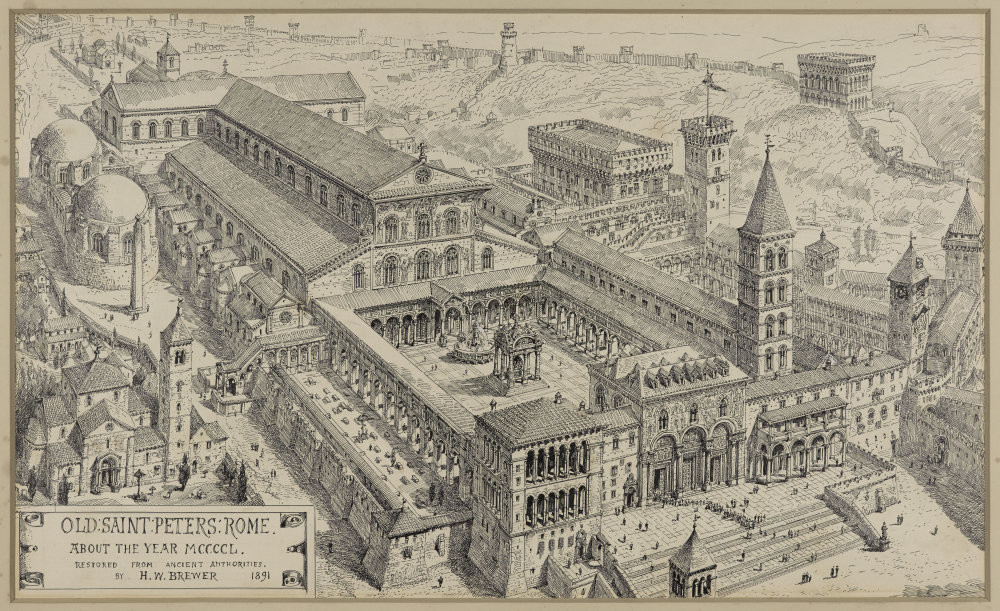 A 19th-century drawing by Henry William Brewer of Old St. Peter's Basilica, built in 318 by Constantine the Great The Roman Empire facilitated the spread of new ideas through its extensive network of roads and waterways, the relative security of the Pax Romana, and the promotion of a common culture with strong Greek influences, all of which allowed ideas to be more easily expressed and understood.[61] However, unlike most religions in the Roman Empire, Christianity required its followers to renounce all other gods, a practice inherited from Judaism. Because Christians refused to participate in pagan festivals and civic rituals, they were excluded from many aspects of public life, leading some non-Christians, including government authorities, to fear that they were angering the gods and thereby threatening the peace and prosperity of the empire. The resulting prosecutions became a defining element of early Christian self-understanding until Christianity was legalized in the 4th century.[62] In 313, Constantine the Great—the first Roman emperor to convert to Christianity—issued the Edict of Milan, which legalized the Christian faith, and he moved the imperial capital to Constantinople (modern Istanbul, Turkey) in 330. In 380, the Edict of Thessalonica made Nicene Christianity the state church of the Roman Empire, a status that continued within the shrinking territory of the Byzantine Empire until its fall in 1453. Elsewhere, the Church functioned independently of imperial authority, becoming especially evident after the East-West Schism. During the period of the Seven Ecumenical Councils, five principal sees emerged—Rome, Constantinople, Alexandria, Antioch, and Jerusalem—formalized in the mid-6th century, arranged by Justinian I, the Byzantine emperor from 527 to 565, as the pentarchy.[63][64] In 451, the Council of Chalcedon, in a canon of disputed validity,[65] elevated the see of Constantinople to a role "second in eminence and power to the bishop of Rome".[66] From c. 350 – c. 500, the bishops, or popes, of Rome steadily increased their authority through consistently intervening in helping orthodox leaders during theological disputes, which encouraged appeals to them.[67] Emperor Justinian, under his controlled territories, established a form of caesaropapism where he could regulate "the minutest details of worship and discipline" and "theologian opinions" in the Church—establishing imperial influence over Rome and other Western territories again.[68] This act created the Byzantine Papacy period (537–752) in which popes required approval from the emperor or his representative for consecration, leading to most being selected by the emperor from his Greek-speaking subjects, which created a "melting pot" of Western and Eastern Christian traditions in art and liturgy.[69][70] In the following centuries, Germanic tribes who invaded the Roman Empire adopted Christianity in its Arian form, which the Council of Nicaea declared heretical, causing discord between Germanic rulers and Catholic subjects.[71][72] In 497, Clovis I, the Frankish ruler, converted to orthodox Catholicism and he aligned himself with the papacy and the monastic communities—an act that unified Germanic rulers and Catholic subjects for the most part.[73] Following his lead, the Visigoths converted to Catholicism in 589, and the Lombards in Italy gradually adopted it during the 7th century.[74][75] Western Christianity—particularly through its monastic institutions—played a massive role in preserving classical civilization, including its artistic traditions and literacy.[76] Benedict of Nursia (c. 480–543), one of the founders of Western monasticism, with his Rule, exerted a crucial influence on European culture with his appropriation of the Church's monastic spiritual heritage and his preservation and transmission of ancient culture with the spread of the Benedictine tradition. During this time, monastic Ireland became a center of scholarship; early Irish missionaries such as Columbanus and Columba spread Christianity and established monasteries across continental Europe.[76] |
古代とローマ帝国 主な記事:初期キリスト教、五教皇制、カトリック教会の異端一覧 19世紀のヘンリー・ウィリアム・ブリュワーによる古聖ペテロ大聖堂の図。318年にコンスタンティヌス大帝によって建設された ローマ帝国は、広範な道路網と水路網、パックス・ロマーナの比較的安定した治安、そして強いギリシャ文化の影響を受けた共通文化の促進を通じて、新たな思 想の普及を促進した。これら全てが、思想の表現と理解をより容易にしたのである[61]。しかし、ローマ帝国の他の宗教とは異なり、キリスト教は信者に他 の全ての神々を放棄することを要求した。これはユダヤ教から受け継がれた慣行であった。キリスト教徒は異教の祭典や市民儀礼への参加を拒んだため、公共生 活の多くの側面から排除された。これにより政府当局を含む非キリスト教徒の一部は、彼らが神々の怒りを買い帝国の平和と繁栄を脅かしているのではないかと 恐れた。こうした迫害は、4世紀にキリスト教が合法化されるまで、初期キリスト教徒の自己認識を形作る決定的な要素となった。[62] 313年、キリスト教に改宗した最初のローマ皇帝コンスタンティヌス大帝はミラノ勅令を発布し、キリスト教を合法化した。彼は330年に帝国の首都をコン スタンティノープル(現在のトルコ・イスタンブール)に移した。380年、テッサロニキ勅令によりニカイア派キリスト教がローマ帝国の国教となった。この 地位は、1453年の滅亡まで縮小を続けるビザンツ帝国の領域内で維持された。その他の地域では、教会は帝国の権威から独立して機能し、特に東西教会分裂 後はその傾向が顕著となった。七つの公会議の時代には、ローマ、コンスタンティノープル、アレクサンドリア、アンティオキア、エルサレムの五つの主要主教 座が台頭した。これらは6世紀半ば、527年から565年までビザンツ皇帝を務めたユスティニアヌス1世によって「五主教制」として正式に確立された [63][64]。 451年、カルケドン公会議は(その正統性が議論される教令において)[65]、コンスタンティノープル主教座を「ローマ司教に次ぐ権威と権力を持つ」地 位に昇格させた[66]。約350年から約500年にかけて、ローマの司教(教皇)は、神学論争において正統派指導者を支援するため一貫して介入すること で権威を着実に高め、彼らへの上訴を促した。[67] ユスティニアヌス帝は支配地域において、教会内の「礼拝と規律の細部」や「神学者の見解」を規制できる帝王神権制を確立し、ローマやその他の西方地域に対 する帝国の影響力を再び確立した。[68] この行為によりビザンツ教皇制時代(537–752)が始まり、教皇の叙階には皇帝またはその代理人の承認が必要となった。その結果、皇帝がギリシャ語を 話す臣民の中から教皇を選出するケースがほとんどとなり、美術や典礼において東西キリスト教の伝統が「融合」する状況が生まれた。[69][70] その後数世紀にわたり、ローマ帝国に侵入したゲルマン諸族はアリウス派のキリスト教を採用した。ニカイア公会議が異端と宣言したこの教義は、ゲルマンの支配者とカトリックの臣民との間に不和を生んだ。[71] [72] 497年、フランク族の統治者クロヴィス1世は正統カトリックに改宗し、教皇庁や修道院共同体と結びついた。この行為により、ゲルマン人統治者とカトリッ ク教徒の臣民は概ね統一された。[73] 彼の先例に従い、西ゴート族は589年にカトリックへ改宗し、イタリアのロンバルド族も7世紀にかけて徐々にこれを採用した。[74] [75]西洋キリスト教は、特に修道院制度を通じて、芸術的伝統や識字能力を含む古典文明の保存に極めて大きな役割を果たした。[76] 西洋修道院制度の創始者の一人であるヌルシアのベネディクト(約480-543年)は、その『規則』によって、教会の修道院的霊的遺産を継承し、ベネディ クト会伝統の普及を通じて古代文化を保存・伝達したことで、ヨーロッパ文化に決定的な影響を与えた。この時代、修道院制度を持つアイルランドは学問の中心 地となった。コルンバヌスやコルンバといった初期のアイルランド人宣教師たちはキリスト教を広め、大陸ヨーロッパ全域に修道院を設立したのである。 [76] |
| Middle Ages and Renaissance Further information: History of Christianity during the Middle Ages and Christianity in the 16th century § Renaissance Church 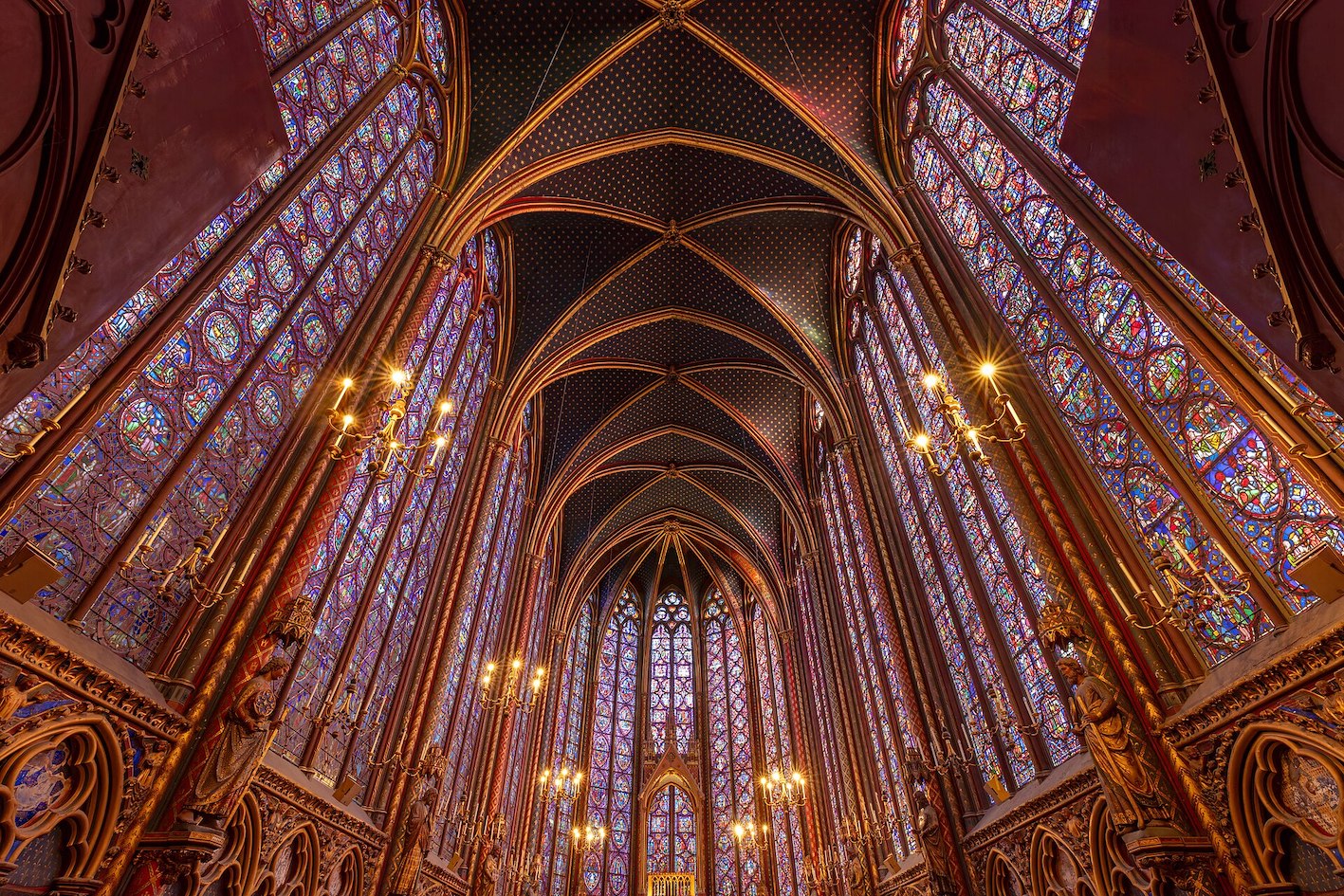 An interior view of the Sainte-Chapelle on the Île de la Cité in Paris, France, completed in 1248. During the Middle Ages, many buildings in the Gothic architecture-style were erected as places of worship for the Catholic Church. From Late Antiquity to the dawn of the modern age, the Catholic Church held a dominant influence on Western civilization, being the primary sponsor of Romanesque, Gothic, Renaissance, Mannerist, and Baroque styles in art, architecture, and music—including visual artists like Raphael, Michelangelo, Leonardo da Vinci, Sandro Botticelli, Fra Angelico, Tintoretto, Titian, Gian Lorenzo Bernini, and Caravaggio.[12][77][78] A Stanford University historian Paul Legutko said the Church is "at the center of the development of the values, ideas, science, laws, and institutions" of Western civilization.[79] Monks established the first universities in Europe in the time of Western Christendom.[80][81][82] In higher education, several older cathedral schools became universities beginning in the 11th century, including the University of Oxford, University of Paris, and University of Bologna. Dating back to 6th-century AD, monks and nuns spearheaded higher education with Christian cathedral schools or monastic schools.[83] These new universities expanded their curriculums to include academic programs for clerics, lawyers, civil servants, and physicians.[84] Thus, due to its initial origins, the university is generally regarded as starting in a Medieval Christian setting.[85][86][87] Massive mid-7th century Islamic invasions elongated the struggles of power between Christianity and Islam throughout the Mediterranean Basis; the Byzantine Empire lost its lands of the eastern patriarchates of Jerusalem, Alexandria and Antioch were reduced to Constantinople, the empire's capital, and the Frankish state, centered away from the Islamic domination of the Mediterranean, evolved into the dominant power that shaped the Western Europe of the Middle Ages.[88] Battles in Toulouse and Tours halted Islamic advancements in the West; a failed siege of Constantinople halted them in the East. In 751, the Byzantine Empire lost the city of Ravenna, which governed the small fragments of Italy, including Rome, to the Lombards, meaning confirmation by a no longer existent exarch was not asked during the election of Pope Stephen II in 752—the papacy had to look elsewhere for a civil power to protect it.[89] The Frankish king Pepin the Short conquered the Lombards in 754 at the urgent request of Pope Stephen, and then gifted the lands back to the pope, initiating the time of the Papal States. In the 860s, Rome and the Byzantine East had a conflict during the Photian schism, as Photius criticized the Latin West for adding the filioque clause, after being excommunicated by Nicholas I, causing unresolved issues that led to further divisions.[90] 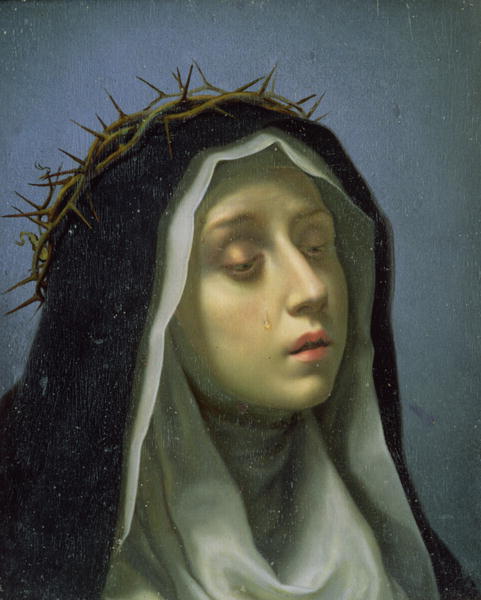 A painting of St. Catherine of Siena by Carlo Dolci. A 14th century Catholic mystic associated with Dominican spirituality, she helped to heal the Great Western Schism. In the 11th century the efforts of Hildebrand of Sovana led to the creation of the College of Cardinals to elect new popes, starting with Pope Alexander II in the papal election of 1061. When Alexander II died, Hildebrand was elected to succeed him, as Pope Gregory VII. The basic election system of the College of Cardinals which Gregory VII helped establish has continued to function into the 21st century. Pope Gregory VII further initiated the Gregorian Reforms regarding the independence of the clergy from secular authority. This led to the Investiture Controversy between the church and the Holy Roman Emperors, over which had the authority to appoint bishops and popes.[91][92] In 1095 the Byzantine emperor, Alexius I, appealed to Pope Urban II for help against renewed Muslim invasions in the Byzantine–Seljuk wars,[93] which caused Urban to launch the First Crusade aimed at aiding the Byzantine Empire and returning the Holy Land to Christian control.[94] In the 11th century strained relations between the primarily Greek church and the Latin Church separated them in the East–West Schism, partially due to conflicts over papal authority. The Fourth Crusade and the sacking of Constantinople by renegade crusaders proved the final breach.[95] In the twelfth century, inquisitions began in the Catholic Kingdom of France in response to the Albigensians. The system spread throughout other European countries in the succeeding centuries, through multiple forms: first as individual inquisitors sporadically appointed for certain problem areas by popes, then as state-sponsored tribunals.[96] The ad hoc use of torture by secular medieval judges was common, and the directives governing inquisitions progressively allowed various situations where non-maiming, non-bloody torture could or must be used to corroborate testimony, not only on some classes of accused but sometimes even on denouncers and witnesses.[97] In the early 13th century mendicant orders were founded by Francis of Assisi and Dominic de Guzmán. The studia conventualia and studia generalia of the mendicant orders played a large role in the transformation of church-sponsored cathedral schools and palace schools, such as that of Charlemagne at Aachen, into the prominent universities of Europe.[98] Scholastic theologians and philosophers such as the Dominican priest Thomas Aquinas studied and taught at these studia. Aquinas' Summa Theologica was an intellectual milestone in its synthesis of the legacy of ancient Greek philosophers such as Plato and Aristotle with the content of Christian revelation.[99] A growing sense of church-state conflicts marked the 14th century. In 1309, to escape instability in Rome, Pope Clement V became the first of seven popes to reside in the fortified city of Avignon in southern France[100] during a period known as the Avignon Papacy. The Avignon Papacy ended in 1376 when the pope returned to Rome.[101] In 1378 a 38-year-long Western Schism began, with claimants to the papacy located in Rome, Avignon and, after 1409, Pisa.[101] The matter was largely resolved in 1414–1418 at the Council of Constance, with the claimants in Rome and Pisa agreeing to resign and the third claimant excommunicated by the cardinals, who held a new election naming Martin V pope.[102] In 1438 the Council of Florence convened, which featured a strong dialogue focussed on understanding the theological differences between the East and West, with the hope of reuniting the Catholic and Orthodox churches.[103] Several eastern churches reunited, forming the majority of the Eastern Catholic Churches.[104] |
中世とルネサンス 詳細情報:中世におけるキリスト教の歴史および16世紀のキリスト教 § ルネサンス期の教会 フランス・パリのシテ島にあるサント・シャペル(聖堂)の内部。1248年に完成した。中世には、カトリック教会の礼拝所として、ゴシック建築様式の建造物が数多く建てられた。 古代末期から近代初期にかけて、カトリック教会は西洋文明に支配的な影響力を持ち、ロマネスク様式、ゴシック様式、ルネサンス様式、マニエリスム様式、バ ロック様式といった美術・建築・音楽の主要な後援者であった。ラファエロ、ミケランジェロ、レオナルド・ダ・ヴィンチ、サンドロ・ボッティチェッリ、フ ラ・アンジェリコ、ティントレット、ティツィアーノ、ジャン・ロレンツォ・ベルニーニ、カラヴァッジョといった視覚芸術家たちもその支援を受けた。 [12][77][78] スタンフォード大学の歴史学者ポール・レグトコは、教会が西洋文明の「価値観、思想、科学、法律、制度の発展の中心」にあると述べている。[79] 西洋キリスト教世界において、最初の大学は修道士たちによって設立された。[80][81][82] 高等教育では、11世紀以降、オックスフォード大学、パリ大学、ボローニャ大学など、いくつかの古い大聖堂付属学校が大学へと発展した。6世紀に遡るキリ スト教大聖堂付属学校や修道院学校において、修道士や修道女たちが高等教育の先駆けとなったのである。[83] これらの新大学は、聖職者、法律家、公務員、医師向けの学術プログラムをカリキュラムに追加した。[84] したがって、その起源から、大学は一般的に中世キリスト教環境で始まったと見なされている。[85][86][87] 7世紀中頃の大規模なイスラム侵攻は、地中海全域におけるキリスト教とイスラム教の権力闘争を長期化させた。ビザンツ帝国はエルサレム、アレクサンドリ ア、アンティオキアの東方総主教区領土を失い、首都コンスタンティノープルとフランク王国のみに縮小した。フランク王国は地中海におけるイスラム支配圏の 外縁に位置し、中世西ヨーロッパを形成する支配勢力へと発展した。[88] トゥールーズとトゥールの戦いは西方のイスラム勢力の進撃を阻止し、コンスタンティノープル包囲戦の失敗は東方での進撃を止めた。751年、ビザンツ帝国 はローマを含むイタリアの細分化された領土を統治していたラヴェンナをロンバルド人に奪われた。これにより752年の教皇ステファノ2世の選出時には、既 に存在しないエクザルフの承認が求められなくなった。教皇庁は自らを守る世俗の権力を他所に求めざるを得なくなったのである。[89] フランク王ピピン3世は754年、教皇ステファノの緊急要請に応じてロンバルド人を征服し、その領土を教皇に返還した。これが教皇領時代の始まりである。 860年代、ローマとビザンツ帝国はフォトス派分裂により対立した。フォトスがラテン教会が「フィリオクエ」条項を追加したことを批判し、ニコラウス1世 によって破門されたことで、未解決の問題が生じ、さらなる分裂を招いたのである。[90] カルロ・ドルチ作、シエナの聖カタリナ像。14世紀のカトリックの神秘主義者であり、ドミニコ会の精神性に関連した彼女は、大分裂の癒しに貢献した。 11世紀、ソヴァーナのヒルデブランドは、1061年の教皇選挙でアレクサンダー2世を皮切りに、新しい教皇を選出するための枢機卿団の創設に尽力した。 アレクサンダー2世が亡くなると、ヒルデブランドは後継者として、教皇グレゴリウス7世に選出された。グレゴリウス7世が確立に貢献した枢機卿会議の基本 的な選挙制度は、21世紀になっても機能し続けている。教皇グレゴリウス7世はさらに、聖職者の世俗的権力からの独立に関するグレゴリオ改革を開始した。 これは、司教や教皇を任命する権限を誰が持つかをめぐる、教会と神聖ローマ皇帝間の叙任権争いにつながった。[92] 1095年、ビザンツ皇帝アレクシオス1世は、ビザンツ・セルジューク戦争におけるイスラム教徒の新たな侵略に対する支援を教皇ウルバヌス2世に要請した [93]。これにより、ウルバヌスはビザンツ帝国を支援し、聖地をキリスト教の支配下に戻すことを目的とした第一次十字軍を立ち上げた。[94] 11世紀、主にギリシャ系教会とラテン系教会との緊張関係は、教皇権を巡る対立も一因となり、東西教会分裂へと発展した。第四回十字軍と反逆者たちによる コンスタンティノープル略奪が、最終的な決裂をもたらした。[95] 12世紀、アルビジョア派への対応としてカトリックのフランス王国で異端審問が始まった。この制度はその後数世紀にわたり、様々な形態で他のヨーロッパ諸 国に広がった。最初は教皇が特定の問題地域に散発的に任命した個人審問官として、次に国家が後援する法廷としてである。[96] 世俗の中世裁判官による拷問の臨機応変な使用は一般的であり、異端審問を統制する指令は次第に、特定の被疑者階級だけでなく時には告発者や証人に対して も、証言を裏付けるために身体損傷を伴わない、流血を伴わない拷問が使用可能あるいは必須となる様々な状況を認めるようになった。[97] 13世紀初頭、アッシジのフランチェスコとドミニコ・デ・グスマンによって托鉢修道会が創設された。これらの修道会の修道院付属学校(studia conventualia)及び総合学校(studia generalia)は、教会が支援する大聖堂学校や宮廷学校(例えばアーヘンのカール大帝の宮廷学校)を、ヨーロッパの著名な大学へと変貌させる上で大 きな役割を果たした。[98] ドミニコ会の司祭トマス・アクィナスらスコラ神学者・哲学者はこれらの修道院学校で学び教えた。アクィナスの『神学大全』は、プラトンやアリストテレスら 古代ギリシャ哲学者の遺産とキリスト教啓示の内容を統合した知的里程標であった。[99] 14世紀は教会と国家の対立が深まる時代であった。1309年、ローマの不安定な情勢を逃れるため、教皇クレメンス5世は南フランスの要塞都市アヴィニョ ン[100]に居を構えた。これがアヴィニョン教皇庁と呼ばれる時代で、後に7人の教皇が同地に滞在することになる。アヴィニョン教皇庁は1376年、教 皇がローマへ帰還したことで終焉を迎えた[101]。1378年には38年間に及ぶ西教会の分裂が始まり、ローマ、アヴィニョン、そして1409年以降は ピサにそれぞれ教皇を名乗る者が存在した。この問題は、1414年から1418年にかけてコンスタンツ公会議でほぼ解決し、ローマとピサの教皇は辞任に合 意し、3人目の教皇は枢機卿たちによって破門され、マーティン5世が新たな選挙で教皇に選出された。[102] 1438年、フィレンツェ公会議が開催された。この会議では、カトリック教会と正教会の再統一を望み、東西の神学的異なる点の理解に焦点を当てた活発な対話が行われた。[103] いくつかの東方教会が再統一し、東方カトリック教会の大半を形成した。[104] |
| Age of Discovery and Counter-Reformation Main articles: Catholic Church and the Age of Discovery and Counter-Reformation 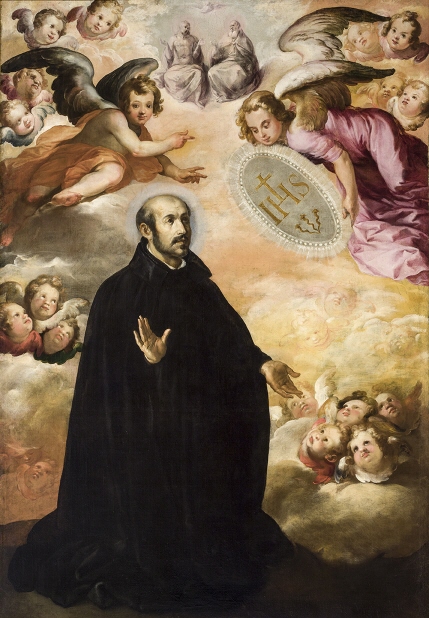 La obra representa a San Ignacio de Loyola, el fundador de la Compañía de Jesús, siendo glorificado. 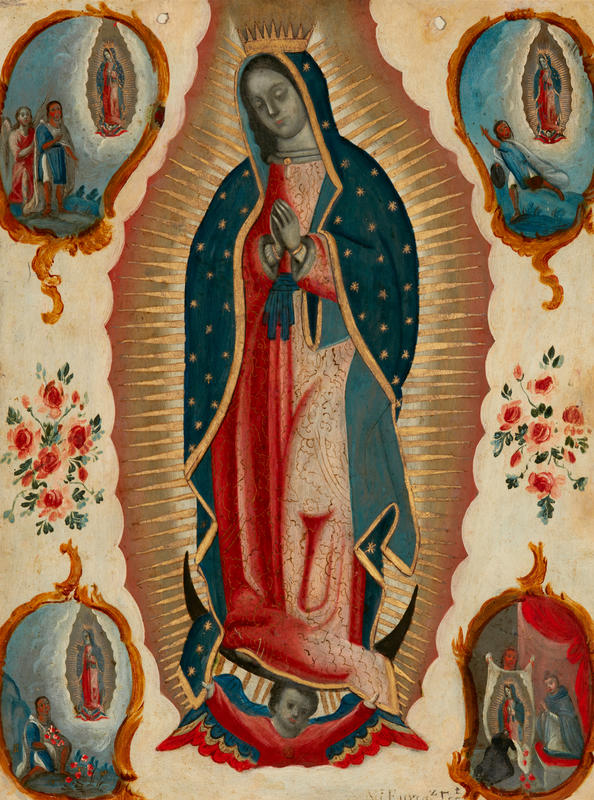 Our Lady of Guadalupe by , after 1722, oil on copper, El Paso Museum of Art With the rise of Protestantism, the Catholic Church lost some adherents in Europe. Counter-Reformation groups such as the Jesuits were founded to tackle this. At the same time, Catholicism spread in the Americas through evangelisation, represented by the apparition of Our Lady of Guadalupe. The Age of Discovery beginning in the 15th century saw the expansion of Western Europe's political and cultural influence worldwide. Because of the rise in power overseas of strongly Catholic nations of Spain and Portugal (as well as France), Catholicism was spread to the Americas, Asia and Oceania by explorers, conquistadors, and missionaries, as well as by the conversion of people who lived in these societies to the Catholic faith. Pope Alexander VI had awarded sovereignty rights over most of the newly discovered lands to Spain and Portugal (later confirmed by the Treaty of Tordesillas)[105] and the ensuing patronato system allowed state authorities, not the Vatican, to control all clerical appointments in the new colonies.[106] In 1521 the Portuguese explorer Ferdinand Magellan made the first Catholic converts in the Philippines.[107] Elsewhere, Portuguese missionaries under the Spanish Jesuit Francis Xavier evangelized in India, China and Japan.[108] The French colonization of the Americas beginning in the 16th century established a Catholic Francophone population and forbade non-Catholics to settle in Quebec.[109] In 1415 popular Bohemian preacher Jan Hus was burned at the stake for refusing to recant Wycliffite heresies.[110] His "hot-headed" reform efforts presaged Martin Luther, an Augustinian friar in Germany, who sent a list of topics for academic disputation, the Ninety-five Theses, to several bishops in 1517.[111] His theses protested against some Catholic doctrines as well as contemporary practices such as the supposed sale of indulgences, and these were the start of a rapidly escalating series of inflammatory works ending with On the Babylonian Captivity of the Church (1520) which accused the Pope of being the anti-Christ:[112] this led to his excommunication in 1521.[111][113] In Switzerland Huldrych Zwingli, John Calvin and other Protestant Reformers further criticized certain Catholic teachings. These challenges developed into the Reformation, which gave birth to the great majority of Protestant denominations[114] and also crypto-Protestantism within the Catholic Church.[115] Meanwhile, Henry VIII of the Kingdom of England petitioned Pope Clement VII for a declaration of nullity concerning his marriage to Catherine of Aragon. When this was denied, he had the Acts of Supremacy passed to make himself Supreme Head of the Church of England, spurring the English Reformation and the eventual development of Anglicanism.[116] 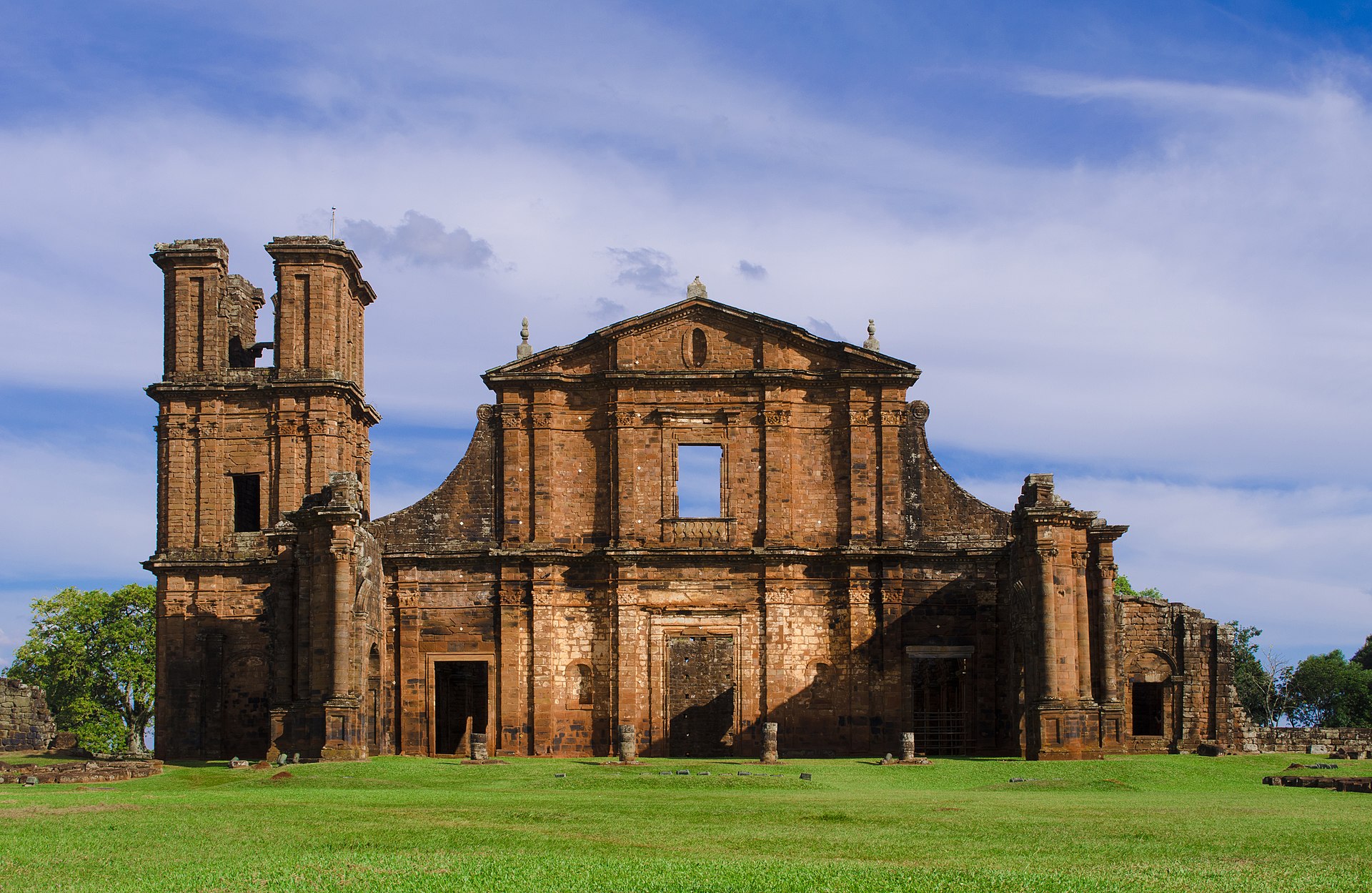 Ruins of the Jesuit mission of São Miguel das Missões in Brazil The Reformation contributed to clashes between the Protestant Schmalkaldic League and the Catholic Emperor Charles V and his allies. The first nine-year war ended in 1555 with the Peace of Augsburg but continued tensions produced a far graver conflict—the Thirty Years' War—which broke out in 1618.[117] In France a series of conflicts termed the French Wars of Religion was fought from 1562 to 1598 between the Huguenots (French Calvinists) and the forces of the French Catholic League, which were backed and funded by a series of popes.[118] This ended under Pope Clement VIII, who hesitantly accepted King Henry IV of France's 1598 Edict of Nantes granting civil and religious toleration to French Protestants.[117][118] The Council of Trent (1545–1563) became the driving force behind the Counter-Reformation in response to the Protestant movement. Doctrinally, it reaffirmed many central Catholic teachings such as transubstantiation, the keeping of the sacraments, and the requirement of good works anchored in love and hope to justify one's salvation, as well as faith as a necessary condition to attain such salvation.[119] In subsequent centuries, Catholicism spread widely across the world, in part through missionaries and imperialism, although its hold on European populations declined due to the growth of religious scepticism during and after the Enlightenment.[120] |
大航海時代と反宗教改革 主な記事:カトリック教会と大航海時代および反宗教改革 この作品は、イエズス会の創設者である聖イグナチオ・デ・ロヨラが栄光に包まれている様子を描いている。 グアダルーペの聖母、1722年以降、銅板油彩、エルパソ美術館所蔵 プロテスタントの台頭により、カトリック教会はヨーロッパで信徒の一部を失った。これに対処するため、イエズス会などの反宗教改革団体が設立された。同時に、グアダルーペの聖母出現に象徴されるように、カトリックはアメリカ大陸で布教活動を通じて広がった。 15 世紀に始まった大航海時代は、西ヨーロッパの政治的、文化的な影響力が世界中に拡大した時代であった。スペインやポルトガル(そしてフランス)といったカ トリックの強い国々が海外で勢力を拡大したため、カトリックは探検家、征服者、宣教師たちによって、またこれらの社会に住む人々がカトリックに改宗するこ とによって、アメリカ大陸、アジア、オセアニアに広まった。教皇アレクサンダー6世は、新たに発見された土地の大部分の主権をスペインとポルトガルに与え た(後にトルデシリャス条約で確認された)[105]。そして、それに続くパトロナート制度により、バチカンではなく国家当局が、新しい植民地における聖 職者の任命をすべて管理することになった。[106] 1521年、ポルトガル人探検家フェルディナンド・マゼランは、フィリピンで初めてカトリックへの改宗者を生み出した。[107] 他の地域では、スペイン人イエズス会士フランシスコ・ザビエル率いるポルトガル人宣教師たちが、インド、中国、日本で布教活動を行った。[108] 16世紀に始まったフランスによるアメリカ大陸の植民地化は、カトリックのフランス語圏住民を確立し、非カトリック教徒のケベックへの定住を禁じた。 [109] 1415年、ボヘミアで人気のあった説教者ヤン・フスは、ウィクリフの異端説を撤回することを拒否したため、火刑に処された[110]。彼の「熱血的な」 改革の取り組みは、ドイツのアウグスティヌス会の修道士であるマルティン・ルターを予見するものであり、ルターは1517年に、学術的論争のための論題リ スト「95ヶ条の論題」を複数の司教に送った。[111] 彼の論文は、免罪符の販売など、カトリックの教義や当時の慣習に抗議するものであり、これは、教皇を反キリストであると非難した『教会のバビロン捕囚につ いて』(1520年)で終わる、急速にエスカレートする一連の扇動的な著作の始まりであった。[112] これにより、1521年に彼は破門された。[111] [113] スイスではウルドリヒ・ツヴィングリ、ジャン・カルヴァンらプロテスタント改革者たちがカトリック教義をさらに批判した。これらの挑戦は宗教改革へと発展 し、大多数のプロテスタント教派[114]とカトリック教会内の隠れプロテスタント[115]を生み出した。一方、イングランド王ヘンリー8世はクレメン ス7世教皇に対し、アラゴン王女キャサリンとの婚姻無効宣言を請願した。これが拒否されると、彼は自身をイングランド国教会の最高指導者とする「最高権威 法」を成立させ、イングランド宗教改革と最終的に英国国教会の発展を促した[116]。 ブラジルにあるサン・ミゲル・ダス・ミソエスのイエズス会宣教所の遺跡 宗教改革は、プロテスタントのシュマルカルデン同盟とカトリックの皇帝カール5世及びその同盟国との衝突を招いた。最初の9年戦争は1555年のアウクス ブルク宗教和約で終結したが、緊張は続き、はるかに深刻な紛争——三十年戦争——を引き起こした。これは1618年に勃発した。[117] フランスでは1562年から1598年にかけて、ユグノー(フランスのカルヴァン派)とフランス・カトリック同盟軍との間で「フランス宗教戦争」と呼ばれ る一連の紛争が起きた。カトリック同盟軍は歴代の教皇から支援と資金提供を受けていた。[118] この戦争は教皇クレメンス8世の治世下で終結した。同教皇は躊躇しつつも、1598年にフランス国王アンリ4世が公布したナントの勅令を承認した。この勅 令はフランス国内のプロテスタントに対する市民的・宗教的寛容を認めるものだった。[117][118] トリエント公会議(1545年~1563年)は、プロテスタント運動への反動として反宗教改革の原動力となった。教義的には、聖体の実体変化説、秘跡の保 持、救いを正当化するための愛と希望に基づく善行の必要性、そして救いを得るための必要条件としての信仰など、カトリックの中核的教義を再確認した。 [119] その後数世紀にわたり、カトリックは宣教師や帝国主義を通じて世界中に広く普及した。ただし啓蒙時代とその後の宗教的懐疑主義の高まりにより、ヨーロッパ におけるその支配力は衰えた。[120] |
| Enlightenment and modern period Main article: Age of Enlightenment From the 17th century onward, the Enlightenment questioned the power and influence of the Catholic Church over Western society.[121] In the 18th century, writers such as Voltaire and the Encyclopédistes wrote biting critiques of both religion and the Catholic Church. One target of their criticism was the 1685 revocation of the Edict of Nantes by King Louis XIV of France, which ended a century-long policy of religious toleration of Protestant Huguenots. As the papacy resisted pushes for Gallicanism, the French Revolution in 1789 shifted power to the state, caused the destruction of churches, the establishment of a Cult of Reason,[122] and the martyrdom of nuns during the Reign of Terror.[123] In 1798 Napoleon's General Louis-Alexandre Berthier invaded the Italian Peninsula, imprisoning Pope Pius VI, who died in captivity. Napoleon later re-established the Catholic Church in France through the Concordat of 1801.[124] The end of the Napoleonic Wars brought Catholic revival and the return of the Papal States.[125] In 1854 Pope Pius IX, with the support of the overwhelming majority of Catholic bishops, whom he had consulted from 1851 to 1853, proclaimed the Immaculate Conception as a dogma in the Catholic Church.[126] In 1870 the First Vatican Council affirmed the doctrine of papal infallibility when exercised in specifically defined pronouncements,[127][128] striking a blow to the rival position of conciliarism. Controversy over this and other issues resulted in a breakaway movement called the Old Catholic Church.[129] The Italian unification of the 1860s incorporated the Papal States, including Rome itself from 1870, into the Kingdom of Italy, thus ending the papacy's temporal power. In response Pius IX excommunicated King Victor Emmanuel II, refused payment for the land and rejected the Italian Law of Guarantees, which granted him special privileges. To avoid placing himself in visible subjection to the Italian authorities, he remained a "prisoner in the Vatican".[130] This stand-off, which was spoken of as the Roman question, was resolved by the Lateran Treaty in 1929, whereby the Holy See acknowledged Italian sovereignty over the former Papal States in return for payment and Italy's recognition of papal sovereignty over Vatican City as a new sovereign and independent state.[131] Catholic missionaries generally supported, and sought to facilitate, the European imperial powers' conquest of Africa during the late nineteenth century. According to the historian of religion Adrian Hastings, Catholic missionaries were generally unwilling to defend African rights or encourage Africans to see themselves as equals to Europeans, in contrast to Protestant missionaries, who were more willing to oppose colonial injustices.[132] |
啓蒙時代と近代 主な記事:啓蒙時代 17世紀以降、啓蒙主義は西洋社会におけるカトリック教会の権力と影響力に疑問を投げかけた[121]。18世紀にはヴォルテールや百科全書派の作家たち が、宗教とカトリック教会双方に対して辛辣な批判を展開した。彼らの批判の的となったのは、1685年にフランス国王ルイ14世がナントの勅令を廃止した ことだ。これにより、プロテスタントのユグノーに対する1世紀にわたる宗教的寛容政策は終焉を迎えた。教皇庁がガリカニズムの推進に抵抗する中、1789 年のフランス革命は権力を国家に移し、教会の破壊、理性崇拝の確立[122]、恐怖政治下での修道女の殉教をもたらした。[123] 1798年、ナポレオンの将軍ルイ=アレクサンドル・ベルティエがイタリア半島に侵攻し、教皇ピウス6世を監禁した。教皇は監禁中に死亡した。ナポレオン は後に1801年のコンコルダートを通じてフランスにおけるカトリック教会を再建した。[124] ナポレオン戦争の終結はカトリック復興と教皇領の復活をもたらした。[125] 1854年、教皇ピウス9世は、1851年から1853年にかけて協議したカトリック司教の大多数からの支持を得て、無原罪の御宿りをカトリック教会の教 義として宣言した。[126] 1870年、第1バチカン公会議は、明確に定義された宣言において行使される教皇無謬性の教義を承認した[127][128]。これは公会議主義という対 立する立場への打撃となった。この問題やその他の論争は、旧カトリック教会と呼ばれる分離運動を引き起こした。[129] 1860年代のイタリア統一により、ローマ教皇領(1870年以降はローマ市自体を含む)はイタリア王国に編入され、教皇の世俗的権力は終焉を迎えた。こ れに対しピウス9世はヴィットーリオ・エマヌエーレ2世を破門し、領地代金の支払いを拒否、教皇に特権を認めるイタリアの保証法を拒否した。イタリア当局 への従属を公然と示すことを避けるため、教皇は「バチカンの囚人」として留まった。[130] この対立状態は「ローマ問題」と呼ばれ、1929年のラテラノ条約によって解決された。同条約により、聖座は旧教皇領に対するイタリアの主権を承認する代 わりに補償金を受け取り、イタリアはバチカン市国を新たな主権独立国家として承認した。[131] カトリックの宣教師たちは、19世紀後半のヨーロッパ列強によるアフリカ征服を概ね支持し、その促進を図った。宗教史家エイドリアン・ヘイスティングズに よれば、カトリック宣教師はアフリカの権利を擁護したり、アフリカ人にヨーロッパ人と対等であるという自覚を持たせたりすることに消極的だった。これに対 し、プロテスタント宣教師は植民地支配の不正義に反対する姿勢をより強く示した。[132] |
| 20th century Main article: Catholic Church in the 20th century Members of the Canadian Army's Royal 22nd Regiment in audience with Pope Pius XII on 4 July 1944, following the Battle of Anzio, which liberated Rome from Nazi German and the Italian fascist occupation during World War II 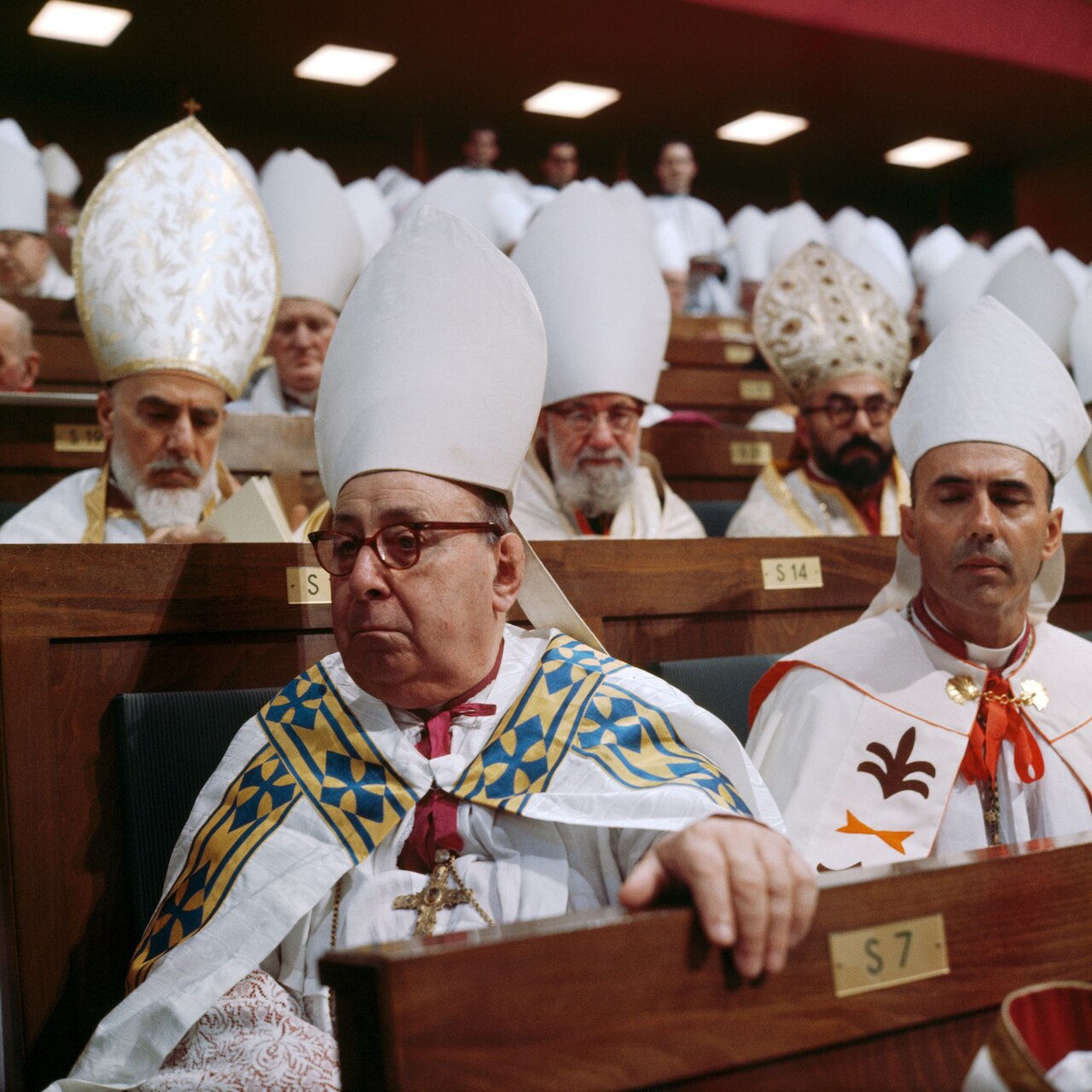 Bishops listen during the Second Vatican Council in the early 1960s 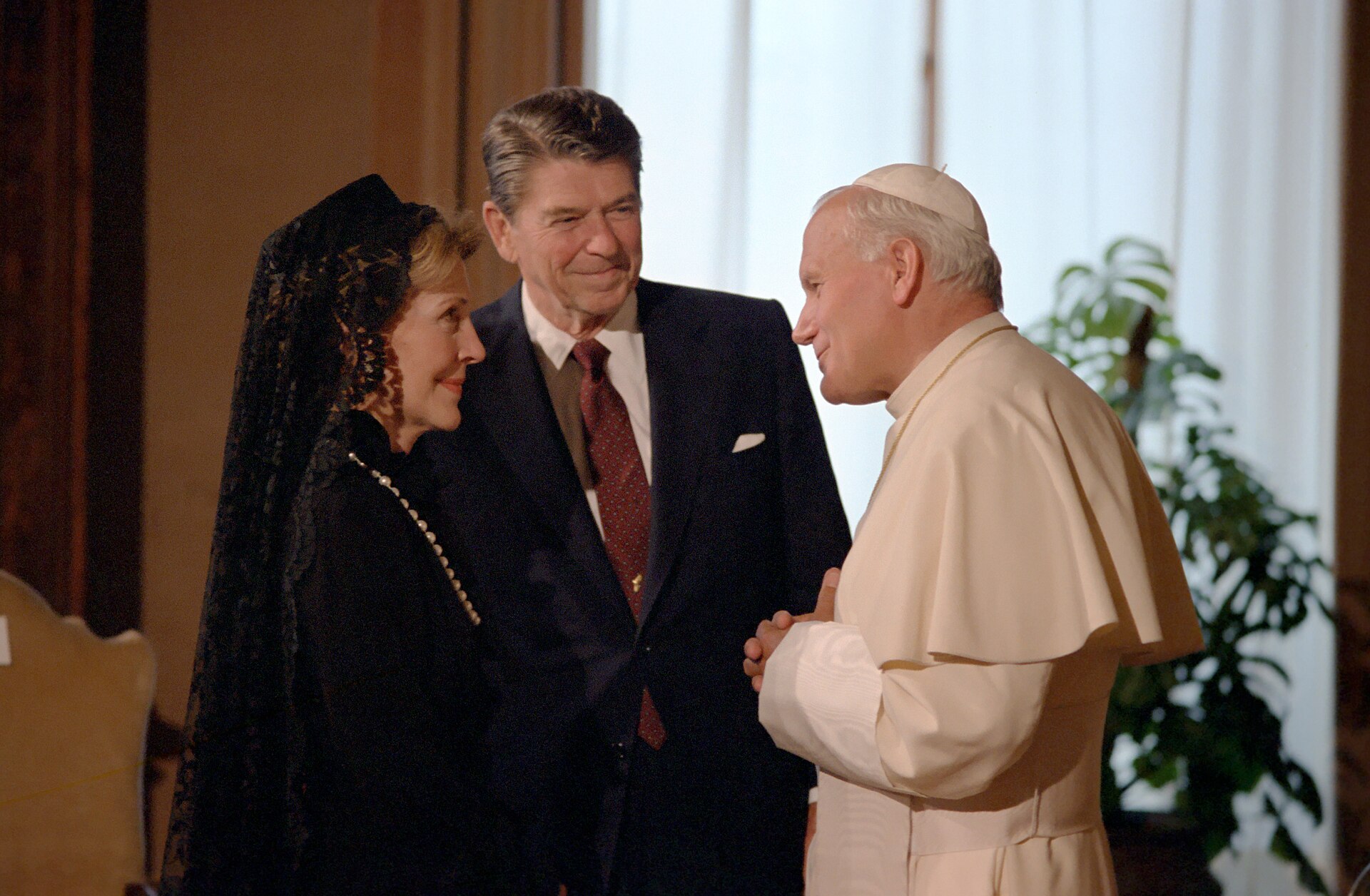 Pope John Paul II and then U.S. president Ronald Reagan (pictured with his wife Nancy) meeting in June 1982; both Pope John Paul II and Reagan were credited with contributing to the Revolutions of 1989, which led to the fall of communism and the end of the Cold War two years later, in 1991. During the 20th century, the church's global reach continued to grow, despite the rise of anti-Catholic authoritarian regimes and the collapse of European Empires, accompanied by a general decline in religious observance in the West. Under the popes Benedict XV and Pius XII the Holy See sought to maintain public neutrality through the World Wars, acting as peace broker and delivering aid to the victims of the conflicts. In the 1960s Pope John XXIII convened the Second Vatican Council, which ushered in radical change to church ritual and practice, and in the later 20th century the long papacy of Pope John Paul II contributed to the fall of communism in Europe, and a new public and international role for the papacy.[133][134] From the late 20th century, the Catholic Church has been criticized for its doctrines on sexuality, its inability to ordain women and its handling of sexual abuse cases. The Second Vatican Council (1962–65) introduced the most significant changes to Catholic practices since the Council of Trent, four centuries before.[135] Initiated by Pope John XXIII, this ecumenical council modernized the practices of the Catholic Church, allowing the Mass to be said in the vernacular (local language) and encouraging "fully conscious, and active participation in liturgical celebrations".[136] It intended to engage the church more closely with the present world (aggiornamento), which was described by its advocates as an "opening of the windows".[137] In addition to changes in the liturgy, it led to changes to the church's approach to ecumenism,[138] and a call to improved relations with non-Christian religions, especially Judaism, in its document Nostra aetate.[139] The council, however, generated significant controversy in implementing its reforms: proponents of the "Spirit of Vatican II" such as the Swiss theologian Hans Küng said that Vatican II had "not gone far enough" to change church policies.[140] Traditionalist Catholics, such as Archbishop Marcel Lefebvre, however, strongly criticized the council, arguing that its liturgical reforms led "to the destruction of the Holy Sacrifice of the Mass and the sacraments", among other issues.[141] The teaching on the morality of contraception also came under scrutiny; after a series of disagreements, Humanae vitae upheld the church's prohibition of all forms of contraception.[142][143][note 6][144] In 1978 Pope John Paul II, formerly Archbishop of Kraków in the Polish People's Republic, became the first non-Italian pope in 455 years. His 26 1/2-year pontificate was one of the longest in history and was credited with hastening the fall of communism in Europe.[145][146] John Paul II sought to evangelize an increasingly secular world. He travelled more than any other pope, visiting 129 countries,[147] and used television and radio as means of spreading the church's teachings. He also emphasized the dignity of work and natural rights of labourers to have fair wages and safe conditions in Laborem exercens.[148] He emphasized several church teachings, including moral exhortations against abortion, euthanasia and against the widespread use of capital punishment, in Evangelium Vitae.[149] |
20世紀 主な記事:20世紀のカトリック教会 第二次世界大戦中、ナチス・ドイツとイタリアのファシストによる占領からローマを解放したアンツィオの戦いの後、1944年7月4日に教皇ピウス12世と謁見したカナダ陸軍王立第22連隊の兵士たち 1960年代初頭の第二バチカン公会議で司教たちが聴講する様子 1982年6月、教皇ヨハネ・パウロ2世と当時のアメリカ大統領ロナルド・レーガン(妻ナンシーと写っている)の会談。教皇ヨハネ・パウロ2世とレーガン はともに、1989年の革命に貢献したと評価されている。この革命は2年後の1991年に共産主義の崩壊と冷戦の終結をもたらした。 20世紀を通じて、反カトリック的な権威主義体制の台頭やヨーロッパ帝国の崩壊、西洋における宗教的実践の全般的な衰退にもかかわらず、教会の世界的な影 響力は拡大し続けた。ベネディクト15世とピウス12世の教皇時代、聖座は世界大戦を通じて公的な中立性を維持しようと努め、和平仲介者として行動し、紛 争の犠牲者への支援を提供した。1960年代、教皇ヨハネ23世は第二バチカン公会議を招集し、教会の儀礼と慣行に抜本的な変革をもたらした。20世紀後 半には、教皇ヨハネ・パウロ2世の長期にわたる在位がヨーロッパにおける共産主義の崩壊に寄与し、教皇職に新たな公的・国際的役割をもたらした。 [133][134] 20世紀後半以降、カトリック教会は性に関する教義、女性の聖職者叙階の不可、性的虐待事件への対応について批判を受けている。 第二バチカン公会議(1962-65年)は、4世紀前のトレント公会議以来、カトリックの慣行に最も重要な変更をもたらした[135]。教皇ヨハネ23世 によって開始されたこの公会議は、カトリック教会の慣行を近代化し、ミサを現地語(母国語)で執り行うことを許可し、「典礼の祝典への完全な意識的かつ積 極的な参加」を奨励した。[136] これは教会を現代世界とより密接に関わらせる(アジョルナメント)ことを意図したもので、支持者らはこれを「窓を開けること」と表現した。[137] 典礼の変更に加え、公会議はエキュメニズムへの教会の姿勢の変化をもたらし、[138] 特にユダヤ教をはじめとする非キリスト教宗教との関係改善を『ノストラ・アエターテ』で呼びかけた。[139] しかし、公会議の改革実施には重大な論争が伴った。「第二バチカン公会議の精神」を主張するスイス人神学者ハンス・キュングらは、教会政策の変革において 公会議が「不十分であった」と述べた。[140] 一方、マルセル・ルフェーブル大司教のような伝統主義カトリック教徒は、公会議を強く批判した。彼らは、公会議の典礼改革が「聖なるミサの犠牲と秘跡の破 壊」など、様々な問題を引き起こしたと主張した。[141] 避妊の道徳性に関する教義も精査の対象となった。一連の意見の相違を経て、『人間の生命』は、あらゆる形態の避妊を禁止する教会の立場を支持した。 [142][143][注6][144] 1978年、ポーランド人民共和国のクラクフ大司教であったヨハネ・パウロ2世が、455年ぶりに非イタリア人教皇として即位した。彼の26年半にわたる 在位期間は史上最長級であり、ヨーロッパにおける共産主義崩壊を加速させたと評価されている。[145][146] ヨハネ・パウロ2世は、ますます世俗化する世界への布教を目指した。歴代教皇の中で最も多く、129カ国を訪問し[147]、テレビやラジオを教会の教え を広める手段として活用した。また『労働の行使』において、労働の尊厳と、労働者が公正な賃金と安全な労働条件を得る自然権を強調した。[148] 彼は『エヴァンジェリウム・ヴィタエ』において、中絶や安楽死、広範な死刑執行に対する道徳的勧告を含む、いくつかの教会の教えを強調した。[149] |
| 21st century Pope Benedict XVI, elected in 2005, was known for upholding traditional Christian values against secularization,[150] and for increasing use of the Tridentine Mass as found in the Roman Missal of 1962, which he titled the "Extraordinary Form".[151] Citing the frailties of advanced age, Benedict resigned in 2013, becoming the first pope to do so in nearly 600 years.[152] Pope Francis became in 2013 the first pope from the Americas, the first from the Southern Hemisphere and the first from outside Europe since the eighth-century Gregory III.[153][154] Francis made efforts to further close Catholicism's estrangement with the Eastern churches.[155] His installation was attended by Patriarch Bartholomew I of Constantinople of the Eastern Orthodox Church,[156] the first time since the Great Schism of 1054 that the Eastern Orthodox Ecumenical Patriarch of Constantinople has attended a papal installation,[157] while he also met Patriarch Kirill of Moscow, head of the largest Eastern Orthodox church, in 2016; this was reported as the first such high-level meeting between the two churches since the Great Schism of 1054.[158] In 2017 during a visit in Egypt, Pope Francis re-established mutual recognition of baptism with the Coptic Orthodox Church.[159] Pope Leo XIV was elected as Pope in the 2025 conclave, following the death of Francis. He is the first Augustinian pope, the first North American pope (born in Chicago in the United States), and the first pope of Peruvian citizenship.[160] |
21世紀の 教皇ベネディクト16世は、2005年に選出された。世俗化に対抗して伝統的なキリスト教的価値観を守り[150]、1962年ローマ典礼書に基づくトリ エント式ミサの使用を拡大したことで知られている。彼はこれを「特別形式」と呼んだ。[151] 高齢による衰弱を理由に、ベネディクトは2013年に辞任した。これは約600年ぶりの教皇辞任であった。[152] 2013年に就任した教皇フランシスコは、アメリカ大陸出身者としては初めて、南半球出身者としては初めて、そして8世紀のグレゴリウス3世以来ヨーロッ パ以外出身者としては初めての教皇となった[153][154]。フランシスコはカトリック教会と東方教会との隔たりをさらに縮める努力を行った。 [155] 彼の就任式には東方正教会のコンスタンティノープル総主教バルトロメオス1世が出席した[156]。これは1054年の大分裂以来、コンスタンティノープ ル総主教が教皇就任式に出席した初めての事例である[157]。また2016年には最大規模の東方正教会を率いるモスクワ総主教キリルとも会談した。これ は1054年の大分裂以来、両教会間で初めての高レベル会談と報じられた[158]。2017年にはエジプト訪問中に、教皇フランシスコはコプト正教会と の洗礼の相互承認を再確立した[159]。 フランシスコの死後、2025年のコンクラーベで教皇レオ14世が選出された。彼は初のアウグスチノ会出身教皇であり、初の北米出身教皇(アメリカ合衆国シカゴ生まれ)、そして初のペルー国籍を持つ教皇である。 |
| Organization Main articles: Hierarchy of the Catholic Church and Catholic Church by country 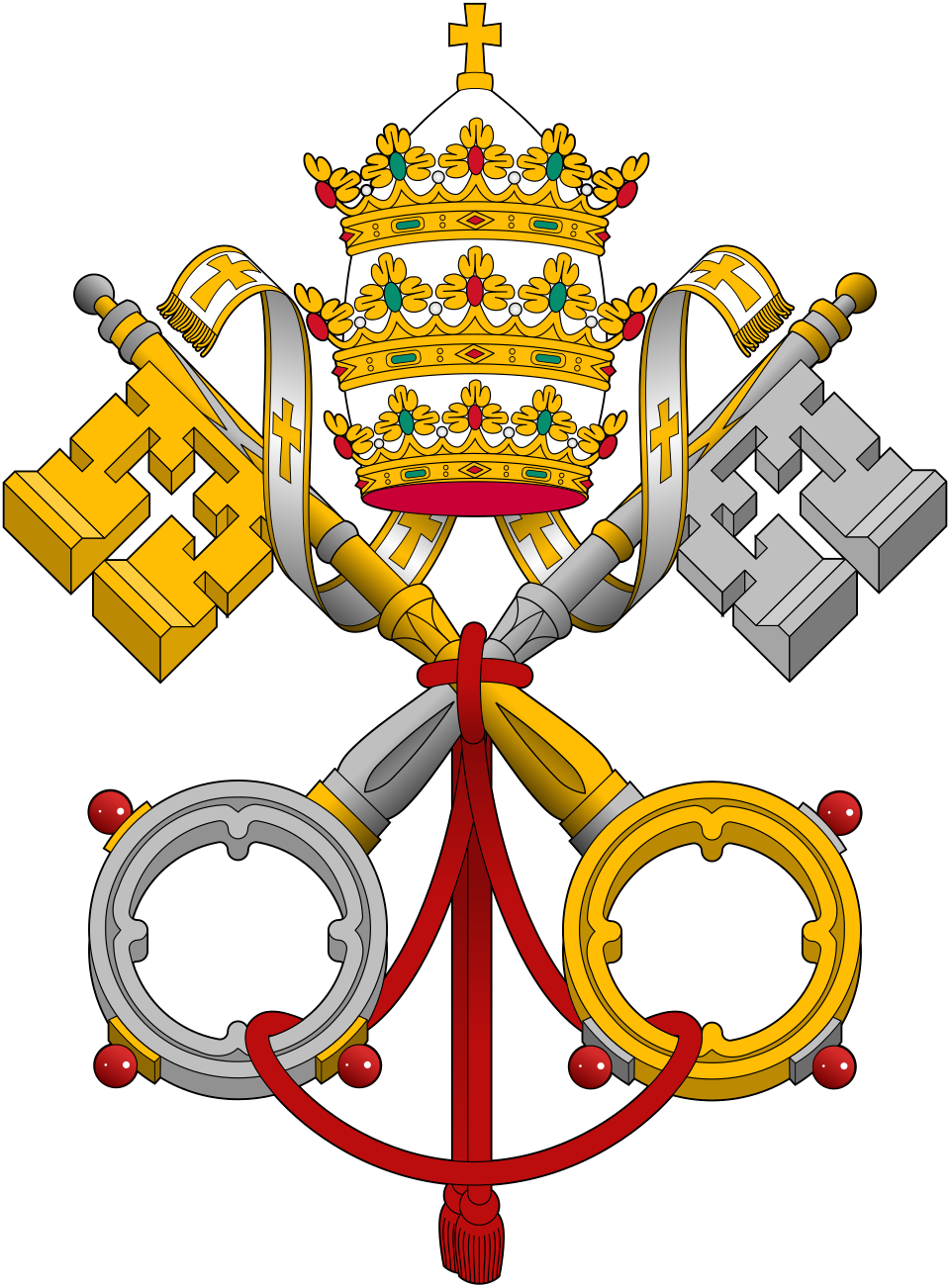 The crossed keys of the Holy See symbolize those of Simon Peter. The triple crown papal tiara symbolizes the triple power of the pope as "father of kings", "governor of the world" and "Vicar of Christ". The gold cross symbolizes the sovereignty of Jesus. The Catholic Church follows an episcopal polity, led by bishops who have received the sacrament of Holy Orders who are given formal jurisdictions of governance within the church.[161][162] There are three levels of clergy: the episcopate, composed of bishops who hold jurisdiction over a geographic area called a diocese or eparchy; the presbyterate, composed of priests ordained by bishops and who work in local dioceses or religious orders; and the diaconate, composed of deacons who assist bishops and priests in a variety of ministerial roles. Ultimately leading the entire Catholic Church is the bishop of Rome, known as the pope (Latin: papa, lit. 'father'), whose jurisdiction is called the Holy See (Sancta Sedes in Latin).[163] In parallel to the diocesan structure are a variety of religious institutes that function autonomously, often subject only to the authority of the pope, though sometimes subject to the local bishop. Most religious institutes only have male or female members but some have both. Additionally, lay members aid many liturgical functions during worship services. The Catholic Church has been described as the oldest multinational organization in the world.[164][165][166] |
組織 主な記事: カトリック教会の階層構造、国別カトリック教会 聖座の交差した鍵は、シモン・ペテロの鍵を象徴する。三重の冠である教皇のティアラは、教皇が「王たちの父」「世界の統治者」「キリストの代理人」という三重の権力を持つことを象徴する。金の十字架はイエスの主権を象徴する。 カトリック教会は主教制を採用している。聖職叙階の秘跡を受けた主教たちが指導し、教会内で正式な統治権限を与えられている。[161][162] 聖職者には三つの階層がある:司教職(主教区または教区と呼ばれる地理的区域を管轄する司教で構成)、司祭職(司教によって叙階され、地方教区や修道会で 働く司祭で構成)、助祭職(司教や司祭を様々な奉仕的役割で補佐する助祭で構成)。カトリック教会全体を最終的に統率するのはローマの司教、すなわち教皇 (ラテン語: papa、文字通り「父」)であり、その管轄区域は聖座(ラテン語: Sancta Sedes)と呼ばれる。[163] 教区構造と並行して、様々な修道会が自律的に機能している。これらは多くの場合教皇の権威のみに従うが、時には現地の司教の管轄下にあることもある。ほと んどの修道会は男性または女性のみを会員とするが、両方を擁する修道会もある。さらに、信徒会員は礼拝中の多くの典礼的役割を補助する。カトリック教会は 世界で最も古い多国籍組織と評されている。[164][165][166] |
| Holy See, papacy, Roman Curia, and College of Cardinals Main articles: Holy See, Pope, Roman Curia, and College of Cardinals Further information: List of popes 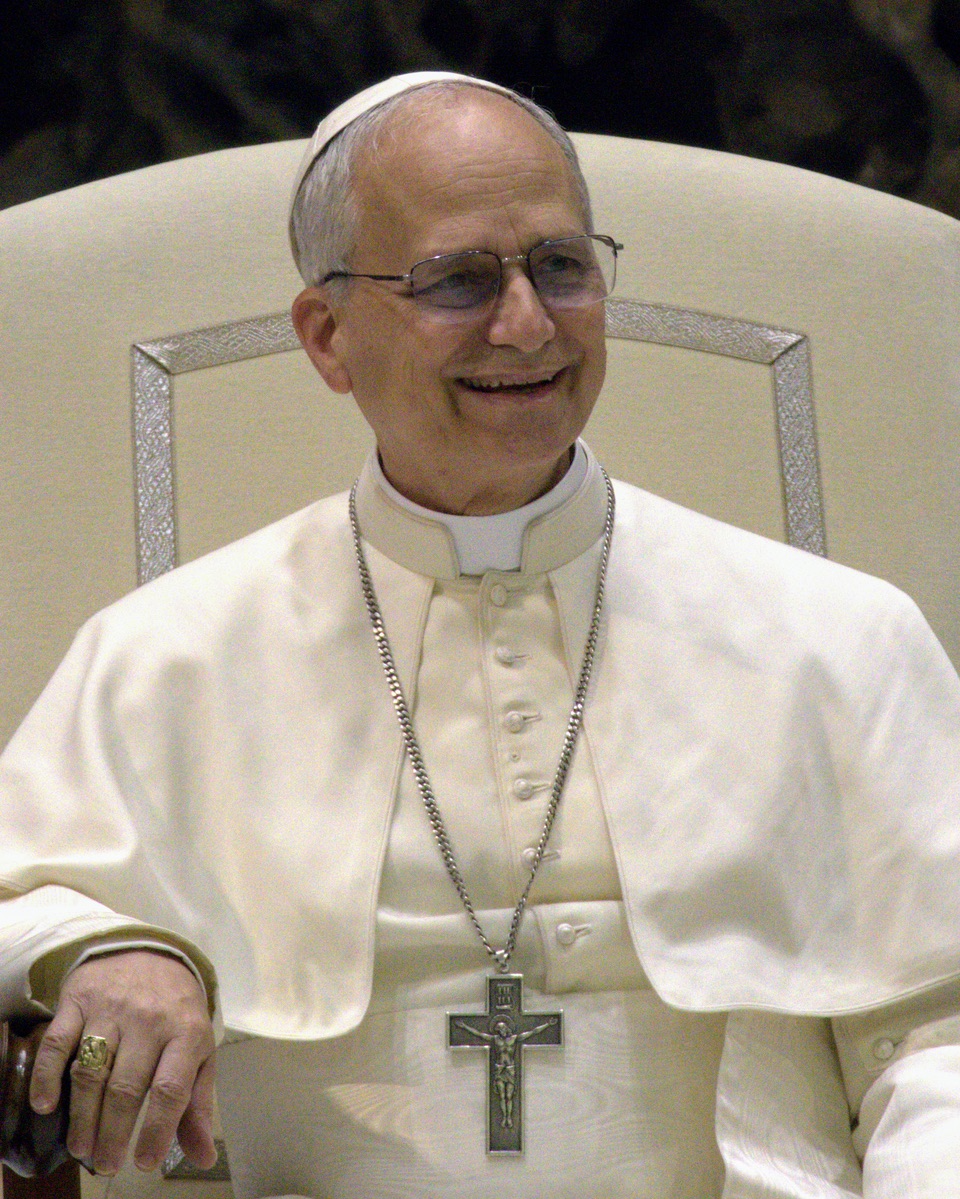 Pope Leo XIV, the 267th and current pope of the Catholic Church, a title he holds ex officio as bishop of Rome and sovereign of Vatican City, was elected in the 2025 papal conclave. The hierarchy of the Catholic Church is headed[note 7] by the pope, currently Pope Leo XIV, who was elected on 8 May 2025 by a papal conclave. The office of the pope is known as the papacy. The Catholic Church holds that Christ instituted the papacy upon giving the keys of Heaven to Saint Peter. His ecclesiastical jurisdiction is called the Holy See, or the Apostolic See (meaning the see of the apostle Peter).[172][173] Directly serving the pope is the Roman Curia, the central governing body that administers the day-to-day business of the Catholic Church.[174] The pope is also sovereign of Vatican City,[175] a small city-state entirely enclaved within the city of Rome, which is an entity distinct from the Holy See. It is as head of the Holy See, not as head of Vatican City State, that the pope receives ambassadors of states and sends them his own diplomatic representatives.[176] The position of cardinal is a rank of honour bestowed by popes on certain clerics, such as leaders within the Roman Curia, bishops serving in major cities and distinguished theologians. For advice and assistance in governing, the pope may turn to the College of Cardinals.[177] Following the death or resignation of a pope,[note 8] members of the College of Cardinals who are under age 80 act as an electoral college, meeting in a papal conclave to elect a successor.[179] Although the conclave may elect any male Catholic in the world as pope, since 1389 only cardinals have been elected.[180] |
ローマ教皇庁、教皇、ローマ教皇庁、枢機卿団 主な記事:ローマ教皇庁、教皇、ローマ教皇庁、枢機卿団 詳細情報:歴代教皇一覧 レオ14世は、カトリック教会の第267代かつ現教皇である。この称号は、ローマ司教およびバチカン市国の元首として当然に持つものである。彼は2025年の教皇選挙で選出された。 カトリック教会の階層構造は教皇によって統率される。現教皇レオ14世は2025年5月8日に教皇選挙会議で選出された。教皇の職位は教皇職と呼ばれる。 カトリック教会は、キリストが聖ペテロに天国の鍵を与えた際に教皇職を設立したと主張している。その教会管轄権は聖座、あるいは使徒座(使徒ペテロの座を 意味する)と呼ばれる。[172][173] 教皇に直接仕えるのはローマ教皇庁であり、カトリック教会の日常業務を管理する中央統治機関である。[174] 教皇はまた、ローマ市内に完全に囲まれた小規模な都市国家であるバチカン市国の元首でもある。このバチカン市国は聖座とは別の存在だ。教皇が国家の大使を 受け入れ、自らの外交使節を派遣するのは、バチカン市国の元首としてではなく、聖座の長としての立場によるものである。[176] 枢機卿の地位は、ローマ教皇庁内の指導者、主要都市で奉職する司教、著名な神学者など、特定の聖職者に教皇が授ける名誉の位階である。統治における助言と支援を得るため、教皇は枢機卿団に助力を求めることがある。[177] 教皇の死亡または辞任後[注8]、80歳未満の枢機卿団のメンバーは選挙人団として機能し、教皇選挙会議(コンクラーベ)に集まって後継者を選出する。 [179] コンクラーベは世界中のカトリック教徒の男性なら誰でも教皇に選出できるが、1389年以降、選出されたのは枢機卿のみである。[180] |
| Canon law Main article: Canon law of the Catholic Church See also: Catholic Church § Liturgy Catholic canon law (Latin: jus canonicum)[181] is the system of laws and legal principles made and enforced by the hierarchical authorities of the Catholic Church to regulate its external organization and government and to order and direct the activities of Catholics toward the mission of the church.[182] The canon law of the Latin Church was the first modern Western legal system,[183] and is the oldest continuously functioning legal system in the West,[184][185] while the distinctive traditions of Eastern Catholic canon law govern the 23 Eastern Catholic particular churches sui iuris.[186] Positive ecclesiastical laws, based directly or indirectly upon immutable divine law or natural law, derive formal authority in the case of universal laws from promulgation by the supreme legislator—the Supreme Pontiff—who possesses the totality of legislative, executive and judicial power in his person,[187] while particular laws derive formal authority from promulgation by a legislator inferior to the supreme legislator, whether an ordinary or a delegated legislator. The actual subject material of the canons is not just doctrinal or moral in nature, but all-encompassing of the human condition. It has all the ordinary elements of a mature legal system:[188] laws, courts, lawyers, judges,[188] a fully articulated legal code for the Latin Church[189] as well as a code for the Eastern Catholic Churches,[189] principles of legal interpretation,[190] and coercive penalties.[191][192] Canon law concerns the Catholic Church's life and organization and is distinct from civil law. In its own field it gives force to civil law only by specific enactment in matters such as the guardianship of minors.[193] Similarly, civil law may give force in its field to canon law, but only by specific enactment, as with regard to canonical marriages.[194] Currently, the 1983 Code of Canon Law is in effect for the Latin Church.[195] The distinct 1990 Code of Canons of the Eastern Churches (CCEO, after the Latin initials) applies to the autonomous Eastern Catholic Churches.[196] |
教会法 主な記事:カトリック教会の教会法 関連項目:カトリック教会 § 典礼 カトリック教会法(ラテン語: jus canonicum)[181]とは、カトリック教会の外部組織と統治を規制し、信徒の活動を教会の使命に向けて秩序づけ指導するために、教会の階層的権 威によって制定・施行される法体系および法的原則である。[182] ラテン教会の教会法は最初の近代的西洋法体系であり[183]、西洋で最も長く継続的に機能する法体系である[184][185]。一方、東方カトリック 教会法の特徴的な伝統は、23の東方カトリック特別教会(sui iuris)を統治している[186]。 正統な教会法は、不変の神法または自然法に直接的・間接的に基づいており、普遍法の場合、立法・行政・司法の全権をその身に有する最高立法者である教皇に よる公布によって形式的権威を得る[187]。一方、個別法は、最高立法者より下位の立法者(通常立法者または委任立法者)による公布によって形式的権威 を得る。教会法の実際の主題は、教義的・道徳的性質に留まらず、人間のあらゆる状態を包括するものである。成熟した法体系の通常の要素を全て備えている: [188] 法律、裁判所、弁護士、裁判官、[188] ラテン教会向けの完全に体系化された法典[189]、東方カトリック教会向けの法典[189]、法的解釈の原則[190]、強制力のある罰則[191] [192]。 教会法はカトリック教会の生活と組織に関わるものであり、市民法とは異なる。その領域においては、未成年者の後見などの事項について、特定の制定によって のみ市民法に効力を与える[193]。同様に、市民法もその領域において教会法に効力を与えることがあるが、教会法上の婚姻に関する場合のように、特定の 制定によってのみである。[194] 現在、ラテン教会には1983年制定のカノン法典が適用されている。[195] 一方、自治権を持つ東方カトリック教会には、別個の1990年制定東方教会カノン法典(CCEO:ラテン語頭字語)が適用される。[196] |
| Latin and Eastern churches Main articles: Catholic particular churches and liturgical rites, Latin Church, and Eastern Catholic Churches In the first thousand years of Catholic history, different varieties of Christianity developed in the Western and Eastern Christian areas of Europe, Asia and Africa. Though most Eastern-tradition churches are no longer in communion with the Catholic Church after the Great Schism of 1054 (as well as the earlier Nestorian Schism and Chalcedonian Schism), 23 autonomous particular churches of eastern traditions participate in the Catholic communion, also known as "churches sui iuris" (Latin: "of one's own right"). The largest and most well known is the Latin Church, the only Western-tradition church, with more than 1 billion members worldwide. Relatively small in terms of adherents compared to the Latin Church, are the 23 self-governing Eastern Catholic Churches with a combined membership of 17.3 million as of 2010.[197][198][199][200] The Latin Church is governed by the pope and diocesan bishops directly appointed by him. The pope exercises a direct patriarchal role over the Latin Church, which is considered to form the original and still major part of Western Christianity, a heritage of certain beliefs and customs originating in Europe and northwestern Africa, some of which are inherited by many Christian denominations that trace their origins to the Protestant Reformation.[201] The Eastern Catholic Churches follow the traditions and spirituality of Eastern Christianity and are churches that have always remained in full communion with the Catholic Church or who have chosen to re-enter full communion in the centuries following the East–West Schism or earlier divisions. These churches are communities of Catholic Christians whose forms of worship reflect distinct historical and cultural influences rather than differences in doctrine.[202] The pope's recognition of Eastern Catholic Churches has caused controversy in ecumenical relations with the Eastern Orthodox and other eastern churches. Historically, pressure to conform to the norms of the Western Christianity practised by the majority Latin Church led to a degree of encroachment (Liturgical Latinisation) on some of the Eastern Catholic traditions. The Second Vatican Council document, Orientalium Ecclesiarum, built on previous reforms to reaffirm the right of Eastern Catholics to maintain their distinct liturgical practices.[202] A church sui iuris is defined in the Code of Canons for the Eastern Churches as a "group of Christian faithful united by a hierarchy" that is recognized by the pope in his capacity as the supreme authority on matters of doctrine within the church.[203] The Eastern Catholic Churches are in full communion with the pope, but have governance structures and liturgical traditions separate from that of the Latin Church.[198] Some Eastern Catholic churches are governed by a patriarch who is elected by the synod of the bishops of that church,[204] others are headed by a major archbishop,[205] others are under a metropolitan,[206] and others are organized as individual eparchies.[207] Each church has authority over the particulars of its internal organization, liturgical rites, liturgical calendar and other aspects of its spirituality, subject only to the authority of the pope.[208] The Roman Curia has a specific department, the Congregation for the Oriental Churches, to maintain relations with them.[209] |
ラテン教会と東方教会 主な記事:カトリックの個別教会と典礼儀式、ラテン教会、東方カトリック教会 カトリックの歴史の最初の千年間に、ヨーロッパ、アジア、アフリカの西側と東側のキリスト教地域で、異なるキリスト教の形態が発展した。1054年の大分 裂(それ以前のネストリウス派分裂やカルケドン分裂も含む)以降、東方伝統の教会のほとんどはカトリック教会との交わりを失ったが、23の自治的な東方伝 統の教会がカトリックの交わりに参加している。これらは「教会 sui iuris」(ラテン語で「独自の権利を持つ教会」の意)とも呼ばれる。最大かつ最も有名なのはラテン教会であり、唯一の西洋伝統教会として世界中に10 億人以上の信徒を持つ。ラテン教会と比較すると信徒数が比較的少ないのは、23の自治的な東方カトリック教会であり、2010年時点で合計1,730万人 の信徒を有する。[197][198][199] [200] ラテン教会は教皇と、教皇が直接任命する教区司教によって統治される。教皇はラテン教会に対して直接的な家長的役割を行使する。ラテン教会は西洋キリスト 教の原初的かつ現在も主要な部分を形成すると考えられており、ヨーロッパと北西アフリカに起源を持つ特定の信仰や慣習の遺産である。その一部は、プロテス タント宗教改革に起源を遡る多くのキリスト教派にも受け継がれている。[201] 東方カトリック教会は、東方キリスト教の伝統と霊性を継承する教会である。これらは、カトリック教会と常に完全な交わりを保ってきた教会、あるいは東西教 会分裂やそれ以前の分裂後の数世紀に完全な交わりへの復帰を選択した教会である。これらの教会はカトリック・キリスト教徒の共同体であり、その礼拝形式は 教義の違いというより、異なる歴史的・文化的影響を反映している。[202] 教皇による東方カトリック教会の承認は、東方正教会やその他の東方教会とのエキュメニカルな関係において論争を引き起こした。歴史的に、多数派であるラテ ン教会が実践する西洋キリスト教の規範への順応圧力は、東方カトリックの伝統の一部に対する一定の侵食(典礼のラテン化)をもたらした。第二バチカン公会 議の文書『東方教会』は、これまでの改革を基盤とし、東方カトリック教徒が独自の典礼慣行を維持する権利を再確認した。[202] 教会法典(東方教会編)において、教会 sui iuris(自立法教会)とは「教会の教義に関する最高権威としての教皇によって承認された、階層組織によって結ばれたキリスト教信徒の集団」と定義され ている。[203] 東方カトリック教会は教皇と完全な交わりにあるが、ラテン教会とは別の統治構造と典礼伝統を有している。[198] 東方カトリック教会の中には、その教会の司教会議によって選出される総主教によって統治されるもの[204]、大司教によって統治されるもの[205]、 都主教によって統治されるもの[206]、そして個々の教区として組織されているものがある。[207] 各教会は、教皇の権威のみに従属しつつ、自らの内部組織、典礼儀式、典礼暦、その他の霊性に関する諸事項について権限を有する。[208] ローマ教皇庁には、東方教会との関係を維持するための専門部署として東方教会省が設置されている。[209] |
| Dioceses, parishes, organizations, and institutes Further information: List of Catholic dioceses (structured view), Parish in the Catholic Church, Religious institute, and Catholic charities Distribution of Catholics[210] 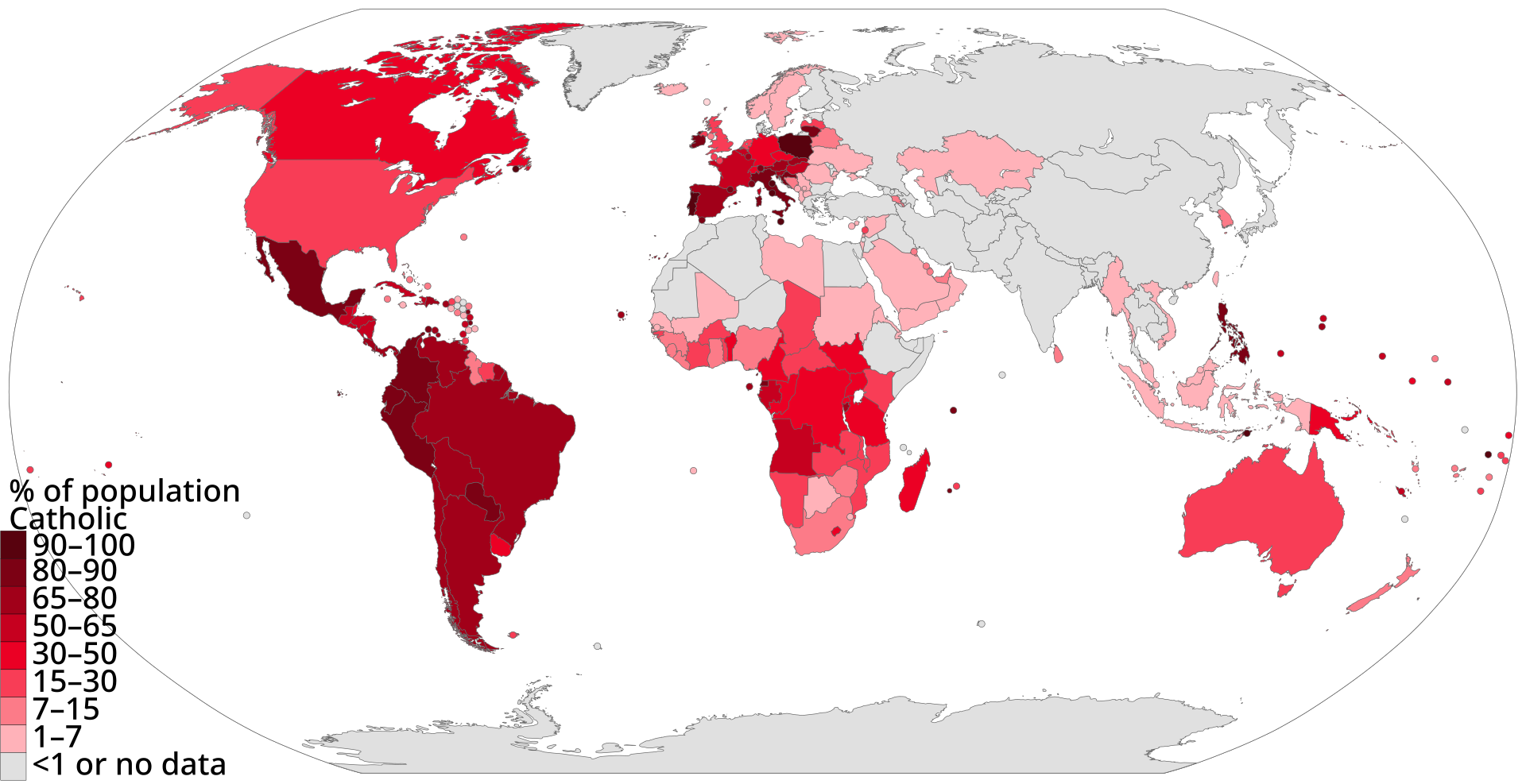 The percentage of Catholics by country, 2010 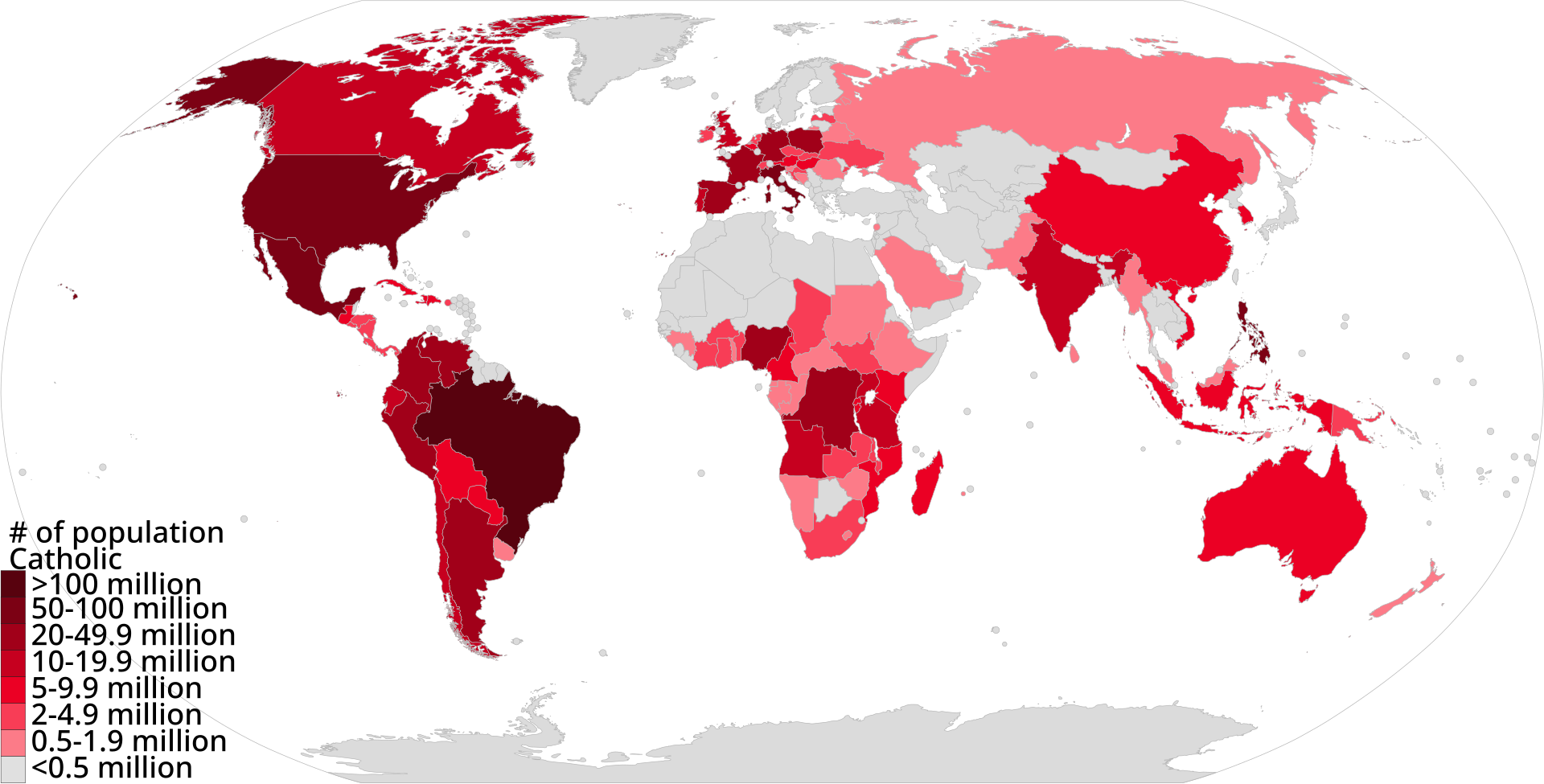 The number of Catholics by country, 2010 Individual countries, regions, and major cities are served by particular churches known as dioceses in the Latin Church, or eparchies in the Eastern Catholic Churches, each of which are overseen by a bishop. As of 2021, the Catholic Church has 3,171 dioceses globally.[211] The bishops in a particular country are members of a national or regional episcopal conference.[212] Dioceses are divided into parishes, each with one or more priests, deacons, or lay ecclesial ministers.[213] Parishes are responsible for the day to day celebration of the sacraments and pastoral care of the laity.[214] As of 2016 there are approximately 221,700 parishes worldwide.[7] In the Latin Church, Catholic men may serve as deacons or priests by receiving sacramental ordination. Men and women may serve as extraordinary ministers of Holy Communion, as readers (lectors), or as altar servers. Historically, boys and men have only been permitted to serve as altar servers; however, since the 1990s, girls and women have also been permitted.[215][note 9] Catholics may enter into consecrated life either on an individual basis, as a hermit or consecrated virgin, or by joining an institute of consecrated life (a religious institute or a secular institute) in which to take vows confirming their desire to follow the three evangelical counsels of chastity, poverty and obedience.[216] Examples of institutes of consecrated life are the Benedictines, the Carmelites, the Dominicans, the Franciscans, the Missionaries of Charity, the Legionaries of Christ and the Sisters of Mercy.[216] "Religious institutes" is a modern term encompassing both "religious orders" and "religious congregations", which were once distinguished in canon law.[217] The terms "religious order" and "religious institute" tend to be used as synonyms colloquially.[218] By means of Catholic charities and beyond, the Catholic Church is the largest non-government provider of education and health care in the world.[25] |
教区、小教区、組織、修道会 詳細情報:カトリック教区一覧(構造化表示)、カトリック教会における小教区、修道会、カトリック慈善団体 カトリック信者の分布[210] 国別カトリック信者比率(2010年) 国別カトリック信者数(2010年) 個々の国、地域、主要都市は、ラテン教会では教区、東方カトリック教会では教区(エパルキア)と呼ばれる特定の教会によって管轄されている。各教区は司教 によって監督される。2021年現在、カトリック教会は全世界に3,171の教区を有している[211]。特定の国の司教たちは、全国または地域の司教協 議会に所属している。[212] 教区は小教区に分割され、各小教区には1人以上の司祭、助祭、または平信徒教会奉仕者が配置される。[213] 小教区は日常的な秘跡の執行と信徒の牧会を担当する。[214] 2016年時点で、世界には約221,700の小教区が存在する。[7] ラテン教会において、カトリックの男性は秘跡による叙階を受けることで助祭または司祭として奉仕できる。男女ともに聖体拝領の臨時奉仕者、朗読者(レク ター)、祭壇奉仕者として奉仕できる。歴史的には、祭壇奉仕者は少年と男性のみが許可されていたが、1990年代以降、少女と女性も許可されるようになっ た。[215][注9] カトリック教徒は、隠者や奉献された処女として個人で奉献生活に入るか、奉献生活団体(修道会または世俗修道会)に加入し、貞潔・貧困・服従という三つの 福音的勧告に従う意志を誓願によって確認する。[216] 聖職生活の修道会の例としては、ベネディクト会、カルメル会、ドミニコ会、フランシスコ会、愛の宣教者会、キリストの軍団、慈悲の姉妹会などがある。 [216] 「宗教団体」は、かつて教会法で区別されていた「修道会」と「修道会」の両方を包括する現代的な用語である。[217] 「修道会」と「修道会」という用語は、口語的には同義語として使われる傾向がある。[218] カトリック慈善団体などを通じて、カトリック教会は世界で最大の非政府系教育・健康提供者である。[25] |
| Membership Main article: Catholic Church by country Further information: List of Christian denominations by number of members View source data. 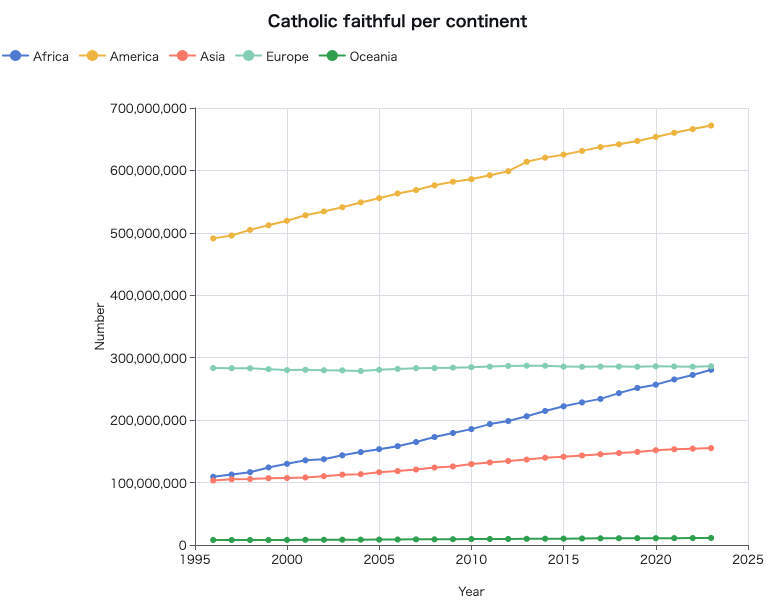 View source data. 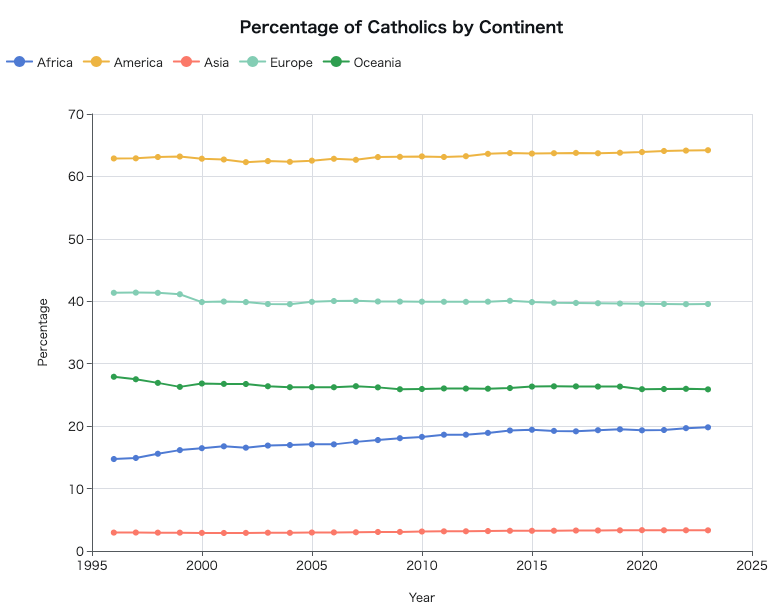 Geographic distribution of Catholics in 2023[5] 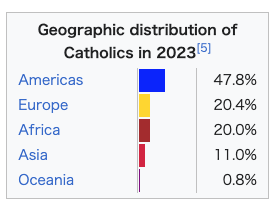 Americas 47.8% Europe 20.4% Africa 20.0% Asia 11.0% Oceania 0.8% As of 2020 Catholicism is the second-largest religious body in the world after Sunni Islam.[219] Catholics represent about half of all Christians.[220] According to the World Christian Database, there are 1.272 billion Catholics globally, as of 2025.[4] According to the Annuario Pontificio, church membership, defined as baptized Catholics, was 1.406 billion at the end of 2023, which was 17.4% of the world population:[5] Under Pope Francis the church membership grew by almost 11%, with growth concentrated in Africa and loss in Europe.[221] Brazil has the largest Catholic population in the world, followed by Mexico, the Philippines and the United States.[222] Geographic distribution of Catholics worldwide continues to shift, with 20.0% in Africa, 47.8% in the Americas, 11.0% in Asia, 20.4% in Europe and 0.8% in Oceania.[5] Catholic ministers include ordained clergy, lay ecclesial ministers, missionaries and catechists. Also as of the end of 2023, there were 463,859 ordained clergy, including 5,430 bishops, 406,996 priests (diocesan and religious) and 51,433 deacons (permanent).[5] Non-ordained ministers, as at October 2024, include 2,883,049 catechists and 413,561 lay missionaries.[223] Catholics who have committed to religious or consecrated life instead of marriage or single celibacy, as a state of life or relational vocation, include 49,414 male religious (as of 2022) and 589,423 women religious (as of 2023). These are not ordained, nor generally considered ministers unless also engaged in one of the lay minister categories above.[5] |
会員数 主な記事: 国別カトリック教会 詳細情報: 会員数別キリスト教宗派一覧 ソースデータを参照。 ソースデータを参照。 2023年のカトリック教徒の地理的分布[5] アメリカ大陸 47.8% ヨーロッパ 20.4% アフリカ 20.0% アジア 11.0% オセアニア 0.8% 2020年現在、カトリックはスンニ派イスラム教に次いで世界第2位の宗教団体である[219]。カトリック教徒は全キリスト教徒の約半数を占める [220]。世界キリスト教データベースによれば、2025年時点で世界のカトリック教徒は12億7200万人である。[4] 教皇庁年鑑によれば、洗礼を受けたカトリック信徒を教会会員と定義した場合、2023年末の会員数は14億600万人で、世界人口の17.4%を占めた。 [5] 教皇フランシスコの治世下で教会会員数は約11%増加し、その増加は主にアフリカで集中し、ヨーロッパでは減少した。[221] カトリック信者数が世界最多の国はブラジルであり、次いでメキシコ、フィリピン、アメリカ合衆国が続く。[222] カトリック信者の地理的分布は変化を続けており、アフリカが20.0%、アメリカ大陸が47.8%、アジアが11.0%、ヨーロッパが20.4%、オセアニアが0.8%を占める。[5] カトリックの聖職者には、叙階された聖職者、平信徒教会奉仕者、宣教師、教理教師が含まれる。また2023年末時点で、叙階された聖職者は463,859 名おり、内訳は司教5,430名、司祭(教区司祭・修道司祭)406,996名、助祭(終身助祭)51,433名である。[5] 2024年10月時点の非聖職者には、2,883,049人のカテキスタと413,561人の信徒宣教師が含まれる。[223] 結婚や独身生活ではなく、生活状態または関係的召命として宗教生活や奉献生活を選んだカトリック信徒には、男性修道者49,414人(2022年時点)と 女性修道者589,423人(2023年時点)が含まれる。これらは聖職者ではなく、上記の信徒奉仕者のいずれかに従事していない限り、一般的に奉仕者と 見なされない。[5] |
| Doctrine Main article: Catholic theology Catholic doctrine has developed over the centuries, reflecting direct teachings of early Christians, formal definitions of heretical and orthodox beliefs by ecumenical councils and in papal bulls, and theological debate by scholars. The church believes that it is continually guided by the Holy Spirit as it discerns new theological issues and is protected infallibly from falling into doctrinal error when a firm decision on an issue is reached.[224][225] It teaches that revelation has one common source, God, and two distinct modes of transmission: Sacred Scripture and Sacred Tradition,[226][227] and that these are authentically interpreted by the Magisterium.[228][229] Sacred Scripture consists of the 73 books of the Catholic Bible, consisting of 46 Old Testament and 27 New Testament writings. Sacred Tradition consists of those teachings believed by the church to have been handed down since the time of the Apostles.[230] Sacred Scripture and Sacred Tradition are collectively known as the "deposit of faith" (depositum fidei in Latin). These are in turn interpreted by the Magisterium (from magister, Latin for "teacher"), the church's teaching authority, which is exercised by the pope and the College of Bishops in union with the pope.[231] Catholic doctrine is authoritatively summarized in the Catechism of the Catholic Church, published by the Holy See.[232][233] |
教義 主な記事: カトリック神学 カトリックの教義は、初期キリスト教徒の直接的な教え、公会議や教皇勅書による異端と正統信仰の公式定義、そして学者による神学的議論を反映しながら、数 世紀にわたり発展してきた。教会は、新たな神学的問題を識別する際に聖霊によって絶えず導かれ、問題について確固たる決定がなされた際には、教義上の誤り に陥ることから間違いなく守られていると信じている。[224][225] 啓示には一つの共通の源である神と、二つの異なる伝達様式、すなわち聖書と聖伝がある[226][227]と教え、これらは教導権によって真正に解釈され る[228][229]。聖書はカトリック聖書の73巻から成り、旧約聖書46書と新約聖書27書で構成される。聖伝は、使徒たちの時代から教会によって 受け継がれてきたと信じられている教えから成る。聖書と聖伝は合わせて「信仰の宝庫」(ラテン語でdepositum fidei)と呼ばれる。これらは教導権(ラテン語 magister「教師」に由来)によって解釈される。教導権とは教会の教導権威であり、教皇と教皇と一致する司教団によって行使される。[231] カトリック教義は、聖座が発行する『カトリック教会のカテキズム』に権威をもって要約されている。[232][233] |
| Nature of God Main article: Trinity 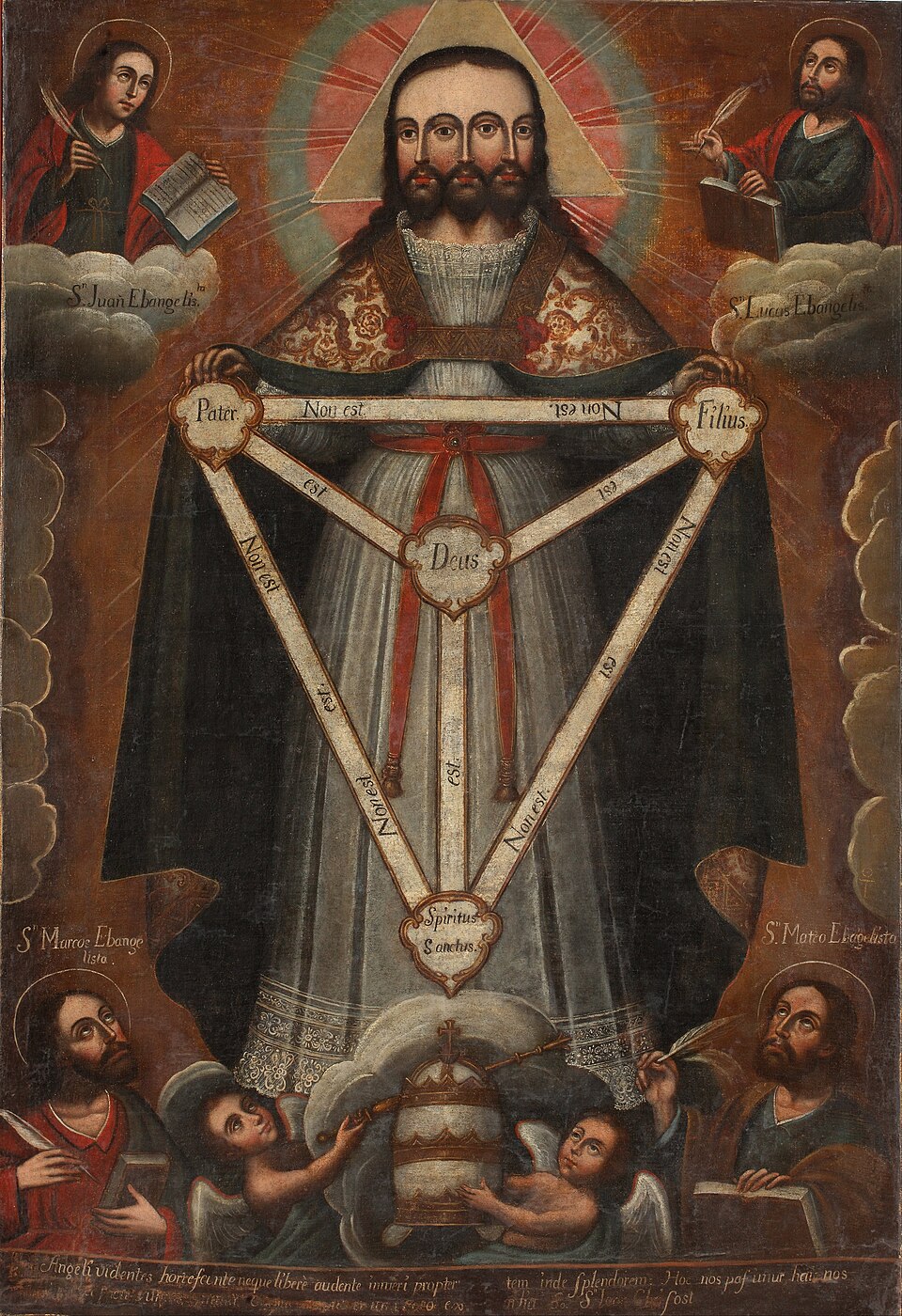 An anonymous 18th century Catholic painting from the Peruvian Cuzco School. This work depicts the Holy Triune God; one in essence, with three persons; holding the theological diagram of the Shield of the Trinity. The Catholic Church holds that there is one eternal God, who exists as a perichoresis ("mutual indwelling") of three hypostases, or "persons": God the Father; God the Son; and God the Holy Spirit (also called the Holy Ghost), which together are called the "Holy Trinity".[234] Catholics believe that Jesus Christ is the "Second Person" of the Trinity, God the Son. In an event known as the Incarnation, through the power of the Holy Spirit, God became united with human nature through the conception of Christ in the womb of the Blessed Virgin Mary. Christ, therefore, is understood as being both fully divine and fully human, including possessing a human soul. It is taught that Christ's mission on earth included giving people his teachings and providing his example for them to follow as recorded in the four Gospels.[235] Jesus is believed to have remained sinless while on earth, and to have allowed himself to be unjustly executed by crucifixion, as a sacrifice of himself to reconcile humanity to God; this reconciliation is known as the Paschal Mystery.[236] The Greek term "Christ" and the Hebrew "Messiah" both mean "anointed one", referring to the Christian belief that Jesus' death and resurrection are the fulfilment of the Old Testament's messianic prophecies.[237] The Catholic Church teaches dogmatically that "the Holy Spirit proceeds eternally from the Father and the Son, not as from two principles but as from one single principle".[238] It holds that the Father, as the "principle without principle", is the first origin of the Spirit, but also that he, as Father of the only Son, is with the Son the single principle from which the Spirit proceeds.[239] This belief is expressed in the Filioque clause which was added to the Latin version of the Nicene Creed of 381 but not included in the Greek versions of the creed used in Eastern Christianity.[240] |
神の性質 主な記事:三位一体 18世紀のペルー・クスコ派の無名カトリック画家による絵画。この作品は三位一体の神を描いている。本質において一つでありながら三つの人格を持ち、三位一体の盾の神学的図式を掲げている。 カトリック教会は、永遠の神が唯一存在し、三つの人格(または「人格」)である父なる神、子なる神、聖霊なる神(聖霊とも呼ばれる)の相互内在(ペリコレシス)として存在すると主張する。これら三つは合わせて「聖三位一体」と呼ばれる。[234] カトリック教徒は、イエス・キリストが三位一体の「第二位格」、すなわち神の子であると信じる。受肉と呼ばれる出来事において、聖霊の力により、神は聖母 マリアの胎内でキリストが受胎したことで人間性と一体となった。したがってキリストは、人間の魂を含む完全なる神性かつ完全なる人間性を持つ存在と理解さ れる。キリストの地上における使命は、四福音書に記録されているように、人々に教えを与え、模範を示すことだったと教えられる。[235] イエスは地上にいた間、罪を犯さず、人類を神と和解させるための自己犠牲として、不当な十字架刑による処刑を受け入れたと信じられている。この和解は復活 の神秘として知られる。[236] ギリシャ語の「キリスト」とヘブライ語の「メシア」はどちらも「油注がれた者」を意味し、イエスの死と復活が旧約聖書のメシア的預言の成就であるというキ リスト教の信仰を指す。[237] カトリック教会は教義上、「聖霊は父と子から永遠に発する。二つの原理からではなく、一つの原理からである」と教える。[238] 父は「原理なき原理」として聖霊の第一の起源であると同時に、独り子なる子の父として、子と共に聖霊が発する唯一の原理であると主張する。この信仰は、 381年のニカイア信条のラテン語版に追加された「フィリオクエ」条項で表現されているが、東方キリスト教で使用される信条のギリシャ語版には含まれてい ない。 |
| Nature of the church Main article: Catholic ecclesiology The Catholic Church teaches that it is the "one true church",[15][241] "the universal sacrament of salvation for the human race",[242][243] and "the one true religion".[244] According to the Catechism, the Catholic Church is further described in the Nicene Creed as the "one, holy, catholic, and apostolic Church".[245] These are collectively known as the Four Marks of the Church. The church teaches that its founder is Jesus Christ.[246][47] The New Testament records several events considered integral to the establishment of the Catholic Church, including Jesus' activities and teaching and his appointment of the apostles as witnesses to his ministry, suffering, and resurrection. The Great Commission, after his resurrection, instructed the apostles to continue his work. The coming of the Holy Spirit upon the apostles, in an event known as Pentecost, is seen as the beginning of the public ministry of the Catholic Church.[50] The church teaches that all duly consecrated bishops have a lineal succession from the apostles of Christ, known as apostolic succession.[247] In particular, the Bishop of Rome (the pope) is considered the successor to the apostle Simon Peter, a position from which he derives his supremacy over the church.[248] Catholic belief holds that the church "is the continuing presence of Jesus on earth"[249] and that it alone possesses the full means of salvation.[250] Through the passion (suffering) of Christ leading to his crucifixion as described in the Gospels, it is said Christ made himself an oblation to God the Father to reconcile humanity to God;[251] the Resurrection of Jesus makes him the firstborn from the dead, the first among many brethren.[252] By reconciling with God and following Christ's words and deeds, an individual can enter the Kingdom of God.[253] The church sees its liturgy and sacraments as perpetuating the graces achieved through Christ's sacrifice to strengthen a person's relationship with Christ and aid in overcoming sin.[254] |
教会の本質 主な記事:カトリック教会論 カトリック教会は、自らが「唯一の真の教会」[15][241]、「人類のための普遍的な救いの秘跡」[242][243]、「唯一の真の宗教」 [244]であると教える。カテキズムによれば、カトリック教会はニカイア信条においてさらに「唯一、聖なる、カトリック、使徒的教会」と表現される。 [245] これらは総称して「教会の四つの特徴」と呼ばれる。教会はその創設者がイエス・キリストであると教える。[246][47] 新約聖書は、カトリック教会の設立に不可欠とみなされるいくつかの出来事を記録している。これには、イエスの活動と教え、そして彼の宣教、苦悩、復活の証 人として使徒たちを任命したことが含まれる。復活後の大宣教命令は、使徒たちにその業を継続するよう命じた。ペンテコステとして知られる出来事における使 徒たちへの聖霊降臨は、カトリック教会の公的宣教活動の始まりと見なされている。[50] 教会は、正式に叙階されたすべての司教が、キリストの使徒たちからの直系継承、すなわち使徒継承を有すると教える。[247] 特にローマの司教(教皇)は使徒シモン・ペテロの後継者とされ、この地位から教会に対する至上権を導いている。[248] カトリックの信仰によれば、教会は「地上におけるイエスの継続的な現存」[249]であり、救いの完全な手段を唯一有する。[250] 福音書に記されるキリストの苦悩(受難)とそれに続く十字架刑を通じて、キリストは自らを父なる神への捧げ物とし、人類を神と和解させたとされる。 [251] イエスの復活は、彼を死者の中から最初に生まれた者、多くの兄弟たちの長子とする。[252] 神と和解し、キリストの言葉と行いに従うことで、個人は神の王国に入ることができる。[253] 教会は自らの典礼と秘跡を、キリストの犠牲によって達成された恵みを永続させるものとして見ている。それは人格のキリストとの関係を強め、罪を克服する助 けとなるのである。[254] |
| Final judgement Main article: Last Judgment § Catholicism The Catholic Church teaches that, immediately after death, the soul of each person will receive a particular judgement from God, based on their sins and their relationship to Christ.[255][256] This teaching also attests to another day when Christ will sit in universal judgement of all mankind. This final judgement, according to the Church's teaching, will bring an end to human history and mark the beginning of both a new and better heaven and earth ruled by God in righteousness.[257] Depending on the judgement rendered following death, it is believed that a soul may enter one of three states of the afterlife: Heaven is a state of unending union with the divine nature of God, not ontologically, but by grace. It is an eternal life, in which the soul contemplates God in ceaseless beatitude.[258] Purgatory is a temporary condition for the purification of souls who, although destined for Heaven, are not fully detached from sin and thus cannot enter Heaven immediately.[259] In Purgatory, the soul suffers, and is purged and perfected. Souls in purgatory may be aided in reaching heaven by the prayers of the faithful on earth and by the intercession of saints.[260] Final Damnation: Finally, those who persist in living in a state of mortal sin and do not repent before death subject themselves to hell, an everlasting separation from God.[261] The church teaches that no one is condemned to hell without having freely decided to reject God.[262] No one is predestined to hell and no one can determine with absolute certainty who has been condemned to hell.[263] Catholicism teaches that through God's mercy a person can repent at any point before death, be illuminated with the truth of the Catholic faith, and thus obtain salvation.[264] Some Catholic theologians have speculated that the souls of unbaptized infants and non-Christians without mortal sin but who die in original sin are assigned to limbo, although this is not an official dogma of the church.[265] While the Catholic Church teaches that it alone possesses the full means of salvation,[250] it also acknowledges that the Holy Spirit can make use of Christian communities separated from itself to "impel towards Catholic unity"[266] and "tend and lead toward the Catholic Church",[266] and thus bring people to salvation, because these separated communities contain some elements of proper doctrine, albeit admixed with errors. It teaches that anyone who is saved is saved through the Catholic Church but that people can be saved outside of the ordinary means known as baptism of desire, and by pre-baptismal martyrdom, known as baptism of blood, as well as when conditions of invincible ignorance are present, although invincible ignorance in itself is not a means of salvation.[267] The Vatican II document Lumen gentium further clarifies the possibility of salvation of those who "through no fault of their own, do not know the Gospel of Christ or his Church, but who nevertheless seek God with a sincere heart," being "moved by (divine) grace"."CCC, 847". Vatican.va. |
最後の審判 主な記事: 最後の審判 § カトリック教 カトリック教会は、死後直ちに、各人の魂は自らの罪とキリストとの関係に基づいて、神から個別審判を受けると教える。[255][256] この教えはまた、キリストが全人類に対する普遍的審判を行う別の日を証言している。教会の教えによれば、この最終審判は人類の歴史に終止符を打ち、神の正 義によって支配される新しくより良い天と地の始まりを告げるものである。[257] 死後の裁きによって、魂は三つの来世の状態のいずれかに入るものと信じられている: 天国とは、神の本質との終わりのない結合の状態である。それは存在論的にはではなく、恵みによって実現される。魂が絶え間ない至福の中で神を凝視する永遠の生命である。[258] 煉獄は、天国行きが定められているものの、罪から完全に離脱しておらず、したがって直ちに天国に入ることができない魂が、浄化を受けるための一時的な状態 である。[259] 煉獄において、魂は苦悩し、清められ、完全なものとなる。煉獄の魂は、地上の信徒の祈りと聖人の取り次ぎによって、天国に至る助けを得ることができる。 [260] 最終的破滅:最後に、致命的な罪の状態に生き続け、死の前に悔い改めない者は、地獄、すなわち神からの永遠の分離に自らを委ねる。[261] 教会は、神を拒むことを自由に決断せずに地獄に裁かれる者はいないと教える。[262] 地獄に予め定められている者はおらず、誰が地獄に裁かれたかを絶対的な確信をもって決定できる者もいない。[263] カトリック教義によれば、神の慈悲により人は死の直前まで悔い改め、カトリック信仰の真理に照らされ、それによって救いを得ることができる。[264] 一部のカトリック神学者は、洗礼を受けていない幼児や、致命的な罪を犯さずに原罪のまま死んだ非キリスト教徒の魂は、リンボ(煉獄)に置かれると推測して いるが、これは教会の公式な教義ではない。[265] カトリック教会は、救いの完全な手段を自らが独占的に有すると教える一方で[250]、聖霊が自らから分離したキリスト教共同体をも用いて「カトリックの 統一へと駆り立てる」[266]ことや「カトリック教会へと導く」[266]ことを認め、それによって人々を救いに至らせるとする。なぜなら、これらの分 離した共同体には誤りと混ざり合いながらも、正しい教義の要素が一部含まれているからである。カトリック教会は、救われる者は皆カトリック教会を通じて救 われると教えるが、通常の手段である「望みの洗礼」以外でも、洗礼前の殉教(血の洗礼)や、不可抗力の無知の状態にある場合にも救われる可能性があると認 めている。ただし不可抗力の無知そのものが救いの手段ではない。[267] 第二バチカン公会議の文書『諸国民の光』はさらに、「自らの過失によらずキリストの福音や教会を知らないが、誠実な心で神を求め、神の恵みに動かされてい る者」の救いの可能性を明確にしている。 |
| Saints and devotions Main articles: Saint, Canonization, Veneration, and Catholic devotions A saint (also historically known as a hallow) is a person who is recognized as having an exceptional degree of holiness or likeness or closeness to God, while canonization is the act by which a Christian church declares that a person who has died was a saint, upon which declaration the person is included in the "canon", or list, of recognized saints.[268][269] The first persons honoured as saints were the martyrs. By the fourth century, however, "confessors"—people who had confessed their faith not by dying but by suffering—began to be venerated publicly.[270] In the Catholic Church, both in Latin and Eastern Catholic churches, the act of canonization is reserved to the Apostolic See and occurs at the conclusion of a long process requiring extensive proof that the candidate for canonization lived and died in such an exemplary and holy way that he is worthy to be recognized as a saint. The church's official recognition of sanctity implies that the person is now in Heaven and that he may be publicly invoked and mentioned officially in the liturgy of the church, including in the Litany of the Saints. Canonization allows universal veneration of the saint in the liturgy of the Roman Rite; for permission to venerate merely locally, only beatification is needed.[271] Devotions are "external practices of piety" which are not part of the official liturgy of the Catholic Church but are part of the popular spiritual practices of Catholics.[272] These include various practices regarding the veneration of the saints, especially veneration of the Virgin Mary. Other devotional practices include the Stations of the Cross, the Sacred Heart of Jesus, the Holy Face of Jesus,[273] the various scapulars, novenas to various saints,[274] pilgrimages[275] and devotions to the Blessed Sacrament,[274] and the veneration of saintly images such as the santos.[276] The bishops at the Second Vatican Council reminded Catholics that "devotions should be so drawn up that they harmonize with the liturgical seasons, accord with the sacred liturgy, are in some fashion derived from it, and lead the people to it, since, in fact, the liturgy by its very nature far surpasses any of them."[277] |
聖人と信仰 主な項目:聖人、列聖、崇敬、カトリックの信仰 聖人(歴史的には聖者とも呼ばれる)とは、並外れた聖性、あるいは神への類似性や親密さを備えた人物として認められた者を指す。一方、列聖とはキリスト教 教会が、亡くなった人物が聖人であったと宣言する行為であり、この宣言によってその人物は公認された聖人の一覧である「聖人名簿」に追加される。 [268] 最初に聖人として称えられたのは殉教者たちであった。しかし4世紀までに、「告白者」——死ではなく苦悩によって信仰を告白した人々——が公に崇敬される ようになった。 カトリック教会において、ラテン教会と東方カトリック教会の双方で、列聖の行為は使徒座にのみ認められており、列聖候補者が聖人として認められるに値する ほど模範的で聖なる生き方と死に方をしたとの広範な証拠を必要とする長い過程を経て行われる。教会による聖性の公式認定は、その人格が今や天国に存在し、 公に祈願され、聖人列挙を含む教会の典礼において公式に言及されることを意味する。列聖により、ローマ典礼における聖人への普遍的崇敬が認められる。地域 限定の崇敬を許可するには、列福のみが必要である。[271] 信心行いは「外部的な敬虔の実践」であり、カトリック教会の公式典礼の一部ではないが、信徒の一般的な霊的実践の一部である[272]。これには聖人崇 敬、特に聖母マリア崇敬に関する様々な実践が含まれる。その他の敬虔な実践には、十字架の道行き、イエスの聖心、イエスの聖顔[273]、様々なスカプラ リウム、様々な聖人へのノベナ[274]、巡礼[275]、聖体の崇敬[274]、そしてサントスなどの聖なる像への崇敬がある。[276] 第二バチカン公会議の司教たちはカトリック教徒に対し、「敬虔な行いは、典礼の季節と調和し、聖なる典礼と一致し、何らかの形で典礼に由来し、人々を典礼 へと導くように構成されるべきである。なぜなら、実際、典礼はその本質において、いかなる敬虔な行いをもはるかに凌駕するからである」と指摘した。 [277] |
Virgin Mary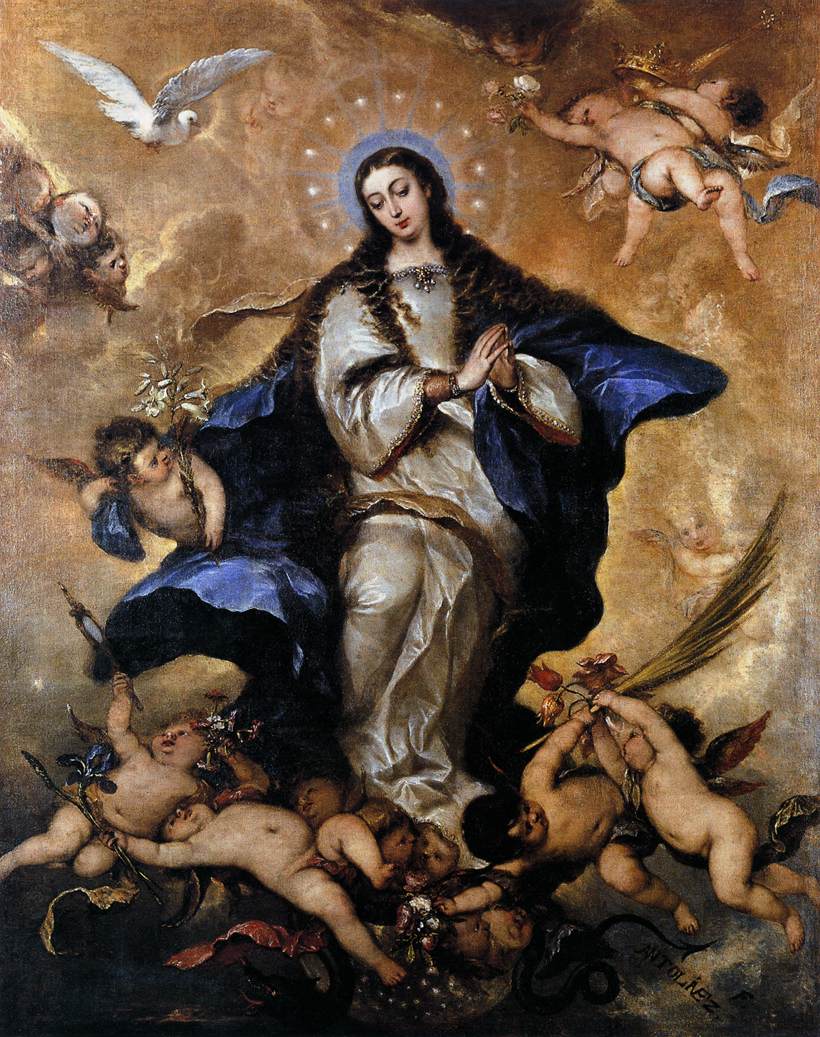 Main articles: Veneration of Mary in the Catholic Church, Mariology of the Catholic Church, Mariology of the saints, and Mariology of the popes The Blessed Virgin Mary is highly regarded in the Catholic Church, proclaiming her as Mother of God, free from original sin and an intercessor. Catholic Mariology deals with the dogmas and teachings concerning the life of Mary, mother of Jesus, as well as the veneration of Mary by the faithful. Mary is held in special regard, declared the Mother of God (Greek: Θεοτόκος, romanized: Theotokos, lit. 'God-bearer'), and believed as dogma to have remained a virgin throughout her life.[278] Further teachings include the doctrines of the Immaculate Conception (her own conception without the stain of original sin) and the Assumption of Mary (that her body was assumed directly into heaven at the end of her life). Both of these doctrines were defined as infallible dogma, by Pope Pius IX in 1854 and Pope Pius XII in 1950 respectively,[279] but only after consulting with the Catholic bishops throughout the world to ascertain that this is a Catholic belief.[280] In the Eastern Catholic churches, however, they continue to celebrate the feast of the Assumption under the name of the Dormition of the Mother of God on the same date.[281] The teaching that Mary died before being assumed significantly precedes the idea that she did not. St John Damascene wrote that "St Juvenal, Bishop of Jerusalem, at the Council of Chalcedon (451), made known to the Emperor Marcian and Pulcheria, who wished to possess the body of the Mother of God, that Mary died in the presence of all the Apostles, but that her tomb, when opened, upon the request of St Thomas, was found empty; wherefrom the Apostles concluded that the body was taken up to Heaven."[282] Devotions to Mary are part of Catholic piety but are distinct from the worship of God.[283] Practices include prayers and Marian art, music and architecture. Several liturgical Marian feasts are celebrated throughout the Church Year and she is honoured with many titles such as Queen of Heaven. Pope Paul VI called her Mother of the Church because, by giving birth to Christ, she is considered to be the spiritual mother to each member of the Body of Christ.[279] Because of her influential role in the life of Jesus, prayers and devotions such as the Hail Mary, the Rosary, the Salve Regina and the Memorare are common Catholic practices.[284] Pilgrimage to the sites of several Marian apparitions affirmed by the church, such as Lourdes, Fátima and Guadalupe,[285] are also popular Catholic devotions.[286] |
聖母マリア 主な記事:カトリック教会におけるマリア崇敬、カトリック教会のマリア論、聖人たちのマリア論、教皇たちのマリア論 聖母マリアはカトリック教会において高く尊ばれ、原罪のない神の母であり、執り成し手であると宣言されている。 カトリックのマリア論は、イエスの母マリアの生涯に関する教義と教え、ならびに信者によるマリア崇敬を扱う。マリアは特別な敬意をもって崇められ、神の母 (ギリシャ語: Θεοτόκος、ローマ字表記: Theotokos、直訳: 神を産む者)と宣言され、生涯を通じて処女であり続けたことが教義として信じられている。[278] さらに、教義には無原罪の御宿り(彼女自身の受胎が原罪の汚れなしに行われたこと)が含まれ、生涯を通じて処女であり続けたことが教義として信じられてい る。[278] その他の教えには、神の母(ギリシャ語: Θεοτόκος、ローマ字表記: Theotokos、直訳: 神を産む者)の教義や、生涯を通じて処女であり続けたことが教義として信じられていることが含まれる。[278] さらに、教義には無原罪の御宿り(彼女自身の受胎が原罪の汚れなしに行われたこと)が含まれ、生涯を通じて処女であり続けたことが教義として信じられてい る。[278] その他の教えには、神の母(ギリシャ語: Θεοτόκος、 さらに、無原罪の御宿り(原罪の汚れなくして受胎したこと)と聖母の被昇天(生涯の終わりに肉体ごと天に上げられたこと)の教義も含 まれる。これらの教義は、それぞれ1854年に教皇ピウス9世、1950年に教皇ピウス12世によって、誤り得ない教義として定義された[279]。ただ し、これはカトリックの信仰であることを確認するため、世界中のカトリック司教と協議した後のことである。[280] しかし東方カトリック教会では、同日に「神の母の眠り」の名で被昇天の祭儀を祝う慣習が継続している。[281] マリアが被昇天前に死亡したという教えは、彼女が死亡しなかったとする考えよりもはるかに古い。聖ヨハネス・ダマスコスは次のように記している。「エルサ レムの司教ユウェナリスは、カルケドン公会議(451年)において、神の母の遺体を所有しようとした皇帝マルキアヌスとプルケリアに対し、マリアは全ての 使徒たちの面前で死んだが、聖トマスが求めて墓を開けたところ、それは空であったと伝えた。使徒たちはこのことから、その遺体が天に上げられたと結論づけ た」と記している[282]。 マリアへの信仰はカトリックの敬虔の一部だが、神への礼拝とは区別される。[283] 実践には祈りやマリア芸術、音楽、建築が含まれる。教会暦を通じて複数の典礼上のマリア祭が祝われ、彼女は「天の女王」など多くの称号で称えられる。教皇 パウロ6世は彼女を「教会の母」と呼んだ。なぜならキリストを産んだことにより、彼女はキリストの体の各成員に対する霊的な母と見なされるからである。 [279] イエスの生涯における彼女の重要な役割ゆえに、「アヴェ・マリア」「ロザリオ」「サルヴェ・レジーナ」「メモラーレ」といった祈りと敬虔な行為はカトリッ クの一般的な慣習である。[284] ルルド、ファティマ、グアダルーペなど、教会が認めた聖母マリア出現の地への巡礼も、カトリックの一般的な敬虔な行為である。[285][286] |
| Sacraments Main article: Sacraments of the Catholic Church Holy Mass at the Sanctuary of Our Lady of Fátima, Portugal. The host and the chalice are displayed to the people immediately after the consecration of the bread and wine into the Holy Body and Blood of Christ. The Catholic Church teaches that it was entrusted with seven sacraments that were instituted by Christ. The number and nature of the sacraments were defined by several ecumenical councils, most recently the Council of Trent.[287][note 10] These are Baptism, Confirmation, the Eucharist, Penance, Anointing of the Sick (formerly called Extreme Unction, one of the "Last Rites"), Holy Orders and Holy Matrimony. Sacraments are visible rituals that Catholics see as signs of God's presence and effective channels of God's grace to all those who receive them with the proper disposition (ex opere operato).[288] The Catechism of the Catholic Church categorizes the sacraments into three groups, the "sacraments of Christian initiation", "sacraments of healing" and "sacraments at the service of communion and the mission of the faithful". These groups broadly reflect the stages of people's natural and spiritual lives which each sacrament is intended to serve.[289] The liturgies of the sacraments are central to the church's mission. According to the Catechism: In the liturgy of the New Covenant every liturgical action, especially the celebration of the Eucharist and the sacraments, is an encounter between Christ and the Church. The liturgical assembly derives its unity from the "communion of the Holy Spirit" who gathers the children of God into the one Body of Christ. This assembly transcends racial, cultural, social—indeed, all human affinities.[290] According to church doctrine, the sacraments of the church require the proper form, matter, and intent to be validly celebrated.[291] In addition, the Canon Laws for both the Latin Church and the Eastern Catholic Churches govern who may licitly celebrate certain sacraments, as well as strict rules about who may receive the sacraments.[292] Notably, because the church teaches that Christ is present in the Eucharist,[293] those who are conscious of being in a state of mortal sin are forbidden to receive the sacrament until they have received absolution through the sacrament of Reconciliation (Penance).[294] Catholics are normally obliged to abstain from eating for at least an hour before receiving the sacrament.[294] Non-Catholics are ordinarily prohibited from receiving the Eucharist as well.[292][295] Catholics, even if they were in danger of death and unable to approach a Catholic minister, may not ask for the sacraments of the Eucharist, penance or anointing of the sick from someone, such as a Protestant minister, who is not known to be validly ordained in line with Catholic teaching on ordination.[296][297] Likewise, even in grave and pressing need, Catholic ministers may not administer these sacraments to those who do not manifest Catholic faith in the sacrament. In relation to the churches of Eastern Christianity not in communion with the Holy See, the Catholic Church is less restrictive, declaring that "a certain communion in sacris, and so in the Eucharist, given suitable circumstances and the approval of Church authority, is not merely possible but is encouraged."[298] |
秘跡 主な記事:カトリック教会の秘跡 ポルトガル、ファティマの聖母聖堂における聖体祭。聖体と聖杯は、パンとぶどう酒がキリストの聖なる体と血に聖別された直後に信徒に示される。 カトリック教会は、キリストによって制定された七つの秘跡を託されていると教える。秘跡の数と性質は、いくつかの公会議、最近ではトレント公会議によって 定義された[287]。[注10] これらは洗礼、堅信、聖体、告解、病者の塗油(旧称「終油の秘跡」、かつて「終末秘跡」の一つ)、聖職叙階、聖婚である。秘跡とは目に見える儀礼であり、 カトリック教徒はこれを神の臨在のしるし、また適切な心構えをもって受ける者すべてへの神の恵みの効果的な経路(ex opere operato)と見なす。[288] カトリック教会のカテキズムは秘跡を三つのグループに分類している。「キリスト教入門の秘跡」、「癒しの秘跡」、「信徒の交わりと使命に奉仕する秘跡」で ある。これらのグループは、各秘跡が奉仕することを意図している人々の自然的生命と霊的生活の段階を広く反映している。[289] 秘跡の典礼は教会の使命の中核をなす。カテキズムによれば: 新約の典礼において、あらゆる典礼行為、特に聖体祭儀と秘跡の執行は、キリストと教会との出会いである。典礼の集会は「聖霊の交わり」からその一致を得 る。聖霊は神の子らをキリストの唯一の体へと集める。この集会は人種的、文化的、社会的―つまりあらゆる人間的親和性を超越するものである。[290] 教会の教義によれば、教会の秘跡は有効に執行されるために適切な形式、物質、意図を必要とする。[291]加えて、ラテン教会と東方カトリック教会の両方 の教会法は、特定の秘跡を合法的に執行できる者、および秘跡を受けることができる者に関する厳格な規則を定めている。[292] 特に、教会はキリストが聖体の中に現存すると教えるため[293]、重大な罪の状態にあると自覚している者は、和解の秘跡(懺悔)による赦しを受けるま で、聖体を受けることが禁じられている。[294] カトリック教徒は通常、聖体拝領の少なくとも1時間前には飲食を控える義務がある。[294] 非カトリック教徒も通常、聖体拝領は禁じられている。[292] [295] カトリック教徒は、たとえ死の危険に瀕しカトリック司祭に近づくことができない場合であっても、聖体、懺悔、病者の塗油といった秘跡を、プロテスタントの 牧師など、カトリックの叙階に関する規律に沿って有効に叙階されたと認められない者から求めることはできない。[296] [297] 同様に、カトリックの司祭は、たとえ深刻かつ差し迫った必要があっても、聖体においてカトリックの信仰を明らかに示さない者に対してこれらの秘跡を施して はならない。ローマ教皇庁と共にある関係にない東方キリスト教教会に関しては、カトリック教会はより制限が緩く、「適切な状況と教会当局の承認のもとで は、聖体における一定の聖体共祭(sacramental communion)は単に可能であるだけでなく、奨励される」と宣言している。[298] |
| Sacraments of initiation Main article: Sacraments of initiation Baptism 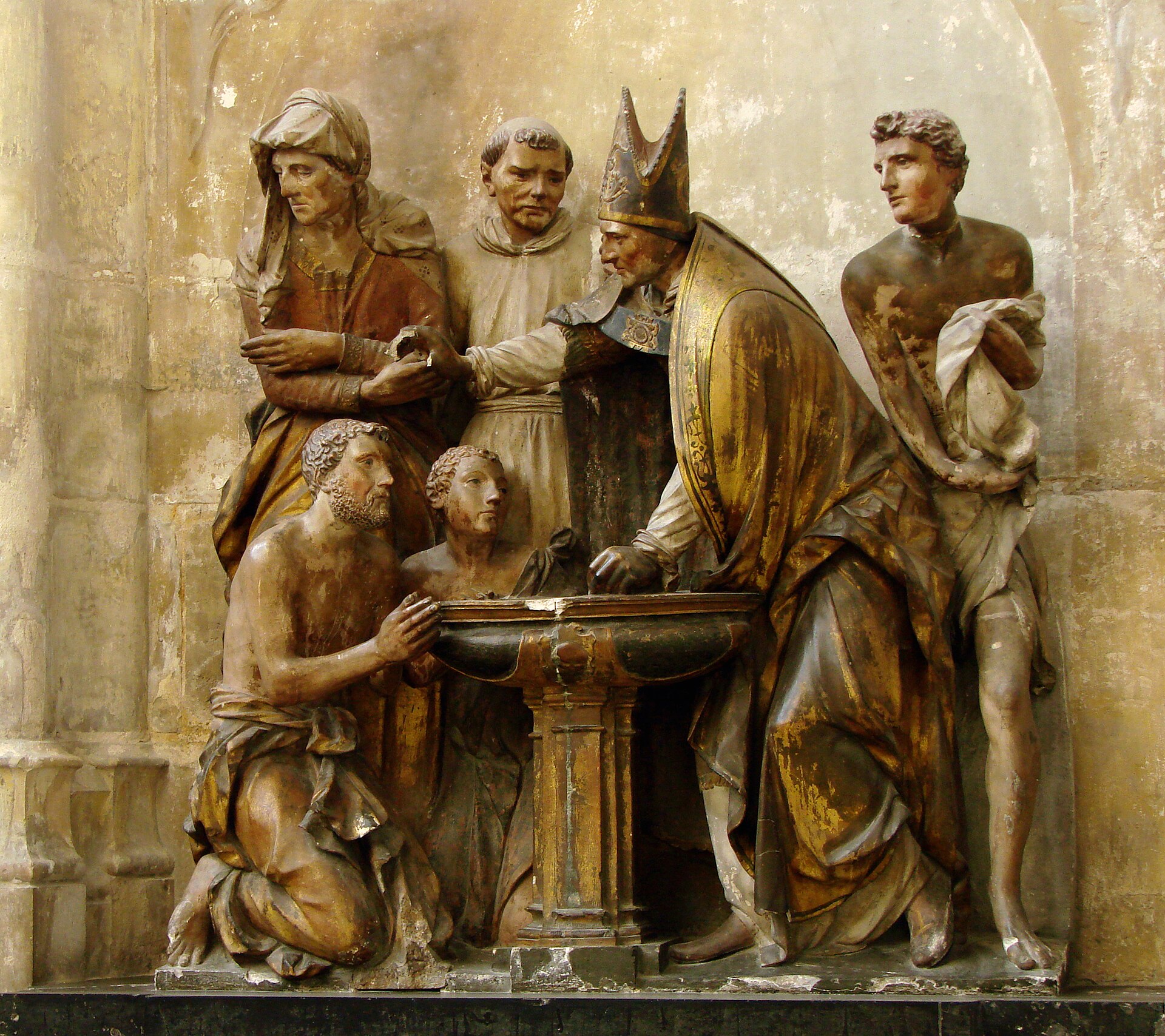 Baptism of Augustine of Hippo as represented in a sculptural group in Troyes Cathedral (1549), France As viewed by the Catholic Church, Baptism is the first of three sacraments of initiation as a Christian.[299] It washes away all sins, both original sin and personal actual sins.[300] It makes a person a member of the church.[301] As a gratuitous gift of God that requires no merit on the part of the person who is baptized, it is conferred even on children,[302] who, though they have no personal sins, need it on account of original sin.[303] If a new-born child is in a danger of death, anyone—be it a doctor, a nurse, or a parent—may baptize the child.[304] Baptism marks a person permanently and cannot be repeated.[305] The Catholic Church recognizes as valid baptisms conferred even by people who are not Catholics or Christians, provided that they intend to baptize ("to do what the Church does when she baptizes") and that they use the Trinitarian baptismal formula.[306] Confirmation Main article: Confirmation in the Catholic Church The Catholic Church sees the sacrament of confirmation as required to complete the grace given in baptism.[307] When adults are baptized, confirmation is normally given immediately afterwards,[308] a practice followed even with newly baptized infants in the Eastern Catholic Churches.[309] In the West confirmation of children is delayed until they are old enough to understand or at the bishop's discretion.[310] In Western Christianity, particularly Catholicism, the sacrament is called confirmation, because it confirms and strengthens the grace of baptism; in the Eastern Churches, it is called chrismation, because the essential rite is the anointing of the person with chrism,[311] a mixture of olive oil and some perfumed substance, usually balsam, blessed by a bishop.[311][312] Those who receive confirmation must be in a state of grace, which for those who have reached the age of reason means that they should first be cleansed spiritually by the sacrament of Penance; they should also have the intention of receiving the sacrament, and be prepared to show in their lives that they are Christians.[313] Eucharist Main article: Eucharist in the Catholic Church 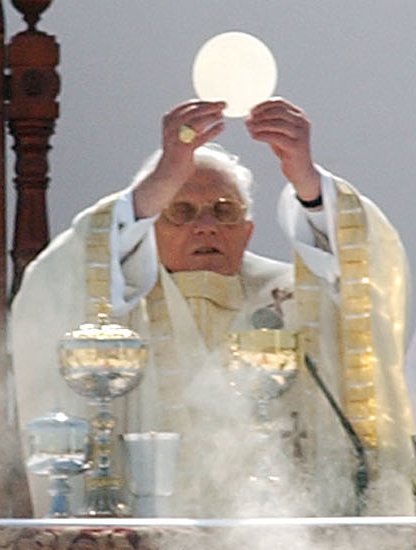 Pope Benedict XVI celebrates the Eucharist at the canonization of Frei Galvão in São Paulo, Brazil on 11 May 2007. For Catholics, the Eucharist is the sacrament which completes Christian initiation. It is described as "the source and summit of the Christian life".[314] The ceremony in which a Catholic first receives the Eucharist is known as First Communion.[315] The Eucharistic celebration, also called the Mass or Divine liturgy, includes prayers and scriptural readings, as well as an offering of bread and wine, which are brought to the altar and consecrated by the priest to become the body and the blood of Jesus Christ, a change called transubstantiation.[316][note 11] The words of consecration reflect the words spoken by Jesus during the Last Supper, where Christ offered his body and blood to his Apostles the night before his crucifixion. The sacrament re-presents (makes present) the sacrifice of Jesus on the cross,[317] and perpetuates it. Christ's death and resurrection give grace through the sacrament that unites the faithful with Christ and one another, remits venial sin, and aids against committing moral sin (though mortal sin itself is forgiven through the sacrament of penance).[318] |
入門の秘跡 主な記事: 入門の秘跡 洗礼 フランス、トロワ大聖堂の彫刻群(1549年)に描かれたヒッポのアウグスティヌスの洗礼 カトリック教会によれば、洗礼はキリスト教徒としての入門の秘跡三つの最初のものである[299]。それは原罪と個人的な実際の罪の両方を洗い流す。 [300] 洗礼は人を教会の成員とする。[301] 洗礼を受ける者に何らの功績も求めない神の無償の賜物として、洗礼は幼児にも授けられる。[302] 幼児は個人的な罪を持たないが、原罪のために洗礼を必要とする。[303] 新生児が死の危険に瀕している場合、医師、看護師、親など誰でもその子を洗礼することができる。[304] 洗礼は人格に永久に刻印され、繰り返すことはできない。カトリック教会は、カトリック教徒やキリスト教徒でない者による洗礼も、洗礼の意図(「教会が洗礼 を行う際に為すことを為す」)があり、三位一体の洗礼定式を用いる場合に限り、有効と認めている。 堅信 詳細記事:カトリック教会における堅信 カトリック教会は堅信の秘跡を、洗礼で与えられた恩寵を完成させるために必要とみなしている。[307]成人の洗礼時には通常、直後に堅信が授けられる。 [308]東方カトリック教会では新生児の洗礼後にも同様の慣行がある。[309]一方、西方教会では子供が理解できる年齢に達するまで、あるいは司教の 裁量により堅信は延期される。[310] 西洋キリスト教、特にカトリックでは、この秘跡は堅信(confirmation)と呼ばれる。洗礼の恵みを確証し強化するからである。東方教会では、聖 油塗布(chrismation)と呼ばれる。本質的な儀式が聖油(chrism)による塗油であるためだ。[311] 聖油とは、オリーブ油と香油(通常はバルサム)を混合し、司教によって祝福されたものである。[311] [312] 堅信を受ける者は恩寵の状態にある必要がある。理性の年齢に達した者にとっては、まず懺悔の秘跡によって霊的に清められるべきだ。また秘跡を受ける意思を 持ち、自らの生活においてキリスト者であることを示す準備が整っているべきである。[313] 聖体 主な記事: カトリック教会における聖体 2007年5月11日、ブラジル・サンパウロにおけるフリー・ガルヴァオの列聖式で聖体祭儀を執り行う教皇ベネディクト16世。 カトリック教徒にとって聖体祭儀は、キリスト教の入門を完成させる秘跡である。「キリスト教生活の源であり頂点」と称される。[314] カトリック教徒が初めて聖体を受ける儀式は初聖体と呼ばれる。[315] 聖体祭儀(ミサまたは神聖な典礼とも呼ばれる)には、祈りと聖書の朗読に加え、パンとワインの奉献が含まれる。これらは祭壇に捧げられ、司祭によって聖別 され、イエス・キリストの体と血へと変化する。この変化は「実体変化」と呼ばれる。[316][注11] 聖化の言葉は、最後の晩餐でイエスが語った言葉を反映している。そこでは、キリストが十字架刑の前夜、使徒たちに自らの体と血を捧げた。この秘跡は、十字 架上のイエスの犠牲を再現(現在化)し[317]、それを永続させる。キリストの死と復活は、聖餐を通して恵みを与える。この恵みは信徒をキリストと互い に結びつけ、軽罪を赦し、道徳的罪を犯すのを防ぐ助けとなる(ただし大罪そのものは告解の秘跡によって赦される)。 |
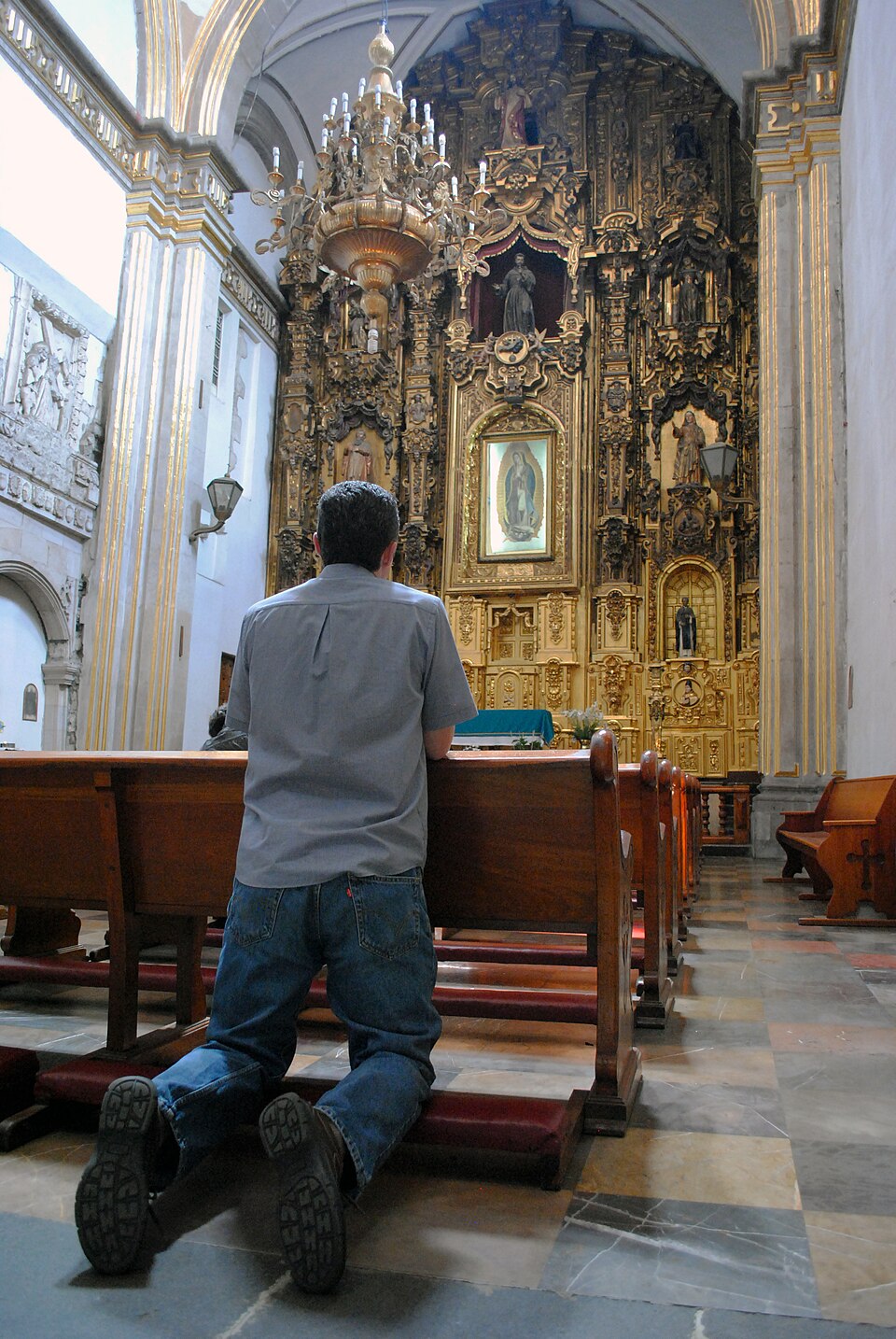 A Catholic prays in a church in Mexico. Sacraments of healing Penance Main article: Sacrament of Penance The Sacrament of Penance (also called Reconciliation, Forgiveness, Confession, and Conversion[319]) exists for the conversion of those who, after baptism, separate themselves from Christ by sin.[320] Essential to this sacrament are acts both by the sinner (examination of conscience, contrition with a determination not to sin again, confession to a priest, and performance of some act to repair the damage caused by sin) and by the priest (determination of the act of reparation to be performed and absolution).[321] Serious sins (mortal sins) should be confessed at least once a year and always before receiving Holy Communion, while confession of venial sins also is recommended.[322] The priest is bound under the severest penalties to maintain the "seal of confession", absolute secrecy about any sins revealed to him in confession.[323] Anointing of the sick Main article: Anointing of the Sick in the Catholic Church 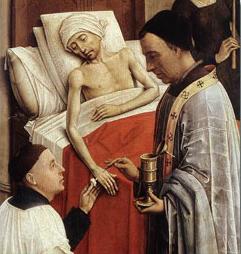 The Seven Sacraments Altarpiece triptych painting of Extreme Unction (Anointing of the Sick) with oil being administered by a priest during last rites. Rogier van der Weyden, 1445. While chrism is used only for the three sacraments that cannot be repeated, a different oil is used by a priest or bishop to bless a Catholic who, because of illness or old age, has begun to be in danger of death.[324] This sacrament, known as Anointing of the Sick, is believed to give comfort, peace, courage and, if the sick person is unable to make a confession, even forgiveness of sins.[325] The sacrament is also referred to as Unction, and in the past as Extreme Unction, and it is one of the three sacraments that constitute the last rites, together with Penance and Viaticum (Eucharist).[326] Sacraments at the service of communion According to the Catechism, there are two sacraments of communion directed towards the salvation of others: priesthood and marriage.[327] Within the general vocation to be a Christian, these two sacraments "consecrate to specific mission or vocation among the people of God. Men receive the holy orders to feed the Church by the word and grace. Spouses marry so that their love may be fortified to fulfil duties of their state".[328] |
メキシコの教会で祈るカトリック教徒。 癒しの秘跡 懺悔 詳細記事: 懺悔の秘跡 懺悔の秘跡(和解、赦し、告白、回心とも呼ばれる[319])は、洗礼を受けた後、罪によってキリストから離れてしまった者の回心のために存在する。 [320] この秘跡には、罪人による行為(良心の省察、再犯しない決意を伴う悔い改め、司祭への告白、罪による損害を償うための何らかの行為の実行)と司祭による行 為(償いの行為の決定と赦免)が不可欠である。[321] 重大な罪(致命的な罪)は少なくとも年に一度、また聖体拝領の前には必ず告白すべきであり、軽罪の告白も推奨される。[322]司祭は、告白で明かされたあらゆる罪について絶対的な秘密を守る「告解の秘跡」を厳格な罰則の下で守らねばならない。[323] 病者の塗油 詳細記事:カトリック教会における病者の塗油 七つの秘跡 祭壇画三連祭壇画『終油の秘跡(病者の塗油)』、司祭が終油の秘跡において油を塗布する場面。ロヒール・ファン・デル・ウェイデン作、1445年。 聖油は繰り返せない三つの秘跡にのみ使用されるが、病気や老齢により死の危険に瀕したカトリック信者を祝福する際には、司祭や司教が異なる油を用いる [324]。この秘跡は病者の塗油として知られ、慰め、平安、勇気を与え、病人が告解できない場合には罪の赦しさえも与えると信じられている。[325] この秘跡は「塗油の秘跡」とも呼ばれ、過去には「終油の秘跡」とも称された。告解と聖体拝領(聖体)と共に、終末秘跡を構成する三つの秘跡の一つである。[326] 交わりの奉仕としての秘跡 カテキズムによれば、他者の救いを目的とする交わりの秘跡は二つある。司祭職と婚姻である。[327] キリスト者としての普遍的召命の中で、これら二つの秘跡は「神の民の中での特定の使命や召命に奉献するものである。男性は聖職を受け、言葉と恵みによって 教会を養う。配偶者は、自らの状態における義務を果たすために愛が強化されるよう結婚する」。[328] |
| Holy Orders Main article: Holy orders in the Catholic Church 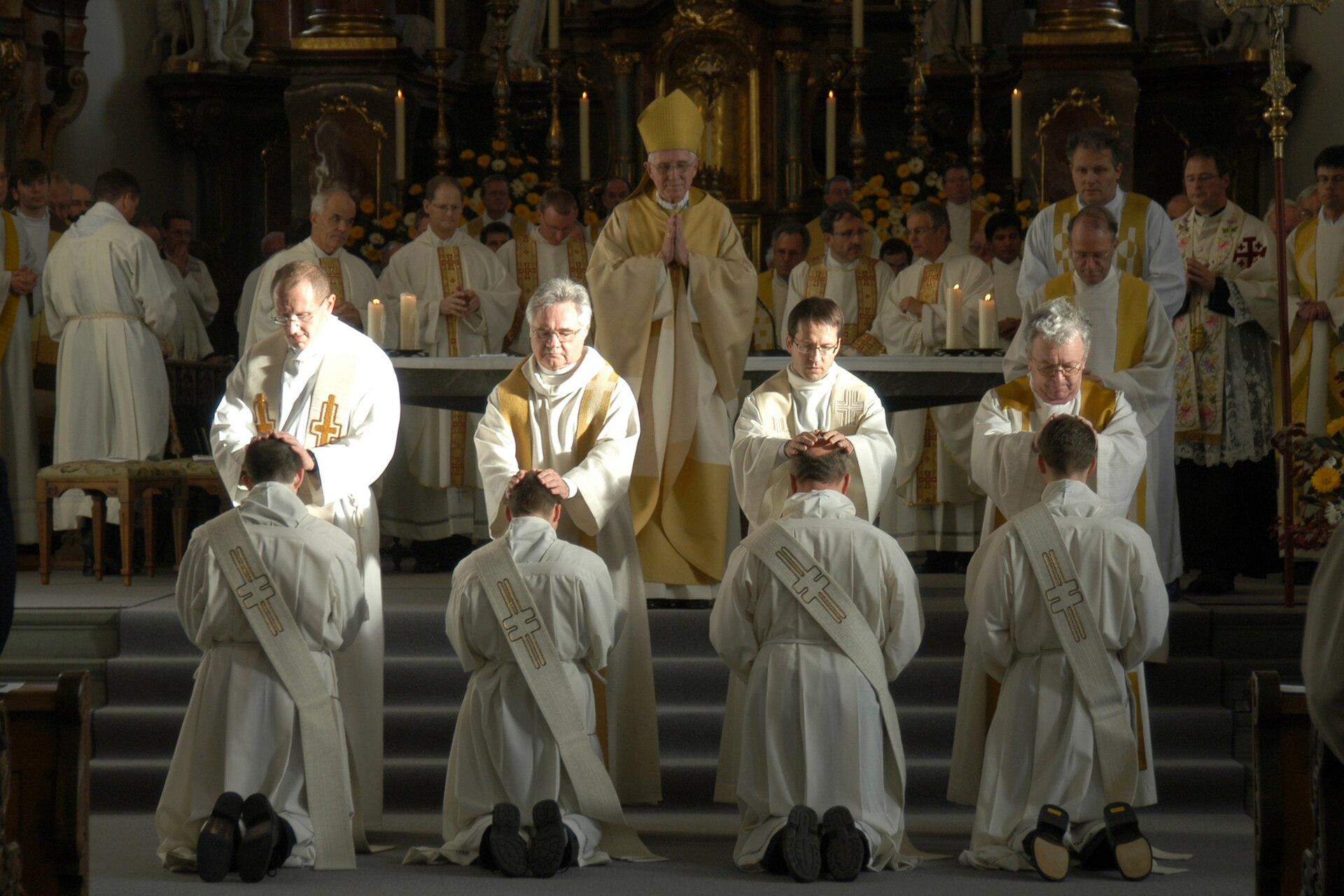 Priests lay their hands on the ordinands during the rite of ordination. The sacrament of Holy Orders consecrates and deputes some Christians to serve the whole body as members of three degrees or orders: episcopate (bishops), presbyterate (priests) and diaconate (deacons).[329][330] The church has defined rules on who may be ordained into the clergy. In the Latin Church the priesthood is generally restricted to celibate men, and the episcopate is always restricted to celibate men.[331] Men who are already married may be ordained in certain Eastern Catholic churches in most countries,[332] and the personal ordinariates and may become deacons even in the Latin Church[333][334] (see Clerical marriage). After becoming a Catholic priest, a man may not marry (see Clerical celibacy) unless he is formally laicized.[335] All clergy, whether deacons, priests or bishops, may preach, teach, baptize, witness marriages and conduct funeral liturgies.[336] Only bishops and priests can administer the sacraments of the Eucharist, Reconciliation (Penance) and Anointing of the Sick.[337][338] Only bishops can administer the sacrament of Holy Orders, which ordains someone into the clergy.[339] Matrimony Main article: Marriage in the Catholic Church See also: Catholic teachings on sexual morality 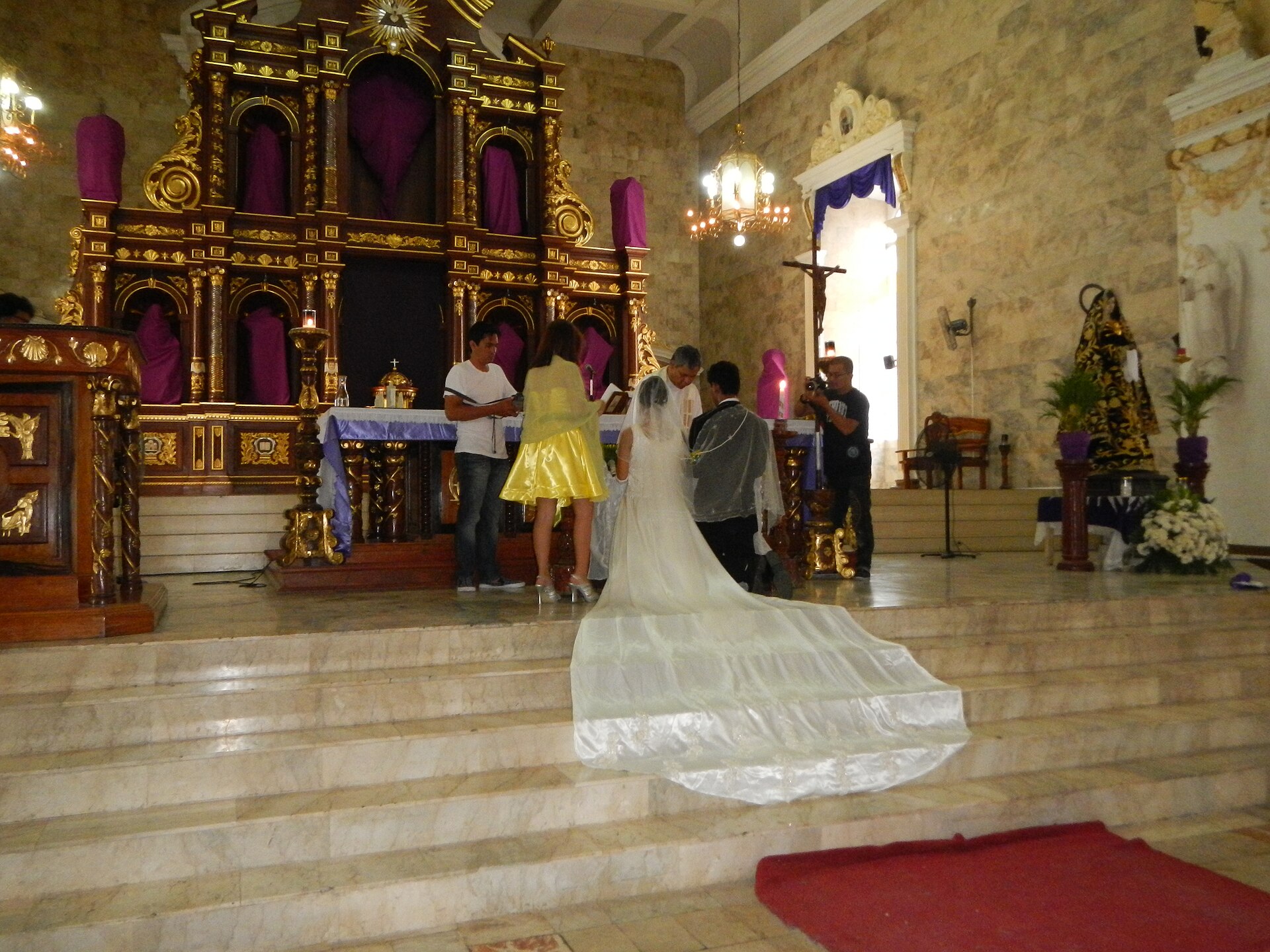 Wedding mass in the Philippines The Catholic Church teaches that marriage is a social and spiritual bond between a man and a woman, ordered towards the good of the spouses and procreation of children; according to Catholic teachings on sexual morality, it is the only appropriate context for sexual activity. A Catholic marriage, or any marriage between baptized individuals of any Christian denomination, is viewed as a sacrament. A sacramental marriage, once consummated, cannot be dissolved except by death.[340][note 12] The church recognizes certain conditions, such as freedom of consent, as required for any marriage to be valid; In addition, the church sets specific rules and norms, known as canonical form, that Catholics must follow.[343] The church does not recognize divorce as ending a valid marriage and allows state-recognized divorce only as a means of protecting the property and well-being of the spouses and any children. However, consideration of particular cases by the competent ecclesiastical tribunal can lead to declaration of the invalidity of a marriage, a declaration usually referred to as an annulment. Remarriage following a divorce is not permitted unless the prior marriage was declared invalid.[344] |
聖職叙階 主な記事:カトリック教会の聖職叙階 司祭は叙階式において叙階を受ける者に手を置く。 聖職叙階の秘跡は、一部のキリスト教徒を聖別し、三つの位階または聖職(主教職、司祭職、助祭職)の成員として教会全体に仕えるよう任命するものである。 [329] [330] 教会は聖職に叙階される者の資格について規則を定めている。ラテン教会では司祭職は一般的に独身男性に限定され、司教職は常に独身男性に限定される。 [331] 既婚男性は、多くの国の東方カトリック教会[332]や個人教区司教区において聖職に叙階され、ラテン教会においても助祭となることが可能である [333][334](聖職者の婚姻参照)。カトリック司祭となった男性は、正式に俗化されない限り結婚することはできない(聖職者の独身制参照)。 [335] 助祭、司祭、司教を問わず、全ての聖職者は説教、教導、洗礼、婚姻の立会、葬儀の典礼を執り行うことができる[336]。聖体、和解(告解)、病者の塗油 の秘跡を授けることができるのは司教と司祭のみである[337][338]。聖職者としての叙階を行う聖職叙階の秘跡を授けることができるのは司教のみで ある。[339] 婚姻 主な記事: カトリック教会における結婚 関連項目: カトリックの性的道徳に関する教え フィリピンにおける結婚式ミサ カトリック教会は、結婚とは男性と女性の間における社会的・霊的な絆であり、配偶者の幸福と子孫の繁栄を目的とするものであると教える。カトリックの性的 道徳に関する教えによれば、結婚は性的行為を行う唯一の適切な場である。カトリックの結婚、あるいはキリスト教のいかなる宗派の洗礼を受けた者同士の結婚 も、秘跡と見なされる。秘跡としての結婚は、一旦成就すれば、死によってのみ解消される。[340][注12] 教会は、いかなる結婚も有効であるために必要な条件として、自由な同意などを認めている。さらに、教会はカトリック教徒が従わなければならない特定の規則 と規範、いわゆる「教会法上の形式」を定めている。[343] 教会は離婚を有効な結婚の終了とは認めず、配偶者や子供の財産と福祉を保護する手段としてのみ、国家が認める離婚を許容する。ただし、管轄の教会裁判所に よる個別事案の審理を経て、結婚の無効宣言(通常は婚姻無効宣告と呼ばれる)がなされる場合がある。離婚後の再婚は、前の結婚が無効と宣言されない限り認 められない。[344] |
| Liturgy Main articles: Catholic liturgy and Eastern Catholic liturgy Catholic religious objects – Holy Bible, crucifix and rosary Among the 24 autonomous (sui iuris) churches, numerous liturgical and other traditions exist, called rites, which reflect historical and cultural diversity rather than differences in belief.[345] In the definition of the Code of Canons of the Eastern Churches, "a rite is the liturgical, theological, spiritual, and disciplinary patrimony, culture and circumstances of history of a distinct people, by which its own manner of living the faith is manifested in each Church sui iuris".[346] The liturgy of the sacrament of the Eucharist, called the Mass in the West and Divine Liturgy or other names in the East, is the principal liturgy of the Catholic Church.[347] This is because it is considered the propitiatory sacrifice of Christ himself.[348] Eastern Catholic Churches have their own rites: the liturgies of the Eucharist and the other sacraments vary from rite to rite, reflecting different theological emphases. Western rites Main articles: Roman Rite and Latin liturgical rites The Roman Rite is the most common rite of worship used by the Catholic Church, with the Ordinary Form of the Roman Rite form of the Mass. Its use is found worldwide, originating in Rome and spreading throughout Europe, influencing and eventually supplanting local rites.[349] The present ordinary form of Mass in the Roman Rite, found in the post-1969 editions of the Roman Missal, is usually celebrated in the local vernacular language, using an officially approved translation from the original text in Latin.[350] Its most widely used form was promulgated by Pope Paul VI in 1969 and revised by Pope John Paul II in 2001. In certain circumstances, the 1962 form of the Roman Rite remains authorized in the Latin Church. Since 2014, clergy in the small personal ordinariates set up for groups of former Anglicans under the terms of the 2009 document Anglicanorum Coetibus[351] are permitted to use a variation of the Roman Rite called "Divine Worship" or, less formally, "Ordinariate Use",[352] which incorporates elements of the Anglican liturgy and traditions.[note 13] In the Archdiocese of Milan, with around five million Catholics the largest in Europe,[353] Mass is celebrated according to the Ambrosian Rite. Other Latin Church rites include the Mozarabic[354] and those of some religious institutes.[355] These liturgical rites have an antiquity of at least 200 years before 1570, the date of Pope Pius V's Quo primum, and were thus allowed to continue.[356] |
典礼 主な記事:カトリック典礼と東方カトリック典礼 カトリックの宗教的物品 – 聖書、十字架、ロザリオ 24の自治教会(スィ・ユリス教会)の中には、典礼やその他の伝統が数多く存在する。これらは「典礼形式」と呼ばれ、信仰の異なる点というより、歴史的・ 文化的な多様性を反映している。[345] 東方教会法典の定義によれば、「典礼形式とは、各自治教会において独自の信仰実践が表れる、特定民族の典礼的・神学的・霊的・規律的遺産、文化、歴史的状 況である」[346]。 聖体の秘跡の典礼は、西方ではミサ、東方では神聖な典礼(ディヴィーン・リチュルジー)などと呼ばれるが、カトリック教会の主要な典礼である。[347] これは、聖体秘跡がキリスト自身の贖罪の犠牲と見なされているためである。[348] 東方カトリック教会は独自の典礼を持つ。聖体秘跡やその他の秘跡の典礼は典礼ごとに異なり、異なる神学的重点を反映している。 西方典礼 主な記事:ローマ典礼、ラテン典礼 ローマ典礼はカトリック教会で最も広く用いられる礼拝形式であり、そのミサはローマ典礼の通常形式である。その使用は世界中に見られ、ローマに起源を持ち ヨーロッパ全土に広がり、各地の典礼に影響を与え、最終的にはそれらに取って代わった。[349] ローマ典礼における現在の通常形式のミサは、1969年以降のローマ典礼書に収録されており、通常は現地の俗語で執り行われる。これはラテン語の原典から 公式に承認された翻訳を使用している。[350] 最も広く用いられている形式は、1969年に教皇パウロ6世によって公布され、2001年に教皇ヨハネ・パウロ2世によって改訂された。特定の状況下では、1962年式のローマ典礼がラテン教会において依然として認可されている。 2014年以降、2009年の文書『アングリカノルム・コエティウス』[351]に基づき元英国国教会信徒グループのために設置された小規模な個人教区司 教区では、聖職者が「ディバイン・ワーシップ」または非公式に「教区司教区式」[352]と呼ばれるローマ典礼の変形版を使用することが許可されている。 これは英国国教会の典礼と伝統の要素を取り入れている。[注13] 約500万人のカトリック信者を擁するヨーロッパ最大のミラノ大司教区では、アンブロジウス典礼に従ってミサが執り行われている。その他のラテン教会典礼 には、モサラベ典礼[354]や一部の修道会典礼[355]がある。これらの典礼は、教皇ピウス5世の『クオ・プリムム』公布(1570年)の少なくとも 200年前から存在していたため、継続が認められた[356]。 |
| Eastern rites Main article: Catholic particular churches and liturgical rites § Eastern rites 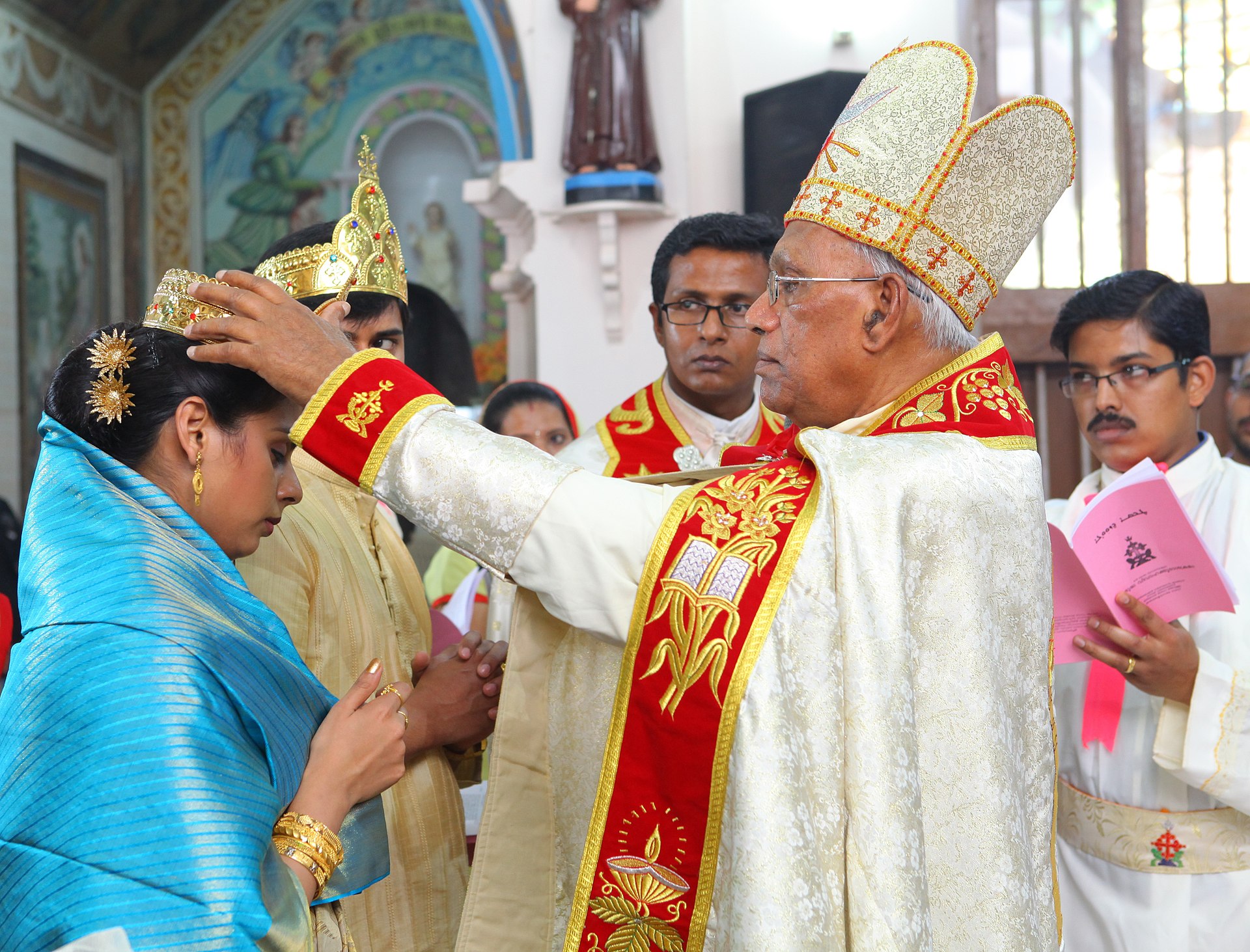 East Syrian Rite wedding crowning celebrated by a bishop of the Syro-Malabar Catholic Church in India, one of the 23 Eastern Catholic Churches in full communion with the pope and the Catholic Church The Eastern Catholic Churches share common patrimony and liturgical rites as their counterparts, including Eastern Orthodox and other Eastern Christian churches who are no longer in communion with the Holy See. These include churches that historically developed in Russia, Caucasus, the Balkans, North Eastern Africa, India and the Middle East. The Eastern Catholic Churches are groups of faithful who have either never been out of communion with the Holy See or who have restored communion with it at the cost of breaking communion with their associates of the same tradition.[357] The liturgical rites of the Eastern Catholic Churches include the Byzantine Rite (in its Antiochian, Greek and Slavonic recensions), the Alexandrian Rite, the West Syrian Rite, the Armenian Rite, and the East Syriac Rite. Eastern Catholic Churches have the autonomy to set the particulars of their liturgical forms and worship, within certain limits to protect the "accurate observance" of their liturgical tradition.[358] In the past, some of the rites used by the Eastern Catholic Churches were subject to a degree of liturgical Latinization. In recent years Eastern Catholic Churches have returned to traditional Eastern practices in accord with the 1964 Vatican II decree Orientalium Ecclesiarum.[359] Each church has its own liturgical calendar.[360] |
東方典礼 主な記事: カトリックの個別教会と典礼典礼 § 東方典礼 インドのシロ・マラバル・カトリック教会の司教によって執り行われる東シリア典礼の結婚式における冠戴式。これは教皇およびカトリック教会と完全な交わりにある23の東方カトリック教会の一つである 東方カトリック教会は、東方正教会や聖座との交わりを失った他の東方キリスト教教会を含む、その対となる教会と共通の遺産と典礼典礼を共有している。これ には、ロシア、コーカサス、バルカン半島、北東アフリカ、インド、中東で歴史的に発展した教会が含まれる。東方カトリック教会は、聖座との交わりを一度も 断ったことがない、あるいは同じ伝統を持つ仲間との交わりを断つ代償を払って聖座との交わりを回復した信徒の集団である。 東方カトリック教会の典礼儀式には、ビザンチン典礼(アンティオキア、ギリシャ、スラヴ各版)、アレクサンドリア典礼、西シリア典礼、アルメニア典礼、東 シリア典礼が含まれる。東方カトリック教会は、自らの典礼伝統の「正確な遵守」を守る一定の制限内で、典礼形式と礼拝の詳細を定める自治権を有する。 [358] 過去には、東方カトリック教会で使用されていた典礼の一部が、ある程度の典礼ラテン化の影響を受けていた。近年、東方カトリック教会は1964年の第二バ チカン公会議の法令『東方教会に関する教令』に従い、伝統的な東方典礼の慣行に戻っている。[359] 各教会は独自の典礼暦を持っている。[360] |
| Social, moral and cultural issues Catholic social teaching Main article: Catholic social teaching 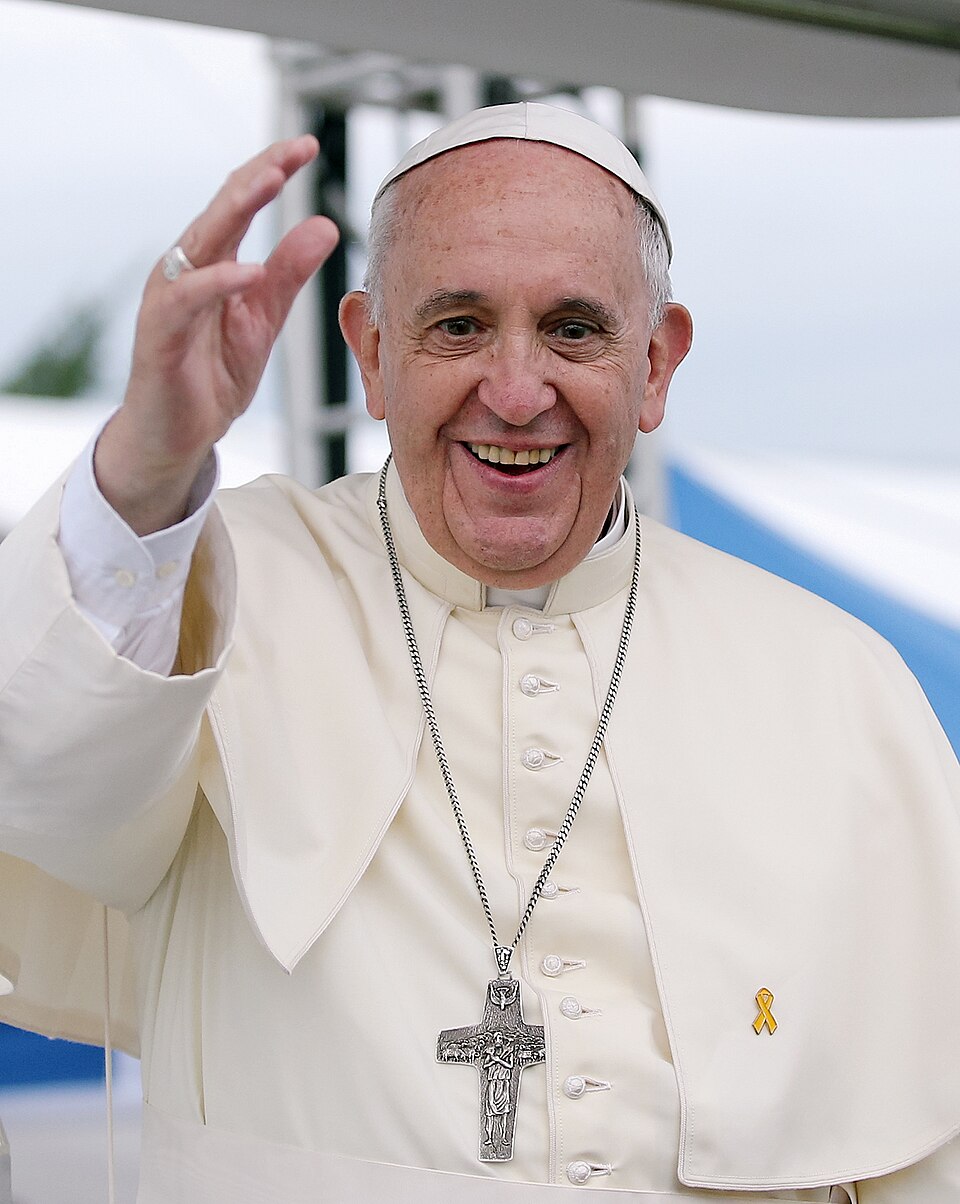 On 24 May 2015, Pope Francis issued the Laudato si', an encyclical that deals with questions such as consumerism, responsible development and environmental degradation. Catholic social teaching, reflecting the concern Jesus showed for the impoverished, places a heavy emphasis on the corporal works of mercy and the spiritual works of mercy, namely the support and concern for the sick, the poor and the afflicted.[361][362] Church teaching calls for a preferential option for the poor while canon law prescribes that "The Christian faithful are also obliged to promote social justice and, mindful of the precept of the Lord, to assist the poor."[363] Its foundations are widely considered to have been laid by Pope Leo XIII's 1891 encyclical letter Rerum novarum which upholds the rights and dignity of labour and the right of workers to form unions.[364][365] Social services Main articles: Catholic Church and health care and Catholic education  Saint Teresa of Calcutta advocated for the sick, the poor and the needy by practising the acts of corporal works of mercy. She was awarded the Nobel Peace Prize in 1979. The Catholic Church is the largest non-government provider of education and medical services in the world.[25] In 2010 the Catholic Church's Pontifical Council for Pastoral Assistance to Health Care Workers said that the church manages 26% of health care facilities in the world, including hospitals, clinics, orphanages, pharmacies and centres for those with leprosy.[366] The church has always been involved in education, since the founding of the first universities of Europe.[83] It runs and sponsors thousands of primary and secondary schools, colleges and universities throughout the world[367][7] and operates the world's largest non-governmental school system.[368] Religious institutes for women have played a particularly prominent role in the provision of health and education services,[369] as with orders such as the Sisters of Mercy, Little Sisters of the Poor, the Missionaries of Charity, the Sisters of St. Joseph of the Sacred Heart, the Sisters of the Blessed Sacrament and the Daughters of Charity of Saint Vincent de Paul.[370] The Catholic nun Mother Teresa of Calcutta, India, founder of the Missionaries of Charity, was awarded the Nobel Peace Prize in 1979 for her humanitarian work among India's poor.[371] Bishop Carlos Filipe Ximenes Belo won the same award in 1996 for "work towards a just and peaceful solution to the conflict in East Timor".[372] The church is also actively engaged in international aid and development through organizations such as Catholic Relief Services, Caritas Internationalis, Aid to the Church in Need, refugee advocacy groups such as the Jesuit Refugee Service and community aid groups such as the Saint Vincent de Paul Society.[373] |
社会的、道徳的、文化的課題 カトリック社会教説 主な記事:カトリック社会教説 2015年5月24日、教皇フランシスコは回勅『ラウダート・シ』を発布した。これは消費主義、責任ある開発、環境破壊といった問題を取り扱うものである。 カトリック社会教説は、イエスが貧しい人々に対して示した関心を反映し、肉体的な慈悲の業と精神的な慈悲の業、すなわち病者、貧者、苦しむ人々への支援と 配慮を強く重視している。[361][362] 教会の教えは貧しい者への優先的選択を求め、教会法は「キリスト教信徒はまた、社会正義を促進し、主の戒めを心に留めて貧しい者を助ける義務がある」と規 定している[363]。その基礎は、労働の権利と尊厳、労働者の組合結成権を擁護したレオ13世の1891年の回勅『レラム・ノヴァルム』によって築かれ たと広く考えられている。[364][365] 社会福祉 関連項目: カトリック教会と健康・カトリック教育 聖テレサ・オブ・カルカッタは、肉体的な慈愛の業を実践することで病者・貧者・困窮者を擁護した。1979年にノーベル平和賞を受賞している。 カトリック教会は世界で最大の非政府系教育・健康サービス提供者である。[25] 2010年、カトリック教会の医療従事者牧会評議会は、教会が病院、診療所、孤児院、薬局、ハンセン病患者のためのセンターを含む世界の健康施設の26% を管理していると発表した。[366] 教会はヨーロッパ初の大学創設以来、常に教育に関わってきた。[83] 世界中に数千の小中学校、大学を運営・支援し[367][7]、世界最大の非政府系学校システムを運営している。[368] 女性修道会は、健康・教育サービスの提供において特に顕著な役割を果たしてきた。慈悲の姉妹会、貧しい人々の小さな姉妹会、慈善の宣教者会、聖心聖ヨゼフ 修道会、聖体の姉妹会、聖ヴィンセント・ド・ポール慈善の娘たちといった修道会がその例である。[370] インド・カルカッタ出身のカトリック修道女マザー・テレサ(慈善宣教会の創立者)は、インドの貧困層に対する人道支援活動により1979年にノーベル平和 賞を受賞した。[371] カルロス・フィリペ・シメネス・ベロ司教は「東ティモール紛争の公正かつ平和的解決に向けた活動」により1996年に同賞を受賞した。[372] カトリック教会はまた、カトリック救済サービス、カリタス・インターナショナル、教会援助会といった組織を通じ、国際援助・開発活動に積極的に関与してい る。さらにイエズス会難民サービスなどの難民支援団体や、聖ビンセンテ・デ・ポール協会などの地域支援団体も活動している。[373] |
| Sexual morality Main articles: Catholic theology of sexuality, Catholic theology of the body, and Marriage in the Catholic Church  An allegory of chastity by Hans Memling Chastity and marriage In the church's teaching, sexual activity should be reserved to married couples without artificial birth control. Marriage is considered the only appropriate context for sexual activity,[374] whether in a sacramental marriage among Christians or in a natural marriage where one or both spouses are unbaptized. Even in romantic relationships, including engagement to marriage, partners are called to abstain from sexual activity, in order to test mutual respect and fidelity.[375] Chastity in marriage requires, in particular, conjugal fidelity and protecting the fecundity of marriage. The couple must foster trust and honesty as well as spiritual and physical intimacy. Sexual activity must always be open to the transmission of new life;[376] the church calls this the procreative significance. It must likewise always bring a couple together in love; the church calls this the unitive significance.[377] Artificial contraception and certain other sexual practices are not permitted, although natural family planning methods are permitted to provide healthy spacing between births, or to postpone children for a just reason.[378] Church teachings about sexuality have become an issue of increasing controversy in the Western world, especially after the close of the Second Vatican Council in the 1960s, due to changing cultural attitudes described as the sexual revolution.[377] Pope Francis said in 2015 that he was worried that the church has grown "obsessed" with issues such as abortion, same-sex marriage and contraception, and for prioritizing moral doctrines over helping the poor and marginalized.[379][380] Homosexuality Main article: Homosexuality and the Catholic Church The Catholic Church also teaches that "homosexual acts" are "contrary to the natural law", "acts of grave depravity" and "under no circumstances can they be approved", but that persons experiencing homosexual tendencies must be accorded respect and dignity.[381] According to the Catechism of the Catholic Church, The number of men and women who have deep-seated homosexual tendencies is not negligible. This inclination, which is objectively disordered, constitutes for most of them a trial. They must be accepted with respect, compassion, and sensitivity. Every sign of unjust discrimination in their regard should be avoided... Homosexual persons are called to chastity. By the virtues of self-mastery that teach them inner freedom, at times by the support of disinterested friendship, by prayer and sacramental grace, they can and should gradually and resolutely approach Christian perfection.[381] This part of the Catechism was quoted by Pope Francis in a 2013 press interview in which he remarked, when asked about an individual: I think that when you encounter a person like this [the individual he was asked about], you must make a distinction between the fact of a person being gay from the fact of being a lobby, because lobbies, all are not good. That is bad. If a person is gay and seeks the Lord and has good will, well who am I to judge them?[382] This remark and others made in the same interview were seen as a change in the tone, but not in the substance of the teaching of the church,[383] which includes opposition to same-sex marriage.[384][385] Certain dissenting Catholic groups, such as DignityUSA, oppose the position of the Catholic Church and seek to change it and to educate Catholics on LGBT issues.[386] The Catholic Church has banned all such groups from church property.[387] Orthodox Catholic groups, such as Building Catholic Futures, encourage parishes to incorporate celibate gay people into the church communities.[388] Divorce and declarations of nullity Main article: Declaration of nullity Further information: Divorce law by country Canon law makes no provision for divorce between baptized individuals, as a valid, consummated sacramental marriage is considered to be a lifelong bond.[389] However, a declaration of nullity may be granted when the proof is produced that essential conditions for contracting a valid marriage were absent from the beginning—in other words, that the marriage was not valid due to some impediment. A declaration of nullity, commonly called an annulment, is a judgement on the part of an ecclesiastical tribunal determining that a marriage was invalidly attempted.[390] Marriages among unbaptized individuals may be dissolved with papal permission under certain situations, such as a desire to marry a Catholic, under Pauline or Petrine privilege.[341][342] An attempt at remarriage following divorce without a declaration of nullity places "the remarried spouse ... in a situation of public and permanent adultery". An innocent spouse who lives in continence following divorce, or couples who live in continence following a civil divorce for a grave cause, do not sin.[391] Worldwide, diocesan tribunals completed over 49000 cases for nullity of marriage in 2006. Over the past 30 years about 55 to 70% of annulments have occurred in the United States. The growth in annulments has been substantial; in the United States, 27,000 marriages were annulled in 2006, compared to 338 in 1968. However, approximately 200,000 married Catholics in the United States divorce each year; 10 million total as of 2006.[392][note 14] Divorce is increasing in some predominantly Catholic countries in Europe.[394] Contraception and abortion Main article: Christian views on birth control § Catholicism See also: Catholic Church and HIV/AIDS and Religious response to assisted reproductive technology § Catholicism 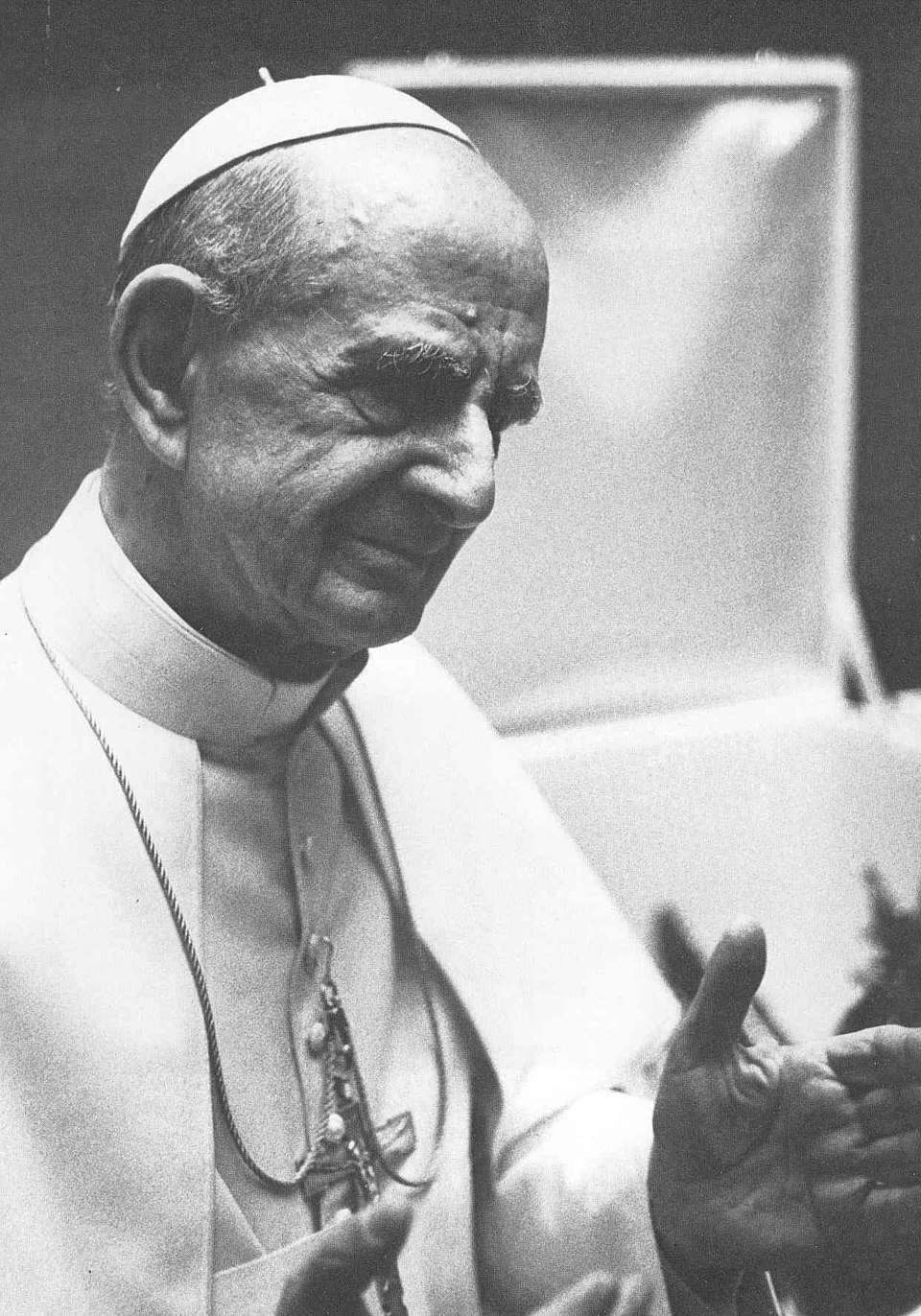 Pope Paul VI issued Humanae vitae on 25 July 1968. The church teaches that sexual intercourse should only take place between a man and woman who are married to each other, and should be without the use of birth control or contraception. In his encyclical Humanae vitae[395] (1968) Pope Paul VI firmly rejected all artificial contraception, thus contradicting dissenters in the church who saw the birth control pill as an ethically justifiable method of contraception, though he permitted the regulation of births by means of natural family planning (NFP.) This teaching was continued especially by John Paul II in his encyclical Evangelium Vitae, where he clarified the church's position on artificial contraception, abortion and euthanasia by condemning them as part of a "culture of death" and calling instead for a "culture of life".[396] Many Western Catholics have voiced significant disagreement with the church's teaching on contraception.[397] Overturning the church's teaching on this point features high on progressive agendas.[398] Catholics for Choice, a political lobbyist group that is not associated with the Catholic Church, stated in 1998 that 96% of American Catholic women had used contraceptives at some point in their lives and that 72% of Catholics believed that one could be a good Catholic without obeying the church's teaching on birth control.[399] Use of natural family planning methods among United States Catholics purportedly is low, although the number cannot be known with certainty.[note 15] As Catholic health providers are among the largest providers of services to patients with HIV/AIDS worldwide, there is significant controversy within and outside the church regarding the use of condoms as a means of limiting new infections, as condom use ordinarily constitutes prohibited contraceptive use.[402] Similarly, the Catholic Church opposes artificial insemination regardless of whether it is homologous (from the husband) or heterologous (from a donor) and in vitro fertilization (IVF), saying that the artificial process replaces the love and conjugal act between a husband and wife.[403] In addition, it opposes IVF because it might cause disposal of embryos; Catholics believe an embryo is an individual with a soul who must be treated as such.[404] For this reason, the church also opposes abortion.[405] The Catholic Church oppose all forms of abortion procedures whose direct purpose is to destroy a zygote, blastocyst, embryo or fetus, since it holds that "human life must be respected and protected absolutely from the moment of conception. From the first moment of his existence, a human being must be recognized as having the rights of a person – among which is the inviolable right of every innocent being to life".[406] However, the Church does recognize as morally legitimate certain acts which indirectly result in the death of the fetus. The 1983 Code of Canon Law imposes automatic (latae sententiae) excommunication on Latin Catholics who actually procure an abortion,[407] if they fulfill the conditions for being subject to such a sanction.[408] Due to the anti-abortion stance, some Catholics oppose receiving vaccines derived from fetal cells obtained via abortion. On 21 December 2020, and regarding COVID-19 vaccination, the Congregation for the Doctrine of the Faith emitted a document stating that "it is morally acceptable to receive Covid-19 vaccines that have used cell lines from aborted fetuses in their research and production process" when no alternative vaccine is available, since "the moral duty to avoid such passive material cooperation is not obligatory if there is a grave danger, such as the otherwise uncontainable spread of a serious pathological agent."[409][410] The document states that receiving the vaccine does not constitute endorsement of the practice of abortion, and that "the morality of vaccination depends not only on the duty to protect one's own health, but also on the duty to pursue the common good."[410] The document cautions further: Those who, however, for reasons of conscience, refuse vaccines produced with cell lines from aborted fetuses, must do their utmost to avoid, by other prophylactic means and appropriate behavior, becoming vehicles for the transmission of the infectious agent. In particular, they must avoid any risk to the health of those who cannot be vaccinated for medical or other reasons, and who are the most vulnerable.[410] |
性的道徳 主な記事:カトリックの性に関する神学、カトリックの身体に関する神学、カトリック教会における結婚 ハンス・メムリンク作「貞操の寓意」 貞操と結婚 教会の教えによれば、性的行為は人工避妊を用いない夫婦に限定されるべきである。性的行為は、キリスト教徒間の秘跡的結婚であれ、配偶者のいずれかまたは 双方が洗礼を受けていない自然結婚であれ、結婚という文脈においてのみ適切とみなされる[374]。婚約を含む恋愛関係においても、相互の尊重と忠実さを 試すため、パートナーは性的行為を控えるよう求められる。[375] 結婚における貞操は、特に夫婦間の忠実さと結婚の生殖能力の保護を要求する。夫婦は信頼と誠実さ、精神的・肉体的な親密さを育まねばならない。性的行為は 常に新たな生命の伝達に開かれていなければならない[376]。教会はこれを「生殖的意義」と呼ぶ。同様に、それは常に夫婦を愛によって結びつけるもので なければならない。教会はこれを「結合的意義」と呼ぶ。[377] 人工避妊や特定の性的行為は認められない。ただし、自然な家族計画法は、出産間隔を健康的に空けるため、あるいは正当な理由で出産を遅らせるために許され る。[378] 西洋社会において、特に1960年代の第2バチカン公会議終了後、性的革命と呼ばれる文化的態度の変化に伴い、教会の性に関する教えはますます論争の的と なっている。[377] 教皇フランシスコは2015年、教会が中絶・同性婚・避妊といった問題に「執着」し、貧しい者や社会的弱者への支援よりも道徳的教義を優先していることを 懸念していると述べた。[379][380] 同性愛 詳細記事: 同性愛とカトリック教会 カトリック教会はまた、「同性愛行為」は「自然法に反する」「重大な堕落の行為」であり、「いかなる状況下でも承認されることはない」と教える。しかし同 性愛傾向を持つ者には、敬意と尊厳をもって接しなければならないと述べている。[381] 『カトリック教会のカテキズム』によれば、 根深い同性愛傾向を持つ男女の数は少なくない。この傾向は客観的に乱れているが、彼らの大半にとって試練を構成する。彼らは敬意、思いやり、そして配慮を もって受け入れられねばならない。彼らに対する不当な差別のあらゆる兆候は避けられるべきである...同性愛者は貞潔を求められている。内なる自由を教え る自制の徳によって、時には無私の友情の支えによって、祈りと秘跡の恵みによって、彼らは徐々に断固としてキリスト教的完全性へと近づくことができ、また そうすべきである。[381] このカテキズムの箇所は、2013年の記者会見で教皇フランシスコが引用した。ある人物について問われた際、彼はこう述べた: こういう人(質問された人物)に出会った時、その人がゲイであることと、ロビー活動をしていることとは区別すべきだと思う。ロビー活動は、全てが善いわけ ではない。それは悪いことだ。もしその人が同性愛者であり、主を求め、善い意志を持っているなら、私がどうしてその人を裁けるだろうか?[382] この発言や同インタビューでの他の発言は、教会の教えのトーンの変化と見なされたが、その本質は変わっていない[383]。それは同性婚への反対を含む[384]。[385] ディグニティUSAなどの一部の異議を唱えるカトリック団体は、カトリック教会の立場に反対し、その変更を求め、カトリック教徒にLGBT問題について教育しようとしている。[386] カトリック教会は、そのような団体すべてを教会所有地から排除している。[387] カトリックの未来を築く会のような正統派カトリック団体は、独身の同性愛者を教会共同体に取り入れるよう教区に促している。[388] 離婚と無効宣言 主な記事: 無効宣言 詳細情報: 国の離婚法 教会法は、洗礼を受けた者同士の離婚を認めていない。有効かつ履行された秘跡的結婚は生涯の絆と見なされるからだ。[389] ただし、有効な婚姻を締結するための本質的条件が当初から欠けていたこと、つまり何らかの障害により婚姻が無効であったことを証明した場合、無効宣告が認 められることがある。無効宣告(一般に婚姻無効宣告と呼ばれる)とは、教会法廷が婚姻が無効に試みられたと判断する判決である。[390] 洗礼を受けていない者同士の婚姻は、カトリック信者との結婚を望む場合など特定の状況下で、パウロ特権またはペトロ特権に基づき教皇の許可を得て解消され ることがある。[341][342]無効宣告なしに離婚後に再婚を試みることは、「再婚した配偶者を…公然かつ恒久的な姦通の状態に置く」ことになる。離 婚後、禁欲生活を続ける無実の配偶者、あるいは重大な理由による民事離婚後、禁欲生活を続ける夫婦は罪を犯さない。 2006年、世界中の教区裁判所は49,000件以上の婚姻無効訴訟を処理した。過去30年間で、婚姻無効の約55~70%が米国で発生している。無効宣 告の増加は著しく、米国では1968年に338件だった婚姻無効が、2006年には27,000件に達した。しかし、アメリカでは毎年約20万組のカト リック信徒が離婚している。2006年時点で累計1000万組に達する[392][注14]。ヨーロッパの主要カトリック諸国でも離婚が増加傾向にある [394]。 避妊と中絶 主な記事:キリスト教の避妊観 § カトリック教 関連項目:カトリック教会とHIV/AIDS、生殖補助医療への宗教的対応 § カトリック教 教皇パウロ6世は1968年7月25日に『人間の生命』(Humanae vitae)を発表した。 教会は、性交は互いに結婚した男女の間でのみ行われるべきであり、避妊や人工避妊の使用を伴うべきではないと教えている。教皇パウロ6世は回勅『人間の生 命』(1968年)において、あらゆる人工避妊法を断固として拒否した。これは避妊薬を倫理的に正当な避妊法と見なす教会内の異論者たちと対立する立場で あった。ただし自然家族計画(NFP)による出産調節は認めた。この教えは特にヨハネ・パウロ2世によって『生命の福音』で継承され、人工避妊・中絶・安 楽死を「死の文化」の一部として非難し、代わりに「生命の文化」を提唱することで教会の立場を明確にした[396]。 多くの西洋カトリック信徒は、避妊に関する教会の教えに重大な異議を唱えている[397]。この点における教会の教えを覆すことは、進歩派の主要な課題と なっている[398]。カトリック教会とは無関係の政治ロビー団体「カトリック教徒のための選択」は1998年、アメリカのカトリック女性のうち96%が 人生のどこかで避妊具を使用したこと、またカトリック教徒の72%が避妊に関する教会の教えに従わなくても良きカトリック教徒であり得ると信じていると発 表した。[399] 米国カトリック教徒における自然家族計画法の使用率は低いとされるが、正確な数値は不明である。[注15] カトリック系医療機関は世界的にHIV/AIDS患者への最大規模のサービス提供者であるため、新規感染抑制手段としてのコンドーム使用については、教会 内外で大きな論争がある。通常、コンドーム使用は禁じられた避妊行為に該当するからだ。[402] 同様にカトリック教会は、同種(夫からの)か異種(提供者からの)かを問わず人工授精や体外受精(IVF)に反対している。人工的な過程が夫婦間の愛と性 行為に取って代わると主張するためだ。[403] さらに、IVFが胚の廃棄を招く可能性があるため反対している。カトリック教徒は胚を魂を持つ個人と見なし、そのように扱わねばならないと信じるからだ。 [404] この理由から、教会は中絶にも反対している。[405] カトリック教会は、受精卵、胚盤胞、胚、胎児を直接的に破壊することを目的とするあらゆる形態の中絶処置に反対する。なぜなら「人間の生命は受胎の瞬間か ら絶対的に尊重され保護されなければならない。存在の最初の瞬間から、人間は人格としての権利を有すると認められなければならない。その中には、あらゆる 無垢な存在が持つ不可侵の生命権が含まれる」と主張するからである。[406] ただし教会は、間接的に胎児の死をもたらす行為の一部を道徳的に正当と認めている。1983年制定のカノン法典は、中絶を実際に実行したラテン系カトリッ ク教徒に対し、[407] 制裁対象となる条件を満たす場合、自動的(latae sententiae)な破門を課す。[408] 中絶反対の立場から、一部のカトリック教徒は中絶によって得られた胎児細胞由来のワクチン接種に反対している。2020年12月21日、COVID-19 ワクチン接種に関して教理省は文書を発表し、 「代替ワクチンが存在しない場合、研究・製造過程で中絶胎児由来細胞株を使用したCOVID-19ワクチンの接種は道徳的に許容される」とされた。その根 拠として「深刻な病原体の拡散など重大な危険が存在する場合、このような受動的物質的協力(中絶細胞使用)を回避する道徳的義務は課されない」と説明され ている。[409][410] 同文書は、ワクチン接種が中絶行為の容認を意味せず、「接種の道徳性は自己の健康保護義務だけでなく、公益追求の義務にも依存する」と明記している。 [410] さらに文書は次のように警告する: しかし、良心の理由から中絶胎児由来細胞株で製造されたワクチンを拒否する者は、他の予防手段や適切な行動によって、感染性病原体の媒介者となることを極 力避けるべきである。特に、医学的その他の理由でワクチン接種を受けられず、最も脆弱な立場にある人々の健康へのリスクを回避しなければならない。 [410] |
| Death penalty and euthanasia Main article: Catholic Church and capital punishment The Catholic Church is committed to the worldwide abolition of the death penalty in any circumstance.[411] The current Catechism of the Catholic Church teaches that "in the light of the Gospel" the death penalty is "inadmissible because it is an attack on the inviolability and dignity of the person" and that the Catholic Church "works with determination for its abolition worldwide."[412] In his 2020 encyclical Fratelli tutti, Francis repeated that the death penalty is "inadmissible" and that "there can be no stepping back from this position".[413] On 9 January 2022 Pope Francis stated in his annual speech to Vatican ambassadors: "The death penalty cannot be employed for a purported state justice, since it does not constitute a deterrent nor render justice to victims, but only fuels the thirst for vengeance".[414] There is controversy about whether the Catholic Church considers the death penalty intrinsically evil.[415] The American Archbishop José Horacio Gómez[415] and the Catholic philosopher Edward Feser argue that this is a matter of prudential judgement and that the church does not teach this as a de fide statement;[416] others, such as Cardinals Charles Maung Bo and Rino Fisichella, state that it does.[415] The Catholic Church opposes active euthanasia and physician-assisted suicide on the grounds that life is a gift from God and should not be prematurely shortened. However, the church allows dying people to refuse extraordinary treatments that would minimally prolong life without hope of recovery.[417][418] |
死刑と安楽死 主な記事:カトリック教会と死刑 カトリック教会は、いかなる状況においても死刑の世界的廃止を強く求めている。[411] 現行の『カトリック教会のカテキズム』は、「福音の光に照らして」死刑は「人格の不可侵性と尊厳に対する攻撃であるため容認できない」と教え、カトリック 教会は「その世界的廃止に向けて断固として取り組んでいる」と述べている。[412] 2020年の回勅『フラテッリ・トゥッティ』で、フランシスコ教皇は死刑が「容認できない」ものであり、「この立場から後退することはありえない」と繰り 返した。[413] 2022年1月9日、教皇フランシスコはバチカン駐在大使への年次演説で次のように述べた。「死刑は国家の正義を装って行使されるべきではない。なぜなら それは抑止力とならず、被害者に正義をもたらすこともなく、復讐への渇望を煽るだけだからである」。[414] カトリック教会が死刑を本質的に悪と見なすか否かについては議論がある。[415] アメリカのホラシオ・ゴメス大司教[415]やカトリック哲学者エドワード・フェザーは、これは慎重な判断の問題であり、教会がこれを信仰上の教義として 教えているわけではないと主張する。[416] 一方、チャールズ・マウン・ボー枢機卿やリノ・フィシケッラ枢機卿らは、教会がそう教えていると述べている。[415] カトリック教会は、生命は神からの賜物であり、早々に断つべきではないという理由で、積極的安楽死と医師による自殺幇助に反対している。ただし、回復の見込みがなく、生命をわずかに延ばすだけの特別な治療を、死に瀕した者が拒否することは認めている。[417][418] |
| Holy orders and women Main articles: Ordination of women in the Catholic Church and Women in the Catholic Church Women and men religious engage in a variety of occupations such as contemplative prayer, teaching, providing health care, and working as missionaries.[369][419] Catholic women have played diverse roles in the life of the church, with religious institutes providing a formal space for their participation and convents providing spaces for their self-government, prayer and influence through many centuries. Religious sisters and nuns have been extensively involved in developing and running the church's worldwide health and education service networks.[420] Holy Orders are reserved for men. Efforts in support of the ordination of women to the priesthood led to several rulings by the Roman Curia or popes against the proposal, as in Declaration on the Question of the Admission of Women to the Ministerial Priesthood (1976), Mulieris Dignitatem (1988) and Ordinatio sacerdotalis (1994). According to the latest ruling, found in Ordinatio sacerdotalis, Pope John Paul II affirmed that the Catholic Church "does not consider herself authorised to admit women to priestly ordination".[421] In defiance of these rulings, independent opposition groups such as Roman Catholic Womenpriests have performed ceremonies they affirm as sacramental ordinations, with, reputedly, an ordaining male Catholic bishop in the first few instances, which, according to canon law, are both illicit and invalid and considered mere simulations[422] of the sacrament of ordination.[423][note 16] The Congregation for the Doctrine of the Faith responded by issuing a statement clarifying that any Catholic bishops involved in ordination ceremonies for women, as well as the women themselves if they were Catholic, would automatically receive the penalty of excommunication (latae sententiae, literally "with the sentence already applied", i.e. automatically), citing canon 1378 of canon law and other church laws.[424] Sexual abuse cases Main article: Catholic Church sexual abuse cases From the 1990s the issue of sexual abuse of minors by Catholic clergy and other church members has become the subject of civil litigation, criminal prosecution, media coverage and public debate in countries around the world. Many Catholic bishops and other officials had protected priests accused of sexual abuse, and transferred them to other assignments elsewhere, where they continued to commit sex crimes against children. There has been resultant extensive public criticism of the Church.[425] In response to the scandals, formal procedures have been established to help prevent abuse, encourage the reporting of any abuse that occurs and to handle such reports promptly, although groups representing victims have disputed their effectiveness.[426] In 2014, Pope Francis instituted the Pontifical Commission for the Protection of Minors for the safeguarding of minors.[427] Environmental The church has also addressed stewardship of the natural environment, and its relationship to other social and theological teachings. In the document Laudato si', dated 24 May 2015, Pope Francis critiques consumerism and irresponsible development, and laments environmental degradation and climate change.[428] The pope expressed concern that the warming of the planet is a symptom of a greater problem: the developed world's indifference to the destruction of the planet as humans pursue short-term economic gains.[429] |
聖職と女性 主な記事:カトリック教会における女性の叙階とカトリック教会における女性 修道女と修道男は、黙想的祈り、教育、健康に関するサービス提供、宣教師としての活動など、様々な職業に従事している。[369][419] カトリックの女性は教会の生活において多様な役割を果たしてきた。修道会は彼女たちの参加のための正式な場を提供し、修道院は数世紀にわたり彼女たちの自 治、祈り、影響力のための場を提供してきた。修道女や尼僧は、教会の世界的な健康・教育サービスネットワークの構築と運営に広く関わってきた。[420] 聖職叙階は男性に限定されている。女性の司祭叙階を支持する動きに対し、ローマ教皇庁や歴代教皇は『女性の司祭職への参入に関する宣言』(1976年)、 『女性の尊厳』(1988年)、『司祭叙階』(1994年)などにおいて、この提案を否定する複数の決定を下してきた。最新の規律である『司祭叙階に関す る規律』において、教皇ヨハネ・パウロ2世はカトリック教会が「女性を司祭叙階に認める権限を有していない」と断言した。[421] これらの裁定に反し、ローマ・カトリック女性司祭団などの独立した反対団体は、秘跡としての叙階式と称する儀式を行ってきた。最初の数例では、カトリック の男性司教が叙階を行ったと伝えられているが、教会法によれば、これらは違法かつ無効であり、叙階の秘跡の単なる模倣[422]と見なされる。[423] [注16] これに対し教理省は声明を発表し、女性の叙階式に関与したカトリック司教、およびカトリック信徒である女性自身は、教会法1378条その他の教会法規を根 拠に、自動的に破門の罰(latae sententiae、文字通り「判決が既に適用された状態」、すなわち自動的)を受けることを明確にした。[424] 性的虐待事件 詳細記事: カトリック教会における性的虐待事件 1990年代以降、カトリック聖職者やその他の教会関係者による未成年者への性的虐待問題は、世界各国で民事訴訟、刑事訴追、メディア報道、公的議論の対 象となった。多くのカトリック司教やその他の聖職者は、性的虐待の疑いのある司祭を庇護し、他の任務に異動させたが、彼らは異動先でも子供に対する性犯罪 を継続した。その結果、教会に対する広範な批判が巻き起こった。[425] これらのスキャンダルを受けて、虐待の防止、発生した虐待の報告の促進、およびそのような報告の迅速な処理を支援するための正式な手続きが確立された。た だし、被害者を代表する団体はその有効性に異議を唱えている。[426] 2014年、教皇フランシスコは未成年者の保護のために「未成年者保護のための教皇庁委員会」を設置した。[427] 環境問題 教会は自然環境の管理と、他の社会的・神学的教えとの関係にも取り組んでいる。2015年5月24日付の文書『ラウダート・シ』で、教皇フランシスコは消 費主義と無責任な開発を批判し、環境破壊と気候変動を嘆いている。[428] 教皇は、地球温暖化がより大きな問題の兆候であることに懸念を示した。すなわち、人間が短期的な経済的利益を追求する中で、先進国が地球の破壊に対して無 関心であることだ。[429] |
| Catholic Church and politics Catholic Church and race Catholic art Catholic culture Catholic peace traditions Glossary of the Catholic Church Index of Catholic Church articles Index of Vatican City-related articles List of Catholic religious institutes Liturgical year of the Catholic Church Lists of Catholics List of popes Role of Christianity in civilization Society of Jesus |
カトリック教会と政治 カトリック教会と人種 カトリック美術 カトリック文化 カトリックの平和の伝統 カトリック教会の用語集 カトリック教会関連記事の索引 バチカン市国関連記事の索引 カトリック宗教団体のリスト カトリック教会の典礼年 カトリック教徒のリスト 歴代教皇のリスト 文明におけるキリスト教の役割 イエズス会 |
| Notes 01. This term may either refer to the entire church, including both the Latin Church and the Eastern Catholic Churches, or to the Latin Church specifically. While the Catholic Church considers itself to be the authentic continuation of the Christian community founded by Jesus Christ, it teaches that other Christian churches and communities can be in an imperfect communion with the Catholic Church.[17][18] Quote of St Ignatius to the Smyrnaeans (c. 110 AD) Examples uses of "Roman Catholic" by the Holy See: the encyclicals Divini Illius Magistri Archived 23 September 2010 at the Wayback Machine of Pope Pius XI and Humani generis Archived 19 April 2012 at the Wayback Machine of Pope Pius XII; joint declarations signed by Pope Benedict XVI with Archbishop of Canterbury Rowan Williams on 23 November 2006 Archived 2 March 2013 at the Wayback Machine and Patriarch Bartholomew I of Constantinople on 30 November 2006. Archived 30 April 2011 at the Wayback Machine Example use of "Roman" Catholic by a bishop's conference: The Baltimore Catechism, an official catechism authorized by the Catholic bishops of the United States, states: "That is why we are called Roman Catholics; to show that we are united to the real successor of St Peter" (Question 118) and refers to the church as the "Roman Catholic Church" under Questions 114 and 131 (Baltimore Catechism). Archived 23 September 2015 at the Wayback Machine While ruling contraception to be prohibited, Pope Paul VI did, however, consider natural family planning methods to be morally permissible if used with just cause. According to Catholic teaching, Jesus Christ is the 'invisible Head' of the Church[167][168][169] while the pope is the 'visible Head'.[170][171] The last resignation occurred on 28 February 2013, when Pope Benedict XVI retired, citing ill health in his advanced age. The next most recent resignation occurred in 1415, as part of the Council of Constance's resolution of the Avignon Papacy.[178] In 1992, the Vatican clarified the 1983 Code of Canon Law removed the requirement that altar servers be male; permission to use female altar servers within a diocese is at the discretion of the bishop.[215] 10. Other councils that addressed the sacraments include the Second Council of Lyon (1274); Council of Florence (1439); as well as the Council of Trent (1547)[287] For an outline of the Eucharistic liturgy in the Roman Rite, see the side bar in the "Worship and liturgy". Marriages involving unbaptized individuals are considered valid, but not sacramental. While sacramental marriages are insoluble, non-sacramental marriages may be dissolved under certain situations, such as a desire to marry a Catholic, under Pauline or Petrine privilege.[341][342] The Divine Worship variant of the Roman Rite differs from the "Anglican Use" variant, which was introduced in 1980 for the few United States parishes established in accordance with a pastoral provision for former members of the Episcopal Church (the American branch of the Anglican Communion). Both uses adapted Anglican liturgical traditions for use within the Catholic Church. With regard to divorce in the United States, according to the Barna Group, among all who have been married, 33% have been divorced at least once; among American Catholics, 28% (the study did not track religious annulments).[393] Regarding use of natural family planning, in 2002, 24% of the U.S. population identified as Catholic,[400] but according to a 2002 study by the Centers for Disease Control and Prevention, of sexually active Americans avoiding pregnancy, only 1.5% were using NFP.[401] 16. According to Roman Catholic Womanpriests: "The principal consecrating Roman Catholic male bishop who ordained our first women bishops is a bishop with apostolic succession within the Roman Catholic Church in full communion with the pope."[423] |
注記 01. この用語は、ラテン教会と東方カトリック教会を含む教会全体を指す場合もあれば、特にラテン教会を指す場合もある。 カトリック教会は自らをイエス・キリストによって設立されたキリスト教共同体の真正な継承者と見なしているが、他のキリスト教教会や共同体がカトリック教会と不完全な交わりにある可能性があると教えている。[17] [18] 聖イグナティオスのスミルナ人への手紙(紀元110年頃) ローマ教皇庁による「ローマ・カトリック」の使用例:教皇ピウス11世の回勅『ディヴィニ・イリウス・マギストリ』(2010年9月23日ウェイバックマ シンにアーカイブ)、教皇ピウス12世の回勅『ウマーニ・ジェネリス』(2012年4月19日ウェイバックマシンにアーカイブ); 教皇ベネディクト16世が2006年11月23日にカンタベリー大主教ローワン・ウィリアムズと、2006年11月30日にコンスタンティノープル総主教 バルトロメオス1世と署名した共同宣言。2011年4月30日時点のアーカイブ 司教協議会による「ローマ」カトリックの使用例:米国カトリック司教団が公認した公式教理問答『ボルチモア教理問答』は次のように述べている: 「それゆえ我々はローマ・カトリックと呼ばれる。聖ペテロの真の後継者と結ばれていることを示すためである」(第118問)。また第114問及び第131 問では教会を「ローマ・カトリック教会」と呼称している(『ボルチモア教理問答』)。2015年9月23日ウェイバックマシンにアーカイブ 避妊を禁止するとしつつも、教皇パウロ6世は正当な理由がある場合、自然家族計画法は道徳的に許容されると考えていた。 カトリックの教えによれば、イエス・キリストは教会の『見えない頭』[167][168][169]であり、教皇は『見える頭』である[170]。[171] 最後の辞任は2013年2月28日、ベネディクト16世が高齢による健康上の理由を挙げて退位した時である。次に近い辞任は1415年、コンスタンツ公会議によるアヴィニョン教皇問題の解決の一環として行われた。[178] 1992年、バチカンは1983年カノン法典が祭壇奉仕者の男性限定要件を撤廃したことを明確にした。教区内での女性祭壇奉仕者の使用許可は司教の裁量に委ねられている。[215] 10. 秘跡を扱った他の公会議には、第2リヨン公会議(1274年)、フィレンツェ公会議(1439年)、トリエント公会議(1547年)がある。[287] ローマ典礼における聖体礼儀の概要については、「礼拝と典礼」のサイドバーを参照のこと。 洗礼を受けていない者同士の結婚は有効とみなされるが、秘跡的ではない。秘跡的結婚は不可解である一方、非秘跡的結婚は特定の状況下で解消され得る。例え ばカトリック信者との再婚を希望する場合、パウロ的特権またはペトロ的特権に基づき解消が可能である。[341] [342] ローマ典礼の「神聖礼拝」様式は、1980年に米国で導入された「英国国教会様式」とは異なる。後者は米国聖公会(英国国教会アメリカ支部)の元信徒向け に牧的配慮で設立された少数の教区向けである。両様式とも英国国教会の典礼伝統をカトリック教会内で使用するよう改変したものである。 米国の離婚状況について、バーナ・グループによれば、結婚経験者の33%が少なくとも一度は離婚している。米国カトリック教徒では28%である(この調査では宗教的無効宣告は追跡していない)。[393] 自然家族計画(NFP)の使用に関しては、2002年時点で米国人口の24%がカトリック教徒と自認していた[400]が、疾病予防管理センター (CDC)の2002年調査によれば、妊娠を避けている性的に活発なアメリカ人のうち、NFPを利用していたのはわずか1.5%であった。[401] 16. ローマ・カトリック女性司祭団によれば:「我々の最初の女性司教を叙階した主要なローマ・カトリック男性司教は、ローマ教皇と完全な交わりにあるローマ・カトリック教会内の使徒的継承を持つ司教である。」[423] |
| References NOTE: CCC stands for Catechism of the Catholic Church. The number following CCC is the paragraph number, of which there are 2865. The numbers cited in the Compendium of the CCC are question numbers, of which there are 598. Canon law citations from the 1990 Code of Canons of the Eastern Churches are labelled "CCEO, Canon xxx", to distinguish from canons of the 1983 Code of Canon Law, which are labelled "Canon xxx". Marshall, Thomas William (1844). Notes of the Episcopal Polity of the Holy Catholic Church. London: Levey, Rossen and Franklin. ASIN 1163912190. Stanford, Peter. "Roman Catholic Church". BBC Religions. BBC. Archived from the original on 6 January 2021. Retrieved 1 February 2017. Bokenkotter 2004, p. 18. "Status of Global Christianity, 2025, in the Context of 1900 –2050" (PDF). Center for the Study of Global Christianity, Gordon-Conwell Theological Seminary. Archived (PDF) from the original on 15 February 2025. Retrieved 28 March 2025. Christian total 2,645,317,000, Catholic total 1,272,775,000 (48.1%) "The Pontifical Yearbook 2025 and the Annuarium Statisticum Ecclesiae 2023". L'Osservatore Romano (in Italian). 20 March 2025. Retrieved 26 March 2025. Calderisi, Robert. Earthly Mission – The Catholic Church and World Development; TJ International Ltd; 2013; p. 40 "Laudato Si". Vermont Catholic. 8 (4) (Winter ed.): 73. 2016–2017. Retrieved 19 December 2016. Marty, Martin E. (2021). "Roman Catholicism". Encyclopedia Britannica. Archived from the original on 15 June 2015. Retrieved 17 June 2021. Mark A. Noll. The New Shape of World Christianity (Downers Grove, IL: IVP Academic, 2009), 191. Haynes, Jeffrey (2016). Routledge Handbook of Religion and Politics. Routledge. ISBN 978-1-317-28746-9. Archived from the original on 26 December 2022. Retrieved 8 December 2022. Varghese, Alexander P. (2008). India : History, Religion, Vision And Contribution To The World. Atlantic Publishers & Dist. ISBN 978-81-269-0904-9. Archived from the original on 26 December 2022. Retrieved 8 December 2022. O'Collins, p. v (preface). "Statistics by Country, by Catholic Population [Catholic-Hierarchy]". Catholic-Hierarchy.org. David M. Cheney. 20 November 2005. Archived from the original on 4 March 2023. Retrieved 4 March 2023. "Lumen gentium". vatican.va. Archived from the original on 6 September 2014. Retrieved 11 October 2020. "Vatican congregation reaffirms truth, oneness of Catholic Church". Catholic News Service. Archived from the original on 10 July 2007. Retrieved 17 March 2012. Bokenkotter 2004, p. 7. "Responses to Some Questions regarding Certain Aspects of the Doctrine of the Church". Vatican.va. Archived from the original on 13 August 2013. It is possible, according to Catholic doctrine, to affirm correctly that the Church of Christ is present and operative in the churches and ecclesial communities not yet fully in communion with the Catholic Church, on account of the elements of sanctification and truth that are present in them. "Declaration on the Unicity and Salvific Universality of Jesus Christ and the Church Dominus Iesus § 17". Vatican.va. Therefore, there exists a single Church of Christ, which subsists in the Catholic Church, governed by the Successor of Peter and by the Bishops in communion with him. The Churches which, while not existing in perfect Koinonia with the Catholic Church, remain united to her by means of the closest bonds, that is, by apostolic succession and a valid Eucharist, are true particular churches. Therefore, the Church of Christ is present and operative also in these Churches, even though they lack full communion with the Catholic Church since they do not accept the Catholic doctrine of the Primacy, which, according to the will of God, the Bishop of Rome objectively has and exercises over the entire Church. ... 'The Christian faithful are therefore not permitted to imagine that the Church of Christ is nothing more than a collection—divided, yet in some way one—of Churches and ecclesial communities; nor are they free to hold that today the Church of Christ nowhere really exists, and must be considered only as a goal which all Churches and ecclesial communities must strive to reach.' Holy Bible: Matthew 16:19 Catechism of the Catholic Church (2nd ed.). Libreria Editrice Vaticana. 2019. Paragraph 890. Catechism of the Catholic Church (2nd ed.). Libreria Editrice Vaticana. 2019. Paragraph 835. The rich variety of ... theological and spiritual heritages proper to the local churches 'unified in a common undertaking shows all the more resplendently the catholicity of the undivided Church'.(cf. Second Vatican Council, Dogmatic Constitution on the Church Lumen gentium, 23) Colin Gunton. "Christianity among the Religions in the Encyclopedia of Religion", Religious Studies, Vol. 24, no. 1, p. 14. In a review of an article from the Encyclopedia of Religion, Gunton writes: "[T]he article [on Catholicism in the encyclopedia] rightly suggests caution, suggesting at the outset that Roman Catholicism is marked by several different doctrinal, theological and liturgical emphases." Catechism of the Catholic Church (2nd ed.). Libreria Editrice Vaticana. 2019. Paragraphs 1322–27. [T]he Eucharist is the sum and summary of our faith "The Four Marian Dogmas". Catholic News Agency. Retrieved 25 March 2017. Agnew, John (12 February 2010). "Deus Vult: The Geopolitics of Catholic Church". Geopolitics. 15 (1): 39–61. doi:10.1080/14650040903420388. ISSN 1465-0045. S2CID 144793259. Center, Global Catholic Resource (25 June 2021). "Catholic Organizations & Foundations (List)". The Global Catholic Resource Center. Retrieved 19 January 2026. "Catholic Vision for U.S. Humanitarian and Development Assistance | USCCB". www.usccb.org. Retrieved 19 January 2026. Raymond Wacks, Law: A Very Short Introduction, 2nd Ed. (Oxford University Press, 2015) p. 13. Davie, Grace (8 December 2021). The Oxford Handbook of Religion and Europe. Oxford University Press. p. 70. ISBN 9780191872402. "Top 5 Issues Hounding Today's Catholic Church". www.christianitydaily.com. 19 January 2026. Retrieved 19 January 2026. John Meyendorff, Catholicity and the Church, St Vladimirs Seminary Press, 1997, ISBN 0-88141-006-3, p. 7 Elwell, Walter; Comfort, Philip Wesley (2001), Tyndale Bible Dictionary, Tyndale House Publishers, pp. 266, 828, ISBN 0-8423-7089-7 MacCulloch, Christianity, p. 127. Thurston, Herbert (1908). "Catholic". In Knight, Kevin (ed.). The Catholic Encyclopedia. Vol. 3. New York: Robert Appleton Company. Archived from the original on 3 January 2024. Retrieved 17 August 2012. "Cyril of Jerusalem, Lecture XVIII, 26". Tertullian.org. 6 August 2004. Archived from the original on 8 June 2023. Retrieved 17 August 2012. "Edictum de fide catholica". Archived from the original on 8 February 2012. Retrieved 9 October 2017. "Eastern Orthodoxy" Archived 31 May 2020 at the Wayback Machine, Encyclopædia Britannica online. "catholic, adj. and n." Oxford English Dictionary Online. Oxford University Press, June 2014. Web. 7 August 2014. Excerpt: "After the separation of East and West 'Catholic' was assumed as its descriptive epithet by the Western or Latin Church, as 'Orthodox' was by the Eastern or Greek. At the Reformation, the term 'Catholic' was claimed as its exclusive right by the body remaining under the Roman obedience, in opposition to the 'Protestant' or 'Reformed' National Churches. These, however, also retained the term, giving it, for the most part, a wider and more ideal or absolute sense, as the attribute of no single community, but only of the whole communion of the saved and saintly in all churches and ages. In England, it was claimed that the Church, even as Reformed, was the national branch of the 'Catholic Church' in its proper historical sense." Note: The full text of the OED definition of "catholic" can be consulted here. McBrien, Richard (2008). The Church. Harper Collins. p. xvii. Online version available Browseinside.harpercollins.com Archived 27 August 2009 at the Wayback Machine. Quote: "[T]he use of the adjective 'Catholic' as a modifier of 'Church' became divisive only after the East–West Schism... and the Protestant Reformation. ... In the former case, the Western Church claimed for itself the title Catholic Church, while the East appropriated the name Orthodox Church. In the latter case, those in communion with the Bishop of Rome retained the adjective "Catholic", while the churches that broke with the Papacy were called Protestant." "Roman Catholic, n. and adj". Oxford English Dictionary. Archived from the original on 25 June 2023. Retrieved 24 October 2017. "Eastern Catholics: Where are they? Where should they be?". Catholic News Herald. Diocese of Charlotte. 12 March 2020. Archived from the original on 4 January 2024. Retrieved 19 March 2022. "Documents of the II Vatican Council". Vatican.va. Archived from the original on 5 June 2004. Retrieved 4 May 2009. Note: The pope's signature appears in the Latin version. "Decrees of the First Vatican Council – Papal Encyclicals". 29 June 1868. Archived from the original on 8 January 2024. Retrieved 29 July 2018. "The Bull of Indiction of the Sacred Oecumenical and General Council of Trent under the Sovereign Pontiff, Paul III." Archived 30 July 2018 at the Wayback Machine The Council of Trent: The Canons and Decrees of the Sacred and Oecumenical Council of Trent. Ed. and trans. J. Waterworth. London: Dolman, 1848. Retrieved from History. Hanover.edu, 12 September 2018. "Catholic Encyclopedia: Roman Catholic". New Advent. Archived from the original on 1 April 2019. Retrieved 11 October 2017. "Kenneth D. Whitehead". ewtn.com. Archived from the original on 20 November 2023. Retrieved 11 October 2017. Bokenkotter 2004, p. 30. Kreeft, p. 980. Burkett, p. 263 Barry, p. 46. Catechism of the Catholic Church (2nd ed.). Libreria Editrice Vaticana. 2019. Paragraph 1076. The Church was made manifest to the world on the day of Pentecost by the outpouring of the Holy Spirit... Herbermann, Charles, ed. (1913). "Holy Ghost" . Catholic Encyclopedia. New York: Robert Appleton Company. "He [the Holy Spirit] is essentially the Spirit of truth (John 14:16–17; 15:26), Whose office it is to ... to teach the Apostles the full meaning of it [of the truth] (John 14:26; 16:13). With these Apostles, He will abide forever (John 14:16). Having descended on them at Pentecost, He will guide them in their work (Acts 8:29)... Catechism of the Catholic Church (2nd ed.). Libreria Editrice Vaticana. 2019. Paragraphs 880, 883. Christian Bible, Matthew 16:13–20 "Saint Peter the Apostle: Incidents important in interpretations of Peter". Encyclopædia Britannica. Archived from the original on 10 November 2014. Retrieved 8 November 2014. Catechism of the Catholic Church (2nd ed.). Libreria Editrice Vaticana. 2019. Paragraphs 880–81. Joyce, George (1913). "The Pope" . In Herbermann, Charles (ed.). Catholic Encyclopedia. New York: Robert Appleton Company. "Was Peter in Rome?". Catholic Answers. 10 August 2004. Archived from the original on 12 December 2016. Retrieved 9 November 2014. if Peter never made it to the capital, he still could have been the first pope, since one of his successors could have been the first holder of that office to settle in Rome. After all, if the papacy exists, it was established by Christ during his lifetime, long before Peter is said to have reached Rome. There must have been a period of some years in which the papacy did not yet have its connection to Rome. Brown, Raymond E. (2003). 101 Questions and Answers on the Bible. Paulist Press. pp. 132–34. ISBN 978-0-8091-4251-4. Ehrman, Bart D (2006). Peter, Paul, and Mary Magdalene: The Followers of Jesus in History and Legend. US: Oxford University Press. p. 84. ISBN 978-0-19-530013-0. Peter, in short, could not have been the first bishop of Rome, because the Roman church did not have anyone as its bishop until about a hundred years after Peter's death. Bokenkotter 2004, p. 24. MacCulloch, Christianity, pp. 155–59, 164. Valliere, Paul (2012). Conciliarism. Cambridge University Press. p. 92. ISBN 978-1-107-01574-6. Patriarch, Bartholomew (2008). Encountering the Mystery. Random House. p. 3. ISBN 978-0-385-52561-9. Archived from the original on 10 March 2024. Retrieved 31 March 2021. Michalopulos, George C. (11 September 2009). "Canon 28 and Eastern Papalism: Cause or Effect?". Archived from the original on 10 January 2013. Noble, p. 214. "Rome (early Christian)". Cross, F.L., ed., The Oxford Dictionary of the Christian Church. New York: Oxford University Press. 2005 Ayer, p. 553 Baumgartner, Frederic J. (2003). Behind Locked Doors: A History of the Papal Elections. Palgrave Macmillan. pp. 10–12. ISBN 978-0-312-29463-2. Duffy, Eamon. 1997. Saints & Sinners: A History of the Popes. Yale University Press. pp. 66–67 Le Goff, p. 14: "The face of the barbarian invaders had been transformed by another crucial fact. Although some of them had remained pagan, another part of them, not the least, had become Christian. But, by a curious chance, which was to leave serious consequences, these converted barbarians—the Ostrogoths, Visigoths, Burgundians, Vandals, and later the Lombards—had been converted to Arianism, which had become a heresy after the council of Nicaea. They had in fact been converted by followers of the 'apostle of the Goths', Wulfilas." Le Goff, p. 14: "Thus what should have been a religious bond was, on the contrary, a subject of discord and sparked off bitter conflicts between Arian barbarians and Catholic Romans." Le Goff, p. 21: "Clovis' master-stroke was to convert himself and his people not to Arianism, like the other barbarian kings, but to Catholicism." Le Goff, p. 21 Drew, Katherine Fischer (2014). The Lombard Laws. University of Pennsylvania Press. p. xviii. ISBN 978-0-8122-1055-2. Cahill, Thomas (1995). How The Irish Saved Civilization: The Untold Story of Ireland's Heroic Role from the Fall of Rome to the Rise of Medieval Europe. New York City: Penguin Random House. Woods, pp. 115–27 Duffy, p. 133. Woods, Thomas Jr. "Review of How the Catholic Church Built Western Civilisation". National Review Book Service. Archived from the original on 22 August 2006. Retrieved 16 September 2006. Den Heijer, Alexandra (2011). Managing the University Campus: Information to Support Real Estate Decisions. Academische Uitgeverij Eburon. ISBN 9789059724877. Many of the medieval universities in Western Europe were born under the aegis of the Catholic Church, usually as cathedral schools or by papal bull as Studia Generali. A. Lamport, Mark (2015). Encyclopedia of Christian Education. Rowman & Littlefield. p. 484. ISBN 9780810884939. All the great European universities—Oxford, to Paris, to Cologne, to Prague, to Bologna—were established with close ties to the Church. B M. Leonard, Thomas (2013). Encyclopedia of the Developing World. Routledge. p. 1369. ISBN 9781135205157. Europe established schools in association with their cathedrals to educate priests, and from these emerged eventually the first universities of Europe, which began forming in the eleventh and twelfth centuries. Riché, Pierre (1978): "Education and Culture in the Barbarian West: From the Sixth through the Eighth Century", Columbia: University of South Carolina Press, ISBN 0-87249-376-8, pp. 126–27, 282–98 Rudy, The Universities of Europe, 1100–1914, p. 40 Verger, Jacques [in French] (1999). Culture, enseignement et société en Occident aux XIIe et XIIIe siècles (in French) (1st ed.). Presses universitaires de Rennes in Rennes. ISBN 978-2-86847-344-8. Archived from the original on 13 March 2020. Retrieved 17 June 2014. Verger, Jacques. "The Universities and Scholasticism", in The New Cambridge Medieval History: Volume V c. 1198–c. 1300. Cambridge University Press, 2007, 257. Rüegg, Walter: "Foreword. The University as a European Institution", in: A History of the University in Europe. Vol. 1: Universities in the Middle Ages, Cambridge University Press, 1992, ISBN 0-521-36105-2, pp. xix–xx Pirenne, Henri (1980) [1925]. Medieval Cities: Their Origins and the Revival of Trade. Frank D. Halsey (trans.). Princeton, NJ: Princeton University Press. pp. 27–32. ISBN 978-0-691-00760-1. Richards, Jeffrey (2014). The Popes and the Papacy in the Early Middle Ages. Routledge. p. 230. ISBN 978-1-317-67817-5. Walker, Willston (1985). History of the Christian Church. Simon and Schuster. pp. 250–51. ISBN 978-0-684-18417-3. Archived from the original on 10 March 2024. Retrieved 31 March 2021. Vidmar, The Catholic Church Through the Ages (2005), pp. 107–11 Duffy, Saints and Sinners (1997), p. 78, quote: "By contrast, Paschal's successor Eugenius II (824–27), elected with imperial influence, gave away most of these papal gains. He acknowledged the Emperor's sovereignty in the papal state, and he accepted a constitution imposed by Lothair which established imperial supervision of the administration of Rome, imposed an oath to the Emperor on all citizens, and required the pope–elect to swear fealty before he could be consecrated. Under Sergius II (844–847) it was even agreed that the pope could not be consecrated without an imperial mandate and that the ceremony must be in the presence of his representative, a revival of some of the more galling restrictions of Byzantine rule." Riley-Smith, p. 8 Bokenkotter 2004, pp. 140–41. Phillips, Jonathan (2005). The Fourth Crusade and the Sack of Constantinople. Penguin Books. p. PT19. ISBN 978-1-101-12772-8. Kelly, Henry Ansgar (December 1989). "Inquisition and the Prosecution of Heresy: Misconceptions and Abuses". Church History. 58 (4): 439–451. doi:10.2307/3168207. JSTOR 3168207. Kelly, Henry Ansgar (2015). "Judicial Torture in Canon Law and Church Tribunals: From Gratian to Galileo". The Catholic Historical Review. 101 (4): 754–793. ISSN 0008-8080. JSTOR 43898858. Woods, pp. 44–48 Bokenkotter 2004, pp. 158–59. Duffy, Saints and Sinners (1997), p. 122 Morris, p. 232 McManners, p. 240 Geanakoplos, Deno John (1989). Constantinople and the West. Madison: University of Wisconsin Press. ISBN 978-0-299-11880-8. Collinge, William J. (2012). Historical Dictionary of Catholicism. Scarecrow Press. p. 169. ISBN 978-0-8108-5755-1. Archived from the original on 8 September 2023. Retrieved 31 March 2021. Koschorke, pp. 13, 283 Hastings (1994), p. 72 Koschorke, p. 21 Koschorke, pp. 3, 17 Lyons (2013), p. 17 Schaff, Phillip. New Schaff-Herzog Encyclopedia of Religious Knowledge, Vol. V: Goar - Innocent. p. 418. Bokenkotter 2004, p. 215. Schaff, Phillip. New Schaff-Herzog Encyclopedia of Religious Knowledge, Vol. VII: Liutprand - Moralities. p. 71. Vidmar, p. 184. Bokenkotter 2004, pp. 223–24. Fernández, Luis Martínez (2000). "Crypto-Protestants and Pseudo-Catholics in the Nineteenth-Century Hispanic Caribbean". Journal of Ecclesiastical History. 51 (2): 347–65. doi:10.1017/S0022046900004255. S2CID 162296826. Bokenkotter 2004, pp. 235–37. Vidmar, The Catholic Church Through the Ages (2005), p. 233 Duffy, Saints and Sinners (1997), pp. 177–78 Bokenkotter 2004, pp. 242–44. Maxwell, Melvin. Bible Truth or Church Tradition, p. 70 Pollard, pp. 7–8 Bokenkotter 2004, pp. 283–85. Herbermann, Charles, ed. (1913). "The Sixteen Blessed Teresian Martyrs of Compiègne" . Catholic Encyclopedia. New York: Robert Appleton Company. Collins, p. 176 Duffy, pp. 214–16 "John Paul II, General Audience". Vatican.va. 24 March 1993. Archived from the original on 10 August 2011. Retrieved 30 June 2011. Leith, Creeds of the Churches (1963), p. 143 Duffy, Saints and Sinners (1997), p. 232 Fahlbusch, The Encyclopedia of Christianity (2001), p. 729 Kertzer, David I. (2006). Prisoner of the Vatican. Houghton Mifflin Harcourt. p. PT155. ISBN 978-0-547-34716-5. Archived from the original on 10 March 2024. Retrieved 31 March 2021. D'Agostino, Peter R. (2010). "'Utterly Faithless Specimens': Italians in the Catholic Church in America". In Connell, William J.; Gardaphé, Fred (eds.). Anti-Italianism: Essays on a Prejudice. Palgrave Macmillan. pp. 33–34. ISBN 978-0-230-11532-3. Archived from the original on 10 March 2024. Retrieved 31 March 2021. Adrian Hastings, The Church in Africa, 1450–1950, Oxford: Clarendon, 1996, 394–490 Geoffrey Blainey; A Short History of Christianity; Viking; 2011 "Pope Stared Down Communism in Homeland – and Won". CBC News. April 2005. Archived from the original on 23 December 2007. Retrieved 31 January 2008. The Second Vatican Council Celebrating Its Achievements and the Future. p. 86 "Constitution on the Sacred Liturgy Sacrosanctum Concilium". Vatican.va. 4 December 1963. Archived from the original on 21 February 2008. Retrieved 12 January 2012. Duffy, pp. 270–76 Duffy, Saints and Sinners (1997), pp. 272, 274 Pope Paul VI (28 October 1965). "Nostra aetate: Declaration on the Relation of the Church to Non-Christian Religions". Archived from the original on 20 December 2008. Retrieved 16 June 2011. According to Section 4: "True, the Jewish authorities and those who followed their lead pressed for the death of Christ; still, what happened in His passion cannot be charged against all the Jews, without distinction, then alive, nor against the Jews of today. Although the Church is the new people of God, the Jews should not be presented as rejected or accursed by God, as if this followed from the Holy Scriptures." Bauckham, p. 373 O'Neel, Brian (3 April 2003). "Holier Than Thou: How Rejection of Vatican II Led Lefebvre into Schism". This Rock. 14 (4). San Diego: Catholic Answers. Archived from the original on 10 May 2010. May, John F. (2012). World Population Policies: Their Origin, Evolution, and Impact. Springer. pp. 202–03. ISBN 978-94-007-2837-0. Archived from the original on 10 March 2024. Retrieved 31 March 2021. Kinkel, R. John (2014). Papal Paralysis: How the Vatican Dealt with the AIDS Crisis. Lexington. p. 2. ISBN 978-0-7391-7684-9. "Germain Grisez on "Humanae Vitae", Then and Now: The Dust Still Hasn't Settled, But There Are Signs of Hope". Zenit: The World Seen from Rome. 14 July 2003. Archived from the original on 29 November 2014. Retrieved 16 November 2014. "2 April – This Day in History". History.co.uk. Archived from the original on 13 May 2011. Retrieved 28 October 2010. Peter and Margaret Hebblethwaite and Peter Stanford (2 April 2005). "Obituary: Pope John Paul II". The Guardian. London. Archived from the original on 29 August 2013. Retrieved 28 October 2010. Maxwell-Stuart, P.G. (2006). Chronicle of the Popes: Trying to Come Full Circle. London: Thames & Hudson. p. 234. ISBN 978-0-500-28608-1. John Paul II (15 May 1981). "Laborem exercens". Libreria Editrice Vaticana. Archived from the original on 27 October 2014. Retrieved 16 November 2014. John Paul II (25 March 1995). "Evangelium Vitae". Libreria Editrice Vaticana. Archived from the original on 27 October 2014. Retrieved 16 November 2014. Johnston, Jerry Earl (18 February 2006). "Benedict's encyclical offers hope for world". Deseret News. Archived from the original on 2 April 2015. Retrieved 12 September 2010. WebCitation archive Gledhill, Ruth "Pope set to bring back Latin Mass that divided the Church" The Times 11 October 2006. Retrieved 21 November 2010 WebCitation archive Smith-Spark, Laura; Messia, Hada (13 February 2013). "Pope's resignation was not forced by health issues, spokesman says". CNN. Archived from the original on 2 April 2015. Retrieved 30 March 2015. Donadio, Rachel (27 October 2019). "Pope Francis, the Revolutionary, Takes On the Traditionalists". The Atlantic. Archived from the original on 28 July 2021. Retrieved 19 June 2021. Ambrosino, Brandon (13 July 2018). "Everything you need to know about Pope Francis". Vox. Archived from the original on 24 June 2021. Retrieved 19 June 2021. Ritter, Karl, "Pope Francis reaches out to Jews" Archived 15 February 2016 at the Wayback Machine, huffingtonpost.com, 16 March 2013. Retrieved 16 March 2013. Demacopoulos, George E., "The extraordinary historical significance of His Holiness' presence at Pope Francis' installation as Bishop of Rome" Archived 18 October 2017 at the Wayback Machine, Archon News (Order of St. Andrew the Apostle), 19 March 2013. Retrieved 19 March 2013. Pelowski, Alton J. (May 2013). "Our Eastern Brothers". Columbia. pp. 20–23. Archived from the original on 25 May 2017. Retrieved 17 March 2017. "Unity call as Pope Francis holds historic talks with Russian Orthodox Patriarch". BBC. 12 February 2016. Archived from the original on 12 February 2016. Retrieved 13 February 2016. Miille, Andrew (3 May 2017). "Catholics and Copts Recognise Shared Baptism". The Philadelphia Trumpet. Archived from the original on 25 May 2017. Retrieved 22 May 2017. Rocca, Francis X. (8 May 2025). "The Conclave Just Did the Unthinkable". The Atlantic. Retrieved 30 May 2025. Catechism of the Catholic Church (2nd ed.). Libreria Editrice Vaticana. 2019. Paragraphs 880–883. '[T]he Roman Pontiff [the pope], ... has full, supreme, and universal power over the whole Church, a power which he can always exercise unhindered.' 'The college or body of bishops has no authority unless united with the Roman Pontiff, Peter's successor, as its head.' As such, this college has 'supreme and full authority over the universal Church; but this power cannot be exercised without the agreement of the Roman Pontiff.' Van Hove, A. (1913). "Hierarchy" . In Herbermann, Charles (ed.). Catholic Encyclopedia. New York: Robert Appleton Company. "It is usual to distinguish a twofold hierarchy in the Church, that of order and that of jurisdiction, corresponding to the twofold means of sanctification, grace, which comes to us principally through the sacraments, and good works, which are the fruit of grace." "Christ's Faithful – Hierarchy, Laity, Consecrated Life: The episcopal college and its head, the Pope". Catechism of the Catholic Church. Vatican City: Libreria Editrice Vaticana. 1993. Archived from the original on 3 March 2021. Retrieved 14 April 2013. Robinson, Paula (April 2017). "Globalization of the Catholic Church: Implications for managing a large multinational organization for a long period of time". Bryant Digital Repository. Archived from the original on 21 May 2023. Retrieved 30 July 2023. "Pope, CEO". The Economist. ISSN 0013-0613. Archived from the original on 30 July 2023. Retrieved 30 July 2023. Yglesias, Matthew (13 March 2013). "The New Pope Runs One of America's Largest Businesses". Slate. ISSN 1091-2339. Archived from the original on 30 July 2023. Retrieved 30 July 2023. "Lesson 11: On the Church". Catholic News Agency. Archived from the original on 9 August 2020. Retrieved 3 September 2020. Most, William G. "The Catholic Church is the Mystical Body of Christ". ewtn.com. Global Catholic Network. Archived from the original on 4 August 2020. Retrieved 3 September 2020. "Christ's Headship". catholicculture.org. Archived from the original on 23 October 2020. Retrieved 3 September 2020. "The Pope". newadvent.org. Archived from the original on 7 October 2018. Retrieved 3 September 2020. "Lumen Gentium". The Holy See. Archived from the original on 6 September 2014. Retrieved 15 March 2020. Pelikan, Jaroslav (1985). Christian Tradition: A History of the Development of Doctrine, Volume 4: Reformation of Church and Dogma (1300–1700). University of Chicago Press. p. 114. ISBN 978-0-226-65377-8.[permanent dead link] Feduccia, Robert, ed. (2005). Primary Source Readings in Catholic Church History. Saint Mary's Press. p. 85. ISBN 978-0-88489-868-9. Archived from the original on 10 March 2024. Retrieved 31 March 2021. O'Connell, Gerard (19 March 2022). "With Pope Francis' reform of the Roman Curia, nine years of work is coming to fruition". America Magazine. Retrieved 20 March 2022. "Vatican City State – State and Government". Vaticanstate.va. Archived from the original on 22 July 2010. Retrieved 11 August 2010. "Country Profile: Vatican City State/Holy See | Travel and Living Abroad". British Foreign and Commonwealth Office. 27 February 2012. Archived from the original on 31 December 2010. Retrieved 26 June 2012. McDonough (1995), p. 227 Duffy (1997), p. 415 Duffy (1997), p. 416 Duffy (1997), pp. 417–18 Black's Law Dictionary, 5th ed., p. 771: "Jus canonicum" Della Rocca 1959, p. 3. Berman, Harold J. (1983). Law and Revolution: The Formation of the Western Legal Tradition. Harvard University Press. pp. 86, 115. ISBN 978-0674517769. Peters, Edward N. "CanonLaw.info Home Page". Archived from the original on 28 September 2011. Retrieved 11 June 2013. Wacks, Raymond (2015). Law: A Very Short Introduction (2nd ed.). Oxford University Press. p. 13. ISBN 978-0198745624. Pete Vere & Michael Trueman, Surprised by Canon Law, vol. 2. Cincinnati, Ohio: Servant Books, 2007, p. 123 "Canon 331 – 1983 Code of Canon Law". Vatican.va. Segreteria per la Comunicazione. Archived from the original on 2 April 2007. Retrieved 15 March 2020. Peters, Edward N. "A Catechist's Introduction to Canon Law". CanonLaw.info. Archived from the original on 2 August 2017. Retrieved 11 June 2013. Della Rocca 1959, p. 49. "Code of Canon Law: text – IntraText CT". intratext.com. Archived from the original on 11 December 2020. Retrieved 18 June 2014. "Canonical Basics" (PDF). Christifidelis. Vol. 30, no. 7. St. Joseph Foundation. 25 December 2012. p. 3. Archived from the original (PDF) on 14 July 2014. Pink, Thomas (1 August 2012). "Conscience and Coercion". First Things. The Institute on Religion and Public Life. Archived from the original on 2 April 2015. Retrieved 24 March 2015. The 1983 Code of Canon Law still teaches that the Church has a coercive authority over the baptized, with the authority to direct and to punish, by temporal as well as spiritual penalties, for culpable apostasy or heresy. Beal, John P. (2000). New Commentary on the Code of Canon Law. Paulist Press. p. 85. ISBN 978-0-8091-4066-4. Archived from the original on 10 March 2024. Retrieved 31 March 2021. "Agreement between the Holy See and the Republic of Malta on the recognition of civil effects to canonical marriages and to the decisions of the ecclesiastical authorities and tribunals about the same marriages". Vatican.va. Secretariat of State. 3 February 1993. Archived from the original on 16 February 2014. Retrieved 6 August 2014. "Code of Canon Law: Book I General Norms (1–6)". Intratext Library. Archived from the original on 29 April 2015. Retrieved 3 April 2015. "1990 Code of Canons of Oriental churches". jgray.org. Jason Gray. Archived from the original on 12 March 2015. Retrieved 3 April 2015. Ronald G. Roberson. "Eastern Catholic Churches Statistics 2010". CNEWA. Archived from the original on 18 May 2019. Retrieved 30 April 2011. Colin Gunton. "Christianity among the Religions in the Encyclopedia of Religion", Religious Studies, Vol. 24, no. 1, p. 14. In a review of an article from the Encyclopedia of Religion, Gunton writes "... [T] he article [on Catholicism in the encyclopedia] rightly suggests caution, suggesting at the outset that Roman Catholicism is marked by several different doctrinal and theological emphases." "Orientalium Ecclesiarum". Vatican Council II. 2. Archived from the original on 1 September 2000. Retrieved 30 April 2011. Kevin R. Yurkus (14 July 2005). "The Other Catholics: A Short Guide to the Eastern Catholic Churches". Catholic Education Resource Center. Archived from the original on 27 February 2021. Retrieved 20 June 2017. "General Essay on Western Christianity" Archived 28 April 2017 at the Wayback Machine, "Western Church/Roman Catholicism" Archived 25 February 2021 at the Wayback Machine Overview of World Religions. Division of Religion and Philosophy, University of Cumbria. 1998/9 ELMAR Project. Accessed 26 March 2015. Parry, Ken; David Melling, eds. (1999). The Blackwell Dictionary of Eastern Christianity. Malden, MA: Blackwell Publishing. ISBN 0-631-23203-6. "Code of Canons for the Eastern Churches, Title 2". intratext.com. 1992. "CCEO, Canons 55–150" Archived 24 February 2021 at the Wayback Machine. Intratext.com (English Translation). 1990. "CCEO, Canons 151–154". 1990. "CCEO, Canons 155–173". 1990. "CCEO, Canons 174–176". 1990. "CCEO, Canon 27–28." Archived 22 July 2011 at the Wayback Machine. Intratext.com (English Translation). 1990. "Congregation for the Oriental Churches: Profile". Rome: Vatican.va. Archived from the original on 14 May 2011. Retrieved 2 April 2015. "Table: Christian Population as Percentages of Total Population by Country". Pew Research Center. Retrieved 13 October 2015. Vatican, Annuario Pontificio 2009, p. 1172. Annuario Pontifico per l'anno 2010 (Città di Vaticano: Libreria Editrice Vaticana, 2010) Barry, p. 52 "Canon 519 1983 Code of Canon Law". Intratext.com. Archived from the original on 31 January 2021. Retrieved 25 March 2015. The parish priest is the proper clergyman in charge of the congregation of the parish entrusted to him. He exercises the pastoral care of the community entrusted to him under the authority of the diocesan bishop, whose ministry of Christ he is called to share, so that for this community he may carry out the offices of teaching, sanctifying and ruling with the cooperation of other priests or deacons and with the assistance of lay members of Christ's faithful, in accordance with the law. Acta Apostolicae Sedis 86 (PDF). 1994. pp. 541–42. Archived from the original (PDF) on 21 July 2015.; English translation Archived 9 February 2021 at the Wayback Machine They can be laity or ordained priests. "Canon 573–746". 1983 Code of Canon Law. Vatican.va. Archived from the original on 18 April 2016. Retrieved 9 March 2008. "Google Scholar". scholar.google.com. Archived from the original on 5 June 2022. Retrieved 5 June 2022. Cafardi, Nicolas P. "Catholic Law Schools and Ex Corde Ecclesiae" Archived 24 February 2021 at the Wayback Machine, Theological Exploration, vol. 2. no. 1 of Duquesne University and in Law Review of University of Toledo, vol. 33 "Definition of Catholic Church on the Your Dictionary website". Yourdictionary.com. Archived from the original on 8 March 2021. Retrieved 3 June 2020. The Roman Catholic Church, which consists of 23 particular Churches in full communion with the Bishop of Rome. The Catholic Church is the world's second largest religious body after Sunni Islam. Chryssides, George D.; Wilkins, Margaret Z. (2014). Christians in the Twenty-First Century. Routledge. p. 9. ISBN 978-1-317-54558-3. Roughly half of all Christians worldwide are Roman Catholics Anthony Faiola. (21 April 2025). "Pope Francis, whose humility and empathy reshaped the papacy, dies at 88". Washington Post website Retrieved 21 April 2025. "The Global Catholic Population". Pew Research Center. 13 February 2013. Archived from the original on 28 September 2013. Retrieved 4 April 2021. "Catholic Church Statistics 2024" (PDF). fides.org. 17 October 2024. Retrieved 26 March 2025. Catechism of the Catholic Church (2nd ed.). Libreria Editrice Vaticana. 2019. Paragraph 889. [I]n order to preserve the Church in the purity of the faith handed on by the apostles, Christ who is the Truth willed to confer on her a share in his own infallibility. Second Vatican Council. "Chapter III, paragraph 25". Lumen Gentium. Vatican. Archived from the original on 6 September 2014. Retrieved 24 July 2010. by the light of the Holy Spirit ... vigilantly warding off any errors that threaten their flock. Catechism of the Catholic Church (2nd ed.). Libreria Editrice Vaticana. 2019. Paragraphs 80–81. Paul VI, Pope (1964). "Lumen Gentium chapter 2, Paragraph 14". Vatican. Archived from the original on 6 September 2014. Retrieved 9 March 2008. Catechism of the Catholic Church (2nd ed.). Libreria Editrice Vaticana. 2019. Paragraphs 888–92. Catechism of the Catholic Church (2nd ed.). Libreria Editrice Vaticana. 2019. Paragraphs 85–88. Schreck, pp. 15–19 Schreck, p. 30 Marthaler, preface John Paul II, Pope (1997). "Laetamur Magnopere". Vatican. Archived from the original on 14 March 2015. Retrieved 21 March 2015. Catechism of the Catholic Church (2nd ed.). Libreria Editrice Vaticana. 2019. Paragraphs 232–37, 252. McGrath, pp. 4–6. Catechism of the Catholic Church (2nd ed.). Libreria Editrice Vaticana. 2019. Paragraph 595. Kreeft, pp. 71–72 "Greek and Latin Traditions on Holy Spirit". ewtn.com. Archived from the original on 3 September 2004. Retrieved 12 February 2015. Catechism of the Catholic Church (2nd ed.). Libreria Editrice Vaticana. 2019. Paragraph 248. Catechism of the Catholic Church (2nd ed.). Libreria Editrice Vaticana. 2019. Paragraphs 245–48. William Cardinal Levada (29 June 2007). "Responses to Some Questions Regarding Certain Aspects of the Doctrine of the Church". Rome: Congregation for the Doctrine of the Faith. Archived from the original on 13 August 2013. Retrieved 26 November 2014. "Pastoral Constitution on the Church in the Modern World GAUDIUM ET SPES § 45". Vatican.va. 7 December 1965. Archived from the original on 17 October 2012. Retrieved 4 April 2015. Felici, Pericle, ed. (21 November 1964). "Dogmatic Constitution on the Church Lumen Gentium". Archived from the original on 6 September 2014. Retrieved 4 April 2015. Para. 2, 2nd sentence: "Dignitatis humanae". Archived from the original on 11 February 2012. Retrieved 20 June 2015. Catechism of the Catholic Church (2nd ed.). Libreria Editrice Vaticana. 2019. Paragraph 811. Kreeft, p. 98, quote "The fundamental reason for being a Catholic is the historical fact that the Catholic Church was founded by Christ, was God's invention, not man's;... As the Father gave authority to Christ (Jn 5:22; Mt 28:18–20), Christ passed it on to his apostles (Lk 10:16), and they passed it on to the successors they appointed as bishops." (see also Kreeft, p. 980) Barry, p. 46 Catechism of the Catholic Church (2nd ed.). Libreria Editrice Vaticana. 2019. Paragraph 880. Schreck, p. 131 Catechism of the Catholic Church (2nd ed.). Libreria Editrice Vaticana. 2019. Paragraph 816. The Second Vatican Council's Decree on Ecumenism explains: 'For it is through Christ's Catholic Church alone, which is the universal help toward salvation, that the fullness of the means of salvation can be obtained. It was to the apostolic college alone, of which Peter is the head, that we believe that our Lord entrusted all the blessings of the New Covenant, in order to establish on earth the one Body of Christ into which all those should be fully incorporated who belong in any way to the People of God.' [Unitatis redintegratio 3 § 5.] Catechism of the Catholic Church (2nd ed.). Libreria Editrice Vaticana. 2019. Paragraph 608. Colossians 1.18 Barry, p. 26 "The paschal mystery in the sacraments of the church". Compendium of the Catechism of the Catholic Church. Vatican.va. 2005. Archived from the original on 22 January 2021. Retrieved 14 December 2014. Catechism of the Catholic Church (2nd ed.). Libreria Editrice Vaticana. 2019. Paragraphs 1021–22, 1039, 1051. The Last Judgment will reveal even to its furthest consequences the good each person has done or failed to do during his earthly life Schreck, p. 397 Catechism of the Catholic Church (2nd ed.). Libreria Editrice Vaticana. 2019. Paragraphs 1038–41. Catechism of the Catholic Church (2nd ed.). Libreria Editrice Vaticana. 2019. Paragraphs 1023–29, 1042–50. Catechism of the Catholic Church (2nd ed.). Libreria Editrice Vaticana. 2019. Paragraphs 1030–32, 1054. "Saints' Prayers for Souls in Purgatory". Ewtn.com. Archived from the original on 30 April 2011. Retrieved 28 October 2010. Catechism of the Catholic Church (2nd ed.). Libreria Editrice Vaticana. 2019. Paragraphs 1033–37, 1057. Catechism of the Catholic Church (2nd ed.). Libreria Editrice Vaticana. 2019. Paragraph 1058. Catechism of the Catholic Church (2nd ed.). Libreria Editrice Vaticana. 2019. Paragraph 1037. Christian Bible, Luke 23:39–43 "Library: The Hope of Salvation for Infants Who Die Without Being Baptised". Catholic Culture. 19 January 2007. Archived from the original on 1 May 2011. Retrieved 28 October 2010. "Christ's Church Subsists in the Catholic Church". ewtn.com. Archived from the original on 20 November 2018. Retrieved 27 August 2015. Fanning, William (1913). "Baptism" . In Herbermann, Charles (ed.). Catholic Encyclopedia. New York: Robert Appleton Company. (See: "Necessity of baptism" and "Substitutes for the sacrament") Wilson, Douglas; Fischer, Ty (2005). Omnibus II: Church Fathers Through the Reformation. Veritas Press. p. 101. ISBN 978-1-932168-44-0. Archived from the original on 10 March 2024. Retrieved 31 March 2021. The word 'hallow' means 'saint,' in that 'hallow' is just an alternative form of the word 'holy' ('hallowed be Thy name'). Diehl, Daniel; Donnelly, Mark (2001). Medieval Celebrations. Stackpole Books. p. 13. ISBN 978-0-8117-2866-9. The word hallow was simply another word for saint.[permanent dead link] Beccari, Camillo (1908). "Confessor" . In Herbermann, Charles (ed.). Catholic Encyclopedia. Vol. 4. New York: Robert Appleton Company. "Beatification, in the present discipline, differs from canonization in this: that the former implies (1) a locally restricted, not a universal, permission to venerate, which is (2) a mere permission, and no precept; while canonization implies a universal precept" (Beccari, Camillo. "Beatification and Canonisation". Archived 24 July 2018 at the Wayback Machine The Catholic Encyclopedia. Vol. 2. New York, New York: Robert Appleton Company, 1907. Accessed 27 May 2009.). Carroll, Michael P. (1989). Catholic Cults and Devotions: A Psychological Inquiry. McGill-Queen's University Press. p. 7. ISBN 978-0-7735-0693-0. Archived from the original on 10 March 2024. Retrieved 31 March 2021. "Catholic Prayers, Novenas, Prayers of Jesus, Marian Prayers, Prayers of the Saints". EWTN. Archived from the original on 7 April 2015. Retrieved 4 April 2015. "Popular Devotions". New Advent. Archived from the original on 24 April 2015. Retrieved 4 April 2015. "Pilgrimages". New Advent. Archived from the original on 11 February 2021. Retrieved 4 April 2015. Knight, Christopher (15 September 1994). "Art Review: Images of 'Santos': Fascinating Portrait of Catholic Devotion". Los Angeles Times. Archived from the original on 16 April 2015. Retrieved 4 April 2015. Sacrosanctum Concilium, 13 "Pope Benedict XVI. 1 January 2012 – Feast of Solemnity of the Blessed Virgin Mary". Vatican.va. 1 January 2012. Archived from the original on 2 July 2012. Retrieved 17 August 2012. Barry, p. 106 Schaff, Philip (2009). The Creeds of Christendom. ISBN 1-115-46834-0, p. 211. "People, Look East: The Dormition of Mary". CNEWA. 15 August 2021. Archived from the original on 21 August 2021. Retrieved 22 August 2021. "What do we mean by "the sleep of Mary" or "the dormition of Mary"?". Catholic Straight Answers. 21 May 2013. Archived from the original on 21 August 2021. Retrieved 22 August 2021. Schreck, pp. 199–200 Barry, pp. 122–23 Schreck, p. 368 Baedeker, Rob (21 December 2007). "World's most-visited religious destinations". USA Today. Archived from the original on 8 March 2008. Retrieved 3 March 2008. Catechism of the Catholic Church (2nd ed.). Libreria Editrice Vaticana. 2019. Paragraphs 1113–14, 1117. Kreeft, pp. 298–99 Catechism of the Catholic Church (2nd ed.). Libreria Editrice Vaticana. 2019. Paragraphs 1210–11. Catechism of the Catholic Church (2nd ed.). Libreria Editrice Vaticana. 2019. Paragraph 1097. Herbermann, Charles, ed. (1913). "Sacraments" . Catholic Encyclopedia. New York: Robert Appleton Company. "CoCC 291". Vatican.va. To receive Holy Communion one must be fully incorporated into the Catholic Church and be in the state of grace, that is, not conscious of being in mortal sin. Anyone who is conscious of having committed a grave sin must first receive the sacrament of Reconciliation before going to Communion. Also important for those receiving Holy Communion are a spirit of recollection and prayer, observance of the fast prescribed by the Church, and an appropriate disposition of the body (gestures and dress) as a sign of respect for Christ. Kreeft, p. 326 Kreeft, p. 331 Catechism of the Catholic Church (2nd ed.). Libreria Editrice Vaticana. 2019. Paragraphs 1400–01. "Principles and Norms on Ecumenism – 132". vatican.va. Archived from the original on 16 August 2010. Retrieved 12 February 2016. Catechism of the Catholic Church (2nd ed.). Libreria Editrice Vaticana. 2019. Paragraph 1400. Catechism of the Catholic Church (2nd ed.). Libreria Editrice Vaticana. 2019. Paragraph 1399. Catechism of the Catholic Church (2nd ed.). Libreria Editrice Vaticana. 2019. Paragraph 1275. Catechism of the Catholic Church (2nd ed.). Libreria Editrice Vaticana. 2019. Paragraph 1263. Catechism of the Catholic Church (2nd ed.). Libreria Editrice Vaticana. 2019. Paragraph 1267. Catechism of the Catholic Church (2nd ed.). Libreria Editrice Vaticana. 2019. Paragraph 1282. Catechism of the Catholic Church (2nd ed.). Libreria Editrice Vaticana. 2019. Paragraph 1250. Lazowski, Philip (2004). Understanding Your Neighbor's Faith: What Christians and Jews Should Know About Each Other. KTAV Publishing House. p. 157. ISBN 978-0-88125-811-0. Catechism of the Catholic Church (2nd ed.). Libreria Editrice Vaticana. 2019. Paragraph 1272. Catechism of the Catholic Church (2nd ed.). Libreria Editrice Vaticana. 2019. Paragraph 1256. Catechism of the Catholic Church (2nd ed.). Libreria Editrice Vaticana. 2019. Paragraph 1285. "Canon 883". 1983 Code of Canon Law. Intratext.com. 4 May 2007. Retrieved 30 June 2011. "CCEO, Canon 695". Intratext.com (English translation). 1990. Retrieved 30 June 2011. "Canon 891". 1983 Code of Canon Law. Vatican.va. Archived from the original on 28 June 2011. Retrieved 30 June 2011. "Compendium of the CCC, 267". Vatican.va. Retrieved 30 June 2011. "Council of Florence: Bull of union with the Armenians". Ewtn.com. Retrieved 30 June 2011. Catechism of the Catholic Church (2nd ed.). Libreria Editrice Vaticana. 2019. Paragraph 1310. Catechism of the Catholic Church (2nd ed.). Libreria Editrice Vaticana. 2019. Paragraphs 1322–24. "Catholic Activity: Preparing for First Holy Communion". Catholicculture.org. Retrieved 25 March 2015. Pohle, Joseph (1913). "The Real Presence of Christ in the Eucharist" . In Herbermann, Charles (ed.). Catholic Encyclopedia. New York: Robert Appleton Company. Catechism of the Catholic Church (2nd ed.). Libreria Editrice Vaticana. 2019. Paragraphs 1365–1372. Because it is the memorial of Christ's Passover, the Eucharist is also a sacrifice, thus, in the ritual text of the Mass, the priest asks of the congregation present, 'Pray, brothers and sisters, that this my sacrifice and yours may be acceptable to God, the Almighty Father.' The sacrificial character of the Eucharist is manifested in the very words of institution: 'This is my body which is given for you' and 'This cup which is poured out for you is the New Covenant in my blood.' [Lk 22:19–20] In the Eucharist, Christ gives us the very body which he gave up for us on the cross, the very blood which he 'poured out for many for the forgiveness of sins.' [Mt 26:28] Catechism of the Catholic Church (2nd ed.). Libreria Editrice Vaticana. 2019. Paragraphs 1392–95. "Compendium of the CCC, 296". Vatican.va. Retrieved 30 June 2011. "Compendium of the CCC, 297". Vatican.va. Retrieved 30 June 2011. "Compendium of the CCC, 302–03". Vatican.va. Retrieved 30 June 2011. "Compendium of the CCC, 304–06". Vatican.va. Retrieved 30 June 2011. "Compendium of the CCC, 309". Vatican.va. Retrieved 30 June 2011. "Compendium of the CCC, 316". Vatican.va. Retrieved 30 June 2011. "Compendium of the CCC, 319". Vatican.va. Retrieved 30 June 2011. Toner, Patrick (1913). "Extreme Unction" . In Herbermann, Charles (ed.). Catholic Encyclopedia. New York: Robert Appleton Company. Catechism of the Catholic Church (2nd ed.). Libreria Editrice Vaticana. 2019. Paragraph 1534. Catechism of the Catholic Church (2nd ed.). Libreria Editrice Vaticana. 2019. Paragraph 1535. "Canon 1008–1009". 1983 Code of Canon Law. Vatican.va. Archived from the original on 2 March 2016. Retrieved 12 February 2016. (As modified by the 2009 motu proprio Archived 16 June 2011 at the Wayback Machine Omnium in mentem) Catechism of the Catholic Church (2nd ed.). Libreria Editrice Vaticana. 2019. Paragraph 1536. Karl Keating, "What Catholics Really Believe: Setting the Record Straight: Chapter 46: Priestly Celibacy". ewtn.com. Retrieved on 27 August 2015. Niebuhr, Gustav (16 February 1997). "Bishop's Quiet Action Allows Priest Both Flock And Family". The New York Times. Retrieved 4 April 2008. Canon 1031 Archived 21 February 2008 at the Wayback Machine Catholic Church Canon Law. Retrieved 9 March 2008. Canon 1037 Archived 18 February 2008 at the Wayback Machine, Catholic Church Canon Law. Retrieved 9 March 2008. John P. Beal, New Commentary on the Code of Canon Law (Paulist Press 2000 ISBN 978-0-80914066-4), pp. 389–390 Committee on the Diaconate. "Frequently Asked Questions About Deacons". United States Conference of Catholic Bishops. Retrieved 9 March 2008. Canon 42 Catholic Church Canon Law. Retrieved 9 March 2008. Canon 375 Archived 19 February 2008 at the Wayback Machine, Catholic Church Canon Law. Retrieved 9 March 2008. Barry, p. 114. Catechism of the Catholic Church (2nd ed.). Libreria Editrice Vaticana. 2019. Paragraphs 1601, 1614. The matrimonial covenant, by which a man and a woman establish between themselves a partnership of the whole of life, is by its nature ordered toward the good of the spouses and the procreation and education of offspring; this covenant between baptized persons has been raised by Christ the Lord to the dignity of a sacrament. Rev. Mark J. Gantley. "Petrine or Pauline Privilege". EWTN Global Catholic Network. 3 September 2004. Accessed 15 November 2014. "Canon 1141–1143". 1983 Code of Canon Law. Catholicdoors.com. Catechism of the Catholic Church (2nd ed.). Libreria Editrice Vaticana. 2019. Paragraph 1631. Catechism of the Catholic Church (2nd ed.). Libreria Editrice Vaticana. 2019. Paragraph 1629. Catechism of the Catholic Church (2nd ed.). Libreria Editrice Vaticana. 2019. Paragraphs 1200–09. "CCEO, Canon 28 § 1". Vatican.va (official text Archived 4 June 2011 at the Wayback Machine). Intratext.com (English translation). 1990. Excerpt: "Ritus est patrimonium liturgicum, theologicum, spirituale et disciplinare cultura ac rerum adiunctis historiae populorum distinctum, quod modo fidei vivendae uniuscuiusque Ecclesiae sui iuris proprio exprimitur." (A rite is the liturgical, theological, spiritual and disciplinary heritage, differentiated by peoples' culture and historical circumstances, that finds expression in each sui iuris Church's own way of living the faith). "Catechism of the Catholic Church – IntraText – 1362–64". vatican.va. Archived from the original on 1 January 2015. Catechism of the Catholic Church (2nd ed.). Libreria Editrice Vaticana. 2019. Paragraph 1367. Dobszay, Laszlo (2010). "3". The Restoration and Organic Development of the Roman Rite. New York: T&T Clark International. pp. 3–5. ISBN 978-0-567-03385-7. "Sacrosanctum Concilium". www.vatican.va. Second Vatican Council, Constitution on the Sacred Liturgy, art. 36, 3-4). ""Anglicanorum Coetibus: Providing for Personal Ordinariates for Anglicans Entering into Full Communion with the Catholic Church"". Apostolic Constitution of Pope Benedict XVI. vatican.va. 4 November 2009. Archived from the original on 27 October 2014. Retrieved 31 July 2011. "Personal Ordinariate of Our Lady of Walsingham". ordinariate.org.uk. Archived from the original on 4 March 2016. Retrieved 12 February 2016. "News Headlines". catholicculture.org. "Mozarabic Rite". New Advent. Retrieved 29 March 2015. "Western Catholic Liturgics/Early Western Liturgics". Liturgica.com. Archived from the original on 21 May 2015. Retrieved 29 March 2015. "Quo primum". New Advent. Retrieved 29 March 2015. Fortescue, Adrian (1913). "Eastern Churches" . In Herbermann, Charles (ed.). Catholic Encyclopedia. New York: Robert Appleton Company. See "Eastern Catholic Churches"; In part: "The definition of an Eastern-Rite Catholic is: A Christian of any Eastern Catholic churches in union with the pope: i.e. a Catholic who belongs not to the Roman, but to an Eastern rite. They differ from other Eastern Christians in that they are in communion with Rome, and from Latins in that they have other rites" "CCEO, Canon 40". Intratext.com (English translation). 1990. Parry, Ken; David Melling; et al., eds. (1999). The Blackwell Dictionary of Eastern Christianity. Malden, MA: Blackwell Publishing. pp. 357–85. ISBN 978-0-631-23203-2. "Eastern Rite Catholicism" (PDF). Catholic Conference of Kentucky. Archived from the original (PDF) on 10 April 2015. Retrieved 4 April 2015. Delany, Joseph (1913). "Corporal and Spiritual Works of Mercy" . In Herbermann, Charles (ed.). Catholic Encyclopedia. New York: Robert Appleton Company. "Compendium of the CCC, 388". Vatican.va. Retrieved 30 June 2011. "Canon 222 § 2". 1983 Code of Canon Law. Vatican.va. Archived from the original on 3 March 2016. Retrieved 12 February 2016. "Rerum Novarum". Britannica. Retrieved 1 November 2025. "Rerum Novarum Summary". CAPP-USA. 6 March 2025. "Catholic hospitals comprise one quarter of world's healthcare, council reports". Catholic News Agency. 10 February 2010. Retrieved 17 August 2012. "Catholic Education" (PDF). Gardner, Roy; Lawton, Denis; Cairns, Jo (2005), Faith Schools, Routledge, p. 148, ISBN 978-0-415-33526-3 Zieglera, J. J. (12 May 2012). "Nuns Worldwide". Catholic World Report. "Vocations Online Internet Directory of Women's Religious Communities". Joliet Diocese Vocation Office. 2010. Archived from the original on 10 September 2018. Retrieved 14 June 2018. "Press Release – The Nobel Peace Prize 1979". Nobelprize.org. 27 October 1979. Retrieved 28 October 2010. "Press Release – Nobel Peace Prize 1996". Nobelprize.org. 11 October 1996. Retrieved 28 October 2010. "International Catholic Peacebuilding Organisations (directory)". Notre Dame, IN: Catholic Peacebuilding Network. 2015. Archived from the original on 3 April 2015. Retrieved 2 April 2015. Catechism of the Catholic Church (2nd ed.). Libreria Editrice Vaticana. 2019. Paragraphs 2337, 2349. 'People should cultivate [chastity] in the way that is suited to their state of life. Some profess virginity or consecrated celibacy which enables them to give themselves to God alone with an undivided heart in a remarkable manner. Others live in the way prescribed for all by the moral law, whether they are married or single.' (CDF, Persona humana 11.) Married people are called to live conjugal chastity; others practise chastity in continence: 'There are three forms of the virtue of chastity: the first is that of spouses, the second that of widows, and the third that of virgins. We do not praise any one of them to the exclusion of the others. ... This is what makes for the richness of the discipline of the Church.' (St. Ambrose, De viduis 4,23:PL 16,255A.) Catechism of the Catholic Church (2nd ed.). Libreria Editrice Vaticana. 2019. Paragraphs 2348–50. "Church teaching about contraception". Roman Catholic Diocese of Helena. Archived from the original on 19 December 2014. Retrieved 19 December 2014. Pope Paul VI (25 July 1968). "Humanae Vitae". vatican.va. Catechism of the Catholic Church (2nd ed.). Libreria Editrice Vaticana. 2019. Paragraphs 2364–72. "A Big Heart Open to God: An interview with Pope Francis". America. 30 September 2013. Retrieved 16 February 2021. Goodstein, Laurie (20 September 2013). "Pope Says Church Is 'Obsessed' With Gays, Abortion and Birth Control". The New York Times. Catechism of the Catholic Church (2nd ed.). Libreria Editrice Vaticana. 2019. Paragraphs 2357–59. "Full transcript of Pope's in-flight press remarks released". Catholic News Agency. 5 August 2013. Retrieved 12 October 2013. "Pope on gays: A shift in tone, not substance". CNN. 29 July 2013. Archived from the original on 5 December 2020. Retrieved 12 October 2013. Catechism of the Catholic Church (2nd ed.). Libreria Editrice Vaticana. 2019. Paragraphs 1601–05. Kuruvilla, Carol (22 December 2012). "Pope Benedict denounces gay marriage during his annual Christmas message". NY Daily News. New York. "Statement of Position & Purpose". Joseph Cardinal Ratzinger (1 October 1986). "LETTER TO THE BISHOPS OF THE CATHOLIC CHURCH ON THE PASTORAL CARE OF HOMOSEXUAL PERSONS". America The Jesuit Review. Retrieved 28 May 2025. Eve Tushnet (26 June 2023). "Young LGBT Catholics need to know they belong in the church. I'm creating a curriculum to tell them that". America The Jesuit Review. Retrieved 28 May 2025. Catechism of the Catholic Church (2nd ed.). Libreria Editrice Vaticana. 2019. Paragraph 1640. Catechism of the Catholic Church (2nd ed.). Libreria Editrice Vaticana. 2019. Paragraphs 1625–32. Catechism of the Catholic Church (2nd ed.). Libreria Editrice Vaticana. 2019. Paragraphs 2384–86. Soule, W. Becket. "Preserving the Sanctity of Marriage" (PDF). 2009. Knights of Columbus. Archived from the original (PDF) on 7 November 2021. Retrieved 6 January 2014. "New Marriage and Divorce Statistics Released". Barna Group. 2008. Archived from the original on 19 December 2014. "Divorces rising in Catholic Europe". Los Angeles Times. 24 May 2006. Paul VI, Pope (1968). "Humanae vitae". Vatican. Archived from the original on 3 March 2011. Retrieved 2 February 2008. Bokenkotter 2004, pp. 27, 154, 493–94. A summary and restatement of the debate is available in Roderick Hindery. "The Evolution of Freedom as Catholicity in Catholic Ethics." Anxiety, Guilt, and Freedom. Eds. Benjamin Hubbard and Brad Starr, UPA, 1990. "Front Page". Ten Commandments for Church Reform. Retrieved 8 November 2022. Catholics for a Choice (1998). "A Matter of Conscience: Catholics on Contraception" (PDF). Archived from the original (PDF) on 11 October 2006. Retrieved 1 October 2006. Largest Religious Groups in the USA. Accessed 13 November 2005. Chandra, A.; Martinez G.M.; Mosher W.D.; Abma J.C.; Jones J. (2005). "Fertility, Family Planning, and Reproductive Health of U.S. Women: Data From the 2002 National Survey of Family Growth" (PDF). Vital and Health Statistics. 23 (25). National Center for Health Statistics. Retrieved 20 May 2007. See Table 56. "Pope speaks out on condoms". The Catholic Leader. CNS. 29 March 2009. Retrieved 27 March 2017. Pope Benedict XVI's declaration that distribution of condoms only increases the problem of AIDS is the latest and one of the strongest statements in a simmering debate inside the church... he was asked whether the church's approach to AIDS prevention—which focuses primarily on sexual responsibility and rejects condom campaigns—was unrealistic and ineffective... The pope did not get into the specific question of whether in certain circumstances condom use was morally licit or illicit in AIDS prevention, an issue that is still under study by Vatican theologians. "Pope Benedict XVI Declares Embryos Developed For In Vitro Fertilisation Have Right To Life". Medical News Today. Archived from the original on 29 December 2008. Allen, John L., The Future Church: How Ten Trends are Revolutionising the Catholic Church, p. 223. USCCB Committee on Pro-Life Activities. "Respect for Unborn Human Life: The Church's Constant Teaching". United States Conference of Catholic Bishops. Retrieved 14 October 2021. "Catechism of the Catholic Church - IntraText". www.vatican.va. Retrieved 5 July 2017. "Penal Sanctions in the Church" (PDF). The Holy See. Archived from the original (PDF) on 12 June 2023. "Code of Canon Law: Table of Contents". www.vatican.va. Archived from the original on 24 December 2007. "Pontifical Academy for Life Statement: Moral Reflections on Vaccines Prepared from Cells Derived from Aborted Human Foetuses". The Linacre Quarterly. 86 (2–3): 182–87. 1 May 2019. doi:10.1177/0024363919855896. ISSN 0024-3639. PMC 6699053. PMID 32431408. Congregation for the Doctrine of the Faith (21 December 2020). "Note on the morality of using some anti-Covid-19 vaccines (21 December 2020)". Vatican. Retrieved 23 June 2021. Brockhaus, Hannah (2 August 2018). "Vatican changes Catechism teaching on death penalty, calls it 'inadmissible'". Catholic News Agency. Retrieved 2 August 2018. Harlan, Chico (2 August 2018). "Pope Francis changes Catholic Church teaching to say death penalty is 'inadmissible'". The Washington Post. Retrieved 2 August 2018. Pentin, Edward (4 October 2020). "Pope's New Encyclical 'Fratelli Tutti' Outlines Vision for a Better World". National Catholic Register. Retrieved 6 October 2020. Pullella, Philip (9 January 2023). "Pope condemns Iran's use of death penalty against protesters". Reuters. Retrieved 13 January 2023. Trabbic, Joseph G. (16 August 2018). "Capital punishment: Intrinsically evil or morally permissible?". Catholic World Report. Retrieved 27 February 2023. The revision of no. 2267 of the Catechism of the Catholic Church recently authorized by Pope Francis to develop magisterial teaching on the death penalty has generated a variety of conflicting interpretations. These interpretations could be divided up in different ways. One division might note that some interpretations claim—or strongly imply—that the revision teaches that the death penalty is intrinsically evil, whereas others claim that it continues to teach, in line with past magisterial declarations, that the death penalty is morally permissible in certain circumstances. Feser, Edward (3 August 2018). "Pope Francis and Capital Punishment". First Things. Retrieved 26 February 2023. Dowbiggin 2003, p. 98 "Religious Groups' Views on End-of-Life Issues". Pew Research Center. 21 November 2013. Retrieved 7 August 2022. "Europe – Catholic nuns and monks decline". BBC News. 5 February 2008. Retrieved 12 March 2013. Sack, Kevin (20 August 2011). "Nuns, a 'Dying Breed,' Fade From Leadership Roles at Catholic Hospitals". The New York Times. Apostolic Letter Ordinatio Sacerdotalis of John Paul II to the Bishops of the Catholic Church on Reserving Priestly Ordination to Men Alone Archived 25 November 2015 at the Wayback Machine Copyright 1994 Libreria Editrice Vaticana. Retrieved 25 March 2015 "Canon 1379". 1983 Code of Canon Law. Vatican.va. Archived from the original on 20 October 2012. Retrieved 17 August 2012. "Ordinations: Response Regarding Excommunication Decree" Archived 1 February 2019 at the Wayback Machine. 2011 Roman Catholic Womenpriests-USA, Inc. Retrieved 5 June 2011 "Vatican decrees excommunication for participation in 'ordination' of women". Catholic News Agency. 29 May 2008. Retrieved 6 June 2011. "Accused - BishopAccountability.org". Bishop-accountability.org. Retrieved 21 January 2025. David Willey (15 July 2010). "Vatican 'speeds up' abuse cases". BBC News. Retrieved 28 October 2010. "Comunicato della Sala Stampa: Istituzione della Pontificia Commissione per la Tutela dei Minori" [Press Release: Establishment of the Pontifical Commission for the Protection of Minors] (Press release) (in Italian). Holy See Press Office. 22 March 2014. B0199/00444. Retrieved 30 March 2014. Yardley, Jim; Goodstein, Laurie (18 June 2015). "Pope Francis, in Sweeping Encyclical, Calls for Swift Action on Climate Change". The New York Times. Vallely, Paul (28 June 2015). "The Pope's Ecological Vow". The New York Times. Retrieved 29 June 2015. |
参考文献 注:CCCはカトリック教会のカテキズム(カテキズム)の略称である。CCCに続く数字は段落番号であり、全2865段落ある。CCC要約集で引用される 数字は質問番号であり、全598問ある。1990年東方教会法典からの引用は 「CCEO、カノン xxx」と表記されている。これは、1983 年の教会法典の「カノン xxx」と区別するためである。 マーシャル、トーマス・ウィリアム (1844)。聖カトリック教会の司教政治に関する注記。ロンドン:Levey、Rossen、フランクリン。ASIN 1163912190。 スタンフォード、ピーター。「ローマカトリック教会」。BBC 宗教。BBC。2021年1月6日にオリジナルからアーカイブ。2017年2月1日取得。 Bokenkotter 2004、18ページ。 「1900年から2050年における世界キリスト教の現状、2025年」 (PDF). グローバル・キリスト教研究センター、ゴードン・コンウェル神学校。2025年2月15日にオリジナルからアーカイブ (PDF)。2025年3月28日閲覧。キリスト教徒総数 2,645,317,000人、カトリック教徒総数 1,272,775,000人 (48.1%) 「2025年教皇年鑑および2023年教会統計年鑑」. ロマ・ロッセヴォラート(イタリア語). 2025年3月20日. 2025年3月26日閲覧. カルデリシ、ロバート。地上の使命 - カトリック教会と世界の発展; TJ International Ltd; 2013; p. 40 「ラウダート・シ」。バーモント・カトリック。8 (4) (冬号): 73. 2016–2017. 2016年12月19日取得。 マーティ、マーティン E. (2021) 。「ローマカトリック」。ブリタニカ百科事典。2015年6月15日にオリジナルからアーカイブ。2021年6月17日取得。 マーク・A・ノール。『世界キリスト教の新たな姿』(イリノイ州ダウナーズグローブ:IVPアカデミック、2009年)、191ページ。 ヘインズ、ジェフリー(2016)。『ラウトレッジ宗教と政治ハンドブック』。ラウトレッジ。ISBN 978-1-317-28746-9。2022年12月26日にオリジナルからアーカイブ。2022年12月8日に取得。 ヴァルゲーゼ、アレクサンダー P. (2008)。『インド: 歴史、宗教、世界へのビジョンと貢献。アトランティック出版社。ISBN 978-81-269-0904-9。2022年12月26日にオリジナルからアーカイブ。2022年12月8日に取得。 オコリンズ、p. v(序文)。 「カトリック人口による国別統計 [Catholic-Hierarchy]」。Catholic-Hierarchy.org。David M. Cheney。2005年11月20日。2023年3月4日にオリジナルからアーカイブ。2023年3月4日に取得。 「Lumen gentium」。vatican.va。2014年9月6日にオリジナルからアーカイブ。2020年10月11日取得。 「バチカン会衆、カトリック教会の真実と唯一性を再確認」。カトリックニュースサービス。2007年7月10日オリジナルからアーカイブ。2012年3月17日取得。 Bokenkotter 2004、p. 7。 「教会教義の特定の側面に関するいくつかの質問への回答」。Vatican.va。2013年8月13日にオリジナルからアーカイブ。カトリック教義によ れば、 キリストの教会が、カトリック教会と完全な交わりをまだ持たない諸教会や教会共同体の中に、聖化の要素と真理の要素が存在するため、正しく存在し活動して いると断言することは可能である。 「イエス・キリストと教会の唯一性と救済的普遍性に関する宣言 ドミヌス・イエズス §17」. Vatican.va. したがって、唯一のキリストの教会は存在し、それはカトリック教会に存し、ペトロの後継者と彼と交わりを持つ司教たちによって統治される。カトリック教会 と完全な交わり(コイノニア)にはないものの、 最も緊密な絆、すなわち使徒的継承と有効な聖体によってカトリック教会と結びついている教会は、真の個別教会である。したがって、カトリック教会の教義で ある首位権(ローマ司教が神の意志により客観的に全教会に対して有し行使する権威)を受け入れていないためカトリック教会との完全な交わりを欠いていると はいえ、キリストの教会はこれらの教会においても存在し、活動している。... したがって、キリスト教信徒は、キリストの教会が、分裂しつつも何らかの形で一つである諸教会や教会共同体の集合体に過ぎないなどと想像してはならない。 また、今日においてキリストの教会は実在せず、単に全ての教会や教会共同体が目指すべき目標としてのみ考えられるべきだなどと主張する自由もないのであ る。 聖書:マタイによる福音書 16:19 カトリック教会のカテキズム(第2版)。バチカン出版局。2019年。890項。 カトリック教会のカテキズム(第2版) . Libreria Editrice Vaticana. 2019. 第835項。各地方教会に固有の...神学的・霊的遺産が「共通の事業において統一されることで、分裂していない教会の普遍性が一層輝かしく示される」の である。(参照:第二バチカン公会議、教会に関する教義憲章『諸国民の光』23) コリン・ガントン。「宗教百科事典におけるキリスト教」『宗教研究』第24巻第1号、14頁。宗教百科事典の項目を論評したガントンは次のように記す: 「[百科事典のカトリック教項目は]ローマ・カトリックが複数の異なる教義的・神学的・典礼的特徴を持つことを冒頭で示唆し、慎重な見解を正しく提示して いる」 カトリック教会のカテキズム カトリック教会のカテキズム(第2版)。バチカン出版局。2019年。1322-27項。聖体拝領は我々の信仰の総括であり要約である。 「四つのマリア教義」。カトリック通信社。2017年3月25日閲覧。 アグニュー、ジョン(2010年2月12日)。「デウス・ヴルト:カトリック教会の地政学」。『地政学』15巻1号:39-61頁。doi:10.1080/14650040903420388。ISSN 1465-0045。S2CID 144793259. グローバル・カトリック・リソース・センター (2021年6月25日). 「カトリック組織・財団一覧」. グローバル・カトリック・リソース・センター. 2026年1月19日閲覧. 「米国の人道支援・開発援助に対するカトリックのビジョン | USCCB」. www.usccb.org. 2026年1月19日閲覧。 レイモンド・ワックス『法律:超入門』第2版(オックスフォード大学出版局、2015年)p. 13。 デイヴィー、グレース(2021年12月8日)。『オックスフォード宗教とヨーロッパハンドブック』。オックスフォード大学出版局。p. 70. ISBN 9780191872402. 「現代カトリック教会を悩ませる5大問題」. www.christianitydaily.com. 2026年1月19日. 2026年1月19日閲覧。 ジョン・メイエンドルフ『カトリック性と教会』聖ウラジーミル神学校出版局、1997年、ISBN 0-88141-006-3、p. 7 エルウェル、ウォルター;コンフォート、フィリップ・ウェズリー (2001), 『ティンデール聖書辞典』, ティンデール・ハウス出版社, pp. 266, 828, ISBN 0-8423-7089-7 マッカロック, 『キリスト教』, p. 127. サーストン、ハーバート (1908). 「カトリック」. ナイト、ケヴィン (編). 『カトリック百科事典』. 第3巻. ニューヨーク: ロバート・アップルトン社. 2024年1月3日時点のオリジナルからアーカイブ. 2012年8月17日閲覧. 「エルサレムのシリル、講義第18、26」 . Tertullian.org. 2004年8月6日. 2023年6月8日にオリジナルからアーカイブ. 2012年8月17日に閲覧. 「カトリック信仰に関する勅令」. 2012年2月8日にオリジナルからアーカイブ。2017年10月9日に取得。 「東方正教会」 2020年5月31日にウェイバックマシンでアーカイブ、ブリタニカ百科事典オンライン版。 「カトリック、形容詞および名詞」 オックスフォード英語辞典オンライン版。オックスフォード大学出版局、 2014年6月。ウェブ。2014年8月7日。抜粋:「東西の分裂後、『カトリック』は西側またはラテン教会によってその記述的形容詞として 採用され、『正教』は東側またはギリシャ教会によって採用された。宗教改革において、『カトリック』という用語は、ローマの従属下に留まる団体によって排 他的な権利として主張され、『プロテスタント』または『改革派』国家教会に対抗するものとなった。しかし、これらもまたこの用語を保持し、主に、単一の共 同体ではなく、より広く、より理想的または絶対的な意味での属性として、より広範な意味を与えた。」 プロテスタント」あるいは「改革派」の国民教会に対抗する形で、ローマ教皇の支配下に留まった団体が「カトリック」という用語の独占的権利を主張した。し かし、これらの団体もまたこの用語を保持し、大部分においてより広範で理想的あるいは絶対的な意味、すなわち単一の共同体ではなく、あらゆる教会と時代に おける救われた聖なる者たちの全交わりの属性として用いた。イングランドでは、改革された教会であっても、歴史的意味における「カトリック教会」の国民的 分派であると主張された。」 注:OED の「カトリック」の定義の全文は、こちらで参照できる。 マクブライエン、リチャード(2008)。『教会』ハーパーコリンズ社。p. xvii。オンライン版は Browseinside.harpercollins.com で閲覧可能。2009年8月27日、ウェイバックマシンにアーカイブ。引用:「『カトリック』という形容詞を『教会』の修飾語として用いることが、東西教 会分裂...およびプロテスタント宗教改革を経て、分裂の原因となった。前者の場合、西側教会は自らをカトリック教会と称し、東側教会は正教会と名乗っ た。後者の場合、ローマ教皇と交わりを持つ教会は「カトリック」という形容詞を保持し、教皇と決別した教会はプロテスタントと呼ばれた。「 」Roman Catholic, n. and adj「. Oxford English Dictionary. Archived from the original on 25 June 2023. Retrieved 24 October 2017. 」Eastern Catholics: Where are they? Where should they be?". Catholic News Herald. Diocese of Charlotte. 12 March 2020. Archived from the original on 4 January 2024. 2022年3月19日閲覧。 「第二バチカン公会議文書」。Vatican.va。2004年6月5日時点のオリジナルからアーカイブ。2009年5月4日閲覧。注:教皇の署名はラテン語版に現れる。 「第一バチカン公会議の決定事項 – 教皇回勅」。1868年6月29日。2024年1月8日にオリジナルからアーカイブ。2018年7月29日に取得。 「教皇パウロ3世によるトレント公会議の招集布告」2018年7月30日ウェイバックマシンにアーカイブ。トレント公会議:トレント公会議の規範と決定。 J.ウォーターワース編訳。ロンドン:ドルマン社、1848年。History.Hanover.eduより取得。2018年9月12日。 「カトリック百科事典:ローマ・カトリック」。ニューアドベント。2019年4月1日にオリジナルからアーカイブ。2017年10月11日に取得。 「ケネス・D・ホワイトヘッド」。ewtn.com。2023年11月20日にオリジナルからアーカイブ。2017年10月11日に取得。 ボケンコッター 2004, p. 30. クリーフト、980ページ。 バーケット、263ページ バリー、46ページ。 カトリック教会のカテキズム(第2版)。バチカン出版局。2019年。1076項。教会はペンテコステの日に聖霊の注ぎによって世界に現れた... ハーバーマン、チャールズ編(1913)。「聖霊」. カトリック百科事典. ニューヨーク:ロバート・アップルトン社. 「彼[聖霊]は本質的に真理の霊である(ヨハネ14:16-17; 15:26)。その役目は...使徒たちに真理の完全な意味を教えることである (ヨハネ14:26; 16:13)。この使徒たちと共に、聖霊は永遠に留まる(ヨハネ14:16)。ペンテコステに彼らに降りた聖霊は、その働きを導く(使徒言行録8: 29)... カトリック教会のカテキズム (第2版)。バチカン出版局。2019年。880、883項。 キリスト教聖書、マタイによる福音書16:13–20 「使徒聖ペトロ:ペトロ解釈における重要な出来事」。ブリタニカ百科事典。2014年11月10日にオリジナルからアーカイブ。2014年11月8日に取得。 カトリック教会のカテキズム(第2版)。バチカン出版局。2019年。880-81項。 ジョイス、ジョージ(1913)。「教皇」. ハーバーマン、チャールズ(編)。カトリック百科事典。ニューヨーク:ロバート・アップルトン社。 「ペテロはローマにいたのか?」 カトリック・アンサーズ. 2004年8月10日. 2016年12月12日時点のオリジナルからアーカイブ. 2014年11月9日閲覧. たとえペテロが首都に到達しなかったとしても、彼は最初の教皇であった可能性がある。なぜなら、彼の後継者の一人がローマに定住した最初の教皇職保持者で あったかもしれないからだ。結局のところ、 教皇職が存在するならば、それはペテロがローマに到達したとされるよりずっと前の、キリストの存命中にキリストによって確立されたのだ。教皇職がまだロー マとのつながりを持たなかった数年の期間があったに違いない。 ブラウン、レイモンド・E.(2003)。『聖書に関する101の質問と回答』。パウリスト・プレス。132-34頁。ISBN 978-0-8091-4251-4. Ehrman, Bart D (2006). Peter, Paul, and Mary Magdalene: The Followers of Jesus in History and Legend. US: Oxford University Press. p. 84. ISBN 978-0-19-530013-0. 要するに、ペテロはローマの初代司教ではありえなかった。なぜならペテロの死後約百年間、ローマ教会には司教が存在しなかったからだ。 ボケンコッター 2004, p. 24. マッカロック『キリスト教史』pp. 155–59, 164. ヴァリエール, ポール (2012). 『公会議主義』. ケンブリッジ大学出版局。92頁。ISBN 978-1-107-01574-6。 バルトロメオス総主教(2008)。神秘との出会い。ランダムハウス。p. 3。ISBN 978-0-385-52561-9。2024年3月10日にオリジナルからアーカイブ。2021年3月31日に取得。 ミハロプロス、ジョージ・C.(2009年9月11日)。「カノン28と東方教皇主義:原因か結果か?」。2013年1月10日にオリジナルからアーカイブ。 ノーブル、214ページ。 「ローマ(初期キリスト教)」。クロス、F.L.編、『オックスフォードキリスト教教会辞典』。ニューヨーク:オックスフォード大学出版局。2005年 エアヤー、553ページ バウムガートナー、フレデリック・J. (2003). 『閉ざされた扉の向こう側:教皇選挙の歴史』. パルグレイブ・マクミラン. pp. 10–12. ISBN 978-0-312-29463-2. ダフィー、イーモン. 1997. 『聖人と罪人:教皇の歴史』. イエール大学出版局. pp. 66–67 ル・ゴフ、14 ページ:「野蛮な侵略者たちの様相は、もうひとつの重要な事実によって変化していた。彼らの中には異教徒のままでいる者もいたが、その一方で、かなりの数 がキリスト教徒になっていた。しかし、奇妙な偶然によって、深刻な結果をもたらすことになるが、 改宗した野蛮人たち、すなわち東ゴート族、西ゴート族、ブルグント族、ヴァンダル族、そして後にロンゴバルド族は、ニカイア公会議後に異端となったアリウ ス主義に改宗していた。彼らは実際には、「ゴート族の使徒」ウルフィラスの信奉者たちによって改宗させられていたのである。" ル・ゴフ、14ページ:「こうして本来なら宗教的結束となるべきものが、逆に不和の種となり、アリウス派の蛮族とカトリックのローマ人との間で激しい対立を引き起こした。」 ル・ゴフ、21ページ:「クロヴィスの見事な手腕は、他の蛮族の王たちのようにアリウス派ではなく、カトリックへ自らと民を改宗させたことにある。」 ル・ゴフ、21頁 ドリュー、キャサリン・フィッシャー(2014)。『ロンバルド法典』。ペンシルベニア大学出版局。xviii頁。ISBN 978-0-8122-1055-2。 ケイヒル、トーマス(1995) 。アイルランド人が文明を救った方法:ローマ帝国崩壊から中世ヨーロッパの台頭まで、アイルランドの英雄的役割の知られざる物語。ニューヨーク市:ペンギン・ランダムハウス。 ウッズ、 pp. 115–27 ダフィー、p. 133。 ウッズ、トーマス・ジュニア。「カトリック教会が西洋文明を築いた方法」のレビュー。ナショナル・レビュー・ブック・サービス。2006年8月22日にオリジナルからアーカイブ。2006年9月16日に取得。 デン・ヘイヤー、アレクサンドラ (2011) 。大学キャンパスの管理:不動産の意思決定を支援する情報。アカデミシェ・ウイトゲヴェレイ・エブルン。ISBN 9789059724877。西ヨーロッパの中世大学は、その多くがカトリック教会の支援のもとで誕生した。通常は大聖堂付属学校として、あるいは教皇勅 書によってスタディア・ジェネラリとして設立された。 A. ラムポート、マーク (2015)。キリスト教教育事典。ローマン&リトルフィールド。p. 484頁。ISBN 9780810884939。オックスフォードからパリ、ケルン、プラハ、ボローニャに至るまで、ヨーロッパの主要大学は全て教会と密接な関係を持って設 立された。 B M. Leonard, Thomas (2013). 『発展途上世界百科事典』. Routledge. p. 1369. ISBN 9781135205157. ヨーロッパでは は司祭を教育するため、大聖堂と結びついた学校を設立した。そこからやがてヨーロッパ初の大学が生まれ、11世紀から12世紀にかけて形成され始めたので ある。 リシェ、ピエール(1978) 『蛮族の西欧における教育と文化:6世紀から8世紀まで』コロンビア:サウスカロライナ大学出版局、ISBN 0-87249-376-8、pp. 126–27, 282–98 ルディ『ヨーロッパの大学、1100–1914年』 p. 40 ヴェルジェ、ジャック[フランス語](1999)。『12~13世紀西欧の文化・教育・社会』(フランス語)(初版)。レンヌ大学出版局刊。ISBN 978-2-86847-344-8。2020年3月13日時点のオリジナルからアーカイブ。2014年6月17日閲覧。 ヴェルジェ、ジャック。「大学とスコラ哲学」、『新ケンブリッジ中世史:第5巻 c. 1198–c. 1300』所収。ケンブリッジ大学出版局、2007年、257頁。 リュッグ、ヴァルター:「序文。ヨーロッパの制度としての大学」、『ヨーロッパにおける大学の歴史』第1巻:中世の大学、ケンブリッジ大学出版局、 1992年、ISBN 0-521-36105-2、xix–xx頁 ピレンヌ、アンリ(1980年)[1925年]。『中世都市:その起源と貿易の復興』。フランク・D・ハルシー訳。ニュージャージー州プリンストン:プリンストン大学出版局。pp. 27–32。ISBN 978-0-691-00760-1。 リチャーズ、ジェフリー(2014)。『中世初期の教皇と教皇庁』。ラウトレッジ。p. 230。ISBN 978-1 -317-67817-5。 ウォーカー、ウィルストン(1985)。『キリスト教会の歴史』。サイモン・アンド・シュスター。250-51 ページ。ISBN 978-0-684-18417-3。2024年3月10日にオリジナルからアーカイブ。2021年3月31日に取得。 ヴィドマー、『時代を超えたカトリック教会』(2005年)、107-11ページ ダフィー、『聖人と罪人』(1997年)、78ページ、引用:「対照的に、皇帝の影響力によって選出されたパスカルの後継者、エウゲニウス2世 (824-827)は、皇帝の影響力によって選出され、教皇が獲得した権益のほとんどを放棄した。彼は教皇領における皇帝の主権を認め、ロテールが課した 憲法を受け入れた。この憲法は、ローマの行政に対する皇帝の監督権を確立し、すべての市民に皇帝への忠誠の誓いを課し、教皇が聖別される前に忠誠を誓うこ とを義務づけた。セルギウス2世(844-847)の治世下では には、皇帝の勅令なしに教皇を叙任できず、その式典には皇帝の代理人が立ち会う必要があることまで合意された。これはビザンツ支配下のより苛烈な制限の一 部が復活したのである。」 ライリー=スミス、p. 8 ボケンコッター 2004, pp. 140–41. フィリップス、ジョナサン (2005) 『第四回十字軍とコンスタンティノープル略奪』ペンギンブックス刊、p. PT19。ISBN 978-1-101-12772-8。 ケリー、ヘンリー・アンスガー(1989年12月)。「異端審問と異端の訴追:誤解と濫用」『教会史』58巻4号、439–451頁。doi:10.2307/3168207. JSTOR 3168207. ケリー、ヘンリー・アンスガー (2015). 「教会法と教会法廷における司法拷問:グラティアヌスからガリレオまで」. カトリック歴史評論. 101 (4): 754–793. ISSN 0008-8080. JSTOR 43898858。 ウッズ、44-48 ページ ボケンコッター 2004、158-59 ページ。 ダフィー、聖人と罪人 (1997)、122 ページ モリス、232 ページ マクマナーズ、240 ページ ゲアナコプロス、 デノ・ジョン (1989)。『コンスタンティノープルと西洋』。マディソン:ウィスコンシン大学出版。ISBN 978-0-299-11880-8。 コリンジ、ウィリアム・J. (2012). 『カトリック教会の歴史辞典』. スケアクロウ・プレス. p. 169. ISBN 978-0-8108-5755-1. 2023年9月8日にオリジナルからアーカイブ。2021年3月31日に取得。 コショーク、pp. 13、283 ヘイスティングス (1994)、p. 72 コショーク、21ページ コショーク、3、17ページ ライオンズ(2013)、17ページ シャフ、フィリップ。『新シャフ=ヘルツォーク宗教知識百科事典』第5巻:ゴア - イノセント。418頁。 ボケンコッター 2004, p. 215. シャフ、フィリップ。『新シャフ=ヘルツォーク宗教知識百科事典』第7巻:リウトプランド - 道徳論。71頁。 ヴィドマー, p. 184. ボケンコッター 2004, pp. 223–24. フェルナンデス、ルイス・マルティネス(2000)。「19世紀ヒスパニック・カリブにおける隠密プロテスタントと偽カトリック教徒」。『教会史ジャーナ ル』。51巻2号:347–65頁。doi:10.1017/S0022046900004255。S2CID 162296826。 Bokenkotter 2004、235-37 ページ。 Vidmar、The Catholic Church Through the Ages (2005)、233 ページ ダフィー、Saints and Sinners (1997)、177-78 ページ Bokenkotter 2004、242-4 ページ 4. マクスウェル、メルビン。『聖書の真理か教会の伝統か』70ページ ポラード、7~8ページ ボケンコッター 2004、283~85ページ。 ハーバーマン、チャールズ編(1913)。「コンピエーニュの16人の聖テレジアの殉教者たち」 『カトリック百科事典』 ニューヨーク:ロバート・アップルトン社。 コリンズ 、176 ページ ダフィー、214-16 ページ 「ヨハネ・パウロ 2 世、一般謁見」。Vatican.va。1993 年 3 月 24 日。2011 年 8 月 10 日にオリジナルからアーカイブ。2011 年 6 月 30 日取得。 リース、教会の信条 (1963)、143 ページ ダフィー、『聖人と罪人』(1997年)、232ページ ファールブッシュ、『キリスト教百科事典』(2001年)、729ページ カーツァー、デイヴィッド・I(2006)。『バチカンの囚人』。ホートン・ミフリン・ハーコート。p. PT155。ISBN 978-0-547-34716 -5。2024年3月10日にオリジナルからアーカイブ。2021年3月31日に取得。 D'Agostino, Peter R. (2010) . 「『全く信仰心のない者たち』:アメリカのカトリック教会におけるイタリア人」. ウィリアム・J・コネル、フレッド・ガルダフェ(編). 『反イタリア主義:偏見に関する論考』. パルグレイブ・マクミラン. pp. 33–34. ISBN 978-0-230-11532-3. 2024年3月10日時点のオリジナルからアーカイブ. 2021年3月31日取得。 エイドリアン・ヘイスティングス『アフリカの教会 1450-1950』オックスフォード:クラレンドン、1996年、394-490頁ジェフリー・ブレイニー『キリスト教の短い歴史』バイキング社、 2011年「教皇は祖国で共産主義と対峙し、勝利した」CBCニュース、2005年4月。2007年12月23日にオリジナルからアーカイブ。2008年 1月31日に取得。第二バチカン公会議 その成果と未来を祝う。p. 86「聖なる典礼に関する憲法 Sacrosanctum Concilium」。Vatican.va。1963年12月4日。2008年2月21日にオリジナルからアーカイブ。2012年1月12日に取得。ダ フィー、270-76ページダフィー、『聖人と罪人』(1997年)、272、274ページ教皇パウロ6世(1965年10月28日)。「Nostra aetate: Declaration on the Relation of the Church to Non-Christian Religions」。2008年12月20日にオリジナルからアーカイブ。2011年6月16日取得。第4項によると、「確かに、ユダヤ人当局者たちと その指導者に従った者たちは、キリストの死を迫った。それでも、キリストの受難で起きたことは、当時生きていた全てのユダヤ人を区別なく責めることはでき ず、今日のユダヤ人に対しても責めることはできない。教会が新しい神の民であるとはいえ、ユダヤ人を聖書から導かれるかのように、神に拒絶されたり呪われ たりした存在として提示すべきではない。」バウカム、p. 373オニール、ブライアン(2003年4月3日) . 「聖なる者より聖なる者:第二バチカン公会議の拒絶がルフェーブルを分裂へ導いた経緯」. 『ディス・ロック』. 14巻4号. サンディエゴ:カトリック・アンサーズ. 2010年5月10日時点のオリジナルからアーカイブ. メイ、ジョン・F. (2012). 『世界人口政策:その起源、変遷、影響』. スプリンガー. pp. 202–03. ISBN 978-94-007-2837-0。2024年3月10日にオリジナルからアーカイブ。2021年3月31日に取得。キンケル、R. ジョン (2014)。教皇の麻痺:バチカンがエイズ危機にどう対処したか。レキシントン。p. 2。ISBN 978-0-7391-7684-9。「ジェルマン・グリゼ、「Humanae Vitae」について、当時と現在:まだ決着はついていないが、希望の見える兆しがある」。Zenit:ローマから見た世界。2003年7月14日。 2014年11月29日にオリジナルからアーカイブ。2014年11月16日に取得。 「4月2日 - 歴史上のこの日」。History.co.uk。2011年5月13日にオリジナルからアーカイブ。2010年10月28日に取得。 ピーター・ヘブルスウェイト、マーガレット・ヘブルスウェイト、ピーター・スタンフォード(2005年4月2日)。「訃報:教皇ヨハネ・パウロ2世」。ガーディアン。ロンドン。2013年8月29日にオリジナルからアーカイブ。2010年10月28日取得。 Maxwell-Stuart, P.G. (2006). Chronicle of the Popes: Trying to Come Full Circle. London: Thames & Hudson. p. 234. ISBN 978-0-500-28608-1. ヨハネ・パウロ2世 (1981年5月15日). 「労働の行使」. バチカン出版局. 2014年10月27日にオリジナルからアーカイブ。2014年11月16日に取得。 ヨハネ・パウロ2世(1995年3月25日)。『エヴァンジェリウム・ヴィターエ』。バチカン出版局。2014年10月27日にオリジナルからアーカイブ。2014年11月16日に取得。 ジョンストン、ジェリー・アール(2006年2月18日)。「ベネディクトの回勅は世界に希望をもたらす」。デゼレット・ニュース。2015年4月2日にオリジナルからアーカイブされた。2010年9月12日に取得。WebCitationアーカイブ グレッドヒル、ルース「教皇、教会を分断したラテン語ミサを復活させる」タイムズ紙 2006年10月11日。2010年11月21日に取得 WebCitationアーカイブ スミス=スパーク、ローラ;メシア、ハダ(2013年2月13日)。「教皇の辞任は健康問題によるものではないと報道官が発表」CNN。2015年4月2日時点のオリジナルからアーカイブ。2015年3月30日閲覧。 ドナディオ、レイチェル(2019年10月27日)。「革命家、教皇フランシスコが伝統主義者たちに挑む」。アトランティック。2021年7月28日にオリジナルからアーカイブ。2021年6月19日閲覧。 アンブロジーノ、ブランドン(2018年7月13日) . 「教皇フランシスコについて知っておくべきことすべて」. Vox. 2021年6月24日にオリジナルからアーカイブ. 2021年6月19日に取得. リッター、カール, 「教皇フランシスコ、ユダヤ教徒に手を差し伸べる」 Archived 2016年2月15日 at the Wayback Machine, huffingtonpost.com, 2013年3月16日. 2013年3月16日に取得. デマコプロス、ジョージ E.、「ローマ司教としての教皇フランシスコの就任式に聖下が出席したことの、歴史的に非常に重要な意味」 2017年10月18日、ウェイバックマシンにアーカイブ、アーコン・ニュース(使徒聖アンドルー騎士団)、2013年3月19日。2013年3月19日 取得。 ペロウスキー、アルトン J. (2013年5月)。「我らの東方兄弟たち」。コロンビア。20-23 ページ。2017年5月25日にオリジナルからアーカイブ。2017年3月17日取得。 「教皇フランシスコがロシア正教会の総主教と歴史的な会談を行い、一致を呼びかける」。BBC。2016年2月12日。2016年2月12日にオリジナルからアーカイブ。2016年2月13日取得。 ミール、アンドルー(2017年5月3日)。「カトリック教徒とコプト教徒は、共通の洗礼を認める」。フィラデルフィア・トランペット。2017年5月25日にオリジナルからアーカイブ。2017年5月22日に取得。 ロッカ、フランシス X. (2025年5月8日)。「コンクラーベは考えられないことをした」。アトランティック。2025年5月30日に取得。 カトリック教会の教理問答 (第2版)。リブレリア・エディトリチェ・ヴァティカーナ。2019年。880-883項。『ローマ教皇(教皇)は…教会全体に対して完全かつ至高の普遍 的権威を有し、この権威は常に妨げられることなく行使できる』。『司教団は、その長であるペトロの後継者であるローマ教皇と一致しない限り、いかなる権威 も有しない』。したがって、この司教団は「普遍教会に対する至高かつ完全な権威を有する。しかしこの権力は、ローマ教皇の同意なしには行使できない」。 ヴァン・ホーヴェ、A.(1913)。「聖職階層」。『カトリック百科事典』チャールズ・ハーバーマン編。ニューヨーク:ロバート・アップルトン社。「教 会における聖職階層は通常、二つの側面、すなわち聖化の二つの手段、主に秘跡を通じて与えられる恩寵と、恩寵の果実である善行に対応する、秩序の階層と管 轄の階層に区別される。」 「キリストの信徒たち - 階層、信徒、奉献生活:司教団とその長である教皇」。カトリック教会の教理問答。バチカン市国:バチカン出版局。1993年。2021年3月3日にオリジナルからアーカイブ。2013年4月14日取得。 ロビンソン、ポーラ (2017年4月)。「カトリック教会のグローバル化:大規模な多国籍組織を長期間管理することの意味」。ブライアント・デジタル・リポジトリ。2023年5月21日にオリジナルからアーカイブ。2023年7月30日に取得。 「教皇、最高経営責任者」。エコノミスト。ISSN 0013-0613。2023年7月30日にオリジナルからアーカイブ。2023年7月30日に取得。 イグレシアス、マシュー(2013年3月13日)。「新教皇はアメリカ最大の企業の一つを経営している」。スレート。ISSN 1091-2339。2023年7月30日にオリジナルからアーカイブ。2023年7月30日に取得。 「第11課:教会について」カトリック通信社。2020年8月9日時点のオリジナルからアーカイブ。2020年9月3日閲覧。 モスト、ウィリアム・G.「カトリック教会はキリストの神秘的な体である」ewtn.com。グローバル・カトリック・ネットワーク。2020年8月4日時点のオリジナルからアーカイブ。2020年9月3日閲覧。 「キリストの頭としての権威」。catholicculture.org。2020年10月23日にオリジナルからアーカイブ。2020年9月3日に取得。 「教皇」。newadvent.org。2018年10月7日にオリジナルからアーカイブ。2020年9月3日に取得。 「ルメン・ゲンティウム」。聖座。2014年9月6日にオリジナルからアーカイブ。2020年3月15日に閲覧。 ペリカン、ヤロスラフ(1985)。『キリスト教の伝統:教義の発展史 第4巻:教会と教義の改革(1300–1700)』。シカゴ大学出版局。114頁。ISBN 978-0 -226-65377-8。[永久リンク切れ] フェドゥッチア、ロバート編(2005)。『カトリック教会史の一次資料読本』。セント・メアリーズ・プレス。85頁。ISBN 978-0-88489-868-9。2024年3月10日にオリジナルからアーカイブされた。2021年3月31日に取得。 オコンネル、ジェラルド(2022年3月19日)。「ローマ教皇フランシスコによるローマ教皇庁の改革で、9年間の取り組みが実を結ぼうとしている」。アメリカ・マガジン。2022年3月20日に取得。 「バチカン市国 – 国家と政府」 。Vaticanstate.va。2010年7月22日にオリジナルからアーカイブ。2010年8月11日に取得。 「国別プロフィール:バチカン市国/聖座 | 海外旅行と海外生活」。英国外務・英連邦省。2012年2月27日。2010年12月31日にオリジナルからアーカイブ。2012年6月26日に取得。 マクドノー (1995)、227 ページ ダフィー (1997)、415 ページ ダフィー (1997)、416 ページ ダフィー (1997)、417-18 ページ ブラック法律辞典、第 5 版、771 ページ:「Jus canonicum」 デラ・ロッカ 1959、3 ページ。 バーマン、ハロルド J. (1983)。法律と革命:西洋の法的伝統の形成。ハーバード大学出版局。86、115 ページ。ISBN 978-0674517769。 ピーターズ、エドワード N. 「CanonLaw.info ホームページ」 . 2011年9月28日にオリジナルからアーカイブされた。2013年6月11日に取得。 ワックス、レイモンド(2015)。『法:ごく短い入門』(第2版)。オックスフォード大学出版局。p. 13。ISBN 978-0198745624。 ピート・ヴェレ&マイケル・トゥルーマン、『驚きの教会法』、第2巻。オハイオ州シンシナティ:サーヴァントブックス、2007年、123頁 「カノン331条 – 1983年カノン法典」。Vatican.va。セグレテリア・ペル・ラ・コムニカツィオーネ。2007年4月2日にオリジナルからアーカイブ。2020年3月15日取得。 ピーターズ、エドワード・N.「カテキスタのための教会法入門」CanonLaw.info。2017年8月2日オリジナルからアーカイブ。2013年6月11日取得。 デッラ・ロッカ 1959, p. 49. 「教会法典:テキスト – IntraText CT」intratext.com。2020年12月11日にオリジナルからアーカイブされた。2014年6月18日に取得。 「カノニカル基礎」 (PDF). Christifidelis. 第30巻第7号. St. Joseph Foundation. 2012年12月25日. p. 3. 2014年7月14日にオリジナル (PDF) からアーカイブ. Pink, Thomas (2012年8月1日). 「良心と強制」. ファースト・シングス. 宗教と公共生活研究所. 2015年4月2日にオリジナルからアーカイブ. 2015年3月24日閲覧。1983年カノン法典は、教会が洗礼を受けた者に対して強制的な権威を有し、有責な背教や異端に対して、霊的罰だけでなく世俗 的罰によっても指導し罰する権限を持つと依然として教えている。 ビール、ジョン・P.(2000年)。『カノン法典新注解』。ポールリスト出版。85ページ。ISBN 978-0-8091-4066-4。2024年3月10日にオリジナルからアーカイブ。2021年3月31日閲覧。 「カノニカル婚姻及び同婚姻に関する教会当局・裁判所の決定に対する民事上の効力の承認に関する聖座とマルタ共和国との間の協定」。Vatican.va。国務省。1993年2月3日。2014年2月16日にオリジナルからアーカイブ。2014年8月6日閲覧。 「カノン法典 法典:第1編 総則(1–6)」。イントラテキスト図書館。2015年4月29日にオリジナルからアーカイブ。2015年4月3日に閲覧。 「1990年東方教会カノン法典」。jgray.org。ジェイソン・グレイ。2015年3月12日にオリジナルからアーカイブ。2015年4月3日に閲覧。 ロナルド・G・ロバーソン。「 東方カトリック教会統計2010」。CNEWA。2019年5月18日にオリジナルからアーカイブ。2011年4月30日に取得。 コリン・ガントン。「宗教百科事典におけるキリスト教」、宗教研究、第24巻第1号、 p. 14. 『宗教百科事典』の記事の書評で、ガントンは次のように書いている。「…[百科事典の]カトリック教に関する記事は、ローマ・カトリック教がいくつかの異 なる教義的・神学的強調によって特徴づけられていることを冒頭で示唆し、正しく慎重さを促している。」 「東方教会に関する教令」 」。第二バチカン公会議。2。2000年9月1日にオリジナルからアーカイブ。2011年4月30日に取得。 ケビン・R・ユルカス(2005年7月14日)。「他のカトリック教徒たち:東方カトリック教会への短いガイド」。カトリック教育リソースセンター。2021年2月27日にオリジナルからアーカイブ。2017年6月20日に取得。 「 西洋キリスト教に関する総論」ウェイバックマシンに2017年4月28日アーカイブ、「西洋教会/ローマカトリック」ウェイバックマシンに2021年2月 25日アーカイブ。世界宗教概論。カンブリア大学宗教哲学学部。1998/9 ELMARプロジェクト。2015年3月26日閲覧。 パリー、ケン;デイヴィッド・メリング編(1999)。『ブラックウェル東方キリスト教辞典』。マールドン、マサチューセッツ州:ブラックウェル出版。ISBN 0-631-23203-6。 「東方教会法典、第2編」。intratext.com。1992年。 「CCEO、カノン55–150」ウェイバックマシンに2021年2月24日アーカイブ。Intratext.com(英語訳)。1990年。 「CCEO、カノン151–154」。1990年。 「CCEO、カノン155–173」。1990年。 「CCEO、カノン174–176」。1990年。 「CCEO、カノン27–28」。2011年7月22日ウェイバックマシンにアーカイブ。Intratext.com(英語訳)。1990年。 「東方教会省:概要」。ローマ:Vatican.va。2011年5月14日にオリジナルからアーカイブ。2015年4月2日に取得。 「表:国別キリスト教徒人口の総人口に占める割合」 ピュー・リサーチ・センター。2015年10月13日閲覧。 バチカン、『教皇年鑑2009年版』、1172頁。 『教皇年鑑2010年版』(バチカン市国:バチカン出版局、2010年) バリー、52ページ 「カノン法典第519条 1983年カノン法典」。イントラテキスト・ドットコム。2021年1月31日にオリジナルからアーカイブされた。2015年3月25日に取得。教区司祭 は、自分に委ねられた教区の信徒共同体を担当する正当な聖職者である。彼は、教区司教の権威のもとで、自分に委ねられた共同体の牧会的ケアを行使する。教 区司教はキリストの奉仕を分かち合うよう召されている者であり、この共同体のために、他の司祭や助祭の協力のもと、またキリストの信徒である平信徒の援助 を得て、教え、聖化し、統治する職務を遂行する。他の司祭や助祭との協力のもと、またキリストの信徒である平信徒の援助を得て、法令に従って行うのであ る。 『Acta Apostolicae Sedis』86号 (PDF). 1994年. pp. 541–42. 2015年7月21日にオリジナル (PDF) からアーカイブ。; 英語訳 2021年2月9日ウェイバックマシンにアーカイブ 彼らは信徒でも叙階された司祭でもよい。「カノン573–746」。1983年カノン法典。Vatican.va。2016年4月18日にオリジナルからアーカイブ。2008年3月9日取得。 「Google Scholar」。scholar.google.com。2022年6月5日にオリジナルからアーカイブ。2022年6月5日に取得。 Cafardi, Nicolas P. 「カトリック法学校とエク・コルデ・エクレジア」 2021年2月24日にウェイバックマシンでアーカイブ、神学探求、第2巻第1号(デュケイン大学)およびトレド大学法学評論、第33巻 「Your Dictionaryウェブサイトにおけるカトリック教会の定義」. Yourdictionary.com. 2021年3月8日にオリジナルからアーカイブ. 2020年6月3日に閲覧. ローマ・カトリック教会は、ローマ教皇と完全な交わりを持つ23の個別教会から構成される。カトリック教会はスンニ派イスラム教に次いで世界第2位の宗教 団体である。 クリサイドス、ジョージ・D.;ウィルキンス、マーガレット・Z. (2014). 『21世紀のキリスト教徒』. ラウトレッジ. p. 9. ISBN 978-1-317-54558-3. 世界中のキリスト教徒の約半数がローマ・カトリック教徒である アンソニー・ファイオラ. (2025年4月21日). 「謙虚さと共感で教皇職を変えたフランシスコ教皇、88歳で死去」。ワシントン・ポストウェブサイト。2025年4月21日閲覧。 「世界のカトリック人口」。ピュー・リサーチ・センター。2013年2月13日。2013年9月28日にオリジナルからアーカイブ。2021年4月4日閲覧。 「カトリック教会統計2024」(PDF)。fides.org。2024年10月17日。2025年3月26日閲覧。 カトリック教会のカテキズム(第2版)。バチカン出版局。2019年。889項。教会が使徒たちから受け継いだ信仰の純粋さを保つために、真理であるキリストは、教会に自らの誤りなき性質の一部を授けることを望まれた。 第二バチカン公会議。「第三章、25項」。『教会憲章』。バチカン。2014年9月6日にオリジナルからアーカイブ。2010年7月24日に取得。聖霊の光によって... 警戒を怠らず、羊の群れを脅かすあらゆる誤りを防ぐのである。 カトリック教会のカテキズム(第2版)。バチカン出版局。2019年。80-81項。 パウロ6世教皇(1964年)。「教会憲章 第2章 第14項」。バチカン。2014年9月6日時点のオリジナルからアーカイブ。2008年3月9日取得。 カトリック教会のカテキズム (第2版)。バチカン出版局。2019年。888-92項。 カトリック教会のカテキズム(第2版)。バチカン出版局。2019年。85-88項。 シュレック、15-19頁 シュレック、30ページ マルターラー、序文 教皇ヨハネ・パウロ二世(1997年)。「ラエタムル・マグノペレ」。バチカン。2015年3月14日にオリジナルからアーカイブ。2015年3月21日に閲覧。 カトリック教会のカテキズム(第2版)。バチカン出版局。2019年。第232-237項、第252項。 マクグラス、pp. 4-6。 カトリック教会のカテキズム(第2版)。バチカン出版局。2019年。第595項。 クリーフト、pp. 71-72 「聖霊に関するギリシャとラテンの伝統」ewtn.com。2004年9月3日時点のオリジナルからアーカイブ。2015年2月12日閲覧。 カトリック教会のカテキズム(第2版)。バチカン出版局。2019年。第248項。 カトリック教会のカテキズム(第2版)。バチカン出版局。2019年。第245-48項。 ウィリアム・レヴァダ枢機卿 (2007年6月29日). 「教会の教義に関する特定の側面についてのいくつかの質問への回答」. ローマ: 信仰教理省. 2013年8月13日にオリジナルからアーカイブ. 2014年11月26日に閲覧. 「現代世界における教会に関する牧的憲章 ガウディウム・エト・スペス § 45」. Vatican.va. 1965年12月7日. 2012年10月17日にオリジナルからアーカイブ. 2015年4月4日に閲覧. フェリチ, ペリクレ, 編 (1964年11月21日). 「教会に関する教義憲章『諸国民の光』」。2014年9月6日にオリジナルからアーカイブ。2015年4月4日に閲覧。 第2項、第2文:「人間の尊厳に関する教令」」。2012年2月11日にオリジナルからアーカイブ。2015年6月20日に閲覧。 カトリック教会のカテキズム(第2版)。バチカン出版局。2019年。第811項。 クリーフト、98ページ、引用「カトリックである根本的な理由は、カトリック教会がキリストによって設立されたという歴史的事実にある。それは人間の発明 ではなく、神の発明であった。父がキリストに権威を与えたように(ヨハネ5:22、マタイ28:18-20)、キリストはそれを使徒たちに委ね(ルカ 10:16)、使徒たちは自ら任命した後継者である司教たちにそれを伝えた。」(クリーフト、980頁も参照) バリー、46頁 カトリック教会のカテキズム(第2版)。バチカン出版局。2019年。880項。 シュレック、131頁 カトリック教会のカテキズム(第2版)。バチカン出版局。2019年。816項。第二バチカン公会議のエキュメニズムに関する決定は次のように説明する: なぜなら、救いへの普遍的な助けであるキリストのカトリック教会を通してのみ、救いの手段の充満を得ることができるからである。我々は、主が新約のすべて の祝福を使徒団のみに託されたと信じる。ペトロがその長である使徒団は、地上で唯一のキリストの体を確立するためのものであり、神の民に何らかの形で属す るすべての者が完全に組み込まれるべき体である。」[Unitatis redintegratio 3 § 5.] カトリック教会のカテキズム(第2版)。バチカン出版局。2019年。608項。 コロサイの信徒への手紙 1.18 バリー、26ページ 「教会の秘跡における復活の神秘」。カトリック教会のカテキズム要約。Vatican.va。2005年。2021年1月22日にオリジナルからアーカイブ。2014年12月14日に取得。 カトリック教会のカテキズム(第2版)。バチカン出版局。2019年。1021-22項、1039項、1051項。最後の審判は、地上での生涯において各人が行った善、あるいは行わなかった善を、その最も遠い結果に至るまで明らかにする。 シュレック、397ページ カトリック教会のカテキズム (第2版)。バチカン出版局。2019年。1038-41項。 カトリック教会のカテキズム(第2版) . Libreria Editrice Vaticana. 2019. 1023–29, 1042–50項。 カトリック教会のカテキズム(第2版)。Libreria Editrice Vaticana. 2019. 1030–32, 1054項。 「煉獄の魂のための聖人の祈り」 . Ewtn.com. 2011年4月30日にオリジナルからアーカイブされた。2010年10月28日に取得。 カトリック教会のカテキズム(第2版). バチカン出版局. 2019. 1033-37項, 1057項. カトリック教会のカテキズム(第2版)。バチカン出版局。2019年。1058項。 カトリック教会のカテキズム(第2版)。バチカン出版局。2019年。1037項。 キリスト教聖書、ルカによる福音書23:39–43 「ライブラリ: 洗礼を受けずに死んだ幼児の救いの希望」。カトリック文化。2007年1月19日。2011年5月1日にオリジナルからアーカイブ。2010年10月28日に取得。 「キリストの教会はカトリック教会に存続する」。ewtn. com。2018年11月20日にオリジナルからアーカイブ。2015年8月27日に取得。 ファニング、ウィリアム(1913)。「洗礼」 。ハーバーマン、チャールズ(編)。カトリック百科事典。ニューヨーク:ロバート・アップルトン社。(参照:「洗礼の必要性」および「聖餐の代替」) ウィルソン、ダグラス;フィッシャー、タイ (2005). オムニバス II: 宗教改革までの教父たち. ベリタス・プレス. p. 101. ISBN 978-1-932168-44-0. 2024年3月10日にオリジナルからアーカイブ。2021年3月31日に取得。「聖別する」という言葉は「聖人」を意味し、「聖別する」は「聖なる」と いう単語の別の形にすぎない。『聖なる者』の別形に過ぎないという意味だ。『御名は聖なるものなり』という文脈で用いられる。 ディール、ダニエル;ドネリー、マーク(2001)。『中世の祝祭』スタックポール・ブックス刊。13頁。ISBN 978-0-8117-2866-9。『聖別する』という言葉は単に『聖人』の別称であった。[永久リンク切れ] ベッカリ、カミッロ(1908)。「告解司祭」. ハーバーマン、チャールズ(編)。『カトリック百科事典』。第4巻。ニューヨーク:ロバート・アップルトン社。 「現在の規律における列福は、列聖とは次のように異なる:前者は(1)普遍的ではなく地域限定的な崇敬の許可を意味し、それは(2)単なる許可であって義 務ではない。一方、列聖は普遍的な義務を意味する」(ベッカリ、カミッロ。「列福と列聖」。2018年7月24日ウェイバックマシンにアーカイブ。カト リック百科事典。第2巻。ニューヨーク:ロバート・アップルトン社、1907年。2009年5月27日閲覧)。 キャロル、マイケル・P.(1989)。『カトリックの信仰と祈り:心理学的考察』。マギル・クイーンズ大学出版局。p. 7。ISBN 978-0-7735-0693-0。2024年3月10日にオリジナルからアーカイブ。2021年3月31日に取得。 " カトリックの祈り、ノベナ、イエスの祈り、マリアの祈り、聖人の祈り」。EWTN。2015年4月7日にオリジナルからアーカイブ。2015年4月4日に取得。 「大衆的信仰」。ニューアドベント。2015年4月24日にオリジナルからアーカイブ。2015年4月4日に取得。 「巡礼」。ニューアドベント。2021年2月11日時点のオリジナルからアーカイブ。2015年4月4日閲覧。 ナイト、クリストファー(1994年9月15日)。「美術評論:『サントス』のイメージ:カトリックの信仰の魅惑的な肖像」。ロサンゼルス・タイムズ。2015年4月16日時点のオリジナルからアーカイブ。2015年4月4日閲覧。 『教会憲章』13 「教皇ベネディクト16世。2012年1月1日 – 聖母マリアの荘厳祭」。バチカン。va. 2012年1月1日。2012年7月2日にオリジナルからアーカイブ。2012年8月17日に取得。 Barry, p. 106 Schaff, Philip (2009). キリスト教の信条集。ISBN 1-115-46834-0, p. 211. 「人々よ、東を見よ:聖母の眠り 」。CNEWA。2021年8月15日。2021年8月21日にオリジナルからアーカイブ。2021年8月22日に閲覧。 「『マリアの眠り』あるいは『マリアの永眠』とは何を意味するのか?」カトリック・ストレート・アンサーズ. 2013年5月21日. 2021年8月21日時点のオリジナルからアーカイブ. 2021年8月22日閲覧. シュレック、199-200ページ バリー、122-123ページ シュレック、368ページ ベデカー、ロブ(2007年12月21日)。「世界で最も訪問者の多い宗教的観光地」 」。USAトゥデイ。2008年3月8日にオリジナルからアーカイブ。2008年3月3日に閲覧。 カトリック教会のカテキズム(第2版)。バチカン出版局。2019年。1113–14項、1117項。 クリーフト、pp. 298–99 カトリック教会のカテキズム(第2版 版)。バチカン出版局。2019年。1210-11項。 カトリック教会のカテキズム(第2版)。バチカン出版局。2019年。1097項。 ハーバーマン、チャールズ編(1913年)。「秘跡」. カトリック百科事典. ニューヨーク: ロバート・アップルトン社. 「CoCC 291」. Vatican.va. 聖体拝領を受けるには、カトリック教会に完全に帰属し、恩寵の状態、すなわち重大な罪を犯している自覚がない状態にある必要がある。重大な罪を犯したと自 覚している者は、聖体拝領の前にまず和解の秘跡を受けなければならない。聖体拝領を受ける者にとって重要なのは、祈りと黙想の精神、教会が定める断食の遵 守、そしてキリストへの敬意の表れとしての身体の姿勢(身振りや服装)である。クリーフト、326頁 クリーフト、331頁 カトリック教会のカテキズム(第2版)。バチカン出版局。2019年。第1097項。(身振りや服装)が重要である。これはキリストへの敬意の表れであ る。 クリーフト、p. 326 クリーフト、p. 331 カトリック教会のカテキズム(第2版)。バチカン出版局。2019年。1400-01項。 「エキュメニズムに関する原則と規範 – 132」。vatican.va。2010年8月16日時点のオリジナルからアーカイブ。2016年2月12日閲覧。 カトリック教会のカテキズム(第2版)。バチカン出版局。2019年。第1400項。 カトリック教会のカテキズム(第2版)。バチカン出版局。2019年。第1399項。 カトリック教会のカテキズム(第2版)。バチカン出版局。2019年。第1275項。 カトリック教会のカテキズム(第2版)。バチカン出版局。2019年。第1263項。 カトリック教会のカテキズム(第2版)。バチカン出版局。2019年。第1267項。 カトリック教会のカテキズム(第2版)。バチカン出版局。2019年。第1282項。 カトリック教会のカテキズム(第2版)。バチカン出版局。2019年。第1250項。 ラゾウスキー、フィリップ(2004)。『隣人の信仰を理解する:キリスト教徒とユダヤ教徒が互いについて知るべきこと』。KTAV出版。p. 157. ISBN 978-0-88125-811-0. カトリック教会のカテキズム(第2版)。バチカン出版局。2019年。第1272項。 カトリック教会のカテキズム(第2版)。バチカン出版局。2019年。1256項。 カトリック教会のカテキズム(第2版)。バチカン出版局。2019年。1285項。 「カノン883」。1983年カノン法典。Intratext.com。2007年5月4日。2011年6月30日閲覧。 「CCEO、カノン695」。Intratext.com(英語訳)。1990年。2011年6月30日閲覧。 「カノン891」。1983年カノン法典。Vatican.va。2011年6月28日にオリジナルからアーカイブ。2011年6月30日閲覧。 「カトリック教会のカテキズム要約、267」。Vatican.va。2011年6月30日閲覧。 「フィレンツェ公会議: アルメニア人との合同の勅書」。Ewtn.com。2011年6月30日取得。 カトリック教会のカテキズム(第2版)。バチカン出版局。2019年。1310項。 カトリック教会のカテキズム(第2版)。バチカン出版局。2019年。1322 –24. 「カトリック活動:初聖体準備」. Catholicculture.org. 2015年3月25日閲覧. ポーレ、ジョセフ (1913). 「聖体におけるキリストの実在」. ハーバーマン、チャールズ (編). カトリック百科事典. ニューヨーク: ロバート・アップルトン社. カトリック教会のカテキズム(第2版)。バチカン出版局。2019年。1365–1372項。聖体拝領はキリストの過越の記念であるため、同時に犠牲でも ある。ゆえにミサの儀礼文において司祭は参列者にこう求める。「 兄弟姉妹よ、この私の犠牲、そしてあなたがたの犠牲が、全能の父なる神に受け入れられますように祈ってください。」聖体の犠牲的性格は、制定の言葉そのも のに現れている。「これはあなたがたのためにささげる私の体である」と「この杯は、あなたがたのために注がれる私の血による新しい契約である。」 [ルカ22:19–20] 聖体において、キリストは十字架上で我々のために捧げたまさにその御体、すなわち『多くの者の罪の赦しのために注がれた』まさにその御血を我々に与えるの である。[マタイ26:28] カトリック教会のカテキズム (第2版)。バチカン出版局。2019年。1392-95項。 「カトリック教理要綱、296」。Vatican.va。2011年6月30日閲覧。 「カトリック教理要綱、297」。Vatican.va. 2011年6月30日閲覧。 「カトリック教会のカテキズム要約、302–03」。Vatican.va。2011年6月30日閲覧。 「カトリック教会のカテキズム要約、304–06」。Vatican.va。2011年6月30日閲覧。 「カトリック教理要綱、309」。Vatican.va。2011年6月30日閲覧。 「カトリック教理要綱、316」。Vatican.va。2011年6月30日閲覧。 「カトリック教理要綱、319」。Vatican.va。2011年6月30日閲覧。 トナー、パトリック(1913)。「終油の秘跡」。ハーバーマン、チャールズ(編)。『カトリック百科事典』。ニューヨーク:ロバート・アップルトン社。 カトリック教会のカテキズム(第2版)。バチカン出版局。2019年。1534項。 カトリック教会のカテキズム(第2版)。バチカン出版局。2019年。1535項。 「カノン1008–1009」。1983年カノン法典。Vatican.va。2016年3月2日にオリジナルからアーカイブされた。2016年2月12 日に取得。(2009年教皇自発教令『オムニウム・イン・メンテム』により修正されたもの。2011年6月16日にウェイバックマシンにアーカイブされ た) カトリック教会のカテキズム(第2版)。バチカン出版局。2019年。第1536項。 カール・キーティング、「カトリック教徒が本当に信じていること:記録を正す:第46章:司祭の独身制」。ewtn.com。2015年8月27日に取得。 ニーバー、グスタフ(1997年2月16日)。「司教の静かな決断が司祭に信徒と家族の両方をもたらす」。ニューヨーク・タイムズ。2008年4月4日取得。 カノン1031 2008年2月21日ウェイバックマシンにアーカイブ カトリック教会カノン法。2008年3月9日取得。 カノン1037 2008年2月18日ウェイバックマシンにアーカイブ カトリック教会カノン法。2008年3月9日取得。 ジョン・P・ビール、『カノン法典新解説』(ポールリスト・プレス 2000 ISBN 978-0-80914066-4)、pp. 389–390 助祭委員会。「助祭に関するよくある質問」。アメリカ合衆国カトリック司教協議会。2008年3月9日閲覧。 カノン42 カトリック教会カノン法。2008年3月9日閲覧。 カノン375 2008年2月19日時点のウェイバックマシンによるアーカイブ、カトリック教会カノン法。2008年3月9日閲覧。 バリー、114ページ。 カトリック教会のカテキズム(第2版)。バチカン出版局。2019年。1601項、1614項。結婚の契約は、男女が互いの間に生涯にわたる共同生活を築 くものであり、 その本質により、配偶者の善と子孫の誕生及び教育に向けられている。洗礼を受けた者同士のこの契約は、主キリストによって秘跡の尊厳へと高められた。 マーク・J・ガントリー師。「ペトロ的またはパウロ的特権」。EWTNグローバル・カトリック・ネットワーク。2004年9月3日。2014年11月15日閲覧。 「カノン1141–1143」。1983年カノン法典。Catholicdoors.com。 カトリック教会のカテキズム(第2版)。バチカン出版局。2019年。1631項。 カトリック教会のカテキズム(第2版)。バチカン出版局。2019年。1629項。 カトリック教会のカテキズム(第2版)。バチカン出版局。2019年。1200-09項。 「CCEO、カノン28 § 1」。Vatican.va(公式テキスト 2011年6月4日ウェイバックマシンにアーカイブ)。Intratext.com(英語訳)。1990年。抜粋:「典礼とは、典礼的、神学的、霊的、規 律的な文化の遺産であり、諸国民の付随する事柄の歴史によって区別されるものである。それは、各々の自法教会が自らの方法で信仰を生きる様式として表現さ れる。」 (典礼とは、各々の教会が独自の方法で信仰を生きることに表れる、典礼的、神学的、霊的、規律的な遺産であり、人々の文化や歴史的状況によって区別される ものである)。 「カトリック教会のカテキズム – IntraText – 1362–64」。vatican.va。2015年1月1日にオリジナルからアーカイブされた。 カトリック教会のカテキズム(第2版)。バチカン出版局。2019年。1367項。 ドブザイ、ラースロー(2010年)。「3」。『ローマ典礼の復興と有機的発展』。ニューヨーク:T&T Clark International。3-5頁。ISBN 978-0-567-03385-7。 「サクロサンクトゥム・コンシリウム」。www.vatican.va。第二バチカン公会議、聖なる典礼に関する憲法、第36条、3-4項)。 「『アングリカノルム・コエティウス』:カトリック教会との完全な交わりに入るアングリカンのための個人的教区に関する規定」 」。教皇ベネディクト16世の使徒憲章。vatican.va。2009年11月4日。2014年10月27日にオリジナルからアーカイブ。2011年7 月31日に取得。 「ウォルシングハムの聖母個人的教区」。ordinariate.org.uk。2016年3月4日にオリジナルからアーカイブ。2016年2月12日に取得。 「ニュース見出し」。catholicculture.org。 「モサラベ典礼」。New Advent。2015年3月29日に取得。 「 西洋カトリック典礼学/初期西洋典礼学」。Liturgica.com。2015年5月21日にオリジナルからアーカイブ。2015年3月29日に閲覧。 「クオ・プリムム」。ニューアドベント。2015年3月29日閲覧。 フォートスキュー、エイドリアン (1913). 「東方教会」. ハーバーマン、チャールズ (編). カトリック百科事典. ニューヨーク: ロバート・アップルトン社. 「東方カトリック教会」の項を参照; 一部引用: 東方典礼カトリック教徒の定義は次の通りである:ローマ教皇と一致する東方カトリック教会のキリスト教徒、すなわちローマ典礼ではなく東方典礼に属するカ トリック教徒である。彼らは他の東方キリスト教徒とはローマと一致している点で異なり、ラテン系とは典礼が異なる点で異なる」 「CCEO, Canon 40」. Intratext.com (英語訳) . 1990. Parry, Ken; David Melling; et al., eds. (1999). The Blackwell Dictionary of Eastern Christianity. Malden, MA: Blackwell Publishing. pp. 357–85. ISBN 978-0-631-23203-2. 「Eastern Rite Catholicism」 (PDF). Catholic Conference of Kentucky. Archived from the original (PDF) 2015年4月10日。2015年4月4日取得。 デラニー、ジョセフ (1913). 「肉体と精神の慈悲の業」. ハーバーマン、チャールズ (編). カトリック百科事典. ニューヨーク: ロバート・アップルトン社. 「カトリック教理要綱、388」。Vatican.va。2011年6月30日取得。 「教会法典第222条第2項」。1983年教会法典。Vatican.va。2016年3月3日にオリジナルからアーカイブ。2016年2月12日取得。 「レラム・ノヴァルム」。ブリタニカ。2025年11月1日取得。 「レラム・ノヴァルム要約」。CAPP-USA。2025年3月6日。 「カトリック病院は世界の医療の4分の1を占める、と評議会が報告」。カトリック通信社。2010年2月10日。2012年8月17日取得。 「カトリック教育」 (PDF)。 Gardner, Roy; Lawton, Denis; Cairns, Jo (2005), 『信仰学校』, Routledge, p. 148, ISBN 978-0-415-33526-3 ジーグラー、J. J. (2012年5月12日). 「世界中の修道女たち」. カトリック・ワールド・レポート. 「女性修道会オンライン職業案内」. ジョリエット教区職業案内室. 2010年. 2018年9月10日にオリジナルからアーカイブ. 2018年6月14日閲覧. 「プレスリリース – 1979年ノーベル平和賞」. Nobelprize.org. 1979年10月27日. 2010年10月28日閲覧. 「プレスリリース – 1996年ノーベル平和賞」. Nobelprize.org. 1996年10月11日. 2010年10月28日閲覧. 「国際カトリック平和構築組織(ディレクトリ)」。ノートルダム、インディアナ州:カトリック平和構築ネットワーク。2015年。2015年4月3日にオリジナルからアーカイブ。2015年4月2日に取得。 カトリック教会のカテキズム(第2版)。バチカン出版局。2019年。2337項、2349項。『人々は、自らの生活状態に適した方法で貞潔を育むべきで ある。ある者は、神のみに心を分け隔てなく捧げる驚くべき方法で、処女性または奉献された独身生活を選択する。他の者は、自らの生活状態に適した方法で貞 潔を育む。ある者は、神のみに心を分け隔てなく捧げる驚くべき方法で、処女性または奉献された独身生活を選択する。他の者は、自らの生活状態に適した方法 で貞潔を育む。ある者は、神のみに心を分け隔てなく捧げる驚くべき方法で、処女性または奉献された独身生活を選択する。他の者は、自らの生活状態に適した 方法で貞潔を育む。ある者は、神のみに心を分け隔てなく捧げる驚くべき方法で、処女性または奉献された独身生活を選択する。他の者は、自らの生活状態に適 した方法で貞潔を育む。ある者は、神のみに心を分け隔てなく捧げる [貞潔]を自らの生活状態に適した方法で育むべきである。ある者は処女性または奉献された独身生活を誓い、それによって驚くべき方法で心を一つにして神の みに献身する。他の者は、結婚しているか独身かを問わず、道徳律がすべての人に定める方法で生きる。」(CDF, Persona humana 11.)結婚した者は夫婦としての貞潔を生きるよう召されている。他の者は禁欲によって貞潔を実践する。「貞潔の徳には三つの形態がある。第一は配偶者の もの、第二は未亡人のもの、第三は処女のものだ。我々は他の形態を排除してどれか一つを称賛するわけではない。…これこそが教会の規律の豊かさを成す所以 である。」(聖アンブロシウス『未亡人について』4,23:PL 16,255A. ) カトリック教会のカテキズム(第2版)。バチカン出版局。2019年。2348-50項。 「避妊に関する教会の教え」。ローマ・カトリック・ヘレナ教区。2014年12月19日時点のオリジナルからアーカイブ。2014年12月19日閲覧。 教皇パウロ6世(1968年7月25日)。『人間の生命について』。vatican.va。 カトリック教会のカテキズム(第2版)。バチカン出版局。2019年。2364-72項。 「神に開かれた大きな心:教皇フランシスコとのインタビュー」。アメリカ。2013年9月30日。2021年2月16日取得。 グッドスタイン、ローリー(2013年9月20日)。「教皇、教会は同性愛者、中絶、避妊に『執着』していると発言」。ニューヨーク・タイムズ紙。 カトリック教会のカテキズム(第2版)。バチカン出版局。2019年。2357-59項。 「教皇の機内記者会見発言全文が公開」。カトリック通信社。2013年8月5日。2013年10月12日閲覧。 「教皇の同性愛者に関する発言:本質ではなく口調の変化」。CNN。2013年7月29日。2020年12月5日にオリジナルからアーカイブ。2013年10月12日閲覧。 カトリック教会のカテキズム(第2版)。バチカン出版局。2019年。1601–05項。 クルヴィラ、キャロル(2012年12月22日)。「教皇ベネディクト、年次クリスマスメッセージで同性婚を非難」。NYデイリーニュース。ニューヨーク。 「立場と目的の声明」。 ヨゼフ・ラッツィンガー枢機卿(1986年10月1日)。「同性愛者の牧会についてカトリック教会の司教たちへの書簡」。『アメリカ・ザ・イエズス会レビュー』。2025年5月28日閲覧。 イヴ・タシュネット(2023年6月26日)。「若いLGBTカトリック教徒は、自分たちが教会に属していることを知る必要がある。彼らに伝えるためのカリキュラムを作成中だ」。『アメリカ・ザ・ジェスイット・レビュー』。2025年5月28日閲覧。 カトリック教会のカテキズム(第2版)。バチカン出版局。2019年。1640項。 カトリック教会のカテキズム(第2版)。バチカン出版局。2019年。第1625-32項。 カトリック教会のカテキズム(第2版)。バチカン出版局。2019年。第2384-86項。 ソウル、W. ベケット。「結婚の神聖性の維持」(PDF)。2009年。コロンブス騎士団。2021年11月7日にオリジナル(PDF)からアーカイブ。2014年1月6日に取得。 「新たな結婚と離婚統計が発表」。バーナ・グループ。2008年。2014年12月19日にオリジナルからアーカイブ。 「カトリック圏ヨーロッパで離婚が増加」。ロサンゼルス・タイムズ。2006年5月24日。 教皇パウロ6世 (1968). 「人間の生命について」。バチカン。2011年3月3日にオリジナルからアーカイブ。2008年2月2日に取得。 ボケンコッター 2004, pp. 27, 154, 493–94. この議論の要約と再構成はロデリック・ヒンダリーによる「カトリック倫理における自由の進化としてのカトリック性」で読める。ベンジャミン・ハバードとブラッド・スター編『不安、罪悪感、そして自由』UPA、1990年。 「 フロントページ」。『教会改革のための十戒』。2022年11月8日閲覧。 カトリック教徒の選択(1998)。「良心の問題:避妊に関するカトリック教徒の立場」(PDF)。2006年10月11日時点のオリジナル(PDF)からアーカイブ。2006年10月1日取得。 米国最大の宗教団体。2005年11月13日アクセス。 チャンドラ、A. Martinez G.M.、Mosher W.D.、Abma J.C.、Jones J. (2005). 「米国女性の妊孕性、家族計画、およびリプロダクティブ・ヘルス:2002 年の全国家族成長調査からのデータ」 (PDF). 生命統計および健康統計. 23 (25). 国立健康統計センター. 2007年5月20日取得。表56を参照。 「教皇、コンドームについて発言」。カトリック・リーダー。CNS。2009年3月29日。2017年3月27日取得。コンドームの配布はエイズの問題を 増大させるだけだという教皇ベネディクト16世の宣言は、教会内でくすぶっている議論の中で、最新かつ最も強い声明の一つである... 彼は、エイズ予防に対する教会のアプローチ(主に性的責任に焦点を当て、コンドームのキャンペーンを拒否する)は非現実的で効果がないのではないか、と尋 ねられた... エイズ予防へのアプローチ―主に性的責任に焦点を当て、コンドームキャンペーンを拒否する―が非現実的で効果がないかどうか尋ねられた…教皇は、特定の状 況下でエイズ予防におけるコンドーム使用が道徳的に許されるか否かという具体的な問題には触れなかった。この問題はバチカンの神学者たちによって現在も研 究中である。 「教皇ベネディクト16世、体外受精用に開発された胚に生命の権利があると宣言」。Medical News Today. 2008年12月29日時点のオリジナルからアーカイブ。 アレン、ジョン・L. 『未来の教会:10の潮流がカトリック教会に革命をもたらす』p. 223. 米国カトリック司教協議会生命擁護活動委員会. 「胎児の人命尊重:教会の不変の教え」. 米国カトリック司教協議会. 2021年10月14日閲覧。 「カトリック教会のカテキズム - IntraText」。www.vatican.va。2017年7月5日取得。 「教会における刑罰的制裁」 (PDF)。聖座。2023年6月12日時点のオリジナル (PDF) からアーカイブ。 「教会法典:目次」。www.vatican.va。2007年12月24日時点のオリジナルからアーカイブ。 「教皇庁生命アカデミー声明:中絶されたヒト胎児由来細胞から製造されたワクチンに関する道徳的考察」。『The Linacre Quarterly』。86巻(2–3号): 182–87頁。2019年5月1日。doi:10.1177/0024363919855896. ISSN 0024-3639. PMC 6699053. PMID 32431408. 教義省(2020年12月21日) . 「新型コロナウイルス感染症対策ワクチン使用の道徳性に関する覚書(2020年12月21日)」。バチカン。2021年6月23日閲覧。 ブロックハウス、ハンナ(2018年8月2日)。「バチカン、死刑に関するカテキズムの教えを変更し『容認できない』と表明」。カトリック通信社。2018年8月2日閲覧。 ハーラン、チコ (2018年8月2日)。「教皇フランシスコ、カトリック教会の教義を変更し死刑を『容認できない』と表明」。ワシントン・ポスト。2018年8月2日閲覧。 ペンティン、エドワード(2020年10月4日)。「教皇の新回勅『フラテッリ・トゥッティ』がより良い世界へのビジョンを提示」。ナショナル・カトリック・レジスター。2020年10月6日閲覧。 プルエラ、フィリップ(2023年1月9日)。「教皇、抗議者への死刑執行を非難」。ロイター。2023年1月13日閲覧。 トラビック、ジョセフ・G.(2018年8月16日)。「死刑:本質的に悪か、道徳的に許容されるか?」。カトリック・ワールド・レポート。2023年2 月27日閲覧。教皇フランシスコが死刑に関する教会の教えを発展させるため最近承認した『カトリック教会のカテキズム』第2267項の改訂は、様々な相反 する解釈を生み出した。これらの解釈は異なる方法で分類できる。一つの分類では、一部の解釈が —あるいは強く示唆している—と主張する解釈があるのに対し、他の解釈は、過去の教導宣言に沿って、特定の状況下では死刑が道徳的に許容されるとの教えを 継続していると主張する。 フェザー、エドワード(2018年8月3日)。「教皇フランシスコと死刑」。ファースト・シングス。2023年2月26日閲覧。 ダウビギン 2003, p. 98 「終末期問題に関する宗教団体の見解」。ピュー・リサーチ・センター。2013年11月21日。2022年8月7日閲覧。 「ヨーロッパ – カトリックの修道女と修道士の減少」。BBCニュース。2008年2月5日。2013年3月12日閲覧。 サック、ケビン(2011年8月20日)。「『絶滅危惧種』の修道女たち、カトリック病院の指導的立場から消える」。」。ニューヨーク・タイムズ。 ヨハネ・パウロ2世によるカトリック教会司教団への使徒的書簡『司祭叙階の男性限定に関する規律』 2015年11月25日ウェイバックマシンにアーカイブ 著作権1994年 バチカン出版局。2015年3月25日閲覧。 「教会法典第1379条」。1983年教会法典。Vatican.va。2012年10月20日時点のオリジナルからアーカイブ。2012年8月17日閲覧。 「規律:破門令に関する回答」 2019年2月1日時点のウェイバックマシンにアーカイブ。2011年 米国カトリック女性司祭協会。2011年6月5日閲覧 「バチカン、女性の『規律』参加者に破門を宣告」。カトリック通信社。2008年5月29日。2011年6月6日閲覧。 「告発対象者 - BishopAccountability.org」。Bishop-accountability.org。2025年1月21日閲覧。 デイヴィッド・ウィリー (2010年7月15日). 「バチカン、虐待事件の処理を『加速』」. BBCニュース. 2010年10月28日閲覧. 「報道室発表:未成年者保護のための教皇庁委員会設立」[プレスリリース](イタリア語)。聖座報道室。2014年3月22日。B0199/00444。2014年3月30日閲覧。 ヤードリー、ジム;グッドスタイン、ローリー ローリー(2015年6月18日)。「教皇フランシスコ、包括的回勅で気候変動への迅速な行動を呼びかけ」。ニューヨーク・タイムズ。 ヴァレリー、ポール(2015年6月28日)。「教皇の生態学的誓い」。ニューヨーク・タイムズ。2015年6月29日閲覧。 |
| Bibliography Asci, Donald P. (2002) The Conjugal Act as Personal Act. A Study of the Catholic Concept of the Conjugal Act in the Light of Christian anthropology, San Francisco: Ignatius Press. ISBN 0-89870-844-3 "Canon 42". 1983 Code of Canon Law. Vatican. Archived from the original on 20 February 2008. Retrieved 9 March 2008. "Catechism of the Catholic Church". Libreria Editrice Vaticana. 1994. Archived from the original on 6 February 2012. Retrieved 1 May 2011. Barry, Rev. Msgr. John F (2001). One Faith, One Lord: A Study of Basic Catholic Belief. Gerard F. Baumbach, Ed.D. ISBN 0-8215-2207-8. Bauer, Susan Wise (2010). The History of Medieval World: From the Conversion of Constantine to the First Crusade. Norton. ISBN 978-0-393-05975-5. Baumgartner, Frederic J. (2003). Behind Locked Doors: A History of the Papal Elections. Palgrave Macmillan. ISBN 0-312-29463-8. Bethell, Leslie (1984). The Cambridge History of Latin America. Cambridge University Press. ISBN 0-521-23225-2. Bokenkotter, Thomas (2004). A Concise History of the Catholic Church. Doubleday. ISBN 0-385-50584-1. Bunson, Matthew (2008). Our Sunday Visitor's Catholic Almanac. Our Sunday Visitor Publishing. ISBN 1-59276-441-X. Bruni, Frank; Burkett, Elinor (2002). A Gospel of Shame: Children, Sexual Abuse and the Catholic Church. Harper Perennial. p. 336. ISBN 978-0-06-052232-2. Chadwick, Owen (1995). A History of Christianity. Barnes & Noble. ISBN 0-7607-7332-7. Clarke, Graeme (2005), "Third-Century Christianity", in Bowman, Alan K., Peter Garnsey and Averil Cameron. The Cambridge Ancient History 2nd ed., volume 12: The Crisis of Empire, A.D. 193–337, Cambridge University Press, pp. 589–671, ISBN 978-0-521-30199-2. Collinge, William J. Historical dictionary of Catholicism (1997) online free Collins, Michael; Price, Mathew A. (1999). The Story of Christianity. Dorling Kindersley. ISBN 0-7513-0467-0. Coriden, James A; Green, Thomas J; Heintschel, Donald E. (1985). The Code of Canon Law: A Text and Commentary, Study Edition. Paulist Press. ISBN 978-0-8091-2837-2. Davidson, Ivor (2005). The Birth of the Church. Monarch. ISBN 1-85424-658-5. Della Rocca, Fernando (1 January 1959). Manual of Canon Law. Bruce Pub. Co. Derrick, Christopher (1967). Trimming the Ark: Catholic Attitudes and the Cult of Change. New York: P.J. Kennedy & Sons. ISBN 978-0-09-096850-3. Duffy, Eamon (1997). Saints and Sinners, a History of the Popes. Yale University Press. ISBN 0-300-07332-1. Dowbiggin, Ian (2003). A Merciful End: The Euthanasia Movement in Modern America. Oxford: Oxford University Press. pp. 182–183. ISBN 9780195154436. Dussel, Enrique (1981). A History of the Church in Latin America. Wm. B. Eerdmans. ISBN 0-8028-2131-6. Fahlbusch, Erwin (2007). The Encyclopedia of Christianity. Wm. B. Eerdmans. ISBN 0-8028-2415-3. Froehle, Bryan; Mary Gautier (2003). Global Catholicism, Portrait of a World Church. Orbis books; Center for Applied Research in the Apostolate, Georgetown University. ISBN 1-57075-375-X. Gale Group. (2002) New Catholic Encyclopedia, 15 vol, with annual supplements; highly detailed coverage Hastings, Adrian (2004). The Church in Africa 1450–1950. Oxford University Press. ISBN 0-19-826399-6. Herring, George (2006). An Introduction to the History of Christianity. Continuum International. ISBN 0-8264-6737-7. Koschorke, Klaus; Ludwig, Frieder; Delgado, Mariano (2007). A History of Christianity in Asia, Africa, and Latin America, 1450–1990. Wm B Eerdmans Publishing Co. ISBN 978-0-8028-2889-7. Kreeft, Peter (2001). Catholic Christianity. Ignatius Press. ISBN 0-89870-798-6. Latourette, by Kenneth Scott. Christianity in a Revolutionary Age: A History of Christianity in the 19th and 20th centuries (5 vol. 1969); detailed coverage of Catholicism in every major country Ulrich L. Lehner, (2016) The Catholic Enlightenment. The Forgotten History of a Global Movement ISBN 978-0-19-023291-7 Leith, John (1963). Creeds of the Churches. Aldine Publishing Co. ISBN 0-664-24057-7. MacCulloch, Diarmaid (2010). Christianity: The First Three Thousand Years. Viking. ISBN 978-0-670-02126-0. originally published 2009 by Allen Lane, as A History of Christianity MacCulloch, Diarmaid (2003). The Reformation. Viking. ISBN 0-670-03296-4. MacMullen, Ramsay (1984), Christianising the Roman Empire: (A.D. 100–400). New Haven, CT: Yale University Press, ISBN 978-0-585-38120-6 Marthaler, Berard (1994). Introducing the Catechism of the Catholic Church, Traditional Themes and Contemporary Issues. Paulist Press. ISBN 0-8091-3495-0. McBrien, Richard and Harold Attridge, eds. (1995) The HarperCollins Encyclopedia of Catholicism. HarperCollins. ISBN 978-0-06-065338-5. McManners, John, ed. The Oxford Illustrated History of Christianity. (Oxford University Press 1990). ISBN 0-19-822928-3. Norman, Edward (2007). The Roman Catholic Church, An Illustrated History. University of California Press. ISBN 978-0-520-25251-6. O'Collins, Gerald; Farrugia, Maria (2003). Catholicism: The Story of Catholic Christianity Oxford University Press. ISBN 978-0-19-925995-3. Perreau-Saussine, Emile (2012). Catholicism and Democracy: An Essay in the History of Political Thought. ISBN 978-0-691-15394-0. Phayer, Michael (2000). The Catholic Church and the Holocaust, 1930–1965. Indiana University Press. ISBN 0-253-33725-9. Pollard, John Francis (2005). Money and the Rise of the Modern Papacy, 1850–1950. Cambridge University Press. ISBN 978-0-521-81204-7. Rhodes, Anthony (1973). The Vatican in the Age of the Dictators (1922–1945). Holt, Rinehart and Winston. ISBN 0-03-007736-2. Riley-Smith, Jonathan (1997). The First Crusaders. Cambridge University Press. ISBN 978-0-511-00308-0. Schreck, Alan (1999). The Essential Catholic Catechism.Servant Publications. ISBN 1-56955-128-6. Schwaller, John Frederick. (2011) The history of the Catholic Church in Latin America: from conquest to revolution and beyond (NYU Press) Smith, Janet, ed. (1993) Why "Humanae Vitae" Was Right, San Francisco: Ignatius Press. Smith, Janet (1991) "Humanae Vitae", a Generation Later, Washington, DC: Catholic University of America Press, Stewart, Cynthia (2008) The Catholic Church: A Brief Popular History 337 pp. Tausch, Arno, Global Catholicism in the Age of Mass Migration and the Rise of Populism: Comparative Analyses, Based on Recent World Values Survey and European Social Survey Data (24 November 2016). Available at https://mpra.ub.uni-muenchen.de/75243/1/MPRA_paper_75243.pdf IDEAS/RePEc, University of Connecticut Tausch, Arno, The Effects of 'Nostra Aetate:' Comparative Analyses of Catholic Antisemitism More Than Five Decades after the Second Vatican Council (8 January 2018). Available at SSRN 3098079 or doi:10.2139/ssrn.3098079 Tausch, Arno, Are Practicing Catholics More Tolerant of Other Religions than the Rest of the World? Comparative Analyses Based on World Values Survey Data (21 November 2017). Available at SSRN 3075315 or doi:10.2139/ssrn.3075315 Vatican, Central Statistics Office (2007). Annuario Pontificio (Pontifical Yearbook). Libreria Editrice Vaticana. ISBN 978-88-209-7908-9. Vidmar, John (2005). The Catholic Church Through the Ages. Paulist Press. ISBN 0-8091-4234-1. Wilken, Robert (2004). "Christianity". in Hitchcock, Susan Tyler; Esposito, John. Geography of Religion. National Geographic Society. ISBN 0-7922-7317-6. |
参考文献 注:CCCはカトリック教会のカテキズム(カテキズム)の略称である。CCCに続く数字は段落番号であり、全2865段落ある。CCC要約集で引用される 数字は質問番号であり、全598問ある。1990年東方教会法典からの引用は 「CCEO、カノン xxx」と表記されている。これは、1983 年の教会法典の「カノン xxx」と区別するためである。 マーシャル、トーマス・ウィリアム (1844)。聖カトリック教会の司教政治に関する注記。ロンドン:Levey、Rossen、フランクリン。ASIN 1163912190。 スタンフォード、ピーター。「ローマカトリック教会」。BBC 宗教。BBC。2021年1月6日にオリジナルからアーカイブ。2017年2月1日取得。 Bokenkotter 2004、18ページ。 「1900年から2050年における世界キリスト教の現状、2025年」 (PDF). グローバル・キリスト教研究センター、ゴードン・コンウェル神学校。2025年2月15日にオリジナルからアーカイブ (PDF)。2025年3月28日閲覧。キリスト教徒総数 2,645,317,000人、カトリック教徒総数 1,272,775,000人 (48.1%) 「2025年教皇年鑑および2023年教会統計年鑑」. ロマ・ロッセヴォラート(イタリア語). 2025年3月20日. 2025年3月26日閲覧. カルデリシ、ロバート。地上の使命 - カトリック教会と世界の発展; TJ International Ltd; 2013; p. 40 「ラウダート・シ」。バーモント・カトリック。8 (4) (冬号): 73. 2016–2017. 2016年12月19日取得。 マーティ、マーティン E. (2021) 。「ローマカトリック」。ブリタニカ百科事典。2015年6月15日にオリジナルからアーカイブ。2021年6月17日取得。 マーク・A・ノール。『世界キリスト教の新たな姿』(イリノイ州ダウナーズグローブ:IVPアカデミック、2009年)、191ページ。 ヘインズ、ジェフリー(2016)。『ラウトレッジ宗教と政治ハンドブック』。ラウトレッジ。ISBN 978-1-317-28746-9。2022年12月26日にオリジナルからアーカイブ。2022年12月8日に取得。 ヴァルゲーゼ、アレクサンダー P. (2008)。『インド: 歴史、宗教、世界へのビジョンと貢献。アトランティック出版社。ISBN 978-81-269-0904-9。2022年12月26日にオリジナルからアーカイブ。2022年12月8日に取得。 オコリンズ、p. v(序文)。 「カトリック人口による国別統計 [Catholic-Hierarchy]」。Catholic-Hierarchy.org。David M. Cheney。2005年11月20日。2023年3月4日にオリジナルからアーカイブ。2023年3月4日に取得。 「Lumen gentium」。vatican.va。2014年9月6日にオリジナルからアーカイブ。2020年10月11日取得。 「バチカン会衆、カトリック教会の真実と唯一性を再確認」。カトリックニュースサービス。2007年7月10日オリジナルからアーカイブ。2012年3月17日取得。 Bokenkotter 2004、p. 7。 「教会教義の特定の側面に関するいくつかの質問への回答」。Vatican.va。2013年8月13日にオリジナルからアーカイブ。カトリック教義によ れば、 キリストの教会が、カトリック教会と完全な交わりをまだ持たない諸教会や教会共同体の中に、聖化の要素と真理の要素が存在するため、正しく存在し活動して いると断言することは可能である。 「イエス・キリストと教会の唯一性と救済的普遍性に関する宣言 ドミヌス・イエズス §17」. Vatican.va. したがって、唯一のキリストの教会は存在し、それはカトリック教会に存し、ペトロの後継者と彼と交わりを持つ司教たちによって統治される。カトリック教会 と完全な交わり(コイノニア)にはないものの、 最も緊密な絆、すなわち使徒的継承と有効な聖体によってカトリック教会と結びついている教会は、真の個別教会である。したがって、カトリック教会の教義で ある首位権(ローマ司教が神の意志により客観的に全教会に対して有し行使する権威)を受け入れていないためカトリック教会との完全な交わりを欠いていると はいえ、キリストの教会はこれらの教会においても存在し、活動している。... したがって、キリスト教信徒は、キリストの教会が、分裂しつつも何らかの形で一つである諸教会や教会共同体の集合体に過ぎないなどと想像してはならない。 また、今日においてキリストの教会は実在せず、単に全ての教会や教会共同体が目指すべき目標としてのみ考えられるべきだなどと主張する自由もないのであ る。 聖書:マタイによる福音書 16:19 カトリック教会のカテキズム(第2版)。バチカン出版局。2019年。890項。 カトリック教会のカテキズム(第2版) . Libreria Editrice Vaticana. 2019. 第835項。各地方教会に固有の...神学的・霊的遺産が「共通の事業において統一されることで、分裂していない教会の普遍性が一層輝かしく示される」の である。(参照:第二バチカン公会議、教会に関する教義憲章『諸国民の光』23) コリン・ガントン。「宗教百科事典におけるキリスト教」『宗教研究』第24巻第1号、14頁。宗教百科事典の項目を論評したガントンは次のように記す: 「[百科事典のカトリック教項目は]ローマ・カトリックが複数の異なる教義的・神学的・典礼的特徴を持つことを冒頭で示唆し、慎重な見解を正しく提示して いる」 カトリック教会のカテキズム カトリック教会のカテキズム(第2版)。バチカン出版局。2019年。1322-27項。聖体拝領は我々の信仰の総括であり要約である。 「四つのマリア教義」。カトリック通信社。2017年3月25日閲覧。 アグニュー、ジョン(2010年2月12日)。「デウス・ヴルト:カトリック教会の地政学」。『地政学』15巻1号:39-61頁。doi:10.1080/14650040903420388。ISSN 1465-0045。S2CID 144793259. グローバル・カトリック・リソース・センター (2021年6月25日). 「カトリック組織・財団一覧」. グローバル・カトリック・リソース・センター. 2026年1月19日閲覧. 「米国の人道支援・開発援助に対するカトリックのビジョン | USCCB」. www.usccb.org. 2026年1月19日閲覧。 レイモンド・ワックス『法律:超入門』第2版(オックスフォード大学出版局、2015年)p. 13。 デイヴィー、グレース(2021年12月8日)。『オックスフォード宗教とヨーロッパハンドブック』。オックスフォード大学出版局。p. 70. ISBN 9780191872402. 「現代カトリック教会を悩ませる5大問題」. www.christianitydaily.com. 2026年1月19日. 2026年1月19日閲覧。 ジョン・メイエンドルフ『カトリック性と教会』聖ウラジーミル神学校出版局、1997年、ISBN 0-88141-006-3、p. 7 エルウェル、ウォルター;コンフォート、フィリップ・ウェズリー (2001), 『ティンデール聖書辞典』, ティンデール・ハウス出版社, pp. 266, 828, ISBN 0-8423-7089-7 マッカロック, 『キリスト教』, p. 127. サーストン、ハーバート (1908). 「カトリック」. ナイト、ケヴィン (編). 『カトリック百科事典』. 第3巻. ニューヨーク: ロバート・アップルトン社. 2024年1月3日時点のオリジナルからアーカイブ. 2012年8月17日閲覧. 「エルサレムのシリル、講義第18、26」 . Tertullian.org. 2004年8月6日. 2023年6月8日にオリジナルからアーカイブ. 2012年8月17日に閲覧. 「カトリック信仰に関する勅令」. 2012年2月8日にオリジナルからアーカイブ。2017年10月9日に取得。 「東方正教会」 2020年5月31日にウェイバックマシンでアーカイブ、ブリタニカ百科事典オンライン版。 「カトリック、形容詞および名詞」 オックスフォード英語辞典オンライン版。オックスフォード大学出版局、 2014年6月。ウェブ。2014年8月7日。抜粋:「東西の分裂後、『カトリック』は西側またはラテン教会によってその記述的形容詞として 採用され、『正教』は東側またはギリシャ教会によって採用された。宗教改革において、『カトリック』という用語は、ローマの従属下に留まる団体によって排 他的な権利として主張され、『プロテスタント』または『改革派』国家教会に対抗するものとなった。しかし、これらもまたこの用語を保持し、主に、単一の共 同体ではなく、より広く、より理想的または絶対的な意味での属性として、より広範な意味を与えた。」 プロテスタント」あるいは「改革派」の国民教会に対抗する形で、ローマ教皇の支配下に留まった団体が「カトリック」という用語の独占的権利を主張した。し かし、これらの団体もまたこの用語を保持し、大部分においてより広範で理想的あるいは絶対的な意味、すなわち単一の共同体ではなく、あらゆる教会と時代に おける救われた聖なる者たちの全交わりの属性として用いた。イングランドでは、改革された教会であっても、歴史的意味における「カトリック教会」の国民的 分派であると主張された。」 注:OED の「カトリック」の定義の全文は、こちらで参照できる。 マクブライエン、リチャード(2008)。『教会』ハーパーコリンズ社。p. xvii。オンライン版は Browseinside.harpercollins.com で閲覧可能。2009年8月27日、ウェイバックマシンにアーカイブ。引用:「『カトリック』という形容詞を『教会』の修飾語として用いることが、東西教 会分裂...およびプロテスタント宗教改革を経て、分裂の原因となった。前者の場合、西側教会は自らをカトリック教会と称し、東側教会は正教会と名乗っ た。後者の場合、ローマ教皇と交わりを持つ教会は「カトリック」という形容詞を保持し、教皇と決別した教会はプロテスタントと呼ばれた。「 」Roman Catholic, n. and adj「. Oxford English Dictionary. Archived from the original on 25 June 2023. Retrieved 24 October 2017. 」Eastern Catholics: Where are they? Where should they be?". Catholic News Herald. Diocese of Charlotte. 12 March 2020. Archived from the original on 4 January 2024. 2022年3月19日閲覧。 「第二バチカン公会議文書」。Vatican.va。2004年6月5日時点のオリジナルからアーカイブ。2009年5月4日閲覧。注:教皇の署名はラテン語版に現れる。 「第一バチカン公会議の決定事項 – 教皇回勅」。1868年6月29日。2024年1月8日にオリジナルからアーカイブ。2018年7月29日に取得。 「教皇パウロ3世によるトレント公会議の招集布告」2018年7月30日ウェイバックマシンにアーカイブ。トレント公会議:トレント公会議の規範と決定。 J.ウォーターワース編訳。ロンドン:ドルマン社、1848年。History.Hanover.eduより取得。2018年9月12日。 「カトリック百科事典:ローマ・カトリック」。ニューアドベント。2019年4月1日にオリジナルからアーカイブ。2017年10月11日に取得。 「ケネス・D・ホワイトヘッド」。ewtn.com。2023年11月20日にオリジナルからアーカイブ。2017年10月11日に取得。 ボケンコッター 2004, p. 30. クリーフト、980ページ。 バーケット、263ページ バリー、46ページ。 カトリック教会のカテキズム(第2版)。バチカン出版局。2019年。1076項。教会はペンテコステの日に聖霊の注ぎによって世界に現れた... ハーバーマン、チャールズ編(1913)。「聖霊」. カトリック百科事典. ニューヨーク:ロバート・アップルトン社. 「彼[聖霊]は本質的に真理の霊である(ヨハネ14:16-17; 15:26)。その役目は...使徒たちに真理の完全な意味を教えることである (ヨハネ14:26; 16:13)。この使徒たちと共に、聖霊は永遠に留まる(ヨハネ14:16)。ペンテコステに彼らに降りた聖霊は、その働きを導く(使徒言行録8: 29)... カトリック教会のカテキズム (第2版)。バチカン出版局。2019年。880、883項。 キリスト教聖書、マタイによる福音書16:13–20 「使徒聖ペトロ:ペトロ解釈における重要な出来事」。ブリタニカ百科事典。2014年11月10日にオリジナルからアーカイブ。2014年11月8日に取得。 カトリック教会のカテキズム(第2版)。バチカン出版局。2019年。880-81項。 ジョイス、ジョージ(1913)。「教皇」. ハーバーマン、チャールズ(編)。カトリック百科事典。ニューヨーク:ロバート・アップルトン社。 「ペテロはローマにいたのか?」 カトリック・アンサーズ. 2004年8月10日. 2016年12月12日時点のオリジナルからアーカイブ. 2014年11月9日閲覧. たとえペテロが首都に到達しなかったとしても、彼は最初の教皇であった可能性がある。なぜなら、彼の後継者の一人がローマに定住した最初の教皇職保持者で あったかもしれないからだ。結局のところ、 教皇職が存在するならば、それはペテロがローマに到達したとされるよりずっと前の、キリストの存命中にキリストによって確立されたのだ。教皇職がまだロー マとのつながりを持たなかった数年の期間があったに違いない。 ブラウン、レイモンド・E.(2003)。『聖書に関する101の質問と回答』。パウリスト・プレス。132-34頁。ISBN 978-0-8091-4251-4. Ehrman, Bart D (2006). Peter, Paul, and Mary Magdalene: The Followers of Jesus in History and Legend. US: Oxford University Press. p. 84. ISBN 978-0-19-530013-0. 要するに、ペテロはローマの初代司教ではありえなかった。なぜならペテロの死後約百年間、ローマ教会には司教が存在しなかったからだ。 ボケンコッター 2004, p. 24. マッカロック『キリスト教史』pp. 155–59, 164. ヴァリエール, ポール (2012). 『公会議主義』. ケンブリッジ大学出版局。92頁。ISBN 978-1-107-01574-6。 バルトロメオス総主教(2008)。神秘との出会い。ランダムハウス。p. 3。ISBN 978-0-385-52561-9。2024年3月10日にオリジナルからアーカイブ。2021年3月31日に取得。 ミハロプロス、ジョージ・C.(2009年9月11日)。「カノン28と東方教皇主義:原因か結果か?」。2013年1月10日にオリジナルからアーカイブ。 ノーブル、214ページ。 「ローマ(初期キリスト教)」。クロス、F.L.編、『オックスフォードキリスト教教会辞典』。ニューヨーク:オックスフォード大学出版局。2005年 エアヤー、553ページ バウムガートナー、フレデリック・J. (2003). 『閉ざされた扉の向こう側:教皇選挙の歴史』. パルグレイブ・マクミラン. pp. 10–12. ISBN 978-0-312-29463-2. ダフィー、イーモン. 1997. 『聖人と罪人:教皇の歴史』. イエール大学出版局. pp. 66–67 ル・ゴフ、14 ページ:「野蛮な侵略者たちの様相は、もうひとつの重要な事実によって変化していた。彼らの中には異教徒のままでいる者もいたが、その一方で、かなりの数 がキリスト教徒になっていた。しかし、奇妙な偶然によって、深刻な結果をもたらすことになるが、 改宗した野蛮人たち、すなわち東ゴート族、西ゴート族、ブルグント族、ヴァンダル族、そして後にロンゴバルド族は、ニカイア公会議後に異端となったアリウ ス主義に改宗していた。彼らは実際には、「ゴート族の使徒」ウルフィラスの信奉者たちによって改宗させられていたのである。" ル・ゴフ、14ページ:「こうして本来なら宗教的結束となるべきものが、逆に不和の種となり、アリウス派の蛮族とカトリックのローマ人との間で激しい対立を引き起こした。」 ル・ゴフ、21ページ:「クロヴィスの見事な手腕は、他の蛮族の王たちのようにアリウス派ではなく、カトリックへ自らと民を改宗させたことにある。」 ル・ゴフ、21頁 ドリュー、キャサリン・フィッシャー(2014)。『ロンバルド法典』。ペンシルベニア大学出版局。xviii頁。ISBN 978-0-8122-1055-2。 ケイヒル、トーマス(1995) 。アイルランド人が文明を救った方法:ローマ帝国崩壊から中世ヨーロッパの台頭まで、アイルランドの英雄的役割の知られざる物語。ニューヨーク市:ペンギン・ランダムハウス。 ウッズ、 pp. 115–27 ダフィー、p. 133。 ウッズ、トーマス・ジュニア。「カトリック教会が西洋文明を築いた方法」のレビュー。ナショナル・レビュー・ブック・サービス。2006年8月22日にオリジナルからアーカイブ。2006年9月16日に取得。 デン・ヘイヤー、アレクサンドラ (2011) 。大学キャンパスの管理:不動産の意思決定を支援する情報。アカデミシェ・ウイトゲヴェレイ・エブルン。ISBN 9789059724877。西ヨーロッパの中世大学は、その多くがカトリック教会の支援のもとで誕生した。通常は大聖堂付属学校として、あるいは教皇勅 書によってスタディア・ジェネラリとして設立された。 A. ラムポート、マーク (2015)。キリスト教教育事典。ローマン&リトルフィールド。p. 484頁。ISBN 9780810884939。オックスフォードからパリ、ケルン、プラハ、ボローニャに至るまで、ヨーロッパの主要大学は全て教会と密接な関係を持って設 立された。 B M. Leonard, Thomas (2013). 『発展途上世界百科事典』. Routledge. p. 1369. ISBN 9781135205157. ヨーロッパでは は司祭を教育するため、大聖堂と結びついた学校を設立した。そこからやがてヨーロッパ初の大学が生まれ、11世紀から12世紀にかけて形成され始めたので ある。 リシェ、ピエール(1978) 『蛮族の西欧における教育と文化:6世紀から8世紀まで』コロンビア:サウスカロライナ大学出版局、ISBN 0-87249-376-8、pp. 126–27, 282–98 ルディ『ヨーロッパの大学、1100–1914年』 p. 40 ヴェルジェ、ジャック[フランス語](1999)。『12~13世紀西欧の文化・教育・社会』(フランス語)(初版)。レンヌ大学出版局刊。ISBN 978-2-86847-344-8。2020年3月13日時点のオリジナルからアーカイブ。2014年6月17日閲覧。 ヴェルジェ、ジャック。「大学とスコラ哲学」、『新ケンブリッジ中世史:第5巻 c. 1198–c. 1300』所収。ケンブリッジ大学出版局、2007年、257頁。 リュッグ、ヴァルター:「序文。ヨーロッパの制度としての大学」、『ヨーロッパにおける大学の歴史』第1巻:中世の大学、ケンブリッジ大学出版局、 1992年、ISBN 0-521-36105-2、xix–xx頁 ピレンヌ、アンリ(1980年)[1925年]。『中世都市:その起源と貿易の復興』。フランク・D・ハルシー訳。ニュージャージー州プリンストン:プリンストン大学出版局。pp. 27–32。ISBN 978-0-691-00760-1。 リチャーズ、ジェフリー(2014)。『中世初期の教皇と教皇庁』。ラウトレッジ。p. 230。ISBN 978-1 -317-67817-5。 ウォーカー、ウィルストン(1985)。『キリスト教会の歴史』。サイモン・アンド・シュスター。250-51 ページ。ISBN 978-0-684-18417-3。2024年3月10日にオリジナルからアーカイブ。2021年3月31日に取得。 ヴィドマー、『時代を超えたカトリック教会』(2005年)、107-11ページ ダフィー、『聖人と罪人』(1997年)、78ページ、引用:「対照的に、皇帝の影響力によって選出されたパスカルの後継者、エウゲニウス2世 (824-827)は、皇帝の影響力によって選出され、教皇が獲得した権益のほとんどを放棄した。彼は教皇領における皇帝の主権を認め、ロテールが課した 憲法を受け入れた。この憲法は、ローマの行政に対する皇帝の監督権を確立し、すべての市民に皇帝への忠誠の誓いを課し、教皇が聖別される前に忠誠を誓うこ とを義務づけた。セルギウス2世(844-847)の治世下では には、皇帝の勅令なしに教皇を叙任できず、その式典には皇帝の代理人が立ち会う必要があることまで合意された。これはビザンツ支配下のより苛烈な制限の一 部が復活したのである。」 ライリー=スミス、p. 8 ボケンコッター 2004, pp. 140–41. フィリップス、ジョナサン (2005) 『第四回十字軍とコンスタンティノープル略奪』ペンギンブックス刊、p. PT19。ISBN 978-1-101-12772-8。 ケリー、ヘンリー・アンスガー(1989年12月)。「異端審問と異端の訴追:誤解と濫用」『教会史』58巻4号、439–451頁。doi:10.2307/3168207. JSTOR 3168207. ケリー、ヘンリー・アンスガー (2015). 「教会法と教会法廷における司法拷問:グラティアヌスからガリレオまで」. カトリック歴史評論. 101 (4): 754–793. ISSN 0008-8080. JSTOR 43898858。 ウッズ、44-48 ページ ボケンコッター 2004、158-59 ページ。 ダフィー、聖人と罪人 (1997)、122 ページ モリス、232 ページ マクマナーズ、240 ページ ゲアナコプロス、 デノ・ジョン (1989)。『コンスタンティノープルと西洋』。マディソン:ウィスコンシン大学出版。ISBN 978-0-299-11880-8。 コリンジ、ウィリアム・J. (2012). 『カトリック教会の歴史辞典』. スケアクロウ・プレス. p. 169. ISBN 978-0-8108-5755-1. 2023年9月8日にオリジナルからアーカイブ。2021年3月31日に取得。 コショーク、pp. 13、283 ヘイスティングス (1994)、p. 72 コショーク、21ページ コショーク、3、17ページ ライオンズ(2013)、17ページ シャフ、フィリップ。『新シャフ=ヘルツォーク宗教知識百科事典』第5巻:ゴア - イノセント。418頁。 ボケンコッター 2004, p. 215. シャフ、フィリップ。『新シャフ=ヘルツォーク宗教知識百科事典』第7巻:リウトプランド - 道徳論。71頁。 ヴィドマー, p. 184. ボケンコッター 2004, pp. 223–24. フェルナンデス、ルイス・マルティネス(2000)。「19世紀ヒスパニック・カリブにおける隠密プロテスタントと偽カトリック教徒」。『教会史ジャーナ ル』。51巻2号:347–65頁。doi:10.1017/S0022046900004255。S2CID 162296826。 Bokenkotter 2004、235-37 ページ。 Vidmar、The Catholic Church Through the Ages (2005)、233 ページ ダフィー、Saints and Sinners (1997)、177-78 ページ Bokenkotter 2004、242-4 ページ 4. マクスウェル、メルビン。『聖書の真理か教会の伝統か』70ページ ポラード、7~8ページ ボケンコッター 2004、283~85ページ。 ハーバーマン、チャールズ編(1913)。「コンピエーニュの16人の聖テレジアの殉教者たち」 『カトリック百科事典』 ニューヨーク:ロバート・アップルトン社。 コリンズ 、176 ページ ダフィー、214-16 ページ 「ヨハネ・パウロ 2 世、一般謁見」。Vatican.va。1993 年 3 月 24 日。2011 年 8 月 10 日にオリジナルからアーカイブ。2011 年 6 月 30 日取得。 リース、教会の信条 (1963)、143 ページ ダフィー、『聖人と罪人』(1997年)、232ページ ファールブッシュ、『キリスト教百科事典』(2001年)、729ページ カーツァー、デイヴィッド・I(2006)。『バチカンの囚人』。ホートン・ミフリン・ハーコート。p. PT155。ISBN 978-0-547-34716 -5。2024年3月10日にオリジナルからアーカイブ。2021年3月31日に取得。 D'Agostino, Peter R. (2010) . 「『全く信仰心のない者たち』:アメリカのカトリック教会におけるイタリア人」. ウィリアム・J・コネル、フレッド・ガルダフェ(編). 『反イタリア主義:偏見に関する論考』. パルグレイブ・マクミラン. pp. 33–34. ISBN 978-0-230-11532-3. 2024年3月10日時点のオリジナルからアーカイブ. 2021年3月31日取得。 エイドリアン・ヘイスティングス『アフリカの教会 1450-1950』オックスフォード:クラレンドン、1996年、394-490頁ジェフリー・ブレイニー『キリスト教の短い歴史』バイキング社、 2011年「教皇は祖国で共産主義と対峙し、勝利した」CBCニュース、2005年4月。2007年12月23日にオリジナルからアーカイブ。2008年 1月31日に取得。第二バチカン公会議 その成果と未来を祝う。p. 86「聖なる典礼に関する憲法 Sacrosanctum Concilium」。Vatican.va。1963年12月4日。2008年2月21日にオリジナルからアーカイブ。2012年1月12日に取得。ダ フィー、270-76ページダフィー、『聖人と罪人』(1997年)、272、274ページ教皇パウロ6世(1965年10月28日)。「Nostra aetate: Declaration on the Relation of the Church to Non-Christian Religions」。2008年12月20日にオリジナルからアーカイブ。2011年6月16日取得。第4項によると、「確かに、ユダヤ人当局者たちと その指導者に従った者たちは、キリストの死を迫った。それでも、キリストの受難で起きたことは、当時生きていた全てのユダヤ人を区別なく責めることはでき ず、今日のユダヤ人に対しても責めることはできない。教会が新しい神の民であるとはいえ、ユダヤ人を聖書から導かれるかのように、神に拒絶されたり呪われ たりした存在として提示すべきではない。」バウカム、p. 373オニール、ブライアン(2003年4月3日) . 「聖なる者より聖なる者:第二バチカン公会議の拒絶がルフェーブルを分裂へ導いた経緯」. 『ディス・ロック』. 14巻4号. サンディエゴ:カトリック・アンサーズ. 2010年5月10日時点のオリジナルからアーカイブ. メイ、ジョン・F. (2012). 『世界人口政策:その起源、変遷、影響』. スプリンガー. pp. 202–03. ISBN 978-94-007-2837-0。2024年3月10日にオリジナルからアーカイブ。2021年3月31日に取得。キンケル、R. ジョン (2014)。教皇の麻痺:バチカンがエイズ危機にどう対処したか。レキシントン。p. 2。ISBN 978-0-7391-7684-9。「ジェルマン・グリゼ、「Humanae Vitae」について、当時と現在:まだ決着はついていないが、希望の見える兆しがある」。Zenit:ローマから見た世界。2003年7月14日。 2014年11月29日にオリジナルからアーカイブ。2014年11月16日に取得。 「4月2日 - 歴史上のこの日」。History.co.uk。2011年5月13日にオリジナルからアーカイブ。2010年10月28日に取得。 ピーター・ヘブルスウェイト、マーガレット・ヘブルスウェイト、ピーター・スタンフォード(2005年4月2日)。「訃報:教皇ヨハネ・パウロ2世」。ガーディアン。ロンドン。2013年8月29日にオリジナルからアーカイブ。2010年10月28日取得。 Maxwell-Stuart, P.G. (2006). Chronicle of the Popes: Trying to Come Full Circle. London: Thames & Hudson. p. 234. ISBN 978-0-500-28608-1. ヨハネ・パウロ2世 (1981年5月15日). 「労働の行使」. バチカン出版局. 2014年10月27日にオリジナルからアーカイブ。2014年11月16日に取得。 ヨハネ・パウロ2世(1995年3月25日)。『エヴァンジェリウム・ヴィターエ』。バチカン出版局。2014年10月27日にオリジナルからアーカイブ。2014年11月16日に取得。 ジョンストン、ジェリー・アール(2006年2月18日)。「ベネディクトの回勅は世界に希望をもたらす」。デゼレット・ニュース。2015年4月2日にオリジナルからアーカイブされた。2010年9月12日に取得。WebCitationアーカイブ グレッドヒル、ルース「教皇、教会を分断したラテン語ミサを復活させる」タイムズ紙 2006年10月11日。2010年11月21日に取得 WebCitationアーカイブ スミス=スパーク、ローラ;メシア、ハダ(2013年2月13日)。「教皇の辞任は健康問題によるものではないと報道官が発表」CNN。2015年4月2日時点のオリジナルからアーカイブ。2015年3月30日閲覧。 ドナディオ、レイチェル(2019年10月27日)。「革命家、教皇フランシスコが伝統主義者たちに挑む」。アトランティック。2021年7月28日にオリジナルからアーカイブ。2021年6月19日閲覧。 アンブロジーノ、ブランドン(2018年7月13日) . 「教皇フランシスコについて知っておくべきことすべて」. Vox. 2021年6月24日にオリジナルからアーカイブ. 2021年6月19日に取得. リッター、カール, 「教皇フランシスコ、ユダヤ教徒に手を差し伸べる」 Archived 2016年2月15日 at the Wayback Machine, huffingtonpost.com, 2013年3月16日. 2013年3月16日に取得. デマコプロス、ジョージ E.、「ローマ司教としての教皇フランシスコの就任式に聖下が出席したことの、歴史的に非常に重要な意味」 2017年10月18日、ウェイバックマシンにアーカイブ、アーコン・ニュース(使徒聖アンドルー騎士団)、2013年3月19日。2013年3月19日 取得。 ペロウスキー、アルトン J. (2013年5月)。「我らの東方兄弟たち」。コロンビア。20-23 ページ。2017年5月25日にオリジナルからアーカイブ。2017年3月17日取得。 「教皇フランシスコがロシア正教会の総主教と歴史的な会談を行い、一致を呼びかける」。BBC。2016年2月12日。2016年2月12日にオリジナルからアーカイブ。2016年2月13日取得。 ミール、アンドルー(2017年5月3日)。「カトリック教徒とコプト教徒は、共通の洗礼を認める」。フィラデルフィア・トランペット。2017年5月25日にオリジナルからアーカイブ。2017年5月22日に取得。 ロッカ、フランシス X. (2025年5月8日)。「コンクラーベは考えられないことをした」。アトランティック。2025年5月30日に取得。 カトリック教会の教理問答 (第2版)。リブレリア・エディトリチェ・ヴァティカーナ。2019年。880-883項。『ローマ教皇(教皇)は…教会全体に対して完全かつ至高の普遍 的権威を有し、この権威は常に妨げられることなく行使できる』。『司教団は、その長であるペトロの後継者であるローマ教皇と一致しない限り、いかなる権威 も有しない』。したがって、この司教団は「普遍教会に対する至高かつ完全な権威を有する。しかしこの権力は、ローマ教皇の同意なしには行使できない」。 ヴァン・ホーヴェ、A.(1913)。「聖職階層」。『カトリック百科事典』チャールズ・ハーバーマン編。ニューヨーク:ロバート・アップルトン社。「教 会における聖職階層は通常、二つの側面、すなわち聖化の二つの手段、主に秘跡を通じて与えられる恩寵と、恩寵の果実である善行に対応する、秩序の階層と管 轄の階層に区別される。」 「キリストの信徒たち - 階層、信徒、奉献生活:司教団とその長である教皇」。カトリック教会の教理問答。バチカン市国:バチカン出版局。1993年。2021年3月3日にオリジナルからアーカイブ。2013年4月14日取得。 ロビンソン、ポーラ (2017年4月)。「カトリック教会のグローバル化:大規模な多国籍組織を長期間管理することの意味」。ブライアント・デジタル・リポジトリ。2023年5月21日にオリジナルからアーカイブ。2023年7月30日に取得。 「教皇、最高経営責任者」。エコノミスト。ISSN 0013-0613。2023年7月30日にオリジナルからアーカイブ。2023年7月30日に取得。 イグレシアス、マシュー(2013年3月13日)。「新教皇はアメリカ最大の企業の一つを経営している」。スレート。ISSN 1091-2339。2023年7月30日にオリジナルからアーカイブ。2023年7月30日に取得。 「第11課:教会について」カトリック通信社。2020年8月9日時点のオリジナルからアーカイブ。2020年9月3日閲覧。 モスト、ウィリアム・G.「カトリック教会はキリストの神秘的な体である」ewtn.com。グローバル・カトリック・ネットワーク。2020年8月4日時点のオリジナルからアーカイブ。2020年9月3日閲覧。 「キリストの頭としての権威」。catholicculture.org。2020年10月23日にオリジナルからアーカイブ。2020年9月3日に取得。 「教皇」。newadvent.org。2018年10月7日にオリジナルからアーカイブ。2020年9月3日に取得。 「ルメン・ゲンティウム」。聖座。2014年9月6日にオリジナルからアーカイブ。2020年3月15日に閲覧。 ペリカン、ヤロスラフ(1985)。『キリスト教の伝統:教義の発展史 第4巻:教会と教義の改革(1300–1700)』。シカゴ大学出版局。114頁。ISBN 978-0 -226-65377-8。[永久リンク切れ] フェドゥッチア、ロバート編(2005)。『カトリック教会史の一次資料読本』。セント・メアリーズ・プレス。85頁。ISBN 978-0-88489-868-9。2024年3月10日にオリジナルからアーカイブされた。2021年3月31日に取得。 オコンネル、ジェラルド(2022年3月19日)。「ローマ教皇フランシスコによるローマ教皇庁の改革で、9年間の取り組みが実を結ぼうとしている」。アメリカ・マガジン。2022年3月20日に取得。 「バチカン市国 – 国家と政府」 。Vaticanstate.va。2010年7月22日にオリジナルからアーカイブ。2010年8月11日に取得。 「国別プロフィール:バチカン市国/聖座 | 海外旅行と海外生活」。英国外務・英連邦省。2012年2月27日。2010年12月31日にオリジナルからアーカイブ。2012年6月26日に取得。 マクドノー (1995)、227 ページ ダフィー (1997)、415 ページ ダフィー (1997)、416 ページ ダフィー (1997)、417-18 ページ ブラック法律辞典、第 5 版、771 ページ:「Jus canonicum」 デラ・ロッカ 1959、3 ページ。 バーマン、ハロルド J. (1983)。法律と革命:西洋の法的伝統の形成。ハーバード大学出版局。86、115 ページ。ISBN 978-0674517769。 ピーターズ、エドワード N. 「CanonLaw.info ホームページ」 . 2011年9月28日にオリジナルからアーカイブされた。2013年6月11日に取得。 ワックス、レイモンド(2015)。『法:ごく短い入門』(第2版)。オックスフォード大学出版局。p. 13。ISBN 978-0198745624。 ピート・ヴェレ&マイケル・トゥルーマン、『驚きの教会法』、第2巻。オハイオ州シンシナティ:サーヴァントブックス、2007年、123頁 「カノン331条 – 1983年カノン法典」。Vatican.va。セグレテリア・ペル・ラ・コムニカツィオーネ。2007年4月2日にオリジナルからアーカイブ。2020年3月15日取得。 ピーターズ、エドワード・N.「カテキスタのための教会法入門」CanonLaw.info。2017年8月2日オリジナルからアーカイブ。2013年6月11日取得。 デッラ・ロッカ 1959, p. 49. 「教会法典:テキスト – IntraText CT」intratext.com。2020年12月11日にオリジナルからアーカイブされた。2014年6月18日に取得。 「カノニカル基礎」 (PDF). Christifidelis. 第30巻第7号. St. Joseph Foundation. 2012年12月25日. p. 3. 2014年7月14日にオリジナル (PDF) からアーカイブ. Pink, Thomas (2012年8月1日). 「良心と強制」. ファースト・シングス. 宗教と公共生活研究所. 2015年4月2日にオリジナルからアーカイブ. 2015年3月24日閲覧。1983年カノン法典は、教会が洗礼を受けた者に対して強制的な権威を有し、有責な背教や異端に対して、霊的罰だけでなく世俗 的罰によっても指導し罰する権限を持つと依然として教えている。 ビール、ジョン・P.(2000年)。『カノン法典新注解』。ポールリスト出版。85ページ。ISBN 978-0-8091-4066-4。2024年3月10日にオリジナルからアーカイブ。2021年3月31日閲覧。 「カノニカル婚姻及び同婚姻に関する教会当局・裁判所の決定に対する民事上の効力の承認に関する聖座とマルタ共和国との間の協定」。Vatican.va。国務省。1993年2月3日。2014年2月16日にオリジナルからアーカイブ。2014年8月6日閲覧。 「カノン法典 法典:第1編 総則(1–6)」。イントラテキスト図書館。2015年4月29日にオリジナルからアーカイブ。2015年4月3日に閲覧。 「1990年東方教会カノン法典」。jgray.org。ジェイソン・グレイ。2015年3月12日にオリジナルからアーカイブ。2015年4月3日に閲覧。 ロナルド・G・ロバーソン。「 東方カトリック教会統計2010」。CNEWA。2019年5月18日にオリジナルからアーカイブ。2011年4月30日に取得。 コリン・ガントン。「宗教百科事典におけるキリスト教」、宗教研究、第24巻第1号、 p. 14. 『宗教百科事典』の記事の書評で、ガントンは次のように書いている。「…[百科事典の]カトリック教に関する記事は、ローマ・カトリック教がいくつかの異 なる教義的・神学的強調によって特徴づけられていることを冒頭で示唆し、正しく慎重さを促している。」 「東方教会に関する教令」 」。第二バチカン公会議。2。2000年9月1日にオリジナルからアーカイブ。2011年4月30日に取得。 ケビン・R・ユルカス(2005年7月14日)。「他のカトリック教徒たち:東方カトリック教会への短いガイド」。カトリック教育リソースセンター。2021年2月27日にオリジナルからアーカイブ。2017年6月20日に取得。 「 西洋キリスト教に関する総論」ウェイバックマシンに2017年4月28日アーカイブ、「西洋教会/ローマカトリック」ウェイバックマシンに2021年2月 25日アーカイブ。世界宗教概論。カンブリア大学宗教哲学学部。1998/9 ELMARプロジェクト。2015年3月26日閲覧。 パリー、ケン;デイヴィッド・メリング編(1999)。『ブラックウェル東方キリスト教辞典』。マールドン、マサチューセッツ州:ブラックウェル出版。ISBN 0-631-23203-6。 「東方教会法典、第2編」。intratext.com。1992年。 「CCEO、カノン55–150」ウェイバックマシンに2021年2月24日アーカイブ。Intratext.com(英語訳)。1990年。 「CCEO、カノン151–154」。1990年。 「CCEO、カノン155–173」。1990年。 「CCEO、カノン174–176」。1990年。 「CCEO、カノン27–28」。2011年7月22日ウェイバックマシンにアーカイブ。Intratext.com(英語訳)。1990年。 「東方教会省:概要」。ローマ:Vatican.va。2011年5月14日にオリジナルからアーカイブ。2015年4月2日に取得。 「表:国別キリスト教徒人口の総人口に占める割合」 ピュー・リサーチ・センター。2015年10月13日閲覧。 バチカン、『教皇年鑑2009年版』、1172頁。 『教皇年鑑2010年版』(バチカン市国:バチカン出版局、2010年) バリー、52ページ 「カノン法典第519条 1983年カノン法典」。イントラテキスト・ドットコム。2021年1月31日にオリジナルからアーカイブされた。2015年3月25日に取得。教区司祭 は、自分に委ねられた教区の信徒共同体を担当する正当な聖職者である。彼は、教区司教の権威のもとで、自分に委ねられた共同体の牧会的ケアを行使する。教 区司教はキリストの奉仕を分かち合うよう召されている者であり、この共同体のために、他の司祭や助祭の協力のもと、またキリストの信徒である平信徒の援助 を得て、教え、聖化し、統治する職務を遂行する。他の司祭や助祭との協力のもと、またキリストの信徒である平信徒の援助を得て、法令に従って行うのであ る。 『Acta Apostolicae Sedis』86号 (PDF). 1994年. pp. 541–42. 2015年7月21日にオリジナル (PDF) からアーカイブ。; 英語訳 2021年2月9日ウェイバックマシンにアーカイブ 彼らは信徒でも叙階された司祭でもよい。「カノン573–746」。1983年カノン法典。Vatican.va。2016年4月18日にオリジナルからアーカイブ。2008年3月9日取得。 「Google Scholar」。scholar.google.com。2022年6月5日にオリジナルからアーカイブ。2022年6月5日に取得。 Cafardi, Nicolas P. 「カトリック法学校とエク・コルデ・エクレジア」 2021年2月24日にウェイバックマシンでアーカイブ、神学探求、第2巻第1号(デュケイン大学)およびトレド大学法学評論、第33巻 「Your Dictionaryウェブサイトにおけるカトリック教会の定義」. Yourdictionary.com. 2021年3月8日にオリジナルからアーカイブ. 2020年6月3日に閲覧. ローマ・カトリック教会は、ローマ教皇と完全な交わりを持つ23の個別教会から構成される。カトリック教会はスンニ派イスラム教に次いで世界第2位の宗教 団体である。 クリサイドス、ジョージ・D.;ウィルキンス、マーガレット・Z. (2014). 『21世紀のキリスト教徒』. ラウトレッジ. p. 9. ISBN 978-1-317-54558-3. 世界中のキリスト教徒の約半数がローマ・カトリック教徒である アンソニー・ファイオラ. (2025年4月21日). 「謙虚さと共感で教皇職を変えたフランシスコ教皇、88歳で死去」。ワシントン・ポストウェブサイト。2025年4月21日閲覧。 「世界のカトリック人口」。ピュー・リサーチ・センター。2013年2月13日。2013年9月28日にオリジナルからアーカイブ。2021年4月4日閲覧。 「カトリック教会統計2024」(PDF)。fides.org。2024年10月17日。2025年3月26日閲覧。 カトリック教会のカテキズム(第2版)。バチカン出版局。2019年。889項。教会が使徒たちから受け継いだ信仰の純粋さを保つために、真理であるキリストは、教会に自らの誤りなき性質の一部を授けることを望まれた。 第二バチカン公会議。「第三章、25項」。『教会憲章』。バチカン。2014年9月6日にオリジナルからアーカイブ。2010年7月24日に取得。聖霊の光によって... 警戒を怠らず、羊の群れを脅かすあらゆる誤りを防ぐのである。 カトリック教会のカテキズム(第2版)。バチカン出版局。2019年。80-81項。 パウロ6世教皇(1964年)。「教会憲章 第2章 第14項」。バチカン。2014年9月6日時点のオリジナルからアーカイブ。2008年3月9日取得。 カトリック教会のカテキズム (第2版)。バチカン出版局。2019年。888-92項。 カトリック教会のカテキズム(第2版)。バチカン出版局。2019年。85-88項。 シュレック、15-19頁 シュレック、30ページ マルターラー、序文 教皇ヨハネ・パウロ二世(1997年)。「ラエタムル・マグノペレ」。バチカン。2015年3月14日にオリジナルからアーカイブ。2015年3月21日に閲覧。 カトリック教会のカテキズム(第2版)。バチカン出版局。2019年。第232-237項、第252項。 マクグラス、pp. 4-6。 カトリック教会のカテキズム(第2版)。バチカン出版局。2019年。第595項。 クリーフト、pp. 71-72 「聖霊に関するギリシャとラテンの伝統」ewtn.com。2004年9月3日時点のオリジナルからアーカイブ。2015年2月12日閲覧。 カトリック教会のカテキズム(第2版)。バチカン出版局。2019年。第248項。 カトリック教会のカテキズム(第2版)。バチカン出版局。2019年。第245-48項。 ウィリアム・レヴァダ枢機卿 (2007年6月29日). 「教会の教義に関する特定の側面についてのいくつかの質問への回答」. ローマ: 信仰教理省. 2013年8月13日にオリジナルからアーカイブ. 2014年11月26日に閲覧. 「現代世界における教会に関する牧的憲章 ガウディウム・エト・スペス § 45」. Vatican.va. 1965年12月7日. 2012年10月17日にオリジナルからアーカイブ. 2015年4月4日に閲覧. フェリチ, ペリクレ, 編 (1964年11月21日). 「教会に関する教義憲章『諸国民の光』」。2014年9月6日にオリジナルからアーカイブ。2015年4月4日に閲覧。 第2項、第2文:「人間の尊厳に関する教令」」。2012年2月11日にオリジナルからアーカイブ。2015年6月20日に閲覧。 カトリック教会のカテキズム(第2版)。バチカン出版局。2019年。第811項。 クリーフト、98ページ、引用「カトリックである根本的な理由は、カトリック教会がキリストによって設立されたという歴史的事実にある。それは人間の発明 ではなく、神の発明であった。父がキリストに権威を与えたように(ヨハネ5:22、マタイ28:18-20)、キリストはそれを使徒たちに委ね(ルカ 10:16)、使徒たちは自ら任命した後継者である司教たちにそれを伝えた。」(クリーフト、980頁も参照) バリー、46頁 カトリック教会のカテキズム(第2版)。バチカン出版局。2019年。880項。 シュレック、131頁 カトリック教会のカテキズム(第2版)。バチカン出版局。2019年。816項。第二バチカン公会議のエキュメニズムに関する決定は次のように説明する: なぜなら、救いへの普遍的な助けであるキリストのカトリック教会を通してのみ、救いの手段の充満を得ることができるからである。我々は、主が新約のすべて の祝福を使徒団のみに託されたと信じる。ペトロがその長である使徒団は、地上で唯一のキリストの体を確立するためのものであり、神の民に何らかの形で属す るすべての者が完全に組み込まれるべき体である。」[Unitatis redintegratio 3 § 5.] カトリック教会のカテキズム(第2版)。バチカン出版局。2019年。608項。 コロサイの信徒への手紙 1.18 バリー、26ページ 「教会の秘跡における復活の神秘」。カトリック教会のカテキズム要約。Vatican.va。2005年。2021年1月22日にオリジナルからアーカイブ。2014年12月14日に取得。 カトリック教会のカテキズム(第2版)。バチカン出版局。2019年。1021-22項、1039項、1051項。最後の審判は、地上での生涯において各人が行った善、あるいは行わなかった善を、その最も遠い結果に至るまで明らかにする。 シュレック、397ページ カトリック教会のカテキズム (第2版)。バチカン出版局。2019年。1038-41項。 カトリック教会のカテキズム(第2版) . Libreria Editrice Vaticana. 2019. 1023–29, 1042–50項。 カトリック教会のカテキズム(第2版)。Libreria Editrice Vaticana. 2019. 1030–32, 1054項。 「煉獄の魂のための聖人の祈り」 . Ewtn.com. 2011年4月30日にオリジナルからアーカイブされた。2010年10月28日に取得。 カトリック教会のカテキズム(第2版). バチカン出版局. 2019. 1033-37項, 1057項. カトリック教会のカテキズム(第2版)。バチカン出版局。2019年。1058項。 カトリック教会のカテキズム(第2版)。バチカン出版局。2019年。1037項。 キリスト教聖書、ルカによる福音書23:39–43 「ライブラリ: 洗礼を受けずに死んだ幼児の救いの希望」。カトリック文化。2007年1月19日。2011年5月1日にオリジナルからアーカイブ。2010年10月28日に取得。 「キリストの教会はカトリック教会に存続する」。ewtn. com。2018年11月20日にオリジナルからアーカイブ。2015年8月27日に取得。 ファニング、ウィリアム(1913)。「洗礼」 。ハーバーマン、チャールズ(編)。カトリック百科事典。ニューヨーク:ロバート・アップルトン社。(参照:「洗礼の必要性」および「聖餐の代替」) ウィルソン、ダグラス;フィッシャー、タイ (2005). オムニバス II: 宗教改革までの教父たち. ベリタス・プレス. p. 101. ISBN 978-1-932168-44-0. 2024年3月10日にオリジナルからアーカイブ。2021年3月31日に取得。「聖別する」という言葉は「聖人」を意味し、「聖別する」は「聖なる」と いう単語の別の形にすぎない。『聖なる者』の別形に過ぎないという意味だ。『御名は聖なるものなり』という文脈で用いられる。 ディール、ダニエル;ドネリー、マーク(2001)。『中世の祝祭』スタックポール・ブックス刊。13頁。ISBN 978-0-8117-2866-9。『聖別する』という言葉は単に『聖人』の別称であった。[永久リンク切れ] ベッカリ、カミッロ(1908)。「告解司祭」. ハーバーマン、チャールズ(編)。『カトリック百科事典』。第4巻。ニューヨーク:ロバート・アップルトン社。 「現在の規律における列福は、列聖とは次のように異なる:前者は(1)普遍的ではなく地域限定的な崇敬の許可を意味し、それは(2)単なる許可であって義 務ではない。一方、列聖は普遍的な義務を意味する」(ベッカリ、カミッロ。「列福と列聖」。2018年7月24日ウェイバックマシンにアーカイブ。カト リック百科事典。第2巻。ニューヨーク:ロバート・アップルトン社、1907年。2009年5月27日閲覧)。 キャロル、マイケル・P.(1989)。『カトリックの信仰と祈り:心理学的考察』。マギル・クイーンズ大学出版局。p. 7。ISBN 978-0-7735-0693-0。2024年3月10日にオリジナルからアーカイブ。2021年3月31日に取得。 " カトリックの祈り、ノベナ、イエスの祈り、マリアの祈り、聖人の祈り」。EWTN。2015年4月7日にオリジナルからアーカイブ。2015年4月4日に取得。 「大衆的信仰」。ニューアドベント。2015年4月24日にオリジナルからアーカイブ。2015年4月4日に取得。 「巡礼」。ニューアドベント。2021年2月11日時点のオリジナルからアーカイブ。2015年4月4日閲覧。 ナイト、クリストファー(1994年9月15日)。「美術評論:『サントス』のイメージ:カトリックの信仰の魅惑的な肖像」。ロサンゼルス・タイムズ。2015年4月16日時点のオリジナルからアーカイブ。2015年4月4日閲覧。 『教会憲章』13 「教皇ベネディクト16世。2012年1月1日 – 聖母マリアの荘厳祭」。バチカン。va. 2012年1月1日。2012年7月2日にオリジナルからアーカイブ。2012年8月17日に取得。 Barry, p. 106 Schaff, Philip (2009). キリスト教の信条集。ISBN 1-115-46834-0, p. 211. 「人々よ、東を見よ:聖母の眠り 」。CNEWA。2021年8月15日。2021年8月21日にオリジナルからアーカイブ。2021年8月22日に閲覧。 「『マリアの眠り』あるいは『マリアの永眠』とは何を意味するのか?」カトリック・ストレート・アンサーズ. 2013年5月21日. 2021年8月21日時点のオリジナルからアーカイブ. 2021年8月22日閲覧. シュレック、199-200ページ バリー、122-123ページ シュレック、368ページ ベデカー、ロブ(2007年12月21日)。「世界で最も訪問者の多い宗教的観光地」 」。USAトゥデイ。2008年3月8日にオリジナルからアーカイブ。2008年3月3日に閲覧。 カトリック教会のカテキズム(第2版)。バチカン出版局。2019年。1113–14項、1117項。 クリーフト、pp. 298–99 カトリック教会のカテキズム(第2版 版)。バチカン出版局。2019年。1210-11項。 カトリック教会のカテキズム(第2版)。バチカン出版局。2019年。1097項。 ハーバーマン、チャールズ編(1913年)。「秘跡」. カトリック百科事典. ニューヨーク: ロバート・アップルトン社. 「CoCC 291」. Vatican.va. 聖体拝領を受けるには、カトリック教会に完全に帰属し、恩寵の状態、すなわち重大な罪を犯している自覚がない状態にある必要がある。重大な罪を犯したと自 覚している者は、聖体拝領の前にまず和解の秘跡を受けなければならない。聖体拝領を受ける者にとって重要なのは、祈りと黙想の精神、教会が定める断食の遵 守、そしてキリストへの敬意の表れとしての身体の姿勢(身振りや服装)である。クリーフト、326頁 クリーフト、331頁 カトリック教会のカテキズム(第2版)。バチカン出版局。2019年。第1097項。(身振りや服装)が重要である。これはキリストへの敬意の表れであ る。 クリーフト、p. 326 クリーフト、p. 331 カトリック教会のカテキズム(第2版)。バチカン出版局。2019年。1400-01項。 「エキュメニズムに関する原則と規範 – 132」。vatican.va。2010年8月16日時点のオリジナルからアーカイブ。2016年2月12日閲覧。 カトリック教会のカテキズム(第2版)。バチカン出版局。2019年。第1400項。 カトリック教会のカテキズム(第2版)。バチカン出版局。2019年。第1399項。 カトリック教会のカテキズム(第2版)。バチカン出版局。2019年。第1275項。 カトリック教会のカテキズム(第2版)。バチカン出版局。2019年。第1263項。 カトリック教会のカテキズム(第2版)。バチカン出版局。2019年。第1267項。 カトリック教会のカテキズム(第2版)。バチカン出版局。2019年。第1282項。 カトリック教会のカテキズム(第2版)。バチカン出版局。2019年。第1250項。 ラゾウスキー、フィリップ(2004)。『隣人の信仰を理解する:キリスト教徒とユダヤ教徒が互いについて知るべきこと』。KTAV出版。p. 157. ISBN 978-0-88125-811-0. カトリック教会のカテキズム(第2版)。バチカン出版局。2019年。第1272項。 カトリック教会のカテキズム(第2版)。バチカン出版局。2019年。1256項。 カトリック教会のカテキズム(第2版)。バチカン出版局。2019年。1285項。 「カノン883」。1983年カノン法典。Intratext.com。2007年5月4日。2011年6月30日閲覧。 「CCEO、カノン695」。Intratext.com(英語訳)。1990年。2011年6月30日閲覧。 「カノン891」。1983年カノン法典。Vatican.va。2011年6月28日にオリジナルからアーカイブ。2011年6月30日閲覧。 「カトリック教会のカテキズム要約、267」。Vatican.va。2011年6月30日閲覧。 「フィレンツェ公会議: アルメニア人との合同の勅書」。Ewtn.com。2011年6月30日取得。 カトリック教会のカテキズム(第2版)。バチカン出版局。2019年。1310項。 カトリック教会のカテキズム(第2版)。バチカン出版局。2019年。1322 –24. 「カトリック活動:初聖体準備」. Catholicculture.org. 2015年3月25日閲覧. ポーレ、ジョセフ (1913). 「聖体におけるキリストの実在」. ハーバーマン、チャールズ (編). カトリック百科事典. ニューヨーク: ロバート・アップルトン社. カトリック教会のカテキズム(第2版)。バチカン出版局。2019年。1365–1372項。聖体拝領はキリストの過越の記念であるため、同時に犠牲でも ある。ゆえにミサの儀礼文において司祭は参列者にこう求める。「 兄弟姉妹よ、この私の犠牲、そしてあなたがたの犠牲が、全能の父なる神に受け入れられますように祈ってください。」聖体の犠牲的性格は、制定の言葉そのも のに現れている。「これはあなたがたのためにささげる私の体である」と「この杯は、あなたがたのために注がれる私の血による新しい契約である。」 [ルカ22:19–20] 聖体において、キリストは十字架上で我々のために捧げたまさにその御体、すなわち『多くの者の罪の赦しのために注がれた』まさにその御血を我々に与えるの である。[マタイ26:28] カトリック教会のカテキズム (第2版)。バチカン出版局。2019年。1392-95項。 「カトリック教理要綱、296」。Vatican.va。2011年6月30日閲覧。 「カトリック教理要綱、297」。Vatican.va. 2011年6月30日閲覧。 「カトリック教会のカテキズム要約、302–03」。Vatican.va。2011年6月30日閲覧。 「カトリック教会のカテキズム要約、304–06」。Vatican.va。2011年6月30日閲覧。 「カトリック教理要綱、309」。Vatican.va。2011年6月30日閲覧。 「カトリック教理要綱、316」。Vatican.va。2011年6月30日閲覧。 「カトリック教理要綱、319」。Vatican.va。2011年6月30日閲覧。 トナー、パトリック(1913)。「終油の秘跡」。ハーバーマン、チャールズ(編)。『カトリック百科事典』。ニューヨーク:ロバート・アップルトン社。 カトリック教会のカテキズム(第2版)。バチカン出版局。2019年。1534項。 カトリック教会のカテキズム(第2版)。バチカン出版局。2019年。1535項。 「カノン1008–1009」。1983年カノン法典。Vatican.va。2016年3月2日にオリジナルからアーカイブされた。2016年2月12 日に取得。(2009年教皇自発教令『オムニウム・イン・メンテム』により修正されたもの。2011年6月16日にウェイバックマシンにアーカイブされ た) カトリック教会のカテキズム(第2版)。バチカン出版局。2019年。第1536項。 カール・キーティング、「カトリック教徒が本当に信じていること:記録を正す:第46章:司祭の独身制」。ewtn.com。2015年8月27日に取得。 ニーバー、グスタフ(1997年2月16日)。「司教の静かな決断が司祭に信徒と家族の両方をもたらす」。ニューヨーク・タイムズ。2008年4月4日取得。 カノン1031 2008年2月21日ウェイバックマシンにアーカイブ カトリック教会カノン法。2008年3月9日取得。 カノン1037 2008年2月18日ウェイバックマシンにアーカイブ カトリック教会カノン法。2008年3月9日取得。 ジョン・P・ビール、『カノン法典新解説』(ポールリスト・プレス 2000 ISBN 978-0-80914066-4)、pp. 389–390 助祭委員会。「助祭に関するよくある質問」。アメリカ合衆国カトリック司教協議会。2008年3月9日閲覧。 カノン42 カトリック教会カノン法。2008年3月9日閲覧。 カノン375 2008年2月19日時点のウェイバックマシンによるアーカイブ、カトリック教会カノン法。2008年3月9日閲覧。 バリー、114ページ。 カトリック教会のカテキズム(第2版)。バチカン出版局。2019年。1601項、1614項。結婚の契約は、男女が互いの間に生涯にわたる共同生活を築 くものであり、 その本質により、配偶者の善と子孫の誕生及び教育に向けられている。洗礼を受けた者同士のこの契約は、主キリストによって秘跡の尊厳へと高められた。 マーク・J・ガントリー師。「ペトロ的またはパウロ的特権」。EWTNグローバル・カトリック・ネットワーク。2004年9月3日。2014年11月15日閲覧。 「カノン1141–1143」。1983年カノン法典。Catholicdoors.com。 カトリック教会のカテキズム(第2版)。バチカン出版局。2019年。1631項。 カトリック教会のカテキズム(第2版)。バチカン出版局。2019年。1629項。 カトリック教会のカテキズム(第2版)。バチカン出版局。2019年。1200-09項。 「CCEO、カノン28 § 1」。Vatican.va(公式テキスト 2011年6月4日ウェイバックマシンにアーカイブ)。Intratext.com(英語訳)。1990年。抜粋:「典礼とは、典礼的、神学的、霊的、規 律的な文化の遺産であり、諸国民の付随する事柄の歴史によって区別されるものである。それは、各々の自法教会が自らの方法で信仰を生きる様式として表現さ れる。」 (典礼とは、各々の教会が独自の方法で信仰を生きることに表れる、典礼的、神学的、霊的、規律的な遺産であり、人々の文化や歴史的状況によって区別される ものである)。 「カトリック教会のカテキズム – IntraText – 1362–64」。vatican.va。2015年1月1日にオリジナルからアーカイブされた。 カトリック教会のカテキズム(第2版)。バチカン出版局。2019年。1367項。 ドブザイ、ラースロー(2010年)。「3」。『ローマ典礼の復興と有機的発展』。ニューヨーク:T&T Clark International。3-5頁。ISBN 978-0-567-03385-7。 「サクロサンクトゥム・コンシリウム」。www.vatican.va。第二バチカン公会議、聖なる典礼に関する憲法、第36条、3-4項)。 「『アングリカノルム・コエティウス』:カトリック教会との完全な交わりに入るアングリカンのための個人的教区に関する規定」 」。教皇ベネディクト16世の使徒憲章。vatican.va。2009年11月4日。2014年10月27日にオリジナルからアーカイブ。2011年7 月31日に取得。 「ウォルシングハムの聖母個人的教区」。ordinariate.org.uk。2016年3月4日にオリジナルからアーカイブ。2016年2月12日に取得。 「ニュース見出し」。catholicculture.org。 「モサラベ典礼」。New Advent。2015年3月29日に取得。 「 西洋カトリック典礼学/初期西洋典礼学」。Liturgica.com。2015年5月21日にオリジナルからアーカイブ。2015年3月29日に閲覧。 「クオ・プリムム」。ニューアドベント。2015年3月29日閲覧。 フォートスキュー、エイドリアン (1913). 「東方教会」. ハーバーマン、チャールズ (編). カトリック百科事典. ニューヨーク: ロバート・アップルトン社. 「東方カトリック教会」の項を参照; 一部引用: 東方典礼カトリック教徒の定義は次の通りである:ローマ教皇と一致する東方カトリック教会のキリスト教徒、すなわちローマ典礼ではなく東方典礼に属するカ トリック教徒である。彼らは他の東方キリスト教徒とはローマと一致している点で異なり、ラテン系とは典礼が異なる点で異なる」 「CCEO, Canon 40」. Intratext.com (英語訳) . 1990. Parry, Ken; David Melling; et al., eds. (1999). The Blackwell Dictionary of Eastern Christianity. Malden, MA: Blackwell Publishing. pp. 357–85. ISBN 978-0-631-23203-2. 「Eastern Rite Catholicism」 (PDF). Catholic Conference of Kentucky. Archived from the original (PDF) 2015年4月10日。2015年4月4日取得。 デラニー、ジョセフ (1913). 「肉体と精神の慈悲の業」. ハーバーマン、チャールズ (編). カトリック百科事典. ニューヨーク: ロバート・アップルトン社. 「カトリック教理要綱、388」。Vatican.va。2011年6月30日取得。 「教会法典第222条第2項」。1983年教会法典。Vatican.va。2016年3月3日にオリジナルからアーカイブ。2016年2月12日取得。 「レラム・ノヴァルム」。ブリタニカ。2025年11月1日取得。 「レラム・ノヴァルム要約」。CAPP-USA。2025年3月6日。 「カトリック病院は世界の医療の4分の1を占める、と評議会が報告」。カトリック通信社。2010年2月10日。2012年8月17日取得。 「カトリック教育」 (PDF)。 Gardner, Roy; Lawton, Denis; Cairns, Jo (2005), 『信仰学校』, Routledge, p. 148, ISBN 978-0-415-33526-3 ジーグラー、J. J. (2012年5月12日). 「世界中の修道女たち」. カトリック・ワールド・レポート. 「女性修道会オンライン職業案内」. ジョリエット教区職業案内室. 2010年. 2018年9月10日にオリジナルからアーカイブ. 2018年6月14日閲覧. 「プレスリリース – 1979年ノーベル平和賞」. Nobelprize.org. 1979年10月27日. 2010年10月28日閲覧. 「プレスリリース – 1996年ノーベル平和賞」. Nobelprize.org. 1996年10月11日. 2010年10月28日閲覧. 「国際カトリック平和構築組織(ディレクトリ)」。ノートルダム、インディアナ州:カトリック平和構築ネットワーク。2015年。2015年4月3日にオリジナルからアーカイブ。2015年4月2日に取得。 カトリック教会のカテキズム(第2版)。バチカン出版局。2019年。2337項、2349項。『人々は、自らの生活状態に適した方法で貞潔を育むべきで ある。ある者は、神のみに心を分け隔てなく捧げる驚くべき方法で、処女性または奉献された独身生活を選択する。他の者は、自らの生活状態に適した方法で貞 潔を育む。ある者は、神のみに心を分け隔てなく捧げる驚くべき方法で、処女性または奉献された独身生活を選択する。他の者は、自らの生活状態に適した方法 で貞潔を育む。ある者は、神のみに心を分け隔てなく捧げる驚くべき方法で、処女性または奉献された独身生活を選択する。他の者は、自らの生活状態に適した 方法で貞潔を育む。ある者は、神のみに心を分け隔てなく捧げる驚くべき方法で、処女性または奉献された独身生活を選択する。他の者は、自らの生活状態に適 した方法で貞潔を育む。ある者は、神のみに心を分け隔てなく捧げる [貞潔]を自らの生活状態に適した方法で育むべきである。ある者は処女性または奉献された独身生活を誓い、それによって驚くべき方法で心を一つにして神の みに献身する。他の者は、結婚しているか独身かを問わず、道徳律がすべての人に定める方法で生きる。」(CDF, Persona humana 11.)結婚した者は夫婦としての貞潔を生きるよう召されている。他の者は禁欲によって貞潔を実践する。「貞潔の徳には三つの形態がある。第一は配偶者の もの、第二は未亡人のもの、第三は処女のものだ。我々は他の形態を排除してどれか一つを称賛するわけではない。…これこそが教会の規律の豊かさを成す所以 である。」(聖アンブロシウス『未亡人について』4,23:PL 16,255A. ) カトリック教会のカテキズム(第2版)。バチカン出版局。2019年。2348-50項。 「避妊に関する教会の教え」。ローマ・カトリック・ヘレナ教区。2014年12月19日時点のオリジナルからアーカイブ。2014年12月19日閲覧。 教皇パウロ6世(1968年7月25日)。『人間の生命について』。vatican.va。 カトリック教会のカテキズム(第2版)。バチカン出版局。2019年。2364-72項。 「神に開かれた大きな心:教皇フランシスコとのインタビュー」。アメリカ。2013年9月30日。2021年2月16日取得。 グッドスタイン、ローリー(2013年9月20日)。「教皇、教会は同性愛者、中絶、避妊に『執着』していると発言」。ニューヨーク・タイムズ紙。 カトリック教会のカテキズム(第2版)。バチカン出版局。2019年。2357-59項。 「教皇の機内記者会見発言全文が公開」。カトリック通信社。2013年8月5日。2013年10月12日閲覧。 「教皇の同性愛者に関する発言:本質ではなく口調の変化」。CNN。2013年7月29日。2020年12月5日にオリジナルからアーカイブ。2013年10月12日閲覧。 カトリック教会のカテキズム(第2版)。バチカン出版局。2019年。1601–05項。 クルヴィラ、キャロル(2012年12月22日)。「教皇ベネディクト、年次クリスマスメッセージで同性婚を非難」。NYデイリーニュース。ニューヨーク。 「立場と目的の声明」。 ヨゼフ・ラッツィンガー枢機卿(1986年10月1日)。「同性愛者の牧会についてカトリック教会の司教たちへの書簡」。『アメリカ・ザ・イエズス会レビュー』。2025年5月28日閲覧。 イヴ・タシュネット(2023年6月26日)。「若いLGBTカトリック教徒は、自分たちが教会に属していることを知る必要がある。彼らに伝えるためのカリキュラムを作成中だ」。『アメリカ・ザ・ジェスイット・レビュー』。2025年5月28日閲覧。 カトリック教会のカテキズム(第2版)。バチカン出版局。2019年。1640項。 カトリック教会のカテキズム(第2版)。バチカン出版局。2019年。第1625-32項。 カトリック教会のカテキズム(第2版)。バチカン出版局。2019年。第2384-86項。 ソウル、W. ベケット。「結婚の神聖性の維持」(PDF)。2009年。コロンブス騎士団。2021年11月7日にオリジナル(PDF)からアーカイブ。2014年1月6日に取得。 「新たな結婚と離婚統計が発表」。バーナ・グループ。2008年。2014年12月19日にオリジナルからアーカイブ。 「カトリック圏ヨーロッパで離婚が増加」。ロサンゼルス・タイムズ。2006年5月24日。 教皇パウロ6世 (1968). 「人間の生命について」。バチカン。2011年3月3日にオリジナルからアーカイブ。2008年2月2日に取得。 ボケンコッター 2004, pp. 27, 154, 493–94. この議論の要約と再構成はロデリック・ヒンダリーによる「カトリック倫理における自由の進化としてのカトリック性」で読める。ベンジャミン・ハバードとブラッド・スター編『不安、罪悪感、そして自由』UPA、1990年。 「 フロントページ」。『教会改革のための十戒』。2022年11月8日閲覧。 カトリック教徒の選択(1998)。「良心の問題:避妊に関するカトリック教徒の立場」(PDF)。2006年10月11日時点のオリジナル(PDF)からアーカイブ。2006年10月1日取得。 米国最大の宗教団体。2005年11月13日アクセス。 チャンドラ、A. Martinez G.M.、Mosher W.D.、Abma J.C.、Jones J. (2005). 「米国女性の妊孕性、家族計画、およびリプロダクティブ・ヘルス:2002 年の全国家族成長調査からのデータ」 (PDF). 生命統計および健康統計. 23 (25). 国立健康統計センター. 2007年5月20日取得。表56を参照。 「教皇、コンドームについて発言」。カトリック・リーダー。CNS。2009年3月29日。2017年3月27日取得。コンドームの配布はエイズの問題を 増大させるだけだという教皇ベネディクト16世の宣言は、教会内でくすぶっている議論の中で、最新かつ最も強い声明の一つである... 彼は、エイズ予防に対する教会のアプローチ(主に性的責任に焦点を当て、コンドームのキャンペーンを拒否する)は非現実的で効果がないのではないか、と尋 ねられた... エイズ予防へのアプローチ―主に性的責任に焦点を当て、コンドームキャンペーンを拒否する―が非現実的で効果がないかどうか尋ねられた…教皇は、特定の状 況下でエイズ予防におけるコンドーム使用が道徳的に許されるか否かという具体的な問題には触れなかった。この問題はバチカンの神学者たちによって現在も研 究中である。 「教皇ベネディクト16世、体外受精用に開発された胚に生命の権利があると宣言」。Medical News Today. 2008年12月29日時点のオリジナルからアーカイブ。 アレン、ジョン・L. 『未来の教会:10の潮流がカトリック教会に革命をもたらす』p. 223. 米国カトリック司教協議会生命擁護活動委員会. 「胎児の人命尊重:教会の不変の教え」. 米国カトリック司教協議会. 2021年10月14日閲覧。 「カトリック教会のカテキズム - IntraText」。www.vatican.va。2017年7月5日取得。 「教会における刑罰的制裁」 (PDF)。聖座。2023年6月12日時点のオリジナル (PDF) からアーカイブ。 「教会法典:目次」。www.vatican.va。2007年12月24日時点のオリジナルからアーカイブ。 「教皇庁生命アカデミー声明:中絶されたヒト胎児由来細胞から製造されたワクチンに関する道徳的考察」。『The Linacre Quarterly』。86巻(2–3号): 182–87頁。2019年5月1日。doi:10.1177/0024363919855896. ISSN 0024-3639. PMC 6699053. PMID 32431408. 教義省(2020年12月21日) . 「新型コロナウイルス感染症対策ワクチン使用の道徳性に関する覚書(2020年12月21日)」。バチカン。2021年6月23日閲覧。 ブロックハウス、ハンナ(2018年8月2日)。「バチカン、死刑に関するカテキズムの教えを変更し『容認できない』と表明」。カトリック通信社。2018年8月2日閲覧。 ハーラン、チコ (2018年8月2日)。「教皇フランシスコ、カトリック教会の教義を変更し死刑を『容認できない』と表明」。ワシントン・ポスト。2018年8月2日閲覧。 ペンティン、エドワード(2020年10月4日)。「教皇の新回勅『フラテッリ・トゥッティ』がより良い世界へのビジョンを提示」。ナショナル・カトリック・レジスター。2020年10月6日閲覧。 プルエラ、フィリップ(2023年1月9日)。「教皇、抗議者への死刑執行を非難」。ロイター。2023年1月13日閲覧。 トラビック、ジョセフ・G.(2018年8月16日)。「死刑:本質的に悪か、道徳的に許容されるか?」。カトリック・ワールド・レポート。2023年2 月27日閲覧。教皇フランシスコが死刑に関する教会の教えを発展させるため最近承認した『カトリック教会のカテキズム』第2267項の改訂は、様々な相反 する解釈を生み出した。これらの解釈は異なる方法で分類できる。一つの分類では、一部の解釈が —あるいは強く示唆している—と主張する解釈があるのに対し、他の解釈は、過去の教導宣言に沿って、特定の状況下では死刑が道徳的に許容されるとの教えを 継続していると主張する。 フェザー、エドワード(2018年8月3日)。「教皇フランシスコと死刑」。ファースト・シングス。2023年2月26日閲覧。 ダウビギン 2003, p. 98 「終末期問題に関する宗教団体の見解」。ピュー・リサーチ・センター。2013年11月21日。2022年8月7日閲覧。 「ヨーロッパ – カトリックの修道女と修道士の減少」。BBCニュース。2008年2月5日。2013年3月12日閲覧。 サック、ケビン(2011年8月20日)。「『絶滅危惧種』の修道女たち、カトリック病院の指導的立場から消える」。」。ニューヨーク・タイムズ。 ヨハネ・パウロ2世によるカトリック教会司教団への使徒的書簡『司祭叙階の男性限定に関する規律』 2015年11月25日ウェイバックマシンにアーカイブ 著作権1994年 バチカン出版局。2015年3月25日閲覧。 「教会法典第1379条」。1983年教会法典。Vatican.va。2012年10月20日時点のオリジナルからアーカイブ。2012年8月17日閲覧。 「規律:破門令に関する回答」 2019年2月1日時点のウェイバックマシンにアーカイブ。2011年 米国カトリック女性司祭協会。2011年6月5日閲覧 「バチカン、女性の『規律』参加者に破門を宣告」。カトリック通信社。2008年5月29日。2011年6月6日閲覧。 「告発対象者 - BishopAccountability.org」。Bishop-accountability.org。2025年1月21日閲覧。 デイヴィッド・ウィリー (2010年7月15日). 「バチカン、虐待事件の処理を『加速』」. BBCニュース. 2010年10月28日閲覧. 「報道室発表:未成年者保護のための教皇庁委員会設立」[プレスリリース](イタリア語)。聖座報道室。2014年3月22日。B0199/00444。2014年3月30日閲覧。 ヤードリー、ジム;グッドスタイン、ローリー ローリー(2015年6月18日)。「教皇フランシスコ、包括的回勅で気候変動への迅速な行動を呼びかけ」。ニューヨーク・タイムズ。 ヴァレリー、ポール(2015年6月28日)。「教皇の生態学的誓い」。ニューヨーク・タイムズ。2015年6月29日閲覧。 |
| https://www.vatican.va/content/vatican/en.html |
The Holy See(公式ウェブサイト) |
| https://en.wikipedia.org/wiki/Catholic_Church |
リ ンク
文 献
そ の他の情報
CC
Copyleft,
CC, Mitzub'ixi Quq Chi'j, 1996-2099