付随的損害 / 巻き添え被害
Collateral damage
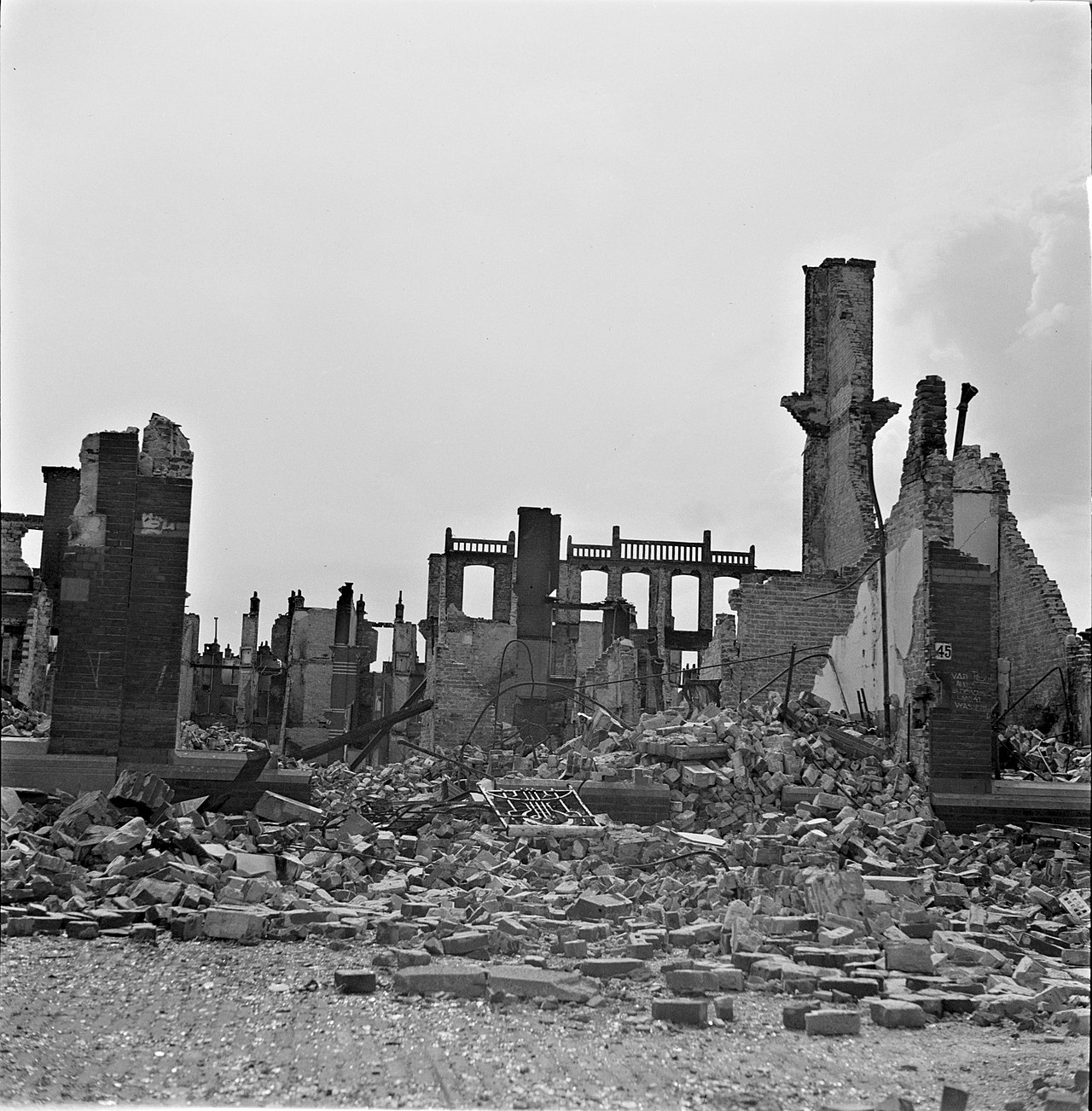
Ruins
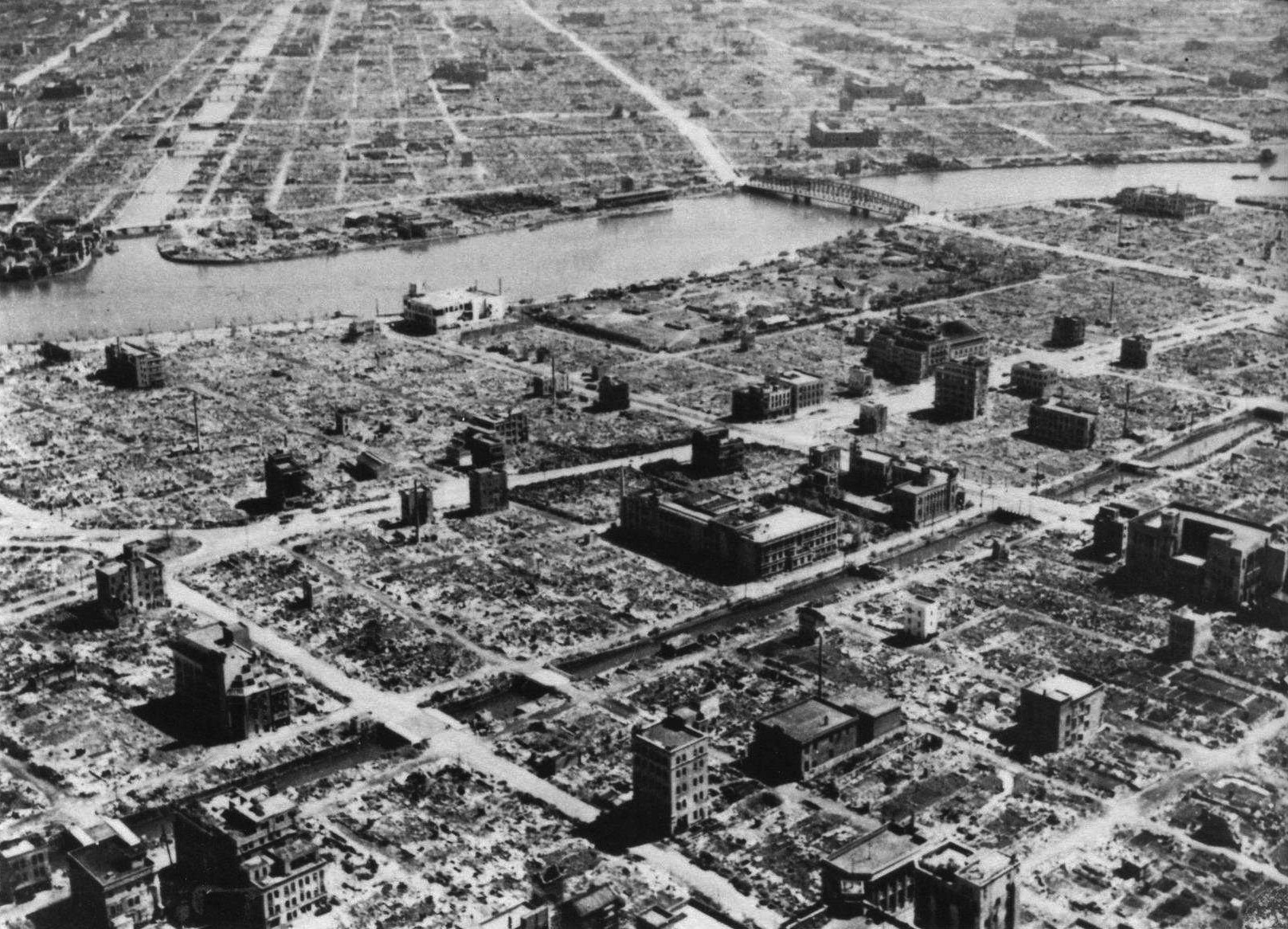
from the Allied accidental bombing of the Bezuidenhout in 1945 / Tokyo
after the massive firebombing attack on the night of 9–10 March 1945
☆
「巻き添え被害[Collateral
damage]」あるいは
「付随的損害」とは、ある活動の結果として生じた、特に民間人に対する偶発的で望ましくない死傷やその他の損害を指す用語である。元々は軍事作戦を説明す
るために作られた言葉だが、現在では非軍事的な文脈でも、行動の意図しない負の結果を指すために用いられる。[3]
「付随的損害」という用語の使用を批判する人々は、これを戦闘中に死亡または負傷した非戦闘員を非人間化する婉曲表現と見なしている。この表現は、非戦闘
員の犠牲を防ぐことに失敗した軍事指導部の責任を軽減するために用いられるのだ[4][5][6][7]。
付随的損害には、敵の民間人を恐怖に陥れたり殺害したりすることを意図した軍事作戦による民間人犠牲は含まれない(例:第二次世界大戦中のドレスデン空襲
やハンブルク空襲、ロシアによるウクライナインフラへの攻撃で公然と「報復的」と称され「町を居住不能にする」ことを意図したもの)。
| "Collateral
damage"
is a term for any incidental and undesired death, injury or other
damage inflicted, especially on civilians, as the result of an
activity. Originally coined to describe military operations,[1] it is
now also used in non-military contexts to refer to negative unintended
consequences of an action.[2][3] Critics of use of the term "collateral damage" see it as a euphemism that dehumanizes non-combatants killed or injured during combat, used to reduce the perceived culpability of military leadership in failing to prevent non-combatant casualties.[4][5][6][7] Collateral damage does not include civilian casualties caused by military operations that are intended to terrorize or kill enemy civilians (e.g., the Bombing of Dresden or Bombing of Hamburg in World War II and Russian strikes against Ukrainian infrastructure openly described as "retaliatory" and intended to "make towns uninhabitable").[8][9][10][11] |
「巻き添え被害[Collateral
damage]」とは、ある活動の結果として生じた、特に民間人に対す
る偶発的で望ましくない死傷やその他の損害を指す用語である。元々は軍事作戦を説明するために作られた言葉だが、現在では非軍事的な文脈でも、行動の意図
しない負の結果を指すために用いられる。[3] 「付随的損害」という用語の使用を批判する人々は、これを戦闘中に死亡または負傷した非戦闘員を非人間化する婉曲表現と見なしている。この表現は、非戦闘 員の犠牲を防ぐことに失敗した軍事指導部の責任を軽減するために用いられるのだ[4][5][6][7]。 付随的損害には、敵の民間人を恐怖に陥れたり殺害したりすることを意図した軍事作戦による民間人犠牲は含まれない(例:第二次世界大戦中のドレスデン空襲 やハンブルク空襲、ロシアによるウクライナインフラへの攻撃で公然と「報復的」と称され「町を居住不能にする」ことを意図したもの)。 |
Ruins from the Allied accidental bombing of the Bezuidenhout in 1945 1945年に連合軍が誤爆したベズイデンハウトの廃墟 |
Tokyo after the massive firebombing attack on the night of 9–10 March 1945, the single most destructive raid in military aviation history. The Tokyo firebombing killed around 100,000 civilians, but the city's industrial productivity—the primary target of the bombing—was cut in half. 1945年3月9日から10日にかけての夜、東京は大規模な焼夷弾攻撃を受けた。これは軍事航空史上最も破壊的な空襲である。東京大空襲では約10万人の 民間人が死亡したが、爆撃の主目的であった都市の工業生産力は半減した。 |
| Origins and usage The term "collateral damage" is often attributed to economist Thomas Schelling, who used it in his 1961 article Dispersal, Deterrence, and Damage published in Operations Research.[12][13] In this article, Schelling discussed military strategies that inadvertently lead to the destruction of civilian areas, not directly targeted but affected by military actions intended to affect other strategic assets. The term came into usage during the Vietnam War and over several decades became entrenched in U.S. armed forces jargon.[14] A 1980s dictionary defined collateral damage as “damage to nonmilitary structures and facilities resulting from a strike on a nearby military target.”[15] After the Persian Gulf War, collateral damage appeared in specialized military dictionaries in addition to standard English dictionaries. These definitions include specific reference to “inadvertent” or “unintended” destruction.[16] According to Scottish linguist Deborah Cameron,[17] "the classic Orwellian arguments for finding this usage objectionable would be that: it is jargon, and to the extent that people cannot decode it, it conceals what is actually going on; it is a euphemism; abstract, agentless, and affectless, so that even if people succeeded in associating it with a real act or event, they would be insulated from any feelings of repulsion or moral outrage". In 1999, "collateral damage" (German: Kollateralschaden) was named the German Un-Word of the Year by a jury of linguistic scholars. With this choice, it was criticized that the term had been used by NATO forces to describe civilian casualties during the Kosovo War, which the jury considered to be an inhuman euphemism.[18] |
起源と使用 「付随的損害」という用語は、経済学者トーマス・シェリングに由来するとされることが多い。彼は1961年に『オペレーションズ・リサーチ』誌に掲載され た論文「分散、抑止、損害」でこの用語を用いた[12][13]。この論文でシェリングは、他の戦略的資産を標的とする軍事行動の副次的な影響として、直 接の標的ではない民間地域が破壊される軍事戦略について論じた。この用語はベトナム戦争期に使用され始め、数十年かけて米軍の専門用語として定着した [14]。 1980年代の辞書では、付随的損害を「近隣の軍事目標への攻撃によって生じた非軍事的構造物や施設への損害」と定義している。[15] 湾岸戦争後、コリダーラル・ダメージは標準的な英語辞典に加え、専門的な軍事辞典にも登場した。これらの定義には「意図しない」あるいは「予期せぬ」破壊 への具体的な言及が含まれている。[16] スコットランドの言語学者デボラ・キャメロンによれば[17]、「この用法に問題があると考える古典的なオーウェル的論拠は次の通りだ: それは専門用語であり、人々が解読できない限り、実際に起きていることを隠蔽する。 それは婉曲表現であり、抽象的で主体性や感情を欠くため、たとえ人々がそれを実際の行為や出来事と結びつけることに成功したとしても、嫌悪感や道徳的憤りから隔離される」というものだ。 1999年、「付随的損害」(ドイツ語: Kollateralschaden)は言語学者からなる審査委員会によりドイツ語の「不適切な言葉」に選ばれた。この選択は、NATO軍がコソボ戦争中 の民間人犠牲者を表現するためにこの用語を使用したことに対する批判であり、審査委員会はこれを非人道的な婉曲表現と見なしたのである[18]。 |
| International humanitarian law Military necessity, along with distinction and proportionality, are three important principles of international humanitarian law, governing the legal use of force in an armed conflict. Offensives causing collateral damage are not automatically classed as a war crimes. They are war crimes when the objective is excessively or solely collateral damage. Luis Moreno-Ocampo, Chief Prosecutor at the International Criminal Court, investigated allegations of war crimes during the 2003 invasion of Iraq and published an open letter containing his findings. A section titled "Allegations concerning War Crimes" elucidates this usage of military necessity, distinction, and proportionality: Under international humanitarian law and the Rome Statute, the death of civilians during an armed conflict, no matter how grave and regrettable, does not in itself constitute a war crime. International humanitarian law and the Rome Statute permit belligerents to carry out proportionate attacks against military objectives,[19] even when it is known that some civilian deaths or injuries will occur. A crime occurs if there is an intentional attack directed against civilians (principle of distinction) (Article 8(2)(b)(i)) or an attack is launched on a military objective in the knowledge that the incidental civilian injuries would be clearly excessive in relation to the anticipated military advantage (principle of proportionality) (Article 8(2)(b)(iv). Article 8(2)(b)(iv) criminalizes intentionally launching an attack in the knowledge that such attack will cause incidental loss of life or injury to civilians or damage to civilian objects or widespread, long-term, and severe damage to the natural environment which would be clearly excessive in relation to the concrete and direct overall military advantage anticipated. Article 8(2)(b)(iv) draws on the principles in Article 51(5)(b) of the 1977 Additional Protocol I to the 1949 Geneva Conventions, but restricts the criminal prohibition to cases that are "clearly" excessive. The application of Article 8(2)(b)(iv) requires, inter alia, an assessment of: the anticipated civilian damage or injury the anticipated military advantage whether (a) was "clearly excessive" in relation to (b).[20] |
国際人道法 軍事上の必要性、区別、比例性は、国際人道法の三つの重要な原則であり、武力紛争における武力行使の合法性を規定する。付随的損害を伴う攻撃は、自動的に戦争犯罪とはみなされない。その目的が過剰に、あるいは専ら付随的損害である場合に限り、戦争犯罪となる。 国際刑事裁判所(ICC)のルイス・モレノ=オカンポ検事長は、2003年のイラク侵攻における戦争犯罪の疑惑を調査し、その調査結果を記した公開書簡を 発表した。「戦争犯罪に関する疑惑」と題された節では、軍事上の必要性、区別、比例性の適用について次のように説明している: 国際人道法及びローマ規程によれば、武力紛争中の民間人の死傷は、いかに深刻で遺憾なものであれ、それ自体では戦争犯罪を構成しない。国際人道法及びロー マ規程は、交戦国が軍事目標に対して比例原則に則った攻撃を行うことを認めている[19]。民間人の死傷が発生することが予見される場合であっても同様で ある。犯罪が成立するのは、民間人を意図的に攻撃した場合(区別原則)(第8条(2)(b)(i))または、軍事目標への攻撃が、予想される軍事上の利益 に対して明らかに過剰な民間人被害を伴うことを知りながら行われた場合(比例原則)(第8条(2)(b)(iv))である。 第8条(2)(b)(iv)は、具体的な直接的な軍事的利益と比べて明らかに過剰となる民間人の死傷、民間物資への損害、あるいは自然環境への広範かつ長期的で深刻な損害が生じると知りながら、意図的に攻撃を実行することを犯罪とする。 第8条(2)(b)(iv)は、1949年ジュネーブ条約の1977年追加議定書I第51条(5)(b)の原則を踏襲しているが、刑事上の禁止を「明らかに」過剰な場合に限定している。第8条(2)(b)(iv)の適用には、とりわけ以下の評価が必要である: 予想される民間人への損害または負傷 予想される軍事上の利益 (a)が(b)に対して「明らかに過剰」であったかどうか。[20] |
| U.S. military approach The USAF Intelligence Targeting Guide defines the term as the "unintentional damage or incidental damage affecting facilities, equipment, or personnel, occurring as a result of military actions directed against targeted enemy forces or facilities",[21] stating that "[s]uch damage can occur to friendly, neutral, and even enemy forces". Another United States Department of Defense document uses "[u]nintentional or incidental injury or damage to persons or objects that would not be lawful military targets in the circumstances ruling at the time",[22] which also states that "[s]uch damage is not unlawful so long as it is not excessive in light of the overall military advantage anticipated from the attack". In U.S. military terminology, the unintentional destruction of allied or neutral targets is called "friendly fire". The U.S. military follows a technology-based process for estimating and mitigating collateral damage. The software used is known as "FAST-CD" or "Fast Assessment Strike Tool—Collateral Damage".[23] |
米軍の対応方針 米空軍情報標的選定ガイドでは、この用語を「標的とされた敵軍部隊または施設に対する軍事行動の結果として生じる、施設、装備、または要員への意図しない 損害または付随的損害」と定義している[21]。また「このような損害は、味方、中立国、さらには敵軍にも生じ得る」と述べている。別の米国防総省文書で は「当時の状況下において合法的な軍事目標とはみなされない人格または物体に対する意図しない、または付随的な傷害または損害」と定義している[22]。 また「攻撃から期待される軍事的優位性の全体像に照らして過剰でない限り、この種の損害は違法ではない」とも述べている。 米軍の用語では、同盟国や中立国の標的を意図せず破壊することを「味方誤射」と呼ぶ。 米軍は付随的損害を推定・軽減するため、技術に基づくプロセスを採用している。使用されるソフトウェアは「FAST-CD」または「Fast Assessment Strike Tool—Collateral Damage」として知られる[23]。 |
| Non-military uses of the phrase While not actually invented by the military,[24] its use in military context has been common. However, the term has since been widely adopted for non-military cases, and in particular, the COVID-19 pandemic. A large number of medical,[25] government sources[26] and media[27] use this term widely in relation to deaths caused indirectly as a result of government policy such as lockdowns, and not directly by the virus itself. Significant debate on the pandemic strategy has ensued, with some advocating restrictions such as lockdowns to save lives, where others claim the 'collateral damage' caused by enforced lockdowns, masks and distancing may in fact cause more deaths over a longer term. An example is the Great Barrington Declaration, signed by over 6,000 medical and other professionals[28] (and mentioned in UK parliament[29] and media[30]) has a FAQ page titled 'Lockdowns and collateral damage',[31] and refers to this phrase several times. The term has also been borrowed by the computing community to refer to the refusal of service to legitimate users when administrators take blanket preventative measures against some individuals who are abusing systems. For example, Realtime Blackhole Lists used to combat email spam generally block ranges of Internet Protocol (IP) addresses rather than individual IPs associated with spam, which can deny legitimate users within those ranges the ability to send email to some domains.[32][33][34] The related term collateral mortality has been presumed to derive from the term "collateral damage" and has been applied within military and non-military contexts. Fisheries are an example of this, where bycatch such as dolphins are called collateral mortality; they are species that die in the pursuit of the legal death of fishing targets, such as tuna.[35] |
この表現の非軍事的用法 実際には軍隊が考案したものではないが[24]、軍事的文脈での使用は一般的であった。しかしその後、この用語は非軍事的な事例、特にCOVID-19パ ンデミックにおいて広く採用されるようになった。多くの医療機関[25]、政府機関[26]、メディア[27]が、ウイルス自体による直接的な死ではな く、ロックダウンなどの政府政策が間接的に引き起こした死に関連して、この用語を広く使用している。パンデミック対策をめぐる議論は激化しており、人命救 助のためロックダウンなどの制限を主張する立場と、強制的なロックダウン・マスク着用・距離確保による「付随的損害」が長期的により多くの死者を招く可能 性を指摘する立場が対立している。例として、6,000人以上の医療専門家らが署名した「グレート・バリントン宣言」[28](英国議会[29]やメディ ア[30]でも言及)には「ロックダウンと付随的損害」[31]と題したFAQページがあり、この表現を複数回言及している。 この用語はコンピューティング分野でも借用され、システムを悪用する一部個人に対する包括的予防措置が正当なユーザーへのサービス拒否を引き起こす状況を 指す。例えばメールスパム対策に用いられるリアルタイムブラックホールリストは、スパムに関連する個別IPではなくIPアドレス範囲をブロックするため、 該当範囲内の正当なユーザーが特定ドメインへメール送信できなくなることがある[32][33]。[34] 関連用語である「付随的死亡率」は「付随的損害」に由来すると考えられており、軍事・非軍事の両分野で用いられる。漁業がその一例であり、マグロなどの漁獲対象を合法的に捕獲する過程で死亡するイルカなどの混獲生物を「付随的死亡率」と呼ぶ。[35] |
| Accidental death Principles of war Unintended consequences Roadkill Center for Civilians in Conflict Principle of double effect |
事故死 戦争の原則 意図せぬ結果 轢死 紛争下の民間人センター 二重効果の原則 |
| References 01. Holland, Joseph (2007). "Military Objective and Collateral Damage: Their Relationship and Dynamics". Yearbook of International Humanitarian Law. 7: 35–78. doi:10.1017/S1389135904000352. ISSN 1389-1359. "Collateral Damage". Merriam-Webster Dictionary. Merriam Webster. Retrieved 17 February 2021. "The meaning and origin of the expression: Collateral Damage". Phrase Finder UK. Retrieved 17 February 2021. "The Political Psychology of Collateral Damage". Archived from the original on 4 March 2016. Peter Olsthoorn (21 September 2010). Military Ethics and Virtues: An Interdisciplinary Approach for the 21st Century. Routledge. p. 125. ISBN 978-1-136-89429-9. Magedah Shabo (2008). Techniques of Propaganda and Persuasion. Prestwick House Inc. p. 134. ISBN 978-1-58049-874-6. George Monbiot (22 October 2014). "'Cleansing the stock' and other ways governments talk about human beings". Comment is Free. Macintyre, Ben (21 March 2014). "'The Bombers and the Bombed,' by Richard Overy". The New York Times. 10. Ivan Arreguín-Toft (19 December 2005). How the Weak Win Wars: A Theory of Asymmetric Conflict. Cambridge University Press. pp. 30–35. ISBN 978-0-521-54869-4. Ivan Arreguín-Toft (19 December 2005). How the Weak Win Wars: A Theory of Asymmetric Conflict. Cambridge University Press. pp. 41–42. ISBN 978-0-521-54869-4. Beau Grosscup (22 August 2006). Strategic Terror: The Politics and Ethics of Aerial Bombardment. Zed Books. pp. 165–166. ISBN 978-1-84277-543-1. Schelling, T. C. (1961). "Dispersal, Deterrence, and Damage". Operations Research. 9 (3): 363–370. doi:10.1287/opre.9.3.363. JSTOR 167568. "In Memoriam: Thomas C. Schelling, 1921–2016". www.wcfia.harvard.edu. 21 December 2016. Retrieved 16 November 2024. Rockel, Stephen J.; Halpern, Rick (2009). Inventing Collateral Damage: Civilian Casualties, War, and Empire. Between the Lines. ISBN 9781897071120. Trevor N. Dupuy, Curt Johnson, and Grace P. Hayes, Dictionary of Military Terms: A Guide to the Language of Warfare and Military Institutions (New York: Wilson, 1986), 51. Lesley Brown, ed., The New Shorter Oxford English Dictionary, vol. 1 (Oxford: Clarendon, 1993), 438; Anne H. Soukhanov, ed., Encarta World English Dictionary (New York: St. Martin’s, 1999), 39; Elizabeth J. Jewell and Frank Abate, eds., The New Oxford American Dictionary (New York: Oxford University Press, 2001), 335. Deborah Cameron (1995). Verbal Hygiene. 2 – Restrictive practices. The politics of style. "Collateral damage" and the politics of discourse. Routledge, p. 72. ISBN 041510355X. "Ein Jahr, ein (Un-)Wort!". Der Spiegel (in German). Article 52 of Additional Protocol I to the Geneva Conventions provides a widely accepted definition of military objective: "In so far as objects are concerned, military objectives are limited to those objects which by their nature, location, purpose or use make an effective contribution to military action and whose total or partial destruction, capture or neutralization, in the circumstances ruling at the time, offers a definite military advantage" (Source: Luis Moreno-Ocampo References page 5, footnote 11). 20. Luis Moreno-Ocampo OTP letter to senders re Iraq Archived 27 March 2009 at the Wayback Machine 9 February 2006. "Allegations concerning War Crimes" Pages 4, 5 "USAF Intelligence Targeting Guide — AIR FORCE PAMPHLET 14- 210 Intelligence". 1 February 1998. p. 180. Retrieved 6 October 2007. "Joint Doctrine Library" (PDF). dtic.mil. Archived from the original (PDF) on 24 August 2014. Retrieved 3 April 2018. Bradley, Graham (21 February 2003). "Military Turns to Software to Cut Civilian Casualties". The Washington Post. p. A18. "The meaning and origin of the expression: Collateral Damage". Phrase Finder UK. Retrieved 17 February 2021.[unreliable source?] Feral-Pierssens, Anne-Laure; Claret, Pierre-Géraud; Chouihed, Tahar (August 2020). "Collateral damage of the COVID-19 outbreak: expression of concern". European Journal of Emergency Medicine. 27 (4): 233–234. doi:10.1097/MEJ.0000000000000717. PMC 7202126. PMID 32345850. Masroor, S. (2020). "Collateral damage of COVID-19 pandemic: Delayed medical care". Journal of Cardiac Surgery. 35 (6): 1345–1347. doi:10.1111/jocs.14638. PMC 7276840. PMID 32419177. Gorvett, Zaria (28 May 2020). "Why most Covid-19 deaths won't be from the virus". BBC Future. "Coronavirus: Health experts join global anti-lockdown movement". 7 October 2020. Retrieved 10 January 2026. "Covid-19: Great Barrington Declaration". The official report of all Parliamentary debates (Hansard). UK Parliament. Retrieved 17 February 2021. 30. Freeman, James (6 October 2020). "Why Won't the Media Listen to These Scientists?". The Wall Street Journal. Retrieved 17 February 2021. "Great Barrington Declaration FAQ". Great Barrington Declaration. Dr. Jay Bhattacharya, Dr. Sunetra Gupta and Dr. Martin Kulldorff. Retrieved 17 February 2021. "Handling spam false positives". www.opswat.com. Retrieved 10 January 2026. "Noncommercial Email Lists: Collateral Damage in the Fight Against Spam". Electronic Frontier Foundation. 12 November 2004. Retrieved 10 January 2026. Sirkin, Marc (4 March 2024). "New email sender rules: Legitimate mailers will be collateral damage". MarTech. Retrieved 10 January 2026. 35. Chuenpagdee, Ratana; Morgan, Lance E.; Maxwell, Sara M.; Norse, Elliott A.; Pauly, Daniel (2003). "Shifting gears: assessing collateral impacts of fishing methods in US waters". Frontiers in Ecology and the Environment. 1 (10): 517–524. doi:10.1890/1540-9295(2003)001[0517:SGACIO]2.0.CO;2. JSTOR 3868162. |
参考文献 01. Holland, Joseph (2007). 「軍事目標と付随的損害:その関係と動態」. 『国際人道法年鑑』. 7: 35–78. doi:10.1017/S1389135904000352. ISSN 1389-1359. 「付随的損害」. マーリアム・ウェブスター辞典. マーリアム・ウェブスター. 2021年2月17日閲覧. 「表現の意味と由来:付随的損害」. フレーズファインダーUK. 2021年2月17日閲覧. 「付随的損害の政治心理学」. 2016年3月4日時点のオリジナルからアーカイブ. ピーター・オルストホーン (2010年9月21日). 『軍事倫理と美徳:21世紀のための学際的アプローチ』. ラウトレッジ. p. 125. ISBN 978-1-136-89429-9. マゲダ・シャボ(2008年)。『プロパガンダと説得の技法』。プレストウィック・ハウス社。134頁。ISBN 978-1-58049-874-6。 ジョージ・モンビオ(2014年10月22日)。「『株の浄化』と政府が人間について語る他の方法」。『コメント・イズ・フリー』。 マッキンタイア、ベン(2014年3月21日)。「リチャード・オーヴァー著『爆撃者と被爆者』」。ニューヨーク・タイムズ。 10. イヴァン・アレギン=トフト(2005年12月19日)。『弱者が戦争に勝つ方法:非対称紛争の理論』。ケンブリッジ大学出版局。30-35頁。ISBN 978-0-521-54869-4。 イヴァン・アレギン=トフト(2005年12月19日)。『弱者が戦争に勝つ方法:非対称的紛争の理論』。ケンブリッジ大学出版局。pp. 41–42。ISBN 978-0-521-54869-4。 ボー・グロスカップ(2006年8月22日)。『戦略的テロ:空爆の政治と倫理』。ゼッドブックス。165–166頁。ISBN 978-1-84277-543-1。 シェリング、T. C.(1961年)。「分散、抑止、損害」. オペレーションズ・リサーチ. 9 (3): 363–370. doi:10.1287/opre.9.3.363. JSTOR 167568. 「追悼:トーマス・C・シェリング、1921–2016」. www.wcfia.harvard.edu。2016年12月21日。2024年11月16日取得。 Rockel, Stephen J.; Halpern, Rick (2009). 『巻き添え被害の発明:民間人犠牲者、戦争、そして帝国』 Between the Lines。ISBN 9781897071120。 トレバー・N・デュピュイ、カート・ジョンソン、グレース・P・ヘイズ著、『軍事用語辞典:戦争と軍事機関の言語ガイド』(ニューヨーク:ウィルソン、1986年)、51ページ。 レスリー・ブラウン編、『新オックスフォード英語辞典(短縮版)』第1巻(オックスフォード:クラレンドン、1993年)、438ページ。アン・H・スー カノフ編、『エンカルタ世界英語辞典』(ニューヨーク:セント・マーティンズ、1999年)、39ページ。エリザベス・J・ジュエル、フランク・アベート 編、『新オックスフォードアメリカン辞典』(ニューヨーク:オックスフォード大学出版局、2001年)、335ページ。 デボラ・キャメロン(1995年)。言語衛生。2 – 制限的慣行。スタイルの政治学。「巻き添え被害」と言説の政治学。ラウトレッジ、72 ページ。ISBN 041510355X。 「Ein Jahr, ein (Un-)Wort!(今年の(不)言葉!)」 『Der Spiegel(ドイツ語)』 ジュネーブ条約の追加議定書 I 第 52 条は、軍事目標について広く受け入れられている定義を規定している。「対象物に関して言えば、軍事目標は、その性質、位置、目的または使用により軍事行動 に効果的に寄与し、かつ、その時点の状況において、その全部または一部の破壊、占領または無力化が明確な軍事的優位をもたらす対象物に限定される」(出 典:ルイス・モレノ=オカンポ 参考文献 5ページ、脚注11)。 20. ルイス・モレノ=オカンポ検察官事務所(OTP)によるイラク関連送付者宛書簡(2009年3月27日ウェイバックマシンにアーカイブ)2006年2月9日付。「戦争犯罪に関する申し立て」4~5ページ 「米空軍情報標的選定ガイド ― 空軍パンフレット14-210 情報」1998年2月1日発行。180ページ。2007年10月6日取得。 「共同ドクトリンライブラリ」 (PDF). dtic.mil. 2014年8月24日、オリジナル (PDF) からアーカイブ。2018年4月3日取得。 ブラッドリー、グラハム (2003年2月21日). 「軍は民間人の犠牲者を減らすためにソフトウェアに目を向ける」. ワシントン・ポスト. p. A18。 「表現の意味と由来:付随的損害」。フレーズファインダー英国。2021年2月17日取得。[信頼性の低い情報源?] Feral-Pierssens, Anne-Laure; Claret, Pierre-Géraud; Chouihed, Tahar (2020年8月)。「COVID-19 流行の付随的損害:懸念表明」. 欧州救急医学ジャーナル. 27 (4): 233–234. doi:10.1097/MEJ.0000000000000717. PMC 7202126. PMID 32345850. マスルール、S.(2020年)。「COVID-19パンデミックの付随的被害:医療ケアの遅延」。心臓外科ジャーナル。35巻6号:1345–1347頁。doi:10.1111/jocs.14638。PMC 7276840。PMID 32419177。 Gorvett, Zaria (2020年5月28日). 「なぜほとんどのCOVID-19死亡はウイルスが原因ではないのか」. BBC Future. 「コロナウイルス:健康専門家が世界的なロックダウン反対運動に参加」. 2020年10月7日. 2026年1月10日閲覧. 「Covid-19:グレート・バリントン宣言」。すべての議会討論の公式報告書(ハンスード)。英国議会。2021年2月17日取得。 30. フリーマン、ジェームズ(2020年10月6日)。「なぜメディアはこれらの科学者の意見に耳を傾けないのか?」。ウォール・ストリート・ジャーナル。2021年2月17日取得。 「グレート・バリントン宣言に関するよくある質問」。グレート・バリントン宣言。ジェイ・バタチャリヤ博士、スネトラ・グプタ博士、マーティン・クルドルフ博士。2021年2月17日取得。 「スパムの誤検知の処理」。www.opswat.com。2026年1月10日取得。 「非営利のメーリングリスト:スパム対策による巻き添え被害」。電子フロンティア財団。2004年11月12日。2026年1月10日取得。 サーキン、マーク(2024年3月4日)。「新しいメール送信者ルール:正当なメール送信者は巻き添え被害を受ける」。MarTech。2026年1月10日取得。 35. Chuenpagdee, Ratana; Morgan, Lance E.; Maxwell, Sara M.; Norse, Elliott A.; Pauly, Daniel (2003). 「ギアの切り替え:米国水域における漁法の副次的な影響の評価」. Frontiers in Ecology and the Environment. 1 (10): 517–524. doi:10.1890/1540-9295(2003)001[0517:SGACIO]2.0.CO;2. JSTOR 3868162。 |
| Roblyer,
Dwight A. (28 April 2003). "Beyond Precision: Issues of Morality and
Decision Making in Minimizing Collateral Casualties". Archived from the
original on 21 April 2021. USAF Intelligence Targeting Guide – Attachment 7: Collateral Damage Perice, Glen A. (23 January 2007). "The Culture of Collateral Damage: A Genealogy". Journal of Poverty. 10 (4): 109–123. doi:10.1300/J134v10n04_06. S2CID 143970665. INIST 18622358. Reynolds, Jefferson D. (1 January 2005). "Collateral damage on the 21st century battlefield: enemy exploitation of the law of armed conflict, and the struggle for a moral high ground". Air Force Law Review. 56: 1–109. Gale A133368631. The Faces of "Collateral Damage" by Charlie Clements, Friends Journal, April 2003 "Collateral Damage: A Military Euphemism for Murder" by Camillo Mac Bica, Znet, 16 April 2007 Authority control databases Edit this at Wikidata GND |
ロブライヤー、ドワイト・A. (2003年4月28日). 「精密さを超えて:付随的犠牲を最小化する際の道徳性と意思決定の問題」. 2021年4月21日にオリジナルからアーカイブされた. 米空軍情報標的選定ガイド – 別添7:付随的損害 ペリス、グレン・A. (2007年1月23日). 「付随的損害の文化:系譜学」『貧困ジャーナル』10巻4号:109–123頁。doi:10.1300/J134v10n04_06。S2CID 143970665。INIST 18622358。 レイノルズ、ジェファーソン・D. (2005年1月1日). 「21世紀の戦場における付随的損害:敵による武力紛争法の悪用と道義的優位性の争い」. 空軍法レビュー. 56: 1–109. ゲイル A133368631. チャーリー・クレメンツ著「『付随的損害』の顔」、『フレンズ・ジャーナル』2003年4月号 カミロ・マック・ビカ著「付随的損害:殺人を婉曲に表現する軍事用語」、『Znet』2007年4月16日 権威制御データベース ウィキデータで編集 GND |
| https://en.wikipedia.org/wiki/Collateral_damage |
リ ンク
文 献
そ の他の情報
CC
Copyleft,
CC, Mitzub'ixi Quq Chi'j, 1996-2099