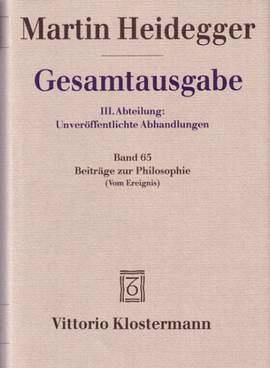

哲学への寄与[出来事について]
Contributions to
Philosophy (Of the Event), 1936-1938
☆哲
学への貢献(出来事について)(ドイツ語:Beiträge zur Philosophie (Vom
Ereignis))は、ドイツの哲学者マーティン・ハイデガーによる著作である。1999年に、パーヴィス・エマドとケネス・マリーによって初めて英語
に翻訳され、インディアナ大学出版局から『哲学への貢献(所有から)』として出版された。2012年には、リチャード・ロジェウィッチとダニエラ・ヴァレ
ガ=ノイによる新たな翻訳が、インディアナ大学出版局から『哲学への貢献(出来事について)』として出版された。1936年から1938年の間に私的に執
筆されたが、1989年にドイツで出版されるまで一般には公開されなかった[1]。この著作は、『存在と時間』(1927年)以降のハイデガーの思想にお
ける「転換」(die Kehre)を反映していると考えられている。
| Contributions to
Philosophy (Of the Event) (German: Beiträge zur Philosophie (Vom
Ereignis)) is a work by German philosopher Martin Heidegger. It was
first translated into English by Parvis Emad and Kenneth Maly and
published by Indiana University Press in 1999 as Contributions to
Philosophy (From Enowning). In 2012, a new translation was produced by
Richard Rojcewicz and Daniela Vallega-Neu and published by Indiana
University Press as Contributions to Philosophy (Of the Event).
Composed privately between 1936 and 1938, but not available to the
public until it was published in Germany in 1989,[1] the work is
thought to reflect "the turn" (die Kehre) in Heidegger's thought after
Being and Time (1927). |
哲学への貢献(出来事について)(ドイツ語:Beiträge
zur Philosophie (Vom
Ereignis))は、ドイツの哲学者マーティン・ハイデガーによる著作である。1999年に、パーヴィス・エマドとケネス・マリーによって初めて英語
に翻訳され、インディアナ大学出版局から『哲学への貢献(所有から)』として出版された。2012年には、リチャード・ロジェウィッチとダニエラ・ヴァレ
ガ=ノイによる新たな翻訳が、インディアナ大学出版局から『哲学への貢献(出来事について)』として出版された。1936年から1938年の間に私的に執
筆されたが、1989年にドイツで出版されるまで一般には公開されなかった[1]。この著作は、『存在と時間』(1927年)以降のハイデガーの思想にお
ける「転換」(die Kehre)を反映していると考えられている。 |
| Summary This section possibly contains original research. Please improve it by verifying the claims made and adding inline citations. Statements consisting only of original research should be removed. (February 2015) (Learn how and when to remove this message) In Contributions to Philosophy (From Enowning), Heidegger builds on the notions of earth and world, which he had previously introduced in "The Origin of the Work of Art", and introduces the concept of "the last god". The result is a move away from the centrality of the phenomenological analyses of Dasein, toward the grounding of Dasein as a historical decision of human beings. Earth can be understood as the condition of possibilities for the world; neither earth nor world can exist without the other, and are thus engaged in a constant and productive struggle or strife. This struggle exists in the crossing from the "first beginning" of Western thought, which began with the ancient Greeks and determined the entire history of metaphysics, to the "other beginning", which will move beyond metaphysics by properly and originally posing the question of the truth of being (Sein). In a parallel fashion, human beings counter god(s), and a space between these four points is opened up for the moment of "enowning", which grounds the "essential sway" of being. The up-welling of the present comes from the future before itself. This means that the being in the now changes the being of the future and thus our utilization of our[who?] being in the past. The "Preview" to Contributions lays out provisionally the unfolding of the work and the methodology, here centered on grounding "the essential swaying of be-ing" rather than on the existential analytic of Dasein put forward in Being and Time. The work is organized into six "joinings", which reflect the crossing to the new or other beginning, and are each equally original in the shift from man as animal rationale to man as Dasein, and from the shift from thinking as representation to inceptual, or be-ing-historical, thinking: 1. Echo: the constant interplay between being and be-ing as not granting, or self-sheltering. In this chapter, Heidegger discusses the necessary ills of machination, the gigantic, and calculation, which, out of the history of metaphysics, reduce the question of be-ing to the belief that all beings — the focus of metaphysics — are created, reproducible, and entirely explainable. This is "necessary" because it is always already a part of the history of the first beginning, and the only thing distressing enough to potentially lead to a more originary distress, which leads to the creative question of be-ing. 2. Playing-forth refers to the hermeneutical relationship between the first beginning and the other beginning, bringing to mind Being and Time's destruction of the history of ontology. Metaphysics is not to be defeated, but rather to be truly understood for the first time, an understanding that will ground this thinking in its history, and allow for the true question of philosophy to be raised. 3. Leap: the posing of the question of be-ing is the leap. The leap does not know what it is leaping into or towards, but in leaping opens up the space for more originary thinking. Since da-sein is projecting-opening, the leap opens a site in which the essential swaying of be-ing may be grounded in thinking-saying. The leap may simply be an originary phenomenological reduction: the leap into a genuine shift in thinking, and a new beginning in the history of philosophy. 4. Grounding 5. The Ones to Come 6. The Last God |
要約 この節には独自研究が含まれている可能性がある。主張を検証し、出典を明記して改善してほしい。独自研究のみから成る記述は削除すべきである。(2015年2月)(このメッセージの削除方法と時期について) 『哲学への貢献』(『エンオーニング』所収)において、ハイデガーは「芸術作品の起源」で既に提示していた「地」と「世界」の概念を発展させ、「最後の 神」という概念を導入する。その結果、現象学的分析におけるダーザイン(現存在)の中心的地位から離れ、ダーザイン(現存在)を人間の歴史的決断として基 盤づける方向へと移行する。大地は世界のための可能性の条件として理解できる。大地も世界も互いなしには存在できず、したがって絶え間なく生産的な闘争や 争いを続けている。この闘争は、古代ギリシャに端を発し形而上学の歴史全体を決定づけた西洋思想の「最初の始まり」から、存在(ゼイン)の真実を正しくか つ原初的に問うことで形而上学を超越する「別の始まり」への移行の中に存在する。同様に、人間は神(たち)に対抗し、これら四点の間には「自己化」の瞬間 が展開する空間が開かれる。そこが「存在の本質的揺らぎ」の基盤となる。現在という湧き上がりは、未来が自らに先立って現れることから生じる。これは、今 ここにある存在が未来の存在を変え、それゆえ我々[誰?]の過去における存在の利用法をも変えることを意味する。 『貢献』への「プレビュー」は、本著作の展開と方法論を暫定的に提示する。ここでは『存在と時間』で提示されたダーザイン(現存在)の実存分析ではなく、 「存在の本質的揺らぎ」の基盤化が中心となる。本書は六つの「結合」で構成される。これらは新たな始まり、あるいは他者的な始まりへの移行を反映し、それ ぞれが等しく独創的である。すなわち、理性的人間としての存在からダーザイン(現存在)としての存在への移行、そして表象としての思考から始原的思考、あ るいは存在-歴史的思考への移行を意味する: 1. エコー:存在と存在者(ビーイング)の絶え間ない相互作用は、与え合いではなく自己保護である。本章でハイデガーは、形而上学の歴史から生じた「機械化」 「巨大化」「計算」という必然的弊害を論じる。これらは存在者(形而上学の焦点)が全て創造され、複製可能で完全に説明可能であるという信念へと、存在の 問題を矮小化する。これは「必然的」である。なぜならそれは常にすでに最初の始まりの歴史の一部であり、より根源的な苦痛へと至りうるほどに苦痛を伴う唯 一のものであり、それが存在の創造的な問いへと導くからである。 2. 遊び出しとは、最初の始まりと他の始まりの間の解釈学的関係を指し、『存在と時間』における存在論の歴史の破壊を想起させる。形而上学は打ち負かされるべ きではなく、初めて真に理解されるべきである。この理解こそが、この思考をその歴史に根ざし、哲学の真の問いを提起することを可能にする。 3. 飛躍:存在の問いを提起することが飛躍である。飛躍は、何に向かって飛び込むのかを知らないが、飛び込むことでより原初的な思考のための空間を開く。ダ・ ザインが投影的開闢である以上、飛躍は存在の本質的揺らぎが思考的言説に根ざし得る場を開く。飛躍とは単に原初的現象学的還帰であるかもしれない。思考に おける真の転換への飛躍、そして哲学史における新たな始まりである。 4. 根底化 5. 来るべき者たち 6. 最後の神 |
| References 1. "Quick reference guide to the English translations of Heidegger". Think.hyperjeff.net. Retrieved 2011-09-18. |
参考文献 1. 「ハイデガー英訳のクイックリファレンスガイド」. Think.hyperjeff.net. 2011年9月18日取得. |
リ ンク
文 献
そ の他の情報
CC
Copyleft,
CC, Mitzub'ixi Quq Chi'j, 1996-2099