
国防省捕虜[戦没者]および行方不明者調査局(DPAA)
Defense POW/MIA
Accounting Agency, DPAA
☆国 防省戦没者[捕虜]・行方不明者調査局(DPAA)は、米国防総省傘下の機関である。その任務は、過去の指定された紛争において捕虜(prisoners of war, POW)または戦時行方不明者(missing in action, MIA)として記録された、所在不明の国防総省関係者を、世界各国から回収し身元を特定することである。
| The Defense POW/MIA
Accounting Agency (DPAA) is an agency within the U.S. Department of
Defense whose mission is to recover and identify unaccounted Department
of Defense personnel listed as prisoners of war (POW) or missing in
action (MIA) from designated past conflicts, from countries around the
world. |
国防省戦没者[捕虜]・行方不明者調査局(DPAA)は、米国防総省傘
下の機関である。その任務は、過去の指定された紛争において捕虜(prisoners of war, POW)または戦時行方不明者(missing
in action, MIA)として記録された、所在不明の国防総省関係者を、世界各国から回収し身元を特定することである。 |
History U.S. Coast Guard Lt. Cmdr. Henry Ritticher, Gold Star brother to Lt. Jack C. Ritticher, places a rosette after Rittcher's name during the National POW/MIA Recognition Day Ceremony hosted by the Defense POW/MIA Accounting Agency (DPAA) at National Memorial Cemetery of the Pacific, Honolulu, Hawaii, Sept. 20, 2024. The rosette signifies Rittcher's remains have been found and identified and is no longer missing in action (MIA).[1] The Defense POW/MIA Accounting Agency was formed on January 15, 2015, as the result the merger of the Joint POW/MIA Accounting Command (JPAC), the Defense Prisoner of War/Missing Personnel Office, and parts of the United States Air Force's Life Sciences Lab.[2] Scientific laboratories are maintained at Offutt Air Force Base, Nebraska, and Joint Base Pearl Harbor–Hickam, Hawaii with their headquarters located at The Pentagon in Washington D.C. Currently, DPAA is in a cooperative agreement with The Henry M. Jackson Foundation for the Advancement of Military Medicine, Inc., which provides operational support during worldwide recovery operations.[3] Following the 2023 wildfires in Maui, the agency assisted in identifying victims' remains.[4] |
歴史 2024年9月20日、ハワイ州ホノルルにある国立太平洋記念墓地で、国防捕虜・行方不明者調査庁(DPAA)主催の国民捕虜・行方不明者追悼式典におい て、ジャック・C・リッチャー中尉のゴールドスター兄弟であるヘンリー・リッチャー米沿岸警備隊中佐が、リッチャーの名前の横にロゼットを付けた。このロ ゼットは、リッチャーの遺骨が発見・身元確認され、行方不明者(MIA)ではなくなったことを示すものである。[1] 国防捕虜・行方不明者調査局(DPAA)は、2015年1月15日、合同捕虜・行方不明者調査司令部(JPAC)、国防捕虜・行方不明者事務所、および米 国空軍生命科学研究所の一部が統合されて設立された。[2] 科学研究所はネブラスカ州オフット空軍基地とハワイ州パールハーバー・ヒッカム統合基地に設置され、本部はワシントンD.C.のペンタゴンに置かれてい る。現在DPAAは、世界規模の遺体回収作戦における運用支援を提供するヘンリー・M・ジャクソン軍事医学振興財団と協力協定を結んでいる。[3] 2023年のマウイ島山火事後、同機関は犠牲者の遺体身元確認を支援した。[4] |
| Recovery of U.S. human remains from the Korean War |
朝鮮戦争における米国人遺体の回収 |
| References 1. "DPAA Hosts 2024 National POW/MIA Recognition Day Ceremony". DVIDS. Retrieved November 7, 2024. 2. "Defense POW/MIA Accounting Agency Becomes Operational". U.S. Department of Defense. 3. "HJF | HJF Teams With Defense POW/MIA Accounting Agency to Account for Missing DoD Personnel". www.hjf.org. Retrieved October 22, 2018. 4. "DNA tests lower the death toll in Maui fire to 97". www.npr.org. Retrieved September 16, 2023. Public Domain This article incorporates text from this source, which is in the public domain: https://www.dpaa.mil/Resources/FAQs.aspx |
参考文献 1. 「DPAA、2024年国民捕虜・行方不明者追悼式典を開催」。DVIDS。2024年11月7日閲覧。 2. 「国防捕虜・行方不明者調査局が活動開始」。米国防総省。 3. 「HJF|HJF、国防捕虜・行方不明者調査局と連携し行方不明国防総省職員の調査を実施」。www.hjf.org。2018年10月22日閲覧。 4. 「DNA鑑定によりマウイ島火災の死者数は97人に減少」。www.npr.org。2023年9月16日閲覧。 パブリックドメイン 本記事はパブリックドメインの以下の出典からテキストを組み込んでいる:https://www.dpaa.mil/Resources/FAQs.aspx |
| Official website (DPAA) News on Nov.10 2025 Due to the lapse of appropriations, the Defense POW/MIA Accounting Agency (DPAA) has been forced to cancel its Joint Field Activities (JFA) in Vietnam and Laos that were planned for late October through early December. The JFA in Laos consisted of three recovery teams and one investigation team, while the JFA in Vietnam consisted of two recovery teams and one investigation team, all of which cannot be deployed. Not affected by the lapse of appropriations are the two Vietnamese recovery teams, both of which will start operations next week. DPAA military and contractor personnel continue to advance the noble mission of providing the fullest possible accounting for U.S. missing p |
【最新ニュース Nov.10 2025】 予算の執行期限切れにより、国防捕虜・行方不明者調査局(DPAA)は、10月下旬から12月上旬にかけて実施予定だったベトナム及びラオスにおける合同 現地活動(JFA)を中止せざるを得なくなった。ラオスでのJFAは3つの回収チームと1つの調査チームで構成され、ベトナムでのJFAは2つの回収チー ムと1つの調査チームで構成されていたが、いずれも展開できなくなった。予算の失効の影響を受けないのは、2つのベトナム人回収チームであり、いずれも来 週から活動を開始する。DPAAの軍関係者と契約業者は、行方不明の米軍兵士について可能な限り完全な記録を提供する崇高な使命を推進し続けている。 |
From Battlefield to Partnership: Honoring Papua New Guinea’s 50th Anniversary Members of the Tolai people perform a Kinavai Dawn Dance during a celebration for Papua New Guinea's 50th Independence Day on Sept. 16, 2025. The Defense POW/MIA Accounting Agency is grateful to its partners in Papua New Guinea and celebrates the long cooperation between the people of Papua New Guinea and the United States, as well as the 50th anniversary of the establishment of diplomatic relations between the two countries following Papua New Guinea's independence from Australia. (U.S. Air Force photo by Staff Sgt. Matthew Angulo) |
戦場から協力関係へ:パプアニューギニア独立50周年を称えて 2025年9月16日、パプアニューギニア独立50周年記念式典で、トライ人民がキナヴァイの夜明けの舞を披露した。国防捕虜・行方不明者調査局は、パプ アニューギニアの協力機関に感謝の意を表し、パプアニューギニアの人民と米国との長きにわたる協力関係、ならびに同国がオーストラリアから独立した後、両 国間で外交関係が樹立されてから50周年を迎えたことを祝う。(米空軍、マシュー・アングーロ曹長撮影) |
| https://en.wikipedia.org/wiki/Defense_POW/MIA_Accounting_Agency |
|
| The recovery of US human remains from the Korean War has continued since the end of the war. More than 36,000 American troops died during the Korean War (1950–1953).[1] As of 2024, the Defense POW/MIA Accounting Agency (DPAA) describes more than 7,400 Americans as "unaccounted for" from the Korean War.[2] The United States Armed Forces estimates that 5,300 of these troops went missing in North Korea.[3] All cases from Korea are under the purview of the Korean War Identification Project (KWIP), which is the largest project in case load and complexity within the DPAA. Korean War identification cases are especially difficult because the remains are highly commingled.[4] |
朝鮮戦争における米兵の遺骨回収は、戦争終結後も継続している。 朝鮮戦争(1950年~1953年)では3万6千人以上の米兵が戦死した。[1] 2024年現在、国防省戦没者・行方不明者調査局(DPAA)は朝鮮戦争における7,400人以上の米兵を「所在不明」と分類している。[2] 米国軍当局は、このうち5,300人が北朝鮮で行方不明になったと推定している。[3] 韓国関連の全事例は朝鮮戦争身元確認プロジェクト(KWIP)の管轄下にある。これはDPAA内で事例数と複雑さにおいて最大のプロジェクトだ。朝鮮戦争 の身元確認事例は遺骨が高度に混在しているため特に困難である。[4] |
 U.S. service members assigned to the Defense POW/MIA Accounting Agency escort a transfer case during a disinterment ceremony at the National Memorial Cemetery of the Pacific on August 11, 2025. During the ceremony, eight caskets from the Korean War were transferred to the DPAA laboratory on Joint Base Pearl Harbor–Hickam, Hawaii, for further scientific analysis and possible identification. In 2019, the DPAA began disinterring 652 sets of unknown remains associated with the Korean War that had been buried at the Punchbowl. These remains were recovered from the Republic of Korea (South Korea) and Democratic Republic of Korea (North Korea) in the 1950s and 1960s, and were buried as unknowns when they could not be identified by the traditional forensic processes available at the time.[5] Operation Glory After the Korean Armistice, in 1954, North Korea returned the remains of more than 3,000 Americans in what was termed Operation Glory.[2] At the same time, US Graves Registration teams recovered remains from South Korea. The US identified thousands of these remains. In 1956, 848 sets of remains that could not be identified were buried in the National Memorial Cemetery of the Pacific, known as the Punchbowl, in Honolulu, Hawaii. Others were later buried there as "unknown soldiers". Another "unknown soldier" was buried in the Tomb of the Unknowns at Arlington National Cemetery.[3] The remains of all of these "unknown soldiers" were treated with formaldehyde, which, in later decades, made their identification through DNA testing difficult.[3] Aftermath of the Cold War  At an arrival ceremony in Hawaii on April 12, 2007, Korean War veteran James Ward thanks Governor Bill Richardson (right), who led a delegation from the U.S. to North Korea to accept the remains of U.S. service members. From 1990 to 1994, North Korea uncovered and returned 208 boxes of remains. The United States Department of Defense's scientists estimate that the remains of as many as 400 people could be held in these boxes.[2] By 2018, 182 people had been identified from the remains in these boxes.[3] Every year since 1993, the DPAA has provided a briefing to the families of the missing or unaccounted for from the Korean War to update them on the status of search and identification efforts. The families are also asked to provide DNA samples to help with identification of remains. In 1995, the DNA bank only had 71 families of the over 8,000 missing, but in 2019, that number was 7,437 families.[6] Remains are examined at the DPAA laboratory at Joint Base Pearl Harbor-Hickman, using mitochondrial DNA (mtDNA) analysis, chest radiographs, and dental and anthropological analysis. Researchers also use circumstantial evidence to assist in making an identification, such as information about where a soldier was presumed missing from, or information gleaned from military medical records. In 1996 the US Department of Defense began dispatching teams to North Korea, carrying out 33 joint operations with the North Koreans and recovering about 220 sets of remains. The US government suspended these operations in 2005, officially because of concerns relating to the safety of US personnel.[3] From 1996 to 2005, the US paid North Korea over US$20 million, ostensibly to cover the costs of these operations.[3] In 1999, the DPAA disinterred the first of the remains from the National Memorial Cemetery of the Pacific in Honolulu, or Punchbowl. The DPAA has focused on using advances in technology and DNA science to begin to identify the more than 800 remains that were buried as "Korea Unknowns." Although these remains were initially thought to be discrete individuals when they were initially interred, it is now suspected that they may also be commingled.[7] In 2007, North Korea sent home the remains of another seven US troops, at the time of the visit of an unofficial US delegation headed by US politician Bill Richardson.[3] During the presidency of Barack Obama (whose term was 2009–2017), the issue was raised without results. In September 2016, North Korean officials made an offer to discuss the return of the remains of about 200 US personnel, but the Obama administration did not pursue the offer.[3] |
2025年8月11日、太平洋国立記念墓地で行われた遺骨発掘式典において、国防捕虜・行方不明者調査局(DPAA)に配属された米軍兵士らが移送ケース を護送した。式典では朝鮮戦争関連の棺8基が、さらなる科学的分析と身元確認の可能性を目的に、ハワイ州パールハーバー・ヒッカム統合基地内のDPAA研 究所へ移送された。2019年、DPAAはパンチボウルに埋葬されていた朝鮮戦争関連の身元不明遺骨652体を発掘し始めた。これらの遺骨は1950年代 から1960年代にかけて大韓民国(韓国)と朝鮮民主主義人民共和国(北朝鮮)から回収されたもので、当時の法医学的手法では身元が特定できなかったた め、身元不明者として埋葬されていた。[5] 栄光の作戦 朝鮮戦争休戦後の1954年、北朝鮮は「栄光の作戦」と称して3,000体以上の米兵遺骨を返還した。[2] 同時に、米軍遺体登録班は韓国から遺骨を回収した。米軍はこれらの遺骨のうち数千体を身元確認した。1956年、身元不明の848体の遺骨はハワイ州ホノ ルルの国立太平洋記念墓地(通称パンチボウル)に埋葬された。その後、他の遺骨も「無名戦士の墓」として同地に埋葬された。別の「無名戦士」はアーリント ン国立墓地の無名戦士の墓に埋葬された[3]。これらの「無名戦士」の遺骨はすべてホルマリン処理されており、これが後年のDNA鑑定による身元確認を困 難にした。[3] 冷戦後の展開 2007年4月12日、ハワイでの到着式典で、朝鮮戦争退役軍人ジェームズ・ウォードが、米軍兵士の遺骨を受け取るため北朝鮮へ米国代表団を率いたビル・リチャードソン知事(右)に感謝の意を表している。 1990年から1994年にかけて、北朝鮮は208箱の遺骨を掘り起こし返還した。米国防総省の科学者らは、これらの箱には最大400人分の遺骨が収めら れていると推定している。[2] 2018年までに、これらの箱から182名の人民の身元が確認された。[3] 1993年以降、DPAA(国防省戦没者遺骨回収局)は毎年、朝鮮戦争で行方不明または身元不明となった兵士の家族に対し、捜索・身元確認活動の進捗状況 を説明する説明会を開催している。家族には遺体の身元確認に役立てるため、DNAサンプルの提供も求められている。1995年、DNAバンクに登録されて いたのは8,000人以上の行方不明者のうちわずか71家族だったが、2019年には7,437家族に増加した。[6] 遺体はパールハーバー・ヒックマン合同基地内のDPAA研究所で、ミトコンドリアDNA(mtDNA)分析、胸部X線写真、歯科・人類学的分析を用いて検 査される。研究者はまた、兵士が行方不明になったと推定される場所に関する情報や、軍医療記録から得られた情報など、状況証拠も身元確認の補助に利用して いる。 1996年、米国防総省は北朝鮮に調査チームを派遣し始め、北朝鮮側と33回の共同作戦を実施し、約220体の遺骨を回収した。米国政府は2005年にこ れらの活動を停止した。公式な理由は米国要員の安全に関する懸念である[3]。1996年から2005年にかけて、米国は北朝鮮に2000万ドル以上を支 払った。表向きはこれらの活動の費用を賄うためである。[3] 1999年、DPAA(国防省戦没者遺骨回収局)はホノルルの国立太平洋記念墓地(通称パンチボウル)から最初の遺骨を改葬した。DPAAは技術とDNA 科学の進歩を活用し、「朝鮮無名戦没者」として埋葬された800体以上の遺骨の身元確認に着手している。当初これらの遺骨は個別の遺体と考えられていた が、現在では混在している可能性も疑われている。[7] 2007年、北朝鮮は米政治家ビル・リチャードソン率いる非公式米国代表団の訪問時に、さらに7名の米兵遺骨を返還した。[3] バラク・オバマ大統領(任期2009年~2017年)の在任中、この問題は提起されたが成果は得られなかった。2016年9月、北朝鮮当局は約200名の 米軍関係者の遺骨返還について協議する提案を行ったが、オバマ政権はこの提案を追求しなかった。[3] |
2018 Singapore Summit and beyond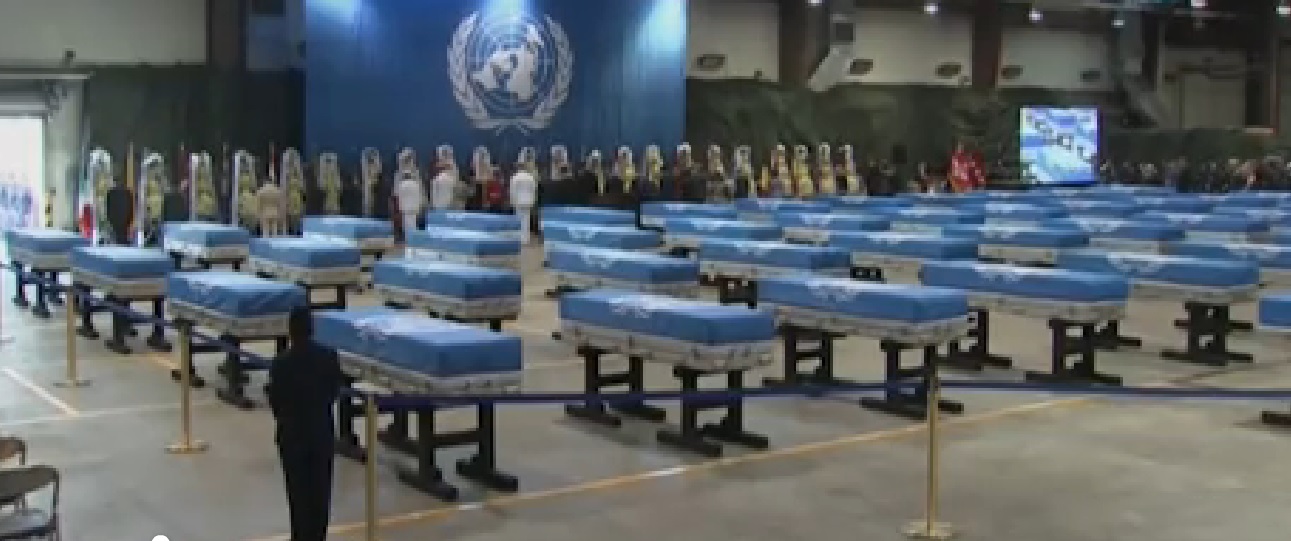 55 boxes of remains being repatriated to the US in 2018 In the Singapore Summit in 2018, US President Donald Trump and Kim Jong Un of North Korea committed "to recovering POW/MIA remains, including the immediate repatriation of those already identified".[8] On 27 July North Korea handed over 55 boxes of human remains. The remains were saluted in a ceremony in their honor by US soldiers.[9] The North Korean authorities reported to the U.S. Defense POW/MIA Accounting Agency that they couldn't be sure how many individuals were represented in the 55 boxes.[10] There was only one dog tag among the remains.[11] Other servicemen could be identified through matching DNA, chest X-rays, and dental records. Twenty boxes were retrieved from the site of the Battle of Unsan, and 35 from the site of the Battle of Chosin Reservoir.[12] There were boots, canteens, and other equipment among the remains.[13] By May 2019, six US servicemen had been identified from the remains in the 55 boxes.[14] By October 2019, it was reported that 35–40 servicemen had been identified.[15] After the failure of the Hanoi Summit, the US suspended the program.[16] As of 1 April 2022 82 remains have been identified from 55 boxes; the total of remains recovered from 1996 to 2005 are 612 of whom 16 are yet unknown.[17] At the September 2018 inter-Korean summit, South Korean President Moon Jae-in and North Korean leader Kim Jong Un agreed to a joint operation to recover remains in part of the Korean Demilitarized Zone. The South Korean Ministry of National Defense estimated that the remains of approximately 200 South Korean soldiers, 100 American and French soldiers, and an unknown number of North Korean and Chinese soldiers are buried in the area. The remains of just over a thousand American troops are thought to be buried in or near the DMZ.[3] On 28 July 2019, President Moon said once excavation was complete for Arrowhead Hill, they would expand it to cover the whole of the DMZ.[18] Also in 2018, the Korean War Identification Project received approval to disinter all the remaining unknowns from the Punchbowl in phases to try to identify them. In 2019, the disinterment process started on 652 sets of unknown remains. This will occur over the next five to seven years in phases, primarily based on the geographic location from which the remains were recovered from. Several phases have already been completed, including R.O.K. Phases one through four and D.P.R.K. Phases one through four. R.O.K. Phase 5 was scheduled to begin on 6 November 2023, and includes 40 unknown remains recovered from the Seoul area (DPAA).[19] On 22 September 2021, the first US-South Korean Joint repatriation service was held: the U.S. received the remains of 1 of 6 U.S. soldiers to be repatriated; South Korea received remains of two of 68 ROK Soldiers to be repatriated.[20] On 22 February 2023, the second US-South Korean Joint repatriation service was held: the U.S. received from South Korea the remains of 1 U.S. Soldier.[21] On 25 June 2023, the third US-South Korean Joint repatriation service was held: South Korea received the remains of 7 ROK soldiers of whom 1 was identified; previous repatriation ceremonies in 2012, 2016, 2018, 2020 and 2021 have returned over 200 ROK remains to South Korea. The DPAA collaboratively worked with the South Korean Ministry of National Defense Agency for KIA Recovery and Identification (MAKRI) to analyze and identify remains.[22] As of 25 April 2024, the total number of unaccounted for personnel stands at 7,478,[23] with 30 and 39 remains being identified in 2022 and 2023, respectively.[7] The DPAA continues to announce identified remains based on the work of the Korean War Identification Project. These identified soldiers are returned to their families for burial. If the remains are found to be South Korean or Chinese in origin, the remains are returned to their home countries in repatriation ceremonies.[citation needed] |
2018年のシンガポールサミットとその先 2018年に米国に返還される55箱の遺骨 2018年のシンガポールサミットで、米国のドナルド・トランプ大統領と北朝鮮の金正恩氏は、「すでに身元が確認された遺骨を直ちに返還することを含め、 捕虜・行方不明者の遺骨を回収する」ことを約束した[8]。7月27日、北朝鮮は55箱の遺骨を引き渡した。遺体は、米兵による敬礼の儀式で称えられた [9]。北朝鮮当局は、米国国防省戦没者・行方不明者調査局に対し、55箱に何人の遺体が収められているかは定かではないと報告した[10]。遺体の中か ら発見されたドッグタグは1つだけだった[11]。その他の軍人は、DNA、胸部X線、歯科記録の照合によって身元が確認された。20箱は雲山(ウンサ ン)の戦場跡から、35箱は長津湖(チョシン)の戦場跡から回収された[12]。遺骨の中にはブーツや水筒、その他の装備品も含まれていた。[13] 2019年5月までに、55箱の遺骸から6名の米軍兵士が特定された。[14] 2019年10月までに、35~40名の兵士が特定されたと報告されている。[15] ハノイサミットの決裂後、米国はこの計画を中断した。[16] 2022年4月1日現在、55箱から82体の遺骨が特定されている。1996年から2005年までに回収された遺骨の総数は612体で、うち16体は未だ 身元不明である。[17] 2018年9月の南北首脳会談で、韓国の文在寅大統領と北朝鮮の金正恩委員長は、朝鮮半島非武装地帯(DMZ)の一部における共同遺骨回収作戦に合意し た。韓国国防省の推定では、この地域には約200名の韓国兵、100名の米仏兵、および不明数の北朝鮮・中国兵の遺骨が埋葬されているとされる。非武装地 帯内またはその周辺には、1000人強の米兵の遺骨が埋葬されていると考えられている。[3] 2019年7月28日、文大統領はアローヘッド・ヒルの発掘が完了次第、非武装地帯全域に調査を拡大すると述べた。[18] また2018年、朝鮮戦争遺骨同定プロジェクトはパンチボウルに残る無名遺骨を段階的に発掘し同定する許可を得た。2019年には652体の無名遺骨の発 掘作業が開始された。これは今後5~7年にわたり、主に遺骨が回収された地理的位置に基づいて段階的に実施される。既に複数の段階が完了している。これに は大韓民国(ROK)第1~4段階及び朝鮮民主主義人民共和国(DPRK)第1~4段階が含まれる。大韓民国第5段階は2023年11月6日に開始予定で あり、ソウル地域で回収された40体の身元不明遺骨を対象とする(DPAA)。[19] 2021年9月22日、初の米韓合同遺骨送還式典が実施された。米国は送還対象6名の米軍兵士のうち1名の遺骨を受け取り、韓国は送還対象68名の韓国軍兵士のうち2名の遺骨を受け取った。[20] 2023年2月22日、第2回米韓合同遺骨送還式典が実施された。米国は韓国から米軍兵士1名の遺骨を受け取った。[21] 2023年6月25日、第3回米韓合同遺骨返還式典が開催された。韓国は7名の韓国人兵士の遺骨を受け取り、うち1名は身元が確認された。2012年、 2016年、2018年、2020年、2021年の過去の返還式典では、200体以上の韓国人兵士の遺骨が韓国に返還されている。DPAAは韓国国防省戦 没者遺骨回収・身元確認庁(MAKRI)と共同で遺骨の分析・身元確認を行った。[22] 2024年4月25日現在、行方不明者の総数は7,478名である[23]。2022年には30名、2023年には39名の遺体が特定された[7]。 DPAAは朝鮮戦争遺体特定プロジェクトの成果に基づき、特定された遺体の発表を継続している。特定された兵士は遺族のもとへ返還され、埋葬される。遺骨 が韓国または中国出身と判明した場合、遺骨は本国送還式典において母国へ返還される。[出典が必要] |
| United Nations Memorial Cemetery – in Busan, South Korea |
国連記念墓地 – 韓国・釜山にある |
| References 1. "Remains of 55 U.S. War Dead in North Korea Start Journey Home After 65 Years". New York Times. 3 August 2018. 2. "Korean War Accounting". Defense POW/MIA Accounting Agency. Retrieved 4 May 2024. Public Domain This article incorporates text from this source, which is in the public domain. 3. "Korean War POW/MIA Accounting Efforts". The National Committee on North Korea. December 2018. 4. "Korean War Identification Project". dpaa-mil.experience.crmforce.mil. Retrieved 4 May 2024. 5. "Disinterring Korean War Unknowns". Defense POW/MIA Accounting Agency. Retrieved 1 September 2025. 6. "Families of Korean War Missing Are Still Hopeful". Defense POW/MIA Accounting Agency. Retrieved 4 May 2024. 7. "DPAA Korean War Identification Project InfoSheet". dpaa-mil.sites.crmforce.mil. Retrieved 4 May 2024. 8. Rosenfeld, Everett (12 June 2018). "Document signed by Trump and Kim includes four main elements related to 'peace regime'". CNBC. Retrieved 12 June 2018. 9. "North Korea returns US troops slain in the Korean War". BBC News. 27 July 2018. 10. Macias, Amanda M. (2 August 2018). "Remains returned from North Korea 'consistent' with being American and from the Korean War, Pentagon says". CNBC. 11. "N Korea returns war dead with one name tag". 1 August 2018. Retrieved 24 January 2019. 12. Copp, Tara (11 September 2018). "2 more service members ID'd from North Korea remains". Military Times. Retrieved 24 January 2019. 13. Philipps, Dave (1 August 2018). "Whose Bones Has North Korea Returned? It May Take Years to Know". New York Times. 14. Babb, Carla (28 May 2019). "US Identifies 6 Americans' Remains from N. Korea". Voice of America. Archived from the original on 29 June 2019. 15. Williams, David (2 October 2019). "US identifies remains of 2 soldiers returned from North Korea after Trump summit". CNN. 16. Browne, Ryan (8 May 2019). "US suspends effort to retrieve war remains from North Korea". CNN. 17. Progress on Korea War remains 23 June 2022 18. "Moon seeks full troop remains excavation in DMZ". Yonhap. 28 July 2019. 19. "DPAA Korean War - Unknowns Phased Disinterment". dpaa-mil.sites.crmforce.mil. Retrieved 4 May 2024. 20. "First-Ever United States and the Republic of Korea Joint Repatriation Ceremony". Defense POW/MIA Accounting Agency. 23 September 2021. Archived from the original on 16 December 2023. Retrieved 22 September 2025. 21. "South Korea transfers remains to U.S. for Identification". Defense POW/MIA Accounting Agency. 22 February 2023. Archived from the original on 6 August 2025. Retrieved 19 October 2025. 22. "DPAA and ROK Host Repatriation Ceremony". Defense POW/MIA Accounting Agency. 23 September 2021. Retrieved 4 May 2024. 23. "DPAA Korean War - Progress on Korean War Personnel Accounting". dpaa-mil.sites.crmforce.mil. Retrieved 4 May 2024.[permanent dead link] |
参考文献 1. 「北朝鮮に埋葬された米軍戦死者55名の遺骨、65年ぶりに帰国へ」『ニューヨーク・タイムズ』2018年8月3日付 2. 「朝鮮戦争戦死者・行方不明者調査」国防省捕虜・行方不明者調査局。2024年5月4日閲覧。パブリックドメイン。本記事はこの出典のテキストを組み込んでいる。 3. 「朝鮮戦争捕虜・行方不明者(POW/MIA)の身元確認活動」. 北朝鮮問題全国委員会. 2018年12月. 4. 「朝鮮戦争身元確認プロジェクト」. dpaa-mil.experience.crmforce.mil. 2024年5月4日閲覧. 5. 「朝鮮戦争無名戦士の遺骨発掘」. 国防省捕虜・行方不明者調査局. 2025年9月1日閲覧。 6. 「朝鮮戦争行方不明者の家族は今も希望を捨てていない」。国防捕虜・行方不明者調査局。2024年5月4日閲覧。 7. 「DPAA朝鮮戦争身元確認プロジェクト情報シート」。dpaa-mil.sites.crmforce.mil。2024年5月4日閲覧。 8. ローゼンフェルド、エヴェレット(2018年6月12日)。「トランプとキムが署名した文書には『平和体制』に関連する4つの主要要素が含まれる」。CNBC。2018年6月12日取得。 9. 「北朝鮮、朝鮮戦争で戦死した米兵の遺骨を返還」。BBCニュース。2018年7月27日。 10. マシアス、アマンダ・M.(2018年8月2日)。「北朝鮮から返還された遺体は米軍兵士で朝鮮戦争のものと一致する」と国防総省が発表。CNBC。 11. 「北朝鮮が戦没者遺骨を返還、名札は1枚のみ」。2018年8月1日。2019年1月24日閲覧。 12. コップ、タラ(2018年9月11日)。「北朝鮮から返還された遺骨からさらに2名の軍人を特定」。ミリタリー・タイムズ。2019年1月24日閲覧。 13. フィリップス、デイブ(2018年8月1日)。「北朝鮮が返還した遺骨は誰のものか?判明には数年かかる可能性」。ニューヨーク・タイムズ。 14. バブ、カーラ(2019年5月28日)。「米国、北朝鮮から6人の米兵の遺骨を特定」。ボイス・オブ・アメリカ。2019年6月29日にオリジナルからアーカイブ。 15. ウィリアムズ、デイビッド(2019年10月2日)。「トランプ首脳会談後、北朝鮮から返還された2人の兵士の遺骨を米国が特定」。CNN。 16. ブラウン、ライアン(2019年5月8日)。「米国、北朝鮮からの戦争遺骨回収作業を一時停止」。CNN。 17. 朝鮮戦争遺骨回収の進展 2022年6月23日 18. 「文大統領、非武装地帯での全戦没者遺骨発掘を求める」。聯合ニュース。2019年7月28日。 19. 「DPAA朝鮮戦争 - 無名戦士の段階的発掘」。dpaa-mil.sites.crmforce.mil。2024年5月4日閲覧。 20. 「初の米国・大韓民国合同遺骨送還式典」。国防捕虜・行方不明者調査局。2021年9月23日。2023年12月16日にオリジナルからアーカイブ。2025年9月22日に閲覧。 21. 「韓国、身元確認のため遺骨を米国に移送」。国防省戦没者・行方不明者調査局。2023年2月22日。2025年8月6日にオリジナルからアーカイブ。2025年10月19日に閲覧。 22. 「DPAAと韓国、遺骨送還式典を共催」。国防捕虜・行方不明者調査局。2021年9月23日。2024年5月4日閲覧。 23. 「DPAA朝鮮戦争 - 朝鮮戦争要員調査の進捗状況」。dpaa-mil.sites.crmforce.mil。2024年5月4日閲覧。[永久リンク切れ] |
| Further reading "Factsheet: POW March Routes and U.N. Cemeteries". Defense POW/MIA Accounting Agency. 24 November 2020. Retrieved 11 May 2022. Lee, Chungsun (15 June 2022). "Between Visible and Invisible Deaths of the Korean War: Re-envisioning Operation Glory (1954) at the United Nations Memorial Cemetery in Korea". International Journal of Military History and Historiography. -1 (aop). Leiden: Koninklijke Brill NV: 458–483. doi:10.1163/24683302-bja10037. S2CID 250368533. |
追加文献(さらに読む) 「ファクトシート:捕虜行進ルートと国連墓地」. 国防捕虜・行方不明者調査局. 2020年11月24日. 2022年5月11日閲覧. 李忠淳(2022年6月15日)。「朝鮮戦争における可視的死と不可視的死の間:韓国国連記念墓地における『栄光の作戦』(1954年)の再考」。『国際 軍事史・歴史学ジャーナル』。-1 (aop)。ライデン:Koninklijke Brill NV:458–483頁。doi:10.1163/24683302-bja10037. S2CID 250368533. |
| https://en.wikipedia.org/wiki/Recovery_of_U.S._human_remains_from_the_Korean_War |
リ ンク
文 献
そ の他の情報
CC
Copyleft,
CC, Mitzub'ixi Quq Chi'j, 1996-2099