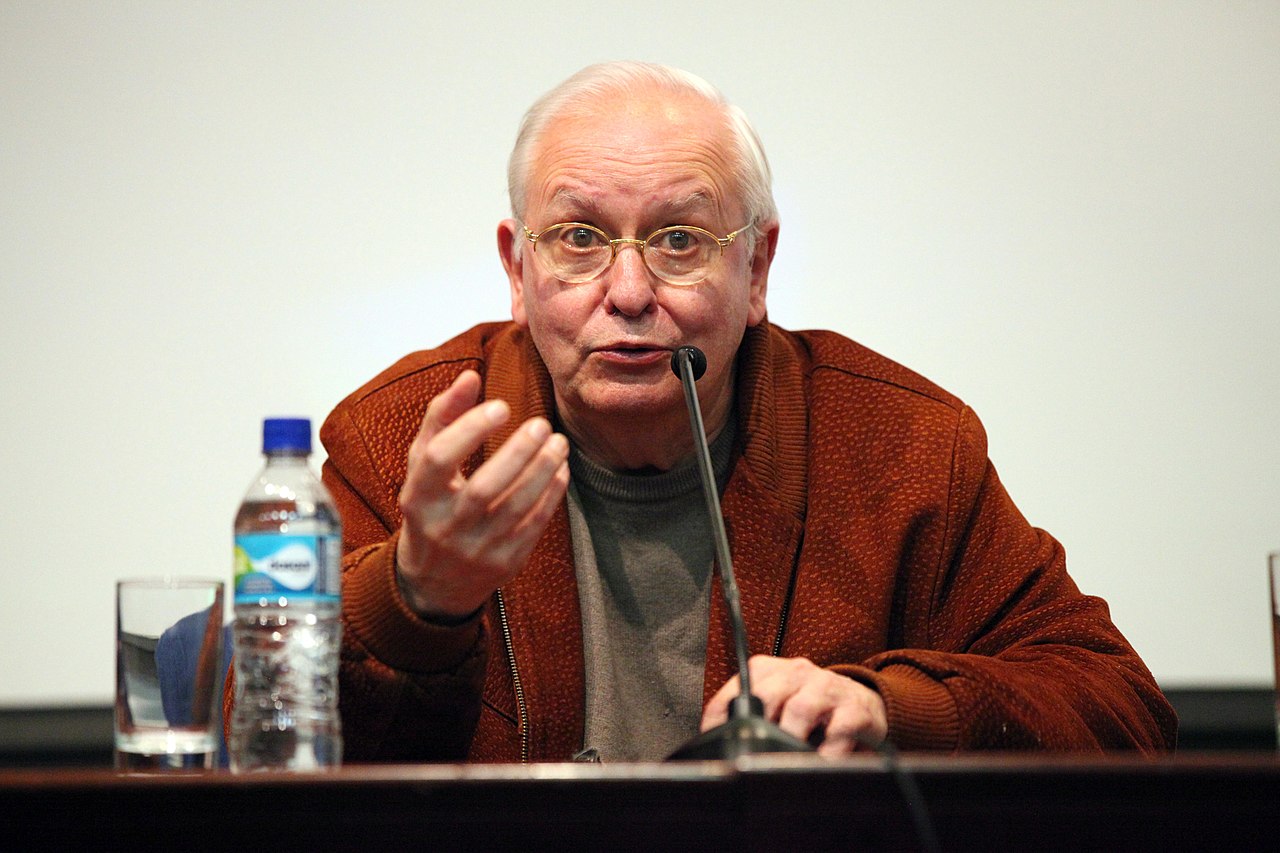
エルネスト・ラクラウ
Ernesto Laclau,
1935-2014
Quito
(Ecuador), 16 de mayo del 2012.- Presentación del Documental
CATASTROIKA y Presentación de la Revista Debates y Combates. Interviene
el Profesor Ernesto Laclau.
Foto:
Xavier Granja Cedeño/Ministerio de Relaciones Exteriores, Comercio e
Integración.
☆
エルネスト・ラクラウ(スペイン語:[laˈklaw]、1935年10月6日 -
2014年4月13日)は、アルゼンチンの政治理論家、哲学者。ポストマルクス主義政治理論の「発明者」と評されることが多い。長年のパートナーである
シャンタル・ムフとの共同研究で知られている。
ブエノスアイレス大学哲学文学部で歴史を学び、1964年に学士号を取得し、1977年にエセックス大学で博士号を取得した。
1986年からエセックス大学で政治理論の教授を務め、イデオロギーと談話分析の大学院プログラム、および人文社会科学理論研究センターを設立し、長年に
わたってそのディレクターを務めた。彼の指導の下、イデオロギーとディスクール分析プログラムは、ポスト構造主義理論(特にソシュールとデリダの著作)、
ポスト分析的思考(ウィトゲンシュタインとリチャード・ロティ)
および精神分析(主にラカン)を基盤とした独自のディスクール分析手法を提供し、アイデンティティ、ディスクール、ヘゲモニーなどの具体的な政治現象の革
新的な分析を行ってきた。この理論的・分析的な方向性は、現在「エセックス・スクール・オブ・ディスクール分析」として知られている。[1]
ラクラウは、北米、南米、西ヨーロッパ、オーストラリア、南アフリカの数多くの大学で幅広く講義を行った。また、米国にあるサンディエゴ州立大学バッファ
ロー校とノースウェスタン大学で教職に就いた。
| Ernesto Laclau
(Spanish: [laˈklaw]; 6 October 1935 – 13 April 2014) was an Argentine
political theorist and philosopher. He is often described as an
'inventor' of post-Marxist political theory. He is well known for his
collaborations with his long-term partner, Chantal Mouffe. He studied history at the University of Buenos Aires Faculty of Philosophy and Letters, graduating with a licenciatura in 1964, and received a PhD from the University of Essex in 1977. From 1986 he served as Professor of Political Theory at the University of Essex, where he founded and directed for many years the graduate programme in Ideology and Discourse Analysis, as well as the Centre for Theoretical Studies in the Humanities and the Social Sciences. Under his directorship, the Ideology and Discourse Analysis programme has provided a research framework for the development of a distinct type of discourse analysis that draws on post-structuralist theory (especially the work of Saussure, and Derrida), post-analytic thought (Wittgenstein, and Richard Rorty) and psychoanalysis (primarily the work of Lacan) to provide innovative analysis of concrete political phenomena, such as identities, discourses and hegemonies. This theoretical and analytical orientation is known today as the 'Essex School of discourse analysis'.[1] Over his career Laclau lectured extensively in many universities in North America, South America, Western Europe, Australia, and South Africa. He also held positions at SUNY Buffalo and Northwestern University, both in the US. |
エルネスト・ラクラウ(スペイン語:[laˈklaw]、1935年
10月6日 -
2014年4月13日)は、アルゼンチンの政治理論家、哲学者。ポストマルクス主義政治理論の「発明者」と評されることが多い。長年のパートナーである
シャンタル・ムフとの共同研究で知られている。 ブエノスアイレス大学哲学文学部で歴史を学び、1964年に学士号を取得し、1977年にエセックス大学で博士号を取得した。 1986年からエセックス大学で政治理論の教授を務め、イデオロギーと談話分析の大学院プログラム、および人文社会科学理論研究センターを設立し、長年に わたってそのディレクターを務めた。彼の指導の下、イデオロギーとディスクール分析プログラムは、ポスト構造主義理論(特にソシュールとデリダの著作)、 ポスト分析的思考(ウィトゲンシュタインとリチャード・ロティ) および精神分析(主にラカン)を基盤とした独自のディスクール分析手法を提供し、アイデンティティ、ディスクール、ヘゲモニーなどの具体的な政治現象の革 新的な分析を行ってきた。この理論的・分析的な方向性は、現在「エセックス・スクール・オブ・ディスクール分析」として知られている。[1] ラクラウは、北米、南米、西ヨーロッパ、オーストラリア、南アフリカの数多くの大学で幅広く講義を行った。また、米国にあるサンディエゴ州立大学バッファ ロー校とノースウェスタン大学で教職に就いた。 |
| Biography Laclau studied history at the University of Buenos Aires[2] and was a member of the PSIN (Socialist Party of the National Left) until 1969, when the British historian Eric Hobsbawm supported his entrance to Oxford.[3] He had close links with Jorge Abelardo Ramos, the founder of the PSIN, although he stated in 2005 that the latter had evolved in a direction he did not appreciate.[3] In the same interview, he claimed that he came from a Yrigoyenista family, and that the Peronist politician Arturo Jauretche, a strong opponent of Justo's dictatorship during the Infamous Decade of the 1930s, was a close friend of his father.[3] In his later years, he had close ties with the Argentine Socialist Confederation (Spanish: Confederación Socialista Argentina),[4] and in Argentina he is associated with Peronism.[5] Laclau died of a heart attack in Seville in 2014.[6][7] |
略歴 ラクラウはブエノスアイレス大学で歴史学を学び[2]、1969年に英国の歴史家エリック・ホブズボームがオックスフォード大学への入学を支援するまで、 PSIN(国民左派社会党)のメンバーだった[3]。彼はPSINの創設者であるホルヘ・アベラルド・ラモスと親しい関係にあったが、2005年には、ラ モスは自分が評価できない方向に進化したと述べている。[3] 同インタビューで、彼は自身がイリゴイェニスタ派の家庭出身であり、1930年代の「恥辱の10年」にフストの独裁政権に強く反対したペロン派政治家アル トゥロ・ハレッチェが父親の親しい友人だったと述べている。[3] 晩年は、アルゼンチン社会主義連合(スペイン語:Confederación Socialista Argentina)と密接な関係にあり[4]、アルゼンチンではペロニズムと関連付けられている[5]。 ラクラウは2014年にセビリアで心臓発作により死去した[6][7]。 |
| Work Laclau's early work was influenced by Althusserian Marxism and focused on issues debated within Neo-Marxist circles in the 1970s, such as the role of the state, the dynamics of capitalism, the importance of building popular movements, and the possibility of revolution. Laclau's most significant book is Hegemony and Socialist Strategy, which he co-authored with Chantal Mouffe in 1985. The position outlined in this book is usually described as post-Marxist because it rejects (a) Marxist economic determinism and (b) the view that class struggle is the most important antagonism in society. In their 2001 introduction to the second edition Laclau and Mouffe commented on this label, stating that whilst 'post-Marxist' they were also 'post-Marxist':[8] their work, though a departure from traditional Western Marxism, retained similar concerns and ideas. A key innovation in Hegemony and Socialist Strategy was Laclau and Mouffe's argument that left-wing movements need to build alliances with a wide variety of different groups if they are to be successful and establish a left-wing 'hegemony'. In the final chapter of the book, the project of "radical and plural democracy" was advocated: a democracy in which subjects accept the importance of the values of liberty and equality, but fight over what the terms mean. In Hegemony and Socialist Strategy Laclau and Mouffe also offered a constructivist account of 'discourse'. By drawing on the work of the later Wittgenstein, they argued that social entities only become meaningful through both linguistic and non-linguistic discursive articulation.[9] As such, the meaning of something is never pre-given but is, instead, constructed through social practices. In a later summary of his view, Laclau claims there is support for this broad sense of discourse in Saussure. "By discourse... I do not mean something that is essentially restricted to the areas of speech and writing, but any complex of elements in which relations play the constitutive role. This means that elements do not pre-exist the relational complex but are constituted through it. Thus 'relation' and 'objectivity' are synonymous. Saussure asserted that there are no positive terms in language, only differences — something is what it is only through its differential relations to something else."[10] Laclau subsequently used this account of discourse to re-consider the nature of identity, arguing that all political identities are discursive - even if they are experienced by individuals as 'natural' (even to the point where one's identity is not recognised as an identity). For example, though an individual may think that they are just 'born male' this is, for Laclau[citation needed] not the case: 'maleness' is a socially constructed category that has no innate meaning. In his more recent works, Laclau returned to a topic that was prevalent in his earliest writings: populism. In On Populist Reason, Laclau considered the nature of populism in political discourse, the creation of a popular hegemonic bloc such as "the people", and the importance of affect in politics. Building on his earlier work, Laclau argued that the basis of populism lies in the creation of "empty signifiers": words and ideas that express a universal idea of justice, and symbolically structure the political environment. Against those who see populism as a threat to democracy, Laclau argued that it is an essential component of it.[11] Before his death, Laclau was working on a book titled Elusive Universality, in which he sought to reconcile the tension between universalism and particularism by proposing that universality is always incomplete and constituted through the articulation of particular demands of subaltern groups.[12] |
仕事 ラクラウの初期の著作はアルチュセール派マルクス主義の影響を受け、1970年代の新マルクス主義圏内で議論された諸問題、例えば国家の役割、資本主義の 動態、大衆運動構築の重要性、革命の可能性などに焦点を当てていた。ラクラウの最も重要な著作は、1985年にシャンタル・ムフと共著した『ヘゲモニーと 社会主義戦略』である。この本で示された立場は、通常ポストマルクス主義と称される。なぜならそれは(a)マルクス主義的経済決定論と(b)階級闘争が社 会における最重要の対立軸であるという見解を拒否するからである。2001年の第二版序文で、ラクラウとムフはこのレッテルについて言及し、「ポストマル クス主義的」であると同時に「ポストマルクス主義的」でもあると述べた[8]。彼らの研究は伝統的な西洋マルクス主義からの脱却でありながら、同様の関心 と思想を保持していたのである。『ヘゲモニーと社会主義戦略』における重要な革新は、左派運動が成功し左派の「ヘゲモニー」を確立するためには、多様なグ ループとの同盟を構築する必要があるというラクラウとムフの主張であった。本書の最終章では、「急進的かつ多元的な民主主義」の構想が提唱された。これ は、主体が自由と平等の価値の重要性を認めつつ、それらの用語が意味する内容について争う民主主義である。 『ヘゲモニーと社会主義戦略』において、ラクラウとムフは「言説」に関する構成主義的解釈も提示した。後期ウィトゲンシュタインの思想を参照し、社会的実 体は言語的・非言語的言説の相互関係を通じて初めて意味を持つと論じた[9]。つまり、何かの意味は予め与えられたものではなく、社会的実践を通じて構築 される。後に自身の見解を要約したラクラウは、この広義の言説概念がソシュールにも支持されていると主張する。「言説とは... とは、本質的に言語や文字の領域に限定されたものを指すのではなく、関係性が構成的役割を果たすあらゆる要素の複合体を意味する。これは、要素が関係性の 複合体に先立って存在せず、それを通じて構成されることを意味する。したがって『関係』と『客観性』は同義語である。ソシュールは、言語には肯定的な用語 は存在せず、差異のみが存在すると主張した——何かは、他の何かとの差異的な関係を通じてのみ、それ自体となるのである。」[10] ラクラウはこの言説論を用いてアイデンティティの本質を再考し、あらゆる政治的アイデンティティは言説的であると論じた。たとえ個人がそれを「自然」なも のとして経験する場合でも(自らのアイデンティティがアイデンティティとして認識されないほどに)。例えば、個人が「単に男性として生まれた」と考えてい る場合でも、ラクラウによれば[出典必要]そうではない。「男性性」とは生得的な意味を持たない社会的に構築されたカテゴリーである。 近年の著作において、ラクラウは初期の著作で頻繁に取り上げていた主題——ポピュリズム——に戻った。『ポピュリスト的理性の論理』において、ラクラウは 政治言説におけるポピュリズムの本質、「人民」といった大衆的ヘゲモニー的ブロックの形成、そして政治における感情の重要性を考察した。先行研究を発展さ せ、ラクラウはポピュリズムの基盤が「空虚な記号」の創造にあると主張した。これは普遍的な正義の理念を表現し、政治環境を象徴的に構造化する言葉や思想 である。ポピュリズムを民主主義への脅威と見なす者たちに対し、ラクラウはそれが民主主義の本質的構成要素であると主張した[11]。 ラクラウは死の直前まで『捉えどころのない普遍性』と題する著作に取り組んでいた。この書において彼は、普遍性は常に不完全であり、サバルタンの個別的な要求の表明を通じて構成されるという提案により、普遍主義と個別主義の間の緊張関係を調和させようとした[12]。 |
| Relationship with Slavoj Žižek Laclau is known for his long standing dialogue with Lacanian "arch-Marxist" Slavoj Žižek. This dates back to at least 1989, when Laclau wrote the introduction to Žižek's first book in English (The Sublime Object of Ideology). Žižek is widely recognized as responsible for Laclau's increased acceptance of Lacanian ideas and his essay "Beyond Discourse Analysis",[13] which was published in Laclau's New Reflections on the Revolutions of Our Time (1990), provided a psychoanalytic critique of Laclau's work. In 2000, Laclau, Žižek and Judith Butler published the trialogue Contingency, Hegemony, Universality, in which each responded to the others' works in a three-essay cycle. Although Žižek and Laclau noted their similarities and mutual respect, significant political and theoretical differences emerged between all three interlocutors. Following several acrimonious publications in the early 2000s, Laclau wrote in On Populist Reason (2005) that Žižek had an impractical and confused approach to politics, describing him as "waiting for the Martians".[14] Their disagreement escalated in the pages of Critical Inquiry in 2006, when in a spate of essays the two argued in an increasingly hostile manner about political action, Marxism and class struggle, Hegel, populism, and the Lacanian Real.[15][16] More recently in a 2014 interview with David Howarth, Laclau stated that his relationship with Žižek had deteriorated due to the latter adopting a "frantic ultra-Leftist stance, wrapped in a Leninism of kindergarten".[17] |
スラヴォイ・ジジェクとの関係 ラクラウは、ラカン派の「極度のマルクス主義者」であるスラヴォイ・ジジェクとの長年にわたる対話で知られる。これは少なくとも1989年に遡り、ラクラ ウがジジェクの英語初著作『イデオロギーの崇高なる対象』の序文を執筆した時期である。ジジェクは、ラクラウがラカン思想をより受け入れられるようになっ た要因として広く認識されている。また、ジジェクの論文「言説分析を超えて」[13]は、ラクラウの『現代革命の再考』(1990年)に掲載され、ラクラ ウの著作に対する精神分析的批判を提供した。2000年、ラクラウ、ジジェク、ジュディス・バトラーは三者対話『偶然性、ヘゲモニー、普遍性』を出版し た。三者は三編の論文で互いの著作に応答した。ジジェクとラクラウは互いの類似性と相互尊重を指摘したが、三者間には重大な政治的・理論的相違が浮き彫り になった。2000年代初頭に数本の辛辣な論考を発表した後、ラクラウは『ポピュリスト的理性について』(2005年)において、ジジェクが「火星人を 待っている」と表現し、その政治的アプローチは非現実的で混乱していると論じた。[14] 両者の対立は2006年『クリティカル・インクワイアリー』誌上で激化した。一連の論考において、政治行動、マルクス主義と階級闘争、ヘーゲル、ポピュリ ズム、ラカン的現実論をめぐり、両者は次第に敵対的な論調で論争を繰り広げた。[15][16] さらに近年では、2014年のデイヴィッド・ハウワースとのインタビューで、ラクラウはジジェクとの関係が悪化した理由を「幼稚園レベルのレーニン主義に 包まれた、狂乱的な超左翼的立場」をジジェクが採ったためだと述べている。[17] |
| Bibliography Politics and Ideology in Marxist Theory (NLB, 1977) Laclau, Ernesto; Mouffe, Chantal (2001) [1985]. Hegemony and Socialist Strategy. London: Verso Books. ISBN 9781859843307. New Reflections on the Revolution of our Time (Verso, 1990) The Making of Political Identities (editor) (Verso, 1994) Emancipation(s) (Verso, 1996) Contingency, Hegemony, Universality (with Judith Butler and Slavoj Žižek) (Verso, 2000) On Populist Reason. Phronesis. London: Verso Books. 2005. ISBN 9781859846513. The Rhetorical Foundations of Society (Verso, 2014) |
参考文献 マルクス主義理論における政治とイデオロギー(NLB、1977年 ラクラウ、エルネスト、ムフ、シャンタル(2001年) [1985年]。ヘゲモニーと社会主義戦略。ロンドン:Verso Books。ISBN 9781859843307。 私たちの時代の革命に関する新たな考察(Verso、1990年 政治的アイデンティティの形成(編者)(ヴェルソ、1994年) 解放(ヴェルソ、1996年) 偶然性、ヘゲモニー、普遍性(ジュディス・バトラー、スラヴォイ・ジジェクと共著)(ヴェルソ、2000年) 『ポピュリストの理性。フロネシス』ロンドン:ヴェルソ・ブックス、2005年。ISBN 9781859846513。 『社会の修辞的基礎』(ヴェルソ、2014年) |
| Antonio Gramsci Chantal Mouffe Essex School of discourse analysis Hegemony discursive theory Laclau-Mouffe List of deconstructionists Louis Althusser Peronism Richard JF Day Slavoj Žižek Saul Newman |
アントニオ・グラムシ シャンタル・ムフ エセックス談話分析学派 ヘゲモニー談話理論ラクラウ・ムフ 脱構築主義者一覧 ルイ・アルチュラー ペロン主義 リチャード・J・F・デイ スラヴォイ・ジジェク ソール・ニューマン |
| Further reading Anna Marie Smith, Laclau and Mouffe: The Radical Democratic Imaginary, London: Routledge, 1998. David Howarth, Discourse, Milton Keynes: Open University Press, 2000. Louise Philips and Marianne Jorgensen, Discourse Analysis as Theory and Method, London: Sage, 2002. David Howarth, Aletta Norval and Yannis Stavrakakis (eds), Discourse Theory and Political Analysis, Manchester: Manchester University Press, 2002. Simon Critchley and Oliver Marchart (eds), Laclau: A Critical Reader, London: Routledge, 2004. Warren Breckman, Adventures of the Symbolic: Postmarxism and Radical Democracy, New York: Columbia University Press, 2013 David Howarth and Jacob Torfing (eds) Discourse Theory in European Politics, Houndmills: Palgrave, 2005. |
さらに詳しく読む アンナ・マリー・スミス『ラクラウとムフ:急進的民主主義の想像力』Routledge、1998年。 デビッド・ハウアート『談話』Open University Press、2000年。 ルイーズ・フィリップス、マリアンヌ・ヨルゲンセン『理論と方法としての談話分析』Sage、2002年。 デビッド・ハウアート、アレッタ・ノルヴァル、ヤニス・スタヴラカキス(編)、『ディスクール理論と政治分析』、マンチェスター:マンチェスター大学出版局、2002年。 サイモン・クリッチリー、オリバー・マーチャート(編)、『ラクラウ:批判的読本』、ロンドン:Routledge、2004年。 ウォーレン・ブレックマン『象徴の冒険:ポストマルクス主義と急進的民主主義』、ニューヨーク:コロンビア大学出版局、2013年。 デビッド・ハウアートとジェイコブ・トーフィン(編)『ヨーロッパ政治における談話理論』、ハウンドミルズ:パームグレイブ、2005年。 |
| https://en.wikipedia.org/wiki/Ernesto_Laclau |
|
| References 1. Townshend, Jules (February 2003). "Discourse theory and political analysis: a new paradigm from the Essex School?". British Journal of Politics and International Relations. 5 (1): 129–142. doi:10.1111/1467-856X.00100. S2CID 146283536. 2. "Cuáles eran las principales ideas de la obra de Ernesto Laclau" [What were the main ideas of the work of Ernesto Laclau]. La Nacion (in Spanish). 13 April 2014. Archived from the original on 18 September 2018. Retrieved 18 April 2015. 3. "Las manos en la masa - Ernesto Laclau contra Negri, Hardt y Zizek" [Hands in the dough - Ernesto Laclau against Negri, Hardt and Zizek]. Pagina/12 (in Spanish). 5 June 2005. 4. "Una apuesta por la transformación" [A commitment to transformation]. La Vanguardia (in Spanish). 5. "Ernesto Laclau, el ideólogo de la Argentina dividida" [Ernesto Laclau, the ideologue of divided Argentina]. Perfil (in Spanish). 14 April 2014. Archived from the original on 19 April 2015. 6. "ÚLTIMO MOMENTO: Falleció en Sevilla, el téorico y politólogo argentino, Ernesto Laclau | Radio Rivadavia" [LAST MOMENT: The Argentine theoretician and political scientist, Ernesto Laclau | Radio Rivadavia] (in Spanish). Rivadavia.com.ar. Archived from the original on 14 April 2014. Retrieved 13 April 2014. 7. Blackburn, Robin. "Ernesto Laclau, 1935-2014". Verso Books. Retrieved 14 April 2014. 8. Laclau & Mouffe 2001. 9. Laclau & Mouffe 2001, p. 108. 10. Laclau 2005, p. 68. 11. Laclau 2005. 12. "Ernesto Laclau. Le particulier". Philosophie Magazine. 21 September 2012. 13. Žižek, Slavoj (1990). Beyond Discourse Analysis. London: Verso Books. pp. 249–260. 14. Laclau 2005, p. 232. 15. Laclau, Ernesto (2006). "Why Constructing A People is the Main Task of Radical Politics". Critical Inquiry. 32 (4): 646–680. doi:10.1086/508086. JSTOR 10.1086/508086. S2CID 146643004. 16. Žižek, Slavoj (2006). "Schlagend, aber nicht Treffend!". Critical Inquiry. 33 (1): 185–211. doi:10.1086/509751. JSTOR 10.1086/509751. S2CID 154718020. 17. Laclau, Ernesto (2014). Ernesto Laclau: Post-Marxism, Populism and Critique. Abingdon: Routledge. p. 271. |
参考文献 1. タウンゼンド、ジュールズ(2003年2月)。「言説理論と政治分析:エセックス学派による新たなパラダイムか?」。『英国政治・国際関係ジャーナル』。 5巻1号:129–142頁。doi:10.1111/1467-856X.00100。S2CID 146283536. 2. 「エルネスト・ラクラウの著作における主要な思想とは何か」. ラ・ナシオン(スペイン語). 2014年4月13日. 2018年9月18日にオリジナルからアーカイブ. 2015年4月18日に閲覧. 3. 「生地に手を突っ込んで - エルネスト・ラクラウ対ネグリ、ハート、ジジェク」. Pagina/12 (スペイン語). 2005年6月5日. 4. 「変革への賭け」. ラ・バンガード (スペイン語). 5. 「エルネスト・ラクラウ、分断されたアルゼンチンのイデオロギー家」. ペルフィル (スペイン語). 2014年4月14日. 2015年4月19日にオリジナルからアーカイブ. 6. 「最新速報:アルゼンチンの理論家・政治学者エルネスト・ラクラウがセビリアで死去|ラジオ・リバダビア」 (スペイン語). Rivadavia.com.ar. 2014年4月14日時点のオリジナルからアーカイブ。2014年4月13日に閲覧。 7. ブラックバーン、ロビン。「エルネスト・ラクラウ、1935-2014」。ヴェルソ・ブックス。2014年4月14日に閲覧。 8. ラクラウ&ムフ 2001年。 9. ラクラウ&ムフ 2001年、108ページ。 10. ラクラウ 2005年、68ページ。 11. ラクラウ 2005年。 12. 「エルネスト・ラクラウ。ル・パルティキュリエ」。フィロソフィー・マガジン。2012年9月21日。 13. ジジェク、スラヴォイ(1990)。『言説分析を超えて』。ロンドン:ヴェルソ・ブックス。pp. 249–260。 14. ラクラウ 2005, p. 232。 15. ラクラウ、エルネスト(2006)。「なぜ人民の構築が急進的政治の主要な課題なのか」『クリティカル・インクワイアリー』32巻4号: 646–680頁. doi:10.1086/508086. JSTOR 10.1086/508086. S2CID 146643004. 16. ジジェク、スラヴォイ(2006)。「打撃は与えるが、的を射ない!」。『クリティカル・インクワイアリー』33巻1号:185–211頁。doi:10.1086/509751。JSTOR 10.1086/509751. S2CID 154718020. 17. ラクラウ、エルネスト (2014). 『エルネスト・ラクラウ:ポストマルクス主義、ポピュリズム、そして批判』. アビンドン:ラウトリッジ. p. 271. |
リ ンク
文 献
そ の他の情報
CC
Copyleft,
CC, Mitzub'ixi Quq Chi'j, 1996-2099