多民族国家
Estado multiétnico, Multinational state
★ 多民族国家あるいは多民族連合とは、二つ以上の国民や国家から構成される主権国家である。これは単一国民国家とは対照的で、後者では一つの国民が大半の人 口を占める。[出典が必要] 「国民」の定義(民族性、言語、政治的アイデンティティに関わる)によっては、多民族国家は通常多文化あるいは多言語であり、地理的には複数の国々で構成 される。例えばイギリス連邦諸国がこれに当たる。 歴史的に存在し、後に複数の国家に分裂した多民族国家には、オスマン帝国、英領インド、清帝国、チェコスロバキア、ソビエト連邦、ユーゴスラビア、アラブ 連合共和国、オーストリア=ハンガリー帝国(二つの多民族国家からなる二重君主制)などがある。一部の分析者は、欧州連合を多民族国家、あるいは潜在的な 多民族国家と位置づけている。
☆なおスペイン語の多民族国家(Estado multiétnico)は、ひとつの国家の中に複数の民族集団(ethnic group)が存在するという「古い考え方」による命名法であり、英語の多国民国家(Multinational state)のほうは、ひとつの国家のなかに複数のネーション(国民)が包摂される——そして、そのネーションは国家アイデンティティよりもより下位の集団的アイデンティティをもつ——という表現をするために、より「現代的な呼称」といえる。
| A multinational
state or a multinational union is a sovereign entity that comprises two
or more nations or states. This contrasts with a nation state, where a
single nation accounts for the bulk of the population.[citation needed]
Depending on the definition of "nation" (which touches on ethnicity,
language, and political identity), a multinational state is usually
multicultural or multilingual, and is geographically composed of more
than one country, such as the countries of the United Kingdom. Historical multinational states that have since split into multiple states include the Ottoman Empire, British India, Qing Empire, Czechoslovakia, the Soviet Union, Yugoslavia, the United Arab Republic and Austria-Hungary (a dual monarchy of two multinational states). Some analysts have described the European Union as a multinational state or a potential one.[1][2] |
多民族国家あるいは多民族連合とは、二つ以上の国民や国家から構成され
る主権国家である。これは単一国民国家とは対照的で、後者では一つの国民が大半の人口を占める。[出典が必要]
「国民」の定義(民族性、言語、政治的アイデンティティに関わる)によっては、多民族国家は通常多文化あるいは多言語であり、地理的には複数の国々で構成
される。例えばイギリス連邦諸国がこれに当たる。 歴史的に存在し、後に複数の国家に分裂した多民族国家には、オスマン帝国、英領インド、清帝国、チェコスロバキア、ソビエト連邦、ユーゴスラビア、アラブ 連合共和国、オーストリア=ハンガリー帝国(二つの多民族国家からなる二重君主制)などがある。一部の分析者は、欧州連合を多民族国家、あるいは潜在的な 多民族国家と位置づけている。 |
| Definition Many attempts have been made to define multinational states. One complicating factor is that it is possible for members of a group that could be considered a nation to identify with more than one nation-state. As Katiambo (2024)[3] explains in Consumer nationalism in Kenya: tracing the rhetorical construction of the nation through anti-brand activism on Facebook, many countries are multination states and there are only "few nation-states with a perfect match between the nation and the state." Ilan Peleg wrote in Democratizing the Hegemonic State: One can be a Scot and a Brit in the United Kingdom, a Jew and an American in the United States, an Igbo and a Nigerian in Nigeria ... One might find it hard to be a Slovak and a Hungarian, an Arab and an Israeli, a Breton and a Frenchman.[4] A state may also be a society, and a multiethnic society has people belonging to more than one ethnic group, in contrast to societies that are ethnically homogeneous. By some definitions of "society" and "homogeneous", virtually all contemporary national societies are multiethnic. The scholar David Welsh argued in 1993 that fewer than 20 of the 180 sovereign states then in existence were ethnically and nationally homogeneous, if a homogeneous state was defined as one in which minorities made up less than 5 percent of the population.[5] Sujit Choudhry therefore argues that "[t]he age of the agriculturally homogeneous state, if ever there was one, is over".[6] |
定義 多民族国家を定義しようとする試みは数多く行われてきた。複雑な要素の一つは、ある集団の成員が、一つの国民とみなされる集団に属しながら、複数の国民国 家に帰属意識を持つ可能性があることだ。カティアンボ(2024年)[3]が『ケニアにおける消費主義的ナショナリズム:フェイスブック上の反ブランド活 動を通じた国家の修辞的構築の追跡』で説明しているように、多くの国は多民族国家であり、「国家と国民が完全に一致する国民国家はごくわずか」である。イ ラン・ペレグは『ヘゲモニック国家の民主化』でこう記している: 英国ではスコットランド人であり英国人でもあることが可能だ。米国ではユダヤ人であり米国人でもある。ナイジェリアではイボ人でありナイジェリア人でもあ る。…しかしスロバキア人でありハンガリー人であること、アラブ人でありイスラエル人であること、ブルトンでありフランス人であることは困難だろう。 [4] 国家は社会でもある。多民族社会には複数の民族集団に属する人々が存在する。これは民族的に均質な社会とは対照的だ。「社会」と「均質」の定義によって は、現代のほぼ全ての国民社会が多民族社会と言える。学者デイヴィッド・ウェルシュは1993年、当時の180の主権国家のうち、少数民族が人口の5%未 満を占める国家を「均質な国家」と定義した場合、民族的・国民的に均質な国家は20未満であると論じた[5]。したがってスジット・チョードリーは「農業 的に均質な国家の時代は、仮にあったとしても、終わった」と主張する。[6] |
| Modern multinational states Africa Further information: Ethnic groups in Africa Most countries in Sub-Saharan Africa are former colonies and, as such, are not drawn along national lines, making them truly multinational states. Ghana Further information: Ethnic groups in Ghana There is no ethnic majority in Ghana. The plurality group, the Akan people, are a meta-ethnicity (that is, a collection of similar but distinct ethnicities). While Akan is the most-widely spoken language in Ghana,[7] English is the official language of government.[8][9] Kenya Further information: Ethnic groups in Kenya Kenya is home to more than 70 ethnic groups; the most populous of which are the Kikuyu, at about 20 percent of the population.[10] Together, the five largest groups—the Kikuyu, Luo, Luhya, Kamba, and Kalenjin—account for 70 percent of Kenyans.[10] The major impediment to nation-building in Kenya is the schism caused by the failure to align the mystically bonded ethnic groups to the state so that the state territory can simultaneously be the national territory and vice versa (Katiambo, 2024, p.6). According to Katiambo (2024) although the hegemony of the nation-state should ideally lead to each state having one nation, regardless of Kenya’s deliberate nation-building efforts aimed at reversing the fragmented ethnic nations of the colonial epoch, the nation-state is still in competition with ethnic sub-nationalism. Nigeria Further information: Ethnic groups in Nigeria 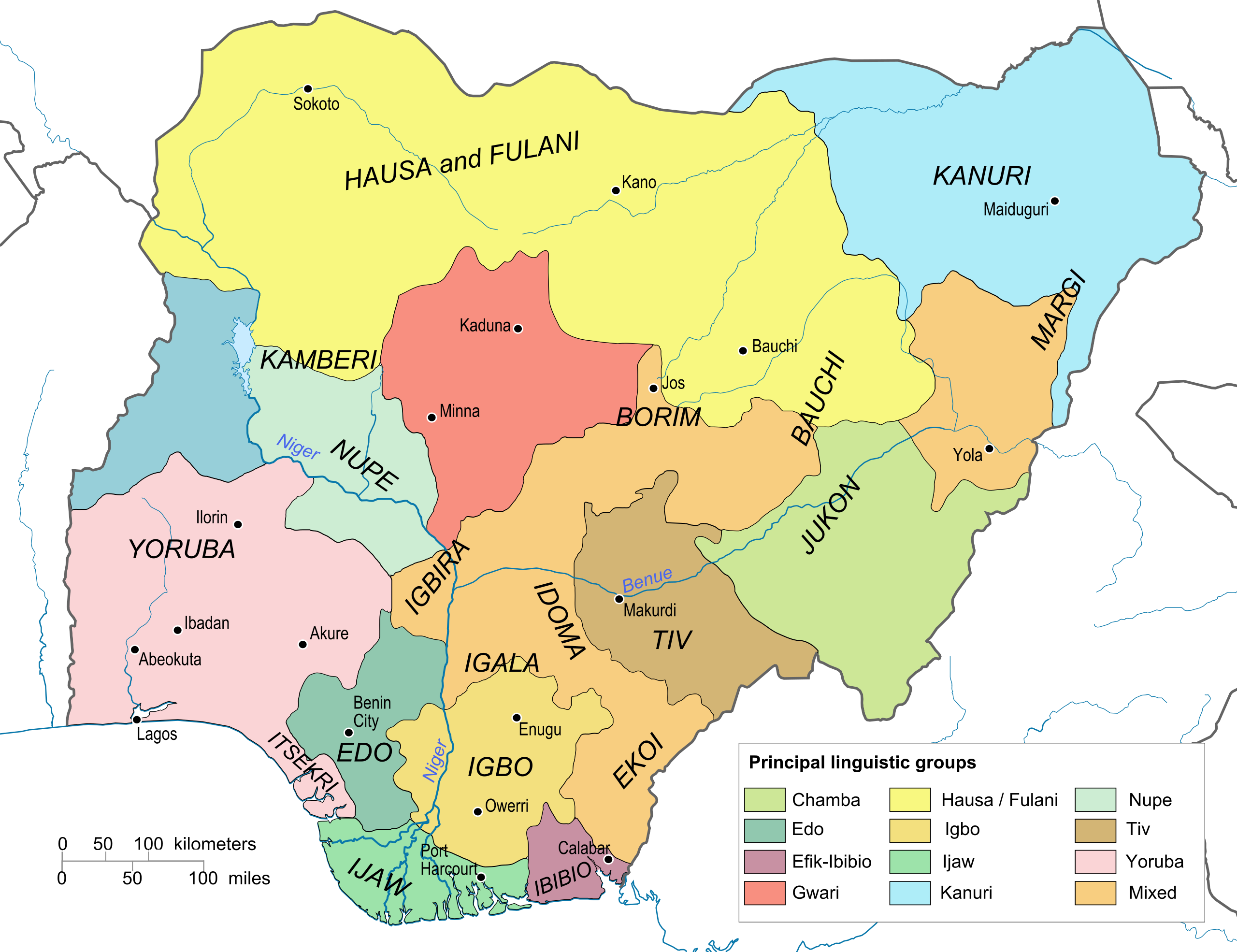 Map of Nigeria's linguistic groups The largest nation in Nigeria is the Hausa-Fulani, which accounts for 29 percent of the country's population. However, the group actually encompasses two distinct ethnicities: the Hausa and the Fulani (or Fulbe). While both ethnicities are found in large areas of West Africa, it is only in Nigeria that they are classified as a single ethnic group for political expediency. Nigeria is also made up of many other ethnic groups like the Yoruba, Igbo and Ibibio. Prior to colonialism, they were not self identified as one ethnic nationality but are so today along with the three Hausa-Fulani, Yoruba, and Igbo which classification does carry between each group of who is part of and not part of the group aside from them Nigeria as about 250–500 other ethnic nationalities considered minorities with some large enough to control the outcomes of elections in states such as the Igala and Urhobo. While some are so small that they only show up in one local Government area. South Africa Further information: Ethnic groups in South Africa 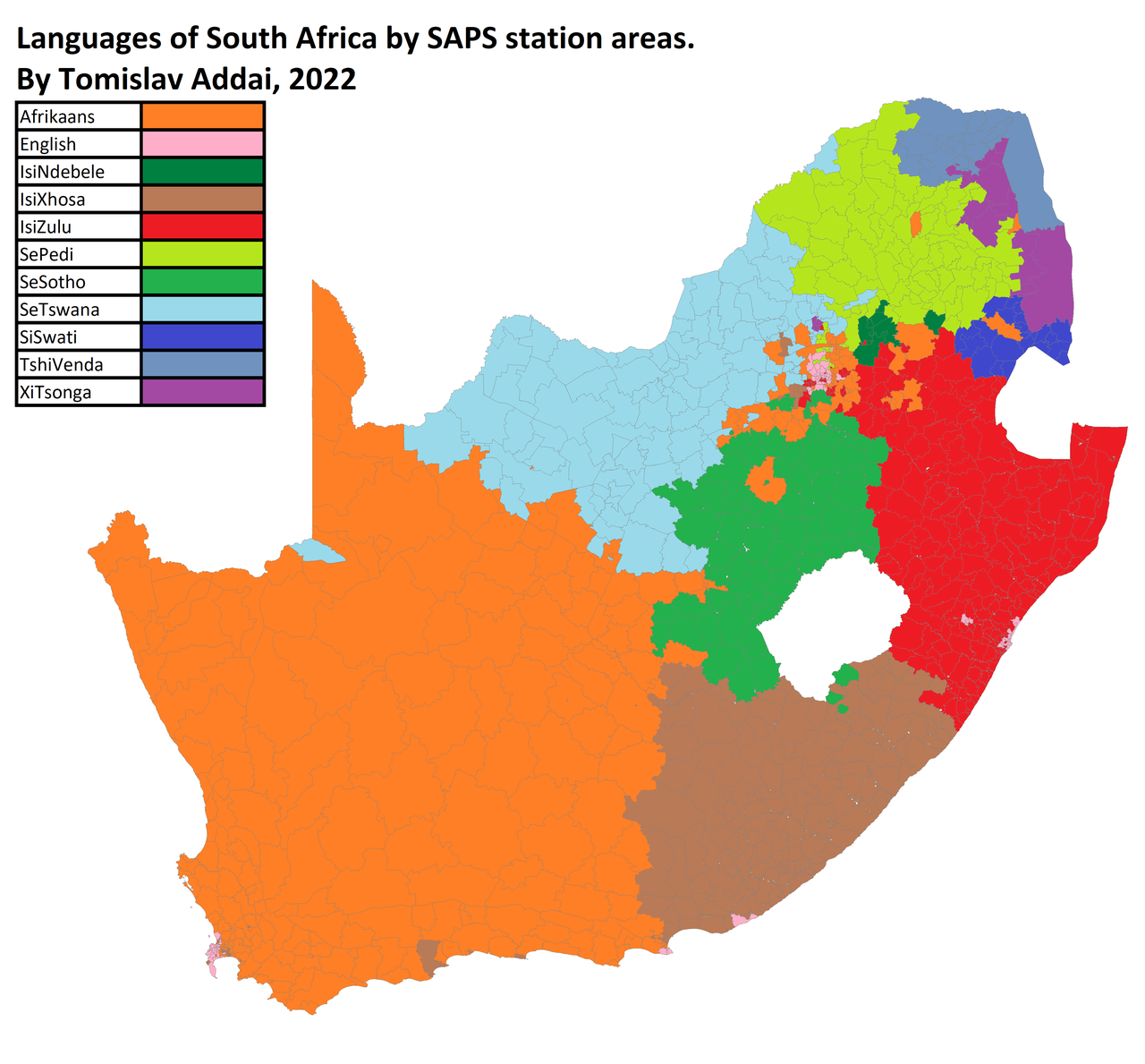 Map showing the dominant languages in South Africa Present-day South Africa is the successor state to the Union of South Africa, which was formed from four British colonies in 1910. South Africa has eleven official languages (Afrikaans, English, Ndebele, Pedi, Sotho, Swazi, Tsonga, Tswana, Venda, Xhosa, and Zulu) and formally recognizes several other languages spoken by minority nations. Speakers of each language may be of a different nationality—for example, some members of the Ndebele and Tswana nations speak Zulu, and groups such as the Thembu and Hlubi speak Xhosa. As is the case throughout Africa, the nations of South Africa mostly correspond to specific regions. However, large cities such as Johannesburg are home to a mixture of national groups, leading to a "melting pot" of cultures. The government has continuously attempted to unify the country's various nationalities and to foster a South African identity. Many of the nationalities found in South Africa are also found in bordering countries, and in some cases, more members live in South Africa than in the country where the group originated. For example, there are more Sotho, Tswana, and Swazi people living in South Africa than in the bordering nation states of Lesotho, Botswana, and Eswatini, respectively. In the past, this has led to conflict. Lesotho still claims large swathes of South Africa, and attempts have been made to cede some South African territory to Botswana and Eswatini. All three states were intended to be incorporated in the Union of South Africa, but those plans never came to fruition because of power struggles within their apartheid governments. Americas Bolivia Main article: Ethnic groups in Bolivia Since 2010, under the presidency of Evo Morales, Bolivia has been officially defined as a plurinational state, which recognizes the national distinctiveness of various indigenous peoples. Canada Main articles: Ethnic groups in Canada and Constitutional debate in Canada Whether Canada should be described as "multinational" is an ongoing topic in academia[11] and popular discourse. The current policy of the federal government is that Canada is bilingual—English and French are both official languages—and multicultural. In 2006, the House of Commons of Canada voted in favour of Government Business No. 11, which states that the Québécois "form a nation within a united Canada".[12] According to Canadian political philosopher Charles Blattberg, Canada should be seen as a multinational country. All Canadians are members of Canada as a civic or political community, a community of citizens, and this is a community that contains many other kinds within it. These include not only communities of ethnic, regional, religious, and civic (the provincial and municipal governments) sorts, but also national communities, which often include or overlap with many of the other kinds. He thus recognizes the following nations within Canada: those formed by the various First Nations, that of francophone Quebecers, that of the anglophones who identify with English Canadian culture, and perhaps that of the Acadians.[13][14] Asia Further information: Ethnic groups in Asia Afghanistan Further information: Demographics of Afghanistan and Ethnic groups in Afghanistan While Pashto and Dari being Afghanistan's two official languages, the nation is separated into several ethnolinguistic groups which the major ones include the Pashtuns, Tajiks, Hazaras, Uzbeks, Aimaqs, Turkmens, Balochs, and Sadats. Among the minor groups are the Pashayis, Nuristanis, Pamiris, Kurds, Kyrgyz, Gujjar and several others. Bhutan Further information: Ethnic groups in Bhutan The four major groups that compose Bhutan's ethnic population are the Ngalops, which make up the majority, the Sharchops, the Lhotshampas, and the aboriginal or indigenous tribal peoples living in villages and communities scattered throughout the country. There are also Tibetan refugees that have been around since 1959 during the 1959 Tibetan Rebellion. Cambodia Further information: Ethnic groups in Cambodia While the ethnic Khmer make up 90-94% of Cambodia, others consists of four different major minority groups: the Chams, the indigenous highland Khmer Loeu tribes, the ethnic Chinese, and the ethnic Vietnamese, in addition to other smaller minority groups such as the Khmer Krom.[15] China Main article: Ethnic groups in China See also: Ethnic groups in Taiwan and Taiwanese indigenous peoples  Ethnolinguistic map of China The People's Republic of China (PRC) is a multinational state consisting of 56 ethnic groups with the Han people the largest ethnic group in mainland China. As of 2010, 91.51% of the population were classified as Han (~1.2 billion).[16] Besides the Han Chinese majority, 55 other ethnic (minority) groups are categorized in present China, numbering approximately 105 million people (8%), mostly concentrated in the bordering northwest, north, northeast, south and southwest but with some in central interior areas. The major minority ethnic groups in China are Zhuang (16.9 million), Hui (10.5 million), Manchu (10.3 million), Uyghur (10 million), Miao (9.4 million), Yi (8.7 million), Tujia (8.3 million), Tibetan (6.2 million), Mongolian (5.9 million), Dong (2.8 million), Buyei (2.8 million), Yao (2.7 million), Bai (1.9 million), Korean (1.8 million), Hani (1.6 million), Li (1.4 million), Kazakh (1.4 million) and Dai (1.2 million).[17] At least 126,000 people from Canada, the US and Europe are living in Mainland China.[18] In addition, there are also unrecognized ethnic groups, for example: Chuanqing people (穿青人), and others, who account for over 730,000 people. However, the Republic of China (ROC), which ruled mainland China from 1912 to 1949 and currently governs the island of Taiwan since 1945, had recognized five main ethnic groups under Five Races Under One Union: Han, Hui, Manchu, Mongol and Tibetan. Since retreating to Taiwan, the ROC government recognizes 16 groups of Taiwanese aborigines, which constitutes a number 569,000 or 2.38% of the island's population. The PRC classifies them as Gāoshān. India Further information: Ethnic groups of India and Scheduled castes and scheduled tribes India has more than 2,000 ethnolinguistic groups which includes over 645 indigenous tribes with 52 major tribes among them, and over 80,000 subcultures, and every major religion is represented being Hinduism, Islam, Adivasi, Sikhism, Buddhism, and Christianity as are four major language families (Indo-Aryan, Dravidian, Austroasiatic, and Sino-Tibetan) and a language isolate (Nihali). Each state and union territory of India has one or more official languages, and the Constitution of India recognizes in particular 22 "scheduled languages". It also recognizes 212 scheduled tribal groups, which together constitute about 7.5% of the country's population.[citation needed] Most of its states are based on a linguistic ethnicity,[19] including Uttar Pradesh, Madhya Pradesh, and Chhattisgarh (Hindustanis), Gujarat (Gujaratis), West Bengal (Bengalis), Maharashtra (Marathis), Odisha (Odias), Goa (Konkanis), Haryana (Haryanvis), Rajasthan (Rajasthanis), Punjab (Punjabis), Tamil Nadu (Tamils), Andhra Pradesh and Telangana (Telugus), Karnataka (Kannada), Kerala (Malayalis), Assam (Assamese), Nagaland (Nagas), Manipur (Manipuris), Mizoram (Mizos), Meghalaya (Khasi), Tripura (Tripuri), and Sikkim (Sikkimese). Jammu and Kashmir is the only union territory in the country based on this which is home to the Kashmiris, Dogras, Ladakhis, Gujjars, Bakarwals, Paharis, Dards, Hanjis, and several other people groups. Furthermore, several other Indian states are themselves ethnically, linguistically, and religiously diverse. The tribes of Uttar Pradesh are Agarias, Baigas, Bhars, Cheros, Gonds, Kolis, Korwas, Tharus, Bhoksas, Bhotiyas, Jaunsaris, and Rajis; Madhya Pradesh is where tribes such as the Gonds, Bhils, Baiga, Korku, Bhadia, Halba, Kaul, Mariya, Malto and Sahariya; Chhattisgarh's tribal population consists mainly of the Gonds, Kanwars, Brinjhwasr, Bhaina, Bhatra, Uraon, Oraons, Kamar, Halba, Baiga, Sanwras, Korwas, Bhariatis, Nageshias, Manghwars, Kharias, and Dhanwars; Bihar has the Bhojpuris, Maithils, and Magadhis, and Jharkhand has the Santhals, Oraons, Mundas, Kharias, and Hos while both states are home to several other groups like the Hindustani-speaking peoples; Uttarakhand is where the Garhwalis, Kumaonis, and tribes like the Jaunsaris, Bhotiyas, Tharus, Bhoksas, Rajis, and Banrawats resides; Karnataka houses the Kannadigas, Tuluvas, and several others; Himachal Pradesh is home to tribes like the Kinnauris, Gujjars, Lahaulis, Gaddis, Swanglas, Pangwalis, Khampas, and others; Arunachal Pradesh being the home of various tribes like the Abor, Hruso, Apatanis, Nyishis, Tagins, Galos, Khamptis, Mishmis, Monpa, any Naga tribes, Sherdukpens, and Singpho; the Assam includes the Assamese, Bodo, and Karbi peoples. Indonesia Further information: Ethnic groups in Indonesia and Native Indonesians 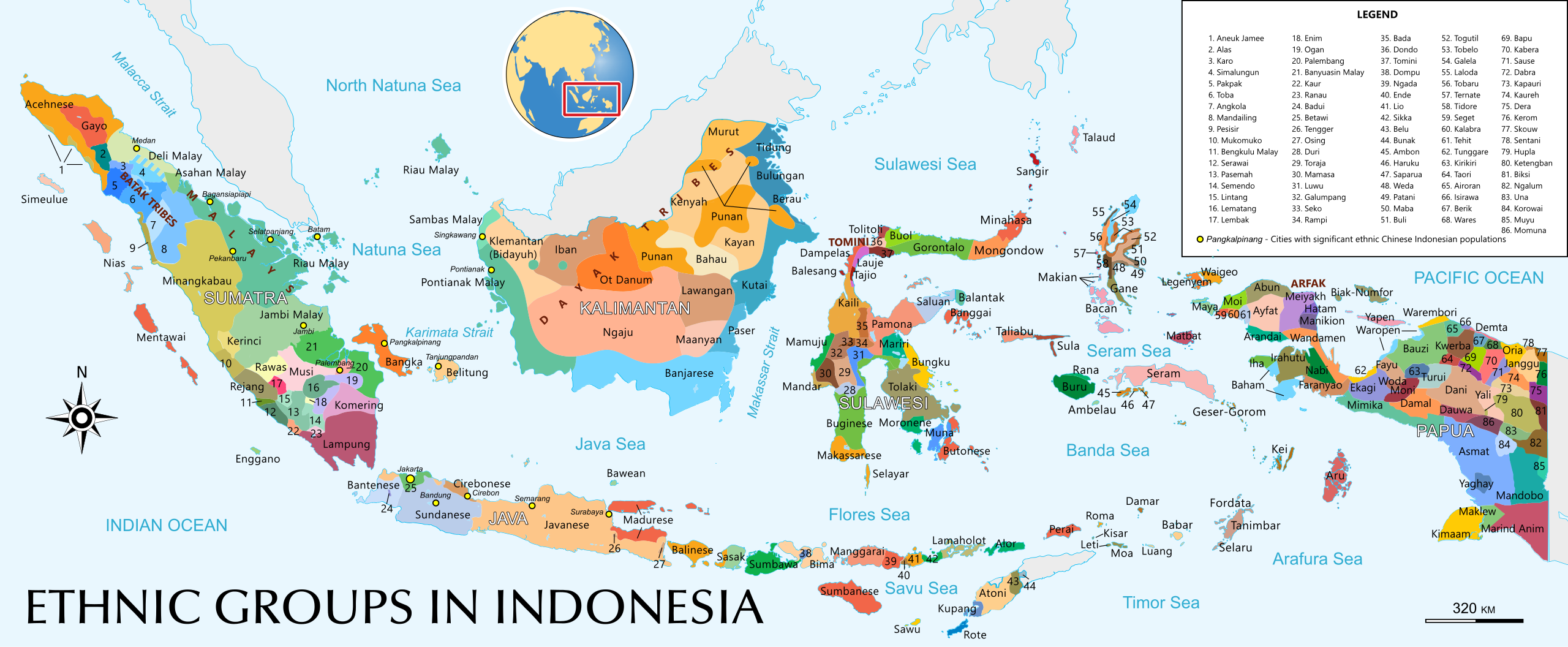 Map showing ethnic groups native to Indonesia Indonesia is a very diverse country with over 600 ethnic groups.[20][21] The vast majority of them speak Austronesian languages and among these tribal people groups are the Javanese, Sundanese, Malays, Madurese, Bugis, Torajans, Bataks, Mandarese, Minangkabau, Betawi, Banjarese, Acehnese, Balinese, Dayaks, Sasaks, Cirebonese, Lampungese, Palembang, Gorontaloa, Minahasan, Nias, and Makassarese. Another group of indigenous peoples in the country are the native Melanesians in the Maluku Islands and Western New Guinea, which include tribes such as the Ambonese, native Timorese peoples, Biak, Dani, Moi, Arfak, Amungme, Asmat, and Korowai, among others. Non-indigenous peoples includes Indos (half-Dutch, half-native Indonesians), Mardijkers, ethnic Chinese and Peranakans, Arabs, and Indians. The largest ethnicity in Indonesia is the Javanese which makes up 40% of the population and most of them live indigenously in Java island, the most populous island in the country. Generally, people who live outside of Jakarta still retain the ethnic language and utilize it in daily conversations. As a result, formation of distinct dialects each unique to the regions, is prominently used among the population. Laos Further information: Demographics of Laos and List of ethnic groups in Laos The government of Laos recognizes over 160 ethnic groups with 49 main ethnicities. These main Laotian ethnic groups separated into 4 linguistic groups which are 8 Lao-Tai peoples which includes the ethnic Lao who make up the majority in the country, 32 Mon-Khmer peoples, 7 Tibeto-Burmese peoples, and 2 Hmong-Loumien peoples. They are generally spread across the nation each with their own distinct traditions, cultures and languages. Malaysia Further information: Ethnic groups in Malaysia When it was formed on 16 September 1963, Malaysia comprised four independent, self-governing nations: Malaya, Singapore, Sabah, and Sarawak. In 1965, Singapore seceded from the federation. Today, Malaya, Sabah, and Sarawak each have their own ethnic majority. Generally, however, Malaysia is considered to have three major groups: Bumiputeras (Malays, Orang Asli, various native tribes of the Borneo states, and Peranakans), ethnic Chinese, and ethnic Indians. While the Malays make up the majority of population in the country, the Ibans for Sarawak and the Kadazan-Dusun, Murut, and Sama-Bajau peoples for Sabah are dominant in their respective states. Malay is the primary official and national language, followed by English. In Sabah and Sarawak, English is the official language, although many locals speak a dialect of Malay. Myanmar Further information: List of ethnic groups in Myanmar 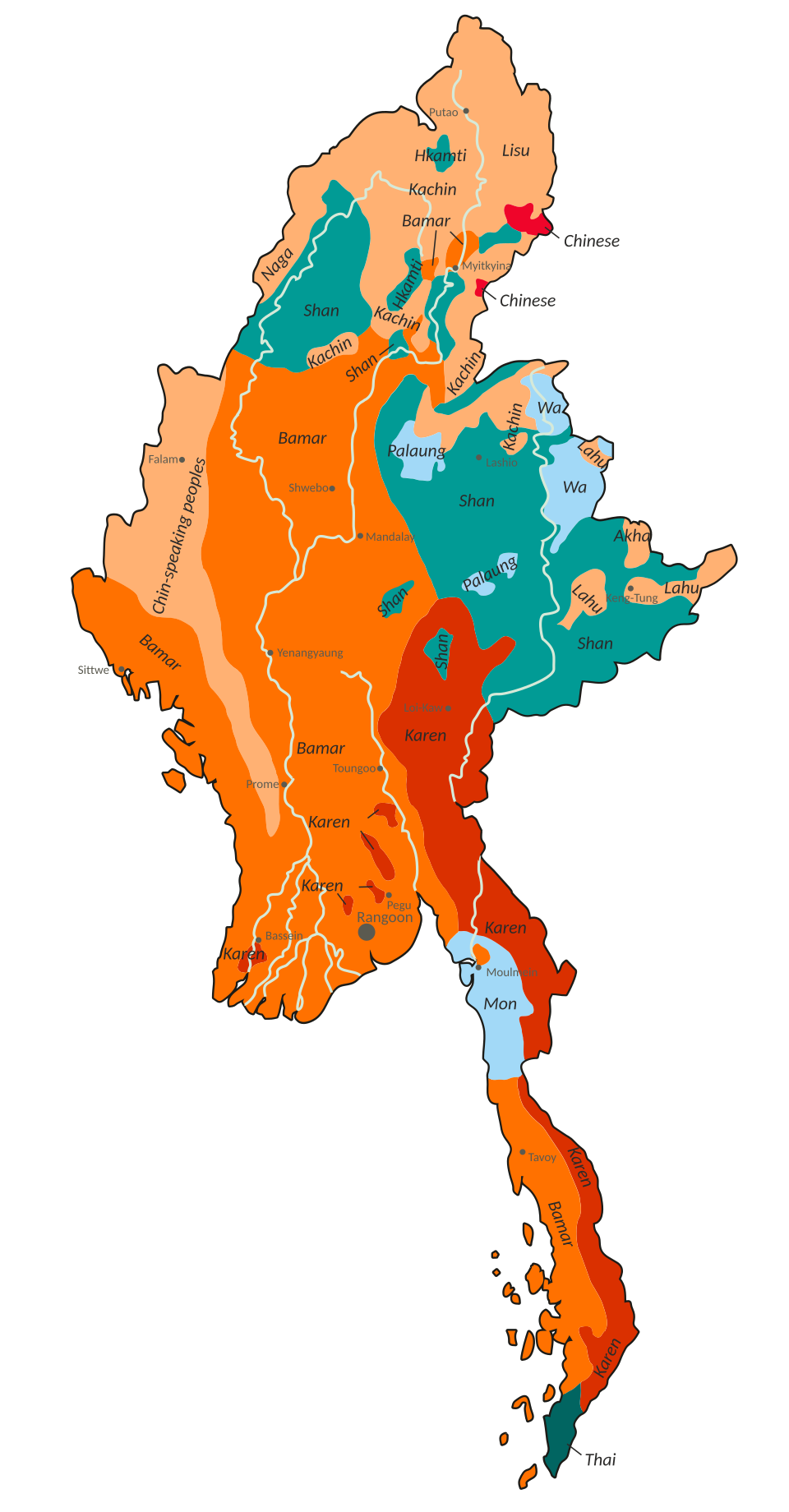 An ethnolinguistic map of Burma, 1972 Myanmar (also known as Burma) is an ethnically diverse nation with 135 distinct ethnic groups officially recognized by the Burmese Government. These are grouped into eight "major national ethnic races": Bamar, Chin, Kachin, Karen, Kayah, Mon, Rakhine, and Shan.[22] The "major national ethnic races" are grouped primarily according to region rather than linguistic or ethnic affiliation, as for example the Shan Major National Ethnic Race includes 33 ethnic groups speaking languages in at least four widely differing language families.[23] Many unrecognized ethnic groups exist, the largest being the Burmese Chinese and Panthay (who together form 3% of the population), Burmese Indians (who form 2% of the population), Rohingya, Anglo-Burmese and Gurkha. Nepal Further information: Ethnic groups in Nepal 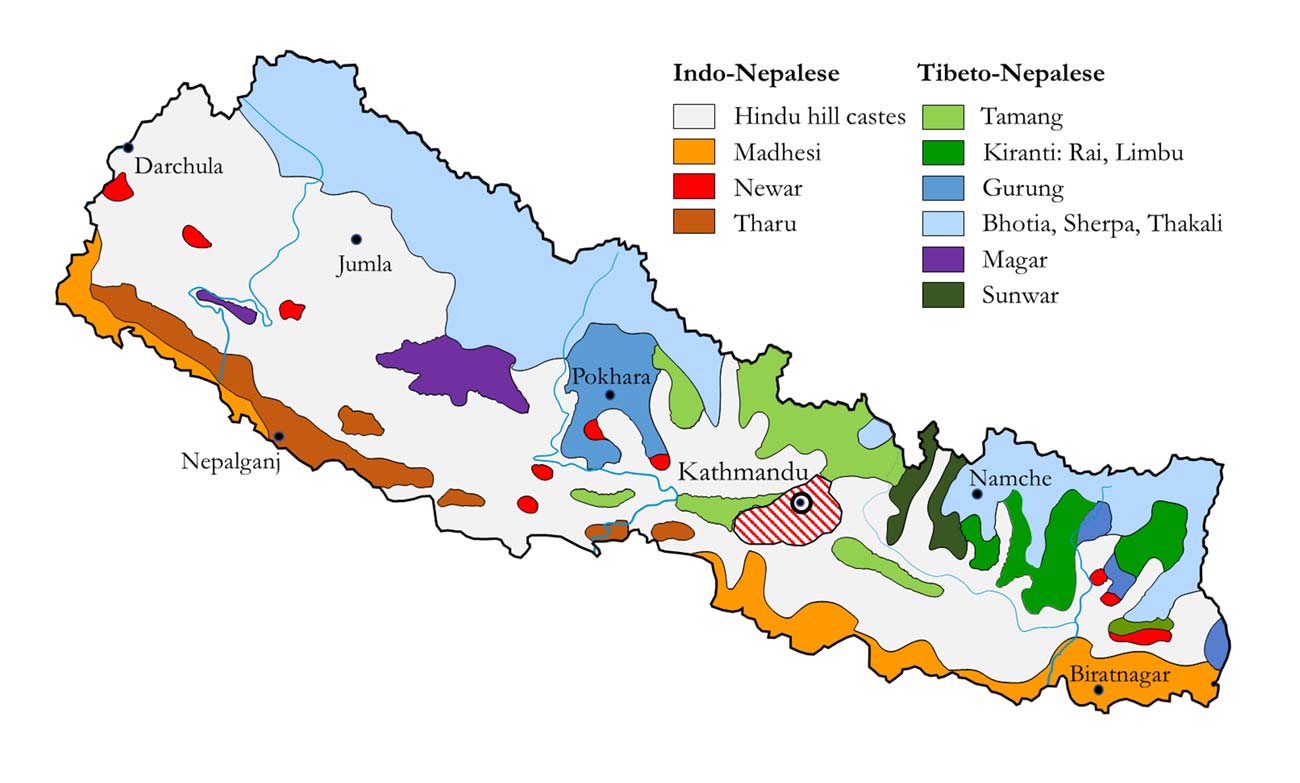 Ethnic groups in Nepal Nepal is a multi-ethnic country with over 100 ethnic groups. Most ethnic groups fall into one of two categories and either speak Indo-Aryan languages or Sino-Tibetan languages. The official language of the country is Nepali, earlier known as Gorkhali in the Kingdom of Nepal, which is part of the Indo-Aryan group and is the spoken by majority of the population. The Indo-Aryan languages languages are spoken by Madhesi people ( Maithili, Bhojpuri, Awadhi) and Tharu ethnic groups which constitutes majority of the speakers in southern Nepal in the Terai region.[24] The people who speak Sino-Tibetan languages includes Tamang, Newari, Magar, Gurung, Kiranti and Sherpa ethnic groups in central and northern Nepal.[24] Much of the ethnic groups migrated from neighbouring countries over the centuries from India and Tibet.[25] Pakistan Further information: Ethnic groups of Pakistan 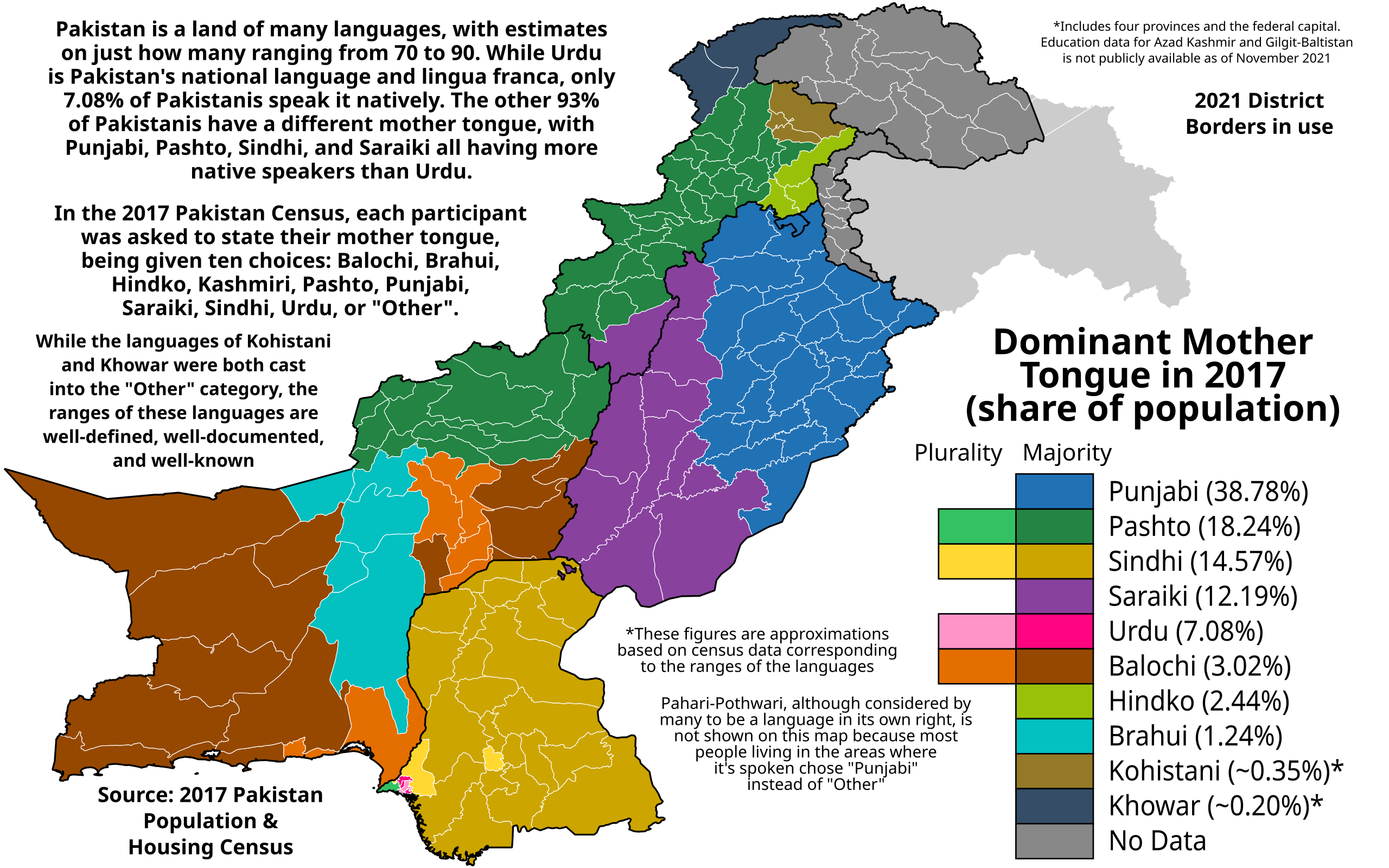 Dominant Ethnolinguistic Group in each Pakistani District as of the 2017 Pakistan Census Pakistan's population comprises various ethnolinguistic groups; the major groups are the Punjabis, Pashtuns, Sindhis, Saraikis, Balochs, Brahuis, Paharis, and Muhajirs. Minor groups includes the Kashmiris, Chitralis, Shina, Baltis, Kohistanis, Torwalis, Hazaras, Burusho, Wakhis, Kalash, Siddis, Uzbeks, Nuristanis, Pamiris, Hazarewals and several other minorities. Present-day Pakistan arose out of the Pakistan Movement, which demanded a separate state for the Muslims of the British Raj. The movement was based on the two-nation theory put forward by Muhammad Ali Jinnah: the idea that Hindus and Muslims in British India represented not only different religious communities but also distinct nations, and hence that, in the event of Indian independence, they should be divided into two nation states. Jinnah outlined the theory as follows: It is extremely difficult to appreciate why our Hindu friends fail to understand the real nature of Islam and Hinduism. They are not religious in the strict sense of the word, but are, in fact, different and distinct social orders, and it is a dream that the Hindus and Muslims can ever evolve a common nationality, and this misconception of one Indian nation has troubles and will lead India to destruction if we fail to revise our notions in time. The Hindus and Muslims belong to two different religious philosophies, social customs, literatures. They neither intermarry nor interdine together and, indeed, they belong to two different civilizations which are based mainly on conflicting ideas and conceptions. Their aspect on life and of life are different. It is quite clear that Hindus and Mussalmans derive their inspiration from different sources of history. They have different epics, different heroes, and different episodes. Very often the hero of one is a foe of the other and, likewise, their victories and defeats overlap. To yoke together two such nations under a single state, one as a numerical minority and the other as a majority, must lead to growing discontent and final destruction of any fabric that may be so built for the government of such a state."[26][27] This movement culminated in the creation of Pakistan in 1947 through the partition of India. Urdu was then promoted as the national language of all South Asian Muslims. However, Pakistan remains ethnically diverse. Punjabis are the largest ethnolinguistic group, but at 45 percent of the population, they do not make up an absolute majority. Furthermore, only 8 percent of Pakistanis speak the national language, Urdu, as their mother tongue. As a result, many nationalist movements that oppose the two-nation theory have emerged, arguing that Pakistan is not only a linguistically diverse state but also a multinational one, and that, therefore, each ethnolinguistic group of Pakistan is a distinct nation.[28] Common grievances of these movements include the idea that Punjabis dominate Pakistan politically and economically, thus marginalizing other groups, and that the establishment of Urdu as the country's sole official language is a form of cultural imperialism that ignores the heritage of Pakistan's diverse peoples. The most successful of these movements was Bengali nationalism, which led to the creation of the Bengali-speaking nation-state of Bangladesh. The movement asserted that Urdu's official status gave an unfair advantage to Muhajirs (most of whom speak Urdu as their mother tongue) and Punjabis (whose mother tongue, Punjabi, is similar to Urdu, and many of whom were educated in Urdu under British rule). Bengalis feared they would be marginalized despite their demographic strength as, at the time, the largest ethnic group of Pakistan. These grievances culminated in the secession of East Bengal (which had been part of the administrative unit of East Pakistan) and the creation of Bangladesh. Today, nationalist movements within Pakistan include those of the Sindhis, Pashtuns, Balochs, Mohajirs, and Kashmiris. The members of these movements assert that Islam cannot be considered the sole basis for nationhood, and that Pakistan is therefore a multinational state. Their demands range from increased autonomy or the transformation of Pakistan into a federation, to the recognition of language rights for non-Urdu-speaking populations, to outright secession. Despite the fact that Punjabis are widely seen as the dominant ethnic group in Pakistan, both economically and politically, there is also a small Punjabi movement that asserts that the Punjabi language has been unfairly subordinated to Urdu and supports the reestablishment of cultural and economic links with East Punjab in India.[29] Philippines Further information: Ethnic groups in the Philippines  Dominant ethnic groups by province The Philippines has more than 182 distinct ethnolinguistic groups that the vast majority of them speaking Austronesian languages, with the Tagalogs, Bisayans, Ilocanos, Bikols, Kapampangans, Pangasinans, Ivatans, Romblomanons, Masbateños, Kamayos, Moros, Igorots, Lumads, Mangyans, and Zamboangueños being the most prevalent. Among the immigrants and mixed peoples are the Spanish Filipinos, Chinese Filipinos, Japanese Filipinos, Mestizo de Españols, Mestizo de Sangleys, Tornatrás, Indian Filipinos, Sangils, Jewish Filipinos, and American Filipinos. Thailand Further information: Demographics of Thailand and Ethnic groups in Thailand There are some 70 ethnic groups in Thailand which make up 24 ethnolinguistically Tai peoples such as the Central Thais, Isan, and Northern Thais, 22 Austroasiatic peoples, with significant populations of Northern Khmer and Kuy, 11 Sino-Tibetan-speaking hill tribes, 3 Austronesian peoples being Malays, Moken, and Urak Lawoi. Immigrants in the nation includes communities like the Chinese, Indians, and Thai Portuguese. However, the Royal Thai Government officially recognizes only 62 of these ethnolinguistic groups. Turkey Further information: Demographics of Turkey There are more than 40 ethnic groups in Turkey. It has been home to many historical peoples and civilizations. Due to its geopolitical location, it has become a homeland for immigrant communities from many different peoples. Vietnam Further information: Demographics of Vietnam and List of ethnic groups in Vietnam The Vietnamese government recognizes 54 ethnic groups, of which the Viet (Kinh) is the largest; according to official Vietnamese figures (2019 census), ethnic Vietnamese account for 85.32% of the nation's population and the non-Vietnamese ethnic groups account for the remaining percent. The ethnic Vietnamese inhabit a little less than half of Vietnam, while the ethnic minorities inhabit the majority of Vietnam's land (albeit the least fertile parts of the country). The central highland peoples commonly termed Degar or Montagnards (mountain people) consist of two main ethnolinguistic types--Malayo-Polynesian and Mon–Khmer. About 30 groups of various cultures and dialects are spread over the highland territory. Other minority groups include the Chams—remnants of the once-mighty Champa Kingdom, conquered by the Vietnamese through a progress called "Nam Tiến", Hmong, Chinese, and Thái. Europe Further information: Ethnic groups in Europe Montenegro is the only European state with no ethnic majority, but many others have ethnic minorities that form a majority within a province or region (see multilingual countries and regions of Europe). Russia Main article: Ethnic groups in Russia 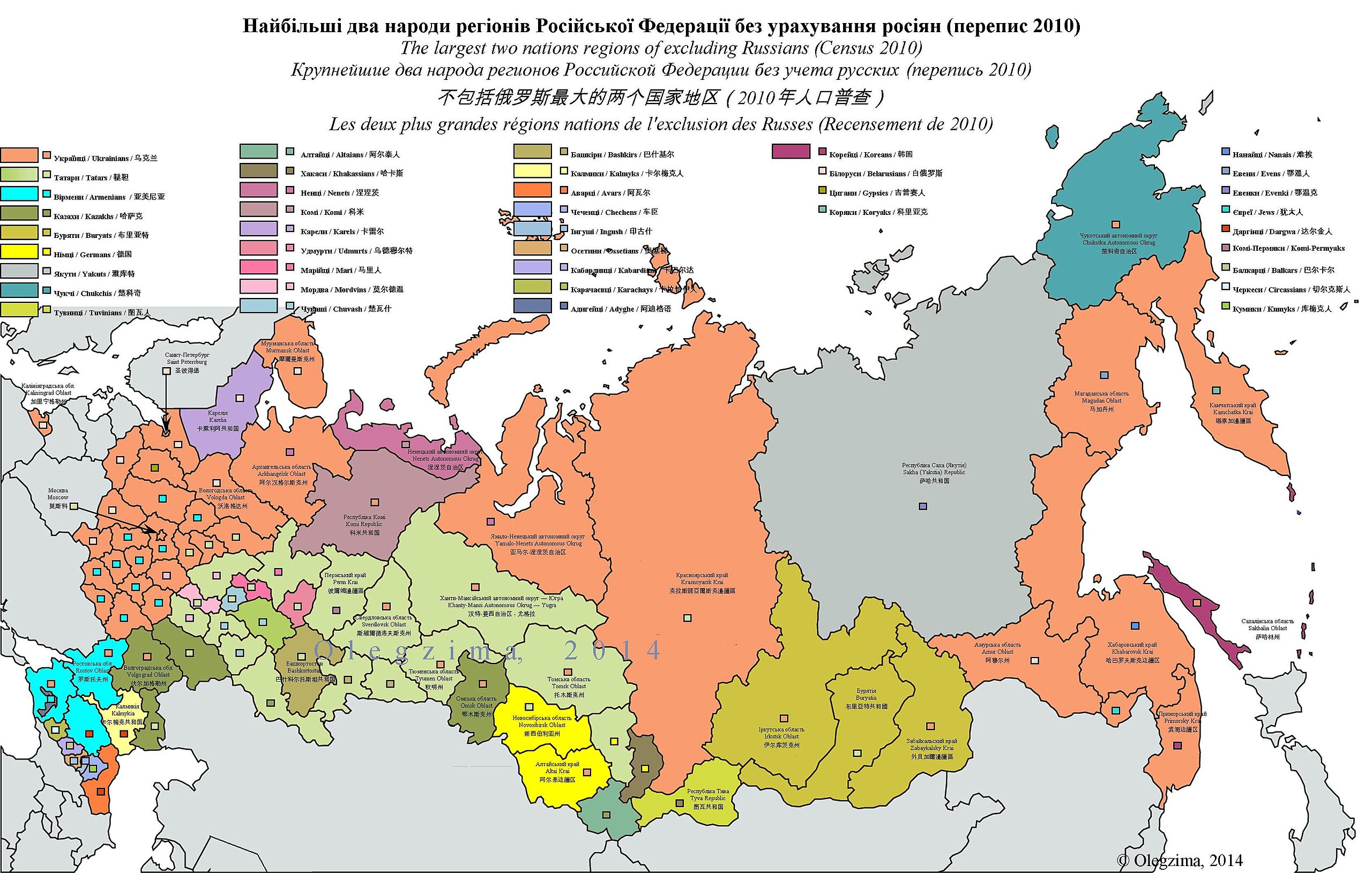 The largest two ethnic groups, excluding Russians, in each region (Census 2010) Russia is a multinational state, and is home to over 193 ethnic groups. In the 2010 Census, roughly 81% of the population were ethnic Russians,[30] and 19% of the population were minorities;[31] while around 84.93% of the Russia's population was of European descent,[31] of which the vast majority were Slavs as well as minorities of Germanic, Baltic-Finns and other peoples. There are 22 republics in Russia, designated to have their own ethnicities, cultures, and languages. In 13 of them, ethnic Russians consist a minority. According to the United Nations, Russia's immigrant population is the third-largest in the world, numbering over 11.6 million;[32] most of which are from post-Soviet states, mainly Ukrainians.[33] The republics are Tatarstan (Volga Tatars), Bashkortostan (Bashkirs, Volga Tatars), Chuvashia (Chuvash), Adygea (Adyghe), Karachay-Cherkessia (Cherkess of Karachay-Cherkessia, Karachays, Nogais, Abaza), Kabardino-Balkaria (Kabardins & Balkars), Chechnya (Chechens), Mordovia (Mordvin), Udmurtia (Udmurts), Mari El (Mari), Kalmykia (Kalmyks), the Komi Republic (Komi), Karelia (Karelians, ethnic Finns, Vepsians), Ingushetia (Ingushs), North Ossetia-Alania (Ossetians), Sakha (Yakuts, Evenki, Evens, Dolgans, Yukaghir), Buryatia (Buryats), Khakassia (Khakas), the Altai Republic (Altai, ethnic Kazakhs), Tuva (Tuvans), and Dagestan (ethnic Azerbaijanis, Chechens, Avars, Dargins, Kumyks, Lezgins, Laks, Tabasarans, Nogais, Aguls, Rutuls, Tsakhurs, Tats and others). There are also 4 autonomous okrugs which are Khanty-Mansi Autonomous Okrug (Khanty & Mansi), Nenets Autonomous Okrug (Nenets), Yamalo-Nenets Autonomous Okrug (Nenets, Selkup), and Chukotka Autonomous Okrug (Chukchi), 1 autonomous oblast, it is Jewish autonomous oblast (Jews, but there are a few of them, because of migration to Israel after dissolution of the Soviet Union), 6 administrative-territorial units with a special status, which are Agin-Buryat Okrug (Buryats) in Zabaykalsky Krai, Ust-Orda Buryat Okrug (Buryats) in Irkutsk Oblast, Koryak Okrug (Koryaks) in Kamchatka Krai, Taymyrsky Dolgano-Nenetsky District (Dolgans, Nenets, Enets, Nganasans) and Evenkiysky District (Evenki) in Krasnoyarsky Krai, Komi-Permyak Okrug (Komi) in Perm Krai. The Tatars, Bashkirs, and Chechens are three predominantly Muslim minorities in the country. Russia is also home to small Buddhist populations, such as the nomadic Buryats in Buryatia, and the Kalmyks; native to Kalmykia, the only Buddhist region in Europe. There are also the Shamanistic peoples of Siberia and the Far North; the Finno-Ugric peoples of Northwest Russia and the Volga region; the Korean inhabitants of Sakhalin; and the diverse peoples of the North Caucasus.[34] Russia's official language is Russian. However, Russia's 193 minority ethnic groups speak over 100 languages.[35] According to the 2002 Census, 142.6 million people speak Russian, followed by Tatar with 5.3 million, and Ukrainian with 1.8 million speakers.[36] The constitution gives the individual republics of the country the right to establish their own state languages in addition to Russian.[37] Belgium Further information: Ethnic groups in Belgium and Communities, regions and language areas of Belgium The territory of Belgium is almost equally divided between the two people groups and their communities: the Dutch-speaking Flemings of Flanders and the French-speaking Walloons of Wallonia. This led to political unrest throughout the 19th and 20th centuries, and in the aftermath of the difficult 2007–08 Belgian government formation, the Belgian media envisaged a partition of Belgium as a potential solution. There is also a German-speaking minority in the east. Bosnia and Herzegovina Further information: Ethnic groups in Bosnia and Herzegovina 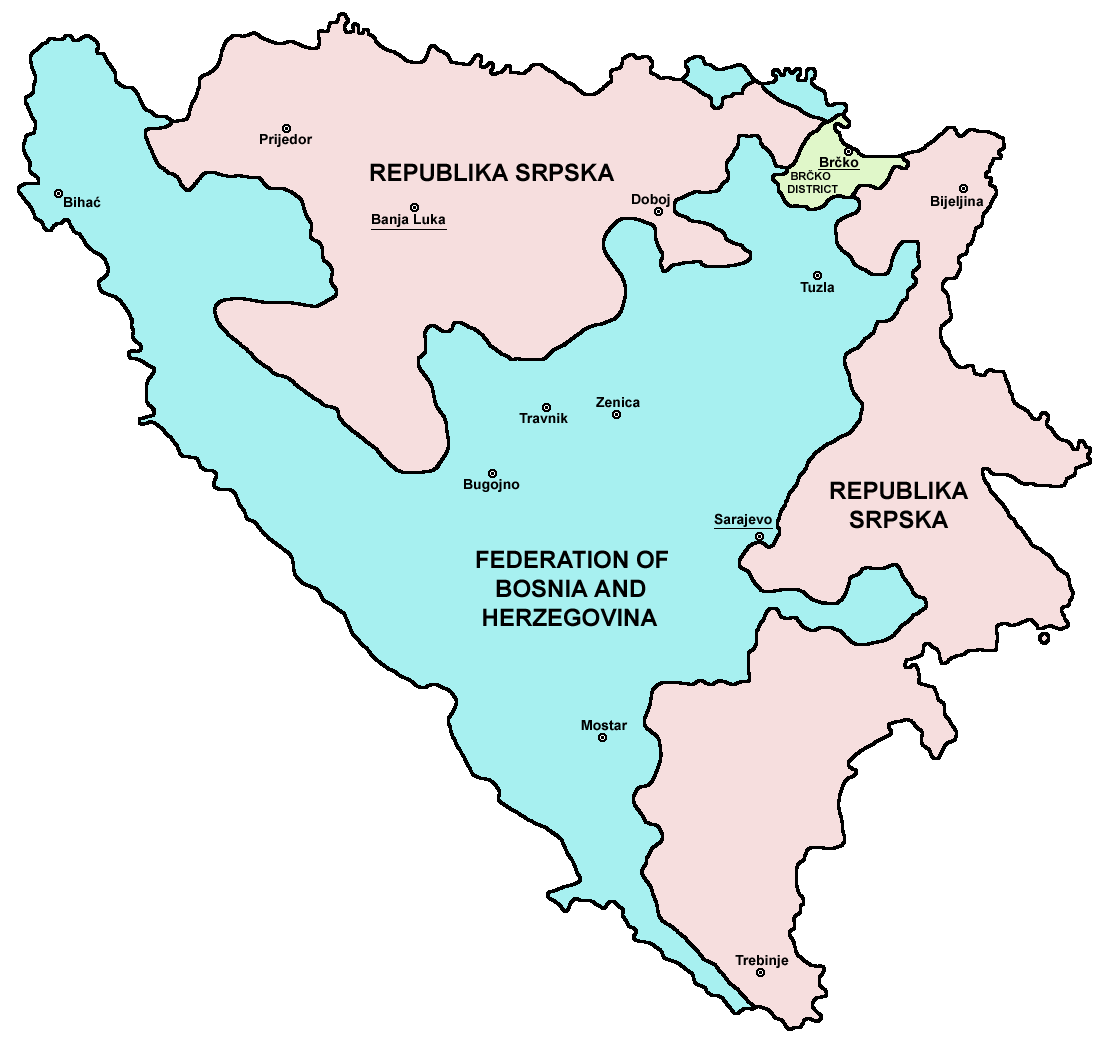 Bosnia and Herzegovina consists of the Federation of Bosnia and Herzegovina (FBiH), the Republika Srpska (RS), and the Brčko District (BD). Bosnia and Herzegovina is home to three ethnic "constituent peoples": Bosniaks (50.11%), Serbs (30.78%), and Croats (15.43%).[38] The country's political divisions were created by the Dayton Agreement, which recognized a second tier of government comprising two entities: the Federation of Bosnia and Herzegovina (mostly Bosniaks and Croats) and the Republika Srpska (mostly Serbs), with each governing roughly half of the state's territory. A third region, the Brčko District, was governed locally. Today, all three ethnic groups have an equal constitutional status over the entire territory of Bosnia and Herzegovina. The country has a bicameral legislature and a three-member presidency composed of one member of each major ethnic group. Norway Further information: Ethnic groups in Norway Official policy states that Norway was founded on the territory of two peoples, Norwegians and Samis.[39] In addition, Forest Finns, Kvens, Jews, Romani, and the Norwegian and Swedish Travellers are recognised as national minorities.[40] Spain Main articles: Ethnic groups in Spain and Nationalisms and regionalisms of Spain 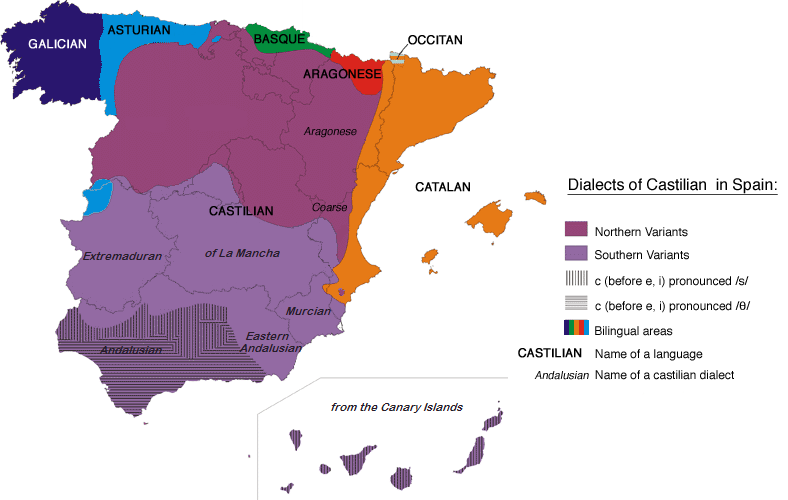 Languages and dialects in Spain Definitions of ethnicity and nationality in Spain are politically fraught, particularly since the transition from Francoist Spain to the (restored) Kingdom of Spain in the 1970s, when local regionalisms and peripheral nationalisms became a major part of national politics. The term Spanish people (Spanish: pueblo español) is defined in the Spanish Constitution of 1978 as the political sovereign, i.e., the citizens of the Kingdom of Spain. The same constitution, in its preamble, speaks of "peoples and nationalities of Spain" (pueblos y nacionalidades de España) and their respective cultures, traditions, languages, and institutions. The CIA World Factbook (2011) describes Spain's ethnic makeup as a "composite of Mediterranean and Nordic types", instead of the usual breakdown of ethnic composition. This reflects the formation of the modern Kingdom of Spain by the accretion of numerous independent Iberian realms: Andalusia, Aragon, Asturias, Castile, Catalonia, Galicia, León, Majorca, Navarre, and Valencia. Thus, today's Spaniards include Andalusians, Aragonese, Asturians, Basques, Cantabrians, Castilians, Catalans, Galicians, Leonese, and Valencians, and individual members of these groups may or may not consider them distinct nations. United Kingdom Further information: Ethnic groups in the United Kingdom 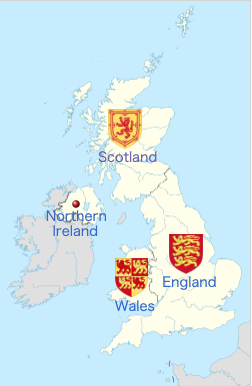 Multinational state is located in the United KingdomEnglandEnglandScotlandScotlandNorthern IrelandNorthern IrelandWalesWales Home Nations of the United Kingdom While the Office for National Statistics describes the United Kingdom as a nation state,[41][42] other people, including former Prime Minister Gordon Brown,[43] describe it as a multinational state.[44][45] The term "Home Nations" is used to describe the national teams that represent the four nations of the United Kingdom: England, Northern Ireland, Scotland, and Wales in various sports.[46] The Kingdom of Great Britain was created on 1 May 1707 by the political union of the kingdoms of England and Scotland.[47] This unification was the result of the Treaty of Union, which was agreed on 22 July 1706 and then ratified by the parliaments of England and Scotland in the 1707 Acts of Union.[48] The two kingdoms, along with the Kingdom of Ireland, had already been in a personal union as a result of the 1603 Union of the Crowns, in which James VI, King of Scots, inherited the Kingdoms of England and Ireland and moved his court from Edinburgh to London. However, until 1707, all three had remained separate political entities with separate political institutions.[49][50] Prior to the Acts of Union, the Kingdoms of England and Scotland both had minority populations of their own that could themselves be called nations. Wales and Cornwall were part of the Kingdom of England (Wales had been officially incorporated into England by the Laws in Wales Acts 1535 and 1542, although it had been a de facto English territory since the 13th century; Cornwall had been conquered during the Anglo-Saxon period). The Northern Isles, with their Norse-derived culture, were part of Scotland, having been pledged by Norway as security against the payment of a dowry for Margaret of Denmark[51] and then integrated in 1471. When the Kingdom of Great Britain was created, many of its inhabitants retained a sense of English, Scottish, or Welsh identity. Many of them also spoke languages other than English: principally Scottish Gaelic, Scots, Welsh, Cornish, and Norn. Almost a century later, the Kingdom of Ireland merged with the Kingdom of Great Britain to form the United Kingdom of Great Britain and Ireland under the 1800 Acts of Union.[52] The United Kingdom thus became the union of the kingdoms of England, Ireland, and Scotland.[49][50] Eventually, disputes within Ireland over the terms of Irish home rule led to the partition of the island:[53] The Irish Free State received dominion status in 1922, while Northern Ireland remained part of the UK.[54] As a result, in 1927, the formal title of the UK was changed to its current form, the United Kingdom of Great Britain and Northern Ireland.[55] Political, ethnic, and religious tensions between Irish and British groups in Northern Ireland culminated in The Troubles.[56] This period of armed conflict erupted in 1966 between loyalist paramilitaries, seeking to maintain the country's position in the UK, and republican paramilitaries, seeking to unify Ireland as a 32-county independent republic. The British Army also played a key role. Following the deaths of over 3,500 people,[57] a peace treaty was reached in 1998,[58] although divisions remain high in some areas and sporadic violence still occurs.[59] The end of the 20th century brought major governing changes, with the establishment of devolved national administrations for Northern Ireland, Scotland, and Wales following pre-legislative referendums.[60] The Scottish National Party, the largest political party in Scotland, is committed to the goal of an independent Scotland within the European Union, but this is opposed by three of the four other parties in the Scottish Parliament. A referendum on Scottish independence was held in September 2014, and 55% of the electorate rejected independence in favour of retaining the union.[61] Plaid Cymru, a Welsh nationalist party, has a similar ambition for Wales. Plaid Cymru is currently the second- or third-largest party in Wales depending on how it is measured.[62] Several parties in Northern Ireland, including the second- and third-largest,[63] seek to establish an independent United Ireland, and have repeatedly called for border polls.[64] The d'Hondt system used in Northern Ireland means that either the First Minister or Deputy First Minister will be from one of these parties.[65] |
現代の多民族国家 アフリカ 詳細情報:アフリカの民族グループ サハラ以南のアフリカの大半の国は旧植民地であり、その性質上、民族境界に沿って形成されていないため、真の多民族国家となっている。 ガーナ 詳細情報:ガーナの民族グループ ガーナには多数派民族は存在しない。最多の民族グループであるアカン族は、メタ民族(つまり、類似しているが異なる複数の民族の集合体)である。ガーナで最も広く話されている言語はアカン語だが[7]、政府の公用語は英語である[8][9]。 ケニア 詳細情報:ケニアの民族グループ ケニアには70以上の民族グループが存在する。最も人口が多いのはキクユ族で、人口の約20%を占める[10]。キクユ族、ルオ族、ルヒヤ族、カンバ族、 カレンジン族の5大集団を合わせると、ケニア人の70%を占める[10]。ケニアにおける国民建設の主要な障害は、神秘的に結びついた民族集団を国民に統 合できず、国民領土が同時に国家領土となり、その逆も成立しないという分裂状態にある(カティアンボ、2024年、p.6)。カティアンボ(2024)に よれば、国民国家のヘゲモニーは理想的には各国民に単一の国民をもたらすべきだが、植民地時代の分断された民族国民を覆すためのケニアの熟議による国家建 設努力にもかかわらず、国民国家は依然として民族的サブナショナリズムと競合している。 ナイジェリア 詳細情報:ナイジェリアの民族グループ ナイジェリアの言語グループ分布図 ナイジェリア最大の民族はハウサ・フラニ族であり、同国人口の29%を占める。しかし実際には、この集団はハウサ族とフラニ族(フルベ族)という二つの異 なる民族から構成されている。両民族とも西アフリカの広範な地域に分布しているが、政治的な便宜上、単一の民族集団として分類されているのはナイジェリア だけである。ナイジェリアにはヨルバ族、イボ族、イビビオ族など他にも多くの民族集団が存在する。植民地時代以前、彼らは自らを一つの民族国民と認識して いなかったが、今日ではハウサ・フルニ、ヨルバ、イボの三民族と共にそう認識されている。・フラニ、ヨルバ、イボの三民族と共に一つの民族国家として認識 されている。この分類は、どの集団がグループに属し、属さないかを各集団間で区別する基準となっている。ナイジェリアには約250~500の少数民族国家 が存在し、イガラ族やウルホボ族のように州選挙の結果を左右するほど大きな集団もあれば、一つの地方政府区域にしか存在しないほど小さな集団もある。 南アフリカ 詳細情報:南アフリカの民族グループ 南アフリカにおける主要言語分布図 現代の南アフリカは、1910年に4つの英国植民地から形成された南アフリカ連邦の後継国家である。 南アフリカには11の公用語(アフリカーンス語、英語、ンデベレ語、ペディ語、ソト語、スワジ語、ツォンガ語、 ツワナ語、ヴェンダ語、コサ語、ズールー語)を有し、少数国民が話す他の言語も正式に認めている。各言語の話し手は異なる国民に属する場合がある。例え ば、ンデベレ族やツワナ族の一部はズールー語を話し、テムブ族やフルビ族などの集団はコサ語を話す。 アフリカ全域と同様に、南アフリカの国民は主に特定の地域に対応している。しかしヨハネスブルグのような大都市では複数の民族集団が混在し、文化の「るつ ぼ」を形成している。政府は一貫して国内の多様な国民を統合し、南アフリカ人としてのアイデンティティを育むよう努めてきた。 南アフリカに存在する国民の多くは、隣接する国々にも分布している。場合によっては、その国民が起源を持つ国よりも、南アフリカに多くの成員が居住してい ることもある。例えば、ソト族、ツワナ族、スワジ族は、それぞれ隣接するレソト、ボツワナ、エスワティニよりも、南アフリカに多く居住している。過去に は、これが紛争の原因となったこともある。レソトは今も南アフリカの大部分の領土を主張しており、ボツワナやエスワティニに南アフリカの領土を割譲しよう とする動きもあった。これら3カ国はすべて南アフリカ連邦に組み込まれる予定だったが、アパルトヘイト政府内の権力闘争により計画は実現しなかった。 アメリカ大陸 ボリビア 詳細記事: ボリビアの民族グループ 2010年以降、エボ・モラレス大統領の下で、ボリビアは公式に多元ナショナリズム国家と定義され、様々な先住民の国家的独自性が認められている。 カナダ 詳細記事: カナダの民族グループ、カナダの憲法論争 カナダを「多民族国家」と表現すべきかは、学界[11]や一般言説で継続的に議論されているテーマである。連邦政府の現行政策では、カナダは二言語国家 (英語とフランス語が公用語)かつ多文化国家と位置づけられている。2006年、カナダ下院は政府事業第11号を可決し、ケベック人が「統一カナダ内の国 民を形成する」と明記した[12]。カナダ政治哲学者チャールズ・ブラットバーグによれば、カナダは多民族国家として捉えるべきである。全てのカナダ人 は、市民的・政治的共同体としてのカナダ、すなわち市民の共同体の構成員である。この共同体には、さらに多くの種類の共同体が内包されている。これには民 族的、地域的、宗教的、市民的(州政府や自治体政府)な共同体だけでなく、多くの場合他の種類の共同体と包含・重複する国民的共同体も含まれる。したがっ て彼は、カナダ国内に以下の国民性を認めている:様々な先住民族によって形成されたもの、フランス語圏のケベック人によるもの、英語圏カナダ文化に帰属意 識を持つ英語話者によるもの、そしておそらくアカディア人によるものである。[13][14] アジア 詳細情報:アジアの民族グループ アフガニスタン 詳細情報:アフガニスタンの人口統計とアフガニスタンの民族グループ アフガニスタンの公用語はパシュトゥー語とダリー語だが、国民は、パシュトゥーン人、タジク人、ハザラ人、ウズベク人、アイマック人、トルクメン人、バロ チ人、サダト人などを主要な民族言語集団として、いくつかの民族言語集団に分かれている。少数集団にはパシャイ人、ヌリスタン人、パミール人、クルド人、 キルギス人、グジャール人などが含まれる。 ブータン 詳細情報:ブータンの民族グループ ブータンの民族人口を構成する4つの主要グループは、大多数を占めるナロップ族、シャルチョップ族、ロトシャンプ族、そして国内に点在する村落やコミュニティに住む先住民である。また、1959年のチベット蜂起以来、同国に居住するチベット難民も存在する。 カンボジア 詳細情報:カンボジアの民族グループ カンボジアの人口の90~94%をクメール族が占めるが、その他には4つの異なる主要な少数民族グループが存在する。すなわちチャム族、先住の高地クメール・ル族、華人、ベトナム系住民である。さらにクメール・クロム族などの小規模な少数民族グループも存在する。 中国 主な記事:中国の民族グループ 関連項目:台湾の民族グループ、台湾先住民 中国の民族言語分布図 中華人民共和国(PRC)は56の民族グループからなる多民族国家であり、漢民族が中国本土で最大の民族グループである。2010年時点で、人口の 91.51%が漢民族(約12億人)に分類された [16]。漢民族の多数派以外に、現在の中国では55の少数民族が分類されており、その人口は約1億500万人(8%)で、主に北西、北、北東、南、南西 の辺境地域に集中しているが、一部は内陸中部地域にも存在する。 中国における主要な少数民族グループは、チワン族(1690万人)、回族(1050万人)、満州族(1030万人)、ウイグル族(1000万人)、ミャオ 族(940万人)、イ族(870万人)、トゥチャ族(830万人)、チベット族(620万人)、モンゴル族(590万人)、 トン族(280万人)、ブイ族(280万人)、ヤオ族(270万人)、バイ族(190万人)、朝鮮族(180万人)、ハニ族(160万人)、リー族 (140万人)、カザフ族(140万人)、ダイ族(120万人)である。[17] カナダ、アメリカ、ヨーロッパから少なくとも12万6千人が中国本土に住んでいる。[18] さらに、穿青人(チュアンチン族)など、公認されていない少数民族も存在し、その人口は73万人を超える。 しかし、1912年から1949年まで中国本土を統治し、1945年以降台湾島を統治している中華民国(ROC)は、「五人種同心」の下で5つの主要民族 を認定していた。すなわち漢族、回族、満州族、モンゴル族、チベット族である。台湾に撤退して以来、ROC政府は16の台湾原住民グループを認定してお り、その人口は56万9000人、島の人口の2.38%を占める。中国政府は彼らを「高山族」と分類している。 インド 詳細情報:インドの民族グループ、指定カーストおよび指定部族 インドには2,000以上の民族言語グループが存在し、そのうち645以上の先住民族部族(主要部族52を含む)と80,000以上のサブカルチャーが含 まれる。主要宗教はヒンドゥー教、イスラム教、アディヴァシ、 シク教、仏教、キリスト教といった主要宗教が存在する。また、4つの主要言語族(インド・アーリア語族、ドラヴィダ語族、オーストロアジア語族、シナ・チ ベット語族)と孤立語(ニハリ語)が存在する。 インドの各州および連邦直轄領は1つ以上の公用語を有し、インド憲法は特に22の「指定言語」を認めている。また、212の指定部族集団を認めており、これらは合わせて国内人口の約7.5%を占める。[出典が必要] ほとんどの州は言語的民族性を基盤としている[19]。これにはウッタル・プラデーシュ州、マディヤ・プラデーシュ州、チャッティースガル州 (ヒンドゥスターニー語)、グジャラート州(グジャラート語)、西ベンガル州(ベンガル語)、マハーラーシュトラ州(マラーティー語)、オリッサ州(オリ ヤー語)、ゴア州(コンカニ語)、ハリヤーナー州(ハリヤーニー語)、ラージャスターン州(ラージャスターニー語)、パンジャーブ州(パンジャービー 語)、タミル・ナードゥ州(タミル語)、アーンドラ・プラデーシュ州およびテランガーナ州 (テルグ人)、カルナータカ州(カンナダ人)、ケララ州(マラヤーラム人)、アッサム州(アッサム人)、ナガランド州(ナガ人)、マニプール州(マニプー ル人)、ミゾラム州(ミゾ人)、メガラヤ州(カーシー人)、トリプラ州(トリプリー人)、シッキム州 (シッキム人)。ジャンムー・カシミールは、この基準に基づいた国内唯一の連邦直轄領であり、カシミール人、ドグラ人、ラダック人、グジャール人、バカル ワル人、パハリ人、ダールド人、ハンジ人、その他数多くの民族集団が居住している。 さらに、他のいくつかのインドの州自体も、民族的、言語的、宗教的に多様である。ウッタル・プラデーシュ州の部族は、アガリア、バイガ、バル、チェロ、ゴ ンド、コリ、コルワ、タル、ボクサ、ボティヤ、ジャウンサリ、ラジである。マディヤ・プラデーシュ州には、ゴンド族、ビル族、バイガ族、コルク族、バディ ア族、ハルバ族、カウル族、マリヤ族、マルト族、サハリヤ族などの部族が存在する。チャッティースガル州の部族人口は主にゴンド族、カンワール族、ブリン ジュワール族、バイナ族、バトラ族、ウラオン族、オラオン族、カマル族、ハルバ族、バイガ族、サンワール族、コルワ族、ブハリヤティ族、ナゲシア族、マン グワール族、カリア族、ダンワール族で構成される。ビハール州にはボージュプリ族、マイティル族、マガディ族がおり、ジャールカンド州にはサンタル族、オ ラオン族、ムンダ族、カリア族、ホス族がいる。両州にはヒンディー語を話す人々など、他にも多くの集団が住んでいる。ウッタラーカンド州にはガルワリ族、 クマオニ族、そしてジャウンサリ族、ボティヤ族、タル族、ボクサ族、ラジ族、バンラワット族などの部族が居住している。カルナータカ州にはカンナダ人、 トゥルーヴァ人、その他多数が居住している。ヒマーチャル・プラデーシュ州にはキナウリ族、グジャール族、ラハウリ族、ガッディ族、スワングラ族、パンガ ワリ族、カンパ族などの部族が住んでいる。アルナーチャル・プラデーシュ州にはアボル族、フルーソ族、アパタニ族、ニシ族、タギン族、ガロ族、カムプティ 族、ミシュミ族、モンパ族、ナガ族、シェルドゥクペン族、シンフォ族など様々な部族が存在する。アッサム州にはアッサム人、ボド族、カルビ族などが含まれ る。 インドネシア 詳細情報:インドネシアの民族グループと先住民族 インドネシアの先住民族を示す地図 インドネシアは600以上の民族グループが存在する非常に多様な国だ。[20][21] その大多数はオーストロネシア語族を話し、これらの部族集団にはジャワ人、スンダ人、マレー人、マドゥラ人、ブギス人、トラジャン人、バタク人、マンダー ル人、ミナンカバウ人、ベタウィ人、バンジャール人、アチェ人、バリ人、ダヤク人、ササック人、チレボン人、ランプン人、パレンバン人、ゴロンタロア人、 ミナハサ人、ニアス人、マカッサル人などが含まれる。国内のもう一つの先住民グループは、マルク諸島と西ニューギニアの先住メラネシア人で、 アンボン人、ティモール先住民、ビアック人、ダニ族、モイ族、アルファク族、アムンメ族、アスマット族、コロワイ族などの部族が含まれる。非先住民には、 インド人(オランダ人と先住民の混血)、マルダイカー人、華人およびプラナカン、アラブ人、インド人が含まれる。 インドネシア最大の民族はジャワ人で、人口の40%を占める。その大半は国内で最も人口の多いジャワ島に先住民族として居住している。一般的に、ジャカル タ以外に住む人々は依然として民族言語を保持し、日常会話で利用している。その結果、各地域に特有の異なる方言が形成され、人口の間で顕著に使用されてい る。 ラオス 詳細情報:ラオスの人口統計とラオスの民族グループ一覧 ラオス政府は160以上の民族グループを公認しており、主要民族は49である。これらの主要ラオス民族グループは4つの言語グループに分類される。すなわ ち、国内の多数派を占めるラオス民族を含む8つのラオタイ系民族、32のモン・クメール系民族、7のチベット・ビルマ系民族、そして2のモン・ルミエン系 民族である。各民族は国内に広く分布し、それぞれ独自の伝統、文化、言語を持っている。 マレーシア 詳細情報:マレーシアの民族グループ 1963年9月16日にマレーシアが結成された時、それは4つの独立した自治国家(マラヤ、シンガポール、サバ、サラワク)で構成されていた。1965 年、シンガポールは連邦から離脱した。現在、マラヤ、サバ、サラワクはそれぞれ独自の民族的多数派を持つ。しかし一般的に、マレーシアには3つの主要なグ ループがあると見なされている:ブミプトラ(マレー人、オラン・アスリ、ボルネオ諸州の様々な先住民族、ペラナカン)、華人系、インド系である。マレー人 は国内人口の大多数を占めるが、サラワク州ではイバン族が、サバ州ではカダザン・ドゥスン族、ムルット族、サマ・バジャウ族がそれぞれ州内で支配的だ。マ レー語が主要な公用語かつ国語であり、次いで英語が用いられる。サバ州とサラワク州では英語が公用語だが、多くの地元住民はマレー語の方言を話す。 ミャンマー 詳細情報:ミャンマーの民族グループ一覧 1972年のビルマの民族言語分布図 ミャンマー(旧称ビルマ)は民族的に多様な国民であり、ビルマ政府が公式に認定する135の異なる民族グループが存在する。これらは8つの「主要国民的民 族人種」に分類される:バマー族、チン族、カチン族、カレン族、カヤー族、モン族、ラカイン族、シャン族である。[22] 「主要国民的民族人種」の分類は、言語的・民族的帰属よりも地域に基づいており、例えばシャン族主要国民的民族人種には、少なくとも4つの大きく異なる語族に属する言語を話す33の民族グループが含まれる。[23] 多くの未承認民族集団が存在し、最大規模はビルマ系中国人とパンタイ(合わせて人口の3%を占める)、ビルマ系インド人(人口の2%)、ロヒンギャ、アングロ・ビルマ人、グルカ人である。 ネパール 詳細情報:ネパールの民族集団 ネパールの民族グループ ネパールは100以上の民族グループが存在する多民族国家である。ほとんどの民族グループは二つのカテゴリーに分類され、インド・アーリア語族かシナ・チ ベット語族のいずれかを話す。国の公用語はネパール語(旧称ゴルカリ語)であり、インド・アーリア語族に属し、人口の大多数が話す。 インド・アーリア語族は、マデシ人(マイティリー語、ボージュプリー語、アワーディー語)やタルー族など、ネパール南部テライ地方の主要な話者層である。 [24] シノ・チベット語族を話す民族には、ネパール中部・北部のタマン族、ニューワール族、マガール族、グルン族、キランティ族、シェルパ族などが含まれる。 [24] 多くの民族集団は、何世紀にもわたりインドやチベットといった近隣諸国から移住してきたものである。[25] パキスタン 詳細情報:パキスタンの民族集団 2017年パキスタン国勢調査時点における各地区の主要民族集団 パキスタンの人口は様々な民族言語集団で構成される。主要集団はパンジャーブ人、パシュトゥーン人、シンド人、サライク人、バロチ人、ブラフイ人、パハリ 人、ムハジール人である。少数集団にはカシミール人、チトラル人、シーナ人、バルティ人、コヒスタン人、トルワリ人、ハザラ人、ブルショ人、 ワキ族、カラシュ族、シッディ族、ウズベク族、ヌリスタン族、パミール族、ハザレワル族、その他複数の少数民族が含まれる。 現在のパキスタンは、英領インドにおけるムスリムのための独立国家を要求したパキスタン運動から生まれた。この運動はムハンマド・アリー・ジンナーが提唱 した二国民理論に基づいていた。すなわち、英領インドにおけるヒンドゥー教徒とムスリムは異なる宗教共同体であるだけでなく、別個の国民でもあり、インド 独立の際には二つの国民国家に分割されるべきだという考えである。ジンナーはこの理論を次のように概説した: ヒンドゥー教徒の友人たちが、イスラム教とヒンドゥー教の真の本質を理解できない理由を把握するのは極めて困難である。これらは厳密な意味での宗教ではな く、実際には異なる社会秩序である。ヒンドゥー教徒とムスリムが共通の国民性を育むことは夢物語だ。この『一つのインド国民』という誤解は問題を引き起こ し、我々が考えを改めなければインドを破滅に導くだろう。ヒンドゥー教徒とムスリムは、異なる宗教哲学、社会慣習、 文学を有している。彼らは互いに結婚せず、共に食事をすることもない。実際、彼らは主に相反する思想と概念に基づく二つの異なる文明に属しているのだ。彼 らの生命観と人生観は異なる。ヒンドゥー教徒とムスリムが異なる歴史の源泉から霊感を得ていることは明らかである。彼らは異なる叙事詩、異なる英雄、異な る物語を有している。往々にして一方の英雄は他方の敵であり、同様に彼らの勝利と敗北は重なり合う。このような二つの国民を、一方が少数派、他方が多数派 として単一国家の下に結びつけることは、増大する不満を招き、そのような国家統治のために構築されうるあらゆる構造の最終的な崩壊を招かねばならない。」 [26][27] この運動は1947年、インドの分割を通じてパキスタンの建国へと結実した。ウルドゥー語はその後、南アジアの全ムスリムにとっての国民語として推進され た。しかしパキスタンは依然として民族的に多様である。パンジャーブ人が最大の民族言語集団だが、人口の45%を占めるに過ぎず、絶対的多数派ではない。 さらに、国民語であるウルドゥー語を母語とするパキスタン人はわずか8%である。その結果、二民族国家論に反対する多くのナショナリスト運動が台頭し、パ キスタンは言語的に多様な国家であるだけでなく多民族国家でもあり、したがってパキスタンの各民族言語集団はそれぞれ独立した国民であると主張している。 [28] こうした運動に共通する不満には、パンジャーブ人が政治・経済的にパキスタンを支配し他の集団を疎外しているという主張や、ウルドゥー語を唯一の公用語と 定めたことが、パキスタンの多様な人々の遺産を無視した文化帝国主義の一形態だという主張がある。 こうした運動の中で最も成功したのはベンガルナショナリズムであり、ベンガル語を話す国民国家バングラデシュの創設につながった。この運動は、ウルドゥー 語の公用語地位がムハージール(その大半が母語としてウルドゥー語を話す)とパンジャーブ人(母語であるパンジャーブ語はウルドゥー語に類似し、その多く が英国統治下でウルドゥー語教育を受けていた)に不当な優位性をもたらすと主張した。ベンガル人は、当時パキスタン最大の民族集団であったにもかかわら ず、自らの人口的優位性にもかかわらず疎外されることを恐れた。こうした不満は、東ベンガル(東パキスタン行政単位の一部であった)の分離とバングラデ シュの建国へと至った。 今日、パキスタン国内のナショナリスト運動には、シンド人、パシュトゥーン人、バロチ人、モハジール人、カシミール人によるものがある。これらの運動の参 加者は、イスラム教を国家の唯一の基盤とみなすことはできず、したがってパキスタンは多民族国家であると主張する。彼らの要求は、自治権の拡大やパキスタ ンの連邦制への転換から、ウルドゥー語を話さない人々の言語権の承認、さらには完全な分離独立まで多岐にわたる。 パンジャーブ人が経済的にも政治的にもパキスタンで支配的な民族と見なされているにもかかわらず、パンジャーブ語がウルドゥー語に不当に従属させられてい ると主張し、インドの東パンジャーブとの文化的・経済的結びつきの再構築を支持する小規模なパンジャーブ運動も存在する。[29] フィリピン 詳細情報: フィリピンの民族グループ 州ごとの支配的民族グループ フィリピンには182以上の異なる民族言語集団が存在し、その大多数はオーストロネシア語族を話す。最も多いのはタガログ人、ビサヤ人、イロカノ人、ビコ ル人、カパンパンガン人、パンガシナン人、イバタン人、ロンブロマンノン人、マスバテノ人、カマヨ人、モロ人、イゴロット人、ルマド人、マンヤン人、ザン ボアンゲノ人である。移民や混血の民族には、スペイン系フィリピン人、中国系フィリピン人、日本系フィリピン人、メスティソ・デ・エスパニョール、メス ティソ・デ・サンゲリ、トルナトラス、インド系フィリピン人、サンギル、ユダヤ系フィリピン人、アメリカ系フィリピン人などがいる。 タイ 詳細情報:タイの人口統計とタイの民族グループ タイには約70の民族グループが存在し、そのうち24はタイ語族に属する民族(中央タイ人、イサーン人、北部タイ人など)、22はオーストロアジア語族に 属する民族(北部クメール人やクィ族など)である。11のシナ・チベット語族を話す山岳民族、3つのオーストロネシア語族(マレー人、モケン族、ウラク・ ラウォイ族)が存在する。国民の移民コミュニティには中国人、インド人、タイ系ポルトガル人などが含まれる。ただしタイ王国政府が公式に認定しているの は、これらの民族言語集団のうち62グループのみである。 トルコ 詳細情報:トルコの人口統計 トルコには40以上の民族グループが存在する。歴史的に多くの民族や文明が居住してきた。地政学的な位置ゆえに、異なる民族からの移民コミュニティの故郷となっている。 ベトナム 詳細情報:ベトナムの人口統計とベトナムの民族グループ一覧 ベトナム政府は54の民族グループを認定しており、その中でベトナム人(キン族)が最大である。ベトナム政府の公式統計(2019年国勢調査)によれば、 ベトナム民族は国民の85.32%を占め、非ベトナム民族グループが残りの割合を占めている。ベトナム人は国土の半分弱に居住しているが、少数民族は国土 の大部分(ただし最も肥沃でない地域)に居住している。 中央高地の住民は一般にデガール族またはモンタニャール族(山岳民族)と呼ばれ、主にマレー・ポリネシア語族とモン・クメール語族の二つの民族言語グループに分けられる。約30の異なる文化や方言を持つ集団が高地地域に分散している。 その他の少数民族には、かつて強大なチャンパ王国を築いたチャム族(ベトナムによる「南進」政策で征服された残存勢力)、モン族、華人、タイ族などが含まれる。 ヨーロッパ 詳細情報: ヨーロッパの民族グループ モンテネグロはヨーロッパで唯一の民族的多数派を持たない国家であるが、他の多くの国々では、州や地域内で多数派を形成する少数民族が存在する(ヨーロッパの多言語国家・地域を参照)。 ロシア 詳細記事:ロシアの民族グループ 各地域におけるロシア人を除く上位2民族グループ(2010年国勢調査) ロシアは多民族国家であり、193以上の民族グループが居住している。2010年国勢調査では、人口の約81%がロシア系民族[30]、19%が少数民族 であった。[31]。ロシア人口の約84.93%はヨーロッパ系であり[31]、その大半はスラブ系で、少数派としてゲルマン系、バルト・フィン系その他 の民族が存在する。ロシアには22の共和国があり、それぞれ独自の民族性、文化、言語を有すると定められている。そのうち13共和国では、ロシア系住民が 少数派となっている。国連によれば、ロシアの移民人口は世界で3番目に多く、1160万人を超える[32]。その大半は旧ソ連諸国出身者で、主にウクライ ナ人である。[33] 該当する共和国は以下の通りである:タタールスタン(ヴォルガ・タタール人)、バシコルトスタン(バシキール人、ヴォルガ・タタール人)、チュヴァシ共和 国(チュヴァシュ人)、アディゲ共和国(アディゲ人)、カラチャイ・チェルケス共和国(カラチャイ・チェルケス人、カラチャイ人、ノガイ人、アバザ人)、 カバルダ・バルカル共和国 (カバルダ人及びバルカル人)、チェチェン(チェチェン人)、モルドヴィア(モルドヴィン人)、ウドムルト(ウドムルト人)、マリ・エル(マリ人)、カル ムイク(カルムイク人)、コミ共和国(コミ人)、カレリア(カレリア人、フィン系民族、ヴェプシ人)、 イングーシ(イングーシュ族)、北オセチア・アラニア(オセチア人)、サハ(ヤクート人、エヴェンキ人、エヴェン人、ドルガン人、ユカギール人)、ブリ ヤート(ブリヤート人)、ハカース(ハカース人)、アルタイ共和国(アルタイ人、民族カザフ人)、トゥヴァ(トゥヴァ人)、ダゲスタン(民族アゼルバイ ジャン人、 チェチェン人、アヴァール人、ダルギン人、クムク人、レズギン人、ラク人、タバサラン人、ノガイ人、アグル人、ルトゥル人、ツァフル人、タト人など)。ま た、4つの自治管区がある。ハンティ・マンシ自治管区(ハンティ人・マンシ人)、ネネツ自治管区(ネネツ人)、ヤマル・ネネツ自治管区 (ネネツ族、セルクープ族)、チュクチ自治管区(チュクチ族)である。さらに1つの自治州、ユダヤ自治州(ユダヤ人。ただし、ソ連崩壊後のイスラエル移住 によりその数は少ない)がある。また、特別な地位を持つ6つの行政地域単位として、ザバイカル地方のアギン・ブリヤート管区(ブリヤート族)、 イルクーツク州のウスト・オルダ・ブリヤート管区(ブリヤート人)、カムチャツカ地方のコリャーク管区(コリャーク人)、クラスノヤルスク地方のタイミ ル・ドルガノ・ネネツ地区(ドルガン人、ネネツ人、エネツ人、ンガナサン人)及びエヴェンキ地区(エヴェンキ人)、ペルミ地方のコミ・ペルミャク管区 (コミ人)がペルミ地方にある。 タタール人、バシキール人、チェチェン人は、国内で主にイスラム教を信仰する三つの少数民族である。ロシアにはまた、ブリアート共和国の遊牧民ブリアート や、ヨーロッパ唯一の仏教地域であるカルムイク共和国の先住民カルムイクなど、小規模な仏教徒集団も存在する。シベリア及び極北地域のシャーマニズムを信 仰する民族、ロシア北西部及びヴォルガ地方のフィン・ウゴル系民族、サハリン島の朝鮮系住民、そして北カフカースの多様な民族も存在する。[34] ロシアの公用語はロシア語である。しかし、ロシア国内の193の少数民族グループは100以上の言語を話す。[35] 2002年の国勢調査によれば、ロシア語話者は1億4260万人、次いでタタール語話者が530万人、ウクライナ語話者が180万人である。[36] 憲法は、各共和国がロシア語に加えて独自の公用語を設定する権利を認めている。[37] ベルギー 詳細情報:ベルギーの民族グループ、ベルギーのコミュニティ・地域・言語圏 ベルギーの領土は、ほぼ均等に二つの民族集団とそのコミュニティに分かれている。すなわち、フランドル地方のオランダ語を話すフランドル人と、ワロン地方 のフランス語を話すワロン人である。この状況は19世紀から20世紀にかけて政治的不安定を招き、困難を極めた2007年から2008年のベルギー政府樹 立の過程では、ベルギーメディアが潜在的な解決策としてベルギーの分割を想定した。東部にはドイツ語を話す少数民族も存在する。 ボスニア・ヘルツェゴビナ 詳細情報:ボスニア・ヘルツェゴビナの民族グループ ボスニア・ヘルツェゴビナは、ボスニア・ヘルツェゴビナ連邦(FBiH)、スルプスカ共和国(RS)、およびブルチコ地区(BD)で構成される。(BD)で構成されている。 ボスニア・ヘルツェゴビナには、3つの民族「構成民族」が居住している:ボスニア人(50.11%)、セルビア人(30.78%)、クロアチア人 (15.43%)。[38] この国の政治的区分はデイトン合意によって定められた。同合意は二つのエンティティからなる第二階層政府を承認した。すなわちボスニア・ヘルツェゴビナ連 邦(主にボスニア系とクロアチア系)とスルプスカ共和国(主にセルビア系)であり、それぞれが国家領土のほぼ半分を統治する。第三の地域であるブルチコ地 区は地方自治で統治された。現在、3つの民族集団はボスニア・ヘルツェゴビナ全土において憲法上同等の地位を有する。同国は二院制議会と、主要民族集団か ら各1名ずつで構成される3人制大統領制を採用している。 ノルウェー 詳細情報:ノルウェーの民族グループ 公式の政策では、ノルウェーはノルウェー人とサーミ人の 2 つの民族の領土の上に設立されたとされている[39]。さらに、森林フィン人、クヴェン人、ユダヤ人、ロマ人、ノルウェー人およびスウェーデン人の旅行者も、少数民族として認められている[40]。 スペイン 主な記事:スペインの民族グループ、スペインのナショナリズムと地域主義 スペインの言語と方言 スペインにおける民族性と国籍の定義は、特に 1970 年代にフランコ政権から(復活した)スペイン王国へと移行して以来、地方の地域主義や周辺部のナショナリズムが国家政治の重要な部分となったため、政治的に複雑な問題となっている。 スペイン人(スペイン語:pueblo español)という用語は、1978年のスペイン憲法で、政治的主権者、すなわちスペイン王国の市民と定義されている。同憲法の序文では、「スペイン の民族および国籍(pueblos y nacionalidades de España)」と、それぞれの文化、伝統、言語、制度について述べられている。 CIAワールドファクトブック(2011年版)は、スペインの民族構成を「地中海系と北欧系の複合体」と記述している。これは従来の民族構成の分類とは異 なる。これは、アンダルシア、アラゴン、アストゥリアス、カスティーリャ、カタルーニャ、ガリシア、レオン、マヨルカ、ナバーラ、バレンシアといった数多 くの独立したイベリア諸王国が合流して現代のスペイン王国が形成されたことを反映している。したがって、今日のスペイン人にはアンダルシア人、アラゴン 人、アストゥリアス人、バスク人、カンタブリア人、カスティーリャ人、カタルーニャ人、ガリシア人、レオン人、バレンシア人が含まれ、これらの集団の個々 の構成員は、自らを独立した国民と考える場合もあれば、そうでない場合もある。 イギリス 詳細情報:イギリスの民族グループ 多民族国家はイギリスに存在するイングランドイングランドスコットランドスコットランド北アイルランド北アイルランドウェールズウェールズ 英国のホーム・ネイションズ 英国国家統計局は英国を国民国家と定義しているが[41][42]、ゴードン・ブラウン元首相を含む他の人々は[43]、英国を多民族国家と表現している [44][45]。「ホーム・ネイションズ」という用語は、様々なスポーツにおいて英国を構成する4つの国民(イングランド、北アイルランド、スコットラ ンド、ウェールズ)を代表する代表チームを指す。[46] グレートブリテン王国は、1707年5月1日にイングランド王国とスコットランド王国の政治的統合によって成立した[47]。この統合は、1706年7月 22日に合意された連合法条約の結果であり、その後1707年の連合法によってイングランド議会とスコットランド議会で批准された。[48] 両王国は、1603年の王冠連合により、アイルランド王国と共に既に個人的な連合を形成していた。この連合により、スコットランド王ジェームズ6世がイン グランド王国とアイルランド王国を継承し、宮廷をエディンバラからロンドンへ移したのである。しかし1707年まで、三王国はそれぞれ独立した政治的実体 として、別個の政治制度を維持していた。[49] [50] 連合法成立以前、イングランド王国とスコットランド王国にはそれぞれ少数派の住民集団が存在し、それ自体が「国民」と呼べる存在であった。ウェールズと コーンウォールはイングランド王国の一部であった(ウェールズは1535年及び1542年のウェールズ法により正式にイングランドに編入されたが、13世 紀以来事実上のイングランド領であった; コーンウォールはアングロ・サクソン時代に征服されていた)。ノルウェー由来の文化を持つ北方諸島はスコットランドの一部であり、ノルウェーがデンマーク のマルグリット王妃の持参金支払いの担保として提供した後[51]、1471年に統合された。グレートブリテン王国が成立した際、その住民の多くはイング ランド人、スコットランド人、あるいはウェールズ人としてのアイデンティティを保持していた。また、多くの住民は英語以外の言語、主にスコットランド・ ゲール語、スコットランド語、ウェールズ語、コーンウォール語、ノルン語を話していた。 ほぼ1世紀後、1800年の連合法によりアイルランド王国はグレートブリテン王国と合併し、グレートブリテン及びアイルランド連合王国が成立した [52]。こうして連合王国はイングランド、アイルランド、スコットランドの三王国連合となった。[49][50] 結局、アイルランド自治の条件をめぐる島内の対立が、島の分割につながった[53]。1922年、アイルランド自由国は自治領の地位を得たが、北アイルラ ンドは英国の領土として残った[54]。その結果、1927年に英国の正式名称は現在の「グレートブリテン及び北アイルランド連合王国」に変更された。 [55] 北アイルランドにおけるアイルランド系と英国系の集団間の政治的、民族的、宗教的緊張は「トラブルズ」として頂点に達した。[56] この武力紛争の時期は1966年に勃発し、英国における同国の地位維持を求めるロイヤリスト系準軍事組織と、アイルランドを32州からなる独立共和国とし て統一しようとする共和主義系準軍事組織との間で起きた。英国軍も重要な役割を果たした。3,500人以上の死者を出した後[57]、1998年に和平条 約が締結された[58]。しかし一部の地域では分断が深刻なままであり、散発的な暴力事件は今なお発生している[59]。 20世紀末には、立法前の住民投票を経て北アイルランド、スコットランド、ウェールズに地方分権行政が確立されるなど、統治体制に大きな変化が生じた[60]。 スコットランド最大の政党であるスコットランド国民党は、欧州連合(EU)内でのスコットランド独立を目標としているが、スコットランド議会の他の4政党 のうち3党がこれに反対している。2014年9月にスコットランド独立の是非を問う住民投票が実施され、有権者の55%が独立を拒否し、連合維持を選択し た[61]。ウェールズナショナリスト政党であるプライド・カムリも、ウェールズに対して同様の野望を抱いている。プライド・カムリは現在、測定方法に よってウェールズで第2または第3の政党となっている。[62] 北アイルランドの複数の政党(第2・第3の政党を含む)[63] は、統一アイルランドの独立を確立しようとしており、国境住民投票を繰り返し要求している。[64] 北アイルランドで使用されているドント方式により、首相または副首相のいずれかがこれらの政党から選出されることになる。[65] |
| Former multinational states Main article: List of empires Further information: List of largest empires Roman Empire Early Romans assimilated neighbouring tribes in the Italian peninsula, including Etruscans and the Greeks of Magna Graecia. The rights of Roman citizenship extended to the Italic peoples from the 1st century BCE, and later more widely: Gauls, Iberians, Greeks, and the peoples of North Africa and of the Near East joined with Britons and Teutons in a multi-ethnic conglomeration, often headed by "provincial" emperors of non-Roman ethnic stock. The success of the Roman state in melding together various nations into a single putative whole shows in the nature and naming of its successor states: the Byzantine Empire officially styled itself as a "Roman Empire" (historians designate it the "Eastern Roman Empire"), and the Holy Roman Empire (the "Holy Roman Empire of the German Nation") maintained pretensions to control various nationalities in Central Europe from 800 to 1806. Qing dynasty The Qing dynasty was an imperial dynasty that ruled China between 1636 and 1912; it was founded by Manchu people, not by Han Chinese. The Manchu-led dynasty exerted minoritarian rule over the majority-Han Chinese population, and in the 17th and 18th centuries incorporated the regions of present-day Mongolia, Tibet and Xinjiang into the empire through military expansionism. This effectively made China a multi-ethnic empire, with different regions having varying degrees of autonomy under Qing rule. Polish-Lithuanian Commonwealth Austria-Hungary Austria-Hungary 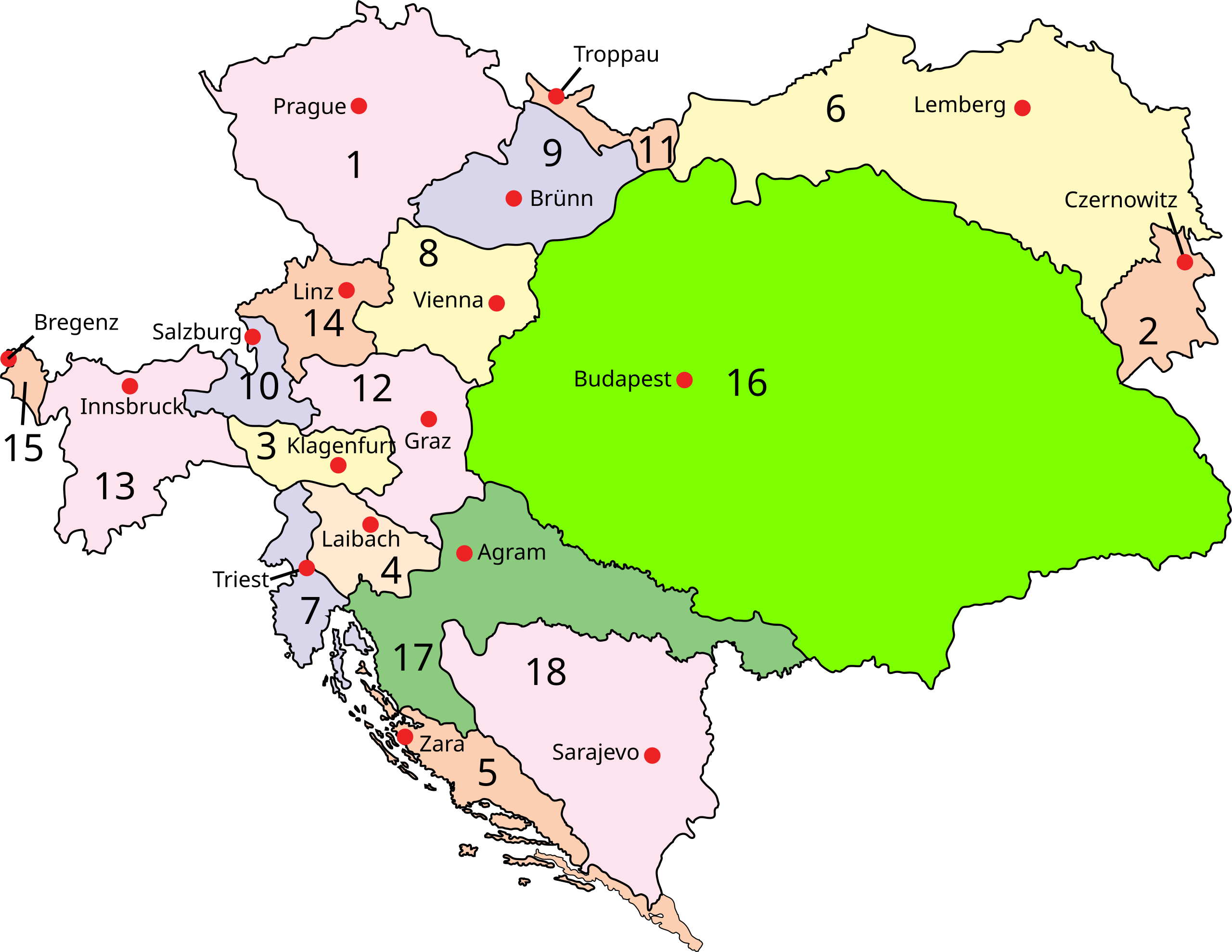 Bohemia (1), Bukovina (2), Carinthia (3), Carniola (4), Dalmatia (5), Galicia (6), Küstenland (7), Lower Austria (8), Moravia (9), Salzburg (10), Silesia (11), Styria (12), Tirol (13), Upper Austria (14), Vorarlberg (15), Hungary (16), Croatia-Slavonia (17), and Bosnia (18). Further information: Ethnic and religious composition of Austria-Hungary Austria-Hungary, which succeeded the Austrian Empire and the Kingdom of Hungary, was a historical monarchy composed by two multinational states. The centrifugal forces within it, coupled with its loss in World War I, led to its breakup in 1918. Its successor states de jure included the First Austrian Republic, the Kingdom of Hungary, while part from her former territories entirely new states were created such as Czechoslovakia, or other parts incorporated into the Kingdom of Serbs, Croats and Slovenes, Poland, Kingdom of Romania, Kingdom of Italy and the Soviet Union. The principal languages of Austria-Hungary were German, Hungarian, Polish, Czech, and Croatian, but there were also many minor languages, including Ukrainian, Romanian, Slovak, Serbian, Slovene, Rusyn, Italian, and Yiddish.[66] Ottoman Empire The Ottoman Empire was the dynastic state of the Turkish House of Osman. At its peak in the 16th and 17th centuries, it controlled much of Southeast Europe, Western Asia, the Caucasus, North Africa, and the Horn of Africa. In addition to Turks, the ethnic groups of the Ottoman Empire included Albanians, Amazighs, Arabs, Armenians, Assyrians, Bosnians, Bulgarians, Circassians, Georgians, Greeks, Jews, Kurds, Laz, Macedonians, Romanians, Serbs, Tatars, and Zazas. Through millet courts, confessional communities were allowed to rule themselves under their own legal systems: for example, sharia law for Muslims, Canon law for Christians, and halakha law for Jews. After the Tanzimat reforms from 1839 to 1876, the term "millet" was used to refer to legally protected religious minority groups, similar to the way other countries use the word "nation". (The word "millet" comes from the Arabic word "millah" (ملة), which literally means "nation".)[citation needed] The millet system has been called an example of pre-modern religious pluralism.[67] Soviet Union 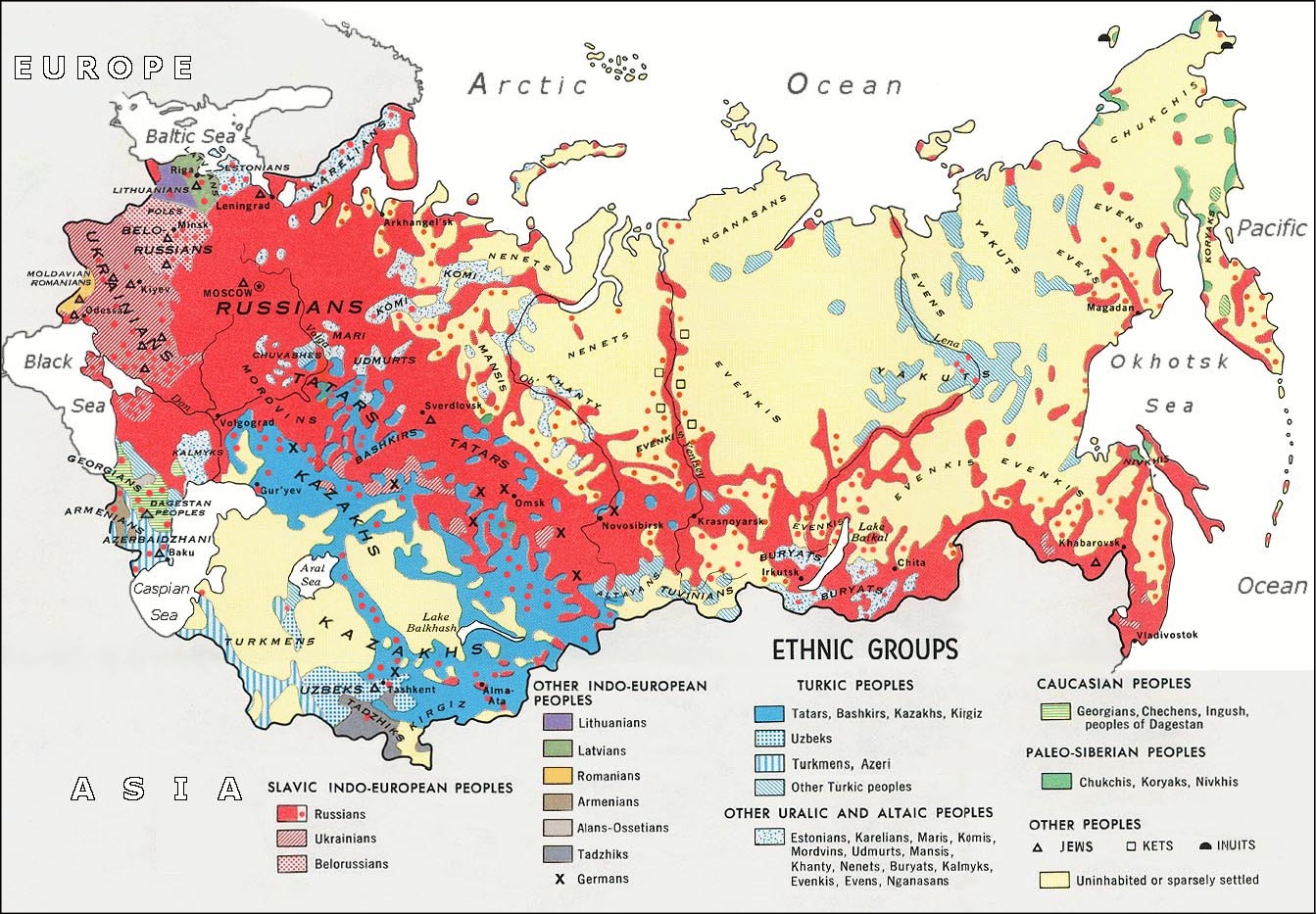 Ethnographic map of the Soviet Union, 1970 The Soviet Union was a state composed of the Soviet republics (of which there were 15 after 1956), with the capital in Moscow. It was founded in December 1922, when the Russian SFSR—which formed during the Russian Revolution of 1917 and emerged victorious in the ensuing Russian Civil War—unified with the Transcaucasian, Ukrainian, and Belarusian SSRs. Addressing the Extraordinary Eighth Congress of Soviets of the Soviet Union on 25 November 1936, Joseph Stalin stated that "within the Soviet Union there are about sixty nations, national groups, and nationalities. The Soviet state is a multinational state."[68] Among the 15 republics were the Baltic states of Estonia, Latvia and Lithuania, which were illegally annexed into the Soviet Union in 1940. The Soviet occupation of the Baltic states was not recognized by a number of Western governments including the United States. In the late 1980s, some of the republics sought sovereignty over their territories, citing Article 72 of the USSR Constitution, which stated that any constituent republic was free to secede.[69] On 7 April 1990, a law was passed allowing a republic to secede if more than two-thirds of its residents voted for secession in a referendum.[70] Many held free elections, and the resulting legislatures soon passed bills that contradicted Soviet laws, in what became known as the War of Laws. In 1989, the Russian SFSR—the largest constituent republic, with about half of the USSR's population—convened a new Congress of People's Deputies and elected Boris Yeltsin its chairman. On 12 June 1990, the Congress declared Russia's sovereignty over its territory and proceeded to pass legislation that attempted to supersede Soviet laws. Legal uncertainty continued through 1991 as constituent republics slowly gained de facto independence. In a referendum on 17 March 1991, majorities in nine of the 15 republics voted to preserve the Union. The referendum gave Soviet leader Mikhail Gorbachev a minor boost, and in the summer of 1991, the New Union Treaty was designed and agreed upon by eight republics. The treaty would have turned the Soviet Union into a much looser federation, but its signing was interrupted by the August Coup—an attempted coup d'état against Gorbachev by hardline Communist Party members of the government and the KGB, who sought to reverse Gorbachev's reforms and reassert the central government's control over the republics. When the coup collapsed, Yeltsin—who had publicly opposed it—came out as a hero, while Gorbachev's power was effectively ended. As a result, the balance of power tipped significantly toward the republics. In August 1991, Latvia and Estonia had regained their independence (following Lithuania's 1990 example), while the other twelve republics continued to discuss new, increasingly loose models for the Union. On 8 December 1991, the presidents of Russia, Ukraine, and Belarus signed the Belavezha Accords, which declared the Soviet Union dissolved and established the Commonwealth of Independent States (CIS) in its place. Doubts remained about the authority of the Belavezha Accords to dissolve the Union, but on 21 December 1991, representatives of every Soviet republic except Georgia—including those that had signed the Belavezha Accords—signed the Alma-Ata Protocol, which confirmed the dissolution of the USSR and reiterated the establishment of the CIS. On 25 December 1991, Gorbachev yielded, resigning as the president of the USSR and declaring the office extinct. He turned the powers vested in the Soviet presidency over to Yeltsin, the president of Russia. The following day, the Supreme Soviet, the highest governmental body of the Soviet Union, dissolved itself. Many organizations, such as the Soviet Army and police forces, remained in place in the early months of 1992, but were slowly phased out and either withdrawn from or absorbed by the newly independent states. Yugoslavia 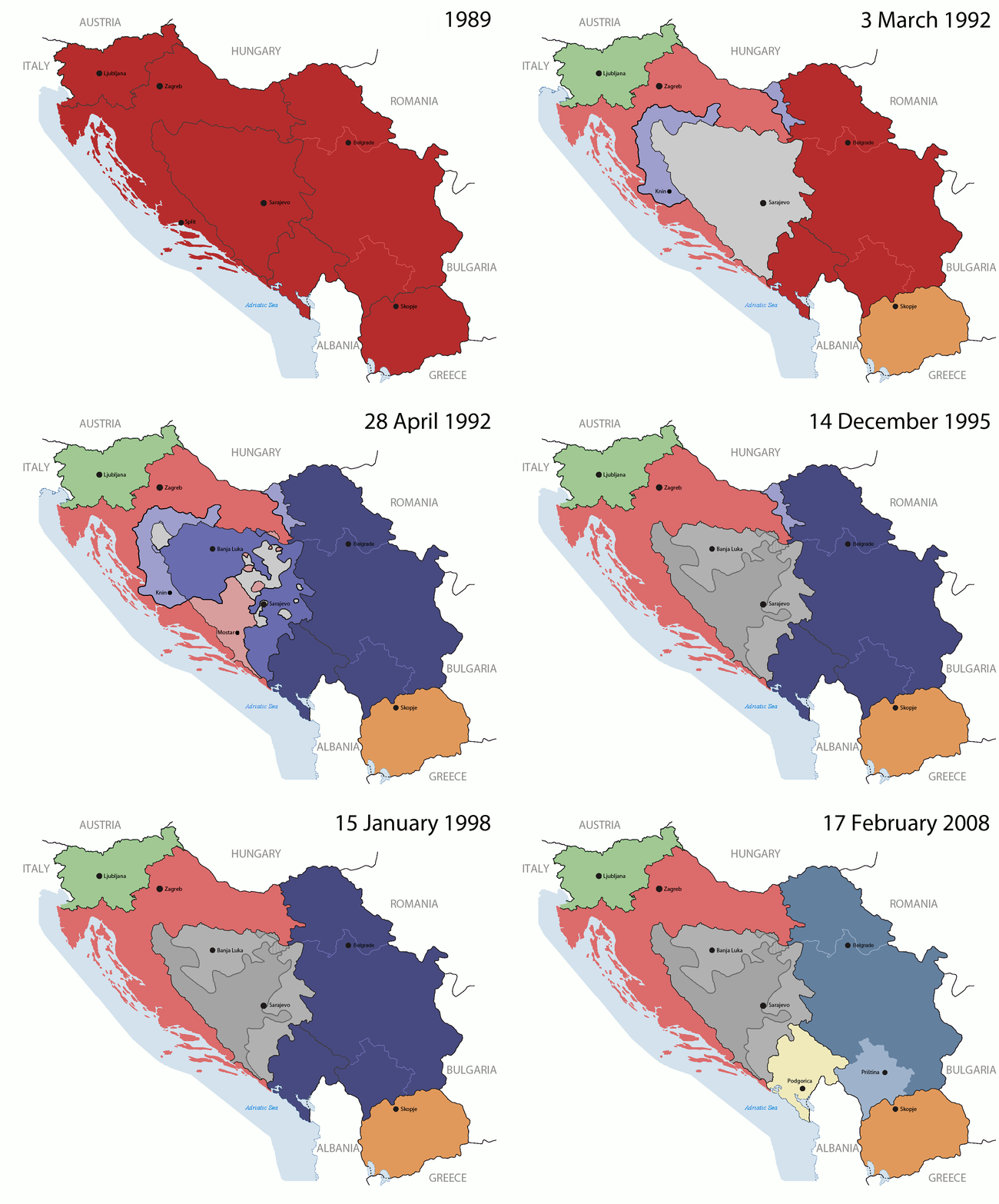 The breakup of the Socialist Federal Republic of Yugoslavia The first country to be known by this name was the Kingdom of Yugoslavia, known until 3 October 1929 as the Kingdom of Serbs, Croats, and Slovenes. It was established on 1 December 1918 by the union of the State of Slovenes, Croats, and Serbs and the Kingdom of Serbia (to which the Kingdom of Montenegro had been annexed on 13 November 1918), and the Conference of Ambassadors gave international recognition to the union on 13 July 1922.[71] The Kingdom of Yugoslavia was invaded by the Axis powers in 1941 and abolished as a result of World War II. It was succeeded by Democratic Federal Yugoslavia, proclaimed in 1943 by the Yugoslav Partisans resistance movement. When a communist government was established in 1946, the country was renamed the Federal People's Republic of Yugoslavia. In 1963, it was renamed again, becoming the Socialist Federal Republic of Yugoslavia (SFRY). This was the largest Yugoslav state, with Istria and Rijeka having been added after World War II. The country consisted of six constituent "socialist republics" (SR Bosnia and Herzegovina, SR Croatia, SR Macedonia, SR Montenegro, SR Slovenia, and SR Serbia) and two "socialist autonomous provinces" (SAP Vojvodina and SAP Kosovo, which became largely equal to other members of the federation after 1974).[72][73] Starting in 1991, the SFRY disintegrated in the Yugoslav Wars, which followed the secession of most of the country's constituent entities. The next Yugoslavia, known as the Federal Republic of Yugoslavia, existed until 2003, when it was renamed Serbia and Montenegro. In 2006, this last vestige separated into Serbia and Montenegro, but only to go further in 2008 after Kosovo unilaterally declared its independence but with limited recognition. Czechoslovakia Further information: Demographics of Czechoslovakia 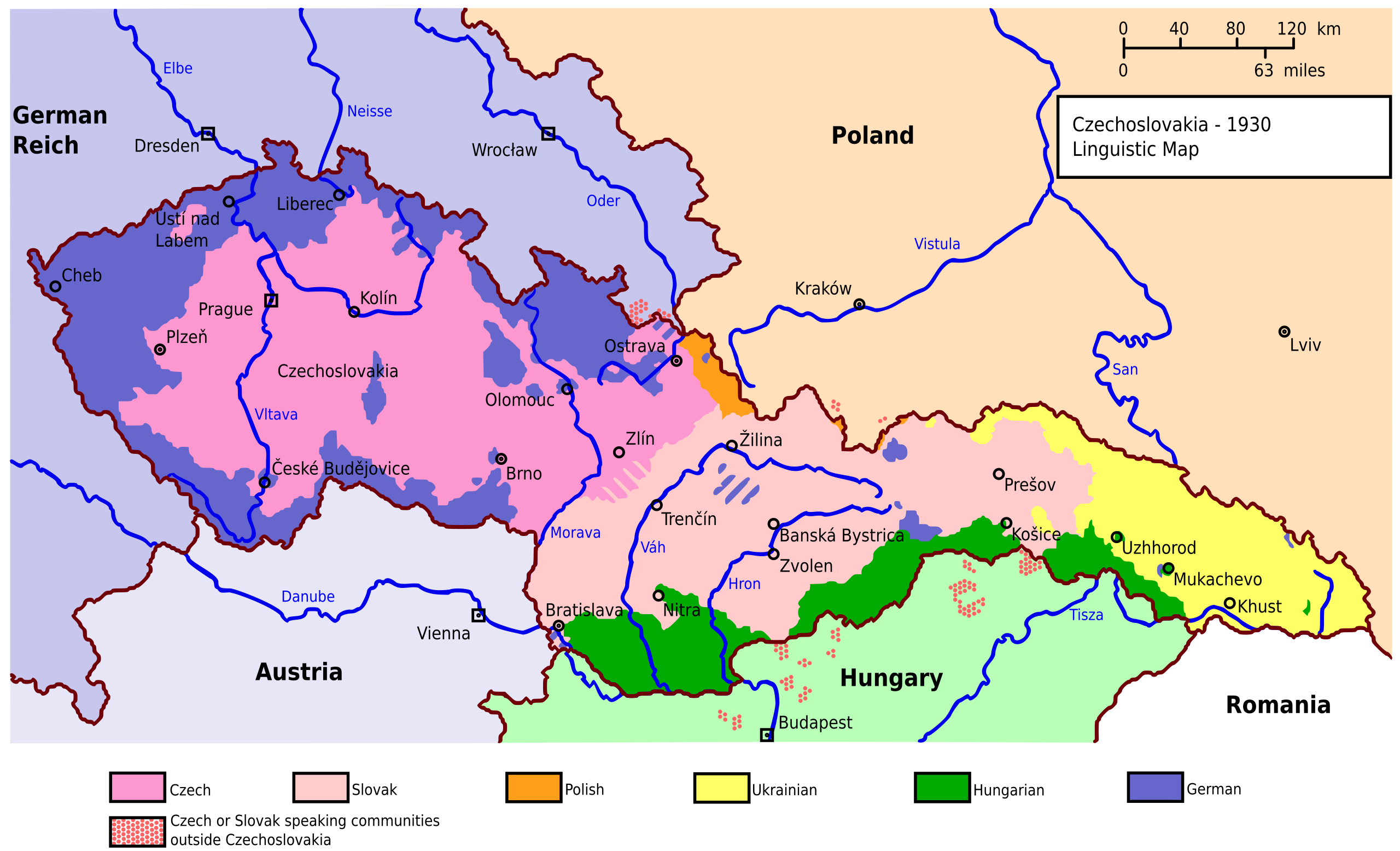 Linguistic map of Czechoslovakia in 1930 Czechoslovakia was a multi-ethnic state, with Czechs and Slovaks as constituent peoples. Sudeten Germans were forcibly expelled after World War II. |
かつての多民族国家 主な記事: 帝国の一覧 詳細情報: 最大規模の帝国の一覧 ローマ帝国 初期のローマ人は、エトルリア人やマグナ・グラエキアのギリシャ人を含む、イタリア半島周辺の部族を同化していった。ローマ市民権は紀元前1世紀からイタ リア人々に拡大され、さらに後にはガリア人、イベリア人、ギリシャ人、北アフリカや近東の人々がブリトン人やゲルマン人と共に多民族の集合体を形成した。 この集合体はしばしば非ローマ系の民族出身の「属州」皇帝によって統治された。ローマ国家が様々な国民を単一の仮の全体へと融合させることに成功したこと は、その後継国家の性質と名称に表れている。ビザンツ帝国は公式に「ローマ帝国」と称し (歴史家は「東ローマ帝国」と呼ぶ)、神聖ローマ帝国(「神聖ローマ帝国」は「ドイツ国民の神聖ローマ帝国」を意味する)は800年から1806年まで中 欧の様々な民族を支配する権威を主張し続けた。 清王朝 清王朝は1636年から1912年まで中国を統治した帝国王朝であり、漢民族ではなく満州族によって建国された。満州族主導の王朝は漢民族多数派に対して 少数派支配を敷き、17~18世紀には軍事的拡張主義によって現在のモンゴル、チベット、新疆地域を帝国に編入した。これにより中国は事実上多民族帝国と なり、清の支配下で各地域は異なる自治権を有した。 ポーランド・リトアニア共和国 オーストリア=ハンガリー帝国 オーストリア=ハンガリー ボヘミア(1)、ブコヴィナ(2)、ケルンテン(3)、カルニオラ(4)、ダルマチア(5)、ガリツィア(6)、キュステンラント(7)、ニーダーエス ターライヒ(8)、モラヴィア(9)、ザルツブルク(10)、シレジア(11)、 シュタイアーマルク州(12)、チロル州(13)、オーバーエスターライヒ州(14)、フォアアールベルク州(15)、ハンガリー(16)、クロアチア・ スラヴォニア(17)、ボスニア(18)。 詳細情報:オーストリア=ハンガリー帝国の民族・宗教構成 オーストリア=ハンガリー帝国は、オーストリア帝国とハンガリー王国を継承した歴史的な君主国であり、二つの多民族国家で構成されていた。内部の離心力と 第一次世界大戦での敗北が相まって、1918年に解体した。法的な後継国家には第一オーストリア共和国、ハンガリー王国が含まれ、旧領土の一部からはチェ コスロバキアなど全く新しい国家が誕生した。その他の地域はセルビア人・クロアチア人・スロベニア人王国、ポーランド、ルーマニア王国、イタリア王国、ソ ビエト連邦に編入された。 オーストリア=ハンガリー帝国の主要言語はドイツ語、ハンガリー語、ポーランド語、チェコ語、クロアチア語であったが、ウクライナ語、ルーマニア語、スロバキア語、セルビア語、スロベニア語、ルシン語、イタリア語、イディッシュ語など多くの少数言語も存在した。[66] オスマン帝国 オスマン帝国はトルコ人オスマン家の王朝国家であった。16世紀から17世紀にかけて最盛期を迎え、東南ヨーロッパ、西アジア、コーカサス、北アフリカ、アフリカの角の大部分を支配した。 オスマン帝国の民族構成には、トルコ人のほか、アルバニア人、アマズィグ人、アラブ人、アルメニア人、アッシリア人、ボスニア人、ブルガリア人、チェルケ ス人、グルジア人、ギリシャ人、ユダヤ人、クルド人、ラズ人、マケドニア人、ルーマニア人、セルビア人、タタール人、ザザ人などが含まれていた。 ミレット法廷を通じて、各宗教共同体は独自の法体系のもとで自治を認められていた。例えば、イスラム教徒にはシャリーア法、キリスト教徒にはカノン法、ユ ダヤ教徒にはハラハー法が適用された。1839年から1876年にかけてのタンジマート改革後、「ミレット」という用語は、他の国々が「国民」という言葉 を使うのと同様に、法的に保護された宗教的少数派集団を指すようになった。(「ミレット」という語はアラビア語の「ミッラー」(ملة)に由来し、文字通 り「国民」を意味する)。[出典が必要] ミレット制度は前近代的な宗教的多元主義の例と評されている。[67] ソビエト連邦 1970年ソビエト連邦民族分布図 ソビエト連邦は、ソビエト共和国(1956年以降は15共和国)で構成される国家であり、首都はモスクワであった。1922年12月、1917年のロシア 革命で成立し、その後のロシア内戦で勝利したロシア・ソビエト連邦社会主義共和国が、トランスカフカース、ウクライナ、ベラルーシの各ソビエト社会主義共 和国と統合して成立した。 1936年11月25日、ソビエト連邦臨時第8回ソビエト大会で演説したヨシフ・スターリンは「ソビエト連邦内には約60の国民、民族集団、民族性が存在 する。ソビエト国家は多民族国家である」と述べた[68]。15の共和国の中には、1940年にソビエト連邦に不法併合されたバルト三国(エストニア、ラ トビア、リトアニア)も含まれていた。ソ連によるバルト三国占領は、アメリカを含む多くの西側諸国政府によって承認されなかった。 1980年代後半、いくつかの共和国は、構成共和国は自由に離脱できると定めたソ連憲法第72条を根拠に、自領土に対する主権を求めた。 [69] 1990年4月7日、住民の3分の2以上が住民投票で分離独立に賛成した場合、共和国が分離できるとする法律が可決された。[70] 多くの共和国で自由選挙が実施され、選出された議会は間もなくソ連の法律と矛盾する法案を可決した。これが後に「法の戦い」として知られるようになった。 1989年、ソ連人口の約半分を占める最大の構成共和国であるロシアSFSRは新たな人民代議員会議を招集し、ボリス・エリツィンを議長に選出した。1990年6月12日、同会議はロシアの領土主権を宣言し、ソ連法を凌駕しようとする立法を進めた。 構成共和国が事実上の独立を徐々に獲得する中、法的な不確実性は1991年を通じて続いた。 1991年3月17日の国民投票では、15の共和国のうち9つで多数派が連邦維持に賛成した。この投票はソ連指導者ミハイル・ゴルバチョフにわずかな追い 風をもたらし、1991年夏には8つの共和国によって新連邦条約が策定・合意された。この条約はソ連をはるかに緩やかな連邦へと変えるはずだったが、その 調印は8月クーデターによって中断された。これは政府内の強硬派共産党員とKGBによるゴルバチョフに対するクーデター未遂事件であり、彼らはゴルバチョ フの改革を覆し、中央政府の共和国に対する支配を再確立しようとした。クーデターが失敗に終わると、公然と反対していたエリツィンが英雄として台頭し、ゴ ルバチョフの権力は事実上終焉を迎えた。 その結果、権力の均衡は著しく共和国側に傾いた。1991年8月、ラトビアとエストニアは(1990年のリトアニアの例に倣い)独立を回復し、他の12共和国は連邦の新たな、より緩やかなモデルについて議論を続けていた。 1991年12月8日、ロシア、ウクライナ、ベラルーシの大統領はベラヴェーシャ合意に署名した。これはソビエト連邦の解体を宣言し、その代わりに独立国 家共同体(CIS)を設立するものであった。ベラヴェーシャ協定による連邦解体の正当性には疑問が残ったが、1991年12月21日、グルジアを除く全ソ 連共和国(ベラヴェーシャ協定署名国を含む)の代表がアルマアタ議定書に署名した。これによりソ連の解体が確認され、CISの設立が改めて宣言された。 1991年12月25日、ゴルバチョフは屈服し、ソ連大統領を辞任するとともに大統領職の廃止を宣言した。彼はソ連大統領に付与されていた権限をロシア大 統領のエリツィンに引き継いだ。 翌日、ソ連の最高政府機関である最高会議は自らを解散した。ソ連軍や警察など多くの組織は1992年初頭まで存続したが、徐々に段階的に廃止され、新たに独立した諸国から撤退するか、あるいは吸収された。 ユーゴスラビア ユーゴスラビア社会主義連邦共和国の解体 この名称で最初に知られる国はユーゴスラビア王国であり、1929年10月3日まではセルビア人・クロアチア人・スロベニア人王国と呼ばれていた。 1918年12月1日、スロベニア・クロアチア・セルビア国とセルビア王国(1918年11月13日にモンテネグロ王国が併合されていた)が連合して成立 し、1922年7月13日の大使会議で国際的に承認された。[71] ユーゴスラビア王国は1941年に枢軸国に侵攻され、第二次世界大戦の結果として廃止された。その後継として、1943年にユーゴスラビア・パルチザン抵 抗運動によって宣言された民主連邦ユーゴスラビアが成立した。1946年に共産主義政府が樹立されると、国名はユーゴスラビア連邦人民共和国に改称され た。1963年には再び改称され、ユーゴスラビア社会主義連邦共和国(SFRY)となった。これは第二次世界大戦後にイストリア半島とリエカが編入され た、史上最大のユーゴスラビア国家である。 この国は6つの構成「社会主義共和国」(ボスニア・ヘルツェゴビナ社会主義共和国、クロアチア社会主義共和国、マケドニア社会主義共和国、モンテネグロ社 会主義共和国、スロベニア社会主義共和国、セルビア社会主義共和国)と2つの「社会主義自治州」(ヴォイヴォディナ社会主義自治州、コソボ社会主義自治 州。1974年以降は他の連邦構成員とほぼ同等の地位となった)で構成されていた。[72] [73] 1991年以降、SFRYは構成体の大半が分離独立した後に発生したユーゴスラビア紛争の中で解体した。次のユーゴスラビアはユーゴスラビア連邦共和国と して2003年まで存続したが、この年セルビア・モンテネグロ連邦共和国に改称された。2006年、この最後の残存国家はセルビアとモンテネグロに分裂し たが、2008年にはコソボが一方的に独立を宣言したことで(承認は限定的だったが)さらに分裂が進んだ。 チェコスロバキア 詳細情報:チェコスロバキアの人口統計 1930年のチェコスロバキア言語分布図 チェコスロバキアは多民族国家であり、チェコ人とスロバキア人が構成民族であった。ズデーテン・ドイツ人は第二次世界大戦後に強制的に追放された。 |
| Multiculturalism Multiracialism Nation state Plurinational Polyethnicity Stateless nation |
多文化主義 多民族主義 国民国家 多元ナショナリズム 多民族性 無国籍民族 |
| References |
https://en.wikipedia.org/wiki/Multinational_state |
| Kelemen, R. Daniel.
(2007). "Built to Last? The Durability of EU Federalism?" (PDF).
Archived from the original (PDF) on 2013-01-20. In Making History:
State of the European Union, Vol. 8, edited by Sophie Meunier and Kate
McNamara, Oxford University Press, p. 52. Kraus, Peter A. (2008). A Union of Diversity: Language, Identity and Polity-Building in Europe. Cambridge University Press. p. 71. ISBN 978-1-139-46981-4. Katiambo, David (2024-12-12). "Consumer nationalism in Kenya: tracing the rhetorical construction of the nation through anti-brand activism on Facebook". African Identities: 1–15. doi:10.1080/14725843.2024.2439423. ISSN 1472-5843. Ilan Peleg, 'Classifying Multinational States' in Democratizing the Hegemonic State (Cambridge University Press, 2007), pp. 78–80 Welsh, David (1993). "Domestic politics and ethnic conflict". In Brown, Michael E. (ed.). Ethnic Conflict and International Security. Princeton: Princeton University Press. pp. 43–60. ISBN 0-691-00068-9. Choudhry, Sujit (2008). "Bridging comparative politics and comparative constitutional law: Constitutional design in divided societies". In Choudhry, Sujit (ed.). Constitutional Design for Divided Societies: Integration or Accommodation?. Oxford: Oxford University Press. pp. 3–40. ISBN 978-0-19-953541-5. "Introduction To The Verbal and Multi-Verbalsystem of Akan" (PDF). ling.hf.ntnu.no. 2013. Archived from the original (PDF) on 7 April 2014. Retrieved 16 November 2013. "Language and Religion". Ghana Embassy. Archived from the original on 1 March 2017. Retrieved 8 January 2017. English is the official language of Ghana and is universally used in schools in addition to nine other local languages. The most widely spoken local languages are, Ga, Dagomba, Mumpruli, Akan and Ewe. "Ghana – 2010 Population and Housing Census" (PDF). Government of Ghana. 2010. Archived from the original (PDF) on 25 September 2013. Retrieved 1 June 2013. "East Africa Living Encyclopedia". www.africa.upenn.edu. Retrieved 2017-01-05. McRoberts, Kenneth (2001). "Canada and the Multinational State". Canadian Journal of Political Science. 34 (4): 683–713. doi:10.1017/S0008423901778055. S2CID 154802932. "Journals No. 87 – November 27, 2006 (39–1) – House of Commons of Canada". www.parl.gc.ca. Retrieved 22 October 2017. Charles Blattberg (2013). ""Canadian Identity" and "Canadian Identity and Language"". University of Montreal. SSRN 2238333. {{cite journal}}: Cite journal requires |journal= (help) Blattberg, Charles (2003). Shall We Dance? A Patriotic Politics for Canada. Montreal: McGill–Queen's University Press. "Cambodia - World Directory of Minorities & Indigenous Peoples". Minority Rights Group. 2015-06-19. Retrieved 2023-04-22. "Han Chinese proportion in China's population drops: census data". Xinhua News (English). 28 April 2011. Archived from the original on 11 July 2016. Retrieved 1 September 2015. "index". www.stats.gov.cn. "Expats in China: nationalities and in which cities they settle". www.beijingrelocation.com. Chari, Mridula (November 2016). "How the map of India was redrawn on the lines of language". Scroll.in. Retrieved 2020-06-16. Ananta, Aris; Arifin, Evi Nurvidya; Hasbullah, M Sairi; Handayani, Nur Budi; Pramono, Agus (2015). Demography of Indonesia's Ethnicity. Institute of Southeast Asian Studies. pp. 12, 27–28. ISBN 978-981-4519-87-8. "Mengulik Data Suku di Indonesia" (in Indonesian). Statistics Indonesia. 18 November 2015. Retrieved 1 January 2021. Retrieved from Myanmar Ministry of Hotels and Tourism webpage at Archived 20 December 2007 at the Wayback Machine "Myanmar People & Races". Archived from the original on 9 June 2010. Retrieved 14 December 2007. For example, the Shan speak a Tai–Kadai language, the Lahu speak a Tibeto-Burman language, the Khamu speak a Mon–Khmer language, and the Yao speak a Hmong–Mien language. Sen Nag, Oishimaya. "What Languages Are Spoken In Nepal?". WorldAtlas. Retrieved 19 February 2023. Massey, Douglas S.; Axinn, William G. (August 2010). "Environmental change and out-migration: evidence from Nepal". Population and Environment. 32 (2–3): 109–136. doi:10.1007/s11111-010-0119-8. PMC 3042700. PMID 21350676. "VIEW: March towards independence". Daily Times. 23 March 2011. Retrieved 29 September 2011. Excerpt from the Presidential Address delivered by Quaid-e-Azam at Lahore, March 22–23, 1940 Archived 2006-06-28 at the Wayback Machine, Nazariapak.info Tariq Rahman (1996). Language and Politics in Pakistan. Oxford University Press. p. 2. Tariq Rahman. 'The Punjabi Movement' from Language and Politics in Pakistan. Ethnic groups in Russia Archived 22 June 2011 at the Wayback Machine, 2002 census, Demoscope Weekly. Retrieved 5 February 2009. "ВПН-2010". perepis-2010.ru. Archived from the original on 18 January 2012. Kirk, Ashley (21 January 2016). "Mapped: Which country has the most immigrants?". The Daily Telegraph. Leonid Ragozin (3 April 2019). "Russia and Ukraine Fight, But Their People Seek Reconciliation". Bloomberg L.P. Retrieved 19 April 2021. Ethnic groups in Russia Archived 2011-06-22 at the Wayback Machine, at demoscope.ru "Russia". Encyclopedia Britannica. Retrieved 8 November 2020. "Russian Census of 2002". 4.3. Population by nationalities and knowledge of Russian; 4.4. Spreading of knowledge of languages (except Russian). Rosstat. Archived from the original on 19 July 2011. Retrieved 16 January 2008. "The Constitution of the Russian Federation". (Article 68, § 2). Retrieved 27 December 2007. "Census of population, households and dwellings in Bosnia and Herzegovina, 2013: Final results" (PDF). Agency for Statistics of Bosnia and Herzegovina. June 2016. Archived from the original (PDF) on 24 December 2017. Retrieved 1 July 2016. Samepolitikk (in Norwegian) Regjeringen.no, retrieved 17 July 2013 Nasjonale minoriteter (in Norwegian) Regjeringen.no, retrieved 17 July 2013 "ONS Glossary of economic terms". Office for National Statistics. Archived from the original on 7 September 2011. Retrieved 24 July 2010. Giddens, Anthony (2006). Sociology. Cambridge: Polity Press. p. 41. ISBN 978-0-7456-3379-4. "Gordon Brown: We must defend the Union", The Telegraph, 25 March 2008. Hogwood, Brian. "Regulatory Reform in a Multinational State: The Emergence of Multilevel Regulation in the United Kingdom" (PDF). Archived from the original (PDF) on 8 June 2011. Retrieved 24 July 2010. "Diversity and Citizenship Curriculum Review" (PDF). Devon County Council. Archived from the original (PDF) on 2011-06-15. Retrieved 13 August 2010. Magnay, Jacquelin (26 May 2010). "London 2012: Hugh Robertson puts Home Nations football team on agenda". The Telegraph. Archived from the original on 28 April 2011. Retrieved 11 September 2010. William E. Burns, A Brief History of Great Britain, p. xxi "Articles of Union with Scotland 1707". UK Parliament. Retrieved 19 October 2008. D. Ross, Chronology of Scottish History (Glasgow: Geddes & Grosset, 2002), ISBN 1-85534-380-0, p. 56. J. Hearn, Claiming Scotland: National Identity and Liberal Culture (Edinburgh; Edinburgh University Press, 2002), ISBN 1-902930-16-9, p. 104. "Orkney and Shetland Are Pawned as Dowry ⋆ History Channel". History Channel. 2016-06-20. Retrieved 2017-01-05. "The Act of Union". Act of Union Virtual Library. Archived from the original on 15 April 2012. Retrieved 15 May 2006. SR&O 1921/533 of 3 May 1921 "The Anglo-Irish Treaty, 6 December 1921". CAIN. Retrieved 15 May 2006. P. Cottrell, The Irish Civil War 1922–23 (London: Osprey, 2008), ISBN 1-84603-270-9, p. 85. "The Troubles gallery – 40 years of conflict in Northern Ireland from the Belfast Telegraph archives – BelfastTelegraph.co.uk". BelfastTelegraph.co.uk. Retrieved 2017-05-22. "BBC – History – The Troubles – Violence". Retrieved 2017-05-22. "The Belfast Agreement – GOV.UK". www.gov.uk. Retrieved 2017-05-22. "Union flag protests: more than 200 arrested in Northern Ireland". The Guardian. Press Association. 2013-04-03. ISSN 0261-3077. Retrieved 2017-05-22. Keating, Michael (1 January 1998). "Reforging the Union: Devolution and Constitutional Change in the United Kingdom". Publius: The Journal of Federalism. 28 (1): 217. doi:10.1093/oxfordjournals.pubjof.a029948. "Scottish referendum: Scotland votes 'No' to independence". BBC News. 2014-09-19. Retrieved 2017-01-05. Simon Jenkins, We'd be a more united kingdom with an independent Scotland[dead link] in The Sunday Times dated September 17, 2006 "Northern Ireland Assembly election 2017 results". BBC News. Retrieved 2017-05-22. "Sinn Fein chief Gerry Adams in fresh call for united Ireland border poll – BelfastTelegraph.co.uk". BelfastTelegraph.co.uk. Retrieved 2017-05-22. "D'Hondt system for picking NI ministers in Stormont". BBC News. 2011-05-11. Retrieved 2017-05-22. Volkszählung vom 31. Dezember 1910, published in Geographischer Atlas zur Vaterlandskunde an der österreichischen Mittelschulen (Vienna, 1911) Sachedina, Abdulaziz Abdulhussein (2001). The Islamic Roots of Democratic Pluralism. Oxford University Press. pp. 96–97. ISBN 0-19-513991-7. The millet system in the Muslim world provided the pre-modern paradigm of a religiously pluralistic society by granting each religious community an official status and a substantial measure of self-government. On the Draft Constitution of the U.S.S.R marxists.org, accessed 15 January 2011 The red blues — Soviet politics by Brian Crozier, National Review, 25 June 1990. Origins of Moral-Ethical Crisis and Ways to Overcome it by V.A.Drozhin Honoured Lawyer of Russia. "Interesting things about the royal order of Montenegro – Untitled". Orderofdanilo. Archived from the original on 16 May 2009. Retrieved 22 October 2017. Huntington, Samuel P. (1996). The clash of civilizations and the remaking of world order. Simon & Schuster. p. 260. ISBN 0-684-84441-9. "History, bloody history". BBC News. March 24, 1999. Retrieved December 29, 2010. |
ケレメン、R・ダニエル(2007)。「永続する構造か?
EU連邦主義の持続可能性について」(PDF)。2013年1月20日にオリジナル(PDF)からアーカイブ。ソフィー・ムニエとケイト・マクナマラ編
『歴史を創る:欧州連合の現状』第8巻、オックスフォード大学出版局、52頁。 クラウス、ピーター・A. (2008). 『多様性の連合:ヨーロッパにおける言語、アイデンティティ、そして政治体制の構築』. ケンブリッジ大学出版局. p. 71. ISBN 978-1-139-46981-4. カティアンボ、デイヴィッド(2024-12-12)。「ケニアにおける消費者ナショナリズム:フェイスブック上の反ブランド活動を通じた国民のレトリッ ク的構築の追跡」。『アフリカのアイデンティティ』:1–15頁。doi:10.1080/14725843.2024.2439423。ISSN 1472-5843。 イラン・ペレグ『多民族国家の分類』『覇権国家の民主化』(ケンブリッジ大学出版局、2007年)、78–80頁 ウェルシュ、デイヴィッド(1993年)。「国内政治と民族紛争」。マイケル・E・ブラウン編『民族紛争と国際安全保障』。プリンストン:プリンストン大学出版局。pp. 43–60. ISBN 0-691-00068-9. Choudhry, Sujit (2008). 「比較政治学と比較憲法学の架け橋:分断された社会における憲法設計」. Choudhry, Sujit (編). 『分断された社会のための憲法設計:統合か、それとも融和か?』. オックスフォード:オックスフォード大学出版局. pp. 3–40. ISBN 978-0-19-953541-5. 「アカン語の動詞および複合動詞体系入門」(PDF). ling.hf.ntnu.no. 2013. 2014年4月7日にオリジナル(PDF)からアーカイブ. 2013年11月16日に閲覧. 「言語と宗教」. ガーナ大使館. 2017年3月1日にオリジナルからアーカイブ. 2017年1月8日に閲覧. 英語はガーナの公用語であり、9つの現地語に加えて学校で広く使用されている。最も広く話されている現地語は、ガー語、ダゴンバ語、ムンプルリ語、アカン 語、エウェ語である。 「ガーナ - 2010 年国勢調査」 (PDF). ガーナ政府. 2010. 2013 年 9 月 25 日にオリジナル (PDF) からアーカイブ。2013 年 6 月 1 日取得。 「東アフリカの生きている百科事典」. www.africa.upenn.edu. 2017 年 1 月 5 日取得。 マクロバーツ、ケネス (2001). 「カナダと多国籍国家」. カナダ政治学雑誌. 34 (4): 683–713. doi:10.1017/S0008423901778055. S2CID 154802932. 「ジャーナル No. 87 – 2006年11月27日 (39–1) – カナダ下院」。www.parl.gc.ca。2017年10月22日取得。 チャールズ・ブラットバーグ (2013)。「「カナダのアイデンティティ」 と 「カナダのアイデンティティと言語」」。モントリオール大学。SSRN 2238333。{{cite journal}}: Cite journal requires |journal= (help) ブラットバーグ、チャールズ (2003). 『踊ろうか?カナダのための愛国的な政治』. モントリオール: マギル・クイーンズ大学出版局。 「カンボジア - 世界少数民族・先住民ディレクトリ」. マイノリティ・ライツ・グループ。2015-06-19. 2023-04-22 取得。 「中国人口における漢民族の割合が減少:国勢調査データ」。新華社通信(英語版)。2011年4月28日。2016年7月11日オリジナルからアーカイブ。2015年9月1日取得。 「index」。www.stats.gov.cn。 「中国在住外国人:国籍と居住都市別分布」。www.beijingrelocation.com。 Chari, Mridula (2016年11月). 「言語境界線に沿って再描かれたインドの地図」。Scroll.in。2020年6月16日閲覧。 アナンタ、アリス; アリフィン、エヴィ・ヌルヴィディア; ハスブラ、M・サイリ; ハンダヤニ、ヌル・ブディ; プラモノ、アグス (2015). 『インドネシア民族の人口統計』. 東南アジア研究所. pp. 12, 27–28. ISBN 978-981-4519-87-8. 「インドネシアの民族データを探る」(インドネシア語)。インドネシア統計局。2015年11月18日。2021年1月1日閲覧。 ミャンマーホテル観光省ウェブページより取得。2007年12月20日ウェイバックマシンにアーカイブ。 「ミャンマーの人々と人種」。2010年6月9日にオリジナルからアーカイブ。2007年12月14日閲覧。例えば、シャン族はタイ・カダイ語族を話し、ラフ族はチベット・ビルマ語族を話し、カム族はモン・クメール語族を話し、ヤオ族はモン・ミエン語族を話す。 セン・ナグ、オイシマヤ。「ネパールではどんな言語が話されているのか?」。WorldAtlas。2023年2月19日閲覧。 マッセイ、ダグラス・S.; アクシン、ウィリアム・G. (2010年8月). 「環境変化と移住:ネパールからの証拠」. Population and Environment. 32 (2–3): 109–136. doi:10.1007/s11111-010-0119-8. PMC 3042700. PMID 21350676. 「見解:独立への行進」. デイリー・タイムズ. 2011年3月23日. 2011年9月29日閲覧. クエイド・エ・アザムによる大統領演説の抜粋(1940年3月22日~23日、ラホールにて)Archived 2006-06-28 at the Wayback Machine, Nazariapak.info タリク・ラーマン(1996)。『パキスタンにおける言語と政治』。オックスフォード大学出版局。p. 2。 タリク・ラーマン。『パキスタンにおける言語と政治』所収「パンジャーブ運動」。 ロシアの民族グループ Archived 2011年6月22日 at the Wayback Machine、2002年国勢調査、デモスコープ・ウィークリー。2009年2月5日閲覧。 「ВПН-2010」。perepis-2010.ru。2012年1月18日にオリジナルからアーカイブ。 カーク、アシュリー(2016年1月21日)。「地図で見る:最も移民が多い国はどこか?」。デイリー・テレグラフ。 レオニード・ラゴジン(2019年4月3日)。「ロシアとウクライナは争うが、両国民は和解を求める」。ブルームバーグL.P. 2021年4月19日閲覧。 ロシアの民族グループ(2011年6月22日ウェイバックマシンにアーカイブ)、demoscope.ruにて 「ロシア」。ブリタニカ百科事典。2020年11月8日閲覧。 「2002年ロシア国勢調査」。4.3. 国民別人口とロシア語習得状況;4.4. 言語習得状況(ロシア語を除く)。ロススタット。2011年7月19日時点のオリジナルからアーカイブ。2008年1月16日閲覧。 「ロシア連邦憲法」。(第68条、第2項)。2007年12月27日閲覧。 「ボスニア・ヘルツェゴビナにおける人口、世帯及び住居の2013年国勢調査:最終結果」(PDF). ボスニア・ヘルツェゴビナ統計庁. 2016年6月. 2017年12月24日にオリジナル(PDF)からアーカイブ. 2016年7月1日閲覧. Samepolitikk(ノルウェー語)Regjeringen.no、2013年7月17日取得 Nasjonale minoriteter(ノルウェー語)Regjeringen.no、2013年7月17日取得 「ONS経済用語集」。国家統計局。2011年9月7日にオリジナルからアーカイブ。2010年7月24日取得。 ギデンズ、アンソニー(2006)。『社会学』。ケンブリッジ:ポリティ・プレス。41ページ。ISBN 978-0-7456-3379-4。 「ゴードン・ブラウン:我々は連合を防衛しなければならない」、『テレグラフ』、2008年3月25日。 ホグウッド、ブライアン。「 多国籍国家における規制改革:英国における多階層規制の出現」 (PDF)。2011年6月8日にオリジナル (PDF) からアーカイブ。2010年7月24日取得。 「多様性と市民権カリキュラムの見直し」 (PDF)。デボン州議会。2011年6月15日にオリジナル (PDF) からアーカイブ。2010年8月13日に取得。 マグネイ、ジャクリン(2010年5月26日)。「ロンドン2012:ヒュー・ロバートソンがホームネイションズサッカーチームを議題に」。テレグラフ。2011年4月28日にオリジナルからアーカイブ。2010年9月11日に取得。 ウィリアム・E・バーンズ、『英国の簡史』、p. xxi 「1707年スコットランドとの連合法」。英国議会。2008年10月19日取得。 D. ロス、『スコットランド史年表』(グラスゴー:ゲデス&グロセット、2002年)、ISBN 1-85534-380-0、p. 56。 J. ハーン『スコットランドを主張する:国民的アイデンティティとリベラル文化』(エディンバラ:エディンバラ大学出版局、2002年)、ISBN 1-902930-16-9、p. 104。 「オークニーとシェトランドが持参金として差し入れられる ⋆ ヒストリーチャンネル」。ヒストリーチャンネル。2016年6月20日。2017年1月5日取得。 「連合法」。連合法仮想図書館。2012年4月15日オリジナルからアーカイブ。2006年5月15日取得。 SR&O 1921/533 1921年5月3日付 「アングロ・アイリッシュ条約、1921年12月6日」。CAIN。2006年5月15日取得。 P. コトレル著『アイルランド内戦 1922–23』(ロンドン:オスプレイ、2008年)、ISBN 1-84603-270-9、85ページ。 「紛争ギャラリー – ベルファスト・テレグラフ紙アーカイブによる北アイルランド紛争40年史 – BelfastTelegraph.co.uk」。BelfastTelegraph.co.uk. 2017年5月22日閲覧。 「BBC – 歴史 – トラブル – 暴力」. 2017年5月22日閲覧。 「ベルファスト合意 – GOV.UK」. www.gov.uk. 2017年5月22日閲覧。 「ユニオンフラッグ抗議:北アイルランドで200人以上が逮捕」。ガーディアン。プレス・アソシエーション。2013年4月3日。ISSN 0261-3077。2017年5月22日閲覧。 キーティング、マイケル(1998年1月1日)。「連合の再構築:英国の権限委譲と憲法改正」。Publius: The Journal of Federalism. 28 (1): 217. doi:10.1093/oxfordjournals.pubjof.a029948. 「スコットランド国民投票:スコットランドは独立に『ノー』を投票」。BBC News. 2014-09-19. 2017-01-05 取得。 サイモン・ジェンキンズ、独立したスコットランドがあれば、英国はより統一された王国になるだろう[リンク切れ]、2006年9月17日付サンデー・タイムズ紙 「2017年北アイルランド議会選挙の結果」。BBCニュース。2017年5月22日取得。 「シン・フェイン党首ジェリー・アダムス、統一アイルランド国境投票を改めて要求 – BelfastTelegraph.co.uk」。BelfastTelegraph.co.uk。2017年5月22日取得。 「ストームントにおける北アイルランド大臣選出のためのドント方式」。BBCニュース。2011年5月11日。2017年5月22日取得。 1910年12月31日国勢調査。1910年12月31日実施の人口調査。オーストリア中等学校地理アトラス(ウィーン、1911年)に掲載 サチェディナ、アブドゥルアジズ・アブドゥルフセイン(2001年)。『民主的多元主義のイスラム的根源』。オックスフォード大学出版局。96-97頁。 ISBN 0-19-513991-7。イスラム世界におけるミレット制度は、各宗教共同体に公的な地位と相当な自治権を認めることで、宗教的に多元的な社会の前近 代的パラダイムを提供した。 ソビエト連邦憲法草案について marxists.org、2011年1月15日アクセス 赤い憂鬱 ― ソビエト政治 ブライアン・クロジエ、ナショナル・レビュー、1990年6月25日。 道徳的・倫理的危機の起源とその克服方法 ロシア名誉弁護士 V.A.ドロージン著。 「モンテネグロ王室勲章の興味深い点 ― 無題」。Orderofdanilo。2009年5月16日時点のオリジナルからアーカイブ。2017年10月22日閲覧。 サミュエル・P・ハンティントン (1996). 『文明の衝突と世界秩序の再構築』. サイモン&シュスター. p. 260. ISBN 0-684-84441-9. 「歴史、血塗られた歴史」. BBCニュース. 1999年3月24日. 2010年12月29日閲覧. |
| https://en.wikipedia.org/wiki/Multinational_state |
☆多
民族国家とは、少なくとも歴史的には、複数の民族(国民)の居住地域や言語・文化圏を包含する国々を指す呼称である。多民族国家は、単一民族国家や主に単
一の民族集団で構成される国民国家とは異なり、民族的に均質ではない。歴史的に、様々な民族グループが、移民、異民族間の結婚、貿易、征服、戦後の領土分
割などを通じて、各国や各地域に大きな政治的・社会的影響力を行使してきた。したがって、多くの国々がある程度の多民族性を示している。[1]
| Un Estado
multiétnico es una denominación, al menos histórica, utilizada para
aquellos países que abarcan hábitats o regiones lingüísticas o
culturales de varios pueblos o etnias (nacionalidades). Un Estado
multiétnico no es homogéneo desde el punto de vista étnico a diferencia
de un Estado monoétnico o Estado nacional que está principalmente
constituido por un solo grupo étnico. Históricamente, diversos grupos
étnicos han ejercido una gran influencia política y social en países y
regiones a través de la inmigración, los matrimonios mixtos, el
comercio, la conquista y la división de tierras tras la guerra. Por lo
tanto, muchos países presentan cierto grado de multietnicidad.[1] |
多民族国家とは、少なくとも歴史的には、複数の民族(国民)の居住地域
や言語・文化圏を包含する国々を指す呼称である。多民族国家は、単一民族国家や主に単一の民族集団で構成される国民国家とは異なり、民族的に均質ではな
い。歴史的に、様々な民族グループが、移民、異民族間の結婚、貿易、征服、戦後の領土分割などを通じて、各国や各地域に大きな政治的・社会的影響力を行使
してきた。したがって、多くの国々がある程度の多民族性を示している。[1] |
| El término Estado multiétnico se
utiliza normalmente como una denominación ilustrativa, no como una
categoría analítica. Por ello, no hay ni criterios claros sobre cuándo
se puede hablar de un Estado multiétnico, ni tampoco sobre las
consecuencias teóricas que pudiera acarrear. Se utiliza como epíteto
frecuentemente para casos como Imperio austrohúngaro, la Unión
Soviética o Yugoslavia. |
多民族国家という用語は、通常、説明的な名称として用いられ、分析的な
カテゴリーとしては用いられない。したがって、いつ多民族国家と言えるのか、またそれが理論的にどのような結果をもたらすのかについて、明確な基準は存在
しない。この用語は、オーストリア=ハンガリー帝国、ソビエト連邦、ユーゴスラビアなどの事例に対して、しばしば形容詞として用いられる。 |
| En 1985, el historiador
canadiense William H. McNeill impartió tres conferencias en la
Universidad de Toronto sobre la multietnicidad en las culturas antiguas
y modernas. El argumento principal de sus conferencias fue que era una
norma cultural que las sociedades estuvieran compuestas por diferentes
grupos étnicos. McNeill argumentó que el ideal de una sociedad
homogénea pudo haberse desarrollado en Europa Occidental entre 1750 y
1920, a medida que la gente se convenció más de una base nacionalista
única para la organización sociopolítica. McNeill creía que el deseo de
naciones homogéneas comenzó a decaer durante la Primera Guerra Mundial. |
1985年、カナダの歴史家ウィリアム・H・マクニールはトロント大学
で、古代および現代文化における多民族性について3回の講演を行った。彼の講演の主な主張は、社会がさまざまな民族グループで構成されることは文化的な規
範であるということだった。マクニールは、1750年から1920年にかけて、社会政治組織の基盤として単一のナショナリズムが人々に広く受け入れられる
ようになるにつれて、均質な社会という理想が西ヨーロッパで発展したのではないかと論じた。マクニールは、均質な国家への欲求は第一次世界大戦中に衰退し
始めたと考えていた。 |
| Las constituciones de los países
multiétnicos varían entre países descentralizados y unitarios (como el
Reino Unido) y países federales (como Bélgica, Suiza y Canadá). Los
partidos nacionales en estas regiones multiétnicas no son
antinacionales, sino que buscan el máximo poder dentro del país. Muchas
decisiones políticas en países multiétnicos se enfrentan a este dilema. |
多民族国家の憲法は、地方分権化された単一国家(英国など)と連邦国家 (ベルギー、スイス、カナダなど)で異なる。こうした多民族地域における全国政党は反国家的ではなく、国内での最大限の権力を求めるものである。多民族国 家における多くの政治的決定は、このジレンマに直面している。 |
| Referencias 1. «Multiétnico - Definicion.de». Definición.de. Consultado el 4 de julio de 2025. 2. «Yugoslavia». autocww2.colorado.edu. Archivado desde el original el 15 de diciembre de 2013. Consultado el 5 de julio de 2025. 3. «РГ + Россия 24: Росстат об итогах Всероссийской переписи населения 2010 года». Российская газета (en ruso). 22 de diciembre de 2011. Consultado el 5 de julio de 2025. 4. «Chinese National Minorities». www.paulnoll.com. Consultado el 5 de julio de 2025. |
参考文献 1. 「多民族 - Definicion.de」。Definición.de。2025年7月4日閲覧。 2. 「ユーゴスラビア」。autocww2.colorado.edu。2013年12月15日にオリジナルからアーカイブ。2025年7月5日閲覧。 3. 「РГ + Россия 24: Росстат об итогах Всероссийской переписи населения 2010 года」。Российская газета(ロシア語)。2011年12月22日。2025年7月5日閲覧。 4. 「中国の少数民族」。www.paulnoll.com。2025年7月5日に閲覧。 |
| Enlaces externos Esta obra contiene una traducción derivada de «Vielvölkerstaat» de Wikipedia en alemán, concretamente de esta versión, publicada por sus editores bajo la Licencia de documentación libre de GNU y la Licencia Creative Commons Atribución-CompartirIgual 4.0 Internacional. Otto Bauer: Die Nationalitätenfrage und die Sozialdemokratie, 2. Edición., Wiener Volksbuchhandlung, Viena 1924. Los conflictos étnicos y sus repercusiones en la sociedad internacional Archivado el 26 de febrero de 2009 en Wayback Machine. |
外部リンク この作品は、ドイツ語版ウィキペディアの「Vielvölkerstaat」 を翻訳したものであり、具体的にはこの版を、GNUフリー文書利用許諾契約およびクリエイティブ・コモンズ表示-継承4.0国際ライセンスに基づいて編集 者らが公開したものである。 オットー・バウアー:Die Nationalitätenfrage und die Sozialdemokratie、第2版、Wiener Volksbuchhandlung、ウィーン、1924年。 民族紛争と国際社会への影響 2009年2月26日、Wayback Machineにアーカイブ。 |
| https://es.wikipedia.org/wiki/Estado_multi%C3%A9tnico |
|
| https://de.wikipedia.org/wiki/Vielv%C3%B6lkerstaat |
|
★Ejemplos de países multiétnicos, 多民族国家の例
| 《歴史上過去の国》 |
||
| 国 | 民族集団 | 存在期間 |
| オスマン帝国 | トルコ人、アラブ人、ギリシャ人、アルメニア人、ブルガリア人、セルビ
ア人 |
1299-1922 |
| ハンガリー=オーストリア帝国 |
ドイツ人、ハンガリー人、チェコ人、スロバキア人、ポーランド人、ルー
マニア人 |
1867-1918 |
| ソビエト連邦 |
ロシア人、ウクライナ人、ベラルーシ人、リトアニア人、ラトビア人、エ
ストニア人、グルジア人、アルメニア人、アゼルバイジャン人、カザフ人、キルギス人、ウズベク人、タジク人、トルクメン人 |
1922-1991 |
| ユーゴスラビア |
セルビア人、クロアチア人、スロベニア人、モンテネグロ人、ボスニア
人、マケドニア人[2] |
|
| 《現存する国》 |
||
| ロシア |
ルサ人、タタール人、チェチェン人、バシキール人、チュヴァシ人、カバ
ルダ人、イングーシ人、オセット人、モルドヴァ人、ヤクート人、ブリヤート人、マリ人、ウドムルト人、トゥヴァ人、チェルケス人、カラチャイ人、カルムク
人、コミ人、バルカル人、アディゲ人、アルタイ人、ヤクート人、カレリア人[3] |
|
| 中国 |
漢族、チベット族、モンゴル族、回族、ウイグル族、チワン族、満州族、
ミャオ族、イ族 |
|
| スペイン |
カスティーリャ人、カタルーニャ人、アストゥリアス人、ガリシア人、バ
スク人、レオン人、アラゴン人、アンダルシア人 |
|
| 連合王国 |
イングランド人、スコットランド人、ウェールズ人、アイルランド人、
コーンウォール人 |
|
| エチオピア |
アファール族、アムハラ族、ベルタ族、グムズ族、グラゲ族、ハディヤ
族、ハラール族、オロモ族、シダマ族、ソマリ族、ティグライ族 |
|
| ベルギー王国 |
ワロン人、フランドル人、ドイツ人 |
|
| メキシコ |
メスティーソ、ナワ族、マヤ族、サポテコ族、ミステコ族、オトミ族、ト
トナカ族、ツォツィル族、ツェルツァール族、ワステコ族、チョール族、プレペチャ族、ミクス族、ウィチョール族、タラウマラ族 |
|
| パキスタン |
パンジャーブ人、シンディ人、パシュトゥーン人、バローチ人、バルティ
人、カシミール人 |
リ ンク
文 献
そ の他の情報
CC
Copyleft,
CC, Mitzub'ixi Quq Chi'j, 1996-2099