アメリカ大陸にはじめて上陸したフィリピン人
First landing of Filipinos in the Americas
☆1587
年10月18日、最初のフィリピン人たちが「ルソン・インディオ」と呼ばれ、船員や奴隷としてスペイン船ヌエストラ・セニョーラ・デ・ブエナ・エスペラン
サ号に乗船し、モロ湾に上陸した。この船はポルトガル領マカオから出航し、マニラ・ガレオン貿易の一環として航海していた。[1]
モロ湾周辺での約3日間の上陸中、船員たちはチュマシュの人民と接触し、最終的にスペイン人1名とフィリピン人1名の計2名の船員が死亡した。[2]
船員の死亡後、モロ湾を出航したヌエストラ・セニョーラ・デ・ブエナ・エスペランサ号は、最終的に目的地のアカプルコに到着した。[3]
1595年まで、他のフィリピン人がカリフォルニアに連れて来られることはなかった。[4]
1995年、モロ湾に1587年の出来事を記念する記念碑が建立された。[5]
これらの出来事を称え、2009年以降10月はフィリピン系アメリカ人歴史月間と定められている。[6]
| First
landing of Filipinos in the Americas |
アメリカ大陸にはじめて上陸したフィリピン人 |
| On 18 October 1587, the first
Filipinos, labeled “Luzon Indios”, and arriving as ship crew and
slaves, landed in Morro Bay aboard the Spanish ship Nuestra Señora de
Buena Esperanza, which had sailed from Portuguese Macau, as part of the
Manila galleon trade.[1] During about three days of travels ashore
around Morro Bay, the crew of the ship came in contact with the Chumash
people, ultimately resulting in the deaths of two crew members: a
Spaniard and a Filipino.[2] Departing Morro Bay after the deaths of the crew members, the Nuestra Señora de Buena Esperanza eventually reached its intended destination of Acapulco.[3] No other Filipino was brought to California until 1595.[4] In 1995, a monument on Morro Bay was dedicated to commemorate the events of 1587.[5] October has been designated as Filipino American History Month since 2009 in recognition of these events.[6] 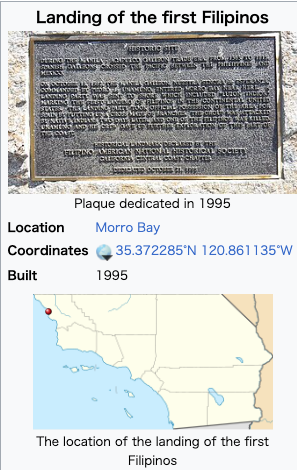 |
1587年10月18日、最初のフィリピン人たちが「ルソン・インディ
オ」と呼ばれ、船員や奴隷としてスペイン船ヌエストラ・セニョーラ・デ・ブエナ・エスペランサ号に乗船し、モロ湾に上陸した。この船はポルトガル領マカオ
から出航し、マニラ・ガレオン貿易の一環として航海していた。[1]
モロ湾周辺での約3日間の上陸中、船員たちはチュマシュの人民と接触し、最終的にスペイン人1名とフィリピン人1名の計2名の船員が死亡した。[2] 船員の死亡後、モロ湾を出航したヌエストラ・セニョーラ・デ・ブエナ・エスペランサ号は、最終的に目的地のアカプルコに到着した。[3] 1595年まで、他のフィリピン人がカリフォルニアに連れて来られることはなかった。[4] 1995年、モロ湾に1587年の出来事を記念する記念碑が建立された。[5] これらの出来事を称え、2009年以降10月はフィリピン系アメリカ人歴史月間と定められている。[6] |
| Background Thousands of years before their first contact with Europeans, the Chumash people established the region around the Channel Islands and areas from San Luis Obispo to Malibu as their territories.[7] At the beginning of the 16th century, European explorers began to explore the Pacific. The Spanish traveled westward with Vasco Núñez de Balboa, first seeing the Pacific Ocean from Panama; then the Pacific was crossed by Ferdinand Magellan, who reached the Philippines.[8] The Chumash's first contact with Europeans occurred on 10 October 1542, when Juan Rodríguez Cabrillo's expedition sailed into the area.[9] Their next contact with Europeans would be 45 years later.[10] Beginning in the mid-16th century, Spain conducted its campaign to conquer the Philippine Islands, led by Miguel López de Legazpi. This concluded with Spanish forces repelling Chinese ambitions to control Manila.[11] As a consequence of the conquest of the Philippines, in 1565 the Manila galleon trade began, sailing from Acapulco – initially to Cebu, and after 1571 to Manila.[12] These ships were crewed largely by Filipinos.[a][1][13] The Filipinos who sailed experienced arduous conditions, poor rations, disease, and the lowest pay among the crew.[14] From 1582 until his death in 1586, Francisco Gali plied the Manila galleon route, initially as a navigator. On a return voyage to Mexico in 1584, Gali navigated the ship he was in to a high latitude, which brought the ship along the North American coast, which Gali had thought was astride the Strait of Anián.[15] In 1585, a mission from Archbishop Pedro Moya de Contreras to survey the Californian coast, and to avoid China, was given to the westward-bound captain of the Manila galleon, who at that time was Gali.[1] Gali died in Manila later that year, leaving the mission to one Pedro de Unamuno.[16] Unamuno was provided additional orders to search for Rica de Oro and Rica de Plata.[17] Unamuno, who had sailed with Gali from Acapulco, had been paid by merchants there to acquire goods in China. Upon reaching Macao, Portuguese authorities seized his two galleons, leaving him and his crew trapped in China. Hearing of this, the Real Audiencia of Manila sought the arrest of Unamuno for disobeying the instructions to avoid China. Fortunately for Unamuno, who could have received the death penalty for his insubordination, Franciscans who wanted to return to Mexico provided funds to purchase a ship, a fragata, which was christened the Nuestra Señora de Buena Esperanza.[1] One of those Franciscans was Martín Ignacio de Loyola; another person who came aboard for the eastward journey was a Japanese boy.[18][19] Leaving the Far East in mid-July 1587, the Nuestra Señora de Buena Esperanza sailed eastward across the Pacific Ocean for a largely uneventful trip.[2] In early September, the ship was damaged when the "masts were sprung", or cracked. More than a month later, the ship spotted land through a fog, and fires were seen onshore.[10] Initial reconnaissance led to the discovery of Morro Bay, which had resources that could replenish the ship's provisions; there were also trees which could be utilized for masts. When people were observed on a hill looking at their ship, it was decided that a landing party should go ashore and claim the bay.[2] |
背景 ヨーロッパ人との最初の接触の数千年前、チュマシュの人民はチャネル諸島周辺とサンルイスオビスポからマリブまでの地域を自らの領土として確立していた。 [7] 16世紀初頭、ヨーロッパの探検家たちが太平洋の探検を始めた。スペイン人はバスコ・ヌニェス・デ・バルボアと共に西進し、パナマから初めて太平洋を目に した。その後フェルディナンド・マゼランが太平洋を横断し、フィリピンに到達した[8]。チュマシュ族がヨーロッパ人と初めて接触したのは1542年10 月10日、フアン・ロドリゲス・カブリロの探検隊がこの海域に進入した時である[9]。次にヨーロッパ人と接触するのは45年後となる。[10] 16世紀半ばから、スペインはミゲル・ロペス・デ・レガスピを指揮官としてフィリピン諸島征服作戦を展開した。これはスペイン軍がマニラ支配を企てた中国 の野望を撃退することで終結した。[11] フィリピン征服の結果、1565年にマニラ・ガレオン貿易が始まった。アカプルコから出航し、当初はセブへ、1571年以降はマニラへ向かった。[12] これらの船の乗組員は主にフィリピン人で構成されていた。[a][1][13] 航海したフィリピン人たちは過酷な環境、貧弱な食糧、病気、そして乗組員中最下位の賃金に苦しんだ。[14] 1582年から1586年に死去するまで、フランシスコ・ガリはマニラ・ガレオン航路に従事した。当初は航海士としてである。1584年のメキシコ帰還航 海で、ガリは乗船した船を高緯度に導いた。これにより船は北米沿岸を航行したが、ガリはそこをアニアン海峡の対岸だと考えていた。[15] 1585年、ペドロ・モヤ・デ・コントレラス大司教はカリフォルニア沿岸の調査と中国回避を目的とした任務を、当時マニラ・ガレオン船の西行船長であった ガリに与えた[1]。 ガリはその年の後半にマニラで死去し、任務はペドロ・デ・ウナムノに引き継がれた[16]。ウナムノには黄金の国と白銀の国を探す追加命令が与えられた [17]。アカプルコからガリと共に航海したウナムノは、現地商人から中国で商品を購入するよう依頼されていた。マカオに到着すると、ポルトガル当局が彼 のガレオン船2隻を押収し、彼と乗組員は中国に取り残された。この事態を知ったマニラ王立審問院は、中国回避の指示に背いたとしてウナムノの逮捕を求め た。反逆罪で死刑を宣告されかねなかったウナムノにとって幸いだったのは、メキシコ帰還を望むフランシスコ会修道士たちが資金を提供し、フラガータ船を購 入したことだ。この船はヌエストラ・セニョーラ・デ・ブエナ・エスペランサと命名された。[1] そのフランシスコ会士の一人がマルティン・イグナシオ・デ・ロヨラであった。また東行きの航海に同乗したもう一人の人格は、日本人の少年であった。 [18][19] 1587年7月中旬、極東を出航したヌエストラ・セニョーラ・デ・ブエナ・エスペランサ号は太平洋を東へ航海し、ほぼ平穏な航海を続けた。[2] 9月初旬、マストが破損する事故が発生した。一ヶ月以上経った後、霧の中を航行する船は陸地を発見し、岸辺に灯りが見えた。[10] 初期の偵察によりモロ湾が発見され、船の物資を補充できる資源があった。マストに使える木々もあった。丘の上で船を見つめる人々を目撃したため、上陸部隊 を派遣して湾を領有することに決めた。[2] |
| Landing On 18 October, the feast day of San Lucas, the initial landing parties came ashore. One party consisted of Unamuno and a dozen soldiers. Another party of "Luzon Indians" and a priest; the priest was Father Martín Ignacio de Loyola, nephew of Ignatius of Loyola.[2] Two of the Filipinos went ahead of the parties, scouting for the locals observed from the ship.[20] Initial attempts to make contact with local people were unsuccessful.[2] When a group of nine Native Americans was observed; they ran off before the landing party could attempt to communicate with them.[1] After claiming possession of the land by placing a cross atop a hill as a sign of their claim, the landing party returned to the ship.[2] After a second landing the next day for exploration and the gathering of supplies for the ship, the landing party spent the night ashore.[2] The next morning, part of the landing party was approached by 23 Native Americans, who ended up taking clothing and canteens from the landing party. Not long after, an attempt to capture Loyola was stopped when a gun was fired.[1] Afterwards, the landing party began to return to their ship and was attacked, resulting in the deaths of one Spaniard and one Filipino, both due to javelin wounds, and several others being injured. Reinforced by a complement from the ship, the group repelled the attack.[2] The next day, the 21 October, the galleon departed, continuing its journey to Acapulco.[1] |
上陸 10月18日、聖ルカの日、最初の上陸部隊が岸に上がった。一隊はウナムノと兵士十数名で構成されていた。もう一隊は「ルソン島のインディアン」と司祭 で、その司祭はマルティン・イグナシオ・デ・ロヨラ神父、イグナチオ・デ・ロヨラの甥であった。[2] フィリピン人2名が先遣隊として船から観察された現地住民の偵察に向かった。[20] 現地住民との接触の試みは当初失敗に終わった。[2] 9名の先住民グループが観察されたが、上陸部隊が接触を試みる前に彼らは逃走した。[1] 丘の頂上に十字架を立てて領有権を主張した後、上陸部隊は船に戻った. [2] 翌日、船の物資調達と探査のため二度目の上陸を行った後、上陸隊は陸上で夜を明かした。[2]翌朝、上陸隊の一部に23人の先住民が近づき、結局彼らは上 陸隊から衣服や水筒を奪った。間もなく、ロヨラ捕縛の試みは銃撃によって阻止された。[1] その後、上陸隊が船へ戻ろうとしたところを襲撃され、槍による傷でスペイン人1名とフィリピン人1名が死亡、数名が負傷した。船から増援を得た一行は攻撃 を撃退した。[2] 翌日10月21日、ガレオン船はアカプルコへ向けて航海を再開した。[1] |
Aftermath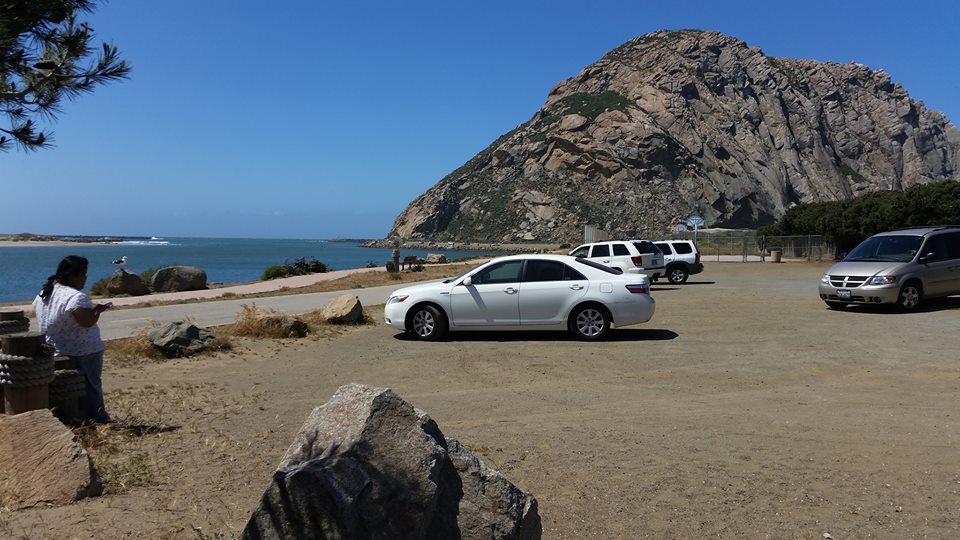 Looking roughly westward, the foreground has the back of the FANHS historic landmark, with Morro Rock in the background. Located in Coleman Park, on the north part of Morro Bay. After departing Morro Bay, the Nuestra Señora de Buena Esperanza sailed southward. It was a few days behind the Santa Ana, which had sailed eastward at a lower latitude and was captured by privateer Thomas Cavendish, a fate which the Nuestra Señora de Buena Esperanza avoided.[16][21] Attempts to sail southward along the coastline were made difficult due to poor weather, including fog.[22] More than a month after departing Morro Bay, the Nuestra Señora de Buena Esperanza arrived at Acapulco.[3] Inland expeditions were prohibited by the Spanish authorities following the hostility encountered at Morro Bay.[22][23] After its initial voyage across the Pacific, the Nuestra Señora de Buena Esperanza continued to be utilized in the Manila galleon trade, but was lost off the coast of Negros Island in 1647.[24] The next documented landing of Filipinos in California was in November 1595, when the Manila galleon San Agustin was wrecked at Point Reyes, the first European ship to be wrecked on the California coast.[4][25] Unlike the interaction of the crew of the Nuestra Señora de Buena Esperanza with the local people, the encounter of the San Agustín with the Coast Miwok did not result in any deaths.[26] Following the wrecking of the San Agustin, which resulted in several deaths, the crew departed in a salvaged launch and reached Acapulco.[27] As late as the Portolà expedition in 1769–1770, the Chumash maintained a large population. However, by the 1910 United States census, fewer than one hundred remained.[28] One reason for the reduction of their population was the introduction of Old World diseases,[10] including pleuropneumonia and smallpox.[29] The discovery of "Puerto San Lucas" by the crew of the galleon was recorded in the log of the voyage. However, the discovery faded into obscurity, until 1929 when the log was translated into English, and published by the California Historical Society.[30] Before then it was believed that Unamuno had sailed into Monterey Bay;[16] another early 20th century source pointed towards Cape Mendocino or San Francisco Bay.[31] More recently, the precise location of where the landing occurred has been disputed, citing inaccurate navigation tools and presumptions in past writings of the event.[32] The 1587 event marks the first documented instance of Asians in what is now California,[33] or anywhere in what is now the United States,[3][34] North America,[35] the Americas.[36] The landing of the first Filipinos at Morro Bay, which occurred 33 years before the events at Plymouth Rock,[b] is often overlooked, even by Filipino Americans.[38] For instance, the Filipinos who landed in 1587 have been described as "invading troops", and more focus is placed on Filipino immigration to the United States during, and after, the American period.[39] Although the landing was an important milestone, it would not be until the latter half of the 18th century that Filipinos began to settle in what would become part of the continental United States.[40] Beginning in 1992, the Filipino American National Historical Society (FANHS) began efforts to commemorate the landing.[41] On 21 October 1995, with the mayor of Morro Bay in attendance, a monument was placed at Morro Bay to commemorate the events of 1587.[1][5] The monument was placed in Coleman Park.[42] By 2009, after follow-up efforts by FANHS, Filipino American History Month was recognized by California, as well as nationally by resolutions in state and national legislatures;[32][43] it occurs every October, in recognition of the landing at Morro Bay.[6] |
余波 大まかに西方向を望むと、手前にはFANHS歴史的建造物の背面が、背景にはモロロックが映っている。モロベイの北側、コールマン公園内に位置する。 モロ湾を出航後、ヌエストラ・セニョーラ・デ・ブエナ・エスペランサ号は南下した。同船はサンタ・アナ号より数日遅れており、サンタ・アナ号はより低緯度 で東進したため私掠船トーマス・キャベンディッシュに捕獲されたが、ヌエストラ・セニョーラ・デ・ブエナ・エスペランサ号はその運命を免れた。[16] [21] 沿岸を南下する航海は、霧を含む悪天候により困難を極めた。[22] モロ湾を出航してから一ヶ月以上を経て、ヌエストラ・セニョーラ・デ・ブエナ・エスペランサ号はアカプルコに到着した。[3] モロ湾での敵対的遭遇を受けて、スペイン当局は内陸への遠征を禁止した。[22][23] 太平洋初航海後、ヌエストラ・セニョーラ・デ・ブエナ・エスペランサ号はマニラ・ガレオン貿易に引き続き使用されたが、1647年にニグロ島沖で失われ た。[24] 次に記録に残るフィリピン人によるカリフォルニア上陸は1595年11月、マニラ・ガレオン船サン・アグスティン号がポイント・レイエスで難破した時であ る。これはカリフォルニア沿岸で難破した最初のヨーロッパ船であった。[4][25] ブエナ・エスペランサ号の乗組員と現地の人々との交流とは異なり、サン・アグスティン号と海岸ミウォク族との遭遇では死者は出なかった。[26] サン・アグスティン号の難破では数名の死者が出たが、乗組員は救出した小舟で脱出し、アカプルコに到達した。[27] 1769年から1770年にかけてのポルトラ遠征の時点でも、チュマシュ族は大きな人口を維持していた。しかし、1910年のアメリカ国勢調査では、 100人未満にまで減少していた。[28] 人口減少の一因は、旧世界の伝染病の導入であった[10]。これには胸膜肺炎や天然痘が含まれる[29]。 ガレオン船の乗組員による「プエルト・サン・ルカーチ」の発見は航海日誌に記録されていた。しかしこの発見は忘れ去られていたが、1929年に日誌が英語 に翻訳され、カリフォルニア歴史協会によって出版されたことで再注目された。それ以前は、ウナムーノがモントレー湾に進入したと考えられていた[16]。 また20世紀初頭の別の資料では、メンドシーノ岬やサンフランシスコ湾を指し示していた[31]。近年では、当時の航海用具の不正確さや過去の記述におけ る推測を根拠に、上陸地点の正確な位置について議論が起きている[32]。 1587年の出来事は、現在カリフォルニアと呼ばれる地域[33]、あるいは現在のアメリカ合衆国全域[3][34]、北アメリカ[35]、アメリカ大陸 [36]におけるアジア人の最初の記録された事例である。プリマスロックでの出来事より33年も前に起きた、モロ湾への最初のフィリピン人上陸は、フィリ ピン系アメリカ人ですら見過ごされがちだ。[38] 例えば、1587年に上陸したフィリピン人は「侵略軍」と表現されることがあり、アメリカ植民地時代およびその後のフィリピン人移民に焦点が当てられる傾 向がある。[39] この上陸は重要な節目であったが、フィリピン人が後にアメリカ本土の一部となる地域に定住し始めたのは18世紀後半になってからである。[40] 1992年から、フィリピン系アメリカ人国家歴史協会(FANHS)は上陸を記念する取り組みを開始した。[41] 1995年10月21日、モロベイ市長の立会いのもと、1587年の出来事を記念する記念碑がモロベイに設置された。[1][5] 記念碑はコールマン公園に設置された。[42] 2009年までに、FANHSの継続的な取り組みの結果、フィリピン系アメリカ人歴史月間はカリフォルニア州で認定され、さらに州議会及び連邦議会決議に より全国的にも認められた。[32][43] これはモロベイ上陸を記念し、毎年10月に実施される。[6] |
| History of Asian Americans History of California History of Filipino Americans |
アジア系アメリカ人の歴史 カリフォルニアの歴史 フィリピン系アメリカ人の歴史 |
| a. Spanish referred to Filipinos during the 16th century as "Indios Luzones".[5][13] b. Plymouth Rock is seen as one of the symbols of the founding of the United States.[37] |
a. スペイン人は16世紀、フィリピン人を「ルソン島のインディオ」と呼んだ。[5][13] b. プリマスロックはアメリカ合衆国建国の象徴の一つと見なされている。[37] |
| References |
|
| Further reading Borah, Eloisa Gomez (Winter 1995). "Filipinos in Unamuno's California Expedition of 1587". Amerasia Journal. 21 (3): 175–183. doi:10.17953/amer.21.3.q050756h25525n72. |
追加文献(さらに読む) ボラ、エロイサ・ゴメス(1995年冬)。「1587年ウナムノのカリフォルニア遠征におけるフィリピン人」。『アメラジア・ジャーナル』。21巻3号:175–183頁。doi:10.17953/amer.21.3.q050756h25525n72。 |
| https://en.wikipedia.org/wiki/First_landing_of_Filipinos_in_the_United_States |
リ ンク
文 献
そ の他の情報
CC
Copyleft,
CC, Mitzub'ixi Quq Chi'j, 1996-2099