赦し/許し
Forgiveness
皇
帝マルクス・アウレリウスは部族に対する勝利の後、敗北した者たちに慈悲を示した(ローマのカピトリーノ美術館所蔵)
☆心理学的意味での許し[Forgiveness]
とは、不当な扱いを受けたり、傷つけられたりした者が、加害者に対する感情や態度を意図的かつ自発的に変え、恨みや復讐心といった負の感情を含む、その行
為の影響を克服する過程である。[1]
理論家によって、許しが同時に否定的な感情を肯定的な態度(例えば加害者への寛容性の向上)に置き換えることを意味するかどうか[2][3][4]、ある
いは加害者との和解を必要とするかどうかについて見解が異なる。[5]
赦しは、異なる人々と文化によって様々な方法で解釈される。[6]
心理学的概念として、また美徳として、赦す義務と赦しの利益は、宗教思想、道徳哲学、社会科学、医学において探求されてきた。世界のほとんどの宗教は赦し
に関する教えを含み、それらの多くは様々な現代の赦しの伝統や実践の基盤を提供している。
心理学的レベルでは、許しは単純な容認(行為を有害と認めつつも「慈善」の名目で「許す」または見過ごすこと)、弁解や赦免(加害者の行為に対する責任を
単に免除すること)、忘却(被害を受けた記憶を消し去ろうとすること)とは異なる。一部の思想では、関係における自己の半分の自己変容に向けた個人的かつ
「自発的」な努力を伴う。これにより、平和が回復され、理想的には心理学者カール・ロジャースが「無条件の肯定的関心」と呼んだ状態が相手に対して回復さ
れるのである。[2][7]
多くの状況では、赦しは修復的司法を期待せずに与えられ、加害者側の反応が全くなくても与えられることがある(例えば、連絡が取れない人や死んだ人を赦す
場合など)。現実的には、被害者が赦せると思うためには、加害者が謝罪などの何らかの形で認める姿勢を示すか、あるいは明確に赦しを請う必要がある場合も
ある。[2]
| Forgiveness, in a
psychological sense, is the intentional and voluntary process by which
one who has felt wronged, harmed, or hurt changes their feelings and
attitude towards the offender, and overcomes the impact of the offense,
including negative emotions such as resentment or desire for
vengeance.[1] Theorists differ in the extent to which they believe
forgiveness also implies replacing the negative emotions with positive
attitudes (e.g., an increased ability to tolerate the
offender),[2][3][4] or requires reconciliation with the offender.[5] Forgiveness is interpreted in many ways by different people and cultures.[6] As a psychological concept and as a virtue, the obligation to forgive and the benefits of forgiveness have been explored in religious thought, moral philosophy, social sciences, and medicine. Most world religions include teachings on forgiveness, and many of these provide a foundation for various modern traditions and practices of forgiveness. On the psychological level, forgiveness is different from simple condoning (viewing action as harmful, but to be "forgiven" or overlooked for certain reasons of "charity"), excusing or pardoning (merely releasing the offender from responsibility for their actions), or forgetting (attempting to remove one's memory of an offense). In some schools of thought, it involves a personal and "voluntary" effort towards the self-transformation of one's half of a relationship, such that one is restored to peace and ideally to what psychologist Carl Rogers has referred to as "unconditional positive regard" towards the other.[2][7] In many contexts, forgiveness is granted without any expectation of restorative justice, and may be granted without any response on the part of the offender (for example, one may forgive a person who is incommunicado or dead). In practical terms, it may be necessary for the offender to offer some form of acknowledgment, such as an apology, or to explicitly ask for forgiveness, for the wronged person to believe themselves able to forgive.[2] |
心理学的意味での許し[Forgiveness]とは、不当な扱いを受けたり、傷つけられたりした
者が、加害者に対する感情や態度を意図的かつ自発的に変え、恨みや復讐心といった負の感情を含む、その行為の影響を克服する過程である。[1]
理論家によって、許しが同時に否定的な感情を肯定的な態度(例えば加害者への寛容性の向上)に置き換えることを意味するかどうか[2][3][4]、ある
いは加害者との和解を必要とするかどうかについて見解が異なる。[5] 赦しは、異なる人々と文化によって様々な方法で解釈される。[6] 心理学的概念として、また美徳として、赦す義務と赦しの利益は、宗教思想、道徳哲学、社会科学、医学において探求されてきた。世界のほとんどの宗教は赦し に関する教えを含み、それらの多くは様々な現代の赦しの伝統や実践の基盤を提供している。 心理学的レベルでは、許しは単純な容認(行為を有害と認めつつも「慈善」の名目で「許す」または見過ごすこと)、弁解や赦免(加害者の行為に対する責任を 単に免除すること)、忘却(被害を受けた記憶を消し去ろうとすること)とは異なる。一部の思想では、関係における自己の半分の自己変容に向けた個人的かつ 「自発的」な努力を伴う。これにより、平和が回復され、理想的には心理学者カール・ロジャースが「無条件の肯定的関心」と呼んだ状態が相手に対して回復さ れるのである。[2][7] 多くの状況では、赦しは修復的司法を期待せずに与えられ、加害者側の反応が全くなくても与えられることがある(例えば、連絡が取れない人や死んだ人を赦す 場合など)。現実的には、被害者が赦せると思うためには、加害者が謝罪などの何らかの形で認める姿勢を示すか、あるいは明確に赦しを請う必要がある場合も ある。[2] |
Nature of forgiveness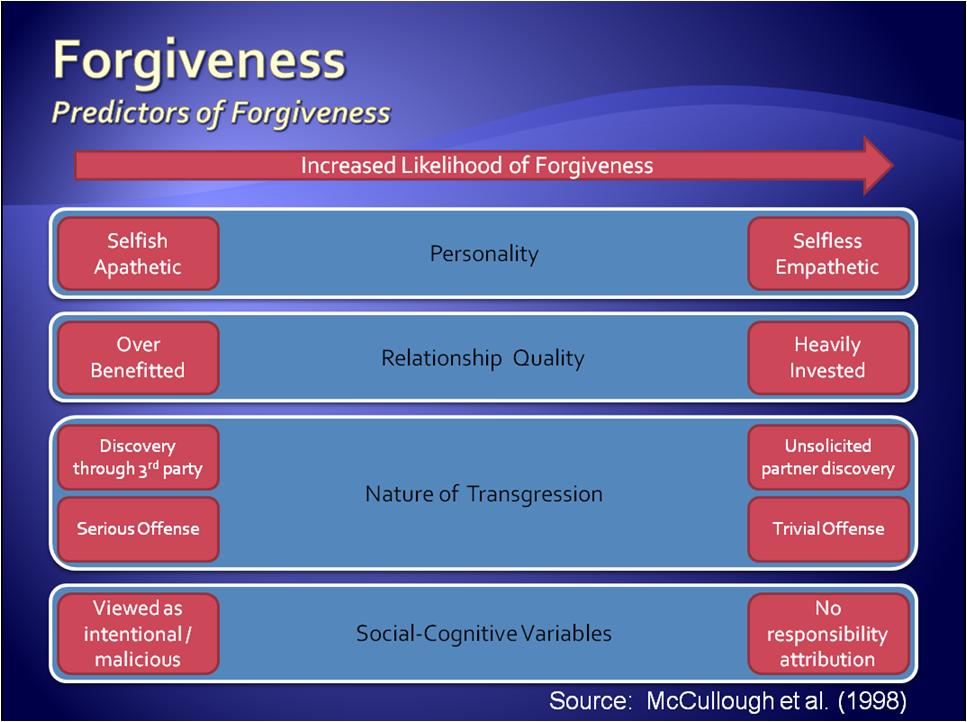 Factors determining the likelihood of forgiveness in an intimate relationship As of 2006, there is no consensus for a psychological definition of forgiveness in research literature. There is agreement that forgiveness is a process, and several models describing the process of forgiveness have been published, including one from a radical behavioral perspective.[8] Dr. Robert Enright from the University of Wisconsin–Madison founded the International Forgiveness Institute and initiated forgiveness studies. He developed a 20-Step Process Model of Forgiveness.[9] In that model, in order to forgive someone, the victim should examine the wrong they suffered, who caused it, and the context in which it happened; consider the anger they feel about it, any associated shame or guilt, and how it has affected them; decide whether they want to advance to an attitude of forgiveness, and, if so, work on understanding, compassion, and acceptance, and make a gesture of reconciliation to the offender; then, reformulate the way they remember the experience of being wronged and of developing forgiveness in order to healthily integrate this into their life story. A longitudinal study showed that people who were generally more neurotic, angry, and hostile in life were less likely to forgive another person. They were more likely to avoid their transgressor and want to enact revenge two and a half years after the transgression.[10] Studies show that people who forgive are happier and healthier than those who hold resentment.[11] The first study to look at how forgiveness improves physical health discovered that when people think about forgiving an offender, their cardiovascular and nervous system functioning improves.[12] Another study found that the more forgiving people were, the less they suffered from a wide range of illnesses. Less forgiving people reported a greater number of health problems.[13] Dr. Fred Luskin of Stanford University, author of Forgive for Good, presented evidence that forgiveness can be learned (i.e. is a teachable, practiceable skill) and has powerful, positive health effects. In three separate studies, including one with Catholics and Protestants from Northern Ireland whose family members were murdered during The Troubles, he found that people who are taught how to forgive become less angry, feel less hurt, are more optimistic, become more forgiving in a variety of situations, and become more compassionate and self-confident. His studies show a reduction in experience of stress, in physical manifestations of stress, and an increase in vitality.[14] In a study conducted in Rwanda to examine discourses and practices of forgiveness following the 1994 genocide, sociologist Benoit Guillou highlighted the extensive range of meanings associated with the term "forgiveness" and its underlying political nature. In the study's findings, Guillou presented four[specify] primary aspects of forgiveness to facilitate a clearer comprehension of both its applications and the circumstances in which forgiveness can contribute to the restoration of social connections.[15] |
許しの本質 親密な関係における許しの可能性を決定する要因 2006年現在、研究文献において許しに関する心理学的な定義について合意は存在しない。許しがプロセスであるという点では一致しており、そのプロセスを説明する複数のモデルが発表されている。その中には急進的な行動主義的視点に基づくものも含まれる。[8] ウィスコンシン大学マディソン校のロバート・エンライト博士は国際許し研究所を設立し、許し研究の先駆者となった。彼は20段階の許しプロセスモデルを開 発した。[9] このモデルでは、誰かを許すために被害者は以下のことを行うべきだとされる:苦悩した不当行為、その加害者、発生した状況を検証すること; それに対する怒りや関連する恥・罪悪感、そしてそれが自分に与えた影響を考察する。次に、許す姿勢へ進む意思があるか判断し、進む場合は理解・共感・受容 に努め、加害者への和解の意思表示を行う。その後、不当な扱いを受けた経験と許しを育んだ過程を再構築し、これを人生の物語に健全に統合するのだ。 縦断的研究によれば、日常生活で神経質・怒りっぽい・敵意が強い傾向にある人ほど、他者を許す可能性が低い。彼らは加害者を避け、加害行為から2年半後も復讐を望む傾向が強かった。[10] 研究によれば、許す人は恨みを抱く人より幸福で健康である。[11] 許しが身体の健康を改善するメカニズムを初めて検証した研究では、加害者を許そうと考えた時、心血管系と神経系の機能が向上することが判明した。[12] 別の研究では、許す度合いが高い人ほど、多様な疾患による苦悩の割合が低いことが確認された。許す度合いが低い人ほど、より多くの健康問題を報告した。 [13] スタンフォード大学のフレッド・ラスキン博士(著書『Forgive for Good』)は、許しは習得可能(つまり教えられる実践的スキル)であり、強力な健康効果をもたらすという証拠を示した。北アイルランドの「トラブル」期 間中に家族を殺害されたカトリック教徒とプロテスタントを対象とした研究を含む三つの別々の研究で、許し方を教わった人々は怒りが減り、傷つきが少なくな り、楽観的になり、様々な状況でより寛容になり、思いやりと自信が増すことが分かった。彼の研究は、ストレス体験の減少、ストレスの身体的症状の軽減、そ して活力の増加を示している。[14] 1994年のジェノサイド後のルワンダで、許しに関する言説と実践を調査した研究において、社会学者ブノワ・ギユーは「許し」という言葉に付随する広範な 意味合いとその根底にある政治的性質を強調した。研究結果の中でギユーは、許しの応用と、許しが社会的つながりの回復に寄与し得る状況の両方をより明確に 理解するために、許しの四つの主要な側面を提示した。[15] |
| deas about what forgiveness is not The neutrality of this section is disputed. Relevant discussion may be found on the talk page. Please do not remove this message until conditions to do so are met. (July 2023) (Learn how and when to remove this message) Forgiveness does not encompass condoning, forgetting, or excusing the transgressor's actions. Additionally, the victim does not have to minimize their feelings of having been wronged in order to forgive, nor do they have to reconcile with the transgressor.[2][14][16] The focus of forgiveness is not to deny or suppress anger; rather, its focus is on dealing with resentment.[17][18][14] In particular, it is healthy to acknowledge and express negative emotions before one forgives.[19] Forgiveness is also distinct from accountability or justice;[20] punishment and compensation are independent of the choice to forgive, and the victim can forgive or not forgive while still pursuing punishment and/or compensation.[21][22] While a victim may have granted decisional forgiveness (refraining from seeking revenge, possibly reconciling), they may not have emotionally forgiven the offender (replacing negative emotions towards them with positive ones) or expressed forgiveness to them. Additionally, expressing emotions may be distinct from genuinely experiencing the emotions (i.e. people can claim one emotional experience while actually feeling something else instead).[22][23] Although it is heavily debated,[4] emotional forgiveness is generally considered to be for the benefit of the victim and not the offender, unless the victim chooses to involve the offender by expressing forgiveness to them or reconciling. Forgiveness cannot be granted by an uninvolved party.[2][14] Timeliness Psychologist Wanda Malcolm, in Women's Reflections on the Complexities of Forgiveness, outlines reasons why forgiveness takes time: working on self-care and/or personal healing may take priority (i.e. therapy, medical injuries, etc.); issues of safety may need to be addressed; and facilitating forgiveness immediately after an interpersonal offense may be premature.[19] Malcolm explains, "premature efforts to facilitate forgiveness may be a sign of our reluctance to witness our client's pain and suffering and may unwittingly reinforce the client's belief that the pain and suffering is too much to bear and must be suppressed or avoided."[19] Worthington et al. observed that "anything done to promote forgiveness has little impact unless substantial time is spent at helping participants think through and emotionally experience their forgiveness".[24][25] |
赦しとは何かについての誤解 この節の中立性は議論の余地がある。関連する議論はトークページで行われている。条件が満たされるまでこのメッセージを削除してはならない。(2023年7月) (このメッセージの削除方法と時期について) 許しは、加害者の行為を容認したり、忘れたり、言い訳したりすることを意味しない。さらに、被害者は許すために不当に扱われたという感情を軽視する必要も なければ、加害者と和解する必要もない。[2][14][16] 許しの焦点は怒りを否定したり抑圧したりすることではなく、むしろ恨みに対処することにある。[17][18] [14] 特に、許す前に否定的な感情を認め表現することは健全である。[19] 許しは責任追及や正義とも異なる。[20] 罰や補償は許す選択とは独立しており、被害者は罰や補償を求めつつも許すか許さないかの選択ができる。[21][22] 被害者が意思決定的な赦し(復讐を求めず、場合によっては和解する)を与えたとしても、加害者に対する感情的な赦し(彼らへの否定的な感情を肯定的な感情 に置き換える)や、加害者への赦しの表明は行っていない可能性がある。さらに、感情を表明することは、その感情を真に経験することとは異なる場合がある (つまり、人はある感情を経験していると主張しながら、実際には別の感情を感じていることがある)。[22][23] 激しい議論があるものの[4]、感情的な許しは一般的に加害者ではなく被害者の利益のためと考えられている。ただし被害者が加害者に許しを表明したり和解 したりして加害者を関与させる選択をした場合は別だ。無関係な第三者が許しを与えることはできない[2]。[14] タイミング 心理学者ワンダ・マルコムは『許しの複雑性に関する女性の考察』で、許しに時間がかかる理由を次のようにまとめている:自己ケアや個人的な癒し(例:セラ ピー、身体的傷の治療など)が優先される場合がある;安全上の問題に対処する必要がある場合がある;対人関係における侵害の直後に許しを促すのは時期尚早 である場合がある。[19] マルコムは説明する。「早まった許しの促進は、クライアントの痛みや苦悩を直視するのをためらう表れであり、その痛みや苦悩が耐え難く、抑圧または回避す べきだというクライアントの信念を無意識に強化する可能性がある」[19] ワージントンらは「許しを促進するあらゆる行為は、参加者が許しについて考え抜き、感情的に体験する時間を十分に費やさなければ、ほとんど効果がない」と観察している。[24][25] |
| In philosophical thought The philosopher Joseph Butler (Fifteen Sermons) defined forgiveness as "overcoming of resentment, the overcoming of moral hatred, as a speech act, and as forbearance".[26] In his 1962 lecture on "Freedom and Resentment"', philosopher P. F. Strawson described forgiveness as "a rather unfashionable subject in moral philosophy" at that time.[27] |
哲学的思考において 哲学者ジョセフ・バトラー(『十五の説教』)は、赦しを「恨みの克服、道徳的憎悪の克服、言語行為としての、そして寛容としてのもの」と定義した。 [26] 1962年の「自由と恨み」に関する講演で、哲学者P・F・ストローソンは、当時の赦しを「道徳哲学においてやや時代遅れな主題」と述べた。[27] |
| Religious views Further information: Salvation and Sin Religion can affect how someone forgives. For example, one may work towards forgiveness through religious activity, religious affiliation and teachings, and imitation.[28] Abrahamic Judaism See also: Repentance in Judaism In Judaism, if a person causes harm, but then sincerely and honestly apologizes to the wronged individual and tries to rectify the wrong, the wronged individual is encouraged, but not required, to grant forgiveness: It is forbidden to be obdurate and not allow yourself to be appeased. On the contrary, one should be easily pacified and find it difficult to become angry. When asked by an offender for forgiveness, one should forgive with a sincere mind and a willing spirit ... forgiveness is natural to the seed of Israel. — Mishneh Torah, Teshuvah 2:10 In Judaism, one must go "to those he has harmed" to be entitled to forgiveness.[29] One who sincerely apologizes three times for a wrong committed against another has fulfilled their obligation to seek forgiveness.[30] This means that in Judaism a person cannot obtain forgiveness from God for wrongs they have done to other people. This also means that, unless the victim forgave the perpetrator before he died, murder is unforgivable in Judaism, and murderers will answer to God for it, though the victims' family and friends can forgive the murderer for their grief. The Tefila Zaka meditation, which is recited just before Yom Kippur, closes with the following: I know that there is no one so righteous that they have not wronged another, financially or physically, through deed or speech. This pains my heart within me, because wrongs between humans and their fellow are not atoned by Yom Kippur, until the wronged one is appeased. Because of this, my heart breaks within me, and my bones tremble; for even the day of death does not atone for such sins. Therefore I prostrate and beg before You, to have mercy on me, and grant me grace, compassion, and mercy in Your eyes and in the eyes of all people. For behold, I forgive with a final and resolved forgiveness anyone who has wronged me, whether in person or property, even if they slandered me, or spread falsehoods against me. So I release anyone who has injured me either in person or in property, or has committed any manner of sin that one may commit against another [except for legally enforceable business obligations, and except for someone who has deliberately harmed me with the thought 'I can harm him because he will forgive me']. Except for these two, I fully and finally forgive everyone; may no one be punished because of me. And just as I forgive everyone, so may You grant me grace in the eyes of others, that they too forgive me absolutely. Thus, the "reward" for forgiving others is not God's forgiveness for wrongs done to others, but rather help in obtaining forgiveness from the other person. Sir Jonathan Sacks, chief rabbi of the United Hebrew Congregations of the Commonwealth, summarized: "It is not that God forgives, while human beings do not. To the contrary, we believe that just as only God can forgive sins against God, so only human beings can forgive sins against human beings."[31] Jews observe a Day of Atonement, Yom Kippur, on the day before God decides what will happen during the coming year.[29] Just prior to Yom Kippur, Jews ask forgiveness of those they have wronged during the prior year (if they have not already done so).[29] During Yom Kippur itself, Jews fast and pray for God's forgiveness for their transgressions against God in the prior year.[29] Sincere repentance is required, and since God can only forgive one for the sins one has committed against God, it is necessary for Jews to also seek the forgiveness of those people who they have wronged.[29] Christianity 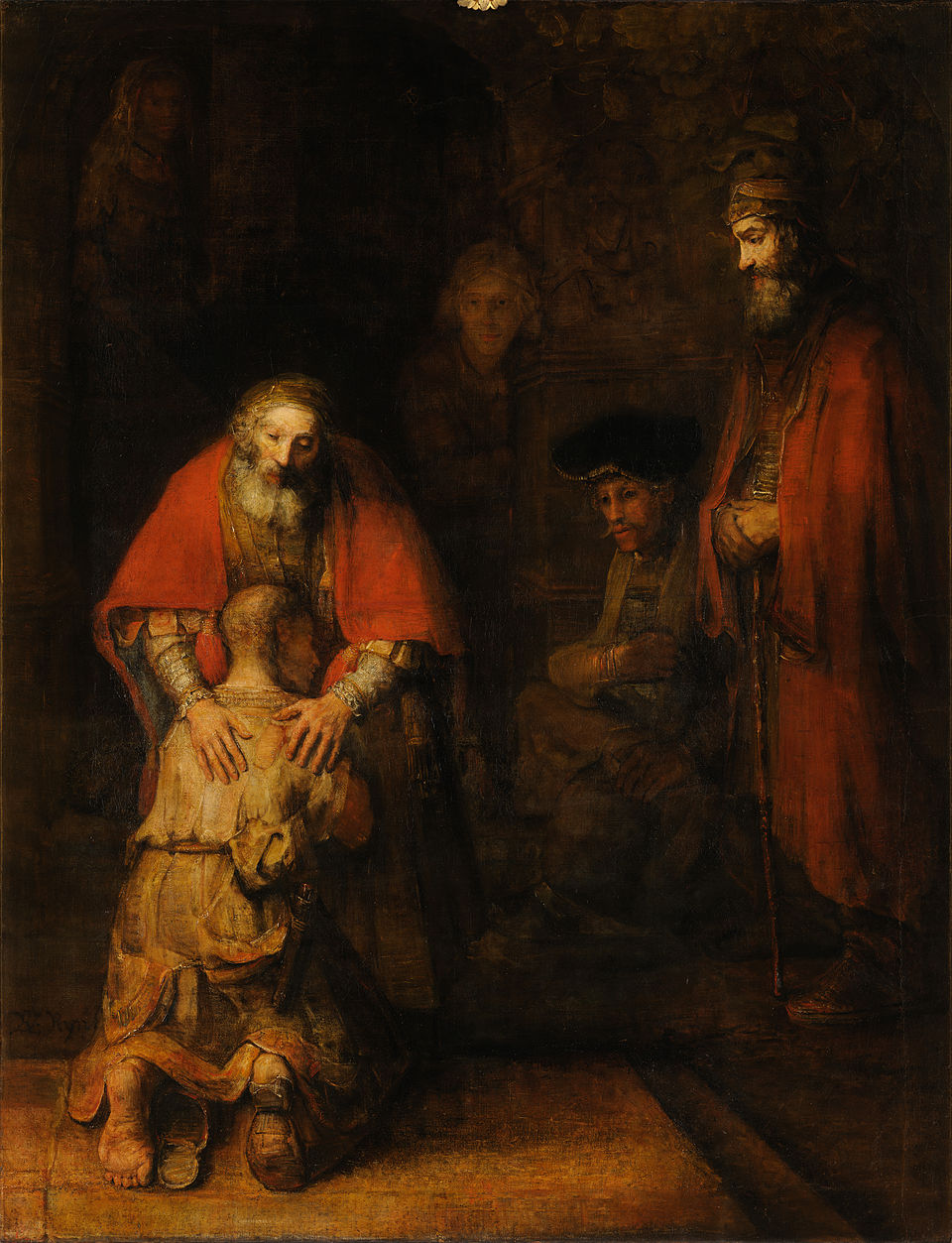 Rembrandt – "The Return of the Prodigal Son" Forgiveness is central to Christian ethics. Unlike in Judaism, in Christianity God can forgive sins committed by people against people, since he can forgive every sin except for the eternal sin, and forgiveness from one's victim is not necessary for salvation.[32] The Parable of the Prodigal Son[33] is perhaps the best known[citation needed] parable about forgiveness and demonstrates God's forgiveness of those who repent. Hannah Arendt stated that Jesus was "the discoverer of the role of forgiveness in the realm of human affairs."[34] Forgiving offenses is a spiritual work of mercy.[35] The Catholic Church believes in God's grace of forgiveness of sin[36] and in the necessity of repentance in order to receive said forgiveness.[37] According to Catholicism, God commands people to pray for forgiveness ("And forgive us our trespasses") because he wants to forgive sin and rejoice over people,[38][39] as well as for the same reason he grants the graces of contrition and prayer.[40] When God forgives a sin, despite his omniscience, he forgets the sin, and at the particular and general judgments, only unforgiven sins will be judged.[41] Those who refuse said forgiveness at the moment of death commit the eternal sin of final impenitence.[42][43] In Catholicism, there are sacramental and non-sacramental ways to obtain God's forgiveness of sin. Sacramental ways include baptism (which forgives original sin, all venial and mortal sin, and all temporary and eternal punishment), confession (which forgives all venial and mortal sin and all eternal punishment), the Eucharist (which forgives all venial sin), and the anointing of the sick (which forgives all venial and mortal sin and all eternal punishment).[44][45][46] Non-sacramental ways include the works of mercy and perfect contrition.[47][48] Works of mercy can also be offered up for the partial forgiveness of the dead in Purgatory,[49] and partial and plenary indulgences can respectively obtain partial and full (plenary) forgiveness of temporary punishment - either for the person who obtains it or for the dead in Purgatory.[50] The Apostolic Pardon is a plenary indulgence that Catholics, dying in sanctifying grace, can obtain for themselves.[51][52] Divine forgiveness is considered infinitely greater than human forgiveness because it can grant preservative redemption (i.e. the Immaculate Conception of Mary[53] and the fruit of Holy Communion[54]) and purge sin via deification.[55] Pope Benedict XVI, on a visit to Lebanon in 2012, insisted that peace must be based on mutual forgiveness: "Only forgiveness, given and received, can lay lasting foundations for reconciliation and universal peace".[56] During a General Audience in 2019, Pope Francis encouraged forgiving others as God forgives oneself: "We are forgiven as we forgive others."[57] |
宗教的見解 詳細情報:救済と罪 宗教は人の許し方にも影響する。例えば、宗教的活動や所属、教え、模倣を通じて許しを目指すこともある。[28] アブラハムの宗教 ユダヤ教 関連項目:ユダヤ教における悔い改め ユダヤ教では、もし人が害を与えた後、誠実かつ正直に被害者に謝罪し、過ちを正そうとするならば、被害者は許すことが推奨されるが、義務ではない。 頑固で和解を拒むことは禁じられている。むしろ、人は容易に和解し、怒りに駆られにくい性質を持つべきだ。加害者から赦しを求められた場合、誠実な心と進んでの精神で赦すべきである…赦しはイスラエルの子孫にとって自然なものである。 ―ミシュナー・トーラー、テシュバー 2:10 ユダヤ教では、赦しを得るためには「自分が害を与えた者」のもとへ赴かねばならない[29]。他者に対して犯した過ちについて三度誠実に謝罪した者は、赦 しを求める義務を果たしたことになる。[30] これはユダヤ教において、人が他者に対して犯した過ちについて神からの赦しを得られないことを意味する。また、被害者が加害者の死前に赦さなければ、殺人 はユダヤ教において赦されず、殺人者は神にその罪を問われるが、被害者の家族や友人は自らの悲しみから殺人者を赦すことはできる。ヨム・キップルの直前に 唱えられる瞑想文「テフィラ・ザカ」は次のように締めくくられる: 私は知っている。金銭的にも身体的にも、言葉でも行動でも、他人を傷つけたことがないほど正しい者はいないと。このことが私の心を痛ませる。なぜなら人間 同士の過ちは、被害者が和解するまで贖罪の日(ヨム・キプル)によって償われないからだ。このため私の心は砕け、骨は震える。死の日でさえ、そのような罪 を償うことはできないのだから。ゆえに私はあなたの御前にひれ伏し、懇願する。私を憐れみ、あなたの御目と全ての人の御目にあって、恵みと慈しみと憐れみ をお与えください。見よ、私は私を傷つけた者、たとえその者が私を中傷し、偽りを広めた者であっても、その者が私を傷つけたのが人格であろうと財産であろ うと、最終的かつ断固として赦す。だから私は、身体や財産を傷つけた者、あるいは他者に対して犯しうるあらゆる罪を犯した者を解放する[ただし、法的に強 制可能な商取引上の義務、および「彼は許すだろうから害しても構わない」という意図で故意に私を傷つけた者を除く]。この二者を除き、私は完全に、そして 最終的に全ての人を赦す。私のために誰一人罰せられることのないように。そして私が全ての人を赦すように、あなたも私に恵みを与え、他の人々の目にも私を 完全に赦す者とならせてください。 つまり、他者を赦すことの「報い」とは、他者への過ちに対する神の赦しではなく、むしろ相手から赦しを得るための助けなのである。 英連邦ユダヤ教連合の首席ラビ、サー・ジョナサン・サックスはこう要約した。「神だけが赦し、人間は赦さないというわけではない。むしろ我々は、神に対する罪を赦せるのは神のみであるのと同様に、人間に対する罪を赦せるのは人間のみであると信じるのだ」[31] ユダヤ教徒は、神が翌年の運命を決定する前日に「贖罪の日(ヨム・キップル)」を祝う[29]。ヨム・キップルの直前、ユダヤ教徒は前年に傷つけた者たち (まだ謝罪していない場合)に許しを請う[29]。ヨム・キップル当日、ユダヤ教徒は断食し、前年に神に対して犯した過ちに対する神の赦しを祈る。 [29] 真心の悔い改めが求められ、神は神に対する罪のみを赦すため、ユダヤ人は傷つけた人々からの赦しも求める必要がある。[29] キリスト教 レンブラント – 「放蕩息子の帰還」 赦しはキリスト教倫理の中核をなす。ユダヤ教と異なり、キリスト教では神は人々が人に対して犯した罪をも赦し得る。なぜなら神は永遠の罪を除くあらゆる罪 を赦し得るからであり、救いを得るために被害者からの赦しは必要とされない。[32] 放蕩息子のたとえ話[33]は、おそらく最もよく知られた[出典必要]赦しに関するたとえ話であり、悔い改める者に対する神の赦しを示している。ハンナ・ アーレントは、イエスは「人間社会における赦しの役割を発見した者」だと述べている[34]。 過ちを赦すことは、霊的な慈悲の業である[35]。カトリック教会は、罪の赦しという神の恵み[36]と、その赦しを受けるための悔い改めの必要性を信じ る[37]。カトリック教義によれば、神は人々に赦しを祈るよう命じる(「我らの罪を赦し給え」)のは、神が罪を赦し、人々を喜ばせたいからであり [38][39]、悔い改めと祈りの恵みを与えるのも同じ理由による。[40] 神は全知であるにもかかわらず、罪を赦す際にはその罪を忘れる。そして個別審判と総審判において裁かれるのは、赦されなかった罪のみである。[41] 死の瞬間にこの赦しを拒む者は、永遠の罪である「終末的不悔悛」を犯すことになる。[42][43] カトリック教義では、神の罪の赦しを得る手段として、秘跡による方法と秘跡によらない方法がある。秘跡による方法には、洗礼(原罪、全ての軽罪・重罪、一 時的・永遠の罰を赦す)、告解(全ての軽罪・重罪と永遠の罰を赦す)、聖体拝領(全ての軽罪を赦す)、病者の塗油(全ての軽罪・重罪と永遠の罰を赦す)が 含まれる。[44] [45][46] 非秘跡的な方法には、慈悲の業と完全な悔い改めが含まれる。[47][48] 慈悲の業は煉獄の死者のための部分的な赦しにも捧げられる。[49] また、部分的免罪と完全免罪は、それぞれ部分的または完全(完全免罪)な一時的罰の赦しを得る。これは免罪を得る者自身のため、あるいは煉獄の死者のため に行われる。[50] 使徒的赦免は、聖化の恵みの中で死を迎えるカトリック信者が自ら獲得できる全免償である。[51][52] 神の赦しは人間の赦しよりも無限に偉大と見なされる。なぜならそれは、保存的贖罪(すなわちマリアの無原罪の御宿り[53]や聖体拝領の果実[54])を 授け、神化によって罪を清めることができるからである。[55] 教皇ベネディクト16世は2012年のレバノン訪問時、平和は相互の赦しに基づくべきだと主張した。「与えられ、受け取られる赦しこそが、和解と普遍的平 和の永続的な基盤を築くのである」[56]。2019年の一般謁見で教皇フランシスコは、神が己を赦すように他者を赦すよう促した。「我々は他者を赦すこ とで赦されるのだ」[57]。 |
| Islam See also: Al-Ghafūr Islam teaches that Allah is Al-Ghaffur "The Oft-Forgiving", and is the original source of all forgiveness (ghufran غفران). Seeking forgiveness from Allah with repentance is a virtue.[58][59] (...) Allah has forgiven what has been done. But those who persist will be punished by Allah. And Allah is Almighty, capable of punishment. — Surah Al-Ma'idah 5:95 Islam recommends forgiveness because Allah values forgiveness. There are numerous verses in the Quran and the Hadiths recommending forgiveness. Islam also allows revenge to the extent of the harm done, but forgiveness is encouraged, with a promise of reward from Allah.[60] The reward of an evil deed is its equivalent. But whoever pardons and seeks reconciliation, then their reward is with Allah. He certainly does not like the wrongdoers. — Surah Ash-Shura 42:40 Afw (عفو is another term for forgiveness in Islam; it occurs 35 times in the Quran, and in some Islamic theological studies, it is used interchangeably with ghufran.[58][59][61] Afw means to pardon or excuse for a fault or an offense. According to Muhammad Amanullah,[62] forgiveness ('Afw) in Islam is derived from three wisdoms. The first and most important wisdom of forgiveness is that it is merciful when the victim or guardian of the victim accepts money instead of revenge.[63] The second wisdom of forgiveness is that it increases the honor and prestige of the one who forgives.[62] Forgiveness is not a sign of weakness, humiliation or dishonor.[59] Rather, forgiveness is honorable, it raises the merit of the forgiver in the eyes of Allah, and it enables a forgiver to enter paradise.[62] The third wisdom of forgiveness is that, according to scholars such as al-Tabari and al-Qurtubi, forgiveness expiates (kaffarah) the forgiver from the sins they may have committed at other occasions in life.[59][64] Forgiveness is a form of charity (sadaqat). Forgiveness comes from taqwa (piety), a quality of God-fearing people.[62] Forgiveness is also described in the form of safh (Arabic: صفح). The term can be translated as turning a page or turning the other cheek. It appears several times alongside the terms 'Afw and ghufran. "But if you pardon, overlook, and forgive ˹their faults˺, then Allah is truly All-Forgiving, Most Merciful." — - Surah At-Taghabun 64:14 |
イスラム 参照:アル=ガフル イスラム教は、アッラーがアル=ガッフルール「寛容なる御方」であり、全ての赦し(グフラン غفران)の源であると教える。悔い改めをもってアッラーの赦しを求めることは美徳である。[58][59] (…)アッラーは既に犯された罪を赦された。しかし、罪を続ける者はアッラーによって罰せられる。アッラーは全能にして、罰する力を持つ。 — スーラ・アル=マーイダ 5:95 イスラム教が赦しを推奨するのは、アッラーが赦しを重んじるからだ。クルアーンとハディースには赦しを勧める節が数多く存在する。イスラム教は加害行為と同等の復讐も認めるが、アッラーからの報いを約束しつつ赦しを奨励する。[60] 悪行の報いはそれに見合うものだ。しかし赦し求め和解を図る者の報いはアッラーにある。アッラーは確かに悪を行う者を好まれない。 —スール・アシュ・シュラー 42:40 アフワ(عفو)はイスラムにおける赦しの別称である。クルアーンに35回登場し、一部のイスラム神学研究ではグフランと互換的に用いられる[58] [59][61]。アフワとは過失や罪を赦す、あるいは免除することを意味する。ムハンマド・アマンッラーによれば[62]、イスラムにおける赦し ('Afw)は三つの知恵に由来する。第一かつ最も重要な知恵は、被害者またはその保護者が復讐の代わりに金銭を受け入れる時、それが慈悲深さであるとい うことだ[63]。第二の知恵は、赦す者の名誉と威信を高めることである[62]。赦しは弱さや屈辱、不名誉の印ではない。むしろ赦しは名誉ある行為であ り、アッラーの御前で赦す者の功徳を高め、楽園への道を開くのである[62]。第三の知恵は、タバリやクルトゥビら学者によれば、赦しは赦す者が人生の他 の場面で犯した罪を贖う(カッファラ)ことにある[59][64]。赦しは慈善(サダカ)の一形態である。赦しは敬虔(タクワー)から生じる。敬虔とは神 を畏れる者の資質である。[62] 赦しはサフ(アラビア語: صفح)という形で表現されることもある。この用語は「ページをめくる」あるいは「もう一方の頬を差し出す」と訳し得る。アフルやグフランという用語と共に幾度か登場する。 「しかしもしあなたがたが赦し、見過ごし、彼らの過ちを許すならば、アッラーはまことに寛容にして慈悲深き方である。」 — - タッガブーン章 64:14 |
| Bahá'í Faith In the Bahá'í Writings, this explanation is given of how to be forgiving toward others: Love the creatures for the sake of God and not for themselves. You will never become angry or impatient if you love them for the sake of God. Humanity is not perfect. There are imperfections in every human being, and you will always become unhappy if you look toward the people themselves. But if you look toward God, you will love them and be kind to them, for the world of God is the world of perfection and complete mercy. Therefore, do not look at the shortcomings of anybody; see with the sight of forgiveness. — `Abdu'l-Bahá, The Promulgation of Universal Peace, p. 92 Dharmic Buddhism In Buddhism, forgiveness prevents harmful thoughts from disturbing one's mental well-being.[65] Buddhism recognizes that feelings of hatred and ill-will leave a lasting effect on our mind-karma. Buddhism encourages the cultivation of thoughts with more wholesome effects. "In contemplating the law of karma, we realize that it is not a matter of seeking revenge but of practicing mettā and forgiveness, for the victimizer is, truly, the most unfortunate of all."[66] When resentments have already arisen, the Buddhist view is to calmly release them by going back to their roots[further explanation needed]. Buddhism questions the reality of the passions that make forgiveness necessary as well as the reality of the objects of those passions.[67] "If we haven't forgiven, we keep creating an identity around our pain, and that is what is reborn. That is what suffers."[68] Buddhism places much emphasis on the concepts of mettā (loving-kindness), karuna (compassion), mudita (sympathetic joy), and upekkhā (equanimity), as a means to avoiding resentments in the first place. These reflections are used to understand the context of suffering in the world, both our own and the suffering of others. "He abused me, he struck me, he overcame me, he robbed me" — in those who harbor such thoughts hatred will never cease. "He abused me, he struck me, he overcame me, he robbed me" — in those who do not harbor such thoughts hatred will cease." — Dhammapada 1.3–4 (trans. Radhakrishnan)[69] Dharma Main article: Kshama  Holi is the Hindu festival of colors, celebrated in spring. Traditionally, this is also a day to mark forgiveness, meet others, and repair relationships.[70] In Indonesia, among Balinese Hindus, Ngembak Geni — the day after Nyepi – is the ritual festive day in spring to meet, and both seek forgiveness and forgive each other.[71] In Vedic literature and epics of Hinduism, forgiveness is named ksama or kshyama (Sanskrit: क्षमा)[72] along with other compound words. The word ksama is often combined with kripa (tenderness), daya (kindness), and karuna (करुणा, compassion) in Sanskrit texts.[73] In the Rigveda, forgiveness is discussed in verses dedicated to the deity Varuna, both in the context of the one who has done wrong and the one who is wronged.[74] Forgiveness is considered one of the six cardinal virtues in Hindu Dharma. The theological basis for forgiveness in Hindu Dharma is that a person who does not forgive carries the weight of memories of the wrong, negative feelings, anger, and other unresolved emotions that affect their present and future. In Hindu Dharma, one should not only forgive others, but also seek forgiveness if one has wronged another person.[73] Forgiveness is to be sought from the individual wronged and society at large, by methods including charity, purification, fasting, rituals, and meditative introspection. Forgiveness is further refined in Hindu Dharma with feminine and masculine forms. The feminine form is demonstrated by Lakshmi (called Goddess Sri in some parts of India) and the masculine is demonstrated by her husband Vishnu.[73] Lakshmi forgives even when the wrongdoer does not repent, while Vishnu forgives only when the wrongdoer repents. In Hindu Dharma, Lakshmi's feminine forgiveness granted without repentance is higher and more noble than the masculine forgiveness granted only after repentance. In the Hindu epic Ramayana, Sita, the wife of King Rama, is symbolically eulogized for forgiving a crow even as it harms her, and is eulogized again later in the work for forgiving those who harass her while she has been kidnapped in Lanka.[73] Many other Hindu stories discuss forgiveness with or without repentance.[75] Forgiveness is the subject of extensive debates in Hindu literature. In some Hindu texts,[76] certain sins and intentional acts are argued to be naturally unforgivable (ex. murder and rape). These ancient scholars argue whether blanket forgiveness is morally justifiable, and whether forgiveness encourages crime, disrespect, social disorder, and people not taking others seriously.[77] Other ancient Hindu texts highlight that forgiveness is not the same as reconciliation. Forgiveness in Hindu Dharma does not necessarily require that one reconcile with the offender, though it does not rule out reconciliation. Instead, forgiveness in Hindu philosophy is being compassionate, tender, kind, and letting go of the harm caused by someone or something else.[78] Forgiveness is essential to free oneself from negative thoughts and to be able to focus on living a moral and ethical life (a dharmic life).[73] In the highest self-realized state, forgiveness becomes the essence of one's personality, and the persecuted person remains unaffected, does not feel like a victim, and lives free from anger (akrodhi).[79] Other epics and ancient literature of Hindu Dharma discuss forgiveness. For example: Forgiveness is virtue; forgiveness is sacrifice; forgiveness is the Vedas; forgiveness is the Shruti. Forgiveness protecteth the ascetic merit of the future; forgiveness is asceticism; forgiveness is holiness; and by forgiveness is it that the universe is held together. — Mahabharata, Book 3, Vana Parva, Section XXIX[80] Righteousness is the one highest good, forgiveness is the one supreme peace, knowledge is one supreme contentment, and benevolence, one sole happiness. — Mahabharata, Book 5, Udyoga Parva, Section XXXIII[81] Janak asked: "Oh lord, how does one attain wisdom? how does liberation happen?" Ashtavakra replied: "Oh beloved, if you want liberation, then renounce imagined passions as poison, take forgiveness, innocence, compassion, contentment and truth as nectar; (...)" — Ashtavakra Gita[82][83] Jainism See also: Micchami Dukkadam and Kshamavani In Jainism, forgiveness is one of the main virtues Jains should cultivate. Kṣamāpanā, or supreme forgiveness, forms part of one of the ten characteristics of dharma.[84] In the Jain prayer (pratikramana), Jains repeatedly seek forgiveness from various creatures—even from single-sensed beings (ekindriyas), like plants and microorganisms they may have harmed while eating and doing routine activities.[85] Forgiveness is asked by saying micchāmi dukkaḍaṃ—a Prakrit phrase literally meaning "may all the evil that has been done be fruitless."[86] During samvatsari—the last day of the Jain festival paryusana—Jains utter the phrase micchāmi dukkaḍaṃ after pratikraman. As a matter of ritual, Jains greet their friends and relatives with micchāmi dukkaḍaṃ. No private quarrel or dispute may be carried beyond samvatsari, and letters and telephone calls are made to faraway friends and relatives asking their forgiveness.[87] In their daily prayers and samayika, Jains recite Iryavahi sutra, seeking forgiveness from all creatures while involved in routine activities.[88] Jain texts quote Māhavīra on forgiveness:[89] By practicing prāyaṣcitta (repentance), a soul gets rid of sins, and commits no transgressions; he who correctly practices prāyaṣcitta gains the road and the reward of the road, he wins the reward of good conduct. By begging forgiveness he obtains happiness of mind; thereby he acquires a kind disposition towards all kinds of living beings; by this kind disposition he obtains purity of character and freedom from fear. — Māhavīra in Uttarādhyayana Sūtra 29:17–18 The code of conduct among monks requires them to ask forgiveness for all transgressions:[90] If among monks or nuns occurs a quarrel or dispute or dissension, the young monk should ask forgiveness of the superior, and the superior of the young monk. They should forgive and ask forgiveness, appease and be appeased, and converse without restraint. For him who is appeased, there will be success (in control); for him who is not appeased, there will be no success; therefore one should appease one's self. "Why has this been said, Sir? Peace is the essence of monasticism." — Kalpa Sūtra 8:59 Other Hoʻoponopono Hoʻoponopono is an ancient Hawaiian practice of reconciliation and forgiveness combined with prayer. Similar practices were performed on islands throughout the South Pacific, including Samoa, Tahiti, and New Zealand. Traditionally, Hoʻoponopono is practiced by healing priests or kahuna lapaʻau among family members of a person who is physically ill. Modern versions are performed within the family by a family elder or by the individual alone. |
バハイ教 バハイの書物には、他者に対して寛容である方法についてこう説明されている: 神のために生き物を愛せよ。彼らのためではない。神のために愛すれば、決して怒ったり苛立ったりすることはない。人間は完璧ではない。あらゆる人間には欠 点がある。人々そのものを見れば、常に不幸になるだろう。しかし神に目を向ければ、彼らを愛し親切にできる。神の世界は完全なる慈悲に満ちた世界だから だ。だから誰の欠点も見ず、寛容の眼差しで見よ。 —アブドゥル・バハ『普遍的平和の普及』92頁 ダルマ 仏教 仏教において、赦しは有害な思考が心の安寧を乱すのを防ぐ。[65] 仏教は憎しみや悪意の感情が心の業(カルマ)に永続的な影響を残すことを認める。仏教はより健全な効果をもたらす思考の育成を促す。「業の法則を考察する とき、復讐を求めることではなく、慈愛(メッタ)と赦しを実践することが重要だと気づく。なぜなら加害者こそが、真に最も不幸な存在だからだ。」 [66] 恨みが既に生じた場合、仏教の見解は、その根源に立ち返って冷静に手放すことにある[詳細説明が必要]。仏教は、許しを必要とする情念の現実性、そしてそ れらの情念の対象の現実性そのものを問う。[67]「許さなければ、痛みを中心にアイデンティティを作り続け、それが生まれ変わる。それが苦悩するのだ」 [68] 仏教は、そもそも怨恨を避ける手段として、慈(メッタ)、悲(カルナ)、喜(ムディタ)、捨(ウペッカ)の概念を強く重視する。これらの観念は、世界における苦悩の文脈、すなわち自らの苦悩と他者の苦悩の両方を理解するために用いられる。 「彼は私を罵った、殴った、打ち負かした、奪った」― こうした思いを抱く者には憎しみは決して消えない。「彼は私を罵った、殴った、打ち負かした、奪った」― こうした思いを抱かない者には憎しみは消える。 ― ダンマパダ 1.3–4(ラダクリシュナン訳)[69] ダルマ 主な記事:クシャマ ホーリーはヒンドゥー教の色の祭りで、春に祝われる。伝統的にこの日は許しを記し、他者と会い、関係を修復する日でもある。[70] インドネシアのバリ島ヒンドゥー教徒の間では、ニュピの翌日のンゲバク・ゲニが春の儀礼的な祝日で、互いに会い、許しを求め、許し合う日である。[71] ヴェーダ文献やヒンドゥー教の叙事詩では、赦しはクシャマ(サンスクリット語: क्षमा)[72]と呼ばれ、他の複合語と共に用いられる。サンスクリット文献では、クシャマはしばしばクリパ(慈愛)、ダーヤ(慈悲)、カルナ (करुणा、憐れみ)と組み合わされる[73]。リグ・ヴェーダでは、神ヴァルナに捧げられた詩句において、過ちを犯した者と被害を受けた者の双方の文 脈で許しが論じられている。[74] 許しはヒンドゥー教における六つの基本徳の一つとされる。 ヒンドゥー教における許しの神学的根拠は、許さない人格は過ちの記憶、否定的な感情、怒り、その他の未解決の感情の重荷を背負い、それが現在と未来に影響 を及ぼすというものである。ヒンドゥー教では、他者を許すだけでなく、自分が他者に過ちを犯した場合には自ら許しを請うべきとされる。[73] 許しは、慈善活動、浄化、断食、儀礼、瞑想による内省などの方法を通じて、被害を受けた個人や社会全体から求めるべきである。 ヒンドゥー教における許しは、さらに女性的形態と男性的形態によって洗練される。女性的な形態はラクシュミ(インドの一部地域では女神シュリーと呼ばれ る)によって示され、男性的な形態は彼女の夫ヴィシュヌによって示される[73]。ラクシュミは過ちを犯した者が悔い改めなくても許すが、ヴィシュヌは悔 い改めた場合にのみ許す。ヒンドゥー教において、悔い改めを条件としないラクシュミの女性的な許しは、悔い改めを条件とする男性的な許しよりも高尚で尊い ものとされる。ヒンドゥー教の叙事詩『ラーマーヤナ』では、ラーマ王の妻シーターが、自分を傷つけるカラスさえも許したことで象徴的に称賛され、後にラン カで誘拐された際に自分を苦しめた者たちを許したことで再び称賛される[73]。他の多くのヒンドゥー教の物語でも、悔い改めの有無を問わず許しについて 論じられている[75]。 許しはヒンドゥー教文献において広範な議論の対象となっている。一部のヒンドゥー教文献[76]では、特定の罪や故意の行為(例:殺人、強姦)は本質的に 許しがたいと論じられている。これらの古代の学者たちは、無条件の許しが道徳的に正当化されるかどうか、また許しが犯罪や不敬、社会秩序の乱れ、他者を真 剣に受け止めない態度を助長するかどうかについて議論している[77]。 他の古代ヒンドゥー教文献は、許しと和解は同一ではないことを強調している。ヒンドゥー教における赦しは、必ずしも加害者との和解を必要としない。とはい え和解を排除するわけでもない。むしろヒンドゥー哲学における赦しとは、慈悲深く、優しく、思いやりを持ち、他者や何らかの要因によって引き起こされた害 を手放すことである[78]。赦しは、否定的な思考から自らを解放し、道徳的・倫理的な生活(ダルマ的な生活)に集中するために不可欠である。[73] 最高の自己実現状態において、許しは人格の本質となり、迫害された者は影響を受けず、被害者意識を持たず、怒り(アクロディ)から解放された生活を送る。 [79] ヒンドゥー教の他の叙事詩や古代文献も許しについて論じている。例えば: 許しは徳である。許しは犠牲である。許しはヴェーダである。許しはシュルティである。 赦しは未来の修行の功徳を守り、赦しは修行であり、赦しは聖性である。そして赦しによって宇宙は保たれている。 — マハーバーラタ、第3巻、ヴァーナ・パルヴァ、第29章[80] 正義は唯一の至高の善であり、赦しは唯一の至高の平安であり、知識は唯一の至高の満足であり、慈愛は唯一の幸福である。 — マハーバーラタ、第5巻、ウディヤーガ・パルヴァ、第33章[81] ジャナクは尋ねた。「おお主よ、いかにして人は知恵を得るのか?いかにして解脱は起こるのか?」 アシュタヴァクラは答えた。「おお愛しき者よ、もし解脱を望むならば、想像上の情熱を毒として捨てよ。寛容、無垢、慈悲、満足、真実を甘露として受け入れよ; (...)」 — アシュタヴァクラ・ギーター[82][83] ジャイナ教 関連項目:ミッチャミ・ドゥッカダム、クシャマーヴァーニ ジャイナ教において、許しは信者が培うべき主要な徳の一つである。クシャマーパーナー(至高の許し)は、ダルマの十の特質の一つを成す。[84] ジャイナ教の祈り(プラティクラマナ)において、信者は様々な生き物から繰り返し赦しを求める。植物や微生物といった単感覚存在(エキンドリヤ)でさえ も、食事や日常活動で傷つけた可能性のある存在から赦しを請うのである[85]。赦しは「micchāmi dukkaḍaṃ」というプラークリット語の句で求められる。これは文字通り「なされた全ての悪が実を結ばんことを」という意味である。[86] ジャイナ教の祭典パリユサナ最終日であるサムヴァツァリの日には、プラティクラマナの後で「micchāmi dukkaḍaṃ」と唱える。儀礼として、ジャイナ教徒は親族や友人に「micchāmi dukkaḍaṃ」と挨拶する。私的な争いや論争はサムヴァツァリを越えて持ち越してはならず、遠く離れた親族や友人には手紙や電話で許しを請うのであ る。[87] 日常の祈りとサマイカにおいて、ジャイナ教徒は『イリヤヴァヒ経』を唱え、日常活動に関わる全ての生き物から許しを求める。[88] ジャイナ教の経典は、マハーヴィーラによる赦しについてこう記している:[89] 悔い改め(プラヤーシュチッタ)を実践することで、魂は罪から解放され、過ちを犯さなくなる。正しく悔い改めを実践する者は、道とその報いを得て、善行の 報いを得るのだ。赦しを乞うことで心の安らぎを得、それによりあらゆる生き物への慈愛の心を育む。この慈愛の心によって品性の清らかさと恐怖からの解放を 得るのである。 — 『ウッタラーディヤーヤナ経』29:17–18におけるマハーヴィーラの言葉 僧侶間の行動規範では、あらゆる過ちについて赦しを請うことが義務付けられている:[90] 僧侶や尼僧の間で争いや論争や不和が生じた場合、若い僧侶は年長者に許しを請い、年長者は若い僧侶に許しを請うべきである。彼らは許し合い、和解し、和ら げ、和らげられ、制約なく語り合うべきである。和らげられた者には(制御における)成功があり、和らげられなかった者には成功はない。ゆえに自らを和らげ るべきである。「なぜこのような教えがあるのか、尊師よ? 平和こそが僧侶の本質であるのに」 — カルパ経 8:59 その他 ホオポノポノ ホオポノポノは、祈りと結びついた和解と赦しの古代ハワイの慣習である。サモア、タヒチ、ニュージーランドを含む南太平洋の島々でも同様の慣習が行われて いた。伝統的にホオポノポノは、身体的に病む者の家族の中で、癒しの司祭(カフナ・ラパアウ)によって実践される。現代版は家族の長老によって、あるいは 個人単独で家族内で行われる。 |
| Popular recognition This section may be unbalanced towards certain viewpoints. Please help improve it by adding information on neglected viewpoints. Relevant discussion may be found on the talk page. (March 2025) The need to forgive is widely recognized, but people are often unsure how to accomplish it. For example, in a large representative sampling of American people on various religious topics in 1988, the Gallup Organization found that 94% said it was important to forgive, but 85% said they needed some outside help to be able to forgive. However, regular prayer was not found to be effective for this purpose. The Gallup poll revealed that the only effective mediator was engagement in "meditative prayer".[91] Forgiveness was a core mechanism of restorative justice programs[92] after the abolition of apartheid in the truth and reconciliation process, among victims and perpetrators of Rwandan genocide, in response to the violence in the Israeli–Palestinian conflict, and the Northern Ireland conflict. This was documented in the film Beyond Right and Wrong: Stories of Justice and Forgiveness (2012).[93] Forgiveness is associated with the theory of emotion because it draws from a person's emotional connection to a situation. Most people are taught to understand and practice forgiveness at a young age.[citation needed] |
一般的な認識 この節は特定の見解に偏っている可能性がある。軽視されている見解に関する情報を追加し、改善に協力してほしい。関連する議論はトークページで行われている。(2025年3月) 許す必要性は広く認識されているが、人々はしばしばその実現方法に確信が持てない。例えば、1988年に様々な宗教的テーマについてアメリカ人を対象に 行った大規模な代表的な調査で、ギャラップ社は94%が「許すことは重要だ」と答えた一方で、85%が「許すためには何らかの外部の助けが必要だ」と答え たことを明らかにした。しかし、定期的な祈りはこの目的には効果的ではないと判明した。ギャラップの世論調査は、唯一の効果的な媒介は「瞑想的な祈り」へ の取り組みであることを示した。[91] 赦しは、アパルトヘイト廃止後の真実和解プロセスにおける修復的司法プログラム[92]、ルワンダ虐殺の被害者と加害者間、イスラエル・パレスチナ紛争や 北アイルランド紛争への対応において中核的な仕組みとなった。これは映画『善悪を超えて:正義と赦しの物語』(2012年)で記録されている。[93] 許しは感情理論と関連している。なぜなら、それは状況に対する個人の個人的な感情的結びつきに根ざしているからだ。ほとんどの人は幼い頃から許しを理解し実践するよう教えられている。[出典が必要] |
| In relationships Forgiveness in marriage Forgiveness in marriage is important.[94] When two people can forgive each other, this contributes to a happy marriage. Forgiveness can help prevent problems from worsening and aid in conflict resolution.[95] Depending on the severity of the transgression, partners may engage in different communication behavior to seek or grant forgiveness.[96] In dating relationships (as opposed to marriages), couples are less likely to acknowledge transgressions in the relationship and more likely to forgive each other unconditionally, as well as being more understanding towards their partners.[96] When married couples argue, they tend to focus on who is right and who is wrong.[95] Merolla distinguished two types of forgiveness: conditional/indirect forgiveness and direct forgiveness.[97] Direct forgiveness involves discussion of the incident. The forgiving person must be straightforward and clear in telling the offender that they forgive them. Indirect forgiveness focuses on minimizing conflict. Forgivers do not explicitly tell the offender that they are forgiven, but it is meant to be tacitly understood. This could come from tactics such as humor, eye contact, hugging, or reverting to normal behavior. Therefore, indirect forgiveness is less appropriate following a severe incident and more appropriate for smaller transgressions like minor disagreements or fights.[98] There is also conditional forgiveness, in which the offender is forgiven with stipulations. The offender may make a deal to refrain from the behavior that might have led to the transgression, such as drinking alcohol.[citation needed] In a 2005 study, researchers investigated whether forgiveness is important in a marriage, particularly if it accrues before or after an argument as well as its role in broken promises. Researchers found six components that were related to forgiveness in marriage: satisfaction, ambivalence, conflict, attributions, empathy, and commitment.[95] Sheldon et al. conducted a study in which they surveyed both married and dating couples on past relational transgressions, the communication strategies used to grant forgiveness, the degree of forgiveness within a specific relationship, and the ratings of relationship satisfaction. The severity of the transgression was measured by three different factors and rated on a scale of severity. Five common strategies of forgiveness emerged and were rated on the frequency of their use. Forgiveness tendency (how likely couples were to forgive) was measured in five aspects and rated on how likely couples were to agree to forgive, and relationship satisfaction was measured using Hendrick's Relationship Assessment Scale. The study showed that in married partners, the tendency to forgive was positively related to the use of minimizing and nonverbal forgiveness strategies. When it came to the severity of the transgression, the likelihood of forgiveness was unrelated to use of any specific forgiveness strategy.[99] In dating relationships, the tendency to forgive was positively correlated with the use of nonverbal and explicit strategies, as was the transgression severity. Overall, this study showed that both married and dating couples who experienced similar amounts of transgressions did not differ largely in their satisfaction in the relationship after the forgiveness had occurred.[citation needed][clarification needed] People in a relationship often believe that forgiveness means both parties must forget what had happened. When couples forgive their spouses, they sometimes need help from professionals to overcome the lingering emotions. Researchers described differences between how each individual perceives the situation based on who is in pain and who caused the pain.[95][clarification needed] The acts and effects of forgiveness can vary depending on the relationship. Between people who are married, friends, or acquaintances, the process of forgiving is similar but not completely the same.[100] Enright's model of forgiveness Enright's model of forgiveness describes forgiveness as a journey through four phases:[95] Uncovering phase The person explores the pain that they have experienced. Decision phase The nature of forgiveness is discussed. The person commits to try to forgive the transgressor. Work phase The focus shifts to the transgressor to gain insight and understanding. Deepening phase The victim moves toward resolution, becoming aware that they are not alone, having received forgiveness form others, and finds meaning and purpose in the forgiveness process. The researchers also came up with recommendations for practitioners to help married individuals communicate with each other, resolve problems, and forgive each other more easily. People should explore and understand what forgiveness means, as preconceived ideas of forgiveness can make couples reluctant to forgive.[95] For example, a conflict may arise if a person does not forgive their spouse out of fear that the spouse might think that they are weak. |
人間関係において 結婚における許し 結婚における許しは重要だ。[94] 二人が互いに許し合える時、それは幸せな結婚につながる。許しは問題が悪化するのを防ぎ、対立解決を助ける。[95] 過ちの深刻さに応じて、パートナーは許しを求めたり与えたりする際に異なるコミュニケーション行動を取る。[96] 結婚関係とは対照的に、交際中のカップルは関係における過ちを認める傾向が低く、無条件に許し合う可能性が高く、またパートナーに対してより理解を示す傾 向がある。[96] 既婚カップルが口論する際、どちらが正しいか間違っているかに焦点を当てる傾向がある。[95] メロラは許しを二種類に分類した:条件付き/間接的な許しと直接的な許しである。[97] 直接の許しは、その出来事についての話し合いを伴う。許す側は、加害者に対して「許す」という意思を率直かつ明確に伝えなければならない。 間接的許しは、対立を最小限に抑えることに焦点を当てる。許す側は加害者に「許した」と明言しないが、暗黙のうちに理解されることを意図する。これはユー モア、アイコンタクト、抱擁、あるいは通常の行動に戻るといった手法から生じうる。したがって、間接的許しは深刻な出来事の後には不適切であり、些細な意 見の相違や喧嘩のような小さな過失に対してより適切である。[98] 条件付き許しも存在する。これは加害者に条件を付けて許すものだ。加害者は、過失を招いた可能性のある行動(例えば飲酒)を控えるという取り決めを交わすことがある。[出典が必要] 2005年の研究では、特に口論の前後で生じる許しや、約束違反における許しの役割について、婚姻関係における許しの重要性が調査された。研究者らは婚姻 における許しに関連する6つの要素を特定した:満足度、両価性、葛藤、帰属、共感、そしてコミットメントである。[95] シェルドンらは、既婚カップルと交際中のカップルを対象に、過去の関係における違反行為、許しを与えるために用いたコミュニケーション戦略、特定の関係に おける許しの程度、および関係満足度の評価について調査を行った。違反行為の深刻度は 3 つの異なる要因によって測定され、深刻度の尺度で評価された。許しに関する 5 つの一般的な戦略が明らかになり、それらの使用頻度に基づいて評価された。許す傾向(カップルが許す可能性)は 5 つの側面で測定され、カップルが許すことに同意する可能性について評価され、関係満足度はヘンドリックの関係評価尺度を用いて測定された。この研究は、既 婚パートナーでは、許す傾向は、最小化および非言語的な許しの戦略の使用と正の相関があることを示した。違反の深刻さに関しては、許す可能性は、特定の許 しの戦略の使用とは無関係であった。[99] 交際関係では、許す傾向は、違反の深刻度と同様に、非言語的および明示的な戦略の使用と正の相関があった。全体として、この研究は、同程度の違反を経験し た既婚カップルと交際カップルは、許した後、その関係に対する満足度に大きな違いは見られなかったことを示した。[要出典][説明が必要] 関係にある人々は、許すとは双方が起きたことを忘れなければならないと信じがちだ。配偶者を許す際、残る感情を克服するために専門家の助けが必要な場合も ある。研究者は、苦痛を受けている者と与えた者によって、個人が状況をどう認識するかに異なる点があると説明した。[95] [説明が必要] 許しの行為とその効果は、関係性によって異なる。夫婦間、友人同士、知人同士では、許すプロセスは似ているが完全に同一ではない。[100] エンライトの許しのモデル エンライトの許しのモデルは、許しを四つの段階を経る旅として説明する。[95] 発見段階 人は自分が経験した痛みを探求する。 |
| Interventions Psychology researchers agree that the purpose of forgiveness interventions is to decrease the overall negative effect associated with the initial perceived wrongdoing.[101][102] The incorporation of forgiveness into therapy has gained popularity.[101] The growth of forgiveness in psychology has given rise to the study of forgiveness interventions.[101] A meta-analysis of group-based forgiveness interventions examined how well they increase self-reported forgiveness (or decrease "unforgiveness"). It concluded that "The data appears to speak clearly: Forgiveness interventions are effective."[103] Types There are various forms of forgiveness interventions.[101] One forces patients to confront the thoughts that prevent their forgiveness with introspective techniques and expressing themselves to a therapist.[101][102] Another encourages the wronged person to see things from the offender's point of view and try to understand the offender's reasoning.[101][102] This may allow patients to more easily forgive offenders.[101][102] Researchers have studied forgiveness interventions in relationships and whether or not prayer increases forgiveness. One study found that praying for a friend or thinking positive thoughts about that person every day for four weeks increases the chances of forgiving that friend or partner, which leads to a better relationship.[104] Contrary evidence There is conflicting evidence on the effectiveness of forgiveness interventions. Some researchers have taken a critical approach to the forgiveness intervention approach to therapy.[101] Critics argue that forgiveness interventions may increase negative affect because they try to inhibit the person's feelings towards the offender. This can result in the person feeling negatively towards themselves. The approach implies that the negative emotions the person is feeling are unacceptable and feelings of forgiveness are correct and acceptable. This might inadvertently promote feelings of shame and contrition in the person wronged.[101] Psychologist Wanda Malcolm states "it is not a good idea to make forgiveness an a-priori goal of therapy".[19] Steven Stosny asserts that victims must heal first and then forgive,[18] and that fully acknowledging the grievance (both recognizing what actions were harmful and naming the emotions the victim felt as a response) is an essential first step before forgiveness can occur.[105] Some researchers worry that forgiveness interventions promote unhealthy relationships, and that individuals with toxic relationships will continue to forgive those who continuously wrong them, when in fact they should be distancing themselves from those people.[101][106] Several studies show high effectiveness rates of forgiveness interventions when done continuously over a long period. However, some researchers have found these interventions ineffective over short periods.[101] Children Some studies looked at the effectiveness of forgiveness interventions on young children, including several cross-cultural studies. One looked at forgiveness interventions and Chinese children, who were less likely to forgive those who had wronged them, finding an effect[specify] of such interventions on the children.[101] Older adults Older adults who receive forgiveness interventions report higher levels of forgiveness than those who did not receive treatment. Forgiveness treatments resulted in lower depression, stress, and anger than no-treatment conditions. Forgiveness interventions also enhanced positive psychological states, indicated by factors such as life satisfaction, subjective happiness, and psychological wellbeing. This was regardless of the specific intervention model or format (group or individual).[107] |
介入 心理学研究者らは、許しの介入の目的が、当初認識された不正行為に伴う全体的な負の影響を減少させることにあると一致して認めている。[101] [102] 許しを治療に取り入れる手法は広く普及している。[101] 心理学における許しの研究の進展は、許しの介入に関する研究を生み出した。[101] 集団ベースの許し介入に関するメタ分析は、自己申告による許しの増加(「許せない」感情の減少)効果を検証した。結論として「データは明確に示している:許し介入は有効である」と結論づけた。[103] 種類 許し介入には様々な形態がある。[101] 一つは内省技法を用い、患者に許しを妨げる思考と向き合わせ、セラピストへの自己表現を促すものだ。[101][102] もう一つは被害者に加害者の視点から物事を見させ、加害者の考え方を理解させようとする。[101][102] これにより患者は加害者をより容易に許せるようになる。[101] [102] 研究者らは人間関係における許し介入や、祈りが許しを促進するかどうかを調査している。ある研究では、友人やパートナーのために4週間毎日祈る、あるいは その人について前向きな考えを持つことで、相手を許す可能性が高まり、結果として関係が改善することが示された。[104] 相反する証拠 許し介入の効果については相反する証拠が存在する。一部の研究者は、治療における許し介入アプローチに対して批判的な立場を取っている。[101] 批判派は、許し介入が加害者への感情を抑圧しようとするため、むしろネガティブな感情を増幅させると主張する。これは被害者が自己に対して否定的な感情を 抱く結果を招きかねない。このアプローチは、被害者が感じるネガティブな感情は受け入れがたく、許しの感情こそが正しく許容されるべきだと暗に示唆する。 これは意図せず、被害者に恥や悔恨の感情を助長する可能性がある。[101] 心理学者ワンダ・マルコムは「許しをア・プリオリに治療の目標とすることは好ましくない」と述べている。[19] スティーブン・ストスニーは、被害者はまず癒やされ、その後で許すべきだと主張する。[18] また、許しが生まれる前に、被害を受けた事実を完全に認めること(どのような行為が有害だったかを認識し、それに対する被害者の感情を明確に名指すこと) が不可欠な第一歩だとする。[105] 一部の研究者は、許しを促す介入が不健全な人間関係を助長する恐れがあると懸念している。有害な関係にある個人が、実際には距離を置くべき相手に対して、繰り返し傷つけられるにもかかわらず許し続ける可能性があるというのである。[101][106] 複数の研究では、長期にわたり継続的に実施された許しの介入の高い有効性が示されている。しかし一部の研究者は、短期間ではこれらの介入が効果的でないことを発見している[101]。 子ども いくつかの研究は、幼い子どもに対する許しの介入の有効性を調査しており、複数の異文化間研究も含まれる。ある研究は中国の子どもを対象に許しの介入を検証し、彼らには加害者を許す傾向が低く、こうした介入が子どもに効果[明記]をもたらすことを発見した。[101] 高齢者 許し介入を受けた高齢者は、介入を受けなかった高齢者と比べて許しの度合いが高いと報告している。許し介入は、介入なしの条件と比べて抑うつ、ストレス、 怒りの低減をもたらした。また、生活満足度、主観的幸福感、心理的ウェルビーイングなどの要因によって示されるように、許し介入は肯定的な心理状態を高め た。これは、具体的な介入モデルや形式(集団または個人)に関係なく見られた。[107] |
| Mental health Survey data from 2000 showed that 61% of participants who were part of a small religious group reported that the group helped them be more forgiving. People who reported that their religious groups promoted forgiveness also found more success in overcoming addiction, guilt, and discouragement.[108] Mindfulness may play a mediator role in the relationship between forgiveness and health outcomes. The beneficial health effects of forgiveness are contingent upon the presence and practice of mindfulness.[109] Self-forgiveness is an important part of self-acceptance and mental health. Lack of self-forgiveness can negatively affect mental health. Among the elderly, self-forgiveness often involves introspection about past wrongdoings, aiming to prevent their recurrence. When people successfully learn from transgressions, their mental health may improve.[110] Self-forgiveness can reduce feelings of guilt and shame associated with hypersexual behavior, as well as help individuals reduce negative hypersexual behavior.[111] Self-forgiveness may be associated with procrastination. Self-forgiveness allows a person to overcome the negative effects linked to earlier behavior and adopt proactive approaches toward similar tasks. Embracing self-forgiveness for procrastination can enhance self-esteem and mental well-being, potentially leading to a reduction in procrastination tendencies.[112] The self-help book Forgiveness and Health: Scientific Evidence and Theories Relating Forgiveness to Better Health details the benefits and the mental, physical, and psychological results of forgiveness. Stress relief may be the chief factor that connects forgiveness and well-being. Levels of stress go down when levels of forgiveness rise, resulting in a decrease in mental health symptoms.[113] Forgiveness lifts the forgiver's burden of anger or hatred toward the transgressor, and may lead to better understanding of the transgressor. This improves the forgiver's health and outlook.[114] A meta-analysis of several controlled studies of forgiveness-oriented psychological interventions tried to determine whether certain classes of intervention helped people to forgive, and also whether this helped their emotional health in general.[115] It found strong support for forgiveness interventions that helped people go through a multi-step process of forgiveness, but no support for forgiveness interventions that were designed merely to help people decide to forgive. Another meta-analysis examined how forgiveness interventions affected depression, anxiety, and hopelessness, and concluded that "interventions designed to promote forgiveness are more effective at helping participants achieve forgiveness and hope and reduce depression and anxiety than either no treatment or alternative treatments."[116] |
精神的衛生 2000年の調査データによると、小規模な宗教団体に所属する参加者の61%が、その団体が自分をより寛容にする助けになったと報告した。宗教団体が寛容を促進すると報告した人々は、依存症、罪悪感、落胆を克服する上でもより成功を収めた。[108] マインドフルネスは、寛容と健康結果の関係において媒介的役割を果たす可能性がある。寛容の有益な健康効果は、マインドフルネスの存在と実践に依存している。[109] 自己寛容は自己受容とメンタルヘルスの重要な要素だ。自己許しが欠如すると、精神的健康に悪影響を及ぼす。高齢者においては、自己許しは往々にして過去の 過ちへの内省を伴い、その再発防止を目指す。過ちから学び取ることに成功した時、精神的健康は改善する可能性がある。[110] 自己許しは、過度の性行動に伴う罪悪感や恥の感情を軽減し、個人が否定的な過度の性行動を減らす助けとなる。[111] 自己許しは先延ばし行動と関連している可能性がある。自己許しは、過去の行動に伴う負の影響を克服し、類似の課題に対して積極的なアプローチを取ることを 可能にする。先延ばしに対する自己許しを受け入れることは、自尊心と精神的健康を高め、先延ばし傾向の減少につながる可能性がある。[112] 自己啓発書『Forgiveness and Health: Scientific Evidence and Theories Relating Forgiveness to Better Health』は、許しの恩恵と精神的・身体的・心理的結果を詳述している。ストレス軽減が許しと幸福感を結びつける主因かもしれない。許しの度合いが高 まるとストレスレベルが低下し、結果として精神的健康症状が減る。[113] 許しは、許す側に生じる加害者への怒りや憎しみの重荷を取り除き、加害者への理解を深める可能性がある。これにより許す側の健康状態と人生観が改善される。[114] 許しを目的とした心理的介入に関する複数の対照研究のメタ分析は、特定の介入手法が人々の許しを促進するか、またそれが感情的な健康全般に寄与するかを検 証しようとした。[115] その結果、人々が多段階の許しのプロセスを経るのを助ける許し介入には強い支持が得られたが、単に許す決断を促すように設計された許し介入には支持が得ら れなかった。 別のメタ分析では、許し介入が抑うつ、不安、絶望感に与える影響を検証し、「許しを促進するように設計された介入は、無治療または代替治療よりも、参加者が許しと希望を達成し、抑うつと不安を軽減するのに効果的である」と結論づけた。[116] |
| Physical health See also: Broaden-and-build There have been a number of studies attempting to find a correlation between forgiveness and physical health. Some studies show no correlation while others show a positive correlation.[117] Evidence supporting a correlation People with forgiving personalities tend to experience better physical health. A study focusing on relationships revealed that the level of forgiveness exhibited by individuals had a discernible impact on their physical well-being, regardless of whether they were in positive or negative relationships.[118] People who decide to genuinely forgive someone also have better physical health. This is due to the relationship between forgiveness and stress reduction.[119] People who choose to forgive another have lower blood pressure and lower cortisol levels than those who do not. This is theorized to be due to forgiveness and suggests forgiveness is an evolutionarily-selected trait.[119] Forgiveness may reduce hostility (which is inversely correlated with physical health), and lack of forgiveness may degrade the immune system because it puts stress on the individual. Forgiving people may have more social support and less stressful marriages, and forgiveness may be related to other personality traits that correlate with physical health.[119] Forgiveness may also correlate with physical health because hostility is associated with poor coronary performance. Unforgiveness is a kind of hostility, and forgiveness is letting go of hostility. Heart patients who are treated with a combination of medicine and therapy that includes forgiveness have improved cardiac health compared to those treated with medicine alone.[117] Forgiveness may also lead to an improvement in an individual's perception of their own physical health. This correlation applies to both self-forgiveness and other-forgiveness, but is especially true of self-forgiveness. Individuals who are more capable of forgiving themselves have better perceived physical health.[120] People who forgive can have healthier hearts, fewer depression symptoms, and less anxiety. Forgiveness can help mental health, especially with people who have mental disorders. Forgiveness can also improve the immune system.[121] Criticisms [icon] This section needs expansion. You can help by adding missing information. (January 2016) Forgiveness studies have been refuted by critics who claim that there is no direct correlation between forgiveness and physical health. Forgiveness, due to the reduction of directed anger, contributes to mental health, and mental health contributes to physical health, but there is no evidence that forgiveness itself directly improves physical health. Most of the studies on forgiveness cannot isolate it as an independent variable in an individual's well-being, so it is difficult to prove causation.[122] Research into the correlation between physical health and forgiveness has been criticized for being too focused on unforgiveness. Research shows more what hostility and unforgiveness contribute to poor health than it shows what forgiveness contributes to good health.[122] Unforgiving or holding grudges can contribute to adverse health outcomes by perpetuating anger and heightening sympathetic nervous system arousal and cardiovascular reactivity. Expression of anger has been strongly associated with chronically elevated blood pressure and with the aggregation of platelets, which may increase vulnerability to heart disease.[123] |
身体の健康 関連項目: 拡大・構築理論 許しと身体の健康の相関関係を探る研究が数多く行われている。相関関係を示さない研究もあれば、正の相関を示す研究もある。[117] 相関関係を示す証拠 寛容な人格の人は、より良い身体の健康状態を経験する傾向がある。人間関係に焦点を当てた研究では、個人が示す許しのレベルが、その関係が良好か否かを問わず、身体の健康状態に明確な影響を与えることが明らかになった。[118] 誰かを心から許す決断をした人も、より良い身体の健康状態を保つ。これは許しとストレス軽減の関係によるものである。[119] 他者を許す選択をした人は、許さない人よりも血圧が低く、コルチゾール値も低い。これは許しによる効果と考えられており、許しが進化的に選択された特性で あることを示唆している。[119] 許しは敵意(身体の健康と逆相関)を軽減し、許さないことは個人にストレスを与えるため免疫システムを低下させる可能性がある。許す人は社会的支援が多 く、ストレスの少ない結婚生活を送っている可能性があり、許しは身体の健康と相関する他の性格特性とも関連しているかもしれない。[119] 許しは身体の健康とも相関する可能性がある。なぜなら敵意は冠動脈機能の低下と関連しているからだ。許さないことは一種の敵意であり、許すことは敵意を手 放すことである。薬物療法と許しを含む心理療法を併用した心臓病患者は、薬物療法のみを受けた患者に比べて心臓の健康状態が改善している。[117] 許しは個人の自己健康認識の向上にもつながる。この相関は自己許しと他者許しの両方に当てはまるが、特に自己許しに顕著だ。自己を許す能力が高い個人は、より良好な自己健康認識を持つ。[120] 許す人は心臓が健康で、抑うつ症状や不安が少ない傾向がある。許しは精神衛生、特に精神障害を持つ人々の精神衛生に役立つ。許しは免疫システムも改善する。[121] 批判 [icon] この節は拡充が必要です。不足している情報を追加することで貢献できます。(2016年1月) 許しに関する研究は、許しと身体の健康の間に直接的な相関関係はないと主張する批判者によって反駁されている。許しは、向けられた怒りの減少によって精神 的健康に寄与し、精神的健康は身体の健康に寄与するが、許し自体が直接的に身体の健康を改善する証拠はない。許しに関する研究のほとんどは、個人の幸福に おいて独立変数として許しを分離できないため、因果関係を証明するのは難しい。[122] 身体の健康と許しの相関関係に関する研究は、許さないことに焦点を当てすぎていると批判されている。研究が示しているのは、敵意や許さないことが健康悪化 に寄与する点であり、許しが健康改善に寄与する点ではない。[122] 許さないことや恨みを抱くことは、怒りを持続させ、交感神経系の興奮や心血管反応を高めることで、健康への悪影響をもたらす可能性がある。怒りの表現は、 慢性的な高血圧や血小板凝集と強く関連しており、これが心臓病への脆弱性を高める可能性がある。[123] |
| Self-forgiveness Self-forgiveness is commonly associated with reflection. Self-forgiveness happens in response to situations in which someone has done something they perceive to be morally wrong and that they consider themselves to be responsible for. Self-forgiveness is the overcoming of negative emotions that the wrongdoer associates with the wrongful action, which can include guilt, regret, remorse, blame, shame, self-hatred and/or self-contempt.[124] Major and traumatic life events can cause individuals to experience guilt or self-hatred. People can reflect on their behavior to determine if their actions are moral. In traumatic situations, people may self-forgive by allowing themselves to change and live a moral life. Self-forgiveness may be required in situations where the individual hurt themselves or others.[125] Self-forgiveness has a moderating effect between depression and suicidality. This suggests that self-forgiveness (up to a point) is protective against suicide, hinting at possible prevention strategies.[126] Therapeutic model People can unintentionally cause harm or offense to one another. It is important that individuals recognize when this happens and self-forgive in the process of making amends.[127] Self-forgiveness can benefit emotional and mental well-being. The ability to forgive oneself for past offenses can lessen negative emotions, such as shame and guilt, while increasing positive practices, such as self-kindness and self-compassion.[128] However, the process of self-forgiveness may be misinterpreted and therefore not accurately completed.[127] This could lead to increased feelings of regret or self-blame. To avoid this, and to increase the positive benefits associated with genuine self-forgiveness, a specific therapeutic model can be used to encourage genuine self-forgiveness. The proposed model has four key elements: responsibility, remorse, restoration, and renewal:[128] Responsibility is the first necessary step towards genuine self-forgiveness.[128] To avoid the negative effect associated with emotions such as overwhelming guilt or regret, offenders must first recognize that they have hurt another person, and accept responsibility for their actions.[127][128] Once the person accepts responsibility, it is natural for them to experience remorse or guilt. However, these feelings can be processed and expressed.[128] Restoration allows the offending person to make the necessary amends to the person(s) they have hurt. During renewal, the offending person genuinely forgives themself for their past transgressions and can engage in more positive and meaningful behaviors such as self-compassion and self-kindness.[128] |
自己許し 自己許しは、一般的に内省と結びついている。 自己許しは、誰かが道徳的に間違っていると認識し、かつ自分が責任を負うべきだと考える行為を行った状況への反応として生じる。自己許しとは、加害者がそ の不正行為と結びつけて抱く負の感情——罪悪感、後悔、自責の念、非難、恥、自己嫌悪、あるいは自己軽蔑など——を克服することである。[124] 重大でトラウマ的な人生の出来事は、個人に罪悪感や自己嫌悪を引き起こすことがある。人は自らの行動を振り返り、それが道徳的かどうかを判断する。トラウ マ的な状況では、人は自らを許し、変化を許容し、道徳的な人生を生きることで自己許しを行うことがある。自己を傷つけたり他者を傷つけたりした状況では、 自己許しが必要となる場合がある。[125] 自己許しは、抑うつと自殺傾向の間に緩和効果を持つ。これは自己許し(一定の範囲内で)が自殺に対する防護的役割を果たす可能性を示唆し、予防戦略の可能 性をほのめかしている。[126] 治療モデル 人は意図せず互いに傷つけたり不快にさせたりすることがある。こうした事態を自覚し、償いの過程で自己許しを行うことが重要だ。[127] 自己許しは情緒的・精神的健康に寄与する。過去の過ちを自ら許す能力は、恥や罪悪感といった負の感情を軽減し、自己への優しさや自己への思いやりといった 積極的実践を増大させる。[128] しかし自己許しの過程は誤解されやすく、正確に完了しない可能性がある。[127] これにより後悔や自己非難の感情が増幅される恐れがある。これを回避し、真の自己許しに伴う有益な効果を高めるため、特定の治療モデルを用いて真の自己許 しを促すことができる。提案されたモデルには四つの主要要素がある:責任、後悔、回復、再生である: [128] 責任は、真の自己許しに向けた最初の必須ステップだ。[128] 圧倒的な罪悪感や後悔といった感情に伴う悪影響を避けるためには、加害者はまず自分が他者を傷つけたことを認識し、自らの行動に対する責任を受け入れなければならない。[127][128] 責任を受け入れた後、後悔や罪悪感を経験するのは自然な流れだ。しかし、これらの感情は処理され、表現されることができる。[128] 修復は、加害者が傷つけた相手に対して必要な償いを行うことを可能にする。 再生の過程で、加害者は過去の過ちを心から自ら許し、自己への思いやりや優しさといったより前向きで意義ある行動を取ることができるようになる。[128] |
| Unapologetic forgiveness In some contexts, forgiveness can help someone deal with an offender who refuses to apologize for or even recognize wrongdoings. According to Glen Pettigrove, "the relationship between apologies and the adjectives 'apologetic' and 'unapologetic' is not quite so straightforward."[129] Choosing to forgive someone correlates with whether that person is truly sorry for their actions.[130] Forgiving a person who does not seem remorseful for their actions can be difficult, but it may loosen the grip the person has over the victim. Intrusive thoughts can cause the forgiver to have feelings of low self-worth and to endure a traumatic phase due to the offender's actions.[131] A person may benefit from letting go and accepting what has happened.[132] Letting go does not erase the recognition of what the offender did, but forgiveness can lead to inner peace. Despite the lack of apology from the offender, forgiving them may solve problems and increase self-love for the victim.[130] Jean Hampton sees the decision to forgive the unrepentant wrongdoer as expressing a commitment "to see a wrongdoer in a new, more favorable light" as one who is not completely rotten or morally dead.[129] |
謝罪を拒む相手への赦し 状況によっては、赦しは加害者が過ちを認めず謝罪すら拒む場合に対処する助けとなる。グレン・ペティグローブによれば、「謝罪と『謝罪的』『謝罪しない』 という形容詞の関係は、それほど単純ではない」[129]。誰かを許す選択は、その人物が自らの行為を真に悔いているかどうかに連動する[130]。悔い 改めの様子が見られない人物を許すのは困難だが、その人物が被害者に及ぼす支配力を弱める可能性がある。侵入的思考は、加害者の行為によって許す側に自己 価値の低さやトラウマ的な段階を経験させる。[131] 人は手放し、起きたことを受け入れることで利益を得られる。[132] 手放すことは加害者の行為の認識を消し去らないが、許しは内なる平穏をもたらしうる。加害者からの謝罪がなくても、許すことで問題は解決し、被害者の自己 愛が高まる可能性がある。[130] ジャン・ハンプトンは、悔い改めない加害者を許す決断を「加害者を新たな、より好意的な視点で見る」という決意の表明と見なしている。つまり、加害者が完全に腐敗しているわけでも、道徳的に死んでいるわけでもないという認識だ。[129] |
| A Course in Miracles – 1976 book by Helen Schucman Anantarika-karma – Five heinous offenses in Buddhism Clementia – Roman goddess of clemency Compassion – Movement or motivation to help others Contrition – Christian concept of repentance for sins Eleos – Greek deity of mercy and compassion Ho'oponopono – Traditional Hawaiian practice of reconciliation and forgiveness Letter of Reconciliation of the Polish Bishops to the German Bishops – 1965 pastoral letter Pardon – Forgiveness of a crime by the government Regret – Negative emotional reaction to personal past acts Relational transgressions – Violation of an implicit or explicit relational rules Remorse – Distressing emotion experienced by a person who regrets actions they have done in the past Repentance – Reviewing one's actions and feeling contrition or regret Resentment – Emotion consisting of a mixture of disappointment, disgust and anger Truth and Reconciliation Commission – Commission tasked with discovering and revealing past wrongdoing Apokatastasis – Restoration to the original or primordial condition |
奇跡のコース – ヘレン・シュクマン著、1976年刊 無辺業(アナンタリカ・カルマ) – 仏教における五逆罪 クレメンティア – 慈悲のローマ神 慈悲 – 他者を助けようとする動きや動機 悔悟 – 罪に対するキリスト教の悔い改めの概念 エレオス – 慈悲と憐れみのギリシャ神 ホオポノポノ – 和解と赦しの伝統的ハワイの慣習 ポーランド司教団によるドイツ司教団への和解の手紙 – 1965年の牧書 赦免 – 政府による犯罪の赦し 後悔 – 個人的な過去の行為に対する否定的な感情的反応 関係性違反 – 明示的または暗黙の関係性規範への違反 後悔 – 過去に犯した行為を悔やむ人格が経験する苦痛を伴う感情 悔い改め – 自身の行為を顧みて悔恨や後悔を感じる行為 憤り – 失望、嫌悪、怒りが混ざった感情 真実和解委員会 – 過去の不正行為を明らかにする任務を負う委員会 アポカタスタシス – 原始的状態への回復 |
| References Citations 01. Doka, Kenneth (2017). Grief is a journey. Atria Books. pp. 14–16. ISBN 978-1-4767-7151-9. Hieronymi, Pamela (May 2001). "Articulating an Uncompromising Forgiveness" (PDF). pp. 1–2. Retrieved 2020-01-18. North, Joanna (1998). Exploring Forgiveness. University of Wisconsin. pp. 20–21. ISBN 0-299-15774-1. "American Psychological Association. Forgiveness: A Sampling of Research Results." (PDF). 2006. pp. 5–8. Archived from the original (PDF) on 2011-06-26. Retrieved 2009-02-07. "What Is Forgiveness?". University of California, Berkeley: The Greater Good Science Center. Archived from the original on 2013-11-14. Field, Courtney; Zander, Jaimie; Hall, Guy (September 2013). "'Forgiveness is a present to yourself as well': An intrapersonal model of forgiveness in victims of violent crime". International Review of Victimology. 19 (3): 235–247. doi:10.1177/0269758013492752. ISSN 0269-7580. S2CID 145625500. Wade, Nathaniel (14 August 2020). "Forgive and be free". Aeon. Lawler-Row, Kathleen A.; Scott, Cynthia A.; Raines, Rachel L.; Edlis-Matityahou, Meirav; Moore, Erin W. (2007-06-01). "The Varieties of Forgiveness Experience: Working toward a Comprehensive Definition of Forgiveness". Journal of Religion and Health. 46 (2): 233–248. doi:10.1007/s10943-006-9077-y. ISSN 1573-6571. S2CID 33474665. Rogers, Carl (1956). Client-Centered Therapy (3 ed.). Boston: Houghton-Mifflin. Cordova, J.; Cautilli, J.; Simon, C.; Axelrod-Sabtig, R (2006). "Behavior Analysis of Forgiveness in Couples Therapy". IJBCT. 2 (2): 192. Enright, Robert (2001). Forgiveness Is a Choice. American Psychological Association. ISBN 1-55798-757-2. 10. Maltby, J.; Wood, A.M.; Day, L.; Kon, T.W.H.; Colley, A.; Linley, P.A. (2008). "Personality predictors of levels of forgiveness two and a half years after the transgression" (PDF). Journal of Research in Personality. 42 (4): 1088–1094. doi:10.1016/j.jrp.2007.12.008. Archived from the original (PDF) on 2009-03-19. "Forgiving". A Campaign for Forgiveness Research. 2006. Archived from the original on 2006-06-15. Retrieved 2006-06-19. vanOyen-Witvilet, C.; Ludwig, T.E.; Vander Lann, K.L. (2001). "Granting Forgiveness or Harboring Grudges: Implications for Emotions, Physiology, and Health". Psychological Science. 12 (12): 117–23. doi:10.1111/1467-9280.00320. PMID 11340919. S2CID 473643. Sarinopoulos, S. (2000). "Forgiveness and Physical Health: A Doctoral Dissertation Summary". World of Forgiveness (2): 16–18. Luskin, Fred (September 2003). Forgive for Good: A Proven Prescription for Health & Happiness. HarperOne. p. 7–8. ISBN 978-0-06-251721-0. Guillou, Benoît (2014). "Le pardon est-il durable? Une enquête au Rwanda" (in French). Paris. Archived from the original on 2016-11-05. Worthington, Everett (25 July 2018). "Everett Worthington - Justice, Forgiveness, and Reconciliation: How Psychology Informs Theology". Youtube. GordonConwell. Retrieved 19 December 2019. (Archived at Ghostarchive and the Wayback Machine) Romm, Cari (11 January 2017). "Rushing to Forgiveness is not a Binary State". The Cut. Retrieved 19 December 2019. Hughes, Paul M.; Warmke, Brandon (2017-05-31). "Stanford Encyclopedia of Philosophy". Emotion Accounts (of what forgiveness is). Retrieved 2020-01-18. Stosny, Steven (September 1, 2013). Living & Loving after Betrayal. New Harbinger Publications. p. 227. ISBN 978-1-60882-752-7. Malcolm, Wanda (Oct 19, 2007). Women's Reflections on the Complexities of Forgiveness. Routledge. pp. 275–291. ISBN 978-0-415-95505-8. 20. Enright, Robert (2017-08-10). "Two Weaknesses of Forgiving: it victimizes and it stops justice". Psychology Today. Retrieved 19 December 2019. Marsh, Jason (2015-07-29). "Is Vengeance Better For Victims, than Forgiveness?". Greater Good. Retrieved 19 December 2019. Luskin, Fred; Seago, Laura. "Forgiveness is not what you think it is". Curable Health (Interview). Interviewed by Laura Seago. Retrieved 19 December 2019. North, Joanna (1998). Exploring Forgiveness. University of Wisconsin. p. 17. ISBN 0-299-15774-1. Zaibert, Loe (2009). "The Paradox of Forgiveness" (PDF). Journal of Moral Philosophy. 6 (3): 365–393. doi:10.1163/174552409X433436. Archived from the original (PDF) on 19 October 2021. Retrieved 19 December 2019. Seltzer, Leon F. (2015-02-20). "Fake vs. True Forgiveness". Psychology Today. Retrieved 19 December 2019. Worthington, Everett (February 1, 2001). "Forgiveness is an emotion-focused coping strategy that can reduce health risks and promote health resilience" (PDF). Psychology & Health. 19 (3): 385–405. doi:10.1080/0887044042000196674. S2CID 10052021. Retrieved 19 December 2019. Worthington, Everett L.; Kurusu, Taro A.; Collins, Wanda; Berry, Jack W.; Ripley, Jennifer S.; Baier, Sasha N. (2000). "Forgiving Usually Takes Time: A Lesson Learned by Studying Interventions to Promote Forgiveness". Journal of Psychology and Theology. 28 (1). SAGE Publications: 3–20. doi:10.1177/009164710002800101. ISSN 0091-6471. S2CID 146762070. Bedrick, David (2014-09-25). "6 reasons not to forgive, not yet". Psychology Today. Retrieved 2020-01-18. Newberry, Paul A. (April 2001). "Joseph Butler on Forgiveness: A Presupposed Theory of Emotion". Journal of the History of Ideas. 62 (2): 233–244. doi:10.2307/3654356. JSTOR 3654356. Strawson, P. F. (9 May 1962), Freedom and Resentment (PDF), archived from the original (Philosophical lecture) on 18 January 2024, retrieved 18 May 2024 Escher, Daniel (2013). "How Does Religion Promote Forgiveness? Linking Beliefs, Orientations, and Practices". Journal for the Scientific Study of Religion. 52 (1): 100–119. doi:10.1111/jssr.12012. ISSN 0021-8294. JSTOR 23353893. "Yom Kippur". Judaism 101. 2006. Archived (PDF) from the original on 2016-08-23. Retrieved 2006-04-26. 30. Shulchan Aruch OC 606:1 Sacks, Jonathan (2006-01-07). "The force of forgiveness" (PDF). Covenant and Conversation. Archived from the original (PDF) on 2009-03-19. Retrieved 2009-02-07. "Catechism of the Catholic Church 1864". www.vatican.va. Archived from the original on 2003-04-01. Retrieved Mar 5, 2023. Valea, Ernest (2006). "The Parable of the Prodigal Son in Christianity and Buddhism". Archived from the original on 2009-02-01. Retrieved 2009-02-03. Arendt, Hannah (1958). "Irreversibility and the Power to Forgive". The Human Condition.[page needed] "Catechism of the Catholic Church 2447". www.vatican.va. Archived from the original on 2021-04-22. Retrieved Mar 5, 2023. Catechism of the Catholic Church 976 Catechism of the Catholic Church 1492 Catechism of the Catholic Church 1453 USCCB Bible, Luke 15:21-24 40. Roman Catechism, "Confidence in God's Mercy" Roman Catechism, "The Sentence of the Just" Catechism of the Catholic Church, 1033 Archived 9 June 2012 at the Wayback Machine Catechism of the Catholic Church 1037 Catechism of the Catholic Church 1421 Catechism of the Catholic Church 1263 Catechism of the Catholic Church 1393 Catechism of the Catholic Church 1452 Catechism of the Catholic Church 1434 Catechism of the Catholic Church 1032 50. Catechism of the Catholic Church 1471 McNamara, Father Edward (2013-10-15). "A Zenit Daily Dispatch: Indulgences at the Point of Death". EWTN. Archived from the original on 2018-07-11. Retrieved 2022-03-19. Mullady, Brian (31 October 2012). "Repetition of Apostolic Blessing with Plenary Indulgence?". Homiletic & Pastoral Review. Ignatius Press. ISSN 0018-4268. Catechism of the Catholic Church 491 Catechism of the Catholic Church 1395 Catechism of the Catholic Church 1999 Benedict XVI (15 September 2012). "Address of His Holiness Pope Benedict XVI". May 25th Hall of the Baabda Presidential Palace: Holy See. Archived from the original on 24 October 2014. Retrieved 2015-12-23. Watkins, Devin (April 24, 2019). "Pope at Audience: 'We are forgiven as we forgive others'". Vatican News. Abu-Nimer; Nasser (2013). "Forgiveness in The Arab and Islamic Contexts". Journal of Religious Ethics. 41 (3): 474–494. doi:10.1111/jore.12025. Quran 5:95 Leaman, Oliver (2005). The Qur'an: An Encyclopedia. Routledge. pp. 213–216. ISBN 978-0-415-32639-1. 60. Mohammad Hassan Khalil (2012). Islam and the Fate of Others: The Salvation Question. Oxford University Press. pp. 65–94. ISBN 978-0-19-979666-3. Quran 42:40 Shah, S.S. (1996). "Mercy Killing in Islam: Moral and Legal Issues". Arab Law Quarterly. 11 (2): 105–115. doi:10.2307/3381592. JSTOR 3381592. Amanullah, M. (2004). "Just Retribution (Qisas) Versus Forgiveness ('Afw)". Islam: Past, Present and Future. pp. 871–883. International Seminar on Islamic Thoughts Proceedings, December 2004, Department of Theology and Philosophy, Faculty of Islamic Studies Universiti Kebangsaan Malaysia Gottesman, E. (1991). "Reemergence of Qisas and Diyat in Pakistan". Columbia Human Rights Law Review. 23: 433–439. Tsang, J.A.; McCullough, M.E.; Hoyt, W.T. (2005). "Psychometric and Rationalization Accounts of the Religion-Forgiveness Discrepancy". Journal of Social Issues. 61 (4): 785–805. doi:10.1111/j.1540-4560.2005.00432.x. Athamina, Khalil (1992). "Al-Qisas: its emergence, religious origin and its socio-political impact on early Muslim society". Studia Islamica (76): 53–74. doi:10.2307/1595660. JSTOR 1595660. Chen Yu-Hsi (2006). "Introduction to Buddhism Series". Psychjourney. Archived from the original on 2006-04-14. Retrieved 2006-06-19. Ajahn Sumedho (October 1997). "Universal Loving Kindness". Forest Sangha (42). Archived from the original on 2008-12-10. Retrieved 2009-02-07. O'Leary, Joseph S. (2006). "Buddhism and Forgiveness". Archived from the original on 2008-12-08. Retrieved 2009-02-07. Ajahn Pasanno (2004). "Preparing for Death". Abhayagiri Buddhist Monastery. Archived from the original on 2006-01-18. Retrieved 2006-06-19. "Yamakavagga: Pairs". Access to Insight. Translated by Thanissaro Bikkhu. 1997. Archived from the original on 2009-04-15. 70. Agarwal, R. (2013). "Water Festivals of Thailand: The Indian Connection". Journal of Social Sciences, Humanities, and Arts. Silpakorn University: 7–18. Archived from the original on 2013-11-02. "Vaishnava Rites". Encyclopædia Britannica. 2009. Sacred times and festivals. Archived from the original on 2013-10-07. "Bali's day of silence". Bali & Indonesia on the Net. 2010. Archived from the original on 2009-01-31. "Forgiveness". English-Sanskrit Dictionary, Spoken Sanskrit. Germany. 2010. Archived from the original on 2013-11-02. McCullough, Michael E.; Pargament, Kenneth I.; Thoresen, Carl E. (2001). Forgiveness: Theory, Research, and Practice. The Guildford Press. pp. 21–39. ISBN 978-1-57230-711-7. The Hymns of RugVeda. Translated by Griffith, Ralph. Motilal Banarsidas. 1973. Hunter, Alan (2007). "Forgiveness: Hindu and Western Perspectives". Journal of Hindu-Christian Studies. 20 (1): 11. doi:10.7825/2164-6279.1386. Ransley, Cynthia (2004). Forgiveness: Themes and issues. Forgiveness and the healing process: A central therapeutic concern. Brunner-Routledge. pp. 10–32. ISBN 1-58391-182-0. See Manusamhita, 11.55, Mahabharata Vol. II, 1022:8 Mohapatra, Prafulla (2008). Ethics and Society. Concept Publishing. pp. 22–25. ISBN 978-81-8069-523-0. Temoshok, Lydia R.; Chandra, Prabha S. (28 August 2001). "The Meaning of Forgiveness in a Specific Situational and Cultural Context". In McCullough, Michael E.; Pargament, Kenneth I.; Thoresen, Carl E. (eds.). Forgiveness: Theory, Research, and Practice. The Guildford Press. ISBN 978-1-57230-711-7. Radhakrishnan, Sarvepalli (1995). Religion and Society. Indus: Harper Collins India. Sinha, Jadunath (1985). Indian psychology. Vol. 2 (Emotion and Will). New Delhi: Motilal Banarsidas. 80. Krishna-Dwaipayana Vyasa (1896). "Vana Parva". Mahabharata. Vol. I. Translated by Kisari Mohan Ganguli. Section XXIX. Archived from the original on 2013-03-27. "Udyoga Parva, chapter XXXIII". Mahabharata. Translated by Sri Kisari Mohan Ganguli. Archived from the original on 2013-10-12. "Ashtavakra Gita, Chapter 1, Verse 2". Osho – Transform Yourself Through the Science of Meditation. Translated by OSHO. 2008. Archived from the original on 2013-10-29. Original: मुक्तिं इच्छसि चेत्तात विषयान् विषवत्त्यज । क्षमार्जवदयातोषसत्यं पीयूषवद् भज || 2 || Ashtavakra Gita has over 10 translations, each different; the above is closest consensus version Mukerjee, Radhakamal (1971). Aṣṭāvakragītā (the Song of the Self Supreme): The Classical Text of Ātmādvaita by Aṣṭāvakra. Motilal Banarsidass Publ. ISBN 978-81-208-1367-0. Varni, Jinendra (1993). Tukol, T.K.; Dixit, K.K. (eds.). Translated Justice. New Delhi: Bhagwan Mahavir memorial Samiti. verse 84; Samaṇ Suttaṁ; Ed. Prof. Sagarmal Jain Jaini, Padmanabh (2000). Collected Papers on Jaina Studies. Delhi: Motilal Banarsidass Publ. p. 285. ISBN 978-81-208-1691-6. Chapple, Christopher Key (2006). Jainism and Ecology: Nonviolence in the Web of Life. Delhi: Motilal Banarsidass Publishers. p. 46. ISBN 978-81-208-2045-6. Hastings, James (2003). Encyclopedia of Religion and Ethics. Vol. 10. Kessinger Publishing. p. 876. ISBN 978-0-7661-3682-3. Concept of Pratikramana. Translated by Shah, Nagin J.; Sen, Madhu. Ahmedabad: Gujarat Vidyapith. 1993. pp. 25–26. Müller, F. Max, ed. (2001) [1895]. The Uttarādhyayana Sūtra. Sacred Books of the East vol.45, Part 2. Translated by Jacobi, Hermann. Oxford: The Clarendon Press. ISBN 978-0-7007-1538-1. Archived from the original on 2009-07-04. Note: ISBN refers to the UK:Routledge (2001) reprint. URL is the scanned version of the original 1895 reprint. 90. Jacobi, Hermann (2001) [1884]. Müller, F. Max (ed.). The Kalpa Sūtra. Sacred Books of the East. Vol. 22, Part 1. Oxford: The Clarendon Press. ISBN 978-0-7007-1538-1. Archived from the original on 2007-09-29. Note: ISBN refers to the UK:Routledge (2001) reprint. URL is the scanned version of the original 1884 reprint. Gorsuch, R. L.; Hao, J. Y. (1993). "Forgiveness: An exploratory factor analysis and its relationship to religious variables". Review of Religious Research. 34 (4): 351–363. doi:10.2307/3511971. JSTOR 3511971. Archived from the original on 2004-09-21. "About Breaking the Cycle, A project of the Bruderhof". www.breakingthecycle.com. Retrieved 2020-01-18. Fraser, Giles (8 February 2013). "The key to forgiveness is the refusal to seek revenge". The Guardian. Archived from the original on 24 March 2014. Retrieved Feb 21, 2013. "Beyond Right & Wrong: Stories of Justice and Forgiveness". Forgiveness Project. February 1, 2013. Archived from the original on March 2, 2013. Retrieved February 22, 2013. Fincham, Frank D.; Hall, Julie; Beach, Steven R.H. (October 2006). "Forgiveness in Marriage: Current Status and Future Directions". Family Relations. 55 (4): 415–427. doi:10.1111/j.1741-3729.2005.callf.x-i1. ISSN 0197-6664. Fincham, F.; Hall, J.; Beach, S. (2006). "Forgiveness In Marriage: Current Status And Future Directions". Family Relations. 55 (4): 415–427. doi:10.1111/j.1741-3729.2005.callf.x-i1. Sheldon, Pavica; Antony, Mary Grace (2019). "Forgive and Forget: A Typology of Transgressions and Forgiveness Strategies in Married and Dating Relationships". Western Journal of Communication. 83 (2): 232–251. doi:10.1080/10570314.2018.1504981. Merolla, Andy J. (2008). "Communicating forgiveness in friendships and dating relationships". Communication Studies. 2 (59): 114–131. Kelley, Douglas, L.; Waldron, Vincent, R. (2005). "An Investigation of Forgiveness-seeking Communication and Relational Outcomes". Communication Quarterly. 3 (53): 339–358. doi:10.1080/01463370500101097. Sheldon, Pavica; Gilchrist-Petty, Eletra; Lessley, James Adam (2014). "The Relationship Between Forgiveness Tendency, Communication of Forgiveness, and Relationship Satisfaction in Married and Dating Relationships". Communication Reports. 27 (2): 78–90. doi:10.1080/08934215.2014.902486. 100. Fow, Neil Robert (1996). "The Phenomenology of Forgiveness and Reconciliation". Journal of Phenomenological Psychology. 27 (2): 219–233. doi:10.1163/156916296X00113. Wade, Nathaniel G.; Johnson, Chad V.; Meyer, Julia E. (2008). "Understanding concerns about interventions to promote forgiveness: A review of the literature". Psychotherapy: Theory, Research, Practice, Training. 45 (1): 88–102. doi:10.1037/0033-3204.45.1.88. PMID 22122367. Wade, Nathaniel G.; Bailey, Donna C.; Shaffer, Philip (2005). "Helping Clients Heal: Does Forgiveness Make a Difference?". Professional Psychology: Research and Practice. 36 (6): 634–641. doi:10.1037/0735-7028.36.6.634. Wade, Nathanie; Worthington, Everett; Meyer, Julia (2005). "But Do They Work? A Meta-Analysis of Group Interventions to Promote Forgiveness". Handbook of Forgiveness. Lambert, Nathaniel (2010). "Motivating Change in Relationships: Can Prayer Increase Forgiveness?". Psychological Science. 21 (1). Los Angeles, Calif.: SAGE Publications: 126–132. doi:10.1177/0956797609355634. JSTOR 41062174. PMID 20424033. S2CID 20228955. Beach, S.R.H.; Fincham, F.D.; Hurt, T.; McNair, L.M.; Stanley, S.M. (2008). "Prayer and marital intervention: A conceptual framework". Journal of Social and Clinical Psychology. 27 (7): 641–669. doi:10.1521/jscp.2008.27.7.641. PMC 2802219. PMID 20054450. Luskin, Fred (January 21, 2013). Forgive For Good. HarperOne. ISBN 978-0-06-251721-0. Stover, C.S. (1 April 2005). "Domestic Violence Research: What Have We Learned and Where Do We Go From Here?". Journal of Interpersonal Violence. 20 (4): 448–454. doi:10.1177/0886260504267755. PMID 15722500. S2CID 22219265. López, Javier; Serrano, Maria Inés; Giménez, Isabel; Noriega, Cristina (January 2021). "Forgiveness Interventions for Older Adults: A Review". Journal of Clinical Medicine. 10 (9): 1866. doi:10.3390/jcm10091866. ISSN 2077-0383. PMC 8123510. PMID 33925790. Wuthnow, Robert (2000). "How Religious Groups Promote Forgiving: A National Study". Journal for the Scientific Study of Religion. 39 (2): 125–139. doi:10.1111/0021-8294.00011. Webb, Jon R.; Phillips, T. Dustin; Bumgarner, David; Conway-Williams, Elizabeth (2012-06-22). "Forgiveness, Mindfulness, and Health". Mindfulness. 4 (3): 235–245. doi:10.1007/s12671-012-0119-0. ISSN 1868-8527. S2CID 144214249. 110. Ingersoll-Dayton, Berit; Krause, Neal (2005-05-01). "Self-Forgiveness A Component of Mental Health in Later Life". Research on Aging. 27 (3): 267–289. doi:10.1177/0164027504274122. ISSN 0164-0275. S2CID 210225071. Hook, Joshua N.; Farrell, Jennifer E.; Davis, Don E.; Tongeren, Daryl R. Van; Griffin, Brandon J.; Grubbs, Joshua; Penberthy, J. Kim; Bedics, Jamie D. (2015-01-02). "Self-Forgiveness and Hypersexual Behavior". Sexual Addiction & Compulsivity. 22 (1): 59–70. doi:10.1080/10720162.2014.1001542. ISSN 1072-0162. S2CID 145006916. Wohl, Michael J. A.; Pychyl, Timothy A.; Bennett, Shannon H. (2010). "I forgive myself, now I can study: How self-forgiveness for procrastinating can reduce future procrastination". Personality and Individual Differences. 48 (7): 803–808. doi:10.1016/j.paid.2010.01.029. Weir, Kirsten (January 2017). "Forgiveness can improve mental and physical health". APA CE Corner. Raj, Paul; Elizabeth, C.S.; Padmakumari, P. (2016-12-31). Walla, Peter (ed.). "Mental health through forgiveness: Exploring the roots and benefits". Cogent Psychology. 3 (1) 1153817. doi:10.1080/23311908.2016.1153817. ISSN 2331-1908. S2CID 73654630. Baskin, Thomas W.; Enright, Robert D. (2004). "Intervention Studies on Forgiveness: A Meta-Analysis" (PDF). Journal of Counseling & Development. 82: 79–90. doi:10.1002/j.1556-6678.2004.tb00288.x. Wade, Nathaniel; Hoyt, William; Kidwell, Julia; Worthington, Everett (2013). "Efficacy of Psychotherapeutic Interventions to Promote Forgiveness: A Meta-Analysis". Journal of Consulting and Clinical Psychology. 82 (1): 154–170. doi:10.1037/a0035268. PMID 24364794. McCullough, Michael; Vanoyen, Charlotte (2002). "The Psychology of Forgiveness". Handbook of Positive Psychology. Berry, Jack W.; Everett, L. Jr. Worthington (2001). "Forgivingness, Relationship Quality, Stress While Imagining Relationship Events, and Physical and Mental Health". Journal of Counseling Psychology. 48 (4): 447–55. doi:10.1037/0022-0167.48.4.447. Worthington, Everett L.; Scherer, Michael (2004). "Forgiveness Is an Emotion-focused Coping Strategy That Can Reduce Health Risks and Promote Health Resilience: Theory, Review, and Hypotheses". Psychology & Health. 19 (3): 385–405. doi:10.1080/0887044042000196674. S2CID 10052021. 120. Wilson, T.; Milosevic, A.; Carroll, M.; Hart, K.; Hibbard, S. (2008). "Physical Health Status in Relation to Self-Forgiveness and Other-Forgiveness in Healthy College Students". Journal of Health Psychology. 13 (6): 798–803. doi:10.1177/1359105308093863. PMID 18697892. S2CID 24569507. Mayo Clinic Staff (13 November 2020). "Forgiveness; Letting go of grudges and bitterness". Mayo Clinic. Retrieved 10 April 2021. McCullough, Michael E.; Pargament, Kenneth I.; Thoresen, Carl E. (2000). Forgiveness: Theory, Research, and Practice. New York: Guilford Press. vanOyen-Witvliet, Charlotte; Ludwig, Thomas E.; Vander Laan, Kelly L. (2001). "Granting Forgiveness or Harboring Grudges: Implications for Emotion, Physiology, and Health". Psychological Science. 12 (2): 117–123. doi:10.1111/1467-9280.00320. ISSN 0956-7976. JSTOR 40063597. PMID 11340919. S2CID 473643. Gamlund, Espen (2014). "Ethical aspects of self-forgiveness". Sats. 15 (2). doi:10.1515/sats-2014-0006. S2CID 147396952. Archived from the original on 2015-10-02. Retrieved 2015-08-11. Szablowinski, Zenon (2011). "Self-forgiveness and forgiveness". The Heythrop Journal. 53 (4): 678–689. doi:10.1111/j.1468-2265.2010.00611.x. Jung, Minjee; Park, Yeonsoo; Baik, Seung Yeon; Kim, Cho Long; Kim, Hyang Sook; Lee, Seung-Hwan (February 2019). "Self-Forgiveness Moderates the Effects of Depression on Suicidality". Psychiatry Investigation. 16 (2): 121–129. doi:10.30773/pi.2018.11.12.1. ISSN 1738-3684. PMC 6393745. PMID 30808118. Fisher, M.L.; Exline, J.J. (2010). "Moving toward self-forgiveness: Removing barriers related to shame, guilt, and regret". Social and Personality Psychology Compass. 4 (8): 548–558. doi:10.1111/j.1751-9004.2010.00276.x. Cornish, Marilyn A.; Wade, Nathaniel G. (2015). "A therapeutic model of self-forgiveness with intervention strategies for counselors". Journal of Counseling & Development. 93 (1): 96–104. doi:10.1002/j.1556-6676.2015.00185.x. Wade, Nathaniel; Cornish, Marilyn (29 March 2023). "How to forgive yourself". Psyche. Aeon Media Group Ltd. Pettigrove, Glen (2012). Forgiveness and love. Oxford: Oxford University Press. ISBN 978-0-19-165485-5. OCLC 810531587. 130. Pettigrove, Glen (July 2004). "Unapologetic Forgiveness". American Philosophical Quarterly. 41 (3): 187–204. JSTOR 20010156. "Forgiveness: Letting go of grudges and bitterness". Mayo Clinic. Mayo Clinic Staff. 2022-11-22. Souders, Beata (2019-08-13). "Why is Forgiveness Important?". PositivePsychology.com. Retrieved 2020-11-20. |
参考文献 引用文献 01. ドカ、ケネス (2017). 『悲しみは旅である』. アトリア・ブックス. pp. 14–16. ISBN 978-1-4767-7151-9. ヒエロニミ、パメラ (2001年5月). 「妥協なき赦しを語る」 (PDF). pp. 1–2. 2020-01-18 取得. ノース, ジョアンナ (1998). 『許しを探る』. ウィスコンシン大学出版局. pp. 20–21. ISBN 0-299-15774-1. 「アメリカ心理学会. 許し:研究結果の抜粋.」 (PDF). 2006. pp. 5–8. 2011年6月26日にオリジナル (PDF) からアーカイブ。2009年2月7日に取得。 「許しとは何か?」カリフォルニア大学バークレー校:グレイター・グッド科学センター。2013年11月14日にオリジナルからアーカイブ。 Field, Courtney; Zander, Jaimie; Hall, Guy (2013年9月). 「『許しは自分自身への贈り物でもある』:暴力犯罪被害者における許しの内的モデル」. International Review of Victimology. 19 (3): 235–247. doi:10.1177/0269758013492752. ISSN 0269-7580. S2CID 145625500. ウェイド、ナサニエル(2020年8月14日)。「許し、自由になれ」。Aeon。 ローラー=ロウ、キャスリーン・A.;スコット、シンシア・A.;レインズ、レイチェル・L.;エドリス=マティティヤフ、メイラヴ;ムーア、エリン・ W.(2007年6月1日)。「許しの経験の多様性:許しの包括的定義に向けた取り組み」 。Journal of Religion and Health(宗教と健康のジャーナル)。46 (2): 233–248. doi:10.1007/s10943-006-9077-y. ISSN 1573-6571. S2CID 33474665. Rogers, Carl (1956). クライアント中心療法(第 3 版)。ボストン:ホートン・ミフリン。 コルドバ、J.、カウティリ、J.、サイモン、C.、アクセルロッド・サブティグ、R(2006)。「カップルセラピーにおける許しの行動分析」。IJBCT。2 (2): 192。 エンライト、ロバート(2001) 。許すことは選択である。アメリカ心理学会。ISBN 1-55798-757-2。 10. Maltby, J.; Wood, A.M.; Day, L.; Kon, T.W.H.; Colley, A.; Linley, P.A. (2008). 「違反行為から 2 年半後の許しのレベルに関する人格的予測因子」 (PDF) . Journal of Research in Personality. 42 (4): 1088–1094. doi:10.1016/j.jrp.2007.12.008. 2009年3月19日にオリジナル (PDF) からアーカイブされた。 「許すこと」. 許し研究キャンペーン. 2006. 2006-06-15にオリジナルからアーカイブ. 2006-06-19に取得. vanOyen-Witvilet, C.; Ludwig, T.E.; Vander Lann, K.L. (2001). 「許しを与えるか、恨みを抱くか:感情、生理機能、健康への影響」. 心理科学. 12 (12): 117–23. doi:10.1111/1467-9280.00320. PMID 11340919. S2CID 473643. Sarinopoulos, S. (2000). 「許しと身体の健康:博士論文要約」. World of Forgiveness (2): 16–18. ラスキン、フレッド(2003年9月)。『許すことは善である:健康と幸福のための実証済み処方箋』。ハーパーワン。p. 7–8。ISBN 978-0-06-251721-0。 ギヨ、ブノワ(2014)。「許しは持続するのか?ルワンダにおける調査」(フランス語)。パリ。2016年11月5日にオリジナルからアーカイブされた。 ワージントン、エヴェレット(2018年7月25日)。「エヴェレット・ワージントン - 正義、許し、和解:心理学が神学に与える示唆」。Youtube。ゴードン・コンウェル。2019年12月19日に取得。(Ghostarchiveと Wayback Machineにアーカイブ) ロム、キャリ (2017年1月11日). 「急いで許すことは二元的な状態ではない」. The Cut. 2019年12月19日閲覧. ヒューズ、ポール・M.; ウォームキー、ブランドン (2017-05-31). 「スタンフォード哲学百科事典」。感情による説明(許しとは何か)。2020年1月18日閲覧。 ストスニー、スティーブン(2013年9月1日)。『裏切り後の生き方と愛し方』。ニューハービジャー出版。227頁。ISBN 978-1-60882-752-7。 マルコム、ワンダ(2007年10月19日)。『女性の視点から見た許しの複雑性』。ラウトレッジ。275–291頁。ISBN 978-0-415-95505-8。 20. エンライト、ロバート(2017年8月10日)。「 許すことの二つの弱点:それは被害者を犠牲にし、正義を阻む」。『Psychology Today』。2019年12月19日閲覧。 マーシュ、ジェイソン(2015年7月29日)。「復讐は許しよりも被害者にとって良いのか?」。『Greater Good』。2019年12月19日閲覧。 ラスキン、フレッド;シーゴ、ローラ。「許しは君が思っているものとは違う」。キュラブル・ヘルス(インタビュー)。ローラ・シーゴによるインタビュー。2019年12月19日閲覧。 ノース、ジョアンナ(1998)。『許しを探る』。ウィスコンシン大学出版。p. 17。ISBN 0-299-15774-1。 ザイバート、ロー(2009)。「許しのパラドックス」 (PDF). Journal of Moral Philosophy. 6 (3): 365–393. doi:10.1163/174552409X433436. 2021年10月19日にオリジナル (PDF) からアーカイブ. 2019年12月19日取得. セルツァー、レオン・F. (2015-02-20). 「偽りの赦しと真の赦し」. サイコロジー・トゥデイ. 2019年12月19日取得. ワージントン、エヴェレット (2001年2月1日). 「赦しは感情に焦点を当てた対処戦略であり、健康リスクを減らし健康回復力を促進する」 (PDF). 心理学と健康。19 (3): 385–405. doi:10.1080/0887044042000196674. S2CID 10052021. 2019年12月19日取得。 ワージントン、エベレット L.、栗栖太郎 A.、コリンズ、ワンダ、ベリー、ジャック W.、リプリー、ジェニファー S.、バイアー、サーシャ N. (2000)。「許すには通常時間がかかる:許しを促進するための介入を研究して学んだ教訓」。心理学と神学のジャーナル。28 (1)。SAGE Publications: 3–20. doi:10.1177/009164710002800101. ISSN 0091-6471. S2CID 146762070. Bedrick, David (2014-09-25). 「まだ許さない 6 つの理由」. Psychology Today. 2020年1月18日閲覧。 ニューベリー、ポール・A. (2001年4月). 「ジョセフ・バトラーの許し論:感情に関する前提理論」. Journal of the History of Ideas. 62 (2): 233–244. doi:10.2307/3654356. JSTOR 3654356. ストローソン、P. F. (1962年5月9日), 『自由と恨み』(PDF), オリジナル (哲学講義) から2024年1月18日にアーカイブ, 2024年5月18日に取得 エッシャー, ダニエル(2013)。「宗教はいかにして赦しを促進するか? 信念、志向、実践の関連性」。『宗教の科学的研究ジャーナル』。52 (1): 100–119。doi:10.1111/jssr.12012。ISSN 0021-8294。JSTOR 23353893。 「ヨム・キプール」『ユダヤ教101』2006年。2016年8月23日時点のオリジナル(PDF)からアーカイブ。2006年4月26日閲覧。 30. シュルハン・アルーフ オーハール 606:1 サックス、ジョナサン (2006年1月7日). 「 許しの力」 (PDF). 契約と対話. 2009年3月19日にオリジナル (PDF) からアーカイブ. 2009年2月7日に閲覧. 「カトリック教会のカテキズム 1864」. www.vatican.va. 2003年4月1日にオリジナルからアーカイブ. 2023年3月5日に閲覧. ヴァレア、アーネスト(2006年)。「キリスト教と仏教における放蕩息子のたとえ話」。2009年2月1日にオリジナルからアーカイブ。2009年2月3日に取得。 アーレント、ハンナ(1958年)。「不可逆性と赦す力」。『人間の条件』。[ページ番号不明] 「カトリック教会のカテキズム 2447」。www.vatican.va。2021年4月22日にオリジナルからアーカイブ。2023年3月5日に取得。 カトリック教会のカテキズム 976 カトリック教会のカテキズム 1492 カトリック教会のカテキズム 1453 USCCB聖書、ルカによる福音書 15:21-24 40. ローマ教会のカテキズム、「神の慈悲への信頼」 ローマ教理問答、「義人の判決」 カトリック教会のカテキズム、1033 2012年6月9日ウェイバックマシンにアーカイブ カトリック教会のカテキズム 1037 カトリック教会のカテキズム 1421 カトリック教会のカテキズム 1263 カトリック教会のカテキズム 1393 カトリック教会のカテキズム 1452 カトリック教会のカテキズム 1434 カトリック教会のカテキズム 1032 50. カトリック教会のカテキズム 1471 マクナマラ、エドワード神父 (2013-10-15). 「A Zenit Daily Dispatch: Indulgences at the Point of Death」. EWTN. 2018年7月11日にオリジナルからアーカイブされた。2022年3月19日に取得。 マラディ、ブライアン(2012年10月31日)。「使徒的祝福の反復と全免罪?」『説教と牧会レビュー』。イグナティウス・プレス。ISSN 0018-4268。 カトリック教会のカテキズム 491 カトリック教会のカテキズム 1395 カトリック教会のカテキズム 1999 ベネディクト16世 (2012年9月15日). 「教皇ベネディクト16世の演説」. バブダ大統領宮殿5月25日ホール: ローマ教皇庁. 2014年10月24日にオリジナルからアーカイブ. 2015年12月23日に取得。 ワトキンス、デヴィン(2019年4月24日)。「教皇の謁見:『我々は他者を赦すように赦される』」。バチカンニュース。 アブ・ニメル、ナセル(2013)。「アラブおよびイスラムの文脈における赦し」。Journal of Religious Ethics. 41 (3): 474–494. doi:10.1111/jore.12025. クルアーン 5:95 Leaman, Oliver (2005). The Qur'an: An Encyclopedia. Routledge. pp. 213–216. ISBN 978-0-415-32639-1。 60. モハンマド・ハッサン・ハリル (2012)。『イスラムと他者の運命:救済の問題』。オックスフォード大学出版局。65–94 ページ。ISBN 978-0-19-979666-3。 クルアーン 42:40 Shah, S.S. (1996). 「イスラムにおける安楽死:道徳的および法的問題」. Arab Law Quarterly. 11 (2): 105–115. doi:10.2307/3381592. JSTOR 3381592. アマンラ、M.(2004)。「正当な報復(キサース)対赦免(アフワ)」。『イスラム:過去、現在、未来』。871–883頁。イスラム思想国際セミナー議事録、2004年12月、マレーシア国民大学イスラム研究学部神学・哲学学科 ゴットスマン、E.(1991)。「パキスタンにおけるキサとディヤットの再興」。コロンビア人権法レビュー。23: 433–439。 ツァン、J.A.;マッカロー、M.E.;ホイト、 W.T. (2005). 「宗教と赦しの不一致に関する心理測定学的説明と合理化説明」. ジャーナル・オブ・ソーシャル・イッシューズ. 61 (4): 785–805. doi:10.1111/j.1540-4560.2005.00432.x. Athamina, Khalil (1992). 「アル=キサース:その出現、宗教的起源、および初期イスラム社会への社会政治的影響」. Studia Islamica (76): 53–74. doi:10.2307/1595660. JSTOR 1595660. Chen Yu-Hsi (2006). 「仏教入門シリーズ」. サイコジャーニー. 2006年4月14日時点のオリジナルからアーカイブ. 2006年6月19日に閲覧. アジャーン・スメードー (1997年10月). 「普遍的な慈愛」. フォレスト・サンガ (42). 2008年12月10日時点のオリジナルからアーカイブ. 2009年2月7日に閲覧。 オリアリー、ジョセフ・S.(2006年)。「仏教と許し」。2008年12月8日にオリジナルからアーカイブ。2009年2月7日に閲覧。 アジャーン・パサノ(2004年)。「死への準備」。アバヤギリ仏教寺院。2006年1月18日にオリジナルからアーカイブ。2006年6月19日に取得。 「ヤマカヴァッガ:対句」。アクセス・トゥ・インサイト。タニッサロ比丘訳。1997年。2009年4月15日にオリジナルからアーカイブ。 70. アガルワル、R.(2013)。「タイの水祭り:インドとの繋がり」。社会科学・人文科学・芸術ジャーナル。シルパコーン大学:7–18。2013年11月2日にオリジナルからアーカイブ。 「ヴァイシュナヴァの儀式」。ブリタニカ百科事典。2009年。聖なる時と祭り。2013年10月7日にオリジナルからアーカイブされた。 「バリの沈黙の日」。バリ&インドネシア・オン・ザ・ネット。2010年。2009年1月31日にオリジナルからアーカイブされた。 「許し」。英語-サンスクリット語辞典、話しサンスクリット語。ドイツ。2010年。2013年11月2日にオリジナルからアーカイブ。 McCullough, Michael E.; Pargament, Kenneth I.; Thoresen, Carl E. (2001). 許し:理論、研究、実践。ギルフォード・プレス。21-39 ページ。ISBN 978-1-57230-711-7。 ルグヴェーダの賛美歌。グリフィス、ラルフ訳。モティラル・バナールシダス。1973 年。 ハンター、アラン (2007) 。「許し:ヒンドゥー教と西洋の視点」。ヒンドゥー教・キリスト教研究ジャーナル。20 (1): 11. doi:10.7825/2164-6279.1386. Ransley, Cynthia (2004). 許し:テーマと問題。許しと癒しのプロセス:中心的な治療上の関心事。Brunner-Routledge. pp. 10–32. ISBN 1-58391-182-0. マヌ・サンスクリタ、11.55、マハーバーラタ第II巻、1022:8を参照せよ モハパトラ、プラフラ(2008年)。『倫理と社会』。コンセプト出版。pp. 22–25. ISBN 978-81-8069-523-0. テモショク、リディア・R.;チャンドラ、プラバ・S. (2001年8月28日). 「特定の状況的・文化的文脈における赦しの意味」. マッカロウ、マイケル・E.; パーガメント、ケネス I.、ソーレン、カール E. (編). 『許し:理論、研究、実践』. ギルフォード・プレス. ISBN 978-1-57230-711-7. ラダクリシュナン、サルベパリ (1995). 『宗教と社会』. インダス:ハーパーコリンズ・インディア. シンハ、ジャドゥナート (1985). 『インド心理学』. 第 2 巻(感情と意志)。ニューデリー:Motilal Banarsidas。 80. クリシュナ・ドワイパヤナ・ヴィヤーサ (1896). 「ヴァナ・パルヴァ」. マハーバーラタ. 第 I 巻. キスアリ・モハン・ガンギリによる翻訳. セクション XXIX. 2013-03-27 のオリジナルからアーカイブ. 「ウディョーガ・パルヴァ、第 XXXIII 章」 . 『マハーバーラタ』. スリ・キサリ・モハン・ガングリ訳. 2013年10月12日時点のオリジナルからアーカイブ. 「アシュタヴァクラ・ギーター、第1章、第2節」. 『瞑想の科学で自らを変容せよ』. OSHO訳. 2008年. 2013年10月29日時点のオリジナルからアーカイブ. मुक्तिं इच्छसि चेत्तात विषयान् विष वत्त्यज । क्षमार्जवदयातोषसत्यं पीयू षवद् भज || 2 || アシュタヴァクラ・ギーターには10以上の翻訳があり、それぞれ異なる。上記は最も合意された版である ムケルジー、ラダカマル(1971)。『アシュタヴァクラ・ギーター(至高の自己の歌)』(アシュタヴァクラによるアトマドヴァイタの古典的テキスト)。モティラル・バナールシダス出版。ISBN 978-81-208-1367-0。 ヴァルニ、ジネンドラ(1993)。トゥコール、T.K.;ディクシット、K.K.(編)。『翻訳された正義』。ニューデリー:バグワン・マハーヴィール記念サミティ。84節;サマーン・スッタ;編者 サガルマル・ジャイン教授 ジャイニ、パドマナブ(2000)。ジャイナ研究論文集。デリー:モティラル・バナールシダス社。285ページ。ISBN 978-81-208-1691-6。 チャップル、クリストファー・キー(2006)。ジャイナ教と生態学:生命の網における非暴力。デリー:モティラル・バナールシダス社。46 ページ。ISBN 978-81-208-2045-6。 ヘイスティングス、ジェームズ (2003)。『宗教と倫理の百科事典』。第 10 巻。ケシンガー出版。876 ページ。ISBN 978-0-7661-3682-3。 プラティクラマナの概念。翻訳:シャー、ナギン J.、セン、マドゥ。アーメダバード:グジャラート・ヴィディヤピス。1993年。25-26ページ。 ミュラー、F. マックス、編 (2001) [1895]。ウッタラーディヤヤナ・スートラ。東洋の聖典 vol.45、パート 2。ジャコビ、ヘルマン訳。オックスフォード:クレアンドン・プレス。ISBN 978-0-7007-1538-1。2009年7月4日にオリジナルからアーカイブ。注:ISBN は英国:ラウトレッジ (2001) 復刻版。URL は 1895 年の復刻版の原本をスキャンしたものである。 90. ヤコビ、ヘルマン (2001) [1884]。ミュラー、F. マックス (編)。カルパ・スートラ。東洋の聖典。第 22 巻、第 1 部。オックスフォード:クラレンドン・プレス。ISBN 978-0-7007-1538-1。2007年9月29日にオリジナルからアーカイブ。注:ISBN は英国:Routledge (2001) 復刻版を指す。URL は 1884 年の復刻版の原本をスキャンした版である。 Gorsuch, R. L.; Hao, J. Y. (1993). 「許し:探索的因子分析と宗教的変数との関係」. 『宗教研究レビュー』. 34 (4): 351–363. doi:10.2307/3511971. JSTOR 3511971. 2004年9月21日にオリジナルからアーカイブ. 「サイクルを断ち切るについて、ブルーダーホーフのプロジェクト」. www.breakingthecycle.com. 2020年1月18日閲覧. フレイザー, ジャイルズ (2013年2月8日). 「許しの鍵は復讐を求めないことだ」. ガーディアン. 2014年3月24日にオリジナルからアーカイブ. 2013年2月21日閲覧. 「正誤を超えて:正義と赦しの物語」. フォギブネス・プロジェクト. 2013年2月1日. 2013年3月2日にオリジナルからアーカイブ. 2013年2月22日に閲覧. フィンチャム, フランク・D.; ホール, ジュリー; ビーチ, スティーブン・R・H. (2006年10月) . 「結婚における許し:現状と今後の方向性」. 家族関係. 55 (4): 415–427. doi:10.1111/j.1741-3729.2005.callf.x-i1. ISSN 0197-6664. フィンチャム, F.; ホール、J.;ビーチ、S. (2006). 「結婚における許し:現状と今後の方向性」. 家族関係. 55 (4): 415–427. doi:10.1111/j.1741-3729.2005.callf.x-i1. シェルドン, パビカ; アントニー, メアリー・グレース (2019). 「許しと忘却:結婚関係と交際関係における違反行為と許し戦略の類型論」. 西部コミュニケーションジャーナル. 83 (2): 232–251. doi:10.1080/10570314.2018.1504981. Merolla, Andy J. (2008). 「友情関係と交際関係における許しの伝達」. Communication Studies. 2 (59): 114–131. Kelley, Douglas, L.; Waldron, Vincent, R. (2005). 「許しを求めるコミュニケーションと関係性の結果に関する調査」. コミュニケーション・クォータリー. 3 (53): 339–358. doi:10.1080/01463370500101097. シェルドン, パビカ; ギルクリスト=ペティ, エレトラ; レスリー、ジェームズ・アダム (2014). 「結婚関係と交際関係における許しの傾向、許しの伝達、関係満足度の関係」. 『コミュニケーション・レポート』. 27 (2): 78–90. doi:10.1080/08934215.2014.902486. 100. フォウ、ニール・ロバート(1996)。「許しと和解の現象学」。『現象学的心理学ジャーナル』。27(2): 219–233。doi:10.1163/156916296X00113。 ウェイド、ナサニエル・G.;ジョンソン、チャド・V.;マイヤー、ジュリア・E. (2008). 「許しを促進する介入に関する懸念の理解:文献レビュー」. 『心理療法:理論、研究、実践、訓練』. 45 (1): 88–102. doi:10.1037/0033-3204.45.1.88. PMID 22122367. ウェイド、ナサニエル・G.;ベイリー、ドナ・C.;シェイファー、フィリップ (2005). 「クライアントの癒しを助ける:許しは違いを生むのか?」. 専門心理:研究と実践. 36 (6): 634–641. doi:10.1037/0735-7028.36.6.634. ウェイド、ナサニエル;ワージントン、エヴェレット;マイヤー、ジュリア(2005)。「しかし効果はあるのか? 許しを促進する集団介入のメタ分析」。『許しのハンドブック』。 ランバート、ナサニエル(2010)。「関係性における変化の動機付け:祈りは許しを増やすことができるか?」。Psychological Science. 21 (1). ロサンゼルス, カリフォルニア州: SAGE Publications: 126–132. doi:10.1177/0956797609355634. JSTOR 41062174. PMID 20424033. S2CID 20228955. ビーチ、S.R.H.;フィンチャム、F.D.;ハート、T.;マクネア、L.M.;スタンレー、S.M. (2008). 「祈りと婚姻介入:概念的枠組み」. ソーシャル・アンド・クリニカル・サイコロジー・ジャーナル. 27 (7): 641–669. doi:10.1521/jscp.2008.27.7.641. PMC 2802219. PMID 20054450. ラスキン、フレッド (2013年1月21日). 『Forgive For Good』. HarperOne. ISBN 978-0-06-251721-0. ストバー, C.S. (2005年4月1日). 「家庭内暴力研究:我々が学んだことと今後の方向性」. 『対人暴力ジャーナル』. 20 (4): 448–454. doi:10.1177/0886260504267755. PMID 15722500. S2CID 22219265. ロペス、ハビエル; セラーノ、マリア・イネス; ヒメネス、イサベル; ノリエガ、クリスティーナ (2021年1月). 「高齢者向け許しの介入:レビュー」. 臨床医学ジャーナル. 10 (9): 1866. doi:10.3390/jcm10091866. ISSN 2077-0383. PMC 8123510. PMID 33925790. Wuthnow, Robert (2000). 「宗教団体が許しを促進する方法:全国調査」. Journal for the Scientific Study of Religion. 39 (2): 125–139. doi:10.1111/0021-8294.00011. Webb, Jon R.; Phillips, T. Dustin; Bumgarner, David; Conway-Williams, Elizabeth (2012-06-22). 「許し、マインドフルネス、そして健康」. マインドフルネス. 4 (3): 235–245頁。doi:10.1007/s12671-012-0119-0。ISSN 1868-8527。S2CID 144214249。 110. インガーソル・デイトン、ベリット、クラウス、ニール (2005-05-01). 「自己許し、老年期の精神的健康の構成要素」. Research on Aging. 27 (3): 267–289. doi:10.1177/0164027504274122. ISSN 0164-0275。S2CID 210225071。 フック、ジョシュア N.、ファレル、ジェニファー E.、デイヴィス、ドン E.、トンゲレン、ダリル R. ヴァン、グリフィン、ブランドン J.、グラブス、ジョシュア、ペンバースィ、J. キム、ベディックス、ジェイミー D. (2015-01-02) 「自己許しと過度の性行動」『性的依存と強迫性』22 (1): 59–70. doi:10.1080/10720162.2014.1001542. ISSN 1072-0162. S2CID 145006916. ウォール、マイケル・J・A; パイチル、ティモシー・A; ベネット、シャノン・H(2010年)。「自分を許す、これで勉強できる:先延ばしに対する自己許しが将来の先延ばしをどう減らすか」。『パーソナリ ティ・アンド・インディヴィジューアル・ディファレンシズ』。48巻7号: 803–808. doi:10.1016/j.paid.2010.01.029. ウィアー、カーステン(2017年1月)。「許しは精神的・身体の健康を改善する」。APA CEコーナー。 ラージ、ポール;エリザベス、C.S.;パドマクマリー、P.(2016年12月31日)。ワラ、ピーター (編)。「許しによる精神健康:根源と効益の探求」。コージェント心理学。3(1) 1153817。doi:10.1080/23311908.2016.1153817。ISSN 2331-1908。S2CID 73654630。 バスキン、トーマス・W.;エンライト、ロバート・D. (2004). 「許しに関する介入研究:メタ分析」 (PDF). カウンセリング・開発ジャーナル. 82: 79–90. doi:10.1002/j.1556-6678.2004.tb00288.x. ウェイド、ナサニエル; ホイト、ウィリアム; キッドウェル、ジュリア; ワーシントン、エヴェレット (2013). 「許しを促進する心理療法的介入の有効性:メタ分析」. 臨床心理相談ジャーナル. 82 (1): 154–170. doi:10.1037/a0035268. PMID 24364794. マッカラフ、マイケル; ヴァノイエン、シャーロット (2002). 「許しの心理学」. 『ポジティブ心理学ハンドブック』. ベリー、ジャック・W.; エベレット・L・ジュニア・ワージントン (2001). 「許しやすさ、関係性の質、関係イベントを想像した際のストレス、および心身の健康」. 『カウンセリング心理学ジャーナル』. 48 (4): 447–55. doi:10.1037/0022-0167.48.4.447. ワージントン、エヴェレット・L.;シェラー、マイケル(2004)。「許しは健康リスクを減らし健康回復力を促進する感情に焦点を当てた対処戦略であ る:理論、レビュー、仮説」。『心理学と健康』。19 (3): 385–405. doi:10.1080/0887044042000196674. S2CID 10052021. 120. ウィルソン、T.、ミロシェビッチ、A.、キャロル、M.、ハート、K.、ヒバード、S. (2008)。「健康な大学生における自己許しおよび他者許しと身体的健康状態の関係」。健康心理学ジャーナル。13 (6): 798–803. doi:10.1177/1359105308093863. PMID 18697892. S2CID 24569507. メイヨークリニックスタッフ(2020年11月13日)。「許し;恨みや苦い思いを手放す」。メイヨークリニック。2021年4月10日閲覧。 マッカラフ、マイケル・E.;パーガメント、ケネス・I.;ソーレンセン、カール・E.(2000)。『許し:理論、研究、実践』。ニューヨーク:ギルフォード・プレス。 vanOyen-Witvliet, Charlotte; Ludwig, Thomas E.; Vander Laan, Kelly L. (2001). 「許しを与えるか、恨みを抱くか:感情、生理機能、健康への影響」. Psychological Science. 12 (2): 117–123. doi:10.1111/1467-9280.00320. ISSN 0956-7976. JSTOR 40063597. PMID 11340919. S2CID 473643. Gamlund, Espen (2014). 「自己許しの倫理的側面」. Sats. 15 (2). doi:10.1515/sats-2014-0006. S2CID 147396952. 2015年10月2日にオリジナルからアーカイブ. 2015年8月11日に閲覧. Szablowinski, Zenon (2011). 「自己許しと許し」. The Heythrop Journal. 53 (4): 678–689. doi:10.1111/j.1468-2265.2010.00611.x. Jung, Minjee; Park, Yeonsoo; Baik, Seung Yeon; Kim, Cho Long; Kim, Hyang Sook; Lee, Seung-Hwan (2019年2月). 「自己許しが抑うつが自殺傾向に及ぼす影響を緩和する」. 精神医学調査. 16 (2): 121–129. doi:10.30773/pi.2018.11.12.1. ISSN 1738-3684. PMC 6393745. PMID 30808118. フィッシャー, M.L.; エクスライン, J.J. (2010). 「自己許しへ向かう:恥、罪悪感、後悔に関連する障壁の除去」. Social and Personality Psychology Compass. 4 (8): 548–558. doi:10.1111/j.1751-9004.2010.00276.x. コーニッシュ, マリリン・A.; ウェイド, ナサニエル・G. (2015). 「カウンセラーのための介入戦略を伴う自己許しの治療モデル」. カウンセリング・開発ジャーナル. 93 (1): 96–104. doi:10.1002/j.1556-6676.2015.00185.x. ウェイド、ナサニエル; コーンウィッシュ、マリリン (2023年3月29日). 「自分を許す方法」. サイケ. イオン・メディア・グループ社. ペティグローブ、グレン (2012). 『許しと愛』. オックスフォード: オックスフォード大学出版局. ISBN 978-0-19-165485-5。OCLC 810531587。 130. ペティグローブ、グレン(2004年7月)。「謝罪を伴わない赦し」。『アメリカ哲学季刊』。41巻3号:187–204頁。JSTOR 20010156。 「許し:恨みや苦しみを手放すこと」. メイヨークリニック. メイヨークリニックスタッフ. 2022年11月22日. サウダーズ, ベータ (2019年8月13日). 「なぜ許しが重要なのか?」. PositivePsychology.com. 2020年11月20日閲覧. |
| Bibliography Cecrle, Randall J. (2007). Balancing the Scales of Justice with Forgiveness and Repentance. DREC Enterprises. ISBN 978-1-60266-041-0. Forward, Susan (1990). Toxic Parents: Overcoming Their Hurtful Legacy and Reclaiming Your Life. Griswold, Charles (2007). Forgiveness: a Philosophical Exploration. Cambridge University Press. ISBN 978-0-521-70351-2. Konstan, David (2010). Before Forgiveness: The Origins of a Moral Idea. Cambridge/New York: Cambridge University Press. Kramer, Joel; Alstad, Diana (1993). The Guru Papers: Masks of Authoritarian Power. Frog Books. ISBN 1-883319-00-5. Lampert, Khen (2005). Traditions of Compassion: From Religious Duty to Social Activism. Palgrave Macmillan. ISBN 1-4039-8527-8. Lomax, Eric. The Railway Man: A POW's Searing Account of War, Brutality, and Forgiveness. Luskin, Fred (2002). Forgive for Good: A Proven Prescription for Health and Happiness. Harper. Marcus, G. (2011), The Power of Forgiveness, Sapients.Net Murphy, J.; Hampton, J. (1988), Forgiveness and Mercy, Cambridge University Press Norlock, K. (2009). Forgiveness from a Feminist Perspective. Lexington Books. Pettigrove, G. (2012). Forgiveness and Love. Oxford University Press. Safer, Jeanne (2000). Forgiving and Not Forgiving: Why Sometimes It's Better Not to Forgive. HarpPeren. ISBN 0-380-79471-3. Schmidt, Doug (2003). The Prayer of Revenge: Forgiveness in the Face of Injustice. David C Cook. ISBN 0-7814-3942-6. Tipping, Colin C. (1997). Radical Forgiveness: Making Room for the Miracle. Quest Publishing & Distribution. ISBN 0-9704814-1-1. |
参考文献 Cecrle, Randall J. (2007). 『赦しと悔い改めによる正義の天秤の均衡』. DREC Enterprises. ISBN 978-1-60266-041-0. Forward, Susan (1990). 『有害な親:その傷つける遺産を克服し、人生を取り戻す』. グリズウォルド、チャールズ(2007)。『許し:哲学的探求』。ケンブリッジ大学出版局。ISBN 978-0-521-70351-2。 コンスタン、デイヴィッド(2010)。『許しの前に:道徳的観念の起源』。ケンブリッジ/ニューヨーク:ケンブリッジ大学出版局。 クレイマー、ジョエル;アルスタッド、ダイアナ(1993)。『教祖の書:権威主義的権力の仮面』。フロッグ・ブックス。ISBN 1-883319-00-5。 ランパート、ケン(2005)。『慈悲の伝統:宗教的義務から社会活動へ』。パルグレイブ・マクミラン。ISBN 1-4039-8527-8。 ロマックス、エリック。『鉄道員:戦争、残虐行為、そして許しについての捕虜の痛烈な記録』。 ラスキン、フレッド (2002)。『許すことは良いこと:健康と幸福のための実証済みの処方箋』。ハーパー。 マーカス、G. (2011)、『許す力』、Sapients.Net マーフィー、J.、ハンプトン、J. (1988)、『許しと慈悲』、ケンブリッジ大学出版局 ノーロック、K. (2009)。『フェミニストの視点から見た許し』。レキシントン・ブックス。 ペティグローブ、G.(2012)。『許しと愛』。オックスフォード大学出版局。 セイファー、ジャンヌ(2000)。『許すことと許さないこと:時には許さないほうが良い理由』。ハープペレン。ISBN 0-380-79471-3。 シュミット、ダグ(2003)。『復讐の祈り:不正に直面したときの許し』。デイヴィッド・C・クック。ISBN 0-7814-3942-6。 ティッピング、コリン・C(1997)。『急進的な許し:奇跡のための余地を作る』。クエスト出版・流通。ISBN 0-9704814-1-1。 |
| https://en.wikipedia.org/wiki/Forgiveness |
リ ンク
文 献
そ の他の情報
CC
Copyleft,
CC, Mitzub'ixi Quq Chi'j, 1996-2099