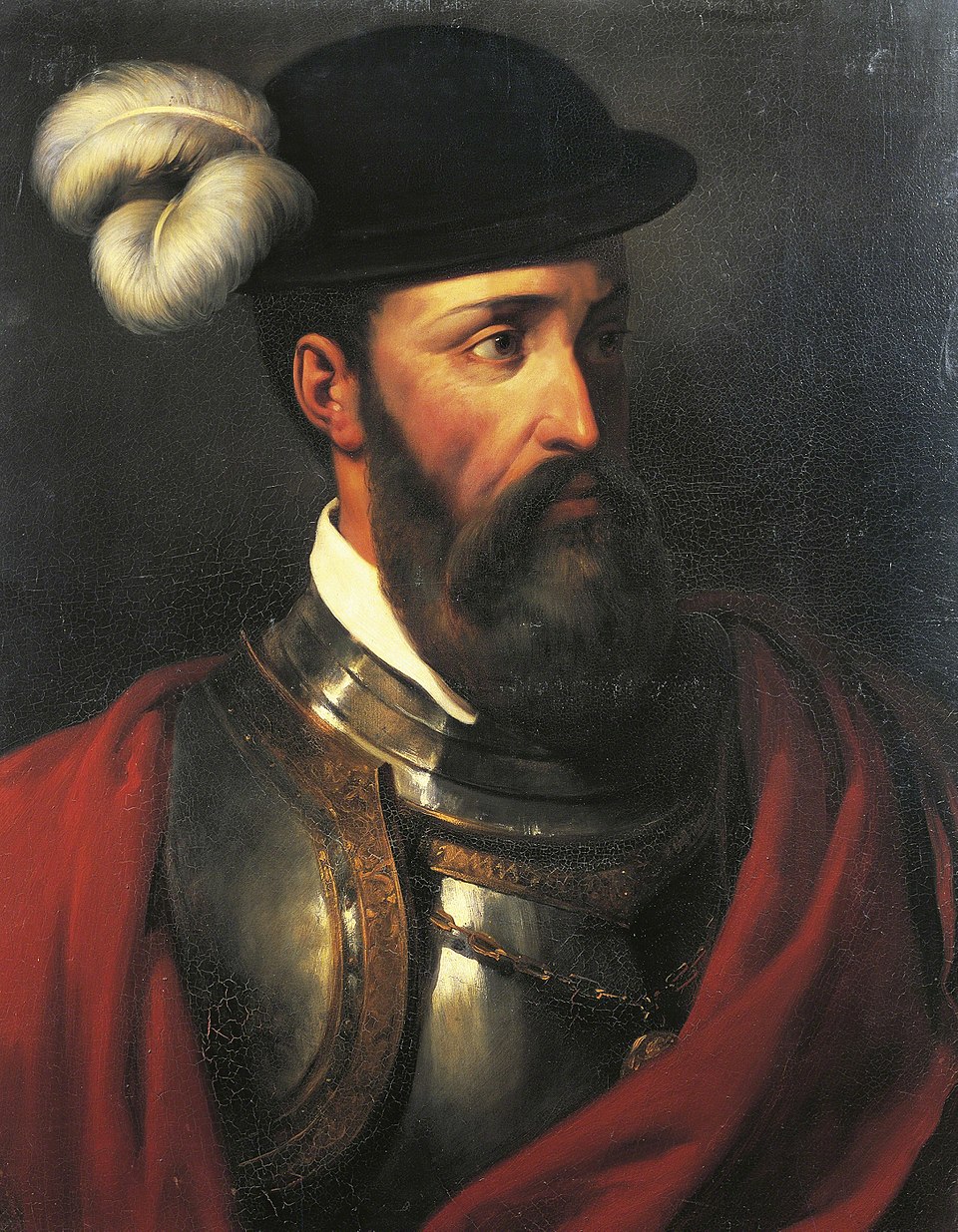
フランシスコ・ピサロ
Francisco Pizarro,
ca.1478-1541
☆フランシスコ・ピサロ[Francisco Pizarro]
(/pɪˈzɑːroʊ/;スペイン語発音:[fɾanˈθisko piˈθaro];1478年頃 -
1541年6月26日)は、スペインの征服者である。インカ帝国征服へとつながった遠征で最もよく知られている。
スペインのトルヒーリョで貧しい家庭に生まれたピサロは、新大陸で富と冒険を求める道を選んだ。ウラバ湾へ赴き、バスコ・ヌニェス・デ・バルボアがパナマ
地峡を横断する際に同行した。そこで彼らはアメリカ大陸から太平洋を目にした最初のヨーロッパ人となった。新設されたパナマ市の市長を数年間務め、ペルー
への遠征を二度試みたが失敗に終わった。1529年、ピサロはスペイン王室からペルー征服遠征の許可を得て、三度目にして成功する遠征に出発した。
沿岸部に住む現地住民がこの侵略に抵抗すると、ピサロは内陸部へ進軍し、ペルー初のスペイン人入植地サン・ミゲル・デ・ピウラを建設した。一連の作戦の
末、1532年11月のカハマルカ戦役でピサロはインカ皇帝アタワルパを捕らえた。皇帝解放の身代金が要求され、アタワルパは部屋いっぱいの金を用意した
が、ピサロは様々な罪状をでっち上げ、1533年7月に彼を処刑した。同年、ピサロはインカの首都クスコに入り、ペルー征服を完了した。1535年1月に
はリマ市を建設した。ピサロは最終的に権力闘争の犠牲となり、1541年に暗殺された。
| Francisco Pizarro
(/pɪˈzɑːroʊ/; Spanish: [fɾanˈθisko piˈθaro]; c. 1478 – 26 June 1541)
was a Spanish conquistador, best known for his expeditions that led to
the Spanish conquest of the Inca Empire. Born in Trujillo, Spain, to a poor family, Pizarro chose to pursue fortune and adventure in the New World. He went to the Gulf of Urabá and accompanied Vasco Núñez de Balboa in his crossing of the Isthmus of Panama, where they became the first Europeans to see the Pacific Ocean from the Americas. He served as mayor of the newly founded Panama City for a few years and undertook two failed expeditions to Peru. In 1529, Pizarro obtained permission from the Spanish crown to lead a campaign to conquer Peru and went on his third, and successful, expedition. When local people who lived along the coast resisted this invasion, Pizarro moved inland and founded the first Spanish settlement in Peru, San Miguel de Piura. After a series of manoeuvres, Pizarro captured the Inca emperor Atahualpa at the Battle of Cajamarca in November 1532. A ransom for the emperor's release was demanded and Atahualpa filled a room with gold, but Pizarro charged him with various crimes and executed him in July 1533. The same year, Pizarro entered the Inca capital of Cuzco and completed his conquest of Peru. In January 1535, he founded the city of Lima. Pizarro eventually fell victim to political power struggles and was assassinated in 1541.[2] |
フランシスコ・ピサロ[Francisco Pizarro](/pɪˈzɑːroʊ/;スペイン語発音:
[fɾanˈθisko piˈθaro];1478年頃 -
1541年6月26日)は、スペインの征服者である。インカ帝国征服へとつながった遠征で最もよく知られている。 スペインのトルヒーリョで貧しい家庭に生まれたピサロは、新大陸で富と冒険を求める道を選んだ。ウラバ湾へ赴き、バスコ・ヌニェス・デ・バルボアがパナマ 地峡を横断する際に同行した。そこで彼らはアメリカ大陸から太平洋を目にした最初のヨーロッパ人となった。新設されたパナマ市の市長を数年間務め、ペルー への遠征を二度試みたが失敗に終わった。1529年、ピサロはスペイン王室からペルー征服遠征の許可を得て、三度目にして成功する遠征に出発した。 沿岸部に住む現地住民がこの侵略に抵抗すると、ピサロは内陸部へ進軍し、ペルー初のスペイン人入植地サン・ミゲル・デ・ピウラを建設した。一連の作戦の 末、1532年11月のカハマルカ戦役でピサロはインカ皇帝アタワルパを捕らえた。皇帝解放の身代金が要求され、アタワルパは部屋いっぱいの金を用意した が、ピサロは様々な罪状をでっち上げ、1533年7月に彼を処刑した。同年、ピサロはインカの首都クスコに入り、ペルー征服を完了した。1535年1月に はリマ市を建設した。ピサロは最終的に権力闘争の犠牲となり、1541年に暗殺された。 |
| Early life Francisco Pizarro was born in Trujillo, Cáceres, Spain (then in the Crown of Castile) in modern-day Extremadura, Spain. He was the illegitimate son of infantry colonel Gonzalo Pizarro (1446–1522) and Francisca González, a woman of poor means. His date of birth is uncertain, but it is believed to be sometime in the 1470s, probably 1475. Little attention was paid to his education and he grew up illiterate.[3] His father served in Navarre and in the Italian campaigns under Córdoba. His mother married late in life and had a son, Francisco Martín de Alcántara, who was at the conquest of Peru with his half-brother from its inception.[4] Through his father, Francisco was a second cousin, once removed, of Hernán Cortés.[5] |
幼少期 フランシスコ・ピサロはスペインのエストレマドゥーラ地方(当時カスティーリャ王国領)にあるカセレス県トルヒーリョで生まれた。彼は歩兵大佐ゴンサロ・ ピサロ(1446–1522)と貧しい女性フランシスカ・ゴンサレスの非嫡出子であった。生年月日は定かではないが、1470年代、おそらく1475年頃 と推定される。教育はほとんど受けず、読み書きができないまま成長した。[3] 父はナバラで仕え、コルドバ指揮下のイタリア戦役にも従軍した。母は晩年に再婚し、フランシスコ・マルティン・デ・アルカンタラという息子をもうけた。こ の男は異母兄と共にペルー征服の初期段階から参加していた。[4] 父方の血筋を通じて、フランシスコはエルナン・コルテスの従兄弟の息子にあたる。[5] |
| Early career as Conquistador Main article: Spanish conquest of New Granada On 10 November 1509, Pizarro sailed from Spain to the New World with Alonso de Ojeda on an expedition to Urabá.[6] Pizarro became a participant in Ojeda's failed colony, commanding the remnants until he abandoned it with the survivors.[7]: 93 He sailed to Cartagena and joined the fleet of Martín Fernández de Enciso and, in 1513, accompanied Balboa in his crossing of the Isthmus of Panama to the Pacific.[3][8] The following year, Pedro Arias Dávila became the newly appointed governor of Castilla de Oro and succeeded Balboa. During the next five years, Pizarro became a close associate of Dávila and the governor assigned him a repartimiento of natives and cattle.[7]: 93 When Dávila decided to get rid of Balboa out of distrust, he instructed Pizarro to personally arrest him and bring him to stand trial. Balboa was beheaded in January 1519. For his loyalty to Dávila, Pizarro was rewarded with the positions of mayor (Alcalde) and magistrate of the then recently founded Panama City from 1519 to 1523.[9] |
征服者としての初期の経歴 主な記事: スペインによる新グラナダ征服 1509年11月10日、ピサロはアロンソ・デ・オヘダと共にウラバ遠征のためスペインから新大陸へ船出した。[6] ピサロはオヘダの失敗した植民地計画に参加し、残存部隊を指揮したが、生存者と共に植民地を放棄した。[7]: 93 その後カルタヘナへ渡り、マルティン・フェルナンデス・デ・エンシソの艦隊に加わった。1513年にはバルボアに随行し、パナマ地峡を越えて太平洋へ到達 した。[3][8] 翌年、ペドロ・アリアス・ダビージャが新任のカスティージャ・デ・オロ総督に就任し、バルボアの後任となった。その後5年間、ピサロはダビラの側近とな り、総督から先住民と家畜の分配(レパルティミエント)を任された。[7]:93 ダビラが不信感からバルボアを排除しようと決めた際、ピサロに直接バルボアを逮捕し裁判にかけるよう命じた。バルボアは1519年1月に斬首された。ダビ ラへの忠誠に対し、ピサロは1519年から1523年まで、当時創設されたばかりのパナマ市の市長(アルカルデ)兼治安判事の地位を授けられた。[9] |
| Expeditions to South America Main article: Spanish colonization of the Americas The first attempt to explore western South America was undertaken in 1522 by Pascual de Andagoya. The native South Americans he encountered told him about a gold-rich territory called Virú, which was on a river called Pirú (from which we get the pronunciation Perú).[8]: 24 These reports were relayed by the Spanish-Inca mestizo writer Garcilaso de la Vega in Comentarios Reales de los Incas (1608). Andagoya eventually established contact with several Native American curacas (chiefs), some of whom he later claimed were sorcerers and witches. Having reached as far as the San Juan River (part of the present boundary between Ecuador and Colombia) Andagoya fell ill and returned to Panama. He spread the news and stories about "Pirú" – a great land to the south rich with gold (the legendary El Dorado). These revelations, along with the accounts for Cortés' success in Mexico, caught the attention of Pizarro, prompting a series of expeditions to the south. In 1524, while he was still in Panama, Pizarro formed a partnership with a priest, Hernando de Luque and a soldier, Diego de Almagro, to explore and conquer the South. Pizarro, Almagro and Luque later explicitly renewed their compact,[8]: 24 agreeing to conquer and divide equally among themselves the empire they hoped to vanquish. While their accord was strictly oral, they dubbed their enterprise the Empresa del Levante and determined that Pizarro would command the expedition, Almagro would provide military and food supplies and Luque would be in charge of finances and additional provisions.[7]: 95 |
南アメリカへの遠征 主な記事: スペインによるアメリカ大陸の植民地化 南アメリカ西部を探検する最初の試みは、1522年にパスカル・デ・アンダゴヤによって行われた。彼が出会った南アメリカの先住民は、ピルーと呼ばれる川 (ここからペルーという発音が生まれた)沿いに、ヴィルーという金に富んだ地域があると彼に伝えた。[8]: 24 これらの報告は、スペイン系インカ混血の作家ガルシラソ・デ・ラ・ベガが『インカ王家の回顧録』(1608年)で伝えている。 アンダゴヤは最終的に複数の先住民のクラーカ(首長)と接触したが、そのうち数人を後に邪術師や妖術師だと主張した。サン・フアン川(現在のエクアドルと コロンビアの国境の一部)まで到達したアンダゴヤは病に倒れ、パナマへ戻った。彼は「ピルー」——南方に広がる黄金に富む大いなる地(伝説のエル・ドラ ド)——に関する知らせや物語を広めた。これらの情報と、コルテスがメキシコで成功を収めたという報告はピサロの注意を引き、南への一連の遠征を促した。 1524年、パナマに滞在中のピサロは、司祭エルナンド・デ・ルケと兵士ディエゴ・デ・アルマグロと提携し、南方の探検と征服に乗り出した。ピサロ、アル マグロ、ルケは後に契約を明文化し[8]: 24 、征服を目指す帝国を制圧後、三者で均等に分割することを合意した。彼らの合意は口頭のみであったが、 この事業を「レバンテ遠征」と名付け、ピサロが遠征隊の指揮を執り、アルマグロが軍事物資と食糧を調達し、ルケが資金と追加物資の管理を担当することを決 めた[7]: 95。 |
| First expedition (1524) In November 1524, the first of three expeditions left Panama for the conquest of Peru with about 80 men and four horses.[8]: 24 Juan de Salcedo was the standard bearer, Nicolás de Ribera was the treasurer and Juan Carvallo was the inspector.[10]: 45, 47 Diego de Almagro was left behind because he was to recruit men, gather additional supplies and join Pizarro later. The Governor of Panama, Pedro Arias Dávila, at first approved in principle the exploration of South America. Pizarro's first expedition, however, turned out to be a failure as his conquistadors, sailing down the Pacific coast, reached no further than Colombia before succumbing to bad weather, lack of food and skirmishes with hostile natives, one of which caused Almagro to lose an eye by arrow-shot. The place names the Spanish bestowed along their route, including Puerto Deseado (desired port), Puerto del Hambre (port of hunger) and Punta Quemado or Puebla Quemado (burned port), confirmed their difficulties. Fearing subsequent hostile encounters like the one the expedition endured at the Battle of Punta Quemada, Pizarro ended his first expedition and returned to Panama.[7]: 94–102 |
第一次遠征(1524年) 1524年11月、三度の遠征のうち最初の隊がパナマを出発し、約80名の兵士と4頭の馬を率いてペルー征服に向かった。[8]: 24 旗手はフアン・デ・サルセド、会計係はニコラス・デ・リベラ、監察官はフアン・カルバロであった。[10]: 45, 47 ディエゴ・デ・アルマグロは、兵士の募集と追加物資の調達を担当し、後でピサロに合流するため残された。パナマ総督ペドロ・アリアス・ダビージャは当初、 南米探検を原則的に承認した。しかしピサロの最初の遠征は失敗に終わった。太平洋沿岸を下った征服者たちはコロンビアまでしか到達できず、悪天候、食糧不 足、敵対的な先住民との小競り合いに屈した。その一つでアルマグロは矢で目を失った。スペイン人が航路に付けた地名——プエルト・デセアド(望みの港)、 プエルト・デル・アンブレ(飢餓の港)、プンタ・ケマドあるいはプエブラ・ケマド(焼け焦げた港)——は彼らの苦難を物語っていた。プンタ・ケマダの戦い のような敵対的遭遇を恐れたピサロは、最初の遠征を打ち切りパナマへ帰還した[7]: 94–102。 |
| Second expedition (1526) Two years later Pizarro, Almagro and Luque started the arrangements for a second expedition with permission from Pedro Arias Dávila, Panama's governor. Dávila, who himself was preparing an expedition north to Nicaragua, was reluctant to permit another expedition, having lost confidence in Pizarro. The three associates eventually won his trust and he acquiesced. By this time, a new governor was to arrive and succeed Dávila. Pedro de los Ríos took charge as the new colonial administrator in July 1526 and initially approved Pizarro's expeditions (he would join him several years later in Peru).[7]: 103–104 On 10 March 1526, Pizarro left Panama with two ships with 160 men and several horses, reaching as far as the Colombian San Juan River. Soon after arriving the party separated, with Pizarro staying to explore the new and often perilous territory off the swampy Colombian coasts, while the expedition's co-commander, Almagro, returned to Panama for reinforcements. Pizarro's Piloto Mayor (main pilot), Bartolomé Ruiz, continued sailing south and, after crossing the equator, found and captured a balsa (raft) under sail, with natives from Tumbes. To everyone's surprise, these carried textiles, ceramic objects and some pieces of gold, silver and emeralds, making Ruiz's findings the central focus of this second expedition. Some natives were taken aboard Ruiz's ship to serve as interpreters.[7]: 105–109 [8]: 24–25 He then set sail north for the San Juan River, arriving to find Pizarro and his men exhausted from the difficulties they had faced exploring the new territory. Soon Almagro sailed into the port laden with supplies and a reinforcement of at least eighty recruits who had arrived at Panama from Spain with an expeditionary spirit. The findings and excellent news from Ruiz along with Almagro's new reinforcements cheered Pizarro and his tired followers. They decided to sail back to the territory already explored by Ruiz and, after a difficult voyage due to strong winds and currents, reached Atacames on the Ecuadorian coast. Here, they found a large native population recently brought under Inca rule. Unfortunately for the conquistadores, the people they encountered seemed so defiant and numerous that the Spanish decided not to enter the land.[7]: 110–112 |
第二回遠征(1526年) 二年後、ピサロ、アルマグロ、ルケはパナマ総督ペドロ・アリアス・ダビラの許可を得て第二回遠征の準備を始めた。ダビラ自身はニカラグアへの北進遠征を計 画中で、ピサロへの信頼を失っていたため、新たな遠征を許可することに消極的だった。しかし三人の仲間は最終的に彼の信頼を勝ち取り、ダビラは承諾した。 この頃、ダビラの後任となる新総督が到着する予定だった。ペドロ・デ・ロス・リオスが1526年7月に新たな植民地行政官として着任し、当初はピサロの遠 征を承認した(彼は数年後にペルーでピサロと合流することになる)。[7]: 103–104 1526年3月10日、ピサロは160名の兵士と数頭の馬を乗せた2隻の船でパナマを出発し、コロンビアのサン・フアン川まで到達した。到着後まもなく一 行は分かれ、ピサロはコロンビアの湿地帯沿岸の未開で危険な地域を探索するため残留した。一方、遠征の共同指揮官アルマグロは増援を求めてパナマへ戻っ た。ピサロの主任航海士バルトロメ・ルイスは南下を続け、赤道を越えた後、トゥンベス出身の先住民が乗った帆走中の筏(いかだ)を発見し捕獲した。驚くべ きことに、彼らは織物、陶器、金・銀・エメラルドの装飾品を所持しており、ルイスが発見した品々がこの第二遠征の核心となった。通訳役として数名の先住民 がルイス船に連れて行かれた。[7]: 105–109 [8]: 24–25 その後ルイスはサン・フアン川を目指して北へ進み、新たな土地の探索で困難に直面し疲弊したピサロとその部下たちを発見した。間もなくアルマグロが物資を 満載した船で港に入港した。スペインから遠征精神に燃えてパナマに到着した少なくとも80名の増援兵も同乗していた。ルイスからの発見物と好報、そしてア ルマグロの新たな増援は、疲弊したピサロとその部下たちを奮い立たせた。彼らはルイスが既に探検した地域へ戻り、強風と海流による困難な航海を経て、エク アドル沿岸のアタカメスに到達することを決めた。ここで彼らは、インカ支配下に置かれたばかりの多数の先住民を発見した。しかし征服者たちにとって不幸な ことに、遭遇した住民は反抗的で数が多すぎたため、スペイン人たちはその土地へ進入しないことを決めた。[7]: 110–112 |
The Famous Thirteen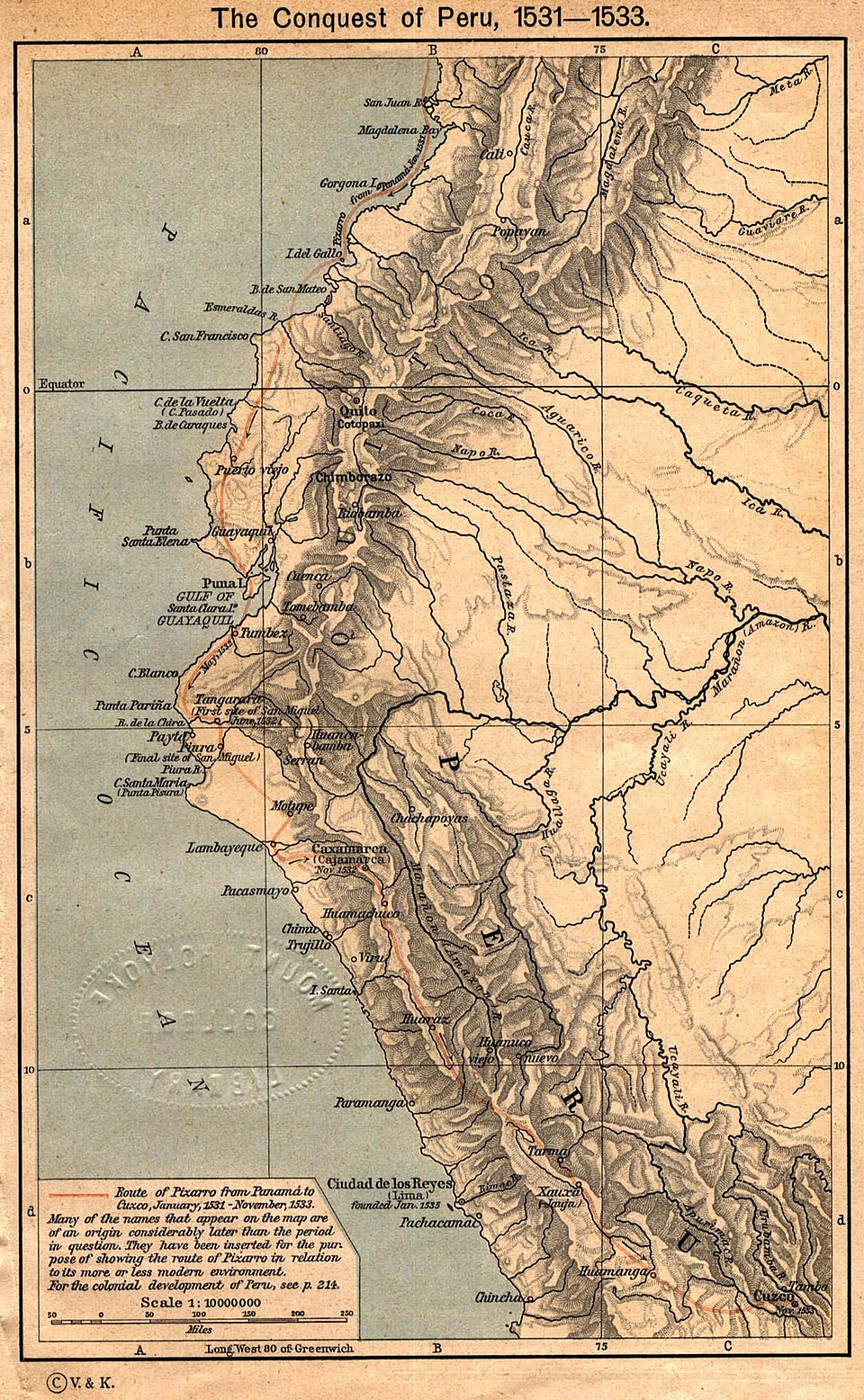 Francisco Pizarro's route of exploration during the conquest of Peru (1531–1533) After much wrangling between Pizarro and Almagro, it was decided that Pizarro would stay at a safer place, the Isla de Gallo,[8]: 25–26 near the coast, while Almagro would return to Panama with Luque for more reinforcements – this time with proof of the gold they had found and the news of the discovery of the obviously wealthy land they had explored. The new governor of Panama, Pedro de los Ríos, had learned of the mishaps of Pizarro's expeditions and the deaths of various settlers who had gone with him. Fearing an unsuccessful outcome, he rejected Almagro's application for continued resources. In addition, he ordered two ships commanded by Juan Tafur to be sent immediately with the intention of bringing Pizarro and his crew back to Panama.[7]: 112–115 Pizarro had no intention of returning and when Tafur arrived at Isla de Gallo, Pizarro drew a line in the sand, saying: "There lies Peru with its riches; Here, Panama and its poverty. Choose, each man, what best becomes a brave Castilian. For my part, I go to the south."[7]: 116 Only 13 men stayed with Pizarro. They later became known as "The Famous Thirteen" (Los trece de la fama),[8]: 26 while the rest of the expeditioners stayed with Tafur. Ruiz left in one of the ships with the intention of joining Almagro and Luque in their efforts to gather reinforcements. Soon after the ships left, Pizarro and his men constructed a crude boat and journeyed 25 leagues north to La Isla Gorgona, where they would remain for seven months before the arrival of new provisions.[7]: 117–118 Back in Panama, Pedro de los Ríos (after much convincing by Luque) had finally acquiesced to the requests for another ship, but only to bring Pizarro back within six months and completely abandon the expedition. Almagro and Luque grasped the opportunity and left Panama (this time without new recruits) for La Isla Gorgona to join Pizarro once again. On meeting Pizarro, the associates decided to continue sailing south on the recommendations of Ruiz's Indian interpreters.[7]: 118 By April 1528, they finally reached the northwestern Peruvian Tumbes Region. Tumbes became the first success that the Spanish had so long desired. They were received with a warm welcome of hospitality and provisions from the Tumpis, the local inhabitants. On subsequent days two of Pizarro's men, Alonso de Molina and Pedro de Candia, reconnoitred the territory and both, on separate accounts, reported back the riches of the land, including the decorations of silver and gold around the chief's residence and the hospitable attentions with which they were received by everyone. The Spanish also saw for the first time the Peruvian llama,[8]: 26 which Pizarro called "little camels". Pizarro continued receiving the same accounts of a powerful monarch who ruled over the land they were exploring. These events served as evidence to convince the expedition that the wealth and power displayed at Tumbes were an example of the riches of the Peruvian territory. The conquistadors decided to return to Panama to prepare the final expedition of conquest with more recruits and provisions. Before leaving, however, Pizarro and his followers sailed south along the coast to see if anything of interest could be found. Historian William H. Prescott recounts that after passing through territories they named such as Cabo Blanco, port of Payta, Sechura, Punta de Aguja, Santa Cruz and Trujillo (founded by Almagro years later), they finally reached for the first time the ninth degree of the southern latitude in South America. On their return towards Panama, Pizarro briefly stopped at Tumbes, where two of his men had decided to stay to learn the customs and language of the natives. Pizarro was also given two Peruvian boys to learn Spanish, one of whom was later baptised as Felipillo and served as an important interpreter, the equivalent of Cortés' La Malinche of Mexico, and another called Martinillo.[10]: 126, 128 Their final stop was at La Isla Gorgona, where two of his invalid men (one had died) had been left behind. After at least 18 months away, Pizarro and his followers anchored off the coasts of Panama to prepare for the final expedition.[7]: 119–126 |
有名な十三人 ペルー征服期(1531–1533年)におけるフランシスコ・ピサロの探検ルート ピサロとアルマグロの間で激しい議論が交わされた後、ピサロはより安全な場所であるガジョ島[8]: 25–26 (海岸近く)に留まり、アルマグロはル ケと共にパナマへ戻ってさらなる増援を求めることに決まった。今回は発見した金の証拠と、明らかに豊かな土地を探検したとの知らせを携えての帰還である。 パナマの新総督ペドロ・デ・ロス・リオスは、ピサロ遠征隊の災難と同行した入植者たちの死を知っていた。失敗を恐れた彼は、アルマグロの継続的な資源供給 の要請を拒否した。さらに彼はフアン・タフル指揮下の二隻の船を直ちに派遣し、ピサロとその乗組員をパナマへ連れ戻すよう命じた。[7]: 112–115 ピサロは戻るつもりはなかった。タフルがガジョ島に到着した時、ピサロは砂に線を引いて言った。「あちらが富あるペルーだ。こちらが貧しいパナマだ。各々、勇敢なカスティーリャ人にふさわしい道を選べ。俺は南へ向かう」と宣言した。[7]: 116 ピサロと共に残ったのはわずか13名であった。彼らは後に「名高い十三人」(ロス・トレセ・デ・ラ・ファマ)として知られるようになる[8]: 26 。 残りの遠征隊員はタフルと共に留まった。ルイスは増援集めのためアルマグロとルケに合流する意図で船で去った。船が出航するとすぐ、ピサロと部下たちは粗 末な船を建造し、25リーグ北のゴルゴナ島へ移動した。そこで彼らは新たな物資が届くまでの7か月間を過ごすことになる。[7]: 117–118 パナマでは、ルケの執拗な説得の末、ペドロ・デ・ロス・リオスがようやく追加船の要請を承諾した。ただし条件は、6ヶ月以内にピサロを連れ戻し、遠征を完 全に放棄することだった。アルマグロとルケはこの機会を捉え、パナマを出発した(今回は新兵を伴わず)。再びピサロと合流するため、ゴルゴナ島へ向かった のである。ピサロと合流した仲間たちは、ルイスが連れていたインディオ通訳の勧めに従い、さらに南へ航海を続けることに決めた。[7]: 118 1528年4月、彼らはついにペルー北西部のトゥンベス地方に到達した。トゥンベスは、スペイン人が長年望んでいた最初の成功地となった。現地住民トゥン ピ族は彼らを温かく迎え、食料を提供した。その後数日間、ピサロの部下であるアロンソ・デ・モリーナとペドロ・デ・カンディアが領土を偵察した。二人は別 々の報告で、この地の豊かさを伝えた。首長の住居を飾る銀や金の装飾、そして住民全員から受けたもてなしの心遣いなどが含まれていた。スペイン人たちはま た、初めてペルーのラマ[8]: 26 を目にした。ピサロはこれを「小さなラクダ」と呼んだ。ピサロは、彼らが探検している土地を支配する強大な君主に ついての同じ報告を続けて受け取った。これらの出来事は、トゥンベスで示された富と権力がペルー領土の豊かさの例であることを遠征隊に確信させる証拠と なった。征服者たちは、より多くの兵員と物資を調達するため、最終的な征服遠征の準備を整えるべくパナマへ戻ることを決めた。しかし出発前に、ピサロとそ の一団は興味深いものがないか探るため、海岸沿いに南へ船出した。歴史家ウィリアム・H・プレスコットによれば、彼らはカボ・ブランコ、パイタ港、セチュ ラ、プンタ・デ・アグハ、サンタ・クルス、トルヒーリョ(後にアルマグロが建設)といった地名をつけた地域を通過した後、ついに南米で初めて南緯9度に到 達した。 パナマへ戻る途中、ピサロはトゥンベスに一時的に立ち寄った。そこでは、部下の2人が先住民の習慣や言語を学ぶために留まることを決めていた。また、ピサ ロはスペイン語を学ぶために2人のペルー人の少年を預かった。そのうちの1人は後にフェリピージョと洗礼名を受け、コルテスのラ・マリンチェに匹敵する重 要な通訳として働いた。もう1人はマルティニージョと呼ばれていた。[10]: 126, 128 彼らの最後の寄港地はラ・イスラ・ゴルゴナで、そこで2人の傷病兵(1人は死亡)が置き去りにされた。少なくとも18か月の旅を経て、ピサロとその仲間た ちはパナマ沖に停泊し、最後の遠征の準備をした。[7]: 119–126 |
| Capitulation of Toledo Main article: Capitulation of Toledo of 1529 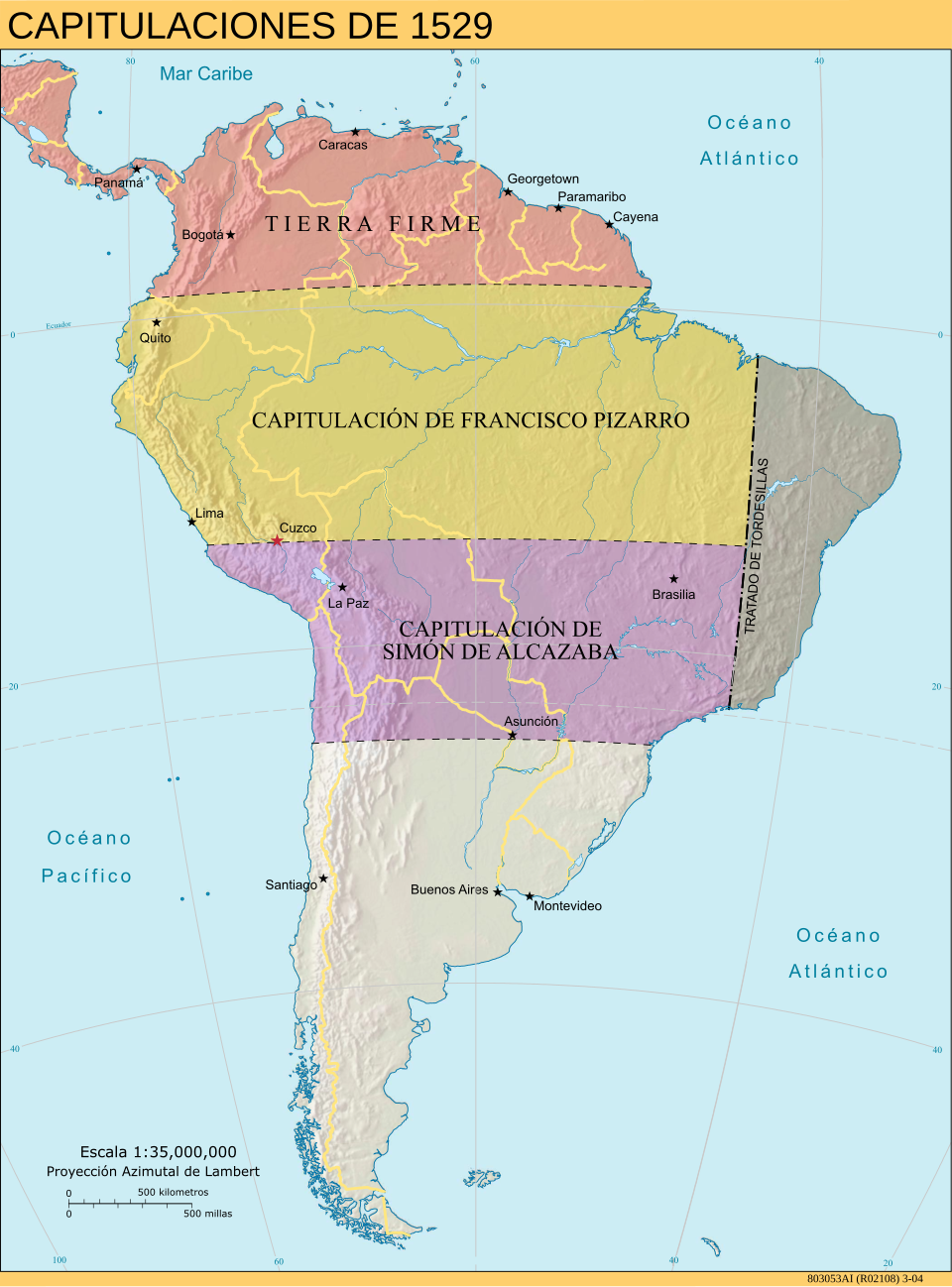 The Governorate of New Castile was given to Francisco Pizarro. When the new governor of Panama, Pedro de los Ríos, refused permission for a third expedition to the south, the associates resolved that Pizarro should leave for Spain and appeal to the sovereign in person. Pizarro sailed from Panama for Spain in the spring of 1528, accompanied by Pedro de Candia, some natives and llamas, plus samples of fabric, gold and silver.[7]: 127–128 Pizarro reached Seville in early summer. King Charles I, who was at Toledo, had an interview with Pizarro and heard of his expeditions in South America. The conquistador described the territory as rich in gold and silver that he and his followers had bravely explored "to extend the empire of Castile". The king, who was soon to leave for Italy, was impressed at his accounts and promised his support for the conquest of Peru. Queen Isabel, though, in the absence of the king, signed the Capitulación de Toledo on 6 July 1529,[11] a licence document that authorised Pizarro to proceed with the conquest of Peru. Pizarro was officially named the Governor, Captain general, Adelantado and Alguacil Mayor, of New Castile for the distance of 200 leagues along the newly discovered coast and invested with all authority and prerogatives, leaving his associates in secondary positions (a fact that later incensed Almagro and would lead to eventual discord). One of the grant conditions was that within six months, Pizarro should raise a sufficiently equipped force of 250 men, of whom 100 might be drawn from the colonies.[7]: 132–134, 137 This gave Pizarro time to leave for his native Trujillo and convince his brother Hernando Pizarro and other close friends to join him on his third expedition.[7]: 136 Francisco de Orellana joined the group and would later discover and explore the length of the Amazon River. Two half-brothers on his father's side, Juan Pizarro and Gonzalo Pizarro,[8]: 27 and a half-brother from his mother, Francisco Martín de Alcántara,[7]: 136 later also decided to join him, as well as his cousin Pedro Pizarro, who served as his page.[12]: 13 When the expedition left the following year, it numbered three ships, 180 men and 27 horses.[7]: 138 Pizarro could not raise the number of men the Capitulación required and sailed clandestinely from the port of Sanlúcar de Barrameda for the Canary Island of La Gomera in January 1530. He was joined there by his brother Hernando and the remaining men in two vessels that would sail back to Panama.[7]: 137 Pizarro's third and final expedition left Panama for Peru on 27 December 1530.[8]: 27 |
トレドの降伏 詳細な記事: 1529年のトレド降伏 新カスティーリャ総督の地位はフランシスコ・ピサロに与えられた。 パナマの新総督ペドロ・デ・ロス・リオスが南への第三次遠征の許可を拒否したため、仲間たちはピサロがスペインへ渡り、自ら君主に訴えるべきだと決めた。 ピサロは1528年の春、ペドロ・デ・カンディア、数人の先住民、ラマ、そして布地、金、銀のサンプルを伴ってパナマからスペインへ向けて出航した。 [7]: 127–128 ピサロは初夏にセビリアに到着した。トレドにいたカルロス1世はピサロと面会し、南米遠征の報告を受けた。征服者はその地を金銀に富むと説明し、自身と部 下が「カスティーリャ帝国の拡大」のために勇敢に探検したと語った。間もなくイタリアへ出発する予定だった国王は、その報告に感銘を受け、ペルー征服への 支援を約束した。しかし国王不在の中、イサベル王妃は1529年7月6日、トレド条約に署名した[11]。これはピサロにペルー征服を進める許可を与える 認可文書であった。ピサロは新たに発見された海岸線に沿って200リーグの範囲において、新カスティーリャ総督・総司令官・アデランタド・アルグアシル・ マヨールに正式に任命され、あらゆる権限と特権を付与された。これにより彼の仲間たちは下位の地位に留まることとなった(この事実は後にアルマグロを激怒 させ、最終的に不和を招くことになる)。この任命条件の一つとして、ピサロは6ヶ月以内に250名の十分な装備を備えた部隊を編成する必要があった。その うち100名は植民地から補充してもよいとされていた[7]: 132–134, 137 これによりピサロは故郷トルヒーリョへ戻り、弟エルナンド・ピサロや親しい友人たちを第三次遠征への参加に説得する時間を得た[7]: 136。フランシ スコ・デ・オレリャーナもこの隊に加わり、後にアマゾン川を発見・探検することになる。父方の異母兄弟であるフアン・ピサロとゴンサロ・ピサロ[8]: 27、母方の異母兄弟フランシスコ・マルティン・デ・アルカンタラ[7]: 136も後に参加を決意した。従兄弟で従者として仕えていたペドロ・ピサロも 加わった。[12]: 13 翌年、遠征隊が出発した時には、船3隻、乗組員180名、馬27頭で構成されていた。[7]: 138 ピサロは契約書で定められた人数を集められず、1530年1月にサンルーカル・デ・バラメダの港から密かに出航し、カナリア諸島のラ・ゴメラ島へ向かっ た。そこで兄エルナンドと残りの兵士が合流し、二隻の船でパナマへ戻った。[7]: 137 ピサロの三度目にして最後の遠征隊は、1530年12月27日にパナマからペルーへ向けて出航した。[8]: 27 |
| Conquest of Peru (1532) Main article: Spanish conquest of the Inca Empire 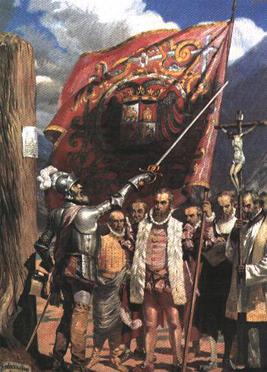 Pizarro and his followers in Lima in 1535 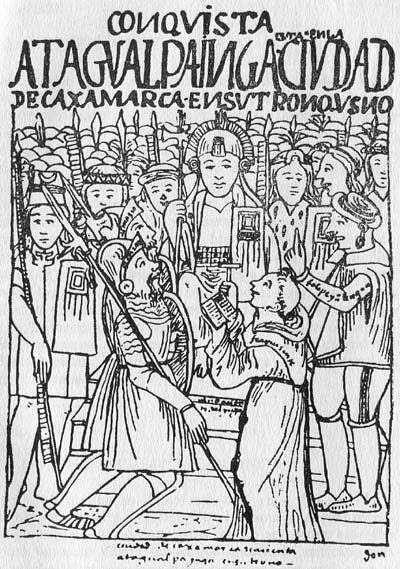 Pizarro meets with the Inca Emperor Atahualpa, 1532 In 1531, Pizarro once again landed on the coasts near Ecuador, the province of Coaque and the region of esmeraldas, where some gold, silver and emeralds were procured and then dispatched to Almagro. The latter had stayed in Panama to gather more recruits.[7]: 139–140 Sebastián de Belalcázar soon arrived with 30 men.[7]: 141 Though Pizarro's main objective was then to set sail and dock at Tumbes as during his previous expedition, he was forced to confront the Punian natives in the Battle of Puná, leaving three or four Spaniards dead and many wounded. Soon after, Hernando de Soto, another conquistador who had joined the expedition, arrived with 100 volunteers and horses to aid Pizarro and with him sailed towards Tumbes,[7]: 143 only to find the place deserted and destroyed. The two conquistadors suspected that the settlers had disappeared or died under murky circumstances. The chiefs explained that the fierce tribes of Punians had attacked them and ransacked the place.[7]: 152–153 As Tumbes no longer afforded safe accommodations, Pizarro led an excursion into the hinterland in May 1532 and established the first Spanish settlement in Peru, San Miguel de Piura, and a repartimiento.[7]: 153–154 Leaving 50 men back at the settlement under the command of Antonio Navarro, Pizarro proceeded with his conquest accompanied by 200 men on 24 September 1532.[7]: 155–156 After arriving at Zaran, de Soto was dispatched to a Peruvian garrison at Caxas. After a week, he returned with an envoy from the Inca himself, with presents and an invitation to visit the Inca ruler's camp.[7]: 156–158 Following the defeat of his brother, Huáscar, in the Inca Civil War, Atahualpa had been resting in the Sierra of northern Peru, near Cajamarca, in the nearby thermal baths known today as the Inca Baths. Arriving at Cajamarca on 15 November 1532, Pizarro had a force of just 110-foot soldiers, 67 cavalry, three arquebuses and two falconets. He sent Hernando Pizarro and de Soto to an audience with Atahualpa in his camp. Atahualpa agreed to meet Pizarro in his Cajamarca plaza fortress the next day. Fray Vincente de Valverde and native interpreter Felipillo approached Atahualpa in Cajamarca's central plaza. After the Dominican friar expounded the "true faith" and the need to pay tribute to the Emperor Charles V, Atahualpa replied, "I shall be no man's tributary." His complacency, because fewer than 200 Spanish remained, as opposed to his 50,000-man army, of which 6,000 accompanied him to Cajamarca, sealed his fate and that of the Inca empire.[7]: 157, 161, 166–177 Atahualpa's refusal led Pizarro and his force to attack the Inca army in what became the Battle of Cajamarca on 16 November 1532. The Spanish were successful. Pizarro executed Atahualpa's 12-man honour guard and took the Inca captive at the so-called Ransom Room. By February 1533, Almagro had joined Pizarro in Cajamarca with an additional 150 men and 50 horses.[7]: 186–194 Despite fulfilling his promise of filling one room (22 by 17 feet or 7 by 5 metres)[13] with gold and two with silver, Atahualpa was convicted of 12 charges, including killing his brother and plotting against Pizarro and his forces. He was executed by garrote on 29 August 1533. Francisco Pizarro and de Soto were opposed to Atahualpa's execution, but Francisco consented to the trial due to the "great agitation among the soldiers", particularly by Almagro. De Soto was on a reconnaissance mission the day of the trial and execution and upon his return expressed his dismay, stating, "he should have been taken to Castile and judged by the emperor."[7]: 202–204, 206 [14] King Charles later wrote to Pizarro: "We have been displeased by the death of Atahualpa, since he was a monarch and particularly as it was done in the name of justice." Pizarro advanced with his army of 500 Spaniards toward Cuzco, accompanied by Chalcuchimac, one of the leading Inca generals of the north and a supporter of Atahualpa, who was subsequently burned at the stake. Manco Inca Yupanqui joined Pizarro after the death of Túpac Huallpa.[7]: 191, 210, 216 During the exploration of Cuzco, Pizarro was impressed and through his officers wrote back to Spain to King Charles, saying: "This city is the greatest and the finest ever seen in this country or anywhere in the Indies... We can assure your Majesty that it is so beautiful and has such fine buildings that it would be remarkable even in Spain." The Spanish sealed the conquest of Peru by entering Cuzco on 15 November 1533.[7]: 216 Jauja, in the fertile Mantaro Valley, was established as Peru's provisional capital in April 1534,[10]: 286 but it was high up in the mountains and too distant from the sea to serve as the capital. Pizarro founded the city of Lima on Peru's central coast on 6 January 1535, which he considered to be one of the most important things he had created in life.[7]: 227–229 By early 1536, Manco Inka, supported by an army of perhaps 100,000 people, initiated a siege of Cuzco. At the same time, smaller Inca expeditionary forces moved to destroy other European strongholds. In the three years of continuous warfare since the arrival of Pizarro, Inca military leaders had become familiar with Spanish military tactics and developed effective counters. Perhaps the most effective of these military innovations was the one that dealt with the Europeans' greatest advantage on the battlefield: horses. Inca soldiers would offer battle but hold their position until the Spaniards had concentrated their cavalry in order to break the indigenous line. They would then fall back before the cavalry charge and draw the Europeans into a canyon where previously positioned forces could crush them under avalanches of rocks and missile weapons. Instead of charging the numerically inferior Europeans as they had done early on, Inca soldiers used their discipline and knowledge of the terrain in order to draw the armoured cavalry charge into a death trap. Well-documented battlefield deaths show that many more Spaniards died in these battles than in the early days of the war when theoretically the Inca had a much greater advantage. Despite winning the majority of the battles, the inability of the Inca forces to overwhelm Cuzco's fortifications, manned as they were by only 200 fighting men armed with gunpowder weapons, signalled the definitive victory of Spanish forces. After the final effort of the Inca to recover Cuzco had been defeated by Almagro, a dispute occurred between Pizarro and Almagro regarding the limits of their jurisdiction, as both claimed the city of Cuzco. The king of Spain had awarded the Governorate of New Toledo to Almagro and the Governorate of New Castile to Pizarro. The dispute had originated from a disagreement on how to interpret the limit between the governorates.[7]: 254–256 This led to confrontations between the Pizarro brothers and Almagro, who was eventually defeated during the Battle of Las Salinas in 1538 and executed. Almagro's son, also named Diego and known as El Mozo, was later stripped of his lands and left bankrupt by Pizarro. Atahualpa's wife, 10-year-old Cuxirimay Ocllo Yupanqui, was with Atahualpa's army in Cajamarca and had stayed with him while he was imprisoned. Following his execution, she was taken to Cuzco, given the name Doña Angelina and made the concubine of Francisco Pizarro. By 1538, it was known she had borne Pizarro two sons, Juan and Francisco.[15] |
ペルー征服(1532年) 主な記事:スペインによるインカ帝国征服 1535年、リマにおけるピサロとその配下たち 1532年、ピサロがインカ皇帝アタワルパと面会 1531年、ピサロは再びエクアドル近郊の海岸、コアケ州およびエスメラルダス地方に上陸した。そこで金、銀、エメラルドが調達され、アルマグロのもとへ 送られた。アルマグロはパナマに残り、さらなる兵士の募集を行っていた。[7]: 139–140 セバスティアン・デ・ベラルカサルは30名の兵を率いて間もなく到着した。[7]: 141 ピサロの主目的は前回遠征時と同様にトゥンベスへ出航・接岸することだったが、プナ族との戦闘(プナの戦い)を余儀なくされ、スペイン人3~4名が死亡、 多数の負傷者を出した。その後間もなく、遠征に参加していた別の征服者エルナンド・デ・ソトが、ピサロを支援するため志願兵100名と馬を率いて到着し、 共にトゥンベスへ向かって出航した[7]: 143 。しかし到着すると、その地は廃墟と化していた。二人の征服者は、入植者たちが不可解な状況で消え 去ったか死亡したのではないかと疑った。首長たちは、凶暴なプニア族が彼らを襲撃し、その場所を略奪したと説明した[7]: 152–153 トゥンベスはもはや安全な宿泊施設を提供できなくなったため、ピサロは 1532 年 5 月に内陸部への遠征を指揮し、ペルーで最初のスペイン人入植地、サン・ミゲル・デ・ピウラ、およびレパルティミエントを設立した[7]: 153–154 アントニオ・ナヴァロの指揮下、50人の兵を入植地に残し、ピサロは1532年9月24日、200人の兵を伴って征服を進めた。[7]: 155–156 ザランに到着後、デ・ソトはカシャスのペルー駐屯軍に派遣された。1週間後、彼はインカ皇帝自体の使者を伴って戻り、贈り物とインカ皇帝の陣営を訪問する 招待状を持ってきた。[7]: 156–158 インカ内戦で弟ワスカルが敗れた後、アタワルパはペルー北部のシエラ地方、カハマルカ近郊で休息を取っていた。その場所は現在インカの浴場として知られる 温泉地である。1532年11月15日にカハマルカに到着したピサロの部隊は、歩兵110名、騎兵67名、火縄銃3丁、ファルコネット砲2門のみであっ た。彼はエルナンド・ピサロとデ・ソトをアタワルパの陣営へ使者として派遣した。アタワルパは翌日、カハマルカの広場要塞でピサロと会うことに同意した。 カハマルカ中央広場にて、ドミニコ会の修道士ビンセンテ・デ・バルベルデと現地通訳フェリピージョがアタワルパに接近した。修道士が「真の信仰」と皇帝カ ルロス5世への貢納義務を説くと、アタワルパは「我は誰の貢納者にもならぬ」と返答した。 彼の慢心が、自らの運命とインカ帝国の終焉を決定づけた。当時、スペイン兵は200名未満であったのに対し、アタワルパの軍勢は5万人を数え、うち6千人がカハマルカに同行していたのである。[7]: 157, 161, 166–177 アタワルパの拒否により、ピサロとその部隊は1532年11月16日、カハマルカでの戦いとして知られるインカ軍への攻撃を開始した。スペイン軍は勝利を 収めた。ピサロはアタワルパの12人の親衛隊を処刑し、いわゆる「身代金部屋」でインカ皇帝を捕虜とした。1533年2月までに、アルマグロが150人の 兵と50頭の馬を率いてカハマルカに合流した。[7]: 186–194 アタワルパは約束通り、1室(22フィート×17フィート/7メートル×5メートル)[13]を金で埋め、2室を銀で埋めたにもかかわらず、弟殺害やピサ ロとその軍隊への謀反計画など12の罪で有罪判決を受けた。1533年8月29日、絞首刑により処刑された。フランシスコ・ピサロとデ・ソトはアタワルパ 処刑に反対したが、特にアルマグロら兵士の「激しい動揺」を受け、フランシスコは裁判を容認した。デ・ソトは裁判と処刑当日、偵察任務に出ており、帰還後 「皇帝の裁きを受けるためカスティーリャへ連行されるべきだった」と憤慨を表明した。[7]: 202–204, 206 [14] カルロス王は後にピサロにこう書き送った。「我々はアタワルパの死を不快に思っている。彼は君主であったからだ。特にそれが正義の名のもとに為されたこと に対してはなおさらである」 ピサロは500名のスペイン兵を率いてクスコへ進軍した。同行したのは北方の有力なインカ将軍でアタワルパ支持者だったチャルクチマックであり、彼は後に 火刑に処された。トゥパク・ワルパの死後、マンコ・インカ・ユパンキはピサロに合流した。[7]: 191, 210, 216 クスコの探査中、ピサロはその壮麗さに感銘を受け、将校を通じてスペインのカルロス王に次のように報告した。「この都市は、この国やインド諸島全域でこれ までに見た中で最も偉大で最も優れたものです…陛下にお伝えしますが、その美しさと建築物の素晴らしさは、スペイン国内でも際立った存在となるでしょ う。」 スペイン軍は1533年11月15日にクスコに入城し、ペルー征服を確定させた。[7]: 216 肥沃なマンタロ川流域にあるハウハは1534年4月に ペルーの暫定首都として定められたが[10]: 286 、山岳地帯の高地に位置し海から遠すぎるため首都としての機能を果たせなかった。ピサロは 1535年1月6日、ペルー中央海岸にリマ市を創設した。彼はこれを生涯で成し遂げた最も重要な事柄の一つと考えた。[7]: 227–229 1536年初頭までに、マンコ・インカは約10万の軍勢を率いてクスコ包囲を開始した。同時に、小規模なインカ遠征軍が他のヨーロッパ人拠点の破壊に向 かった。ピサロ到来後の3年間の継続的な戦争で、インカの軍事指導者たちはスペイン軍の戦術を熟知し、効果的な対抗策を編み出していた。おそらく最も効果 的だった軍事的革新は、戦場におけるヨーロッパ人の最大の強みである馬に対処するものであった。インカの兵士たちは戦闘を挑むが、スペイン軍が騎兵を集中 させて先住民の陣形を崩そうとするまで陣地を保持した。その後、騎兵の突撃の前に後退し、ヨーロッパ人を峡谷へと誘い込む。そこでは事前に配置された部隊 が、岩の雪崩や投射武器で彼らを粉砕したのである。インカの兵士たちは、戦いの初期のように数的に劣るヨーロッパ軍に突撃する代わりに、規律と地形知識を 駆使して、鎧をまとった騎兵隊の突撃を死の罠へと誘い込んだのである。戦死者の記録から明らかなように、インカが理論上はるかに優位だった戦争初期より も、これらの戦闘で多くのスペイン兵が死亡した。大半の戦闘で勝利したにもかかわらず、火薬兵器で武装したわずか200名の兵士が守るクスコの要塞をイン カ軍が突破できなかったことが、スペイン軍の決定的な勝利を告げるものとなった。 アルマグロがインカ帝国のクスコ奪還の最後の試みを撃破した後、ピサロとアルマグロの間で管轄区域の境界を巡る争いが生じた。両者ともクスコ市を自らの支 配下と主張したのである。スペイン国王はアルマグロに「新トレド総督府」を、ピサロに「新カスティーリャ総督府」を授けていた。この争いは、両総督府の境 界線をどう解釈するかという意見の相違に端を発していた[7]。 254–256 この対立はピサロ兄弟とアルマグロとの衝突へと発展し、アルマグロは1538年のラス・サリナス戦役で敗北し処刑された。アルマグロの息子(同じくディエ ゴと呼ばれ「エル・モソ」として知られる)は後にピサロによって領地を剥奪され、破産状態に追い込まれた。 アタワルパの妻である10歳のクシリマイ・オクヨ・ユパンキは、カハマルカでアタワルパの軍隊と共にいた。そして彼が投獄されている間も彼と共に留まって いた。処刑後、彼女はクスコへ連行され、ドニャ・アンヘリーナという名を授けられ、フランシスコ・ピサロの側室となった。1538年までに、彼女がピサロ との間にフアンとフランシスコという二人の息子を産んだことが知られている。[15] |
Death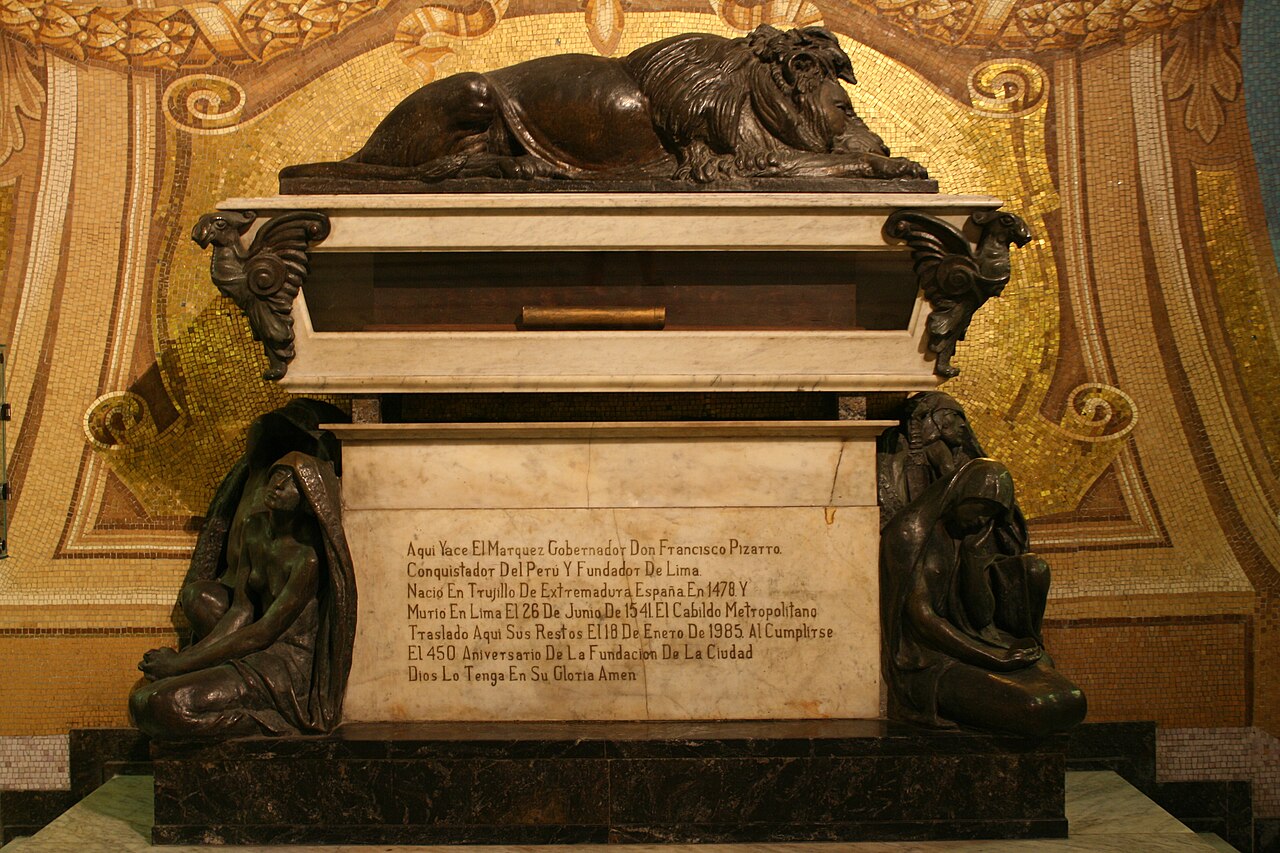 Tomb of Francisco Pizarro in the Lima Cathedral In Lima, on 26 June 1541 "a group of 20 heavily armed supporters of Diego de Almagro II stormed Pizarro's palace, assassinating him and then forcing the terrified city council to appoint young Almagro as the new governor of Peru".[16] "Most of Pizarro's guests fled, but a few fought the intruders, numbered variously between seven and 25. While Pizarro struggled to buckle on his breastplate, his defenders, including his half-brother Martín de Alcántara, were killed".[10]: 143 For his part, Pizarro killed two attackers and ran through a third. A contemporary chronicler, Agustín de Zárate, wrote that Pizarro fought until "he was too exhausted to brandish his sword" and then was struck fatally in the throat. When he fell to the ground he reportedly drew a cross on the floor with his blood and kissed it before dying.[17] A modern forensic examination of his remains indicated that Pizarro had been savagely attacked with multiple stab wounds to his head and neck as well as defensive wounds to his hands and arms.[18] Pizarro's remains were briefly interred in the cathedral courtyard; at some later time, his head and body were separated and buried in separate boxes underneath the floor of the cathedral. In 1892, in preparation for the anniversary of Christopher Columbus' discovery of the Americas, a body believed to be that of Pizarro was exhumed and put on display in a glass coffin. However, in 1977, men working on the cathedral's foundation discovered a lead box in a sealed niche, which bore the inscription: "Here is the head of Marquess Don Francisco Pizarro who discovered and conquered the kingdoms of Peru and presented them to the crown of Castile." A team of forensic scientists from the United States, led by William R. Maples, was invited to examine the two bodies and they soon determined that the body which had been honoured in the glass case for nearly a century had been incorrectly identified. The skull within the lead box not only bore the marks of multiple sword blows, but the features bore a remarkable resemblance to portraits made of the man in life.[19][20] |
死 リマ大聖堂内のフランシスコ・ピサロの墓 1541年6月26日、リマにおいて「重武装したディエゴ・デ・アルマグロ二世の支持者20名がピサロの宮殿に乱入し、彼を暗殺した。その後、恐怖に震え る市議会に若いアルマグロをペルーの新総督に任命するよう強要した」。[16]「ピサロの客人の大半は逃げ出したが、7人から25人と数え方の異なる数名 の者が侵入者と戦った。ピサロが胸当てを装着しようと苦闘する間、異母兄弟マルティン・デ・アルカンタラを含む護衛たちは殺害された」。[10]: 143 ピサロ自身は襲撃者2人を殺害し、3人目を刺し貫いた。同時代の記録者アグスティン・デ・サラーテによれば、ピサロは「剣を振るう力すら失うほど」戦い続 け、その後喉を致命傷で貫かれたという。地面に倒れた彼は、自らの血で床に十字を描き、それを口づけしてから息を引き取ったと伝えられている。[17] 遺体の現代的な法医学的検査によれば、ピサロは頭部と首に複数の刺し傷を受けるという残忍な攻撃を受け、手と腕には防御創があった。[18] ピサロの遺体は一時的に大聖堂の中庭に埋葬された。その後、頭部と胴体が分離され、別々の箱に収められて大聖堂の床下に埋葬された。1892年、クリスト ファー・コロンブスのアメリカ大陸発見記念日を前に、ピサロの遺体と信じられるものが発掘され、ガラス棺に収められて公開された。しかし1977年、大聖 堂の基礎工事中に作業員が密閉されたニッチから鉛の箱を発見した。そこには「ここにペルー王国を発見し征服し、カスティーリャ王冠に献上したドン・フラン シスコ・ピサロ侯爵の頭部あり」と刻まれていた。ウィリアム・R・メイプルズ率いる米国の法医学者チームが両遺体の鑑定を依頼され、ガラスケースでほぼ一 世紀にわたり崇められてきた遺体が誤認されていたことを即座に断定した。鉛箱内の頭蓋骨には複数の剣傷の痕があっただけでなく、その顔貌は生前の肖像画と 驚くほど酷似していたのである。[19][20] |
| Legacy icon This section needs additional citations for verification. Please help improve this article by adding citations to reliable sources in this section. Unsourced material may be challenged and removed. (June 2020) (Learn how and when to remove this message) 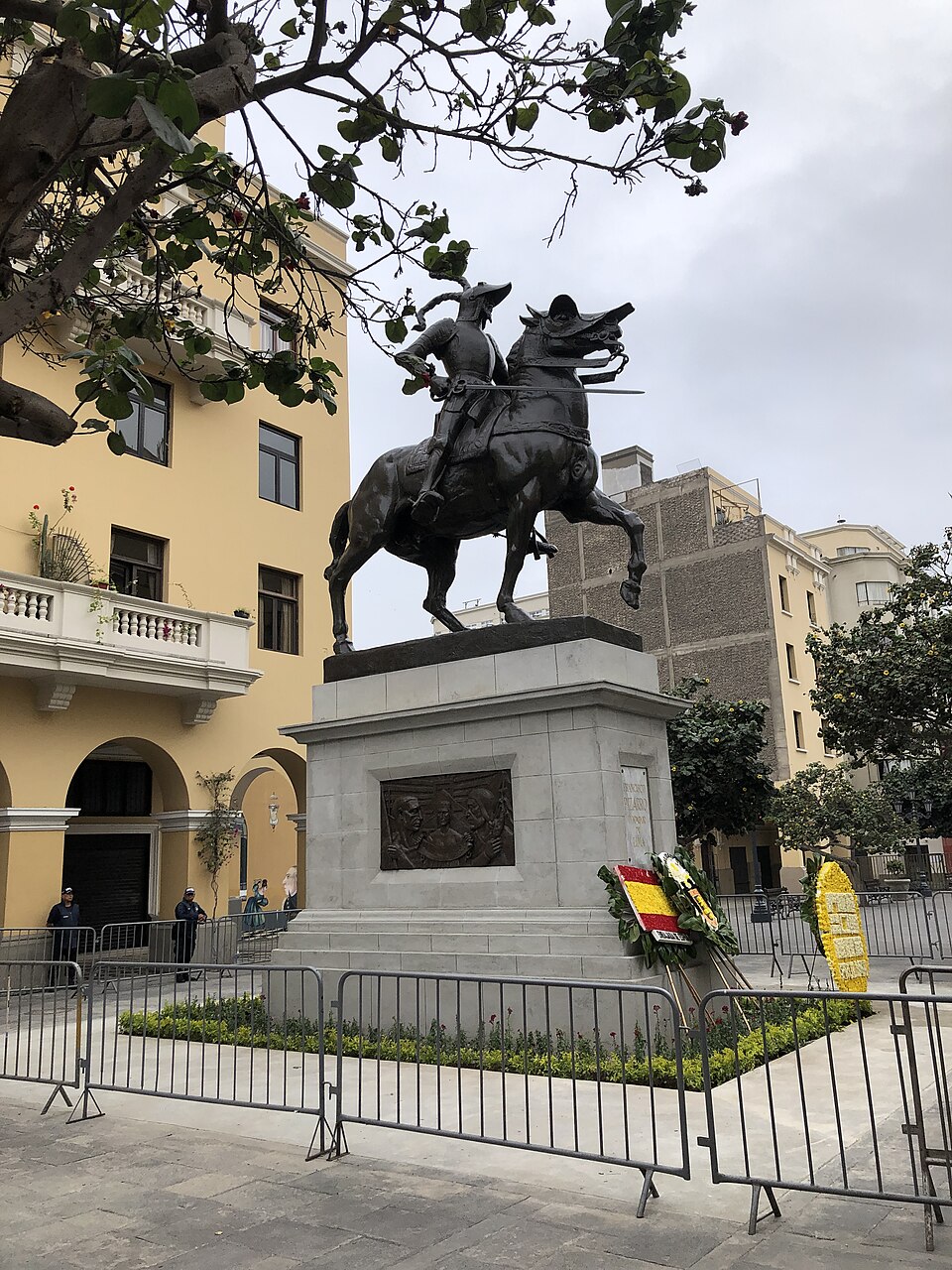 Pizarro's Statue in Lima, Peru 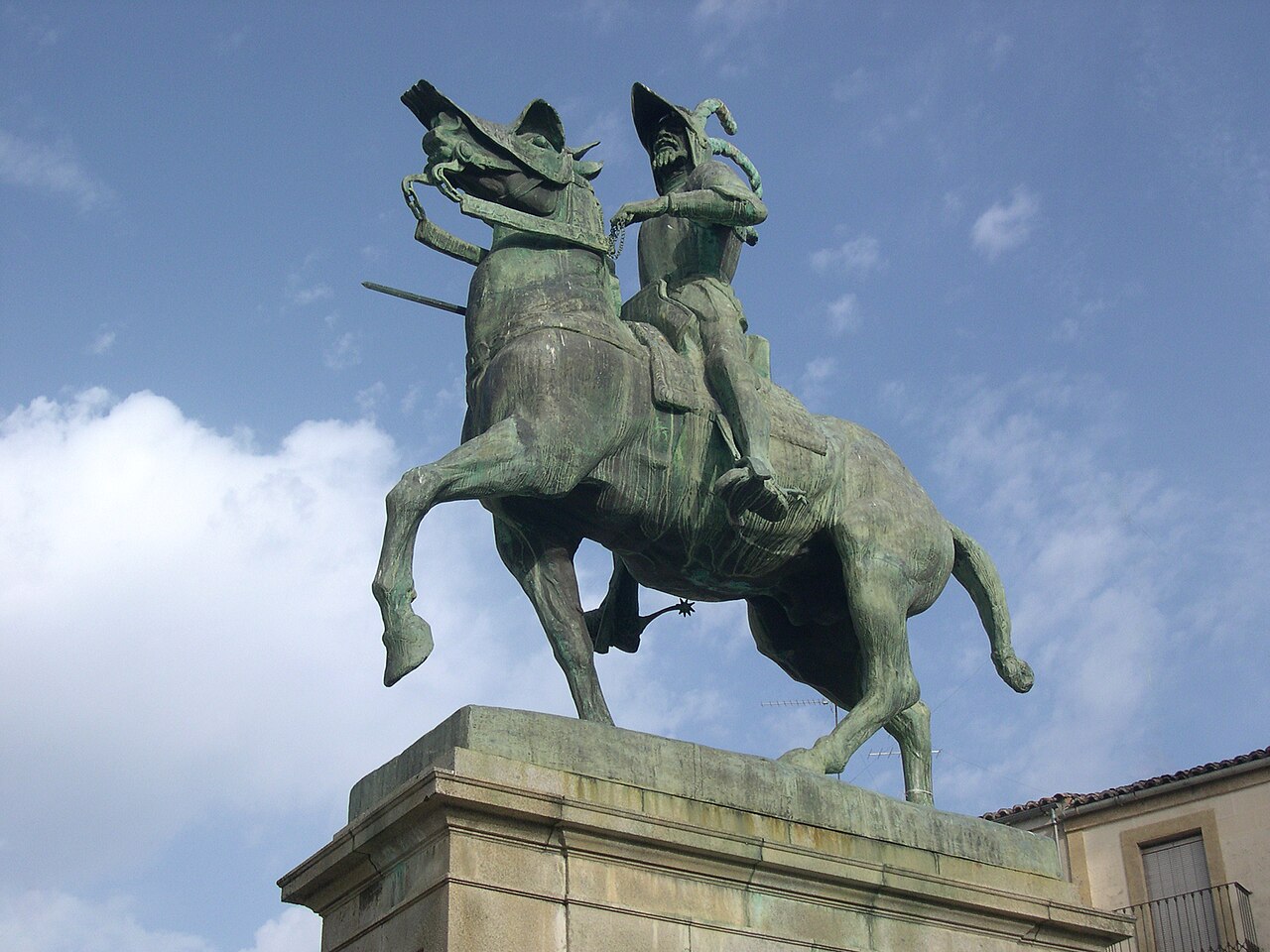 Pizarro's statue in Trujillo, Spain By his marriage to Quispe Sisa, Pizarro had a son also named Francisco, who married his relative Inés Pizarro, without issue. After Pizarro's death, Inés Yupanqui, whom he took as a mistress, Inca princess and favourite sister of Atahualpa, who had been given to Francisco in marriage by her brother, married a Spanish cavalier named Ampuero and left for Spain, taking her daughter who would later be legitimized by imperial decree. Francisca Pizarro Yupanqui eventually married her uncle Hernando Pizarro in Spain on 10 October 1537; the third son of Pizarro who was never legitimized, Francisco, by Dona Angelina, a wife of Atahualpa that he had taken as a mistress, died shortly after reaching Spain.[21] After his invasion, Pizarro destroyed the Inca state and whilst ruling the area for almost a decade, initiated the decline of local cultures. The Incas' polytheistic religion was replaced by Christianity and much of the local population was reduced to serfdom[citation needed] under the Spanish elite[dubious – discuss]. The cities of the Inca Empire were transformed into Spanish Catholic cities. Pizarro has been reviled for ordering Atahualpa's death despite the ransom payment (which Pizarro kept, after paying the Spanish king his due). Some Peruvians, particularly those of indigenous descent, may regard him negatively, although until relatively recently Pizarro had been portrayed positively, for instance in textbooks, for introducing Catholicism and creating a privileged class of mainly Spanish descent.[citation needed] Sculptures In the early 1930s, sculptor Ramsay MacDonald created three copies of an anonymous European foot soldier resembling a conquistador with a helmet, wielding a sword and riding a horse. The first copy was offered to Mexico to represent Cortés, though it was rejected. The statue was taken to Lima in 1934 and re-purposed to represent Pizarro. One other copy of the statue was unveiled in Wisconsin. The mounted statue of Pizarro in the Plaza Mayor in Trujillo, Spain, was created by American sculptor Charles Cary Rumsey. It was presented to the city by his widow in 1926. In Peru, the statue's original location was the atrium of the Metropolitan Cathedral of Lima.[22] In 1952 it was moved to the Plaza Pizarro,[23] and in 2003 it was relocated to Parque de La Muralla after 17 months in a warehouse, without the pedestal with which it was inaugurated and that it had throughout its history, being placed on a concrete base.[24][25] On 15 January 2025, it was again moved to a pedestrian street next to the Plaza Mayor to be inaugurated, with the pedestal, as part of the city's 490th anniversary on the 18th.[26][27] Palace of the Conquest Main article: Palacio de la Conquista 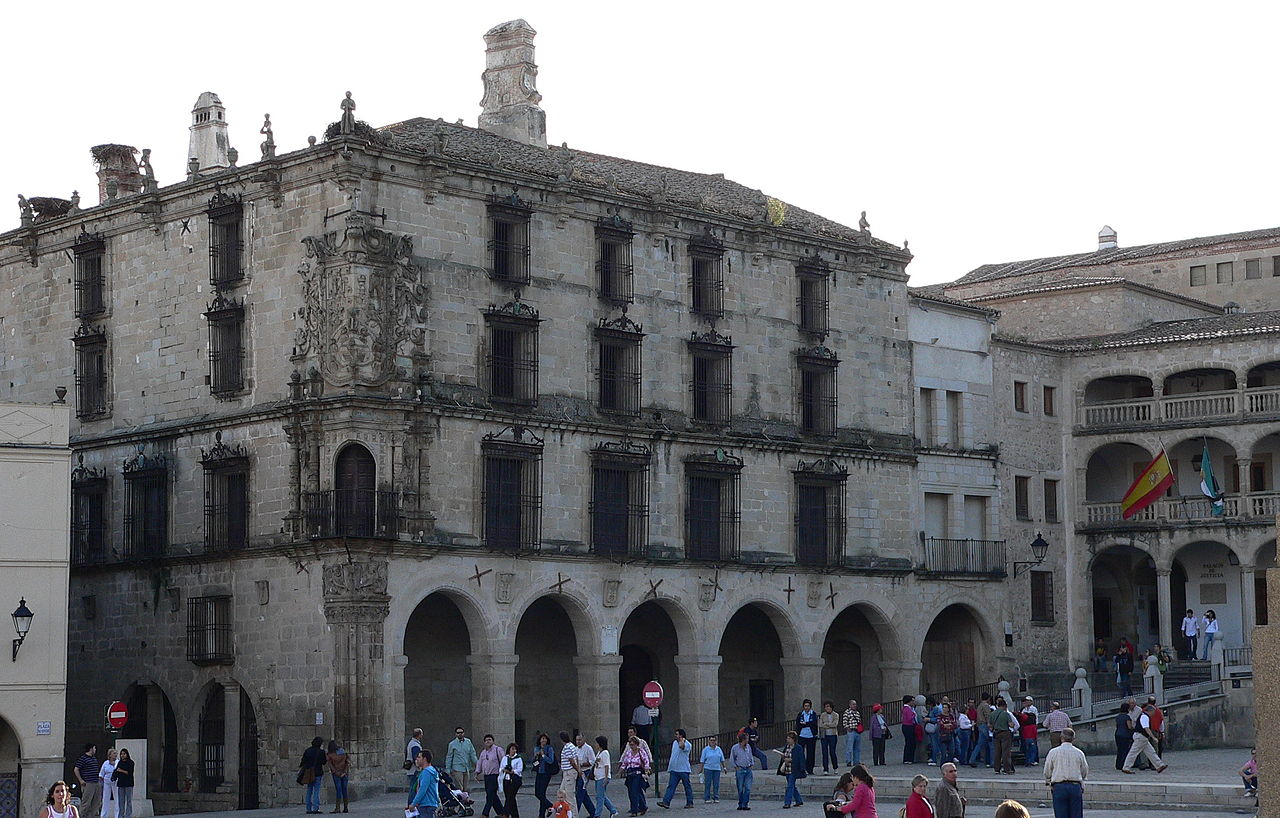 Palace of the Conquest, Trujillo, Spain After returning from Peru extremely wealthy, the Pizarro family erected a plateresque-style palace on the corner of the Plaza Mayor in Trujillo. Francisca Pizarro Yupanqui and her uncle/husband Hernando Pizarro ordered the construction of the palace; it features busts of them and others.[28] It instantly became a recognizable symbol of the plaza. The opulent palace is structured in four stands, giving it the significance of the coat of arms of the Pizarro family, which is situated at one of its corner balconies displaying its iconographic content. The building's decor includes plateresque ornaments and balustrades. |
レガシー アイコン この節は検証可能な情報源を必要としている。信頼できる情報源をこの節に追加して、記事の改善に協力してほしい。出典のない記述は削除される可能性がある。(2020年6月)(このメッセージの削除方法と時期について) ペルー、リマにあるピサロの像 スペイン、トルヒーリョにあるピサロの像 ピサロはキスペ・シサとの結婚により、同じくフランシスコと名付けられた息子をもうけた。この息子は親族であるイネス・ピサロと結婚したが、子供は生まれ なかった。ピサロの死後、彼が愛人として囲っていたインカの王女でアタワルパの寵愛を受ける妹、イネス・ユパンキは、兄によってフランシスコに嫁がされた 後、スペイン人騎士アンプエロと結婚し、後に皇帝の勅令で嫡出子と認められることになる娘を連れてスペインへ去った。フランシスカ・ピサロ・ユパンキは 1537年10月10日、スペインで叔父エルナンド・ピサロと結婚した。ピサロの三男で、アタワルパの妻ドナ・アンヘリーナを妾として得たフランシスコ は、スペイン到着直後に死亡した。[21] ピサロは侵攻後、インカ帝国を滅ぼし、10年近く支配を続ける中で現地文化の衰退を招いた。インカの多神教はキリスト教に取って代わられ、住民の多くはス ペイン人支配層の下で農奴状態に陥った[出典必要]。インカ帝国の都市はスペインのカトリック都市へと変貌した。ピサロは身代金支払い後もアタワルパの処 刑を命じたことで非難されている(身代金はスペイン王への納税後、ピサロが私物化した)。一部のペルー人、特に先住民系住民は彼を否定的に見る場合があ る。とはいえ比較的最近まで、教科書などでカトリック導入や主にスペイン系特権階級の創出を称える形で、ピサロは肯定的に描かれていた。[出典が必要] 彫刻 1930年代初頭、彫刻家ラムゼイ・マクドナルドは、ヘルメットをかぶり剣を携え馬に乗る、征服者に似た無名のヨーロッパ人歩兵の像を3体制作した。最初 の複製はコルテスを象徴するものとしてメキシコに贈呈されたが、拒否された。この像は1934年にリマへ移され、ピサロ像として再利用された。もう1体の 複製像はウィスコンシン州で除幕された。スペイン・トルヒーリョのメイン広場にあるピサロの騎馬像は、アメリカ人彫刻家チャールズ・キャリー・ラムジーの 作である。1926年に彼の未亡人が同市へ寄贈した。 ペルーでは、この像はもともとリマ大聖堂の中庭に設置されていた[22]。 1952年にピサロ広場へ移設され[23]、2003年には17ヶ月間倉庫に保管された後、歴史を通じて使用されてきた台座なしで、コンクリート製の土台 の上に設置され、ラ・ムラーヤ公園へ再移設された。[24][25] 2025年1月15日、同像は再びマヨール広場に隣接する歩行者専用道路へ移設され、18日の都市創立490周年記念行事の一環として台座付きで除幕され た。[26][27] 征服宮殿 詳細記事: Palacio de la Conquista 征服の宮殿、トルヒーリョ、スペイン ペルーから莫大な富を得て帰国したピサロ家は、トルヒーリョのプラサ・マヨール角地にプラテレスコ様式の宮殿を建立した。フランシスカ・ピサロ・ユパンキ とその叔父であり夫でもあるエルナンド・ピサロが宮殿建設を命じ、彼らや他の人物の胸像が飾られている。[28] この宮殿は瞬く間に広場を代表する象徴となった。 豪華な宮殿は四つの基壇で構成され、ピサロ家の紋章を象徴している。その紋章は角のバルコニーの一つに掲げられ、図像的内容を示している。建物の装飾にはプラテレスコ様式の装飾や欄干が含まれている。 |
In popular culture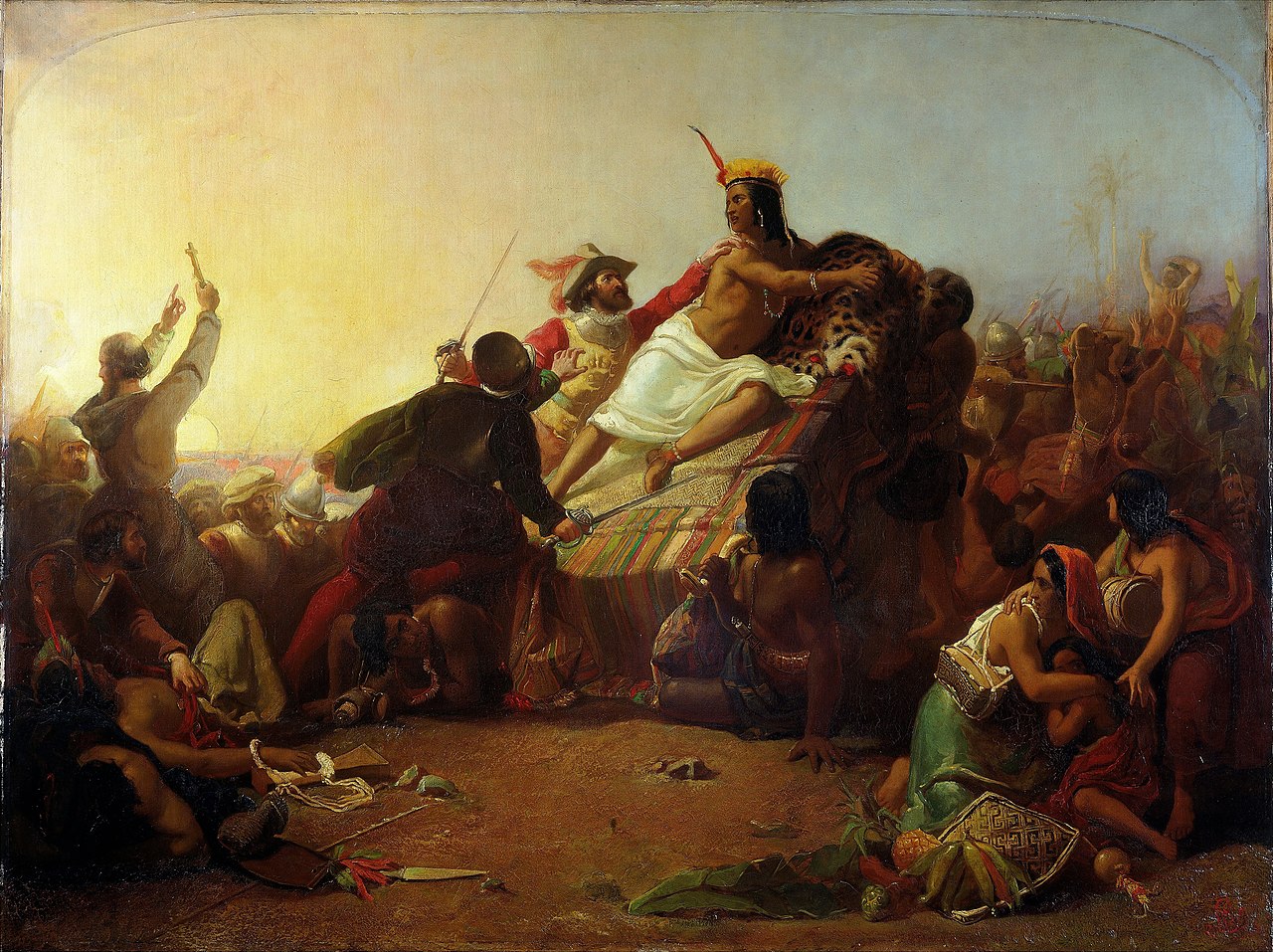 Pizarro Seizing the Inca of Peru by John Everett Millais, 1846 Pizarro is the title and subject of a dramatic tragedy by Richard Brinsley Sheridan, presented in 1799.[29] Sheridan based his work on the German tragedy by August von Kotzebue, Die Spanier in Peru. Pizarro is the main protagonist of the theatre play The Royal Hunt of the Sun and a film of the same name. Rather than an accurate depiction of historical events, its subject is Pizarro's spirituality and personal relationship with Atahualpa. The film mostly stays true to the dialogue-based character of the play and a chamber setting while providing respected actors of the time (1969). Francisco Pizarro is depicted as a major supporting character in The Mysterious Cities of Gold, where he is obsessed with locating one of the seven lost cities of gold. In the English version of the series, the character of Pizarro is voiced by Maurice Podbrey. The novel "Un puñado de gloria" by Eduardo Sguiglia has Francisco Pizarro as one of the main protagonists and narrates his overthrow and fall.[30] Pizarro is also the protagonist in the historical novel The Gold of Caxamalca by Jakob Wassermann. Pizarro is a character in "Surya kandle Sona" (The golden tears of the sun), a novella in Bengali, penned by Premendra Mitra. Pizarro is depicted as a scheming fortune-hunter who conquered Peru by dint of treachery and the ruthless application of the Machiavellian policy of putting expediency above morality. The protagonist of the story is Ghanaram (an ancestor of Ghanashyam Das, a teller of tall tales) who wages a heroic struggle against the Spanish conquistadors to emancipate Peru from the fetters of slavery but ultimately fails to fulfil his mission. (Source: Ghanada Samagra, volume 3, Ananda Publishers) Randall Garrett, known mainly as a science fiction writer, wrote the novelette Despoilers of the Golden Empire, whose language leads readers to believe they are reading a story about a space invasion in the far future, while in fact it describes Pizarro's conquest of the Incas. As noted by Garrett, every word of the story is historically accurate, but it was written in a deliberately misleading way. Pizarro appears in 2025's Civilization VII as a conquistador for the Spanish Empire. He is one of the options for a Great Person during the exploration era.[31] |
ポピュラー・カルチャーにおけるピサロ ジョン・エヴァレット・ミレイ作『ペルーのインカを捕らえるピサロ』(1846年) ピサロはリチャード・ブリンズリー・シェリダンによる劇的悲劇の題名であり主題である。1799年に上演された[29]。シェリダンはアウグスト・フォン・コッツェブーのドイツ悲劇『ペルーのスペイン人』を基にこの作品を作った。 ピサロは舞台劇『太陽の王の狩り』及び同名映画の主人公である。歴史的事実の正確な描写というより、ピサロの精神性とアタワルパとの個人的関係が主題だ。映画は1969年当時の一流俳優を起用しつつ、舞台の対話中心の性格と室内劇的な設定をほぼ忠実に再現している。 フランシスコ・ピサロは『黄金の七都市』において主要な脇役として描かれ、七つの失われた黄金都市の一つを探すことに執着している。英語版シリーズでは、ピサロのキャラクターはモーリス・ポッドブレイが声を担当している。 エドゥアルド・スギージャの小説『一握りの栄光』では、フランシスコ・ピサロが主要な主人公の一人として登場し、彼の失脚と没落が語られる。[30] ヤコブ・ヴァッサーマンの歴史小説『カシャマルカの黄金』でもピサロは主人公である。 ベンガル語中編小説『太陽の黄金の涙』(原題:Surya kandle Sona)では、ピサロはプレメンドラ・ミトラによって描かれた登場人物である。ピサロは、ペルーを征服した狡猾な野心家として描かれている。彼は裏切り と、道徳よりも便宜を優先するマキャベリ主義的政策を冷酷に実行することで成功を収めた。物語の主人公はガナラム(誇張話師ガナシャム・ダスの祖先)であ り、スペインの征服者たちに対して英雄的な戦いを繰り広げ、ペルーを奴隷制の束縛から解放しようとするが、最終的には使命を果たせなかった。(出典: Ghanada Samagra 第3巻、Ananda Publishers) 主にSF作家として知られるランドール・ギャレットは、中編小説『黄金帝国の略奪者たち』を執筆した。その文体は読者に遠い未来の宇宙侵略物語を読んでい ると思わせるが、実際にはピサロによるインカ征服を描いている。ギャレットが指摘したように、物語の一語一語は歴史的に正確だが、意図的に誤解を招く形で 書かれている。 ピサロは2025年発売の『シヴィライゼーションVII』において、スペイン帝国の征服者として登場する。彼は探索時代における偉人候補の一人である。[31] |
| Works of Pizarro Pizarro, Francisco (15 January 2009). "Cartas del Marqués Don Francisco Pizarro (1533–1541)". KUPRIENKO. bloknot.info (A. Skromnitsky). Pizarro, Francisco (15 January 2009). "Cédula de encomienda de Francisco Pizarro a Diego Maldonado, Cuzco, 15 de abril de 1539". KUPRIENKO. bloknot.info (A. Skromnitsky, in Russian). "Francisco Pizarro response to a petition by Pedro del Barco", 14 April 1539. From the Collections at the Library of Congress |
ピサロの著作 ピサロ、フランシスコ(2009年1月15日)。「ドン・フランシスコ・ピサロ侯爵の手紙(1533–1541年)」。クプリエンコ。bloknot.info(A. スクロムニツキー)。 ピサロ、フランシスコ(2009年1月15日)。「フランシスコ・ピサロからディエゴ・マルドナドへのエンコミエンダ委任状、クスコ、1539年4月15日」。クプリエンコ。bloknot.info(A. スクロムニツキー、ロシア語)。 「ペドロ・デル・バルコの請願に対するフランシスコ・ピサロの回答」、1539年4月14日。米国議会図書館所蔵 |
| References 01. Cúneo-Vidal, R.: "Los hijos americanos de los Pizarros de la conquista". "Francisco Pizarro | Biography, Accomplishments, & Facts". britannica.com. Retrieved 10 April 2022. "Francisco Pizarro". Catholic Encyclopedia. Retrieved 11 January 2012. "Pizarro". Euskalmet. Archived from the original on 4 June 2011. Retrieved 20 April 2011. Machado, José Timoteo Montalvão (1970). Dos Pizarros de Espanha Aos de Portugal E Brasil - História E Genealogia. Penn Warren, Robert. "Biography of Alonso de Ojeda". chroniclesofamerica.com. Robert Penn Warren. Retrieved 18 January 2017. Prescott, W.H., 2011, The History of the Conquest of Peru, Digireads.com Publishing, ISBN 9781420941142 Hemming, John (1970). The Conquest of the Incas. Harcourt. p. 23. ISBN 978-0-15-122560-6. Andagoya, Pascual de (12 August 1865). Narrative of the Proceedings of Pedrarias Davila (1865). 10. Leon, P.; (1998), The Discovery and Conquest of Peru, Chronicles of the New World Encounter, edited and translated by Cook and Cook, Durham, Duke University Press, ISBN 978-0822321460 "college.hmco.com". Pizzaro, P. (1571), Relation of the Discovery and Conquest of the Kingdoms of Peru, Vol. 1–2, New York, Cortes Society, RareBooksClub.com, ISBN 978-1235937859 Francisco Pizarro, Catholic Encyclopedia. "The History of the Conquest of Peru by William H. Prescott – Full Text Free Book (Part 8/17)". fullbooks.com. de Betanzos, Juan; Hamilton, Roland; Buchanan, Dana (1996). Narrative of the Incas. University of Texas Press. ISBN 978-0-292-75559-8. Following Pizarro's assassination, Doña Angelina married the interpreter Juan de Betanzos. Burkholder, Mark A.; Johnson, Lyman L. (2004). Colonial Latin America. Oxford University Press. p. 59. ISBN 978-0-19-515685-0. Stirling 2005, p. 141. "[1] Exploring the Inca Heartland - Pizarro's Family and His Head", Archaeology, Archaeological Institute of America, 1 September 1999. Maples, W.R.; Gatliff, B.P.; Ludeña, H.; Benfer, R.; Goza, W. (1989). "The death and mortal remains of Francisco Pizarro". Journal of Forensic Sciences. 34 (4): 1021–1036. doi:10.1520/JFS12733J. PMID 2668443. 20. Maxey, R.; "The Misplaced Conquistador – Francisco Pizarro Archived 19 January 2016 at the Wayback Machine." Prescott, William; History of the Conquest of Peru Archived 26 January 2016 at the Wayback Machine, chapter 28. Cáceda, Mónica (2 May 2003). "El enemigo de Pizarro". Peru.com. Archived from the original on 10 July 2007. Retrieved 8 December 2023. Hess, Peter (17 May 2013). "Pizarro in Exile". Cultures Contexts. University of Texas. "Francisco Pizarro cabalga hacia el olvido en Lima, la ciudad que fundó". RPP Noticias. 18 January 2017. Fernández Arribasplata, María (17 January 2011). "Las movidas de don Francisco". El Comercio. "Así se trasladó el monumento de Francisco Pizarro a su nueva ubicación". El Comercio. 17 January 2025. Romaña, Andrés (16 January 2025). "Estatua de Francisco Pizarro ya se encuentra en el Centro Histórico de Lima". Perú 21. "Palacio de la Conquista". Archived from the original on 7 May 2016. Retrieved 22 April 2016. Watson, George (1971). The New Cambridge Bibliography of English Literature: Volume 2; Volumes 1660–1800. Cambridge University Press. ISBN 978-0-521-07934-1. 30. Sguiglia, Eduardo (2003). Un puñado de gloria (in Spanish). Grijalbo Mondadori. ISBN 978-950-28-0287-9. "SPAIN - EXPLORATION AGE CIVILIZATION". civilization.2k.com. 2K Games. Retrieved 12 June 2025. |
参考文献 01. クネオ=ビダル, R.: 「征服期のピサロ家のアメリカの子孫たち」 「フランシスコ・ピサロ|伝記、功績、事実」britannica.com. 2022年4月10日閲覧。 「フランシスコ・ピサロ」カトリック百科事典. 2012年1月11日閲覧。 「Pizarro」. Euskalmet. 2011年6月4日時点のオリジナルからアーカイブ. 2011年4月20日閲覧. Machado, José Timoteo Montalvão (1970). Dos Pizarros de Espanha Aos de Portugal E Brasil - História E Genealogia. ペン・ウォーレン、ロバート。「アロンソ・デ・オヘダの伝記」。chroniclesofamerica.com。ロバート・ペン・ウォーレン。2017年1月18日閲覧。 プレスコット、W.H.、2011年、『ペルー征服の歴史』、Digireads.com Publishing、ISBN 9781420941142 ヘミング、ジョン (1970). 『インカ帝国征服史』. ハークート. p. 23. ISBN 978-0-15-122560-6. アンダゴヤ、パスカル・デ (1865年8月12日). 『ペドラリアス・ダビージャの記録 (1865年)』. 10. レオン, P.; (1998), 『ペルーの発見と征服』, 新世界遭遇の年代記, クックとクックによる編集・翻訳, デュラム, デューク大学出版局, ISBN 978-0822321460 「college.hmco.com」. ピサロ、P. (1571)、『ペルー王国発見と征服の経緯』、第 1 巻~第 2 巻、ニューヨーク、コルテス協会、RareBooksClub.com、ISBN 978-1235937859 フランシスコ・ピサロ、カトリック百科事典。 「ウィリアム・H・プレスコット著『ペルー征服の歴史』全文無料書籍(第 8/17 部)」。fullbooks.com。 de Betanzos, Juan; Hamilton, Roland; Buchanan, Dana (1996). Narrative of the Incas. University of Texas Press. ISBN 978-0-292-75559-8. ピサロの暗殺後、ドニャ・アンヘリーナは通訳のフアン・デ・ベタンソスと結婚した。 バークホルダー、マーク A.、ジョンソン、ライマン L. (2004)。『植民地時代のラテンアメリカ』。オックスフォード大学出版局。59 ページ。ISBN 978-0-19-515685-0。 スターリング 2005、141 ページ。 「[1] インカの中心地を探る - ピサロの家族と彼の首」、『考古学』、アメリカ考古学協会、1999年9月1日。 メイプルズ、W.R.;ガトリフ、B.P.;ルデニャ、H.;ベンファー、R.;ゴザ、W.(1989)。「フランシスコ・ピサロの死と遺骸」。法科学 ジャーナル。34巻4号:1021–1036頁。doi:10.1520/JFS12733J。PMID 2668443。 20. マクシー、R.;「置き去りにされた征服者 - フランシスコ・ピサロ」ウェイバックマシンに2016年1月19日アーカイブ。 プレスコット、ウィリアム; 『ペルー征服史』第28章。 カセダ、モニカ (2003年5月2日). 「ピサロの敵」. Peru.com. 2007年7月10日時点のオリジナルからアーカイブ. 2023年12月8日閲覧。 ヘス、ピーター(2013年5月17日)。「亡命中のピサロ」。カルチャーズ・コンテクスト。テキサス大学。 「フランシスコ・ピサロ、彼が創設した都市リマで忘れ去られゆく」。RPPニュース。2017年1月18日。 フェルナンデス・アリバスプラタ、マリア(2011年1月17日)。「ドン・フランシスコの動き」。エル・コメルシオ。 「フランシスコ・ピサロの記念碑が新場所へ移設された経緯」。エル・コメルシオ。2025年1月17日。 ロマニャ、アンドレス(2025年1月16日)。「フランシスコ・ピサロ像がリマ歴史地区に設置」。ペルー21。 「征服宮殿」。2016年5月7日時点のオリジナルからアーカイブ。2016年4月22日閲覧。 ワトソン、ジョージ(1971)。『新ケンブリッジ英文学書誌:第2巻;1660–1800年』。ケンブリッジ大学出版局。ISBN 978-0-521-07934-1。 30. エドゥアルド・スギリア(2003)。『一握りの栄光』(スペイン語)。グリハルボ・モンダドーリ。ISBN 978-950-28-0287-9。 「スペイン - 探検時代の文明」。civilization.2k.com。2K Games。2025年6月12日閲覧。 |
| Further reading MacQuarrie, Kim (2007). The Last Days of the Incas. ISBN 978-0-7432-6049-7. Rowe, John H. (2006). "The Inca civil war and the establishment of Spanish power in Peru". Ñawpa Pacha - Journal of Andean Archaeology. 28 (28): 1–9. doi:10.1179/naw.2006.28.1.002. ISSN 0077-6297. JSTOR 27977824. S2CID 140711175. Stirling, Stuart (2005). Pizarro - conqueror of the Inca. Sutton Pub. ISBN 0-7509-3682-7. Varón Gabai, Rafael (1997). Francisco Pizarro and His Brothers - The Illusion of Power in Sixteenth-century Peru. University of Oklahoma Press. ISBN 0-585-17048-7. OCLC 44963949. Conquest of the Incas, John Hemming, 1973, ISBN 0-15-602826-3 The Discovery and Conquest of Peru by William H. Prescott, ISBN 0-7607-6137-X Fiction Cajamarca o la Leyenda Negra, a tragedy for the theater in Spanish by Santiago Sevilla in Liceus El Portal de las Humanidades Pizarro, a tragedy, by Richard Brinsley Sheridan, in Google books |
追加文献(さらに読む) マッコーリー、キム(2007)。『インカ最後の日々』。ISBN 978-0-7432-6049-7。 ロウ、ジョン・H.(2006)。「インカ内戦とペルーにおけるスペイン勢力の確立」。『ニャウパ・パチャ - アンデス考古学ジャーナル』。28 (28): 1–9. doi:10.1179/naw.2006.28.1.002. ISSN 0077-6297. JSTOR 27977824. S2CID 140711175. スターリング、スチュワート (2005)。ピサロ - インカの征服者。サットン出版。ISBN 0-7509-3682-7。 バロン・ガバイ、ラファエル (1997)。フランシスコ・ピサロとその兄弟たち - 16 世紀ペルーにおける権力の幻想。オクラホマ大学出版。ISBN 0-585-17048-7。OCLC 44963949。 インカの征服、ジョン・ヘミング、1973年、ISBN 0-15-602826-3 『ペルーの発見と征服』ウィリアム・H・プレスコット著、ISBN 0-7607-6137-X フィクション 『カハマルカ、あるいは黒い伝説』サンティアゴ・セビージャ作、スペイン語劇、リセウス・エル・ポータル・デ・ラス・ウマーニダデス所蔵 『ピサロ』リチャード・ブリンズリー・シェリダン作、悲劇、Googleブックス所蔵 |
| https://en.wikipedia.org/wiki/Francisco_Pizarro |
リ ンク
文 献
そ の他の情報
CC
Copyleft,
CC, Mitzub'ixi Quq Chi'j, 1996-2099