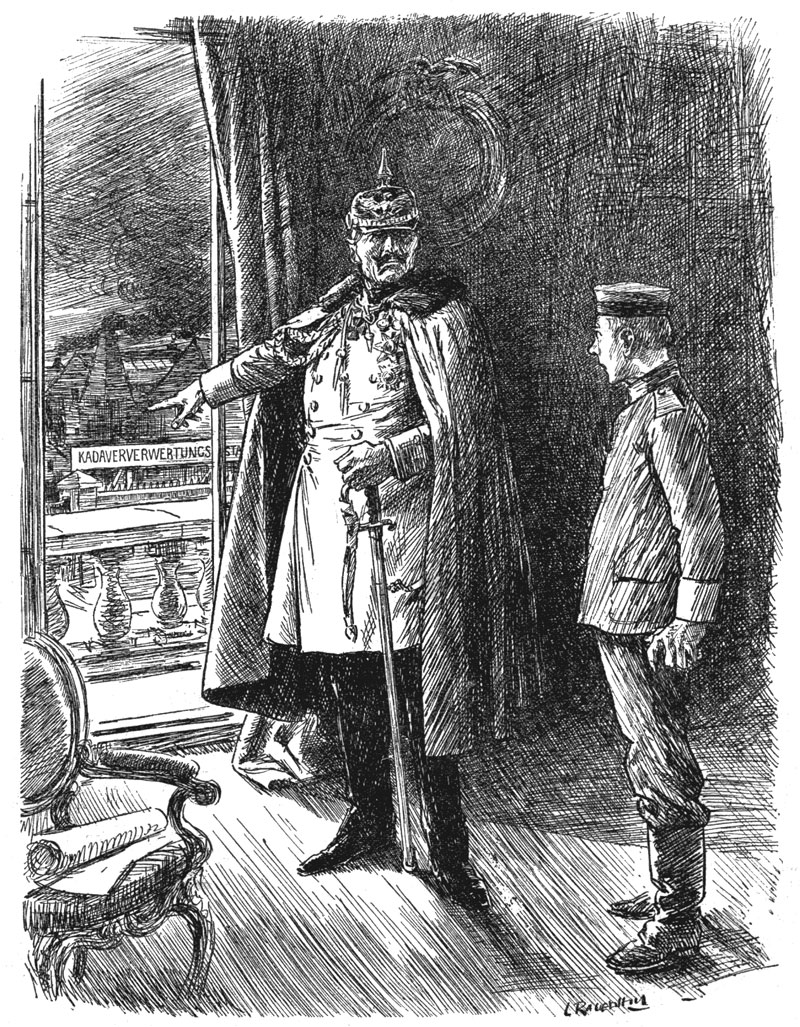
ドイツの死体処理工場
German Corpse Factory,
Kadaververwertungsanstalt
Wilhelm
II to a recruit. "And don't forget that your Kaiser will find a use for
you—alive or dead." Punch, 25 April 1917
☆ドイツの死体工場[German Corpse
Factory]、
あるいはカダーヴェルフェルツァルツタンスタンス(直訳「死体利用工場」)は、第一次世界大戦中の連合国間で繰り返し流布された残虐宣伝の一つである。こ
れはドイツ帝国が第一次世界大戦中に人間の死体を脂肪抽出に利用したという主張を記述したものである。戦後、英国とフランスで行われた調査により、これら
の話は虚偽であることが明らかになった[2]。
典型的な説によれば、カダヴェルフェルヴァルトゥングスアンスタルトはドイツ軍が運営する特殊施設であり、連合国による封鎖下で油脂製品が不足したため、
戦場のドイツ軍死体を油脂抽出に利用し、その油脂をニトログリセリン、蝋燭、潤滑油、さらには靴用油の製造に用いていたとされる。この施設は前線の後方
で、DAVG(Deutsche Abfall-Verwertungs
Gesellschaft、ドイツ廃棄物利用会社)によって運営されていたとされる。
歴史家ピアーズ・ブレンドンはこれを第一次世界大戦における「最も恐ろしい残虐行為の噂」と呼び[3]、ジャーナリストのフィリップ・ナイトリーは「この
戦争で最も広まった残虐行為の噂」と評している。[4]
戦後、英国遠征軍情報部長を務めたジョン・チャーターズは演説で、この話をプロパガンダ目的で創作したと述べたとされる。主な目的は中国を対独戦争に参戦
させることだった。
近年の研究者はチャーターズが創作したとする説を信用していない[5]。プロパガンダ史家ランダル・マーリンは「この話の真の出所はノースクリフ・プレス
の紙面にある」と述べ、ノースクリフ卿が所有する新聞を指している。エイドリアン・グレゴリーは、この話は長年流布していた噂に起源があり、特定の個人に
よって「創作」されたものではないと推測している。「死体処理工場は、悪意あるプロパガンダ担当者の発明品ではない。それは民衆の伝承、いわゆる『都市伝
説』であり、公式に言及される数ヶ月前から既に広まっていたのだ」[6]
| The German Corpse
Factory or Kadaververwertungsanstalt (literally "Carcass-Utilization
Factory"), also sometimes called the "German Corpse-Rendering Works" or
"Tallow Factory"[1] was a recurring work of atrocity propaganda among
the Allies of World War I, describing the German Empire's supposed use
of human corpses in fat rendering during World War I. In the postwar
years, investigations in Britain and France revealed that these stories
were false.[2] According to a typical version of the story, the Kadaververwertungsanstalt was a special installation operated by the Germans in which, due to fat product scarcety amid the allied blockade, German battlefield corpses were rendered down for fat, which was then used to manufacture nitroglycerine, candles, lubricants, and even boot dubbin. It was supposedly operated behind the front lines by the DAVG — Deutsche Abfall-Verwertungs Gesellschaft ("German Waste Utilization Company"). Historian Piers Brendon has called it "the most appalling atrocity story" of World War I,[3] while journalist Phillip Knightley has called it "the most popular atrocity story of the war."[4] After the war, John Charteris, the former Chief of Intelligence at the British Expeditionary Force, allegedly stated in a speech that he had invented the story for propaganda purposes, with the principal aim of getting the Chinese to join the war against Germany. Recent scholars do not credit the claim that Charteris created the story.[5] Propaganda historian Randal Marlin says "the real source for the story is to be found in the pages of the Northcliffe press", referring to newspapers owned by Lord Northcliffe. Adrian Gregory presumes that the story originated from rumours that had been circulating for years, and that it was not "invented" by any individual: "The corpse-rendering factory was not the invention of a diabolical propagandist; it was a popular folktale, an 'urban myth', which had been circulated for months before it received any official notice."[6] |
ドイツの死体工場[German Corpse
Factory]、あるいはカダーヴェルフェルツァルツタンスタンス
(直訳「死体利用工場」)は、第一次世界大戦中の連合国間で繰り返し流布された残虐宣伝の一つである。これはドイツ帝国が第一次世界大戦中に人間の死体を
脂肪抽出に利用したという主張を記述したものである。戦後、英国とフランスで行われた調査により、これらの話は虚偽であることが明らかになった[2]。 典型的な説によれば、カダヴェルフェルヴァルトゥングスアンスタルトはドイツ軍が運営する特殊施設であり、連合国による封鎖下で油脂製品が不足したため、 戦場のドイツ軍死体を油脂抽出に利用し、その油脂をニトログリセリン、蝋燭、潤滑油、さらには靴用油の製造に用いていたとされる。この施設は前線の後方 で、DAVG(Deutsche Abfall-Verwertungs Gesellschaft、ドイツ廃棄物利用会社)によって運営されていたとされる。 歴史家ピアーズ・ブレンドンはこれを第一次世界大戦における「最も恐ろしい残虐行為の噂」と呼び[3]、ジャーナリストのフィリップ・ナイトリーは「この 戦争で最も広まった残虐行為の噂」と評している。[4] 戦後、英国遠征軍情報部長を務めたジョン・チャーターズは演説で、この話をプロパガンダ目的で創作したと述べたとされる。主な目的は中国を対独戦争に参戦 させることだった。 近年の研究者はチャーターズが創作したとする説を信用していない[5]。プロパガンダ史家ランダル・マーリンは「この話の真の出所はノースクリフ・プレス の紙面にある」と述べ、ノースクリフ卿が所有する新聞を指している。エイドリアン・グレゴリーは、この話は長年流布していた噂に起源があり、特定の個人に よって「創作」されたものではないと推測している。「死体処理工場は、悪意あるプロパガンダ担当者の発明品ではない。それは民衆の伝承、いわゆる『都市伝 説』であり、公式に言及される数ヶ月前から既に広まっていたのだ」[6] |
| History Rumours and cartoons Rumours that the Germans used the bodies of their soldiers to create fat appear to have been circulating by 1915. Cynthia Asquith noted in her diary on 16 June 1915: “We discussed the rumour that the Germans utilise even their corpses by converting them into glycerine with the by-product of soap.”[7] Such stories also appeared in the American press in 1915 and 1916.[7] The French press also took it up in Le Gaulois, in February, 1916.[7] In 1916 a book of cartoons by Louis Raemaekers was published. One depicted bodies of German soldiers being loaded onto a cart in neatly packaged batches. This was accompanied with a comment written by Horace Vachell: “I am told by an eminent chemist that six pounds of glycerine can be extracted from the corpse of a fairly well nourished Hun... These unfortunates, when alive, were driven ruthlessly to inevitable slaughter. They are sent as ruthlessly to the blast furnaces. One million dead men are resolved into six million pounds of glycerine."[7] A later cartoon by Bruce Bairnsfather also referred to the rumour, depicting a German munitions worker looking at a can of glycerine and saying "Alas! My poor Brother!" (parodying a well-known advertisement for Bovril).[7] By 1917 the British and their allies were hoping to bring China into the war against Germany. On 26 February 1917 the English-language North-China Daily News published a story that the Chinese President Feng Guozhang had been horrified by Admiral Paul von Hintze's attempts to impress him when the "Admiral triumphantly stated that they were extracting glycerine out of dead soldiers!". The story was picked up by other papers.[7] In all these cases the story was told as rumour, or as something heard from people supposed to be 'in the know'. It was not presented as documented fact.[7] |
歴史 噂と風刺画 ドイツ軍が兵士の遺体から脂肪を製造したという噂は、1915年までに広まっていたようだ。シンシア・アスキスは1915年6月16日の日記にこう記して いる。「我々は噂について議論した。ドイツ軍は遺体すら利用し、石鹸の副産物であるグリセリンに変換しているという噂だ」 [7] この種の噂は1915年と1916年にアメリカの新聞でも報じられた。[7] フランスの新聞『ル・ゴーロワ』も1916年2月にこれを掲載した。[7] 1916年にはルイ・ラエマカーズの風刺画集が出版された。ある絵は、整然と梱包されたドイツ兵の遺体が荷車に積み込まれる様子を描いていた。これにはホ ラティウス・ヴァッシェルの解説が添えられていた。「著名な化学者によれば、栄養状態が比較的良好なフン族(ドイツ兵)の死体からは6ポンドのグリセリン が抽出できるそうだ…これらの不幸な者たちは、生前には容赦なく屠殺へと駆り立てられた。死後も同様に容赦なく高炉へと送られるのだ。百万の死者が六百万 ポンドのグリセリンへと分解されるのだ。」[7] 後にブルース・バーンズファーザーが描いた風刺画もこの噂を引用し、ドイツの軍需工場労働者がグリセリンの缶を見て「ああ!哀れな我が兄弟よ!」と呟く様 子を描いた(ボヴリルの有名な広告をパロディ化したもの)。[7] 1917年までに、英国とその同盟国は中国を対独戦争に引き入れようとしていた。1917年2月26日、英字紙『北華日報』は、中国大統領・馮国璋が、 ポール・フォン・ヒンツェ提督の誇示的な態度に衝撃を受けたと報じた。提督は「我々は死んだ兵士からグリセリンを抽出している!」と誇らしげに宣言したと いうのだ。この話は他の新聞にも取り上げられた。[7] いずれの場合も、この話は噂として、あるいは「事情通」とされる人々から聞いた話として伝えられた。文書化された事実として提示されたわけではない。[7] |
| The Corpse factory The first English language account of a real and locatable Kadaververwertungsanstalt appeared in the 16 April 1917 issue of The Times of London. In a short piece at the foot of its "Through German Eyes" review of the German press, it quoted from a recent issue of the German newspaper Berliner Lokal-Anzeiger a very brief story by reporter Karl Rosner of only 59 words in length, which described the bad smell coming from a "Kadaver" rendering factory, making no reference to the corpses being human.[8][5] The following day, 17 April 1917, the story was repeated more prominently in editions of The Times and Daily Mail (both owned by Lord Northcliffe at the time), The Times running it under the title Germans and their Dead,[9] in the context of a 500-plus word story which the editorial introduction stated came from the 10 April edition of the Belgian newspaper l'Indépendance Belge published in England, which in turn had received it from La Belgique, another Belgian newspaper published in Leiden, The Netherlands. The Belgian account stated specifically that the bodies were those of soldiers and interpreted the word "kadaver" as a reference to human corpses.[10] The story described how corpses arrived by rail at the factory, which was placed "deep in forest country" and surrounded by an electrified fence, and how they were rendered for their fats which were then further processed into stearin (a form of tallow). It went on to claim that this was then used to make soap, or refined into an oil "of yellowish brown colour". The supposedly incriminating passage in the original German article was translated in the following words: We pass through Evergnicourt. There is a dull smell in the air, as if lime were being burnt. We are passing the great Corpse Utilization Establishment (Kadaververwertungsanstalt) of this Army Group. The fat that is won here is turned into lubricating oils, and everything else is ground down in the bones mill into a powder, which is used for mixing with pigs' food and as manure. A debate followed in the pages of The Times and other papers. The Times stated that it had received a number of letters "questioning the translation of the German word Kadaver, and suggesting that it is not used of human bodies. As to this, the best authorities are agreed that it is also used of the bodies of animals." Letters were also received confirming the story from Belgian and Dutch sources and later from Romania.[citation needed] The New York Times reported on 20 April that the article was being credited by all the French newspapers with the exception of the Paris-Midi, which preferred to believe that the corpses in question were those of animals rather than humans. The New York Times itself did not credit the story, pointing out that it appeared in early April and that German newspapers traditionally indulged in April Fools' Day pranks, and also that the expression "Kadaver" was not employed in current German usage to mean a human corpse, the word "Leichnam" being used instead.[11] The only exception was corpses used for dissection—cadavers.[citation needed] On 25 April the weekly British humorous magazine Punch printed a cartoon entitled "Cannon-Fodder—and After," which showed the Kaiser and a German recruit. Pointing out of a window at a factory with smoking chimneys and the sign "Kadaververwertungs[anstalt]," the Kaiser tells the young man: "And don't forget that your Kaiser will find a use for you—alive or dead."[12] On 30 April the story was raised in the House of Commons, and the government declined to endorse it. Lord Robert Cecil declared that he had no information beyond newspaper reports. He added that, "in view of other actions by German military authorities, there is nothing incredible in the present charge against them." However, the government, he said, had neither the responsibility nor the resources to investigate the allegations. In the months that followed, the account of the Kadaververwertungsanstalt circulated worldwide, but never expanded beyond the account printed in The Times; no eyewitnesses ever appeared, and the story was never enlarged or amplified. Some individuals within the government nonetheless hoped to exploit the story, and Charles Masterman, director of the War Propaganda Bureau at Wellington House, was asked to prepare a short pamphlet. This was never published, however. Masterman and his mentor, Prime Minister David Lloyd George, never took the story seriously.[citation needed] An undated anonymous pamphlet entitled A 'corpse-conversion' Factory: A Peep Behind the German Lines was published by Darling & Son, probably around this time in 1917. A month later, The Times revived the rumour by publishing a captured German Army order that made reference to a Kadaver factory. It was issued by the VsdOK, which The Times interpreted as Verordnungs-Stelle ("instructions department"). The Frankfurter Zeitung, however, insisted that it stood for Veterinar-Station (veterinary station). The Foreign Office agreed that order could only be referring to "the carcasses of horses."[13] Paul Fussell has also suggested that this may have been a deliberate British mistranslation of the phrase Kadaver Anstalt on a captured German order that all available animal remains be sent to an installation to be reduced to tallow.[14] |
死体処理場 実在し位置特定可能なカダヴェルフェルツァルツングスアンシュタルト(死体処理場)に関する最初の英語記事は、1917年4月16日付ロンドン・タイムズ 紙に掲載された。同紙の「ドイツの視点」欄(ドイツ紙評)の末尾に掲載された短い記事で、ドイツ紙ベルリナー・ロカル・アンツァイガーの最新号から、記者 カール・ロスナーによるわずか59語の極短記事を引用した。そこでは「カダーバー」処理工場から漂う悪臭について記述されており、死体が人間であることに は一切言及していない。[8] [5] 翌日1917年4月17日、この記事は『タイムズ』紙と『デイリー・メール』紙(当時いずれもノースクリフ卿が所有)でより目立つ形で再掲載された。『タ イムズ』紙は「ドイツ人とその死者」という見出しで掲載した[9]。これは500語以上の記事の一部であり、編集部の紹介文によれば、ベルギー紙『ル・ア ンデパンダンス・ベルジュ』の4月10日付版(英国で発行)からの転載で、同紙はオランダ・ライデンで発行される別のベルギー紙『ラ・ベルジック』から受 け取ったものだった。ベルギー側の記事は、遺体が兵士の死体であることを明確に述べ、「カダーバー」という単語を人間の死体を指すものと解釈していた [10]。 記事は、死体が鉄道で「深い森林地帯」に位置し電気柵で囲まれた工場に運ばれ、脂肪を抽出するために処理され、さらにステアリン(獣脂の一種)に加工され る過程を記述していた。さらに、この油脂が石鹸製造に用いられるか、あるいは「黄褐色の油」に精製されると主張していた。ドイツ語原文記事中の問題とされ る箇所は、以下の言葉で翻訳されていた: 我々はエヴェルニクールを通過する。空気には石灰を焼いているかのような鈍い臭いが漂っている。我々は、この軍集団の巨大な死体処理施設(カダーヴェル フェルヴァルトゥングスアンスタルト)の前を通り過ぎている。ここで得られる脂肪は潤滑油に加工され、その他全ては骨粉砕機で粉末に粉砕される。この粉末 は豚の飼料混合物や肥料として使用される。 この件について、タイムズ紙をはじめとする各紙で論争が起きた。タイムズ紙は「ドイツ語の『カダーヴェル』の訳語に疑問を呈し、この語が人体を指すもので はないと示唆する」多数の書簡を受け取ったと述べた。これについて、権威ある専門家たちは、この言葉が動物の死体にも用いられる点で一致している。」ま た、ベルギーやオランダの情報源から、後にルーマニアからも、この話を裏付ける手紙が届いた。[出典が必要] ニューヨーク・タイムズ紙は4月20日、パリ・ミディ紙を除く全てのフランス紙がこの記事を信用していると報じた。パリ・ミディ紙は、問題の死体が人間で はなく動物のものだと信じることを選んだ。ニューヨーク・タイムズ紙自体はこの話を信用せず、4月上旬に掲載されたこと、ドイツ紙が伝統的にエイプリル フールの冗談を好むこと、また「カダーヴェル」という表現が現代ドイツ語で人間の死体を意味する用法には使われておらず、代わりに「ライヒナム」という語 が使われていることを指摘した[11]。唯一の例外は解剖用の死体、すなわちカダバー(cadaver)であった。 4月25日、英国の週刊風刺雑誌『パンチ』は「砲弾の餌食―そしてその後」と題した風刺画を掲載した。そこにはカイザーとドイツ人新兵が描かれていた。煙 を吐く工場の煙突と「カダーバー処理場」の看板を指さしながら、カイザーは若者に言う。「忘れるな、お前のカイザーはお前を活かす。生きていようが死んで いようがな」と。[12] 4月30日、この話は下院で取り上げられたが、政府はこれを支持しなかった。ロバート・セシル卿は、新聞報道以上の情報はないと宣言した。彼はさらに、 「ドイツ軍当局の他の行動を考慮すれば、彼らに対する現在の告発に不自然な点はない」と付け加えた。しかし、政府にはこの疑惑を調査する責任も資源もない と述べた。その後数か月間、カダヴェルフェルツァルツングスアンシュタルトの記述は世界中に広まったが、タイムズ紙に掲載された内容を超えることはなかっ た。目撃者は現れず、話が拡大されることもなかった。 それでも政府内の一部は、この話を活用しようと望んだ。ウェリントン・ハウスの戦争宣伝局長チャールズ・マスターマンは、短いパンフレットを作成するよう 依頼された。しかし、これは決して出版されなかった。マスターマンとその師であるデイヴィッド・ロイド・ジョージ首相は、この話を真剣に受け止めなかっ た。日付不明の匿名パンフレット『死体処理工場:ドイツ軍戦線の裏側を覗く』がダーリング&サン社から出版されたのは、おそらく1917年のこの時期であ る。 一ヶ月後、タイムズ紙はドイツ軍が押収した命令書を掲載し、カダーヴェル工場に関する噂を再燃させた。この命令書はVsdOKによって発行されたもので、 タイムズ紙はこれを「指令局(Verordnungs-Stelle)」と解釈した。しかしフランクフルター・ツァイトゥング紙は、これが「獣医局 (Veterinar-Station)」を意味すると主張した。外務省は、この命令が「馬の死骸」を指すに違いないと認めた。[13] ポール・ファッセルはまた、これは捕獲したドイツ軍命令書に記された「カダーバー・アンシュタルト」という語句を、英国が意図的に誤訳した可能性を示唆している。その命令書は、利用可能な動物の死骸をすべて施設に送って獣脂に加工するよう命じていた。[14] |
| Postwar claims Charteris' speech On 20 October 1925, the New York Times reported on a speech given by Brigadier General John Charteris at the National Arts Club the previous evening.[15] Charteris was then a Conservative MP for Glasgow, but had served as Chief of Army Intelligence for part of the war. According to the Times, the brigadier told his audience that he had invented the cadaver-factory story as a way of turning the Chinese against the Germans, and he had transposed the captions of two photographs that came into his possession, one showing dead soldiers being removed by train for funerals, the second showing a train car bearing horses to be processed for fertiliser. A subordinate had suggested forging a diary of a German soldier to verify the accusation, but Charteris vetoed the idea.[16] On his return to the UK, Charteris unequivocally denied the New York Times' report in a statement to The Times, saying that he was only repeating speculation that had already been published in the 1924 book These Eventful Years: The Twentieth Century In The Making. This referred to an essay by Bertrand Russell, in which Russell asserted that, Any fact which had a propaganda value was seized upon, not always with strict regard for truth. For example, worldwide publicity was given to the statement that the Germans boiled down human corpses in order to extract from them gelatine and other useful substances. This story was widely used in China when that country's participation was desired, because it was hoped that it would shock the well-known Chinese reverence for the dead... The story was set going cynically by one of the employees in the British propaganda department, a man with a good knowledge of German, perfectly well aware that "Kadaver" means "carcase," not "corpse,"...[17] Charteris stated that he had merely repeated Russell's speculations, adding the extra information about the proposed fake diary: Certain suggestions and speculations as regards the origins of the Kadaver story, which have already been published in These Eventful Years (British Encyclopedia Press) and elsewhere, which I repeated, are, doubtless unintentionally, but nevertheless unfortunately, turned into definite statements of fact and attributed to me. Lest there should still be any doubt, let me say that I neither invented the Kadaver story nor did I alter the captions in any photographs, nor did I use faked material for propaganda purposes. The allegations that I did so are not only incorrect but absurd, as propaganda was in no way under G.H.Q. France, where I had charge of the Intelligence Services. I should be as interested as the general public to know what was the true origin of the Kadaver story. G.H.Q. France only came in when a fictitious diary supporting the Kadaver story was submitted. When this diary was discovered to be fictitious, it was at once rejected.[18] The question was once again raised in Parliament, and Sir Laming Worthington-Evans said that the story that the Germans had set up a factory for the conversion of dead bodies first appeared on 10 April 1917, in the Berliner Lokal-Anzeiger, and in the Belgian newspapers l'Independance Belge and La Belgique.[citation needed] Sir Austen Chamberlain finally established that the British government accepted that the story was untrue, when in a reply in Parliament on 2 December 1925 he said that the German Chancellor had authorised him to say on the authority of the German government, that there was never any foundation for the story, and that he accepted the denial on behalf of His Majesty's Government.[citation needed] |
戦後の主張 チャーターリスの演説 1925年10月20日、ニューヨーク・タイムズ紙は前夜にナショナル・アーツ・クラブで行われたジョン・チャーターリス准将の演説を報じた[15]。当 時チャーターリスはグラスゴー選出の保守党議員だったが、戦争中の一時期は陸軍情報部長を務めていた。タイムズ紙によれば、准将は聴衆に対し、中国人をド イツ人に対して敵対させる手段として死体工場の話をでっち上げたこと、そして自身が入手した二枚の写真の説明文を入れ替えたことを明かした。一枚は葬儀の ために列車で運ばれる死んだ兵士たち、もう一枚は肥料用に処理される馬を載せた貨車だった。部下が告発を裏付けるためドイツ兵の日記を偽造するよう提案し たが、チャターリスはこれを却下した[16]。 帰国後、チャターリスはタイムズ紙への声明でニューヨーク・タイムズ紙の報道を明確に否定し、自身が繰り返したのは1924年刊『激動の年々:形成される 二十世紀』に既に掲載されていた推測に過ぎないと述べた。これはバートランド・ラッセルの論考を指しており、ラッセルはこう断言していた。 宣伝価値のある事実は、必ずしも真実を厳密に考慮せずに利用された。例えば、ドイツ軍が人体を煮沸してゼラチンや有用物質を抽出していたという主張は世界 的に報道された。この話は、中国の参戦を望む際に広く利用された。中国人の死者を尊ぶ心を知って、衝撃を与えることを期待したからだ…この話は、英国宣伝 部の職員の一人によって冷笑的に流布された。彼はドイツ語に精通しており、「カダバー」が「死体」ではなく「死骸」を意味することを完全に理解していた… [17] チャーターズは、ラッセルの推測を単に繰り返したに過ぎず、偽造日記の計画に関する追加情報を付加したと述べている: 『カダバー』話の起源に関するいくつかの示唆や推測は、既に『These Eventful Years』(英国百科事典出版社)や他の媒体で公表されており、私がそれを繰り返したものである。それらが、おそらく意図せずとも、残念ながら、確固た る事実の主張として私のもとに帰せられている。なお疑念が残る恐れがあるため明言するが、私はカダバー話を創作したことも、写真のキャプションを改変した ことも、プロパガンダ目的で偽造資料を使用したこともない。そうした主張は誤りであるばかりか荒唐無稽だ。私が情報部を担当したフランス軍総司令部 (G.H.Q. France)では、プロパガンダ活動は一切行われていなかったからだ。カダバーの話の真の出所が何であったかについては、一般の人々と同じくらい私も知 りたいと思う。フランス軍最高司令部(G.H.Q. France)が関与したのは、カダバーの話を裏付ける架空の日記が提出されたときだけである。この日記が偽物であることが発覚すると、即座に却下され た。[18] この問題は再び議会で取り上げられ、レイミング・ワージントン=エヴァンス卿は、ドイツ軍が死体を処理するための工場を設立したという話は、1917年4 月10日にベルリナー・ロカル・アンツァイガー紙、およびベルギーの新聞であるル・アンデパンダンス・ベルジュ紙とラ・ベルジュ紙で初めて報じられたと述 べた。 オースティン・チェンバレン卿は、1925年12月2日の議会での答弁で、ドイツ首相がドイツ政府の権限をもって、この話はまったくの虚偽であり、英国政 府はこれを否定すると述べたことを認め、英国政府を代表してこの否定を受け入れたと述べたことで、英国政府がこの話が虚偽であることを最終的に認めた。 [要出典] |
| Interwar and World War II The claim that Charteris invented the story to sway the opinion of the Chinese against the Germans was given wide circulation in Lord Arthur Ponsonby's highly influential book, Falsehood in War-Time, which examined, according to its subtitle, an "Assortment of Lies Circulated Throughout the Nations During the Great War". In his 1931 book Spreading Germs of Hate, pro-Nazi writer George Sylvester Viereck also insisted that Charteris had originated the story: The explanation was vouchsafed by General Charteris himself in 1926 [sic], at a dinner at the National Arts Club, New York City. It met with diplomatic denial later on, but is generally accepted.[19] Charteris's alleged 1925 comments later gave Adolf Hitler rhetorical ammunition to portray the British as liars who would invent imaginary war crimes.[20] The widespread belief that the Kadaververwertungsanstalt had been invented as propaganda had an adverse effect during World War II on rumours emerging about the Holocaust. One of the earliest reports in September 1942, known as the "Sternbuch cable" stated that the Germans were "bestially murdering about one hundred thousand Jews" in Warsaw and that "from the corpses of the murdered, soap and artificial fertilizers are produced".[21] Victor Cavendish-Bentinck, chairman of the British Joint Intelligence Committee, noted that these reports were rather too similar to "stories of employment of human corpses during the last war for the manufacture of fat which was a grotesque lie."[21] Likewise, The Christian Century commented that "The parallel between this story and the ‘corpse factory’ atrocity tale of the First World War is too striking to be overlooked.”[21] German scholar Joachim Neander notes that "There can be no doubt that the reported commercial use of the corpses of the murdered Jews undermined the credibility of the news coming from Poland and delayed action that might have rescued many Jewish lives."[21] |
戦間期と第二次世界大戦 チャーターズが中国人のドイツに対する世論を操作するためにこの話をでっち上げたという主張は、アーサー・ポンソンビー卿の影響力の強い著書『戦時中の虚 偽』で広く流布された。この本の副題によれば、それは「第一次世界大戦中に各国で流布された様々な嘘」を検証したものである。1931年の著書『憎悪の種 を撒く』で、親ナチス派の作家ジョージ・シルベスター・ヴィアレックもチャーターズが話を創作したと主張した: この説明は1926年[原文ママ]、ニューヨーク市のナショナル・アーツ・クラブでの夕食会でチャーターズ将軍自身が明かしたものである。後に外交的な否定がなされたが、一般に受け入れられている。[19] チャーターズが1925年に発言したとされるこの話は、後にアドルフ・ヒトラーが英国人を虚偽の戦争犯罪をでっち上げる嘘つきとして描くための修辞的材料 となった[20]。カダーヴェルフェルツァルツングスアンシュタルトがプロパガンダとして捏造されたという広範な認識は、第二次世界大戦中にホロコースト に関する噂が浮上した際、悪影響を及ぼした。1942年9月の初期報告の一つ「シュテルンブッフ電報」は、ドイツ軍がワルシャワで「約10万人のユダヤ人 を獣のように虐殺している」と述べ、「殺害された死体から石鹸と化学肥料が製造されている」と記していた。[21] 英国合同情報委員会議長ヴィクター・キャベンディッシュ=ベンティンクは、これらの報告が「前大戦中に脂肪製造のため人体を悪用したというグロテスクな 嘘」とあまりにも類似していると指摘した。[21] 同様に『クリスチャン・センチュリー』誌は「この話と第一次世界大戦の『死体工場』虐殺説との類似性は、見過ごせないほど顕著である」と論評した。 [21] ドイツ人学者ヨアヒム・ネアンダーは「殺害されたユダヤ人の死体を商業利用したという報道が、ポーランドからの情報の信頼性を損ない、多くのユダヤ人の命 を救えたかもしれない行動を遅らせたことは疑いようがない」と指摘している。[21] |
| Recent scholarship Modern scholarship supports the view that the story arose from rumours circulating among troops and civilians in Belgium, and was not an invention of the British propaganda machine. It moved from rumour to apparent "fact" after the report in the Berliner Lokal-Anzeiger appeared about a real cadaver-processing factory. The ambiguous wording of the report allowed Belgian and British newspapers to interpret it as proof of the rumours that human corpses were used. Phillip Knightley says that Charteris may have concocted the claim that he invented the story in order to impress his audience, not realising a reporter was present.[16] Randal Marlin says that Charteris's claim to have invented the story is "demonstrably false" in a number of details. However, it is possible that a fake diary was created but never used. Nevertheless, this diary, which Charteris claimed to still exist “in the war museum in London”, has never been found. It is also possible that Charteris suggested that the story would be useful propaganda in China, and that he created a miscaptioned photograph to be sent to the Chinese, but again there is no evidence of this.[20] Adrian Gregory is highly critical of Lord Ponsonby's account in Falsehood in War-Time, arguing that the story, like many other anti-German atrocity tales, originated with ordinary soldiers and members of the public: “the process was bottom-up more than top-down,” and that in most of the false atrocity stories “the public were misleading the press”, rather than a sinister press propaganda machine deceiving an innocent public.[22] Joachim Neander says that the process was more like a "feedback loop" in which plausible stories were picked up and used by propagandists such as Charteris: "Charteris and his office most probably did not have a part in creating the 'Corpse factory' story. It can, however, be safely assumed that they were actively involved in its spreading." Furthermore, the story would have remained little more than rumour and tittle-tattle if it had not been taken up by respectable newspapers such as The Times in 1917.[23] Israeli writer Shimon Rubinstein suggested in 1987 that it was possible that the story of the corpse factory was true, but that Charteris wished to discredit it in order to foster harmonious relations with post-war Germany after the 1925 Treaty of Locarno. Rubinstein posited that such factories were “possible pilot-plants for the extermination centers the Nazis built during World War II.”[24] Joachim Neander has commented that the absence of any reliable evidence that the “Corpse factory” establishments actually existed, completely undermines Rubinstein’s claims.[23] |
近年の研究 現代の研究は、この話がベルギーの軍隊や民間人の間で流れた噂から生まれたものであり、英国のプロパガンダ機関による創作ではないという見解を支持してい る。ベルリナー・ロカル・アンツァイガー紙が実際の死体処理工場について報じた後、噂は明らかな「事実」へと変貌した。報道の曖昧な表現が、ベルギーとイ ギリスの新聞に「人間の死体が使用された」という噂の証拠として解釈される余地を与えた。フィリップ・ナイトリーは、チャーターズが聴衆を感心させるため に「自分がこの話を創作した」と主張した可能性を指摘している。彼は記者が同席していることに気づいていなかったという[16]。ランダル・マーリンは、 チャーターズの創作主張が「明らかに虚偽」である点を複数の詳細で立証している。ただし、偽の日記が作成されたが使用されなかった可能性はある。とはい え、チャーターズが「ロンドンの戦争博物館に現存する」と主張したこの日記は、未だ発見されていない。また、チャーターズが中国向けの有用なプロパガンダ としてこの話を提案し、中国側に送るために誤ったキャプション付きの写真を作成した可能性もあるが、これも証拠は存在しない。 エイドリアン・グレゴリーは『戦時下の虚偽』においてポンソンビー卿の記述を強く批判している。彼は、この話を含む多くの反ドイツ残虐行為の伝承が、一般 兵士や市民から発祥したと主張する。「このプロセスはトップダウンよりもボトムアップであった」と述べ、ほとんどの虚偽の残虐行為話において「市民が報道 機関を誤導していた」のであり、陰険な報道プロパガンダ機関が無垢な市民を欺いていたわけではないと論じている。[22] ヨアヒム・ニーアンダーによれば、この過程はむしろ「フィードバックループ」に近く、信憑性のある話がチャターリスのようなプロパガンダ担当者に拾い上げ られ利用されたという。「チャターリスとその部署は『死体工場』話の創作にはおそらく関与していない。しかし、その拡散には積極的に関与していたと断じて 差し支えない」と述べている。さらに、この話は1917年に『タイムズ』紙のような信頼できる新聞が取り上げなければ、単なる噂やうわさ話に過ぎなかった だろう。[23] イスラエル人作家シモン・ルービンシュタインは1987年、死体工場の話自体は真実である可能性を示唆しつつ、チャーターリスが1925年のロカルノ条約 後の戦後ドイツとの調和的な関係を築くため、この話を信用失墜させようとしたと主張した。ルービンシュタインは、こうした工場は「ナチスが第二次世界大戦 中に建設した絶滅収容所の試作工場であった可能性がある」と提唱した。[24] ヨアヒム・ネアンダーは、「死体工場」施設が実際に存在したとする信頼できる証拠が一切ないことは、ルービンシュタインの主張を完全に否定すると指摘して いる。[23] |
| Similar claims in later conflicts During the 2022 Russian invasion of Ukraine, a claim emerged in 2023 that the Russian military was concealing its losses with a similar method of packing human corpses into meat, often referred to as "mobik meat cubes". These claims were never able to be verified and have since been dismissed as another case of disinformation in the Russian invasion of Ukraine.[25] |
後の紛争における同様の主張 2022年のロシアによるウクライナ侵攻中、2023年にロシア軍が死体を肉に詰める同様の手法で損失を隠蔽しているという主張が浮上した。これはしばし ば「モビク肉塊」と呼ばれる。これらの主張は検証されることはなく、ロシアによるウクライナ侵攻における別の偽情報事例として否定されている。[25] |
| Anti-German sentiment Soap made from human corpses Lampshades made from human skin |
反ドイツ感情 人間の死体から作られた石鹸 人間の皮膚で作られたランプシェード |
| Notes 01. Fussell, Paul (2000). The Great War and Modern Memory. Oxford University Press US. pp. 116–117. ISBN 0-19-513332-3. Nicholas John Cull; David Holbrook Culbert; David Welch (2003). Propaganda and Mass Persuasion: A Historical Encyclopedia, 1500 to the Present. ABC-CLIO. p. 25. ISBN 978-1576078204. Brendon, Piers (2000). The Dark Valley: A Panorama of the 1930s. Knopf. p. 58. ISBN 0-375-40881-9. Knightley, Phillip (2000). The First Casualty: The War Correspondent as Hero and Myth-Maker from the Crimea to Kosovo. Prion. p. 114. ISBN 1-85375-376-9. Badsey, Stephen (2014). The German Corpse Factory: a study in First World War Propaganda. Solihull: Helion. ISBN 9781909982666. Gregory, Adrian (2008). The Last Great War. British Society and the First World War, Cambridge University Press, p. 57. Neander, Joachim, The German Corpse Factory. The Master Hoax of British Propaganda in the First World War, Saarland University Press, 2013, pp.79-85. ISBN 9783862231171 "Use of Dead Bodies: Callous Admission". The Times. No. 41453. London. 16 April 1917. p. 7. "Germans and their Dead. Revolting Treatment. Science and the Barbarian Spirit". The Times. No. 41454. London. 17 April 1917. p. 5. 10. Marlin, Randal (2002). Propaganda and the Ethics of Persuasion. Broadview Press. p. 72. ISBN 1-55111-376-7. "Cadavers Not Human.; Gruesome Tale Believed to be Somebody's Notion of an April Fool Joke" (PDF). The New York Times. 20 April 1917. "Cannon-Fodder—and After". Punch. Vol. 152. 25 April 1917. The Times, May 30, 1917; National Archives, FO 395/147 Fussell, Paul (2000). The Great War and Modern Memory. Oxford University Press US. p. 116. ISBN 0-19-513332-3. Littlefield, Walter (29 November 1925). "How "Corpse Factory" Story Started". The New York Times. Knightley, p. 105 Franklin Henry Hooper (ed), These eventful years: the twentieth century in the making, as told by many of its makers; being the dramatic story of all that has happened throughout the world during the most momentous period in all history, The Encyclopædia Britannica Company, ltd., 1924, p.381. Charteris, John (4 November 1925). "War Propaganda". The Times. Viereck, George Sylvester (1931). Spreading Germs of Hate. London: Duckworth. 20. Marlin, Randal (2002). Propaganda and the Ethics of Persuasion. Broadview. pp. 73–4. Neander, Joachim, The German Corpse Factory. The Master Hoax of British Propaganda in the First World War, Saarland University Press, 2013, pp.8-9.ISBN 9783862231171 Gregory, p.69. Neander, Joachim, The German Corpse Factory. The Master Hoax of British Propaganda in the First World War, Saarland University Press, 2013, p.175. ISBN 9783862231171 Rubinstein, Shimon; Rubinstein, Gretty (1987). German Atrocity Or British Propaganda: The Seventieth Anniversary of a Scandal : German Corpse Utilization Establishments in the First World War. Jerusalem: Acadamon. p. 9. OCLC 20220470. 25. van Brugen, Elizabeth. "Fact Check: Were Dead Russian Soldiers Packed Into Grisly 'Meat Cubes'?". Newsweek. |
注 01. フッセル、ポール(2000)。『第一次世界大戦と現代の記憶』。オックスフォード大学出版局米国。pp. 116–117。ISBN 0-19-513332-3。 ニコラス・ジョン・カル;デイヴィッド・ホルブルック・カルバート;デイヴィッド・ウェルチ(2003)。『プロパガンダとマス・ペーシュア:歴史的百科事典、1500年から現代まで』ABC-CLIO刊、25頁。ISBN 978-1576078204。 ブレンダン、ピアーズ(2000)。『暗き谷:1930年代のパノラマ』クノップフ刊、58頁。ISBN 0-375-40881-9。 ナイトリー、フィリップ(2000)。『最初の犠牲者:クリミアからコソボまで、英雄かつ神話創造者としての戦争特派員』。プライオン。114頁。ISBN 1-85375-376-9。 バドジー、スティーブン(2014)。『ドイツの死体工場:第一次世界大戦プロパガンダ研究』。ソリフル:ヘリオン。ISBN 9781909982666。 グレゴリー、エイドリアン(2008)。『最後の大戦争。英国社会と第一次世界大戦』。ケンブリッジ大学出版局、57頁。 ネアンデル、ヨアヒム、『ドイツの死体工場』。第一次世界大戦における英国プロパガンダの巨大小説、ザールラント大学出版、2013年、79-85頁。ISBN 9783862231171 「死体の利用:冷酷な告白」。タイムズ紙。第41453号。ロンドン。1917年4月16日。7頁。 「ドイツ人とその死者。反逆的な扱い。科学と野蛮な精神」。タイムズ紙。第41454号。ロンドン。1917年4月17日。5ページ。 10. マーリン、ランダル(2002)。『プロパガンダと説得の倫理』。ブロードビュー・プレス。72ページ。ISBN 1-55111-376-7。 「死体は人間ではない。誰かのエイプリルフールの冗談と思われる恐ろしい話」 (PDF). ニューヨーク・タイムズ. 1917年4月20日. 「砲弾の餌食―そしてその後」. パンチ. 第152巻. 1917年4月25日. タイムズ紙, 1917年5月30日; 国立公文書館、FO 395/147 Fussell, Paul (2000). The Great War and Modern Memory. Oxford University Press US. p. 116. ISBN 0-19-513332-3. Littlefield, Walter (1925年11月29日). 「『死体工場』の物語がどのように始まったか」. ニューヨーク・タイムズ. ナイトリー、105ページ フランクリン・ヘンリー・フーパー(編)、『波乱に満ちたこの数年:20世紀の形成、その多くの創り手たちによる語らい、歴史上最も重要な時期に世界中で起こったすべての出来事の劇的な物語』、ブリタニカ百科事典社、1924年、381ページ。 チャーターズ、ジョン(1925年11月4日)。「戦争プロパガンダ」。タイムズ紙。 ヴィアレック、ジョージ・シルベスター(1931)。憎しみの種をまく。ロンドン:ダックワース。 20. マーリン、ランダル(2002)。プロパガンダと説得の倫理。ブロードビュー。73-4ページ。 ネアンデル、ヨアヒム、『ドイツの死体工場。第一次世界大戦における英国プロパガンダの巨大小説』、ザールラント大学出版、2013年、8-9頁。ISBN 9783862231171 グレゴリー、69頁。 ニーダー、ヨアヒム『ドイツの死体工場。第一次世界大戦における英国プロパガンダの巨大小説』ザールラント大学出版、2013年、175頁。ISBN 9783862231171 ルービンシュタイン、シモン;ルービンシュタイン、グレッティ(1987)。ドイツの残虐行為か英国のプロパガンダか:スキャンダルの70周年:第一次世界大戦におけるドイツの死体利用施設。エルサレム:アカダモン。9ページ。OCLC 20220470。 25. ヴァン・ブルーゲン、エリザベス。「事実確認:死んだロシア兵は恐ろしい『肉の立方体』に詰め込まれたのか?」。ニューズウィーク。 |
| https://en.wikipedia.org/wiki/German_Corpse_Factory |
リ ンク
文 献
そ の他の情報
CC
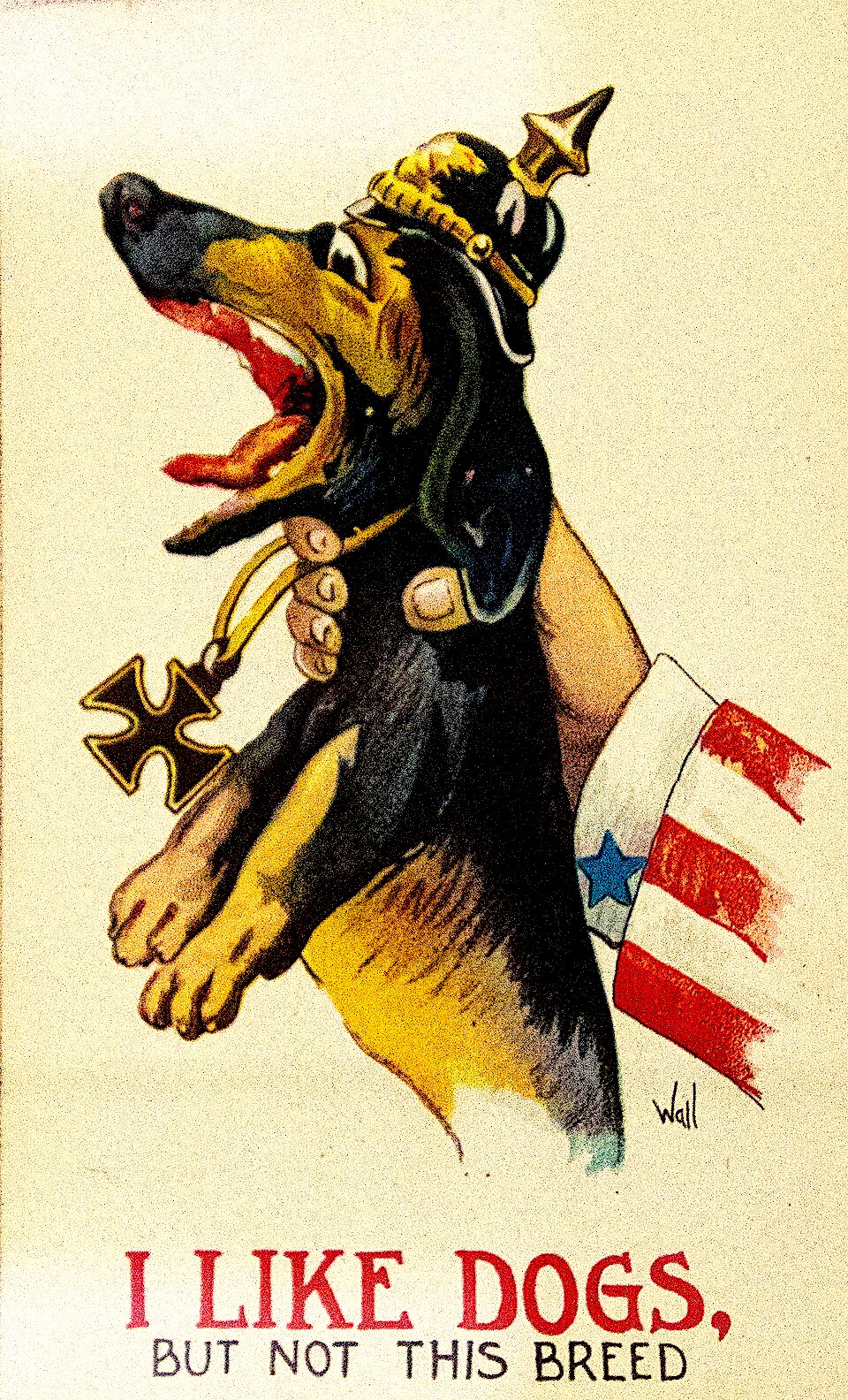
World War I Anti-German propaganda: a dachshund wearing a Pickelhaube and an Iron cross being strangled by Uncle Sam.
Copyleft,
CC, Mitzub'ixi Quq Chi'j, 1996-2099