Hate crime should be distinguished from hate violence, or hate incidents, which might not necessarily be criminalised[7] Incidents may involve physical assault, homicide, damage to property, bullying, harassment, verbal abuse (which includes slurs) or insults, mate crime, or offensive graffiti or letters (hate mail).[8] Non-criminal actions that are motivated by these reasons are often called "bias incidents".[citation needed]
For example, the criminal law of the United States, the Federal Bureau of Investigation (FBI) defines a hate crime as a traditional offense like murder, arson, or vandalism with an added element of bias. Hate itself is not a hate crime, but committing a crime motivated by bias against one or more of the social groups listed above, or by bias against their derivatives constitutes a hate crime.[9] A hate crime law is a law intended to deter bias-motivated violence.[10] Hate crime laws are distinct from laws against hate speech: hate crime laws enhance the penalties associated with conduct which is already criminal under other laws, while hate speech laws criminalize a category of speech. Hate speech is a factor for sentencing enhancement in the United States, distinct from laws that criminalize speech.
ヘイトクライムは、必ずしも犯罪化されないヘイト暴力やヘイトインシデントと区別されるべきだ[7]。インシデントには、身体的暴行、殺人、器物損壊、い じめ、嫌がらせ、言葉による虐待(差別的発言を含む)、侮辱、仲間内犯罪、または攻撃的な落書きや手紙(ヘイトメール)が含まれることがある[8]。これ らの動機による非犯罪的行為は、しばしば「バイアスインシデント」と呼ばれる[出典必要]。
例えば、米国の刑法において、連邦捜査局(FBI)はヘイトクライムを、殺人、放火、器物損壊といった伝統的な犯罪に偏見の要素が加わったものと定義して いる。憎悪そのものはヘイトクライムではないが、上記の社会的集団の一つまたは複数に対する偏見、あるいはそれらの派生集団に対する偏見によって動機づけ られた犯罪を犯すことはヘイトクライムを構成する。[9] ヘイトクライム法は、偏見に基づく暴力を抑止することを目的とした法律である。[10] ヘイトクライム法はヘイトスピーチ禁止法とは異なる:ヘイトクライム法は他の法律で既に犯罪とされている行為に対する刑罰を強化する一方、ヘイトスピーチ 法は特定の言説を犯罪化する。米国ではヘイトスピーチは量刑加重の要素であり、言説を犯罪化する法律とは区別される。
The term "hate crime" came into common usage in the United States during the 1980s, but it is often used retrospectively in order to describe events which occurred prior to that era.[11] From the Roman persecution of Christians to the Nazi slaughter of Jews, hate crimes were committed by individuals as well as governments long before the term was commonly used.[6] A major part of defining crimes as hate crimes is determining that they have been committed against members of historically oppressed groups.[12][13]
During the past two centuries, typical examples of hate crimes in the U.S. include the lynching of African Americans, largely in the South, lynchings of Europeans in the East, and lynching of Mexicans and Chinese in the West; cross burnings in order to intimidate black activists or drive black families out of predominantly white neighborhoods both during and after Reconstruction; assaults on lesbian, gay, bisexual and transgender people; the painting of swastikas on Jewish synagogues; and xenophobic responses to a variety of minority ethnic groups.[14]
The verb "to lynch" is attributed to the actions of Charles Lynch, an 18th-century Virginia Quaker. Lynch, other militia officers, and justices of the peace rounded up Tory sympathizers who were given a summary trial at an informal court; sentences which were handed down included whipping, property seizure, coerced pledges of allegiance, and conscription into the military. Originally, the term referred to the extrajudicial organized but unauthorized punishment of criminals. It later evolved to describe executions which were committed outside "ordinary justice". It is highly associated with white suppression of African Americans in the South, and periods of weak or nonexistent police authority, as in certain frontier areas of the Old West.[6]
Due to the COVID-19 pandemic, the violence against people of Chinese origin significantly increased on the background of accusation of spreading the virus.[15][16][17] In May 2020, the Polish-based "Never Again" Association published its report titled The Virus of Hate: The Brown Book of Epidemic, that documented numerous acts of racism, xenophobia, and discrimination that occurred in the wake of the COVID-19 pandemic, as well as cases of spreading hate speech and conspiracy theories about the epidemic by the Alt-Right.[18] In the U.S., this wave of hate brought back old and harmful stereotypes. The idea of the "Yellow Peril," the belief that Asians are a threat to Western society, reappeared in news stories and social media, reinforcing long-standing fears and suspicions. At the same time, the "Model Minority" myth made it harder for people to see the very real struggles Asian Americans face, painting them as silent and successful, and often excluding them from conversations about racial injustice. As a result, Asian Americans across the country experienced a dramatic rise in hate crimes, from verbal abuse and being spit on to physical attacks in public places. Elderly individuals were especially targeted, with several shocking assaults captured on video. Businesses were vandalized, and many people were harassed simply for wearing a mask or speaking their native language. These were not just random incidents, they were symptoms of deep-rooted racism that was reignited during a time of fear, uncertainty, and misinformation.
「ヘイトクライム」という用語は1980年代にアメリカで一般に広まったが、それ以前の出来事を説明するために遡及的に使われることが多い。[11] ローマによるキリスト教徒迫害からナチスによるユダヤ人虐殺まで、この言葉が一般的になるずっと前から、個人や政府によってヘイトクライムは行われてき た。[6] 犯罪をヘイトクライムと定義する上で重要な要素は、それが歴史的に抑圧されてきた集団の成員に対して行われたものであると認定することだ。[12] [13]
過去2世紀における米国の憎悪犯罪の典型例には、主に南部でのアフリカ系アメリカ人に対するリンチ、東部でのヨーロッパ系住民へのリンチ、西部でのメキシ コ系・中国系住民へのリンチが含まれる。また、再建期前後を通じて、黒人活動家を威嚇したり白人地域から黒人家族を追い出すための十字架焼却、レズビア ン・ゲイ・バイセクシュアル・トランスジェンダーへの暴行、 ユダヤ教のシナゴーグへの卍字の落書き、そして様々な少数民族グループに対する排外的な反応があった。[14]
「リンチする」という動詞は、18世紀のバージニア州クエーカー教徒チャールズ・リンチの行動に由来する。リンチや他の民兵隊幹部、治安判事はトーリー党 支持者を一斉検挙し、非公式の法廷で即決裁判にかけた。言い渡された刑罰には鞭打ち、財産没収、忠誠の誓いの強制、軍隊への徴兵が含まれた。本来この用語 は、司法外で行われる組織的だが非公認の犯罪者処罰を指した。後に「通常の司法」の外で行われる処刑を意味するようになった。この言葉は、南部におけるア フリカ系アメリカ人への白人による抑圧や、旧西部開拓時代の辺境地域など、警察権力が弱いか存在しない時期と強く結びついている。[6]
COVID-19パンデミックにより、ウイルス拡散の非難を背景に、中国系住民に対する暴力事件が著しく増加した。[15][16][17] 2020年5月、ポーランドの「二度と繰り返すな」協会は『憎悪のウイルス:疫病の褐色書』と題する報告書を発表した。これはCOVID-19パンデミッ クを契機に発生した数多くの人種主義、外国人排斥、差別行為、ならびにオルタナ右翼による憎悪表現や疫病に関する陰謀論の拡散事例を記録したものである。 [18] 米国では、この憎悪の波が古く有害な固定観念を蘇らせた。「黄禍論」——アジア人が西洋社会への脅威だという考え——がニュース記事やソーシャルメディア に再登場し、長年根付いた恐怖や疑念を強化した。同時に「模範的少数派」という神話は、アジア系アメリカ人が直面する現実の苦闘を見えにくくした。彼らを 黙って成功する存在として描き、人種的不公正に関する議論から排除しがちだったのだ。結果として全米のアジア系アメリカ人は、公の場での暴言や唾を吐かれ る行為から身体的攻撃に至るまで、ヘイトクライムの急増を経験した。高齢者が特に標的となり、衝撃的な暴行が動画に収められた事例も複数あった。店舗は破 壊され、マスクを着用したり母国語を話したりしただけで嫌がらせを受ける人も多かった。これらは単なる偶発的な事件ではなく、恐怖と不確実性と誤った情報 が蔓延する時期に再燃した、根深い人種主義の症状だった。
Hate crimes can have significant and wide-ranging psychological consequences, not only for their direct victims but for others of the group as well. Moreover, victims of hate crimes often experience a sense of victimization that goes beyond the initial crime, creating a heightened sense of vulnerability towards future victimization.[19] In many ways, hate crime victimization can be a reminder to victims of their marginalized status in society, and for immigrants or refugees, may also serve to make them relive the violence that drove them to seek refuge in another country.[19] A 1999 U.S. study of lesbian and gay victims of violent hate crimes documented that they experienced higher levels of psychological distress, including symptoms of depression and anxiety, than lesbian and gay victims of comparable crimes which were not motivated by antigay bias.[20] A manual issued by the Attorney-General of the province of Ontario in Canada lists the following consequences:[21]
Impact on the individual victim
psychological and affective disturbances; repercussions on the victim's identity and self-esteem; both reinforced by a specific hate crime's degree of violence, which is usually stronger than that of a common crime.
Effect on the targeted group
generalized terror in the group to which the victim belongs, inspiring feelings of vulnerability among its other members, who could be the next hate crime victims.
Effect on other vulnerable groups
ominous effects on minority groups or on groups that identify themselves with the targeted group, especially when the referred hate is based on an ideology or a doctrine that preaches simultaneously against several groups.
Effect on the community as a whole
divisions and factionalism arising in response to hate crimes are particularly damaging to multicultural societies.
Hate crime victims can also develop depression and psychological trauma.[22] They suffer from typical symptoms of trauma: lack of concentration, fear, unintentional rethinking of the incident and feeling vulnerable or unsafe. These symptoms may be severe enough to qualify as PTSD. In the United States, the Supreme Court has accepted the claim that hate crimes cause 'distinct emotional harm' to victims. People who have been victims of hate crimes avoid spaces where they feel unsafe which can make communities less functional when ties with police are strained by persistent group fears and feelings of insecurity.[23] In the United States, hate crime has been shown to reduce educational attainment among affected groups—particularly among black, non-Hispanic victims.[24]
A review of European and American research indicates that terrorist bombings cause Islamophobia and hate crimes to flare up but, in calmer times, they subside again, although to a relatively high level. Terrorists' most persuasive message is that of fear; a primary and strong emotion, fear increases risk estimates and has distortive effects on the perception of ordinary Muslims. Widespread Islamophobic prejudice seems to contribute to anti-Muslim hate crimes, but indirectly; terrorist attacks and intensified Islamophobic prejudice serve as a window of opportunity for extremist groups and networks.[25]
ヘイトクライムは、直接の被害者だけでなく、その集団に属する他の者たちに対しても、重大かつ広範な心理的影響をもたらすことがある。さらに、ヘイトクラ イムの被害者は、最初の犯罪を超えた被害体験をしばしば経験し、将来の被害に対する脆弱性の感覚を強める。[19] 多くの点で、ヘイトクライムの被害体験は、被害者に社会における自らの周縁化された立場を想起させるものであり、移民や難民にとっては、他国に避難を求め た原因となった暴力を再び体験させる役割も果たす可能性がある。[19] 1999年の米国におけるレズビアン・ゲイの暴力的なヘイトクライム被害者を対象とした研究では、反同性愛的偏見を動機としない同種の犯罪の被害者と比 べ、抑うつや不安の症状を含むより高いレベルの心理的苦痛を経験していることが記録されている。[20] カナダ・オンタリオ州司法長官が発行したマニュアルには、以下の影響が列挙されている: [21]
被害者個人への影響
心理的・情緒的障害;被害者のアイデンティティと自尊心への悪影響;これらは通常一般犯罪より激しい憎悪犯罪特有の暴力性によって増幅される。
標的集団への影響
被害者が属する集団全体への恐怖感の拡散。他の構成員に脆弱性を感じさせ、彼らが次の憎悪犯罪の被害者となる可能性を暗示する。
その他の脆弱な集団への影響
特に、複数の集団を同時に敵視するイデオロギーや教義に基づく憎悪が背景にある場合、標的集団と同一視される少数派集団や集団に深刻な影響を及ぼす。
地域社会全体への影響
ヘイトクライムへの反応として生じる分断や派閥争いは、多文化社会において特に有害である。
ヘイトクライムの被害者は、うつ病や心的外傷(PTSD)を発症することもある[22]。彼らはトラウマの典型的な症状に苦悩する:集中力の欠如、恐怖、 事件の意図しない反芻、無防備さや不安感。これらの症状はPTSDと診断されるほど深刻な場合がある。米国最高裁は、ヘイトクライムが被害者に「明確な精 神的損害」をもたらすとの主張を認めている。被害者は安全を感じない場所を避け、持続的な集団的恐怖や不安感によって警察との絆が損なわれると、コミュニ ティの機能低下を招く。[23] 米国では、ヘイトクライムが被害を受けた集団、特に非ヒスパニック系黒人の教育達成度を低下させることが示されている。[24]
欧米の研究をレビューすると、テロ爆弾事件はイスラム恐怖症とヘイトクライムを激化させるが、平穏な時期には再び沈静化する(ただし比較的高い水準で)。 テロリストの最も説得力あるメッセージは恐怖である。根源的で強い感情である恐怖はリスク評価を高め、一般のムスリムに対する認識を歪める。広範なイスラ ム恐怖症的偏見は反ムスリム憎悪犯罪に寄与するようだ。ただし間接的にである。テロ攻撃と強まったイスラム恐怖症的偏見は、過激派グループやネットワーク にとって好機となる窓となるのだ。[25]
Sociologists Jack McDevitt and Jack Levin's 2002 study into the motives for hate crimes found four motives, and reported that "thrill-seeking" accounted for 66 percent of all hate crimes overall in the United States:[26][27]
Thrill-seeking – perpetrators engage in hate crimes for excitement and drama. Often, there is no greater purpose behind the crimes, with victims being vulnerable because they have an ethnic, religious, sexual or gender background that differs from their attackers. While the actual animosity present in such a crime can be quite low, thrill-seeking crimes were determined to often be dangerous, with 70 percent of thrill-seeking hate crimes studied involving physical attacks. Typically, these attacks are perpetrated by groups of young teenagers or adults seeking excitement.[28]
Defensive – perpetrators engage in hate crimes out of a belief they are protecting their communities. Often, these are triggered by a certain background event. Perpetrators believe society supports their actions but is too afraid to act and thus they believe they have communal assent in their actions.
Retaliatory – perpetrators engage in hate crimes out of a desire for revenge. This can be in response to perceived personal slights, other hate crimes or terrorism. The "avengers" target members of a group whom they believe committed the original crime, even if the victims had nothing to do with it. These kinds of hate crimes are a common occurrence after terrorist attacks.
Mission offenders – perpetrators engage in hate crimes out of ideological reasons. They consider themselves to be crusaders, often for a religious or racial cause. They may write complex explanations for their views and target symbolically important sites, trying to maximize damage. They believe that there is no other way to accomplish their goals, which they consider to be justification for excessive violence against innocents. This kind of hate crime often overlaps with terrorism, and is considered by the FBI to be both the rarest and deadliest form of hate crime.
In a later article, Levin and fellow sociologist Ashley Reichelmann found that following the September 11 attacks, thrill motivated hate crimes tended to decrease as the overall rate of violent crime decreased while defensive hate crimes increased substantially. Specifically, they found that 60% of all hate motivated assaults in 2001 were perpetrated against those the offenders perceived to be Middle Eastern and were motivated mainly by a desire for revenge.[29] Levin and McDevitt also argued that while thrill crimes made up the majority of hate crimes in the 1990s, after September 11, 2001, hate crimes in the United States shifted from thrill offenses by young groups to more defensive oriented and more often perpetrated by older individuals respond to a precipitating event.[28]
The motivations of hate-crime offenders are complex. Therefore, there is no one theory that can completely account for hate-motived crimes.[30] However, Mark Austin Walters previously attempted to synthesize three interdisciplinary theories to account for the behavior of hate-crime offenders:
1. Strain Theory: suggests that hate crimes are motivated by perceived economic and material inequality, which results in differential attitudes towards outsiders who may be viewed as "straining" already scarce resources. An example of this can be seen in the discourse surrounding some people's apprehension towards immigrants, who feel as though immigrants and/or refugees receive extra benefits from government and strain social systems.
2. Doing Difference Theory: suggests that some individuals fear groups other than their own and, as a result of this, seek to suppress different cultures.
3. Self-Control Theory: suggests that a person's upbringing determines their tolerance threshold towards others, here individuals with low self-esteem are often impulsive, have poor employment prospects, and have little academic success.
Walters argues that a synthesis of these theories provides a more well-rounded scope of the motivations behind hate crimes, where he explains that social, cultural, and individual factors interact to elicit the violence behavior of individuals with low self-control.[30]
Additionally, psychological perspectives within the realm of behaviorism have also contributed to theoretical explanations for the motivations of hate crimes particularly as it relates to conditioning and social learning. For instance, the seminal work of John B. Watson and Rosalie Rayner illustrated that hate, a form of prejudice, was a conditioned emotional response.[31] Later on, the work of Arthur Staats and Carolyn Staats illustrated that both hate and fear were learned behavioral responses.[32] In their experiment, Staats and Staats paired positive and negative works with several different nationalities. The pairing of verbal stimuli was a form of conditioning, and it was found to influence attitude formation and attitude change.
These studies are of interest when considering modern forms of prejudice directed towards ethnic, religious, or racial groups.[32] For instance, there was a significant increase in Islamophobia and hate crimes following the 9/11 terrorist attacks on the United States. Simultaneously, the news media was consistently pairing Islam with terrorism. Thus, the pairing of verbal stimuli in the media contributed to widespread prejudice towards all Arab individuals in a process that is known as semantic generalization, which refers to how a learned behavior can generalize across situations based on meaning or other abstract representations.[33] These occurrences continue today with the social and political discourse that contribute to the context in which people learn, come to form beliefs, and engage in behavioral actions. Although not all individuals with prejudicial attitudes go on to engage in hate-motived crime, it has been suggested that hate-crime offenders come to learn their prejudices through social interaction, consumption of biased news media, political hate speech, and internal misrepresentations of cultures other than their own.[34]
Risk management for hate-crime offenders
Compared to other types of offending, there has been relatively little research directed towards the management of hate-crime offenders.[35] However, risk management for hate-crime offenders is an important consideration for forensic psychology and public safety in order to decrease the potential for future harm. Forensic risk assessments are designed to evaluate the likelihood of re-offending and to aid in risk management strategies. While not specifically designed for hate crime offenders, some of the most common risk assessment tools used to assess risk for hate-crime offenders include the Violence Risk Appraisal Guide (VRAG;[36]), the Historical Clinical Risk Management 20 (HCR-20;[37]) and the Psychopathy Checklist-Revised (PCL-R;[38]). Research has shown that assessing and addressing risk posed by hate-crime offenders is especially complex, and while existing tools are useful, it is important to incorporate bias-oriented factors (Dunbar et al., 2005). That is, hate-crime offenders do tend to score high risk on tools including both static and dynamic factors, but severity has been found to not be solely related to these factors, illustrating a need to incorporate biases and ideological factors.[39]
社会学者ジャック・マクデヴィットとジャック・レビンによる2002年の憎悪犯罪の動機に関する研究では、四つの動機が確認された。米国全体では憎悪犯罪の66%が「スリル追求」によるものだと報告されている:[26][27]
スリル追求 – 加害者は興奮や劇的な体験を求めて憎悪犯罪に手を染める。多くの場合、犯罪の背後にはより大きな目的はなく、被害者は加害者と異なる民族的・宗教的・性 的・ジェンダー背景を持つため脆弱な立場にある。実際の敵意は極めて低い場合もあるが、スリル追求型犯罪は危険性が高いと判明しており、調査対象の70% が身体的攻撃を伴っていた。典型的には、興奮を求める10代の若者や成人の集団によって実行される。[28]
防衛的 – 加害者は自らのコミュニティを守っているという信念からヘイトクライムに及ぶ。多くの場合、特定の背景となる出来事が引き金となる。加害者は社会が自らの 行動を支持しているものの、行動を起こすには恐れすぎていると信じ、したがって自らの行動には共同体の同意があると考える。
報復的 – 加害者は復讐欲求からヘイトクライムを実行する。これは個人的な侮辱、他のヘイトクライムやテロへの反応として現れる。「復讐者」は、たとえ被害者が無関 係であっても、元々の犯罪を犯したと信じる集団のメンバーを標的にする。この種のヘイトクライムはテロ攻撃後に頻繁に発生する。
使命型加害者 – 加害者はイデオロギー的理由からヘイトクライムを実行する。彼らは自らを宗教的・人種的信条のための十字軍と位置付け、複雑な思想的根拠を主張し、象徴的 に重要な場所を標的として被害を最大化しようとする。無実の人々への過剰な暴力も、自らの目的達成には必要不可欠な手段だと正当化している。この種の憎悪 犯罪はテロリズムと重なり、FBIによって最も稀でありながら最も致死率の高い形態とされている。
レヴィンと社会学者のアシュリー・ライチェルマンは後年の論文で、9.11同時多発テロ後、スリル目的のヘイトクライムは暴力犯罪全体の減少に伴い減少傾 向を示した一方、防衛的ヘイトクライムは大幅に増加したと指摘している。具体的には、2001年のヘイトクライムによる暴行事件の60%が、加害者が中東 系と認識した対象に対して行われ、その動機は主に復讐心によるものだった。[29] レヴィンとマクデヴィットはまた、1990年代にはスリル犯罪がヘイト犯罪の大半を占めていたが、2001年9月11日以降、米国のヘイト犯罪は若年層に よるスリル犯罪から、より防衛的指向で、より頻繁に高齢者が引き金となる事件に対応して犯行に及ぶ形態へ移行したと論じた。[28]
ヘイト犯罪の加害者の動機は複雑だ。したがって、憎悪動機犯罪を完全に説明できる単一の理論は存在しない。[30] しかしマーク・オースティン・ウォルターズは以前、憎悪犯罪者の行動を説明するため、三つの学際的理論を統合しようとした:
1. 緊張理論:憎悪犯罪は、経済的・物質的不平等を認識した結果生じる動機によるものであり、既に乏しい資源を「圧迫」していると見なされる外部者に対する差 別的態度を引き起こすと提唱する。この例は、移民や難民が政府から特別な恩恵を受け、社会システムに負担をかけていると感じる人々の懸念という言説に表れ ている。
2. 差異化理論:一部の個人が自グループ以外の集団を恐れ、その結果として異なる文化を抑制しようとすることを示唆する。
3. 自制理論:人格の育ち方が他者への許容度を決定するとする。ここでは自尊心の低い人格が衝動的で、就職の見通しが悪く、学業的成功も乏しい傾向にある。
ウォルターズは、これらの理論を統合することでヘイトクライムの動機をより包括的に捉えられると主張する。彼は社会的・文化的・個人的要因が相互作用し、自制心の低い個人の暴力行為を引き起こすと説明している。[30]
さらに、行動主義の領域における心理学的視点も、特に条件付けや社会的学習に関連する憎悪犯罪の動機についての理論的説明に貢献している。例えば、ジョ ン・B・ワトソンとロザリー・レイナーの画期的な研究は、偏見の一形態である憎悪が条件付けられた感情的反応であることを示した。[31] その後、アーサー・スタッツとキャロリン・スタッツの研究は、憎悪と恐怖の両方が学習された行動反応であることを示した。[32] 彼らの実験では、スタッツとスタッツは、いくつかの異なる国民について、肯定的な言葉と否定的な言葉を組み合わせた。この言語刺激の組み合わせは条件付け の一形態であり、態度の形成と変化に影響を与えることがわかった。
これらの研究は、民族、宗教、人種グループに対する現代的な偏見を考える上で興味深いものである。[32] 例えば、アメリカへの9.11同時多発テロ事件後、イスラム恐怖症やヘイトクライムが著しく増加した。同時に、ニュースメディアは一貫してイスラム教とテ ロリズムを結びつけて報じた。こうしてメディアにおける言語刺激の結びつけは、意味論的一般化と呼ばれるプロセスを通じて、全てのアラブ人に対する広範な 偏見を助長した。これは、学習された行動が意味や他の抽象的表象に基づいて状況を超えて一般化される過程を指す。[33] このような現象は現在も続いており、人々が学習し、信念を形成し、行動を起こす文脈を形成する社会的・政治的言説に寄与している。偏見を持つ全ての個人が 憎悪動機犯罪に及ぶわけではないが、憎悪犯罪の加害者は社会的相互作用、偏ったニュースメディアの消費、政治的憎悪表現、そして自文化以外の文化に対する 内面的な誤った認識を通じて偏見を学習すると指摘されている。[34]
憎悪犯罪加害者のリスク管理
他の犯罪類型と比較すると、憎悪犯罪加害者の管理に関する研究は比較的少ない。[35] しかし、将来の危害発生の可能性を低減するためには、憎悪犯罪加害者のリスク管理は法心理学と公共安全にとって重要な考慮事項である。法医学的リスク評価 は再犯の可能性を評価し、リスク管理戦略を支援するために設計されている。ヘイトクライム犯罪者向けに特別に設計されたものではないが、ヘイトクライム犯 罪者のリスク評価に用いられる最も一般的なリスク評価ツールには、暴力リスク評価ガイド(VRAG;[36])、ヒストリカル・クリニカル・リスクマネジ メント20(HCR-20;[37])、サイコパシーチェックリスト改訂版(PCL-R;[38])などがある。研究によれば、ヘイトクライム犯罪者がも たらすリスクの評価と対応は特に複雑であり、既存のツールは有用であるものの、偏見指向的要因を取り入れることが重要である(Dunbar et al., 2005)。つまり、ヘイトクライム犯罪者は静的要因と動的要因の両方を含むツールで高リスクを示す傾向があるが、その深刻度はこれらの要因のみに関連し ているわけではないことが判明しており、偏見やイデオロギー的要因を取り入れる必要性を示している。[39]
The Organisation for Security and Co-operation in Europe (OSCE)[40], the world's largest regional security organisations with 57 members states from Europe, Central Asia and America, passed Ministerial Council Decision No. 9/09 on combating hate crimes[41], to monitor, prevent and control hate crime[42]. As a result, OSCE publishes regular reports capturing the levels of hate crimes recorded and prosecuted in its 57 member states.
Moreover, OSCE's Office for Democratic Institutions and Human Rights (ODIHR) has a mandate to protect victims of hate crime through policy action, advice and support to victim organisations, NGOs and practitioners located in their members[43]. They have produced a series of training programmes, practical guides and policy advice for practitioners supporting hate crime victims both within and outside of the criminal justice system[44]. Recently, OSCE and its ODIHR department acknowledged the complexity that hate crime presents both in relation to its prevention and control, and that hate violence extends beyond what the law understand reaching into the fabric of its members' societies[45]. As a result, they launched a series of victim focused projects, such as EStAR: Enhancing hate crime victim support project, exploring non-punitive approaches to hate violence including community based interventions[46]. In 2025, they took a step further by looking at the potential of restorative justice for preventing and controlling hate violence. ODIHR worked with restorative justice leader, Professor Theo Gavrielides, to publish "Implementing Restorative Justice for Hate Incidents and Hate Crimes - a Practical Guide"[47]. In writing the Guide, Gavrielides carried out fieldwork across the OSCE member states which showed that restorative justice is being used in schools, youth and criminal justice settings across the OSCE member states[48]. However, there is lack of consistency in implementation as well as low awareness among victims and offenders[49]. Gavrielides' OSCE Guide was supported by the Working Group on hate crime victim support, which is part of the European Union High Level Group on combating hate speech and hate crime[50]. The EU High Level Group was set up to support EU Member States to protect and support victims of hate crime through law development and practical support including the better implementation of restorative justice.
欧州安全保障協力機構(OSCE)[40]は、欧州、中央アジア、アメリカから57の加盟国を有する世界最大の地域安全保障機構である。同機構は憎悪犯罪 対策に関する閣僚理事会決定第9/09号[41]を採択し、憎悪犯罪[42]の監視、予防、管理を行っている。その結果、OSCEは57の加盟国で記録さ れ起訴されたヘイトクライムのレベルをまとめた定期報告書を公表している。
さらにOSCEの民主的機関・人権事務所(ODIHR)は、加盟国内の被害者団体・NGO・実務者に対する政策提言・助言・支援を通じ、ヘイト犯罪被害者 を保護する権限を有する[43]。刑事司法制度内外を問わずヘイト犯罪被害者を支援する実務者向けに、一連の研修プログラム・実践ガイド・政策提言を策定 している[44]。近年、OSCE及びそのODIHR部門は、憎悪犯罪の予防と管理における複雑性、並びに憎悪暴力の法的な枠組みを超え加盟国の社会構造 に浸透する性質を認めた。その結果、被害者中心のプロジェクト群を立ち上げた。例えばEStAR(憎悪犯罪被害者支援強化プロジェクト)では、地域社会 ベースの介入を含む、憎悪暴力に対する非懲罰的アプローチを模索している。2025年には、憎悪暴力の予防・管理における修復的司法の可能性を検討する段 階へ進んだ。ODIHRは修復的司法の権威であるテオ・ガブリエリデス教授と協力し、「憎悪事件・憎悪犯罪への修復的司法導入実践ガイド」を出版した [47]。ガイド作成にあたり、ガブリエリデス教授はOSCE加盟国全域で現地調査を実施。その結果、加盟国各国の学校・青少年・刑事司法の現場で修復的 司法が活用されている実態が明らかになった[48]。ただし、実施方法に一貫性が欠けるほか、被害者と加害者の双方における認知度が低い現状も浮き彫りと なった[49]。ガブリエリデスのOSCEガイドは、欧州連合(EU)のヘイトスピーチ及びヘイトクライム対策ハイレベルグループ[50]の一部であるヘ イトクライム被害者支援作業部会の支援を受けた。EUハイレベルグループは、法整備や実践的支援(修復的司法のより良い実施を含む)を通じて、EU加盟国 がヘイトクライムの被害者を保護・支援することを目的として設置された。
Hate crime laws generally fall into one of several categories:
laws defining specific bias-motivated acts as distinct crimes;
criminal penalty-enhancement laws;
laws creating a distinct civil cause of action for hate crimes; and
laws requiring administrative agencies to collect hate crime statistics.[51] Sometimes (as in Bosnia and Herzegovina), the laws focus on war crimes, genocide, and crimes against humanity with the prohibition against discriminatory action limited to public officials.[citation needed]
Europe and Asia
Council of Europe
Since 2006, with the Additional Protocol to the Convention on Cybercrime, most signatories to that Convention – mostly members of the Council of Europe – committed to punish as a crime racist and xenophobic hate speech done through the internet. [52]
Andorra
Discriminatory acts constituting harassment or infringement of a person's dignity on the basis of origin, citizenship, race, religion, or gender (Penal Code Article 313). Courts have cited bias-based motivation in delivering sentences, but there is no explicit penalty enhancement provision in the Criminal Code. The government does not track hate crime statistics, although they are relatively rare.[51]
Armenia
Armenia has a penalty-enhancement statute for crimes with ethnic, racial, or religious motives (Criminal Code Article 63).[51]
Austria
Austria has a penalty-enhancement statute for reasons like repeating a crime, being especially cruel, using others' helpless states, playing a leading role in a crime, or committing a crime with racist, xenophobic or especially reprehensible motivation (Penal Code section 33(5)).[53] Austria is a party to the Convention on Cybercrime, but not the Additional Protocol.
Azerbaijan
Azerbaijan has a penalty-enhancement statute for crimes motivated by racial, national, or religious hatred (Criminal Code Article 61). Murder and infliction of serious bodily injury motivated by racial, religious, national, or ethnic intolerance are distinct crimes (Article 111).[51] Azerbaijan is a party to the Convention on Cybercrime, but not the Additional Protocol.
Belarus
Belarus has a penalty-enhancement statute for crimes motivated by racial, national, and religious hatred and discord.[51][54]
Belgium
Belgium's Act of 25 February 2003 ("aimed at combating discrimination and modifying the Act of 15 February 1993 which establishes the Centre for Equal Opportunities and the Fight against Racism") establishes a penalty-enhancement for crimes involving discrimination on the basis of gender, supposed race, color, descent, national or ethnic origin, sexual orientation, civil status, birth, fortune, age, religious or philosophical beliefs, current or future state of health and handicap or physical features. The Act also "provides for a civil remedy to address discrimination."[51] The Act, along with the Act of 20 January 2003 ("on strengthening legislation against racism"), requires the centre to collect and publish statistical data on racism and discriminatory crimes.[51] Belgium is a party to the Convention on Cybercrime, but not the Additional Protocol.
Bosnia and Herzegovina
The Criminal Code of Bosnia and Herzegovina (enacted 2003) "contains provisions prohibiting discrimination by public officials on grounds, inter alia, of race, skin colour, national or ethnic background, religion and language and prohibiting the restriction by public officials of the language rights of the citizens in their relations with the authorities (Article 145/1 and 145/2)."[55]
Bulgaria
Bulgarian criminal law prohibits certain crimes motivated by racism, xenophobia and sexual orientation (since 2023), but a 1999 report by the European Commission against Racism and Intolerance found that it does not appear that those provisions "have ever resulted in convictions before the courts in Bulgaria."[56]
Croatia
The Croatian Penal Code explicitly defines hate crime in article 89 as "any crime committed out of hatred for someone's race, skin color, sex, sexual orientation, language, religion, political or other belief, national or social background, asset, birth, education, social condition, age, health condition or other attribute".[57] On 1 January 2013, a new Penal Code was introduced with the recognition of a hate crime based on "race, skin color, religion, national or ethnic background, sexual orientation or gender identity".[58]
Czech Republic
The Czech legislation finds its constitutional basis in the principles of equality and non-discrimination contained in the Charter of Fundamental Rights and Basic Freedoms. From there, we can trace two basic lines of protection against hate-motivated incidents: one passes through criminal law, the other through civil law. The current Czech criminal legislation has implications both for decisions about guilt (affecting the decision whether to find a defendant guilty or not guilty) and decisions concerning sentencing (affecting the extent of the punishment imposed). It has three levels, to wit:
a circumstance determining whether an act is a crime – hate motivation is included in the basic constituent elements. If hate motivation is not proven, a conviction for a hate crime is not possible.
a circumstance determining the imposition of a higher penalty – hate motivation is included in the qualified constituent elements for some types of crimes (murder, bodily harm). If hate motivation is not proven, the penalty is imposed according to the scale specified for the basic constituent elements of the crime.
general aggravating circumstance – the court is obligated to take the hate motivation into account as a general aggravating circumstance and determines the amount of penalty to impose. Nevertheless, it is not possible to add together a general aggravating circumstance and a circumstance determining the imposition of a higher penalty. (see Annex for details)
Current criminal legislation does not provide for special penalties for acts that target another by reason of his sexual orientation, age or health status. Only the constituent elements of the criminal offence of Incitement to hatred towards a group of persons or to the curtailment of their rights and freedoms and general aggravating circumstances include attacking a so-called different group of people. Such a group of people can then, of course, be also defined by sexual orientation, age or health status. A certain disparity has thus been created between, on the one hand, those groups of people who are victimized by reason of their skin color, faith, nationality, ethnicity or political persuasion and enjoy increased protection, and, on the other hand, those groups that are victimized by reason of their sexual orientation, age or health status and are not granted increased protection. This gap in protection against attacks motivated by the victim's sexual orientation, age or health status cannot be successfully bridged by interpretation. Interpretation by analogy is inadmissible in criminal law, sanctionable motivations being exhaustively enumerated.[59]
Denmark
Although Danish law does not include explicit hate crime provisions, "section 80(1) of the Criminal Code instructs courts to take into account the gravity of the offence and the offender's motive when meting out penalty, and therefore to attach importance to the racist motive of crimes in determining sentence."[60] In recent years judges have used this provision to increase sentences on the basis of racist motives.[51][61]
Since 1992, the Danish Civil Security Service (PET) has released statistics on crimes with apparent racist motivation.[51]
Estonia
Under section 151 of the Criminal Code of Estonia of 6 June 2001, which entered into force on 1 September 2002, with amendments and supplements and as amended by the Law of 8 December 2011, "activities which publicly incite to hatred, violence or discrimination on the basis of nationality, race, colour, sex, language, origin, religion, sexual orientation, political opinion, or financial or social status, if this results in danger to the life, health or property of a person, are punishable by a fine of up to 300 fine units or by detention".[62]
Finland
Finnish Criminal Code 515/2003 (enacted 31 January 2003) makes "committing a crime against a person, because of his national, racial, ethnical or equivalent group" an aggravating circumstance in sentencing.[51][63] In addition, ethnic agitation (Finnish: kiihotus kansanryhmää vastaan) is criminalized and carries a fine or a prison sentence of not more than two years. The prosecution need not prove that an actual danger to an ethnic group is caused but only that malicious message is conveyed. A more aggravated hate crime, warmongering (Finnish: sotaan yllyttäminen), carries a prison sentence of one to ten years. However, in case of warmongering, the prosecution must prove an overt act that evidently increases the risk that Finland is involved in a war or becomes a target for a military operation. The act in question may consist of
illegal violence directed against a foreign country or its citizens,
systematic dissemination of false information on Finnish foreign policy or defense
public influence on the public opinion towards a pro-war viewpoint or
public suggestion that a foreign country or Finland should engage in an aggressive act.[64]
France
In 2003, France enacted penalty-enhancement hate crime laws for crimes motivated by bias against the victim's actual or perceived ethnicity, nation, race, religion, or sexual orientation. The penalties for murder were raised from 30 years (for non-hate crimes) to life imprisonment (for hate crimes), and the penalties for violent attacks leading to permanent disability were raised from 10 years (for non-hate crimes) to 15 years (for hate crimes).[51][65]
Georgia
"There is no general provision in Georgian law for racist motivation to be considered an aggravating circumstance in prosecutions of ordinary offenses. Certain crimes involving racist motivation are, however, defined as specific offenses in the Georgian Criminal Code of 1999, including murder motivated by racial, religious, national or ethnic intolerance (article 109); infliction of serious injuries motivated by racial, religious, national or ethnic intolerance (article 117); and torture motivated by racial, religious, national or ethnic intolerance (article 126). ECRI reported no knowledge of cases in which this law has been enforced. There is no systematic monitoring or data collection on discrimination in Georgia."[51]
Germany
The German Criminal Code does not have hate crime legislation, instead, it criminalizes hate speech under a number of different laws, including Volksverhetzung. In the German legal framework motivation is not taken into account while identifying the element of the offence. However, within the sentencing procedure the judge can define certain principles for determining punishment. In section 46 of the German Criminal Code it is stated that "the motives and aims of the perpetrator; the state of mind reflected in the act and the willfulness involved in its commission"[66] can be taken into consideration when determining the punishment; under this statute, hate and bias have been taken into consideration in sentencing in past cases.[67]
Hate crimes are not specifically tracked by German police, but have been studied separately: a recently published EU "Report on Racism" finds that racially motivated attacks are frequent in Germany, identifying 18,142 incidences for 2006, of which 17,597 were motivated by right-wing ideologies, both about a 14% year-by-year increase.[68] Relative to the size of the population, this represents an eightfold higher rate of hate crimes than reported in the US during the same period.[69] Awareness of hate crimes in Germany remains low.[70]
Greece
Article Law 927/1979 "Section 1,1 penalizes incitement to discrimination, hatred or violence towards individuals or groups because of their racial, national or religious origin, through public written or oral expressions; Section 1,2 prohibits the establishment of, and membership in, organizations which organize propaganda and activities aimed at racial discrimination; Section 2 punishes public expression of offensive ideas; Section 3 penalizes the act of refusing, in the exercise of one's occupation, to sell a commodity or to supply a service on racial grounds."[71] Public prosecutors may press charges even if the victim does not file a complaint. However, as of 2003, no convictions had been attained under the law.[72]
Hungary
Violent action, cruelty, and coercion by threat made on the basis of the victim's actual or perceived national, ethnic, religious status or membership in a particular social group are punishable under article 174/B of the Hungarian Criminal Code.[51] This article was added to the Code in 1996.[73] Hungary is a party to the Convention on Cybercrime, but not the Additional Protocol.
Iceland
Section 233a of the Icelandic Penal Code states "Anyone who in a ridiculing, slanderous, insulting, threatening or any other manner publicly abuses a person or a group of people on the basis of their nationality, skin colour, race, religion or sexual orientation, shall be fined or jailed for up to two years."[74] Iceland is a party to the Convention on Cybercrime, but not the Additional Protocol.
India
India does not have any specific laws governing hate crimes in general other than hate speech which is covered under the Indian Penal Code.
Ireland
In legal effect since December 31, 2024 Ireland implemented broad-based comprehensive legislation on hate crimes.[75]
The Prohibition of Incitement to Hatred Act 1989 created the offence of inciting hatred against a group of persons on account of their race, colour, nationality, religion, ethnic or national origins, membership of the Traveller community (an indigenous minority group), or sexual orientation.[51][76] Frustration at the low number of prosecutions (18 by 2011) was attributed to a misconception that the law addressed hate crimes more generally as opposed to incitement in particular.[77]
In 2019, a UN rappourteur told Irish representatives at the Committee on the Elimination of Racial Discrimination, meeting at UN Geneva, to introduce new hate crime legislation to combat the low prosecution rate for offences under the 1989 act – particularly for online hate speech – and lack of training for the Garda Síochána on racially motivated crimes. The rapporteur's points came during a rise in anti-immigrant rhetoric and racist attacks in Ireland and were based on recommendations submitted by the Irish Human Rights and Equality Commission and numerous other civil society organisations. Reforms are supported by the Irish Network Against Racism.[78]
The Criminal Justice (Incitement to Violence or Hatred and Hate Offences) Bill known as the "Hate Crime Bill", prohibiting hate speech or incitement to hate crimes based on protected characteristics, is in its Third Stage at the Seanad, Ireland's upper house, as of June 2023 and the Irish Times reports it is likely to become law in late 2023.[79][80] It has drawn concern from the Irish Council for Civil Liberties and from across the political spectrum (specifically from Michael McDowell, Rónán Mullen, and People Before Profit), as well as internationally, from business magnate Elon Musk and political activist Donald Trump Jr.[80] Paul Murphy of People Before Profit said the bill created a "thought crime" by its criminalisation of possessing material prepared for circulation where circulation would incite hatred.[80] Pauline O'Reilly, a Green Party senator said that the existing legislation was "not effective" and outdated, adding that the Gardaí saw a rise of 30% in hate crime in Ireland."[81]
Data published by the Gardaí showed a 29% increase in hate crimes and hate-related incidents from 448 in 2021 to 582 in 2022.[82] The Gardaí recognise that "despite improvements, hate crime and hate related incidents are still under-reported".[83]
Italy
Italian criminal law, at Section 3 of Law No. 205/1993, the so-called Legge Mancino (Mancino law), contains a penalty-enhancement provision for all crimes motivated by racial, ethnic, national, or religious bias.[51] Italy is a party to the Convention on Cybercrime, but not the Additional Protocol.
Kazakhstan
In Kazakhstan, there are constitutional provisions prohibiting propaganda promoting racial or ethnic superiority.[51]
Kyrgyzstan
In Kyrgyzstan, "the Constitution of the State party prohibits any kind of discrimination on grounds of origin, sex, race, nationality, language, faith, political or religious convictions or any other personal or social trait or circumstance, and that the prohibition against racial discrimination is also included in other legislation, such as the Civil, Penal and Labour Codes."[84]
Article 299 of the Criminal Code defines incitement to national, racist, or religious hatred as a specific offense. This article has been used in political trials of suspected members of the banned organization Hizb-ut-Tahrir.[51][85]
Netherlands
In March, 2025, the Dutch Senate voted in favour of a bill by which penalties for crimes with a discriminatory aim can be aggravated by 1/3. Since the Lower Chamber of Parliament already accepted the bill, this legislation will soon become into effect.
Poland
Article 13 of the Constitution of Poland prohibits organizations "whose programmes or activities sanction racial or national hatred".[86]
Russia
Article 29 of Constitution of the Russian Federation bans incitement to riot for the sake of stirring societal, racial, ethnic, and religious hatred as well as the promotion of the superiority of the same. Article 282 of the Criminal code further includes protections against incitement of hatred (including gender) via various means of communication, instilling criminal penalties including fines and imprisonment.[87] Although a former member of the Council of Europe, Russia is not a party to the Convention on Cybercrime.
Slovenia
In 2023, Slovenia introduced a penalty-enhancement provision in its Penal Code. If the victim's national, racial, religious or ethnic origin, sex, colour, descent, property, education, social status, political or other opinion, disability, sexual orientation or any other personal circumstance was a factor contributing to the commission of the criminal offence, it shall be taken into account when determining the penalty.[88]
Spain
Article 22(4) of the Spanish Penal Code includes a penalty-enhancement provision for crimes motivated by bias against the victim's ideology, beliefs, religion, ethnicity, race, nationality, gender, sexual orientation, illness or disability.[51]
On 14 May 2019, the Spanish Attorney General distributed a circular instructing on the interpretation of hate crime law. This new interpretation includes nazis as a collective that can be protected under this law.[89]
Although a member of the Council of Europe, Spain is not a party to the Convention on Cybercrime.
Sweden
Article 29 of the Swedish Penal Code includes a penalty-enhancement provision for crimes motivated by bias against the victim's race, color, nationality, ethnicity, sexual orientation, religion, or "other similar circumstance" of the victim.[51][90]
Ukraine
The constitution of Ukraine guarantees protection against hate crime:
Article 10: "In Ukraine, free development, use and protection of Russian and other languages of ethnic minorities of Ukraine are guaranteed".
Article 11: "The State shall promote the development of the ethnic, cultural, linguistic and religious identity of all indigenous peoples and ethnic minorities of Ukraine".
Article 24: "There can be no privileges or restrictions on the grounds of race, color of the skin, political, religious or other beliefs, sex, ethnic or social origin, property status, place of residence, language or other grounds".[91]
Under the Criminal Codex, crimes committed because of hatred are hate crimes and carry increased punishment in many articles of the criminal law. There are also separate articles on punishment for a hate crime.
Article 161: "Violations of equality of citizens depending on their race, ethnicity, religious beliefs, disability and other grounds: Intentional acts aimed at incitement to ethnic, racial or religious hatred and violence, to demean the ethnic honor and dignity, or to repulse citizens' feelings due to their religious beliefs, as well as direct or indirect restriction of rights or the establishment of direct or indirect privileges of citizens on the grounds of race, color, political, religious or other beliefs, sex, disability, ethnic or social origin, property status, place of residence, language or other grounds" (maximum criminal sentence of up to 8 years in prison).
Article 300: "Importation, manufacture or distribution of literature and other media promoting a cult of violence and cruelty, racial, ethnic or religious intolerance and discrimination" (maximum criminal sentence of up to 5 years in prison).[92]
United Kingdom
For England and Wales, the Sentencing Act 2020 makes racial or religious hostility, or hostility related to disability, sexual orientation, or transgender identity an aggravation in sentencing for crimes in general.[93]
Separately, the Crime and Disorder Act 1998 defines separate offences, with increased sentences, for racially or religiously aggravated assaults, harassment, and a handful of public order offences.
For Northern Ireland, Public Order 1987 (S.I. 1987/463 (N.I. 7)) serves the same purposes.[94] A "racial group" is a group of persons defined by reference to race, colour, nationality (including citizenship) or ethnic or national origins. A "religious group" is a group of persons defined by reference to religious belief or lack of religious belief.
"Hate crime" legislation is distinct from "hate speech" legislation. See Hate speech laws in the United Kingdom.
The Crime Survey for England and Wales (CSEW) reported in 2013 that there were an average of 278,000 hate crimes a year with 40 percent being reported according to a victims survey; police records only identified around 43,000 hate crimes a year.[95][needs update] It was reported that police recorded a 57-percent increase in hate crime complaints in the four days following the UK's European Union membership referendum; however, a press release from the National Police Chief's Council stated that "this should not be read as a national increase in hate crime of 57 percent".[96][97]
In 2013, Greater Manchester Police began recording attacks on goths, punks and other alternative culture groups as hate crimes.[98]
On 4 December 2013, Essex Police launched the 'Stop the Hate' initiative as part of a concerted effort to find new ways to tackle hate crime in Essex. The launch was marked by a conference in Chelmsford, hosted by Chief Constable Stephen Kavanagh, which brought together 220 delegates from a range of partner organizations involved in the field. The theme of the conference was 'Report it to Sort it' and the emphasis was on encouraging people to tell police if they have been a victim of hate crime, whether it be based on race, religion, sexual orientation, transgender identity or disability.[99]
Crown Prosecution Service guidance issued on 21 August 2017 stated that online hate crimes should be treated as seriously as offences in person.[100]
Perhaps the most high-profile hate crime in modern Britain occurred in Eltham, London, on 24 April 1993, when 18-year-old black student Stephen Lawrence was stabbed to death in an attack by a gang of white youths. Two white teenagers were later charged with the murder, and at least three other suspects were mentioned in the national media, but the charges against them were dropped within three months after the Crown Prosecution Service concluded that there was insufficient evidence to prosecute. However, a change in the law a decade later allowed a suspect to be charged with a crime twice if new evidence emerged after the original charges were dropped or a "not guilty" verdict was delivered in court. Gary Dobson, who had been charged with the murder in the initial 1993 investigation, was found guilty of Stephen Lawrence's murder in January 2012 and sentenced to life imprisonment, as was David Norris, who had not been charged in 1993. A third suspect, Luke Knight, had been charged in 1993 but was not charged when the case came to court nearly 20 years later.[citation needed]
In September 2020, the Law Commission proposed that sex or gender be added to the list of protected characteristics.[101][102]
The United Kingdom is a party to the Convention on Cybercrime, but not the Additional Protocol.
A 2021 investigation by Newsnight and The Law Society Gazette found that alleged hate crimes in which the victim was a police officer were significantly more likely to result in a successful prosecution. The investigation found that in several areas, crimes against police officers and staff constituted up to half of all hate crimes convictions, despite representing a much smaller proportion of reported incidents.[103]
Scotland
Under Scottish Common law the courts can take any aggravating factor into account when sentencing someone found guilty of an offence.[104][105] There is legislation dealing with the offences of incitement of racial hatred, racially aggravated harassment, and prejudice relating to religious beliefs, disability, sexual orientation, and transgender identity.[106] A Scottish Executive working group examined the issue of hate crime and ways of combating crime motivated by social prejudice, reporting in 2004.[107] Its main recommendations were not implemented, but in their manifestos for the 2007 Scottish Parliament election several political parties included commitments to legislate in this area, including the Scottish National Party, which now forms the Scottish Government. The Offences (Aggravation by Prejudice) (Scotland) Bill was introduced on 19 May 2008 by Patrick Harvie MSP,[108] having been prepared with support from the Scottish Government, and was passed unanimously by the parliament on 3 June 2009.[109]
The Hate Crime and Public Order (Scotland) Act 2021 comes into force on 1 April 2024.[110] Its introduction was criticised by the Association of Scottish Police Superintendents saying it feared Police Scotland would be deluged by cases, diverting officers from tackling violent offenders and that the Act threatened to fuel claims of "institutional bias" against the force.[111]
Non-crime hate incidents
In March 2024, Scottish Conservatives MSP Murdo Fraser threatened Police Scotland with legal action following his criticism of the Scottish Government's transgender policy was logged as a "hate incident" after being told that his name appears in police records for expressing his view about the policy even though no crime was committed.[112] Fraser had shared a column written by Susan Dalgety for The Scotsman, which claimed the Scottish Government's 'non-binary equality action plan' would lead to children being "damaged by this cult" and commenting "Choosing to identify as 'non-binary' is as valid as choosing to identify as a cat. I'm not sure governments should be spending time on action plans for either."[113]
Eurasian countries with no hate crime laws
The famous fresco Bathing of the Christ, after being vandalized by a Kosovo Albanian mob during the 2004 unrest in Kosovo
Albania, Cyprus, San Marino and Turkey have no hate crime laws.[51] Nonetheless, all of these except Turkey are parties to the Convention on Cybercrime and the Additional Protocol.
North America
Canada
"In Canada the legal definition of a hate crime can be found in sections 318 and 319 of the Criminal Code".[114]
In 1996, the federal government amended a section of the Criminal Code that pertains to sentencing. Specifically, section 718.2. The section states (with regard to the hate crime):
A court that imposes a sentence shall also take into consideration the following principles:
(a) a sentence should be increased or reduced to account for any relevant aggravating or mitigating circumstances relating to the offence or the offender, and, without limiting the generality of the foregoing,
(i) evidence that the offence was motivated by bias, prejudice or hate based on race, national or ethnic origin, language, colour, religion, sex, age, mental or physical disability, sexual orientation, or any other similar factor, ... shall be deemed to be aggravating circumstances.[114]
A vast majority (84 percent) of hate crime perpetrators were "male, with an average age of just under 30. Less than 10 of those accused had criminal records, and less than 5 percent had previous hate crime involvement".[115] "Only 4 percent of hate crimes were linked to an organized or extremist group".[116]
As of 2004, Jewish people were the largest ethnic group targeted by hate crimes, followed by black people, Muslims, South Asians, and homosexuals (Silver et al., 2004).[116] More recently, hate crimes targeting Jews accounted for 67% of all reported hate crimes targeting religions in 2022.[117]
During the Nazi regime in Germany, antisemitism was a cause of hate-related violence in Canada. For example, on 16 August 1933, there was a baseball game in Toronto and one team was made up mostly of Jewish players. At the end of the game, a group of Nazi sympathizers unfolded a Swastika flag and shouted "Heil Hitler." That event erupted into a brawl that pitted Jews and Italians against Anglo Canadians; the brawl went on for hours.[114]
The first time someone was charged for hate speech over the internet occurred on 27 March 1996. "A Winnipeg teenager was arrested by the police for sending an email to a local political activist that contained the message "Death to homosexuals...it's prescribed in the Bible! Better watch out next Gay Pride Week.'"[116]
During the COVID-19 pandemic, Canada saw a sudden rise in hate crimes based on race, religion, and sexual orientation.[118] Statistics Canada reported there was a 72% increase in hate crimes between 2019 and 2021.[119]
Mexico
Alejandro Gertz Manero, Attorney General of Mexico, recommended in August 2020 that all murders involving women be investigated as femicides. An average of 11 women are killed every day.[120]
Murders of LGBTQ individuals are not legally classified as hate crimes in Mexico, although Luis Guzman of the Cohesión de Diversidades para la Sustentabilidad (Codise) notes that there is a lot of homophobia in Mexico, particularly in the states of Veracruz, Chihuahua, and Michoacán. Between 2014 and May 2020, there have been 209 such murders registered.[121]
United States
Main article: Hate crime laws in the United States
Shepard (center), Louvon Harris (left), Betty Bryd Boatner (right) with President Barack Obama in 2009 to promote the Hate Crimes Prevention Act
Hate crime laws have a long history in the United States. The first hate crime[122] laws were passed after the American Civil War, beginning with the Civil Rights Act of 1871, in order to combat the growing number of racially motivated crimes which were being committed by the Reconstruction era—Ku Klux Klan. Following the Reconstruction era, the Jim Crow era emerged. These were laws formed and enforced to segregate and disenfranchise African Americans. These laws were in place to maintain a racial hierarchy by punishing African Americans who resisted or challenged the system. The enforcement of Jim Crow often involved violence and intimidation, including lynchings, bombings, and false arrests. In response, African Americans engaged in various forms of resistance, such as public protests and sit-ins. The modern era of hate-crime legislation began in 1968 with the passage of federal statute, 18 U.S.C.A. § 249, part of the Civil Rights Act which made it illegal to "by force or by threat of force, injure, intimidate, or interfere with anyone who is engaged in six specified protected activities, by reason of their race, color, religion, or national origin."[123] However, "The prosecution of such crimes must be certified by the U.S. attorney general."[124]
The first state hate-crime statute, California's Section 190.2, was passed in 1978 and provided penalty enhancements in cases when murders were motivated by prejudice against four "protected status" categories: race, religion, color, and national origin. Washington included ancestry in a statute which was passed in 1981. Alaska included creed and sex in 1982, and later disability, sexual orientation, and ethnicity. In the 1990s some state laws began to include age, marital status, membership in the armed forces, and membership in civil rights organizations.[125]
Until California state legislation included all crimes as possible hate crimes in 1987, criminal acts which could be considered hate crimes in various states included aggravated assault, assault and battery, vandalism, rape, threats and intimidation, arson, trespassing, stalking, and various "lesser" acts.[126]
Defined in the 1999 National Crime Victim Survey, "A hate crime is a criminal offence. In the United States, federal prosecution is possible for hate crimes committed on the basis of a person's race, religion, or nation origin when engaging in a federally protected activity." In 2009, capping a broad-based public campaign lasting more than a decade, President Barack Obama signed into law the Matthew Shepard and James Byrd Jr. Hate Crimes Prevention Act. The Act added actual or perceived gender, gender identity, sexual orientation, and disability to the federal definition of a hate crime, and dropped the prerequisite that the victim be engaging in a federally protected activity. Led by Shepard's parents and a coalition of civil rights groups, with ADL (the Anti-Defamation League),[127][128] in a lead role, the campaign to pass the Matthew Shepard Act lasted 13 years, in large part because of opposition to including the term "sexual orientation" as one of the bases for deeming a crime to be a hate crime.[129]
ADL also drafted model hate crimes legislation in the 1980s that serves as the template for the legislation that a majority of states have adopted.[130] As of the fall of 2020, 46 of the 50 states and Washington, D.C. have statutes criminalizing various types of hate crimes.[131] Thirty-one states and the District of Columbia have statutes creating a civil cause of action in addition to the criminal penalty for similar acts. Twenty-seven states and the District of Columbia have statutes requiring the state to collect hate crime statistics.[132] In May 2020, the killing of African-American jogger Ahmaud Arbery reinvigorated efforts to adopt a hate-crimes law in Georgia, which was one of a handful of states without a such legislation. Led in great part by the Hate-Free Georgia Coalition, a group of 35 nonprofit groups organized by the Georgia state ADL,[133] the legislation was adopted in June 2020, after 16 years of debate.[134][135]
According to the FBI Hate Crime Statistics report for 2006, hate crimes increased nearly 8 percent nationwide, with a total of 7,722 incidents and 9,080 offences reported by participating law enforcement agencies. Of the 5,449 crimes against persons, 46 percent were classified as intimidation, and 32 percent as simple assaults. Acts of vandalism or destruction comprised 81 percent of the 3,593 crimes against property.[136]
However, according to the FBI Hate Crime Statistics for 2007, the number of hate crimes decreased to 7,624 incidents reported by participating law enforcement agencies.[137] These incidents included nine murders and two rapes (out of the almost 17,000 murders and 90,000 forcible rapes committed in the U.S. in 2007).[138]
In June 2009, Attorney General Eric Holder said recent killings showed the need for a tougher U.S. hate-crimes law to stop "violence masquerading as political activism."[139]
Leadership Conference on Civil Rights Education Fund published a report in 2009 revealing that 33 percent of hate-crime offenders were under the age of 18, while 29 percent were between the ages of 18 and 24.[140]
The 2011 hate-crime statistics show 46.9 percent were motivated by race, and 20.8 percent by sexual orientation.[141]
In 2015, the Hate Crimes Statistics report identified 5,818 single-bias incidents involving 6,837 offenses, 7,121 victims, and 5,475 known offenders[122]
In 2017, the FBI released new data showing a 17 percent increase in hate crimes between 2016 and 2017.[142]
In 2018, the Hate Crime Statistics report showed 59.5 percent were motivated by race bias and 16.9 percent by sexual orientation.[143]
Prosecutions of hate crimes have been difficult in the United States. Recently, state governments have attempted to re-investigate and re-try past hate crimes. One notable example was Mississippi's decision to retry Byron De La Beckwith in 1990 for the 1963 murder of Medgar Evers, a prominent figure in the NAACP and a leader of the civil rights movement.[144] This was the first time in U.S. history that an unresolved civil rights case was re-opened. De La Beckwith, a member of the Ku Klux Klan, was tried for the murder on two previous occasions, resulting in hung juries. A mixed-race jury found Beckwith guilty of murder, and he was sentenced to life in prison in 1994.[145]
According to a November 2016 report issued by the FBI, hate crimes are on the rise in the United States.[146] The number of hate crimes increased from 5,850 in 2015, to 6,121 hate crime incidents in 2016, an increase of 4.6 percent.[147][148][149]
The Khalid Jabara-Heather Heyer National Opposition to Hate, Assault, and Threats to Equality Act (NO HATE), which was first introduced in 2017, was reintroduced in June 2019 to improve hate crime reporting and expand support for victims as a response to anti-LGBTQ, anti-Muslim and antisemitic attacks. The bill would fund state hate-crime hotlines, and support expansion of reporting and training programs in law enforcement agencies.[150]
According to a 2021 study, in the years between 1992 and 2014, white people were the offenders in 74.5 percent of anti-Asian hate crimes, 99 percent of anti-black hate crimes, and 81.1 percent of anti-Hispanic hate crimes.[151]
Victims in the United States
After a slow decline, the number of hate crimes increased since the mid 2010s.[152]
One of the largest waves of hate crimes in the history of the United States took place during the civil rights movement in the 1950s and 1960s. Violence and threats of violence were common against African Americans, and hundreds of people died due to such acts. Members of this ethnic group faced violence from groups such as the Ku Klux Klan, as well as violence from individuals who were committed to maintaining segregation.[153] At the time, civil rights leaders such as Martin Luther King Jr. and their supporters fought hard for the right of African Americans to vote, as well as for equality in their everyday lives. African Americans have been the target of hate crimes since the Civil War,[154] and the humiliation of this ethnic group was also desired by many anti-black individuals. Other frequently reported bias motivations were bias against a religion, bias against a particular sexual orientation, and bias against a particular ethnicity or national origin.[155] At times, these bias motivations overlapped, because violence can be both anti-gay and anti-black, for example.[156] There are many terms that victims of hate crimes have been subjected to over the years, especially when it comes to minority groups. The African American population is just one of many groups that have been degraded by society. For example, "coon," "sambo," "pickaninny," "jigaboo," "buck," and "mammy" are all slurs and derogatory terms that have been used throughout history against African Americans. These are all examples of ethnophaulisms, which are racial slurs and terms that are used during or motivate hate crimes against African Americans.
Analysts have compared groups in terms of the per capita rate of hate crimes committed against them to allow for differing populations. Overall, the total number of hate crimes committed since the first hate crime bill was passed in 1997 is 86,582.[157]
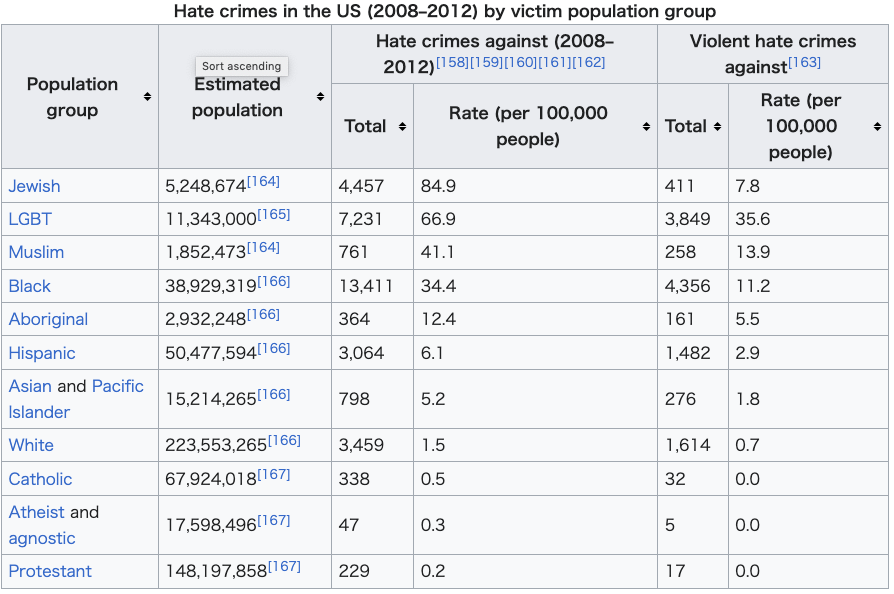
Among the groups which are mentioned in the Hate Crimes Statistics Act, the largest number of hate crimes are committed against African Americans.[168] During the Civil Rights Movement, some of the most notorious hate crimes included the 1968 assassination of Martin Luther King Jr., the 1964 murders of Charles Moore and Henry Dee, the 1963 16th Street Baptist Church bombing, the 1955 murder of Emmett Till,[154] and the burning of crosses, churches, Jewish synagogues, and other places of worship of minority religions. Such acts began to take place more frequently after the racial integration of many schools and public facilities.[168]
Since then, hate crimes targeting Jews have risen sharply, as in 2023, Antisemitic hate crimes increased by 63% to an all-time high of 1,832 incidents in the United States.[169] Furthermore, Jews comprise roughly 2% of the American population, but represent 68% of all religion-based hate crimes in the country.[170]
High-profile murders targeting victims based on their sexual orientation have prompted the passage of hate crimes legislation, notably the cases of Sean W. Kennedy and Matthew Shepard. Kennedy's murder was mentioned by Senator Gordon Smith in a speech on the floor of the U.S. Senate while he advocated such legislation. The Matthew Shepard and James Byrd, Jr. Hate Crimes Prevention Act was signed into law in 2009. It included sexual orientation, gender identity and expression, disably status, and military personnel and their family members.[171][172] This is the first all-inclusive bill ever passed in the United States, taking 45 years to complete.[clarification needed]
Gender-based crimes may also be considered hate crimes. This view would designate rape and domestic violence, as well as non-interpersonal violence against women such as the École Polytechnique massacre in Quebec, as hate crimes.[173][174][175]
Following the September 11, 2001, terrorist attacks, the United States experienced a spike in overall hate crimes against Muslim individuals. In the year before, only 28 events had been recorded of hate crimes against Muslims; in 2001, this number jumped to 481. While the number decreased in the following years, the number of Muslim hate crimes remains higher than pre-2001.[176] After the beginning of the Gaza war on October 7, 2023, hate crimes began to increase once again due to the United States allyship with Israel. Palestinian-Americans became a target for hate crimes and were blamed for the conflict leading to violence, including in the case of the Murder of Wadea al-Fayoume, a 6-year-old Palestinian-American boy killed by a white man who was motivated by anti-Muslim extremism.[citation needed]
In May 2018, ProPublica reviewed police reports for 58 cases of purported anti-heterosexual hate crimes. ProPublica found that about half of the cases were anti-LGBT hate crimes that had been miscategorized, and that the rest were motivated by hate towards Jews, blacks or women or that there was no element of a hate crime at all. ProPublica did not find any cases of hate crimes spurred by anti-heterosexual bias.[177]
Anti-trans hate crime
In 2017, shortly after President Donald Trump took office, hate crimes against transgender individuals increased.[178] In June 2020, after the death of several African Americans at the hands of police officers – in particular, George Floyd – triggered protests around the world as part of the Black Lives Matter movement,[179] hate crimes against the black trans community began to increase.[180]
South America
Further information: Social cleansing
Brazil
In Brazil, hate crime laws focus on racism, racial injury, and other special bias-motivated crimes such as, for example, murder by death squads[181] and genocide on the grounds of nationality, ethnicity, race or religion.[182] Murder by death squads and genocide are legally classified as "hideous crimes" (crimes hediondos in Portuguese).[183]
The crimes of racism and racial injury, although similar, are enforced slightly differently.[184] Article 140, 3rd paragraph, of the Penal Code establishes a harsher penalty, from a minimum of one year to a maximum of three years, for injuries motivated by "elements referring to race, color, ethnicity, religion, origin, or the condition of being an aged or disabled person".[185] On the other side, Law 7716/1989 covers "crimes resulting from discrimination or prejudice on the grounds of race, color, ethnicity, religion, or national origin".[186]
In addition, the Brazilian Constitution defines as a "fundamental goal of the Republic" (Article 3rd, clause IV) "to promote the well-being of all, with no prejudice as to origin, race, sex, color, age, and any other forms of discrimination".[187]
Chile
In 2012, the Anti-discrimination law amended the Criminal Code adding a new aggravating circumstance of criminal responsibility, as follows: "Committing or participating in a crime motivated by ideology, political opinion, religion or beliefs of the victim; nation, race, ethnic or social group; sex, sexual orientation, gender identity, age, affiliation, personal appearance or suffering from illness or disability."[188][189]
Middle East
Israel is the only country in the Middle East that has hate crime laws.[citation needed] Hate crime, as passed by the Israeli Knesset (Parliament), is defined as crime for reason of race, religion, gender and sexual orientation.
Oceania
Australia within February 2025, passed comprehensive and extensive legislation on hate crimes at a federal governmental level.[190]
ヘイトクライム法は一般的に以下のいずれかのカテゴリーに分類される:
特定の偏見に基づく行為を独立した犯罪として定義する法律
刑事罰を加重する法律
ヘイトクライムに対する独立した民事訴訟原因を創設する法律
行政機関にヘイトクライム統計の収集を義務付ける法律[51]時には(ボスニア・ヘルツェゴビナのように)、法律は戦争犯罪、ジェノサイド、人道に対する罪に焦点を当て、差別的行為の禁止は公務員に限定される場合がある[出典必要]
ヨーロッパとアジア
欧州評議会
2006年以降、「サイバー犯罪に関する条約の追加議定書」により、同条約の署名国の大半(主に欧州評議会加盟国)は、インターネットを通じた人種差別的・外国人排斥的なヘイトスピーチを犯罪として処罰することを約束した。[52]
アンドラ
出身地、国籍、人種、宗教、ジェンダーに基づく嫌がらせや人格の尊厳侵害を構成する差別的行為 (刑法第313条)。裁判所は量刑において偏見に基づく動機を引用しているが、刑法に明示的な刑罰加重規定は存在しない。政府はヘイトクライムの統計を追 跡していないが、比較的稀である。[51]
アルメニア
アルメニアは、民族的、人種的、宗教的動機に基づく犯罪に対する刑罰加重規定を有する(刑法第63条)。[51]
オーストリア
オーストリアには、犯罪の反復、特に残酷な行為、他人の無力状態の利用、犯罪における主導的役割、人種差別的・外国人嫌悪的または特に非難すべき動機によ る犯罪などの理由による刑罰加重規定がある(刑法第33条(5))。[53] オーストリアはサイバー犯罪条約の締約国であるが、追加議定書には加盟していない。
アゼルバイジャン
アゼルバイジャンは、人種的、民族的、宗教的憎悪に基づく犯罪に対して刑罰加重規定を設けている(刑法第61条)。人種的、宗教的、民族的、あるいは民族 的不寛容に基づく殺人及び重大な身体傷害の加害は、独立した犯罪として規定されている(第111条)。[51] アゼルバイジャンはサイバー犯罪条約の締約国であるが、追加議定書には加盟していない。
ベラルーシ
ベラルーシは人種的、国民的、宗教的憎悪および不和を動機とする犯罪に対する刑罰加重規定を有している。[51][54]
ベルギー
ベルギーの2003年2月25日法(「差別対策及び機会均等・人種主義対策センターの設置を定めた1993年2月15日法の改正を目的とする」)は、ジェ ンダー、推定される人種、肌の色、出自、国民・民族的起源、性的指向、婚姻状況、出生、財産、年齢、 宗教的・哲学的信条、現在または将来の健康、障害または身体的特徴に基づく差別を伴う犯罪に対して刑罰加重を規定している。同法はまた「差別に対処するた めの民事救済を規定している」[51]。同法は、2003年1月20日の法律(「人種主義に対する立法の強化に関する」)とともに、同センターに対し人種 主義および差別的犯罪に関する統計データの収集と公表を義務付けている[51]。ベルギーはサイバー犯罪条約の締約国であるが、追加議定書には署名してい ない。
ボスニア・ヘルツェゴビナ
ボスニア・ヘルツェゴビナ刑法(2003年制定)は「公職者が人種、肌の色、国民的・民族的背景、宗教、言語などを理由に差別することを禁止する規定を含 み、また公職者が当局との関係において市民の言語権を制限することを禁止している(第145条1項及び2項)」とされている。[55]
ブルガリア
ブルガリア刑法は人種主義、外国人嫌悪、性的指向を動機とする特定の犯罪を禁止している(2023年以降)。しかし欧州人種差別・不寛容対策委員会 (ECRI)の1999年報告書によれば、これらの規定が「ブルガリアの裁判所において有罪判決につながった事例は確認されていない」とされている。 [56]
クロアチア
クロアチア刑法第89条は、ヘイトクライムを「人種、肌の色、性別、性的指向、言語、宗教、政治的その他の信念、国民的・社会的出身、財産、出生、教育、 社会的地位、年齢、健康状態その他の属性に対する憎悪に基づいて行われる犯罪」と明示的に定義している。[57] 2013年1月1日、新たな刑法が施行され、「人種、肌の色、宗教、国民的・民族的背景、性的指向、ジェンダー」に基づくヘイトクライムの認定が追加され た。[58]
チェコ共和国
チェコの法制度は、基本権及び基本的自由に関する憲章に規定された平等及び非差別の原則を憲法上の根拠としている。そこから、憎悪動機による事件に対する 二つの基本的な保護の枠組みが導かれる。一つは刑法を通じ、もう一つは民法を通じる。現行のチェコ刑法は、有罪判決の決定(被告人の有罪・無罪の判断に影 響)と量刑の決定(科される刑罰の程度に影響)の両方に影響を及ぼす。具体的には三つのレベルがある:
犯罪の成立要件を定める要素-憎悪動機は基本構成要素に含まれる。憎悪動機が立証されなければ、憎悪犯罪としての有罪判決は不可能である。
加重刑の適用を定める要素-憎悪動機は特定犯罪(殺人、傷害)の加重構成要件に含まれる。憎悪動機が立証されなければ、基本構成要素に定められた量刑基準に従って刑が科される。
一般的な加重事情として、裁判所は憎悪動機を一般的な加重事情として考慮し、科すべき刑罰の量を決める義務がある。ただし、一般的な加重事情と刑罰加重事情を併合することはできない(詳細は別添参照)。
現行の刑法は、性的指向・年齢・健康状態を理由に他者を標的とする行為に対する特別刑罰を規定していない。集団に対する憎悪の扇動またはその権利・自由の 制限を構成する犯罪要素と一般加重事情のみが、いわゆる「異なる集団」への攻撃を含む。当然ながら、この「集団」は性的指向・年齢・健康状態によっても定 義され得る。したがって、肌の色、信仰、国籍、民族、政治的信条を理由に被害を受け、強化された保護を享受する集団と、 性的指向、年齢、健康を理由に被害を受けながらも強化された保護を認められていない集団との間に、一定の格差が生じている。被害者の性的指向、年齢、健康 を動機とする攻撃に対する保護のこの格差は、解釈によって埋めることはできない。類推解釈は刑法上許容されず、処罰対象となる動機は網羅的に列挙されてい るのである。[59]
デンマーク
デンマーク法には憎悪犯罪に関する明文規定はないが、「刑法第80条第1項は、量刑に際し犯罪の重大性と犯人の動機を考慮するよう裁判所に指示しており、 したがって人種差別的動機を量刑判断において重視するよう求めている」[60]。近年、裁判官はこの規定を根拠に人種差別的動機を理由とした量刑加重を 行っている[51]。[61]
1992年以降、デンマーク治安警察(PET)は明らかな人種差別的動機に基づく犯罪の統計を発表している。[51]
エストニア
2001年6月6日付エストニア刑法第151条(2002年9月1日施行、改正・追加を経て、2011年12月8日法により改正)によれば、「国籍、人 種、肌の色、 性別、言語、出身、宗教、性的指向、政治的意見、あるいは経済的・社会的地位に基づく憎悪、暴力、差別を公然と扇動する行為は、人格の生命、健康、財産に 危険をもたらす場合、300罰金単位以下の罰金または拘禁に処せられる』。[62]
フィンランド
フィンランド刑法515/2003(2003年1月31日制定)は、「その人格の国民、人種、民族的またはこれに相当する集団を理由として犯罪を犯すこ と」を量刑上の加重事情としている。[51][63] さらに、民族扇動 (フィンランド語: kiihotus kansanryhmää vastaan)は犯罪とされ、罰金または2年以下の懲役が科される。検察は民族集団への実際の危険が生じたことを立証する必要はなく、悪意のあるメッ セージが伝達されたことのみを証明すればよい。より悪質な憎悪犯罪である戦争煽動(フィンランド語:sotaan yllyttäminen)は、1年から10年の懲役刑を科す。ただし戦争煽動の場合、検察側はフィンランドが戦争に巻き込まれるリスクや軍事作戦の標的 となる危険性を明らかに高める明白な行為を立証しなければならない。問題となる行為は以下を含む可能性がある:
外国またはその国民に対する違法な暴力行為、
フィンランドの外交政策または防衛に関する虚偽情報の組織的な流布、
世論を戦争支持的な見解へ公然と誘導する行為、または
外国またはフィンランドが攻撃的行為を行うべきだと公然と示唆する行為。[64]
フランス
2003年、 フランスは、被害者の実際のまたは認識された民族、国民、人種、宗教、性的指向に対する偏見を動機とする犯罪に対して、刑罰を加重するヘイトクライム法を 制定した。殺人の刑罰は30年(非ヘイト犯罪)から終身刑(ヘイト犯罪)に引き上げられ、永続的な障害をもたらす暴力攻撃の刑罰は10年(非ヘイト犯罪) から15年(ヘイト犯罪)に引き上げられた。[51][65]
ジョージア
「ジョージア法には、一般犯罪の起訴において人種差別的動機を加重要因とみなす規定は存在しない。ただし、1999年制定のジョージア刑法では、人種差別 的動機を伴う特定の犯罪が特別に定義されている。これには以下が含まれる:人種的、宗教的、国家的、民族的偏見に基づく殺人(第109条)、人種的、宗教 的、国家的、民族的偏見に基づく重傷傷害(第117条)、人種的、宗教的、国家的、民族的偏見に基づく拷問(第126条)。」 (第109条)、人種・宗教・民族的不寛容に基づく重傷傷害(第117条)、人種・宗教・民族的不寛容に基づく拷問(第126条)である。欧州差別撤廃委 員会(ECRI)は、この法律が適用された事例を把握していないと報告している。ジョージアでは差別に関する体系的な監視やデータ収集は行われていな い。」[51]
ドイツ
ドイツ刑法にはヘイトクライムに関する法律は存在しない。代わりに、人民扇動罪(Volksverhetzung)を含む複数の異なる法律の下でヘイトス ピーチを犯罪化している。ドイツの法的枠組みでは、犯罪の構成要件を特定する際に動機は考慮されない。ただし、量刑手続きにおいて、裁判官は刑罰を決定す るための特定の原則を定義することができる。ドイツ刑法第46条では「加害者の動機と目的、行為に反映された精神状態、およびその実行における故意性」 [66]が量刑判断において考慮され得ると規定されている。この条項に基づき、過去の判例では憎悪や偏見が量刑判断に反映されてきた。[67]
ドイツ警察はヘイトクライムを特別に追跡していないが、別途調査は行われている。最近公表されたEU「人種主義に関する報告書」によれば、ドイツでは人種 的動機による攻撃が頻発しており、2006年には18,142件が確認された。このうち17,597件は右翼イデオロギーに動機づけられたもので、いずれ も前年比約14%の増加を示している。[68] 人口規模を考慮すると、これは同時期の米国で報告されたヘイトクライム発生率の8倍に相当する。[69] ドイツにおけるヘイトクライムへの認識は依然として低い。[70]
ギリシャ
法律第927/1979号「第1条第1項は、人種的・民族的・宗教的起源に基づく個人または集団への差別・憎悪・暴力の扇動を、公的な書面または口頭によ る表現を通じて処罰する。第1条第2項は、人種差別を目的とした宣伝活動を行う団体の設立および加入を禁止する。第2条は、公然と攻撃的な思想を表明する 行為を処罰する。第3項は、職業上の行為において人種的理由による商品販売・サービス提供の拒否を処罰する。」[71] 被害者が告訴しなくても検察官は起訴できる。しかし2003年時点で、本法に基づく有罪判決は一度もなかった。[72]
ハンガリー
被害者の実際の、または認識された国民、民族、宗教的地位、あるいは特定の社会的集団への所属を根拠とした暴力行為、残虐行為、脅迫による強制は、ハンガ リー刑法第174条B項により処罰される。[51] この条項は1996年に刑法に追加された。[73] ハンガリーはサイバー犯罪条約の締約国であるが、追加議定書には加盟していない。
アイスランド
アイスランド刑法第233a条は「国民、肌の色、人種、宗教、性的指向を理由に、嘲笑、誹謗、侮辱、脅迫その他の方法で人格または集団を公然と虐待した者 は、罰金または2年以下の懲役に処する」と規定している。[74] アイスランドはサイバー犯罪条約の締約国であるが、追加議定書には加盟していない。
インド
インドには、ヘイトスピーチ(インド刑法で規定)以外のヘイトクライム全般を規制する特定の法律は存在しない。
アイルランド
2024年12月31日より法的効力を有するアイルランドは、ヘイトクライムに関する広範かつ包括的な立法を実施した。[75]
1989年憎悪扇動禁止法は、人種、肌の色、国民、宗教、民族的・国家的起源、トラベラー・コミュニティ(先住少数民族集団)への所属、または性的指向を 理由とした集団に対する憎悪の扇動を犯罪とした。[51][76] 起訴件数の低さ(2011年までに18件)に対する不満は、同法が特定の扇動ではなく憎悪犯罪全般に対処するものだという誤解に起因していた。[77]
2019年、国連ジュネーブで開催された人種差別撤廃委員会において、国連報告者はアイルランド代表に対し、1989年法に基づく犯罪の起訴率が低い状況 に対処するため、新たなヘイトクライム立法を導入するよう求めた。特にオンライン上のヘイトスピーチに対する起訴率の低さと、ガーダ・シオチャーナ(アイ ルランド警察)の人種的動機犯罪に関する訓練不足を指摘した。この勧告は、アイルランド国内で反移民的な言説や人種差別的攻撃が増加する中で出されたもの であり、アイルランド人権平等委員会や多数の市民団体が提出した勧告に基づいている。改革はアイルランド反人種差別ネットワークによって支持されている。 [78]
「ヘイトクライム法案」として知られる刑事司法(暴力や憎悪の煽動、ヘイト犯罪)法案は、保護対象の特徴に基づくヘイトスピーチやヘイト犯罪の煽動を禁止 するものであり、2023年6月現在、アイルランドの上院である上院で第3段階の審議が行われており、アイリッシュ・タイムズ紙は、2023年後半に法制 化される可能性が高いと報じている。[79][80] この法案は、アイルランド市民的自由評議会や、政治のあらゆる分野(特にマイケル・マクダウェル、ロナン・マレン、人民優先党)から、また国際的には、実 業家のイーロン・マスクや政治活動家のドナルド・トランプ・ジュニアからも懸念が寄せられている。[80] 人民優先党のポール・マーフィーは、この法案は、憎悪を煽るような流通を目的とした資料の所持を犯罪化することで、「思想犯罪」を生み出していると述べ た。[80] グリーン党の上院議員であるポーリーン・オライリーは、現行の法律は「効果がない」かつ時代遅れであると述べ、ガーダ(アイルランド警察)がアイルランド におけるヘイトクライムが 30% 増加したと認識していることを付け加えた。[81]
ガーダが公表したデータによると、ヘイトクライムおよびヘイト関連の事件は 2021 年の 448 件から 2022 年には 582 件へと 29% 増加した。[82] ガーダは「改善が見られるものの、憎悪犯罪および憎悪関連事件は依然として過少報告されている」と認識している。[83]
イタリア
イタリア刑法は、1993年法律第205号(通称マンチーノ法)第3条において、人種的、民族的、国民的、または宗教的偏見に基づく動機による全ての犯罪 に対して刑罰加重規定を設けている。[51] イタリアはサイバー犯罪条約の締約国であるが、追加議定書には署名していない。
カザフスタン
カザフスタンでは、人種的・民族的優越性を助長する宣伝を禁止する憲法規定がある。[51]
キルギス
キルギスでは、「国家の憲法は、出身、性別、人種、国民、言語、信仰、政治的または宗教的信念、その他の個人的または社会的特性や状況に基づくあらゆる差別を禁止しており、人種差別禁止は民法、刑法、労働法などの他の法令にも含まれている」[84]。
刑法第299条は、国民・人種的・宗教的憎悪の扇動を特定の犯罪として定義している。この条項は、禁止組織ヒズブ・タハリールの容疑者に対する政治裁判で適用されてきた。[51] [85]
オランダ
2025年3月、オランダ上院は差別的意図を持つ犯罪の刑罰を3分の1加重できる法案を可決した。下院が既に同法案を承認しているため、この法律はまもなく施行される。
ポーランド
ポーランド憲法第13条は、「人種的またはナショナリズム憎悪を容認する綱領または活動を行う組織」を禁止している。[86]
ロシア
ロシア連邦憲法第29条は、社会的・人種的・民族的・宗教的憎悪を煽動する目的での暴動扇動、及びそれらの優越性の主張を禁止している。刑法第282条は さらに、各種通信手段による憎悪(ジェンダーを含む)の扇動に対する保護規定を設け、罰金や禁固刑を含む刑事罰を規定している。[87] ロシアは欧州評議会の元加盟国であるが、サイバー犯罪条約には加盟していない。
スロベニア
2023年、スロベニアは刑法に刑罰加重規定を導入した。被害者の国民、人種、宗教的・民族的出身、性別、肌の色、家系、財産、教育、社会的地位、政治的 その他の意見、障害、性的指向、その他の個人的事情が犯罪の遂行に寄与した要因である場合、刑罰を決定する際にこれを考慮する。[88]
スペイン
スペイン刑法第22条第4項には、被害者のイデオロギー、信条、宗教、民族、人種、国籍、ジェンダー、性的指向、疾病または障害に対する偏見を動機とする犯罪に対する刑罰加重規定が含まれている。[51]
2019年5月14日、スペイン検察総長はヘイトクライム法の解釈に関する通達を配布した。この新たな解釈では、ナチスも同法で保護される集団に含まれる。[89]
スペインは欧州評議会の加盟国であるが、サイバー犯罪条約には加盟していない。
スウェーデン
スウェーデン刑法第29条は、被害者の人種、肌の色、国民、民族、性的指向、宗教、または「その他の類似の状況」に対する偏見を動機とする犯罪に対して刑罰加重規定を設けている。[51] [90]
ウクライナ
ウクライナ憲法はヘイトクライムからの保護を保証している:
第10条:「ウクライナにおいては、ロシア語及びウクライナの少数民族のその他の言語の自由な発展、使用及び保護が保証される」。
第11条:「国家は、ウクライナの全ての先住民及び少数民族の民族的、文化的、言語的、宗教的アイデンティティの発展を促進する」。
第24条:「人種、肌の色、政治的・宗教的その他の信条、性別、民族的・社会的出身、財産状態、居住地、言語その他の理由に基づく特権や制限は存在し得ない」。[91]
刑法典によれば、憎悪を理由に犯された犯罪はヘイトクライムとされ、刑法の多くの条項において加重処罰の対象となる。ヘイトクライムに対する処罰を定めた独立した条項も存在する。
第161条:「人種、民族、宗教的信念、障害その他の理由に基づく市民の平等権の侵害: 民族的、人種、宗教的憎悪や暴力の扇動、民族の名誉や尊厳を傷つける行為、宗教的信念に基づく市民感情の貶め、ならびに人種、肌の色、政治的・宗教的その 他の信念、性別、障害、民族的・社会的出身、財産状態、居住地、言語その他の理由に基づく市民の権利の直接的・間接的制限、または直接的・間接的特権の付 与を目的とした故意の行為」 (最高刑は懲役8年)。
第300条:「暴力や残虐行為の崇拝、人種的・民族的・宗教的不寛容及び差別を助長する文献その他の媒体の輸入、製造又は流通」(最高刑は懲役5年)。[92]
イギリス
イングランド及びウェールズにおいては、2020年量刑法により、人種的・宗教的敵意、あるいは障害・性的指向・トランスジェンダーのアイデンティティに関連する敵意が、一般犯罪の量刑における加重要因となる。[93]
これとは別に、1998年犯罪及び治安法は、人種的・宗教的動機による暴行、嫌がらせ、及び一部の公序良俗違反行為について、刑を加重する別個の罪を規定している。
北アイルランドにおいては、1987年公序法(S.I. 1987/463 (N.I. 7))が同様の目的を果たす。[94]「人種的集団」とは、人種、肌の色、国籍(市民権を含む)、民族的・国家的起源を基準として定義される集団を指す。 「宗教的集団」とは、宗教的信念または無信仰を基準として定義される集団を指す。
「ヘイトクライム」法は「ヘイトスピーチ」法とは別物である。詳細は「イギリスのヘイトスピーチ法」を参照のこと。
イングランド・ウェールズ犯罪調査(CSEW)の2013年報告によれば、被害者調査では年間平均278,000件のヘイトクライムが発生し、そのうち 40%が通報されていた。警察記録で特定されたヘイトクライムは年間約43,000件に過ぎなかった。[95][更新が必要] 英国のEU加盟国民投票後4日間で、警察が記録したヘイトクライム苦情が57%増加したと報じられた。しかし全国警察長官評議会のプレスリリースは「これ をヘイトクライムの国民的な57%増加と解釈すべきではない」と述べた。[96] [97]
2013年、グレーター・マンチェスター警察はゴス、パンク、その他のオルタナティブ文化グループに対する攻撃をヘイトクライムとして記録し始めた。[98]
2013年12月4日、エセックス警察は「憎悪を止めよう」イニシアチブを開始した。これはエセックス州におけるヘイトクライム対策の新手法模索の一環で ある。開始記念としてチェルムズフォードで会議が開催され、スティーブン・カバナ警察本部長が主催。関連分野のパートナー組織から220名の代表者が集結 した。会議のテーマは「報告して解決する」であり、人種、宗教、性的指向、トランスジェンダーのアイデンティティ、障害を理由とする憎悪犯罪の被害に遭っ た場合、警察に通報するよう促すことに重点が置かれた。[99]
2017年8月21日に発行された王立検察庁のガイダンスは、オンライン上の憎悪犯罪は対面での犯罪と同様に深刻に扱うべきだと述べた。[100]
現代英国で最も注目を集めた憎悪犯罪は、1993年4月24日にロンドン・エルサムで発生した。当時18歳の黒人学生スティーブン・ローレンスが白人青年 グループによる襲撃で刺殺された事件である。後に白人少年2名が殺人罪で起訴され、少なくとも3名の容疑者が全国メディアで報じられたが、 しかし王立検察庁が起訴に十分な証拠がないと判断したため、3ヶ月以内に起訴は取り下げられた。ところが10年後の法改正により、当初の起訴が取り下げら れた後や 「無罪」判決が下された場合、容疑者を再度起訴できるようになった。1993年の最初の捜査で殺人罪で起訴されていたゲイリー・ドブソンは、2012年1 月にスティーブン・ローレンス殺害の有罪判決を受け終身刑を宣告された。同様に、1993年には起訴されていなかったデイビッド・ノリスも有罪判決を受け た。第三の容疑者ルーク・ナイトは1993年に起訴されたが、事件が裁判にかけられた約20年後には起訴されなかった。[出典必要]
2020年9月、法制度審議会は保護対象特性リストにジェンダーを追加するよう提案した。[101][102]
英国はサイバー犯罪条約の締約国であるが、追加議定書には署名していない。
2021年のニュースナイトと法律協会ガゼットによる調査では、被害者が警察官であるとされるヘイトクライム事件は、有罪判決が下される可能性が著しく高 いことが判明した。この調査では、複数の地域において、警察官や職員に対する犯罪が、報告された事件数の割合がはるかに小さいにもかかわらず、ヘイトクラ イム有罪判決の最大半数を占めていることが明らかになった。[103]
スコットランド
スコットランドのコモン・ローでは、裁判所は有罪判決を受けた者に対する量刑において、あらゆる加重要因を考慮に入れることができる。[104] [105] 人種的憎悪の扇動、人種的加重要因を伴う嫌がらせ、宗教的信念・障害・性的指向・トランスジェンダーのアイデンティティに関する偏見を処罰する法令が存在 する。[106] スコットランド行政機関の作業部会は、憎悪犯罪と社会的偏見に基づく犯罪対策を検討し、2004年に報告書を提出した。[107] その主要な提言は実施されなかったが、2007年のスコットランド議会選挙に向けた各政党のマニフェストには、この分野での立法化を約束する内容が含まれ ていた。現在スコットランド政府を構成するスコットランド国民党もその一つである。「犯罪(偏見による加重)(スコットランド)法案」は、スコットランド 政府の支援を得て準備され、2008年5月19日にパトリック・ハーヴィー議員によって提出された[108]。2009年6月3日に議会で満場一致で可決 された。[109]
2021年制定の「憎悪犯罪及び公序良俗(スコットランド)法」は2024年4月1日に施行される。[110] この法案導入に対し、スコットランド警察警視協会は「スコットランド警察が事件処理に追われ、暴力犯罪者への対応が疎かになる恐れがある」「警察組織に対 する『制度的偏見』の主張を助長する危険性がある」と批判した。[111]
犯罪に該当しないヘイトインシデント
2024年3月、スコットランド保守党のムルド・フレイザー議員は、スコットランド政府のトランスジェンダー政策に対する自身の批判が「ヘイトインシデン ト」として記録されたことを受け、警察スコットランドに対し法的措置をほのめかした。[112] フレイザーは『スコッツマン』紙のスーザン・ダルゲティ寄稿コラムを共有していた。同コラムはスコットランド政府の「非二元性平等行動計画」が子供たちを 「このカルトによって傷つけられる」と主張し、「『非二元性』を自認する選択は、猫を自認する選択と同じくらい正当だ」と論評していた。政府はどちらの行 動計画にも時間を費やすべきではないと思う」とコメントしていた。[113]
ヘイトクライム法を制定していないユーラシア諸国
2004年のコソボ騒乱の際に、コソボのアルバニア人暴徒によって破壊された有名なフレスコ画「キリストの沐浴」
アルバニア、キプロス、サンマリノ、トルコにはヘイトクライムに関する法律がない。[51] とはいえ、トルコを除くこれらの国々はすべて、サイバー犯罪に関する条約および追加議定書の締約国である。
北米
カナダ
「カナダでは、ヘイトクライムの法的定義は刑法第 318 条および第 319 条に記載されている」。[114]
1996年、連邦政府は、量刑に関する刑法の一部を改正した。具体的には、第718.2条である。この条項は(ヘイトクライムに関して)次のように述べている。
判決を下す裁判所は、以下の原則も考慮に入れなければならない。
(a) 量刑は、犯罪または犯罪者に関連するいかなる加重または軽減事情を考慮して増減されるべきであり、前項の一般性を制限することなく、
(i) 人種、国民または民族的出身、言語、肌の色、宗教、性別、年齢、精神的または身体的障害、性的指向、またはその他の類似の要因に基づく偏見、先入見、または憎悪によって動機づけられた犯罪の証拠は、加重事情とみなされる。[114]
ヘイトクライムの加害者の圧倒的多数(84%)は「男性で、平均年齢は30歳弱であった。被告人のうち前科があった者は10人に満たず、過去のヘイトクラ イム関与歴があった者は5%未満であった」。[115]「ヘイトクライムのわずか4%が組織的または過激派グループに関連していた」。[116]
2004年時点で、ヘイトクライムの標的となる最大の民族集団はユダヤ人で、次いで黒人、ムスリム、南アジア系、同性愛者であった(Silver et al., 2004)。[116] より最近では、2022年に報告された宗教を標的としたヘイトクライム全体の67%がユダヤ人を標的としたものだった。[117]
ナチス政権下のドイツ時代、反ユダヤ主義はカナダにおける憎悪関連の暴力の要因となった。例えば1933年8月16日、トロントで行われた野球試合では、 一方のチームが主にユダヤ人選手で構成されていた。試合終了後、ナチス支持者グループが卍旗を広げ「ハイル・ヒトラー」と叫んだ。この出来事がきっかけ で、ユダヤ人とイタリア系住民がアングロ・カナダ人と対立する乱闘が発生し、数時間にわたって続いた。[114]
インターネット上のヘイトスピーチで初めて起訴されたのは1996年3月27日のことだ。「ウィニペグの10代の少年が、地元の政治活動家宛てに『同性愛 者は死ね… 聖書にそう書いてある!次のゲイ・プライド週間は気をつけろよ」という内容のメールを送信したとして警察に逮捕された。」[116]
COVID-19パンデミック中、カナダでは人種、宗教、性的指向に基づくヘイトクライムが急増した。[118] カナダ統計局によると、2019年から2021年にかけてヘイトクライムは72%増加した。[119]
メキシコ
アレハンドロ・ゲルツ・マネロ司法長官は2020年8月、女性を巻き込んだ全ての殺人を女性殺害事件として捜査するよう勧告した。平均して1日11人の女性が殺害されている。[120]
メキシコではLGBTQ個人に対する殺害は法的にヘイトクライムとして分類されていない。ただし、持続可能性のための多様性結束(Codise)のルイ ス・グスマンは、メキシコ、特にベラクルス州、チワワ州、ミチョアカン州では同性愛嫌悪が蔓延していると指摘している。2014年から2020年5月まで に、209件の同種殺害が記録されている。[121]
アメリカ合衆国
詳細記事: アメリカ合衆国のヘイトクライム法
シェパード(中央)、ルーヴォン・ハリス(左)、ベティ・ブライド・ボートナー(右)が2009年、バラク・オバマ大統領と共にヘイトクライム防止法の推進のために
米国におけるヘイトクライム法は長い歴史を持つ。最初のヘイトクライム法[122]は南北戦争後に制定され、1871年公民権法が先駆けとなった。これは 復興期にクークラックスクランによって増加した人種差別的犯罪に対抗するためである。再建時代の後、ジム・クロウ時代が到来した。これはアフリカ系アメリ カ人を隔離し公民権を剥奪するために制定・施行された法律群である。これらの法律は、体制に抵抗したり挑戦したりするアフリカ系アメリカ人を罰することで 人種的階層を維持するために存在した。ジム・クロウ法の施行には、リンチ、爆破、不当逮捕を含む暴力や威嚇が頻繁に伴った。これに対し、アフリカ系アメリ カ人は公の抗議活動や座り込みなど様々な抵抗形態を展開した。現代のヘイトクライム立法の時代は、1968年に連邦法18 U.S.C.A. § 249(公民権法の一部)が成立したことで始まった。この法律は「人種、肌の色、宗教、出身国を理由に、6つの特定された保護活動に従事する者を、暴力ま たは暴力の脅威によって傷害、威嚇、妨害する行為」を違法とした。[123] ただし「こうした犯罪の起訴には米国司法長官の認証が必要である」[124]。
州レベルの最初のヘイトクライム法は、1978年にカリフォルニア州で制定された第190.2条である。これは人種、宗教、肌の色、出身国の4つの「保護 対象属性」に対する偏見が動機となった殺人事件において、刑罰を加重する規定を設けた。ワシントン州は1981年に制定した法令で祖先を包含した。アラス カ州は1982年に信条と性別を、後に障害、性的指向、民族性を包含した。1990年代には、年齢、婚姻状況、軍隊所属、公民権団体所属を包含する州法も 現れた。[125]
1987年にカリフォルニア州法が全ての犯罪をヘイトクライムの可能性として包含するまでは、各州でヘイトクライムとみなされ得る犯罪行為には、加重暴 行、暴行及び傷害、器物損壊、強姦、脅迫及び威嚇、放火、不法侵入、ストーキング、及び様々な「軽微な」行為が含まれていた。[126]
1999年全国犯罪被害者調査で定義された「ヘイトクライムとは犯罪行為である。米国では、連邦政府が保護する活動に従事している人格に対し、人種、宗 教、国民を理由に犯されたヘイトクライムについて連邦起訴が可能である。」2009年、10年以上に及ぶ広範な市民運動の集大成として、バラク・オバマ大 統領は「マシュー・シェパード及びジェームズ・バード・ジュニア・ヘイトクライム防止法」に署名し法律とした。この法律は、連邦政府が定義するヘイトクラ イムの構成要件に、実際のまたは認識されたジェンダー、性自認、性的指向、障害を追加し、被害者が連邦政府が保護する活動に従事していることを前提条件と する規定を削除した。シェパードの両親と公民権団体連合が主導し、反中傷連盟(ADL)[127]が主導的役割を果たしたマシュー・シェパード法成立運動 は13年を要したが、その主な理由は「性的指向」を犯罪認定の根拠の一つに含めることへの反対があったためである。[128]が主導的役割を果たした。マ シュー・シェパード法成立に向けた運動は13年間続いたが、その主な理由は「性的指向」をヘイトクライムの根拠の一つに含めることへの反対があったためで ある。[129]
ADLは1980年代にヘイトクライム法モデル法案も起草しており、これは現在大多数の州が採用している立法のテンプレートとなっている。[130] 2020年秋時点で、50州中46州とワシントンD.C.が各種ヘイトクライムを犯罪化する法令を制定している。[131] 31州とコロンビア特別区は、同様の行為に対する刑事罰に加え、民事上の訴権を創設する法令を有している。27州とコロンビア特別区では、州がヘイトクラ イム統計を収集することを義務付ける法令がある。[132] 2020年5月、アフリカ系アメリカ人のジョガー、アーマウド・アーベリーが殺害された事件を契機に、ジョージア州ではヘイトクライム法制定の動きが再燃 した。同州は、こうした法律を持たない数少ない州の一つであった。ジョージア州反差別連盟(ADL)が組織した35の非営利団体からなる「ヘイトフリー・ ジョージア連合」[133]が主導し、16年に及ぶ議論の末、2020年6月に同法が成立した[134]。[135]
FBIの2006年ヘイトクライム統計報告書によれば、参加法執行機関が報告したヘイトクライムは全国で8%近く増加し、事件数は7,722件、犯罪行為 数は9,080件に上った。人格に対する犯罪5,449件のうち、46%が脅迫、32%が単純暴行に分類された。財産に対する犯罪3,593件のうち、破 壊行為や損壊行為は81%を占めた。[136]
しかし、FBIの2007年ヘイトクライム統計によれば、参加法執行機関が報告したヘイトクライム件数は7,624件に減少した。[137] これらの事件には9件の殺人及び2件の強姦が含まれていた(2007年に米国で発生した約17,000件の殺人及び90,000件の強姦のうち)。 [138]
2009年6月、エリック・ホルダー司法長官は、最近の殺害事件が「政治活動と偽装した暴力」を阻止するため、米国におけるヘイトクライム法の強化が必要であることを示していると述べた。[139]
公民権教育基金指導者会議は2009年、ヘイトクライム加害者の33%が18歳未満、29%が18~24歳であることを明らかにした報告書を発表した。[140]
2011年のヘイトクライム統計では、動機が人種に基づく事件が46.9%、性的指向に基づく事件が20.8%を占めた。[141]
2015年のヘイトクライム統計報告書では、単一偏見事件が5,818件、関連する犯罪行為が6,837件、被害者が7,121人、身元が判明した加害者が5,475人と特定された。[122]
2017年、FBIは新たなデータを発表し、2016年から2017年にかけてヘイトクライムが17%増加したことを示した。[142]
2018年のヘイトクライム統計報告書では、59.5%が人種偏見を動機とし、16.9%が性的指向を動機としていた。[143]
米国ではヘイトクライムの起訴は困難を極めている。近年、州政府は過去のヘイトクライム事件の再捜査・再審理を試みている。顕著な例として、1990年に ミシシッピ州がNAACPの要人であり公民権運動の指導者であったメドガー・エバースの1963年殺害事件について、バイロン・デ・ラ・ベックウィスの再 審理を決定したことが挙げられる。[144] これは米国史上初めて未解決の公民権事件が再審理された事例である。クー・クラックス・クランのメンバーであったデ・ラ・ベックウィズは、過去に2度殺人 罪で起訴されたが、いずれも陪審員評決が割れた。1994年、混血の陪審員団がベックウィズに殺人罪の有罪評決を下し、終身刑が言い渡された。[145]
FBIが2016年11月に発表した報告書によれば、米国ではヘイトクライムが増加傾向にある。[146] ヘイトクライムの件数は2015年の5,850件から2016年には6,121件へと4.6%増加した。[147][148] [149]
2017年に初めて提出された「カリド・ジャバラ=ヘザー・ヘイヤー国民憎悪・暴行・平等脅威反対法(NO HATE)」は、反LGBTQ、反ムスリム、反ユダヤ主義的攻撃への対応として、憎悪犯罪の報告体制改善と被害者支援拡充を目的とし、2019年6月に再 提出された。この法案は、州のヘイトクライムホットラインへの資金提供や、法執行機関における報告体制と研修プログラムの拡充を支援するものである。 [150]
2021年の研究によれば、1992年から2014年の間に、反アジア系ヘイトクライムの74.5%、反黒人ヘイトクライムの99%、反ヒスパニック系ヘイトクライムの81.1%で、加害者は白人であった。[151]
米国の被害者
ヘイトクライムの件数は緩やかな減少傾向にあったが、2010年代半ば以降増加している。[152]
米国史上最大規模のヘイトクライム発生は、1950年代から1960年代の公民権運動期に起きた。アフリカ系アメリカ人に対する暴力や暴力の脅威は日常茶 飯事であり、何百人もの人々がそのような行為によって命を落とした。この民族グループのメンバーは、クー・クラックス・クランなどの団体による暴力だけで なく、人種隔離の維持に熱心な個人による暴力にも直面した。[153] 当時、マーティン・ルーサー・キング・ジュニアなどの公民権運動の指導者たちとその支持者たちは、アフリカ系アメリカ人の投票権と日常生活における平等の ために懸命に戦った。アフリカ系アメリカ人は南北戦争以来、ヘイトクライムの標的となってきた。また、この民族に対する屈辱は、多くの反黒人主義者たちに も望まれていた。その他、頻繁に報告されている偏見による動機としては、特定の宗教に対する偏見、特定の性的指向に対する偏見、特定の民族や出身国に対す る偏見などがある。[155] 例えば、暴力は反同性愛と反黒人の両方である場合もあるため、これらの偏見の動機は時に重複することもある。[156] ヘイトクライムの被害者は、特にマイノリティグループに関しては、長年にわたり多くの蔑称にさらされてきた。アフリカ系アメリカ人は、社会によって貶めら れてきた多くのグループのうちの1つにすぎない。例えば「クーン」「サンボ」「ピカニーニ」「ジガブー」「バック」「マミー」などは、歴史的にアフリカ系 アメリカ人に対して使われてきた侮蔑的呼称である。これらは全てエスノフォリズムの例であり、アフリカ系アメリカ人に対するヘイトクライムの動機付けや実 行時に用いられる人種差別的呼称だ。
分析家たちは、人口規模が異なることを考慮するため、各集団に対する憎悪犯罪の発生率を比較している。1997年に最初の憎悪犯罪法案が可決されて以来、憎悪犯罪の総発生件数は86,582件である。[157]
ヘイトクライム統計法で言及されているグループの中で、最も多くのヘイトクライムがアフリカ系アメリカ人に対して行われている。公民権運動の間、最も悪名 高いヘイトクライムとしては、1968年のマーティン・ルーサー・キング・ジュニアの暗殺、1964年のチャールズ・ムーアとヘンリー・ディーの殺害、 1963年の16番街バプテスト教会爆破事件、1955年のエメット・ティルの殺害、[154] 十字架、教会、ユダヤ教のシナゴーグ、その他の少数派宗教の礼拝所の焼却などが挙げられる。こうした行為は、多くの学校や公共施設が人種統合された後、よ り頻繁に発生するようになった。[168]
それ以来、ユダヤ人を標的としたヘイトクライムは急増しており、2023年には、米国における反ユダヤ主義的なヘイトクライムは63%増加し、1,832 件という過去最高を記録した。[169] さらに、ユダヤ系は米国人口の約2%を占めるに過ぎないが、国内の宗教に基づくヘイトクライムの68%がユダヤ系を標的としている。[170]
性的指向を理由に被害者を標的とした注目すべき殺人事件が、ヘイトクライム法の成立を促した。特にショーン・W・ケネディとマシュー・シェパードの事件が 挙げられる。ケネディ殺害事件は、ゴードン・スミス上院議員が同法成立を訴える上院本会議での演説で言及された。マシュー・シェパード及びジェームズ・ バード・ジュニア憎悪犯罪防止法は2009年に成立した。同法は性的指向、ジェンダー自認及びジェンダー表現、障害状態、軍人及びその家族を対象に含め た。[171][172]これは米国で初めて包括的に成立した法案であり、成立までに45年を要した。[説明が必要]
ジェンダーに基づく犯罪もヘイトクライムと見なされる場合がある。この見解によれば、強姦や家庭内暴力、さらにケベック州のエコール・ポリテクニーク虐殺事件のような女性に対する非対人暴力がヘイトクライムに指定されることになる。[173][174][175]
2001年9月11日のテロ攻撃後、米国ではイスラム教徒に対するヘイトクライム全体が急増した。前年にはイスラム教徒に対するヘイトクライムはわずか 28件しか記録されていなかったが、2001年にはこの数は481件に急増した。その後数年で数は減少したものの、イスラム教徒に対するヘイトクライム件 数は2001年以前よりも高い水準を維持している。[176] 2023年10月7日にガザ戦争が始まると、米国がイスラエルと同盟関係にあることから、ヘイトクライムは再び増加し始めた。パレスチナ系アメリカ人はヘ イトクライムの標的となり、紛争の責任を問われて暴力を受けるようになった。その一例が、反イスラム過激主義に駆られた白人男性によって殺害された6歳の パレスチナ系アメリカ人少年、ワディア・アル・ファイユームの殺人事件である。[出典が必要]
2018年5月、ProPublicaは反異性愛者ヘイトクライムとされる58件の警察報告書を検証した。ProPublica は、その約半数が誤って分類された反 LGBT ヘイトクライムであり、残りはユダヤ人、黒人、女性に対する憎悪が動機であるか、あるいはヘイトクライムの要素がまったくなかったことを発見した。 ProPublica は、反異性愛者バイアスによって引き起こされたヘイトクライムの事例は発見しなかった。[177]
反トランスジェンダーのヘイトクライム
2017年、ドナルド・トランプ大統領が就任して間もなく、トランスジェンダーの人々に対するヘイトクライムが増加した[178]。2020年6月、 ジョージ・フロイド氏をはじめとする複数のアフリカ系アメリカ人が警察官の手によって死亡したことを受け、ブラック・ライヴズ・マター運動の一環として世 界中で抗議行動が起こった[179]。その後、黒人のトランスジェンダーコミュニティに対するヘイトクライムが増加し始めた[180]。
南アメリカ
詳細情報:社会的浄化
ブラジル
ブラジルでは、ヘイトクライムに関する法律は、人種主義、人種的傷害、および、例えば、死の部隊による殺人[181] や、国民、民族、人種、宗教を理由とした大量虐殺など、その他の特別な偏見による犯罪に焦点を当てている[182]。死の部隊による殺人および大量虐殺 は、法律上「凶悪犯罪」(ポルトガル語で crimes hediondos)に分類される。[183]
人種主義犯罪と人種的傷害犯罪は類似しているが、執行方法が若干異なる。[184]刑法第140条第3項は、「人種、肌の色、民族、宗教、出身、あるいは 高齢者・障害者であるという状態」を動機とする傷害に対して、最低1年から最高3年というより重い刑罰を定めている。[185] 一方、法律7716/1989は「人種、肌の色、民族、宗教、または国民を理由とする差別または偏見に起因する犯罪」を対象とする。[186]
さらにブラジル憲法は「共和国の基本目標」(第3条第4項)として「出身、人種、性別、肌の色、年齢その他のいかなる差別もなく、すべての者の福祉を促進すること」を定めている。[187]
チリ
2012年、反差別法は刑法を改正し、刑事責任の新たな加重事情として以下を追加した:「被害者のイデオロギー、政治的意見、宗教または信条;国民、人 種、民族または社会的集団;性別、性的指向、ジェンダー、年齢、所属、個人的な外見、または疾病・障害を理由とする動機による犯罪の実行または関与」。 [188] [189]
中東
中東でヘイトクライム法を制定しているのはイスラエルのみである。[出典必要] イスラエル国会(クネセト)で可決されたヘイトクライムは、人種、宗教、ジェンダー、性的指向を理由とする犯罪と定義されている。
オセアニア
オーストラリアは2025年2月までに、連邦政府レベルで包括的かつ広範なヘイトクライム関連法を成立させた。[190]
Support
Justifications for harsher punishments for hate crimes focus on the notion that hate crimes cause greater individual and societal harm.[191] In a 2014 book, author Marian Duggan asserts that when the core of a person's identity is attacked, the degradation and dehumanization is especially severe, and additional emotional and physiological problems are likely to result. Wider society can suffer from the disempowerment of a group of people.[191] Furthermore, it is asserted that the chances for retaliatory crimes are greater when a hate crime has been committed. The riots in Los Angeles, California, that followed the beating of Rodney King, a black motorist, by a group of white police officers are cited as support for this argument.[14] The beating of white truck driver Reginald Denny by black rioters during the same riot is also an example that supports this argument.
In Wisconsin v. Mitchell, the U.S. Supreme Court unanimously found that penalty-enhancement hate crime statutes do not conflict with free speech rights, because they do not punish an individual for exercising freedom of expression; rather, they allow courts to consider motive when sentencing a criminal for conduct which is not protected by the First Amendment.[192] In the case of Chaplinsky v. New Hampshire, the court defined "fighting words" as "those which by their very utterance inflict injury or tend to incite an immediate breach of the peace."[193]
David Brax argues that critics of hate-crime laws are wrong in claiming that hate crimes punish thoughts or motives; he asserts they do not do this, but instead punish people for choosing these reasons to commit a criminal act.[194] Similarly, Andrew Seidel writes, "Hate crime or bias intimidation crimes are not thoughtcrimes. Most crimes require two things: an act and an intent... If you simply hate someone based on race, sexuality, or creed, that thought is not punishable. Only the thought combined with an illegal action is criminal."[195]
支持派
ヘイトクライムに対するより厳しい処罰の正当性は、ヘイトクライムが個人と社会により大きな害をもたらすという概念に焦点を当てている。[191] 2014年の著書で、著者マリアン・ダガンは、人格のアイデンティティの核心が攻撃された場合、その貶められ非人間化は特に深刻であり、追加的な感情的・ 生理的問題が生じる可能性が高いと主張している。さらに、社会は、あるグループの人が抱えるdisempowermentによって苦悩する可能性がある。 また、ヘイトクライムが発生した場合、報復犯罪が発生する可能性が高くなるとも主張されている。この主張を裏付ける例として、カリフォルニア州ロサンゼル スで、黒人の運転手ロドニー・キングが白人警察官グループに暴行を受けた後に発生した暴動が挙げ 同じ暴動の中で、黒人の暴徒たちが白人のトラック運転手レジーナルド・デニーを暴行した事件も、この主張を裏付ける例である。
ウィスコンシン州対ミッチェル事件において、合衆国最高裁判所は、憎悪犯罪に対する刑罰強化法は、表現の自由を行使した個人を罰するものではないため、言 論の自由の権利と矛盾しない、と満場一致で判断した。むしろ、この法律は、憲法修正第1条で保護されていない行為について、裁判所が犯罪者に刑を宣告する 際に動機を考慮することを可能にするものである。[192] Chaplinsky 対 New Hampshire 事件では、裁判所は「争いを招く言葉」を「その発話自体が傷害を与える、あるいは即座に治安の乱れを煽る傾向のある言葉」と定義した。[193]
デビッド・ブラックスは、ヘイトクライム法を批判する人々が、ヘイトクライムは思想や動機を罰すると言うのは間違っている、と主張している。彼は、ヘイト クライムはそうしたものではなく、犯罪行為を行うためにそうした理由を選んだ人々を罰するものである、と主張している。[194] 同様に、アンドルー・サイデルは、「ヘイトクライムや偏見に基づく脅迫犯罪は、思想犯罪ではない。ほとんどの犯罪には、行為と意図という 2 つの要素が必要だ... 単に人種、性的指向、信条に基づいて誰かを嫌うという思考は、罰せられるものではない。違法行為と結びついた思考だけが犯罪となる」[195]。
The U.S. Supreme Court unanimously found the St. Paul Bias-Motivated Crime Ordinance amounted to viewpoint-based discrimination in conflict with rights of free speech, because it selectively criminalized bias-motivated speech or symbolic speech for disfavored topics while permitting such speech for other topics.[196] Many critics further assert that it conflicts with an even more fundamental right: free thought. The claim is that hate-crime legislation effectively makes certain ideas or beliefs, including religious ones, illegal, in other words, thought crimes.[197] Heidi Hurd argues that hate crimes criminalize certain dispositions yet do not show why hate is a morally worse disposition for a crime than one motivated by jealousy, greed, sadism or vengeance or why hatred and bias are uniquely responsive to criminal sanction compared to other motivations. Hurd argues that whether or not a disposition is worse than another is case sensitive and thus it is difficult to argue that some motivations are categorically worse than others.[198]
In their book Hate Crimes: Criminal Law and Identity Politics, James B. Jacobs and Kimberly Potter criticize hate crime legislation for exacerbating conflicts between groups. They assert that by defining crimes as being committed by one group against another, rather than as being committed by individuals against their society, the labeling of crimes as "hate crimes" causes groups to feel persecuted by one another, and that this impression of persecution can incite a backlash and thus lead to an actual increase in crime.[199] Jacobs and Potter also argued that hate crime legislation can end up only covering the victimization of some groups rather than all, which is a form of discrimination itself and that attempts to remedy this by making all identifiable groups covered by hate crime protection thus make hate crimes co-terminus with generic criminal law. The authors also suggest that arguments which attempt to portray hate crimes as worse than normal crimes because they spread fear in a community are unsatisfactory, as normal criminal acts can also spread fear yet only hate crimes are singled out.[199] Indeed, it has been argued that victims have varied reactions to hate crimes, so it is not necessarily true that hate crimes are regarded as more harmful than other crimes.[200][201] Dan Kahan argues that the "greater harm" argument is conceptually flawed, as it is only because people value their group identities that attacks motivated by an animus against those identities are seen as worse, thus making it the victim and society's reaction to the crime rather than the crime itself.[202]
Heidi Hurd argues that hate crime represents an effort by the state to encourage a certain moral character in its citizen and thus represents the view that the instillation of virtue and the elimination of vice are legitimate state goals, which she argues is a contradiction of the principles of liberalism. Hurd also argues that increasing punishment for an offence because the perpetrator was motivated by hate compared to some other motivation means that the justice systems is treating the same crime differently, even though treating like cases alike is a cornerstone of criminal justice.[203]
Some have argued hate crime laws bring the law into disrepute and further divide society, as groups apply to have their critics silenced.[204] American forensic psychologist Karen Franklin said that the term hate crime is somewhat misleading since it assumes there is a hateful motivation which is not present in many occasions;[205] in her view, laws to punish people who commit hate crimes may not be the best remedy for preventing them because the threat of future punishment does not usually deter such criminal acts.[206] Some on the political left have been critical of hate crime laws for expanding the criminal justice system and dealing with violence against minority groups through punitive measures.[10] Briana Alongi argues that hate crime legislation is inconsistent, redundant and arbitrarily applied, while also being partially motivated by political opportunism and media bias rather than purely by legal principle.[207]
米国最高裁は、セントポール市の偏見動機犯罪規律が、特定の主題に対する偏見動機に基づく言論や象徴的表現を選択的に犯罪化しつつ、他の主題については同 様の表現を許容している点で、言論の自由の権利と矛盾する見解に基づく差別にあたると満場一致で判断した[196]。多くの批判者はさらに、この規律がよ り根本的な権利である思想の自由とも矛盾すると主張する。憎悪犯罪法は、宗教的信念を含む特定の思想や信念を事実上違法化し、言い換えれば思想犯罪を成立 させるとの主張である[197]。ハイディ・ハードは、憎悪犯罪が特定の性質を犯罪化しながらも、憎悪が嫉妬・貪欲・サディズム・復讐心といった動機と比 べて道徳的に悪質な犯罪動機である理由、あるいは憎悪や偏見が他の動機と比べて刑事制裁に特に応じるべき理由を示していないと論じる。ハードは、ある性質 が別の性質より悪いかどうかはケースバイケースであり、したがって特定の動機が他の動機よりもカテゴリー的に悪いと主張するのは困難だと論じている [198]。
ジェームズ・B・ジェイコブスとキンバリー・ポッターは著書『ヘイトクライム:刑法とアイデンティティ政治』で、ヘイトクライム法が集団間の対立を悪化さ せると批判している。彼らは、犯罪を「個人による社会への行為」ではなく「集団間での行為」と定義することで、「ヘイトクライム」というレッテルが集団間 の相互迫害意識を助長し、この迫害感が反発を招いて実際の犯罪増加につながる可能性があると主張する。[199] ジェイコブスとポッターはさらに、ヘイトクライム法は結局、全ての集団ではなく一部の集団の被害しかカバーできず、それ自体が差別の一形態だと論じた。ま た、全ての特定可能な集団をヘイトクライム保護の対象とすることでこれを是正しようとする試みは、ヘイトクライムを一般的な刑法と同一視することになると 指摘した。著者らはさらに、ヘイトクライムが地域社会に恐怖を広める点で通常の犯罪より悪質だとする主張は不十分だと示唆している。通常の犯罪行為も恐怖 を広める可能性があるにもかかわらず、ヘイトクライムだけが特別に扱われるからだ[199]。実際、被害者がヘイトクライムに対して示す反応は様々であ り、ヘイトクライムが他の犯罪より有害と見なされるとは限らないという議論もある。[200][201] ダン・カハンは「より大きな害」論は概念的に欠陥があると主張する。人々が自らの集団的アイデンティティを重視するからこそ、そのアイデンティティに対す る敵意に基づく攻撃がより悪質と見なされるのであり、これは犯罪そのものではなく被害者と社会の反応に起因するからだ[202]。
ハイディ・ハードは、ヘイトクライムは国家が市民に特定の道徳的性格を促す試みであり、美徳の浸透と悪徳の排除が正当な国家目標であるという見解を表して いると論じる。これは自由主義の原則と矛盾すると彼女は主張する。ハードはまた、他の動機と比較して、加害者が憎悪によって動機づけられたという理由で犯 罪に対する罰を重くすることは、刑事司法の基盤である「類似の事件は同様に扱う」という原則に反し、司法制度が同じ犯罪を異なる方法で扱っていることを意 味すると主張している。[203]
ヘイトクライム法は、批判者を沈黙させるために団体が申請を行うため、法律の信用を傷つけ、社会をさらに分断すると主張する者もいる。[204] 米国の法医学心理学者カレン・フランクリンは、ヘイトクライムという用語は、多くの場合存在しない憎悪の動機があるということを前提としているため、やや 誤解を招くものであると述べた。[205] 彼女の見解では、ヘイトクライムを犯した者を罰する法律は、将来の罰の脅威は通常、そのような犯罪行為を阻止しないため、それを防止するための最善の救済 策ではないかもしれない。[206] 政治的な左派の一部は、刑事司法制度を拡大し、懲罰的な措置によってマイノリティグループに対する暴力に対処するヘイトクライム法を批判している。 [10] ブリアナ・アロンギは、ヘイトクライム法は一貫性に欠け、冗長で、恣意的に適用されていると主張している。また、純粋に法的原則ではなく、政治的な機会主 義やメディアの偏見によって部分的に動機づけられているとも述べている。[207]
Discrimination
Documenting Hate
Ethnic cleansing
Ethnocentrism
Genocide
Hate group
Hate media
Hate speech
Hate studies
Nativism (politics)
Oppression
Persecution
Prejudice
Racism
Supremacism
Xenophobia
差別
憎悪の記録
民族浄化
民族中心主義
ジェノサイド
憎悪団体
憎悪メディア
憎悪表現
憎悪研究
ナショナリズム(政治)
抑圧
迫害
偏見
人種差別
優越主義
外国人嫌悪
Stop AAPI Hate National Report (2021) This organization documented nearly 11,000 hate incidents from March 2020 to December 2021. https://stopaapihate.org
Stop AAPI Hate国民報告書(2021年)この団体は2020年3月から2021年12月までに約11,000件のヘイト事件を記録した。https://stopaapihate.org