イラン=コントラ事件
Iran–Contra affair, ماجرای ایران-کنترا
☆イラン・コントラ事件[Iran–Contra
affair]
(ペルシア語: ماجرای ایران-کنترا、スペイン語: Caso
Irán-Contra)は、イラン・コントラ疑惑、コントラゲート、イラン・イニシアチブ、あるいは単にイラン・コントラとも呼ばれる。1981年から
1986年にかけて、レーガン政権の高官らが仲介したイランへの武器密輸を中核とする米国の政治スキャンダルである。[1]
政権は武器販売の収益を、ニカラグアの反サンディニスタ反政府勢力「コントラ」への資金源とすることを望んでいた。議会が可決しロナルド・レーガンが署名
した一連の法律であるボーランド修正条項により、立法による予算措置を通じたコントラへの追加資金提供は議会によって禁止されていたが、レーガン政権は非
予算資金を用いて秘密裏に彼らへの資金提供を継続した。[2]
政権が武器輸送を正当化した理由は、イランのイスラム革命防衛隊とつながりのあるイスラム主義準軍事組織ヒズボラがレバノンで拘束していた7人の米国人人
質を解放する試みの一環だと主張したためである。[3]
武器と人質の交換案は、亡命イラン人武器商人マヌチェール・ゴルバニファールが提案した。[4][5][6]
レーガン政権内部の一部は、武器販売がイランに影響を与え、ヒズボラに人質解放を促すことを期待していた。[7]
1986年11月、レバノンの雑誌アッシュ・シラーが武器取引を報じると、国際的なニュースとなり、レーガンは全国テレビで声明を発表した。彼は武器移送
は確かにあったが、米国は武器と人質を交換したわけではないと主張した。[8]
調査は、事件に関連する大量の文書がレーガン政権当局者によって破棄されたり、調査官から隠蔽されたりしたことで妨げられた。[9]
1987年3月、レーガンは再び全国テレビ演説を行い、この件について全責任を負うと表明し、「イランへの戦略的窓口として始まったものが、実行段階で武
器と人質の交換に堕した」と述べた。[10]
この事件は、議会と、レーガン大統領が任命した 3
人のタワー委員会によって調査された。いずれの調査も、レーガン大統領自身が複数の計画の全容を知っていたという証拠は見つからなかった。[3]
さらに、1986 年 12
月、この計画に関与した当局者による犯罪行為の可能性を調査するため、ローレンス・ウォルシュ司法副長官が独立弁護士に任命された。結局、キャスパー・ワ
インバーガー国防長官やオリバー・ノース中佐を含む数十人の政権当局者が起訴された。その結果、11人が有罪判決を受けたが、そのうちのいくつかは上訴で
取り消された。起訴または有罪判決を受けた残りの者たちは、この事件当時副大統領だったジョージ・H・W・ブッシュ大統領の任期終了間際に全員恩赦を受け
た。イラン・コントラ事件で刑務所に服役したのは1人だけで、他の者は保護観察処分を受けたか、裁判が係属中に恩赦を受けた。元独立検事ウォルシュは、
ブッシュが恩赦を発令したことは、ワインバーガー裁判で明らかになった証拠によって自身も関与が明らかになることを先制的に防いだものであり、ブッシュ、
ワインバーガー、およびその他のレーガン政権高官による「欺瞞と妨害」のパターンがあったと指摘した。[13] ウォルシュは 1993 年 8 月
4 日に最終報告書を提出し[14]、後に弁護士としての経験を『ファイアウォール:イラン・コントラ陰謀と隠蔽工作』に記した。[13]
| The Iran–Contra
affair (Persian: ماجرای ایران-کنترا; Spanish: Caso Irán-Contra), also
referred to as the Iran–Contra scandal, the Contragate, Iran
Initiative, or simply Iran–Contra, was a political scandal in the
United States that centered on arms trafficking to Iran between 1981
and 1986, facilitated by senior officials of the Reagan
administration.[1] The administration hoped to use the proceeds of the
arms sale to fund the Contras, an anti-Sandinista rebel group in
Nicaragua. Under the Boland Amendments, a series of laws passed by
Congress and signed by Ronald Reagan, further funding of the Contras by
legislative appropriations was prohibited by Congress, but the Reagan
administration continued funding them secretly using non-appropriated
funds.[2] The administration's justification for the arms shipments was that they were part of an attempt to free seven U.S. hostages being held in Lebanon by Hezbollah, an Islamist paramilitary group connected to Iran's Islamic Revolutionary Guard Corps.[3] The idea to exchange arms for hostages was proposed by Manucher Ghorbanifar, an expatriate Iranian arms dealer.[4][5][6] Some within the Reagan administration hoped the sales would influence Iran to get Hezbollah to release the hostages.[7] After the Lebanese magazine Ash-Shiraa reported on the weapon dealings in November 1986, it broke international news, prompting Reagan to appear on national television. He claimed that while the weapons transfers had indeed occurred, the U.S. did not trade arms for hostages.[8] The investigation was impeded when large volumes of documents relating to the affair were destroyed or withheld from investigators by Reagan administration officials.[9] In March 1987, Reagan made a further nationally televised address, saying he was taking full responsibility for the affair and stating that "what began as a strategic opening to Iran deteriorated, in its implementation, into trading arms for hostages."[10] The affair was investigated by Congress and by the three-person, Reagan-appointed Tower Commission. Neither investigation found evidence that President Reagan himself knew of the extent of the multiple programs.[3] Additionally, U.S. Deputy Attorney General Lawrence Walsh was appointed independent counsel in December 1986 to investigate possible criminal actions by officials involved in the scheme. In the end, several dozen administration officials were indicted, including Secretary of Defense Caspar Weinberger and Lieutenant Colonel Oliver North. Eleven convictions resulted, some of which were vacated on appeal.[11] The rest of those indicted or convicted were all pardoned in the final days of the presidency of George H. W. Bush, who had been vice president at the time of the affair.[12] Only one Iran–Contra defendant served a prison sentence; others received probation or had trials pending and then received a pardon. Former Independent Counsel Walsh noted that, in issuing the pardons, Bush appeared to be preempting being implicated himself by evidence that came to light during the Weinberger trial, and that there was a pattern of "deception and obstruction" by Bush, Weinberger, and other senior Reagan administration officials.[13] Walsh submitted his final report on 4 August 1993[14] and later wrote an account of his experiences as counsel, Firewall: The Iran-Contra Conspiracy and Cover-Up.[13] |
イラン・コントラ事件[Iran–Contra
affair](ペルシア語: ماجرای
ایران-کنترا、スペイン語: Caso
Irán-Contra)は、イラン・コントラ疑惑、コントラゲート、イラン・イニシアチブ、あるいは単にイラン・コントラとも呼ばれる。1981年から
1986年にかけて、レーガン政権の高官らが仲介したイランへの武器密輸を中核とする米国の政治スキャンダルである。[1]
政権は武器販売の収益を、ニカラグアの反サンディニスタ反政府勢力「コントラ」への資金源とすることを望んでいた。議会が可決しロナルド・レーガンが署名
した一連の法律であるボーランド修正条項により、立法による予算措置を通じたコントラへの追加資金提供は議会によって禁止されていたが、レーガン政権は非
予算資金を用いて秘密裏に彼らへの資金提供を継続した。[2] 政権が武器輸送を正当化した理由は、イランのイスラム革命防衛隊とつながりのあるイスラム主義準軍事組織ヒズボラがレバノンで拘束していた7人の米国人人 質を解放する試みの一環だと主張したためである。[3] 武器と人質の交換案は、亡命イラン人武器商人マヌチェール・ゴルバニファールが提案した。[4][5][6] レーガン政権内部の一部は、武器販売がイランに影響を与え、ヒズボラに人質解放を促すことを期待していた。[7] 1986年11月、レバノンの雑誌アッシュ・シラーが武器取引を報じると、国際的なニュースとなり、レーガンは全国テレビで声明を発表した。彼は武器移送 は確かにあったが、米国は武器と人質を交換したわけではないと主張した。[8] 調査は、事件に関連する大量の文書がレーガン政権当局者によって破棄されたり、調査官から隠蔽されたりしたことで妨げられた。[9] 1987年3月、レーガンは再び全国テレビ演説を行い、この件について全責任を負うと表明し、「イランへの戦略的窓口として始まったものが、実行段階で武 器と人質の交換に堕した」と述べた。[10] この事件は、議会と、レーガン大統領が任命した 3 人のタワー委員会によって調査された。いずれの調査も、レーガン大統領自身が複数の計画の全容を知っていたという証拠は見つからなかった。[3] さらに、1986 年 12 月、この計画に関与した当局者による犯罪行為の可能性を調査するため、ローレンス・ウォルシュ司法副長官が独立弁護士に任命された。結局、キャスパー・ワ インバーガー国防長官やオリバー・ノース中佐を含む数十人の政権当局者が起訴された。その結果、11人が有罪判決を受けたが、そのうちのいくつかは上訴で 取り消された。起訴または有罪判決を受けた残りの者たちは、この事件当時副大統領だったジョージ・H・W・ブッシュ大統領の任期終了間際に全員恩赦を受け た。イラン・コントラ事件で刑務所に服役したのは1人だけで、他の者は保護観察処分を受けたか、裁判が係属中に恩赦を受けた。元独立検事ウォルシュは、 ブッシュが恩赦を発令したことは、ワインバーガー裁判で明らかになった証拠によって自身も関与が明らかになることを先制的に防いだものであり、ブッシュ、 ワインバーガー、およびその他のレーガン政権高官による「欺瞞と妨害」のパターンがあったと指摘した。[13] ウォルシュは 1993 年 8 月 4 日に最終報告書を提出し[14]、後に弁護士としての経験を『ファイアウォール:イラン・コントラ陰謀と隠蔽工作』に記した。[13] |
| Background Prior to the Iranian Revolution, the U.S. was the largest seller of arms to Iran under Mohammad Reza Pahlavi, and the vast majority of the weapons that the Islamic Republic of Iran inherited in January 1979 were U.S.-made.[15] To maintain this arsenal, Iran required a steady supply of spare parts to replace those broken and worn out. In November 1979, after Iranian students stormed the U.S. embassy in Tehran and took 66 Americans hostage, U.S. President Jimmy Carter imposed an arms embargo on Iran.[15] In September 1980, Iraq invaded Iran and Iran desperately needed weapons and spare parts for its current weaponry. After Ronald Reagan took office as president on 20 January 1981 and the hostages were released, he vowed to continue Carter's policy of blocking arms sales to Iran on the grounds that Iran supported terrorism.[15] However, a group of senior Reagan administration officials in the Senior Interdepartmental Group conducted a secret study on 21 July 1981. It concluded that the arms embargo was ineffective because Iran could always buy arms and spare parts for its U.S. weapons elsewhere, while, at the same time, the arms embargo opened the door for Iran to fall into the Soviet sphere of influence as the Kremlin could sell Iran weapons if the U.S. would not.[15] The conclusion was that the U.S. should start selling arms to Iran as soon as it was politically possible.[15] This was made more difficult politically due to Ayatollah Khomeini's openly declared goal of exporting his Islamic revolution all over the Middle East and overthrowing the governments of Iraq, Kuwait, Saudi Arabia, and the other states around the Persian Gulf, which led to the Americans perceiving Khomeini as a major threat to the U.S.[15] In the spring of 1983, the U.S. launched Operation Staunch, a wide-ranging diplomatic effort to persuade other nations all over the world not to sell arms or spare parts for weapons to Iran.[15] This was at least part of the reason the Iran–Contra affair proved so humiliating for the U.S. when the story first broke in November 1986 that the U.S. itself was selling arms to Iran. At the same time that the U.S. government was considering its options on selling arms to Iran, Contra militants based in Honduras were waging a guerrilla war to topple the FSLN revolutionary government of Nicaragua. Almost from the time he took office in 1981, a major goal of the Reagan administration was the overthrow of the left-wing Sandinista government in Nicaragua and to support the Contra rebels.[16] The Reagan administration's policy toward Nicaragua produced a major clash between the executive and legislative branches as Congress sought to limit, if not curb altogether, the ability of the White House to support the Contras.[16] Direct U.S. funding of the Contras insurgency was made illegal through the Boland Amendment, the name given to three U.S. legislative amendments between 1982 and 1984 aimed at limiting U.S. government assistance to Contra militants. By 1984, funding for the Contras had run out; and, in October of that year, a total ban came into effect. The second Boland Amendment, in effect from 3 October 1984 to 3 December 1985, stated: During the fiscal year 1985 no funds available to the Central Intelligence Agency, the Department of Defense or any other agency or entity of the United States involved in intelligence activities may be obligated or expended for the purpose of or which may have the effect of supporting directly or indirectly military or paramilitary operations in Nicaragua by any nation, organization, group, movement, or individual.[16] In violation of the Boland Amendment, senior officials of the Reagan administration continued to secretly arm and train the Contras and provide arms to Iran, an operation they called "the Enterprise".[17][18] Given the Contras' heavy dependence on U.S. military and financial support, the second Boland Amendment threatened to break the Contra movement and led to President Reagan ordering in 1984 that the National Security Council (NSC) "keep the Contras together 'body and soul'", no matter what Congress voted for.[16] A major legal debate at the center of the Iran–Contra affair concerned the question of whether the NSC was part of the "any other agency or entity of the United States involved in intelligence activities" covered by the Boland Amendment. The Reagan administration argued it was not, and many in Congress argued that it was.[16] The majority of constitutional scholars have asserted the NSC did indeed fall within the purview of the second Boland Amendment, though the amendment did not mention the NSC by name.[19] The broader constitutional question at stake was the power of Congress versus the power of the presidency. The Reagan administration argued that, because the constitution assigned the right to conduct foreign policy to the executive, its efforts to overthrow the government of Nicaragua were a presidential prerogative that Congress had no right to try to halt via the Boland Amendments.[20] By contrast, congressional leaders argued that the constitution had assigned Congress control of the budget, and Congress had every right to use that power not to fund projects they disapproved of, such as attempting to overthrow the government of Nicaragua.[20] As part of the effort to circumvent the Boland Amendment, the NSC established "the Enterprise", an arms-smuggling network headed by a retired U.S. Air Force officer turned arms dealer Richard Secord that supplied arms to the Contras. It was ostensibly a private sector operation, but in fact was controlled by the NSC.[19] To fund "the Enterprise", the Reagan administration was constantly on the look-out for funds that came from outside the U.S. government, thus not technically violating the exact phrasing of the Amendment regardless of the money's ultimate purpose.[21] Ironically, military aid to the Contras was reinstated with congressional consent in October 1986, a month before the scandal broke.[22][23] In his 1995 memoir My American Journey, General Colin Powell, the U.S. Deputy National Security Advisor, wrote that the weapons sales to Iran were used "for purposes prohibited by the elected representatives of the American people [...] in a way that avoided accountability to the President and Congress. It was wrong."[24] In 1985, Panamanian dictator Manuel Noriega offered to help the U.S. by allowing Panama as a staging ground for operations against the FSLN and offering to train Contras in Panama, but this would later be overshadowed by the Iran–Contra affair itself.[25] At around the same time, the Soviet Bloc also engaged in arms deals with ideologically opponent buyers,[26] possibly involving some of the same players as the Iran–Contra affair.[27] In 1986, a complex operation involving East Germany's Stasi and the Danish-registered ship Pia Vesta ultimately aimed to sell Soviet arms and military vehicles to South Africa's Armscor, using various intermediaries to distance themselves from the deal. Noriega was apparently one of these intermediaries but backed out on the deal as the ship and weapons were seized at a Panamanian port.[28][29][27] The Pia Vesta led to a small controversy, as the Panamanian and Peruvian governments in 1986 accused the U.S. and each other of being involved in the East Germany-originated shipment.[30][27] |
背景 イラン革命以前、米国はムハンマド・レザー・パーレビー統治下のイランに対し最大の武器供給国であった。1979年1月にイスラム共和国が継承した兵器の 大半は米国製であった[15]。この兵器体系を維持するため、イランは故障・老朽化した部品を交換するための安定した予備部品供給を必要としていた。 1979年11月、イラン人学生がテヘランの米国大使館を占拠し66人の米国人を人質にした後、ジミー・カーター米大統領はイランに対する武器禁輸措置を 発動した[15]。1980年9月、イラクがイランに侵攻し、イランは現行兵器用の武器と予備部品を緊急に必要としていた。1981年1月20日にロナル ド・レーガンが大統領に就任し、人質が解放された後、彼はイランがテロリズムを支援しているという理由で、カーター政権のイランへの武器販売阻止政策を継 続すると誓った[15]。しかし、1981年7月21日、レーガン政権の高官グループである上級省庁間グループが秘密調査を実施した。その結論は、武器禁 輸は効果がないというものだった。なぜならイランは米国製兵器の武器や予備部品を常に他国から購入できる一方で、武器禁輸はイランがソ連の影響圏に陥る道 を開くからである。米国が武器を売らなければ、クレムリンがイランに武器を売ることができるからだ。結論として、米国は政治的に可能になり次第、イランへ の武器販売を開始すべきだとされた。[15] しかしこの方針は、ホメイニ師が中東全域へのイスラム革命輸出と、イラク・クウェート・サウジアラビアをはじめペルシャ湾岸諸国の政権転覆を公然と宣言し たことで政治的に困難を極めた。これによりアメリカはホメイニ師を自国への重大な脅威と認識するに至ったのである。[15] 1983年春、米国は「スタウンチ作戦」を開始した。これは世界各国の政府に対し、イランへの武器や武器用部品の売却を控えるよう説得する広範な外交努力 であった[15]。1986年11月に米国自身がイランに武器を売却していた事実が明るみに出た際、イラン・コントラ事件が米国にとってこれほどまでに屈 辱的なものとなった背景には、少なくともこの作戦が影響していた。 米国政府がイランへの武器販売を検討していたのと同時期に、ホンジュラスを拠点とするコントラ武装勢力は、ニカラグアのFSLN革命政府を打倒すべくゲリ ラ戦を展開していた。1981年の就任当初から、レーガン政権の主要目標の一つは、ニカラグアの左翼サンディニスタ政権の打倒とコントラ反乱軍の支援で あった。[16] ニカラグアに対するレーガン政権の政策は、議会がホワイトハウスのコントラ支援能力を制限、あるいは完全に抑制しようとしたことで、行政と立法の間に重大 な対立を生んだ。[16] 1982年から1984年にかけて成立した3つの米国議会修正条項「ボーランド修正条項」により、コントラ反乱勢力への米国政府の支援を制限する目的で、 コントラへの直接資金援助は違法化された。1984年までにコントラへの資金は枯渇し、同年10月には全面禁止が発効した。1984年10月3日から 1985年12月3日まで有効だった第2次ボーランド修正条項は次のように定めた: 1985会計年度において、中央情報局、国防総省、または諜報活動に関与するその他の米国機関・団体が利用可能な資金は、いかなる国家、組織、集団、運 動、個人によるニカラグアでの軍事・準軍事作戦を直接的または間接的に支援する目的、もしくはその効果をもたらす目的で、支出または義務付けられてはなら ない。[16] ボランド修正条項に違反し、レーガン政権の高官らは「エンタープライズ作戦」と称する活動において、コントラへの秘密裏な武器供与・訓練及びイランへの武 器提供を継続した。[17][18] コントラ勢力が米国の軍事・財政支援に大きく依存していたため、第二ボランド修正案はコントラ運動の崩壊を招く恐れがあった。これを受けレーガン大統領は 1984年、議会がどのような決議を行おうとも、国家安全保障会議(NSC)に対し「コントラ勢力を『体と魂』の両面で結束させ続けよ」と命じた。 [16] イラン・コントラ事件の核心をなす法的な論争は、NSCがボランド修正案の対象となる「諜報活動に関与する合衆国のその他の機関または団体」に含まれるか どうかであった。レーガン政権は該当しないと主張し、議会内の多くは該当すると主張した[16]。憲法学者の大多数は、修正案にNSCの名称が明記されて いなかったにもかかわらず、NSCは確かに第二ボランド修正案の適用範囲内にあると主張した。[19] より広範な憲法上の争点は、議会の権限と大統領の権限の対立であった。レーガン政権は、憲法が外交政策の遂行権を行政機関に付与しているため、ニカラグア 政府転覆への取り組みは大統領の特権であり、議会がボランド修正条項によってこれを阻止しようとする権利はないと主張した。[20] これに対し、議会指導部は、憲法が予算の管理権を議会に与えていると主張した。議会は、ニカラグア政府転覆のような不承認プロジェクトへの資金提供を拒否 する権限を当然有しているというのだ。[20] ボランド修正条項を回避する一環として、国家安全保障会議(NSC)は「ザ・エンタープライズ」を設立した。これは退役米空軍将校で武器商人となったリ チャード・セコードが率いる武器密輸ネットワークであり、コントラ反政府勢力に武器を供給した。表向きは民間セクターの事業だったが、実際にはNSCに よって管理されていた。[19] 「エンタープライズ」に資金を供給するため、レーガン政権は、その資金が最終的にどのような目的で使用されるかに関係なく、技術的には修正条項の正確な文 言に違反しない、米国政府外部からの資金源を常に探していた。[21] 皮肉なことに、コントラへの軍事援助は、スキャンダルが発覚する 1 ヶ月前の 1986 年 10 月、議会の同意を得て再開された。[22] [23] 1995年に出版された回顧録『My American Journey』の中で、米国国家安全保障問題担当副大統領補佐官だったコリン・パウエル将軍は、イランへの武器販売は「米国国民の選出された代表者が禁 止した目的のために、大統領や議会への説明責任を回避する方法で」利用されたと記している。それは間違っていた。[24] 1985年、パナマの独裁者マヌエル・ノリエガは、パナマをFSLNに対する作戦の拠点として提供し、パナマでコントラを訓練することを提案して米国を支 援することを申し出たが、これは後にイラン・コントラ事件そのものに影を覆われてしまった。[25] ほぼ同時期に、ソ連圏もイデオロギー的に敵対する買い手との武器取引を行っていた[26]。この取引にはイラン・コントラ事件と同じ関係者が関与していた 可能性がある[27]。1986年には、東ドイツのシュタージとデンマーク船籍のピア・ベスタ号が関与した複雑な作戦が実施され、様々な仲介業者を介して 取引から距離を置きつつ、ソ連製武器と軍用車両を南アフリカのアルムスコル社に売却することを最終目的としていた。ノリエガは明らかにこれらの仲介者の一 人だったが、船舶と武器がパナマの港で押収されたため取引から撤退した[28][29][27]。ピア・ベスタ号事件は小規模な論争を引き起こし、 1986年にパナマ政府とペルー政府は、東ドイツ発のこの輸送に関与したとして米国と互いを非難した[30][27]。 |
| Arms sales to Iran See also: Brokers of Death arms case and Israel in the Iran–Iraq War As reported in The New York Times in 1991, "continuing allegations that Reagan campaign officials made a deal with the Iranian Government of Ayatollah Ruhollah Khomeini in the fall of 1980" led to "limited investigations". However "limited", those investigations established that "Soon after taking office in 1981, the Reagan Administration secretly and abruptly changed United States policy." Secret Israeli arms sales and shipments to Iran began in that year, even as, in public, the Reagan administration presented a different face, and "aggressively promoted a public campaign [...] to stop worldwide transfers of military goods to Iran". The New York Times explains: "Iran at that time was in dire need of arms and spare parts for its American-made arsenal to defend itself against Iraq, which had attacked it in September 1980", while "Israel [a US ally] was interested in keeping the war between Iran and Iraq going to ensure that these two potential enemies remained preoccupied with each other". Major General Avraham Tamir, a high-ranking Israeli Defense Ministry official in 1981, said there was an "oral agreement" to allow the sale of "spare parts" to Iran. This was based on an "understanding" with Secretary of State Alexander Haig (which a Haig adviser denied). This account was confirmed by a former senior US diplomat with a few modifications. The diplomat claimed that "[Ariel] Sharon violated it, and Haig backed away". A former "high-level" Central Intelligence Agency (CIA) official who saw reports of arms sales to Iran by Israel in the early 1980s estimated that the total was about $2 billion a year—but also said, "The degree to which it was sanctioned I don't know."[31] Two of the key middlemen in the arms sales were Saudi billionaire Adnan Khashoggi and former SAVAK agent Manucher Ghorbanifar.[32] On or about 11 June 1985, a draft National Security Decision Directive was written at the behest of National Security Adviser Robert McFarlane which called for the US to begin a rapprochement with the Islamic Republic of Iran.[15] The paper read: Dynamic political evolution is taking place inside Iran. Instability caused by the pressures of the Iraq-Iran war, economic deterioration and regime in-fighting create the potential for major changes inside Iran. The Soviet Union is better positioned than the U.S. to exploit and benefit from any power struggle that results in changes from the Iranian regime [...]. The U.S. should encourage Western allies and friends to help Iran meet its import requirements so as to reduce the attractiveness of Soviet assistance [...]. This includes provision of selected military equipment.[33] Defense Secretary Caspar Weinberger was highly negative, writing on his copy of McFarlane's paper: "This is almost too absurd to comment on [...] like asking Qaddafi to Washington for a cozy chat."[34] Secretary of State George Shultz was also opposed, asking that having designated Iran a State Sponsor of Terrorism in January 1984, how could the US possibly sell arms to Iran?[34] Only the Director of the CIA William J. Casey supported McFarlane's plan to start selling arms to Iran.[34] In early July 1985, the historian Michael Ledeen, a consultant of National Security Adviser Robert McFarlane, requested assistance from Israeli Prime Minister Shimon Peres for help in the sale of arms to Iran.[35] Having talked to an Israeli diplomat David Kimche and Ledeen, McFarlane learned that the Iranians were prepared to have Hezbollah release US hostages in Lebanon in exchange for Israelis shipping Iran US weapons.[34] Having been designated a State Sponsor of Terrorism since January 1984,[36] Iran was in the midst of the Iran–Iraq War and could find few Western nations willing to supply it with weapons.[citation needed] The idea behind the plan was for Israel to ship weapons through an intermediary (identified as Manucher Ghorbanifar) to the Islamic Republic as a way of aiding a supposedly moderate, politically influential faction within the regime of Ayatollah Khomeini who was believed to be seeking a rapprochement with the US; after the transaction, the US would reimburse Israel with the same weapons, while receiving monetary benefits.[37] McFarlane in a memo to Shultz and Weinberger wrote: The short term dimension concerns the seven hostages; the long term dimension involves the establishment of a private dialogue with Iranian officials on the broader relations [...]. They sought specifically the delivery from Israel of 100 TOW missiles [...].[34] The plan was discussed with President Reagan on 18 July 1985 and then again on 6 August 1985.[34] Shultz at the latter meeting warned Reagan that "we were just falling into the arms-for-hostages business and we shouldn't do it".[34] The Americans believed that there was a moderate faction within the Islamic Republic headed by Akbar Hashemi Rafsanjani, the powerful speaker of the Majlis who was seen as a leading potential successor to Khomeini and who was alleged to want a rapprochement with the US.[38] The Americans believed that Rafsanjani had the power to order Hezbollah to free the US hostages and establishing a relationship with him by selling Iran arms would ultimately place Iran back within the US sphere of influence.[38] It remains unclear if Rafsanjani really wanted a rapprochement with the US or was just deceiving Reagan administration officials who were willing to believe that he was a moderate who would effect a rapprochement.[38] Rafsanjani, whose nickname was "the Shark", was described by the UK journalist Patrick Brogan as a man of great charm and formidable intelligence known for his subtlety and ruthlessness whose motives in the Iran–Contra affair remain completely mysterious.[38] The Israeli government required that the sale of arms meet high-level approval from the US government, and, when McFarlane convinced them that the US government approved the sale, Israel obliged by agreeing to sell the arms.[35] In 1985, President Reagan entered Walter Reed National Military Medical Center for colon cancer surgery. Reagan's recovery was nothing short of miserable, as the 74-year-old President admitted having little sleep for days in addition to his immense physical discomfort. While doctors seemed to be confident that the surgery was successful, the discovery of his localized cancer was a daunting realization for Reagan. From seeing the recovery process of other patients, as well as medical "experts" on television predicting his death to be soon, Reagan's typical optimistic outlook was dampened. These factors were bound to contribute to psychological distress in the midst of an already distressing situation.[39] Additionally, Reagan's invocation of the 25th Amendment prior to the surgery was a risky and unprecedented decision that smoothly flew under the radar for the duration of the complex situation. While it only lasted slightly longer than the length of the procedure (approximately seven hours and 54 minutes), this temporary transfer of power was never formally recognized by the White House. It was later revealed that this decision was made on the grounds that "Mr. Reagan and his advisors did not want his actions to establish a definition of incapacitation that would bind future presidents." Reagan expressed this transfer of power in two identical letters that were sent to the speaker of the House of Representatives, Representative Tip O'Neill, and the president pro tempore of the senate, Senator Strom Thurmond.[40] While the President was recovering in the hospital, McFarlane met with him and told him that representatives from Israel had contacted the National Security Agency to pass on confidential information from what Reagan later described as the "moderate" Iranian faction headed by Rafsanjani opposed to the Ayatollah's hardline anti-US policies.[37] The visit from McFarlane in Reagan's hospital room was the first visit from an administration official outside of Donald Regan since the surgery. The meeting took place five days after the surgery and only three days after doctors gave the news that his polyp had been malignant. The three participants of this meeting had very different recollections of what was discussed during its 23-minute duration. Months later, Reagan even stated that he "had no recollection of a meeting in the hospital in July with McFarlane and that he had no notes which would show such a meeting". This does not come as a surprise considering the possible short and long-term effects of anesthesia on patients above the age of 60, in addition to his already weakened physical and mental state.[opinion][39] According to Reagan, these Iranians sought to establish a quiet relationship with the US, before establishing formal relationships upon the death of the aging Ayatollah.[37] In Reagan's account, McFarlane told Reagan that the Iranians, to demonstrate their seriousness, offered to persuade the Hezbollah militants to release the seven US hostages.[41] McFarlane met with the Israeli intermediaries;[42] Reagan claimed that he allowed this because he believed that establishing relations with a strategically located country, and preventing the Soviet Union from doing the same, was a beneficial move.[37] Although Reagan claims that the arms sales were to a "moderate" faction of Iranians, the Walsh Iran–Contra Report states that the arms sales were "to Iran" itself,[43] which was under the control of the Ayatollah. Following the Israeli–US meeting, Israel requested permission from the US to sell a small number of BGM-71 TOW antitank missiles to Iran, claiming that this would aid the "moderate" Iranian faction,[41] by demonstrating that the group actually had high-level connections to the US government.[41] Reagan initially rejected the plan, until Israel sent information to the US showing that the "moderate" Iranians were opposed to terrorism and had fought against it.[44] Now having a reason to trust the "moderates", Reagan approved the transaction, which was meant to be between Israel and the "moderates" in Iran, with the US reimbursing Israel.[41] In his 1990 autobiography An American Life, Reagan claimed that he was deeply committed to securing the release of the hostages; it was this compassion that supposedly motivated his support for the arms initiatives. The president requested that the "moderate" Iranians do everything in their capability to free the hostages held by Hezbollah.[4] Reagan always publicly insisted after the scandal broke in late 1986 that the purpose behind the arms-for-hostages trade was to establish a working relationship with the "moderate" faction associated with Rafsanjani to facilitate the reestablishment of the US–Iranian alliance after the soon to be expected death of Khomeini, to end the Iran–Iraq War and end Iranian support for Islamic terrorism while downplaying the importance of freeing the hostages in Lebanon as a secondary issue.[45] By contrast, when testifying before the Tower Commission, Reagan declared that the hostage issue was the main reason for selling arms to Iran.[46] A BGM-71 TOW antitank guided missile The following arms were supplied to Iran:[43][47] First arms sales in 1981 (see above) 20 August 1985 – 96 TOW antitank missiles 14 September 1985 – 408 more TOWs 24 November 1985 – 18 Hawk antiaircraft missiles 17 February 1986 – 500 TOWs 27 February 1986 – 500 TOWs 24 May 1986 – 508 TOWs, 240 Hawk spare parts 4 August 1986 – More Hawk spares 28 October 1986 – 500 TOWs |
イランへの武器販売 関連項目:死のブローカー事件およびイラン・イラク戦争におけるイスラエル 1991年のニューヨーク・タイムズ紙が報じたところによれば、「1980年秋にレーガン陣営の幹部らがホメイニ師率いるイラン政府と取引を行ったという 継続的な疑惑」が「限定的な調査」につながった。しかし「限定的」とはいえ、その調査は「1981年に政権を掌握した直後、レーガン政権が米国の方針を秘 密裏かつ突然変更した」ことを立証した。その年、表向きは「イランへの世界的な軍事物資移転を阻止する」ための公的キャンペーンを積極的に推進する一方 で、イスラエルによるイランへの秘密の武器販売と輸送が開始されたのである。ニューヨーク・タイムズ紙は説明する。「当時イランは、1980年9月に攻撃 してきたイラクから自衛するため、米国製兵器庫の武器と予備部品を緊急に必要としていた」一方で「イスラエル[米国の同盟国]は、イランとイラクの戦争を 継続させ、この二つの潜在的な敵国が互いに忙殺される状態を維持することに利害関係を持っていた」。1981年にイスラエル国防省の高官だったアブラハ ム・タミール少将は、イランへの「予備部品」の販売を許可する「口頭での合意」があったと述べた。これは、アレクサンダー・ヘイグ国務長官との「了解」に 基づくものだった(ヘイグの顧問はこれを否定している)。この説明は、若干の修正はあるものの、元米国高官によって確認されている。この外交官は、「(ア リエル)シャロンがそれを違反し、ヘイグはそれを撤回した」と主張した。1980年代初頭にイスラエルによるイランへの武器販売の報告を見た、元「高位」 の米国中央情報局(CIA)当局者は、その総額は約20億ドル/年と推定したが、「それがどの程度認可されていたかはわからない」とも述べている。 [31] 武器取引の主要な仲介者2名は、サウジアラビアの億万長者アドナン・カショギと元サヴァク(イラン秘密警察)工作員マヌチェール・ゴルバニファルであっ た。[32] 1985年6月11日頃、国家安全保障担当大統領補佐官ロバート・マクファーレンの指示により国家安全保障決定指令(NSDD)草案が作成された。これは米国がイラン・イスラム共和国との和解を開始するよう求める内容であった。[15] その文書にはこう記されていた: イラン国内ではダイナミックな政治的変革が進行中だ。イラク・イラン戦争の圧力、経済悪化、政権内部抗争による不安定化が、イラン国内で重大な変化を起こ す可能性を生み出している。イラン政権の変化をもたらす権力闘争を、ソ連は米国よりも有利に利用し利益を得られる立場にある[...]。米国は、ソ連の支 援の魅力を減らすために、イランの輸入要件を満たすよう、西側の同盟国や友好国に支援を促すべきである。これには、特定の軍事装備の提供も含まれる。 キャスパー・ワインバーガー国防長官は、マクファーレンの報告書に「これはコメントするにもあまりにも不条理だ [...] カダフィ大佐をワシントンに招いて親しくおしゃべりをするようなものだ」と書き込んで、強い否定の意を示した[34]。ジョージ・シュルツ国務長官も反対 し、1984年1月にイランを「テロ支援国家」に指定したのに、どうして米国がイランに武器を販売できるのかと問いただした。[34] CIA長官ウィリアム・J・ケーシーだけが、イランへの武器販売開始というマクファーレンの計画を支持した。[34] 1985年7月初旬、国家安全保障問題担当大統領補佐官ロバート・マクファーレンの顧問である歴史家マイケル・レディーンは、イランへの武器販売につい て、イスラエルのシモン・ペレス首相に支援を要請した。[35] マクファーレンはイスラエル外交官デイヴィッド・キムチェとリーディーンとの会談で、イラン側がレバノンにおける米人人質解放と引き換えに、イスラエルが 米国製兵器をイランへ輸送する案をヒズボラに提示する用意があることを知った。[34] 1984年1月以降「テロ支援国家」に指定されていたイラン[36]は、イラン・イラク戦争の最中で、武器供給に同意する西側諸国はほとんど存在しなかっ た。[要出典] この計画の背景には、イスラエルが仲介者(マヌチェール・ゴルバニファーと特定)を通じてイスラム共和国に武器を輸送し、米国との和解を模索していると見 られていたアヤトラ・ホメイニー政権内の、穏健で政治的に影響力のある派閥を支援するという考えがあった。取引後、米国はイスラエルに同等の武器を償還す ると同時に、金銭的な利益を得るというものであった。[37] マクファーレンは、シュルツとワインバーガー宛のメモの中で次のように記している。 短期的な側面は 7 人の人質に関するものであり、長期的な側面は、より広範な関係についてイラン当局者との非公式対話を確立することである [...])。彼らは、特にイスラエルから 100 発の TOW ミサイルの納入を求めていた [...])。[34] この計画は、1985年7月18日、そして1985年8月6日にレーガン大統領と協議された[34]。後者の会議でシュルツは、レーガンに「我々は人質と武器の取引に陥ろうとしている。それはすべきではない」と警告した。[34] アメリカ側は、イスラム共和国内に穏健派が存在すると考えていた。その指導者は、マジュリス(議会)の強力な議長であり、ホメイニの後継者候補として有力 視されていたアクバル・ハシェミ・ラフサンジャニであった。彼はアメリカとの和解を望んでいると噂されていた。[38] アメリカ側は、ラフサンジャニがヒズボラに米人人質の解放を命じる権限を持ち、イランへの武器販売を通じて彼との関係を構築すれば、最終的にイランを米国 の影響圏内に戻せると考えていた。[38] ラフサンジャニが実際に米国との和解を望んでいたのか、それとも和解を実現する穏健派だと信じたがっていたレーガン政権の当局者を欺いていたのかは、今な お不明である。[38] 「シャーク」の異名を持つラフサンジャニは、英国のジャーナリスト、パトリック・ブローガンによって、その機微さと冷酷さで知られる、非常に魅力的で並外 れた知性を持つ人物と評された。イラン・コントラ事件における彼の動機は、今なお完全に謎のままである。[38] イスラエル政府は武器売却に米政府の高レベル承認を要求していた。マクファーレンが米政府が売却を承認したとイスラエルを説得すると、イスラエルは武器売 却に同意した。[35] 1985年、レーガン大統領は結腸癌手術のためウォルター・リード国立軍事医療センターに入院した。74歳の大統領は、激しい肉体的苦痛に加え、数日間ほ とんど眠れなかったと認めるほど、回復過程は悲惨なものだった。医師団は手術の成功に自信を示していたものの、局所癌の発見はレーガンにとって衝撃的な現 実だった。他の患者の回復過程を目の当たりにし、テレビの医療「専門家」が自身の死を間近と予測する様子を見て、レーガンの典型的な楽観主義は陰りを帯び た。こうした要因は、既に苦痛に満ちた状況の中で、心理的苦痛を増幅させるに違いない[39]。さらに、手術前にレーガンが第25修正条項を発動したこと は、複雑な状況下で目立たずに実行された、リスクを伴う前例のない決断だった。この一時的な権力移譲は手術時間(約7時間54分)をわずかに超える程度 だったが、ホワイトハウスは正式にこれを認めることはなかった。後に、この決定は「レーガン氏とその顧問たちが、彼の行動によって将来の大統領を拘束する 無能力の定義を確立することを望まなかった」という理由で下されたことが明らかになった。レーガンは、この権力移譲について、下院議長であるティップ・オ ニール議員と上院仮議長であるストーム・サーモンド上院議員に、2通の同一の内容の手紙を送って伝えた。[40] 大統領が病院で療養中、マクファーレンは大統領と面会し、イスラエルの代表者が国家安全保障局に連絡を取り、レーガンが後に「穏健派」と表現した、アヤト ラの反米強硬政策に反対するラフサンジャニ率いるイランの派閥からの機密情報を伝えたと伝えた。[37] マクファーレンがレーガンの病室を訪れたのは、ドナルド・リーガン以外では手術後初めてのことだった。この面会は手術の 5 日後、医師がポリープが悪性であると診断してからわずか 3 日後に実施された。この 23 分間の面会の内容について、3 人の参加者はそれぞれまったく異なる記憶を持っていた。数か月後、レーガンは「7月に病院でマクファーレンと会った記憶はなく、そのような会合を示すメモ も残っていない」と述べた。60歳以上の患者に対する麻酔の短期的・長期的影響に加え、彼の既に衰弱した心身の状態を考慮すれば、これは驚くべきことでは ない。[意見][39] レーガンによれば、これらのイラン人代表は、高齢のアヤトラの死後に正式な関係を築く前に、米国との静かな関係を構築しようとしていたという。[37] レーガンの説明では、マクファーレンはイラン側が真剣さを示すため、ヒズボラ武装勢力に7人の米国人人質の解放を説得すると申し出たことを伝えた。 [41] マクファーレンはイスラエルの仲介者と会談した。[42] レーガンは、戦略的に重要な位置にある国との関係を確立し、ソ連が同様の動きをするのを防ぐことが有益だと考えたため、これを許可したと主張している。 [37] レーガンは武器販売がイランの「穏健派」勢力へのものだと主張しているが、ウォルシュ・イラン・コントラ報告書は、武器販売はアヤトラの支配下にある「イ ラン」自体へのものだったと述べている。[43] イスラエルと米国の会談後、イスラエルは米国に対し、少数のBGM-71 TOW対戦車ミサイルをイランに売却する許可を求めた。これは「穏健派」イラン勢力に利益をもたらすと主張したものである[41]。その根拠として、同グ ループが実際に米国政府と高レベルな繋がりを持っていることを示すためだと説明した。[41] レーガンは当初この計画を拒否したが、イスラエルが「穏健派」イラン勢力がテロリズムに反対し、これと戦ってきたことを示す情報を米国に送ったことで態度 を変えた[44]。こうして「穏健派」を信頼する理由を得たレーガンは、イスラエルとイランの「穏健派」との間で取引が行われることを承認した。米国はイ スラエルに代金を支払うことになっていた。[41] 1990年の自伝『アメリカン・ライフ』で、レーガンは人質解放に深く尽力したと主張している。この人道的な思いやりこそが、武器取引計画を支持した動機 だとされている。大統領は「穏健派」イラン人に対し、ヒズボラに拘束された人質解放のために可能な限りの努力を尽くすよう要請した[4]。1986年末に スキャンダルが発覚した後も、レーガンは常に公の場で、武器と人質の交換取引の目的は、ホメイニ師の死後間もなく予想されるイラン・イラク戦争終結と、米 国とイランの同盟関係再構築を促進するため、ラフサンジャニ派に関連する「穏健派」勢力との実務的関係を確立することであり、レバノンにおける人質解放の 重要性は二次的な問題として軽視されていたと主張し続けた[45]。イラン同盟関係を構築し、イラン・イラク戦争を終結させ、イランのイスラムテロ支援を 終わらせるためだと主張した。レバノンでの人質解放の重要性は二次的な問題として軽視していた[45]。これに対し、タワー委員会での証言では、人質問題 こそがイランへの武器販売の主因だと述べている[46]。 BGM-71 TOW対戦車誘導ミサイル イランに供給された武器は以下の通りである[43] [47] 1981年の最初の武器販売(上記参照) 1985年8月20日 – TOW対戦車ミサイル96基 1985年9月14日 – TOWミサイル追加408基 1985年11月24日 – ホーク対空ミサイル18基 1986年2月17日 – TOWミサイル500基 1986年2月27日 – TOW 500発 1986年5月24日 – TOW 508発、ホーク予備部品 240点 1986年8月4日 – ホーク予備部品追加 1986年10月28日 – TOW 500発 |
| First few arms sales The first arms sales to Iran began in 1981, though the official paper trail has them beginning in 1985 (see above). On 20 August 1985, Israel sent 96 US-made TOW missiles to Iran through an arms dealer Manucher Ghorbanifar.[48] Subsequently, on 14 September 1985, 408 more TOW missiles were delivered. On 15 September 1985, following the second delivery, Reverend Benjamin Weir was released by his captors, the Islamic Jihad Organization. On 24 November 1985, 18 Hawk antiaircraft missiles were delivered. Modifications in plans Robert McFarlane resigned on 4 December 1985,[49][50] stating that he wanted to spend more time with his family,[51] and was replaced by Admiral John Poindexter.[52] Two days later, Reagan met with his advisors at the White House, where a new plan was introduced. This called for a slight change in the arms transactions: instead of the weapons going to the "moderate" Iranian group, they would go to "moderate" Iranian army leaders.[53] As each weapons delivery was made from Israel by air, hostages held by Hezbollah would be released.[53] Israel would continue to be reimbursed by the US for the weapons. Though staunchly opposed by Secretary of State George Shultz and Secretary of Defense Caspar Weinberger, the plan was authorized by Reagan, who stated that, "We were not trading arms for hostages, nor were we negotiating with terrorists".[54] In his notes of a meeting held in the White House on 7 December 1985, Weinberger wrote he told Reagan that this plan was illegal, writing: I argued strongly that we have an embargo that makes arms sales to Iran illegal and President couldn't violate it and that 'washing' transactions through Israel wouldn't make it legal. Shultz, Don Regan agreed.[55] Weinberger's notes have Reagan saying he "could answer charges of illegality but he couldn't answer charge [sic] that 'big strong President Reagan passed up a chance to free hostages'."[55] Now retired National Security Advisor McFarlane flew to London to meet with Israelis and Ghorbanifar in an attempt to persuade the Iranian to use his influence to release the hostages before any arms transactions occurred; this plan was rejected by Ghorbanifar.[53] On the day of McFarlane's resignation, Oliver North, a military aide to the US National Security Council (NSC), proposed a new plan for selling arms to Iran, which included two major adjustments: instead of selling arms through Israel, the sale was to be direct at a markup; and a portion of the proceeds would go to the Contras, Nicaraguan paramilitary fighters waging guerrilla warfare against the Sandinista government, claiming power after an election full of irregularities.[56][not specific enough to verify] The dealings with the Iranians were conducted via the NSC with Admiral Poindexter and his deputy Colonel North, with the US historians Malcolm Byrne and Peter Kornbluh writing that Poindexter granted much power to North "who made the most of the situation, often deciding important matters on his own, striking outlandish deals with the Iranians, and acting in the name of the president on issues that were far beyond his competence. All of these activities continued to take place within the framework of the president's broad authorization. Until the press reported on the existence of the operation, nobody in the administration questioned the authority of Poindexter's and North's team to implement the president's decisions".[57] North proposed a $15 million markup, while contracted arms broker Ghorbanifar added a 41-percent markup of his own.[58] Other members of the NSC were in favor of North's plan; with large support, Poindexter authorized it without notifying President Reagan, and it went into effect.[59] At first, the Iranians refused to buy the arms at the inflated price because of the excessive markup imposed by North and Ghorbanifar. They eventually relented, and, in February 1986, 1,000 TOW missiles were shipped to the country.[59] From May to November 1986, there were additional shipments of miscellaneous weapons and parts.[59] Both the sale of weapons to Iran and the funding of the Contras attempted to circumvent not only stated administration policy, but also the Boland Amendment. Administration officials argued that, regardless of Congress restricting funds for the Contras, or any affair, the President (or in this case the administration) could carry on by seeking alternative means of funding such as private entities and foreign governments.[60] Funding from one foreign country, Brunei, was botched when North's secretary, Fawn Hall, transposed the numbers of North's Swiss bank account number. A Swiss businessperson, suddenly $10 million richer, alerted the authorities of the mistake. The money was eventually returned to the Sultan of Brunei, with interest.[61] On 7 January 1986, John Poindexter proposed to Reagan a modification of the approved plan: instead of negotiating with the "moderate" Iranian political group, the US would negotiate with "moderate" members of the Iranian government.[62] Poindexter told Reagan that Ghorbanifar had important connections within the Iranian government, so, with the hope of the release of the hostages, Reagan approved this plan as well.[62] Throughout February 1986, weapons were shipped directly to Iran by the US (as part of Oliver North's plan), but none of the hostages were released. Retired National Security Advisor McFarlane conducted another international voyage, this one to Tehran—bringing with him a gift of a Bible with a handwritten inscription by Ronald Reagan[63][64] and, according to George W. Cave, a cake baked in the shape of a key.[63] Howard Teicher described the cake as a joke between North and Ghorbanifar.[65] McFarlane met directly with Iranian officials associated with Rafsanjani, who sought to establish US–Iranian relations in an attempt to free the four remaining hostages.[66] The US delegation comprised McFarlane, North, Cave (a retired CIA officer who served as the group's translator), Teicher, Israeli diplomat Amiram Nir, and a CIA communicator.[67] They arrived in Tehran in an Israeli plane carrying forged Irish passports on 25 May 1986.[68] This meeting also failed. Much to McFarlane's disgust, he did not meet ministers, and instead met in his words "third and fourth level officials".[68] At one point, an angry McFarlane shouted: "As I am a Minister, I expect to meet with decision-makers. Otherwise, you can work with my staff."[68] The Iranians requested concessions such as Israel's withdrawal from the Golan Heights, which the US rejected.[66] More importantly, McFarlane refused to ship spare parts for the Hawk missiles until the Iranians had Hezbollah release the US hostages, whereas the Iranians wanted to reverse that sequence with the spare parts being shipped first before the hostages were freed.[68] The differing negotiating positions led to McFarlane's mission going home after four days.[69] After the failure of the secret visit to Tehran, McFarlane advised Reagan not to talk to the Iranians anymore, advice that was disregarded.[69] Subsequent dealings On 26 July 1986, Hezbollah freed the US hostage Father Lawrence Jenco, former head of Catholic Relief Services in Lebanon.[69] Following this, William J. Casey, head of the CIA, requested that the US authorize sending a shipment of small missile parts to Iranian military forces as a way of expressing gratitude.[70] Casey also justified this request by stating that the contact in the Iranian government might otherwise lose face or be executed, and hostages might be killed. Reagan authorized the shipment to ensure that those potential events would not occur.[70] North used this release to persuade Reagan to switch over to a "sequential" policy of freeing the hostages one by one, instead of the "all or nothing" policy that the Americans had pursued until then.[69] By this point, the Americans had grown tired of Ghorbanifar who had proven himself a dishonest intermediary who played off both sides to his own commercial advantage.[69] In August 1986, the Americans had established a new contact in the Iranian government, Ali Hashemi Bahramani, the nephew of Rafsanjani and an officer in the Revolutionary Guard.[69] The fact that the Revolutionary Guard was deeply involved in international terrorism seemed only to attract the Americans more to Bahramani, who was seen as someone with the influence to change Iran's policies.[69] Richard Secord, a US arms dealer, who was being used as a contact with Iran, wrote to North: "My judgment is that we have opened up a new and probably better channel into Iran".[69] North was so impressed with Bahramani that he arranged for him to secretly visit Washington, D.C. and gave him a guided tour at midnight of the White House.[69] North frequently met with Bahramani in the summer and autumn of 1986 in West Germany, discussing arms sales to Iran, the freeing of hostages held by Hezbollah and how best to overthrow President Saddam Hussein of Iraq and the establishment of "a non-hostile regime in Baghdad".[69] In September and October 1986, three more Americans—Frank Reed, Joseph Cicippio, and Edward Tracy—were abducted in Lebanon by a separate terrorist group, who referred to them simply as "G.I. Joe", after the popular US toy. The reasons for their abduction are unknown, although it is speculated that they were kidnapped to replace the freed Americans.[71] One more original hostage, David Jacobsen, was later released. The captors promised to release the remaining two, but the release never happened.[72] During a secret meeting in Frankfurt in October 1986, North told Bahramani that "Saddam Hussein must go".[69] North also claimed that Reagan had told him to tell Bahramani that: "Saddam Hussein is an asshole."[69] Bahramani during a secret meeting in Mainz informed North that Rafsanjani "for his own politics [...] decided to get all the groups involved and give them a role to play".[73] Thus, all the factions in the Iranian government would be jointly responsible for the talks with the Americans and "there would not be an internal war".[73] This demand of Bahramani caused much dismay on the US side as it made clear to them that they would not be dealing solely with a "moderate" faction in the Islamic Republic but rather with all the factions in the Iranian government—including those who were very much involved in terrorism.[73] Despite this, the talks were not broken off.[73] |
最初の数件の武器販売 イランへの最初の武器販売は1981年に始まったが、公式文書では1985年開始とされている(上記参照)。1985年8月20日、イスラエルは武器商人 マヌチェール・ゴルバニファールを通じて、米国製TOWミサイル96発をイランに送った。[48] その後、1985年9月14日にはさらに408発のTOWミサイルが納入された。1985年9月15日、2度目の納入後、ベンジャミン・ウィアー牧師が誘 拐犯であるイスラム聖戦機構によって解放された。1985年11月24日には、18発のホーク対空ミサイルが納入された。 計画の変更 ロバート・マクファーレンは1985年12月4日に辞任した[49][50]。家族と過ごす時間を増やしたいと述べた[51]。後任にはジョン・ポインデ クスター提督が就任した[52]。その2日後、レーガンはホワイトハウスで顧問団と会談し、新たな計画が提示された。この計画では、武器取引に若干の変更 が加えられた。武器は「穏健派」のイラン人グループではなく、「穏健派」のイラン軍指導者に渡されることになったのだ[53]。武器はイスラエルから空輸 で配送され、そのたびに、ヒズボラが拘束している人質が解放されるという[53]。武器の代金は、引き続き米国がイスラエルに支払うことになっていた。 ジョージ・シュルツ国務長官とキャスパー・ワインバーガー国防長官は強く反対したが、この計画はレーガンによって承認された。レーガンは「我々は人質と武 器を交換しているわけでも、テロリストと交渉しているわけでもない」と述べた。[54] 1985年12月7日にホワイトハウスで開催された会議のメモの中で、ワインバーガーは、この計画は違法であるとレーガンに伝えたと記している。 私は、イランへの武器販売を違法とする禁輸措置があり、大統領はそれを違反することはできず、イスラエルを経由した「洗浄」取引によって合法化されるわけではないと強く主張した。シュルツ、ドン・レーガンも同意した。[55] ワインバーガーのメモによると、レーガンは「違法性の非難には答えられるが、『強大なレーガン大統領が人質解放の機会を逃した』という非難には答えられな い」と述べている。[55] 現在は引退した国家安全保障問題担当大統領補佐官マクファーレンは、ロンドンに飛び、イスラエル人およびゴルバニファーと会談し、武器取引が行われる前 に、ゴルバニファーが影響力を行使して人質を解放するよう説得を試みた。しかし、この計画はゴルバニファーによって拒否された。[53] マクファーレン辞任当日、米国国家安全保障会議(NSC)の軍事補佐官オリバー・ノースは、イランへの武器販売に関する新計画を提案した。そこには二つの 主要な調整が含まれていた:イスラエル経由ではなく、直接販売で価格を上乗せすること; そして収益の一部は、不正だらけの選挙の後に権力を掌握したサンディニスタ政府に対してゲリラ戦を繰り広げていたニカラグアの準軍事組織コントラに流れる ことだった。[56] [検証不可能な情報] イランとの取引はNSCを通じてポインデクスター提督とその副官ノース大佐によって行われ、米国の歴史家マルコム・バーンとピーター・コーンブルーは、ポ インデクスターがノースに多大な権限を付与したと記している。「ノースは状況を最大限に利用し、重要な事項をしばしば独断で決定し、イランと突飛な取引を 結び、自身の権限をはるかに超えた問題について大統領の名義で行動した。これらの活動は全て、大統領の広範な授権枠内で継続して行われた。報道機関がこの 作戦の存在を報じるまで、政権内の誰もポインデクスターとノースのチームが大統領決定を実行する権限を疑問視しなかった。」[57] ノースは1500万ドルの値上げを提案し、契約武器ブローカーのゴルバニファーはさらに41%の独自値上げを加えた。他の国家安全保障会議のメンバーは ノースの計画を支持した。広範な支持を得て、ポインデクスターはレーガン大統領に通知することなくこれを承認し、計画は実行に移された。当初、イラン側は ノースとゴルバニファールが課した過剰な上乗せ価格のため、武器購入を拒否した。しかし最終的に折れ、1986年2月に1,000発のTOWミサイルが同 国へ出荷された。[59] 1986年5月から11月にかけて、その他の武器や部品の追加出荷が行われた。[59] イランへの武器販売とコントラ支援の両方において、政府の公式方針だけでなくボランド修正条項も回避しようとした。政権関係者は、議会がコントラへの資金 提供を制限しようが、いかなる問題があろうが、大統領(この場合は政権)は民間企業や外国政府といった代替資金調達手段を模索することで事業を継続できる と主張した[60]。ブルネイからの資金調達では、ノースの秘書フォーン・ホールがノースのスイス銀行口座番号の数字を転記ミスしたため失敗した。突然 1000万ドルを手にしたスイスの実業家が当局に誤りを通報した。資金は最終的にブルネイのスルタンに利息付きで返還された。[61] 1986年1月7日、ジョン・ポインデクスターはレーガンに対し、承認済み計画の修正を提案した。すなわち「穏健派」イラン政治団体との交渉ではなく、イ ラン政府内の「穏健派」メンバーと交渉するという内容である。[62] ポインデクスターは、ゴルバニファーがイラン政府内に重要なコネクションを持っているとレーガンに伝えた。人質の解放を期待して、レーガンはこの計画も承 認した。[62] 1986年2月を通して、米国は(オリバー・ノースの計画の一環として)武器を直接イランに輸送したが、人質は一人も解放されなかった。退役国家安全保障 問題担当大統領補佐官マクファーレンは再び国際的な航海を行い、今度はテヘランへ向かった。持参品はロナルド・レーガンの直筆の献辞が記された聖書 [63][64]と、ジョージ・W・ケイブによれば鍵の形に焼かれたケーキであった[63]。ハワード・タイチャーは、このケーキをノースとゴルバニ ファールの間の冗談だと説明している。[65] マクファーレンはラフサンジャニ派のイラン当局者と直接会談した。ラフサンジャニ派は残る4人の人質解放を目指し、米イラン関係樹立を模索していた。 [66] 米国代表団はマクファーレン、ノース、ケイブ(通訳を務めた元CIA職員)、タイチャー、イスラエル外交官アミラム・ニール、CIA通信担当官で構成され ていた。[67] 一行は1986年5月25日、偽造アイルランド旅券を携えイスラエル機でテヘランに到着した。[68] この会談も失敗に終わった。マクファーレンの強い不満をよそに、彼は大臣級ではなく、自身の表現によれば「三流・四流の役人」としか会えなかった。 [68] ある時点で、怒ったマクファーレンは叫んだ:「私は大臣だ。意思決定者と会うのが当然だ。そうでなければ、私のスタッフと仕事をしてくれ」と叫んだ [68]。イラン側はゴラン高原からのイスラエル撤退などの譲歩を要求したが、米国はこれを拒否した[66]。さらに重要なのは、マクファーレンがホーク ミサイルの予備部品の輸送を、イラン側がヒズボラに米国人人質を解放するまで拒否したのに対し、イラン側は人質の解放前に予備部品を先に輸送するという順 序の逆転を求めていた点である[68]。異なる交渉姿勢により、マクファーレンの使節団は4日後に帰国した。[69] テヘランへの秘密訪問が失敗した後、マクファーレンはレーガンにイランとの交渉継続を止めるよう助言したが、この助言は無視された。[69] その後の取引 1986年7月26日、ヒズボラはレバノンにおけるカトリック救済サービス(CRS)の元代表である米国人人質、ローレンス・ジェンコ神父を解放した。 [69] これを受けCIA長官ウィリアム・J・ケイシーは、感謝の意を示すためイラン軍への小型ミサイル部品供与を米国政府に要請した。[70] ケイシーはこの要請を、イラン政府内の連絡役が面目を失うか処刑され、人質が殺害される恐れがあるためと正当化した。レーガンはこうした事態を防ぐため供 与を承認した。[70] ノースはこの解放を機に、レーガンに「全員解放か無条件解放か」という従来の政策から、人質を一人ずつ解放する「段階的」政策への転換を説得した。 [69] この時点で、アメリカ側はゴルバニファールに嫌気がさしていた。彼は両陣営を商業的利益のために利用する不誠実な仲介者だと判明していたからだ。[69] 1986年8月、アメリカ側はイラン政府内に新たな接触窓口を確立した。ラフサンジャニの甥であり革命防衛隊の将校であるアリ・ハシェミ・バラマニであ る。[69] 革命防衛隊が国際テロリズムに深く関与している事実は、むしろアメリカ側のバラマニへの関心を高める結果となった。彼はイランの政策を変える影響力を持つ 人物と見なされていたのである。[69] イランとの連絡役として利用されていた米国の武器商人リチャード・セコードはノースにこう書き送った。「我々はイランへの新たな、おそらくより優れたルー トを開拓したとの判断だ」[69]。ノースはバラマニに強い感銘を受け、彼を密かにワシントンD.C.に招き、深夜にホワイトハウスの案内付き見学をさせ た。[69] ノースは1986年の夏から秋にかけて西ドイツで頻繁にバラマニと会合を持ち、イランへの武器販売、ヒズボラに拘束された人質の解放、イラクのサダム・フ セイン大統領打倒と「バグダッドにおける非敵対的政権」樹立の最善策について協議した。[69] 1986年9月から10月にかけて、さらに3人のアメリカ人——フランク・リード、ジョセフ・チチッピオ、エドワード・トレーシー——がレバノンで別のテ ロリスト集団に拉致された。彼らは単に「G.I.ジョー」と呼ばれ、これはアメリカで人気の玩具に由来する。拉致の理由は不明だが、解放されたアメリカ人 との交換要員として誘拐されたと推測されている。[71] 当初の人質のうち、デイビッド・ジェイコブセンは後に解放された。残る2名についても解放が約束されたが、実現することはなかった。[72] 1986年10月、フランクフルトでの秘密会合で、ノースはバラマニに対し「サダム・フセインは退陣すべきだ」と伝えた。[69] ノースはまた、レーガン大統領からバラマニに「サダム・フセインはろくでなしだ」と伝えるよう指示されたとも主張した。[69] バーラマニはマインツでの秘密会合で、ラフサンジャニが「自身の政治的思惑から…全てのグループを巻き込み役割を与えることを決めた」とノースに伝えた。 [73] これによりイラン政府内の全派閥がアメリカとの交渉に共同責任を負い、「内部抗争は起きない」ことになった。[73] バラマニのこの要求は米国側に大きな失望をもたらした。イスラム共和国の「穏健派」勢力のみと交渉するのではなく、テロリズムに深く関与する勢力を含むイ ラン政府内の全派閥と対峙せねばならないことが明らかになったからだ。[73] それにもかかわらず、交渉は打ち切られなかった。[73] |
| Discovery and scandal After a leak by Mehdi Hashemi, a senior official in the Islamic Revolutionary Guard Corps, the Lebanese magazine Ash-Shiraa exposed the arrangement on 3 November 1986.[74] According to Patrick Seale, it was the Syrian President Hafez Al-Assad who leaked the information, which he had received from a Syrian agent in Tehran, to Ash-Shiraa.[75][76] According to Seymour Hersh, an unnamed former military officer told him that the leak may have been orchestrated by a covert team led by Arthur S. Moreau Jr., assistant to the chair of the US Joint Chiefs of Staff, due to fears the scheme had grown out of control.[77] This was the first public report of the weapons-for-hostages deal. The operation was discovered only after an airlift of guns (Corporate Air Services HPF821) was downed over Nicaragua. Eugene Hasenfus, who was captured by Nicaraguan authorities after surviving the plane crash, initially alleged in a press conference on Nicaraguan soil that two of his coworkers, Max Gomez and Ramon Medina, worked for the CIA.[78] He later said he did not know whether they did or not.[79] The Iranian government confirmed the Ash-Shiraa story, and, 10 days after the story was first published, President Reagan appeared on national television from the Oval Office on 13 November, stating: My purpose was [...] to send a signal that the United States was prepared to replace the animosity between [the US and Iran] with a new relationship [...]. At the same time we undertook this initiative, we made clear that Iran must oppose all forms of international terrorism as a condition of progress in our relationship. The most significant step which Iran could take, we indicated, would be to use its influence in Lebanon to secure the release of all hostages held there.[8] The scandal was compounded when Oliver North destroyed or hid pertinent documents between 21 November and 25 November 1986. During North's trial in 1989, his secretary, Fawn Hall, testified extensively about helping North alter and shred official US National Security Council (NSC) documents from the White House. According to The New York Times, enough documents were put into a government shredder to jam it.[58] Hall also testified that she smuggled classified documents out of the Old Executive Office Building by concealing them in her boots and dress.[80] North's explanation for destroying some documents was to protect the lives of individuals involved in Iran and Contra operations.[58] It was not until 1993, years after the trial, that North's notebooks were made public, and only after the National Security Archive and Public Citizen sued the Office of the Independent Counsel under the Freedom of Information Act.[58] The diversion of funds is revealed What is involved is that in the course of the arms transfers, which involved the United States providing the arms to Israel and Israel in turn transferring the arms—in effect, selling the arms to representatives of Iran. Certain monies which were received in the transaction between representatives of Israel and representatives of Iran were taken and made available to the forces in Central America, which are opposing the Sandinista government there.[81] – U.S. Attorney General Edwin Meese, White House news conference on November 25, 1986 During the 1989 trial, North testified that on 21, 22 or 24 of November 1986, he witnessed Poindexter destroy what may have been the only signed copy of a presidential covert-action finding that sought to authorize CIA participation in the November 1985 Hawk missile shipment to Iran.[58] U.S. Attorney General Edwin Meese admitted on 25 November that profits from weapons sales to Iran were made available to assist the Contra rebels in Nicaragua. On the same day, John Poindexter resigned, and President Reagan fired Oliver North.[82] Poindexter was replaced by Frank Carlucci on 2 December 1986.[83] When the story broke, many legal and constitutional scholars expressed dismay that the NSC, which was supposed to be just an advisory body to assist the President with formulating foreign policy, had "gone operational" by becoming an executive body covertly executing foreign policy on its own.[84] The National Security Act of 1947, which created the NSC, gave it the vague right to perform "such other functions and duties related to the intelligence as the National Security Council may from time to time direct."[85] However, the NSC had usually, although not always, acted as an advisory agency until the Reagan administration when the NSC had "gone operational", a situation that was condemned by both the Tower Commission and by Congress as a departure from the norm.[85] The American historian John Canham-Clyne asserted that the Iran–Contra affair and the NSC "going operational" were not departures from the norm, but were the logical and natural consequence of the existence of the "national security state", the plethora of shadowy government agencies with multi-million dollar budgets operating with little oversight from Congress, the courts or the media, and for whom upholding national security justified almost everything.[85] Canham-Clyne argued that for the "national security state", the law was an obstacle to be surmounted rather than something to uphold and that the Iran–Contra affair was just "business as usual", something he asserted that the media missed by focusing on the NSC having "gone operational".[85] In Veil: The Secret Wars of the CIA 1981–1987, journalist Bob Woodward chronicled the role of the CIA in facilitating the transfer of funds from the Iran arms sales to the Nicaraguan Contras spearheaded by Oliver North. According to Woodward, then-Director of the CIA William J. Casey admitted to him in February 1987 that he was aware of the diversion of funds to the Contras.[86] The controversial admission occurred while Casey was hospitalized for a stroke, and, according to his wife, was unable to communicate. On 6 May 1987, William Casey died the day after Congress began public hearings on Iran–Contra. Independent Counsel Lawrence Walsh later wrote: "Independent Counsel obtained no documentary evidence showing Casey knew about or approved the diversion. The only direct testimony linking Casey to early knowledge of the diversion came from [Oliver] North."[87] Gust Avrakodos, who was responsible for the arms supplies to the Afghans at this time, was aware of the operation as well and strongly opposed it, in particular the diversion of funds allotted to the Afghan operation. According to his Middle Eastern experts, the operation was pointless because the moderates in Iran were not in a position to challenge the fundamentalists. However, he was overruled by Clair George.[88] |
発見とスキャンダル イスラム革命防衛隊の高官メフディ・ハシェミによる情報漏洩を受け、レバノンの雑誌アシュ・シラーは1986年11月3日にこの取り決めを暴露した。 [74] パトリック・シールによれば、この情報を漏らしたのはシリア大統領ハフェズ・アル=アサドであり、彼はテヘランのシリア工作員から得た情報をアシュ・シ ラーに提供した。[75] [76] シーモア・ハーシュによれば、匿名の元軍関係者が彼に語ったところでは、この漏洩は、計画が制御不能に陥った恐れから、米国統合参謀本部議長補佐官アー サー・S・モロー・ジュニア率いる秘密チームによって仕組まれた可能性があるという。[77] これが武器と人質の交換取引に関する最初の公的報道であった。この作戦は、銃器輸送機(コーポレート・エア・サービス HPF821)がニカラグア上空で撃墜されて初めて発覚した。墜落事故を生き延びてニカラグア当局に拘束されたユージン・ハゼンフスは、当初ニカラグア国 内での記者会見で、同僚のマックス・ゴメスとラモン・メディナがCIAのために働いていたと主張した[78]。しかし後に、彼らがそうだったかどうかは知 らないと述べた。[79] イラン政府はアシュ・シラー紙の報道を裏付け、記事掲載から10日後の11月13日、レーガン大統領は大統領執務室から全国テレビ演説を行い、次のように 述べた: 私の目的は[...]米国が[米国とイランの]敵意を新たな関係に置き換える用意があるという信号を送ることだった[...]。この取り組みと同時に、我 々は関係進展の条件として、イランがあらゆる形態の国際テロリズムに反対することを明確にした。イランが取ることのできる最も重要な措置は、レバノンにお ける影響力を活用し、同国で拘束されている全人質の解放を確保することだと示唆した。[8] このスキャンダルは、オリバー・ノースが1986年11月21日から25日にかけて関連文書を破棄または隠蔽したことでさらに悪化した。1989年のノー ス裁判で、秘書フォーン・ホールはホワイトハウスから持ち出した国家安全保障会議(NSC)の公式文書をノースと共に改ざん・シュレッダー処理した詳細を 証言した。ニューヨーク・タイムズによれば、政府用シュレッダーに投入された文書量は機械を故障させるほどだった[58]。ホールはまた、機密文書をブー ツやドレスに隠して旧大統領執務棟から持ち出したとも証言している。[80] ノースが一部の文書を破棄した理由は、イラン・コントラ作戦に関与した関係者の生命を守るためだと説明した。[58] ノースのノートが公開されたのは裁判から数年経った1993年になってからであり、国家安全保障アーカイブとパブリック・シチズンが情報公開法に基づき独 立検察官室を提訴した結果であった。[58] 資金流用が発覚 問題の核心は、米国がイスラエルに武器を供給し、イスラエルがそれを転送(実質的にはイランの代表者に売却)する武器移転の過程にある。イスラエル代表者 とイラン代表者間の取引で受け取った資金の一部が流用され、中米でサンディニスタ政権に反対する勢力に提供されたのである。[81] – エドウィン・ミーズ米国司法長官、1986年11月25日ホワイトハウス記者会見 1989年の裁判でノースは証言した。1986年11月21日、22日、あるいは24日のいずれかの日に、ポインデクスターが、1985年11月のイラン 向けホークミサイル輸送へのCIA参加を承認しようとする大統領の秘密行動承認書――おそらく唯一の署名済み原本――を破棄するのを目撃したと。[58] エドウィン・ミース米国司法長官は11月25日、イランへの武器販売による利益がニカラグアのコントラ反政府勢力支援に流用された事実を認めた。同日、 ジョン・ポインデクスターは辞任し、レーガン大統領はオリバー・ノースを解任した[82]。ポインデクスターの後任には1986年12月2日、フランク・ カルルーチが就任した。[83] この事実が発覚した際、多くの法律学者や憲法学者は、本来は大統領の外交政策立案を支援する諮問機関に過ぎないはずのNSCが、自ら外交政策を秘密裏に実 行する執行機関へと「実働化」したことに強い懸念を表明した。[84] NSCを創設した1947年国家安全保障法は、同機関に「国家安全保障会議が随時指示する情報関連その他の機能及び職務」を遂行する曖昧な権限を与えてい た。[85] しかしNSCは、レーガン政権下で「実務化」するまでは、常にではないにせよ、概ね諮問機関として機能していた。この状況はタワー委員会と議会双方から、 従来の規範からの逸脱として非難された。[85] アメリカ史家ジョン・キャンハム=クラインは、イラン・コントラ事件とNSCの「実務化」は規範からの逸脱ではなく、「国家安全保障国家」の存在がもたら した論理的かつ自然な帰結だと主張した。この国家安全保障国家とは、議会・司法・メディアの監視をほとんど受けず、数百万ドル規模の予算を持つ数多くの影 の政府機関が存在する状態を指す。彼らにとって国家安全保障の維持は、ほぼあらゆる行為を正当化する理由となった。[85] キャナム=クラインは「国家安全保障国家」にとって法は遵守すべきものではなく、乗り越えるべき障害に過ぎず、イラン・コントラ事件は単なる「日常業務」 であったと論じた。メディアがNSCの「実務化」に焦点を当てたことでこの本質を見逃したと彼は主張した。[85] ジャーナリストのボブ・ウッドワードは『ヴェイル:CIAの秘密戦争 1981-1987』において、CIAがイラン武器売却による資金をニカラグアのコントラ反政府勢力へ転用する過程で果たした役割を記録した。その転用は オリバー・ノースが主導していた。ウッドワードによれば、当時のCIA長官ウィリアム・J・ケイシーは1987年2月、コントラへの資金流用を認識してい たことを彼に認めたという。[86] この物議を醸す告白は、ケーシーが脳卒中で入院中に行われたものであり、妻によれば意思疎通が不可能な状態だった。1987年5月6日、ウィリアム・ケー シーは議会がイラン・コントラ事件の公聴会を開始した翌日に死去した。独立検察官ローレンス・ウォルシュは後にこう記している。「独立検察官は、ケーシー が資金流用を知っていた、あるいは承認していたことを示す文書証拠を一切入手できなかった。ケーシーが資金流用の初期段階から知っていたことを示す唯一の 直接的な証言は[オリバー]ノースによるものだった」 [87] 当時アフガンへの武器供給を担当していたガスト・アヴラコドスもこの作戦を認識しており、特にアフガン作戦に割り当てられた資金の流用には強く反対してい た。彼の中東専門家によれば、イランの穏健派は原理主義派に対抗できる立場にないため、この作戦は無意味だった。しかし彼はクレア・ジョージに却下され た。[88] |
| Tower Commission Main article: Tower Commission On 25 November 1986, President Reagan announced the creation of a Special Review Board to look into the matter; the following day, he appointed former Senator John Tower, former Secretary of State Edmund Muskie, and former National Security Adviser Brent Scowcroft to serve as members. This Presidential Commission took effect on 1 December and became known as the Tower Commission. The main objectives of the commission were to inquire into "the circumstances surrounding the Iran–Contra matter, other case studies that might reveal strengths and weaknesses in the operation of the National Security Council system under stress, and the manner in which that system has served eight different presidents since its inception in 1947". The Tower Commission was the first presidential commission to review and evaluate the National Security Council.[89] 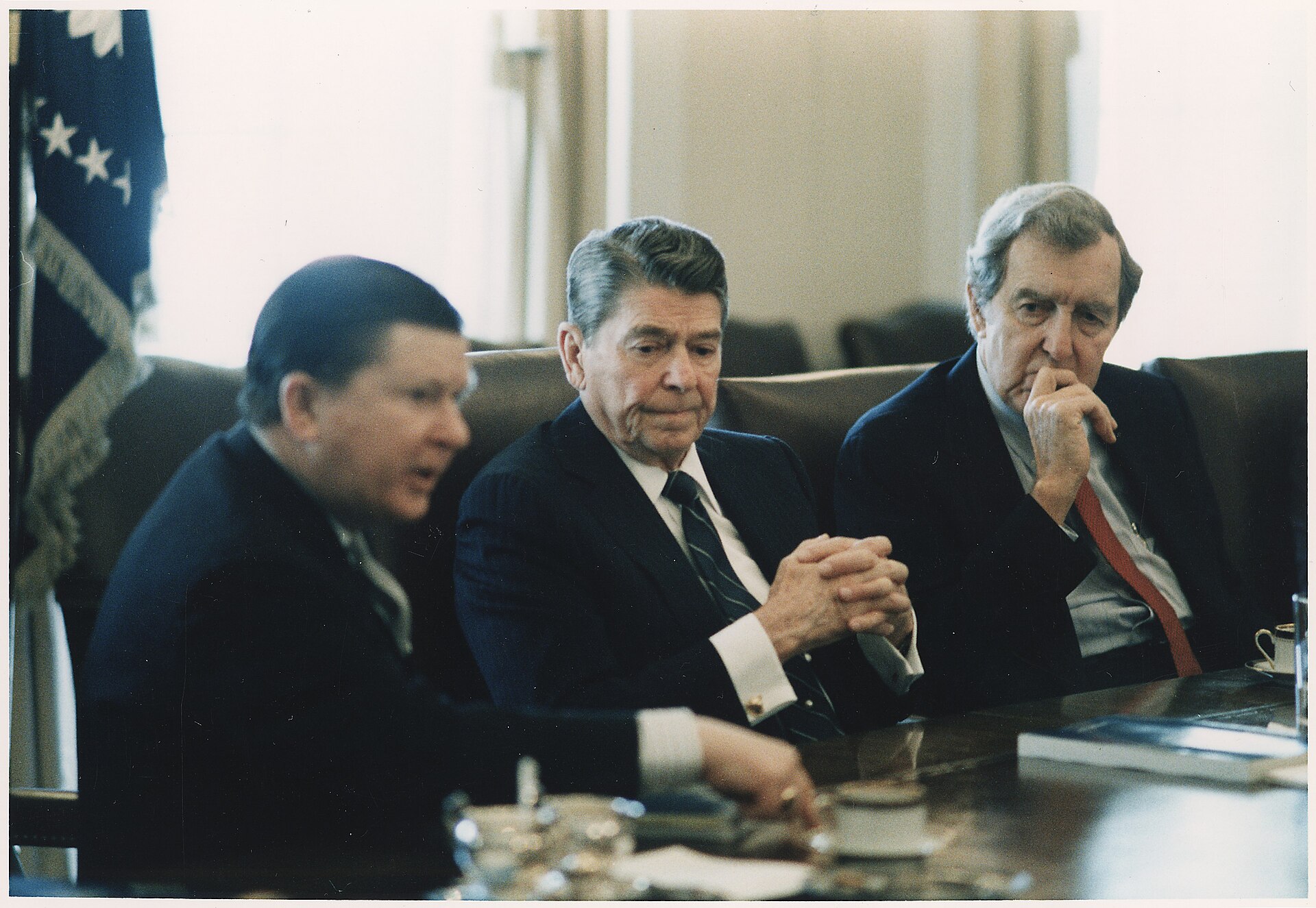 President Reagan (center) receives the Tower Commission Report in the White House Cabinet Room; John Tower is at left and Edmund Muskie is at right, 1987. President Reagan appeared before the Tower Commission on 2 December 1986, to answer questions regarding his involvement in the affair. When asked about his role in authorizing the arms deals, he first stated that he had; later, he appeared to contradict himself by stating that he had no recollection of doing so.[90] In his 1990 autobiography, An American Life, Reagan acknowledges authorizing the shipments to Israel.[91] The report published by the Tower Commission was delivered to the president on 26 February 1987. The commission had interviewed 80 witnesses to the scheme, including Reagan, as well as Manucher Ghorbanifar and Adnan Khashoggi.[90] The 200-page report was the most comprehensive of any released,[90] criticizing the actions of Oliver North, John Poindexter, Caspar Weinberger, and others. It determined that President Reagan did not have knowledge of the extent of the program, especially about the diversion of funds to the Contras, although it argued that the president ought to have had better control of the National Security Council staff. The report heavily criticized Reagan for not properly supervising his subordinates or being aware of their actions. A major result of the Tower Commission was the consensus that Reagan should have listened to his National Security Advisor more, thereby placing more power in the hands of that chair. |
タワー委員会 メイン記事: タワー委員会 1986年11月25日、レーガン大統領は本件を調査する特別審査委員会の設置を発表した。翌日、元上院議員ジョン・タワー、元国務長官エドマンド・マス キー、元国家安全保障問題担当大統領補佐官ブレント・スコウクロフトを委員に任命した。この大統領委員会は12月1日に発足し、タワー委員会として知られ るようになった。委員会の主な目的は、「イラン・コントラ事件を取り巻く状況、国家安全保障会議システムの運用における強みと弱みを明らかにする可能性の あるその他の事例研究、および同システムが1947年の創設以来8人の大統領にどのように奉仕してきたか」を調査することだった。タワー委員会は国家安全 保障会議を審査・評価した最初の大統領委員会である。[89] 1987年、ホワイトハウスの閣議室でレーガン大統領(中央)がタワー委員会報告書を受け取る様子。左はジョン・タワー、右はエドマンド・マスキー。 レーガン大統領は1986年12月2日、タワー委員会に出席し、本件への関与に関する質問に答えた。武器取引の承認における自身の役割を問われると、当初 は承認したと述べたが、後に「そのような記憶はない」と発言し、自ら矛盾する様子を見せた[90]。1990年の自伝『アメリカン・ライフ』において、 レーガンはイスラエルへの武器輸送を承認したことを認めている[91]。 タワー委員会が発表した報告書は、1987年2月26日に大統領に提出された。委員会は、レーガン、マヌチャー・ゴルバニファー、アドナン・カショギを含 む、この計画に関する80人の証人を聞き取り調査した。200ページにわたるこの報告書は、これまでに発表されたものの中で最も包括的なものであり、オリ バー・ノース、ジョン・ポインデクスター、キャスパー・ワインバーガーらの行動を批判した。報告書は、レーガン大統領は、特にコントラへの資金流用につい て、この計画の全容を把握していなかったと結論づけたが、大統領は国家安全保障会議のスタッフをよりよく管理すべきだったとも主張した。報告書は、部下を 適切に監督しなかったこと、また部下の行動を把握していなかったことを理由に、レーガンを厳しく批判した。タワー委員会の主な成果は、レーガンは国家安全 保障問題担当大統領補佐官の意見にもっと耳を傾けるべきだったという合意であり、その結果、その職の権限が強化された。 |
| Congressional committees investigating the affair Main article: Congressional committees investigating the Iran–Contra affair In January 1987, Congress announced it was opening an investigation into the Iran–Contra affair. Depending upon one's political perspective, the congressional investigation into the Iran–Contra affair was either an attempt by the legislative arm to gain control over an out-of-control executive arm, a partisan "witch hunt" by the Democrats against a Republican administration or a feeble effort by Congress that did far too little to rein in the "imperial presidency" that had run amok by breaking numerous laws.[92] The Democratic-controlled United States Congress issued its own report on 18 November 1987, stating that "If the president did not know what his national security advisers were doing, he should have."[3] The congressional report wrote that the president bore "ultimate responsibility" for wrongdoing by his aides, and his administration exhibited "secrecy, deception and disdain for the law".[93] It also read that "the central remaining question is the role of the President in the Iran–Contra affair. On this critical point, the shredding of documents by Poindexter, North and others, and the death of Casey, leave the record incomplete". |
イラン・コントラ事件を調査する議会委員会 メイン記事: イラン・コントラ事件を調査する議会委員会 1987年1月、議会はイラン・コントラ事件の調査を開始すると発表した。政治的立場によって、議会によるイラン・コントラ事件の調査は、立法府が制御不 能な行政府を掌握しようとする試みであったか、民主党による共和党政権への党派的な「ウイッチハント」であったか、あるいは数々の法律を破って暴走した 「帝王的大統領」を抑制するにはあまりにも不十分な、議会の弱々しい努力であったか、と評価が分かれる。[92] 民主党が支配する米国議会は1987年11月18日、独自の報告書を発表し「大統領が国家安全保障担当補佐官らの行動を知らなかったとしても、知るべき だった」と述べた[3]。議会報告書は、大統領が側近の不正行為に対し「最終的な責任」を負うと記し、その政権は「秘密主義、欺瞞、そして法への軽蔑」を 示したと指摘した。[93] また報告書は「残された核心的な疑問は、イラン・コントラ事件における大統領の役割である。この重大な点について、ポインデクスターやノースらによる文書 破棄、そしてケイシーの死により、記録は不完全なままである」と記した。 |
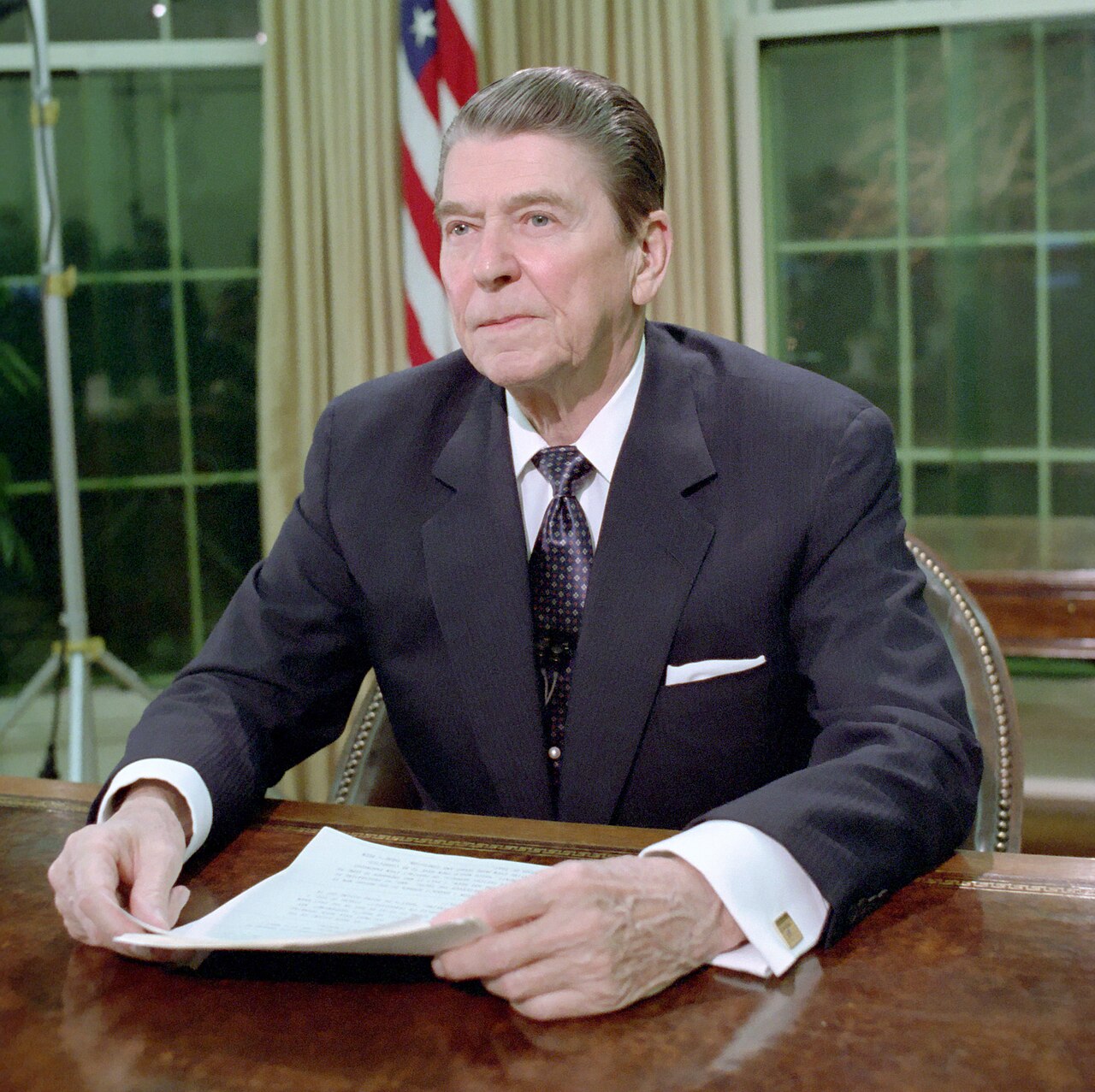
| Aftermath Reagan addresses the affair from the Oval Office; March 4, 1987. Reagan expressed regret with regard to the situation in a nationally televised address from the Oval Office on March 4, 1987, and in two other speeches.[94] Reagan had not spoken to the American people directly for three months amidst the scandal,[95] and he offered the following explanation for his silence: The reason I haven't spoken to you before now is this: You deserve the truth. And as frustrating as the waiting has been, I felt it was improper to come to you with sketchy reports, or possibly even erroneous statements, which would then have to be corrected, creating even more doubt and confusion. There's been enough of that.[95] Reagan then took full responsibility for the acts committed: First, let me say I take full responsibility for my own actions and for those of my administration. As angry as I may be about activities undertaken without my knowledge, I am still accountable for those activities. As disappointed as I may be in some who served me, I'm still the one who must answer to the American people for this behavior.[95] Finally, the president acknowledged that his previous assertions that the U.S. did not trade arms for hostages were incorrect: A few months ago I told the American people I did not trade arms for hostages. My heart and my best intentions still tell me that's true, but the facts and the evidence tell me it is not. As the Tower board reported, what began as a strategic opening to Iran deteriorated, in its implementation, into trading arms for hostages. This runs counter to my own beliefs, to administration policy, and to the original strategy we had in mind.[95] Reagan's role in these transactions is still not definitively known. It is unclear exactly what Reagan knew and when, and whether the arms sales were motivated by his desire to save the U.S. hostages. Oliver North wrote that "Ronald Reagan knew of and approved a great deal of what went on with both the Iranian initiative and private efforts on behalf of the contras and he received regular, detailed briefings on both ... I have no doubt that he was told about the use of residuals for the Contras, and that he approved it. Enthusiastically."[96] Handwritten notes by Defense Secretary Weinberger indicate that the President was aware of potential hostage transfers[clarification needed] with Iran, as well as the sale of Hawk and TOW missiles to what he was told were "moderate elements" within Iran.[97] Notes taken by Weinberger on 7 December 1985 record that Reagan said that "he could answer charges of illegality but he couldn't answer charge that 'big strong President Reagan passed up a chance to free hostages'".[97] The Republican-written "Report of the Congressional Committees Investigating the Iran-Contra Affair" made the following conclusion: There is some question and dispute about precisely the level at which he chose to follow the operation details. There is no doubt, however, ... [that] the President set the US policy towards Nicaragua, with few if any ambiguities, and then left subordinates more or less free to implement it.[98] Domestically, the affair precipitated a drop in President Reagan's popularity. His approval ratings suffered "the largest single drop for any U.S. president in history", from 67% to 46% in November 1986, according to a New York Times/CBS News poll.[99] The "Teflon President", as Reagan was nicknamed by critics,[100] survived the affair, however, and his approval rating recovered.[101] Internationally, the damage was more severe. Magnus Ranstorp wrote, "U.S. willingness to engage in concessions with Iran and the Hezbollah not only signaled to its adversaries that hostage-taking was an extremely useful instrument in extracting political and financial concessions for the West but also undermined any credibility of U.S. criticism of other states' deviation from the principles of no-negotiation and no concession to terrorists and their demands."[102] In Iran, Mehdi Hashemi, the leaker of the scandal, was executed in 1987, allegedly for activities unrelated to the scandal. Though Hashemi made a full video confession to numerous serious charges, some observers find the coincidence of his leak and the subsequent prosecution highly suspicious.[103] In 1994, just five years after leaving office, President Reagan announced that he had been diagnosed with Alzheimer's disease.[104] Lawrence Walsh, who was appointed Independent Counsel in 1986 to investigate the transactions, later implied Reagan's declining health may have played a role in his handling of the situation. However, Walsh did note that he believed President Reagan's "instincts for the country's good were right".[105][unreliable source] |
余波 レーガン大統領が楕円形執務室から事件について語る;1987年3月4日。 レーガンは1987年3月4日、楕円形執務室から全国テレビ演説を行い、また別の二つの演説でこの状況について遺憾の意を表明した[94]。スキャンダル発生後、レーガンは三ヶ月間アメリカ国民に直接語りかけていなかった[95]。彼は沈黙について次のように説明した: これまで国民に話さなかった理由はこうだ。国民には真実を知る権利がある。待ち続けるのは苛立たしいが、不完全な報告や誤った発言で国民に臨むのは不適切だと感じた。後で訂正すれば、さらに疑念と混乱を生むだけだ。そうした事態は十分にあった。[95] レーガンはその後、行われた行為について全面的な責任を認めた: まず、私自身の行動と私の政権の行動について、全面的な責任を負うことを表明する。私の知らないところで進められた活動にどれほど怒りを感じようとも、私 は依然としてそれらの活動に対する責任を負う。私に仕えた者たちの一部に対してどれほど失望しようとも、この行為についてアメリカ国民に説明しなければな らないのは私である。[95] 最後に大統領は、米国が人質と武器を交換しなかったという自身の以前の主張が誤りであったことを認めた: 数ヶ月前、私はアメリカ国民に、人質と武器を交換しなかったと述べた。私の心と善意は今もそれが真実だと告げているが、事実と証拠はそうではないと示して いる。タワー委員会が報告した通り、イランへの戦略的接近として始まったものは、実行過程で武器と人質の交換へと変質した。これは私の信念にも、政権の政 策にも、当初の戦略構想にも反するものである。[95] これらの取引におけるレーガンの役割は、依然として明確にはわかっていない。レーガンがいつ、何を正確に知っていたのか、また、武器販売は米国人人質を救 いたいという彼の願望によって動機づけられたものだったのかどうかは不明である。オリバー・ノースは、「ロナルド・レーガンは、イランとの交渉とコントラ 支援のための私的な取り組みの両方について、その多くを知っており、承認していた。彼は、その両方について、定期的かつ詳細な報告を受けていた... コントラへの残余資金の使用について報告を受け、それを承認したことは間違いない。熱狂的に」と記している。[96] ワインバーガー国防長官の手書きのメモによると、大統領はイランとの人質交換の可能性[説明が必要]、およびイラン国内の「穏健派」と伝えられた勢力への ホークミサイルおよび TOW ミサイルの販売について認識していた。[97] 1985年12月7日にワインバーガーが取ったメモには、レーガンが「違法性の非難には答えられるが、『強大なレーガン大統領が人質解放の機会を逃した』 という非難には答えられない」と述べたと記録されている。[97] 共和党が作成した「イラン・コントラ事件を調査する議会委員会報告書」は、次のような結論を下している。 彼が作戦の詳細をどの程度まで把握していたかについては、いくつかの疑問や論争がある。しかし、大統領がニカラグアに対する米国の政策を、ほとんど曖昧さなく決定し、その実施を部下にほぼ自由に任せたことは疑いの余地がない。[98] 国内では、この事件によりレーガン大統領の人気は急落した。ニューヨーク・タイムズ/CBSニュースの世論調査によれば、支持率は1986年11月に 67%から46%へ「歴代米大統領中最大の単一下落幅」を記録した[99]。しかし批判派から「テフロン大統領」と揶揄されたレーガンは[100]、この 事件を乗り切り支持率は回復した[101]。 国際的には被害がより深刻だった。マグヌス・ランストルプはこう記している。「米国がイランやヒズボラとの譲歩に応じる姿勢は、敵対勢力に対し人質事件が 西側諸国から政治的・財政的譲歩を引き出す極めて有用な手段であることを示しただけでなく、テロリストとその要求に対する『交渉せず、譲歩しない』という 原則からの逸脱を米国が他国を批判する信頼性を損なった」 [102] イランでは、このスキャンダルの内部告発者メフディ・ハシェミが1987年に処刑された。表向きはスキャンダルとは無関係の活動が理由とされる。ハシェミ は数多くの重大な容疑について完全な自白ビデオを残しているが、告発とその直後の起訴が同時期に起こった偶然を、一部の観察者は極めて不審に思っている。 [103] 1994年、レーガン大統領は退任からわずか5年後にアルツハイマー病と診断されたことを発表した。[104] 1986年に取引調査のため独立検察官に任命されたローレンス・ウォルシュは、後にレーガンの健康悪化が事態の対応に影響した可能性を示唆した。ただし ウォルシュは、レーガン大統領の「国益に対する直感は正しかった」と確信していると付言している。[105][信頼性の低い情報源] |
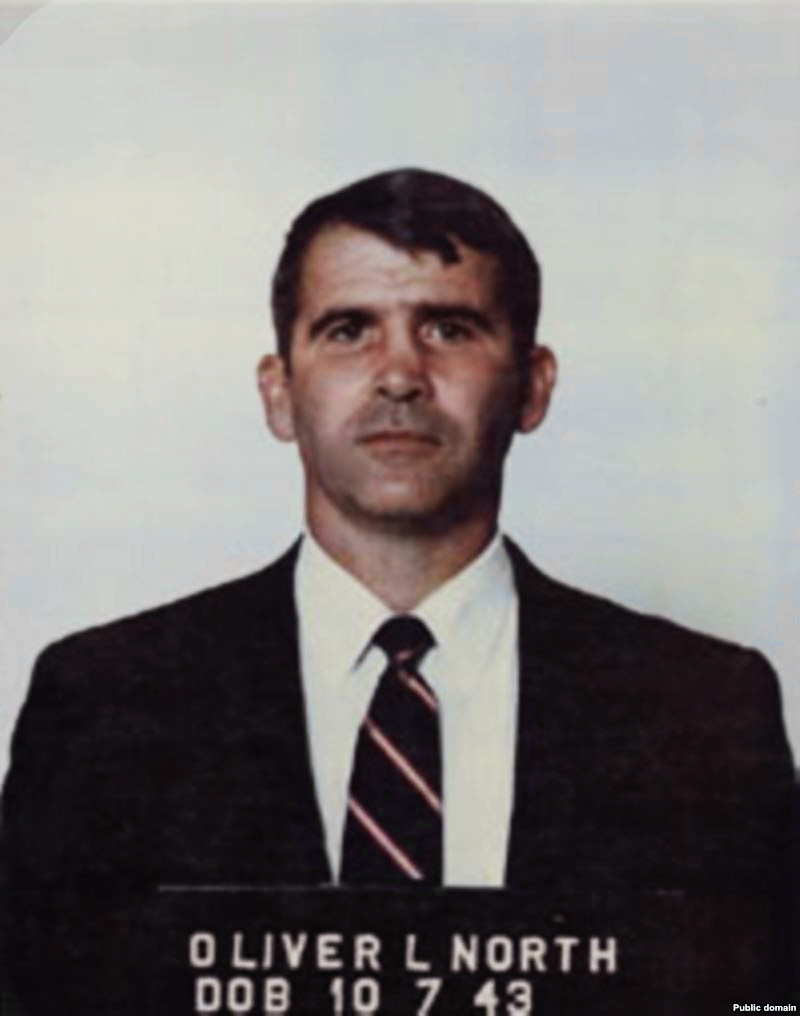
| Indictments Oliver North's mugshot,[106] after his arrest Caspar Weinberger, Secretary of Defense, was indicted on two counts of perjury and one count of obstruction of justice on 16 June 1992.[107] However, he was pardoned by George H. W. Bush on 24 December 1992, before he could be tried.[108] Robert C. McFarlane, National Security Adviser, convicted of withholding evidence, but after a plea bargain was given only two years of probation. Later pardoned by President George H. W. Bush.[109] Elliott Abrams, Assistant Secretary of State, convicted of withholding evidence, but after a plea bargain was given only two years probation. Later pardoned by President George H. W. Bush.[110] Alan D. Fiers, Chief of the CIA's Central American Task Force, convicted of withholding evidence and sentenced to one year probation. Later pardoned by President George H. W. Bush. Clair George, Chief of Covert Ops-CIA, convicted on two charges of perjury, but pardoned by President George H. W. Bush before sentencing.[111] Oliver North, member of the National Security Council, was indicted on 16 charges.[112] A jury convicted him of accepting an illegal gratuity, obstruction of a congressional inquiry, and destruction of documents. The convictions were overturned on appeal because his Fifth Amendment rights may have been violated by use of his immunized public testimony[113] and because the judge had incorrectly explained the crime of destruction of documents to the jury.[114] Fawn Hall, Oliver North's secretary, was given immunity from prosecution on charges of conspiracy and destroying documents in exchange for her testimony.[115] Jonathan Scott Royster, Liaison to Oliver North, was given immunity from prosecution on charges of conspiracy and destroying documents in exchange for his testimony.[116] National Security Advisor John Poindexter was convicted of five counts of conspiracy, obstruction of justice, perjury, defrauding the government, and the alteration and destruction of evidence. A panel of the D.C. Circuit overturned the convictions on 15 November 1991 for the same reason the court had overturned Oliver North's, and by the same 2 to 1 vote.[117] The Supreme Court refused to hear the case.[118] Duane Clarridge. An ex-CIA senior official, he was indicted in November 1991 on seven counts of perjury and false statements relating to a November 1985 shipment to Iran. He was pardoned before trial by President George H. W. Bush.[119][120] Richard V. Secord. A former Air Force major general, who was involved in arms transfers to Iran and diversion of funds to Contras, he pleaded guilty in November 1989 to making false statements to Congress and was sentenced to two years of probation. As part of his plea bargain, Secord agreed to provide further truthful testimony in exchange for the dismissal of remaining criminal charges against him.[121][17] Albert Hakim. A businessman, he pleaded guilty in November 1989 to supplementing the salary of North by buying a $13,800 fence for North with money from "the Enterprise", which was a set of foreign companies Hakim used in Iran–Contra. In addition, Swiss company Lake Resources Inc., used for storing money from arms sales to Iran to give to the Contras, pled guilty to stealing government property.[122] Hakim was given two years of probation and a $5,000 fine, while Lake Resources Inc. was ordered to dissolve.[121][123] Thomas G. Clines. A former CIA clandestine service officer. According to Special Prosecutor Walsh, he earned nearly $883,000 helping retired Air Force Maj. Gen. Richard V. Secord and Albert Hakim carry out the secret operations of "the Enterprise". He was indicted for concealing the full amount of his Enterprise profits for the 1985 and 1986 tax years, and for failing to declare his foreign financial accounts. He was convicted and served 16 months in prison, the only Iran–Contra defendant to have served a prison sentence.[124] The Independent Counsel, Lawrence E. Walsh, chose not to re-try North or Poindexter.[125] In total, several dozen people were investigated by Walsh's office.[126] |
起訴 逮捕後のオリバー・ノースの逮捕写真[106] キャスパー・ワインバーガー国防長官は、1992年6月16日に偽証罪2件および司法妨害罪1件で起訴された[107]。しかし、裁判にかけられる前に、1992年12月24日にジョージ・H・W・ブッシュによって恩赦を受けた。[108] ロバート・C・マクファーレン国家安全保障問題担当大統領補佐官は、証拠隠滅で有罪判決を受けたが、司法取引の結果、2年間の保護観察処分に留まった。後にジョージ・H・W・ブッシュ大統領により恩赦を受けた。[109] エリオット・エイブラムス国務次官は、証拠隠滅で有罪判決を受けたが、司法取引の結果、2年間の保護観察処分に留まった。後にジョージ・H・W・ブッシュ大統領により恩赦を受けた。[110] アラン・D・フィアーズ、CIA 中米タスクフォース長、証拠隠滅で有罪判決を受け、1 年間の保護観察処分となった。後にジョージ・H・W・ブッシュ大統領により恩赦を受けた。 クレア・ジョージ、CIA 秘密作戦部長、偽証罪 2 件で有罪判決を受けたが、判決前にジョージ・H・W・ブッシュ大統領により恩赦を受けた。[111] 国家安全保障会議メンバーのオリバー・ノースは16件の罪で起訴された。[112]陪審は彼に対し、違法な謝礼の受領、議会調査妨害、文書破棄の罪で有罪 評決を下した。しかし控訴審で有罪判決は覆された。理由は、彼の公的証言(免責特権適用)が第五修正条項の権利を侵害した可能性[113]と、裁判官が陪 審に対し文書破棄罪の法的定義を誤って説明したためである。[114] オリバー・ノースの秘書、フォーン・ホールは、共謀罪及び文書破棄罪の起訴免除と引き換えに証言した。[115] オリバー・ノースの連絡係、ジョナサン・スコット・ロイスターは、共謀罪及び文書破棄罪の起訴免除と引き換えに証言した。[116] 国家安全保障問題担当大統領補佐官ジョン・ポインデクスターは、共謀罪5件、司法妨害罪、偽証罪、政府詐欺罪、証拠改ざん及び隠滅罪で有罪判決を受けた。 1991年11月15日、連邦巡回区控訴裁判所は、オリバー・ノースの判決を覆したのと同じ理由で、2対1の投票により有罪判決を破棄した[117]。最 高裁はこの事件の審理を拒否した。[118] デュアン・クラリッジ。元CIA高官で、1985年11月のイラン向け輸送に関連する偽証及び虚偽陳述の罪で1991年11月に起訴された。裁判前にジョージ・H・W・ブッシュ大統領により恩赦を受けた。[119] [120] リチャード・V・セコード。元空軍少将。イランへの武器供与及びコントラへの資金流用に関与。1989年11月、議会への虚偽陳述で有罪を認め、2年間の 保護観察処分を受けた。司法取引の一環として、セコードは残りの刑事訴追の取り下げと引き換えに、さらなる真実の証言を提供することに同意した。 [121] [17] アルバート・ハキム。実業家。1989年11月、ハキムがイラン・コントラ事件で利用した外国企業群「ザ・エンタープライズ」からの資金でノースに 13,800ドルのフェンスを購入し、ノースの給与を補填した罪で有罪を認めた。さらに、イランへの武器販売で得た資金をコントラ支援に回すため資金を保 管したスイスの企業レイク・リソーシズ社は、政府財産の窃盗で有罪を認めた。[122]ハキムは2年間の保護観察と5,000ドルの罰金刑を受け、レイ ク・リソーシズ社は解散を命じられた。[121][123] トーマス・G・クラインズ。元CIA秘密工作員。特別検察官ウォルシュによれば、彼は退役空軍少将リチャード・V・セコードとアルバート・ハキムが「ザ・ エンタープライズ」の秘密作戦を遂行するのを支援し、約88万3000ドルを稼いだ。彼は1985年及び1986年の課税年度におけるエンタープライズか らの利益全額を隠蔽したこと、並びに海外金融口座を申告しなかったことで起訴された。彼は有罪判決を受け、16ヶ月の刑期を服役した。イラン・コントラ事 件の被告で実刑を受けたのは彼だけである。[124] 独立検察官ローレンス・E・ウォルシュは、ノースやポインデクスターの再審理を行わないことを選択した。[125] ウォルシュの事務所は計で数十人を調査した。[126] |
| George H. W. Bush's involvement On 27 July 1986, Israeli counterterrorism expert Amiram Nir briefed Vice President Bush in Jerusalem about the weapon sales to Iran.[127] In an interview with The Washington Post in August 1987, Bush stated that he was denied information about the operation and did not know about the diversion of funds.[128] Bush said that he had not advised Reagan to reject the initiative because he had not heard strong objections to it.[128] The Post quoted him as stating, "We were not in the loop."[128] The following month, Bush recounted meeting Nir in his September 1987 autobiography Looking Forward, stating that he began to develop misgivings about the Iran initiative.[129] He wrote that he did not learn the full extent of the Iran dealings until he was briefed by Senator David Durenberger regarding a Senate inquiry into them.[129] Bush added the briefing with Durenberger left him with the feeling he had "been deliberately excluded from key meetings involving details of the Iran operation".[129] In January 1988 during a live interview with Bush on CBS Evening News, Dan Rather told Bush that his unwillingness to speak about the scandal led "people to say 'either George Bush was irrelevant or he was ineffective, he set himself outside of the loop.'"[130] Bush replied, "May I explain what I mean by 'out of the loop'? No operational role."[130][131] Although Bush publicly insisted that he knew little about the operation, his statements were contradicted by excerpts of his diary released by the White House in January 1993.[130][132] An entry dated 5 November 1986 stated: "On the news at this time is the question of the hostages ... I'm one of the few people that know fully the details, and there is a lot of flak and misinformation out there. It is not a subject we can talk about ..."[130][132] International involvement Following the Iran-Contra Affair in 1987, covert military assistance from Taiwan to the Contras was exposed, with reports indicating that Ku Cheng-kang, the co-founder and chairman of World League for Freedom and Democracy played a key role in facilitating the aid. The Taiwanese Ministry of Foreign Affairs later confirmed these activities.[133][134] |
ジョージ・H・W・ブッシュの関与 1986年7月27日、イスラエルの対テロ専門家アミラム・ニールがエルサレムでブッシュ副大統領に対し、イランへの武器販売について説明した。[127] 1987年8月のワシントン・ポスト紙のインタビューで、ブッシュは作戦に関する情報を拒否され、資金の流用について知らなかったと述べた。ブッシュは、 強い反対意見が聞かれなかったため、レーガンにこの計画を拒否するよう助言しなかったと述べた。[128] ワシントン・ポスト紙は、ブッシュが「我々は情報網から外されていた」と発言したと報じた。[128] 翌月、ブッシュは1987年9月出版の自伝『Looking Forward』でニールとの面会を振り返り、イラン計画に対して疑念を抱き始めたと記した。[129] ブッシュは、上院の調査に関するデビッド・デュレンバーガー上院議員からの説明を受けるまで、イラン取引の全容を把握していなかったと記している。 [129] ブッシュはさらに、デュレンバーガーとの説明後、「イラン作戦の詳細に関わる重要な会議から意図的に排除されていた」という感覚を抱いたと付け加えた。 [129] 1988年1月、CBSイブニングニュースの生放送インタビューで、ダン・ラザーはブッシュに対し、スキャンダルについて語ろうとしない姿勢が「人々に 『ジョージ・ブッシュは無関係か、無能か、自ら情報を遮断した』と言わせている」と指摘した。[130] ブッシュは「『情報を遮断した』とはどういう意味か説明させてほしい。作戦上の役割はなかった」と答えた。[130] [131] ブッシュは公の場で作戦についてほとんど知らなかったと主張したが、1993年1月にホワイトハウスが公開した彼の日記の抜粋はその主張と矛盾していた。 [130] [132] 1986年11月5日付の記述にはこうある:「現在のニュースは人質問題が中心だ…詳細を完全に把握している数少ない人間の一人だが、世間には批判や誤情 報が溢れている。これは我々が語れる話題ではない…」[130] [132] 国際的関与 1987年のイラン・コントラ事件後、台湾によるコントラへの秘密軍事支援が暴露された。世界自由民主連盟の共同創設者兼会長である顧承康が支援の仲介で重要な役割を果たしたとの報告があった。台湾外交部はこの活動を後に確認した。[133][134] |
| Pardons On 24 December 1992, after he had been defeated for reelection by Bill Clinton, President George H. W. Bush pardoned five administration officials who had been found guilty on charges relating to the affair.[135][136] They were: Elliott Abrams; Duane Clarridge; Alan Fiers; Clair George; and Robert McFarlane. Bush also pardoned Caspar Weinberger, who had not yet come to trial.[137] Attorney General William P. Barr advised the President on these pardons, especially that of Caspar Weinberger.[138] In response to these Bush pardons, Independent Counsel Lawrence E. Walsh, who headed the investigation of Reagan administration officials' criminal conduct in the Iran–Contra scandal, stated that "the Iran-contra cover-up, which has continued for more than six years, has now been completed." Walsh noted that in issuing the pardons Bush appears to have been preempting being implicated himself in the crimes of Iran–Contra by evidence that was to come to light during the Weinberger trial, and noted that there was a pattern of "deception and obstruction" by Bush, Weinberger and other senior Reagan administration officials.[125][12][13] Modern interpretations The Iran–Contra affair and the ensuing deception to protect senior administration officials (including President Reagan) was cast as an example of post-truth politics by Malcolm Byrne of George Washington University.[139] |
恩赦 1992年12月24日、ビル・クリントンに再選を敗れたジョージ・H・W・ブッシュ大統領は、この事件に関連して有罪判決を受けた5人の政府高官を恩赦した[135][136]。その5人は以下の通りである。 エリオット・エイブラムス デュエイン・クラリッジ アラン・フィアーズ クレア・ジョージ ロバート・マクファーレン ブッシュは、まだ裁判にかけられていなかったキャスパー・ワインバーガーも恩赦した[137]。ウィリアム・P・バー司法長官は、これらの恩赦、特にキャスパー・ワインバーガーの恩赦について大統領に助言した。[138] これらのブッシュの恩赦を受けて、イラン・コントラ事件におけるレーガン政権高官の犯罪行為の調査を指揮した独立検事ローレンス・E・ウォルシュは、「6 年以上も続いたイラン・コントラ事件の隠蔽工作は、これで完了した」と述べた。ウォルシュは、ブッシュが恩赦を発令したことで、ワインバーガーの裁判で明 らかになるであろう証拠によって、自身がイラン・コントラ事件の犯罪に関与したと見られることを先制的に回避しようとしたようだと指摘し、ブッシュ、ワイ ンバーガー、およびその他のレーガン政権高官による「欺瞞と妨害」のパターンがあったと述べた。[125][12] [13] 現代的な解釈 イラン・コントラ事件と、それに続く政権高官(レーガン大統領を含む)を保護するための欺瞞は、ジョージ・ワシントン大学のマルコム・バーンによって、ポスト真実の政治の一例として取り上げられた。[139] |
| Reports and documents The 100th Congress formed a Joint Committee of the United States Congress (Congressional committees investigating the Iran–Contra affair) and held hearings in mid-1987. Transcripts were published as: Iran-Contra Investigation: Joint Hearings Before the Senate Select Committee on Secret Military Assistance to Iran and the Nicaraguan Opposition and the House Select Committee to Investigate Covert Arms Transactions with Iran (U.S. GPO 1987–88). A closed Executive Session heard classified testimony from North and Poindexter; this transcript was published in a redacted format. The joint committee's final report was Report of the Congressional Committees Investigating the Iran-Contra Affair With Supplemental, Minority, and Additional Views (U.S. GPO 17 November 1987). The records of the committee are at the National Archives, but many are still non-public.[140] Testimony was also heard before the House Foreign Affairs Committee, House Permanent Select Committee on Intelligence, and Senate Select Committee on Intelligence and can be found in the Congressional Record for those bodies. The Senate Intelligence Committee produced two reports: Preliminary Inquiry into the Sale of Arms to Iran and Possible Diversion of Funds to the Nicaraguan Resistance (2 February 1987) and Were Relevant Documents Withheld from the Congressional Committees Investigating the Iran-Contra Affair? (June 1989).[141] The Tower Commission Report was published as the Report of the President's Special Review Board (U.S. GPO 26 February 1987). It was also published as The Tower Commission Report by Bantam Books (ISBN 0-553-26968-2). The Office of Independent Counsel/Walsh investigation produced four interim reports to Congress. Its final report was published as the Final Report of the Independent Counsel for Iran/Contra Matters. Walsh's records are available at the National Archives.[142] |
報告書と文書 第100回議会は合衆国議会合同委員会(イラン・コントラ事件調査議会委員会)を設置し、1987年半ばに公聴会を開催した。議事録は『イラン・コントラ 調査:イラン及びニカラグア反体制勢力への秘密軍事援助に関する上院特別委員会並びにイランとの秘密武器取引調査下院特別委員会合同公聴会記録』(米国政 府印刷局 1987-88年)として刊行された。非公開の執行部会ではノースとポインデクスターから機密証言が聴取され、この記録は編集版で公表された。合同委員会 の最終報告書は『イラン・コントラ事件調査議会委員会報告書 補足意見・少数意見・追加意見付』(米国政府印刷局、1987年11月17日)である。委員 会の記録は国立公文書館に保管されているが、多くは未だ非公開である。[140] 証言は下院外交委員会、下院情報特別常設委員会、上院情報特別委員会でも聴取され、各委員会の議会記録に掲載されている。上院情報委員会は二つの報告書を 作成した:『イランへの武器販売及びニカラグア抵抗勢力への資金流用疑惑に関する予備調査』(1987年2月2日)と『イラン・コントラ事件調査議会委員 会から関連文書が隠蔽されたか?』(1989年6月)。[141] タワー委員会報告書は『大統領特別調査委員会報告書』(米国政府印刷局、1987年2月26日)として公表された。またバンタム・ブックスより『タワー委員会報告書』(ISBN 0-553-26968-2)として出版されている。 独立検察官室/ウォルシュ調査は議会へ四つの中間報告書を提出した。最終報告書は『イラン・コントラ問題独立検察官最終報告書』として公表された。ウォルシュの記録は国立公文書館で閲覧可能である。[142] |
| Israel–United States relations Israel's role in the Iran–Iraq War Timeline of the Iran–Contra affair Brokers of Death arms case CIA involvement in Contra cocaine trafficking Congressional committees investigating the Iran–Contra affair Iran–Iraq relations Iran–Israel relations Iran–United States relations Iraq–Israel relations Iraq–United States relations Latin America–United States relations List of federal political scandals in the United States William Northrop 1980 October Surprise theory Operation Tipped Kettle (the transfer of PLO weapons which were seized by Israel in Lebanon to the Contras) United States and state-sponsored terrorism United States foreign policy in the Middle East United States involvement in regime change in Latin America |
イスラエルとアメリカの関係 イラン・イラク戦争におけるイスラエルの役割 イラン・コントラ事件の年表 死の仲介者事件 CIAのコントラコカイン密輸への関与 イラン・コントラ事件を調査した議会委員会 イランとイラクの関係 イランとイスラエルの関係 イランとアメリカの関係 イラクとイスラエルの関係 イラクとアメリカ合衆国の関係 ラテンアメリカとアメリカ合衆国の関係 アメリカ合衆国の連邦政治スキャンダルのリスト ウィリアム・ノースロップ 1980年10月のサプライズ説 ティップド・ケトル作戦(レバノンでイスラエルが押収したPLOの武器をコントラに譲渡した作戦) アメリカ合衆国と国家が支援するテロリズム 中東におけるアメリカ合衆国の外交政策 ラテンアメリカにおける政権交代へのアメリカ合衆国の関与 |
| Footnotes 01. "Iran-Contra Affair". 2026. "H.Amdt.974 to H.R.7355 - 97th Congress (1981-1982)". www.congress.gov. Retrieved 9 July 2025. "Reagan's mixed White House legacy". BBC. 6 June 2004. Archived from the original on 9 February 2011. Retrieved 22 April 2008. Butterfield, Fox (27 November 1988). "Arms for Hostages – Plain and Simple". The New York Times (National ed.). sec. 7. p. 10. Retrieved 29 December 2018. Abshire, David (2005). Saving the Reagan Presidency: Trust Is the Coin of the Realm. Texas A&M University Press. ISBN 9781603446204. Archived from the original on 11 April 2023. Retrieved 19 March 2023. Valentine, Douglas (2008). Reagan, Bush, Gorbachev: Revisiting the End of the Cold War. Praeger Security International. ISBN 9780313352416. Archived from the original on 5 April 2023. Retrieved 19 March 2023. "The Iran-Contra Affair • Levin Center for Oversight and Democracy". Levin Center for Oversight and Democracy. Retrieved 9 July 2025. Reagan, Ronald (13 November 1986). "Address to the Nation on the Iran Arms and Contra Aid Controversy". Ronald Reagan Presidential Foundation. Archived from the original on 6 March 2016. Retrieved 7 June 2008. "Excerpts From the Iran-Contra Report: A Secret Foreign Policy". The New York Times. 1994. Archived from the original on 10 April 2009. Retrieved 7 June 2008. 10. Reagan, Ronald (4 March 1987). "Address to the Nation on the Iran Arms and Contra Aid Controversy". Ronald Reagan Presidential Foundation. Archived from the original on 3 October 2014. Retrieved 7 June 2008. Dwyer, Paula. "Pointing a Finger at Reagan". Business Week. Archived from the original on 16 April 2008. Retrieved 22 April 2008. "Pardons Granted by President George H. W. Bush (1989–1993)". U.S. Department of Justice. 12 January 2015. Archived from the original on 23 December 2020. Retrieved 22 December 2020. Walsh, Lawrence E. (1997). Firewall: The Iran-Contra Conspiracy and Cover-up. New York: W. W. Norton & Company. p. 290. Walsh 1993. Kornbluh & Byrne 1993, p. 213. Hicks 1996, p. 965. Johnston, David (9 November 1989). "Secord Is Guilty of One Charge in Contra Affair". The New York Times (National ed.). sec. A. p. 24. Archived from the original on 18 November 2018. Retrieved 19 July 2011. Corn, David (2 July 1988). "Is There Really A 'Secret Team'?". The Nation. Hicks 1996, p. 966. 20. Hicks 1996, p. 964. Hicks 1996, pp. 966–967. Lemoyne, James (19 October 1986). "Ortega, Faulting Reagan, Warns of Coming War". The New York Times (National ed.). sec. 1. p. 6. Archived from the original on 19 July 2018. Retrieved 15 November 2018. Payton, Brenda (4 April 1988). "Is U.S. Backing Contras with Drug Funds?". Oakland Tribune. Powell, Colin L.; Persico, Joseph E. (1995). My American Journey. New York: Random House. p. 341. ISBN 0-679-43296-5. "Panamanian dictator Manuel Noriega's complex US ties suggest lessons for Trump era, historians say". ABC News. Archived from the original on 7 November 2021. Retrieved 7 November 2021. Plaut, Martin (30 October 2018). "Apartheid, guns and money: book lifts the lid on Cold War secrets". The Conversation. Archived from the original on 8 November 2021. Retrieved 7 November 2021. Van Vuuren, Hennie (2018). Apartheid, guns and money: a tale of profit. London: Oxford University Press. pp. 260–269. ISBN 978-1-78738-247-3. OCLC 1100767741. Plaut, Martin (3 November 2018). "The Chinese and Soviets had a bigger role in supporting apartheid than we previously knew". Quartz. Archived from the original on 7 November 2021. Retrieved 6 November 2021. Guerrero, Alina (18 June 1986). "Danish Ship Caught Carrying Soviet-Made Weapons". Associated Press News. Archived from the original on 28 September 2022. Retrieved 7 November 2021. 30. Tyroler, Deborah (17 December 1986). "The Pia Vesta Caper: A New Dimension To Contragate". NotiCen. Archived from the original on 11 December 2021. Retrieved 7 November 2021. Hersh, Seymour M. (8 December 1991). "U.S. Said to Have Allowed Israel to Sell Arms to Iran". The New York Times (national ed.). sec. 1. p. 1. Archived from the original on 28 July 2018. Retrieved 15 November 2018. "THE WHITE HOUSE CRISIS: THE ROLE OF BUSINESS; ARMS FUND SEEM ENTWINED IN OTHER DEALS BY KHASHOGGI". The New York Times. Kornbluh & Byrne 1993, pp. 213–214. Kornbluh & Byrne 1993, p. 214. "The Iran-Contra Scandal". The American–Israeli Cooperative Enterprise. Archived from the original on 15 May 2008. Retrieved 7 June 2008. "State Sponsors of Terrorism". State.gov. Archived from the original on 1 August 2018. Retrieved 18 August 2014. Reagan 1990, p. 504. Brogan, Patrick (1989). The Fighting Never Stopped: A Comprehensive Guide To World Conflicts Since 1945. New York: Vintage Books. p. 253. Gilbert, Robert E. (2014). "The politics of presidential illness: Ronald Reagan and the Iran-Contra Scandal". Politics and the Life Sciences. 33 (2): 58–76. doi:10.2990/33_2_58. PMID 25901884. S2CID 41674696. 40. Monteagudo, Merrie (8 January 2021). "From the Archives: Ronald Regan first invoked the 25th Amendment in 1985". The San Diego Union Tribune. Archived from the original on 26 January 2021. Retrieved 3 March 2021. Reagan 1990, p. 505. Walsh 1993, chpt. 24. Walsh 1993, Part I. Reagan 1990, p. 506. Kornbluh & Byrne 1993, pp. 214–215. Kornbluh & Byrne 1993, p. 215. "Arms, Hostages and Contras: How a Secret Foreign Policy Unraveled". The New York Times (national ed.). 19 November 1987. sec. A. p. 12. Archived from the original on 26 April 2020. Retrieved 7 June 2008. Hamilton & Inouye 1987. "Letter Accepting the Resignation of Robert C. McFarlane as Assistant to the President for National Security Affairs". Archived from the original on 20 March 2014. Retrieved 4 December 2012. 50. Walsh 1993, chpt. 1. Reagan 1990, p. 509. "Understanding the Iran-Contra Affairs - The Legal Aftermath". Brown University. Archived from the original on 17 May 2022. Retrieved 5 July 2020. Reagan 1990, p. 510. Reagan 1990, p. 512. Kornbluh & Byrne 1993, p. 216. See Washington Post at the time. Kornbluh & Byrne 1993, p. 217. Walsh 1993, vol. I. Avery, Steve (2005). "Irangate: Iran-Contra affair, 1985–1992". U-S-History.com. Archived from the original on 12 May 2011. Retrieved 7 June 2008. 60. Fisher, Louis (1989). "How Tightly Can Congress Draw the Purse Strings?". American Journal of International Law. 83 (4): 758–766. doi:10.2307/2203364. JSTOR 2203364. S2CID 147213452. "Brunei Regains $10 Million". The New York Times (National ed.). Associated Press. 22 July 1987. sec. A. p. 9. Archived from the original on 30 June 2009. Retrieved 28 March 2008. Reagan 1990, p. 516. Gwertzman, Bernard (11 January 1987). "McFarlane Took Cake and Bible to Teheran, Ex-C.I.A. Man Says". The New York Times. Archived from the original on 28 September 2019. Retrieved 9 February 2017. "Calls President Courageous but Weak: Iranian Exhibits Bible Signed by Reagan". Los Angeles Times. 28 January 1987. Archived from the original on 20 November 2011. Retrieved 15 May 2012. Tower, Muskie & Scowcroft 1987, p. B-100. Reagan 1990, pp. 520–521. President's Special Review Board (26 February 1987). Report of the President's Special Review Board. Washington, D.C.: United States Government Printing Office. p. 237. OCLC 15243889. Archived from the original on 5 February 2016. Retrieved 8 June 2015. Kornbluh & Byrne 1993, p. 249. Kornbluh & Byrne 1993, p. 250. 70. Reagan 1990, p. 523. Ranstorp 1997, pp. 98–99. Reagan 1990, pp. 526–527. Kornbluh & Byrne 1993, p. 251. Cave, George (8 September 1994). "Why Secret 1986 U.S.–Iran 'Arms for Hostages' Negotiations Failed". Washington Report on Middle Eastern Affairs. Archived from the original on 7 July 2006. Retrieved 9 January 2007. Seale, Patrick (1989). Asad of Syria: The Struggle for the Middle East. University of California Press. p. 490. ISBN 978-0-520-06667-0. Ehteshami, Anoushiravan; Hinnebusch, Raymond A. (31 January 2002). Syria and Iran: Middle Powers in a Penetrated Regional System. Routledge. ISBN 978-1-134-73021-6. Hersh, Seymour M. (2019). "The Vice President's Men". London Review of Books. 41 (2): 9–12. Archived from the original on 17 January 2019. Retrieved 18 January 2019. "Nicaragua Downs Plane and Survivor Implicates C.I.A." The New York Times (National ed.). 12 October 1986. p. 4004001. Archived from the original on 19 July 2018. Retrieved 20 January 2019. "Hasenfus Tempers Comments on C.I.A." The New York Times (national ed.). 3 November 1986. sec. A. p. 6. Archived from the original on 19 July 2018. Retrieved 20 January 2019. 80. "washingtonpost.com: Hall Testifies of Necessity 'To Go Above Written Law'". The Washington Post. Archived from the original on 28 January 2021. Retrieved 20 January 2021. "Transcript of Attorney General Meese's News Conference". The Washington Post. 26 November 1986. Retrieved 23 April 2023. "Poindexter and North Have Limited Options". The New York Times (National ed.). 26 November 1986. sec. A. p. 12. Archived from the original on 29 June 2019. Retrieved 20 January 2019. "Timeline of Ronald Reagan's life". PBS. 2000. Archived from the original on 21 April 2010. Retrieved 7 June 2008. Canham-Clyne 1992, pp. 623–624. Canham-Clyne 1992, p. 623. Woodward 1987, p. 580. Walsh 1993, chpt. 15. Crile, George (2003). Charlie Wilson's War: The Extraordinary Story of How the Wildest Man in Congress and a Rogue CIA Agent Changed the History. Grove Press. Fisher, Louis (1988). "Foreign Policy Powers of the President and Congress". The Annals of the American Academy of Political and Social Science. 499: 148–159. doi:10.1177/0002716288499001012. S2CID 153469115. 90. Church, George J (2 March 1987). "Tower of Judgement". Time. Archived from the original on 8 March 2008. Retrieved 22 April 2008. Reagan 1990, p. 501. Masker, John Scott (1996). "Teaching the Iran-Contra Affair". PS: Political Science & Politics. 29 (4): 701–703. doi:10.2307/420797. JSTOR 420797. Blumenthal, Sidney (9 June 2005). "Nixon's Empire Strikes Back". The Guardian. London. Archived from the original on 21 March 2014. Retrieved 6 June 2008. "Understanding the Iran-Contra Affairs". Brown University. Archived from the original on 2 August 2020. Retrieved 5 July 2020. "Speech about Iran Contra". PBS. 4 March 1987. Archived from the original on 2 March 2008. Retrieved 23 April 2008. Johnston, David (20 October 1991). "North Says Reagan Knew of Iran Deal". The New York Times. Archived from the original on 14 February 2017. Retrieved 9 February 2017. "Weinberger Diaries Dec 7 handwritten" (PDF). National Security Archive. George Washington University. Archived (PDF) from the original on 3 June 2010. Retrieved 15 April 2010. Report of the Congressional Committees Investigating the Iran-Contra Affair, with supplemental minority and additional views, H. Doc 100–433, S. Doc 100–216, 00th Congress, 1st sess., 13 November 1987, 501 Mayer, Jane; McManus, Doyle (1988). Landslide: The Unmaking of The President, 1984–1988. Houghton Mifflin. pp. 292, 437. 100. Kurtz, Howard (7 June 2004). "15 Years Later, the Remaking of a President". The Washington Post. p. C01. Archived from the original on 27 March 2023. Retrieved 30 December 2018. Sussman, Dalia (6 August 2001). "Reagan Approval: Better in Retrospect" (PDF). ABC News. Archived (PDF) from the original on 12 September 2019. Retrieved 30 December 2018. Ranstorp 1997, p. 203. Abrahamian, Ervand (1999). Tortured Confessions: Prisons and Public Recantations in Modern Iran. Berkeley: University of California Press. pp. 162–166. Reagan, Ronald (5 November 1994). "Alzheimer's Letter" (Press release). Archived from the original on 19 April 2021. Retrieved 3 March 2021 – via WGBH Educational Foundation. "Iran-Contra Affair". History. 17 January 2020. Archived from the original on 8 March 2021. Retrieved 3 March 2021. "The Iran-Contra Affair". Levin Center. Retrieved 4 May 2023. "Weinberger charged in Iran-Contra matter" (Press release). Department of Defense. 16 June 1992. Retrieved 20 August 2024 – via GlobalSecurity.org. "Pardons and Commutations Granted by President George H. W. Bush". United States Department of Justice. 12 January 2015. Retrieved 20 August 2024. Pichirallo, Joe (12 March 1988). "McFarlane Enters Guilty Plea Arising From Iran-Contra Affair; Former Reagan Adviser Withheld Information From Congress". The Washington Post. 110. Walsh 1993, p. xxiii. Walsh 1993, chpt. 17. Shenon, Philip (17 March 1988). "North, Poindexter and 2 Others Indicted on Iran-Contra Fraud and Theft Charges". The New York Times (National ed.). sec. A. p. 1. Archived from the original on 30 October 2017. Retrieved 29 December 2018. Shanon, Philip (21 July 1988). "Civil Liberties Union Asks Court To Quash Iran-Contra Indictment". The New York Times (National ed.). sec. A. p. 14. Archived from the original on 30 November 2018. Retrieved 29 December 2018. U.S. v. North, 910 F.2d 843 (D.C. Cir.), archived from the original. Hall, North Trial Testimony, 3/22/89, pp. 5311–5316, and 3/23/89, pp. 5373–5380, 5385–5387; Chapter 5 Fawn Hall 147 Royster, North Trial Testimony, 3/22/89, pp. 5311–5317, and 3/23/89 pp. 5373–5380, 5386–5386; Chapter 6 Scott Royster 148 "United States of America v. John M. Poindexter, Appellant, 951 F.2d 369 (D.C. Cir. 1992)". Justia Law. Archived from the original on 25 June 2023. Retrieved 25 June 2023. Greenhouse, Linda (8 December 1992). "Iran-Contra Appeal Refused by Court". The New York Times (National ed.). sec. A. p. 22. Archived from the original on 13 June 2018. Retrieved 29 December 2018. Johnston, David (27 November 1991). "Ex-C.I.A. Official Charged on Iran Arms". The New York Times (national ed.). sec. A. p. 12. Archived from the original on 9 November 2012. Retrieved 29 December 2018. 120. "Iran-Contra Pardons". Bangor Daily News. Bangor, Maine. Associated Press. 24 December 1992. p. 2. Archived from the original on 11 August 2021. Retrieved 14 January 2011. "The Iran-Contra Defendants". The Milwaukee Journal. Milwaukee, Wisconsin. Journal wire services. 17 September 1991. p. A6. Retrieved 14 January 2011.[permanent dead link] Yost, Pete (22 November 1989). "Hakim, one company plead guilty to Iran-Contra counts". The Modesto Bee. Modesto, California. Associated Press. p. A-4. Retrieved 14 January 2011. [dead link] Martin, Douglas (1 May 2003). "Albert Hakim, Figure in Iran-Contra Affair, Dies at 66". The New York Times (National ed.). sec. B. p. 8. Archived from the original on 22 February 2015. Retrieved 28 December 2009. Walsh 1993, chpt. 11. Johnston, David (25 December 1992). "Bush Pardons 6 in Iran Affair, Averting a Weinberger Trial; Prosecutor Assails 'Cover-Up'". The New York Times (National ed.). sec. A. p. 1. Archived from the original on 11 April 2019. Retrieved 29 December 2018. "The Legal Aftermath: Prosecutions". Understanding the Iran-Contra Affairs. Brown University. Archived from the original on 9 February 2018. Retrieved 18 January 2018. "Iran-Contra Figure Killed in Plane Crash". apnews.com. 2 December 1988. Archived from the original on 12 April 2021. Retrieved 5 November 2020. Broder, David S. (6 August 1987). "Bush Asserts Vindication in Iran Affair". The Washington Post. Archived from the original on 31 January 2021. Retrieved 5 November 2020. "Bush Barred From Iran Talks, He Writes". Los Angeles Times. 6 September 1987. Archived from the original on 21 April 2021. Retrieved 5 November 2020. 130. Welna, David (6 December 2018). "George H. W. Bush's Mixed Legacy in a Reagan-Era Scandal". NPR. Archived from the original on 31 May 2019. Retrieved 14 November 2020. Bush, George (25 January 1988). "Text of Dan Rather's Interview With George Bush". CBS Evening News (Interview). Interviewed by Dan Rather. Archived from the original on 16 November 2020. Retrieved 14 November 2020 – via The Washington Post. "Excerpts From the Portions of Bush's Diaries Released by the White House". The New York Times. 16 January 1993. sec. 1. p. 8. Archived from the original on 15 November 2020. Retrieved 14 November 2020. 國民黨領導階層分析 [Analysis of the Kuomintang Leadership] (in Traditional Chinese). Fengyun. 1987. pp. 114–119. 臺灣文摘 [Taiwan Digest] (in Traditional Chinese). Vol. 52–63. 臺灣文摘社. 1987. pp. 34–37. Doppler, Jack (January 1993). "No Longer News: The Trial of the Century That Wasn't". ABA Journal. 79 (1): 56–59. Welna, David (6 December 2018). "George H. W. Bush's Mixed Legacy In A Reagan-Era Scandal". NPR. Retrieved 2 May 2025. Bush, George H. W. (24 December 1992). "Proclamation 6518 – Grant of Executive Clemency". The American Presidency Project. Archived from the original on 14 May 2008. Retrieved 23 April 2008. "William P. Barr Oral History, Assistant Attorney General; Deputy Attorney General; Attorney General". Miller Center. 27 October 2016. Archived from the original on 7 December 2018. Retrieved 26 March 2019. Byrne, Malcolm, ed. (25 November 2016). "The Iran-Contra Affair 30 Years Later: A Milestone in Post-Truth Politics: Declassified Records Recall Official Deception in the Name of Protecting a Presidency". Archived 23 December 2021 at the Wayback Machine. National Security Archive Electronic Briefing Book No. 567. Retrieved 26 November 2016. 140. Iran-Contra joint committee Archived 19 July 2017 at the Wayback Machine documents, at the National Archives. The two Senate Intelligence Committee reports are online: senate.gov, 100th Congress Archived 7 April 2011 at the Wayback Machine and 101st Congress[permanent dead link] "Records of Lawrence Walsh relating to Iran/Contra". 4 October 2012. Archived from the original on 19 August 2017. Retrieved 1 September 2017. |
脚注 01. 「イラン・コントラ事件」。2026年。 「H.Amdt.974 to H.R.7355 - 第97回議会(1981-1982)」。www.congress.gov。2025年7月9日閲覧。 「レーガン大統領の複雑なホワイトハウス遺産」。BBC。2004年6月6日。2011年2月9日にオリジナルからアーカイブ。2008年4月22日に閲覧。 バターフィールド、フォックス(1988年11月27日)。「人質と引き換えの武器取引 - 単純明快」。ニューヨーク・タイムズ(全国版)。第7面。10ページ。2018年12月29日閲覧。 アブシャー、デイヴィッド(2005)。『レーガン大統領職を救う:信頼こそが王国の通貨である』。テキサスA&M大学出版局。ISBN 9781603446204。2023年4月11日にオリジナルからアーカイブ。2023年3月19日閲覧。 バレンタイン、ダグラス(2008)。『レーガン、ブッシュ、ゴルバチョフ:冷戦の終焉を再考する』。プレガー・セキュリティ・インターナショナル。ISBN 9780313352416。2023年4月5日にオリジナルからアーカイブ。2023年3月19日に閲覧。 「イラン・コントラ事件 • レヴィン監視と民主主義センター」. レヴィン監視と民主主義センター. 2025年7月9日閲覧. レーガン, ロナルド (1986年11月13日). 「イラン武器とコントラ支援論争に関する国民への演説」. ロナルド・レーガン大統領財団. 2016年3月6日時点のオリジナルからアーカイブ. 2008年6月7日閲覧. 「イラン・コントラ報告書抜粋:秘密の外交政策」. ニューヨーク・タイムズ. 1994年. 2009年4月10日にオリジナルからアーカイブ. 2008年6月7日閲覧. 10. レーガン, ロナルド (1987年3月4日). 「イラン武器・コントラ支援論争に関する国民への演説」. ロナルド・レーガン大統領財団. 2014年10月3日にオリジナルからアーカイブされた。2008年6月7日に取得。 ドワイヤー、ポーラ。「レーガンを非難する」。ビジネスウィーク。2008年4月16日にオリジナルからアーカイブされた。2008年4月22日に取得。 「ジョージ・H・W・ブッシュ大統領による恩赦(1989年~1993年)」。米国司法省。2015年1月12日。2020年12月23日にオリジナルからアーカイブ。2020年12月22日に取得。 ウォルシュ、ローレンス・E. (1997). 『ファイアウォール:イラン・コントラ陰謀と隠蔽工作』. ニューヨーク: W. W. ノートン・アンド・カンパニー. p. 290. ウォルシュ 1993年。 コーンブルー&バーン 1993年、213ページ。 ヒックス 1996年、965ページ。 ジョンストン、デイヴィッド(1989年11月9日)。「セコード、コントラ事件で1件の罪で有罪」。ニューヨーク・タイムズ(全国版)。A面。24ページ。2018年11月18日にオリジナルからアーカイブされた。2011年7月19日に取得。 コーン、デイヴィッド(1988年7月2日)。「『秘密チーム』は実在するのか?」。『ザ・ネイション』。 ヒックス 1996, p. 966. 20. ヒックス 1996, p. 964. ヒックス 1996、966-967 ページ。 レモイン、ジェームズ (1986年10月19日)。「オルテガ、レーガンを非難し、戦争の到来を警告」。ニューヨーク・タイムズ (全国版)。1 面。6 ページ。2018年7月19日にオリジナルからアーカイブ。2018年11月15日取得。 ペイトン、ブレンダ(1988年4月4日)。「米国は麻薬資金でコントラを支援しているのか?」。オークランド・トリビューン。 パウエル、コリン・L.、ペルシコ、ジョセフ・E.(1995)。『My American Journey』ニューヨーク:ランダムハウス。341ページ。ISBN 0-679-43296-5。 「パナマの独裁者マヌエル・ノリエガの複雑な米国との関係は、トランプ時代への教訓を示唆している、と歴史家たちは言う」。ABC ニュース。2021年11月7日にオリジナルからアーカイブ。2021年11月7日に取得。 プラウト、マーティン(2018年10月30日)。「 アパルトヘイト、銃、そして金:冷戦の秘密を暴く本」。ザ・カンバセーション。2021年11月8日にオリジナルからアーカイブ。2021年11月7日に取得。 ヴァン・ヴーレン、ヘニー(2018)。アパルトヘイト、銃、そして金:利益の物語。ロンドン:オックスフォード大学出版局。260-269ページ。ISBN 978-1-78738-247-3。OCLC 1100767741。 プラウト、マーティン(2018年11月3日)。「中国とソ連は、これまで知られていたよりも、アパルトヘイトの支援においてより大きな役割を果たしていた」。クォーツ。2021年11月7日にオリジナルからアーカイブ。2021年11月6日に取得。 ゲレロ、アリナ(1986年6月18日)。「ソ連製の武器を輸送していたデンマーク船が押収される」。AP通信。2022年9月28日にオリジナルからアーカイブ。2021年11月7日に取得。 30. タイロラー、デボラ(1986年12月17日)。「ピア・ベスタ号事件:コントラゲートに新たな側面」. NotiCen. 2021年12月11日時点のオリジナルからアーカイブ. 2021年11月7日閲覧. ハーシュ, シーモア・M. (1991年12月8日). 「米国、イスラエルのイランへの武器販売を容認か」. ニューヨーク・タイムズ (全国版). 第1面. p. 1. 2018年7月28日にオリジナルからアーカイブ。2018年11月15日に取得。 「ホワイトハウス危機:ビジネスの役割;カショギによる他の取引と絡み合う武器資金」。ニューヨーク・タイムズ。 コーンブルー&バーン 1993、213-214 ページ。 コーンブルー&バーン 1993、214 ページ。 「イラン・コントラ事件」。アメリカ・イスラエル協力事業。2008年5月15日にオリジナルからアーカイブ。2008年6月7日に取得。 「テロ支援国家」 。State.gov。2018年8月1日にオリジナルからアーカイブ。2014年8月18日に取得。 Reagan 1990, p. 504. Brogan, Patrick (1989). The Fighting Never Stopped: A Comprehensive Guide To World Conflicts Since 1945. New York: Vintage Books. p. 253. ギルバート、ロバート・E. (2014). 「大統領の病気の政治学:ロナルド・レーガンとイラン・コントラ事件」. 『政治と生命科学』. 33 (2): 58–76. doi:10.2990/33_2_58. PMID 25901884. S2CID 41674696. 40. モンテアグド、メリー(2021年1月8日)。「アーカイブから:ロナルド・レーガンが1985年に初めて第25修正条項を発動した経緯」。サンディエゴ・ユニオン・トリビューン。2021年1月26日にオリジナルからアーカイブ。2021年3月3日に閲覧。 レーガン 1990, p. 505. ウォルシュ 1993, 第24章. ウォルシュ 1993, 第I部. レーガン 1990, p. 506. コーンブルー&バーン 1993, pp. 214–215. コーンブルー&バーン 1993、215 ページ。 「武器、人質、コントラ:秘密外交政策の崩壊」。ニューヨーク・タイムズ(全国版)。1987年11月19日。A 面 12 ページ。2020年4月26日にオリジナルからアーカイブ。2008年6月7日取得。 ハミルトン&イノウエ 1987。 「国家安全保障問題担当大統領補佐官ロバート・C・マクファーレンの辞任を受理する書簡」。2014年3月20日にオリジナルからアーカイブ。2012年12月4日に取得。 50. ウォルシュ 1993、第1章。 レーガン 1990、509ページ。 「イラン・コントラ事件を理解する - 法的余波」。ブラウン大学。2022年5月17日にオリジナルからアーカイブ。2020年7月5日取得。 レーガン 1990、510ページ。 レーガン 1990、512ページ。 コーンブルー&バーン 1993、216ページ。 当時のワシントン・ポスト紙を参照せよ。 コーンブルー&バーン 1993, p. 217. ウォルシュ 1993, 第1巻. エイブリー, スティーブ (2005). 「イランゲート:イラン・コントラ事件、1985–1992」. U-S-History.com. 2011年5月12日にオリジナルからアーカイブされた。2008年6月7日に取得。 60. フィッシャー、ルイス (1989). 「議会は財政支出をどこまで厳しく制限できるか?」。アメリカ国際法ジャーナル。83 (4): 758–766. doi:10.2307/2203364. JSTOR 2203364. S2CID 147213452. 「ブルネイ、1000万ドルを取り戻す」. ニューヨーク・タイムズ (全国版). Associated Press. 1987年7月22日. sec. A. p. 9. 2009年6月30日にオリジナルからアーカイブ. 2008年3月28日に閲覧. Reagan 1990, p. 516. Gwertzman, Bernard (1987年1月11日). 「マクファーレンはケーキと聖書をテヘランに持参した、元CIA職員が語る」. ニューヨーク・タイムズ. 2019年9月28日にオリジナルからアーカイブ. 2017年2月9日に閲覧. 「勇気あるが弱い大統領と評する:イラン人、レーガン署名入り聖書を展示」。ロサンゼルス・タイムズ。1987年1月28日。2011年11月20日にオリジナルからアーカイブ。2012年5月15日に閲覧。 タワー、マスキー&スコークロフト 1987年、p. B-100。 レーガン 1990, pp. 520–521. 大統領特別調査委員会 (1987年2月26日). 『大統領特別調査委員会報告書』. ワシントンD.C.: アメリカ合衆国政府印刷局. p. 237. OCLC 15243889. 2016年2月5日にオリジナルからアーカイブ. 2015年6月8日に取得。 コーンブルー&バーン 1993, p. 249. コーンブルー&バーン 1993, p. 250. 70. レーガン 1990, p. 523. ランストープ 1997, pp. 98–99. Reagan 1990, pp. 526–527. Kornbluh & Byrne 1993, p. 251. Cave, George (1994年9月8日). 「1986年の米イラン『人質と武器交換』交渉が失敗した理由」. Washington Report on Middle Eastern Affairs. 2006年7月7日にオリジナルからアーカイブされた。2007年1月9日に取得。 シール、パトリック(1989)。『シリアのアサド:中東をめぐる闘争』。カリフォルニア大学出版局。490頁。ISBN 978-0-520-06667-0。 エテシャミ、アヌーシラヴァン;ヒンネブッシュ、レイモンド・A.(2002年1月31日)。『シリアとイラン:浸透された地域システムにおける中堅勢力』。ラウトレッジ。ISBN 978-1-134-73021-6。 ハーシュ、シーモア・M.(2019年)。「副大統領の男たち」。『ロンドン・レビュー・オブ・ブックス』。41 (2): 9–12. 2019年1月17日にオリジナルからアーカイブされた。2019年1月18日に取得。 「ニカラグアが航空機を撃墜、生存者がCIA関与を示唆」『ニューヨーク・タイムズ』(全国版)。1986年10月12日。p. 4004001. 2018年7月19日にオリジナルからアーカイブされた。2019年1月20日に取得。 「ハゼンファス、CIAに関する発言を和らげる」『ニューヨーク・タイムズ』(全国版)。1986年11月3日。A面。6ページ。2018年7月19日にオリジナルからアーカイブされた。2019年1月20日に取得。 80. 「washingtonpost.com: ホール、書面上の法律を超える必要性を証言」。ワシントン・ポスト。2021年1月28日にオリジナルからアーカイブ。2021年1月20日に取得。 「ミーズ司法長官記者会見記録」。ワシントン・ポスト。1986年11月26日。2023年4月23日に取得。 「ポインデクスターとノースの選択肢は限られている」。ニューヨーク・タイムズ(全国版)。1986年11月26日。A面。12ページ。2019年6月29日にオリジナルからアーカイブ。2019年1月20日に取得。 「ロナルド・レーガンの生涯の年表」。PBS。2000年。2010年4月21日にオリジナルからアーカイブ。2008年6月7日取得。 Canham-Clyne 1992、623-624ページ。 Canham-Clyne 1992、623ページ。 ウッドワード 1987、580 ページ。 ウォルシュ 1993、第 15 章。 クライル、ジョージ (2003)。チャーリー・ウィルソンの戦争:議会で最もワイルドな男と、CIA の不正な工作員が、どのように歴史を変えたかについての驚くべき物語。グローブ・プレス。 フィッシャー、ルイス (1988)。「大統領と議会の外交政策権限」。アメリカ政治社会科学アカデミー年報。499: 148–159. doi:10.1177/0002716288499001012. S2CID 153469115. 90. チャーチ、ジョージ・J(1987年3月2日)。「審判の塔」。タイム誌。2008年3月8日にオリジナルからアーカイブ。2008年4月22日に取得。 レーガン 1990, p. 501. マスケル、ジョン・スコット(1996)。「イラン・コントラ事件を教える」。PS: Political Science & Politics. 29 (4): 701–703. doi:10.2307/420797. JSTOR 420797. ブルーメンタール、シドニー(2005年6月9日)。「ニクソンの帝国は反撃する」。ガーディアン。ロンドン。2014年3月21日にオリジナルからアーカイブ。2008年6月6日取得。 「イラン・コントラ事件を理解する」. ブラウン大学. 2020年8月2日時点のオリジナルからアーカイブ. 2020年7月5日取得. 「イラン・コントラに関する演説」. PBS. 1987年3月4日. 2008年3月2日時点のオリジナルからアーカイブ. 2008年4月23日取得. ジョンストン、デイヴィッド(1991年10月20日)。「ノース、レーガンはイラン取引を知っていたと語る」。ニューヨーク・タイムズ。2017年2月14日にオリジナルからアーカイブ。2017年2月9日に取得。 「ワインバーガー日記 12月7日 手書き」 (PDF)。国家安全保障アーカイブ。ジョージ・ワシントン大学。2010年6月3日にオリジナルからアーカイブ (PDF)。2010年4月15日取得。 イラン・コントラ事件を調査した議会委員会の報告書、補足的な少数派意見および追加意見付き、H. Doc 100–433、S. Doc 100–216、第00回議会、第1回会期、1987年11月13日、501 メイヤー、ジェーン;マクマナス、ドイル(1988年)。『大敗:大統領の失脚、1984-1988年』。ホートン・ミフリン。292、437頁。 100. カーツ、ハワード(2004年6月7日)。「15年後、大統領の再構築」。ワシントン・ポスト。p. C01. 2023年3月27日にオリジナルからアーカイブされた。2018年12月30日に取得。 サスマン、ダリア(2001年8月6日)。「レーガン支持率:後から見れば高かった」(PDF)。ABCニュース。2019年9月12日にオリジナルからアーカイブされた(PDF)。2018年12月30日に取得。 ランストープ 1997, p. 203. アブラハミアン, エルヴァンド (1999). 『拷問による自白:現代イランにおける刑務所と公の撤回』. バークレー: カリフォルニア大学出版局. pp. 162–166. レーガン, ロナルド (1994年11月5日) 。「アルツハイマーの手紙」(プレスリリース)。2021年4月19日にオリジナルからアーカイブ。2021年3月3日取得 – WGBH 教育財団経由。 「イラン・コントラ事件」。歴史。2020年1月17日。2021年3月8日にオリジナルからアーカイブ。2021年3月3日取得。 「 イラン・コントラ事件」。レヴィン・センター。2023年5月4日取得。 「ワインバーガー、イラン・コントラ事件で起訴される」(プレスリリース)。国防総省。1992年6月16日。2024年8月20日取得 – GlobalSecurity.org経由。 「ジョージ・H・W・ブッシュ大統領による恩赦および減刑」。アメリカ合衆国司法省。2015年1月12日。2024年8月20日取得。 ピチラロ、ジョー(1988年3月12日)。「マクファーレン、イラン・コントラ事件で有罪を認める。元レーガン大統領顧問、議会に情報を隠蔽」。ワシントン・ポスト。 110. ウォルシュ 1993、xxiii ページ。 ウォルシュ 1993, 第17章。 シェノン、フィリップ (1988年3月17日). 「ノース、ポインデクスターら3名、イラン・コントラ詐欺及び窃盗容疑で起訴」. ニューヨーク・タイムズ (全国版). A面. p. 1. 2017年10月30日にオリジナルからアーカイブ. 2018年12月29日に閲覧。 シャノン、フィリップ(1988年7月21日)。「市民自由連合、イラン・コントラ起訴の取り消しを裁判所に要請」。ニューヨーク・タイムズ(全国版)。A面。14頁。2018年11月30日にオリジナルからアーカイブ。2018年12月29日に閲覧。 米国対ノース事件、910 F.2d 843 (D.C. Cir.)、オリジナルからアーカイブ。 ホール、ノース裁判証言、1989年3月22日、pp. 5311–5316、および1989年3月23日、 pp. 5373–5380, 5385–5387; 第5章 フォーン・ホール 147 ロイスター、ノース裁判証言、1989年3月22日、pp. 5311–5317、および1989年3月23日 pp. 5373–5380, 5386–5386; 第6章 スコット・ロイスター 148 「アメリカ合衆国対ジョン・M・ポインデクスター上告人、951 F.2d 369 (D.C. Cir. 1992)」。ジャスティア・ロー。2023年6月25日にオリジナルからアーカイブ。2023年6月25日に閲覧。 グリーンハウス、リンダ(1992年12月8日)。「イラン・コントラ事件控訴、裁判所が却下」。ニューヨーク・タイムズ(全国版)。A面22頁。2018年6月13日にオリジナルからアーカイブ。2018年12月29日に閲覧。 ジョンストン、デイヴィッド(1991年11月27日)。「元CIA職員、イラン武器取引で起訴」『ニューヨーク・タイムズ』(全国版)。A面12頁。2012年11月9日時点のオリジナルからアーカイブ。2018年12月29日閲覧。 120. 「イラン・コントラ恩赦」『バンゴー・デイリー・ニュース』。メイン州バンゴー。AP通信。1992年12月24日。2面。2021年8月11日にオリジナルからアーカイブ。2011年1月14日に取得。 「イラン・コントラ事件の被告たち」。ミルウォーキー・ジャーナル。ウィスコンシン州ミルウォーキー。ジャーナル通信社。1991年9月17日。A6面。2011年1月14日に取得。[永久リンク切れ] ヨスト、ピート(1989年11月22日)。「ハキム、1社がイラン・コントラ事件で有罪を認める」。モデスト・ビー。カリフォルニア州モデスト。AP通信。p. A-4。2011年1月14日取得。[リンク切れ] マーティン、ダグラス(2003年5月1日)。「 イラン・コントラ事件の重要人物、アルバート・ハキム氏、66歳で死去」。ニューヨーク・タイムズ(全国版)。B面。8ページ。2015年2月22日にオリジナルからアーカイブ。2009年12月28日取得。 ウォルシュ 1993、第11章。 ジョンストン、デイヴィッド(1992年12月25日)。「ブッシュ大統領、イラン事件に関わった 6 人に恩赦、ワインバーガー裁判を回避。検察官は「隠蔽工作」を非難」。ニューヨーク・タイムズ(全国版)。A 面 1 ページ。2019年4月11日にオリジナルからアーカイブ。2018年12月29日取得。 「法的余波:起訴」。イラン・コントラ事件を理解する。ブラウン大学。2018年2月9日にオリジナルからアーカイブ。2018年1月18日に取得。 「イラン・コントラ事件の関係者が飛行機事故で死亡」。apnews.com。1988年12月2日。2021年4月12日にオリジナルからアーカイブ。2020年11月5日に取得。 Broder, David S. (1987年8月6日) . 「ブッシュ、イラン問題で無実を主張」. ワシントン・ポスト. 2021年1月31日時点のオリジナルからアーカイブ. 2020年11月5日閲覧. 「ブッシュ、イラン交渉から締め出されたと書簡で表明」. ロサンゼルス・タイムズ. 1987年9月6日. 2021年4月21日時点のオリジナルからアーカイブ. 2020年11月5日閲覧. 130. ウェルナ、デイヴィッド(2018年12月6日)。「レーガン時代のスキャンダルにおけるジョージ・H・W・ブッシュの複雑な遺産」。NPR。2019年5月31日にオリジナルからアーカイブ。2020年11月14日に閲覧。 ブッシュ、ジョージ(1988年1月25日)。「ダン・ラザーによるジョージ・ブッシュへのインタビュー全文」。CBSイブニングニュース(インタ ビュー)。ダン・ラザーによるインタビュー。2020年11月16日にオリジナルからアーカイブ。2020年11月14日に取得 – ワシントン・ポスト経由。 「ホワイトハウスが公開したブッシュの日記の一部抜粋」。ニューヨーク・タイムズ. 1993年1月16日. 第1面. p. 8. 2020年11月15日にオリジナルからアーカイブ. 2020年11月14日に閲覧. 国民党指導階層分析 [Analysis of the Kuomintang Leadership] (繁体字中国語). 風雲. 1987. pp. 114–119. 『台湾文摘』 (台湾文摘社). 第52–63巻. 1987年. pp. 34–37. ドップラー, ジャック (1993年1月). 「もはやニュースではない:世紀の裁判は実現しなかった」. ABAジャーナル. 79 (1): 56–59. ウェルナ、デイヴィッド(2018年12月6日)。「レーガン時代のスキャンダルにおけるジョージ・H・W・ブッシュの複雑な遺産」。NPR。2025年5月2日取得。 ブッシュ、ジョージ・H・W(1992年12月24日)。「大統領令6518号-恩赦の付与」. アメリカ大統領プロジェクト. 2008年5月14日時点のオリジナルからアーカイブ. 2008年4月23日閲覧. 「ウィリアム・P・バー口述歴史:司法次官補、司法副長官、司法長官」. ミラーセンター. 2016年10月27日. 2018年12月7日時点のオリジナルからアーカイブ. 2019年3月26日閲覧。 バーン、マルコム編(2016年11月25日)。「イラン・コントラ事件30年後:ポスト真実政治の分水嶺:機密解除記録が大統領保護の名目での公的欺瞞 を想起させる」。ウェイバックマシンに2021年12月23日アーカイブ。国家安全保障アーカイブ電子ブリーフィングブック第567号。2016年11月 26日閲覧。 140. イラン・コントラ合同委員会文書(2017年7月19日ウェイバックマシンにアーカイブ)、国立公文書館所蔵。 上院情報委員会の二つの報告書はオンラインで閲覧可能:senate.gov、第100議会(2011年4月7日ウェイバックマシンにアーカイブ)、第101議会[永久リンク切れ] 「イラン・コントラ事件に関するローレンス・ウォルシュの記録」。2012年10月4日。2017年8月19日にオリジナルからアーカイブ。2017年9月1日取得。 |
| References Canham-Clyne, John (Fall–Winter 1992). "Business as Usual: Iran-Contra and the National Security State". World Policy Journal. 9 (4): 617–637. ISSN 0740-2775. JSTOR 40209272. Hamilton, Lee H.; Inouye, Daniel K. (1987). Report of the Congressional Committees Investigating the Iran–Contra Affair (Report). Washington, D.C.: U.S. Government Printing Office (published 1995). Hicks, D. Bruce (Fall 1996). "Presidential Foreign Policy Prerogative after the Iran-Contra Affair: A Review Essay". Presidential Studies Quarterly. 26 (4): 962–977. ISSN 0360-4918. JSTOR 27551664. ProQuest 215685196. Kornbluh, Peter; Byrne, Malcolm, eds. (1993). The Iran-contra scandal: the declassified history. A National Security Archive documents reader. New York: New Press. ISBN 978-1-56584-024-9. Ranstorp, Magnus (1997). Hizb'allah in Lebanon: the politics of the western hostage crisis. New York: St. Martin's Press. ISBN 978-0-312-16288-7. Reagan, Ronald (1990). An American life. New York: Simon & Schuster. ISBN 978-0-671-69198-1. Shenon, Philip; Engelberg, Stephen (5 July 1987). "Eight Important Days in November: Unraveling of the Iran–Contra Affair". The New York Times (National ed.). sec. 1. p. 10. Archived from the original on 5 October 2018. Retrieved 15 November 2018. Tower, John; Muskie, Edmund; Scowcroft, Brent (26 February 1987). Report of the President's Special Review Board (Report). Washington, D.C.: U.S. Government Printing Office. OCLC 15243889. Walsh, Lawrence E. (4 August 1993). Final Report of the Independent Counsel for Iran/Contra Matters (Report). Washington, D.C.: U.S. Government Printing Office. OCLC 622094674. Woodward, Bob (1987). Veil: the secret wars of the CIA, 1981-1987. New York: Simon & Schuster. ISBN 978-0-671-60117-1. |
参考文献 Canham-Clyne, John (1992年秋~冬)。「Business as Usual: Iran-Contra and the National Security State」 『World Policy Journal』 9 (4): 617–637. ISSN 0740-2775. JSTOR 40209272. ハミルトン、リー・H.、イノウエ、ダニエル・K. (1987). イラン・コントラ事件を調査した議会委員会報告書 (報告書). ワシントン D.C.: 米国政府印刷局 (1995 年発行). ヒックス、D. ブルース (1996年秋)。「イラン・コントラ事件後の大統領の外交政策特権:レビューエッセイ」。大統領研究季刊誌。26 (4): 962–977. ISSN 0360-4918. JSTOR 27551664. ProQuest 215685196. コーンブルー、ピーター、バーン、マルコム編(1993)。『イラン・コントラ事件:機密解除された歴史。国家安全保障アーカイブ文書読本』。ニューヨーク:ニュープレス。ISBN 978-1-56584-024-9。 ランストープ、マグナス(1997)。『レバノンのヒズボラ:西側人質事件をめぐる政治』。ニューヨーク:セント・マーティンズ・プレス。ISBN 978-0-312-16288-7。 レーガン、ロナルド (1990)。『アメリカン・ライフ』。ニューヨーク:サイモン&シュスター。ISBN 978-0-671-69198-1。 シェノン、フィリップ;エンゲルバーグ、スティーブン (1987年7月5日)。「11月の8つの重要な日:イラン・コントラ事件の解明」。ニューヨーク・タイムズ(全国版)。第1部。10ページ。2018年 10月5日にオリジナルからアーカイブ。2018年11月15日に取得。 タワー、ジョン;マスキ、エドマンド;スコークロフト、ブレント(1987年2月26日)。大統領特別調査委員会報告書(報告書)。ワシントンD.C.:米国政府印刷局。OCLC 15243889。 ウォルシュ、ローレンス・E.(1993年8月4日)。イラン・コントラ問題独立検察官最終報告書(報告書)。ワシントンD.C.: 米国政府印刷局. OCLC 622094674. ウッドワード, ボブ (1987). 『ベール: CIAの秘密戦争 1981-1987』. ニューヨーク: サイモン・アンド・シュスター. ISBN 978-0-671-60117-1. |
| https://en.wikipedia.org/wiki/Iran%E2%80%93Contra_affair |
リ ンク
文 献
そ の他の情報
CC
Copyleft,
CC, Mitzub'ixi Quq Chi'j, 1996-2099