ホセ・マルティ
José Julián Martí
Pérez, 1853-1895
Retrato
más conocido de José Martí hecho en Kingston, Jamaica (1892). Foto de
Juan Bautista Valdés. Publicado por primera vez en Cuba en "El Fígaro"
(La Habana, 1899).
☆
ホセ・フリアン・マルティ・ペレス[José Julián Martí
Pérez][a](スペイン語発音: [xoˈse maɾˈti]、1853年1月28日 -
1895年5月19日)は、キューバのナショナリスト、詩人、哲学者、随筆家、ジャーナリスト、翻訳家、教授、出版者であった。スペインからの祖国解放に
おける役割から、キューバの国民的英雄と見なされている。彼はまたラテンアメリカ文学における重要な人物でもあった。政治活動家であり、重要な哲学者・政
治理論家と見なされている[1][2]。その著作と政治活動を通じて、19世紀のスペイン帝国からの独立を求めるキューバの象徴となり、「キューバ独立の
使徒」と呼ばれる。[3]
少年期から、彼は自由の促進、キューバの政治的独立、そして全てのスペイン系アメリカ人の知的自立に生涯を捧げた。彼の死は、キューバ革命家たちだけでな
く、それまで反乱を起こすことに消極的だったキューバ人たちの間でも、スペインからの独立を求める叫びとして利用された。
スペイン帝国ハバナ生まれのマルティは、若くして政治活動を開始した。スペイン、ラテンアメリカ、アメリカ合衆国を広く巡り、キューバ独立運動への認識と
支援を喚起した。特にフロリダにおけるキューバ亡命者コミュニティの結束は、スペインに対するキューバ独立戦争の成功に決定的だった。彼はこの戦争の計画
と実行における中心人物であり、キューバ革命党とそのイデオロギーの設計者でもあった。1895年5月19日、ドス・リオスでの戦闘中に戦死した。マル
ティは世紀の変わり目のラテンアメリカを代表する知識人の一人と見なされている。彼の著作には一連の詩、随筆、書簡、講演録、小説、児童雑誌が含まれる。
彼は数多くのラテンアメリカおよびアメリカの新聞に寄稿し、また複数の新聞を創刊した。その一つである『パトリア』紙は、キューバ独立運動における彼の重
要な手段となった。死後、彼の詩集『ヴェルソス・センシージョス(簡素な詩)』に収められた多くの詩句が愛国歌「グアンタナメラ」に採用され、この曲は
キューバを代表する代表的な歌となった。自由、解放、民主主義の概念は彼の全作品に共通する主題であり、ニカラグアの詩人ルベン・ダリオやチリの詩人ガブ
リエラ・ミストラルに影響を与えた[4]。1959年のキューバ革命後、マルティのイデオロギーはキューバ政治の主要な推進力となった[5]。彼はまた
キューバの「殉教者」と見なされている[6]。
| José Julián Martí
Pérez[a] (Spanish: [xoˈse maɾˈti]; 28 January 1853 – 19 May 1895) was a
Cuban nationalist, poet, philosopher, essayist, journalist, translator,
professor, and publisher, who is considered a Cuban national hero
because of his role in the liberation of his country from Spain. He was
also an important figure in Latin American literature. He was a
political activist and is considered an important philosopher and
political theorist.[1][2] Through his writings and political activity,
he became a symbol of Cuba's bid for independence from the Spanish
Empire in the 19th century and is referred to as the "Apostle of Cuban
Independence".[3] From adolescence on, he dedicated his life to the
promotion of liberty, political independence for Cuba, and intellectual
independence for all Spanish Americans; his death was used as a cry for
Cuban independence from Spain by both the Cuban revolutionaries and
those Cubans previously reluctant to start a revolt. Born in Havana, Spanish Empire, Martí began his political activism at an early age. He traveled extensively in Spain, Latin America, and the United States, raising awareness and support for the cause of Cuban independence. His unification of the Cuban émigré community, particularly in Florida, was crucial to the success of the Cuban War of Independence against Spain. He was a key figure in the planning and execution of this war, as well as the designer of the Cuban Revolutionary Party and its ideology. He died in military action during the Battle of Dos Ríos on 19 May 1895. Martí is considered one of the great turn-of-the-century Latin American intellectuals. His written works include a series of poems, essays, letters, lectures, a novel, and a children's magazine. He wrote for numerous Latin American and American newspapers; he also founded a number of newspapers. One of those newspapers, Patria, was an important instrument in his campaign for Cuban independence. After his death, many of his verses from the book Versos Sencillos (Simple Verses) were adapted to the patriotic song "Guantanamera", which has become a prominent representative song of Cuba. The concepts of freedom, liberty and democracy are prominent themes in all of his works, which were influential on Nicaraguan poet Rubén Darío and Chilean poet Gabriela Mistral.[4] Following the 1959 Cuban Revolution, Martí's ideology became a major driving force in Cuban politics.[5] He is also regarded as Cuba's "martyr".[6] |
ホセ・フリアン・マルティ・ペレス[José Julián Martí
Pérez][a](スペイン語発音:
[xoˈse maɾˈti]、1853年1月28日 -
1895年5月19日)は、キューバのナショナリスト、詩人、哲学者、随筆家、ジャーナリスト、翻訳家、教授、出版者であった。スペインからの祖国解放に
おける役割から、キューバの国民的英雄と見なされている。彼はまたラテンアメリカ文学における重要な人物でもあった。政治活動家であり、重要な哲学者・政
治理論家と見なされている[1][2]。その著作と政治活動を通じて、19世紀のスペイン帝国からの独立を求めるキューバの象徴となり、「キューバ独立の
使徒」と呼ばれる。[3]
少年期から、彼は自由の促進、キューバの政治的独立、そして全てのスペイン系アメリカ人の知的自立に生涯を捧げた。彼の死は、キューバ革命家たちだけでな
く、それまで反乱を起こすことに消極的だったキューバ人たちの間でも、スペインからの独立を求める叫びとして利用された。 スペイン帝国ハバナ生まれのマルティは、若くして政治活動を開始した。スペイン、ラテンアメリカ、アメリカ合衆国を広く巡り、キューバ独立運動への認識と 支援を喚起した。特にフロリダにおけるキューバ亡命者コミュニティの結束は、スペインに対するキューバ独立戦争の成功に決定的だった。彼はこの戦争の計画 と実行における中心人物であり、キューバ革命党とそのイデオロギーの設計者でもあった。1895年5月19日、ドス・リオスでの戦闘中に戦死した。マル ティは世紀の変わり目のラテンアメリカを代表する知識人の一人と見なされている。彼の著作には一連の詩、随筆、書簡、講演録、小説、児童雑誌が含まれる。 彼は数多くのラテンアメリカおよびアメリカの新聞に寄稿し、また複数の新聞を創刊した。その一つである『パトリア』紙は、キューバ独立運動における彼の重 要な手段となった。死後、彼の詩集『ヴェルソス・センシージョス(簡素な詩)』に収められた多くの詩句が愛国歌「グアンタナメラ」に採用され、この曲は キューバを代表する代表的な歌となった。自由、解放、民主主義の概念は彼の全作品に共通する主題であり、ニカラグアの詩人ルベン・ダリオやチリの詩人ガブ リエラ・ミストラルに影響を与えた[4]。1959年のキューバ革命後、マルティのイデオロギーはキューバ政治の主要な推進力となった[5]。彼はまた キューバの「殉教者」と見なされている[6]。 |
| Life Early life, Cuba: 1853–70 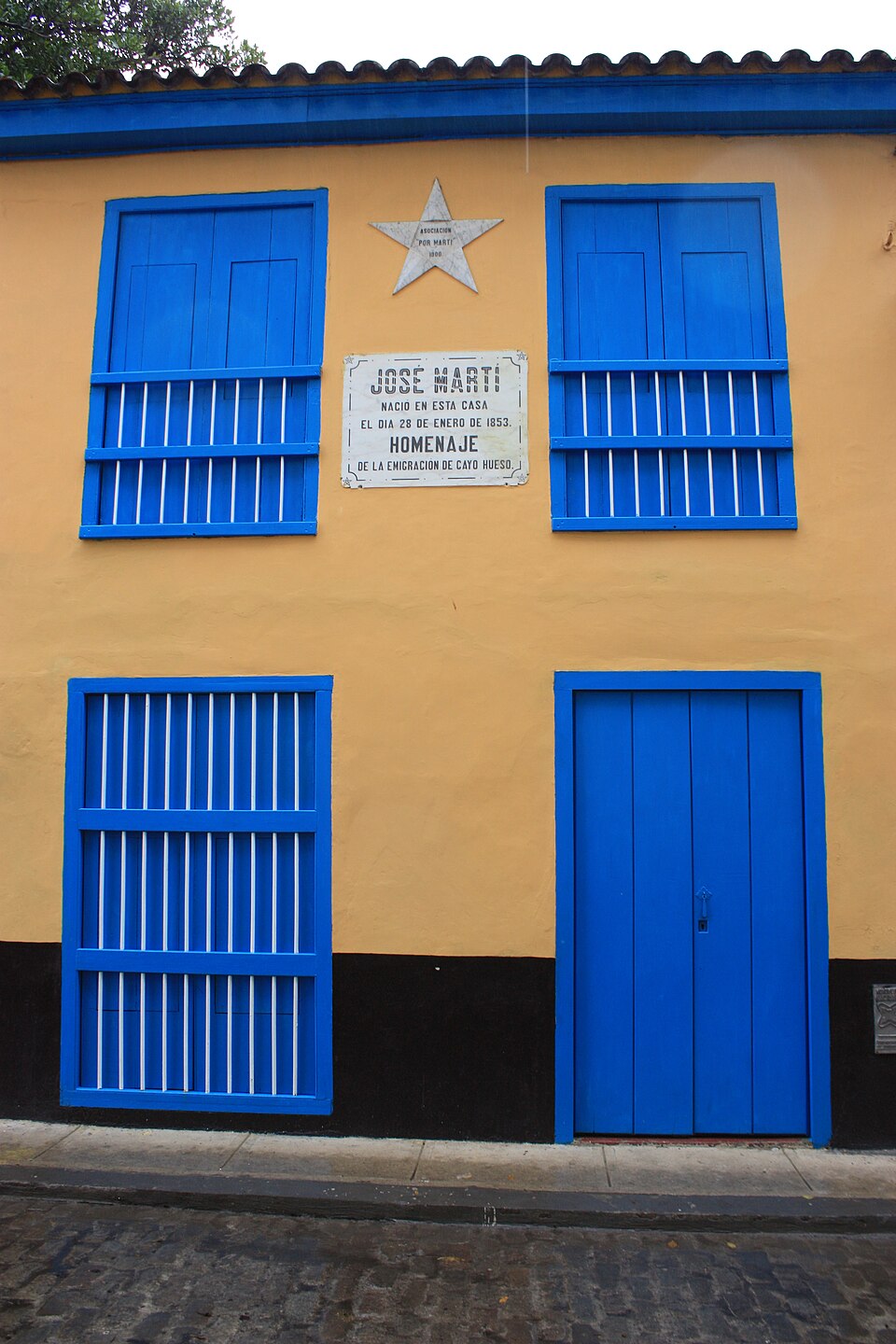 41 Paula Street, Havana, birthplace of José Martí 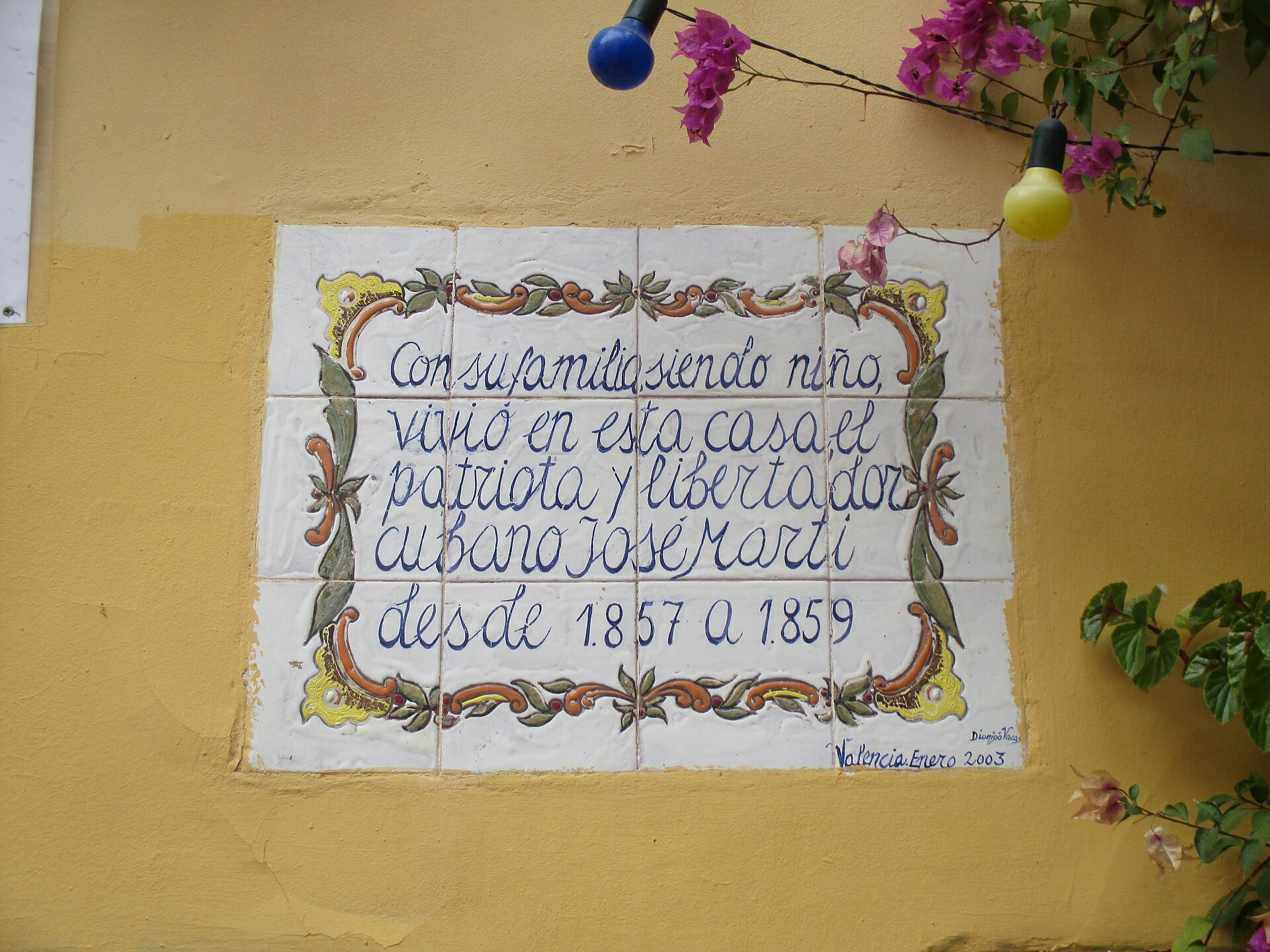 A sign at the Miracle del Mocadoret square, Valencia (Spain) where José Martí spent his childhood José Julián Martí Pérez was born on 28 January 1853, in Havana, at 41 Paula Street, to Spanish parents, a Valencian father, Mariano Martí Navarro, and Leonor Pérez Cabrera, a native of the Canary Islands. Martí was the older brother to seven sisters: Leonor, Mariana, María del Carmen, María del Pilar, Rita Amelia, Antonia and Dolores. He was baptized on 12 February in Santo Ángel Custodio church. When he was four, his family moved from Cuba to Valencia, Spain, but two years later they returned to the island where they enrolled José at a local public school, in the Santa Clara neighborhood where his father worked as a prison guard.[7] 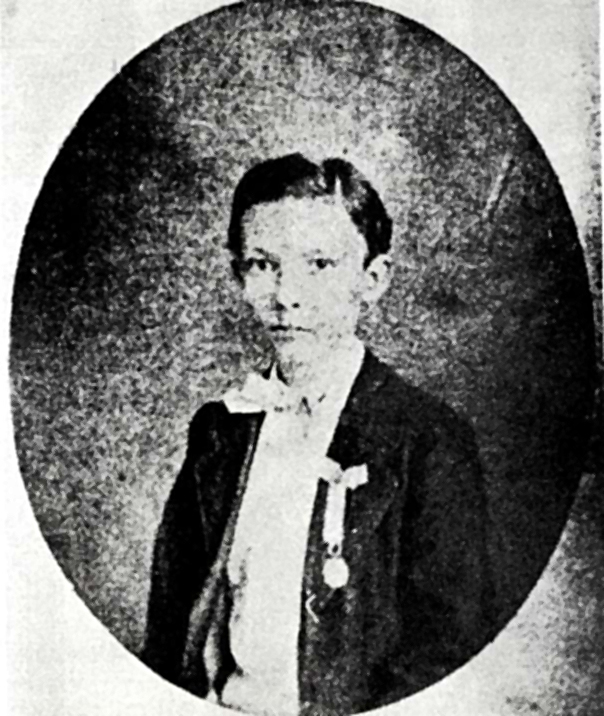 First known portrait of José Martí, during his school years In 1865, he enrolled in the Escuela de Instrucción Primaria Superior Municipal de Varones that was headed by Rafael María de Mendive [es]. Mendive was influential in the development of Martí's political philosophies. Also instrumental in his development of a social and political conscience was his best friend Fermín Valdés Domínguez, the son of a wealthy slave-owning family.[8] In April the same year, after hearing the news of the assassination of Abraham Lincoln, Martí and other young students expressed their pain—through group mourning—for the death of a man who had decreed the abolition of slavery in the United States. In 1866, Martí entered the Instituto de Segunda Enseñanza where Mendive financed his studies.[7] Martí signed up at the Escuela Profesional de Pintura y Escultura de La Habana (Professional School for Painting and Sculpture of Havana) in September 1867, known as Academia Nacional de Bellas Artes San Alejandro, to take drawing classes. He hoped to flourish in this area but did not find commercial success. In 1867, he also entered the school of San Pablo, established and managed by Mendive, where he enrolled for the second and third years of his bachelor's degree and assisted Mendive with the school's administrative tasks. In April 1868, his poem dedicated to Mendive's wife, A Micaela. En la Muerte de Miguel Ángel appeared in Guanabacoa's newspaper El Álbum.[9] When the Ten Years' War broke out in Cuba in 1868, clubs of supporters for the Cuban nationalist cause formed all over Cuba, and José and his friend Fermín joined them. Martí had a precocious desire for the independence and freedom of Cuba. He started writing poems about this vision, while, at the same time, trying to do something to achieve this dream. In 1869, he published his first political writings in the only edition of the newspaper El Diablo Cojuelo, published by Fermín Valdés Domínguez. That same year he published "Abdala", a patriotic drama in verse form in the one-volume La Patria Libre newspaper, which he published himself. "Abdala" is about a fictional country called Nubia which struggles for liberation.[10] His sonnet "10 de Octubre", later to become one of his most famous poems, was also written during that year, and was published later in his school newspaper.[9] 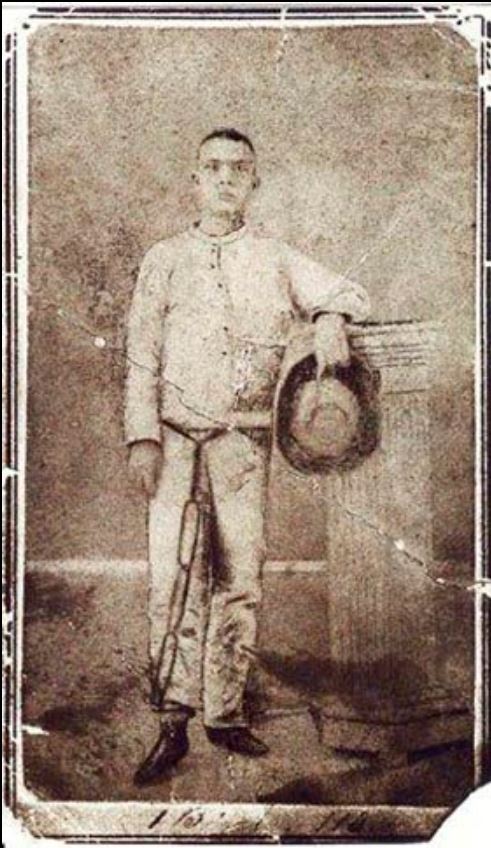 Martí in the quarry of San Lazaro In March of that year, colonial authorities shut down the school, interrupting Martí's studies. He came to resent Spanish rule of his homeland at an early age; likewise, he developed a hatred of slavery, which was still practiced in Cuba.[11] On 21 October 1869, aged 16, he was arrested and incarcerated in the national jail, following an accusation of treason and bribery from the Spanish government upon the discovery of a "reproving" letter, which Martí and Fermín had written to a friend when the friend joined the Spanish army.[12] More than four months later, Martí confessed to the charges and was condemned to six years in prison. His mother tried to free her son (who at 16 was still a minor) by writing letters to the government, and his father went to a lawyer friend for legal support, but these efforts failed. Eventually, Martí fell ill; his legs were severely lacerated by the chains that bound him. As a result, he was transferred to another part of Cuba known as Isla de Pinos instead of further imprisonment. Following that, the Spanish authorities decided to exile him to Spain.[9] In Spain, Martí, who was 18 at the time, was allowed to continue his studies with the hopes that studying in Spain would renew his loyalty to Spain.[13] |
人生 幼少期、キューバ:1853年~1870年 ハバナのポーラ通り41番地、ホセ・マルティの生家 ホセ・マルティが幼少期を過ごした、スペイン、バレンシアのミラクル・デル・モカドレット広場にある看板 ホセ・フリアン・マルティ・ペレスは、1853年1月28日、ハバナのポーラ通り41番地で、スペイン人の両親、バレンシア出身の父親マリアーノ・マル ティ・ナヴァロと、カナリア諸島出身の母親レオノール・ペレス・カブレラのもとに生まれた。マルティには、レオノール、マリアナ、マリア・デル・カルメ ン、マリア・デル・ピラール、リタ・アメリア、アントニア、ドロレスという7人の姉妹がいた。彼は 2 月 12 日、サント・アンヘル・クストディオ教会で洗礼を受けた。4 歳のとき、家族はキューバからスペインのバレンシアに移住したが、2 年後に島に戻り、父親が刑務所の看守として働いていたサンタ・クララ地区にある地元の公立学校にホセを入学させた。 学生時代のホセ・マルティの最初の肖像画 1865年、彼はラファエル・マリア・デ・メンディベが校長を務める「男子上級初等教育市立学校」に入学した。メンディベはマルティの政治思想形成に大き な影響を与えた。また、彼の社会的・政治的良心の発達に重要な役割を果たしたのが親友フェルミン・バルデス・ドミンゲスであった。彼は裕福な奴隷所有者階 級の息子であった。[8] 同年4月、エイブラハム・リンカーン暗殺の報を聞いたマルティら若い学生たちは、集団追悼を通じて、アメリカ合衆国における奴隷制廃止を宣言した人物の死 に対する悲しみを表明した。1866年、マルティはメンディベが学費を援助した中等教育機関に入学した。[7] マルティは1867年9月、ハバナ絵画彫刻専門学校(現サン・アレハンドロ国立美術アカデミー)に入学し、デッサンを学んだ。この分野で成功を収めたいと 願ったが、商業的な成功は得られなかった。同年、彼はメンディベが設立・運営するサン・パブロ学校にも入学した。ここで学士課程の2年次と3年次に在籍 し、学校の事務作業をメンディベの補佐として行った。1868年4月、メンディベの妻に捧げた詩『ミカエラへ。ミゲル・アンヘルの死に際して』がグアナバ コアの新聞『エル・アルブム』に掲載された。[9] 1868年にキューバで十年戦争が勃発すると、キューバ全土にナショナリスト運動の支持者クラブが結成され、ホセと友人フェルミンもこれに加わった。マル ティはキューバの独立と自由に対する並外れた願望を抱いていた。彼はこの理想を詩に綴り始めると同時に、その夢を実現するために行動を起こそうとした。 1869年、彼はフェルミン・バルデス・ドミンゲス発行の新聞『エル・ディアブロ・コヘウロ』の唯一の号に、初めての政治的著作を発表した。同年、自ら発 行した単行本形式の新聞『ラ・パトリア・リブレ』に、愛国的な詩劇『アブダラ』を掲載した。『アブダラ』は解放を争う架空の国ヌビアを題材としている [10]。後に彼の最も有名な詩の一つとなるソネット『10月10日』もこの年に書かれ、後に彼の学校新聞に掲載された。[9] サン・ラサロ採石場のマルティ 同年3月、植民地当局は学校を閉鎖し、マルティの学業を中断させた。彼は幼い頃から祖国に対するスペイン支配への憎悪を抱くようになり、同様に当時キュー バでまだ行われていた奴隷制への憎悪も育んでいった。[11] 1869年10月21日、16歳のマルティは逮捕され国家刑務所に収監された。スペイン政府が「非難の手紙」を発見し、反逆罪と収賄罪で告発したためであ る。この手紙はマルティとフェルミンが、友人がスペイン軍に入隊した際に書いたものだった。[12] 4ヶ月以上経って、マルティは罪を認め、6年の刑を宣告された。母親は16歳の未成年の息子を解放しようと政府に嘆願書を送ったが、父親が弁護士の知人に 法的支援を求めた努力も実らなかった。やがてマルティは病に倒れ、足首を縛る鎖で脚が深く裂傷した。このため、さらなる投獄ではなく、キューバのピノス島 と呼ばれる別の地域へ移送された。その後、スペイン当局は彼をスペインへ追放することを決定した[9]。スペインでは当時18歳だったマルティは、スペイ ンでの学業がスペインへの忠誠心を回復させることを期待され、学業を継続することを許された[13]。 |
| Spain: 1871–74 Monument of Martí in Cádiz, Spain In January 1871, Martí embarked on the steam ship Guipuzcoa, which took him from Havana to Cádiz. He settled in Madrid in a guesthouse in Desengaño St. #10. Arriving at the capital he contacted fellow Cuban Carlos Sauvalle, who had been deported to Spain a year before Martí and whose house served as a center of reunions for Cubans in exile. On 24 March, Cádiz's newspaper La Soberania Nacional, published Martí's article "Castillo" in which he recalled the sufferings of a friend he met in prison. This article would be reprinted in Sevilla's La Cuestión Cubana and New York's La República. At this time, Martí registered himself as a member of independent studies in the law faculty of the Central University of Madrid.[14] While studying here, Martí openly participated in discourse on the Cuban issue, debating through the Spanish press and circulating documents protesting Spanish activities in Cuba. Martí in Madrid, 1871 Martí's maltreatment at the hands of the Spaniards and consequent deportation to Spain in 1871 inspired a tract, Political Imprisonment in Cuba, published in July. This pamphlet's purpose was to move the Spanish public to do something about its government's brutalities in Cuba and promoted the issue of Cuban independence.[15] In September, from the pages of El Jurado Federal, Martí and Sauvalle accused the newspaper La Prensa of having calumniated the Cuban residents in Madrid. During his stay in Madrid, Martí frequented the Ateneo and the National Library, the Café de los Artistas, and the British, Swiss and Iberian breweries. In November he became sick and had an operation, paid for by Sauvalle.[14] On 27 November 1871, eight medical students, who had been accused (without evidence) of the desecration of a Spanish grave, were executed in Havana.[14] In June 1872, Fermín Valdés was arrested because of the 27 November incident. His sentence of six years of jail was pardoned, and he was exiled to Spain where he reunited with Martí. On 27 November 1872, the printed matter Dia 27 de Noviembre de 1871 (27 November 1871) written by Martí and signed by Fermín Valdés Domínguez and Pedro J. de la Torre circulated Madrid. A group of Cubans held a funeral in the Caballero de Gracia church, the first anniversary of the medical students' execution.[16] In 1873, Martí's "A mis Hermanos Muertos el 27 de Noviembre" was published by Fermín Valdés. In February, for the first time, the Cuban flag appeared in Madrid, hanging from Martí's balcony in Concepción Jerónima, where he lived for a few years. In the same month, the Proclamation of the First Spanish Republic by the Cortes on 11 February 1873, reaffirmed Cuba as inseparable to Spain, Martí responded with an essay, The Spanish Republic and the Cuban Revolution, and sent it to the Prime Minister, pointing out that this new freely elected body of deputies that had proclaimed a republic based on democracy had been hypocritical not to grant Cuba its independence.[17] He sent examples of his work to Nestor Ponce de Leon, a member of the Junta Central Revolucionaria de Nueva York (Central revolutionary committee of New York), to whom he would express his will to collaborate on the fight for the independence of Cuba.[16] In May, he moved to Zaragoza, accompanied by Fermín Valdés to continue his studies in law at the Universidad Literaria. The newspaper La Cuestión Cubana of Sevilla, published numerous articles from Martí.[16] In June 1874, Martí graduated with a degree in Civil Law and Canon Law. In August he signed up as an external student at the Facultad de Filosofia y Letras de Zaragoza, where he finished his degree by October. In November he returned to Madrid and then left to Paris. There he met Auguste Vacquerie, a poet, and Victor Hugo. In December 1874 he embarked from Le Havre for Mexico.[18] Prevented from returning to Cuba, Martí went instead to Mexico and Guatemala. During these travels, he taught and wrote, advocating continuously for Cuba's independence.[19] |
スペイン:1871–74 スペイン・カディスにあるマルティの記念碑 1871年1月、マルティは蒸気船ギプスコア号に乗り込み、ハバナからカディスへ向かった。彼はマドリードのデセンガニョ通り10番地の宿に身を寄せた。 首都に到着すると、マルティは1年前にスペインへ追放されていたキューバ人同胞カルロス・サウバジェと連絡を取った。彼の家は亡命キューバ人の集会の場と なっていた。3月24日、カディス紙『ラ・ソベラニア・ナシオナル』はマルティの論文「カスティージョ」を掲載した。彼はこの中で、獄中で出会った友人の 苦悩を回想している。この記事はセビリアの『ラ・クエシオン・クバーナ』紙とニューヨークの『ラ・レプブリカ』紙にも転載された。この時期、マルティはマ ドリード中央大学法学部で自由聴講生として登録した[14]。ここで学んでいる間、マルティはキューバ問題に関する言説に公然と参加し、スペインの新聞を 通じて論争を交わし、キューバにおけるスペインの活動に抗議する文書を配布した。 1871年、マドリードのマティ 1871年、スペイン人による虐待とそれに続くスペインへの追放がきっかけとなり、マティは7月に小冊子『キューバにおける政治的投獄』を発表した。この パンフレットは、スペイン政府のキューバにおける残虐行為に対してスペイン国民に行動を起こさせることを目的とし、キューバ独立の問題を推進した。 [15] 9月、マルティとサウバルは『エル・ハルド・フェデラル』紙上で、マドリード在住キューバ人を誹謗したとして『ラ・プレンサ』紙を非難した。マドリード滞 在中、マルティはアテネオや国立図書館、カフェ・デ・ロス・アルティスタス、英国・スイス・イベリアの醸造所を頻繁に訪れた。11月に病に倒れ手術を受け たが、その費用はサウバルが負担した。[14] 1871年11月27日、スペイン人墓地冒涜の容疑(証拠なし)で告発された8人の医学生がハバナで処刑された。[14] 1872年6月、フェルミン・バルデスは11月27日の事件に関与したとして逮捕された。6年の刑期は恩赦され、スペインへ追放された彼はマルティと再会 した。1872年11月27日、マルティが執筆しフェルミン・バルデス・ドミンゲスとペドロ・J・デ・ラ・トーレが署名した印刷物『1871年11月27 日』がマドリードで配布された。キューバ人グループはカバジェロ・デ・グラシア教会で葬式を執り行い、医学生処刑の1周年を偲んだ。[16] 1873年、マルティの「11月27日に亡き兄弟たちへ」がフェルミン・バルデスにより出版された。同年2月、マルティが数年住んだコンセプシオン・ヘロ ニマのバルコニーにキューバ国旗が掲げられ、マドリードで初めてその姿を見せた。同年2月11日、スペイン議会が第一共和制を宣言した際、キューバはスペ インから切り離せないとの見解が示された。これに対しマルティは『スペイン共和国とキューバ革命』と題する論文を執筆し、首相に送付した。民主主義に基づ く共和国を宣言したこの新たに選出された代議士団が、キューバの独立を認めないのは偽善的だと指摘したのである。[17] 彼は自身の著作のサンプルを、ニューヨーク中央革命委員会のメンバーであるネストール・ポンセ・デ・レオンに送った。マルティは彼に、キューバ独立闘争へ の協力意思を表明したのである。[16] 5月、彼はフェルミン・バルデスと共にサラゴサへ移り、文学大学で法学の勉強を続けた。セビリアの新聞『ラ・クエシオン・クバーナ』はマルティの多数の論 文を掲載した。[16] 1874年6月、マルティは民法と教会法の学位を取得して卒業した。8月にはサラゴサ大学文学部(Facultad de Filosofia y Letras de Zaragoza)の通信教育課程に在籍し、10月までに学位を修了した。11月にマドリードに戻った後、パリへ渡った。そこで詩人オーギュスト・ヴァケ リーやヴィクトル・ウーゴと出会った。1874年12月、ル・アーヴルからメキシコへ向けて船出した[18]。キューバへの帰国が阻まれたマルティは、代 わりにメキシコとグアテマラへ向かった。これらの旅の間、彼は教鞭を執り、執筆を続け、絶えずキューバの独立を訴え続けた[19]。 |
| México and Guatemala: 1875–78 See also: María García Granados y Saborío Martí in Mexico, 1875 In 1875, Martí lived on Calle Moneda in Mexico City near the Zócalo, a prestigious address of the time. One floor above him lived Manuel Antonio Mercado, Secretary of the Distrito Federal, who became one of Martí's best friends. On 2 March 1875, he published his first article for Vicente Villada's Revista Universal, a broadsheet discussing politics, literature, and general business commerce. On 12 March, his Spanish translation of Hugo's Mes Fils (1874) began serialization in Revista Universal. Martí then joined the editorial staff, editing the Boletín section of the publication. In these writings, he expressed his opinions about current events in Mexico. On 27 May, in the newspaper Revista Universal, he responded to the anti-Cuban-independence arguments in La Colonia Española, a newspaper for Spanish citizens living in Mexico. In December, Sociedad Gorostiza (Gorostiza Society), a group of writers and artists, accepted Martí as a member, where he met his future wife, María del Carmen Zayas-Bazán e Hidalgo,[20] during his frequent visits to her Cuban father's house to meet with the Gorostiza group.[21] On 1 January 1876, in Oaxaca, elements opposed to Sebastián Lerdo de Tejada's government, led by Gen. Porfirio Díaz, proclaimed the Plan de Tuxtepec, which instigated a bloody civil war. Martí and Mexican colleagues established the Sociedad Alarcón, composed of dramatists, actors, and critics. At this point, Martí began collaborating with the newspaper El Socialista as leader of the Gran Círculo Obrero (Great Labor Circle) organization of liberals and reformists who supported Lerdo de Tejada. In March, the newspaper proposed a series of candidates as delegates, including Martí, to the first Congreso Obrero, or congress of the workers. On 4 June, La Sociedad Esperanza de Empleados (Employees' Hope Society) designated Martí as delegate to the Congreso Obrero. On 7 December, Martí published his article Alea Jacta Est in the newspaper El Federalista, bitterly criticizing the Porfiristas' armed assault upon the constitutional government in place. On 16 December, he published the article "Extranjero" (foreigner; abroad), in which he repeated his denunciation of the Porfiristas and bade farewell to Mexico.[21] In 1877, using his second name and second surname[22] Julián Pérez as pseudonym, Martí embarked for Havana, hoping to arrange to move his family away to Mexico City from Havana. He returned to Mexico, however, entering at the port of Progreso from which, via Isla de Mujeres and Belize, he travelled south to progressive Guatemala City. He took residence in the prosperous suburb of Ciudad Vieja, home of Guatemala's artists and intelligentsia of the day, on Cuarta Avenida (Fourth Avenue), 3 km south of Guatemala City. While there, he was commissioned by the government to write the play Patria y Libertad (Drama Indio) (Country and Liberty (an Indian Drama)). He personally met the president, Justo Rufino Barrios, about this project. On 22 April, the newspaper El Progreso published his article "Los códigos Nuevos" (The New Laws) pertaining to the then newly enacted Civil Code. On 29 May, he was appointed head of the Department of French, English, Italian and German Literature, History and Philosophy, on the faculty of philosophy and arts of the Universidad Nacional. On 25 July, he lectured for the opening evening of the literary society 'Sociedad Literaria El Porvenir', at the Teatro Colón (the since-renamed Teatro Nacional),[23] at which function he was appointed vice-president of the Society, and acquiring the moniker "el doctor torrente," or Doctor Torrent, in view of his rhetorical style. Martí taught composition classes free at the Academia de Niñas de Centroamérica girls' academy, among whose students he enthralled young María García Granados y Saborío, daughter of Guatemalan president Miguel García Granados. The schoolgirl's crush was unrequited, however, as he went again to México, where he met María del Carmen Zayas-Bazán e Hidalgo and whom he later married.[24] 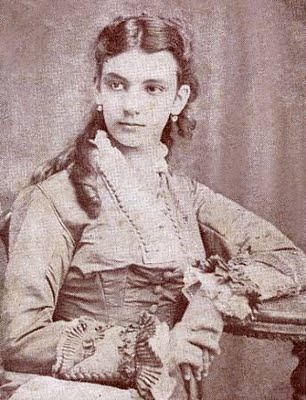 María García Granados y Saborío In 1878, Martí returned to Guatemala and published his book Guatemala, edited in Mexico. On 10 May, socialite María García Granados died of lung disease; her unrequited love for Martí branded her, poignantly, as 'la niña de Guatemala, la que se murió de amor' (the Guatemalan girl who died of love). Following her death, Martí returned to Cuba. There, he resigned signing the Pact of Zanjón which ended the Cuban Ten Years' War, but had no effect on Cuba's status as a colony. He met Afro-Cuban revolutionary Juan Gualberto Gómez, who would be his lifelong partner in the independence struggle and a stalwart defender of his legacy during this same journey. He married Carmen Zayas Bazán on Havana's Calle Tulipán Street at this time. In October, his application to practice law in Cuba was refused, and thereafter he immersed himself in radical efforts, such as for the Comité Revolucionario Cubano de Nueva York (Cuban Revolutionary Committee of New York). On 22 November 1878, his son José Francisco, known fondly as "Pepito", was born.[25] |
メキシコとグアテマラ:1875–78 関連項目:マリア・ガルシア・グラナドス・イ・サボリオ 1875年、メキシコにおけるマルティ 1875年、マルティはメキシコシティのソカロ広場近く、当時の一等地であったモネダ通りに住んでいた。彼の上階には、後にマルティの親友となる連邦区長 官マヌエル・アントニオ・メルカドが住んでいた。1875年3月2日、彼はビセンテ・ビジャダの『レヴィスタ・ユニバーサル』に最初の記事を掲載した。こ の大判新聞は政治、文学、一般商業を論じていた。3月12日には、ウーゴの『我が子ら』(1874年)のスペイン語訳が『レヴィスタ・ユニバーサル』で連 載を開始した。マルティはその後、同誌の編集スタッフに加わり、「ボリティン」欄の編集を担当した。 これらの執筆活動で、彼はメキシコの時事問題に対する意見を表明した。5月27日には、メキシコ在住スペイン人向け新聞『ラ・コロニア・エスパニョーラ』 に掲載された反キューバ独立論への反論を、『レヴィスタ・ユニバーサル』紙上で展開した。12月、文芸家・芸術家集団「ゴロスティサ協会」がマルティを会 員として受け入れた。彼はゴロスティサ協会との会合のため、キューバ人である妻マリア・デル・カルメン・サヤス=バサン・イ・イダルゴの父宅を頻繁に訪 れ、そこで将来の妻と出会った[20]。[21] 1876年1月1日、オアハカでセバスティアン・レルド・デ・テハダ政権に反対する勢力(ポルフィリオ・ディアス将軍率いる)が「トゥクステペック計画」 を宣言し、血みどろの内戦を引き起こした。マルティとメキシコ人同僚たちは劇作家、俳優、批評家で構成される「ソシエダ・アラルコン」を設立した。この時 点でマルティは、エルド・デ・テハダを支持する自由主義者・改革派組織「グラン・シルクロ・オブレロ(大労働者サークル)」の指導者として、新聞『エル・ ソシアリスタ』との協力を開始した。3月、同紙は第一回労働者会議(コングレソ・オブレロ)の代議員候補としてマルティを含む一連の人物を提案した。6月 4日、従業員希望協会はマルティを労働者会議の代表に指名した。12月7日、マルティは『エル・フェデラリスト』紙に「アレア・ジャクタ・エスト(賽は投 げられた)」と題する論説を掲載し、現存する憲法政府に対するポルフィリオ派の武力攻撃を痛烈に批判した。12月16日には「外国人(国外)」と題する記 事を掲載し、ポルフィリオ派への非難を繰り返すと共にメキシコへの別れを告げた。[21] 1877年、マルティは第二の名前と第二の姓[22]であるフリアン・ペレスを偽名としてハバナへ渡航した。ハバナから家族をメキシコシティへ移す手配を しようとしたのである。しかし彼はメキシコへ戻り、プログレソ港から入国した。そこからイスラ・デ・ムヘーレスとベリーズを経由し、進歩的なグアテマラシ ティへ南下した。彼はグアテマラシティの南3キロに位置するクアルタ・アベニーダ(第四大通り)沿い、当時の芸術家や知識人が集う繁栄した郊外シウダ・ビ エハに居を構えた。滞在中、政府から戯曲『祖国と自由(インディオ劇)』の執筆を依頼され、この件でフスト・ルフィーノ・バリオス大統領と直接面会した。 4月22日、新聞『エル・プログレソ』に当時制定されたばかりの民法典に関する彼の記事「ロス・コディオス・ヌエボス(新法)」が掲載された。5月29 日、国立大学哲学芸術学部において、フランス語・英語・イタリア語・ドイツ語文学、歴史、哲学の学科長に任命された。7月25日、文学協会「エル・ポルベ ニール文学協会」の開会晩餐会において、コロニアル劇場(後に国立劇場と改称)で講演を行った。この席で彼は協会副会長に任命され、その雄弁な語り口から 「エル・ドクター・トレント(トルレント博士)」の異名を得た。マルティは中央アメリカ女子学院で無料の作文講座を開講し、グアテマラ大統領ミゲル・ガル シア・グラナドスの娘である若きマリア・ガルシア・グラナドス・イ・サボリオを魅了した。しかし少女の想いは叶わなかった。マルティは再びメキシコへ渡 り、後に結婚するマリア・デル・カルメン・サヤス=バサン・イ・イダルゴと出会うのである。 マリア・ガルシア・グラナドス・イ・サボリオ 1878年、マルティはグアテマラに戻り、メキシコで編集された著書『グアテマラ』を出版した。5月10日、社交界の名士マリア・ガルシア・グラナドスが 肺疾患で死去した。マルティへの片思いが彼女を「愛に死んだグアテマラの娘」という痛ましいレッテルを貼ったのである。彼女の死後、マルティはキューバに 戻った。そこで彼は、キューバ十年戦争を終結させたサンホン協定の調印を辞退したが、これは植民地としてのキューバの地位には何の影響も及ぼさなかった。 彼はアフリカ系キューバ人革命家フアン・グアルベルト・ゴメスと出会い、彼は独立闘争におけるマルティの生涯の同志となり、この同じ旅路においてマルティ の遺産を堅固に守る者となった。この時期、彼はハバナのカリ・トゥリパン通りでカルメン・サヤス・バザンと結婚した。10月、キューバでの弁護士資格申請 が却下されると、彼はニューヨークのキューバ革命委員会(Comité Revolucionario Cubano de Nueva York)など過激な活動に没頭した。1878年11月22日、愛称「ペピート」で親しまれる息子ホセ・フランシスコが誕生した。 |
United States and Venezuela: 1880–90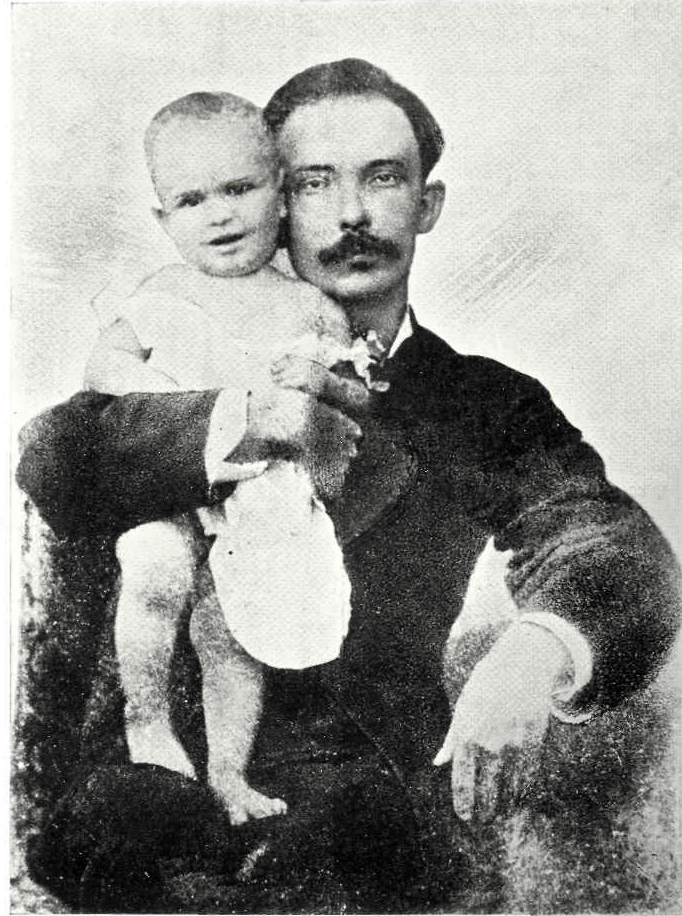 Martí with his son, José Francisco, in New York, 1880 In 1881, after a brief stay in New York, Martí travelled to Venezuela and founded in Caracas the Revista Venezolana, or Venezuelan Review. The journal incurred the wrath of Venezuela's dictator, Antonio Guzmán Blanco, and Martí was forced to return to New York.[26] There, Martí joined General Calixto García's Cuban revolutionary committee, composed of Cuban exiles advocating independence. Here Martí openly supported Cuba's struggle for liberation, and worked as a journalist for La Nación of Buenos Aires and for several Central American journals,[19] especially La Opinion Liberal in Mexico City.[27] The article "El ajusticiamiento de Guiteau," an account of President Garfield's murderer's trial, was published in La Opinion Liberal in 1881, and later selected for inclusion in The Library of America's anthology of American True Crime writing. In addition, Martí wrote poems and translated novels to Spanish. He worked for Appleton and Company and, "on his own, translated and published Helen Hunt Jackson's Ramona. His repertory of original work included plays, a novel, poetry, a children's magazine, La Edad de Oro, and a newspaper, Patria, which became the official organ of the Cuban Revolutionary party".[28] He also served as a consul for Uruguay, Argentina, and Paraguay. Throughout this work, he preached the "freedom of Cuba with an enthusiasm that swelled the ranks of those eager to strive with him for it".[19] Martí in New York, 1885 Tension existed within the Cuban revolutionary committee between Martí and his military compatriots. Martí feared a military dictatorship would be established in Cuba upon independence, and suspected Dominican-born General Máximo Gómez of having these intentions.[29] Martí knew that the independence of Cuba needed time and careful planning. Ultimately, Martí refused to cooperate with Máximo Gómez and Antonio Maceo Grajales, two Cuban military leaders from the Ten Years' War, when they wanted to invade immediately in 1884. Martí knew that it was too early to attempt to win back Cuba, and later events proved him right.[19] |
アメリカ合衆国とベネズエラ:1880–90年 1880年、ニューヨークにて息子ホセ・フランシスコと共にあるマルティ 1881年、ニューヨークでの短期間の滞在後、マルティはベネズエラに渡り、カラカスで『ベネズエラ評論』(Revista Venezolana)を創刊した。この雑誌はベネズエラの独裁者アントニオ・グスマン・ブランコの怒りを買い、マルティはニューヨークへ戻ることを余儀 なくされた[26]。そこでマルティは、独立を主張するキューバ亡命者で構成されたカリクスト・ガルシア将軍のキューバ革命委員会に加わった。ここでマル ティはキューバの解放闘争を公然と支持し、ブエノスアイレスの『ラ・ナシオン』や、特にメキシコシティの『ラ・オピニオン・リベラル』をはじめとする中米 の複数の雑誌で記者として働いた[19]。[27] 1881年に『ラ・オピニオン・リベラル』紙に掲載された「ギトーの処刑」という記事は、ガーフィールド大統領暗殺犯の裁判を記録したもので、後にアメリ カン・トゥルー・クライム作品集『ライブラリー・オブ・アメリカ』に収録された。加えてマルティは詩を書き、小説をスペイン語に翻訳した。彼はアップルト ン社に勤務し、「独自にヘレン・ハント・ジャクソンの『ラモナ』を翻訳・出版した。彼の創作活動には戯曲、小説、詩、児童雑誌『黄金時代』、そしてキュー バ革命党の機関紙となった新聞『祖国』が含まれていた」[28]。またウルグアイ、アルゼンチン、パラグアイの領事職も務めた。こうした活動を通じて、彼 は「キューバの独立を熱烈に訴え、共に闘おうとする人々の勢力を拡大させた」[19]。 1885年、ニューヨークのマティ キューバ革命委員会内では、マティと軍事派の同志たちの間に緊張が存在した。マティは独立後に軍事独裁政権が樹立されることを恐れ、ドミニカ共和国出身の将軍マキシモ・ゴメスがその意図を持っていると疑っていた。 [29] マルティはキューバの独立には時間と周到な計画が必要だと理解していた。結局、マルティは1884年に即時侵攻を主張した十年戦争のキューバ軍指導者、マ キシモ・ゴメスとアントニオ・マセオ・グラハレスとの協力を拒否した。キューバ奪還を試みるには時期尚早だと確信しており、後の出来事が彼の正しさを証明 したのである。[19] |
| United States, Central America and the West Indies: 1891–94 On 1 January 1891, Martí's essay "Nuestra América" was published in New York's Revista Ilustrada, and on the 30th of that month in Mexico's El Partido Liberal. He actively participated in the Conferencia Monetaria Internacional (The International Monetary Conference) in New York during that time as well. On 30 June his wife and son arrived in New York. After a short time, during which Carmen Zayas Bazán realized that Martí's dedication to Cuban independence surpassed that of supporting his family, she returned to Havana with her son on 27 August. Martí would never see them again. The fact that his wife never shared the convictions central to his life was an enormous personal tragedy for Martí.[30] He turned for solace to Carmen Miyares de Mantilla, a Venezuelan who ran a boarding house in New York, and he is presumed to be the father of her daughter María Mantilla, who was in turn the mother of the actor Cesar Romero, who proudly claimed to be Martí's grandson. In September Martí became sick again. He intervened in the commemorative acts of The Independents, causing the Spanish consul in New York to complain to the Argentine and Uruguayan governments. Consequently, Martí resigned from the Argentinean, Paraguayan, and Uruguayan consulates. In October he published his book Versos Sencillos. José Martí (center) poses with workers at the Ybor Factory Building in Ybor City, Tampa, Florida On 26 November he was invited by the Club Ignacio Agramonte, an organization founded by Cuban immigrants in Ybor City, Tampa, Florida, to a celebration to collect funding for the cause of Cuban independence. There he gave a lecture known as "Con Todos, y para el Bien de Todos", which was reprinted in Spanish language newspapers and periodicals across the United States. The following night, another lecture, " Los Pinos Nuevos", was given by Martí in another Tampa gathering in honor of the medical students killed in Cuba in 1871. In November artist Herman Norman painted a portrait of José Martí.[31] On 5 January 1892, Martí participated in a reunion of the emigration representatives, in Cayo Hueso (Key West), the Cuban community where the Bases del Partido Revolucionario (Basis of the Cuban Revolutionary Party) was passed. He began the process of organizing the newly formed party. To raise support and collect funding for the independence movement, he visited tobacco factories, where he gave speeches to the workers and united them in the cause. In March 1892 the first edition of the Patria newspaper, related to the Cuban Revolutionary Party, was published, funded and directed by Martí. During Martí's Key West years, his secretary was Dolores Castellanos (1870–1948), a Cuban-American woman born in Key West, who also served as president of the Protectoras de la Patria: Club Político de Cubanas, a Cuban women's political club in support of Martí's cause, and for whom Martí wrote a poem titled "A Dolores Castellanos." On 8 April, he was elected delegate of the Cuban Revolutionary Party by the Cayo Hueso Club in Tampa and New York. From July to September 1892 he traveled through Florida, Washington, D.C., Philadelphia, Baltimore, Haiti, the Dominican Republic and Jamaica on an organization mission among the exiled Cubans. On this mission, Martí made numerous speeches and visited various tobacco factories. On December 16 he was poisoned in Tampa.[32] In 1893, Martí traveled through the United States, Central America and the West Indies, visiting different Cuban clubs. His visits were received with a growing enthusiasm and raised badly needed funds for the revolutionary cause. On 24 May he met Rubén Darío, the Nicaraguan poet in a theatre act in Hardman Hall, New York City. On 3 June he had an interview with Máximo Gómez in Montecristi, Dominican Republic, where they planned the uprising. In July he met with General Antonio Maceo Grajales in San Jose, Costa Rica.[32] In 1894 he continued traveling for propagation and organizing the revolutionary movement. On 27 January he published "A Cuba!" in the newspaper Patria where he denounced collusion between the Spanish and American interests. In July he visited the president of the Mexican Republic, Porfirio Díaz, and travelled to Veracruz. In August he prepared and arranged the armed expedition that would begin the Cuban revolution.[33] |
アメリカ合衆国、中央アメリカ、西インド諸島:1891–94年 1891年1月1日、マルティの論文「我らのアメリカ」がニューヨークの『レヴィスタ・イルストラダ』誌に掲載された。同月30日にはメキシコの『エル・ パルティード・リベラル』紙にも掲載された。この時期、彼はニューヨークで開催された国際通貨会議(Conferencia Monetaria Internacional)にも積極的に参加した。6月30日、妻と息子がニューヨークに到着した。しかし間もなく、カルメン・サヤス・バザンはマル ティのキューバ独立への献身が家族を支えることよりも優先されていると悟り、8月27日に息子を連れてハバナへ戻った。マルティは二度と彼らに会うことは なかった。妻が彼の人生の核心をなす信念を共有しなかった事実は、マルティにとって計り知れない個人的悲劇であった[30]。彼は慰めを求めて、ニュー ヨークで下宿屋を営むベネズエラ人カルメン・ミヤレス・デ・マンティージャに近づいた。そして彼女の娘マリア・マンティージャの父親と推定される。マリア は俳優セサル・ロメロの母であり、ロメロは自らをマルティの孫と誇らしげに称していた。9月、マルティは再び病に倒れた。彼は「独立派」の記念行事に関与 したため、ニューヨークのスペイン領事からアルゼンチン政府とウルグアイ政府に苦情が申し立てられた。その結果、マルティはアルゼンチン、パラグアイ、ウ ルグアイの領事職を辞任した。10月には著書『Versos Sencillos』を出版した。 ホセ・マルティ(中央)がフロリダ州タンパ、イボルシティのイボル工場ビルで労働者たちと記念撮影 11月26日、フロリダ州タンパのイボルシティにキューバ移民が設立した組織「クラブ・イグナシオ・アグラモンテ」から、キューバ独立運動の資金調達を目 的とした祝賀会への招待を受けた。そこで彼は「Con Todos, y para el Bien de Todos」という講演を行い、その内容は全米の各スペイン語新聞や定期刊行物に再掲載された。その翌夜、1871年にキューバで殺害された医学生たちを 称える、タンパでの別の集会で、マルティは「Los Pinos Nuevos」という別の講演を行った。11月、芸術家のハーマン・ノーマンがホセ・マルティの肖像画を描いた。 1892年1月5日、マルティは、キューバ人コミュニティが住むキーウェスト(Cayo Hueso)で開催された移民代表者の会合に参加し、そこで「革命党の基礎(Bases del Partido Revolucionario)」が採択された。彼は、新しく結成された政党の組織化プロセスを開始した。独立運動の支援と資金調達のために、彼はタバコ 工場を訪れ、労働者たちに演説を行い、彼らを大義に結束させた。1892年3月、キューバ革命党に関連する新聞「パトリア」の創刊号が、マルティの資金援 助と指揮により発行された。キーウェスト滞在中、マルティの秘書を務めたのはドロレス・カステジャーノス(1870-1948)である。キーウェスト生ま れのキューバ系アメリカ人女性で、マルティの運動を支援するキューバ人女性政治団体「祖国守護者会:キューバ人女性政治クラブ」の会長も兼任していた。マ ルティは彼女に捧げる詩「ドロレス・カステジャーノスへ」を執筆している。4月8日、タンパとニューヨークのキーウェスト・クラブにより、キューバ革命党 の代議員に選出された。 1892年7月から9月にかけて、亡命キューバ人組織化のためフロリダ、ワシントンD.C.、フィラデルフィア、ボルチモア、ハイチ、ドミニカ共和国、 ジャマイカを巡った。この任務中、マルティは数多くの演説を行い、様々なタバコ工場を視察した。12月16日、タンパで毒殺された[32]。 1893年、マルティはアメリカ合衆国、中央アメリカ、西インド諸島を巡り、異なるキューバ人クラブを訪問した。彼の訪問は高まる熱意をもって迎えられ、 革命運動に切実に必要とされた資金を集めた。5月24日、ニューヨーク市のハードマン・ホールでの演劇公演でニカラグアの詩人ルベン・ダリオと会った。6 月3日にはドミニカ共和国のモンテクリスティでマキシモ・ゴメスと会談し、蜂起計画を練った。7月にはコスタリカのサンホセでアントニオ・マセオ・グラハ レス将軍と会った。[32] 1894年も彼は革命運動の宣伝と組織化のために旅を続けた。1月27日には新聞『パトリア』に「キューバへ!」を掲載し、スペインとアメリカの利害関係 者の癒着を糾弾した。7月にはメキシコ共和国のポルフィリオ・ディアス大統領を訪問し、ベラクルスへ赴いた。8月にはキューバ革命の幕開けとなる武装遠征 の準備と手配を行った。[33] |
| Return to Cuba: 1895 On 12 January 1895, the North American authorities stopped the steamship Lagonda and two other suspicious ships, Amadis and Baracoa, at the port of Fernandina in Florida, confiscating weapons and ruining Plan de Fernandina (Fernandina Plan). On 29 January, Martí drew up the order of the uprising, signing it with general Jose Maria Rodriguez and Enrique Collazo. Juan Gualberto Gómez was assigned to orchestrate war preparations for La Habana Province, and was able to work right under the noses of the relatively unconcerned Spanish authorities.[34] Martí decided to move to Montecristi, Dominican Republic to join Máximo Gómez and to plan out the uprising.[35] The uprising finally took place on 24 February 1895. A month later, Martí and Máximo Gómez declared the Manifesto de Montecristi, an "exposition of the purposes and principles of the Cuban revolution".[36] Martí had persuaded Gómez to lead an expedition into Cuba. Before leaving for Cuba, Martí wrote his "literary will" on 1 April 1895, leaving his personal papers and manuscripts to Gonzalo de Quesada, with instructions for editing. Knowing that the majority of his writing in newspapers in Honduras, Uruguay, and Chile would disappear over time, Martí instructed Quesada to arrange his papers in volumes. The volumes were to be arranged in the following way: volumes one and two, North Americas; volume three, Hispanic Americas; volume four, North American Scenes; volume five, Books about the Americas (this included both North and South America); volume six, Literature, education and painting. Another volume included his poetry.[36] The expedition, composed of Martí, Gómez, Ángel Guerra, Francisco Borreo, Cesar Salas and Marcos del Rosario, left Montecristi for Cuba on 1 April 1895.[35] Despite delays and desertion by some members, they got to Cuba, landing at Playitas, near Cape Maisí and Imías, Cuba, on 11 April. Once there, they made contact with the Cuban rebels, who were headed by the Maceo brothers, and started fighting against Spanish troops. The revolt did not go as planned, "mainly because the call to revolution received no immediate, spontaneous support from the masses."[37] By 13 May, the expedition reached Dos Rios. On 19 May, Gomez faced Ximenez de Sandoval's troops and ordered Martí to stay with the rearguard, but Martí became separated from the bulk of the Cuban forces, and entered the Spanish line.[35] |
キューバ帰還:1895年 1895年1月12日、北米当局はフロリダ州フェルナンディナ港で蒸気船ラゴンダ号と、その他の不審船アマディス号、バラコア号を停船させ、武器を没収し た。これによりフェルナンディナ計画は頓挫した。1月29日、マルティは蜂起の指令書を作成し、ホセ・マリア・ロドリゲス将軍とエンリケ・コラソと共に署 名した。フアン・グアルベルト・ゴメスにはハバナ県の戦備指揮が命じられ、比較的無関心なスペイン当局の目の前で活動することができた[34]。マルティ はマキシモ・ゴメスと合流し蜂起を計画するため、ドミニカ共和国のモンテクリスティへ移動することを決めた。[35] 蜂起はついに1895年2月24日に発生した。一か月後、マルティとマキシモ・ゴメスは「キューバ革命の目的と原則の表明」である『モンテクリスティ宣言』を発表した。[36] マルティはゴメスを説得し、キューバへの遠征を率いるよう促した。 キューバへ出発する前、マルティは1895年4月1日に「文学的遺言」を書き、個人的な私文書と原稿をゴンサロ・デ・ケサダに託し、編集の指示を与えた。 ホンジュラス、ウルグアイ、チリの新聞に掲載された自身の文章の大半が時と共に消え去ることを知っていたマルティは、ケサダに文書を巻ごとに整理するよう 指示した。その編纂順序は次の通りであった:第1巻・第2巻は北米、第3巻はヒスパニック系アメリカ、第4巻は北米の情景、第5巻はアメリカ大陸に関する 書物(北米と南米の両方を含む)、第6巻は文学・教育・絵画。別の巻には彼の詩が収められた。[36] マルティ、ゴメス、アンヘル・ゲラ、フランシスコ・ボレオ、セサル・サラス、マルコス・デル・ロサリオからなる遠征隊は、1895年4月1日にモンテクリ スティを出発し、キューバへ向かった[35]。遅延や一部の隊員の脱走があったものの、彼らはキューバに到達し、4月11日にキューバのマイシ岬とイミア ス近くのプラヤティスに上陸した。現地ではマセオ兄弟率いるキューバ反乱軍と合流し、スペイン軍との戦闘を開始した。しかし反乱は計画通りには進まなかっ た。「革命の呼びかけが民衆から即座の自発的な支持を得られなかった」ことが主な原因である[37]。5月13日までに遠征隊はドス・リオスに到達した。 5月19日、ゴメスがヒメネス・デ・サンドバルの部隊と対峙した際、マルティに後衛部隊に残るよう命じた。しかしマルティはキューバ軍主力から離脱し、ス ペイン軍の陣地へ突入した[35]。 |
Death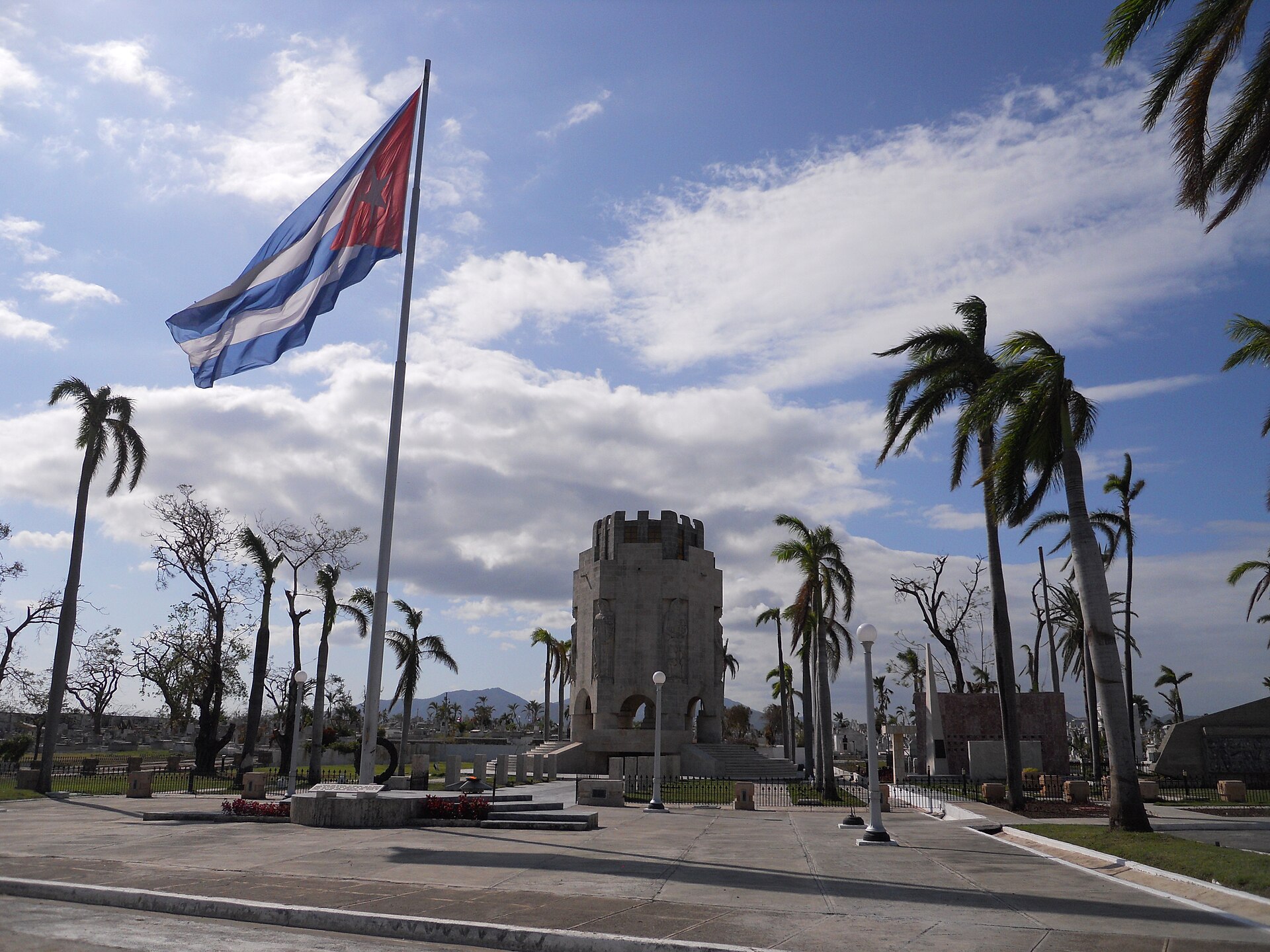 José Martí's mausoleum Martí was killed in battle against Spanish troops at the Battle of Dos Ríos, near the confluence of the rivers Contramaestre and Cauto, on 19 May 1895.[38] Gómez had recognized that the Spaniards had a strong position between palm trees, so he ordered his men to disengage. Martí was alone and seeing a young courier ride by said, "Joven, ¡a la carga!" ('Young man, charge!') This was around midday, and he was dressed in a black jacket while riding a white horse, which made him an easy target for the Spanish. After Martí was shot, the young trooper, Ángel de la Guardia, lost his horse and returned to report the loss. The Spanish took possession of the body, buried it close by, then exhumed the body upon realization of its identity. He was buried in Santa Ifigenia Cemetery in Santiago de Cuba. The death of Martí was a blow to the "aspirations of the Cuban rebels, inside and outside of the island, but the fighting continued with alternating successes and failures until the entry of the United States into the war in 1898".[39] |
死 ホセ・マルティの霊廟 マルティは1895年5月19日、コントラマエストレ川とカウト川の合流点近くで行われたドス・リオスでの戦闘でスペイン軍との戦いで命を落とした [38]。ゴメス将軍は、スペイン軍がヤシの木の間で強固な陣地を築いていることを認識し、部隊に撤退を命じた。マルティは単独で行動しており、若い伝令 が馬で通り過ぎるのを見て「若造、突撃だ!」と叫んだ。これは正午頃のことだった。彼は黒い上着を着て白い馬に乗っていたため、スペイン軍にとって格好の 標的となった。マルティが撃たれた後、若い騎兵アンヘル・デ・ラ・グアルディアは馬を失い、そのことを報告するために戻った。スペイン軍は遺体を確保し、 近くで埋葬したが、その正体に気づくと遺体を掘り起こした。マルティはサンティアゴ・デ・クーバのサンタ・イフィヘニア墓地に埋葬された。 マルティの死は「島内外のキューバ反乱軍の志に打撃を与えたが、1898年にアメリカが戦争に介入するまで、戦いは勝ち負けを繰り返しながら続いた」。[39] |
Political ideology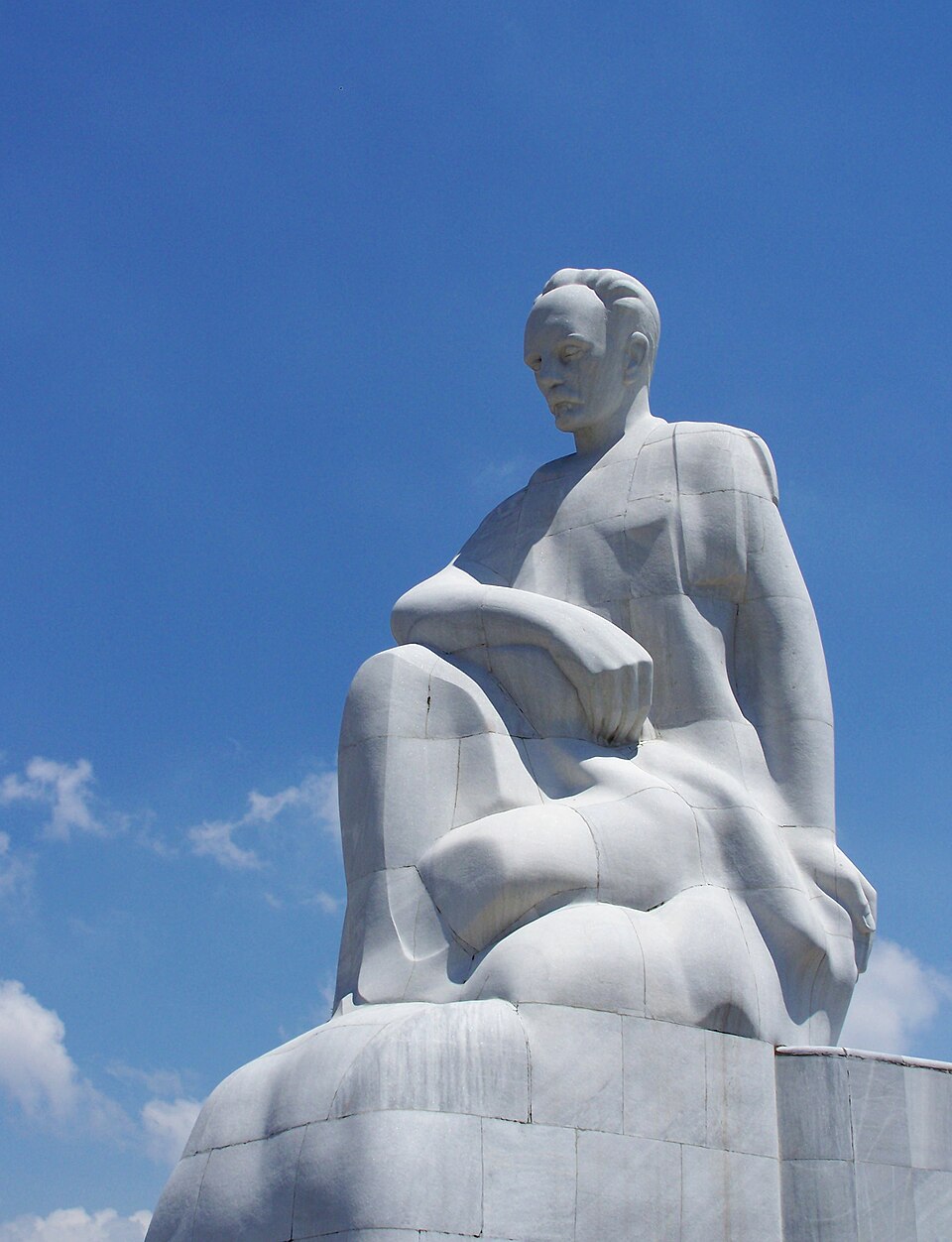 Statue of José Martí in Havana, Cuba Liberalism Martí's political ideas were shaped by his early encounter with Krausist liberalism and its defense of spirituality and solidarity.[40][41][42][43] Radical liberalism in Latin America during this time period often took on a nationalist and anti-imperialist cast, as shown by the examples of Francisco Bilbao in Chile, Benito Juárez in Mexico, José Santos Zelaya in Nicaragua, and Ramón Emeterio Betances in Puerto Rico, whom Martí deeply admired and considered one of his teachers.[44][45] An increasingly radicalized liberalism emphasizing democratic participation, economic equality, national sovereignty, and supplemented by his exposure to doctrines such as Georgism, remained the dominant basis of Martí's outlook.[46][47] Cuban independence Martí wrote extensively about Spanish colonial control and the threat of US expansionism into Cuba. To him, it was unnatural that Cuba was controlled and oppressed by the Spanish government, when it had its own unique identity and culture. In his pamphlet from 11 February 1873, called "The Spanish Republic and the Cuban Revolution", he argued that "Cubans do not live as Spaniards live.... They are nourished by a different system of trade, have links with different countries, and express their happiness through quite contrary customs. There are no common aspirations or identical goals linking the two peoples, or beloved memories to unite them. ... Peoples are only united by ties of fraternity and love.".[48] Slavery Martí opposed slavery and criticized Spain for upholding it. In a speech to Cuban immigrants in Steck Hall, New York, on 24 January 1879, he stated that the war against Spain needed to be fought, recalled the heroism and suffering of the Ten Years' War, which, he declared, had qualified Cuba as a real nation with a right to independence. Spain had not ratified the conditions of the peace treaty, had falsified elections, continued excessive taxation, and had failed to abolish slavery. Cuba needed to be free.[49] Revolutionary tactics Martí proposed in a letter to Máximo Gómez in 1882 the formation of a revolutionary party, which he considered essential in the prevention of Cuba falling back on the Home Rule Party (Partido Autonomista) after the Pact of Zanjón.[50] The Home Rule Party was a peace-seeking party that would stop short of the outright independence that Martí thought Cuba needed. But he was aware that there were social divisions in Cuba, especially racial divisions, that needed to be addressed as well.[51] He thought war was necessary to achieve Cuba's freedom, despite his basic ideology of conciliation, respect, dignity, and balance. The establishment of the patria (fatherland) with a good government would unite Cubans of all social classes and colours in harmony.[52] Together with other Cubans resident in New York, Martí started laying the grounds for the Revolutionary Party, stressing the need for a democratic organization as the basic structure before any military leaders were to join. The military would have to subordinate themselves to the interests of the fatherland. Gómez later rejoined Martí's plans, promising to comply. Martí's consolidation of support among the Cuban expatriates, especially in Florida, was key in the planning and execution of the invasion of Cuba. His speeches to Cuban tobacco workers in Tampa and Key West motivated and united them; this is considered the most important political achievement of his life.[53] At this point he refined his ideological platform, basing it on a Cuba held together by pride in being Cuban, a society that ensured "the welfare and prosperity of all Cubans"[54] independently of class, occupation or race. Faith in the cause could not die, and the military would not try for domination. All pro-independence Cubans would participate, with no sector predominating. From this he established the Cuban Revolutionary Party in early 1892. Martí and the CRP were devoted to secretly organizing the anti-Spanish war. Martí's newspaper, Patria, was a key instrument of this campaign, where Martí delineated his final plans for Cuba. Through this medium he argued against the exploitative colonialism of Spain in Cuba, criticized the Home Rule (Autonomista) Party for having aims that fell considerably short of full independence, and warned against U.S. annexationism which he felt could only be prevented by Cuba's successful independence.[55] He specified his plans for the future Cuban Republic, a multi-class and multi-racial democratic republic based on universal suffrage, with an egalitarian economic base to develop fully Cuba's productive resources and an equitable distribution of land among citizens, with enlightened and virtuous politicians.[56] From Martí's 'Campaign Diaries', written during the final expedition in Cuba, it seems evident that Martí would have reached the highest position in the future Republic of Arms.[57] This was not to be; his death occurred before the Assembly of Cuba was set up. Until his last minute, Martí dedicated his life to achieve full independence for Cuba. His uncompromising belief in democracy and freedom for his fatherland is what characterized his political ideology. |
政治イデオロギー キューバ・ハバナにあるホセ・マルティの像 自由主義 マルティの政治イデオロギーは、クラウス主義的自由主義との初期の接触と、その精神性と連帯の擁護によって形作られた。[40][41][42][43] 当時のラテンアメリカにおける急進的自由主義は、しばしばナショナリスト的・反帝国主義的な色合いを帯びていた。チリのフランシスコ・ビジャオ、メキシコ のベニート・フアレス、ニカラグアのホセ・サントス・セラヤ、プエルトリコのラモン・エメテリオ・ベタンセスといった例がそれを示しており、マルティは彼 らを深く敬愛し、自らの師の一人と見なしていた。[44] [45] 民主的参加、経済的平等、国家主権を強調し、ジョージズムなどの思想に触れたことで補完された、次第に急進化した自由主義は、マルティの世界観の主要な基 盤であり続けた。[46][47] キューバの独立 マルティはスペインの植民地支配と、キューバへの米国の拡張主義の脅威について広く論じた。彼にとって、独自のアイデンティティと文化を持つキューバがス ペイン政府に支配され抑圧されていることは不自然であった。1873年2月11日の小冊子『スペイン共和国とキューバ革命』で、彼は「キューバ人はスペイ ン人のように生きていない」と主張した。彼らは異なる交易体系で養われ、異なる国々と結びつきを持ち、幸福を全く相反する習慣で表現する。両民族を結びつ ける共通の願望や同一の目標、あるいは彼らを一つにする愛すべき記憶など存在しない。…民族は兄弟愛と愛の絆によってのみ結ばれるのだ。」と論じた。 [48] 奴隷制 マルティは奴隷制に反対し、それを維持するスペインを批判した。1879年1月24日、ニューヨークのステック・ホールでキューバ移民に向けた演説の中 で、彼はスペインとの戦争が必要だと述べ、十年戦争の英雄的行為と苦悩を想起した。彼は宣言した、この戦争がキューバを独立の権利を持つ真の国家として認 めたのだと。スペインは和平条約の条件を批准せず、選挙を不正操作し、過剰な課税を続け、奴隷制を廃止しなかった。キューバは自由になる必要があった。 [49] 革命戦術 マルティは1882年、マキシモ・ゴメスへの書簡で革命党の結成を提案した。これはサンホン協定後に自治党(Partido Autonomista)に回帰する事態を防ぐために不可欠だと考えたのである。自治党は平和を求める政党であり、マルティがキューバに必要と考えた完全 な独立には至らない。しかし彼は、キューバに社会的分断、特に人種的分断が存在し、それに対処する必要があることも認識していた。彼の基本的なイデオロ ギーは和解、尊重、尊厳、均衡であったが、キューバの自由を達成するには戦争が必要だと考えた。良き統治による祖国(パトリア)の樹立こそが、あらゆる社 会階層や人種を調和のうちに結集させるだろう[52]。ニューヨーク在住の他のキューバ人とともに、マルティは革命党の基盤づくりを開始した。軍事指導者 が加わる前に、民主的組織を基本構造とする必要性を強調したのである。軍は祖国への忠誠を最優先せねばならない。後にゴメスもマルティの計画に賛同し、こ れに従うことを約束した。 フロリダ州を中心にキューバ亡命者たちの支持を固めたマルティの活動は、キューバ侵攻計画の立案と実行において極めて重要であった。タンパとキーウェスト でキューバ人タバコ労働者たちに向けた彼の演説は、彼らを奮い立たせ結束させた。これは彼の人生における最も重要な政治的成果と見なされている。この時点 で彼はイデオロギー基盤を洗練させ、キューバ人としての誇りに結集するキューバ、階級・職業・人種に関わらず「全てのキューバ人の福祉と繁栄」を保障する 社会を基盤とした。大義への信念は決して死なず、軍部は支配を企てない。独立を支持する全てのキューバ人が参加し、いかなる勢力も優位を占めない。この理 念のもと、1892年初頭にキューバ革命党(CRP)を設立した。 マルティとCRPは反スペイン戦争の秘密組織化に専念した。マルティの新聞『パトリア』はこの運動の主要な手段であり、ここでマルティはキューバに対する 最終計画を明らかにした。この媒体を通じて、彼はスペインのキューバにおける搾取的な植民地主義に反対し、自治党(オートノミスタ党)の目標が完全な独立 には程遠いと批判し、キューバの独立成功によってのみ阻止できると考えた米国の併合主義に対して警告を発した。[55] 彼は将来のキューバ共和国に関する計画を具体的に示した。それは普遍的選挙権に基づく多階級・多民族の民主共和国であり、キューバの生産資源を完全に開発 するための平等主義的経済基盤と、市民間の公平な土地分配、そして啓蒙的で高潔な政治家たちによって支えられるものだった。[56] キューバでの最後の遠征中に記されたマルティの『遠征日記』から、彼が将来の「武器の共和国」において最高位の地位に就くはずだったことは明らかである。 [57] しかしそれは実現しなかった。キューバ議会が設置される前に、彼は命を落としたのである。最期の瞬間まで、マルティはキューバの完全な独立達成に生涯を捧 げた。祖国に対する民主主義と自由への揺るぎない信念こそが、彼のイデオロギーを特徴づけるものだった。 |
| United States Bust of José Martí in Union City, NJ; LA PATRIA ES ARA, NO PEDESTAL.(lit. 'The homeland is an altar, not a pedestal. ') José Martí Monument of Jose Martí in Ybor City (Tampa, Florida). Martí demonstrated an anti-imperialist attitude from an early age, and was convinced that the United States posed a danger for Latin America. While critiquing the United States for its stereotypes of Latin Americans and preoccupation with capitalism, Martí also drew parallels with the American Revolution and the nationalist movement in Cuba.[58] At the same time, he recognized the advantages of the civilizations of Western Europe and the United States, which were open to the reforms that Latin American countries needed in order to detach themselves from the colonial heritage of Spain. Martí's distrust of U.S. politics had developed during the 1880s, due to the intervention threats that loomed on Mexico and Guatemala, and indirectly on Cuba's future. Over time Martí became increasingly alarmed about the United States' intentions for Cuba. The United States desperately needed new markets for its industrial products because of the economic crisis it was experiencing, and the media was talking about the purchase of Cuba from Spain.[59] Cuba was a profitable, fertile country with an important strategic position in the Gulf of Mexico.[60] Martí felt that the interests of Cuba's future lay with its sister nations in Latin America, and were opposite to those of the United States.[61] Another trait that Martí admired was the work ethic that characterized U.S. society. On various occasions Martí conveyed his deep admiration for the immigrant-based society, "whose principal aspiration he interpreted as being to construct a truly modern country, based upon hard work and progressive ideas." Martí stated that he was "never surprised in any country of the world [he had] visited. Here [he] was surprised... [he] remarked that no one stood quietly on the corners, no door was shut an instant, no man was quiet. [He] stopped [him]self, [he] looked respectfully on this people, and [he] said goodbye forever to that lazy life and poetical inutility of our European countries".[62] Although Martí opposed US intervention in Cuba, he found American society to be so great that he believed Latin America should consider imitating the United States. Martí argued that if the US "could reach such a high standard of living in so short a time, and despite, too, its lack of unifying traditions, could not the same be expected of Latin America?"[62] However, Martí believed US expansionism represented Spanish American republics' "greatest danger."[63] Martí was amazed at how education was directed towards helping the development of the nation and once again encouraged Latin American countries to follow the example set by U.S. society. At the same time, he criticized the elitist educational systems of Cuba and the rest of Latin America. Often, Martí recommended countries in Latin America to "send representatives to learn more relevant techniques in the United States". Once this was done, Martí hoped that this representatives would bring a "much-needed modernization to the Latin American agricultural policies".[64] However, not everything in the United States was to be admired by Martí. When it came to politics Martí wrote that politics in the US had "adopted a carnival atmosphere... especially during election time".[65] He saw acts of corruption among candidates, such as bribing "the constituents with vast quantities of beer, while impressive parades wound their way through New York's crowded streets, past masses of billboards, all exhorting the public to vote for the different political candidates".[65] Martí criticized and condemned the elites of the United States as they "pulled the main political strings behind the scenes". According to Martí, the elites "deserved severe censure" as they were the biggest threat to the "ideals with which the United States was first conceived".[65] Martí started to believe that the US had abused its potential. Racism was abundant. Different races were being discriminated against; political life "was both cynically regarded by the public at large and widely abused by 'professional politicians'; industrial magnates and powerful labor groups faced each other menacingly". All of this convinced Martí that a large-scale social conflict was imminent in the United States.[66] On the positive side, Martí was astonished by the "inviolable right of freedom of speech which all U.S. citizens possessed". Martí applauded the United States' Constitution which allowed freedom of speech to all its citizens, no matter what political beliefs they had. In May 1883, while attending political meetings he heard "the call for revolution – and more specifically the destruction of the capitalist system". Martí was amazed that the country maintained freedom of speech even with respect to calls that "could have led to its own destruction". Martí also gave his support to the women's suffrage movements, and was "pleased that women here [took] advantage of this privilege in order to make their voices heard". According to Martí, free speech was essential if any nation was to be civilized and he expressed his "profound admiration for these many basic liberties and opportunities open to the vast majority of U.S. citizens".[67] The works of Martí contain many comparisons between the ways of life of North and Latin America. The former was seen as "hardy, 'soulless', and, at times, cruel society, but one which, nevertheless, had been based upon a firm foundation of liberty and on a tradition of liberty".[67] Although U.S. society had its flaws, they tended to be "of minor importance when compared to the broad sweep of social inequality, and to the widespread abuse of power prevalent in Latin America".[67] Once it became apparent that the United States were actually going to purchase Cuba and intended to Americanize it, Martí "spoke out loudly and bravely against such action, stating the opinion of many Cubans on the United States of America."[68] |
アメリカ合衆国 ニュージャージー州ユニオンシティにあるホセ・マルティの胸像。碑文は「祖国は祭壇であって、台座ではない」と記されている。ホセ・マルティ フロリダ州タンパ、イボルシティにあるホセ・マルティの記念碑。 マルティは幼い頃から反帝国主義的な態度を示し、アメリカがラテンアメリカにとって脅威だと確信していた。アメリカがラテンアメリカ人をステレオタイプ化 し資本主義に固執することを批判しつつ、マルティはアメリカ独立戦争とキューバのナショナリスト運動との類似点も指摘した。[58] 同時に彼は、西ヨーロッパとアメリカの文明が持つ利点も認識していた。それらの文明は、ラテンアメリカ諸国がスペインの植民地時代の遺産から脱却するため に必要な改革を受け入れる姿勢を持っていたのだ。マルティのアメリカ政治への不信感は、1880年代にメキシコとグアテマラ、そして間接的にキューバの将 来に迫った介入の脅威によって育まれた。時が経つにつれ、マルティはキューバに対する米国の意図をますます憂慮するようになった。米国は経済危機により工 業製品の新たな市場を必死に求めており、メディアではスペインからキューバを購入する話も取り沙汰されていた[59]。キューバは収益性の高い肥沃な土地 であり、メキシコ湾における重要な戦略的位置を占めていた[60]。マルティはキューバの未来の利益はラテンアメリカの同胞諸国にあり、米国とは対立する ものと確信していた[61]。 マルティが称賛したもう一つの特徴は、米国社会を特徴づける勤労倫理であった。マルティは度々、移民を基盤とする社会への深い敬意を表明し、「その主要な 志向は、勤労と進歩的な思想に基づく真に近代的な国家を建設することにある」と解釈した。マルティは「世界中のどの国を訪れても驚いたことはなかった。だ がここでは驚いた... 誰も路上でぼんやり立っておらず、一瞬たりとも閉ざされた扉はなく、静かな人間など一人もいなかった。私は立ち止まり、この人々を敬意をもって見つめ、 ヨーロッパ諸国の怠惰な生活と詩的な無益さとは永遠に別れを告げたのだ」と記している。[62] マルティは米国のキューバ介入に反対したものの、米国社会を非常に優れたものと見なし、ラテンアメリカは米国を模倣すべきだと考えた。マルティはこう論じ た。「米国がこれほど短期間で、しかも統一的な伝統に欠けるにもかかわらず、これほど高い生活水準に到達できたのなら、ラテンアメリカにも同じことが期待 できないだろうか?」[62] しかしマルティは、米国の拡張主義がスペイン系アメリカ諸共和国にとって「最大の危険」を意味すると信じていた。[63] マルティは教育が国民発展に資するよう導かれていることに驚き、再びラテンアメリカ諸国に米国社会の模範に従うよう促した。同時に、キューバやその他のラ テンアメリカ諸国のエリート主義的教育制度を批判した。マルティはしばしば、ラテンアメリカ諸国に「米国へ代表者を派遣し、より関連性の高い技術を学ぶべ きだ」と勧告した。こうして派遣された代表者たちが「ラテンアメリカの農業政策に待望の近代化をもたらす」ことをマルティは期待していた。[64] しかし、マルティが米国を称賛した点は全てではなかった。政治に関してマルティは、米国の政治は「特に選挙期間中はカーニバルのような雰囲気を帯びてい る」と記した。[65] 候補者たちの腐敗行為、例えば「有権者に大量のビールを賄賂として配りながら、ニューヨークの混雑した通りを壮大なパレードが蛇行し、無数の看板の前を通 り過ぎ、全てが異なる政治候補への投票を民衆に促していた」[65] といった光景を目にした。マルティは「舞台裏で主要な政治の糸を引く」アメリカのエリート層を批判し非難した。マルティによれば、エリート層は「厳しい非 難に値する」存在であり、彼らが「アメリカ合衆国が当初掲げた理想」に対する最大の脅威であった。[65] マルティは、アメリカがその可能性を濫用していると信じるようになった。人種主義が蔓延していた。異なる人種が差別され、政治生活は「大衆からは冷笑的に 見られ、『職業政治家』によって広く悪用されていた」。産業の巨頭と強力な労働団体が互いに威嚇し合っていた。これら全てが、アメリカで大規模な社会紛争 が差し迫っているとマルティを確信させた。[66] 一方でマルティは「全米市民が持つ言論の自由という不可侵の権利」に驚嘆した。マルティは、いかなる政治的信念を持つ市民にも言論の自由を保障する米国憲 法を称賛した。1883年5月、政治集会に参加した彼は「革命の呼びかけ―より具体的には資本主義体制の破壊」を耳にした。マルティは、自国の破滅を招き かねない主張に対しても言論の自由が守られていることに驚嘆した。また女性参政権運動を支持し、「女性たちがこの特権を利用して自らの声を届けている」こ とを喜んだ。マルティによれば、いかなる国家が文明化されるにも言論の自由は不可欠であり、彼は「米国市民の大多数に開かれたこれらの多くの基本的自由と 機会に深い感銘を受けた」と表明した。[67] マルティの著作には、北米とラテンアメリカの生活様式を比較した記述が数多く見られる。前者は「頑強で『魂のない』、時に残酷な社会」と見なされたが、そ れでも「自由の堅固な基盤と自由の伝統の上に築かれていた」[67]。米国社会には欠点があったものの、それらは「ラテンアメリカに蔓延する広範な社会的 不平等や権力の乱用と比べれば、ささいなものに過ぎなかった」。[67] アメリカ合衆国が実際にキューバを購入し、アメリカ化を意図していることが明らかになると、マルティは「そのような行動に対して大声で勇敢に反対し、多くのキューバ人がアメリカ合衆国に対して抱く意見を表明した」[68]。 |
Latin American identity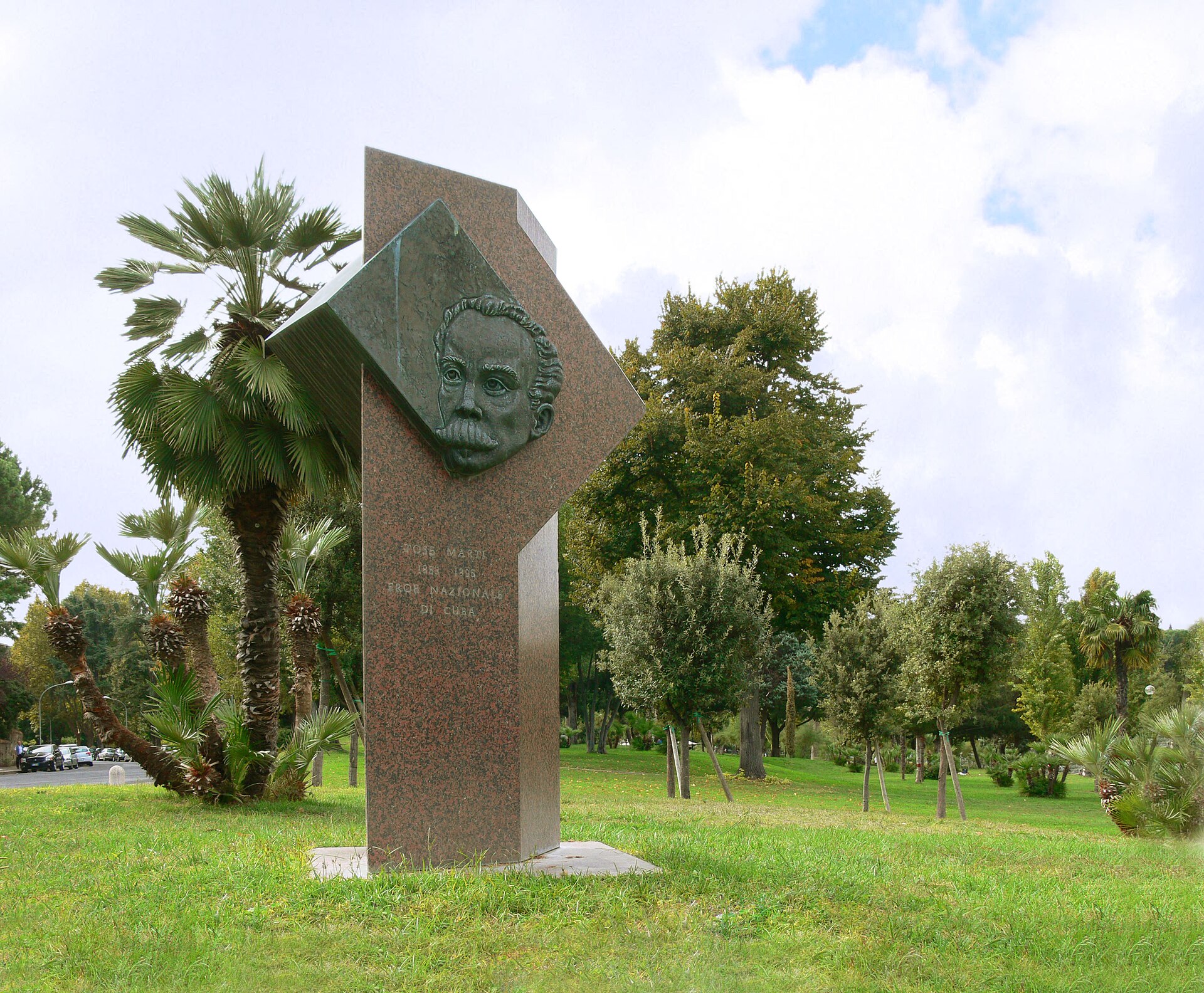 José Martí Monument at Esposizione Universale Roma, Rome José Martí as a liberator believed that the Latin American countries needed to know the reality of their own history. Martí also saw the necessity of a country having its own literature. These reflections started in Mexico from 1875 and are connected to the Mexican Reform, where prominent liberals like Ignacio Manuel Altamirano and Guillermo Prieto had situated themselves in front of a cultural renovation in Mexico, taking on the same approach as Esteban Echeverría thirty years before in Argentina. In the second "Boletin" that Martí published in the Revista Universal (11 May 1875) one can already see Martí's approach, which was fundamentally Latin American. His wish to build a national or Latin American identity was nothing new or unusual in those days; however, no Latin-American intellectual of that time had approached as clearly as Martí the task of building a national identity. He insisted on the necessity of building institutions and laws that matched the natural elements of each country, and recalled the failure of the applications of French and American civil codes in the new Latin American republics. Martí believed that "el hombre del sur", the man of the South, should choose an appropriate development strategy matching his character, the peculiarity of his culture and history, and the nature that determined his being.[69] |
ラテンアメリカのアイデンティティ ローマ万国博覧会におけるホセ・マルティ記念碑 解放者としてホセ・マルティは、ラテンアメリカの諸国が自らの歴史の現実を知る必要があると信じていた。マルティはまた、国が独自の文学を持つ必要性も認 識していた。これらの考察は1875年からメキシコで始まり、メキシコ改革と結びついている。イグナシオ・マヌエル・アルタミラノやギジェルモ・プリエト といった著名な自由主義者たちが、30年前にアルゼンチンのエステバン・エチェベリアが取ったのと同じアプローチで、メキシコの文化的刷新の先頭に立って いたのである。マルティが『レヴィスタ・ウニベルサル』誌(1875年5月11日)に発表した第二回「ボレティン」には、すでにマルティの根本的にラテン アメリカ的なアプローチが見て取れる。国家あるいはラテンアメリカ的アイデンティティを構築したいという彼の願望は、当時としては決して新しくも珍しいも のではなかった。しかし、国家アイデンティティ構築という課題に、マルティほど明確にアプローチした当時のラテンアメリカ知識人はいなかった。彼は、各国 の自然的要素に適合した制度と法律を構築する必要性を主張し、新たなラテンアメリカ共和国におけるフランス民法典やアメリカ民法典の適用が失敗に終わった ことを想起させた。マルティは「南の男= 人間(el hombre del sur)」が、自らの性格、文化と歴史の特異性、そしてその存在を決定づける自然に見合った適切な発展戦略を選択すべきだと信じていたのだ[69]。 |
| Writings Martí as a writer covered a range of genres. In addition to producing newspaper articles and keeping up an extensive correspondence (his letters are included in the collection of his complete works), he wrote a serialized novel, composed poetry, wrote essays, and published four issues of a children's magazine, La Edad de Oro[70](The Golden Age, 1889). His essays and articles occupy more than fifty volumes of his complete works. His prose was extensively read and influenced the modernist generation, especially the Nicaraguan poet Rubén Darío, whom Martí called "my son" when they met in New York in 1893.[71] Martí did not publish any books: only two notebooks (Cuadernos) of verses, in editions outside of the market, and a number of political tracts. The rest (an enormous amount) was left dispersed in numerous newspapers and magazines, in letters, in diaries and personal notes, in other unedited texts, in frequently improvised speeches, and some lost forever. Five years after his death, the first volume of his Obras was published. A novel appeared in this collection in 1911: Amistad funesta, which Martí had made known was published under a pseudonym in 1885. In 1913, also in this edition, his third poetic collection that he had kept unedited: Versos Libres. His Diario de Campaña (Campaign Diary) was published in 1941. Later still, in 1980, Nicaraguan poet Ernesto Mejía Sánchez produced a set of about thirty of Martí's articles written for the Mexican newspaper El Partido Liberal that weren't included in any of his so-called Obras Completas editions. From 1882 to 1891, Martí collaborated in La Nación, a Buenos Aires newspaper. His texts from La Nación have been collected in Anuario del centro de Estudios Martíanos. Over the course of his journalistic career, he wrote for numerous newspapers, starting with El Diablo Cojuelo (The Limping Devil) and La Patria Libre (The Free Fatherland), both of which he helped to found in 1869 in Cuba and which established the extent of his political commitment and vision for Cuba. In Spain he wrote for La Colonia Española,in Mexico for La Revista Universal, and in Venezuela for Revista Venezolana, which he founded. In New York he contributed to Venezuelan periodical La Opinión Nacional, Buenos Aires newspaper La Nación, Mexico's La Opinion Liberal, and The Hour from the U.S.[72] The first critical edition of Martí's complete works began to appear in 1983 in José Martí: Obras completas. Edición crítica. The critical edition of his complete poems was published in 1985 in José Martí: Poesía completa. Edición critica. Volume two of his Obras Completas includes his famous essay 'Nuestra América' which "comprises a variety of subjects relating to Spanish America about which Martí studied and wrote. Here it is noted that after Cuba his interest was directed mostly to Guatemala, Mexico and Venezuela. The various sections of this part are about general matters and international conferences; economic, social and political questions; literature and art; agrarian and industrial problems; immigration; education; relations with the United States and Spanish America; travel notes".[73] According to Martí, the intention behind the publication of "La edad de oro" was "so that American children may know how people used to live, and how they live nowadays, in the United States and in other countries; how many things are made, such as glass and iron, steam engines and suspension bridges and electric light; so that when a child sees a coloured stone he will know why the stone is coloured. ... We shall tell them about everything which is done in factories, where things happen which are stranger and more interesting than the magic in fairy stories. These things are real magic, more marvelous than any. ... We write for children because it is they who know how to love, because it is children who are the hope for the world".[74] Martí's "Versos Sencillos" was written "in the town of Haines Falls, New York, where his doctor has sent [him] to regain his strength 'where streams flowed and clouds gathered in upon themselves'".[75] The poetry encountered in this work is "in many [ways] autobiographical and allows readers to see Martí the man and the patriot and to judge what was important to him at a crucial time in Cuban history".[75] Martí's writings reflected his own views both socially and politically. "Cultivo Una Rosa Blanca" is one of his poems that emphasize his views in hopes of betterment for society: I cultivate a white rose In July as in January For the sincere friend Who gives me his hand frankly And for the cruel person who tears out the heart with which I live, I cultivate neither nettles nor thorns: I cultivate a white rose[76] This poem is a clear description of Martí's societal hopes for his homeland. Within the poem, he talks about how regardless of the person, whether kind or cruel he cultivates a white rose, meaning that he remains peaceful. This coincides with his ideology about establishing unity amongst the people, more so those of Cuba, through a common identity, with no regards to ethnic and racial differences.[77] This doctrine could be accomplished if one treated his enemy with peace as he would treat a friend. The kindness of one person should be shared with all people, regardless of personal conflict. By following the moral that lies within "Cultivo Rosa Blanca", Martí's vision of Cuban solidarity could be possible, creating a more peaceful society that would emanate through future generations. After his breakthrough in Cuba literature[clarification needed], José Martí went on to contribute his works to newspapers, magazines, and books that reflected his political and social views. Because of his early death, Martí was unable to publish a vast collection of poetry; even so, his literary contributions have made him a renowned figure in literature, influencing many writers, and people in general, to aspire to follow in the footsteps of Martí. |
著作 マルティは作家として様々なジャンルを手がけた。新聞記事の執筆や膨大な書簡のやり取り(彼の書簡は全集に収録されている)に加え、連載小説を書き、詩を 創作し、随筆を執筆し、児童雑誌『黄金時代』(1889年)を4号発行した。彼の随筆や記事は全集で50巻以上に及ぶ。その散文は広く読まれ、モダニズム 世代、特にニカラグアの詩人ルベン・ダリオに影響を与えた。マルティは1893年にニューヨークでダリオと会った際、彼を「我が子」と呼んだ[71]。 マルティは書籍を一切出版しなかった。市場流通外の詩集『ノート』(クアデルノス)2冊と、数点の政治パンフレットのみである。残りの膨大な作品は、多数 の新聞・雑誌、書簡、日記・個人的メモ、未編集原稿、即興演説などに散逸し、一部は永久に失われた。死後5年を経て、初めて『作品集』第1巻が刊行され た。1911年には、この全集に小説『不運な友情』が収録された。マルティは、この作品が1885年に偽名で出版されたことを明らかにしていた。1913 年には、同じくこの全集に、彼が未発表のまま残していた3番目の詩集『自由詩』が収録された。彼の『戦場日記』は1941年に出版された。さらにその後、 1980年にニカラグアの詩人エルネスト・メヒア・サンチェスが、マルティがメキシコの新聞エル・パルティード・リベラルに書いた、いわゆる『作品全集』 には収録されなかった約30本の記事をまとめた。1882年から1891年まで、マルティはブエノスアイレスの新聞ラ・ナシオンに協力した。ラ・ナシオン 紙に掲載された彼の文章は、Anuario del centro de Estudios Martianos(マルティ研究センター年鑑)にまとめられている。 ジャーナリストとしてのキャリアの中で、彼は数多くの新聞に記事を執筆した。その最初期は、1869年にキューバで彼が設立に関わったエル・ディアブロ・ コジュエロ(足の不自由な悪魔)紙とラ・パトリア・リブレ(自由の祖国)紙であり、これらの新聞は、彼の政治的な取り組みとキューバに対するビジョンを確 立する場となった。スペインでは『ラ・コロニア・エスパニョーラ』紙、メキシコでは『ラ・レヴィスタ・ユニバーサル』誌、ベネズエラでは自身が創刊した 『レヴィスタ・ベネソラーナ』誌に寄稿した。ニューヨークではベネズエラの定期刊行物『ラ・オピニョン・ナシオナル』紙、ブエノスアイレスの『ラ・ナシオ ン』紙、メキシコの『ラ・オピニョン・リベラル』紙、米国の『ザ・アワー』紙に寄稿した。[72] マルティの全集初批判版は1983年『ホセ・マルティ全集 批判版』として刊行を開始した。詩集の批判版は1985年『ホセ・マルティ詩全集 批判版』で出版された。 全集第2巻には、マルティが研究し執筆したスペイン語圏アメリカに関する多様な主題を網羅した著名な論文『我らのアメリカ』が収録されている。ここで注目 すべきは、キューバ以降、彼の関心が主にグアテマラ、メキシコ、ベネズエラに向けられたことだ。この部分の各章は、一般問題と国際会議、経済・社会・政治 問題、文学と芸術、農業と産業問題、移民、教育、アメリカ合衆国およびスペイン語圏アメリカ諸国との関係、旅行記について論じている。[73] マルティによれば、「黄金時代」出版の意図は「アメリカの子供たちに、かつての人々の暮らしや現代のアメリカ及び他国での生活、ガラスや鉄、蒸気機関や吊 り橋、電灯など多くの物の製造過程を知らしめるためである。そうすれば子供が色石を見た時、その色の理由を理解できるだろう。... 工場で何が行われているか、童話の呪術よりも奇妙で興味深い出来事が起きていることを伝える。これこそが現実の呪術であり、どんな呪術よりも素晴らしいの だ。...我々が子供向けに書くのは、愛することを知っているのは子供たちであり、世界の希望は子供たちだからだ」。[74] マルティの『Versos Sencillos』は「ニューヨーク州ヘインズフォールズの町で書かれた。医師が『小川が流れ、雲が自らに集まる』この地で体力を回復せよと彼を送り込 んだ場所である」。[75] 本書で出会う詩は「多くの点で自伝的であり、読者にマルティという人間と愛国者を見させ、キューバ史の重大な時期に彼にとって何が重要だったかを判断させ る」ものである。[75] マルティの著作は、社会的にも政治的にも彼自身の見解を反映している。「白いバラを育てる」は、社会の改善を願う彼の見解を強調した詩の一つだ: 白いバラを育てる 七月も一月も変わらず 誠実な友のために 率直に手を差し伸べてくれる人のために そして残酷な人のために 私の生きる心臓を引き裂く人のために 蕁麻も棘も育てない: 白いバラを育てる [76] この詩は、マルティが祖国に抱いた社会的希望を明確に描いている。詩の中で彼は、人格が親切であれ残酷であれ、白薔薇を育てる、つまり平和を保つと語る。 これは、民族や人種の違いに関わらず、共通のアイデンティティを通じて、特にキューバの人々の間に団結を築くという彼のイデオロギーと一致する。[77] この教義は、敵を友のように平和的に扱うことで達成できる。個人的な対立に関わらず、一人の優しさは全ての人々と分かち合うべきだ。「白い薔薇を育てる」 に込められた道徳に従うことで、マルティの描くキューバの連帯は実現可能となり、より平和な社会が未来の世代へと受け継がれていく。 キューバ文学における画期的な成果[注釈必要]の後、ホセ・マルティは自身の政治的・社会的見解を反映した新聞、雑誌、書籍への寄稿を続けた。早逝のた め、マルティは膨大な詩集を出版できなかった。それでもなお、彼の文学的貢献は文学界における著名な存在とし、多くの作家や一般の人々にマルティの足跡を 追うことを志向させる影響を与えた。 |
| Style Martí's style of writing is difficult to categorize. He used many aphorisms—short, memorable lines that convey truth and/or wisdom—and long complex sentences. He is considered a major contributor to the Spanish American literary movement known as Modernismo and has been linked to Latin American consciousness of the modern age and modernity.[78] His chronicles combined elements of literary portraiture, dramatic narration, and a dioramic scope. His poetry contained "fresh and astonishing images along with deceptively simple sentiments".[79] As an orator (for he made many speeches) he was known for his cascading structure, powerful aphorisms, and detailed descriptions. More important than his style is how he uses that style to put into service his ideas, making "advanced" convincing notions. Throughout his writing he made reference to historical figures and events, and used constant allusions to literature, current news and cultural matters. For this reason, he may be difficult to read and translate.[80] His didactic spirit encouraged him to establish a magazine for children, La Edad de Oro (1889) which contained a short essay titled "Tres Heroes" (three heroes), representative of his talent to adapt his expression to his audience; in this case, to make the young reader conscious of and amazed by the extraordinary bravery of the three men, Bolivar, Hidalgo, and San Martín. This is his style to teach delightfully.[81] |
スタイル マルティの文体は分類が難しい。彼は多くの格言——真実や知恵を伝える短く記憶に残る言葉——と長く複雑な文を用いた。彼はモダニズモとして知られるスペ イン系アメリカ文学運動の主要な貢献者と見なされ、ラテンアメリカの近代と現代性への意識と結びつけられてきた。[78] 彼のクロニクルは、文学的肖像画、劇的な叙述、そしてジオラマ的な視野の要素を組み合わせた。彼の詩には「新鮮で驚くべきイメージと、一見単純に見える感 情」が含まれていた[79]。演説家として(彼は数多くの演説を行った)、連鎖的な構造、力強い格言、詳細な描写で知られていた。彼の文体そのものよりも 重要なのは、その文体を自らの思想に奉仕させる手法であり、それによって「先進的」な概念を説得力あるものにした点だ。著作全体を通じて歴史的人物や事件 に言及し、文学・時事問題・文化事象への絶え間ない暗示を用いた。このため、彼の文章は読解や翻訳が困難な場合がある[80]。 彼の教訓的精神は、子供向け雑誌『黄金時代』(1889年)の創刊へとつながった。この雑誌に掲載された短編エッセイ「三人の英雄」は、彼の表現を聴衆に 合わせて適応させる才能を象徴している。この場合、若い読者にボリバル、イダルゴ、サン・マルティンの三人の並外れた勇気を自覚させ、驚嘆させるためで あった。これが彼の「楽しませながら教える」スタイルである。[81] |
| Translation José Martí is universally honored as a great poet, patriot and martyr of Cuban Independence, but he was also a translator of some note. Although he translated literary material for the sheer joy of it, much of the translating he did was imposed on him by economic necessity during his many years of exile in the United States. Martí learned English at an early age, and had begun to translate at thirteen. He continued translating for the rest of his life, including his time as a student in Spain, although the period of his greatest productivity was during his stay in New York from 1880 until he returned to Cuba in 1895.[82] 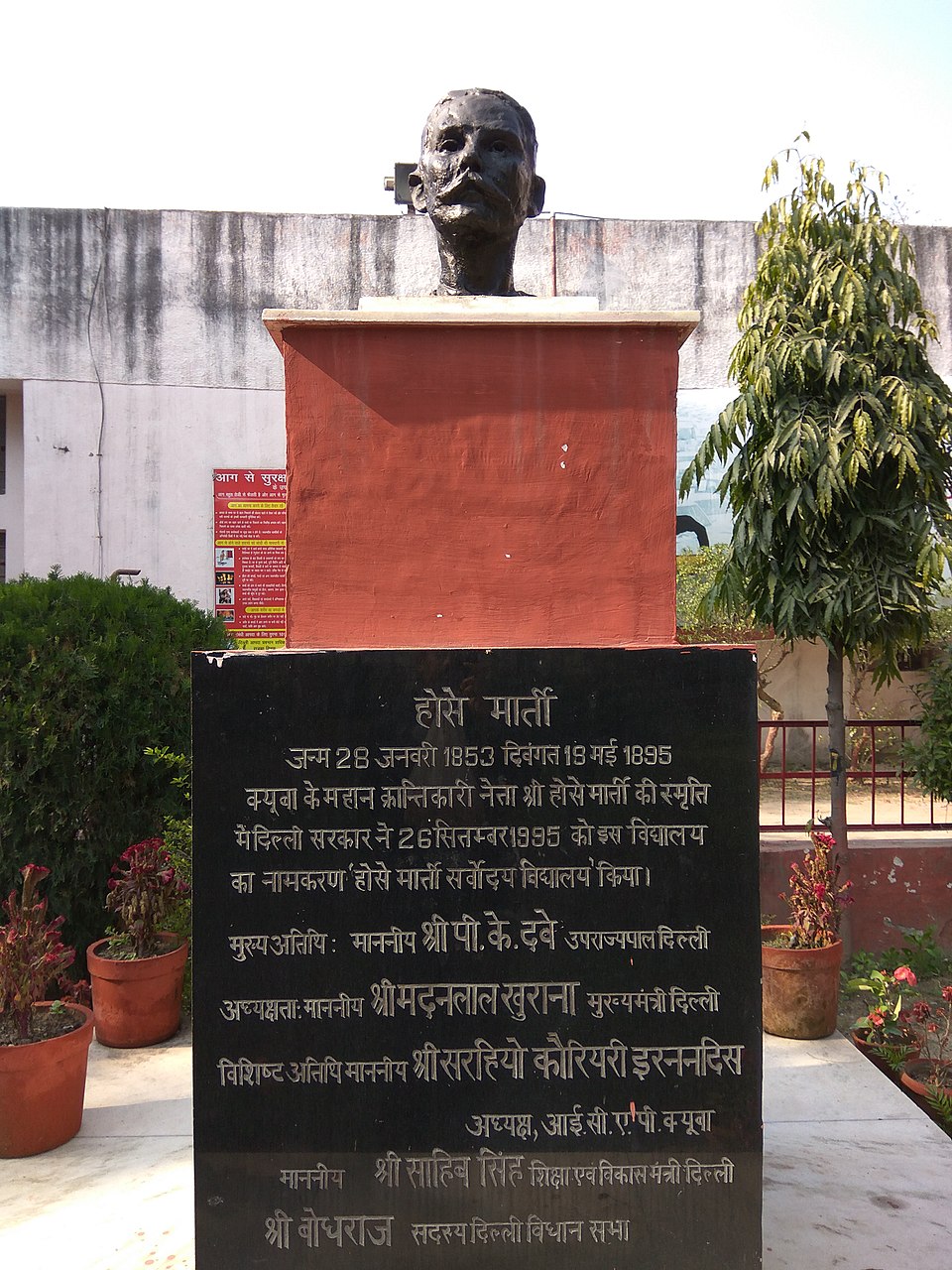 Statue of Jose Martí in a government school named after him in Delhi In New York he was what is known today as a "freelancer," as well as an "in house" translator. He translated several books for the publishing house of D. Appleton, and did a series of translations for newspapers. As a revolutionary activist in Cuba's long struggle for independence he translated into English a number of articles and pamphlets supporting that movement.[83] In addition to fluent English, Martí also spoke French, Italian, Latin and Classical Greek fluently, the latter learned so he could read the Greek classical works in the original.[84] There was clearly a dichotomy in Martí's feeling about the kind of work he was translating. Like many professionals, he undertook for money translation tasks which had little intellectual or emotional appeal for him. Although Martí never presented a systematic theory of translation nor did he write extensively about his approach to translation, he did jot down occasional thoughts on the subject, showcasing his awareness of the translator's dilemma of the faithful versus the beautiful and stating that "translation should be natural, so that it appears that the book were written in the language to which it has been translated".[85] |
ホセ・マルティは偉大な詩人、愛国者、そしてキューバ独立の殉教者とし
て広く称えられているが、彼はまたかなりの翻訳家でもあった。純粋な喜びのために文学作品を翻訳したこともあったが、彼が手がけた翻訳の多くは、アメリカ
での長年の亡命生活における経済的必要性から強いられたものだった。 マルティは幼い頃に英語を学び、13歳で翻訳を始めた。スペイン留学時代を含め生涯を通じて翻訳を続けたが、最も生産的だったのは1880年から1895年にキューバへ帰国するまでのニューヨーク滞在期であった[82]。 デリーの政府学校に立つホセ・マルティ像(同校は彼の名を冠している) ニューヨークでは、現代でいう「フリーランス」でありながら「社内」翻訳者でもあった。D.アップルトン社のために数冊の書籍を翻訳し、新聞向けの一連の 翻訳も手掛けた。キューバの長い独立闘争における革命活動家として、彼はその運動を支持する多くの記事やパンフレットを英語に翻訳した。[83] 流暢な英語に加え、マルティはフランス語、イタリア語、ラテン語、古典ギリシャ語も流暢に話した。後者はギリシャ古典作品を原典で読むために習得したもの である。[84] マルティが翻訳する仕事の種類に対する感情には明らかな二面性があった。多くの専門家と同様、彼は金銭のために、知的・感情的な魅力をほとんど感じない翻 訳業務を引き受けていた。マルティは翻訳に関する体系的な理論を提示したこともなければ、自身のアプローチについて詳細に論じたこともなかった。しかし、 翻訳者が直面する「忠実さ」と「美しさ」のジレンマへの認識を示しつつ、「翻訳は自然であるべきだ。そうすれば、その本は翻訳先の言語で書かれたかのよう に見える」と記すなど、時折この主題に関する所感を書き留めていた。[85] |
| Modernism Modernists, in general, use a subjective language. Martí's stylistic creed is part of the necessity to de-codify the logic rigor and the linguistic construction and to eliminate the intellectual, abstract and systematic expression. There is the deliberate intention and awareness to expand the expressive system of the language. The style changes the form of thinking. Without falling into unilateralism, Martí values the expression because language is an impression and a feeling through the form. Modernism mostly searches for visions and realities, the expression takes in the impressions, the state of mind, without reflection and without concept. This is the law of subjectivity. We can see this in works of Martí, one of the first modernists, who conceives the literary task like an invisible unity, an expressive totality, considering the style like "a form of the content" (forma del contenido).[86] The difference that Martí established between prose and poetry are conceptual. Poetry, as he believes, is a language of the permanent subjective: the intuition and the vision. The prose is an instrument and a method of spreading the ideas, and has the goal of elevating, encouraging and animating these ideas rather than having the expression of tearing up the heart, complaining and moaning. The prose is a service to his people.[87] Martí produces a system of specific signs "an ideological code" (código ideológico). These symbols claim their moral value and construct signs of ethic conduct. Martí's modernism was a spiritual attitude that was reflected on the language. All his writing defines his moral world. One could also say that his ideological and spiritual sphere is fortified in his writing.[87] The difference between Martí and other modernist initiators such as Manuel Gutiérrez Nájera, Julián del Casal, and José Asunción Silva (and the similarity between him and Manuel González Prada) lies in the profound and transcendent value that he gave to literature, converting prose into an article or the work of a journalist. This hard work was important in giving literature authentic and independent value and distancing it from mere formal amusement. Manuel Gutiérrez Nájera, Rubén Darío, Miguel de Unamuno and José Enrique Rodó saved the Martínian articles, which will have an endless value in the writings of the American continent.[88] Apart from Martínian articles, essay writing and literature starts to authorize itself as an alternative and privileged way to talk about politics. Literature starts to apply itself the only hermeneutics able to resolve the enigmas of a Latin American identity.[88] |
モダニズム モダニストたちは概して主体的な言語を用いる。マルティの文体信条は、論理的厳密さや言語的構築を解読し、知的で抽象的かつ体系的な表現を排除する必要性 の一部だ。言語の表現体系を拡張する意図と自覚がそこにある。文体は思考の形態を変える。一方的になることなく、マルティは表現を重視する。言語とは形態 を通した印象であり感覚だからだ。モダニズムは主に視覚と現実を求め、表現は印象や精神状態を、反省や概念なしに受け入れる。これが主体性の法則だ。初期 モダニストの一人であるマルティの作品にこの傾向が見られる。彼は文学的課題を不可視の統一体、表現の全体性として捉え、文体を「内容の形式」 (forma del contenido)と見なした。[86] マルティが散文と詩の間に設定した差異は概念的なものだ。詩は、彼が信じるように、恒久的な主体性の言語である:直感とビジョンだ。散文は思想を広めるた めの道具であり方法であり、心を引き裂くような表現や嘆きや呻きを持つことよりも、これらの思想を高揚させ、励まし、活気づけることを目的とする。散文は 彼の民への奉仕である。[87] マルティは特定の記号体系、「イデオロギー的コード」(código ideológico)を生み出す。これらの記号は道徳的価値を主張し、倫理的行動の記号を構築する。マルティのモダニズムは言語に反映された精神的態度 であった。彼の全著作は道徳的世界を定義する。彼のイデオロギー的・精神的領域が著作によって強化されているとも言える。[87] マルティとマヌエル・グティエレス・ナヘラ、フリアン・デル・カサル、ホセ・アスンシオン・シルバといった他のモダニズムの創始者たちとの異なる点(そし てマヌエル・ゴンサレス・プラダとの類似点)は、彼が文学に与えた深遠かつ超越的な価値にある。彼は散文を記事やジャーナリストの著作へと転換したのだ。 この困難な作業は、文学に真正かつ独立した価値を与え、単なる形式的な娯楽から遠ざける上で重要であった。マヌエル・グティエレス・ナヘラ、ルベン・ダリ オ、ミゲル・デ・ウナムノ、ホセ・エンリケ・ロドはマルティニアン記事を守り抜いた。それらはアメリカ大陸の著作において永遠の価値を持つであろう。 [88] マルティニアン記事とは別に、エッセイや文学は政治を語るための代替的かつ特権的な手段として自らを正当化し始める。文学はラテンアメリカ的アイデンティティの謎を解き明かす唯一の解釈学として自らを適用し始めるのだ。[88] |
| Legacy Symbol of Cuban independence Statue of Martí in Cienfuegos, Cuba Martí's dedication to the cause of Cuban independence and his passionate belief in democracy and justice has made him a hero for all Cubans, a symbol of unity, the "Apostle",[89] a great leader. His writings have created a platform for all that he went through during the duration of this period in time.[90] His ultimate goal of building a democratic, just, and stable republic in Cuba and his obsession with the practical execution of this goal led him to become the most charismatic leader of the 1895 colonial revolution. His work haranguing the Cuban community, raising funds, resolving the disagreements of important revolutionary leaders, and creating the Cuban Revolutionary Party to organize this effort, put into motion the Cuban war of independence.[91] His foresight into the future, shown in his warnings against American political interests for Cuba, was confirmed by the swift occupation of Cuba by the United States following the Spanish–American War. His belief in the inseparability of Cuban and Latin American sovereignty and the expression thereof in his writings have contributed to the shape of the modern Latin American Identity. Through his beliefs for Cuban and Latin American sovereignty, Cuba revolted on former allies.[90] This is why Cuba became an independent nation. His works are a cornerstone of Latin American and political literature and his prolific contributions to the fields of journalism, poetry, and prose are highly acclaimed.[92] Martí depicted on a República de Cuba one peso silver certificate (1936) Influence on Cuban politics Martí was a Classical liberal whose major goal was the liberation of Cuba from Spain and the establishment of a democratic republican government.[93] His writings on the concepts of Cuban nationalism fuelled the 1895 revolution, and have continued to inform conflicting visions of the Cuban nation. According to Carlos Ripoll, the Cuban government under the Communist Party and Castro himself associate themselves with Martí as much as possible. Examples of this include endorsing his anti-imperialist positions and downplaying his views that conflict with Cuban communist doctrine. Despite Martí never having supported communism or single party systems,[94] Cuban leaders repeatedly cited Martí as an inspiration, and claimed that Martí's Partido Revolucionario Cubano was a "forerunner of the Communist Party".[94] In 2016, former Cuban leader Fidel Castro was buried next to Martí in Santiago.[95][96] Regarded as Cuba's "martyr" and "apostle,"[6] several landmarks in Cuba are dedicated to Martí.[6][5] During Castro's tenure, the politics and death of Martí were used to justify certain actions of the state.[94] The Cuban government claimed that Martí had supported a single party system, creating a precedent for a communist government. On the contrary, he was an admirer of democracy and the American republican system, and throughout his life he fiercely criticized any type of dictatorial government.[97] In addition, he also criticized Marx, and warned on several occasions about the dangers of socialism.[98] Martí's nuanced, often ambivalent positions on the most important issues of his day[99] have led Marxist interpreters to see a class conflict between the proletariat and the bourgeoisie as the main theme of his works, while others have identified a liberal-capitalist emphasis.[100] Cubans who oppose the communist government honor Martí as a defender of freedom and democracy, and a figure of hope for the Cuban nation, and condemn Castro's government for manipulating his works and creating a "Castroite Martí" to justify its "intolerance and abridgments of human rights".[101] |
遺産 キューバ独立の象徴 キューバ、シエンフエゴスにあるマルティの像 マルティのキューバ独立への献身と、民主主義と正義への熱烈な信念は、彼を全てのキューバ人の英雄、団結の象徴、「使徒」[89]、偉大な指導者たらしめ た。彼の著作は、この時代における彼の経験の全てを伝える基盤を築いた。[90] キューバに民主的で公正かつ安定した共和国を築くという究極の目標と、その実践への執着が、彼を1895年の植民地革命における最もカリスマ的な指導者へ と押し上げた。キューバ社会への熱弁、資金調達、主要革命指導者間の対立解決、そしてこの運動を組織化するためのキューバ革命党創設といった彼の活動が、 キューバ独立戦争の幕開けとなった。[91] キューバに対するアメリカの政治的利害への警告に見られる彼の先見性は、米西戦争後のアメリカによるキューバの迅速な占領によって裏付けられた。キューバ とラテンアメリカの主権の不可分性への彼の信念と、その信念が著作に表れたことは、現代のラテンアメリカ的アイデンティティの形成に寄与した。キューバと ラテンアメリカの主権に対する彼の信念を通じて、キューバはかつての同盟国に反旗を翻した[90]。これがキューバが独立国家となった理由である。彼の著 作はラテンアメリカ文学および政治文学の礎であり、ジャーナリズム、詩、散文の各分野における多産な貢献は高く評価されている[92]。 マルティを描いたキューバ共和国1ペソ銀貨券(1936年) キューバ政治への影響 マルティは古典的自由主義者であり、その主要な目標はスペインからのキューバ解放と民主的な共和制政府の樹立であった。[93] 彼のキューバナショナリズムに関する著作は1895年の革命を煽り、現在もキューバ国民像をめぐる対立する見解に影響を与え続けている。 カルロス・リポルによれば、共産党政権下のキューバ政府とカストロ自身は可能な限りマルティと結びつけようとしている。その例として、彼の反帝国主義的立 場を支持し、キューバ共産主義の教義と矛盾する見解を軽視することが挙げられる。マルティが共産主義や一党制を支持したことは一度もなかったにもかかわら ず[94]、キューバの指導者たちは繰り返しマルティを精神的支柱として引用し、マルティの「キューバ革命党」が「共産党の先駆け」であったと主張した [94]。2016年、元キューバ指導者フィデル・カストロはサンティアゴでマルティの隣に埋葬された[95]。[96] キューバの「殉教者」かつ「使徒」と見なされるマルティ[6]に捧げられた記念碑が国内に複数存在する[6][5]。カストロ政権下では、マルティの政治 思想と死が国家の特定の行動を正当化する根拠として利用された[94]。キューバ政府はマルティが一党制を支持したと主張し、共産主義政府の先例を創出し た。しかし実際には、彼は民主主義とアメリカ共和制の支持者であり、生涯を通じてあらゆる独裁政権を激しく批判していた[97]。さらにマルクスを批判 し、社会主義の危険性について繰り返し警告も発している。[98] マルティが当時の最重要課題に対して示した、微妙なニュアンスと往々にして両義的な立場[99]は、マルクス主義的解釈者たちに彼の著作の主テーマをプロ レタリアートとブルジョアジーの階級闘争と見なさせると同時に、他の者たちは自由主義的資本主義的強調を指摘している。[100] 共産主義政府に反対するキューバ人は、マルティを自由と民主主義の擁護者、キューバ国民にとっての希望の象徴として称え、カストロ政権が彼の著作を操作し 「カストロ流マルティ」を作り上げて自らの「不寛容と人権侵害」を正当化していることを非難している。[101] |
| Memorials and tributes Plaque and statue of José Martí located inside the Parque Amigos de José Martí in Tampa, FL. José Martí International Airport, Havana's international airport, is named after Martí. A statue of Martí was unveiled in Havana on his 123rd birth anniversary, with President Raúl Castro attending the ceremony.[102] The José Martí Memorial in the Vedado neighborhood of Havana includes a 109-m tower and is the largest monument in the world dedicated to a writer. The National Association of Hispanic Publications, a non-profit organization to promote Hispanic publications, each year designates the José Martí Awards for excellence in Hispanic media.[103] On the waterfront of Cap-Haïtien, Haiti, a city that José Martí visited three times,[104] a power station is named after him.[105] The home where he resided during his final visit in 1895[106] bears a marble plaque.[107] Place José Martí (José Martí Square), featuring a bust of the poet, was inaugurated in 2014.[108] Parque Amigos de José Martí is a small park located in the Ybor City neighborhood of Tampa, FL. In 1956, the land was gifted to Cuba and the park was officially dedicated in 1960.[109] The park prominently features a statue of Martí and a plaque erected in 1998.[110] Near the park's entrance is a plaque commemorating the site of La Casa De Pedroso, a boarding house where Martí convalesced following an attempted poisoning.[111] About a block away is another historical marker commemorating his impromptu speech to Cuban cigar workers from the steps of the Ybor Factory Building in 1893.[112] The parks and markers are inside the Ybor City Historic District. The White Rose German Anti-Nazi resistance group led by Sophie and Hans Scholl of the University of Munich was apparently inspired by Jose Marti's verse "Cultivo Una Rosa Blanca" (Versos Sencillos).[113] In Bucharest Romania a public school and the Romanian-Cuban Friendship Association from Targoviste are both named "Jose Martí". In Shively, Kentucky, a bronze bust atop a marble monument pays tribute to José Martí.[114] In 2009, a bronze statue was built on Boulevard Louis Blanc, in Montpellier, the first such statue of Martí in France.[115] |
記念碑と追悼 フロリダ州タンパにあるホセ・マルティ公園内のホセ・マルティの銘板と像。 ハバナの国際空港であるホセ・マルティ国際空港はマルティにちなんで名付けられた。マルティの生誕123周年を記念し、ラウル・カストロ大統領が出席した 式典でハバナにマルティの像が除幕された。[102] ハバナのベダード地区にあるホセ・マルティ記念碑は、高さ109メートルの塔を備え、作家に捧げられた世界最大の記念碑である。 ヒスパニック系出版物を促進する非営利団体「全米ヒスパニック出版協会」は、毎年、ヒスパニック系メディアにおける優れた業績に対してホセ・マルティ賞を授与している。[103] ハイチのキャップ・ハイシアン(ホセ・マルティが三度訪れた都市[104])のウォーターフロントには、彼の名を冠した発電所がある[105]。1895 年の最後の訪問時に滞在した家屋[106]には大理石の銘板が掲げられている[107]。詩人の胸像を据えたホセ・マルティ広場(Place José Martí)は2014年に開園した。[108] ホセ・マルティの友公園(Parque Amigos de José Martí)は、フロリダ州タンパのイボーシティ地区にある小さな公園だ。1956年に土地がキューバに贈られ、1960年に正式に公園として開園した。 [109] 公園にはマルティの像と1998年に建立された銘板が目立つように設置されている。[110] 公園入口付近には、ラ・カサ・デ・ペドロソ(宿舎)の跡地を記念する銘板がある。マルティはここで毒殺未遂事件後の療養を過ごした。[111] 約1ブロック離れた場所には、1893年にイボル工場ビルの階段でキューバ人葉巻労働者に向けて即興演説を行ったことを記念する別の歴史的標識がある。 [112] これらの公園と標識はイボルシティ歴史地区内に位置する。 ミュンヘン大学のゾフィーとハンス・ショルが率いたドイツの反ナチ抵抗組織「白い薔薇」は、ホセ・マルティの詩「白い薔薇を育てる」(『簡素な詩句』所収)に触発されたとされている。[113] ルーマニアのブカレストでは、公立学校とタルゴヴィシュテのルーマニア・キューバ友好協会が共に「ホセ・マルティ」の名を冠している。 ケンタッキー州シャイブリーでは、大理石の記念碑の上に設置されたブロンズの胸像がホセ・マルティを称えている。[114] 2009年、フランス・モンペリエのルイ・ブラン大通りにブロンズ像が建立された。これはフランス国内初のマルティ像である。[115] |
| List of selected works Monument to José Martí in Sofia, Bulgaria Martí's fundamental works published during his life 1869 January: Abdala 1869 January: 10 de octubre 1871: El presidio político en Cuba 1873: La República Española ante la revolución cubana 1875: Amor con amor se paga 1882: Ismaelillo 1882 February: Ryan vs. Sullivan 1882 February: Un incendio 1882 July: El ajusticiamiento de Guiteau 1883 January: Batallas de la Paz 1883 March: Que son graneros humanos 1883 March: Karl Marx ha muerto 1883 March:El Puente de Brooklyn 1883 September: En Coney Island se vacía Nueva York 1883 December: Los políticos de oficio" 1883 December: Bufalo Bil 1884 April: Los caminadores 1884 November: Norteamericanos 1884 November: El juego de pelota de pies 1885: Amistad funesta 1885 January: Teatro en Nueva York 1885 Una gran rosa de bronce encendida 1885 March:Los fundadores de la constitución 1885 June: Somos pueblo original 1885 August: Los políticos tiene sus púgiles 1886 May: Las revueltas anarquistas de Chicago 1886 September: La ensenanza 1886 October: La Estatua de la Libertad 1887 April: El poeta Walt Whitman 1887 April: El Madison Square 1887 November: Ejecución de los dirigentes anarquistas de Chicago 1887 November: La gran Nevada 1888 May: El ferrocarril elevado 1888 August: Verano en Nueva York 1888 November: Ojos abiertos, y gargantas secas 1888 November: Amanece y ya es fragor 1889: La edad de oro 1889 May: El centenario de George Washington 1889 July: Bañistas 1889 August: Nube Roja 1889 September: La caza de negros 1890 November: El jardín de las orquídeas 1891 October: Versos sencillos 1891 January: Nuestra América 1894 January: ¡A Cuba! 1895: Manifiesto de Montecristi- coauthor with Máximo Gómez Martí's major posthumous works Adúltera Versos libres |
選集一覧 ブルガリア・ソフィアのホセ・マルティ記念碑 マルティの存命中に発表された主要作品 1869年1月:『アブダラ』 1869年1月:『10月10日』 1871年:『キューバにおける政治的投獄』 1873年:キューバ革命におけるスペイン共和国 1875年:愛は愛で返す 1882年:イスマエリヨ 1882年2月:ライアン対サリバン 1882年2月:火災 1882年7月:ギトーの処刑 1883年1月:平和の戦い 1883年3月:人間は穀倉である 1883年3月:カール・マルクス死去 1883年3月:ブルックリン橋 1883年9月:コニーアイランドにニューヨークが空になる 1883年12月:職業政治家 1883年12月:バッファロー・ビル 1884年4月:歩行者たち 1884年11月:北米人 1884年11月:フットボール競技 1885年:不吉な友情 1885年1月:ニューヨークの劇場 1885年:燃える巨大な青銅の薔薇 1885年3月:憲法の制定者たち 1885年6月:我々は先住民である 1885年8月:政治家にはその拳闘士がいる 1886年5月:シカゴの無政府主義者蜂起 1886年9月:教育 1886年10月:自由の女神像 1887年4月:詩人ウォルト・ホイットマン 1887年4月:マディソン・スクエア 1887年11月:シカゴ無政府主義指導者の処刑 1887年11月:大ネバダ 1888年5月:高架鉄道 1888年8月:ニューヨークの夏 1888年11月:開かれた目と乾いた喉 1888年11月:夜明けと共に轟音が響く 1889年:黄金時代 1889年5月:ジョージ・ワシントン生誕100周年 1889年7月:水浴者たち 1889年8月:赤い雲 1889年9月:ニグロ狩り 1890年11月:蘭の花園 1891年10月:簡潔な詩 1891年1月:我らのアメリカ 1894年1月:キューバへ! 1895年:モンテクリスティ宣言 - マキシモ・ゴメスとの共著 マルティの主な死後作品 姦通者 自由詩 |
| International José Martí Prize Radio y Televisión Martí Bust of José Martí, Houston, Texas Monument to José Martí, Madrid, Spain Guantanamera |
国際ホセ・マルティ賞 ラジオ・テレビ・マルティ ホセ・マルティの胸像、テキサス州ヒューストン ホセ・マルティの記念碑、スペイン・マドリード グアンタナメラ |
| References Notes a. In this Spanish name, the first or paternal surname is Martí and the second or maternal family name is Pérez. Citations 01. Hudson, Michael (15 January 2000). "Speech to the Communist Party of Cuba". Retrieved 5 August 2015. Mace, Elisabeth. "The economic thinking of Jose Marti: Legacy foundation for the integration of America". Retrieved 5 August 2015. "Jose Marti, apostle of Cuban Independence". www.historyofcuba.com. Retrieved 22 July 2019. Garganigo, John F. (1997). Huellas de las literaturas hispanoamericanas. Upper Saddle River: Prentice Hall. p. 272. Whitney Jr, W. T. (22 January 2018). "José Martí, soul of the Cuban Revolution". People's World. "José Martí Bust on Cuba's Highest Peak". Atlas Obscura. Alborch Bataller 1995, p. 15 Fidalgo 1998, p. 26 Alborch Bataller 1995, p. 16 10. López 2006, p. 232 "End of Slavery in Cuba". www.historyofcuba.com. Retrieved 22 July 2019. Jones 1953, p. 398 Alborch Bataller 1995, p. 18 Alborch Bataller 1995, p. 23 Martí 1963a, p. 48 Alborch Bataller 1995, p. 24 Pérez-Galdós Ortiz 1999, p. 45 Alborch Bataller 1995, p. 30 Jones 1953, p. 399 20. Hernández, Isairis Sosa (14 February 2018). "Cinco cartas de amor a José Martí" [Five love letters to José Martí]. Juventud Rebelde. Retrieved 17 April 2024. Alborch Bataller 1995, p. 46 It is common, and in fact legal, practice in Spanish-speaking societies to use and include the maternal surname as the "second" last name, such that both surnames are the legal and customary surname of an individual. E.g., Pérez López means that in non-Spanish societies esp. anglophone societies, Pérez is the correct surname to which to refer; otherwise, 'both' names together are the legal surname. Guatemala was one of the first regions of the New World to be exposed to European music Alborch Bataller 1995, p. 52 Alborch Bataller 1995, p. 56 Alborch Bataller 1995, p. 107 Gray 1966, p. 389 Gray 1966, p. 390 García Cisneros 1986, p. 56 30. Fountain 2003, p. 4 Alborch Bataller 1995, p. 159 Alborch Bataller 1995, p. 167 Alborch Bataller 1995, p. 184 Tone 2006, p. 43 Alborch Bataller 1995, p. 191 Gray 1966, p. 391 Tone 2006, p. 48 "125th anniversary of death of José Martí-the Cuban Intellectual, Author and Revolutionary!". UC Berkeley Library. 19 May 2020. Retrieved 17 April 2024. Gray 1966, p. 392 40. Nuccetelli, Susana (2020). An Introduction to Latin American Philosophy. Cambridge University Press. pp. 139–145. Ortega Paredes, Juan J. (2007). "José Martí: su concepto de democracia en el Partido Revolucionario Cubano". Revista de Ciencias Sociales. 115: 100. Jorrin, Miguel (1970). Latin American Political Thought and Ideology. University of North Carolina Press. pp. 161–162. Conde, Guillermo Hierrezuelo (2014). "Il pensiero politico di José Martí". Revista de Estudios Históricos – Juridicos (36): 518–521. doi:10.4067/S0716-54552014000100020. Arroyo, Jossianna (2013). Writing Secrecy in Caribbean Freemasonry. Palgrave Macmillan. p. 102. Hidalgo Paz, Ibrahim (2008). "Puerto Rico en el Partido Revolucionario Cubano, 1895–1898". Revista de la Biblioteca Nacional José Martí. 1 (2): 87–100. Abel, Christopher (2015). José Marti: Revolutionary Democrat. Bloomsbury Publishing. pp. 137–139. Fernandez, Raul A. (1998). José Martí's "Our America": From National to Hemispheric Cultural Studies. Duke University Press. p. 215. Martí 1963b, pp. 93–94 Scott 1984, p. 87 50. Ramos 2001, pp. 34–35 Martí 1963c, p. 172 Martí 1963d, p. 192 Ronning 1990, p. 103 Martí 1963e, p. 270 Bueno 1997, p. 158 Abel 1986, p. 26 60. Turton 1986, p. 57 Giles, Paul (Spring 2004). "The Parallel Worlds of Jose Marti". Radical History Review. 2004 (89): 185–190. doi:10.1215/01636545-2004-89-185. S2CID 144839689. Retrieved 16 November 2017. Holden & Zolov 2000, p. 249 Turton 1986, p. 47 Holden & Zolov 2000, p. 179 Kirk 1977, p. 278 Kirk 1977, pp. 278–79 Martí thought that US expansionism represented the Spanish American republics' "greatest danger" Kirk 1977, p. 279 Kirk 1977, p. 280 Kirk 1977, p. 281 Kirk 1977, p. 282 Kirk 1977, p. 284 Fernández 1995, p. 46[clarification needed] 70. Lally, Carolyn. "Foreign Language Program Articulation: Current Practice and Future Prospects." 2001. p. 54. Garganigo et al., p. 272[clarification needed] Martí 1992, p. 8[clarification needed] Roscoe 1947, p. 280 Nassif 1994, p. 2 Oberhelman 2001, p. 475 Martí, José, Manuel A.Tellechea Versos Sencillos. U of Houston: Arte Público Press, 1997 Morukian, Maria. "Cubanidad: Survival of Cuban Culture Identity in the 21st Century". Fernández Retamar 1970, p. 38 80. Fountain 2003, p. 6 Hernández Pardo 2000, p. 146 Garganigo, p. 273[clarification needed] Fountain 2003, p. 13 Fountain 2003, p. 15 Fernández Retamar 1970, p. 16 "la traducción debe ser natural, para que parezca como si el libro hubiese sido escrito en la lengua al que lo traduces." De la Cuesta 1996, p. 7 Serna 2002, p. 13 Serna 2002, p. 14 Serna 2002, p. 16 Lopez 2006, p. 11 90. Jordan, David (1993). Revolutionary Cuba and the End of the Cold War. University Press Of America. pp. 15–17. ISBN 978-0-8191-8998-1. Ronning 1990, p. 3 Cairo 2003, p. 25 Lecuona, Rafael (March 1991). "Jose Marti and Fidel Castro". International Journal on World Peace. 8 (1): 45–61. JSTOR 20751650. Ripoll, Carlos (1994). "The Falsification of Jose Marti in Cuba". Cuban Studies. 24: 3–38. JSTOR 24485768. "Fidel Castro's ashes buried in Cuba". BBC News. 4 December 2016. "Fidel Castro will be buried next to Jose Marti | Miami Herald". Miami Herald. Archived from the original on 30 November 2016. Cave, Damien (21 March 2016). "Cuban Poet José Martí: Everyone's Revolutionary". The New York Times. León, Luis Leonel (16 February 2021). "Martí jamás sería socialista". López 2006, p. 12 100. Ripoll 1984, p. 45 Ripoll 1984, p. 40 "Cuba unveils US statue of national hero Jose Marti". aljazeera.com. Retrieved 22 July 2019. "José Martí Awards". National Association of Hispanic Publications. 17 November 2016. "Ils rendent hommage à José Martí au Cap-Haïtien". misiones.minrex.gob.cu (in French). 30 January 2020. Retrieved 9 November 2021.[permanent dead link] "Centrale thermique Jose Marti : les fruits ne tiennent pas la promesse des fleurs". www.haitiz.com (in French). Archived from the original on 9 November 2021. Retrieved 9 November 2021. "La maison de José Marti au Cap-Haïtien". laurent.quevilly.pagesperso-orange.fr (in French). Retrieved 9 November 2021. "José Marti Square in Cap-Haitian". haitianphotos.com. Retrieved 9 November 2021. "Haiti – Politic : President Martelly inaugurates the Jose Marti Square in Cap-Haitien". haitilibre.com. Retrieved 9 November 2021. Sellers, John (1 March 2018). "Does Cuba Own Jose Marti Park?". Sunland Tribune. 3 (1). ISSN 2575-2472. 110. "Jose Marti Historical Marker". hmdb.org. Retrieved 23 April 2022. "La Casa de Pedroso Historical Marker". hmdb.org. Retrieved 23 April 2022. "José Martí Historical Marker". hmdb.org. Retrieved 23 April 2022. Dumbach, Annette; Newborn, Jud (2006). Sophie Scholl & The White Rose. One world Publications. p. 58. ISBN 978-1-85168-536-3. Feldkamp, Bonnie Jean (17 October 2022). "How a trip 67 years ago created 'the most Cuban corner of the state' in Shively". Louisville Courier Journal. 115. "First bust of Cuban National Hero Jose Martí to Be Unveiled in France". Cuba Headlines. Retrieved 23 March 2025. |
参考文献 注記 a. このスペイン語名において、最初の姓(父方の姓)はマルティであり、二番目の姓(母方の姓)はペレスである。 引用 01. ハドソン、マイケル (2000年1月15日). 「キューバ共産党への演説」. 2015年8月5日取得. メイス、エリザベス. 「ホセ・マルティの経済思想:アメリカ統合の基盤となる遺産」. 2015年8月5日閲覧。 「キューバ独立の使徒、ホセ・マルティ」www.historyofcuba.com。2019年7月22日閲覧。 ガルガニゴ、ジョン・F.(1997)。『ヒスパノアメリカ文学の足跡』アッパーサドルリバー:プレンティスホール。p. 272。 ホイットニー・ジュニア、W・T(2018年1月22日)。「ホセ・マルティ、キューバ革命の魂」。ピープルズ・ワールド。 「キューバ最高峰に立つホセ・マルティの胸像」。アトラス・オブスキュラ。 アルボルチ・バタジェール 1995年、15ページ フィダルゴ 1998年、26ページ アルボルチ・バタジェール 1995, p. 16 10. ロペス 2006, p. 232 「キューバにおける奴隷制の終焉」。www.historyofcuba.com。2019年7月22日閲覧。 ジョーンズ 1953, p. 398 アルボルチ・バタジェール 1995, p. 18 アルボルチ・バタジェール 1995, p. 23 マルティ 1963a, p. 48 アルボルチ・バタジェール 1995, p. 24 ペレス=ガルドス・オルティス 1999, p. 45 アルボルチ・バタジェール 1995, p. 30 ジョーンズ 1953, p. 399 20. エルナンデス、イサイリス・ソーサ (2018年2月14日). 「ホセ・マルティへの五通のラブレター」. ジュベントゥード・レベルデ. 2024年4月17日閲覧. アルボルチ・バタジェール 1995, p. 46 スペイン語圏社会では、母方の姓を「第二」姓として使用・記載することが一般的であり、実際に合法な慣行である。これにより、両方の姓が個人の法的かつ慣 習的な姓となる。例えば、ペレス・ロペス(Pérez López)の場合、スペイン語圏以外の社会、特に英語圏社会では、ペレス(Pérez)が正しい姓として参照されるべきである。そうでない場合、両方の 名前を合わせたものが法的姓となる。 グアテマラは、新世界の中でヨーロッパの音楽に最初に触れた地域の一つであった。 Alborch Bataller 1995, p. 52 Alborch Bataller 1995, p. 56 Alborch Bataller 1995, p. 107 Gray 1966, p. 389 グレイ 1966、390 ページ ガルシア・シスネロス 1986、56 ページ 30. ファウンテン 2003、4 ページ アルボルチ・バタラー 1995、159 ページ アルボルチ・バタラー 1995、167 ページ アルボルチ・バタラー 1995、184 ページ トーン 2006、43 ページ アルボルチ・バタラー 1995、191 ページ グレイ 1966、391 ページ トーン 2006, p. 48 「ホセ・マルティ没後125周年―キューバの知識人、作家、革命家!」。カリフォルニア大学バークレー校図書館。2020年5月19日。2024年4月17日閲覧。 グレイ 1966, p. 392 40. ヌッチェテッリ、スサナ(2020)。『ラテンアメリカ哲学入門』。ケンブリッジ大学出版局。pp. 139–145。 オルテガ・パレデス、フアン・J.(2007)。「ホセ・マルティ:キューバ革命党における彼の民主主義概念」。『社会科学雑誌』。115: 100。 ホリン、ミゲル(1970)。『ラテンアメリカ政治思想とイデオロギー』。ノースカロライナ大学出版局。pp. 161–162。 コンデ、ギジェルモ・イエレスエロ(2014)。「ホセ・マルティの政治思想」。『歴史・法律研究誌』36号:518–521頁。doi:10.4067/S0716-54552014000100020. アロヨ、ジョシアンナ(2013)。『カリブ海フリーメイソンリーにおける秘密の記述』。パルグレイブ・マクミラン。102頁。 イダルゴ・パス、イブラヒム(2008)。「キューバ革命党におけるプエルトリコ、1895–1898年」. ホセ・マルティ国立図書館誌. 1 (2): 87–100. アベル、クリストファー (2015). ホセ・マルティ:革命的民主主義者. ブルームズベリー出版. pp. 137–139. フェルナンデス、ラウル・A.(1998)。『ホセ・マルティの「我らのアメリカ」:ナショナリズムから半球文化研究へ』。デューク大学出版局。p. 215。 マルティ 1963b, pp. 93–94 スコット 1984, p. 87 50. ラモス 2001, pp. 34–35 マルティ 1963c, p. 172 マルティ 1963d, p. 192 ローニング 1990, p. 103 マルティ 1963e, p. 270 ブエノ 1997, p. 158 アベル 1986, p. 26 60. タートン 1986, p. 57 ジャイルズ, ポール (2004年春). 「ホセ・マルティの並行世界」. 『ラディカル・ヒストリー・レビュー』. 2004 (89): 185–190. doi:10.1215/01636545-2004-89-185. S2CID 144839689。2017年11月16日取得。 Holden & Zolov 2000, p. 249 Turton 1986, p. 47 Holden & Zolov 2000, p. 179 Kirk 1977, p. 278 カーク 1977, pp. 278–79マルティは、米国の拡張主義がスペイン系アメリカ共和国にとって「最大の脅威」だと考えていた カーク 1977, p. 279 カーク 1977, p. 280 カーク 1977, p. 281 カーク 1977, p. 282 カーク 1977, p. 284 フェルナンデス 1995, p. 46[説明が必要] 70. ラリー, キャロリン. 「外国語プログラムの連携:現在の実践と将来展望」. 2001. p. 54. ガルガニゴら, p. 272[説明が必要] マルティ 1992, p. 8[説明が必要] ロスコー 1947, p. 280 ナッシフ 1994, p. 2 オーバーヘルマン 2001, p. 475 マルティ, ホセ, マヌエル・A・テレチェア 編『Versos Sencillos』ヒューストン大学出版局: アルテ・プブリコ・プレス, 1997 モルキアン、マリア。「キューバニダッド:21世紀におけるキューバ文化アイデンティティの存続」。 フェルナンデス・レタマル 1970, p. 38 80. ファウンテン 2003, p. 6 エルナンデス・パルド 2000, p. 146 ガルガニゴ, p. 273[説明が必要] ファウンテン 2003, p. 13 ファウンテン 2003, p. 15 フェルナンデス・レタマル 1970, p. 16 「翻訳は自然でなければならない。そうすれば、その本が翻訳先の言語で書かれたかのように見えるからだ。」デ・ラ・クエスタ 1996, p. 7 セルナ 2002, p. 13 セルナ 2002, p. 14 セルナ 2002, p. 16 ロペス 2006, p. 11 90. ジョーダン, デイヴィッド (1993). 『革命的キューバと冷戦の終焉』. ユニバーシティ・プレス・オブ・アメリカ. pp. 15–17. ISBN 978-0-8191-8998-1。 ロニング 1990, p. 3 カイロ 2003, p. 25 レクーナ、ラファエル (1991年3月). 「ホセ・マルティとフィデル・カストロ」. 国際世界平和ジャーナル。8 (1): 45–61。JSTOR 20751650。 リポル、カルロス(1994)。「キューバにおけるホセ・マルティの改ざん」。キューバ研究。24: 3–38。JSTOR 24485768。 「フィデル・カストロの遺灰、キューバに埋葬」BBCニュース、2016年12月4日。 「フィデル・カストロ、ホセ・マルティの隣に埋葬される | マイアミ・ヘラルド」マイアミ・ヘラルド、2016年11月30日オリジナルからアーカイブ。 ケイヴ、ダミアン(2016年3月21日)。「キューバの詩人ホセ・マルティ:万人の革命家」ニューヨーク・タイムズ。 レオン、ルイス・レオネル(2021年2月16日)。「マルティは決して社会主義者ではなかった」。 ロペス 2006, p. 12 100. リポル 1984, p. 45 リポル 1984, p. 40 「キューバ、国民的英雄ホセ・マルティの米国製像を除幕」。aljazeera.com。2019年7月22日閲覧。 「ホセ・マルティ賞」。全米ヒスパニック出版協会。2016年11月17日。 「キャップ・ハイチアンでホセ・マルティに敬意を表す」。misiones.minrex.gob.cu(フランス語)。2020年1月30日。2021年11月9日閲覧。[永久リンク切れ] 「ホセ・マルティ火力発電所:花は実を結ばない」。www.haitiz.com(フランス語)。2021年11月9日時点のオリジナルからアーカイブ。2021年11月9日閲覧。 「カプリ・ハイチアンのホセ・マルティの家」。laurent.quevilly.pagesperso-orange.fr(フランス語)。2021年11月9日に閲覧。 「キャップ・ハイチアンのホセ・マルティ広場」 haitianphotos.com. 2021年11月9日に閲覧。 「ハイチ政治:マルテリ大統領がキャップ・ハイチアンのホセ・マルティ広場を開設」 haitilibre.com. 2021年11月9日に閲覧。 セラーズ、ジョン (2018年3月1日)。「キューバはホセ・マルティ公園を所有しているのか?」『サンランド・トリビューン』3巻1号。ISSN 2575-2472。 110. 「ホセ・マルティ歴史標識」hmdb.org。2022年4月23日閲覧。 「ラ・カサ・デ・ペドロソ歴史標識」hmdb.org。2022年4月23日閲覧。 「ホセ・マルティ歴史標識」hmdb.org. 2022年4月23日閲覧。 ダンバック、アネット; ニューボーン、ジャッド (2006). 『ゾフィー・ショルと白いバラ』. ワン・ワールド・パブリケーションズ. p. 58. ISBN 978-1-85168-536-3. フェルドカンプ、ボニー・ジーン(2022年10月17日)。「67年前の旅が、シャイブリーに『州内で最もキューバらしい一角』を生み出した経緯」。ルイビル・クーリエ・ジャーナル。 115. 「キューバの国民的英雄ホセ・マルティの初の胸像がフランスで除幕される」。キューバ・ヘッドラインズ。2025年3月23日閲覧。 |
| Bibliography Abel, Christopher (1986), José Martí: Revolutionary Democrat, London: Athlone Alborch Bataller, Carmen, ed. (1995), José Martí: obra y vida, Madrid: Ministerio de Cultura, Ediciones Siruela, ISBN 978-84-7844-300-0. Bueno, Salvador (1997), José Martí y su periódico Patria, Barcelona: Puvill, ISBN 978-84-85202-75-1. Cairo, Ana (2003), Jose Marti y la novela de la cultura cubana, Santiago de Compostela: Universidade de Santiago de Compostela De la Cuesta, Leonel Antonio (1996). Martí, traductor (in Spanish). Salamanca: Universidad Pontificia de Salamanca. ISBN 978-84-7299-372-3. Fernández, Teodosio (1995), "José Martí y la invención de la identidad hispanoamericana", in Alemany Bay, Carmen; Muñoz, Ramiro; Rovira, José Carlos (eds.), José Martí: historia y literatura ante el fin del siglo XIX, Alicante: Universidad de Alicante, pp. ??, ISBN 978-84-7908-308-3.[page needed] Fernández Retamar, Roberto (1970), Martí, Montevideo: Biblioteca de Marcha, OCLC 253831187. Fidalgo, Jose Antonio (1998), "El Doctor Fermín Valdés-Domínguez, Hombre de Ciencias y Su Posible Influencia Recíproca Con José Martí", Cuadernos de Historia de la Salud Pública, vol. 84, pp. 26–34 Fountain, Anne (2003), José Martí and U.S. Writers, Gainesville, FL: University Press of Florida, ISBN 978-0-8130-2617-6. García Cisneros, Florencio (1986), Máximo Gómez: caudillo o dictador?, Miami, FL: Librería & Distribuidora Universal, ISBN 978-0-9617456-0-8. Garganigo, John F.; Costa, Rene; Heller, Ben, eds. (1997), Huellas de las literaturas hispanoamericanas, Upper Saddle River, NJ: Prentice Hall, ISBN 978-0-13-825100-0.[clarification needed] Gray, Richard B. (April 1966), "The Quesadas of Cuba: Biographers and Editors of José Martí y Pérez", The Americas, 22 (4), Academy of American Franciscan History: 389–403, doi:10.2307/979019, JSTOR 979019, S2CID 127392531. Hernández Pardo, Héctor (2000), Luz para el siglo XXI: actualidad del pensamiento de José Martí, Madrid: Ediciones Libertarias, ISBN 978-84-7954-561-1. Holden, Robert H.; Zolov, Eric (2000), Latin America and the United States: A Documentary History, New York: Oxford University Press, ISBN 978-0-19-512993-9. Jones, Willis Knapp (December 1953), "The Martí Centenary", The Modern Language Journal, 37 (8), Blackwell Publishing: 398–402, doi:10.2307/320047, JSTOR 320047. Kirk, John M. (November 1977), "Jose Marti and the United States: A Further Interpretation" (PDF), Journal of Latin American Studies, 9 (2), Cambridge University Press: 275–90, doi:10.1017/S0022216X00020617, JSTOR 156129, S2CID 145685578. Kirk, John M. (1983), José Martí, Mentor of the Cuban Nation, Tampa: University Presses of Florida López, Alfred J. (2006), José Martí and the Future of Cuban Nationalisms, Gainesville, FL: University Press of Florida, ISBN 978-0-8130-2999-3. López, Alfred J. (2014), José Martí: A Revolutionary Life, Austin, TX: University of Texas Press, ISBN 978-0-292-73906-2. Martí, José (1963a), "El presidio político en Cuba. Madrid 1871", Obras Completas, vol. 1, Havana: Editorial Nacional de Cuba, pp. 46–50, OCLC 263517905. Martí, José (1963b), "La República española ante la revolución cubana", Obras Completas, vol. 1, Havana: Editorial Nacional de Cuba, pp. 93–97, OCLC 263517905. Martí, José (1963c), "Letter to Antonio Maceo, 20 July 1882", Obras Completas, vol. 1, Havana: Editorial Nacional de Cuba, pp. 172–73, OCLC 263517905. Martí, José (1963d), "Letter to Enrique Trujillo, 6 July 1885", Obras Completas, vol. 1, Havana: Editorial Nacional de Cuba, OCLC 263517905. Martí, José (1963e), "Speech known as "Con todos y para el bien de todos" given in Tampa, 26 November 1891", Obras Completas, vol. 4, Havana: Editorial Nacional de Cuba, pp. 266–70, OCLC 263517908.[page needed] Martí, José (1992), Fernández Retamar, Roberto (ed.), La edad de oro: edición crítica anotada y prologada, Mexico: Fondo de cultura económica, ISBN 978-968-16-3503-9 Martí, José; Tellechea, Manuel A. (1997), Versos Sencillos, Houston: U of Houston: Arte Público Press Morukian, Maria, Cubanidad: Survival of Cuban Culture Identity in the 21st Century Nassif, Ricardo (March 1994). "José Martí: 1853–95". Prospects. 24 (1–2): 107–119. doi:10.1007/BF02199010. S2CID 143608949. Oberhelman, Harley D. (September 2001), "Reviewed work(s): Versos Sencillos by José Martí. A Translation by Anne Fountain", Hispania, vol. 84, no. 3, American Association of Teachers of Spanish and Portuguese, pp. 474–75, doi:10.2307/3657792, JSTOR 3657792. Pérez-Galdós Ortiz, Víctor (1999), José Martí: Visión de un Hombre Universal, Barcelona: Puvill Libros Ltd. Quiroz, Alfonso (2006), The Cuban Republic and José Martí: reception and use of a national symbol, Lexington Books Ripoll, Carlos (1984). Jose Marti, the United States, and the Marxist Interpretation of Cuban History. New Jersey: Transaction Inc. ISBN 978-0-87855-976-3. Ronning, C. Neale (1990). José Martí and the Emigré Colony in Key West: Leadership and State Formation. New York: Praeger. ISBN 978-0-275-93368-5. Roscoe, Hill R. (October 1947), "Book Reviews", The Americas, vol. 4, no. 2, Academy of American Franciscan History, pp. 278–80, JSTOR 977985. Schulman, Ivan A. (1960), Símbolo y color en la obra de José Martí, Editorial Gredos Scott, Rebecca J. (1984). "Explaining Abolition: Contradiction, Adaptation, and Challenge in Cuban Slave Society, 1860–1886". Comparative Studies in Society and History. 26 (1): 83–111. doi:10.1017/S0010417500010781. ISSN 0010-4175. JSTOR 178521. S2CID 145285938. Serna, Mercedes (2002), Del modernismo y la vanguardia: José Martí, Julio Herrera y Reissig, Vicente Huidobro, Nicanor Parra, Lima: Ediciones El Santo Oficio, ISBN 978-9972-688-18-8. Tone, John L. (2006), War and Genocide in Cuba 1895, Chapel Hill, NC: University of North Carolina Press, ISBN 978-0-8078-7730-2 Turton, Peter (1986), José Martí: Architect of Cuba's Freedom, London: Zed, ISBN 978-0-86232-510-7. Vincent, Jon S. (1978). Jose Marti: Surrealist or Seer?. Vol. 13. Latin American Research Review. pp. 178–81. Westfall, Loy G. (2000). Tampa Bay: Cradle of Cuban Liberty. Key West Cigar City USA. ISBN 0966894820. |
参考文献 アベル、クリストファー(1986)、『ホセ・マルティ:革命的な民主主義者』、ロンドン:アスローン アルボルチ・バタラー、カルメン編(1995)、『ホセ・マルティ:その生涯と作品』、マドリード:文化省、エディシオンズ・シルエラ、ISBN 978-84-7844-300-0。 ブエノ、サルバドール(1997)、『ホセ・マルティとその新聞パトリア』、バルセロナ:プヴィル、ISBN 978-84-85202-75-1。 カイロ、アナ(2003)、『ホセ・マルティとキューバ文化の小説』、サンティアゴ・デ・コンポステーラ:サンティアゴ・デ・コンポステーラ大学 デ・ラ・クエスタ、レオネル・アントニオ(1996)。『マルティ、翻訳者』(スペイン語)。サラマンカ:サラマンカ教皇庁立大学。ISBN 978-84-7299-372-3。 フェルナンデス、テオドシオ(1995)、『ホセ・マルティとヒスパノアメリカン・アイデンティティの創出』、アレマニー・ベイ、カルメン、ムニョス、ラ ミロ、ロヴィラ、ホセ・カルロス(編)、『ホセ・マルティ:19世紀末の歴史と文学』、アリカンテ:アリカンテ大学、pp. ??、 ISBN 978-84-7908-308-3。[ページ番号が必要] フェルナンデス・レタマル、ロベルト(1970)、『マルティ』、モンテビデオ:ビブリオテカ・デ・マルチャ、OCLC 253831187。 フィダルゴ、ホセ・アントニオ(1998)、『フェルミン・バルデス・ドミンゲス博士、科学者、そしてホセ・マルティとの相互影響の可能性』、Cuadernos de Historia de la Salud Pública、第 84 巻、26–34 ページ ファウンテン、アン(2003)、『ホセ・マルティと米国の作家たち』、ゲインズビル、フロリダ州:フロリダ大学出版、ISBN 978-0-8130-2617-6。 ガルシア・シスネロス、フロレンシオ(1986)、『マキシモ・ゴメス:首長か独裁者か?』、フロリダ州マイアミ:Librería & Distribuidora Universal、ISBN 978-0-9617456-0-8。 Garganigo, John F.; Costa, Rene; Heller, Ben, eds. (1997), Huellas de las literaturas hispanoamericanas, Upper Saddle River, NJ: Prentice Hall, ISBN 978-0-13-825100-0. グレイ、リチャード・B.(1966年4月)、「キューバのケサダ家:ホセ・マルティ・イ・ペレスの伝記作家および編集者たち」、The Americas、22 (4)、Academy of American Franciscan History:389–403、 doi:10.2307/979019、JSTOR 979019、S2CID 127392531。 エルナンデス・パルド、ヘクター(2000)、『21世紀への光:ホセ・マルティの思想の現代性』、マドリード:エディシオンズ・リベルタリアス、ISBN 978-84-7954-561-1。 Holden, Robert H.; Zolov, Eric (2000), 『ラテンアメリカとアメリカ合衆国:ドキュメンタリー史』, ニューヨーク:オックスフォード大学出版局, ISBN 978-0-19-512993-9. ジョーンズ、ウィリス・ナップ(1953年12月)、「マルティ生誕100周年」、『モダン・ランゲージ・ジャーナル』37 (8)、ブラックウェル出版:398–402、doi:10.2307/320047、JSTOR 320047。 カーク、ジョン・M(1977年11月)、「ホセ・マルティとアメリカ合衆国:さらなる解釈」(PDF)、『ラテンアメリカ研究ジャーナル』、9 (2)、ケンブリッジ大学出版局:275–90、 doi:10.1017/S0022216X00020617、JSTOR 156129、S2CID 145685578。 カーク、ジョン・M(1983)、『ホセ・マルティ、キューバ国家の師』タンパ:フロリダ大学出版局 ロペス、アルフレッド・J(2006)、『ホセ・マルティとキューバのナショナリズムの未来』ゲインズビル、フロリダ州:フロリダ大学出版局、ISBN 978-0-8130-2999-3。 ロペス、アルフレッド・J. (2014)、『ホセ・マルティ:革命的な人生』、オースティン、テキサス州:テキサス大学出版、ISBN 978-0-292-73906-2。 マルティ、ホセ(1963a)、『キューバの政治囚。マドリード 1871年』、全集、第 1 巻、ハバナ:キューバ国立出版社、46-50 ページ、OCLC 263517905。 マルティ、ホセ(1963b)、「キューバ革命とスペイン共和国」、『全集』第 1 巻、ハバナ:キューバ国立出版社、93-97 ページ、OCLC 263517905。 マルティ、ホセ(1963c)、「アントニオ・マセオへの手紙、1882年7月20日」、全集、第1巻、ハバナ:キューバ国立出版社、172-73ページ、OCLC 263517905。 マルティ、ホセ(1963d)、『エンリケ・トルヒーヨへの手紙、1885年7月6日』、全集、第1巻、ハバナ:Editorial Nacional de Cuba、OCLC 263517905。 マルティ、ホセ(1963e)、「タンパで1891年11月26日に発表された『すべての人々とすべての人の幸福のために』として知られる演説」、全集、第4巻、ハバナ:キューバ国立出版社、266-70ページ、OCLC 263517908。[ページ番号が必要] マルティ、ホセ(1992)、フェルナンデス・レタマル、ロベルト(編)、『黄金時代:注釈付き批評版、序文付き』、メキシコ:経済文化基金、ISBN 978-968-16-3503-9 マルティ、ホセ;テレチェア、マヌエル A. (1997)、『シンプルな詩』ヒューストン:ヒューストン大学:アルテ・プブリコ・プレス モルキアン、マリア、『キューバらしさ:21 世紀におけるキューバ文化のアイデンティティの存続』 ナッシフ、リカルド (1994年3月)。「ホセ・マルティ:1853–95」。Prospects. 24 (1–2): 107–119. doi:10.1007/BF02199010. S2CID 143608949. オーバーヘルマン、ハーレー D. (2001年9月)、"レビュー作品:ホセ・マルティ著『Versos Sencillos』。アン・ファウンテンによる翻訳」、Hispania、第 84 巻、第 3 号、アメリカスペイン語・ポルトガル語教師協会、474–75 ページ、doi:10.2307/3657792、JSTOR 3657792。 ペレス・ガルドス・オルティス、ビクトル(1999)、『ホセ・マルティ:普遍的な人物像』、バルセロナ:Puvill Libros Ltd. キロス、アルフォンソ(2006)、『キューバ共和国とホセ・マルティ:国家的象徴の受容と活用』、Lexington Books リポル、カルロス(1984)。『ホセ・マルティ、アメリカ合衆国、そしてキューバの歴史に関するマルクス主義的解釈』。ニュージャージー:トランザクション社。ISBN 978-0-87855-976-3。 ロニング、C. ニール(1990)。『ホセ・マルティとキーウェストの亡命者コロニー:リーダーシップと国家形成』。ニューヨーク:プレージャー社。ISBN 978-0-275-93368-5。 ロスコ、ヒル R. (1947年10月)、「書評」、The Americas、第4巻、第2号、Academy of American Franciscan History、278-80ページ、JSTOR 977985。 シュルマン、アイヴァン・A. (1960)、『ホセ・マルティの著作における象徴と色彩』、グレドス社 スコット、レベッカ・J. (1984)。「奴隷制度廃止の説明:1860年から1886年のキューバ奴隷社会における矛盾、適応、そして挑戦」。社会と歴史の比較研究。26 (1): 83–111。doi:10.1017/S0010417500010781。ISSN 0010-4175。JSTOR 178521。S2CID 145285938。 セルナ、メルセデス (2002)、『モダニズムと前衛:ホセ・マルティ、フリオ・エレーラ・イ・レイシグ、ビセンテ・ウイドブロ、ニカノール・パラ』 リマ:エディシオネス・エル・サント・オフィシオ、ISBN 978-9972-688-18-8。 トーン、ジョン・L.(2006)、『キューバにおける戦争と虐殺 1895年』、ノースカロライナ州チャペルヒル:ノースカロライナ大学出版、ISBN 978-0-8078-7730-2 タートン、ピーター(1986)、『ホセ・マルティ:キューバの自由の設計者』、ロンドン:ゼッド、ISBN 978-0-86232-510-7。 Vincent, Jon S. (1978). Jose Marti: Surrealist or Seer?. Vol. 13. Latin American Research Review. pp. 178–81. Westfall, Loy G. (2000). Tampa Bay: Cradle of Cuban Liberty. Key West Cigar City USA. ISBN 0966894820. |
| https://en.wikipedia.org/wiki/Jos%C3%A9_Mart%C3%AD |
リ ンク
文 献
そ の他の情報
CC
Copyleft,
CC, Mitzub'ixi Quq Chi'j, 1996-2099