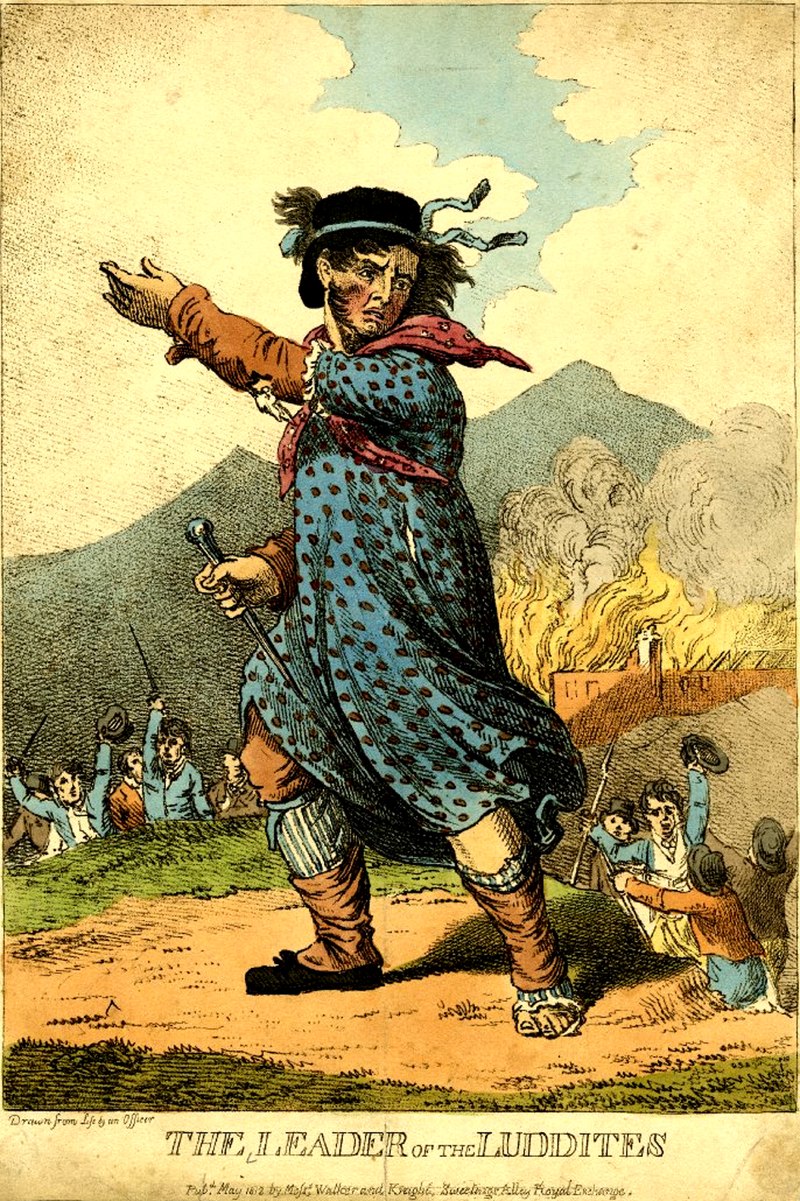
元祖ラッダイト
Classic Luddite
☆[古
典的]ラッダイトとは、19世紀のイギリスにおける繊維労働者の運動に参加した者たちのことだ。彼らは労働者の賃金や製品の品質に関する懸念から、特定の
自動機械の使用に反対した。組織的な襲撃で機械を破壊することも多かった。[1][2]
このグループのメンバーは自らをラッダイトと呼び、伝説的な織工「ネッド・ラッド」の追随者と称した。その名は工場主や政府高官への脅迫状における偽名と
して用いられた。[3]
ラッダイト運動はイングランドのノッティンガムで始まり、1811年から1816年にかけて北西部とヨークシャーに広がった。[4]
工場主らは抗議者を射殺する手段に訴え、最終的にこの運動は法的・軍事的手段によって鎮圧された。これにはラッダイトの容疑者や有罪判決を受けた者への死
刑執行や流刑が含まれていた。[5]
時を経て、この用語は新技術の導入に反対する者たちを指すために用いられるようになった。[6]
| The Luddites were
members of a 19th-century movement of English textile workers who
opposed the use of certain types of automated machinery due to concerns
relating to worker pay and output quality. They often destroyed the
machines in organised raids.[1][2] Members of the group referred to
themselves as Luddites, self-described followers of "Ned Ludd", a
legendary weaver whose name was used as a pseudonym in threatening
letters to mill owners and government officials.[3] The Luddite movement began in Nottingham, England, and spread to the North West and Yorkshire between 1811 and 1816.[4] Mill and factory owners took to shooting protesters and eventually the movement was suppressed by legal and military force, which included execution and penal transportation of accused and convicted Luddites.[5] Over time, the term has been used to refer to those opposed to the introduction of new technologies.[6] |
ラッダイトとは、19世紀のイギリスにおける繊維労働者の運動に参加し
た者たちのことだ。彼らは労働者の賃金や製品の品質に関する懸念から、特定の自動機械の使用に反対した。組織的な襲撃で機械を破壊することも多かった。
[1][2]
このグループのメンバーは自らをラッダイトと呼び、伝説的な織工「ネッド・ラッド」の追随者と称した。その名は工場主や政府高官への脅迫状における偽名と
して用いられた。[3] ラッダイト運動はイングランドのノッティンガムで始まり、1811年から1816年にかけて北西部とヨークシャーに広がった。[4] 工場主らは抗議者を射殺する手段に訴え、最終的にこの運動は法的・軍事的手段によって鎮圧された。これにはラッダイトの容疑者や有罪判決を受けた者への死 刑執行や流刑が含まれていた。[5] 時を経て、この用語は新技術の導入に反対する者たちを指すために用いられるようになった。[6] |
| Etymology The name Luddite (/ˈlʌdaɪt/) occurs in the movement's writings as early as 1811.[3] The movement utilised the eponym of Ned Ludd, an apocryphal apprentice who allegedly smashed two stocking frames in 1779 after being criticised and instructed to change his method. The name often appears as Captain, General, or King Ludd. Different versions of the legends place his residence in Anstey, near Leicester, or Sherwood Forest like Robin Hood.[7] |
語源 ラッド派(/ˈlʌdaɪt/)という名称は、1811年という早い時期に運動の文書に登場している。[3] この運動は、ネッド・ラッドという架空の見習工を名付け親とした。彼は1779年、批判され作業方法の変更を命じられた後、2台のストッキング編み機を破 壊したと伝えられる。この名称はしばしば「ラッド大尉」「ラッド将軍」「ラッド王」として現れる。伝説の異なる版本では、彼の居住地はレスター近郊のアン ステイ、あるいはロビン・フッドのようにシャーウッドの森とされている。[7] |
| History Historical precedents The machine-breaking of the Luddites followed from previous outbreaks of sabotage in the English textile industry, especially in the hosiery and woollen trades. Organised action by stockingers had occurred at various times since 1675.[8][9][10] In Lancashire, new cotton spinning technologies were met with violent resistance in 1768 and 1779. These new inventions produced textiles faster and cheaper because they could be operated by less-skilled, low-wage labourers.[11] These struggles sometimes resulted in government suppression, via Parliamentary acts such as the Protection of Stocking Frames, etc. Act 1788. Periodic uprisings relating to asset prices also occurred in other contexts in the century before Luddism. Irregular rises in food prices provoked the Keelmen to riot in the port of Tyne in 1710[12] and tin miners to steal from granaries at Falmouth in 1727.[a] There was a rebellion in Northumberland and Durham in 1740, and an assault on Quaker corn dealers in 1756. Malcolm L. Thomas argued in his 1970 history The Luddites that machine-breaking was one of the very few tactics that workers could use to increase pressure on employers, undermine lower-paid competing workers, and create solidarity among workers. "These attacks on machines did not imply any necessary hostility to machinery as such; machinery was just a conveniently exposed target against which an attack could be made."[10] Historian Eric Hobsbawm has called their machine wrecking "collective bargaining by riot", which had been a tactic used in Britain since the Restoration because manufactories were scattered throughout the country, and that made it impractical to hold large-scale strikes.[13][14] An agricultural variant of Luddism occurred during the widespread Swing Riots of 1830 in southern and eastern England, centring on breaking threshing machines.[15] |
歴史 歴史的先例 ラッダイト運動による機械破壊は、英国の繊維産業、特に靴下業と毛織物業における過去の破壊行為に端を発する。靴下職人の組織的行動は1675年以降、幾 度か発生していた[8][9][10]。ランカシャーでは1768年と1779年、新たな綿紡績技術に対し激しい抵抗が起きた。これらの新技術は、より低 技能で低賃金の労働者でも操作可能だったため、より速く、より安価に織物を生産できた。[11] こうした争いは時に政府の弾圧を招き、1788年の「靴下枠保護法」などの議会法によって制圧された。 ラッダイト運動以前の1世紀にも、資産価格に関連する定期的な暴動が他の文脈で発生していた。食料価格の不規則な高騰は、1710年にタイン港でキールマ ン(運搬人)の暴動を引き起こし[12]、1727年にはファルマスの錫鉱夫が穀物倉庫から盗みを働いた[a]。1740年にはノーサンバーランドとダラ ムで反乱が発生し、1756年にはクエーカー教徒の穀物商人への襲撃があった。 マルコム・L・トーマスは1970年の著書『ラッダイト』で、機械破壊は労働者が雇用主への圧力を強め、低賃金の競合労働者を弱体化させ、労働者間の連帯 を生み出すために用いられた数少ない戦術の一つだと論じた。「機械への攻撃は、機械そのものへの必然的な敵意を意味するものではない。機械は単に攻撃の標 的として都合よく露出していたに過ぎない」[10]。歴史家エリック・ホブズボームは、彼らの機械破壊を「暴動による団体交渉」と呼んだ。これは復古王政 期以来イギリスで用いられてきた戦術であり、製造工場が全国に分散していたため大規模ストライキの実施が現実的ではなかったためである[13]。[14] ラッド主義の農業版は、1830年にイングランド南部と東部で広範に発生したスウィング暴動の中で見られ、脱穀機の破壊を中心に行われた。[15] |
| Peak activity: 1811–1817 See also: Barthélemy Thimonnier § Sewing machine riot The Luddite movement emerged during the harsh economic climate of the Napoleonic Wars, which saw a rise in difficult working conditions in the new textile factories paired with decreasing birth rates and a rise in education standards in England and Wales.[16] Luddites objected primarily to the rising popularity of automated textile equipment, threatening the jobs and livelihoods of skilled workers as this technology allowed them to be replaced by cheaper and less skilled workers.[1][failed verification] The movement began in Arnold, Nottinghamshire, on 11 March 1811 and spread rapidly throughout England over the following two years.[17][1] The British economy suffered greatly in 1810 to 1812, especially in terms of high unemployment and inflation. The causes included the high cost of the wars with Napoleon, Napoleon's Continental System of economic warfare, and escalating conflict with the United States. The crisis led to widespread protest and violence, but the middle classes and upper classes strongly supported the government, which used the army to suppress all working-class unrest, especially the Luddite movement.[18][19] The Luddites met at night on the moors surrounding industrial towns to practise military-like drills and manoeuvres. Their main areas of operation began in Nottinghamshire in November 1811, followed by the West Riding of Yorkshire in early 1812, and then Lancashire by March 1813. They wrecked specific types of machinery that posed a threat to the particular industrial interests in each region. In the Midlands, these were the "wide" knitting frames used to make cheap and inferior lace articles.[20] In the North West, weavers sought to eliminate the steam-powered looms threatening wages in the cotton trade. In Yorkshire, workers opposed the use of shearing frames and gig mills to finish woollen cloth.[21] Many Luddite groups were highly organised and pursued machine-breaking as one of several tools for achieving specific political ends. In addition to the raids, Luddites coordinated public demonstrations and the mailing of letters to local industrialists and government officials.[22] These letters explained their reasons for destroying the machinery and threatened further action if the use of "obnoxious" machines continued.[23] The writings of Midlands Luddites often justified their demands through the legitimacy of the Company of Framework Knitters, a recognised public body that already openly negotiated with masters through named representatives. In North West England, textile workers lacked these long-standing trade institutions and their letters composed an attempt to achieve recognition as a united body of tradespeople. As such, they were more likely to include petitions for governmental reforms, such as increased minimum wages and the cessation of child labor. Northwestern Luddites were also more likely to use radical language linking their movement to that of American and French revolutionaries. In Yorkshire, the letter-writing campaign shifted to more violent threats against local authorities viewed as complicit in the use of offensive machinery to exert greater commercial control over the labour market. In Yorkshire, the croppers (highly skilled workers who trimmed the nap from fabric to produce smooth, finished cloth) faced mass unemployment due to the introduction of cropping machines by Enoch Taylor of Marsden.[24] This sparked the Luddite movement among the croppers of Yorkshire, who used a hammer dubbed "Enoch" to break the frames of the cropping machines. They called it Enoch to mock Enoch Taylor, and when they broke the frames they purportedly shouted "Enoch made them, and Enoch shall break them."[25] Luddites clashed with government troops at Burton's Mill in Middleton and at Westhoughton Mill, both in Lancashire.[26] The Luddites and their supporters anonymously sent death threats to, and possibly attacked, magistrates and food merchants. Activists smashed Heathcote's lace making machine in Loughborough in 1816.[27] He and other industrialists had secret chambers constructed in their buildings that could be used as hiding places during an attack.[28] In 1817 Jeremiah Brandreth, an unemployed Nottingham stockinger and probable ex-Luddite, led the Pentrich Rising. While this was a general uprising unrelated to machinery, it can be viewed as the last major Luddite act.[29] |
活動ピーク:1811年–1817年 関連項目:バルテルミー・ティモニエ § ミシン暴動 ラッダイト運動は、ナポレオン戦争下の厳しい経済状況の中で発生した。当時、イングランドとウェールズでは、新たな紡績工場での労働条件が悪化する一方 で、出生率が低下し、教育水準が上昇していた。[16] ラッダイト派が主に反対したのは、自動化された紡績機械の普及だった。この技術により熟練労働者が安価で技能の低い労働者に置き換えられるため、彼らの職 と生計が脅かされたのである。[1][検証失敗] この運動は1811年3月11日にノッティンガムシャー州アーノルドで始まり、その後2年間でイングランド全土に急速に広がった。[17] 1810年から1812年にかけて英国経済は苦悩した。特に失業率の高騰とインフレが顕著であった。原因にはナポレオン戦争の高額な軍事費、ナポレオンの 大陸封鎖令による経済的圧迫、米国との対立激化などが挙げられる。この危機は広範な抗議活動と暴動を招いたが、中産階級と上流階級は政府を強く支持した。 政府は軍隊を用いて労働者階級の動乱、特にラッダイト運動を鎮圧した。[18][19] ラッダイト派は工業都市周辺の荒野で夜間に集まり、軍事訓練のような演習や作戦行動を行った。彼らの主な活動地域は1811年11月にノッティンガム シャーで始まり、1812年初頭にはヨークシャー州西地区、1813年3月までにランカシャーへと広がった。彼らは各地域の特定産業利益を脅かす機械を破 壊した。中部地方では安価で粗悪なレース製品を生産する「ワイド」編み機が標的となった[20]。北西部では綿織物業の賃金を脅かす蒸気動力織機を織工た ちが排除しようとした。ヨークシャーでは羊毛織物の仕上げに用いられる剪毛機やギグミルに労働者が反対した。[21] 多くのラッダイト集団は高度に組織化され、特定の政治的目的達成のための手段の一つとして機械破壊を追求した。襲撃に加え、ラッダイトは公のデモや地元産 業家・政府高官への書簡送付を調整した。[22] これらの書簡では機械破壊の理由を説明し、「忌まわしい」機械の使用が続けばさらなる行動を取ると脅した。[23] ミッドランド地方のラッダイト派の文書は、公認の団体である枠編み職人の組合(Company of Framework Knitters)の正当性を根拠に要求を正当化することが多かった。この組合は既に指名された代表者を通じて雇用主と公然と交渉していた。一方、北西イ ングランドの繊維労働者にはこうした伝統的な労働組合組織がなく、彼らの書簡は職人の統一組織としての承認を得る試みであった。そのため、最低賃金の引き 上げや児童労働の廃止といった政府改革を求める請願を盛り込む傾向が強かった。北西部のラッダイトは、自らの運動をアメリカやフランスの革命家たちに関連 付ける過激な表現を用いる傾向も強かった。ヨークシャーでは、労働市場に対する商業的支配を強化するために攻撃的な機械の使用に加担していると見なされた 地方当局に対する脅迫が、書簡運動の中でより暴力的なものへと移行した。 ヨークシャーでは、マルズデンのイーノック・テイラーによる刈り取り機の導入により、クロッパー(布地の起毛を刈り取って滑らかな仕上がりにする高度な技 能を持つ労働者)が大量失業に直面した。[24] これがヨークシャーのクロッパーたちによるラッダイト運動の引き金となった。彼らは「イーノック」と名付けたハンマーでクロッピングマシンのフレームを破 壊した。イーノック・テイラーを嘲笑うためにこの名をつけ、フレームを破壊する際には「イーノックが作ったものを、イーノックが壊す」と叫んだと言われ る。[25] ラッダイト派はランカシャー州ミドルトンのバートン工場とウェストホートン工場で政府軍と衝突した。[26] ラッダイト派とその支持者は治安判事や食料商人に対し匿名で殺害予告を送付し、おそらく襲撃も行った。活動家たちは1816年にラフバラでヒースコートの レース製造機を破壊した。[27] 彼や他の実業家たちは、攻撃時の隠れ場所として使える秘密の部屋を建物内に造らせた。[28] 1817年、ノッティンガムの失業したストッキング職人であり、おそらく元ラッダイトだったジェレマイア・ブランドレスがペントリッチ蜂起を主導した。こ れは機械とは無関係な一般的な反乱だったが、最後の主要なラッダイトの行動と見なせる。[29] |
| Government response 12,000 government troops, most of them belonging to militia or yeomanry units, were involved in suppression of Luddite activity, which historian Eric Hobsbawm wrote was a larger number than the army that the Duke of Wellington led into Portugal in 1808 during the Peninsular War.[30][b] Four Luddites, led by a man named George Mellor, ambushed and assassinated mill owner William Horsfall of Ottiwells Mill in Marsden, West Yorkshire, at Crosland Moor in Huddersfield. Horsfall had remarked that he would "Ride up to his saddle in Luddite blood".[31] Mellor fired the fatal shot to Horsfall's groin, and all four men were arrested. One of the men, Benjamin Walker, turned informant, and the other three were hanged.[32][33][34] Lord Byron denounced what he considered to be the plight of the working class, the government's inane policies and ruthless repression in the House of Lords on 27 February 1812: I have been in some of the most oppressed provinces of Turkey; but never, under the most despotic of infidel governments, did I behold such squalid wretchedness as I have seen since my return, in the very heart of a Christian country.[35] Government officials sought to suppress the Luddite movement with a mass trial at York in January 1813, following the attack on Cartwrights Mill at Rawfolds near Cleckheaton. The government charged over 60 men, including Mellor and his companions, with various crimes in connection with Luddite activities. While some of those charged were actual Luddites, many had no connection to the movement. Although the proceedings were legitimate jury trials, many were abandoned due to lack of evidence and 30 men were acquitted. These trials were intended to act as show trials to deter other Luddites from continuing their activities. The harsh sentences of those found guilty, which included execution and penal transportation, quickly ended the movement.[5][36] Parliament made "machine breaking" (i.e. industrial sabotage) a capital crime with the Destruction of Stocking Frames, etc. Act 1812.[37] Lord Byron opposed this legislation, becoming one of the few prominent defenders of the Luddites after the treatment of the defendants at the York trials.[38] |
政府の対応 12,000人の政府軍兵士がラッド派活動の鎮圧に関与した。その大半は民兵や義勇騎兵部隊に所属していた。歴史家エリック・ホブズボームによれば、この 兵力は1808年の半島戦争時にウェリントン公がポルトガルに派遣した軍隊よりも多かった。[30][b] ジョージ・メラー率いる4人のラッダイトが、ウェスト・ヨークシャー州マーズデンのオティウェルズ製粉所所有者ウィリアム・ホースフォールをハダース フィールドのクロスランド・ムーアで待ち伏せし暗殺した。ホースフォールは「ラッダイトの血で鞍まで浸るほど乗り回す」と発言していた。[31] メラーがホースフォールの股間へ致命傷を与える一撃を放ち、4人全員が逮捕された。うちベンジャミン・ウォーカーは密告者となり、残る3名は絞首刑に処さ れた。[32][33][34]バイロン卿は1812年2月27日、貴族院において労働者階級の窮状、政府の愚かな政策、そして非情な弾圧を非難した: 私はトルコで最も抑圧された地方を幾度となく見てきた。だが、最も専制的な異教徒の政府のもとでさえ、帰国後このキリスト教国の中心部で目にしたような、 このみすぼらしく惨めな光景は見たことがない。[35] 政府当局は、クレックヒートン近郊ローフォールズのカートライト工場襲撃事件を受け、1813年1月にヨークで大規模裁判を開きラッド運動の弾圧を図っ た。政府はメラーとその仲間を含む60人以上の男たちを、ラッド活動に関連する様々な罪で起訴した。起訴された者の中には実際のラッド活動家もいたが、多 くは運動とは無関係だった。裁判は正当な陪審裁判であったが、証拠不十分で多くの訴追が取り下げられ、30名が無罪となった。これらの裁判は見せしめとし て他のラッダイトを活動継続から抑止する意図があった。有罪判決を受けた者への死刑や流刑を含む厳しい刑罰が、運動を急速に終息させた。[5][36] 議会は1812年『ストッキングフレーム破壊等防止法』により「機械破壊」(すなわち産業妨害)を死刑対象犯罪とした。[37] バイロン卿はこの立法に反対し、ヨーク裁判における被告人への扱いを契機に、ラッド派を擁護する数少ない著名人となった。[38] |
| Legacy The Luddites (specifically the croppers, those who operated cropping machinery) are memorialised in the Yorkshire-area folk song "The Cropper Lads", which has been recorded by artists including Lou Killen and Maddy Prior.[39] The croppers were very highly skilled and highly paid before the introduction of cropping machinery, and thus had more to lose and more reason to rebel against the factory owners' use of machinery. Another traditional song which celebrates the Luddites is the song "The Triumph of General Ludd", which was recorded by Chumbawamba for their 1988 album English Rebel Songs.[40] In the 19th century, occupations that arose from the growth of trade and shipping in ports, also as "domestic" manufacturers, were notorious for precarious employment prospects. Underemployment was chronic during this period,[41] and it was common practice to retain a larger workforce than was typically necessary for insurance against labour shortages in boom times.[41] Moreover, the organisation of manufacture by merchant capitalists in the textile industry was inherently unstable. While the financiers' capital was still largely invested in raw materials, it was easy to increase commitment when trade was good and almost as easy to cut back when times were bad. Merchant capitalists lacked the incentive of later factory owners, whose capital was invested in buildings and plants, to maintain a steady rate of production and return on fixed capital. The combination of seasonal variations in wage rates and violent short-term fluctuations springing from harvests and war produced periodic outbreaks of violence.[41] |
レガシー ラッダイト(特に刈り取り機械を操作する刈り取り人)は、ヨークシャー地方の民謡「刈り取り人たちの歌」で記念されている。この曲はルー・キレンやマ ディ・プライアらによって録音されている。[39] 刈り取り人は機械導入前は高度な技能を持ち高給を得ていたため、工場主による機械使用に対して反発する理由と失うものがより大きかった。ラッダイトを称え る別の伝統的歌謡は「ラッド将軍の凱旋」であり、チャンバワンバが1988年のアルバム『イングリッシュ・レベル・ソングス』で録音した[40]。 19世紀、港湾における貿易・海運の発展から生まれた職業、また「国内」製造業者は、不安定な雇用見通しで悪名高かった。この時代、不完全雇用は慢性化し ていた[41]。好況時の労働力不足に備え、通常必要以上の労働力を確保しておくのが一般的な慣行だった[41]。 さらに、繊維産業における商人資本家による製造組織は本質的に不安定だった。金融業者の資本は依然として主に原材料に投資されていたため、貿易が好調な時 は投資を拡大しやすく、不況時にはほぼ同様に簡単に縮小できた。商人資本家には、建物や設備に資本を投下する後の工場所有者たちのような、安定した生産率 と固定資本の収益率を維持する動機が欠けていた。賃金率の季節的変動と、収穫や戦争に起因する激しい短期変動が相まって、定期的に暴動が発生したのである [41]。 |
| Modern usage Nowadays, the term "Luddite" often is used to describe someone who is opposed or resistant to new technologies.[42] In 1956, during a British Parliamentary debate, a Labour spokesman said that "organised workers were by no means wedded to a 'Luddite Philosophy'."[43] By 2006, the term neo-Luddism had emerged to describe opposition to many forms of technology.[44] According to a manifesto drawn up by the Second Luddite Congress (April 1996; Barnesville, Ohio), neo-Luddism is "a leaderless movement of passive resistance to consumerism and the increasingly bizarre and frightening technologies of the Computer Age".[45] The term "Luddite fallacy" is used by economists about the fear that technological unemployment inevitably generates structural unemployment and is consequently macroeconomically injurious. If a technological innovation reduces necessary labour inputs in a given sector, then the industry-wide cost of production falls, which lowers the competitive price and increases the equilibrium supply point that, theoretically, will require an increase in aggregate labour inputs.[46] During the 20th century and the first decade of the 21st century, the dominant view among economists has been that belief in long-term technological unemployment was indeed a fallacy. More recently, there has been increased support for the view that the benefits of automation are not equally distributed.[47][48][49] |
現代的な用法 今日では、「ラッダイト」という言葉は、新しい技術に反対したり抵抗したりする人を指すことが多い。[42] 1956年、英国議会の討論で、労働党のスポークスマンは「組織化された労働者たちは決して『ラッダイト思想』に固執しているわけではない」と述べた。 [43] 2006年までに、多くの技術形態への反対を表現する「ネオ・ラッダイト主義」という用語が出現した。[44] 第二ラッダイト会議(1996年4月、オハイオ州バーンズビル)が作成した宣言書によれば、ネオ・ラッダイト主義とは「消費主義と、コンピューター時代の ますます奇妙で恐ろしい技術に対する、指導者なき受動的抵抗運動」である。[45] 「ラッダイトの誤謬」という用語は、技術的失業が必然的に構造的失業を生み出し、結果としてマクロ経済的に有害であるという懸念について、経済学者が用い るものである。ある技術革新が特定の部門で必要な労働投入量を減少させる場合、業界全体の生産コストは低下し、競争価格は下落する。これにより均衡供給点 は上昇し、理論的には総労働投入量の増加が必要となる。[46] 20世紀から21世紀初頭にかけて、経済学者の主流の見解は、長期的な技術的失業を信じることは確かに誤りだというものだった。近年では、自動化の恩恵が 均等に分配されていないという見解への支持が高まっている。[47][48][49] |
| Postdevelopment theory Ted Kaczynski Ruddington Framework Knitters' Museum – features a Luddite gallery Simple living Swing Riots Technophobia Turner Controversy – return to pre-industrial methods of production |
ポスト開発理論 テッド・カジンスキー ラディントン・フレームワーク・ニッターズ博物館 – ラッダイトのギャラリーがある 質素な生活 スイング暴動 テクノフォビア ターナー論争 – 産業革命以前の生産方法への回帰 |
| Explanatory notes a. The Falmouth magistrates reported to the Duke of Newcastle (16 November 1727) that "the unruly tinners" had "broke open and plundered several cellars and granaries of corn." Their report concludes with a comment which suggests that they were not able to understand the rationale of the direct action of the tinners: "The occasion of these outrages was pretended by the rioters to be a scarcity of corn in the county, but this suggestion is probably false, as most of those who carried off the corn gave it away or sold it at a quarter price." PRO, SP 36/4/22. b. Hobsbawm has popularised this comparison and refers to the original statement in Frank Ongley Darvall (1934) Popular Disturbances and Public Order in Regency England, London, Oxford University Press, p. 260. |
注釈 a. ファルマス治安判事はニューカッスル公爵(1727年11月16日)に対し、「無法な錫鉱夫どもが」複数の「貯蔵庫や穀物倉庫を破壊し略奪した」と報告し た。報告書は、鉱夫たちの直接行動の理由を理解できなかったことを示唆するコメントで締めくくられている。「暴徒らはこれらの暴挙の理由を郡内の穀物不足 と主張したが、この主張はおそらく虚偽である。穀物を奪った者の大半はそれを無償で配布するか、四分の一の価格で売却したからである」。PRO, SP 36/4/22。 b. ホブズボームはこの比較を広く知らしめ、原典はフランク・オンリー・ダーヴァル(1934)『リージェンシー期イングランドにおける民衆騒乱と公共秩序』 (ロンドン、オックスフォード大学出版局)260頁を参照している。 |
| References |
|
| Sources Ford, Martin R. (2009), The Lights in the Tunnel: Automation, Accelerating Technology and the Economy of the Future, Acculant Publishing, ISBN 978-1448659814. Hobsbawm, E. J. (1952). "The Machine Breakers". Past & Present (1): 57–70. doi:10.1093/past/1.1.57. Archived from the original on 13 April 2021. Retrieved 19 September 2012. Jones, Steven E. (2006). Against technology: from the Luddites to Neo-Luddism. CRC Press. ISBN 978-0-415-97868-2. Sale, Kirkpatrick (1995). Rebels against the future: the Luddites and their war on the Industrial Revolution: lessons for the computer age. Basic Books. ISBN 0-201-40718-3. |
出典 フォード、マーティン R. (2009)、『トンネルの明かり:自動化、技術の加速、そして未来の経済』、Acculant Publishing、ISBN 978-1448659814。 ホブズボーム、E. J. (1952). 「機械破壊者たち」. Past & Present (1): 57–70. doi:10.1093/past/1.1.57. 2021年4月13日にオリジナルからアーカイブ。2012年9月19日取得。 ジョーンズ、スティーブン E. (2006). 技術への反逆:ラッダイトからネオ・ラッダイズムまで。CRCプレス。ISBN 978-0-415-97868-2。 セール、カークパトリック(1995)。未来への反逆者たち:ラッダイトと産業革命への戦い:コンピュータ時代への教訓。ベーシック・ブックス。ISBN 0-201-40718-3。 |
| Further reading Anderson, Gary M.; Tollison, Robert D. (1986). "Luddism as cartel enforcement". Journal of Institutional and Theoretical Economics (JITE)/Zeitschrift für die gesamte Staatswissenschaft. 142 (4): 727–738. JSTOR 40750927. Archer, John E. (2000). "Chapter 4: Industrial Protest". Social unrest and popular protest in England, 1780–1840. Cambridge University Press. ISBN 978-0-521-57656-7. Bailey, Brian J. (1998). The Luddite Rebellion. NYU Press. ISBN 0-8147-1335-1. Darvall, F. (1934). Popular Disturbances and Public Order in Regency England. Oxford University Press. Dinwiddy, John (1979). "Luddism and politics in the northern counties". Social History. 4 (1): 33–63. doi:10.1080/03071027908567438. Fox, Nicols (2003). Against the Machine: The Hidden Luddite History in Literature, Art, and Individual Lives. Island Press. ISBN 1-55963-860-5. Grint, Keith; Woolgar, Steve (1997). "The Luddites: Diablo ex Machina". The machine at work: technology, work, and organization. Wiley-Blackwell. ISBN 978-0-7456-0924-9. Haywood, Ian (2006). "Unruly People: The Spectacular Riot". Bloody Romanticism. London: Palgrave Macmillan. pp. 181–222. Horn, Jeff (2015). "Machine-Breaking and the 'Threat from Below' in Great Britain and France during the Early Industrial Revolution". Crowd actions in Britain and France from the middle ages to the modern world. London: Palgrave Macmillan. pp. 165–178. Linebaugh, Peter (2012). Ned Ludd & Queen Mab: machine-breaking, romanticism, and the several commons of 1811–12. PM Press. Linton, David (1992). "The Luddites: How did they get that bad reputation?". Labor History. 33 (4): 529–537. doi:10.1080/00236569200890281. McGaughey, Ewan (2022). "Will Robots Automate Your Job Away? Full Employment, Basic Income, and Economic Democracy". Industrial Law Journal. 51 (3): 511–559. doi:10.1093/indlaw/dwab010. PMC 8344681. SSRN 3044448. Merchant, Brian (2023). Blood in the Machine. Little, Brown and Company. ISBN 9780316487740. Munger, Frank (1981). "Suppression of Popular Gatherings in England, 1800–1830". American Journal of Legal History. 25 (2): 111–140. doi:10.2307/844630. JSTOR 844630. Archived from the original on 28 April 2019. Navickas, Katrina (2005). "The search for 'general Ludd': The mythology of Luddism". Social History. 30 (3): 281–295. doi:10.1080/03071020500185406. O'Rourke, Kevin Hjortshøj; Rahman, Ahmed S.; Taylor, Alan M. (2013). "Luddites, the industrial revolution, and the demographic transition". Journal of Economic Growth. 18 (4): 373–409. doi:10.1007/s10887-013-9096-y. JSTOR 42635331. Pallas, Stephen J. (2018). "'The Hell that Bigots Frame': Queen Mab, Luddism, and the Rhetoric of Working-Class Revolution". Journal for the Study of Radicalism. 12 (2): 55–80. doi:10.14321/jstudradi.12.2.0055. JSTOR 10.14321/jstudradi.12.2.0055. Patterson, A. Temple (April 1948). "Luddism, Hampden Clubs, and Trade Unions in Leicestershire, 1816–17". English Historical Review. 63 (247): 170–188. doi:10.1093/ehr/LXIII.CCXLVII.170. JSTOR 556364. Poitras, Geoffrey (2020). "The Luddite trials: Radical suppression and the administration of criminal justice" (PDF). Journal for the Study of Radicalism. 14 (1): 121–166. doi:10.14321/jstudradi.14.1.0121. JSTOR 10.14321/jstudradi.14.1.0121. Archived (PDF) from the original on 21 May 2022. Pynchon, Thomas (28 October 1984). "Is It O.K. to Be a Luddite?". The New York Times. Archived from the original on 29 March 2021. Retrieved 19 November 2019. Randall, Adrian (2002). Before the Luddites: Custom, Community and Machinery in the English Woollen Industry, 1776–1809. Cambridge University Press. ISBN 978-0-521-89334-3. Rude, George (2005). "Chapter 5, Luddism". The crowd in History, 1730–1848. Serif. ISBN 978-1-897959-47-3. Stöllinger, Roman (November 2018). "The Luddite rebellion: Past and present" (PDF). wiiw Monthly Report. The Vienna Institute for International Economic Studies. pp. 6–11. Archived (PDF) from the original on 19 December 2022. Thomis, Malcolm I. (1970). The Luddites: Machine-Breaking in Regency England. Archon Books. Thompson, E. P. (1968). The Making of the English Working Class. Penguin. ISBN 0140210008. Wasserstrom, Jeffrey (1987). "'Civilization' and Its Discontents: The Boxers and Luddites as Heroes and Villains". Theory and Society: 675–707. JSTOR 657679. Primary sources Binfield, Kevin (2004). Writings of the Luddites. JHU Press. ISBN 0-8018-7612-5. |
追加文献(さらに読む) アンダーソン、ゲイリー・M.、トリソン、ロバート・D. (1986). 「カルテル執行としてのラッダイト運動」. Journal of Institutional and Theoretical Economics (JITE)/Zeitschrift für die gesamte Staatswissenschaft. 142 (4): 727–738. JSTOR 40750927. アーチャー、ジョン E. (2000). 「第 4 章:産業抗議」. イングランドにおける社会不安と大衆抗議、1780–1840. ケンブリッジ大学出版局. ISBN 978-0-521-57656-7. ベイリー、ブライアン・J.(1998)。『ラッダイトの反乱』NYUプレス。ISBN 0-8147-1335-1。 ダーヴァル、F.(1934)。『摂政期イングランドにおける民衆騒乱と公衆秩序』オックスフォード大学出版局。 ディンウィディ、ジョン(1979)。「北部諸州におけるラッダイト運動と政治」 社会史。4 (1): 33–63. doi:10.1080/03071027908567438. フォックス、ニコルズ(2003)。『機械への抵抗:文学、芸術、個人の生活に隠されたラッダイトの歴史』。アイランド・プレス。ISBN 1-55963-860-5。 グリント、キース;ウールガー、スティーブ(1997)。「ラッダイト:機械仕掛けの悪魔」。『働く機械:技術、労働、組織』。ワイリー・ブラックウェ ル。ISBN 978-0-7456-0924-9。 ヘイウッド、イアン(2006)。「手に負えない人々:壮大な暴動」。血塗られたロマン主義。ロンドン:パルグレイブ・マクミラン。pp. 181–222. ホーン、ジェフ (2015). 「機械破壊と初期産業革命期の英国・フランスにおける『下からの脅威』」. 中世から現代世界までの英国・フランスにおける群衆行動. ロンドン:パルグレイブ・マクミラン. pp. 165–178. ラインボー、ピーター(2012)。『ネッド・ラッドと女王マブ:機械破壊、ロマン主義、そして1811-12年の幾つかのコモンズ』。PMプレス。 リントン、デイヴィッド(1992)。「ラッダイトたち:彼らはどうして悪評を得たのか?」。『労働史』。33巻4号:529-537頁。doi: 10.1080/00236569200890281. マクゴーヒー、ユアン(2022)。「ロボットはあなたの仕事を自動化して奪うのか? 完全雇用、ベーシックインカム、経済民主主義」。『産業法ジャーナル』。51巻3号:511–559頁。doi: 10.1093/indlaw/dwab010. PMC 8344681. SSRN 3044448. マーチャント、ブライアン(2023)。『機械の中の血』。リトル・ブラウン・アンド・カンパニー。ISBN 9780316487740。 マンガー、フランク(1981)。「イングランドにおける民衆集会の弾圧、1800–1830年」。『アメリカ法律史ジャーナル』。25巻2号: 111–140頁。doi:10.2307/844630。JSTOR 844630。2019年4月28日にオリジナルからアーカイブされた。 ナヴィカス、カトリーナ(2005)。「『ラッド将軍』の探求:ラッド主義の神話」。『社会史』30巻3号:281–295頁。doi: 10.1080/03071020500185406。 オローク、ケヴィン・ヨートショイ;ラーマン、アーメド・S.;テイラー、アラン・M.(2013)。「ラッダイト、産業革命、そして人口転換」。『経済 成長ジャーナル』。18巻4号:373–409頁。doi:10.1007/s10887-013-9096-y。JSTOR 42635331. パラス、スティーブン・J. (2018). 「偏狭な者たちが描く地獄:『女王マブ』、ラッダイト運動、そして労働者階級革命のレトリック」. Journal for the Study of Radicalism. 12 (2): 55–80. doi:10.14321/jstudradi.12.2.0055. JSTOR 10.14321/jstudradi.12.2.0055. Patterson, A. Temple (1948年4月). 「1816-17年レスターシャーにおけるラッダイト運動、ハムデン・クラブ、労働組合」. 英国の歴史的回顧。63 (247): 170–188. doi:10.1093/ehr/LXIII.CCXLVII.170. JSTOR 556364. ポワトラス、ジェフリー (2020). 「ラッダイト裁判:急進的な弾圧と刑事司法の執行」 (PDF). 急進主義研究ジャーナル。14 (1): 121–166. doi:10.14321/jstudradi.14.1.0121. JSTOR 10.14321/jstudradi.14.1.0121. 2022年5月21日にオリジナルからアーカイブされた (PDF)。 ピンチョン、トーマス(1984年10月28日)。「ラッダイトであることは許されるか?」。『ニューヨーク・タイムズ』。2021年3月29日にオリジ ナルからアーカイブ。2019年11月19日に取得。 ランドール、エイドリアン(2002)。『ラッダイト以前:1776-1809年イギリス毛織物産業における慣習、共同体、機械』ケンブリッジ大学出版 局。ISBN 978-0-521-89334-3。 ルード、ジョージ(2005年)。「第5章 ラッダイト運動」『歴史の中の群衆 1730-1848』セリフ社。ISBN 978-1-897959-47-3。 シュテリンガー、ローマン(2018年11月)。「ラッダイトの反乱:過去と現在」 (PDF)。wiiw月次報告書。ウィーン国際経済研究所。pp. 6–11。2022年12月19日にオリジナルからアーカイブ(PDF)。 トミス、マルコム・I.(1970年)。『ラッダイト:摂政時代のイングランドにおける機械破壊運動』。アーコン・ブックス。 トンプソン、E. P.(1968年)。『イングランド労働者階級の形成』。ペンギン。ISBN 0140210008。 ワッサーストロム、ジェフリー(1987年)。「『文明』とその不満:英雄と悪役としての義和団とラッダイト」『理論と社会』: 675–707. JSTOR 657679. 一次資料 ビンフィールド、ケヴィン(2004)。『ラッダイトの著作集』。JHUプレス。ISBN 0-8018-7612-5。 |
| https://en.wikipedia.org/wiki/Luddite |
★
Rage
Against The Machine - No Shelter (from The Battle Of Mexico City)
リ ンク
文 献
そ の他の情報
CC
Copyleft,
CC, Mitzub'ixi Quq Chi'j, 1996-2099