
セバスティアン・カステリオン
Sebastian Castellio,
1515-1563
☆セ
バスティアン・カステリオン[Sebastian
Castellio](別名セバスチャン・シャテイヨン、シャタイヨン、カステリオン、カステッロ;1515年 -
1563年12月29日)は、フランスの説教者であり神学者である。宗教的寛容、良心の自由、思想の自由を提唱した改革派キリスト教徒の先駆者の一人で
あった。
| Sebastian
Castellio (also Sébastien Châteillon, Châtaillon, Castellión, and
Castello; 1515 – 29 December 1563) was a French preacher and
theologian; and one of the first Reformed Christian proponents of
religious toleration, freedom of conscience and thought. |
セバスティアン・カステリオン[Sebastian
Castellio](別名セバスチャン・シャテイヨン、シャタイヨン、カステリオン、カステッロ;1515年 -
1563年12月29日)は、フランスの説教者であり神学者である。宗教的寛容、良心の自由、思想の自由を提唱した改革派キリスト教徒の先駆者の一人で
あった。 |
| Introduction Castellio was born in 1515 in the village of Saint-Martin-du-Frêne. Having been educated at the age of twenty at the University of Lyon, Castellio became an expert in Latin, Hebrew and Greek.[1] Two hundred years later, Voltaire wrote: "We can measure the virulence of this tyranny by the persecution to which Castellio was exposed at Calvin's instance — although Castellio was a far greater scholar than Calvin, whose jealousy drove him out of Geneva."[2][3][4][5] Castellio later wrote that he was deeply affected and moved when he saw the burning of heretics in Lyon by the French Inquisition,[6] and at the age of twenty-four he decided to subscribe to the teachings of the Reformation. In the spring of 1540, after witnessing the killings of the early Protestant martyrs, he left Lyon and became a missionary for Protestantism.[6] |
はじめに カステリオーは1515年、サン・マルタン・デュ・フレーヌの村で生まれた。20歳でリヨン大学にて教育を受けたカステリオーは、ラテン語、ヘブライ語、 ギリシャ語の専門家となった。[1] 200年後、ヴォルテールはこう記している。「この専制政治の苛烈さは、カルヴァンの指示によってカステリョが受けた迫害から測ることができる。カステ リョはカルヴァンよりもはるかに優れた学者であったにもかかわらず、カルヴァンの嫉妬によってジュネーブから追放されたのだ」[2][3][4][5] カステリオーは後に、リヨンでフランス異端審問によって異端者たちが火あぶりにされるのを見て、深い衝撃と感動を受けたと記している[6]。そして24歳 のときに、宗教改革の教えを信奉することを決心した。1540年の春、初期のプロテスタントの殉教者たちが殺害されるのを目撃した後、彼はリヨンを離れ、 プロテスタントの宣教師となった[6]。 |
| Early career In 1543, after the plague struck Geneva, Sebastian Castellio was one of the only divines in Geneva to visit the sick and console the dying. Though Calvin himself did visit the sick, others among the Genevan ministers did not.[7] For his outstanding work, the Geneva City Council recommended Castellio's permanent appointment as preacher in Vandoeuvres; however, in 1544, a campaign against him was initiated by Calvin. At the time, Castellio decided to translate the Bible into his native French, and was very excited to ask for an endorsement from his friend Calvin, but Calvin's endorsement was already given to his cousin Pierre Olivetan's French translation of the Bible, so Castellio was rebuked and turned down. Calvin wrote to a friend regarding the matter: "Just listen to Sebastian's preposterous scheme, which makes me smile, and at the same time angers me. Three days ago he called on me, to ask permission for the publication of his translation of the New Testament."[8] Castellio and Calvin's disagreements grew even wider when, during a public meeting, Castellio rose to his feet and claimed that clergy should stop persecuting those who disagree with them on matters of Biblical interpretation, and should be held to the same standards that all other believers were held to. Soon after, Calvin charged Castellio with the offence of "undermining the prestige of the clergy". Castellio was forced to resign from his position of Rector and asked to be dismissed from being a preacher in Vandoeuvres. Anticipating future attacks from Calvin, Castellio asked for a signed letter that outlined in detail the reasons for his departure: "That no one may form a false idea of the reasons for the departure of Sebastian Castellio, we all declare that he has voluntarily resigned his position as rector at the College, and up till now performed his duties in such a way that we regarded him worthy to become one of our preachers. If, in the end, the affair was not thus arranged, this is not because any fault has been found in Castellio's conduct, but merely for the reasons previously indicated."[9] |
初期の経歴 1543年、ジュネーブにペストが流行した際、セバスティアン・カステリョはジュネーブで病人を訪ね、死にゆく者を慰めた数少ない神学者の一人であった。 カルヴァン自身は病人を訪ねたが、ジュネーブの他の牧師たちはそうしなかった。[7] この顕著な功績により、ジュネーブ市議会はカステリョをヴァンドゥーヴル地区の常任説教者に任命するよう推薦した。しかし1544年、カルヴァンが彼に対 する弾圧運動を開始した。当時カステリョは聖書を母国語であるフランス語に翻訳することを決意し、友人であるカルヴァンに推薦を求めて非常に興奮してい た。しかしカルヴァンの推薦は既に従兄弟のピエール・オリヴェタンのフランス語訳聖書に与えられており、カステリョは叱責され断られた。カルヴァンはこの 件について友人にこう書いている。「セバスティアンの途方もない計画を聞け。それは私を笑わせると同時に怒らせるものだ。三日前、彼は私のところに来て、 新約聖書翻訳の出版許可を求めてきたのだ。」[8] カステリョとカルヴァンの対立は、公の集会でカステリョが立ち上がり、聖書解釈の問題で意見の異なる者を迫害するのを聖職者は止めるべきだと主張し、聖職 者も他の信者と同じ基準で扱われるべきだと訴えたことで、さらに深まった。間もなくカルヴァンはカステリョを「聖職者の威信を損なう」罪で告発した。カス テリョは学長職を辞任させられ、ヴァンドゥーヴルでの説教者職からの解任を求められた。カルヴァンからの今後の攻撃を予期し、カステリョは自身の離職理由 を詳細に記した署名入りの文書を要求した: 「セバスティアン・カステリョの離職理由について誤った見解が生じぬよう、我々はここに宣言する。彼は自ら進んでカレッジの学長職を辞任した。またこれま で、我々が彼を説教者としての資格を有すると認めるに足る職務遂行を示してきた。最終的にこの件がこのように決着したとしても、それはカステリョの行動に 何らかの過失が認められたためではなく、単に先に示した理由によるものである」 [9] |
| Years of poverty The man who once was the Rector in Geneva was now homeless and in deep poverty. The next few years were desperate times for him. Though one of the most learned men of his time, his life came down to begging for food from door to door. Living in abject poverty with his eight dependents, Castellio was forced to depend on strangers to stay alive. His plight brought sympathy and admiration from his contemporaries. Montaigne wrote "it was deplorable that a man who had done such good service as Castellio should have fallen upon evil days" and added that "many persons would unquestionably have been glad to help Castellio had they known soon enough that he was in want".[10] History indicates that many perhaps were afraid to help Castellio for fear of reprisals from Geneva.[11] Castellio's existence ranged from begging and digging ditches for food to proof-reading for the Basel printshop of Johannes Oporinus. He also worked as a private tutor while translating thousands of pages from Greek, Hebrew and Latin into French and German. He was also the designated successor to Desiderius Erasmus in continuing his work of the reconciliation of Christianity in the Protestant, Anabaptist, and Catholic branches, and prophetically predicted[citation needed] the French Wars of Religion, and potentially the destruction of Christianity in Europe, if Christians could not learn to tolerate and reach each other by love and reason rather than by force of arms, and in short become real followers of Christ, rather than of bitter, partisan, and sectarian ideologies. His writings were widely circulated in manuscript form for a time, but were later forgotten. John Locke desired their publication, but at that time it was a capital crime to even own copies of manuscripts by Castellio or on the Servetus controversy, so Locke's friends convinced him to publish the same ideas under his own name. These writings were remembered by foundational theologians and historians such as Gottfried Arnold, Pierre Bayle, Johann Lorenz von Mosheim, Johann Jakob Wettstein, and Roger Williams.[12] In 1551, his translation of the Bible into Latin [Wikidata] was published;[13][14] in 1555 his French translation of the Bible was published.[13] |
貧困の年月 かつてジュネーブの学長だった男は、今やホームレスとなり、極貧の身となった。その後数年は彼にとって絶望的な時代だった。当時最も学識のある人物の一人 でありながら、彼の生活は戸口から戸口へと食べ物を乞うことに落ちぶれた。八人の家族を抱え、極貧の中で生きるカステリョは、生き延びるために見知らぬ人 々の助けに頼らざるを得なかった。彼の窮状は同時代人の同情と称賛を呼んだ。モンテーニュは「カステリョのように多大な功績を残した人物が、このような悲 惨な境遇に陥ったことは嘆かわしい」と記し、「多くの者は、彼が困窮していることをもっと早く知っていれば、間違いなく喜んで援助しただろう」と付け加え た。[10] 歴史が示すように、多くの人々はジュネーブからの報復を恐れてカステリョを助けることを躊躇したのかもしれない[11]。カステリョの生活は、物乞いや食 料を得るための溝掘りから、ヨハネス・オポリヌスのバーゼル印刷所での校正作業まで多岐にわたった。また家庭教師として働きながら、ギリシャ語、ヘブライ 語、ラテン語からフランス語やドイツ語へ数千ページに及ぶ翻訳を行った。さらに彼は、キリスト教の和解というエラスムスの事業をプロテスタント派、 カトリック各派の和解を推進する後継者として指名され、フランス宗教戦争を予言的に予測した[出典必要]。さらに、キリスト教徒が武力ではなく愛と理性に よって互いを許容し理解し合うことを学べなければ、ヨーロッパにおけるキリスト教の崩壊さえ起こり得ると警告した。要するに、キリスト教徒は党派的で宗派 的なイデオロギーではなく、真のキリストの追随者となるべきだと訴えたのである。彼の著作は一時、写本として広く流通したが、後に忘れ去られた。ジョン・ ロックはそれらの出版を望んだが、当時カステリョの写本やセルベトゥス論争に関する文献を所持することさえ死刑に値する犯罪であったため、ロックの友人た ちは彼に同じ思想を自身の名義で出版するよう説得した。これらの著作はゴットフリート・アルノルト、ピエール・ベイル、ヨハン・ローレンツ・フォン・モス ハイム、ヨハン・ヤコブ・ヴェットシュタイン、ロジャー・ウィリアムズといった基礎的な神学者や歴史家たちによって記憶された。[12] 1551年、彼のラテン語訳聖書[Wikidata]が出版された[13][14]。1555年にはフランス語訳聖書が出版された[13]。 |
| Conflict with Calvin Castellio's fortunes gradually improved, and in August 1553, he was made a Master of Arts of the University of Basel and appointed to a prestigious teaching position.[15] However, in October 1553, the physician and theologian Michael Servetus was executed in Geneva for blasphemy and heresy – in particular, his repudiation of the doctrine of the Trinity. Many prominent Protestant leaders of the day approved of the execution, and Melanchthon wrote to Calvin: "To you also the Church owes gratitude at the present moment, and will owe it to the latest posterity. [...] I affirm also that your magistrates did right in punishing, after a regular trial, this blasphemous man."[16] However, many other contemporary scholars, such as David Joris and Bernardino Ochino (also known as the remonstrators) were outraged both publicly and privately over the execution of Servetus.[17] The synods of Zürich and Schaffhausen were far from enthusiastic, and Castellio took an especially hard line regarding the whole affair. He became enraged over what he saw as a blatant murder committed by Calvin, and spoke of his "hands dripping with the blood of Servetus."[18] As a defence of his actions, in February 1554 Calvin published a treatise titled Defence of the orthodox faith in the sacred Trinity (Defensio orthodoxae fidei de sacra Trinitate) in which he presented arguments in favour of the execution of Servetus for diverging from orthodox Christian doctrine. Three months later, Castellio wrote (as Basil Montfort) a large part of the pamphlet Treatise on Heretics (De haereticis, an sint persequendi) with the place of publication being given on the first page as Magdeburg rather than Basel. The book was financed by the wealthy Italian Bernardino Bonifazio, was published under the pseudonym Martinus Bellius, and was printed by Johannes Oporinus, a known Basel book printer. It is believed that the pamphlet was co-authored by Laelius Socinus and Celio Secondo Curione. Concerning the execution of Servetus, Castellio wrote: "When Servetus fought with reasons and writings, he should have been repulsed by reasons and writings."[19] He invoked the testimony of Church Fathers like Augustine, Chrysostom and Jerome to support freedom of thought, and even used Calvin's own words, written back when he was himself being persecuted by the Catholic Church: "It is unchristian to use arms against those who have been expelled from the Church, and to deny them rights common to all mankind."[20] Asking who is a heretic, he concluded, "I can find no other criterion than that we are all heretics in the eyes of those who do not share our views."[21] 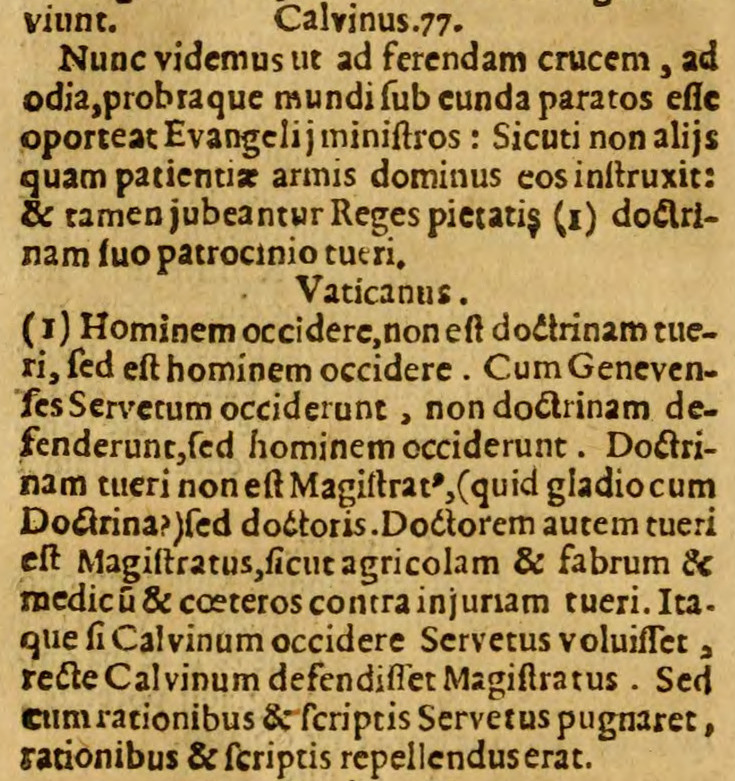 Page of Castellio's Against Calvin's Booklet in which he states: "Hominem occidere, non est doctrinam tueri, sed hominem occidere." ("To kill a man is not to protect a doctrine, it is to kill a man.") Marius Valkhoff describes Castellio's Advice to a desolate France as a pacifist manifesto.[22] Castellio can also be credited with a huge advance in the promotion of the concept of limited government. He passionately argued for separation of church and state and against the idea of theocracy. Arguing that no one is entitled to direct and control another's thought, he stated that authorities should have "no concern with matters of opinion"[23] and concluded: "We can live together peacefully only when we control our intolerance. Even though there will always be differences of opinion from time to time, we can at any rate come to general understandings, can love one another, and can enter the bonds of peace, pending the day when we shall attain unity of faith."[24] |
カルヴァンとの対立 カステリョの境遇は次第に好転し、1553年8月にはバーゼル大学の文学修士号を授与され、名門の教職に任命された[15]。しかし同年10月、医師兼神 学者ミゲル・セルベトゥスがジュネーブで冒涜と異端の罪により処刑された。特に彼が三位一体説を否定したことが問題視されたのである。当時の多くの著名な プロテスタント指導者たちはこの処刑を支持し、メランヒトンはカルヴァンにこう書き送った。「現時点においても、また末永く後世に至るまで、教会はあなた に感謝を捧げるべきである。[...] 貴殿の行政官が、正当な裁判を経てこの冒涜者を処罰したのは正しい判断であったと断言する」[16]。しかし、デイヴィッド・ヨリスやベルナルディーノ・ オキーノ(抗議派として知られる)など、他の多くの同時代学者たちは、セルベトゥスの処刑に公的にも私的にも激怒した。[17] チューリッヒとシャフハウゼンの教会会議は全く熱心ではなく、カステリョはこの件に関して特に厳しい立場を取った。彼はカルヴァンによる露骨な殺人行為に 激怒し、その「手はセルベトゥスの血で滴っている」と述べた。[18] 自らの行為を正当化するため、1554年2月にカルヴァンは『聖なる三位一体に関する正統信仰の擁護』(Defensio orthodoxae fidei de sacra Trinitate)と題する論文を発表した。その中で彼は、セルベトゥスが正統的なキリスト教教義から逸脱したとして処刑されるべきだという論拠を提示 した。 3か月後、カステリョは(バジル・モンフォールとして)小冊子『異端者に関する論文(De haereticis, an sint persequendi)』の大部分を執筆したが、その出版地は、最初のページにはバーゼルではなくマクデブルクと記載されていた。この本は、裕福なイタ リア人ベルナルディーノ・ボニファツィオが資金を提供し、マーティヌス・ベリウスという偽名で出版され、バーゼルの有名な印刷業者ヨハネス・オポリヌスに よって印刷された。このパンフレットは、ラエリウス・ソキヌスとチェリオ・セコンド・クリオーネが共同執筆したものとされている。セルベトゥスの処刑につ いて、カステリョは次のように記している。「セルベトゥスが理屈と文章で戦ったならば、理屈と文章で撃退されるべきだった」[19]。彼は、アウグスティ ヌス、クリソストム、ジェロームといった教父たちの証言を引用して思想の自由を支持し、カトリック教会から迫害を受けていた頃のカルヴァンの言葉さえも引 用した。「教会から追放された者に対して武力を行使し、人類共通の権利を否定することは非キリスト教的である」[20]。異端者とは誰かと問うて、彼はこ う結論づけた。「我々の見解を共有しない者たちの目には、我々全員が異端者に見えるという基準以外に、他に基準は見当たらない」[21]。 カステリョの『カルヴァン反論小冊子』の一節:「人を殺すことは、教義を守るのではなく、人を殺すことである。」(Hominem occidere, non est doctrinam tueri, sed hominem occidere.) マリウス・ヴァルクホフはカステリョの『荒廃したフランスへの助言』を平和主義宣言と評している。[22] カステリョは限定政府の概念推進において画期的な貢献をしたとも言える。彼は教会と国家の分離を熱心に主張し、神政政治の思想に反対した。誰も他人の思想 を直接支配する権利はないと論じ、権威者は「意見の問題に関与すべきではない」[23]と述べ、次のように結論づけた。「我々は不寛容を抑制して初めて平 和に共存できる。時折異なる意見は必ず生じるが、少なくとも大筋の合意には達し、互いを愛し合い、平和の絆を結ぶことは可能だ。信仰の統一が達成されるそ の日が来るまで」と述べた[24]。 |
| Death Castellio died in Basel in 1563 and was buried in the tomb of a noble family. His enemies unearthed the body, burned it, and scattered the ashes. Some of his students erected a monument to his memory, which was later destroyed by accident; only the inscription is preserved.[25] |
死 カステリオーは1563年にバーゼルで死去し、貴族の墓に埋葬された。敵対者たちは遺体を掘り起こし、焼却して灰を散らした。弟子たちの一部が彼の記念碑 を建立したが、後に事故で破壊され、碑文のみが現存している。[25] |
| Works Dialogi Sacri. Geneva 1542, also a much expanded version, Basel 1545 Biblia interprete Sebastiano Castalione [Wikidata]. Basel 1551 Treatise on Heretics. Basel 1554 Against Calvin's Booklet. Basel 1554 (first edition 1612) Castellio Bible. Basel 1555 De arte dubitandi. Advice to a desolate France. 1562 De Imitatione Christi. 1563 |
著作 『聖なる対話集』。ジュネーブ、1542年。また大幅に増補された版がバーゼル、1545年に出版された。 『セバスティアーノ・カスタリオーネによる聖書解釈』。バーゼル、1551年。 『異端者論』。バーゼル、1554年。 『カルヴァンの小冊子に対する論駁』。バーゼル、1554年(初版は1612年)。 カステリオン聖書。バーゼル 1555年 疑う術について。 荒廃したフランスへの助言。1562年 キリストの模倣について。1563年 |
| References 01. Jenkins, Gary W. (2018). Calvin's Tormentors: Understanding the Conflicts That Shaped the Reformer. Baker Academic. p. 64. ISBN 978-1-4934-1326-3. Voltaire (1761). The Ancient and Modern History. Vol. IV. Translated by Smollett, Tobias. London. pp. 80–1. Voltaire (1878) [1756]. "De Genève et de Calvin". Essai sur les mœurs et l'esprit des nations. Vol. II. Paris: Garnier frères. pp. 305–6. Zweig, Stefan (1936). The Right to Heresy: Castellio against Calvin. Translated by Paul, Eden; Paul, Cedar. New York: The Viking Press. p. 89. Zweig, Stefan (1936). Castellio gegen Calvin. Vienna: Herbert Reichner Verlag. p. 127. Zweig 1951, p. 239. Zweig 1951, p. 234. Zweig 1951, p. 242. Zweig 1951, p. 250. 10. Zweig 1951, p. 252. Zweig 1951, pp. 337ff. Guggisbert, Hans (2003). Sebastian Castellio, 1515-1563; Humanist and Defender of Religious Toleration in a Confessional Age; Translated and Edited by Bruce Gordon. Hants England; Burlington, Vermont, USA: Ashgate Publishing Limited. pp. 247–270. ISBN 0754630196. Buisson, Ferdinand (1892). "Les deux traductions de la Bible, en latin (1550) en français (1555)". Sébastien Castellion, sa vie et son oeuvre (1515-1563) : étude sur les origines du protestantisme libéral français (in French). Paris: Librairie Hachette. p. 294. Retrieved 25 May 2020. Gueunier, Nicole (2008). "Le Cantique des cantiques dans la Bible Latine de Castellion". In Gomez-Géraud, Marie-Christine (ed.). Biblia (in French). Presses Paris Sorbonne. p. 148. ISBN 9782840505372. Grayling, A. C. (2007) Towards the Light. The story of the struggles for liberty & rights that made the modern west. London: Bloomsbury. Schaff, Philip. "Protestant Intolerance. Judgments of the Reformers on Servetus.". History of the Christian Church. Vol. VIII. Retrieved 28 May 2008. Bainton, Roland (1951). The Travail of Religious Liberty. Westminster. pp. nearly entire book. Zweig 1951, pp. 298, 332. Rives, Standford (2008). Did Calvin Murder Servetus?. BookSurge. p. 344. ISBN 978-1-4392-0868-7. 20. Zweig 1951, p. 307. "Los Angeles Review of Books". 27 March 2016. Valkhoff, Marius (1967). Advice to a Desolate France (introduction). Grand Rapids: Acton Institute. p. xi. Zweig 1951, p. 311. Zweig 1951, p. 312. 25. Sebastian Castellio Archived 6 March 2005 at the Wayback Machine |
参考文献 01. ジェンキンズ、ゲイリー・W(2018)。『カルヴァンの苦しみ:改革者を形作った葛藤を理解する』ベイカー・アカデミック。64 ページ。ISBN 978-1-4934-1326-3。 ヴォルテール(1761)。『古代および近代史』第 IV 巻。スモレット、トビアス訳。ロンドン。pp. 80–1. ヴォルテール (1878) [1756]。「ジュネーブとカルヴァンについて」。『諸国民の風俗と精神に関する試論』。第 II 巻。パリ:ガーナー・フレール社。pp. 305–6。 ツヴァイク、シュテファン(1936)。『異端の権利:カルヴァンの対カステリョ』。ポール、エデン、ポール、シーダー訳。ニューヨーク:バイキング・プ レス。89 ページ。 ツヴァイク、シュテファン(1936)。『カステリョ対カルヴァン』。ウィーン:ハーバート・ライヒナー出版社。127 ページ。 ツヴァイク 1951、239 ページ。 ツヴァイク 1951, p. 234. ツヴァイク 1951, p. 242. ツヴァイク 1951, p. 250. 10. ツヴァイク 1951, p. 252. ツヴァイク 1951, pp. 337ff. グギスベルト、ハンス(2003)。『セバスティアン・カステリオン、1515-1563:宗教的寛容の擁護者、信仰告白の時代の人文主義者』ブルース・ ゴードン訳・編。イングランド、ハンプシャー;バーモント州バーリントン、米国:アッシュゲート出版。247–270頁。ISBN 0754630196。 ビュイソン、フェルディナン(1892)。「ラテン語(1550年)とフランス語(1555年)による聖書の二つの翻訳」。『セバスチャン・カステリオ ン、その生涯と著作(1515-1563):フランス自由主義プロテスタントの起源に関する研究』(フランス語)。パリ:リブレリー・アシェット。p. 294. 2020年5月25日閲覧。 ギュニエ、ニコール(2008年)。「カステリオンのラテン語聖書における雅歌」。ゴメス=ジェロー、マリー=クリスティーヌ(編)。『聖書』(フランス 語)。プレス・パリ・ソルボンヌ。p. 148。ISBN 9782840505372。 グレイリング、A. C.(2007)『光へ向かって。近代西洋を形作った自由と権利のための闘争の物語』。ロンドン:ブルームズベリー。 シャフ、フィリップ。「プロテスタントの不寛容。改革者たちのセルベトゥスに対する評決」。『キリスト教会の歴史』第VIII巻。2008年5月28日取 得。 ベイントン、ローランド(1951)。『宗教的自由の苦闘』。ウェストミンスター。ほぼ全編。 ツヴァイク 1951, pp. 298, 332. リヴズ、スタンフォード(2008)。『カルヴァンはセルヴェトゥスを殺害したのか?』。ブックスサージ。p. 344。ISBN 978-1-4392-0868-7。 20. ツヴァイク 1951, p. 307。 「ロサンゼルス・レビュー・オブ・ブックス」。2016年3月27日。 ヴァルクホフ、マリウス(1967)。『荒廃したフランスへの助言』(序文)。グランドラピッズ:アクトン研究所。xi頁。 ツヴァイク 1951、311頁。 ツヴァイク 1951、312頁。 25. セバスティアン・カステリョ 2005年3月6日ウェイバックマシンにアーカイブ |
| Bibliography Bainton, Roland (2005). Hunted heretic : the life and death of Michael Servetus, 1511-1553. Providence, R.I: Blackstone Editions Unitarian Universalist Historical Society. ISBN 0-9725017-3-8. Gordon, Bruce (2011). Calvin. New Haven Conn. London: Yale University Press. ISBN 978-0-300-17084-9. Jack, Kristin (2023). Fire and Faith: The Untold Story of Sebastian Castellio's Epic Battle with John Calvin. ISBN 978-0-473-69823-2 Guggisberg, Hans R. (2003). Bruce Gordon (ed.). Sebastian Castellio, 1515–1563: Humanist and Defender of Religious Toleration in a Confessional Age. Aldershot: Ashgate. ISBN 0-7546-3019-6. Zweig, Stefan (1936). Castellio gegen Calvin oder Ein Gewissen gegen die Gewalt [Castellio against Calvin or a conscience against violence]. Vienna: H. Reichner. OCLC 1903690. Zweig, Stefan (1951). Erasmus; The Right to Heresy: Castellio against Calvin. London: Cassell. OCLC 24340377. Greminger, Ueli (2015). Sebastian Castellio - Eine Biographie aus den Wirren der Reformationszeit. Zürich: Orell Fuessli. ISBN 978-3-280-05597-7. |
参考文献 ベイントン、ローランド(2005)。『異端者として追われた男:ミゲル・セルベトゥスの生涯と死、1511-1553』。プロビデンス、R.I:ブラッ クストーン・エディションズ・ユニテリアン・ユニヴァーサリスト歴史協会。ISBN 0-9725017-3-8。 ゴードン、ブルース(2011)。『カルヴァン』コネチカット州ニューヘイブン、ロンドン:イェール大学出版局。ISBN 978-0-300-17084-9。 ジャック、クリスティン(2023)。『火と信仰:セバスティアン・カステリョとジョン・カルヴァンの壮絶な闘いの知られざる物語』ISBN 978-0-473-69823-2 グギスベルク、ハンス・R.(2003)。ブルース・ゴードン(編)。『セバスティアン・カステリョ、1515–1563:宗教的寛容の擁護者、信仰告白 の時代の人文主義者』。オルダーショット:アッシュゲート。ISBN 0-7546-3019-6。 ツヴァイク、シュテファン(1936)。『カステリョ対カルヴァン、あるいは良心対暴力』。ウィーン:H.ライヒナー。OCLC 1903690。 ツヴァイク、シュテファン(1951)。『エラスムス;異端の権利:カステリョ対カルヴァン』。ロンドン:カッセル。OCLC 24340377。 グレミンガー、ウエリ(2015)。『セバスティアン・カステリョ ― 宗教改革の混乱期における伝記』。チューリッヒ:オレル・フュースリ。ISBN 978-3-280-05597-7。 |
| https://en.wikipedia.org/wiki/Sebastian_Castellio |
リ ンク
文 献
そ の他の情報
CC

Copyleft,
CC, Mitzub'ixi Quq Chi'j, 1996-2099