むかし懐疑論、いま量子論
Skepticism
in Wired brain
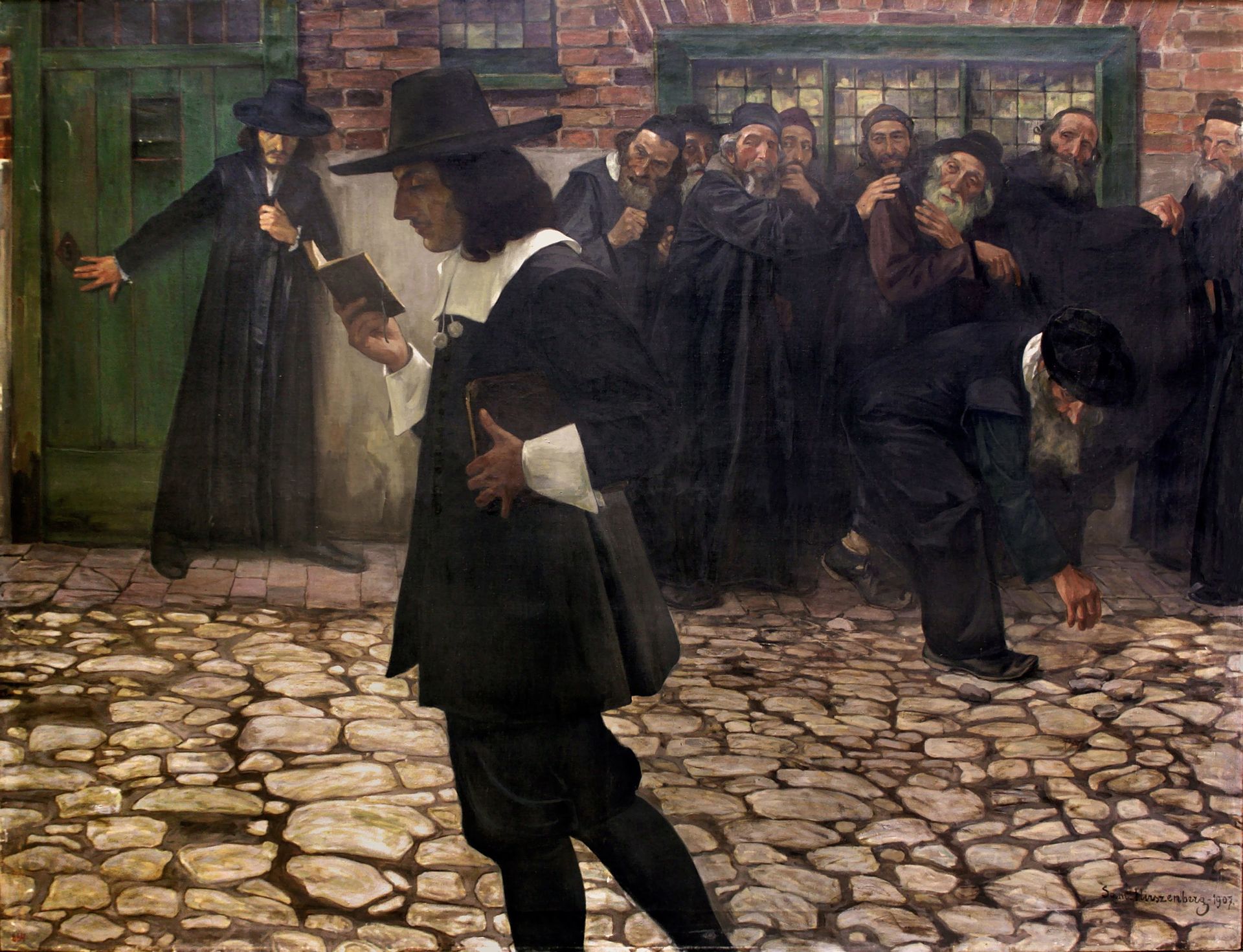
Spinoza, Excommunicated Samuel
Hirszenberg
(1907).
むかし懐疑論、いま量子論
Skepticism
in Wired brain
Spinoza, Excommunicated Samuel
Hirszenberg
(1907).
懐疑論(skepticism)とは、君が知ってい る信念や教理(ドグマ)とは、感性や直感によって身につけてきたものに他ならないから、それを知らない宇宙人がいまここに登場した時に、君がいうことを まったく理解できないだろう、感性や直感を排して、君が経験的に世界について知っていることなど、わずかなものにすぎない、という批判的態度(反省)のこ とである。
"Skepticism (American and Canadian English) or scepticism (British, Irish, and Australian English) is generally a questioning attitude or doubt towards one or more putative instances of knowledge which are asserted to be mere belief or dogma.[1][2] Formally, skepticism is a topic of interest in philosophy, particularly epistemology. More informally, skepticism as an expression of questioning or doubt can be applied to any topic, such as politics, religion, or pseudoscience. It is often applied within restricted domains, such as morality (moral skepticism), theism (skepticism about the existence of God), or the supernatural.[3] Philosophical skepticism comes in various forms. Radical forms of philosophical skepticism deny that knowledge or rational belief is possible and urge us to suspend judgment on many or all controversial matters. More moderate forms of philosophical skepticism claim only that nothing can be known with certainty, or that we can know little or nothing about nonempirical matters, such as whether God exists, whether human beings have free will, or whether there is an afterlife. Skepticism has also inspired a number of contemporary social movements. Religious skepticism advocates for doubt concerning basic religious principles, such as immortality, providence, and revelation.[4] Scientific skepticism advocates for testing beliefs for reliability, by subjecting them to systematic investigation using the scientific method, to discover empirical evidence for them."
「懐疑主義(skepticismアメリカ英語、カ
ナダ英語)または懐疑主義(scepticism
イギリス英語、アイルランド英語、オーストラリア英語)とは、一般に、単なる信念や教義であると主張される知識の1つまたは複数の推定例に対する疑問の態
度や疑念のことである。形式的には、懐疑論は哲学、特に認識論において関心のあるテーマである。より非公式には、疑問や疑念の表現としての懐疑主義は、政
治、宗教、疑似科学など、あらゆるトピックに適用することができる。道徳性(道徳的懐疑主義)、神義論(神の存在に関する懐疑主義)、超自然的なものな
ど、限定された領域で適用されることが多い。哲学的懐疑主義にはさまざまな形態がある。急進的な形の哲学的懐疑主義は、知識や理性的な信念が可能であるこ
とを否定し、論争の的となる事柄の多くまたは全てについて判断を保留するよう促す。より穏健な形の哲学的懐疑論は、確実なことは何もわからないと主張する
だけで、神が存在するかどうか、人間に自由意志があるかどうか、死後の世界があるかどうかなど、経験的でない事柄についてはほとんど何もわからないと主張
する。懐疑主義はまた、現代の社会運動にも影響を与えている。宗教的懐疑主義は、不死、摂理、啓示といった基本的な宗教原理を疑うことを提唱している。科
学的懐疑主義は、科学的手法を使って体系的な調査を行い、経験的証拠を発見することで、信念の信頼性を検証することを提唱している。」
古代ギリシャのピュロン、それを編纂したアイネシデ モス、そして、ピュロン派の主張をまとめたセクストス・エンペイリコスは、西洋思想における懐疑主義の元祖といわれる。それに対して、近代思想のデカルト は、ピュロン的系譜とは別に、アウグスティヌスの自己についての「確実性」についての拡張したコギト・スム(Je pense, donc je suis, Cogito ergo sum)に表せる懐疑論を打ち立てた。すなわち「「私は考える、ゆえに私はある」というこの真理は、懐疑論者のどのような法外な想定によってもゆり動かし えぬほど、堅固な確実なものであることを、私は認めたから、私はこの真理を、私の求めていた哲学の第一原理として、もはや安心して受け入れることができ る、と判断した」デカルト『方法序説』、野田又夫訳『世界の名著22 デカルト〔第3版〕』中央公論社、1967年、p.198.)
経験論批判のデイヴィッド・ヒュームは、因果にもと づく帰納思考に、懐疑論を もって批判したこと[出典]で 著名である:1)「このように、新しい生成にはすべて原因が必要だという考えは知識から引き出されるのではなく、またいかなる学問的推論からも引き出され ないのだから、どうしても観察と経験とから生じるものでなければならない。そこで、当然、次に問題となるのは、いかにして経験はそのような原理を生じさせ るのか、ということである。しかし、私はこの問題を次のような問題にはめ込むほうがもっと都合がよいと思うので、それをこれから研究の主題にしよう。それ は、われわれはなぜ、しかじかの特定の原因は必然的にしかじかの特定の結果を伴わねばならないと断定するのか、また、なぜ、一方から他方へ推理を行うの か、という問題である」ヒューム『人性論』第1編3部3節、大槻春彦訳、世界の名著27、1970:433。2)「このようにして、理性によっては原因と 結果の究極的な結合を見出し得ないだけではなく、さらに経験がそれらの恒常的な相伴を知らせたあとでさえも、なぜわれわれはその経験をすでに観察された個 々の実例以上に拡げるのかという点について、理性によっては納得が得られないのである。したがって、心が一つの対象の観念もしくは印象から、他の対象の観 念もしくは信念へと移るときに、心は理性によって規定されるのではなく、想像においてこれらの対象の観念を連合し、結び合わせるようなある原理によって規 定されるのである」 ibid, p.438)。3)「そういうわけで、こんなに念入りにその仮想の一派の議論を私が示してみせる意図は、私が立てた仮説の真理を、すなわち、原因と結果に 関するすべての推論は習慣にのみ起因すること、また、信念はわれわれの本性の知的部分の働きというよりもむしろ情的部分の働きであること、これらの真理を 読者に気づかせることにほかならない」ibid, p.460)。
●量子論における常識の解体について……
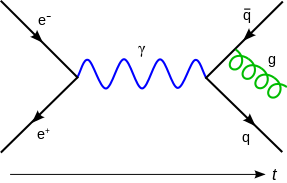
「量子論(量子物理学;Quantum physics) とは、ある物理量が任意の値を取ることができず、特定の離散的な値しかとることができない、すなわち量子化(quantization)を受けるような全 ての現象と効果を扱う学問である。粒子と波動の二重性、物理的過程の不確定性、観測による不可避な擾乱も特徴である。量子論は、マックス・プランクの量子 仮説まで遡る全ての理論、モデル、概念を包括する。量子仮説は1900年に、例えば光や物質構造に対する古典物理学的説明が限界に来ていたために産まれ た」。そして「量子化(りょうしか: quantization) とは、古典力学では連続量として理解されていた物理現象を、量子ひとつひとつの集合体である離散的な物理現象として解釈し直すこと」である。
”In physics, quantization (quantisation) is
the process of transition from a classical understanding of physical
phenomena to a newer understanding known as quantum
mechanics. (It is a procedure for constructing a quantum field
theory starting from a classical field theory.)”
「半導体を利用する電子機器の設計など、微細な領域
に関するテクノロジーのほとんどは量子力学を基礎として成り立っている。そのため量子力学の適用範囲の広さと現代生活への影響の大きさは非常に大きなもの
となっている。一例として、パソコンや携帯電話[9]、レーザーの発振器などは量子力学の応用で開発されている[7]。工学において、電子工学や超伝導は量子力学を基礎として展開」する。
●カント哲学を擁護するグレーテ・ヘルマン(Grete Hermann, 1901-1984)に、若きヴェルナー・ハイゼンベルグが反論する
「……しかし我々は、そこにまさに因果律のある種の 破綻が現れるのを見るのですが、ひとつひとつのラジウムB原子の場合には、それが後でも先でもなく、ちょうど、この瞬間崩壊するということ、また、それが その方向以外ではなく、ちょうどこの方向に電子を放出するということについて原因を指摘することができないのです。そして、そのような原因が存在しないこ とも多くの理由から確実です」——ヴェルナー・ハイゼンベルグ「量子力学とカント哲学」『部分と全体』山崎和夫訳、p.191、pp.188-200, みすず書房、1999年
"Grete Hermann
(1901-1984) was a pupil of mathematical physicist Emmy Noether,
follower and co-worker of neo-Kantian philosopher Leonard Nelson, and
an important intellectual figure in post-war German social democracy.
She is best known for her work on the philosophy of modern physics in
the 1930s, some of which emerged from intense discussions with
Heisenberg and Weizsacker in Leipzig. Hermann's aim was to counter the
threat to the Kantian notion of causality coming from quantum
mechanics. She also discussed in depth the question of 'hidden
variables' (including the first critique of von Neumann's alleged
impossibility proof) and provided an extensive analysis of Bohr's
notion of complementarity.
This volume includes translations of Hermann's two most important
essays on this topic: one hitherto unpublished and one translated here
into English for the first time. It also brings together recent
scholarly contributions by historians and philosophers of science,
physicists, and philosophers and educators following in Hermann's
steps. Hermann's work places her in the first rank among philosophers
who wrote about modern physics in the first half of the last century.
Those interested in the many fields to which she contributed will find
here a comprehensive discussion of her philosophy of physics that
places it in the context of her wider work." - https://ci.nii.ac.jp/ncid/BB24764871.
「グレーテ・ヘルマン(1901-1984)は、数
理物理学者エミー・ノーテルの弟子であり、新カント哲学者レナード・ネルソンの信奉者であり共同研究者であり、戦後ドイツの社会民主主義における重要な知
識人であった。1930年代の現代物理学の哲学に関する研究で最もよく知られており、その一部はライプツィヒでのハイゼンベルクやヴァイツゼッカーとの激
しい議論から生まれた。ヘルマンの目的は、量子力学からもたらされるカント的因果性の概念への脅威に対抗することであった。彼女はまた、「隠れた変数」の
問題(フォン・ノイマンの不可能性の証明に対する最初の批判を含む)について深く議論し、ボーアの相補性の
概念について広範な分析を行った。本書には、このトピックに関するヘルマンの2つの最も重要なエッセイの翻訳が収められている。1つはこれまで未発表のも
ので、もう1つは今回初めて英訳されたものである。また、科学史家や科学哲学者、物理学者、ヘルマンに続く哲学者や教育者による最近の学術的貢献もまとめ
られている。ヘルマンの業績は、前世紀前半に現代物理学について書いた哲学者の中で、彼女を第一級の地位に位置づけている。ヘルマンが貢献した多くの分野
に関心のある人は、彼女の物理学哲学を、より広範な仕事の文脈の中に位置づける包括的な議論をここで見出すことができるだろう。」
●ループ量子重力理論(LQG)
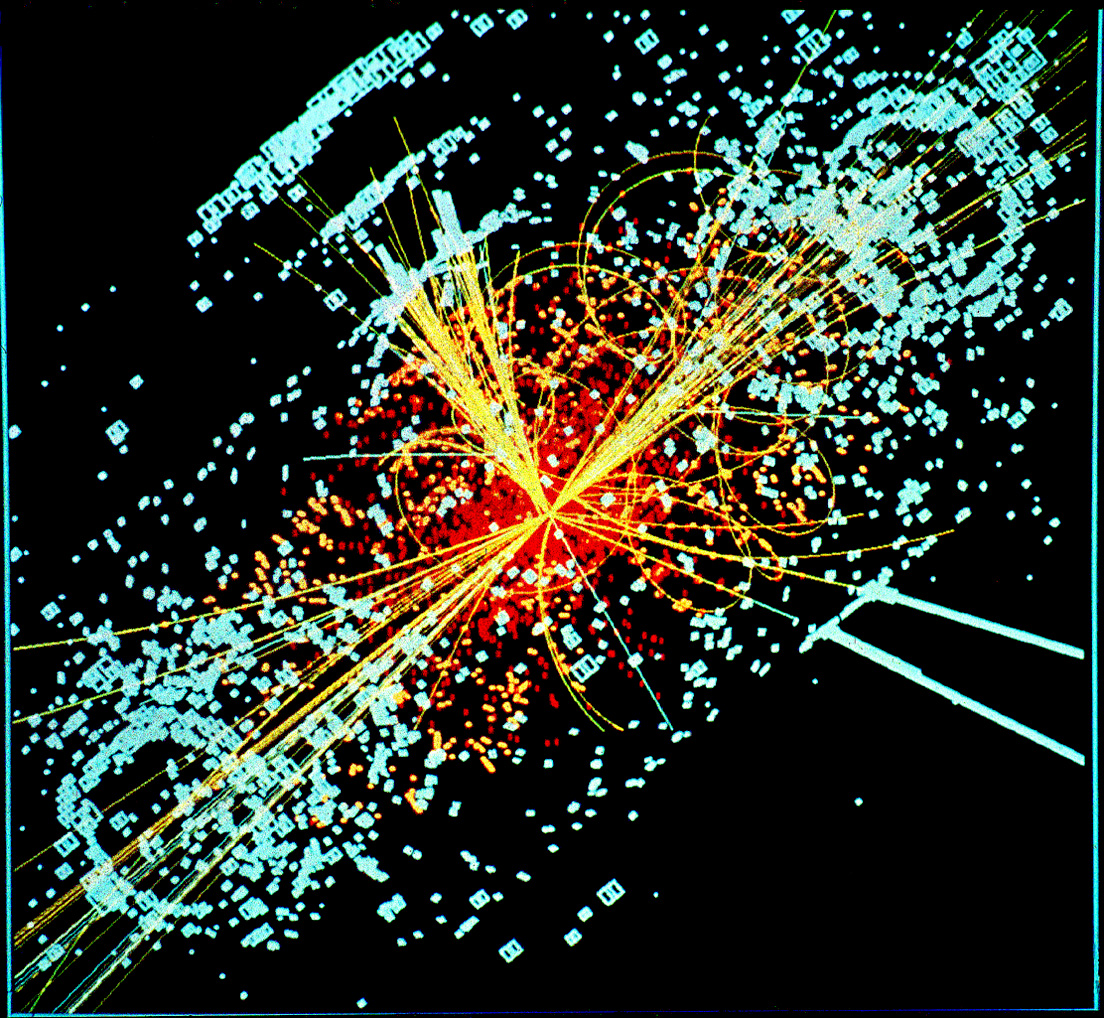
大型ハドロン衝突型加速器CMS粒子検出器のシミュレーションデータ。陽子衝突によって生成されたヒッグス粒子が、ハドロンジェットと電子に崩壊する様子を示している。
| Loop quantum gravity
(LQG) is a theory of quantum gravity that incorporates matter of the
Standard Model into the framework established for the intrinsic quantum
gravity case. It is an attempt to develop a quantum theory of gravity based directly on Albert Einstein's geometric formulation, general relativity. As a theory, LQG postulates that the structure of space and time is composed of finite loops woven into an extremely fine fabric or network. These networks of loops are called spin networks. The evolution of a spin network, or spin foam, has a scale on the order of a Planck length, approximately 10−35 meters, and smaller scales are meaningless. Consequently, not just matter, but space itself, prefers an atomic structure. The areas of research, which involve about 30 research groups worldwide,[1] share the basic physical assumptions and the mathematical description of quantum space. Research has evolved in two directions: the more traditional canonical loop quantum gravity, and the newer covariant loop quantum gravity, called spin foam theory. The most well-developed theory that has been advanced as a direct result of loop quantum gravity is called loop quantum cosmology (LQC). LQC advances the study of the early universe, incorporating the concept of the Big Bang into the broader theory of the Big Bounce, which envisions the Big Bang as the beginning of a period of expansion, that follows a period of contraction, which has been described as the Big Crunch. |
ループ量子重力理論(LQG)は、標準模型の物質を固有の量子重力理論の枠組みに組み込んだ量子重力理論である。 これはアルベルト・アインシュタインの幾何学的定式化である一般相対性理論に直接基づいて量子重力理論を発展させようとする試みだ。理論としてLQGは、 時空の構造が極めて微細な織物やネットワークに編み込まれた有限のループで構成されていると仮定する。これらのループのネットワークはスピンネットワーク と呼ばれる。スピンネットワーク、すなわちスピンフォームの進化は、プランク長(約10−35メートル)オーダーのスケールを持ち、それより小さいスケー ルは無意味である。結果として、物質だけでなく空間そのものが原子構造を好む。 世界中の約30の研究グループが関わるこの研究分野は、基本的な物理的前提と量子空間の数学的記述を共有している。研究は二つの方向で進展した:より伝統 的な標準ループ量子重力理論と、新しい共変ループ量子重力理論(スピンフォーム理論と呼ばれる)。ループ量子重力の直接的な成果として最も発展した理論 は、ループ量子宇宙論(LQC)と呼ばれる。LQCは初期宇宙の研究を推進し、ビッグバン概念をビッグバウンス理論というより広範な枠組みに組み込む。こ の理論では、ビッグバンは収縮期(ビッグクランチ)に続く膨張期の始まりと位置づけられる。 |
| History Main article: History of loop quantum gravity In 1986, Abhay Ashtekar reformulated Einstein's general relativity in a language closer to that of the rest of fundamental physics, specifically Yang–Mills theory.[2] Shortly after, Ted Jacobson and Lee Smolin realized that the formal equation of quantum gravity, called the Wheeler–DeWitt equation, admitted solutions labelled by loops when rewritten in the new Ashtekar variables. Carlo Rovelli and Smolin defined a nonperturbative and background-independent quantum theory of gravity in terms of these loop solutions. Jorge Pullin and Jerzy Lewandowski understood that the intersections of the loops are essential for the consistency of the theory, and the theory should be formulated in terms of intersecting loops, or graphs. In 1994, Rovelli and Smolin showed that the quantum operators of the theory associated to area and volume have a discrete spectrum.[3] That is, geometry is quantized. This result defines an explicit basis of states of quantum geometry, which turned out to be labelled by Roger Penrose's spin networks, which are graphs labelled by spins. The canonical version of the dynamics was established by Thomas Thiemann, who defined an anomaly-free Hamiltonian operator and showed the existence of a mathematically consistent background-independent theory. The covariant, or "spin foam", version of the dynamics was developed jointly over several decades by research groups in France, Canada, UK, Poland, and Germany. It was completed in 2008, leading to the definition of a family of transition amplitudes, which in the classical limit can be shown to be related to a family of truncations of general relativity.[4] The finiteness of these amplitudes was proven in 2011.[5][6] It requires the existence of a positive cosmological constant, which is consistent with observed acceleration in the expansion of the Universe. |
歴史 主な記事:ループ量子重力理論の歴史 1986年、アベイ・アシュテカーは、アインシュタインの一般相対性理論を、他の基礎物理学、特にヤン・ミルズ理論の言語に近い形で再定式化した[2]。 その直後、テッド・ジェイコブソンとリー・スモーリンは、ウィーラー・デウィット方程式と呼ばれる量子重力の形式的な方程式が、新しいアシュテカー変数で 書き直すと、ループでラベル付けされた解を認めることに気づいた。カルロ・ロヴェッリとスモーリンは、これらのループ解を用いて、非摂動的で背景に依存し ない量子重力理論を定義した。ホルヘ・プリンとイェジ・レヴァンドフスキは、ループの交点が理論の一貫性にとって不可欠であり、理論は交差するループ、す なわちグラフを用いて定式化されるべきであると理解した。 1994年、ロヴェッリとスモーリンは、面積と体積に関連する理論の量子演算子が離散的なスペクトルを持つことを示した[3]。つまり、幾何学は量子化さ れる。この結果は、量子幾何学の状態の明確な基礎を定義するものであり、それはロジャー・ペンローズのスピンネットワーク、すなわちスピンでラベル付けさ れたグラフによってラベル付けされることが判明した。 この力学の標準的なバージョンは、トーマス・ティーマンによって確立された。彼は、異常のないハミルトン演算子を定義し、数学的に一貫した背景独立の理論 の存在を示した。この力学の共変的な、あるいは「スピンフォーム」のバージョンは、フランス、カナダ、イギリス、ポーランド、ドイツの研究グループによっ て数十年にわたって共同で開発された。これは 2008 年に完成し、遷移振幅の族の定義につながった。これは、古典的な限界では、一般相対性理論の切り捨ての族に関連していることが示されている。[4] これらの振幅の有限性は 2011 年に証明された。[5][6] これは、宇宙の膨張における観測された加速と一致する、正の宇宙定数の存在を必要とする。 |
| Background independence LQG is formally background independent, meaning the equations of LQG are not embedded in, or dependent on, space and time (except for its invariant topology). Instead, they are expected to give rise to space and time at distances which are 10 times the Planck length. The issue of background independence in LQG still has some unresolved subtleties. For example, some derivations require a fixed choice of the topology, while any consistent quantum theory of gravity should include topology change as a dynamical process.[citation needed] Spacetime as a "container" over which physics takes place has no objective physical meaning and instead the gravitational interaction is represented as just one of the fields forming the world. This is known as the relationalist interpretation of spacetime. In LQG this aspect of general relativity is taken seriously and this symmetry is preserved by requiring that the physical states remain invariant under the generators of diffeomorphisms. The interpretation of this condition is well understood for purely spatial diffeomorphisms. However, the understanding of diffeomorphisms involving time (the Hamiltonian constraint) is more subtle because it is related to dynamics and the so-called "problem of time" in general relativity.[7] A generally accepted calculational framework to account for this constraint has yet to be found.[8][9] A plausible candidate for the quantum Hamiltonian constraint is the operator introduced by Thiemann.[10] |
背景独立性 LQGは形式的に背景独立である。つまりLQGの方程式は、不変の位相を除いて、時空に埋め込まれたり依存したりしない。代わりに、それらはプランク長度 の10倍の距離で時空を生み出すと予想される。LQGにおける背景独立性の問題には、未解決の微妙な点が残っている。例えば、一部の導出ではトポロジーの 固定選択が必要となるが、一貫した量子重力理論はトポロジー変化を動的過程として含めるべきである。[出典が必要] 物理現象が展開される「容器」としての時空は客観的物理的意味を持たず、代わりに重力相互作用は世界を構成する場の一つとして表現される。これは時空の関 係論的解釈として知られる。LQG では、一般相対性理論のこの側面が真剣に受け止められており、この対称性は、物理状態が微分同相変換の生成元の下で不変であるということを要求することに よって保たれている。この条件の解釈は、純粋に空間的な微分同相変換についてはよく理解されている。しかし、時間を含む微分同相変換(ハミルトニアン制 約)の理解は、一般相対性理論における力学やいわゆる「時間の問題」に関連しているため、より微妙である。この制約を説明するための、一般に受け入れられ ている計算の枠組みはまだ見出されていない。量子ハミルトン制約の有力な候補は、ティーマンが導入した演算子である。 |
| https://en.wikipedia.org/wiki/Loop_quantum_gravity |
☆ループ量子重力の歴史(History of loop quantum gravity)
| The history of loop quantum gravity spans more than three decades of intense research. |
ループ量子重力の歴史(History of loop quantum gravity)は、30年以上にわたる精力的な研究の積み重ねである。 |
| History Classical theories of gravitation General relativity is the theory of gravitation published by Albert Einstein in 1915. According to it, the force of gravity is a manifestation of the local geometry of spacetime. Mathematically, the theory is modelled after Bernhard Riemann's metric geometry, but the Lorentz group of spacetime symmetries (an essential ingredient of Einstein's own theory of special relativity) replaces the group of rotational symmetries of space. (Later, loop quantum gravity inherited this geometric interpretation of gravity, and posits that a quantum theory of gravity is fundamentally a quantum theory of spacetime.) In the 1920s, the French mathematician Élie Cartan formulated Einstein's theory in the language of bundles and connections,[1] a generalization of Riemannian geometry to which Cartan made important contributions. The so-called Einstein–Cartan theory of gravity not only reformulated but also generalized general relativity, and allowed spacetimes with torsion as well as curvature. In Cartan's geometry of bundles, the concept of parallel transport is more fundamental than that of distance, the centerpiece of Riemannian geometry. A similar conceptual shift occurs between the invariant interval of Einstein's general relativity and the parallel transport of Einstein–Cartan theory. |
歴史 古典重力理論 一般相対性理論は、1915年にアルバート・アインシュタインが発表した重力理論である。これによれば、重力は時空の局所的な幾何学の現れである。数学的 には、この理論はベルンハルト・リーマンの計量幾何学をモデルとしているが、時空の対称性群であるローレンツ群(アインシュタイン自身の特殊相対性理論の 重要な要素)が、空間の回転対称性群に取って代わっている。(後に、ループ量子重力は重力のこの幾何学的解釈を継承し、重力の量子理論は根本的に時空の量 子理論であると提唱した。) 1920年代、フランスの数学者エリー・カルタンは、束と連結の言語を用いてアインシュタインの理論を定式化した[1]。これはリーマン幾何学の一般化で あり、カルタンはこれに重要な貢献をした。いわゆるアインシュタイン=カルタン重力理論は、一般相対性理論を再定式化しただけでなく一般化し、曲率だけで なくねじれを持つ時空を許容した。カルタンの束の幾何学において、平行移送の概念は距離の概念よりも根本的である。距離はリーマン幾何学の中心概念だ。同 様の概念転換が、アインシュタインの一般相対性理論における不変区間と、アインシュタイン=カルタン理論における平行移送の間で起きている。 |
| Spin networks In 1971, physicist Roger Penrose explored the idea of space arising from a quantum combinatorial structure.[2][3] His investigations resulted in the development of spin networks. Because this was a quantum theory of the rotational group and not the Lorentz group, Penrose went on to develop twistors.[4] |
スピンネットワーク 1971年、物理学者ロジャー・ペンローズは空間が量子組合せ構造から生じるという考えを探求した[2][3]。彼の研究はスピンネットワークの構築につ ながった。これは回転群の量子理論であってローレンツ群の理論ではなかったため、ペンローズはその後ツイスター理論を発展させた[4]。 |
| Loop quantum gravity In 1982, Amitabha Sen tried to formulate a Hamiltonian formulation of general relativity based on spinorial variables, where these variables are the left and right spinorial component equivalents of Einstein–Cartan connection of general relativity.[5] Particularly, Sen discovered a new way to write down the two constraints of the ADM Hamiltonian formulation of general relativity in terms of these spinorial connections. In his form, the constraints are simply conditions that the spinorial Weyl curvature is trace free and symmetric. He also discovered the presence of new constraints which he suggested to be interpreted as the equivalent of Gauss constraint of Yang–Mills field theories. But Sen's work fell short of giving a full clear systematic theory and particularly failed to clearly discuss the conjugate momenta to the spinorial variables, its physical interpretation, and its relation to the metric (in his work he indicated this as some lambda variable). In 1986–87, physicist Abhay Ashtekar completed the project which Amitabha Sen began. He clearly identified the fundamental conjugate variables of spinorial gravity: The configuration variable is as a spinoral connection (a rule for parallel transport; technically, a connection) and the conjugate momentum variable is a coordinate frame (called a vierbein) at each point.[6][7] So these variable became what we know as Ashtekar variables, a particular flavor of Einstein–Cartan theory with a complex connection. General relativity theory expressed in this way, made possible to pursue quantization of it using well-known techniques from quantum gauge field theory. The quantization of gravity in the Ashtekar formulation was based on Wilson loops, a technique developed by Kenneth G. Wilson in 1974[8] to study the strong-interaction regime of quantum chromodynamics (QCD). It is interesting in this connection that Wilson loops were known to be ill-behaved in the case of standard quantum field theory on (flat) Minkowski space, and so did not provide a nonperturbative quantization of QCD. However, because the Ashtekar formulation was background-independent, it was possible to use Wilson loops as the basis for nonperturbative quantization of gravity. Due to efforts by Sen and Ashtekar, a setting in which the Wheeler–DeWitt equation was written in terms of a well-defined Hamiltonian operator on a well-defined Hilbert space was obtained. This led to the construction of the first known exact solution, the so-called Chern–Simons form or Kodama state. The physical interpretation of this state remains obscure. In 1988–90, Carlo Rovelli and Lee Smolin obtained an explicit basis of states of quantum geometry, which turned out to be labeled by Penrose's spin networks.[9][10] In this context, spin networks arose as a generalization of Wilson loops necessary to deal with mutually intersecting loops. Mathematically, spin networks are related to group representation theory and can be used to construct knot invariants such as the Jones polynomial. Loop quantum gravity (LQG) thus became related to topological quantum field theory and group representation theory. In 1994, Rovelli and Smolin showed that the quantum operators of the theory associated to area and volume have a discrete spectrum.[11] Work on the semi-classical limit, the continuum limit, and dynamics was intense after this, but progress was slower. On the semi-classical limit front, the goal is to obtain and study analogues of the harmonic oscillator coherent states (candidates are known as weave states). |
ループ量子重力 1982年、アミタバ・センは、スピン変数に基づく一般相対性理論のハミルトニアン定式化を試みた。このスピン変数は、一般相対性理論のアイシュタイン・ カルタン結合の左右スピン成分に相当するものである[5]。特に、センは、一般相対性理論のADMハミルトニアン定式化の2つの制約を、これらのスピン結 合を用いて記述する新しい方法を発見した。彼の形式では、制約は単にスピノリアル・ワイル曲率がトレースフリーで対称であるという条件である。また、彼は 新しい制約の存在を発見し、それをヤン・ミルズ場理論のガウス制約と同等と解釈することを提案した。しかし、センの研究は、完全で明確な体系的な理論を提 示するには至らず、特に、スピノリアル変数に対する共役運動量、その物理的解釈、およびメトリックとの関係について明確に論じることに失敗した(彼の研究 では、これをあるラムダ変数として示していた)。 1986年から1987年にかけて、物理学者アベイ・アシュテカーは、アミタブ・センが始めたプロジェクトを完成させた。彼は、スピノリアル重力の基本的 な共役変数を明確に特定した。構成変数はスピノリアル接続(平行輸送の規則、技術的には接続)であり、共役運動量変数は各点における座標系 (vierbein と呼ばれる)である。[6][7] したがって、これらの変数は、アシュテカー変数として知られるもの、つまり、複素接続を持つアインシュタイン・カルタン理論の特定の形態となった。このよ うに表現された一般相対性理論は、量子ゲージ場理論のよく知られた手法を用いてその量子化を追求することを可能にした。 アシュテカーの定式化における重力の量子化は、1974年にケネス・G・ウィルソンが量子色力学(QCD)の強相互作用領域を研究するために開発した手法 であるウィルソンループに基づいていた[8]。この点に関して興味深いのは、ウィルソンループは(平坦な)ミンコフスキー空間上の標準的な量子場理論の場 合には挙動が不安定であることが知られており、QCD の非摂動的量子化には利用できなかったことだ。しかし、アシュテカーの定式化は背景に依存しないため、ウィルソンループを重力の非摂動的量子化の基礎とし て利用することが可能となった。 センとアシュテカーの努力により、ウィーラー・デウィット方程式が、明確に定義されたヒルベルト空間上の明確に定義されたハミルトニアン演算子を用いて記 述される設定が得られた。これにより、最初の既知の正確な解、いわゆるチェルン・サイモンズ形式またはコダマ状態が構築された。この状態の物理的解釈は依 然として不明である。 1988年から1990年にかけて、カルロ・ロヴェッリとリー・スモーリンは、量子幾何学の状態の明示的な基底を得た。これは、ペンローズのスピンネット ワークによってラベル付けされることが判明した[9][10]。この文脈では、スピンネットワークは、相互に交差するループを扱うために必要なウィルソン ループの一般化として生じた。数学的には、スピンネットワークは群の表現理論に関連しており、ジョーンズ多項式などの結び目不変量を構築するために使用す ることができる。こうして、ループ量子重力理論(LQG)は、位相的量子場理論および群の表現理論に関連するものとなった。 1994年、ロヴェッリとスモーリンは、面積と体積に関連する理論の量子演算子が離散スペクトルを持つことを示した[11]。その後、半古典的限界、連続限界、および力学に関する研究が活発に行われたが、その進展は遅かった。 半古典的限界の分野では、調和振動子のコヒーレント状態(候補はウィーブ状態として知られている)の類似体を取得し、研究することが目標である。 |
| Hamiltonian dynamics LQG was initially formulated as a quantization of the Hamiltonian ADM formalism, according to which the Einstein equations are a collection of constraints (Gauss, Diffeomorphism and Hamiltonian). The kinematics are encoded in the Gauss and Diffeomorphism constraints, whose solution is the space spanned by the spin network basis. The problem is to define the Hamiltonian constraint as a self-adjoint operator on the kinematical state space. The most promising work[according to whom?] in this direction is Thomas Thiemann's Phoenix Project.[12] |
ハミルトン力学 LQG は当初、ハミルトン ADM 形式の量子化として定式化された。これによれば、アインシュタイン方程式は一連の制約(ガウス、微分同相、ハミルトン)の集合である。運動学はガウス制約 と微分同相制約にコード化されており、その解はスピンネットワーク基底によって生成される空間である。問題は、運動学的状態空間上で自己共役演算子として ハミルトニアン制約を定義することである。この方向性で最も有望な研究[誰による?]は、トーマス・ティーマンのフェニックス・プロジェクトである [12]。 |
| Covariant dynamics Much of the recent[as of?] work in LQG has been done in the covariant formulation of the theory, called "spin foam theory." The present version of the covariant dynamics is due to the convergent work of different groups, but it is commonly named after a paper by Jonathan Engle, Roberto Pereira and Carlo Rovelli in 2007–08.[13] Heuristically, it would be expected that evolution between spin network states might be described by discrete combinatorial operations on the spin networks, which would then trace a two-dimensional skeleton of spacetime. This approach is related to state-sum models of statistical mechanics and topological quantum field theory such as the Turaeev–Viro model of 3D quantum gravity, and also to the Regge calculus approach to calculate the Feynman path integral of general relativity by discretizing spacetime. |
共変力学 LQGにおける最近の研究の多くは、「スピンフォーム理論」と呼ばれる共変形式で進められている。現在の共変力学の形式は、異なる研究グループによる収束 的な研究の成果であるが、一般的にはジョナサン・エングル、ロベルト・ペレイラ、カルロ・ロヴェッリによる2007年から2008年の論文に因んで名付け られている[13]。直観的には、スピンネットワークの状態間の進化は、スピンネットワークに対する離散的な組合せ操作によって記述され、それが時空の二 次元骨格をトレースすることが期待される。このアプローチは、統計力学の状態和モデルや、3次元量子重力のトゥラエフ・ヴィロモデルなどのトポロジカル量 子場理論に関連している。また、時空を離散化することで一般相対性理論のファインマン経路積分を計算するレッジェ計算法のアプローチとも関連している。 |
| History of string theory | 弦理論の歴史 |
| References 1. Élie Cartan. "Sur une généralisation de la notion de courbure de Riemann et les espaces à torsion." C. R. Acad. Sci. (Paris) 174, 593–595 (1922); Élie Cartan. "Sur les variétés à connexion affine et la théorie de la relativité généralisée." Part I: Ann. Éc. Norm. 40, 325–412 (1923) and ibid. 41, 1–25 (1924); Part II: ibid. 42, 17–88 (1925). 2. Penrose, Roger (1971). "Applications of negative dimensional tensors". Combinatorial Mathematics and its Applications. Academic Press. ISBN 0-12-743350-3. 3. Penrose, Roger (1971). "Angular momentum: an approach to combinatorial space-time". In Bastin, Ted (ed.). Quantum Theory and Beyond. Cambridge University Press. ISBN 0-521-07956-X. 4. Penrose, Roger (1987). "On the Origins of Twistor Theory". In Rindler, Wolfgang; Trautman, Andrzej (eds.). Gravitation and Geometry, a Volume in Honour of Ivor Robinson. Bibliopolis. ISBN 88-7088-142-3. 5. Amitabha Sen, "Gravity as a spin system," Phys. Lett. B119:89–91, December 1982. 6. Abhay Ashtekar, "New variables for classical and quantum gravity," Phys. Rev. Lett., 57, 2244-2247, 1986. 7. Abhay Ashtekar, "New Hamiltonian formulation of general relativity," Phys. Rev. D36, 1587-1602, 1987. 8. Wilson, K. (1974). "Confinement of quarks". Physical Review D. 10 (8): 2445. Bibcode:1974PhRvD..10.2445W. doi:10.1103/PhysRevD.10.2445. 9. Carlo Rovelli and Lee Smolin, "Knot theory and quantum gravity," Phys. Rev. Lett., 61 (1988) 1155. 10. Carlo Rovelli and Lee Smolin, "Loop space representation of quantum general relativity," Nuclear Physics B331 (1990) 80-152. 11. Carlo Rovelli, Lee Smolin, "Discreteness of area and volume in quantum gravity" (1994): arXiv:gr-qc/9411005. 12. Thiemann, T (2006). "The Phoenix Project: Master constraint programme for loop quantum gravity". Classical and Quantum Gravity. 23 (7): 2211–2247. arXiv:gr-qc/0305080. Bibcode:2006CQGra..23.2211T. doi:10.1088/0264-9381/23/7/002. S2CID 16304158. 13. Jonathan Engle, Roberto Pereira, Carlo Rovelli, "Flipped spinfoam vertex and loop gravity". Nucl. Phys. B798 (2008). 251–290. arXiv:0708.1236. |
参考文献 1. Élie Cartan. 「リーマン曲率の概念の一般化とねじれ空間について」 C. R. Acad. Sci. (Paris) 174, 593–595 (1922); Élie Cartan. 「アフィン接続を持つ多様体と一般相対性理論について」 Part I: Ann. Éc. Norm. 40, 325–412 (1923) および同上 41, 1–25 (1924); Part II: 同上 42, 17–88 (1925)。 2. ペンローズ、ロジャー (1971)。「負の次元テンソルの応用」。Combinatorial Mathematics and its Applications. Academic Press. ISBN 0-12-743350-3. 3. ペンローズ、ロジャー (1971). 「角運動量:組み合わせ時空間へのアプローチ」. バスティン、テッド (編). Quantum Theory and Beyond. Cambridge University Press. ISBN 0-521-07956-X. 4. ペンローズ、ロジャー(1987)。「ツイスター理論の起源について」。リンドラー、ウォルフガング、トラウトマン、アンジェイ(編)。『重力と幾何学、アイヴァー・ロビンソンに捧げる一冊』。ビブリオポリス。ISBN 88-7088-142-3。 5. Amitabha Sen, 「Gravity as a spin system,」 Phys. Lett. B119:89–91, December 1982. 6. Abhay Ashtekar, 「New variables for classical and quantum gravity,」 Phys. Rev. Lett., 57, 2244-2247, 1986. 7. Abhay Ashtekar, 「New Hamiltonian formulation of general relativity,」 Phys. Rev. D36, 1587-1602, 1987. 8. Wilson, K. (1974). 「Confinement of quarks」. Physical Review D. 10 (8): 2445. Bibcode:1974PhRvD..10.2445W. doi:10.1103/PhysRevD.10.2445. 9. Carlo Rovelli and Lee Smolin, 「Knot theory and quantum gravity,」 Phys. Rev. Lett., 61 (1988) 1155. 10. カルロ・ロヴェッリ、リー・スモーリン、「量子一般相対性理論のループ空間表現」、Nuclear Physics B331 (1990) 80-152。 11. カルロ・ロヴェッリ、リー・スモーリン、「量子重力における面積と体積の離散性」 (1994): arXiv:gr-qc/9411005。 12. ティーマン、T (2006)。「フェニックス・プロジェクト:ループ量子重力のためのマスター制約プログラム」。古典および量子重力。23 (7): 2211–2247。arXiv:gr-qc/0305080。Bibcode:2006CQGra..23.2211T. doi:10.1088/0264-9381/23/7/002. S2CID 16304158. 13. Jonathan Engle、Roberto Pereira、Carlo Rovelli、「反転スピンフォーム頂点とループ重力」。Nucl. Phys. B798 (2008)。251–290。arXiv:0708.1236。 |
| Further reading Topical reviews Carlo Rovelli, "Loop Quantum Gravity," Living Reviews in Relativity 1, (1998), 1, online article, 2001 version. Thomas Thiemann, "Lectures on Loop Quantum Gravity," e-print available as gr-qc/0210094 Abhay Ashtekar and Jerzy Lewandowski, "Background Independent Quantum Gravity: A Status Report," e-print available as gr-qc/0404018 Carlo Rovelli and Marcus Gaul, "Loop Quantum Gravity and the Meaning of Diffeomorphism Invariance," e-print available as gr-qc/9910079. Lee Smolin, "The Case for Background Independence," e-print available as hep-th/0507235. Popular books Julian Barbour, The End of Time: The Next Revolution in Our Understanding of the Universe (1999). Lee Smolin, Three Roads to Quantum Gravity (2001). Carlo Rovelli, Che cos'è il tempo? Che cos'è lo spazio?, Di Renzo Editore, Roma, 2004. French translation: Qu'est ce que le temps? Qu'est ce que l'espace?, Bernard Gilson ed, Brussel, 2006. English translation: What is Time? What is space?, Di Renzo Editore, Roma, 2006. Magazine articles Lee Smolin, "Atoms in Space and Time", Scientific American, January 2004. Easier introductory, expository or critical works Abhay Ashtekar, "Gravity and the Quantum," e-print available as gr-qc/0410054. John C. Baez and Javier P. Muniain, Gauge Fields, Knots and Quantum Gravity, World Scientific (1994). Carlo Rovelli, "A Dialog on Quantum Gravity," e-print available as hep-th/0310077. More advanced introductory/expository works Carlo Rovelli, Quantum Gravity, Cambridge University Press (2004); draft available online. Thomas Thiemann, "Introduction to Modern Canonical Quantum General Relativity," e-print available as gr-qc/0110034. Abhay Ashtekar, New Perspectives in Canonical Gravity, Bibliopolis (1988). Abhay Ashtekar, Lectures on Non-Perturbative Canonical Gravity, World Scientific (1991). Rodolfo Gambini and Jorge Pullin, Loops, Knots, Gauge Theories and Quantum Gravity, Cambridge University Press (1996). Hermann Nicolai, Kasper Peeters, Marija Zamaklar, "Loop Quantum Gravity: An Outside View," e-print available as hep-th/0501114. "Loop and Spin Foam Quantum Gravity: A Brief Guide for beginners" arXiv:hep-th/0601129 H. Nicolai and K. Peeters. Edward Witten, "Quantum Background Independence In String Theory," e-print available as hep-th/9306122. Conference proceedings John C. Baez (ed.), Knots and Quantum Gravity (1993). |
さらに読む トピックレビュー Carlo Rovelli, 「Loop Quantum Gravity,」 Living Reviews in Relativity 1, (1998), 1, オンライン記事、2001年版。 Thomas Thiemann, 「Lectures on Loop Quantum Gravity,」 e-print gr-qc/0210094 アベイ・アシュテカーとジェジー・レワンドフスキー、「背景独立量子重力:現状報告」、e-print gr-qc/0404018 カルロ・ロヴェッリとマーカス・ゴール、「ループ量子重力と微分同相不変性の意味」、e-print gr-qc/9910079 Lee Smolin、「背景独立性の主張」、e-print は hep-th/0507235 として入手可能。 一般向け書籍 Julian Barbour、『時間の終わり:宇宙理解における次の革命』(1999年)。 Lee Smolin、『量子重力への三つの道』(2001年)。 カルロ・ロヴェッリ『時間とは何か?空間とは何か?』(2004年、Di Renzo Editore、ローマ)。フランス語訳:ベルナール・ジルソン編『時間とは何か?空間とは何か?』(2006年、ブリュッセル)。英語訳:カルロ・ロ ヴェッリ『時間とは何か?空間とは何か?』(2006年、Di Renzo Editore、ローマ)。 雑誌記事 リー・スモーリン、「時空における原子」、サイエンティフィック・アメリカン、2004年1月。 よりわかりやすい入門書、解説書、批評書 アベイ・アシュテカー、「重力と量子」、e-print gr-qc/0410054 として入手可能。 ジョン・C・バエズ、ハビエル・P・ムニアイン著『ゲージ場、結び目、量子重力』World Scientific (1994)。 カルロ・ロヴェッリ著「量子重力に関する対話」電子版は hep-th/0310077 として入手可能。 より高度な入門書・解説書 カルロ・ロヴェッリ著『量子重力』ケンブリッジ大学出版局(2004年)。草稿はオンラインで入手可能。 トーマス・ティーマン著「現代のカノニカル量子一般相対性理論入門」電子版は gr-qc/0110034 として入手可能。 アベイ・アシュテカー、『正準重力における新しい視点』、ビブリオポリス(1988年)。 アベイ・アシュテカー、『非摂動正準重力に関する講義』、ワールド・サイエンティフィック(1991年)。 ロドルフォ・ガンビーニ、ホルヘ・プーリン、『ループ、結び目、ゲージ理論、量子重力』、ケンブリッジ大学出版局(1996年)。 Hermann Nicolai、Kasper Peeters、Marija Zamaklar、「ループ量子重力:外部からの視点」、e-print は hep-th/0501114 として入手可能。 「ループおよびスピンフォーム量子重力:初心者向け簡潔ガイド」arXiv:hep-th/0601129 H. Nicolai および K. Peeters。 エドワード・ウィッテン、「弦理論における量子背景独立性」、e-print は hep-th/9306122 として入手可能。 会議議事録 ジョン・C・バエズ(編)、『結び目と量子重力』(1993年)。 |
| https://en.wikipedia.org/wiki/History_of_loop_quantum_gravity |
リンク
文献
その他の情報
Copyleft, CC, Mitzub'ixi Quq Chi'j, 1996-2099

++
Copyleft,
CC, Mitzub'ixi Quq Chi'j, 1996-2099