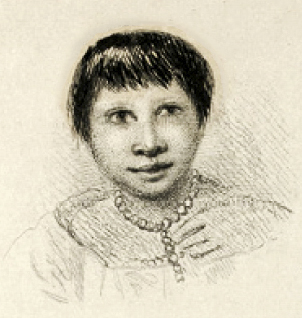
ヨクシュル(フィエギュア・バスケット)
Yokcushlu, "Fuegia
Basket," ca.1821-ca.1883
A
sketch of Yokcushlu from 1833[1]
☆
ヨクシュル(1821年頃 -
1883年頃)は、西ティエラ・デル・フエゴ出身のケウェスクアル族の女性である。1830年、9歳の時に英国船ビーグル号の乗組員に人質として連れ去ら
れ、「フエジア・バスケット」と改名された。ビーグル号の船長ロバート・フィッツロイは当初、盗まれたボートと彼女を交換するつもりだった。しかし後に、
彼女と他の3人のフエギアン(ヨーク・ミンスター、ボート・メモリー、ジェミー・ボタン)をイギリスに連れて行き、教育とキリスト教を学ばせることに決め
た。そうすれば彼らが自民族を「文明化」し、イギリス人の通訳として役立つだろうと考えたのだ。
ヨクシュルはイギリスへの航海を生き延び、英語とキリスト教の教育を受けた。ウィリアム4世とアデレード王妃の宮廷にも招かれた。1831年後半、ヨク
シュルはHMSビーグル号の二度目の航海に同行した。同乗者にはチャールズ・ダーウィンもいた。彼女は同じ捕虜だったエルパルー(「ヨーク・ミンス
ター」)と結婚し、フエゴ島へ戻った。二人はナバリノ島に置き去りにされた。エルパルーとの間に二人の子をもうけ、後にウシュアイアの英国国教会宣教所を
訪れ、トーマス・ブリッジズに自らの物語を語った。
| Yokcushlu (c. 1821 –
c. 1883) was a Kawésqar woman from the western Tierra del Fuego. In
1830, at the age of nine, she was taken hostage by the crew of the
British vessel HMS Beagle and renamed "Fuegia Basket". Robert FitzRoy,
captain of the Beagle, initially intended to trade her for a stolen
boat. He later decided to take her and three other Fuegians, "York
Minster", "Boat Memory", and "Jemmy Button", to England where they
could be educated and taught Christianity so that they might return to
"civilise" their people and serve as interpreters for the British. Yokcushlu survived the voyage to England and was educated in English and Christianity. She appeared at court before King William IV and Queen Adelaide. In late 1831, Yokcushlu embarked on the second voyage of HMS Beagle, where one of her fellow passengers was Charles Darwin. She was married to her fellow captive Elleparu ("York Minster") and returned to Tierra del Fuego where they were left on Navarino Island. She had two children with Elleparu and later visited the Ushuaia Anglican mission where she recounted her story to Thomas Bridges. |
ヨクシュル(1821年頃 -
1883年頃)は、西ティエラ・デル・フエゴ出身のケウェスクアル族の女性である。1830年、9歳の時に英国船ビーグル号の乗組員に人質として連れ去ら
れ、「フエジア・バスケット」と改名された。ビーグル号の船長ロバート・フィッツロイは当初、盗まれたボートと彼女を交換するつもりだった。しかし後に、
彼女と他の3人のフエギアン(ヨーク・ミンスター、ボート・メモリー、ジェミー・ボタン)をイギリスに連れて行き、教育とキリスト教を学ばせることに決め
た。そうすれば彼らが自民族を「文明化」し、イギリス人の通訳として役立つだろうと考えたのだ。 ヨクシュルはイギリスへの航海を生き延び、英語とキリスト教の教育を受けた。ウィリアム4世とアデレード王妃の宮廷にも招かれた。1831年後半、ヨク シュルはHMSビーグル号の二度目の航海に同行した。同乗者にはチャールズ・ダーウィンもいた。彼女は同じ捕虜だったエルパルー(「ヨーク・ミンス ター」)と結婚し、フエゴ島へ戻った。二人はナバリノ島に置き去りにされた。エルパルーとの間に二人の子をもうけ、後にウシュアイアの英国国教会宣教所を 訪れ、トーマス・ブリッジズに自らの物語を語った。 |
Early life and capture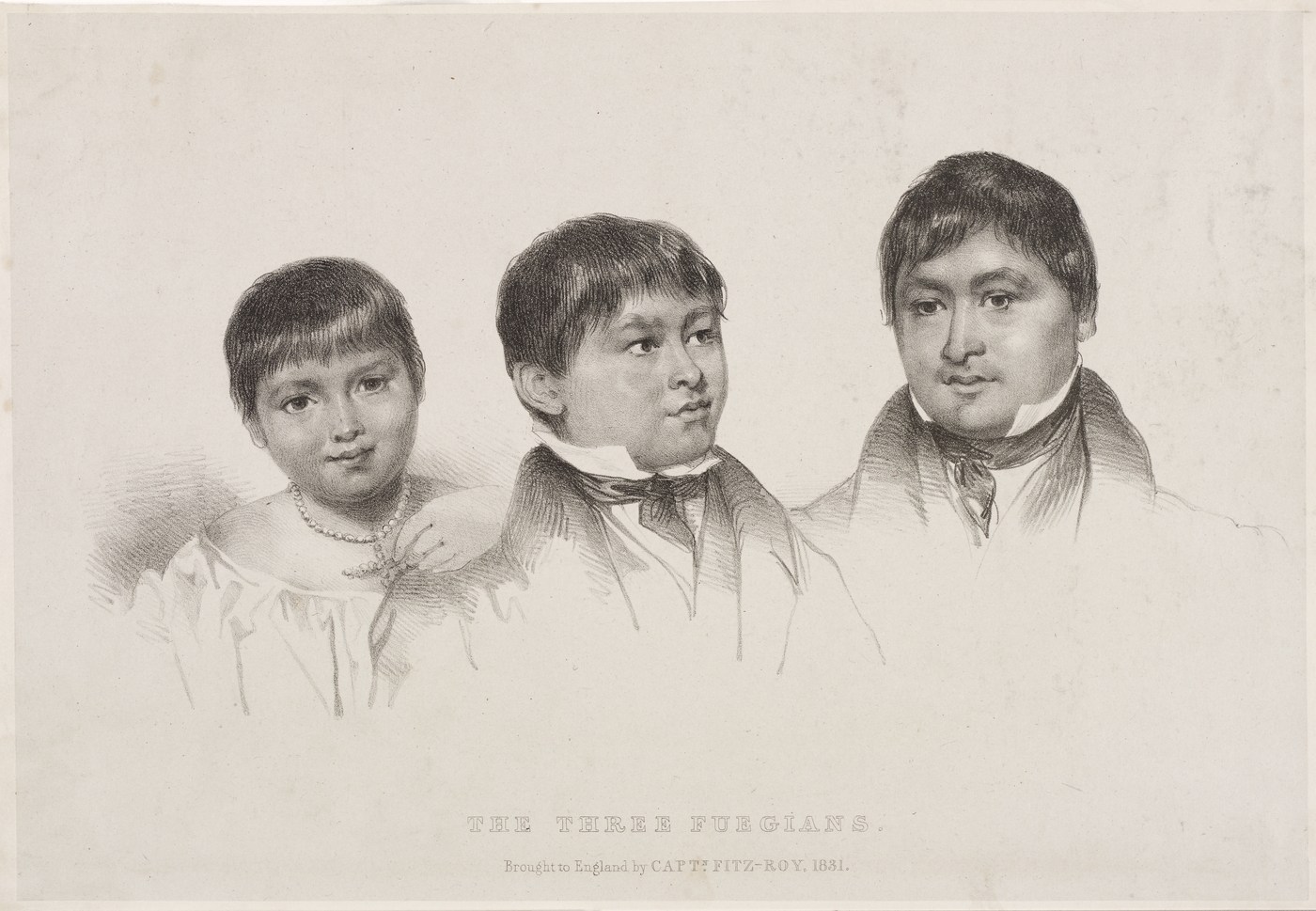 The three captive Fuegians who were taken to England on HMS Beagle: Yokcushlu (left), Orundellico, and Elleparu. Lithograph c. 1831, probably by John Hayter. Yokcushlu was born around 1821 to a Kawésqar family that lived in western Tierra del Fuego. Robert FitzRoy, captain of HMS Beagle was on a surveying mission around Tierra del Fuego in February 1830. Yokcushlu was about nine years old when the British captured her. Initially, FitzRoy and his men took several Fuegians hostage with the intention of trading them for a small survey boat that had allegedly been stolen.[2] All of the hostages escaped except for three children, including Yokcushlu. FitzRoy kept only her as hostage because he wanted to teach her English and he wrote that she seemed healthy and happy.[2] He then decided to take the captives to England where they could be educated and then returned to civilise their communities. The crew of the Beagle renamed the captives. The 26-year-old Elleparu was given the name "York Minster", a 20-year-old was named "Boat Memory", and the 14-year-old boy Orundellico was named "Jemmy Button" because he had been purchased for a button.[3] Yokcushlu was named "Fuegia Basket" because the men whose boat had been stolen had to build a makeshift coracle-like basket to get back to the Beagle.[2][a] On its voyage to England, the Beagle stopped in Montevideo, where Yokcushlu was vaccinated against smallpox and stayed with an English family. In Falmouth Harbour on the southern coast of Antigua, she was reportedly terrified after seeing a steamship.[2] |
幼少期と捕獲 イギリス海軍艦ビーグル号でイギリスに連行された3人の捕虜となったフエゴ人:ヨクシュル(左)、オランデリコ、エルパル。1831年頃の石版画、おそらくジョン・ヘイター作。 ヨクシュルは1821年頃、ティエラ・デル・フエゴ西部に住むカウェスクアル族の家庭に生まれた。1830年2月、HMSビーグル号の船長ロバート・ フィッツロイはティエラ・デル・フエゴ周辺で測量任務中だった。ヨクシュルが捕らえられた時、彼女は9歳前後であった。当初フィッツロイらは、盗まれたと される小型測量艇と引き換えに、数名のフエゴ人を人質として拘束した。[2] 人質は全員脱走したが、ヨクシュルを含む3人の子供だけが捕まった。フィッツロイは彼女だけを人質として残した。英語を教えたいと思ったからだ。彼は彼女 が健康で幸せそうだと記している。[2] その後、捕虜たちをイギリスに連れて行き、教育を受けた後、故郷に戻ってコミュニティを文明化させることに決めた。ビーグル号の乗組員は捕虜たちに新しい 名前を与えた。26歳のエレパルは「ヨーク・ミンスター」、20歳の者は「ボート・メモリー」、14歳の少年オルンデリコは「ジェミー・ボタン」と名付け られた。彼はボタン一枚で買われたからだ。[3] ヨクシュルは「フエギア・バスケット」と名付けられた。盗まれたボートの男たちが、ビーグル号に戻るために仮の筏のような籠を作らざるを得なかったから だ。[2][a] イングランドへの航海途中、ビーグル号はモンテビデオに寄港した。そこでヨクシュルは天然痘の予防接種を受け、イギリス人家庭に預けられた。アンティグア島南岸のファルマス港では、蒸気船を見て恐怖に震えたと伝えられている。[2] |
| Life in England After HMS Beagle arrived in Plymouth in September 1830, "Boat Memory" died of smallpox at the Royal Naval Hospital. Yokcushlu was exposed to measles so that she might gain immunity.[2] FitzRoy offered the captives to the British government, who did not take responsibility for them but agreed to provide assistance and a return voyage to Tierra del Fuego. The Fuegians were placed in the Church Mission Society to be "civilised" and "taught the truths of Christianity".[5] Yokcushlu, Orundellico, and Elleparu were sent to Walthamstow, where for ten months they were educated by the Reverend William Wilson, a schoolmaster, and his spouse.[6][3] In addition to lessons in religion and the English language, they were taught gardening, husbandry, and the use of common tools.[7] Captain FitzRoy, who was an aficionado of phrenology, had the heads of the three captives examined. Yokcushlu was pronounced "the most likely to become a useful member of society".[2] The three captives were granted an audience before the court during the summer of 1831. FitzRoy was questioned by King William IV about the Fuegians' lives, while Queen Adelaide was taken with Yokcushlu, gifting her a ring, one of her own bonnets, and money to purchase clothing.[3] FitzRoy was shocked when Elleparu and Yokcushlu were discovered having sex in a corner of the mission school, and was worried about the reaction of British people should Yokcushlu become pregnant. Thinking the "savages" were a demoralising factor, he advised the Admiralty that he was determined to return the captives to Tierra del Fuego.[5] |
イングランドでの生活 1830年9月、HMSビーグル号がプリマスに到着した後、「ボート・メモリー」は王立海軍病院で天然痘により死亡した。ヨクシュルは免疫を得るため、は しかに曝露された[2]。フィッツロイは捕虜たちを英国政府に引き渡したが、政府は彼らに対する責任を負わず、支援とティエラ・デル・フエゴへの帰還航海 を提供することに同意した。フエギアンたちは、教会伝道協会に預けられ、「文明化」され、「キリスト教の真理」を教えられた。ヨクシュル、オルンデリコ、 エレパルはウォルサムストウに送られ、10か月間、教師であるウィリアム・ウィルソン牧師とその妻から教育を受けた。[3] 宗教と英語の授業に加え、園芸、畜産、一般的な道具の使い方も教えられた。[7] 頭蓋骨学愛好家であったフィッツロイ船長は、3人の捕虜の頭部を検査させた。ヨクシュルは「社会で有用な人材になる可能性が最も高い」と評された。[2] 1831年の夏、3人の捕虜は宮廷で謁見を許された。フィッツロイはウィリアム4世からフエギアンの生活について質問され、アデレード王妃はヨクシュルに心を奪われ、指輪と自分のボンネット、そして衣服を購入するための金銭を彼女に贈った。[3] フィッツロイは、エルパルーとヨクシュルが宣教学校の隅で性行為をしているのを発見して衝撃を受けた。ヨクシュルが妊娠した場合の英国人の反応を懸念した のである。「野蛮人」が士気を低下させる要因だと考え、捕虜たちをティエラ・デル・フエゴへ返還する決意を海軍省に伝えた。[5] |
Second voyage of the Beagle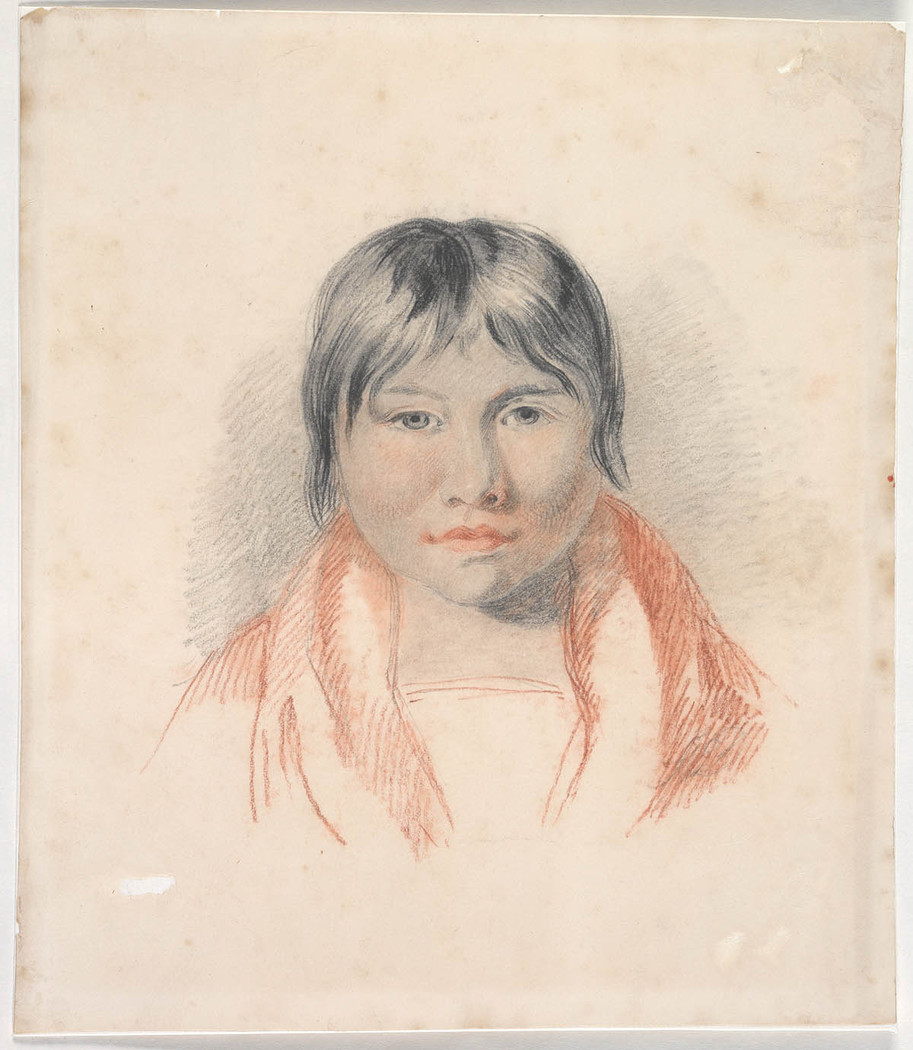 Portrait of a woman, possibly Yokcushlu, from Album of Pencil sketches, watercolours, etc. On 27 December 1831, Yokcushlu, Elleparu, and Orundellico departed England on the second voyage of HMS Beagle. The voyage was captained once again by FitzRoy, and Charles Darwin was serving as a naturalist for the expedition. During the year-long voyage south, Yokcushlu learned some Portuguese and Spanish.[3] In his journal, Darwin described her as a "nice, modest, reserved young girl, with a rather pleasing but sometimes sullen expression".[8] He characterised her as a quick learner and wrote that Elleparu was jealous of any attention directed towards Yokcushlu, who he intended to marry.[3] During the voyage, Yokcushlu was married to Elleparu. The Beagle stopped for three months in Rio de Janeiro and Yokcushlu stayed with an expatriate family there. She taught their children English while she learned Portuguese.[2] Due to poor weather, all three Fuegians were left on Navarino Island, where Orundellico had relations. Elleparu left the island with Yokcushlu on a canoe he had built, taking the supplies that were left for them. When the Beagle returned in 1834, the English crew encountered Orundellico. According to Darwin's journal, Orundellico said he had been tricked by Elleparu, who had taken all of his belongings. FitzRoy later wrote that whaling boat captains reported that Yokcushlu would climb aboard their vessels to spend the night.[5] Explorer William Parker Snow reported that Yokcushlu and Elleparu were seen in 1851.[3] |
ビーグル号の第二航海 『鉛筆スケッチ、水彩画等のアルバム』所収の女性肖像画。おそらくヨクシュルである。 1831年12月27日、ヨクシュル、エレパル、オルンデリコはビーグル号の第二航海に搭乗するためイングランドを出発した。この航海もフィッツロイが船 長を務め、チャールズ・ダーウィンが自然学者として参加した。1年にわたる南下航海の間、ヨクシュルはポルトガル語とスペイン語を少し学んだ[3]。ダー ウィンは日記の中で彼女を「上品で控えめ、内気な若い娘で、やや愛嬌があるが時折不機嫌そうな表情を見せる」と記述している。[8] ダーウィンは彼女を学習能力が高いと評価し、エッレパルがヨクシュルへの注目を妬んでいたと記している。ダーウィンはヨクシュルと結婚するつもりだった。 [3] 航海中にヨクシュルはエッレパルと結婚した。ビーグル号はリオデジャネイロに3か月停泊し、ヨクシュルは現地の移民家族と暮らした。彼女は彼らの子供たち に英語を教えながら、ポルトガル語を学んだ。[2] 悪天候のため、3人のフエギアンは全員ナバリノ島に残された。オルンデリコには同島に親族がいた。エルパルーはヨクシュルと共に、オルンデリコが自作した カヌーで島を離れ、残されていた物資を持ち去った。1834年にビーグル号が再訪した際、英国人乗組員はオルンデリコと遭遇した。ダーウィンの航海日誌に よれば、オルンデリコはエッレパルに騙され、全ての所持品を奪われたと語った。フィッツロイは後に、捕鯨船の船長たちがヨクシュルが船に乗り込んで夜を明 かすと報告したと記している。[5] 探検家ウィリアム・パーカー・スノーは、1851年にヨクシュルとエッレパルが目撃されたと報告している。[3] |
| Later life and legacy Yokcushlu had two children with Elleparu. After he died, she married a younger man. In 1873, she paid a visit to the Ushuaia Mission in the Beagle Channel. Though she had forgotten much of her English, she spoke to Anglican missionary Thomas Bridges. She recounted her experiences on the Beagle and the death of Elleparu. Bridges encountered her again in 1883 when he travelled to the western part of Tierra del Fuego. Yokcushlu was said to be "frail and unhappy, nearing the end of her life".[2] A street in Ushuaia, Argentina is named Fuegia Basket for her.[9] |
晩年と遺産 ヨクシュルはエレパルとの間に二人の子をもうけた。彼の死後、彼女は年下の男性と再婚した。1873年、彼女はビーグル海峡のウシュアイア伝道所を訪れ た。英語の大半は忘れていたが、英国国教会の宣教師トーマス・ブリッジズと会話を交わした。ビーグル号での体験とエレパルの死について語ったのである。ブ リッジズは1883年、ティエラ・デル・フエゴ西部に赴いた際、再び彼女と出会った。ヨクシュルは「衰弱し、不幸で、死期が迫っている」と言われていた。 [2] アルゼンチンのウシュアイアには、彼女にちなんで「フエギア・バスケット」と名付けられた通りがある。[9] |
| List of kidnappings |
誘拐のリスト |
| Notes a. Other accounts say that the name "Fuegia Basket" was for her homeland and her only possession.[4] |
注記 a. 他の記録によれば、「フエギア・バスケット」という名は彼女の故郷と、彼女が持っていた唯一の持ち物に由来すると言う。[4] |
| References 01 'Fuegians' in The narrative of the voyages of H.M. Ships Adventure and Beagle. Vol.2. FitzRoy, R. 1839. Proceedings of the second expedition, 1831-36. 'Fuegians' [plate] pp.324-325 "Yokcushlu (Fuegia Basket)". Darwin Correspondence Project. 13 October 2017. Archived from the original on 1 August 2023. Retrieved 31 July 2023. McConnell, Anita (23 September 2004). "Early non-western European visitors to the British Isles (c. 1500–1855)". In Ingram, Anders (ed.). Oxford Dictionary of National Biography (online ed.). Oxford University Press. doi:10.1093/ref:odnb/72137. ISBN 978-0-19-861412-8. (Subscription, Wikipedia Library access or UK public library membership required.) Toumey, Christopher P. (October 1987). "Jemmy Button". The Americas. 44 (2): 196. doi:10.2307/1007290. JSTOR 1007290. S2CID 251414437. 05. Trifilo, S. Samuel (1 August 1960). "Darwin and the Second Beagle Expedition in Tierra del Fuego". Pacific Historical Review. 29 (3): 223–224, 229. doi:10.2307/3636161. JSTOR 3636161. Archived from the original on 1 August 2023. Retrieved 1 August 2023. Smith, Larry Douglas (1990). "Fitzroy and the Fuegians: A Clash of Cultures". Anglican and Episcopal History. 59 (3): 394–399. ISSN 0896-8039. JSTOR 42610428. Archived from the original on 1 August 2023. Retrieved 1 August 2023. Kuper, Adam (2010). "The Original Sin of Anthropology". Paideuma. 56: 124. JSTOR 41410362. Archived from the original on 1 August 2023. Retrieved 1 August 2023. Darwin, Charles (1839). The Voyage of the Beagle. Archived from the original on 1 August 2023. Retrieved 1 August 2023. 09. "La calle Fuegia Basket fue habilitada para la circulación". Radio Universidad (in Spanish). 11 January 2021. Archived from the original on 1 August 2023. Retrieved 1 August 2023. |
参考文献 01 『アドベンチャー号とビーグル号航海記』第2巻。フィッツロイ、R. 1839年。第2次探検航海記録、1831-36年。『フエギアン』[図版]pp.324-325 「ヨクシュル(フエギアの籠)」。ダーウィン書簡プロジェクト。2017年10月13日。2023年8月1日にオリジナルからアーカイブ。2023年7月31日に取得。 マッコンネル、アニタ(2004年9月23日)。「イギリス諸島への初期の非西欧系訪問者(約1500-1855年)」。イングラム、アンダース(編)。 オックスフォード国家人物事典(オンライン版)。オックスフォード大学出版局。doi:10.1093/ref:odnb/72137。ISBN 978-0-19-861412-8。(購読、ウィキペディア図書館アクセス、または英国公共図書館会員資格が必要)。 トゥーミー、クリストファー・P.(1987年10月)。「ジェミー・ボタン」。アメリカ大陸誌。44 (2): 196. doi:10.2307/1007290. JSTOR 1007290. S2CID 251414437. 05. トリフィロ、S. サミュエル(1960年8月1日)。「ダーウィンとビーグル号第二航海におけるティエラ・デル・フエゴ」『パシフィック・ヒストリカル・レビュー』29巻 3号: 223–224, 229頁. doi:10.2307/3636161. JSTOR 3636161. 2023年8月1日時点のオリジナルからアーカイブ. 2023年8月1日閲覧. スミス、ラリー・ダグラス(1990年)。「フィッツロイとフエゴ人:文化の衝突」。『英国国教会史』。59巻3号:394–399頁。ISSN 0896-8039。JSTOR 42610428。2023年8月1日時点のオリジナルからアーカイブ。2023年8月1日取得。 クーパー、アダム(2010)。「人類学の原罪」。『パイデウマ』。56: 124。JSTOR 41410362。2023年8月1日にオリジナルからアーカイブ。2023年8月1日取得。 ダーウィン、チャールズ(1839)。ビーグル号航海記。2023年8月1日にオリジナルからアーカイブ。2023年8月1日に取得。 09. 「フエギア・バスケット通りが通行可能に」。ラジオ・ウニベルシダッド(スペイン語)。2021年1月11日。2023年8月1日にオリジナルからアーカイブ。2023年8月1日に取得。 |
| https://en.wikipedia.org/wiki/Yokcushlu |
|
リ ンク
文 献
そ の他の情報
CC
Copyleft,
CC, Mitzub'ixi Quq Chi'j, 1996-2099