アウレオラ
Aureola [光
輪]
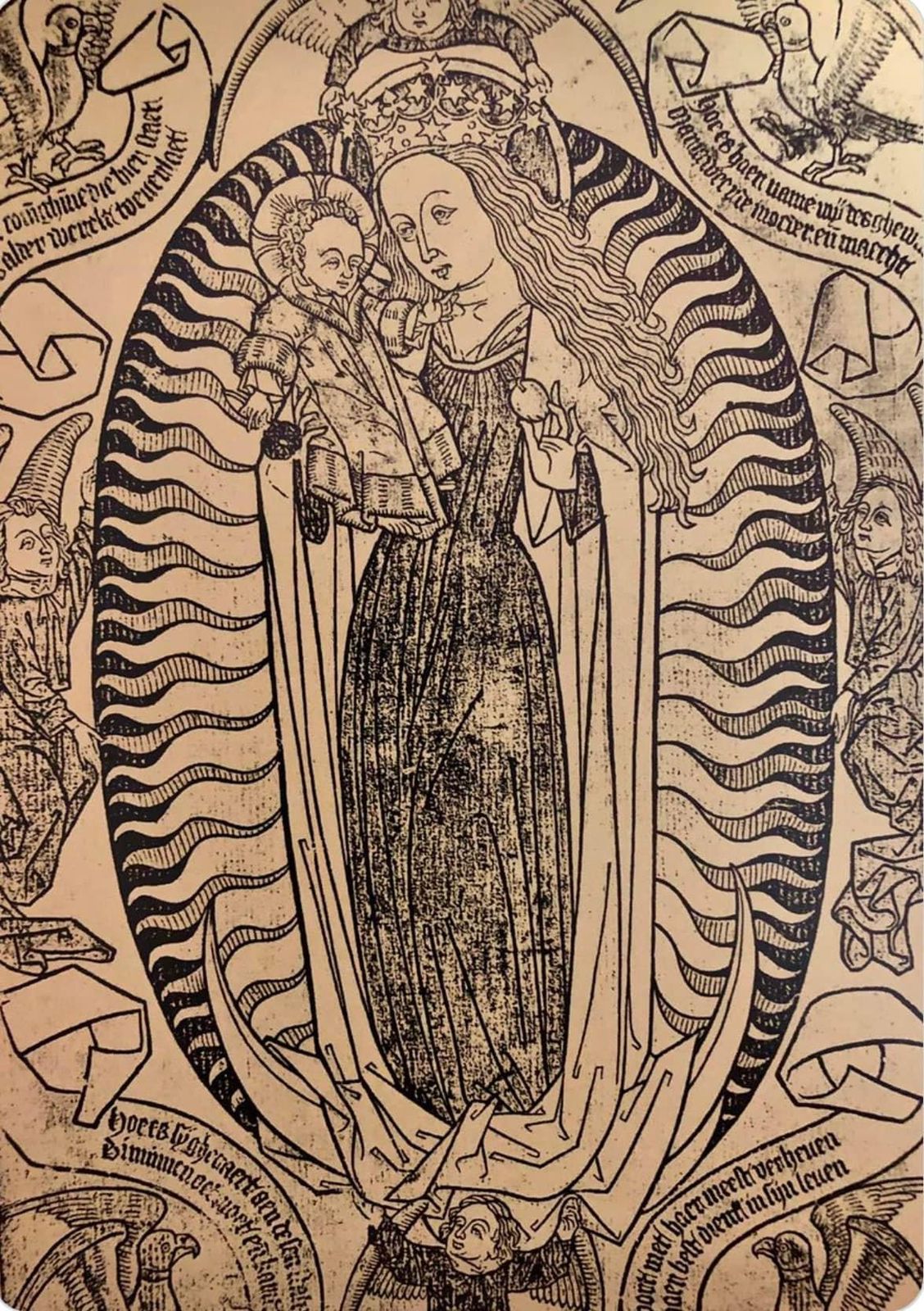
1420年ごろ、ベルリンで印刷された「栄光の聖母像」作者不明、ロンドン・ワーブルグ研究所所蔵[→我々の聖母グアダルーペ]
☆オーロラ[aureola] あるいはオーロレ(ラテン語の「黄金の」を意味するaureaの縮小形)とは、聖なる人物の絵画において、その全身を包む輝く雲の輝きを指す。ロマンス語 では、名詞「アウレオラ」は通常、聖なる人物の頭部を囲む光の円盤を指す。これは英語で「ハロー」または「ニンバス」と呼ばれる。インドの宗教では、背中 や頭部のハローは「プラバーマンダラ」または「プラバーヴァリ」と呼ばれる。
| An aureola or aureole (diminutive
of Latin aurea, "golden") is the radiance of luminous cloud which, in
paintings of sacred personages, surrounds the whole figure. In Romance languages, the noun Aureola is usually more related to the disc of light surrounding the head of sacred figures, which in English is called halo or nimbus. In Indian religions, the back or head halo is called prabhāmaṇḍala or prabhavali. |
オーロラあるいはオーロレ(ラテン語の「黄金の」を意味するaureaの縮小形)とは、聖なる人物の絵画において、その全身を包む輝く雲の輝きを指す。 ロマンス語では、名詞「アウレオラ」は通常、聖なる人物の頭部を囲む光の円盤を指す。これは英語で「ハロー」または「ニンバス」と呼ばれる。インドの宗教では、背中や頭部のハローは「プラバーマンダラ」または「プラバーヴァリ」と呼ばれる。 |
| In art In the earliest periods of Christian art it was confined to the figures of the persons of the Christian Godhead,[citation needed] but it was afterwards extended to the Virgin Mary and to several of the saints. The aureola, when enveloping the whole body, generally appears oval or elliptical in form, but occasionally depicted as circular, vesica piscis, or quatrefoil. When it appears merely as a luminous disk round the head, it is called specifically a halo or nimbus, while the combination of nimbus and aureole is called a glory. The strict distinction between nimbus and aureole is not commonly maintained, and the latter term is most frequently used to denote the radiance round the heads of saints, angels or Persons of the Trinity. This is not to be confused with the specific motif in art of the Christ Child appearing to be a source of light in a Nativity scene. These depictions derive directly from the accounts given by Saint Bridget of Sweden of her visions, in which she describes seeing this.[1] Development The nimbus in Christian art first appeared in the 5th century, but practically the same motif was known from several centuries earlier, in pre-Christian Hellenistic art. It is found in some Persian representations of kings and gods, and appears on coins of the Kushan kings Kanishka, Huvishka and Vasudeva, as well as on most representations of the Buddha in Greco-Buddhist art from the 1st century AD. Its use has also been traced through the Egyptians to the ancient Greeks, representations of Trajan (arch of Constantine) and Antoninus Pius (reverse of a medal) being found with it. Roman emperors were sometimes depicted wearing a radiant crown, with pointed rays intended to represent the rays of the sun. In the circular form the nimbus constitutes a natural and even primitive use of the idea of a crown,[citation needed] modified by an equally simple idea of the emanation of light from the head of a superior being, or by the meteorological phenomenon of a halo. The probability is that all later associations with the symbol refer back to an early astrological origin (compare Mithras), the person so glorified being identified with the sun and represented in the sun's image; so the aureole is the Hvareno of Mazdaism.[2][3] From this early astrological use, the form of "glory" or "nimbus" has been adapted or inherited under new beliefs. |
美術において キリスト教美術の初期段階では、キリスト教の神格の個人に限定されていた[出典必要]が、後に聖母マリアや複数の聖人にも拡大された。 光輪が全身を包む場合、一般に楕円形または卵形に見えるが、円形、魚の膀胱形、四葉形として描かれることもある。 頭部周囲に光る円盤として現れる場合、特にハロー(光輪)またはニンバスと呼ばれる。ニンバスとアウレオラの組み合わせはグローリー(栄光)と呼ばれる。 ニンバスとアウレオラの厳密な区別は一般的ではなく、後者の用語は聖人、天使、または三位一体の神格の頭部周囲の輝きを指すのに最も頻繁に用いられる。 これは、キリスト降誕の場面で光の発信源のように見える幼子キリストの特定の芸術的モチーフと混同してはならない。これらの描写は、聖ブリギッタが自身の幻視について記した記述に直接由来するもので、彼女はそこでこの光景を目撃したと述べている[1]。 発展 キリスト教美術におけるニムバスは5世紀に初めて登場したが、実質的に同一のモチーフは数世紀前のキリスト教以前のヘレニズム美術にも見られる。ペルシャ の王や神々の表現の一部に見られ、クシャーナ朝の王カニシカ、フヴィシュカ、ヴァスデヴァの硬貨にも描かれている。また紀元1世紀以降のギリシャ風仏教美 術における仏陀の表現の大半にも見られる。その使用はエジプト人を経て古代ギリシャ人にも遡ることが確認されており、トラヤヌス帝(コンスタンティヌスの 凱旋門)やアントニヌス・ピウス帝(メダル裏面)の像にも見られる。ローマ皇帝は時に放射状の光を放つ冠を戴いた姿で描かれ、その尖った光線は太陽の光を 表す意図があった。 円形のニムバスは、冠の概念を自然かつ原始的に用いたものであり[出典必要]、優れた存在の頭部から発せられる光という同様に単純な概念、あるいは気象現 象であるハローによって修正されたものである。この象徴が後に持つようになったあらゆる関連性は、おそらく初期の占星術的起源(ミトラ教と比較せよ)に遡 る。かくして栄光に包まれた人格は太陽と同一視され、太陽の形象で表される。したがって光輪はマズダ教のフヴァレノである[2][3]。この初期の占星術 的用法から、「栄光」あるいは「ニムバス」の形態は新たな信仰のもとで適応され、あるいは継承されてきたのである。 |
| Mandorla Main article: Mandorla 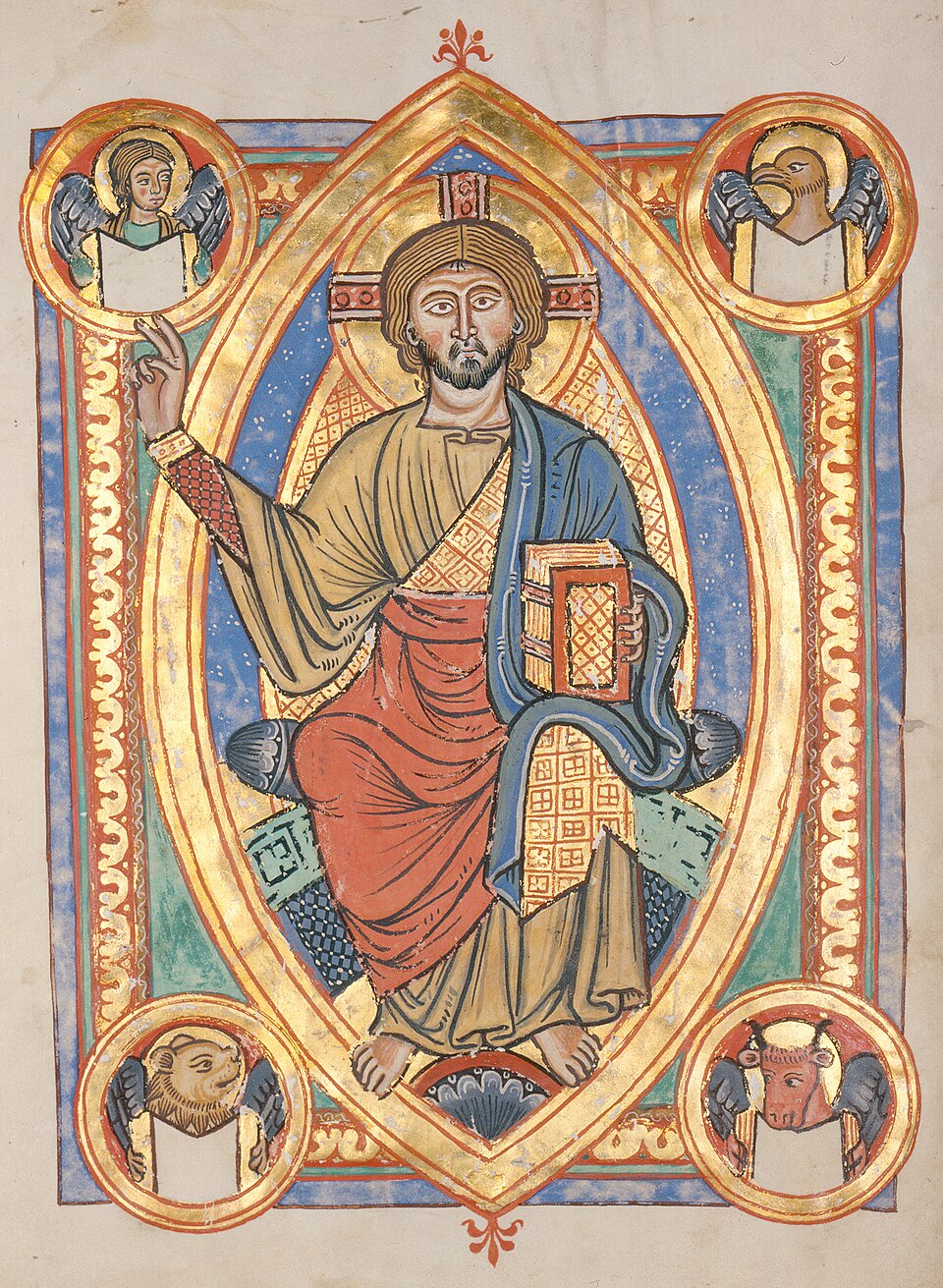 Christ in Majesty shown within a mandorla shape in a medieval illuminated manuscript A mandorla is a vesica piscis shaped aureola which surrounds the figures of Christ and the Virgin Mary in traditional Christian art.[4] It is commonly used to frame the figure of Christ in Majesty in early medieval and Romanesque art, as well as Byzantine art of the same periods. The term refers to the almond like shape: "mandorla" means almond nut in Italian. In icons of the Eastern Orthodox Church, the mandorla is used to depict sacred moments which transcend time and space, such as the Resurrection, Transfiguration, and the Ascension. These mandorla will often be painted in several concentric patterns of color which grow darker as they come close to the center. This is in keeping with the church's use of Apophatic theology, as described by Dionysius the Areopagite and others. As holiness increases, there is no way to depict its brightness, except by darkness. In a famous romanesque fresco of Christ in Glory at Sant Climent de Taüll, the inscription "Ego Sum Lux Mundi" ("I Am the Light of the World") is incorporated in the Mandorla design.[5] The tympanum at Conques has Christ, with a gesture carved in romanesque sculpture, indicate the angels at his feet bearing candlesticks. Six surrounding stars, resembling blossoming flowers, indicate the known planets including the Moon. Here the symbolism implies Christ as the Sun.[6] In one special case, at Cervon (Nièvre), Christ is seated surrounded by eight stars, resembling blossoming flowers. At Conques the flowers are six-petalled. At Cervon, where the almond motif is repeated in the rim of the mandorla, they are five-petalled, as are almond flowers -the first flowers to appear at the end of winter, even before the leaves of the almond tree. Here one is tempted to seek for reference in the symbolism of the nine branched Chanukkiyah candelabrum. In the 12th century a great school of Judaic thought radiated from Narbonne, coinciding with the origins of the Kabbalah.[7] Furthermore, at Cervon the eight star/flower only is six petalled: the Root of David, the Morningstar, mentioned at the close of Book of Revelation (22:16) [8] (In one of the oldest manuscripts of the complete Hebrew Bible, the Leningrad Codex, one finds the Star of David imbedded in an octagon.) In the symbolism of Hildegarde von Bingen the mandorla refers to the Cosmos.[9] |
マンドルラ 主な記事: マンドルラ 中世の装飾写本に描かれた、マンドルラの形の中に示された威厳あるキリスト マンドルラとは、伝統的なキリスト教美術においてキリストや聖母マリアの像を囲む、魚の膀胱(ベシカ・ピシス)の形をした光輪である[4]。中世初期やロ マネスク美術、同時代のビザンチン美術において、威厳あるキリストの像を囲む枠として一般的に用いられる。この用語はアーモンドのような形状に由来する。 「マンドルラ」はイタリア語でアーモンドの実を意味する。東方正教会のイコンでは、復活、変容、昇天など時空を超越した聖なる瞬間を描くためにマンドルラ が用いられる。これらのマンドルラは中心に近づくほど色が濃くなる複数の同心円状の色彩パターンで描かれることが多い。これはディオニュシオス・アレオパ ギテスらが説いた否定神学の教会的運用に沿うものだ。聖性が極大化するほど、その輝きを表現する手段は暗闇以外には存在しない。 サン・クリメント・デ・タウルの栄光のキリストを描いた有名なロマネスク様式のフレスコ画では、「エゴ・スム・ルクス・ムンディ」(「私は世の光である」)という銘文がマンドルラのデザインに組み込まれている。[5] コンク教会のティンパヌムには、ロマネスク彫刻特有の姿勢で、足元に燭台を持つ天使たちを指し示すキリストが刻まれている。周囲を囲む六つの星は開花した花に似ており、月を含む既知の惑星を示している。ここでの象徴は、キリストを太陽として示唆している。[6] セルヴォン(ニエーヴル県)の特殊な例では、開花した花に似た八つの星に囲まれて座るキリストが表現されている。コンクでは花は六弁である。マンダラの縁 にアーモンドのモチーフが繰り返されるセルヴォンでは、アーモンドの花と同様に五弁である。アーモンドの花は冬の終わりに最初に咲き、葉よりも先に現れ る。ここでは九枝のハヌキヤ燭台(ハヌキヤ)の象徴性への言及を探りたくなる。12世紀、ナルボンヌからユダヤ思想の偉大な学派が放射状に広がり、カバラ の起源と時期を同じくした[7]。さらにセルヴォンでは、八つの星/花のモチーフのみが六弁である。これは『ヨハネの黙示録』の終結部(22:16)に言 及される「ダビデの根、明けの明星」である。[8] (ヘブライ語聖書最古写本の一つ、レニングラード写本には八角形に埋め込まれたダビデの星が確認される。) ヒルデガルド・フォン・ビンゲンの象徴体系において、マンドーラは宇宙を指す。[9] |
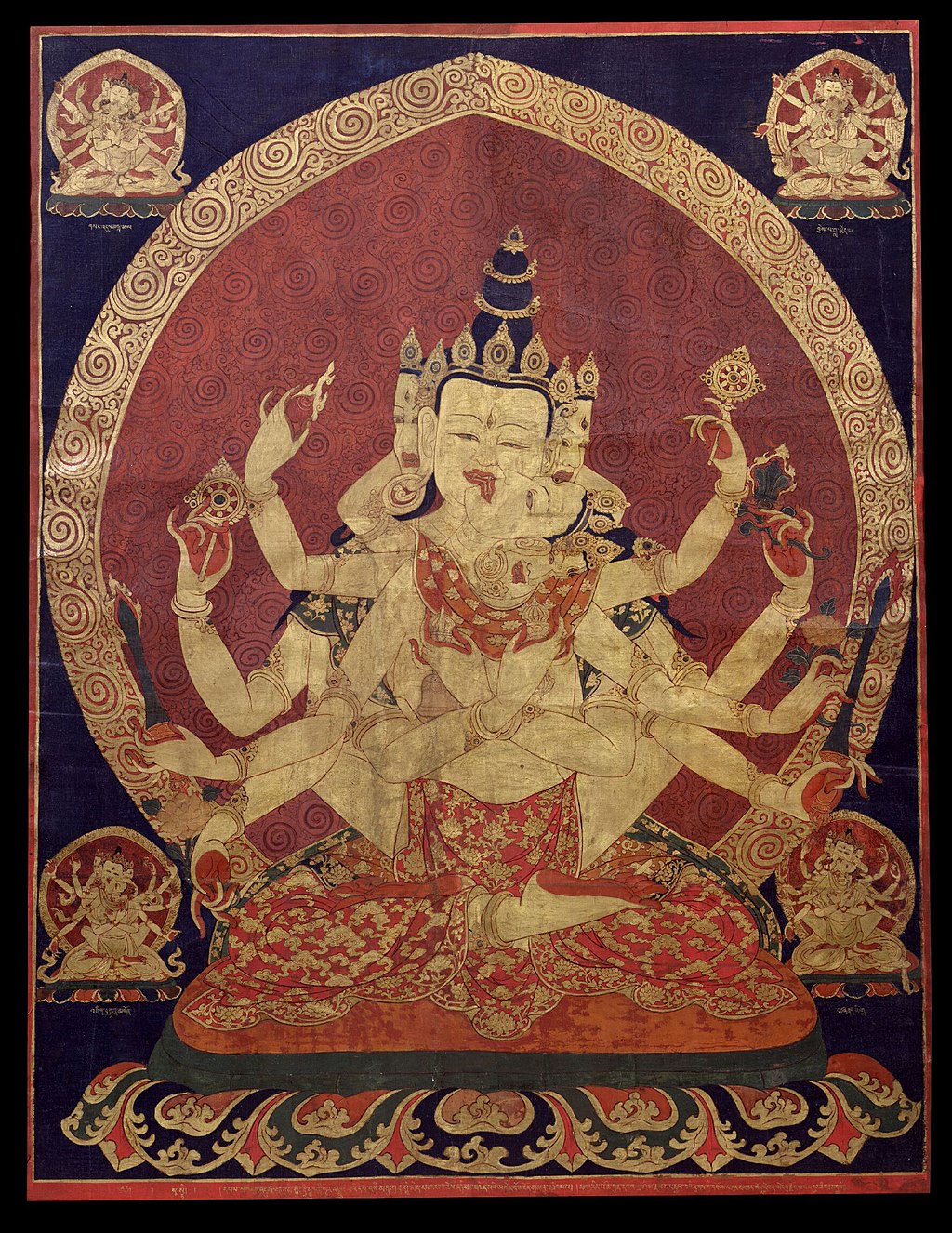 17th century Central Tibetan thanka of Guhyasamaja Akshobhyavajra, Rubin Museum of Art |
17世紀中央チベットの秘密聖会金剛のタンカ、ルービン美術館所蔵 |
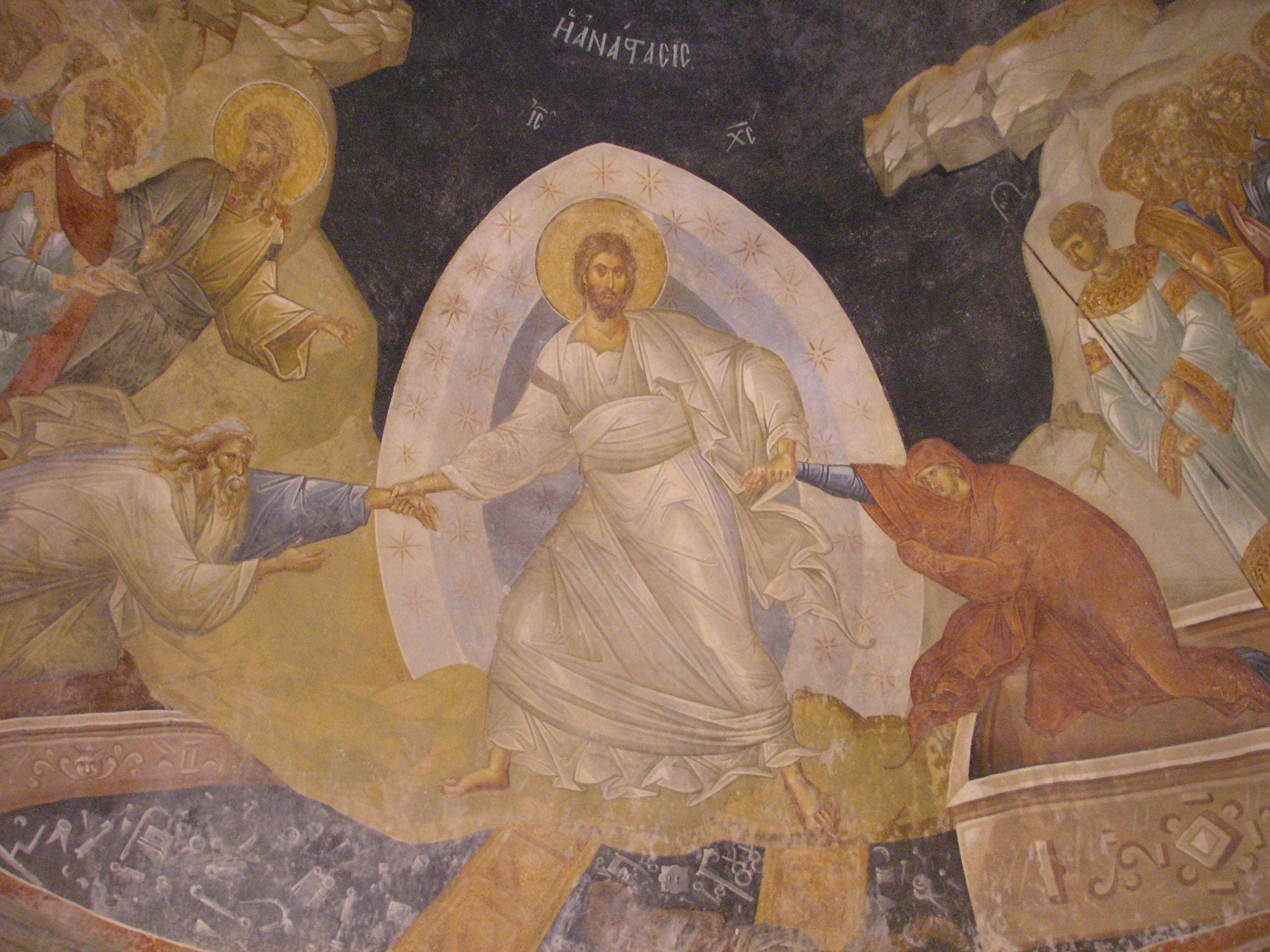 Resurrection of Christ, fresco in Chora Church, Istanbul |
キリストの復活、イスタンブールのホラ教会にあるフレスコ画 |
| Aureole (atmospheric phenomenon) Main articles: Corona (optical phenomenon) and Glory (optical phenomenon) In meteorology, an aureole is the inner disk of a corona, an optical phenomenon produced by the diffraction of light from the Sun or the Moon (or, occasionally, other bright light sources)[10] by individual small water droplets and sometimes tiny ice crystals of a cloud or on a foggy glass surface.[11][12] The aureole is often (especially in case of the Moon) the only visible part of the corona and has the appearance of a bluish-white disk which fades to reddish-brown towards the edge. |
オーロラ(大気現象) 主な記事:コロナ(光学現象)とグローリー(光学現象) 気象学において、オーロラとはコロナの内側の円盤を指す。コロナは太陽や月(時には他の明るい光源)からの光が、雲中の微小な水滴や時に微細な氷晶、ある いは曇ったガラス表面によって回折されることで生じる光学現象である[10]。[11][12] アウレオールは(特に月において)コロナの中で唯一見える部分であることが多く、青みがかった白色の円盤のように見え、縁に向かって赤褐色に薄れていく。 |
| Halo Aureole effect Crown of Immortality Five Crowns |
ハロー 光輪効果 不死の冠 五つの冠 |
| References 1. Schiller, G. (1971). Iconography of Christian Art. Vol. I. London: Lund Humphries. pp. 76–78 & figs. ISBN 0-85331-270-2. 2. Ramsden, E. H. (April 1941). "The Halo: A Further Enquiry into Its Origin". The Burlington Magazine for Connoisseurs. 78 (45). The Burlington Magazine Publications, Ltd.: 131. JSTOR 868232. 3. "Aureola" . Encyclopædia Britannica. Vol. 2 (11th ed.). 1911. p. 924. 4. Liungman, Carl G. (1991). Dictionary of Symbols. W.W. Norton. p. 287. ISBN 0-393-31236-4. 5. Arrimada, Javier (2010). "Conjunt iconogràfic de Sant Climent de Taüll" (in Spanish). Archived from the original on 25 October 2020. 6. Image 7. Scholem, Gershom (1990). Origins of the Kabbalah. Princeton Paperback. ISBN 0-691-07314-7. 8. Image 9. Riedel, Ingrid (1994). Hildegard von Bingen, Prophetin der kosmischen Weisheit. Kreuz Verlag, Zürich. 10. Cowley, Les (2012). "Jupiter corona from Iran". Atmospheric Optics. Retrieved 2016-05-02. 11. Calvert, J. B. "The Corona". Archived from the original on 16 June 2019. Retrieved 22 November 2025. 12. Cowley, Les (16 December 2024). "Coronae: A Phenomenon of Light and Color in the Sky". Atmospheric Optics. Retrieved 22 November 2025. |
参考文献 1. シーラー, G. (1971). 『キリスト教美術図像学』第1巻. ロンドン: ランド・ハンフリーズ. pp. 76–78 & 図版. ISBN 0-85331-270-2. 2. ラムズデン, E. H. (1941年4月). 「後光:その起源に関するさらなる考察」. 『バーリントン・マガジン・フォー・コンノイサーズ』78巻45号。バーリントン・マガジン出版株式会社:131頁。JSTOR 868232。 3. 「アウレオラ」『ブリタニカ百科事典』第2巻(第11版)。1911年。924頁。 4. リュングマン、カール・G. (1991). 『シンボル辞典』. W.W.ノートン. p. 287. ISBN 0-393-31236-4. 5. アリマダ、ハビエル (2010). 「サン・クリメント・デ・タウルの図像学的集合体」(スペイン語)。2020年10月25日にオリジナルからアーカイブ。 6. 画像 7. ショレム、ゲルショム(1990)。『カバラの起源』。プリンストンペーパーバック。ISBN 0-691-07314-7。 8. 画像 9. リデル、イングリッド(1994)。『ヒルデガルト・フォン・ビンゲン、宇宙の知恵の預言者』。クロイツ出版社、チューリッヒ。 10. カウリー、レス(2012)。「イランからの木星コロナ」。『大気光学』。2016年5月2日に取得。 11. カルバート、J. B. 「コロナ」. 2019年6月16日時点のオリジナルからアーカイブ. 2025年11月22日閲覧. 12. カウリー、レス (2024年12月16日). 「コロナ:空に現れる光と色の現象」. 『大気光学』. 2025年11月22日閲覧. |
| Further reading Timmers, J. J. M. (1969). A Handbook of Romanesque Art. New York, London: Icon Editions, Harper and Row. de Champéaux, Gérard; Sterckx, Dom Sébastièn (1966). Symboles, introduction à la nuit des temps 3 (in French). Paris: Zodiaque (printed: Cum Permissu Superiorum). Didron, Adolphe Napoléon (1886). Christian iconography or, the history of Christian art in the Middle Ages. Vol. I. London: George Bell & Sons. Young, Brian (1990). The Villein's Bible; stories in romanesque carving. London: Barry & Jenkins. Cook, Roger (1974). The Tree of Life: Image for the Cosmos. New York: Avon Books. Parry, Ken; Melling, David, eds. (1999). The Blackwell Dictionary of Eastern Christianity. Malden, MA.: Blackwell Publishing. ISBN 0-631-23203-6. |
追加文献(さらに読む) ティマース、J. J. M. (1969). 『ロマネスク美術ハンドブック』. ニューヨーク、ロンドン: アイコン・エディションズ、ハーパー・アンド・ロウ. ド・シャンポー、ジェラール; ステルクス、ドム・セバスティアン (1966). 『シンボル、太古の夜への序説』3 (フランス語). パリ:ゾディアック(印刷:Cum Permissu Superiorum)。 ディドロン、アドルフ・ナポレオン(1886)。キリスト教の図像学、あるいは中世におけるキリスト教美術の歴史。第 I 巻。ロンドン:ジョージ・ベル&サンズ。 ヤング、ブライアン(1990)。農奴の聖書、ロマネスク彫刻に刻まれた物語。ロンドン:バリー&ジェンキンズ。 クック、ロジャー(1974)。『生命の木:宇宙のイメージ』。ニューヨーク:エイボン・ブックス。 パリー、ケン;メリング、デビッド、編(1999)。『ブラックウェル東洋キリスト教辞典』。マールデン、マサチューセッツ州:ブラックウェル出版。ISBN 0-631-23203-6。 |
| https://en.wikipedia.org/wiki/Aureola |
リ ンク
文 献
そ の他の情報
CC

Copyleft,
CC, Mitzub'ixi Quq Chi'j, 1996-2099