司法人類学
Forensic
Anthropology
★司法人類学あるいは法人類学/法医学人類学(Forensic anthropology)は、人類学の成果――とりわけ形質人 類学や自然人類学――を司法領域での応用につかうための学問である。例えば、事件性のある死体の司法解剖や、犯罪巻き込まれた死体や身体の形状を観察した り して、裁判過程に、その客観的資料(データ)を人類学的観点から正しく証明するための基礎学問のことをさす。
☆司法人類学[Forensic anthropology] とは、解剖学的な人類学とその様々な分野、例えば司法考古学や司法埋葬学などを法的状況に適用する学問である。司法人類学者は、飛行機事故などで発生する 可能性のある、腐敗・焼損・切断・その他の理由で識別不能な遺体の身元確認を支援できる。また、ジェノサイドや集団埋葬地の調査・記録においても重要な役 割を果たす。司法病理学者、司法歯科医、殺人捜査官と同様に、司法人類学者も法廷で専門家証人として証言することが多い。骨格に存在する身体的特徴から、 司法人類学者は個人の年齢、性別、身長、人種を特定できる可能性がある。身体的特徴の特定に加え、司法人類学者は骨格の異常を利用して、死因、骨折や医療 処置などの過去の外傷、骨癌などの疾病を特定できる可能性がある。 骨格から個人を特定する手法は、過去の人類学者たちの研究成果と、人間の骨格の差異に関する研究に基づいている。数千の標本の収集と集団内の差異分析を通 じて、身体的特徴に基づく推定が可能となる。これにより、遺骨の特定が実現する可能性がある。司法人類学の分野は20世紀に発展し、訓練を受けた人類学者 や、腐敗過程とそれが骨格に及ぼす影響に関するデータを収集する数多くの研究機関が関わる、完全に認知された司法専門分野へと成長した(→デジタル・フォレンジック)。
| Forensic
anthropology is the application of the anatomical science of
anthropology and its various subfields, including forensic archaeology
and forensic taphonomy,[1] in a legal setting. A forensic
anthropologist can assist in the identification of deceased individuals
whose remains are decomposed, burned, mutilated or otherwise
unrecognizable, as might happen in a plane crash. Forensic
anthropologists are also instrumental in the investigation and
documentation of genocide and mass graves. Along with forensic
pathologists, forensic dentists, and homicide investigators, forensic
anthropologists commonly testify in court as expert witnesses. Using
physical markers present on a skeleton, a forensic anthropologist can
potentially determine a person's age, sex, stature, and race. In
addition to identifying physical characteristics of the individual,
forensic anthropologists can use skeletal abnormalities to potentially
determine cause of death, past trauma such as broken bones or medical
procedures, as well as diseases such as bone cancer. The methods used to identify a person from a skeleton relies on the past contributions of various anthropologists and the study of human skeletal differences. Through the collection of thousands of specimens and the analysis of differences within a population, estimations can be made based on physical characteristics. Through these, a set of remains can potentially be identified. The field of forensic anthropology grew during the twentieth century into a fully recognized forensic specialty involving trained anthropologists as well as numerous research institutions gathering data on decomposition and the effects it can have on the skeleton. |
司法人類学[Forensic
anthropology]とは、解剖学的な人類学とその様々な分野、例えば司法考古学
や司法埋葬学などを法的状況に適用する学問である。司法人類学者は、飛行機事故などで発生する可能性のある、腐敗・焼損・切断・その他の理由で識別不能な
遺体の身元確認を支援できる。また、ジェノサイドや集団埋葬地の調査・記録においても重要な役割を果たす。司法病理学者、司法歯科医、殺人捜査官と同様
に、司法人類学者も法廷で専門家証人として証言することが多い。骨格に存在する身体的特徴から、司法人類学者は個人の年齢、性別、身長、人種を特定できる
可能性がある。身体的特徴の特定に加え、司法人類学者は骨格の異常を利用して、死因、骨折や医療処置などの過去の外傷、骨癌などの疾病を特定できる可能性
がある。 骨格から個人を特定する手法は、過去の人類学者たちの研究成果と、人間の骨格の差異に関する研究に基づいている。数千の標本の収集と集団内の差異分析を通 じて、身体的特徴に基づく推定が可能となる。これにより、遺骨の特定が実現する可能性がある。司法人類学の分野は20世紀に発展し、訓練を受けた人類学者 や、腐敗過程とそれが骨格に及ぼす影響に関するデータを収集する数多くの研究機関が関わる、完全に認知された司法専門分野へと成長した。 |
Modern uses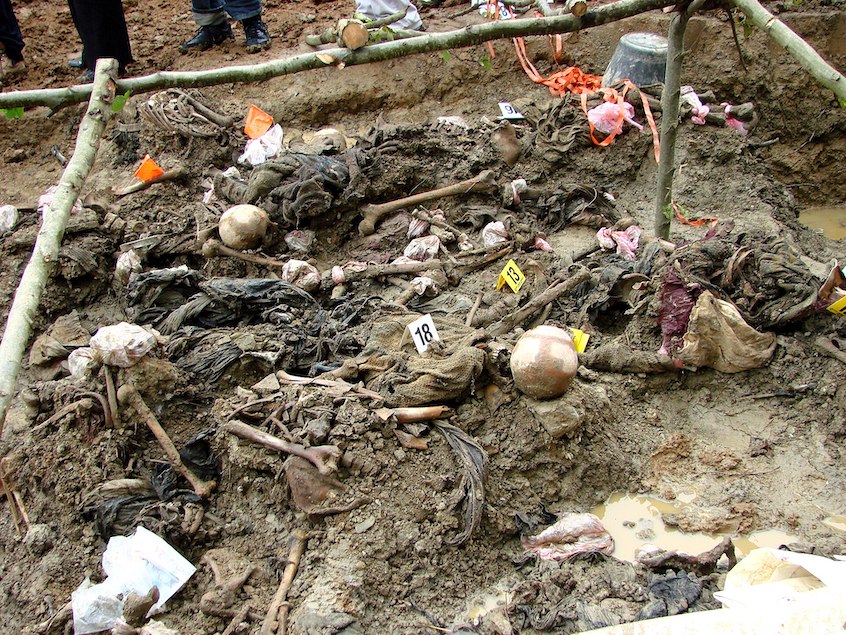 Exhumed bodies of victims of the 1995 Srebrenica Genocide in a mass grave found in 2007. Today, forensic anthropology is a well-established discipline within the forensic field. Anthropologists are called upon to investigate remains and to help identify individuals from bones when other physical characteristics that could be used to identify a body no longer exist. Forensic anthropologists work in conjunction with forensic pathologists to identify remains based on their skeletal characteristics. If the victim is not found for a lengthy period or has been eaten by scavengers, flesh markers used for identification would be destroyed, making normal identification difficult if not impossible. Forensic anthropologists can provide physical characteristics of the person to input into missing person databases such as that of the National Crime Information Center in the US[2] or INTERPOL's yellow notice database.[3] In addition to these duties, forensic anthropologists often assist in the investigation of war crimes and mass fatality investigations. Anthropologists have been tasked with helping to identify victims of the 9/11 terrorist attacks,[4] as well as plane crashes such as the Arrow Air Flight 1285 disaster[5] and the USAir Flight 427 disaster where the flesh had been vaporized or so badly mangled that normal identification was impossible.[6] Anthropologists have also helped identify victims of genocide in countries around the world, often long after the actual event. War crimes anthropologists have helped investigate include the Rwandan genocide[7] and the Srebrenica Genocide.[8] Organizations such as the Forensic Anthropology Society of Europe, the British Association for Forensic Anthropology, and the American Society of Forensic Anthropologists continue to provide guidelines for the improvement of forensic anthropology and the development of standards within the discipline. |
現代的な用途 1995年のスレブレニツァ虐殺の犠牲者たちの遺体が、2007年に発見された集団墓地から発掘された。 今日、司法人類学は司法分野において確立された学問である。遺体の特定に利用できる他の身体的特徴が失われた場合、人類学者は遺骸を調査し、骨から個人を 特定する手助けを求められる。司法人類学者は司法病理学者と連携し、骨格的特徴に基づいて遺体の身元を特定する。被害者が長期間発見されない場合や腐肉食 動物に食われた場合、身元確認に用いる肉体の特徴は破壊され、通常の身元確認は困難か不可能となる。司法人類学者は、米国国家犯罪情報センター[2]やイ ンターポールのイエローノーティスデータベースなどの行方不明者データベースへ入力するための身体的特徴を提供できる。[3] これらの任務に加え、司法人類学者は戦争犯罪の調査や大量死者の調査にも頻繁に協力する。人類学者は、9.11テロ事件[4]の犠牲者や、アロー航空 1285便事故[5]、USエア427便事故[6]といった航空機事故の犠牲者特定にも携わってきた。これらの事故では、肉体が蒸発したりひどく損傷した りして通常の身元確認が不可能だった。人類学者はまた、世界各国のジェノサイド(集団虐殺)の犠牲者特定にも貢献しており、実際の事件から長い時間が経過 した後のケースも多い。戦争犯罪調査において人類学者が関与した事例には、ルワンダ虐殺[7]やスレブレニツァ虐殺[8]が含まれる。欧州法医人類学会、 英国法医人類学会、米国法医人類学会といった組織は、司法人類学の向上と分野内基準の確立に向けた指針提供を継続している。 |
| History Early history 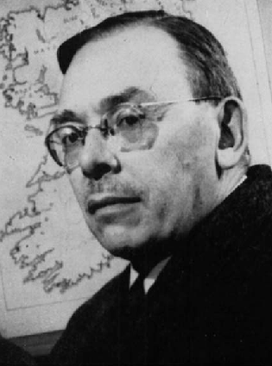 Earnest Hooton, one of the pioneers in the field of physical anthropology. The use of anthropology in the forensic investigation of remains grew out of the recognition of anthropology as a distinct scientific discipline and the growth of physical anthropology. The field of anthropology began in the United States and struggled to obtain recognition as a legitimate science during the early years of the twentieth century.[9] Earnest Hooton pioneered the field of physical anthropology and became the first physical anthropologist to hold a full-time teaching position in the United States.[10] He was an organizing committee member of the American Association of Physical Anthropologists along with its founder Aleš Hrdlička. Hooton's students created some of the first doctoral programs in physical anthropology during the early 20th century.[11] In addition to physical anthropology, Hooton was a proponent of criminal anthropology.[12] Now considered a pseudoscience, criminal anthropologists believed that phrenology and physiognomy could link a person's behavior to specific physical characteristics. The use of criminal anthropology to try to explain certain criminal behaviors arose out of the eugenics movement, popular at the time.[13] It is because of these ideas that skeletal differences were measured in earnest eventually leading to the development of anthropometry and the Bertillon method of skeletal measurement by Alphonse Bertillon. The study of this information helped shape anthropologists' understanding of the human skeleton and the multiple skeletal differences that can occur. Another prominent early anthropologist, Thomas Wingate Todd, was primarily responsible for the creation of the first large collection of human skeletons in 1912. In total, Todd acquired 3,300 human skulls and skeletons, 600 anthropoid skulls and skeletons, and 3,000 mammalian skulls and skeletons.[13] Todd's contributions to the field of anthropology remain in use in the modern era and include various studies regarding suture closures on the skull and timing of teeth eruption in the mandible. Todd also developed age estimates based on physical characteristics of the pubic symphysis. Though the standards have been updated, these estimates are still used by forensic anthropologists to narrow down an age range of skeletonized remains.[14] These early pioneers legitimized the field of anthropology, but it was not until the 1940s, with the help of Todd's student, Wilton M. Krogman, that forensic anthropology gained recognition as a legitimate subdiscipline. |
歴史 初期の歴史 アーネスト・フートンは自然人類学の分野における先駆者の一人である。 遺体の司法調査における人類学の利用は、人類学が独立した科学分野として認識され、自然人類学が発展したことに端を発する。人類学の分野はアメリカで始ま り、20世紀初頭には正当な科学としての認知を得るために苦闘した[9]。アーネスト・フートンは自然人類学の分野を開拓し、アメリカで初めて常勤の教職 に就いた自然人類学者となった[10]。彼は創設者アレス・フルドリツカと共に、アメリカ自然人類学者協会の組織委員を務めた。フートンの教え子たちは 20世紀初頭、自然人類学における最初の博士課程プログラムをいくつか創設した[11]。自然人類学に加え、フートンは犯罪人類学の提唱者でもあった [12]。現在では疑似科学と見なされる犯罪人類学者は、骨相学や人相学によって人格の行動を特定の身体的特徴と結びつけられると信じていた。特定の犯罪 行動を説明しようとする犯罪人類学の利用は、当時流行していた優生学運動から生まれたものである[13]。こうした思想ゆえに、骨格の差異が本格的に測定 されるようになり、最終的にアルフォンス・ベルティヨンの骨格測定法であるベルティヨン法や人体計測学の発展につながった。この情報の研究は、人類学者に よる人骨の理解と、生じうる多様な骨格的差異の認識形成に寄与した。 もう一人の著名な初期人類学者、トーマス・ウィングエイト・トッドは、1912年に人類初の大型骨格コレクションを構築した主責任者である。トッドは合計 で3,300点の人類頭蓋骨・骨格、600点の人猿類頭蓋骨・骨格、3,000点の哺乳類頭蓋骨・骨格を収集した。[13] トッドの人類学への貢献は現代でも活用されており、頭蓋骨の縫合閉鎖や下顎の歯の萌出時期に関する様々な研究が含まれる。トッドはまた、恥骨結合の身体的 特徴に基づく年齢推定法を開発した。基準は更新されたものの、これらの推定法は今も司法人類学者によって、骨化した遺骸の年齢範囲を絞り込むために用いら れている。[14] こうした初期の先駆者たちが人類学の分野を正当化したものの、司法人類学が正式な学問分野として認められるようになったのは1940年代、トッドの弟子で あるウィルトン・M・クロッグマンの貢献があってのことだった。 |
| The growth of forensic anthropology During the 1940s, Krogman was the first anthropologist to actively publicize anthropologists' potential forensic value, going as far as placing advertisements in the FBI Law Enforcement Bulletin informing agencies of the ability of anthropologists to assist in the identification of skeletal remains. This period saw the first official use of anthropologists by federal agencies including the FBI. During the 1950s, the U.S. Army Quartermaster Corps employed forensic anthropologists in the identification of war casualties during the Korean War.[12] It was at this time that forensic anthropology officially began. The sudden influx of available skeletons for anthropologists to study, whose identities were eventually confirmed, allowed for the creation of more accurate formulas for the identification of sex, age,[15] and stature[16] based solely on skeletal characteristics. These formulas, developed in the 1940s and refined by war, are still in use by modern forensic anthropologists. The professionalization of the field began soon after, during the 1950s and 1960s. This move coincided with the replacement of coroners with medical examiners in many locations around the country.[12] It was during this time that the field of forensic anthropology gained recognition as a separate field within the American Academy of Forensic Sciences and the first forensic anthropology research facility and body farm was opened by William M. Bass.[17] Public attention and interest in forensic anthropology began to increase around this time as forensic anthropologists started working on more high-profile cases. One of the major cases of the era involved anthropologist Charles Merbs who helped identify the victims murdered by Ed Gein.[18] |
司法人類学の発展 1940年代、クロッグマンは人類学者が司法分野で果たし得る役割を積極的に公表した最初の人類学者だった。FBI法執行機関向け広報誌に広告を掲載し、 人類学者が骨遺体の身元確認を支援できる能力を各機関に知らせるほどだった。この時期、FBIを含む連邦機関が初めて人類学者を公式に活用した。1950 年代には、朝鮮戦争において米陸軍兵站部隊が戦死者の身元確認に司法人類学者を採用した[12]。司法人類学が正式に始まったのはこの時期である。人類学 者が研究できる遺骨が急増し、その身元が最終的に確認されたことで、骨格の特徴のみに基づいて性別、年齢[15]、身長[16]を特定するより正確な定式 が作成された。1940年代に開発され、戦争を通じて洗練されたこれらの定式は、現代の司法人類学者によって今も使用されている。 この分野の専門化はその後間もなく、1950年代から1960年代にかけて始まった。この動きは、国内の多くの地域で検死官が司法解剖医に置き換わってい く過程と時期を同じくしていた[12]。この時期に、司法人類学はアメリカ法科学アカデミー内で独立した分野として認知され、ウィリアム・M・バスによっ て最初の司法人類学研究施設兼ボディファームが開設された。[17] 公共の関心と司法人類学への興味は、司法人類学者がより注目度の高い事件の調査に携わるようになったこの頃から高まり始めた。当時の主要な事件の一つに は、人類学者チャールズ・マーブスが関与した。彼はエド・ゲインによる殺害被害者の身元確認を支援したのである。[18] |
| Methods One of the main tools forensic anthropologists use in the identification of remains is their knowledge of osteology and the differences that occur within the human skeleton. During an investigation, anthropologists are often tasked with helping to determinate an individual's sex, stature, age, and ancestry. To do this, anthropologists must be aware of how the human skeleton can differ between individuals. |
方法 司法人類学者が遺体の身元確認に用いる主要な手段の一つは、骨学の知識と人骨に生じる差異に関する理解である。調査中、人類学者はしばしば個人の性別、体 格、年齢、祖先の特定を支援する任務を負う。このため人類学者は、人骨が個人間でどのように異なるかを認識していなければならない。 |
| Determination of sex Depending on which bones are present, sex can be determined by looking for distinctive sexual dimorphisms. When available, the pelvis is extremely useful in the determination of sex and when properly examined can achieve sex determination with a great level of accuracy.[19] The examination of the pubic arch and the location of the sacrum can help determine sex. 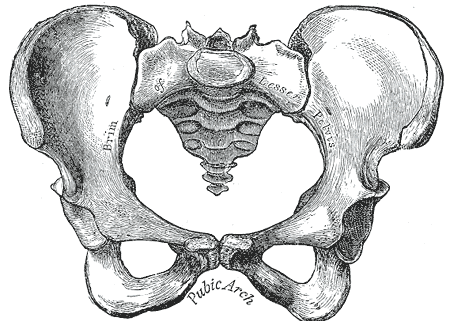 Female pelvis. Note wide pubic arch and shorter, pushed back sacrum 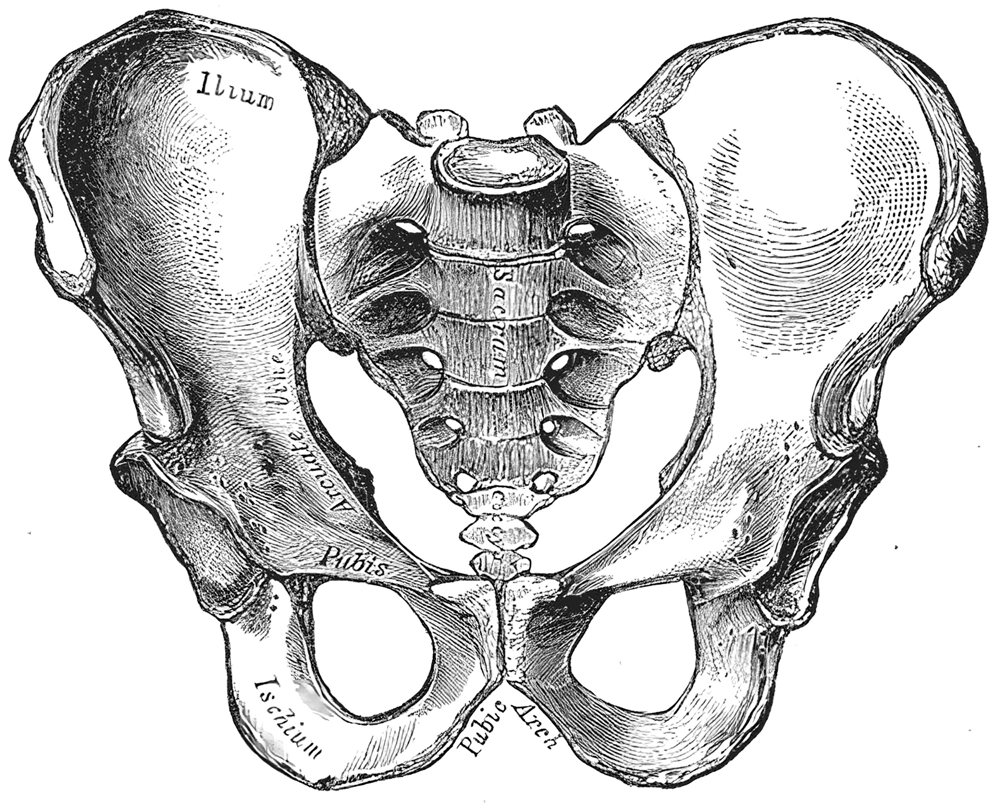 Male pelvis. Note narrow pubic arch and longer sacrum. However, the pelvis is not always present, so forensic anthropologists must be aware of other areas on the skeleton that have distinct characteristics between sexes. The skull also contains multiple markers that can be used to determine sex. Specific markers on the skull include the temporal line, the eye sockets, the supraorbital ridge,[20] as well as the nuchal lines, and the mastoid process.[21] In general, male skulls tend to be larger and thicker than female skulls, and to have more pronounced ridges.[22] Forensic anthropologists need to take into account all available markers in the determination of sex due to the differences that can occur between individuals of the same sex. For example, a female may have a slightly more narrow than a normal pubic arch. It is for this reason that anthropologists usually classify sex as one of five possibilities: male, maybe male, indeterminate, maybe female, or female.[23] In addition, forensic anthropologists are generally unable to make a sex determination unless the individual was an adult at the time of death. The sexual dimorphisms present in the skeleton begin to occur during puberty and are not fully pronounced until after sexual maturation.[24] Consequently, there is currently no reliable method of sex determination of juvenile remains from cranial or post-cranial skeletal elements since dimorphic traits only become apparent after puberty, and this represents a fundamental problem in archaeological and forensic investigations. However, teeth may assist in estimating sex since both sets of teeth are formed well before puberty. Sexual dimorphism has been observed in both deciduous and permanent dentition, although it is much less in deciduous teeth.[25][26][27] On average, male teeth are slightly larger than female teeth, with the greatest difference observed in the canine teeth.[28][29][30] Examination of internal dental tissues has also shown that male teeth consist of absolutely and proportionately greater quantities of dentine than females. Such differences in dental tissue proportions could also be useful in sex determination.[31][32] |
性別の判定 存在する骨の種類によって、性差の顕著な特徴を探ることで性別を判定できる。骨盤が確認できる場合、性別判定に極めて有用であり、適切に検査すれば高い精度で性別を特定できる[19]。恥骨弓と仙骨の位置を調べることで性別判定が可能となる。 女性の骨盤。広い恥骨弓と、短く後方に押し出された仙骨に注意 男性の骨盤。狭い恥骨弓と長い仙骨に注意。 しかし骨盤が常にあるとは限らないため、司法人類学者は骨格の他の部位で性差が明確な特徴を持つ箇所を認識しなければならない。頭蓋骨にも性別判定に利用 できる複数の指標がある。具体的には側頭線、眼窩、眉上隆起[20]、後頭線、乳様突起[21]などだ。一般的に男性の頭蓋骨は女性より大きく厚く、隆起 がより顕著である傾向がある。[22] 司法人類学者は、同性の個体間でも異なる差異が生じ得るため、性別判定において利用可能な全ての指標を考慮する必要がある。例えば、女性の恥骨弓が通常よ りわずかに狭い場合がある。このため人類学者は通常、性別を5つの可能性(男性、男性の可能性あり、判定不能、女性の可能性あり、女性)のいずれかに分類 する。[23] さらに、司法人類学者は通常、死亡時に成体であった個体でなければ性別判定ができない。骨格に見られる性的二形性は思春期に現れ始め、性成熟後まで完全に は顕著にならない。[24] したがって、二形性形質が思春期以降にしか現れないため、頭蓋骨や頭蓋骨以外の骨格要素から幼少期の遺体の性別を判定する信頼できる方法は現在存在しな い。これは考古学や司法調査における根本的な問題である。ただし、歯は思春期よりずっと前に形成されるため、性別推定に役立つ可能性がある。乳歯と永久歯 の両方に性差が認められるが、乳歯ではその差ははるかに小さい。[25][26][27] 平均的に、男性の歯は女性の歯よりわずかに大きく、最も大きな差は犬歯で観察される。[28][29][30] 歯の内部組織の検査からも、男性の歯は女性の歯よりも絶対量および割合的に象牙質の量が多いことが示されている。このような歯組織の割合の差異も性別判定 に有用となり得る。[31][32] |
| Determination of stature The estimation of stature by anthropologists is based on a series of formulas that have been developed over time by the examination of multiple different skeletons from a multitude of different regions and backgrounds. Stature is given as a range of possible values, in centimeters, and typically computed by measuring the bones of the leg, since they are the ones that best correlate with the total height of an individual.[33] The three bones that are used are the femur, the tibia, and the fibula.[34] In addition to the leg bones, the bones of the arm, humerus, ulna, and radius can be used.[35][36] The formulas that are used to determine stature rely on various information regarding the individual. Sex, ancestry, and age should be determined before attempting to ascertain height, if possible. This is due to the differences that occur between populations, sexes, and age groups.[37] By knowing all the variables associated with height, a more accurate estimate can be made. For example, a male formula for stature estimation using the femur is 2.32 × femur length + 65.53 ± 3.94 cm. A female of the same ancestry would use the formula, 2.47 × femur length + 54.10 ± 3.72 cm.[38] It is also important to note an individual's approximate age when determining stature. This is due to the shrinkage of the skeleton that naturally occurs as a person ages. After age 30, a person loses approximately one centimeter of their height every decade.[34] |
身長の推定 人類学者による身長の推定は、様々な地域や背景を持つマルチチュードの異なる骨格を調査する過程で、時間をかけて開発されてきた一連の定式に基づいてい る。身長はセンチメートル単位で可能な値の範囲として示され、通常は脚の骨を測定して計算される。脚の骨は個人の全高と最も相関が良いためである。 [33] 使用される3本の骨は大腿骨、脛骨、腓骨である。[34] 脚の骨に加え、腕の骨である上腕骨、尺骨、橈骨も使用可能である。[35][36] 身長を決定する定式は、個人に関する様々な情報に依存する。可能であれば、身長推定前に性別、祖先、年齢を特定すべきである。これは集団間・性別間・年齢 層間で異なる差異が生じるためだ[37]。身長に関連する全変数を把握することで、より正確な推定が可能となる。例えば大腿骨を用いた男性の身長推定定式 は「2.32 × 大腿骨長 + 65.53 ± 3.94 cm」である。同じ祖先を持つ女性の場合、2.47 × 大腿骨長 + 54.10 ± 3.72 cm の定式を用いる。[38] 身長を推定する際には、個人の概算年齢も重要である。これは加齢に伴い骨格が自然に縮むためだ。30歳以降、人は10年ごとに約1センチの身長を失う。 [34] |
| Determination of age The determination of an individual's age by anthropologists depends on whether or not the individual was an adult or a child. The determination of the age of children, under the age of 21, is usually performed by examining the teeth.[39] When teeth are not available, children can be aged based on which growth plates are sealed. The tibia plate seals around age 16 or 17 in girls and around 18 or 19 in boys. The clavicle is the last bone to complete growth and the plate is sealed around age 25.[40] In addition, if a complete skeleton is available anthropologists can count the number of bones. While adults have 206 bones, the bones of a child have not yet fused resulting in a much higher number. The aging of adult skeletons is not as straightforward as aging a child's skeleton as the skeleton changes little once adulthood is reached.[41] One possible way to estimate the age of an adult skeleton is to look at bone osteons under a microscope. New osteons are constantly formed by bone marrow even after the bones stop growing. Younger adults have fewer and larger osteons while older adults have smaller and more osteon fragments.[40] Another potential method for determining the age of an adult skeleton is to look for arthritis indicators on the bones. Arthritis will cause noticeable rounding of the bones.[42] The degree of rounding from arthritis coupled with the size and number of osteons can help an anthropologist narrow down a potential age range for the individual. |
年齢の判定 人類学者が個人の年齢を判定する際は、その個体が成人か子供かによって方法が異なる。21歳未満の子供の年齢判定は、通常、歯の検査によって行われる。 [39] 歯が利用できない場合、成長板が閉鎖した部位に基づいて子供の年齢を推定できる。脛骨の成長板は、女子では16~17歳頃、男子では18~19歳頃に閉鎖 する。鎖骨は成長が完了する最後の骨であり、その成長板は25歳頃に閉鎖する。[40] さらに、完全な骨格が利用可能な場合、人類学者は骨の数を数えることができる。成人の骨は206個であるのに対し、子供の骨はまだ融合しておらず、その結 果、骨の数ははるかに多くなる。 成人の骨格の年齢推定は、子どもの骨格ほど単純ではない。成人期に達すると骨格の変化がほとんどないからだ。[41] 成人の骨格年齢を推定する一つの方法は、顕微鏡で骨のオステオンを観察することである。骨の成長が止まった後も、骨髄によって新しいオステオンが絶えず形 成される。若い成人ではオステオンの数が少なく大きいが、高齢の成人ではオステオンの断片が多く小さくなる。[40] 成人骨格の年齢を特定する別の潜在的な方法は、骨上の関節炎の指標を探すことだ。関節炎は骨の顕著な丸みを帯びた変形を引き起こす。[42] 関節炎による丸みの程度と、オステオンの大きさ・数を組み合わせることで、人類学者は個体の年齢範囲を絞り込める。 |
| Age estimation of living individuals Age estimation of living individuals is carried out by estimating the biological age when the chronological age of the individual is unknown or uncertain because of the lack of valid identity documents.[43] It is used to confirm if an individual has reached a specific age threshold in cases of criminal liability, asylum seekers and unaccompanied children, human trafficking, adoption, and competitive sports.[44] Guidelines by the Study Group on Forensic Age Diagnostics (Arbeitsgemeinschaft für Forensische Altersdiagnostik, AGFAD), propose that a three-step procedure should be followed for the age estimation: the first step is a physical examination; the second step include the assessment of the hand/wrist development using plain radiographs; the third step is a dental assessment.[45] One of the most used methodologies for the estimation of age from the development of the hand and wrist is the Greulich and Pyle Atlas,[46] whilst to assess dental development the most common method used so far is the 8-teeth technique developed by Demirjian et al..[47] Where the estimated age of the individual might be above 18 years of age, it is possible to use the development of the medial end of the clavicle.[48] Traditionally, those undertaking age estimation in the living, adopt imaging techniques such as plain radiographies and CT scans to carry out the age estimation, however, lately, due to ethical issues surrounding the use of ionising medical imaging modalities for non-medical purposes (e.g., forensic purposes),[49] magnetic resonance imaging, a radiation free medical imaging modality, is being investigated to develop new methodologies to estimate the age of living individuals.[50] |
生存者の年齢推定 生存者の年齢推定は、有効な身分証明書がないために個人の暦年齢が不明または不確かな場合に、生物学的年齢を推定して行われる。[43] これは、刑事責任、難民申請者や同伴者のいない未成年者、人身取引、養子縁組、競技スポーツなどのケースにおいて、個人が特定の年齢基準に達しているかを 確認するために用いられる。[44] 司法年齢診断研究グループ(AGFAD)のガイドラインでは、年齢推定に三段階の手順を提案している。第一段階は身体検査、第二段階は単純X線写真を用い た手・手首の発達評価、第三段階は歯科評価である。[45] 手と手首の発達から年齢を推定するために最もよく使用される方法の一つは、Greulich and Pyle Atlas[46] である。一方、歯の発達を評価するためにこれまで最もよく使用されてきた方法は、デミールジャンらによって開発された 8 歯法[47] である。個人の推定年齢が 18 歳以上である可能性がある場合、鎖骨の内側端の発達を利用することができる。[48] 従来、生きた人間の年齢推定を行う者は、単純X線撮影やCTスキャンなどの画像技術を用いて年齢推定を行ってきた。しかし、最近では、非医療目的(司法目 的など)での電離放射線を用いた医療画像診断法の使用に関する倫理的問題[49] により、放射線を使用しない医療画像診断法である磁気共鳴画像法(MRI)を用いて、生きた人間の年齢を推定する新しい手法の開発が研究されている。 [50] |
| Determination of ancestry The estimation of individuals' ancestry is typically grouped into three groups. However, the use of these classifications is becoming much harder as the rate of interancestrial marriages increases.[51] The maxilla can be used to help anthropologists estimate an individual's ancestry due to the three basic shapes: hyperbolic, parabolic, and rounded.[52] In addition to the maxilla, the zygomatic arch and the nasal opening have been used to narrow down possible ancestry.[53] By measuring distances between landmarks on the skull as well as the size and shape of specific bones, anthropologists can use a series of equations to estimate ancestry. A program called FORDISC has been created that will calculate the most likely ancestry using complex mathematical formulas.[54] This program is continually updated with new information from known individuals to maintain a database of current populations and their respective measurements. A 2009 study found that even in favourable circumstances, FORDISC 3.0 classifications have only a 1% confidence level.[55] Research presented at the 2012 Annual Meeting of the American Association of Physical Anthropologists concluded that ForDisc ancestry determination was not always consistent, and that the program should be used with caution.[56] |
祖先の判定 個人の祖先推定は通常、三つのグループに分類される。しかし、異種間結婚の増加に伴い、これらの分類の適用は困難になりつつある。[51] 上顎骨は、双曲線形、放物線形、丸みを帯びた形状という三つの基本形態から、人類学者が個人の祖先を推定する手助けとなる。[52] 上顎に加え、頬骨弓と鼻孔も祖先の可能性を絞り込むために用いられてきた。[53] 頭蓋骨上のランドマーク間の距離や特定骨の大きさ・形状を測定することで、人類学者は一連の定式を用いて祖先を推定できる。FORDISCと呼ばれるプロ グラムは複雑な数学定式を用いて最も可能性の高い祖先を算出する。[54] このプログラムは既知の個人から得られる新情報を継続的に更新し、現存する集団とその測定値のデータベースを維持している。2009年の研究によれば、好 条件下であってもFORDISC 3.0の分類は信頼度がわずか1%であることが判明した。[55] 2012年アメリカ身体人類学会年次総会で発表された研究は、ForDiscによる祖先判定が常に一貫しているわけではなく、本プログラムは慎重に使用す べきだと結論づけている。[56] |
| Other markers Anthropologists are also able to see other markers present on the bones. Past fractures will be evident by the presence of bone remodeling but only for a certain amount of time. After around seven years, bone remodelling should make the presence of a fracture impossible to see. The examination of any fractures on the bones can potentially help determine the type of trauma they may have experienced. Cause of death is not determined by the forensic anthropologist, as they are not qualified to do so. However, they are able to determine the type of trauma experienced such as gun shot wound, blunt force, sharp force, or a mixture thereof. It is also possible to determine if a fracture occurred ante-mortem (before death), peri-mortem (at the time of death), or post-mortem (after death). Ante-mortem fractures will show signs of healing (depending on how long before death the fracture occurred) while peri- and post-mortem fractures will not. Peri-mortem fractures can incorporate quite a large range of time, as ante-mortem trauma that is unrelated directly to death may not have had time to begin the healing process. Peri-mortem fractures will usually appear clean with rounded margins and equal discolouration after death, while post-mortem breaks will appear brittle.[57] Post-mortem breaks will often be a different colour to the surrounding bone i.e. whiter as they have been exposed to taphonomic processes for a different amount of time. However, depending on how long there is between a post-mortem break and removal this may not be obvious i.e. through re-interment by a killer. Diseases such as bone cancer might be present in bone marrow samples and can help narrow down the list of possible identifications. |
その他の痕跡 人類学者は骨に残る他の痕跡も確認できる。過去の骨折は骨リモデリングの存在によって明らかになるが、それは一定期間に限られる。約7年後には骨リモデリ ングが進み、骨折の痕跡は見えなくなる。骨の骨折を調べることで、被害者が受けた外傷の種類を特定できる可能性がある。死因は司法人類学者が決定するもの ではない。彼らはその資格を持たないからだ。しかし、銃創、鈍器による外傷、鋭器による外傷、あるいはそれらの混合といった、被験者が受けた外傷の種類を 特定することは可能である。また、骨折が死前(死亡前)、死時(死亡時)、死後(死亡後)のいずれに発生したかを判断することもできる。生前骨折は治癒の 兆候を示す(骨折が死亡のどの時点より前に生じたかによる)。一方、周死時および死後骨折には治癒の兆候は見られない。周死時骨折はかなり広い時間範囲を 含む可能性がある。なぜなら、直接死因とは関係のない生前外傷は、治癒過程が始まる前に死亡したケースもあるからだ。死期前骨折は通常、死後には境界が丸 く、変色も均一なきれいな断面を示す。一方、死後骨折は脆い断面となる[57]。死後骨折は周囲の骨と色が異なることが多い。つまり、より長い期間、埋葬 過程に晒されたため、より白く見えるのである。ただし、死後骨折から遺体移動までの期間によっては、この差異が不明瞭になる場合がある。例えば、加害者に よる再埋葬が原因で色調が均一化されることがある。骨髄サンプルからは骨癌などの疾患が検出される可能性があり、これにより身元確認の候補を絞り込む助け となる。 |
| Subfields Forensic archaeology The term "forensic archaeology" is not defined uniformly around the world, and is therefore practiced in a variety of ways.[58] Forensic archaeologists employ their knowledge of proper excavation techniques to ensure that remains are recovered in a controlled and forensically acceptable manner.[59] When remains are found partially or completely buried the proper excavation of the remains will ensure that any evidence present on the bones will remain intact. The difference between forensic archaeologists and forensic anthropologists is that where forensic anthropologists are trained specifically in human osteology and recovery of human remains, forensic archaeologists specialize more broadly in the processes of search and discovery.[60] In addition to remains, archaeologists are trained to look for objects contained in and around the excavation area. These objects can include anything from wedding rings to potentially probative evidence such as cigarette butts or shoe prints.[61] Their training extends further to observing context, association and significance of objects in a crime scene and drawing conclusions that may be useful for locating a victim or suspect.[62] A forensic archaeologist must also be able to utilize a degree of creativity and adaptability during times when crime scenes can not be excavated using traditional archaeological techniques. For example, one particular case study was conducted on the search and recovery of the remains of a missing girl who was found in a septic tank underground. This instance required unique methods unlike those of a typical archeological excavation in order to exhume and preserve the contents of the tank.[60] Forensic archaeologists are involved within three main areas. Assisting with crime scene research, investigation, and recovery of evidence and/or skeletal remains is only one aspect. Processing scenes of mass fatality or incidents of terrorism (i.e. homicide, mass graves and war crimes, and other violations of human rights) is a branch of work that forensic archaeologists are involved with as well.[60] Forensic archaeologists can help determine potential grave sites that might have been overlooked. Differences in the soil can help forensic archaeologists locate these sites. During the burial of a body, a small mound of soil will form from the filling of the grave. The loose soil and increasing nutrients from the decomposing body encourages different kinds of plant growth than surrounding areas. Typically, grave sites will have looser, darker, more organic soil than areas around it.[63] The search for additional grave sites can be useful during the investigation of genocide and mass graves to search for additional burial locations. One other discipline to the career of a forensic archaeologist is teaching and research. Educating law enforcement, crime scene technicians and investigators, as well as undergraduate and graduate students is a critical part of a forensic archaeologist's career in order to spread knowledge of proper excavation techniques to other forensic personnel and to increase awareness of the field in general. Crime scene evidence in the past has been compromised due to improper excavation and recovery by untrained personnel. Forensic anthropologists are then unable to provide meaningful analyses on retrieved skeletal remains due to damage or contamination.[64] Research conducted to improve archaeological field methods, particularly to advance nondestructive methods of search and recovery are also important for the advancement and recognition of the field. There is an ethical component that must be considered. The capability to uncover information about victims of war crimes or homicide may present a conflict in cases that involve competing interests. Forensic archaeologists are often contracted to assist with the processing of mass graves by larger organisations that have motives related to exposure and prosecution rather than providing peace of mind to families and communities. These projects are at times opposed by smaller, human rights groups who wish to avoid overshadowing memories of the individuals with their violent manner(s) of death. In cases like these, forensic archaeologists must practice caution and recognize the implications behind their work and the information they uncover.[65] |
サブ分野 司法考古学 「司法考古学」という用語は世界中で統一された定義がなく、そのため様々な形で実践されている。[58] 司法考古学者は、遺骸が管理された司法的に認められる方法で回収されるよう、適切な発掘技術に関する知識を活用する。[59] 遺体が部分的または完全に埋没している場合、適切な発掘作業によって骨に残存する証拠が損なわれないようにする。司法考古学者と法人類学者の異なる点は、 法人類学者が特に人骨学と人骨遺体の回収を専門とするのに対し、司法考古学者はより広範に捜索と発見のプロセスを専門とする点にある。[60] 遺体に加え、考古学者は発掘区域内および周辺に存在する物品の探索も訓練されている。これらの物品は結婚指輪から、タバコの吸い殻や靴跡のような潜在的に 証拠能力のある物まで多岐にわたる。[61] 彼らの訓練はさらに、犯罪現場における物品の文脈・関連性・重要性を観察し、被害者や容疑者の所在特定に有用な結論を導き出すことまで及ぶ。[62] 司法考古学者はまた、伝統的な考古学技術で発掘できない犯罪現場において、ある程度の創造性と適応力を活用できなければならない。例えば、地下の浄化槽内 で発見された行方不明の少女の遺体の捜索・回収に関する特定の事例研究がある。この事例では、浄化槽の内容物を発掘・保存するために、通常の考古学的発掘 とは異なる独自の方法が必要だった。[60] 司法考古学者が関わる主な領域は三つある。犯罪現場の調査、捜査、証拠や骨格遺体の回収支援は、その一面に過ぎない。 大量死現場やテロ事件(殺人、集団埋葬地、戦争犯罪、その他人権侵害事件など)の処理も、司法考古学者が関わる業務の一分野である。[60] 司法考古学者は、見落とされがちな潜在的な埋葬地を特定するのに役立つ。土壌の差異が、こうした場所の発見に役立つのだ。遺体を埋葬する際、墓穴を埋める 土で小さな盛り土が形成される。この緩い土壌と、腐敗する遺体から増加する養分は、周囲の地域とは異なる種類の植物の生育を促す。一般的に、墓地は周囲の 地域よりも緩く、暗く、有機物が多い土壌を持つ。[63] 追加の墓地を探すことは、ジェノサイドや集団埋葬地の調査において、さらなる埋葬場所を探すのに有用である。 司法考古学者のキャリアにおけるもう一つの分野は教育と研究である。法執行機関、犯罪現場技術者、捜査官、そして学部生・大学院生への教育は、適切な発掘 技術を他の司法科学関係者に広め、この分野への認識を高める上で極めて重要だ。過去には訓練を受けていない者による不適切な発掘と回収が原因で、犯罪現場 の証拠が損なわれた事例がある。その結果、司法人類学者は損傷や汚染により回収された骨格遺骸について有意義な分析を提供できなくなる[64]。考古学的 な現地調査手法、特に非破壊的な捜索・回収手法の進歩を目的とした研究も、この分野の発展と認知にとって重要である。 考慮すべき倫理的側面も存在する。戦争犯罪や殺人事件の被害者に関する情報を明らかにする能力は、利害が対立する事件において葛藤を生じさせる可能性があ る。司法考古学者は、遺族や地域社会の心の平安をもたらすというよりも、暴露や起訴に関連する動機を持つ大規模組織から、集団墓地の処理支援を請け負うこ とが多い。こうしたプロジェクトは、個人の死の暴力的な様相が記憶を覆い隠すことを避けたいと考える小規模な人権団体から反対されることもある。このよう な場合、司法考古学者は慎重に行動し、自らの仕事と発掘した情報の背後にある意味合いを認識しなければならない。 |
Forensic taphonomy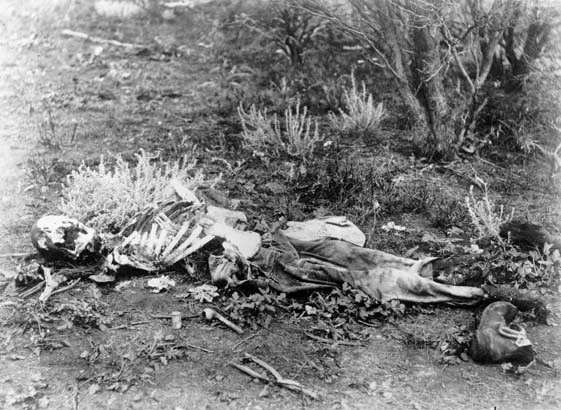 The examination of remains can help build a peri- and post-mortem profile of the individual. The examination of skeletal remains often takes into account environmental factors that affect decomposition. Forensic taphonomy is the study of these postmortem changes to human remains caused by soil, water, and the interaction with plants, insects, and other animals.[66] In order to study these effects, body farms have been set up by multiple universities. Students and faculty study various environmental effects on the decomposition of donated cadavers. At these locations, cadavers are placed in various situations and their rate of decomposition along with any other factors related to the decomposition process are studied. Potential research projects can include whether black plastic causes decomposition to occur faster than clear plastic or the effects freezing can have on a dumped body.[67] Forensic taphonomy is divided into two separate sections, biotaphonomy and geotaphonomy. Biotaphonomy is the study of how the environment affects the decomposition of the body. Specifically it is the examination of biological remains in order to ascertain how decomposition or destruction occurred.[68] This can include factors such as animal scavenging, climate, as well as the size and age of the individual at the time of death. Biotaphonomy must also take into account common mortuary services such as embalming and their effects on decomposition.[69] Geotaphonomy is the examination of how the decomposition of the body affects the environment. Geotaphonomy examinations can include how the soil was disturbed, pH alteration of the surrounding area, and either the acceleration or deceleration of plant growth around the body.[68] By examining these characteristics, examiners can begin to piece together a timeline of the events during and after death. This can potentially help determine the time since death, whether or not trauma on the skeleton was a result of perimortem or postmortem activity, as well as if scattered remains were the result of scavengers or a deliberate attempt to conceal the remains by an assailant.[69] |
司法医学的タフォノミー 遺体の検査は、個人の死前・死後の状態を把握するのに役立つ。 骨格遺体の検査では、分解に影響を与える環境要因を考慮することが多い。司法医学的タフォノミーとは、土壌や水、植物・昆虫・その他の動物との相互作用に よって引き起こされる、死後の人体遺骸の変化を研究する学問である[66]。これらの影響を研究するため、複数の大学がボディファームを設置している。学 生や教員は、寄贈された死体の分解に対する様々な環境的影響を研究する。これらの施設では、死体を様々な状況下に置き、その分解速度や分解過程に関連する その他の要因を研究する。研究テーマとしては、黒いプラスチックが透明なプラスチックよりも分解を早めるか、あるいは凍結が遺棄された死体に与える影響な どが考えられる。[67] 司法タフォノミーは、生物タフォノミーと地質タフォノミーの二分野に分かれる。生物タフォノミーは、環境が遺体の分解に与える影響を研究する学問である。 具体的には、生物学的遺骸を調査し、分解や破壊がどのように進行したかを解明する。[68] これには、動物による腐肉食、気候、死亡時の個人の体格や年齢といった要因が含まれる。生物埋葬学はまた、防腐処理などの一般的な埋葬サービスとその分解 への影響も考慮しなければならない。[69] 地質埋葬学は、遺体の分解が環境に与える影響を調べる学問である。地質埋葬学の調査には、土壌の擾乱状態、周辺地域のpH変化、遺体周辺の植物成長の加速 または減速などが含まれる。[68] こうした特徴を調べることで、死後および死後の出来事のタイムラインを組み立て始めることができる。これにより、死後経過時間の推定、骨格の損傷が死前活 動によるものか死後活動によるものかの判別、遺骸が散乱している原因が腐食動物によるものか加害者による遺骸隠蔽の意図的な試みかといった判断が可能とな る。[69] |
Education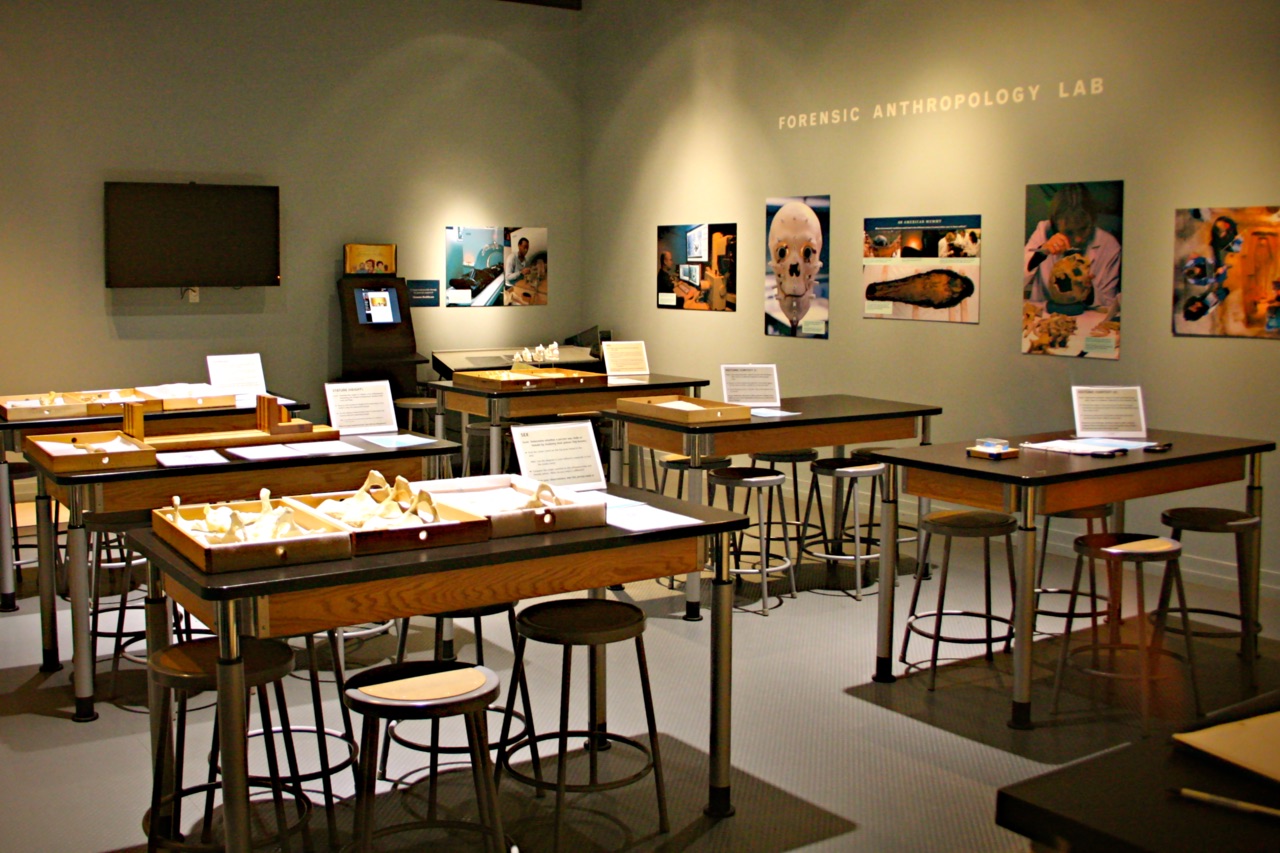 Forensic Anthropology Lab at the National Museum of Natural History, Smithsonian Institution, Washington D.C., US Individuals looking to become forensic anthropologists first obtain a bachelor's degree in anthropology from an accredited university. During their studies they should focus on physical anthropology as well as osteology. In addition it is recommended that individuals take courses in a wide range of sciences such as biology, chemistry, anatomy, and genetics.[70] Once undergraduate education is completed the individual should proceed to graduate level courses. Typically, forensic anthropologists obtain doctorates in physical anthropology and have completed coursework in osteology, forensics, and archaeology. It is also recommended that individuals looking to pursue a forensic anthropology profession get experience in dissection usually through a gross anatomy class as well as useful internships with investigative agencies or practicing anthropologists.[1] Once educational requirements are complete one can become certified by the forensic anthropology society in the region. This can include the IALM exam given by the Forensic Anthropology Society of Europe[71] or the certification exam given by the American Board of Forensic Anthropology.[72] Typically, most forensic anthropologists perform forensic casework on a part-time basis, however there are individuals who work in the field full-time usually with federal or international agencies. Forensic anthropologists are usually employed in academia either at a university or a research facility.[73] |
教育 米国ワシントンD.C.、スミソニアン協会国立自然史博物館司法人類学研究室 司法人類学者を目指す者は、まず認定大学で人類学の学士号を取得する。学修中は自然人類学と骨学に重点を置くべきだ。加えて生物学、化学、解剖学、遺伝学など幅広い科学分野の科目履修が推奨される。[70] 学部教育修了後は大学院課程へ進むべきだ。通常、司法人類学者は自然人類学の博士号を取得し、骨学・法医学・考古学の科目を修了している。司法人類学の職 業を目指す者は、解剖実習(通常は肉眼解剖学の授業を通じて)や捜査機関・現役人類学者との有益なインターンシップで経験を積むことも推奨される。[1] 教育要件を満たせば、地域の司法人類学協会による認定を受けることができる。これには欧州司法人類学協会[71]が実施するIALM試験や、米国司法人類 学委員会が実施する認定試験が含まれる。[72] 通常、法医人類学者の大半は非常勤で司法案件を担当するが、連邦機関や国際機関で常勤する者もいる。法医人類学者は大学や研究施設といった学術機関に雇用されるのが一般的だ。[73] |
| Ethics Like other forensic fields, forensic anthropologists are held to a high level of ethical standards due to their work in the legal system. Individuals who purposefully misrepresent themselves or any piece of evidence can be sanctioned, fined, or imprisoned by the appropriate authorities depending on the severity of the violation. Individuals who fail to disclose any conflict of interests or who fail to report all of their findings, regardless of what they may be, can face disciplinary actions.[74] It is important that forensic anthropologists remain impartial during the course of an investigation. Any perceived bias during an investigation could hamper efforts in court to bring the responsible parties to justice.[75] There is a substantial risk of confirmation bias from knowledge of context, especially with more ambiguous or complex cases.[76][77] In addition to the evidentiary guidelines forensic anthropologists should always keep in mind that the remains they are working with were once a person. If possible, local customs regarding dealing with the dead should be observed and all remains should be treated with respect and dignity. |
倫理 他の司法医学分野と同様に、法医人類学者は司法制度における業務のため、高い倫理基準が求められる。故意に自己や証拠を偽った者は、違反の程度に応じて関 係当局から制裁、罰金、または懲役刑を受ける可能性がある。利益相反を開示しなかった者、あるいは発見事項を全て報告しなかった者は、その内容が何であれ 懲戒処分に直面する。[74] 司法人類学者は調査過程において中立性を保つことが重要である。調査中の偏見の疑いは、法廷で責任者を裁く努力を妨げる恐れがある。[75] 特に曖昧または複雑な事例では、文脈知識による確認バイアスのリスクが顕著である。[76] [77] 証拠に関するガイドラインに加え、司法人類学者は常に、自分が扱う遺体がかつて一人の人間であったことを心に留めておくべきだ。可能であれば、死者の扱いに関する現地の慣習を尊重し、全ての遺体を敬意と尊厳をもって扱うべきである。 |
| Notable forensic anthropologists Name Notable for Ref Sue Black Founding member of the British Association for Human Identification. Former Director of the Centre for Anatomy and Human Identification and the Leverhulme Centre for Forensic Science at the University of Dundee. President of St John's College, Oxford. She has worked in Kosovo, Grenada, Sierra Leone, Iraq, and as part of the response to the Indian Ocean tsunami. [78] Karen Ramey Burns Worked in the investigation of genocides as well as the identification of victims of the 9/11 terrorist attacks and Hurricane Katrina. [79] Michael Finnegan Worked on the identification of Jesse James. [80] Richard Jantz Co-developer of FORDISC. [81] Ellis R. Kerley Worked on the identification of Josef Mengele as well as the victims of the Jonestown mass suicide. [82] William R. Maples Worked on the identification of Czar Nicholas II and other members of the Romanov family as well as the examination of President Zachary Taylor's remains for arsenic poisoning. [83] Fredy Peccerelli Founder and director of the Guatemalan Forensic Anthropology Foundation. [84] Clyde Snow Worked on the identification of King Tutankhamun and the victims of the Oklahoma City bombing as well as the investigation into the murder of John F. Kennedy. [85] Mildred Trotter Created statistical formulas for the calculation of stature based on human long bones through the examination of Korean War casualties. [86] Kewal Krishan Advancement of forensic anthropology in India. [87] William M. Bass Created the first body farm to investigate decomposition in various conditions, such as partially buried, buried during particular times of the year, left out in the open for animal scavengers, and burning. [88] Kathy Reichs Forensic anthropologist and author. Created the fictional character Dr. Temperance Brennan, and the inspiration for the TV series Bones. |
著名な司法人類学者 名前 著名な業績 出典 スー・ブラック 英国人体識別協会の創設メンバー。ダンディー大学解剖学・人体識別センターおよびレバーヒューム法科学センターの元所長。オックスフォード大学セントジョ ンズ・カレッジ学長。コソボ、グレナダ、シエラレオネ、イラクでの活動に加え、インド洋津波災害対応にも従事した。 [78] カレン・レイミー・バーンズ ジェノサイド調査、9.11テロ事件及びハリケーン・カトリーナの犠牲者身元確認に携わった。 [79] マイケル・フィネガン ジェシー・ジェームズの身元確認作業を行った。 [80] リチャード・ジャント フォードイスク(FORDISC)の共同開発者。 [81] エリス・R・カーリー ヨーゼフ・メンゲレ及びジョーンズタウン集団自殺事件の犠牲者身元確認に携わった。 [82] ウィリアム・R・メイプルズ ニコライ2世及びロマノフ家他の身元確認、ザカリー・テイラー大統領遺体のヒ素中毒検査に携わった。 [83] フレディ・ペチェレッリ グアテマラ司法人類学財団の創設者兼所長。 [84] クライド・スノー ツタンカーメン王の身元確認、オクラホマシティ爆破事件の犠牲者特定、ジョン・F・ケネディ暗殺事件の調査に携わった。 [85] ミルドレッド・トロッター 朝鮮戦争の犠牲者を調査し、人体の長骨に基づく身長の定式を統計的に確立した。 [86] ケワル・クリシャン インドにおける司法人類学の発展に貢献した。 [87] ウィリアム・M・バス 様々な条件下での死体腐敗を調査するため、世界初のボディファームを創設した。条件には、部分埋葬、特定の季節の埋葬、動物による腐食を目的とした野外放 置、焼却などが含まれる。 [88] キャシー・ライクス 司法人類学者であり作家。フィクションのキャラクターであるテンプランス・ブレナン博士を創作し、テレビシリーズ『Bones』の着想源となった。 |
| Craniofacial anthropometry Bioarchaeology Forensic pathology Forensic dentistry Forensic science, also known as "forensics" Forensic facial reconstruction List of important publications in anthropology Digital forensics |
頭蓋顔面人類計測学 生物考古学 司法病理学 司法歯科学 司法科学(フォレンジクスとも呼ばれる) 司法的顔面再建術 人類学における重要な出版物一覧 デジタル・フォレンジック |
| References 01. Nawrocki, Stephen P. (June 27, 2006). "An Outline Of Forensic Anthropology" (PDF). Archived from the original (PDF) on 2011-06-15. Retrieved August 21, 2015. "National Crime Information Center: NCIC Files". FBI. Archived from the original on September 28, 2015. Retrieved September 27, 2015. "Notices". INTERPOL. Retrieved September 27, 2015. McShane, Larry (July 19, 2014). "Forensic pathologist details grim work helping identify bodies after 9/11 in new book". Daily News. Retrieved August 18, 2015. Hinkes, MJ (July 1989). "The role of forensic anthropology in mass disaster resolution". Aviat Space Environ Med. 60 (7 Pt 2): A60–3. PMID 2775124. "College Professor Gets the Call to Examine Plane Crashes and Crime Scenes". PoliceOne. July 28, 2002. Archived from the original on September 24, 2015. Retrieved August 18, 2015. Nuwer, Rachel (November 18, 2013). "Reading Bones to Identify Genocide Victims". The New York Times. Retrieved August 18, 2015. Elson, Rachel (May 9, 2004). "Piecing together the victims of genocide / Forensic anthropologist identifies remains, but questions about their deaths remain". SFGate. Retrieved August 18, 2015. 10. Stewart, T. D. (1979). "In the Uses of Anthropology". Forensic Anthropology. Special Publication (11): 169–183. Shapiro, H. L. (1954). "Earnest Albert Hooton 1887-1954". American Anthropologist. 56 (6): 1081–1084. doi:10.1525/aa.1954.56.6.02a00090. Spencer, Frank (1981). "The Rise of Academic Physical Anthropology in the United States (1880-1980)". American Journal of Physical Anthropology. 56 (4): 353–364. doi:10.1002/ajpa.1330560407. Snow, Clyde Collins (1982). "Forensic Anthropology". Annual Review of Anthropology. 11: 97–131. doi:10.1146/annurev.an.11.100182.000525. Cobb, W. Montague (1959). "Thomas Wingate Todd, M.B., Ch.B., F.R.C.S. (Eng.), 1885-1938". Journal of the National Medical Association. 51 (3): 233–246. PMC 2641291. PMID 13655086. Buikstra, Jane E.; Ubelaker, Douglas H. (1991). "Standards for Data Collection from Human Skeletal Remains". Arkansas Archaeology Survey Research Series. 44. McKern, T. W.; Stewart, T. D. (1957), Skeletal Age Changes in Young American Males (PDF), Headquarters, Quartermaster Research and Developmental Command, archived from the original (PDF) on March 4, 2016 Trotter, M.; Gleser, G.C. (1952). "Estimation of Stature from Long Bones of American Whites and Negroes". American Journal of Physical Anthropology. 10 (4): 463–514. Bibcode:1952AJPA...10..463T. doi:10.1002/ajpa.1330100407. PMID 13007782. Buikstra, Jane E.; King, Jason L.; Nystrom, Kenneth (2003). "Forensic Anthropology and Bioarchaeology in the American Anthropologist: Rare but Exquisite Gems". American Anthropologist. 105 (1): 38–52. doi:10.1525/aa.2003.105.1.38. Golda, Stephanie (2010). "A Look at the History of Forensic Anthropology: Tracing My Academic Genealogy". Journal of Contemporary Anthropology. 1 (1). "Identification Of Skeletal Remains" (PDF). forensicjournals.com. November 5, 2010. Retrieved August 19, 2015. 20. "4 Ways to Determine Sex (When All You Have is a Skull". Forensic Outreach. October 8, 2012. Retrieved August 19, 2015. Hawks, John (November 15, 2011). "Determining sex from the cranium". Archived from the original on 2015-09-15. Retrieved August 19, 2015. Pandula, Varun (September 24, 2008). "Differences Between Male Skull and Female Skull". juniordentist.com. Retrieved August 19, 2015. "how do archaeologists determine the sex of a skeleton". marshtide. April 27, 2011. Retrieved August 19, 2015. "Male or Female". Smithsonian National Museum of National History. Retrieved August 19, 2015. Cardoso, Hugo F.V. (January 2008). "Sample-specific (universal) metric approaches for determining the sex of immature human skeletal remains using permanent tooth dimensions". Journal of Archaeological Science. 35 (1): 158–168. Bibcode:2008JArSc..35..158C. doi:10.1016/j.jas.2007.02.013. Harris, Edward F.; Lease, Loren R. (November 2005). "Mesiodistal tooth crown dimensions of the primary dentition: A worldwide survey". American Journal of Physical Anthropology. 128 (3): 593–607. Bibcode:2005AJPA..128..593H. doi:10.1002/ajpa.20162. ISSN 0002-9483. PMID 15895432. Paknahad, Maryam; Vossoughi, Mehrdad; Ahmadi Zeydabadi, Fatemeh (November 2016). "A radio-odontometric analysis of sexual dimorphism in deciduous dentition". Journal of Forensic and Legal Medicine. 44: 54–57. doi:10.1016/j.jflm.2016.08.017. PMID 27611965. Kondo, Shintaro; Townsend, Grant C.; Yamada, Hiroyuki (December 2005). "Sexual dimorphism of cusp dimensions in human maxillary molars". American Journal of Physical Anthropology. 128 (4): 870–877. Bibcode:2005AJPA..128..870K. doi:10.1002/ajpa.20084. ISSN 0002-9483. PMID 16110475. Stroud, J L; Buschang, P H; Goaz, P W (August 1994). "Sexual dimorphism in mesiodistal dentin and enamel thickness". Dentomaxillofacial Radiology. 23 (3): 169–171. doi:10.1259/dmfr.23.3.7835519. ISSN 0250-832X. PMID 7835519. 30. Garn, Stanley M.; Arthur B. Lewis; Rose S. Kerewsky (September 1967). "Genetic Control of Sexual Dimorphism in Tooth Size". Journal of Dental Research. 46 (5): 963–972. doi:10.1177/00220345670460055801. ISSN 0022-0345. PMID 5234039. S2CID 27573899. García-Campos, Cecilia; Martinón-Torres, María; Martín-Francés, Laura; Martínez de Pinillos, Marina; Modesto-Mata, Mario; Perea-Pérez, Bernardo; Zanolli, Clément; Labajo González, Elena; Sánchez Sánchez, José Antonio (June 2018). "Contribution of dental tissues to sex determination in modern human populations" (PDF). American Journal of Physical Anthropology. 166 (2): 459–472. Bibcode:2018AJPA..166..459G. doi:10.1002/ajpa.23447. ISSN 0002-9483. PMID 29460327. S2CID 4585225. Sorenti, Mark; Martinón-Torres, María; Martín-Francés, Laura; Perea-Pérez, Bernardo (2019-03-13). "Sexual dimorphism of dental tissues in modern human mandibular molars". American Journal of Physical Anthropology. 169 (2): 332–340. Bibcode:2019AJPA..169..332S. doi:10.1002/ajpa.23822. PMID 30866041. S2CID 76662620. Auerbach, Benjamin M.; Ruff, Christopher B. (2010). "Stature estimation formulae for indigenous North American populations". American Journal of Physical Anthropology. 141 (2): 190–207. Bibcode:2010AJPA..141..190A. doi:10.1002/ajpa.21131. ISSN 0002-9483. PMID 19591213. "Biological Profile / Stature" (PDF). Simon Fraser University. Archived from the original (PDF) on March 5, 2016. Retrieved August 19, 2015. Mall, G. (March 1, 2001). "Sex determination and estimation of stature from the long bones of the arm". Forensic Sci Int. 117 (1–2): 23–30. doi:10.1016/s0379-0738(00)00445-x. PMID 11230943. Khan, Md Alinawaz; Badakali, Ashok V; Neelannavar, Ramesh (2023-12-19). "Cross Sectional Study to Correlate the Stature and Percutaneous Length of Ulna Bone of Pediatrics Age Group in North Karnataka State of India". International Journal of Medical Students: S100. doi:10.5195/ijms.2023.2327. ISSN 2076-6327. Hawks, John (September 6, 2011). "Predicting stature from bone measurements". Archived from the original on 2015-09-15. Retrieved August 19, 2015. Garwin, April (2006). "Stature". redwoods.edu. Archived from the original on October 25, 2015. Retrieved August 19, 2015. "Skeletons are good age markers because teeth and bones mature at fairly predictable rates" (PDF). Smithsonian National Museum of Natural History. Retrieved August 20, 2015. 40. "Young or Old?". Smithsonian National Museum of Natural History. Retrieved August 20, 2015. "Quick Tips: How To Estimate The Chronological Age Of A Human Skeleton — The Basics". All Things AAFS!. August 20, 2013. Retrieved August 20, 2015. "Skeletons as Forensic Evidence". Archived from the original on August 28, 2015. Retrieved August 20, 2015. Schmeling, A; Dettmeyer, R; Rudolf, E; Vieth, V; Generic, G (2016). "Forensic Age Estimation: Methods, Certainty, and the Law". Dtsch Ärztebl Int. 133 (4): 44–50. doi:10.3238/arztebl.2016.0044. PMC 4760148. PMID 26883413. Black, S. M.; Aggrawal, A.; Payne-James, J. (2010). Age estimation in the living: The practitioners guide. Chichester, West Sussex: UK: Wiley-Blackwell. Schmeling, A.; Grundmann, C.; Fuhrmann, A.; Kaatsch, H.; Knell, B.; Ramsthaler, F.; Reisinger, W.; Riepert, T.; Ritz-Timme, S.; Rösing, F.; Rötzscher, K.; Geserick, G. (2008). "Criteria for age estimation in living individuals". International Journal of Legal Medicine. 122 (6): 457–460. doi:10.1007/s00414-008-0254-2. PMID 18548266. S2CID 21480200. Greulich, W.; Pyle, S. (1959). Radiographic Atlas of Skeletal Development of Hand and Wrist. Stanford, CA: Stanford University Press. Demirjian, A.; Goldstein, H.; Tanner, J.M. (1973). "A new system of dental age assessment". Human Biology. 45 (2): 211–227. PMID 4714564. Schmeling, A.; Schulz, R.; Reisinger, W.; Mühler, M.; Wernecke, K.; Geserick, G. (2004). "Studies on the time frame for ossification of the medial clavicular epiphyseal cartilage in conventional radiography". Int. J. Legal Med. 118 (1): 5–8. doi:10.1007/s00414-003-0404-5. PMID 14534796. S2CID 2723880. European Asylum Support Office (2018). Age Assessment Practice in Europe. Luxembourg: Publications Office of the European Union. 50. Doyle, E.; Márquez-Grant, N.; Field, L.; Holmes, T.; Arthurs, O.J.; van Rijn, R.R.; Hackman, L.; Kasper, K.; Lewis, J.; Loomis, P.; Elliott, D.; Kroll, J.; Viner, M.; Blau, S.; Brough, A.; Martín de las Heras, S.; Garamendi, P.M. (2019). "Guidelines for best practice: Imaging for age estimation in the living" (PDF). Journal of Forensic Radiology and Imaging. 16: 38–49. doi:10.1016/j.jofri.2019.02.001. S2CID 86423929. "Anthropological Views". National Institute of Health. June 5, 2014. Retrieved August 20, 2015. "Analysis of Skeletal Remains". Westport Public Schools. Archived from the original on April 14, 2016. Retrieved August 20, 2015. "Activity: Can You Identify Ancestry?" (PDF). Smithsonian National Museum of Natural History. Retrieved August 20, 2015. "Ancestry, Race, and Forensic Anthropology". Observation Deck. March 31, 2014. Archived from the original on December 19, 2018. Retrieved August 20, 2015. Elliott, Marina; Collard, Mark (2009-11-11). "Fordisc and the determination of ancestry from cranial measurements". Biology Letters. 2009 (5). The Royal Society: 849–852. doi:10.1098/rsbl.2009.0462. PMC 2827999. PMID 19586965. "Poster: Elliott and Collard 2012 Going head to head: FORDISC vs CRANID in the determination of ancestry from craniometric data". meeting.physanth.org. Archived from the original on 2021-04-19. Retrieved 2015-10-22. Smith, Ashley C. (December 10, 2010). "Distinguishing Between Antemortem, Perimortem, and Postmortem Trauma". doi:10.20935/AL1570. Retrieved August 20, 2015. {{cite journal}}: Cite journal requires |journal= (help) Groen, W.J. Mike; Márquez-Grant, Nicholas; Janaway, Robert C. (2015). Forensic archaeology: A global perspective. ISBN 9781118745977. 60. "Forensic Archaeology". Chicora Foundation. Retrieved August 21, 2015. Schultz, Dupras (2008). "The Contribution of Forensic Archaeology to Homicide Investigations". Homicide Studies. 12 (4): 399–413. doi:10.1177/1088767908324430. S2CID 145281304. Nawrocki, Stephen P. (June 27, 2006). "An Outline Of Forensic Archeology" (PDF). Archived from the original (PDF) on 2015-11-29. Retrieved August 21, 2015. Sigler-Eisenberg (1985). "Forensic Research: Expanding the Concept of Applied Archaeology". American Antiquity. 50 (3): 650–655. doi:10.1017/S0002731600086467. S2CID 160047810. "Forensic Archaeology". Simon Fraser University. Archived from the original on January 28, 2018. Retrieved August 21, 2015. Haglund, William (2001). "Archaeology and Forensic Death Investigations". Historical Archaeology. 35 (1): 26–34. doi:10.1007/BF03374524. PMID 17595746. S2CID 44380029. Steele, Caroline (2008-08-20). "Archaeology and the Forensic Investigation of Recent Mass Graves: Ethical Issues for a New Practice of Archaeology". Archaeologies. 4 (3): 414–428. doi:10.1007/s11759-008-9080-x. ISSN 1555-8622. S2CID 4948727. Pokines, James; Symes, Steven A. (2013-10-08). Manual of Forensic Taphonomy. CRC Press. ISBN 9781439878415. Archived from the original on 2016-03-04. Retrieved 2015-08-17. Killgrove, Kristina (June 10, 2015). "These 6 'Body Farms' Help Forensic Anthropologists Learn To Solve Crimes". forbes.com. Retrieved August 20, 2015. "Forensic taphonomy". itsgov.com. December 8, 2011. Retrieved August 20, 2015. Nawrocki, Stephen P. (June 27, 2006). "An Outline Of Forensic Taphonomy" (PDF). Archived from the original (PDF) on 2016-03-04. Retrieved August 20, 2015. 70. Hall, Shane (21 July 2012). "Education Required for Forensic Anthropology". Work - Chron.com. Retrieved August 21, 2015. "FASE/IALM Certification". Forensic Anthropology Society of Europe. Archived from the original on 2015-02-25. Retrieved August 21, 2015. "Certification Examination General Guidelines" (PDF). American Board of Forensic Anthropology. Archived from the original (PDF) on September 10, 2015. Retrieved August 21, 2015. "ABFA – American Board of Forensic Anthropology". Archived from the original on August 29, 2015. Retrieved August 21, 2015. "Code of Ethics and Conduct" (PDF). Scientific Working Group for Forensic Anthropology. June 1, 2010. Archived from the original (PDF) on September 23, 2015. Retrieved August 21, 2015. "Code of Ethics and Conduct" (PDF). American Board of Forensic Anthropology. 2012. Archived from the original (PDF) on September 21, 2015. Retrieved August 21, 2015. Warren, Michael W.; Friend, Amanda N.; Stock, Michala K. (2017-12-15). "Navigating cognitive bias in forensic anthropology". Forensic Anthropology. pp. 39–51. doi:10.1002/9781119226529.ch3. ISBN 978-1-119-22638-3. Cooper, Glinda S.; Meterko, Vanessa (2019-04-01). "Cognitive bias research in forensic science: A systematic review". Forensic Science International. 297: 35–46. doi:10.1016/j.forsciint.2019.01.016. ISSN 0379-0738. PMID 30769302. "About Us". British Association for Human Identification. Retrieved September 28, 2015. Shearer, Lee (January 13, 2012). "Forensic anthropologist Burns dies, a former Athens resident". Retrieved September 28, 2015. 80. Hrenchir, Tim (April 26, 1999). "Scientist who confirmed grave of Jesse James to speak". Archived from the original on 2015-09-30. Retrieved September 28, 2015. Jantz, R.L.; Ousley, S.D. (2005). "FORDISC 3.1 Personal Computer Forensic Discriminant Functions". Archived from the original on September 13, 2015. Retrieved September 28, 2015. Burkhart, Ford (September 12, 1998). "Ellis R. Kerley Is Dead at 74; A Forensic Sherlock Holmes". The New York Times. Retrieved September 28, 2015. Herszenhorn, David M. (March 1, 1997). "William R. Maples, 59, Dies; Anthropologist of Big Crimes". The New York Times. Retrieved September 28, 2015. "Fundación de Antropología Forense de Guatemala". Archived from the original on October 1, 2015. Retrieved September 28, 2015. McFadden, Robert (May 16, 2014). "Clyde Snow, Sleuth Who Read Bones From King Tut's to Kennedy's, Dies at 86". The New York Times. Retrieved September 28, 2015. Byers, Steven N. (2011). Introduction to forensic anthropology (4th ed.). Harlow: Pearson Education. p. 490. ISBN 978-0205790128. Retrieved 10 September 2015. "PU Prof, student's study accepted by US forensic sciences academy". Hindustan Times. February 9, 2015. Retrieved June 18, 2016. 88. Buikstra et al. 2003 |
参考文献 01. Nawrocki, Stephen P. (2006年6月27日). 「司法人類学の概要」 (PDF). 2011年6月15日にオリジナル (PDF) からアーカイブされた。2015年8月21日に取得。 「全米犯罪情報センター: NCICファイル」. FBI. 2015年9月28日にオリジナルからアーカイブされた。2015年9月27日に取得。 「通知」. インターポール. 2015年9月27日に取得。 McShane, Larry (2014年7月19日). 「司法病理学者が新著で9.11後の遺体身元確認という過酷な作業を詳述」. デイリーニュース. 2015年8月18日閲覧. ヒンケス, MJ (1989年7月). 「大規模災害解決における司法人類学の役割」. Aviat Space Environ Med. 60 (7 Pt 2): A60–3. PMID 2775124. 「大学教授が航空機事故と犯罪現場の検証を要請される」。PoliceOne。2002年7月28日。2015年9月24日にオリジナルからアーカイブ。2015年8月18日閲覧。 ニューワー、レイチェル(2013年11月18日)。「虐殺被害者を特定するための骨の解読」。ニューヨーク・タイムズ。2015年8月18日閲覧。 エルソン、レイチェル(2004年5月9日)。「虐殺の犠牲者を再構築する/司法人類学者が遺体を特定するが、死因に関する疑問は残る」。SFGate。2015年8月18日閲覧。 10. スチュワート、T. D.(1979年)。「人類学の用途について」。『司法人類学』。特別刊行物(11):169–183。 シャピロ、H. L.(1954年)。「アーネスト・アルバート・フートン 1887-1954」。『アメリカ人類学者』。56 (6): 1081–1084. doi:10.1525/aa.1954.56.6.02a00090. スペンサー、フランク (1981). 「米国における学術的自然人類学の台頭 (1880-1980)」. American Journal of Natural Anthropology. 56 (4): 353–364. doi:10.1002/ajpa.1330560407. Snow, Clyde Collins (1982). 「司法人類学」. Annual Review of Anthropology. 11: 97–131. doi:10.1146/annurev.an.11.100182.000525. Cobb, W. Montague (1959). 「Thomas Wingate Todd, M.B., Ch.B., F.R.C.S. (Eng.), 1885-1938」. 全米医師会雑誌. 51 (3): 233–246. PMC 2641291. PMID 13655086. Buikstra, Jane E.; Ubelaker, Douglas H. (1991). 「人骨遺骸からのデータ収集基準」. アーカンソー考古学調査研究シリーズ. 44. マッケーン、T. W.;スチュワート、T. D. (1957)、『若いアメリカ人男性の骨格年齢変化』(PDF)、軍需研究開発司令部本部、2016年3月4日にオリジナル(PDF)からアーカイブ トロッター、M.;グレイザー、G.C. (1952)。「アメリカ人白人とニグロの長骨からの身長推定」。アメリカ自然人類学雑誌。10巻4号:463–514頁。Bibcode: 1952AJPA...10..463T。doi:10.1002/ajpa.1330100407。PMID 13007782。 Buikstra, Jane E.; King, Jason L.; Nystrom, Kenneth (2003). 「アメリカ人類学者における司法人類学と生物考古学:稀だが精緻な宝石」. American Anthropologist. 105 (1): 38–52. doi:10.1525/aa.2003.105.1.38. ゴルダ、ステファニー(2010)。「法医人類学の歴史を振り返る:私の学術的系譜を辿って」。現代人類学ジャーナル。1巻1号。 「骨格遺体の同定」(PDF)。forensicjournals.com。2010年11月5日。2015年8月19日閲覧。 20. 「頭蓋骨だけで性別を判定する4つの方法」. 司法普及. 2012年10月8日. 2015年8月19日閲覧. ホークス, ジョン (2011年11月15日). 「頭蓋骨から性別を判定する」. 2015年9月15日にオリジナルからアーカイブされた。2015年8月19日に取得。 Pandula, Varun (2008年9月24日). 「男性頭蓋骨と女性頭蓋骨の異なる点」. juniordentist.com. 2015年8月19日に取得。 「考古学者はどのようにして骨格の性別を判定するのか」. marshtide. 2011年4月27日. 2015年8月19日閲覧. 「男性か女性か」. スミソニアン国立自然史博物館. 2015年8月19日閲覧. カルドーゾ, ヒューゴ・F・V. (2008年1月). 「恒歯の寸法を用いた未成熟な人骨の性別判定のための標本特異的(普遍的)測定法」. 考古学科学ジャーナル。35 (1): 158–168. Bibcode:2008JArSc..35..158C. doi:10.1016/j.jas.2007.02.013. ハリス、エドワード・F.;リース、ローレン・R. (2005年11月). 「乳歯列の歯冠中遠心方向寸法:世界規模調査」. アメリカ自然人類学雑誌. 128 (3): 593–607. Bibcode:2005AJPA..128..593H. doi:10.1002/ajpa.20162. ISSN 0002-9483. PMID 15895432. パクナハド、マリアム; ヴォスギ、メルダッド; アフマディ・ゼイダバディ、ファテメ(2016年11月)。「乳歯列における性差の放射線歯計測学的分析」。司法医学・法医学ジャーナル。44: 54–57. doi:10.1016/j.jflm.2016.08.017. PMID 27611965. 近藤慎太郎; タウンゼンド, グラント C.; 山田博之 (2005年12月). 「ヒト上顎臼歯の尖頭寸法の性差」. 自然人類学雑誌。128 (4): 870–877. Bibcode:2005AJPA..128..870K. doi:10.1002/ajpa.20084. ISSN 0002-9483. PMID 16110475. ストロード, J L; ブシャン, P H; ゴアズ, P W (1994年8月). 「歯髄-歯髄間象牙質およびエナメル質の厚さにおける性差」. 歯科顎顔面放射線学. 23 (3): 169–171. doi:10.1259/dmfr.23.3.7835519. ISSN 0250-832X. PMID 7835519. 30. Garn, Stanley M.; Arthur B. Lewis; Rose S. Kerewsky (1967年9月). 「歯の大きさの性差の遺伝的制御」. Journal of Dental Research. 46 (5): 963–972. doi:10.1177/00220345670460055801. ISSN 0022-0345. PMID 5234039. S2CID 27573899. ガルシア・カンポス、セシリア; マルティノン・トレス、マリア; マルティン・フランセス、ローラ、マルティネス・デ・ピニョス、マリーナ、モデスト・マタ、マリオ、ペレア・ペレス、ベルナルド、ザノリ、クレメント、ラ バホ・ゴンサレス、エレナ、サンチェス・サンチェス、ホセ・アントニオ(2018年6月)。「現代人集団における性別決定に対する歯組織の寄与」 (PDF)。American Journal of Natural Anthropology. 166 (2): 459–472. Bibcode:2018AJPA..166..459G. doi:10.1002/ajpa.23447. ISSN 0002-9483. PMID 29460327. S2CID 4585225. ソレンティ、マーク、マルティノン・トレス、マリア、マルティン・フランセス、ローラ、ペレア・ペレス、ベルナルド (2019-03-13)。「現代人下顎臼歯の歯組織の性的二形性」。自然人類学雑誌。169 (2): 332–340。Bibcode:2019AJPA..169..332S. doi:10.1002/ajpa.23822. PMID 30866041. S2CID 76662620. Auerbach, Benjamin M.; Ruff, Christopher B. (2010). 「北米先住民集団の身長定式」. American Journal of Natural Human Sciences. 141 (2): 190–207. Bibcode:2010AJNHS..141..190A. doi:10.1002/ajpa.21131. ISSN 0002-9483. PMID 19591213. 「生物学的プロファイル/身長」 (PDF). サイモン・フレーザー大学. 2016年3月5日時点のオリジナル (PDF) からアーカイブ. 2015年8月19日取得. モール, G. (2001年3月1日). 「腕の長骨からの性別判定と身長推定」. 司法科学国際誌. 117 (1–2): 23–30. doi:10.1016/s0379-0738(00)00445-x. PMID 11230943. カーン、Md アリナワズ; バダカリ、アショク V; ニーラナヴァル、ラメシュ (2023-12-19). 「インド北カルナータカ州における小児年齢層の身長と尺骨の経皮長との相関に関する横断研究」. 国際医学生ジャーナル: S100. doi:10.5195/ijms.2023.2327. ISSN 2076-6327. ホークス、ジョン(2011年9月6日)。「骨測定から身長を予測する」。2015年9月15日にオリジナルからアーカイブ。2015年8月19日に取得。 ガーウィン、エイプリル(2006年)。「身長」。redwoods.edu。2015年10月25日にオリジナルからアーカイブ。2015年8月19日に取得。 「骨格は優れた年齢指標である。歯と骨は比較的予測可能な速度で成熟するからである」(PDF). スミソニアン国立自然史博物館. 2015年8月20日閲覧. 40. 「若いか老いか?」. スミソニアン国立自然史博物館. 2015年8月20日閲覧. 「クイック・ティップス:人骨の暦年齢推定法 — 基礎編」. All Things AAFS!。2013年8月20日。2015年8月20日閲覧。 「司法証拠としての骨格」。2015年8月28日にオリジナルからアーカイブ。2015年8月20日閲覧。 Schmeling, A; Dettmeyer, R; Rudolf, E; Vieth, V; Generic, G (2016). 「司法年齢推定:方法、確実性、および法律」. Dtsch Ärztebl Int. 133 (4): 44–50. doi:10.3238/arztebl.2016.0044. PMC 4760148. PMID 26883413. Black, S. M.; Aggrawal, A.; Payne-James, J. (2010). 生者の年齢推定:実践者ガイド. 英国ウェスト・サセックス州チチェスター:Wiley-Blackwell. Schmeling, A.; Grundmann, C.; Fuhrmann, A.; Kaatsch, H.; クネル、B.;ラムシュタラー、F.;ライジンガー、W.;リーパート、T.;リッツ=ティメ、S.;ローシング、F.;ロッツシャー、K.;ゲゼリッ ク、G. (2008). 「生体における年齢推定の基準」. 国際法医学雑誌. 122 (6): 457–460. doi:10.1007/s00414-008-0254-2. PMID 18548266. S2CID 21480200. Greulich, W.; Pyle, S. (1959). 『手と手首の骨格発達の放射線画像アトラス』. カリフォルニア州スタンフォード: スタンフォード大学出版局. デミルジャン、A.; ゴールドスタイン、H.; タナー、J.M. (1973). 「歯による年齢評価の新しいシステム」. 『人間生物学』. 45 (2): 211–227. PMID 4714564. シュメリング、A.、シュルツ、R.、ライジンガー、W.、ミュラー、M.、ヴェルネッケ、K.、ゲゼリック、G. (2004). 「従来のレントゲン撮影における内側鎖骨骨端軟骨の骨化時期に関する研究」. Int. J. Legal Med. 118 (1): 5–8. doi:10.1007/s00414-003-0404-5. PMID 14534796. S2CID 2723880. 欧州庇護支援事務所 (2018). 『欧州における年齢査定の実務』. ルクセンブルク: 欧州連合出版局. 50. Doyle, E.; マルケス・グラント、N.、フィールド、L.、ホームズ、T.、アーサーズ、O.J.、ファン・ライン、R.R.、ハックマン、L.、カスパー、K.、ル イス、J.、ルーミス、P.、エリオット、D.、クロール、J.、バイナー、M.、ブラウ、S.、ブラフ、A.、マルティン・デ・ラス・ヘラス、S.、 ガラメンディ、P.M. (2019). 「ベストプラクティスのガイドライン:生存者の年齢推定のための画像診断」 (PDF). 司法放射線学および画像診断学雑誌. 16: 38–49. doi:10.1016/j.jofri.2019.02.001. S2CID 86423929. 「人類学的見解」. 国立衛生研究所. 2014年6月5日. 2015年8月20日閲覧. 「骨格遺骸の分析」. ウェストポート公立学校. 2016年4月14日時点のオリジナルからアーカイブ. 2015年8月20日閲覧. 「アクティビティ:祖先を特定できるか?」 (PDF). スミソニアン国立自然史博物館. 2015年8月20日取得. 「祖先、人種、司法人類学」. 展望台. 2014年3月31日. 2018年12月19日にオリジナルからアーカイブ. 2015年8月20日取得. エリオット、マリーナ、コラード、マーク (2009-11-11). 「Fordisc と頭蓋測定による祖先の決定」. Biology Letters. 2009 (5). 王立協会:849–852。doi:10.1098/rsbl.2009.0462。PMC 2827999。PMID 19586965。 「ポスター:エリオットとコラード 2012 対決:頭蓋計測データからの祖先の決定における FORDISC 対 CRANID」。meeting.physanth.org。2021年4月19日にオリジナルからアーカイブ。2015年10月22日に取得。 スミス、アシュリー C. (2010年12月10日)。「死前、死後、死後の外傷の区別」。doi:10.20935/AL1570。2015年8月20日取得。{{cite journal}}: Cite journal requires |journal= (help) Groen, W.J. Mike; Márquez-Grant, Nicholas; Janaway, Robert C. (2015). 司法考古学:グローバルな視点。ISBN 9781118745977。 60. 「司法考古学」。チコラ財団。2015年8月21日閲覧。 シュルツ、デュプラス(2008)。「殺人事件捜査における司法考古学の貢献」。殺人事件研究。12 (4): 399–413。doi:10.1177/1088767908324430. S2CID 145281304. ナウロッキ、スティーブン・P.(2006年6月27日)。「司法考古学の概要」(PDF)。2015年11月29日にオリジナル(PDF)からアーカイブされた。2015年8月21日に取得。 シグラー=アイゼンベルク (1985). 「司法科学研究:応用考古学の概念の拡大」. 『アメリカン・アンティクィティ』. 50 (3): 650–655. doi:10.1017/S0002731600086467. S2CID 160047810. 「司法考古学」. サイモン・フレーザー大学. 2018年1月28日にオリジナルからアーカイブ. 2015年8月21日に閲覧. Haglund, William (2001). 「考古学と司法死因調査」. 歴史考古学. 35 (1): 26–34. doi:10.1007/BF03374524. PMID 17595746. S2CID 44380029. スティール、キャロライン(2008年8月20日)。「考古学と最近の集団墓地に関する司法調査:新たな考古学実践における倫理的問題」。『考古学』4巻 3号:414–428頁。doi:10.1007/s11759-008-9080-x。ISSN 1555-8622。S2CID 4948727. ポキネス、ジェームズ; サイムズ、スティーブン A. (2013-10-08). 『司法埋葬学マニュアル』. CRC Press. ISBN 9781439878415. 2016-03-04 にオリジナルからアーカイブ. 2015-08-17 に取得. キルグローブ、クリスティーナ(2015年6月10日)。「これら6つの『ボディファーム』が司法人類学者に犯罪解決の手法を学ばせる」。forbes.com。2015年8月20日取得。 「司法埋葬学」。itsgov.com。2011年12月8日。2015年8月20日取得。 ナウロッキ、スティーブン・P(2006年6月27日)。「司法埋葬学の概要」(PDF)。2016年3月4日にオリジナル(PDF)からアーカイブ。2015年8月20日に取得。 70. Hall, Shane (2012年7月21日). 「司法人類学に必要な教育」. Work - Chron.com. 2015年8月21日閲覧. 「FASE/IALM認定」. 欧州司法人類学会. 2015年2月25日にオリジナルからアーカイブ. 2015年8月21日閲覧. 「 「認定試験一般ガイドライン」(PDF). アメリカ司法人類学委員会. 2015年9月10日にオリジナル(PDF)からアーカイブ. 2015年8月21日閲覧. 「ABFA – アメリカ司法人類学委員会」. 2015年8月29日にオリジナルからアーカイブ. 2015年8月21日閲覧. 「倫理・行動規範」 (PDF). 司法人類学科学作業部会. 2010年6月1日. 2015年9月23日時点のオリジナル (PDF) からアーカイブ. 2015年8月21日閲覧. 「倫理・行動規範」 (PDF). アメリカ司法人類学委員会. 2012年。2015年9月21日にオリジナル(PDF)からアーカイブ。2015年8月21日に取得。 ウォーレン、マイケル・W.、フレンド、アマンダ・N.、ストック、ミチャラ・K. (2017-12-15)。「司法人類学における認知バイアスのナビゲート」。司法人類学。39-51ページ。doi: 10.1002/9781119226529.ch3。ISBN 978-1-119-22638-3。 クーパー、グリンダ S.、メーテルコ、ヴァネッサ (2019-04-01)。「司法科学における認知バイアス研究:系統的レビュー」。司法科学国際誌。297: 35–46. doi:10.1016/j.forsciint.2019.01.016. ISSN 0379-0738. PMID 30769302. 「当協会について」。英国人識別協会。2015年9月28日取得。 シアラー、リー(2012年1月13日)。「司法人類学者バーンズ死去、元アテネ在住」。2015年9月28日閲覧。 80. ヘンチール、ティム(1999年4月26日)。「ジェシー・ジェームズの墓を確認した科学者が講演」。2015年9月30日時点のオリジナルからアーカイブ。2015年9月28日閲覧。 Jantz, R.L.; Ousley, S.D. (2005). 「FORDISC 3.1 パーソナルコンピュータ司法判別関数」. 2015年9月13日時点のオリジナルからアーカイブ。2015年9月28日閲覧。 バーカート、フォード (1998年9月12日). 「エリス・R・カーリー氏死去、74歳。司法のシャーロック・ホームズ」. ニューヨーク・タイムズ. 2015年9月28日取得. ハーゼンホーン、デイヴィッド・M.(1997年3月1日)。「ウィリアム・R・メイプルズ、59歳で死去;重大犯罪の司法人類学者」。ニューヨーク・タイムズ。2015年9月28日閲覧。 「グアテマラ司法人類学財団」。2015年10月1日にオリジナルからアーカイブ。2015年9月28日閲覧。 マクファデン、ロバート(2014年5月16日)。「ツタンカーメンからケネディまで、骨を読み解いた探偵クライド・スノー、86歳で死去」。ニューヨーク・タイムズ。2015年9月28日閲覧。 バイヤーズ、スティーブン・N.(2011)。『司法人類学入門』(第4版)。ハーロウ:ピアソン・エデュケーション。490ページ。ISBN 978-0205790128。2015年9月10日閲覧。 「PU教授と学生の研究が米国司法科学アカデミーに受理される」。ヒンドゥスタン・タイムズ。2015年2月9日。2016年6月18日閲覧。 80. Buikstra et al. 2003 |
| https://en.wikipedia.org/wiki/Forensic_anthropology |
☆
| 司法人類学あるいは法人類学(ほうじんるいが
く、英: forensic
anthropology、フォレンジック・アンスロポロジー)とは、司法の文脈における、解剖学的な応用人類学。考古学や化石学(英語版)といった分野
からの応用も含む[1] 。 |
司法人類学は、社会科学分野の中で最も入学率の高い分野の一つであり、
エキサイティングな分野です。しかし、法人類学とは一体何なのでしょうか?また、学生はどのように就職するのでしょうか? |
| 法人類学者は、腐乱、焼失、切断、その他認識が難しい状態の遺体から身
元を特定するための調査を支援し、法医病理学者、法歯学医、そして犯罪捜査の刑事たちと同様に、専門家証人(英語版)(日本でいう鑑定証人)として法廷に
立ち、証言を行うものである。 遺体からの身元特定は、骨格に存在する物理的なマーカーを使用して、被害者の年齢、性別、身長、人種的祖先の決定を行う。またその際、個人の外見的特徴だ けでなく、その死因や、骨折などの過去の外傷・医療処置の有無、骨癌などの疾患なども明らかになる場合がある。 現代における、骨から個人の身元を特定するという手法は、過去の人類学者たちによる様々な貢献と研究の歴史の賜物である。収集された何千もの骨格標本を研 究し、特定の母集団内での差異を分析することにより、法人類学者は身体的特徴に基づく推定を行うことができるようになった。これらをふまえて、法人類学 は、この20世紀、専門訓練を受けた多くの人類学者や、多数の研究機関も生まれ、1つの法科学的専門分野として完全に認められるまでに発展した。 |
司
法人類学者は、生物人類学を専門とし、ミクロの骨から骨要素の形態的構造まで、人間の骨学に焦点を当てる。正常な人間の変化、病気のパターン、病理学、外
傷、タフォノミー(死後に身体がどのように変化するか)などを認識するための訓練を受けている。法医人類学という言葉は、法制度の範囲内で科学を表現する
ために使われる。そのため法医人類学者は、その経験、教育、文脈を利用して、検死官や検視官事務所で現代の身元不明人骨事件の解決に当たっている。法人類
学者は、年齢、性別、人口構成、身長などの識別可能な特徴を推定し、死後の記録と比較できるような特徴を認識することによって、このような活動を行う。
ケースワークには、密葬、大量殺傷、焼失、外傷、身元不明の遺体から見つかった骨格の記録と分析が含まれる。 【出典】この項目は、Katharine Pope, Ten Tips Every Aspiring Forensic Anthropologist Should Know. Anthropology News, JANUARY 5, 2023, からの引用、翻訳です。 |
| 法人類学は、法科学の中でよく確立された分野である。遺体が長期間発見
されず、人を識別する身体的特徴が失われている場合などにおいて、法人類学者が必要とされることになる。 また、法人類学者は、身元不明の遺体から身体的特徴を再構築し、そのデータをNational Crime Information Center(米国)[2] や、国際的なインターポールのデータベースなど、行方不明人のデータベースに登録することによって、身元の特定に役立てている[3]。 法人類学者は、戦争犯罪や大規模事件の捜査の支援も行っている。911テロ[4]、アロー航空1285便墜落事故[5]、USエアー427便墜落事故と いった、通常の身元確認は不可能に近い、非常に悲惨な事故などの犠牲者について、その身元特定に関わる役割を任されてきた[6]。人類学者はまた、実際の 事件から年月が経過した大量虐殺の犠牲者たちの身元を特定する手助けもしてきた。ルワンダ虐殺[7] やスレブレニツァの虐殺などの調査も、法人類学者が実施してきたものである[8]。 現在、欧州法人類学協会、英国法人類学協会、および米国法人類学者協会といった組織は、法人類学の発展および基準の策定に関するガイドラインの提供をして いる。 |
1.
地元の博物館、葬儀場、病院、警察、検死官・検視官事務所などで、インターンや
ボランティアの機会を見つける。このような環境は、経験を積み、地域社会に貢献し、医療法学の分野で働くことが自分に向いているかどうかを見つける絶好の
機会となるはずである。大学卒業後、私(Katharine
Pope)はワシントンDCの健康医学博物館で6ヶ月間ボランティアをした(その間に近くのテキサスロードハウスでウェイトレスとしてお金を稼ぎ、両親と
同居していた)。古い組織学スライドのカタログを作ったり、歴史的な顕微鏡の写真を撮ったりして過ごしたが、時には骨格標本や人骨を解剖学担当の学芸員と
一緒に検討することもなかった。いつも輝かしいわけでも、それほど面白いわけでもなかったが、私は自分自身と恩師に、自分が勤勉で献身的であることを証明
することができた。 2. 大学に通い、人類学、数学、刑事司法、科学の授業を受ける。その後、大学院に進学し、生物人類学の修士号または修士号を取得する。少なくとも1名の実践的 な法医人類学者がいるプログラムを探してください。American Board of Forensic Anthropology (ABFA)のウェブサイトで、米国の教育機関で教えている認定教授のリストを確認してください。 もしあなたが人類学を教えることに興味があったり、法人類学の高度な研究を志したり、ディプロマ資格を取得したい場合は、博士号取得に進んでみる。それは 修士課程と同じ要領です。 |
| 初期の歴史 遺体の法科学的調査における人類学の活用は、人類学の科学分野としての地位と形質人類学の発展によるものである。人類学の分野はアメリカで始まり、20世 紀初頭には正当な科学と認められつつあった[9]。アーネスト・フートン(英語版)は、形質人類学の分野を開拓し、米国でにおいてフルタイムの教職を歴任 した最初の形質人類学者となった[10]。彼は、アメリカ物理人類学者協会の創設者(AlešHrdlička)と共に組織委員会のメンバーでもある。 フートンの弟子たちは、その後20世紀初頭、最初の形質人類学博士号プログラム創立することになる[11][12]。 トーマス・ウィンゲート・トッド(英語版)は、初期の人類学者としてこの分野の確立に貢献した事で、特に著名である。彼は人間の骨格の大規模なコレクショ ンを作成し、合計で3,300体の人骨、600のサルの骨格、および3,000の哺乳類の骨格を収集している[13]。このデータは現代でも様々な研究に 用いられており、現代人類学への大きな貢献となっている。 彼はまた、恥骨接合の特性に基づき、年齢推定値を算出する方法も生み出した。この基準は現在更新されてはいるものの、白骨化した遺骨の年齢範囲を絞り込む ために、現代でも法人類学者によって使用されている[14]。 これらの初期の人類学における先駆者は、人類学を確立したものの、法人類学としての認識を得ることになるのは、トッドの教え子でもあった、ウィルトン. M. クロッグマンが登場してからである。 |
3.
研究室、現場、研究者、犯罪現場、検死官・検視官、分析官・刑事、博物館、非政府組織など、さまざまな経験を積むことである。ポイントは、自分のキャリア
に着地する前に、たくさんの異なる仕事に挑戦することである。
自分に合わないものを排除することは、理想の仕事を見つけたという確認と同じくらい重要なことなのである。私の場合、現場と裏方、どちらにもメリットとデ
メリットがあり、やりがいもある。すべての経験は、新しいことを学ぶチャンスである。 4. 活動地域を考える。本拠地の近くにいたいのか、それとも旅行がしたいのか?今は新しい街に住み、人生の後半には家に引っ越したいですか?もしあなたが大学 を出たばかりなら、今が世界を探検する絶好の機会かもしれない。 5. 自分の勤務時間を考える。あなたは月曜日から金曜日まで、9時から5時までの人間ですか?それとも、シフト勤務や残業、休日出勤、週末出勤、夜勤に抵抗は ないですか?安定を好むのか、それとも柔軟に対応できるのか? 6. 給与の条件は?非営利団体によっては、給与はそれほど高くなくても、あなたの情熱に大きな見返りを与えてくれるかもしれない。健康や家族のために、良い福 利厚生を必要とする仕事はありますか?州や政府の仕事は、あなたにとって最適な選択肢かもしれない。その職種の階層と昇給・昇進の可能性を考えてみましょ う。それは、あなたにとって重要なことであるか? |
| 法人類学の発展 ウィルトン・クロッグマン(英語版)は、1940年代、法科学における人類学者の潜在的な価値を積極的に啓蒙する最初の人類学者であった。この時期になっ て、人類学者はアメリカのFBIなどの連邦政府機関で公式に協力するようになった。1950年代には、アメリカ陸軍は朝鮮戦争中の戦争の犠牲者の身元特定 に法人類学者を採用している[12]。法人類学の正式な起源はこの時である。1940年代に開発され、戦争によって改良された方式は、現代の法人類学者が 利用する手法の元となっている。 アメリカでは、1950年代から1960年代にかけて、法人類学の専門化が始まった。これは、ちょうど検死官(Coroner)が行っていた事を監察医 (Medical Examiner)が行うようになった時期と重なっている[12]。法人類学がアメリカ法科学アカデミーの一分野として認知されるようになったのもこの頃 である[15]。 現代では、法人類学者が、知名度の高い事件に取り組むようになるにつれて、法人類学に対する世間の関心や注目も集まり始めた。有名な事件としては、エド・ ゲインによって殺害された犠牲者の身元特定を行ったのは人類学者チャールズ・メルブスである[16]。 |
7.
その他、指示された仕事」をすることに抵抗はないか?多くの法人類学者は二重の役割を担っている——肩書きは医務死亡調査官で、必要なときに法人類学
のスキルを使うのである。私(Katharine
Pope)は医務死亡調査官として、自分の経験と教育を生かし、州全体から頼りにされる法人類学者になることができた。日々の仕事の大半は、多忙な監察医
務院での日常的な死亡調査であった。 8. 長期的な目標は何か?長く法医学者になり、いろいろなことに挑戦したいのか、それとも1つの機関で1つの仕事を続けたいのか?多くの臨床検査技師は、キャ リアラダーの機会がないので、応募や面接の際には、この可能性を考慮してほしい。 9. 倫理的であること。最新の方法論と実践を知るために、学会に出席し、学術論文を読む。あなたは、専門家として法廷で証言するための経験や教育を受けている か?生物学的プロファイル、骨格病理学、身元確認、外傷分析に関して、自分の経験や教育以外の正式な発言や報告書の作成は絶対にしない。 |
| 手法 調査の過程では、法人類学者はしばしば、遺体の性別、身長、年齢、人種的先祖といった事を推定するよう求められる。方法としては、1つに骨学に関する知識 と骨格内で発生する様々な特徴を見るという手法がとられる。 性別の決定 性別は、骨の性別的な固有の違いを探すことによって決定される。中でも骨盤は、性別の決定に極めて有用であり、もし入手可能であれば、非常に高いレベルの 精度で決定することができる[17]。 【女性の骨盤:幅が広く仙骨が短く奥にある//男性の骨盤: 幅が狭く仙骨が長い】 しかしながら、骨盤は常に存在するわけではないので、法人類学者は、性別間で明確な特徴を有する頭蓋骨といった、他の骨格上の違いも知っておく必要がある [18][19]。 身長の決定 身長の推定は、過去長い間の研究における積み重ねのデータから導きだされた一連の式に基づいてなされる。一般的には足の大腿骨、脛骨、および腓骨 [20]、さらに腕の上腕骨、尺骨、橈骨も測定のために使用される場合がある[21][22][23]。身長を決定する際には、個人のおおよその年齢を確 認することも重要である。人は年をとるにつれて骨格の収縮を起こし、30歳を過ぎると、人は10年ごとに身長の約1センチメートルを失うからである [20]。 年齢の決定 年齢の決定方法は、対象が成人か子供かによって異なる。21歳未満の子供の年齢は、通常は歯を調べることによって決定される[24]。歯が利用できない時 は、成長板に基づいて判定する[25]。完全な骨格が利用可能な場合は、骨の数を数え、大人の骨数(206本)と比較する(子供の骨はまだ融合していない ため、数がずっと多い)。 成人の骨は、成人期に達してもほとんど変化しないため、子供よりも難しい[26]。可能な方法としては、顕微鏡で調べることである。骨の成長が止まって も、新しい骨は骨髄によって常に形成されている[25]。もう一つは、骨の上の関節炎の指標を探すことである[27]。これらの指標を組み合わせ、法人類 学者は個人の推定年齢の範囲を絞り込む。 祖先の決定 人種的祖先の決定は、通常、3つの歴史的グループ、つまり、コーカソイド、モンゴロイド、およびネグロイドに分類される。しかし、これらの分類は、国際結 婚の割合が高まり、困難なものになっている[28]。通常、上顎はそれぞれに属する基本的な形状をもつため、頬骨弓と鼻孔などと共に、その人種的祖先を決 定するために用いられる[29][30]。 これら形状を測定し、その計測値を元に、複雑な数式を用いて計算するFORDISCと呼ばれるプログラムも作成されている[31]。このプログラムは既存 の多くの測定値のデータを保持しており、推定される人種的祖先を導き出すものである。これは物議を醸す場合もあるが、対象者を絞り込むために警察の調査で しばしば必要とされる。 |
10.
弾力的なキャリアを築き、精神的・肉体的に成功するために、家族や友人の間でサポート体制は整っているか?法医学者の多くは、キャリアに関連した燃え尽き
症候群、同情による疲労、トラウマを経験している。(もちろん)感情を抱いてもいいのだ。そのような感情を処理し、このキャリアにおける癒しと繁栄に沿っ
た前向きな行動をとることができるように、報告し、サポートシステムと共有することが実践の一部となる。 法人類学は、やりがいのある、エキサイティングで、チャレンジングなキャリアです。この分野に入る方法はたくさんあり、あなたの学歴や経験を使う機会もた くさんある。この10のステップに従えば、きっとうまくいくはずである。 以上。 【出典】この項目は、Katharine Pope, Ten Tips Every Aspiring Forensic Anthropologist Should Know. Anthropology News, JANUARY 5, 2023, からの引用、翻訳です。 |
| フォレンジック・アーキオロジー(司法考古学) 法考古学者(フォレンジック・アーキオロジスト)は、発掘技術に関する専門知識を活用し、遺骨が法的に許容される方法で確実に回収されるよう支援を行う [32]。遺骨が埋葬されている場合は、適切な発掘により、どんな証拠も無傷のまま収容されることになる。法考古学者と法人類学者の違いは、法人類学者が 特に人骨学と遺体の回収について訓練され、法考古学者はより広範に検索と発見のプロセスを専門としているということである[33]。加えて、考古学者は発 掘区域およびその周辺にある遺物の調査発見の訓練も受けている。これらの遺物は、例えば結婚指輪やたばこの吸い殻、靴の跡など、潜在的に見込みのある証拠 まであらゆるものが含まれる[34][35]。 司法考古学者は、現場の調査、捜査、骨格の回収を支援するといった3つの主要分野に関与するが、あくまで1つの側面に過ぎない。 大量殺人またはテロ(殺人、集団殺害、戦争犯罪、その他の人権侵害)の現場を処理することも、法考古学者が関わる仕事の一つである[33]。 法考古学者は、潜在的に重要な場所を発見する訓練を受けている。遺体が埋葬されている場所では地中で少量の土が形成される。緩い土と分解している体からの 栄養素は、周辺地域とは異なる種類の植物の成長を促進するため、法考古学者はこれらの土壌の違いなどから、有望そうな場所を特定することができる。典型的 なケースでは、通常、墓地はその周辺より緩く、より有機的な土壌を持っている[36]。 フォレンジック・タフォノミー (司法化石学) 埋葬されていた骨格の調査は、しばしば肉体の分解に影響する環境要因を考慮に入れる必要がある。タフォノミーとは、土壌、水、および植物や昆虫、その他の 動物との作用によって引き起こされる、人間の遺体の死後変化についての研究である[37]。これらの影響を研究するために、特別な研究施設(ボディファー ム)が複数の大学で設置されており、学生と教員は、寄贈された死体の分解過程における環境影響を研究している[38]。 フォレンジック・タフォノミーでは、生物タフォノミーと地理タフォノミーの2つの異なるセクションに分けられている。生物分類学は、環境が身体の分解にど のように影響するかの研究で、具体的には、どのようにして分解が起こったのかを確認するための生物学的痕跡調査である[39][40]。 地理タフォノミーは、体の分解がどのように環境に影響を与えるかの調査である。検査には、土壌がどのように乱されたか、周辺地域のpH変化、周囲の植物成 長の速度変化などが含まれる[39]。これらの特性を調べることによって、死亡時の状況とその後の出来事のタイムラインを知ることができる[40]。 |
|
| 教育 一般的に、法人類学者の多くは、人類学の学士号を取得している。大学での学習は身体学と骨学に焦点を合わせ、生物学、化学、解剖学、遺伝学などの幅広い コースを受講することが推奨されている[41]。 その後、大学院に進み、形質人類学で博士号を取得し、骨学、法医学、および考古学の課程を修了する場合が多い。法人類学での専門職を希望する場合は解剖学 クラスだけでなく、調査機関や実践人類学者とのインターンシップを通して解剖の経験を積むことも推奨されている[1]。教育要件が満たされると、その地域 の法人類学協会による認定を受けることができる。ヨーロッパでは、法人類学協会[42] でのIALM試験、アメリカの法人類学委員会による認定試験をクリアするという事を意味している[43]。 通常、ほとんどの法人類学者は大学または研究施設のどちらかで雇用されており、パートタイムで法科学的な仕事を行うケースが多い。ただ、一部は、政府、ま た国際機関においてフルタイムで働いている人も存在する[44]。 |
|
| Ethics Like other forensic fields, forensic anthropologists are held to a high level of ethical standards due to their work in the legal system. Individuals who purposefully misrepresent themselves or any piece of evidence can be sanctioned, fined, or imprisoned by the appropriate authorities depending on the severity of the violation. Individuals who fail to disclose any conflict of interests or who fail to report all of their findings, regardless of what they may be, can face disciplinary actions.[72] It is important that forensic anthropologists remain impartial during the course of an investigation. Any perceived bias during an investigation could hamper efforts in court to bring the responsible parties to justice.[73] In addition to the evidentiary guidelines forensic anthropologists should always keep in mind that the remains they are working with were once a person. If possible, local customs regarding dealing with the dead should be observed and all remains should be treated with respect and dignity. |
倫理 他の法医学分野と同様、法人類学者は、法制度に関わる仕事であるため、高いレベルの倫理基準 を求められる。自分自身や証拠の一部を意図的に偽って説明した場合、違反の重大性に応じて、関係当局から制裁、 罰金、または禁固刑を受ける可能性がある。利益相反を開示しなかったり、調査結果をすべて報告しなかったりした個人は、それが何であるかに かかわらず、懲戒処分に直面することがある。法医人類学者は、調査中も公平であることが重要で す。調査中に偏見を持たれると、法廷で責任者を裁くための努力を阻害する可能性がある [73]。 証拠としてのガイドラインに加え、法人類学者は、扱っている遺骨がかつて人であったことを常に念頭に置く必要がある。可能であれば、死者の扱いに関する現 地の慣習を遵守し、すべての遺骨は敬意と尊厳を持って扱われるべきである。 |
| 著名な法人類学者 アメリカにおいては100人前後の学会で認められた法人類学者がいると言う[47]。 キャシー・ライクス(英語版)[48] - ノースウェスタン大学にて自然人類学の理学博士号(Ph.D)を取得、ノースカロライナ大学の人類学准教授。BONES (テレビドラマ)の元ネタとなった本をはじめ数々の書籍も出しており、ニューヨーク・タイムズのベストセラー作家。ルワンダ国際戦犯法廷他、多数の裁判で も専門の法人類学者として証人台に立つ。 Tadao Furue(古江 忠雄) 1925年台北生まれ。農林中央金庫副総裁、古江雄吉の嫡男として東京都大田区で育つ。 東京大学理学部人類学教室で自然人類学を専攻する。東京大学大学院卒業後、福岡県小倉で行われた朝鮮戦争の米軍戦死者の鑑定を行い、やがて、ハワイの中央 鑑識研究所に異動し、一貫して法医人類学を実践した法医人類学者。現在では広く使われているスーパーインポーズ法を開発し、日本人でありながら、アメリカ 陸軍中央鑑識研究所の責任者となり、「骨のマジシャン」と呼ばれた。 朝鮮戦争、ベトナム戦争での戦死者の遺体を修復し、身元を確認する仕事を担当し、「四万体の骨を読んだ男」として日本でも紹介され、その学術的な功績も高 く評価された。 アメリカ人のピューリッツァ賞受賞作家スーザン・シーハン(Susan SHEEHAN)女史の「Missing Plane」の第2部の主役となる。同書は第二次世界大戦中に行方不明となった米軍爆撃機から遺骨を回収して身元確認がされる過程について書かれており、 古江忠雄は約1年かけて、この22名すべての骨を同定。 1985年、顕著な功績のあった連邦政府職員に贈られる「エクスキャリバー賞」を受賞する。鑑識の分野で日本人でありながら、名実ともにアメリカの第一人 者となる。 1976年、バンコクでエジプト航空機事故の遺体処理の際に感染したB型肝炎が原因で肝臓癌となり1988年他界。生涯を異国で法医人類学に捧げた日本人 法医人類学者。 亡くなった際、ロナルド・レーガン(アメリカ合衆国第40代大統領)から追悼と感謝状が送られた。 作家の曽野綾子と親交が深く、数々の本で対談。古江忠雄が癌闘病中に、ハワイの自宅へ曽野が見舞いに訪れている。 |
|
| 法医病理学 法歯学 法科学 |
|
| https://bit.ly/3Wv2xm7 |
|
| Forensic
anthropology
is the application of the anatomical science of anthropology and its
various subfields, including forensic archaeology and forensic
taphonomy,[1] in a legal setting. A forensic anthropologist can assist
in the identification of deceased individuals whose remains are
decomposed, burned, mutilated or otherwise unrecognizable, as might
happen in a plane crash. Forensic anthropologists are also instrumental
in the investigation and documentation of genocide and mass graves.
Along with forensic pathologists, forensic dentists, and homicide
investigators, forensic anthropologists commonly testify in court as
expert witnesses. Using physical markers present on a skeleton, a
forensic anthropologist can potentially determine a person's age, sex,
stature, and race. In addition to identifying physical characteristics
of the individual, forensic anthropologists can use skeletal
abnormalities to potentially determine cause of death, past trauma such
as broken bones or medical procedures, as well as diseases such as bone
cancer. The methods used to identify a person from a skeleton relies on the past contributions of various anthropologists and the study of human skeletal differences. Through the collection of thousands of specimens and the analysis of differences within a population, estimations can be made based on physical characteristics. Through these, a set of remains can potentially be identified. The field of forensic anthropology grew during the twentieth century into a fully recognized forensic specialty involving trained anthropologists as well as numerous research institutions gathering data on decomposition and the effects it can have on the skeleton. |
司法人類学とは、司法人類学の解剖学的科学と、司法人類考古学や法人類
タフォノミーを含むその様々な下位分野を、法的環境に応用したものである[1]。法人類学者は、飛行機事故のように、遺骨が腐敗、焼失、切除され、あるい
は認識できなくなった死者の身元確認に協力することができる。また、大量虐殺や集団墓地の調査・記録にも法人類学者が活躍しています。司法人類学者は、法
医病理学者、法医歯学者、殺人調査官とともに、一般に鑑定人として法廷で証言する。骨格に使われている物理的な目印から、司法人類学者はその人の年齢、性
別、身長、人種を特定できる可能性がある。個人の身体的特徴の特定に加えて、司法人類学者は、死因、骨折や医療処置などの過去の外傷、および骨癌などの疾
患を特定するために、骨格の異常を使用することができる可能性がある。 骨格から人物を特定するために使われる方法は、様々な人類学者の過去の貢献と人体骨格の違いの研究に依存している。何千もの標本を収集し、集団内の違いを 分析することで、身体的特徴に基づいた推定を行うことができる。これによって、遺骨を特定できる可能性がある。司法人類学の分野は20世紀に発展し、訓練 を受けた人類学者や多くの研究機関が腐敗や骨格への影響に関するデータを収集し、完全に認められた法医学専門分野となった。 |
| Today, forensic anthropology is
a well-established discipline within the forensic field.
Anthropologists are called upon to investigate remains and to help
identify individuals from bones when other physical characteristics
that could be used to identify a body no longer exist. Forensic
anthropologists work in conjunction with forensic pathologists to
identify remains based on their skeletal characteristics. If the victim
is not found for a lengthy period or has been eaten by scavengers,
flesh markers used for identification would be destroyed, making normal
identification difficult if not impossible. Forensic anthropologists
can provide physical characteristics of the person to input into
missing person databases such as that of the National Crime Information
Center in the US[2] or INTERPOL's yellow notice database.[3] In addition to these duties, forensic anthropologists often assist in the investigation of war crimes and mass fatality investigations. Anthropologists have been tasked with helping to identify victims of the 9/11 terrorist attacks,[4] as well as plane crashes such as the Arrow Air Flight 1285 disaster[5] and the USAir Flight 427 disaster where the flesh had been vaporized or so badly mangled that normal identification was impossible.[6] Anthropologists have also helped identify victims of genocide in countries around the world, often long after the actual event. War crimes anthropologists have helped investigate include the Rwandan genocide[7] and the Srebrenica Genocide.[8] Organizations such as the Forensic Anthropology Society of Europe, the British Association for Forensic Anthropology, and the American Society of Forensic Anthropologists continue to provide guidelines for the improvement of forensic anthropology and the development of standards within the discipline. |
今日、司法人類学は法医学の分野で確立された学問分野である。人類学者
は、遺体を調査し、遺体を特定するために使われる他の身体的特徴がもはや存在しない場合に、骨から個人を特定するのに役立つよう求められている。法人類学
者は、法医学病理学者と協力して、骨格の特徴から遺体の身元を確認する。被害者が長期間発見されなかったり、スカベンジャーに食べられたりした場合、識別
に使われる肉標が破壊され、通常の識別は不可能ではないにしても、難しくなる。司法人類学者は、アメリカの国立犯罪情報センター[2]や国際刑事警察機構
のイエローノーティス[3]などの行方不明者データベースに入力するために、その人の身体的特徴を提供することができる。 これらの業務に加え、司法人類学者は戦争犯罪や大量殺戮事件の捜査を支援することもある。9.11テロ事件[4]の被害者の身元確認や、アロー航空 1285便事件[5]、USA航空427便事件などの飛行機事故では、肉体が蒸発したり、ひどく傷ついたりして、通常の身元確認が不可能になった。 また、世界各国で起こった大量虐殺の被害者を、実際の事件から長い時間を経て確認することも、人類学者が行ってきた。ヨーロッパ法医人類学会、イギリス法 医人類学会、アメリカ法医人類学会などの組織は、法医人類学の改善と学問分野内の基準の開発のためのガイドラインを提供し続けている。 |
| History Early history The use of anthropology in the forensic investigation of remains grew out of the recognition of anthropology as a distinct scientific discipline and the growth of physical anthropology. The field of anthropology began in the United States and struggled to obtain recognition as a legitimate science during the early years of the twentieth century.[9] Earnest Hooton pioneered the field of physical anthropology and became the first physical anthropologist to hold a full-time teaching position in the United States.[10] He was an organizing committee member of the American Association of Physical Anthropologists along with its founder Aleš Hrdlička. Hooton's students created some of the first doctoral programs in physical anthropology during the early 20th century.[11] In addition to physical anthropology, Hooton was a proponent of criminal anthropology.[12] Now considered a pseudoscience, criminal anthropologists believed that phrenology and physiognomy could link a person's behavior to specific physical characteristics. The use of criminal anthropology to try to explain certain criminal behaviors arose out of the eugenics movement, popular at the time.[13] It is because of these ideas that skeletal differences were measured in earnest eventually leading to the development of anthropometry and the Bertillon method of skeletal measurement by Alphonse Bertillon. The study of this information helped shape anthropologists' understanding of the human skeleton and the multiple skeletal differences that can occur. Another prominent early anthropologist, Thomas Wingate Todd, was primarily responsible for the creation of the first large collection of human skeletons in 1912. In total, Todd acquired 3,300 human skulls and skeletons, 600 anthropoid skulls and skeletons, and 3,000 mammalian skulls and skeletons.[13] Todd's contributions to the field of anthropology remain in use in the modern era and include various studies regarding suture closures on the skull and timing of teeth eruption in the mandible. Todd also developed age estimates based on physical characteristics of the pubic symphysis. Though the standards have been updated, these estimates are still used by forensic anthropologists to narrow down an age range of skeletonized remains.[14] These early pioneers legitimized the field of anthropology, but it was not until the 1940s, with the help of Todd's student, Wilton M. Krogman, that forensic anthropology gained recognition as a legitimate subdiscipline. |
歴史 初期の歴史 遺体の法医学的調査における人類学の利用は、人類学が独立した科学分野として認識され、自然人類学が発展したことに端を発する。人類学の分野はアメリカで 始まり、20世紀初頭には正当な科学としての認知を得るために苦闘した[9]。アーネスト・フートンは自然人類学の分野を開拓し、アメリカで初めて常勤の 教職に就いた自然人類学者となった[10]。彼は創設者アレス・フルドリツカと共に、アメリカ自然人類学者協会の組織委員を務めた。フートンの教え子たち は20世紀初頭、自然人類学における最初の博士課程プログラムをいくつか創設した[11]。フートンは自然人類学に加え、犯罪人類学の提唱者でもあった [12]。現在では疑似科学と見なされる犯罪人類学者は、骨相学や人相学によって人格の行動を特定の身体的特徴と結びつけられると信じていた。特定の犯罪 行動を説明しようとする犯罪人類学の利用は、当時流行した優生学運動から生まれたものである[13]。こうした思想ゆえに、骨格の差異が本格的に測定され るようになり、最終的にアルフォンス・ベルティヨンの骨格測定法であるベルティヨン法や人体計測学の発展につながった。この情報の研究は、人類学者による 人骨の理解と、生じうる異なる骨格的差異の認識形成に寄与した。 もう一人の著名な初期人類学者、トーマス・ウィングエイト・トッドは、1912年に人類初の大型骨格コレクションを構築した主責任者である。トッドは合計 で3,300点の人類頭蓋骨・骨格、600点の類人猿頭蓋骨・骨格、3,000点の哺乳類頭蓋骨・骨格を収集した。[13] トッドの人類学への貢献は現代でも活用されており、頭蓋骨の縫合閉鎖や下顎の歯の萌出時期に関する様々な研究が含まれる。トッドはまた、恥骨結合の身体的 特徴に基づく年齢推定法を開発した。基準は更新されたものの、これらの推定法は今も法医学人類学者によって、骨化した遺骸の年齢範囲を絞り込むために用い られている。[14] こうした初期の先駆者たちが人類学の分野を正当化したものの、法医学人類学が正式な学問分野として認められるようになったのは、トッドの弟子であるウィル トン・M・クロッグマンの貢献があった1940年代になってからである。 |
| The growth of forensic
anthropology During the 1940s, Krogman was the first anthropologist to actively publicize anthropologists' potential forensic value, going as far as placing advertisements in the FBI Law Enforcement Bulletin informing agencies of the ability of anthropologists to assist in the identification of skeletal remains. This period saw the first official use of anthropologists by federal agencies including the FBI. During the 1950s, the U.S. Army Quartermaster Corps employed forensic anthropologists in the identification of war casualties during the Korean War.[12] It was at this time that forensic anthropology officially began. The sudden influx of available skeletons for anthropologists to study, whose identities were eventually confirmed, allowed for the creation of more accurate formulas for the identification of sex, age,[15] and stature[16] based solely on skeletal characteristics. These formulas, developed in the 1940s and refined by war, are still in use by modern forensic anthropologists. The professionalization of the field began soon after, during the 1950s and 1960s. This move coincided with the replacement of coroners with medical examiners in many locations around the country.[12] It was during this time that the field of forensic anthropology gained recognition as a separate field within the American Academy of Forensic Sciences and the first forensic anthropology research facility and body farm was opened by William M. Bass.[17] Public attention and interest in forensic anthropology began to increase around this time as forensic anthropologists started working on more high-profile cases. One of the major cases of the era involved anthropologist Charles Merbs who helped identify the victims murdered by Ed Gein.[18] https://en.wikipedia.org/wiki/Forensic_anthropology |
法医学人類学の発展 1940年代、クロッグマンは人類学者の法医学的価値を積極的に宣伝した最初の人類学者であり、FBI法執行機関向け情報誌に広告を掲載するまで行った。 これにより、人類学者が骨遺体の身元確認を支援できる能力を各機関に知らせたのである。この時期、FBIを含む連邦機関による人類学者の公式な活用が始 まった。1950年代には、朝鮮戦争において米陸軍兵站総監部が戦死者の身元確認に法医学人類学者を採用した[12]。法医学人類学が正式に始まったのは この時期である。人類学者が研究できる遺骨が急増し、その身元が最終的に確認されたことで、骨格の特徴のみに基づいて性別、年齢、[15]身長[16]を 特定するより正確な定式が作成された。1940年代に開発され戦争を通じて洗練されたこれらの定式は、現代の法医学人類学者によって今も使用されている。 この分野の専門化はその後間もなく、1950年代から1960年代にかけて始まった。この動きは、国内の多くの地域で検死官が法医解剖医に置き換わってい く過程と時期を同じくしていた[12]。この時期に、法医人類学はアメリカ法科学アカデミー内で独立した分野として認知され、ウィリアム・M・バスによっ て最初の法医人類学研究施設兼ボディファームが開設された。[17] この時期、法医人類学者がより注目を集める事件の調査に携わるようになり、一般の関心も高まり始めた。当時の主要な事件の一つに、人類学者チャールズ・ マーブスがエド・ゲインによる殺害被害者の身元確認を支援した事例がある。[18] |
+++
リンク
文献
その他の情報

++
Copyleft,
CC, Mitzub'ixi Quq Chi'j, 1996-2099