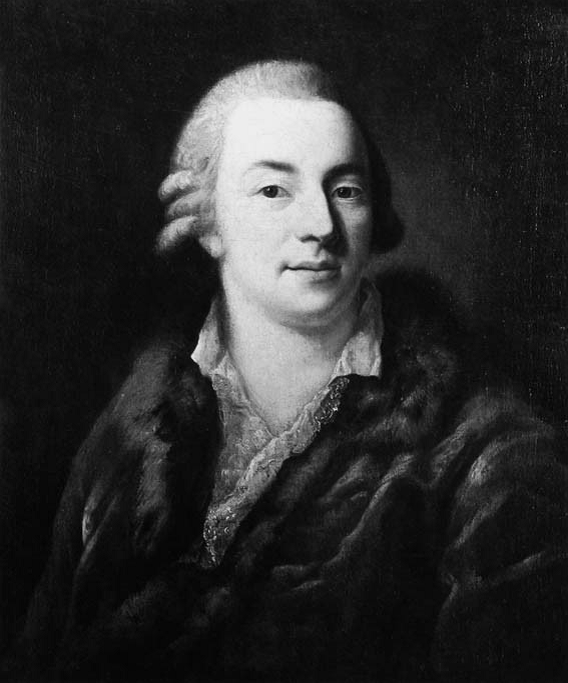
ジアコーモ・カサノーヴァ
Giacomo Casanova,
1725-1798
左:
モリス・ロビンソンとデヴィッド・ピットシンガー(2011年)/ Portrait of Wilhelm Troszel as Don
Juan, by Józef Simmler, 1846
★ ジアコーモ・カサノーヴァ(Giacomo Casanova, 1725-1798)——リアルな人物像としての女たらしあるいは現実に存在した「性豪」
☆
ジャコモ・ジロラモ・カサノヴァ(Giacomo Girolamo
Casanova/ˌkæsəˈnoʊə/,[1][2][3]イタリア語: [ˈdʒaːkomo dˈdʒ
kazaˈnɔːva, kasa-]; 1725年4月2日 - 1798年6月4日)はヴェネツィア共和国出身のイタリアの冒険家、作家である。
[4][5]彼の自伝であるHistoire de ma vie(Story of My
Life)は、18世紀のヨーロッパ社会生活の習慣や規範に関する最も信憑性が高く挑発的な情報源のひとつとみなされている[6]。
カサノヴァは、ファルシ男爵や伯爵(母親の旧姓)、シュヴァリエ・ド・セインガルト(フランス語発音:[sɛ̃ɑ])などの偽名を使うことで知られてい
た。
[7]ヴェネツィアからの2度目の亡命後、フランス語で執筆を始めた後、彼はしばしば作品に「ジャック・カサノヴァ・ド・セインガルト」と署名した
[a]。彼はヨーロッパの王族、教皇、枢機卿、芸術家であるヴォルテール、ゲーテ、モーツァルトらと交わったと主張している。
女性との複雑で手の込んだ情事をしばしば行ったことで有名になり、その名は「自由主義者(リベルタン)の代名詞と言えるかもしれない」[8]。晩年はワル
トシュタイン伯爵家の司書として デュックス・シャトー(ボヘミア)で過ごし、そこで自伝も執筆した。
| Giacomo Girolamo
Casanova (/ˌkæsəˈnoʊvə, ˌkæzə-/,[1][2][3] Italian: [ˈdʒaːkomo
dʒiˈrɔːlamo kazaˈnɔːva, kasa-]; 2 April 1725 – 4 June 1798) was an
Italian adventurer and author from the Republic of Venice.[4][5] His
autobiography, Histoire de ma vie (Story of My Life), is regarded as
one of the most authentic and provocative sources of information about
the customs and norms of European social life during the 18th
century.[6] Casanova was known to use pseudonyms, such as baron or count of Farussi (the maiden name of his mother) or Chevalier de Seingalt (French pronunciation: [sɛ̃ɡɑl]).[7] After he began writing in French, following his second exile from Venice, he often signed his works as "Jacques Casanova de Seingalt".[a] He claims to have mingled with European royalty, popes, and cardinals, along with the artistic figures Voltaire, Goethe, and Mozart. He has become so famous for his often complicated and elaborate affairs with women, that his name "might be said to be synonymous with libertine".[8] His final years were spent in Dux Chateau (Bohemia) as a librarian in Count Waldstein's household, where he also wrote his autobiography. |
ジャコモ・ジロラモ・カサノヴァ
(/ˌkæsəˈnoʊə/,[1][2][3]イタリア語: [ˈdʒaːkomo dˈdʒ kazaˈnɔːva, kasa-];
1725年4月2日 - 1798年6月4日)はヴェネツィア共和国出身のイタリアの冒険家、作家である。
[4][5]彼の自伝であるHistoire de ma vie(Story of My
Life)は、18世紀のヨーロッパ社会生活の習慣や規範に関する最も信憑性が高く挑発的な情報源のひとつとみなされている[6]。 カサノヴァは、ファルシ男爵や伯爵(母親の旧姓)、シュヴァリエ・ド・セインガルト(フランス語発音:[sɛ̃ɑ])などの偽名を使うことで知られてい た。 [7]ヴェネツィアからの2度目の亡命後、フランス語で執筆を始めた後、彼はしばしば作品に「ジャック・カサノヴァ・ド・セインガルト」と署名した [a]。彼はヨーロッパの王族、教皇、枢機卿、芸術家であるヴォルテール、ゲーテ、モーツァルトらと交わったと主張している。 女性との複雑で手の込んだ情事をしばしば行ったことで有名になり、その名は「自由主義者(リベルタン) の代名詞と言えるかもしれない」[8]。晩年はワルトシュタイン伯爵家の司書として デュックス・シャトー(ボヘミア)で過ごし、そこで自伝も執筆した。 |
| Biography Youth 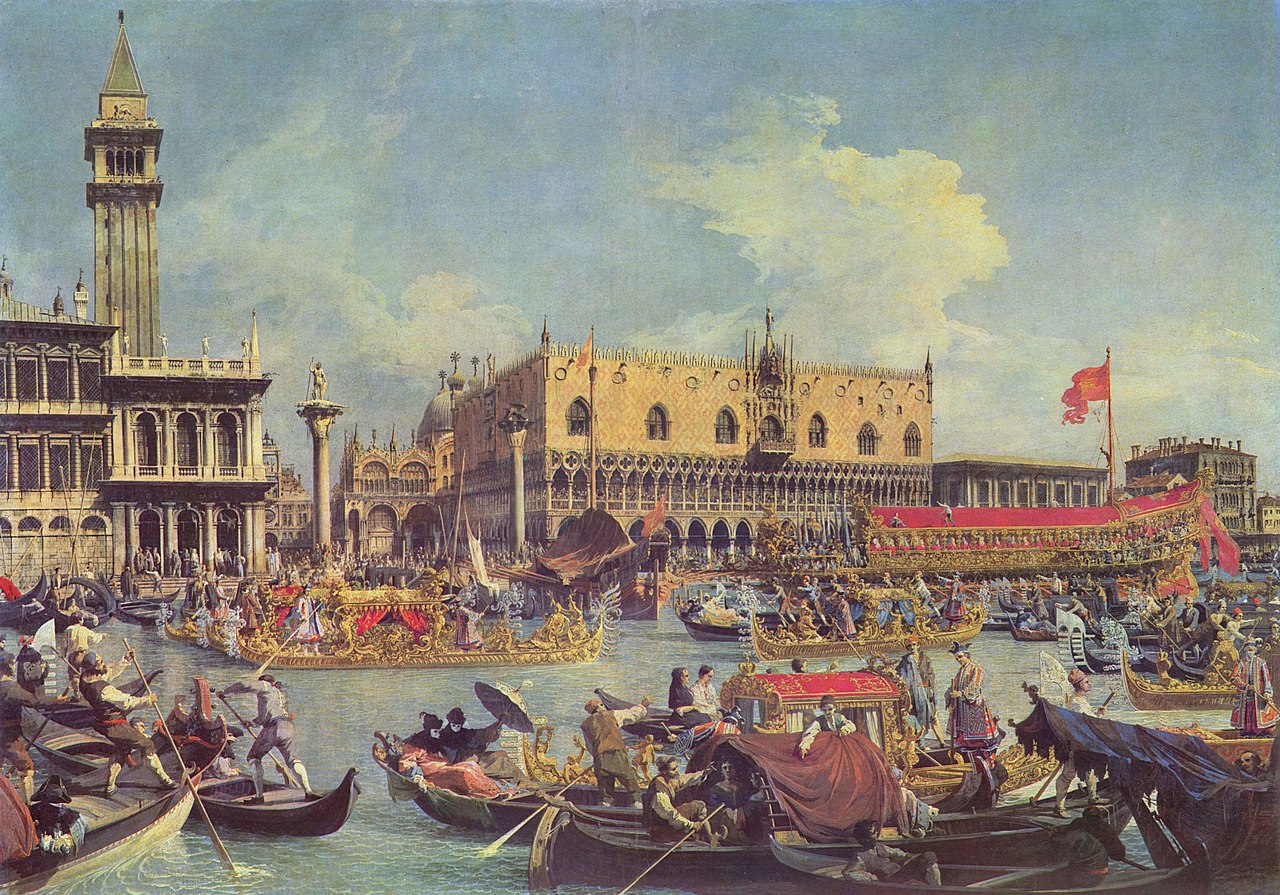 Venice in the 1730s Giacomo Girolamo Casanova was born in Venice in 1725 to actress Zanetta Farussi, wife of actor and dancer Gaetano Casanova. Giacomo was the first of six children, followed by Francesco Giuseppe (1727–1803), Giovanni Battista (1730–1795), Faustina Maddalena (1731–1736), Maria Maddalena Antonia Stella (1732–1800), and Gaetano Alvise (1734–1783).[9][10] At the time of Casanova's birth, the city of Venice thrived as the pleasure capital of Europe, ruled by political and religious conservatives who tolerated social vices and encouraged tourism.[11] It was a required stop on the Grand Tour, traveled by young men coming of age, especially those belonging to the British aristocracy. The famed Carnival, gambling houses, and beautiful courtesans were powerful drawcards. This environment provided many of his formative experiences.[12] 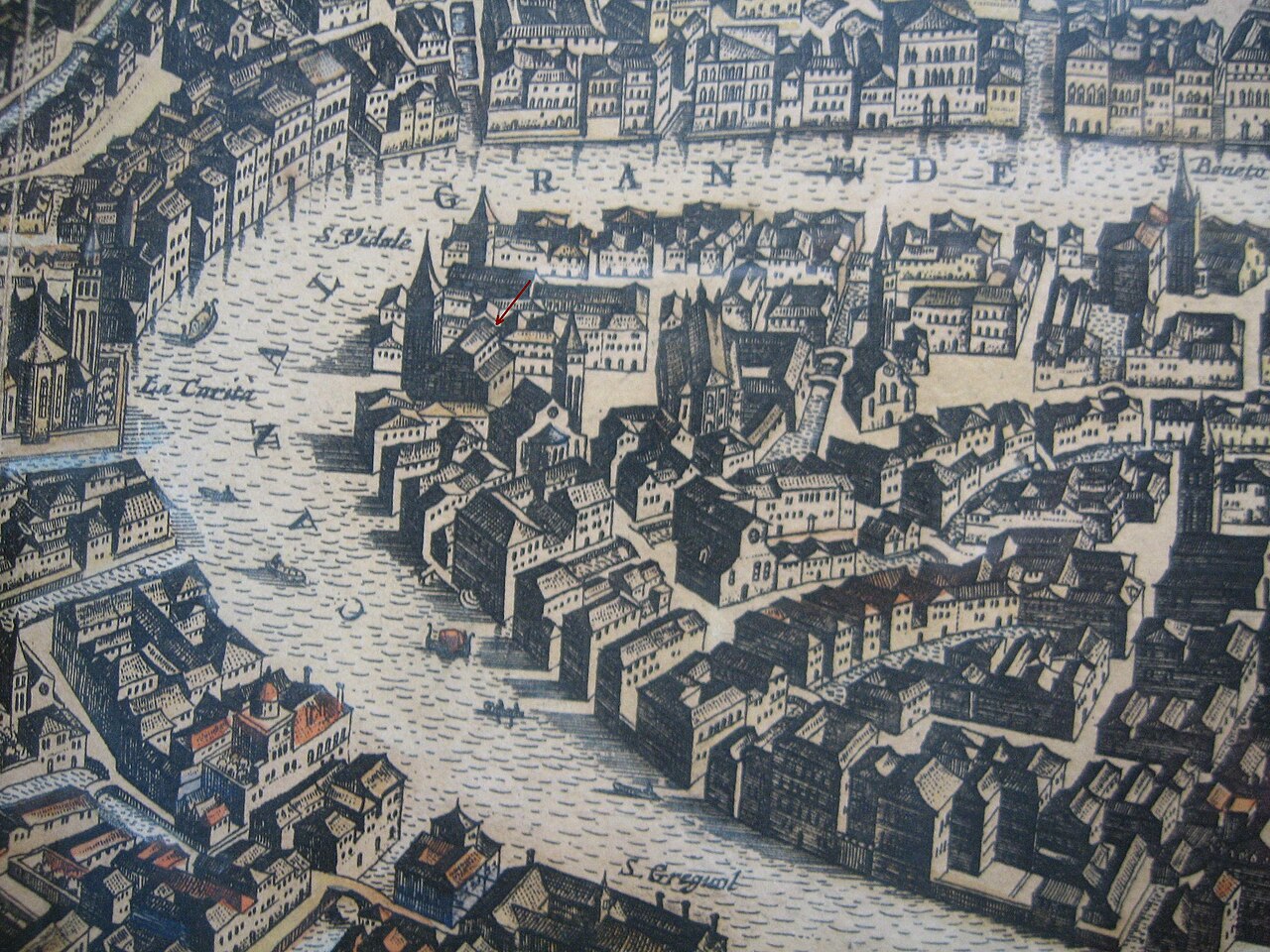 San Samuele – Casanova's childhood neighborhood His grandmother, Marzia Baldissera, cared for him while his mother toured about Europe in the theater. His father died when he was eight. As a child, Casanova suffered nosebleeds and his grandmother sought help from a witch: "Leaving the gondola, we enter a hovel, where we find an old woman sitting on a pallet, with a black cat in her arms and five or six others around her."[13] Though the unguent applied was ineffective, Casanova was fascinated by the incantation.[14] Perhaps to remedy the nosebleeds (a physician blamed the density of Venice's air), Casanova, on his ninth birthday, was sent to a boarding house on the mainland in Padua. For Casanova, the neglect by his parents was a bitter memory. "So they got rid of me," he proclaimed.[15] Conditions at the boarding house were appalling, so he appealed to be placed under the care of Abbé Gozzi, his primary instructor, who tutored him in academic subjects, as well as the violin. Casanova moved in with the priest and his family and lived there through most of his teenage years.[16] In the Gozzi household, Casanova first came into contact with the opposite sex, when Gozzi's younger sister Bettina fondled him at the age of 11. Bettina was "pretty, lighthearted, and a great reader of romances. ... The girl pleased me at once, though I had no idea why. It was she who little by little kindled in my heart the first sparks of a feeling which later became my ruling passion."[17] Although she subsequently married, Casanova maintained a lifelong attachment to Bettina and the Gozzi family.[18] Casanova boasts of having demonstrated from early on a quick wit, an intense appetite for knowledge, and a perpetually inquisitive mind. He entered the University of Padua at 12 and graduated at 17, in 1742, with a degree in law ("for which I felt an unconquerable aversion").[19] His guardian's hope was that he would become an ecclesiastical lawyer.[16] Casanova had also studied moral philosophy, chemistry, and mathematics, and was keenly interested in medicine. ("I should have been allowed to do as I wished and become a physician, in which profession quackery is even more effective than it is in legal practice.")[19] He frequently prescribed his own treatments for himself and friends.[20] While attending the university, Casanova began to gamble and quickly got into debt, causing his recall to Venice by his grandmother, but the gambling habit became firmly established. 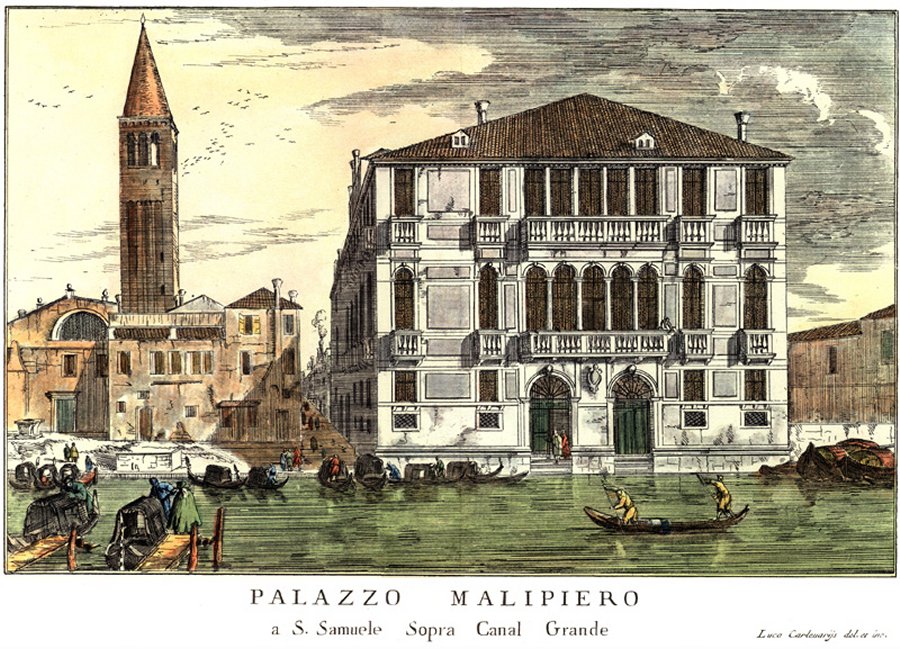 The Church of San Samuele, where Casanova was baptized, and Palazzo Malipiero c. 1716 Back in Venice, Casanova started his clerical law career and was admitted as an abbé after being conferred minor orders by the Patriarch of Venice. He shuttled back and forth to Padua to continue his university studies. By now, he had become something of a dandy—tall and dark, his long hair powdered, scented, and elaborately curled.[b] He quickly ingratiated himself with a patron (something he was to do all his life), 76-year-old Venetian senator Alvise Gasparo Malipiero, the owner of Palazzo Malipiero, close to Casanova's home in Venice.[23] Malipiero moved in the best circles and taught young Casanova a great deal about good food and wine, and how to behave in society. However, Casanova was caught dallying with Malipiero's intended object of seduction, actress Teresa Imer, and the senator drove both of them from his house.[18] Casanova's growing curiosity about women led to his first complete sexual experience, with two sisters, Nanetta and Marton Savorgnan, then 14 and 16, who were distant relatives of the Grimanis. Casanova proclaimed that his life avocation was firmly established by this encounter.[24] Early career in Italy and abroad Scandals tainted Casanova's short church career. After his grandmother's death, Casanova entered a seminary for a short while, but soon his indebtedness landed him in prison for the first time. An attempt by his mother to secure him a position with Bishop Bernardo de Bernardis was rejected by Casanova after a very brief trial of conditions in the bishop's Calabrian see.[25] Instead, he found employment as a scribe with the powerful Cardinal Acquaviva in Rome. On meeting Pope Benedict XIV, Casanova boldly asked for a dispensation to read the "forbidden books" and from eating fish (which he claimed inflamed his eyes). He also composed love letters for another cardinal. When Casanova became the scapegoat for a scandal involving a local pair of star-crossed lovers, Cardinal Acquaviva dismissed Casanova, thanking him for his sacrifice, but effectively ending his church career.[26] In search of a new profession, Casanova bought a commission to become a military officer for the Republic of Venice. His first step was to look the part: Reflecting that there was now little likelihood of my achieving fortune in my ecclesiastical career, I decided to dress as a soldier ... I inquire for a good tailor ... he brings me everything I need to impersonate a follower of Mars. ... My uniform was white, with a blue vest, a shoulder knot of silver and gold... I bought a long sword, and with my handsome cane in hand, a trim hat with a black cockade, with my hair cut in side whiskers and a long false pigtail, I set forth to impress the whole city. — Casanova (2006), p. 223. 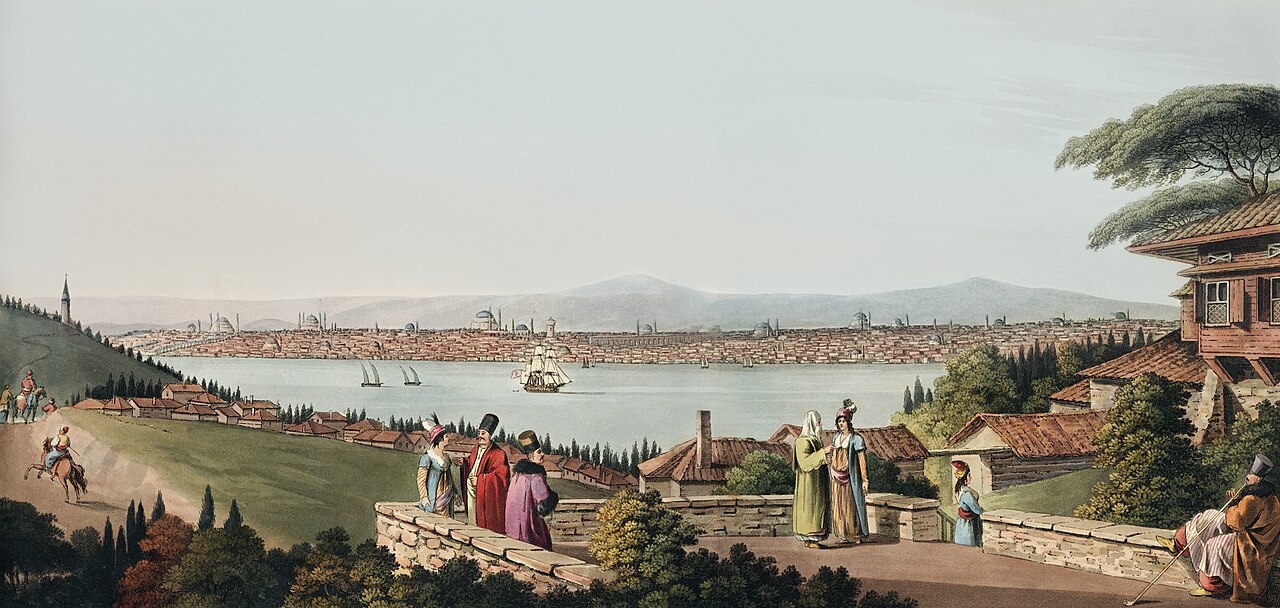 Constantinople in the 18th century He joined a Venetian regiment at Corfu, his stay being broken by a brief trip to Constantinople, ostensibly to deliver a letter from his former master the Cardinal.[27] Finding his advancement too slow and his duty boring, he managed to lose most of his pay playing faro. Casanova soon abandoned his military career and returned to Venice. At the age of 21, he set out to become a professional gambler, but losing all the money remaining from the sale of his commission, he turned to his old benefactor Alvise Grimani for a job. Casanova thus began his third career, as a violinist in the San Samuele theater, "a menial journeyman of a sublime art in which, if he who excels is admired, the mediocrity is rightly despised. ... My profession was not a noble one, but I did not care. Calling everything prejudice, I soon acquired all the habits of my degraded fellow musicians."[28] He and some of his fellows, "often spent our nights roaming through different quarters of the city, thinking up the most scandalous practical jokes and putting them into execution ... we amused ourselves by untying the gondolas moored before private homes, which then drifted with the current". They also sent midwives and physicians on false calls.[29] Good fortune came to the rescue when Casanova, unhappy with his lot as a musician, saved the life of a Venetian patrician of the Bragadin family, who had a stroke while riding with Casanova in a gondola after a wedding ball. They immediately stopped to have the senator bled. Then, at the senator's palace, a physician bled the senator again and applied an ointment of mercury—an all-purpose but toxic remedy at the time[30]—to the senator's chest. This raised his temperature and induced a massive fever, and Bragadin appeared to be choking on his own swollen windpipe. A priest was called as death seemed to be approaching. However, despite protests from the attending physician, Casanova ordered the removal of the ointment and the washing of the senator's chest with cool water. The senator recovered from his illness with rest and a sensible diet.[31] Because of his youth and his facile recitation of medical knowledge, the senator and his two bachelor friends thought Casanova wise beyond his years, and concluded that he must be in possession of occult knowledge. As they were cabalists themselves, the senator invited Casanova into his household and became a lifelong patron.[32] Casanova stated in his memoirs: I took the most creditable, the noblest, and the only natural course. I decided to put myself in a position where I need no longer go without the necessities of life: and what those necessities were for me no one could judge better than me.... No one in Venice could understand how an intimacy could exist between myself and three men of their character, they all heaven and I all earth; they most severe in their morals, and I addicted to every kind of dissolute living. — Casanova (2006), p. 247. For the next three years under the senator's patronage, working nominally as a legal assistant, Casanova led the life of a nobleman, dressing magnificently and, as was natural to him, spending most of his time gambling and engaging in amorous pursuits.[33] His patron was exceedingly tolerant, but he warned Casanova that some day he would pay the price; "I made a joke of his dire Prophecies and went my way." However, not much later, Casanova was forced to leave Venice, due to further scandals. Casanova had dug up a freshly buried corpse to play a practical joke on an enemy and exact revenge, but the victim went into a paralysis, never to recover. In another scandal, a young girl who had duped him[clarification needed] accused him of rape and went to the officials.[34] Casanova was later acquitted of this crime for lack of evidence, but by this time, he had already fled from Venice. 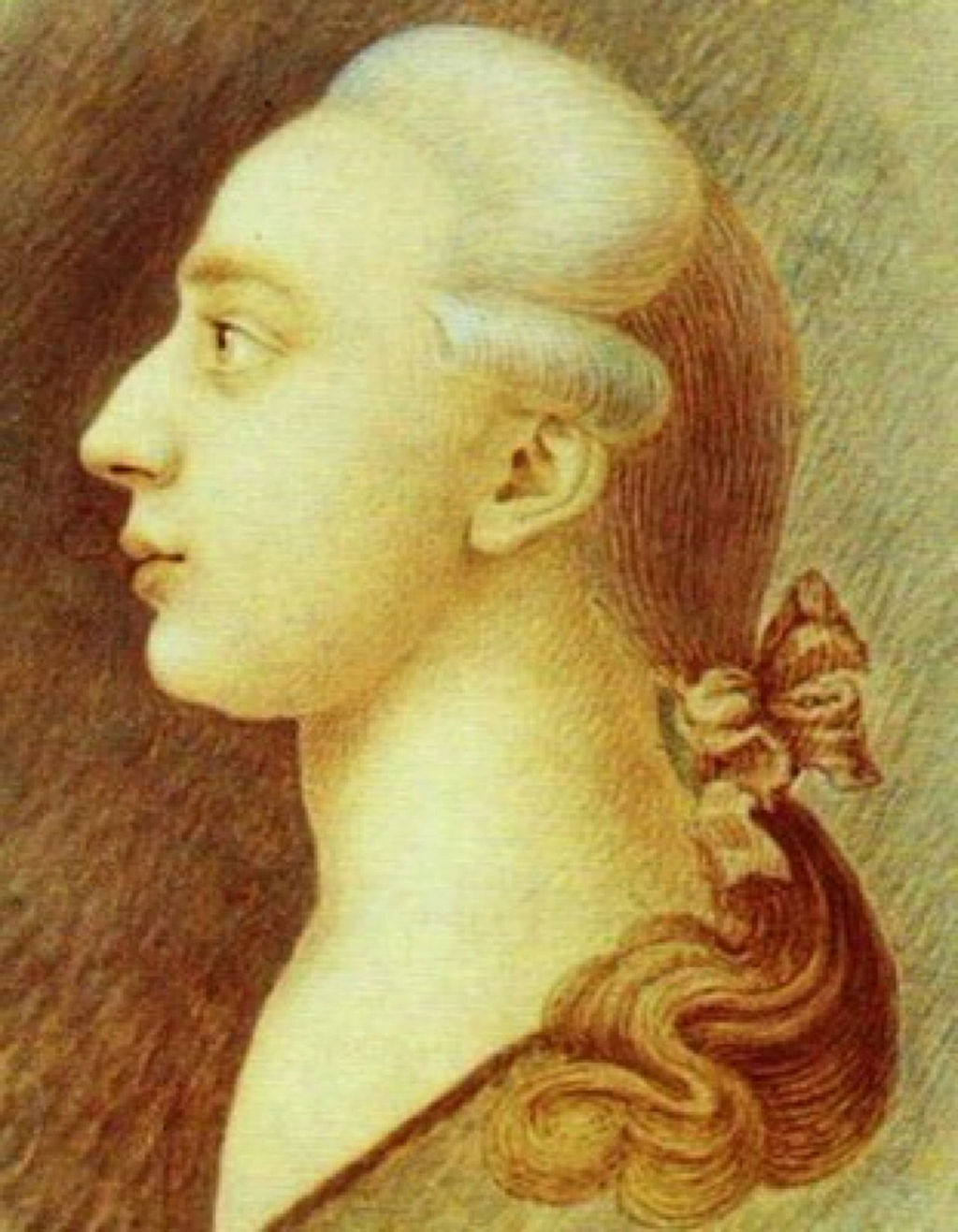 Drawing by his brother Francesco Escaping to Parma, Casanova entered into a three-month affair with a Frenchwoman he named "Henriette", perhaps the deepest love he ever experienced—a woman who combined beauty, intelligence, and culture. In his words, "They who believe that a woman is incapable of making a man equally happy all the twenty-four hours of the day have never known an Henriette. The joy which flooded my soul was far greater when I conversed with her during the day than when I held her in my arms at night. Having read a great deal and having natural taste, Henriette judged rightly of everything."[35] She also judged Casanova astutely. As noted Casanovist J. Rives Childs wrote: Perhaps no woman so captivated Casanova as Henriette; few women obtained so deep an understanding of him. She penetrated his outward shell early in their relationship, resisting the temptation to unite her destiny with his. She came to discern his volatile nature, his lack of social background, and the precariousness of his finances. Before leaving, she slipped into his pocket five hundred louis, mark of her evaluation of him. — Childs 1988, p. 46. Grand tour Crestfallen and despondent, Casanova returned to Venice, and after a good gambling streak, he recovered and set off on a grand tour, reaching Paris in 1750.[36] Along the way, from one town to another, he got into sexual escapades resembling operatic plots.[37] In Lyon, he entered the society of Freemasonry, which appealed to his interest in secret rites and which, for the most part, attracted men of intellect and influence who proved useful in his life, providing valuable contacts and uncensored knowledge. Casanova was also attracted to Rosicrucianism.[38] In Lyons, Casanova became companion and finally took the highest degree of Scottish Rite Master Mason.[39][40][8] Regarding his initiation to the Scottish Rite Freemasonry in Lyon, the Memoirs said: It was in Lyons that a respectable individual, whose acquaintance I made at the house of M. de Rochebaron, obtained for me the favour of being initiated in the sublime trifles of Freemasonry. I arrived in Paris a simple apprentice; a few months after my arrival I became companion and master; the last is certainly the highest degree in Freemasonry, for all the other degrees which I took afterwards are only pleasing inventions, which, although symbolical, add nothing to the dignity of master. — Memoirs of Jacques [Giovanni Giacomo] Casanova De Seingalt 1725–1798. To Paris and Prison, Volume 2A--Paris.[39][41] Casanova stayed in Paris for two years, learned the language, spent much time at the theater, and introduced himself to notables. Soon, however, his numerous liaisons were noted by the Paris police, as they were in nearly every city he visited.[42] In 1752, his brother Francesco and he moved from Paris to Dresden, where his mother and sister Maria Maddalena were living. His new play, La Moluccheide, now lost, was performed at the Royal Theatre, where his mother often played in lead roles.[43][44] He then visited Prague, and Vienna, where the tighter moral atmosphere was not to his liking. He finally returned to Venice in 1753.[45] There, Casanova resumed his escapades, picking up many enemies and gaining the scrutiny of the Venetian inquisitors. His police record became a lengthening list of reported blasphemies, seductions, fights, and public controversy.[46] A state spy, Giovanni Manucci, was employed to draw out Casanova's knowledge of cabalism and Freemasonry and to examine his library for forbidden books. Senator Bragadin, in total seriousness this time (being a former inquisitor himself), advised his "son" to leave immediately or face the stiffest consequences. Imprisonment and escape On 26 July 1755, at age 30, Casanova was arrested for affront to religion and common decency:[47] "The Tribunal, having taken cognizance of the grave faults committed by G. Casanova primarily in public outrages against the holy religion, their Excellencies have caused him to be arrested and imprisoned under the Leads."[48] "The Leads" was a prison of seven cells on the top floor of the east wing of the Doge's palace, reserved for prisoners of higher status as well as certain types of offenders—such as political prisoners, defrocked or libertine priests or monks, and usurers—and named for the lead plates covering the palace roof. The following 12 September, without a trial and without being informed of the reasons for his arrest and of the sentence, he was sentenced to five years imprisonment.[47][49] 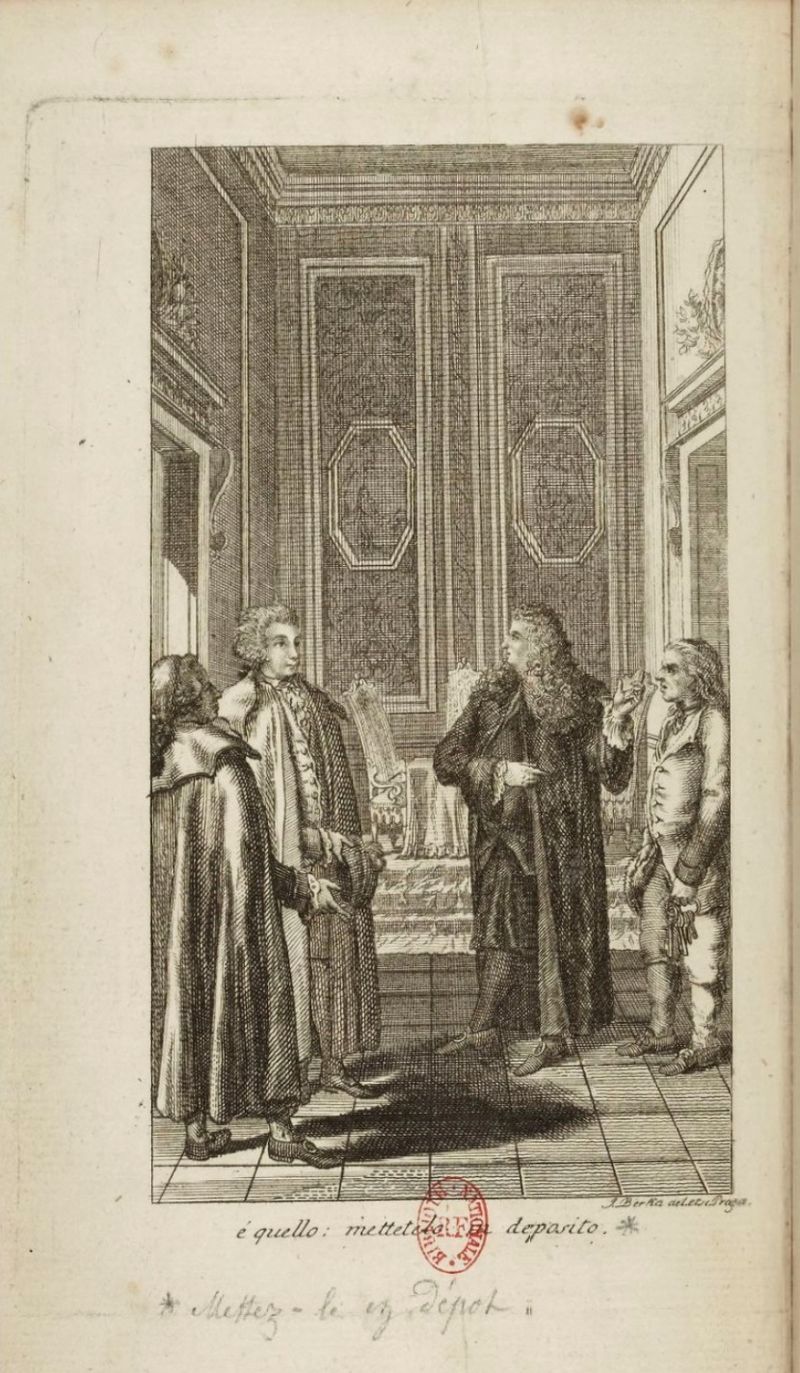 "It's him. Place him in custody!" He was placed in a single-person room with clothing, a pallet bed, table, and armchair in "the worst of all the cells",[50] where he suffered greatly from the darkness, summer heat, and "millions of fleas". He was later housed with a series of cellmates. After five months and a personal appeal from Count Bragadin, he was given warm winter bedding and a monthly stipend for books and better food. During exercise walks he was granted in the prison garret, he found a piece of black marble and an iron bar which he smuggled back to his cell; he hid the bar inside his armchair. When he was temporarily without cellmates, he spent two weeks sharpening the bar into a spike on the stone. Then he began to gouge through the wooden floor underneath his bed, knowing that his cell was directly above the Inquisitor's chamber.[51] Just three days before his intended escape during a festival, when no officials would be in the chamber below, Casanova was moved to a larger, lighter cell with a view, despite his protests that he was perfectly happy where he was. In his new cell, "I sat in my armchair like a man in a stupor; motionless as a statue, I saw that I had wasted all the efforts I had made, and I could not repent of them. I felt that I had nothing to hope for, and the only relief left to me was not to think of the future."[52] Casanova set upon another escape plan. He solicited the help of the prisoner in the adjacent cell, Father Balbi, a renegade priest. The spike, carried to the new cell inside the armchair, was passed to the priest in a folio Bible carried under a heaping plate of pasta by the hoodwinked jailer. The priest made a hole in his ceiling, climbed across and made a hole in the ceiling of Casanova's cell. To neutralize his new cellmate, who was a spy, Casanova played on his superstitions and terrorized him into silence.[53] When Balbi broke through to Casanova's cell, Casanova lifted himself through the ceiling, leaving behind a note that quoted the 117th Psalm (from the Latin Vulgate): "I shall not die, but live, and declare the works of the Lord".[54] 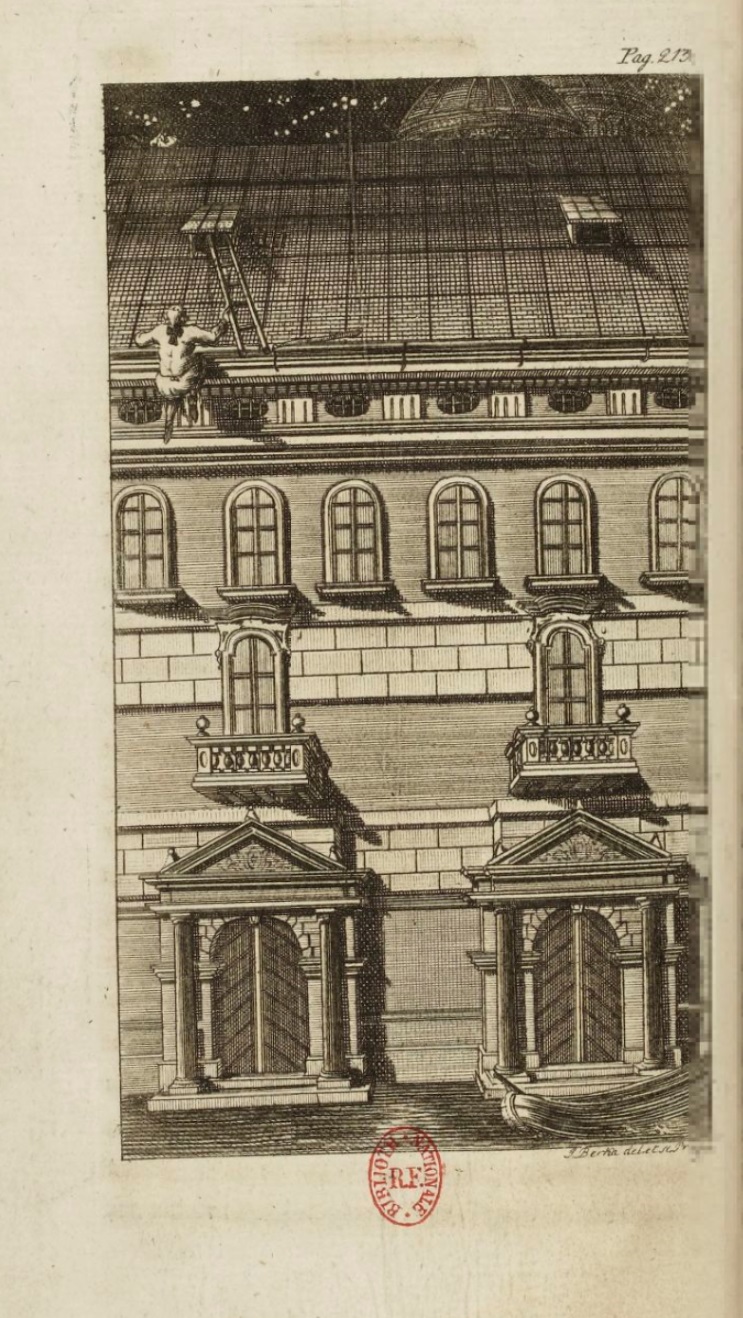 Illustration from Story of My Flight The spy remained behind, too frightened of the consequences if he were caught escaping with the others. Casanova and Balbi pried their way through the lead plates and onto the sloping roof of the Doge's Palace, with a heavy fog swirling. The drop to the nearby canal being too great, Casanova prised open the grate over a dormer window, and broke the window to gain entry. They found a long ladder on the roof, and with the additional use of a bedsheet "rope" that Casanova had prepared, lowered themselves into the room whose floor was 25 feet (7.6 m) below. They rested until morning, changed clothes, then broke a small lock on an exit door and passed into a palace corridor, through galleries and chambers, and down stairs, where, by convincing the guard they had inadvertently been locked into the palace after an official function, they left through a final door.[55] It was 6:00 in the morning and they escaped by gondola. Eventually, Casanova reached Paris, where he arrived on the same day (5 January 1757) that Robert-François Damiens made an attempt on the life of Louis XV.[56] (Casanova would later witness and describe his execution.) Thirty years later in 1787, Casanova wrote Story of My Flight, which was very popular and was reprinted in many languages, and he repeated the tale a little later in his memoirs.[57] Casanova's judgment of the exploit is characteristic: Thus did God provide me with what I needed for an escape which was to be a wonder if not a miracle. I admit that I am proud of it; but my pride does not come from my having succeeded, for luck had a good deal to do with that; it comes from my having concluded that the thing could be done and having had the courage to undertake it. — Casanova (2006), p. 502. Return to Paris He knew his stay in Paris might be a long one and he proceeded accordingly: "I saw that to accomplish anything I must bring all my physical and moral faculties in play, make the acquaintance of the great and the powerful, exercise strict self-control, and play the chameleon."[58] Casanova had matured, and this time in Paris, though still depending at times on quick thinking and decisive action, he was more calculating and deliberate. His first task was to find a new patron. He reconnected with his old friend de Bernis, now the Foreign Minister of France. Casanova was advised by his patron to find a means of raising funds for the state as a way to gain instant favor. Casanova promptly became one of the trustees of the first state lottery, and one of its best ticket salesmen.[59] The enterprise earned him a large fortune quickly.[60] With money in hand, he traveled in high circles and undertook new seductions. He duped many socialites with his occultism, particularly the Marquise Jeanne d'Urfé, using his excellent memory which made him appear to have a sorcerer's power of numerology. In Casanova's view, "deceiving a fool is an exploit worthy of an intelligent man".[61] 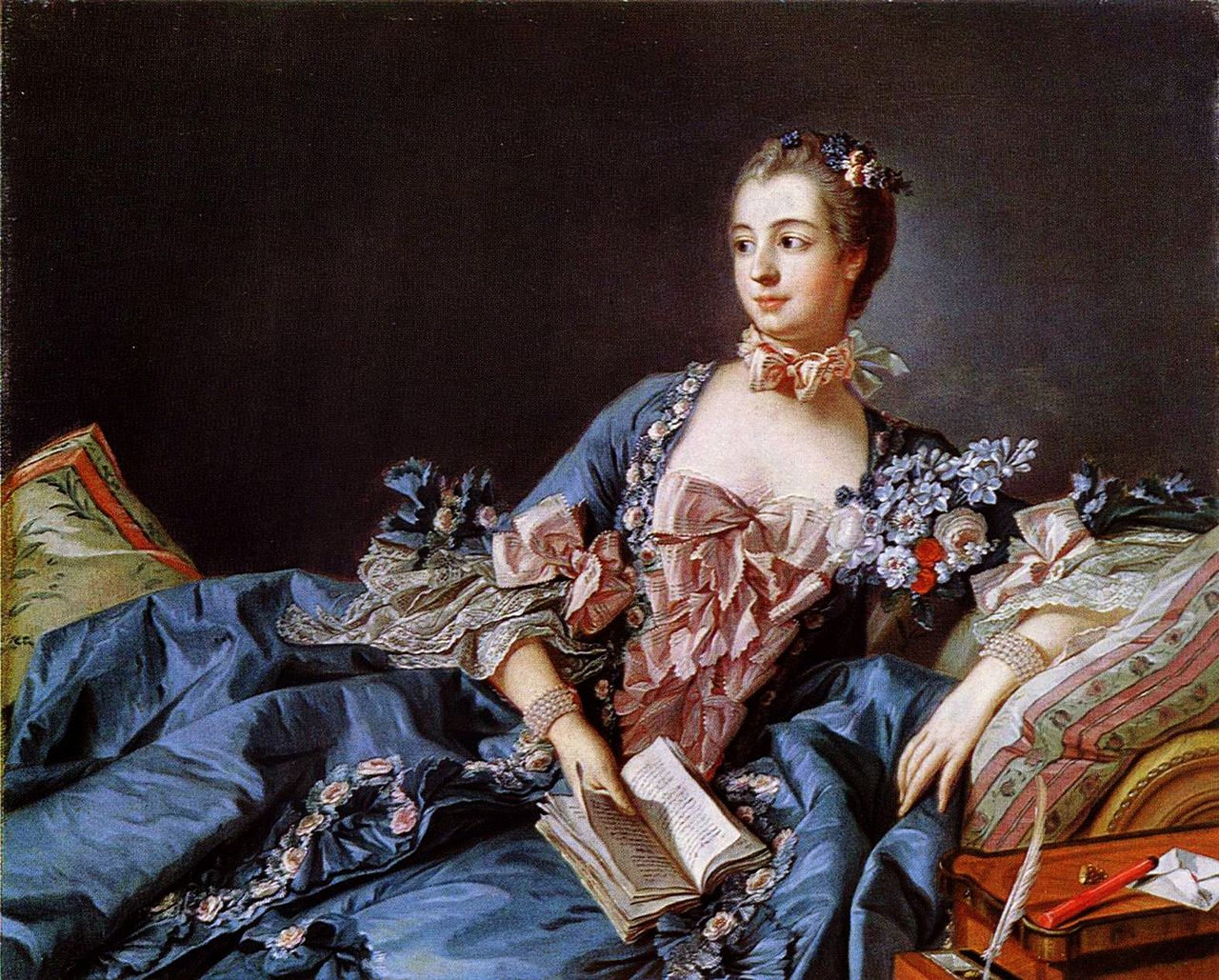 Madame de Pompadour, c. 1750 Casanova claimed to be a Rosicrucian and an alchemist, aptitudes which made him popular with some of the most prominent figures of the era, among them Madame de Pompadour, the Count of Saint-Germain, d'Alembert, and Jean-Jacques Rousseau. So popular was alchemy among the nobles, particularly the search for the "philosopher's stone", that Casanova was highly sought after for his supposed knowledge, and he profited handsomely.[62] He met his match, however, in the Count of Saint-Germain: "This very singular man, born to be the most barefaced of all imposters, declared with impunity, with a casual air, that he was three hundred years old, that he possessed the universal medicine, that he made anything he liked from nature, that he created diamonds."[63] De Bernis decided to send Casanova to Dunkirk on his first spying mission. Casanova was paid well for his quick work and this experience prompted one of his few remarks against the ancien régime and the class on which he was dependent. He remarked in hindsight, "All the French ministers are the same. They lavished money which came out of the other people's pockets to enrich their creatures, and they were absolute: The down-trodden people counted for nothing, and, through this, the indebtedness of the State and the confusion of finances were the inevitable results. A Revolution was necessary."[64] 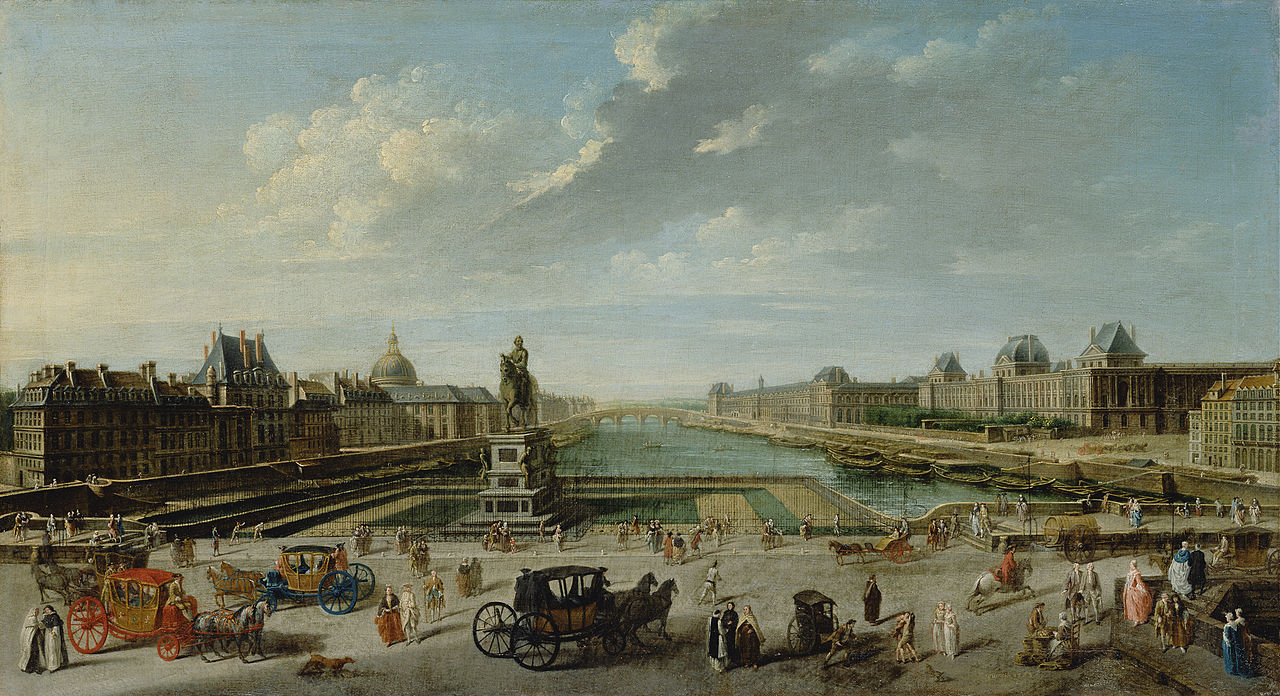 Paris in the 18th century As the Seven Years' War began, Casanova was again called[65] to help increase the state treasury. He was entrusted with a mission of selling state bonds in Amsterdam, the Netherlands being the financial center of Europe at the time.[66] He succeeded in selling the bonds at only an 8% discount, and the following year was rich enough to found a silk manufactory with his earnings. The French government even offered him a title and a pension if he would become a French citizen and work on behalf of the finance ministry, but he declined, perhaps because it would frustrate his wanderlust.[67] Casanova had reached his peak of fortune, but could not sustain it. He ran the business poorly, borrowed heavily trying to save it, and spent much of his wealth on constant liaisons with his female workers who were his "harem".[68] For his debts, Casanova was imprisoned again, this time at For-l'Évêque, but was liberated four days afterwards, upon the insistence of the Marquise d'Urfé. Unfortunately, though he was released, his patron de Bernis was dismissed by Louis XV at that time and Casanova's enemies closed in on him. He sold the rest of his belongings and secured another mission to Holland to distance himself from his troubles.[68] On the run This time, however, his mission failed and he fled to Cologne, then Stuttgart in the spring of 1760, where he lost the rest of his fortune. He was yet again arrested for his debts, but managed to escape to Switzerland. Weary of his wanton life, Casanova visited the monastery of Einsiedeln and considered the simple, scholarly life of a monk. He returned to his hotel to think on the decision, only to encounter a new object of desire, and reverting to his old instincts, all thoughts of a monk's life were quickly forgotten.[69] Moving on, he visited Albrecht von Haller and Voltaire, and arrived in Marseille, then Genoa, Florence, Rome, Naples, Modena, and Turin, moving from one sexual romp to another.[70] In 1760, Casanova started styling himself the Chevalier de Seingalt, a name he was to use increasingly for the rest of his life. On occasion, he would also call himself Count de Farussi (using his mother's maiden name) and when Pope Clement XIII presented Casanova with the Papal Order of the Golden Spur, he had an impressive cross and ribbon to display on his chest.[71] Back in Paris, he set about one of his most outrageous schemes—convincing his old dupe the Marquise d'Urfé that he could turn her into a young man through occult means. The plan did not yield Casanova the big payoff he had hoped for, and the Marquise d'Urfé finally lost faith in him.[72] 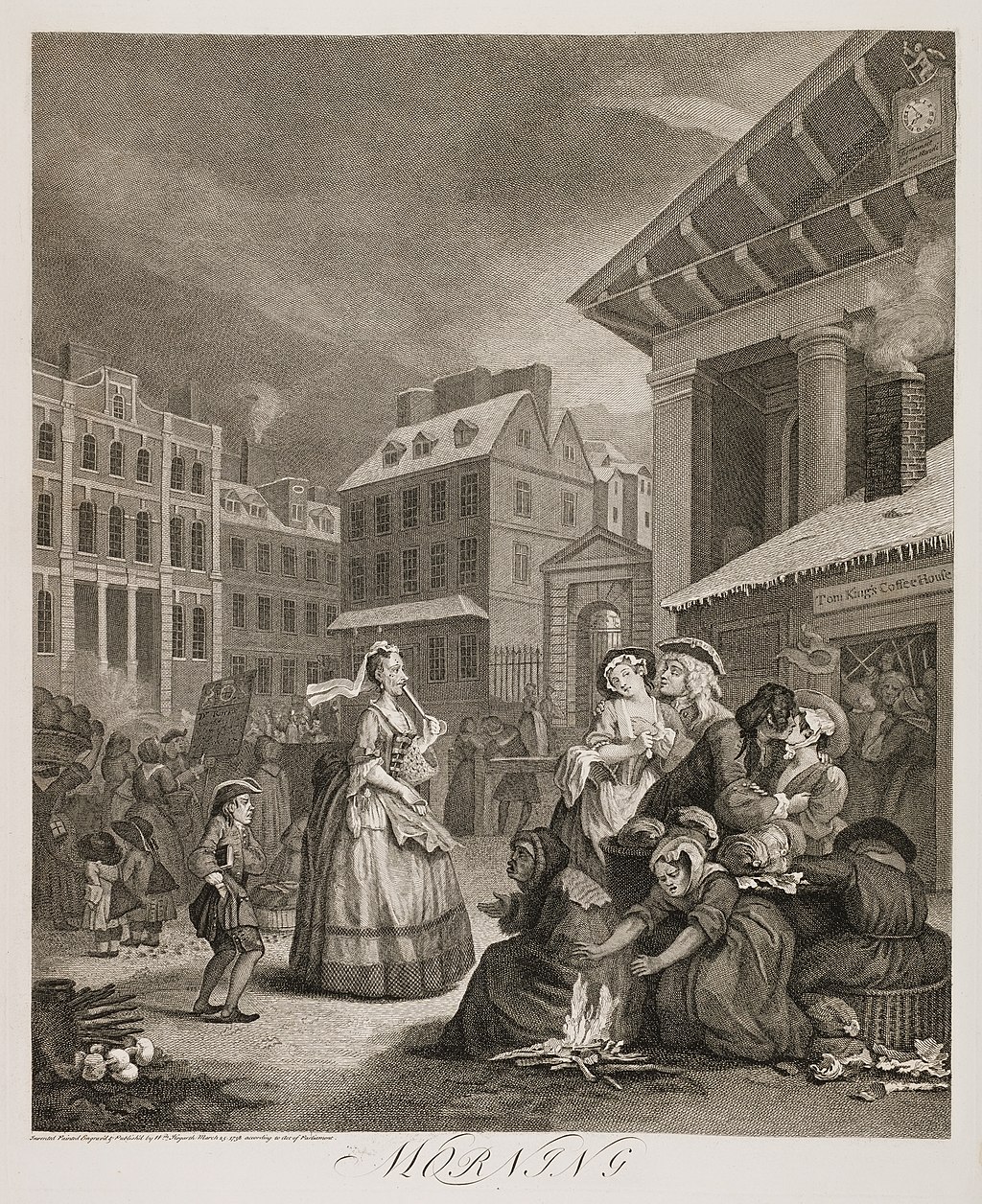 18th-century London by William Hogarth Casanova traveled to England in 1763, hoping to sell his idea of a state lottery to English officials. He wrote of the English, "the people have a special character, common to the whole nation, which makes them think they are superior to everyone else. It is a belief shared by all nations, each thinking itself the best. And they are all right."[73] Through his connections, he worked his way up to an audience with King George III, using most of the valuables he had stolen from the Marquise d'Urfé. While working the political angles, he also spent much time in the bedroom, as was his habit. As a means to find females for his pleasure, not being able to speak English, he put an advertisement in the newspaper to let an apartment to the "right" person. He interviewed many young women, choosing one "Mistress Pauline" who suited him well. Soon, he established himself in her apartment and seduced her. These and other liaisons, however, left him weak with venereal disease and he left England impoverished and ill.[74] He went on to the Austrian Netherlands, recovered, and then for the next three years, traveled all over Europe, covering about 4,500 miles (7,200 km) by coach over rough roads, and going as far as Moscow and Saint Petersburg (the average daily coach trip being about 30 miles (48 km)). Again, his principal goal was to sell his lottery scheme to other governments and repeat the great success he had with the French government, but a meeting with Frederick the Great bore no fruit and in the surrounding German lands, the same result. Lacking neither connections nor confidence, Casanova went to Russia and met with Catherine the Great, but she flatly turned down the lottery idea.[75] In 1766, he was expelled from Warsaw following a pistol duel with Colonel Franciszek Ksawery Branicki over an Italian actress, a lady friend of theirs. Both duelists were wounded, Casanova on the left hand. The hand recovered on its own, after Casanova refused the recommendation of doctors that it be amputated.[76] From Warsaw, he traveled to Breslau in the Kingdom of Prussia, then to Dresden, where he contracted yet another venereal infection.[77][78][79] He returned to Paris for several months in 1767 and hit the gambling salons, only to be expelled from France by order of Louis XV himself, primarily for Casanova's scam involving the Marquise d'Urfé.[80] Now known across Europe for his reckless behavior, Casanova would have difficulty overcoming his notoriety and gaining any fortune, so he headed for Spain, where he was not as notorious. He tried his usual approach, leaning on well-placed contacts (often Freemasons), wining and dining with nobles of influence, and finally arranging an audience with the local monarch, in this case Charles III. When no doors opened for him, however, he could only roam across Spain, with little to show for it. In Barcelona, he escaped assassination and landed in jail for 6 weeks. His Spanish adventure a failure, he returned to France briefly, then to Italy.[81] Return to Venice In Rome, Casanova had to prepare a way for his return to Venice. While waiting for supporters[82] to gain him legal entry into Venice, Casanova began his modern Tuscan-Italian translation of the Iliad, his History of the Troubles in Poland, and a comic play. To ingratiate himself with the Venetian authorities, Casanova did some commercial spying for them. After months without a recall, however, he wrote a letter of appeal directly to the Inquisitors. At last, he received his long-sought permission and burst into tears upon reading "We, Inquisitors of State, for reasons known to us, give Giacomo Casanova a free safe-conduct ... empowering him to come, go, stop, and return, hold communication wheresoever he pleases without let or hindrance. So is our will." Casanova was permitted to return to Venice in September 1774 after 18 years of exile.[83] At first, his return to Venice was a cordial one and he was a celebrity. Even the Inquisitors wanted to hear how he had escaped from their prison. Of his three bachelor patrons, however, only Dandolo was still alive and Casanova was invited back to live with him. He received a small stipend from Dandolo and hoped to live from his writings, but that was not enough. He reluctantly became a correspondent again for Venice, paid by piece work, reporting on religion, morals, and commerce, most of it based on gossip and rumor he picked up from social contacts.[84] He was disappointed. No financial opportunities of interest came about and few doors opened for him in society as in the past. At age 49, the years of reckless living and the thousands of miles of travel had taken their toll. Casanova's smallpox scars, sunken cheeks, and hook nose became all the more noticeable. His easygoing manner was now more guarded. Prince Charles de Ligne, a friend (and uncle of his future employer), described him around 1784: He would be a good-looking man if he were not ugly; he is tall and built like Hercules, but of an African tint; eyes full of life and fire, but touchy, wary, rancorous—and this gives him a ferocious air. It is easier to put him in a rage than to make him gay. He laughs little, but makes others laugh. ... He has a manner of saying things which reminds me of Harlequin or Figaro, and which makes them sound witty. — Masters 1969, p. 257 Venice had changed for him. Casanova now had little money for gambling, few willing females worth pursuing, and few acquaintances to enliven his craven, impulsive tendencies. He heard of the death of his mother and, more paining, visited the deathbed of Bettina Gozzi, who had first introduced him to sex and who died in his arms.[85] His Iliad was published in three volumes, but to limited subscribers and yielding little money. He got into a published dispute with Voltaire over religion.[86] When he asked, "Suppose that you succeed in destroying superstition. With what will you replace it?" Voltaire shot back, "I like that. When I deliver humanity from a ferocious beast which devours it, can I be asked what I shall put in its place." From Casanova's point of view, if Voltaire had "been a proper philosopher, he would have kept silent on that subject ... the people need to live in ignorance for the general peace of the nation".[87] In 1779, Casanova found Francesca, an uneducated seamstress, who became his live-in lover and housekeeper, and who loved him devotedly.[88] Later that year, the Inquisitors put him on the payroll and sent him to investigate commerce between the papal states and Venice. Other publishing and theater ventures failed, primarily from lack of capital. In a downward spiral, Casanova was expelled again from Venice in 1783, after writing a vicious satire poking fun at Venetian nobility. In it, he made his only public statement[89] that Grimani was his true father.[90] Forced to resume his travels again, Casanova arrived in Paris, and in November 1783 met Benjamin Franklin while attending a presentation on aeronautics and the future of balloon transport.[91] For a while, Casanova served as secretary and pamphleteer to Sebastian Foscarini, Venetian ambassador in Vienna. He also became acquainted with Lorenzo Da Ponte, Mozart's librettist, who noted about Casanova, "This singular man never liked to be in the wrong."[92] Notes by Casanova indicate that he may have made suggestions to Da Ponte concerning the libretto for Mozart's Don Giovanni.[93] Final years in Bohemia 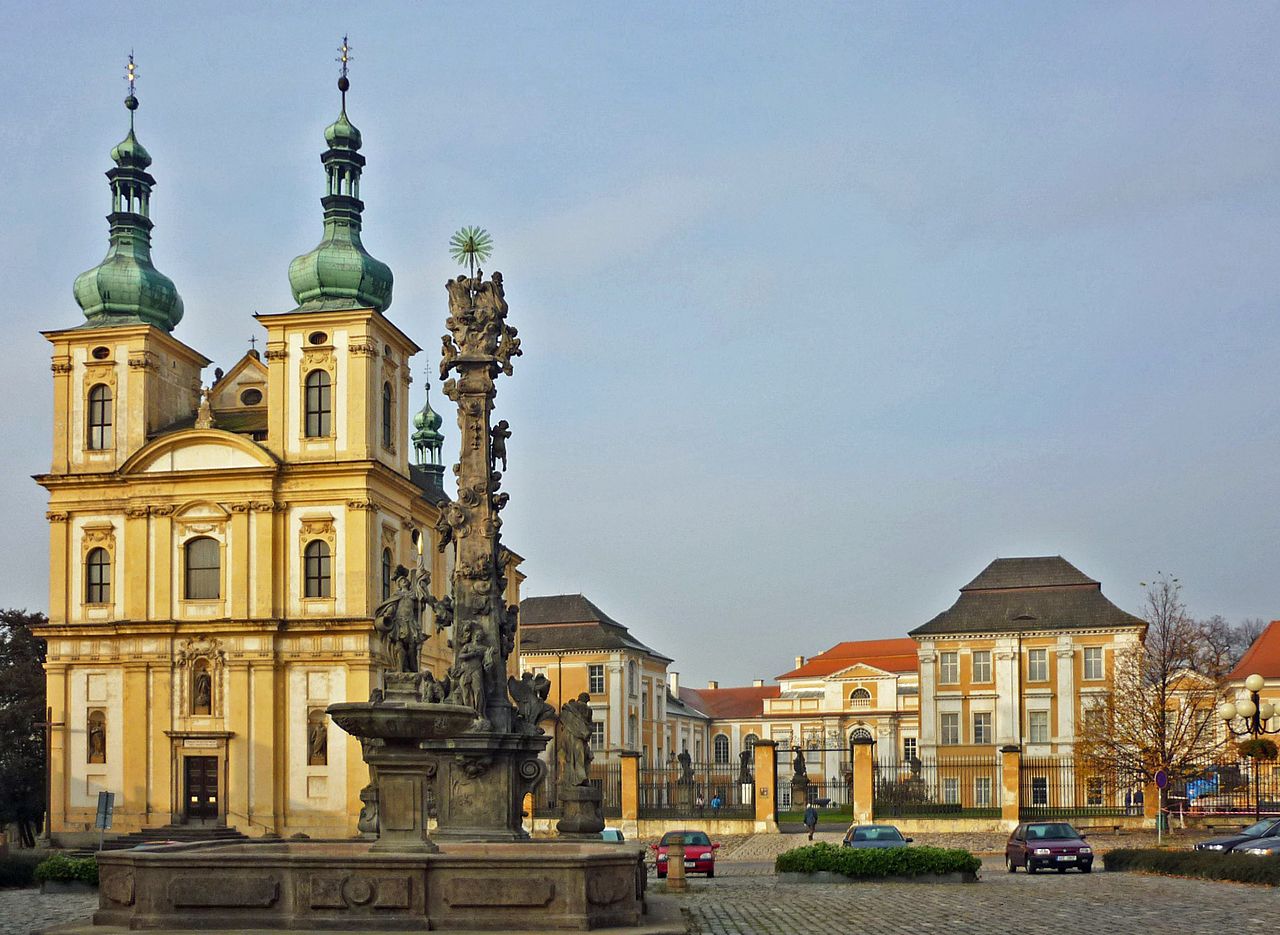 Dux Castle In 1785, after Foscarini died, Casanova began searching for another position. A few months later, he became the librarian to Count Joseph Karl von Waldstein, a chamberlain of the emperor, in the Castle of Dux, Bohemia (now the Czech Republic). The count—himself a Freemason, cabalist, and frequent traveler—had taken to Casanova when they had met a year earlier at Foscarini's residence. Although the job offered security and good pay, Casanova describes his last years as boring and frustrating, though it was a productive time for him in writing.[94] His health had deteriorated dramatically, and he found life among peasants to be less than stimulating. He was only able to make occasional visits to Vienna and Dresden for relief. Although Casanova got on well with the count, his employer was a much younger man with his own eccentricities. The count often ignored him at meals and failed to introduce him to important visiting guests. Moreover, Casanova, the testy outsider, was thoroughly disliked by most of the other inhabitants of the Castle of Dux. Casanova's only friends seemed to be his fox terriers. In despair, Casanova considered suicide, but instead decided that he must live on to record his memoirs, which he did until his death.[95] 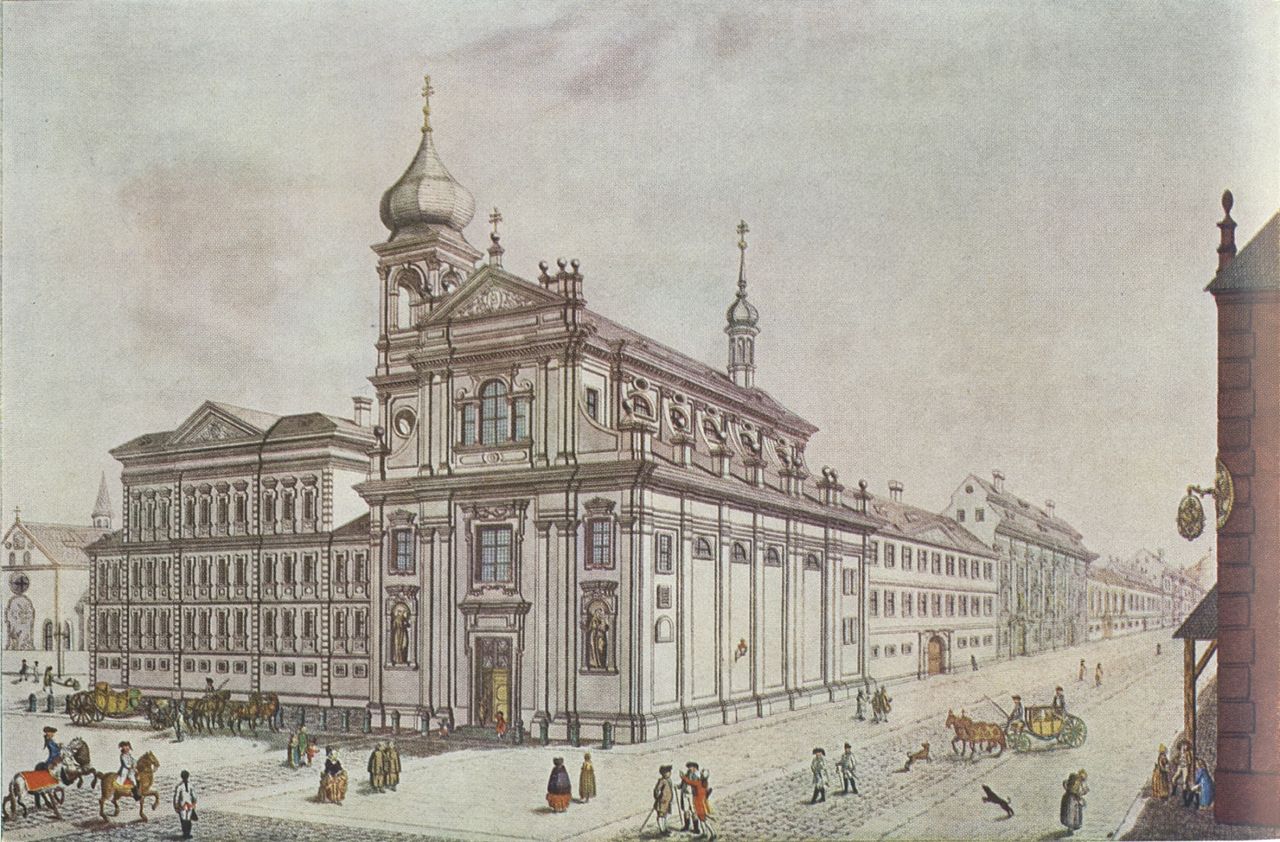 Prague in 1785 He visited Prague, the capital city and principal cultural center of Bohemia, on many occasions. In October 1787, he met Lorenzo da Ponte, the librettist of Wolfgang Amadeus Mozart's opera Don Giovanni, in Prague at the time of the opera's first production and likely met the composer, as well, at the same time. There is reason to believe that he was also in Prague in 1791 for the coronation of Holy Roman Emperor Leopold II as king of Bohemia, an event that included the first production of Mozart's opera La clemenza di Tito.[96] Casanova is known to have drafted dialogue suitable for a Don Juan drama at the time of his visit to Prague in 1787, but none of his verses were ever incorporated into Mozart's Don Giovanni.[97] In 1797, word arrived that the Republic of Venice had ceased to exist and that Napoleon Bonaparte had seized Casanova's home city. It was too late to return home. Casanova died on 4 June 1798 at the age of 73. His last words are said to have been "I have lived as a philosopher and I die as a Christian".[98] Casanova was buried at Dux (nowadays Duchcov in the Czech Republic), but the location of his grave has been forgotten. |
経歴[編集] 青年期[編集] 1730年代のヴェネツィア ジャコモ・ジロラモ・カサノヴァは1725年、俳優でダンサーのガエターノ・カサノヴァの妻で女優のザネッタ・ファルッシの子としてヴェネツィアに生まれ た。フランチェスコ・ジュゼッペ(1727-1803)、ジョヴァンニ・バッティスタ(1730-1795)、ファウスティーナ・マッダレーナ(1731 -1736)、マリア・マッダレーナ・アントニア・ステッラ(1732-1800)、ガエターノ・アルヴィーゼ(1734-1783)と続く。 カサノヴァが生まれた当時、ヴェニスはヨーロッパの享楽都市として繁栄しており、政治的・宗教的保守派が支配し、社会的悪徳を容認し、観光を奨励していた [11]。有名なカーニバル、賭博場、美しい花魁たちは、強力な魅力だった。このような環境は、カサノヴァに多くの形成的な経験をもたらした[12]。 サン・サムエーレ - カサノヴァが幼少期に住んでいた町 カサノヴァの祖母マルツィア・バルディセーラは、母親が演劇でヨーロッパを回っている間、カサノヴァの面倒を見ていた。父親はカサノヴァが8歳の時に亡く なった。子供の頃、カサノヴァは鼻血に悩まされ、祖母は魔女に助けを求めた: 「ゴンドラを降りて小屋に入ると、老婆が黒猫を抱いて藁の上に座っており、周囲には5、6人の老婆がいた。カサノヴァにとって、両親に無視されたことは苦 い思い出だった。「だから彼らは私を追い出した」と彼は宣言した[15]。 寄宿舎の環境はひどいものであったため、カサノヴァはゴッツィ大修道院長のもとで学ぶことを願い出た。ゴッツィ大修道院長は、カサノヴァにヴァイオリンだ けでなく学問も教えてくれた。カサノヴァはゴッツィ修道院長とその家族のもとに身を寄せ、10代のほとんどをそこで過ごした[16]。ゴッツィ家でカサノ ヴァが初めて異性と接触したのは、11歳のときにゴッツィ修道院長の妹のベッティーナがカサノヴァをもてあそんだときだった。 ベッティーナは「かわいくて、気さくで、ロマンスをよく読む子だった。... なぜかはわからなかったが、その少女はすぐに私を喜ばせた。その後、彼女は結婚したが、カサノヴァはベッティーナとゴッツィ家に生涯愛着を持ち続けた [18]。 カサノヴァは早くから機知に富み、知識欲が旺盛で、常に探究心を持っていた。12歳でパドヴァ大学に入学し、1742年に法学を専攻して17歳で卒業した (「私は克服できない嫌悪を感じていた」)[19]。保護者の希望は、彼が教会の弁護士になることだった[16]。(大学に在学中、カサノヴァはギャンブ ルを始め、すぐに借金を抱え、祖母によってヴェネツィアに呼び戻されたが、ギャンブルの習慣は定着した。 カサノヴァが洗礼を受けたサン・サムエーレ教会とマリピエロ宮殿(1716年頃 ヴェネツィアに戻ったカサノヴァは、聖職者としての法律家としてのキャリアをスタートさせ、ヴェネツィア総主教から小修道会を授与され、修道院長として認 められた。大学での勉強を続けるため、パドヴァを往復した。その頃、彼は背が高く、色黒で、長い髪をパウダーで固め、香りをつけ、手の込んだ巻き髪をし た、ダンディな男になっていた。 [23]マリピエーロは一流のサークルを渡り歩き、若いカサノヴァに美味しい料理やワイン、社交界での振る舞い方について多くのことを教えた。しかし、カ サノヴァは、マリピエロの誘惑の対象であった女優のテレサ・イメルと遊んでいるところを見つかり、元老院議員はふたりを家から追い出した[18]。カサノ ヴァは、女性に対する好奇心を募らせ、グリマーニ家の遠い親戚であった当時14歳と16歳のナネッタとマルトン・サヴォルニャンというふたりの姉妹と、初 めて完全な性的経験をすることになる。カサノヴァは、この出会いによって、自分の生涯の職業が確固たるものになったと公言している[24]。 イタリアと海外における初期のキャリア[編集]。 スキャンダルはカサノヴァの短い教会でのキャリアを汚した。祖母の死後、カサノヴァはしばらくの間神学校に入ったが、すぐに借金のために初めて刑務所に入 れられた。母親がベルナルド・デ・ベルナルディス司教のもとで職を得ようと試みたが、司教のカラブリア司教区でのごく短い試練の後、カサノヴァはこれを拒 否した[25]。代わりに、ローマの有力者アッカヴィーヴァ枢機卿のもとで書記として働くことになった。ローマ教皇ベネディクト14世に会うと、カサノ ヴァは大胆にも「禁書」を読むことと、魚(カサノヴァは目に炎症が起きると主張)を食べることの免除を求めた。また、別の枢機卿のためにラブレターを書い た。カサノヴァが地元の恋人同士のスキャンダルのスケープゴートになったとき、アッカヴィーヴァ枢機卿はカサノヴァを解任し、彼の犠牲に感謝したが、彼の 教会でのキャリアは事実上終わった[26]。 新たな職業を求め、カサノヴァはヴェネツィア共和国の軍人になることを命じられた。カサノヴァは、新しい職業を求め、ヴェネチア共和国の軍人になることを 依頼された: 教会でのキャリアで幸運を得る可能性はほとんどないと考え、兵士の格好をすることにした。良い仕立て屋を探すと......火星の従者になりすますのに必 要なものをすべて持ってきてくれた。... 私の軍服は白で、青いベスト、銀と金の肩の結び目があった・・・。私は長剣を買い、ハンサムな杖を手に、黒いコケードのついた刈り上げの帽子をかぶり、髪 を横ひげに切り、長いつけ髪をして、街中の人々に感銘を与えるために出発した。 -Casanova (2006), p. 223. 18世紀のコンスタンティノープル コルフ島でヴェネツィア連隊に入隊したカサノヴァは、表向きはかつての主人であった枢機卿からの手紙を届けるためにコンスタンティノープルに短期間滞在し た。カサノヴァはすぐに軍でのキャリアを捨て、ヴェネツィアに戻った。 21歳の時、プロのギャンブラーになることを目指したが、コミッションの売却で残った金をすべて失い、昔の恩人アルヴィーゼ・グリマーニに仕事を依頼し た。こうしてカサノヴァは、サン・サムエーレ劇場のヴァイオリニストとして、3度目のキャリアをスタートさせた。「卓越した者は賞賛され、凡庸な者は当然 軽蔑される、崇高な芸術の下働きである。... 私の職業は崇高なものではなかったが、気にしなかった。彼と彼の仲間の何人かは、「しばしば夜な夜な街のさまざまな地区を歩き回り、最もスキャンダラスな 悪ふざけを考え、実行に移した。彼らはまた、助産婦や医師を虚偽の呼び出しに送り込んだ[29]。 カサノヴァが音楽家としての自分の地位に不満を抱いていたとき、幸運が訪れた。結婚式の舞踏会の後、カサノヴァとゴンドラに乗っていたときに脳卒中で倒れ たブラガディン家のヴェネツィア貴族を救ったのだ。彼らはすぐに停車し、元老院議員に血を流してもらった。その後、元老院議員の宮殿で、医師が再び元老院 議員の血を抜き、水銀の軟膏-当時は万能薬であったが有毒であった[30]-を元老院議員の胸に塗った。これにより体温が上昇し、高熱が誘発され、ブラガ ディンは腫れた気管で窒息しているように見えた。死が近づいているように見えたため、司祭が呼ばれた。しかし、主治医の抗議にもかかわらず、カサノヴァは 軟膏を取り除き、冷たい水で議員の胸を洗うよう命じた。カサノヴァは、その若さと、医学的な知識を簡単に語ることから、元老院議員や彼の独身時代の友人2 人は、カサノヴァが年齢以上に賢く、オカルト的な知識を持っているに違いないと考えた[31]。自分たちも陰謀論者であったため、議員はカサノヴァを家庭 に招き入れ、生涯のパトロンとなった[32]。 カサノヴァは回想録の中でこう述べている: 私は最も信用でき、最も高貴で、唯一自然な道を選んだ。そして、その必需品が私にとってどのようなものであるかは、私以上に判断できる者はいな い......。ヴェニスの誰も、私と三人の男たちの間に、どうして親密な関係が存在しうるのか理解できなかった。 - カサノヴァ (2006), p. 247. その後3年間、元老院議員の庇護のもとで、名目上は法律家の助手として働きながら、カサノヴァは貴族の生活を送り、華美な服装をし、当然のようにギャンブ ルと情事に明け暮れた[33]。彼の庇護者は非常に寛容であったが、カサノヴァに、いつか代償を払う日が来ると警告した。しかし、それから間もなく、カサ ノヴァはさらなるスキャンダルのためにヴェネツィアを去らざるを得なくなった。カサノヴァは、敵に悪ふざけをして復讐するために埋められたばかりの死体を 掘り起こしたが、被害者は麻痺状態に陥り、回復することはなかった。別のスキャンダルでは、カサノヴァを騙した若い娘[要出典]がカサノヴァを強姦罪で告 発し、官憲に訴えた[34]。後にカサノヴァは証拠不十分で無罪となったが、この時すでにカサノヴァはヴェネツィアから逃亡していた。 兄弟のフランチェスコが描いた絵 パルマに逃れたカサノヴァは、「アンリエット」と名づけたフランス人女性と3ヶ月間関係を持ったが、おそらく彼が経験した中で最も深い愛であった。彼の言 葉を借りれば、「女が男を24時間同じように幸せにすることができないと信じる者は、アンリエットを知らないのだ」。私の魂に溢れる喜びは、夜彼女を腕に 抱いたときよりも、昼間に彼女と会話をしたときのほうがはるかに大きかった。多くの本を読み、天性のセンスを持っていたアンリエットは、すべてのことを正 しく判断していた」[35]。著名なカサノヴァ研究家J.リヴス・チャイルズはこう書いている: アンリエットほどカサノヴァを虜にした女性はいないだろう。彼女は二人の関係の初期に彼の外面的な殻を突き破り、彼と運命を一体にしようとする誘惑に抵抗 した。彼女は、彼の気まぐれな性格、社会的素養のなさ、経済的な不安定さを見抜くようになった。彼女は別れる前に、彼のポケットに500ルイを忍ばせた。 -Childs 1988, p. 46. 大旅行[編集] 落胆し、意気消沈したカサノヴァはヴェネツィアに戻り、ギャンブルに興じた後、立ち直り、大旅行に出発し、1750年にパリに到着した[36]。カサノ ヴァはまた薔薇十字主義にも惹かれていた[38]。リヨンでカサノヴァは仲間となり、最終的にスコティッシュ・ライトのマスター・メイソンの最高位を取得 した[39][40][8]。 リヨンでのスコティッシュ・ライト・フリーメイソンへの入門について、『回想録』は次のように述べている: ロシュバロン師の家で知り合った立派な人が、フリーメーソンの崇高な瑣末な儀式に入門させてくれるよう、私のために便宜を図ってくれたのはリヨンでのこと だった。パリに到着して数カ月後、私は仲間になり、マスターになった。最後の学位はフリーメーソンにおける最高の学位であることは間違いない。その後、私 が受けた他の学位はすべて、象徴的ではあってもマスターの威厳には何の足しにもならない、喜ばしい発明品にすぎない。 - ジャック[ジョヴァンニ・ジャコモ]・カサノヴァ・デ・セインガルト1725-1798年回想録。パリと牢獄へ、第2巻A--パリ[39][41]。 カサノヴァはパリに2年間滞在し、言葉を学び、劇場で多くの時間を過ごし、著名人に自己紹介した。しかし間もなく、彼が訪れたほとんどすべての都市でそう であったように、彼の数々の情事はパリの警察に指摘されるようになった[42]。 1752年、兄のフランチェスコと彼は、母と妹のマリア・マッダレーナが住んでいたドレスデンに移り住んだ。その後、プラハ、ウィーンを訪れたが、厳格な 道徳的雰囲気は彼の好みではなかった[43][44]。1753年、カサノヴァはついにヴェネツィアに戻った[45]。そこで逃亡を再開したカサノヴァ は、多くの敵を作り、ヴェネツィアの審問官の監視を受けるようになった。国家スパイのジョヴァンニ・マヌッチは、カサノヴァの陰謀論やフリーメーソンに関 する知識を引き出し、彼の蔵書に禁書がないか調べるために雇われた[46]。ブラガディン上院議員は、(自身も元審問官であったことから)今回は真剣な態 度で、「息子」に直ちに立ち去るか、最も厳しい結果に直面するよう忠告した。 投獄と逃亡[編集] 1755年7月26日、30歳であったカサノヴァは宗教と良識に対する冒涜の罪で逮捕された。 「48]"鉛牢 "とは、ドージェ宮殿の東翼の最上階にある7つの独房からなる牢獄のことで、身分の高い囚人や特定の種類の犯罪者(政治犯、脱獄した司祭や修道士、簒奪者 など)のために用意され、宮殿の屋根を覆っていた鉛の板にちなんで名付けられた。翌9月12日、裁判もなく、逮捕の理由も判決も知らされないまま、彼は5 年の禁固刑を言い渡された[47][49]。 「彼だ。彼を拘留しろ!」 彼は「独房のなかでも最悪」[50]の、衣服、パレットベッド、テーブル、肘掛け椅子を備えた一人部屋に入れられ、暗闇、夏の暑さ、「何百万匹ものノミ」 に大いに苦しめられた。その後、彼は何人かの同房者と一緒に収容された。5ヶ月後、ブラガディン伯爵から個人的な嘆願があり、暖かい冬の寝具と、本とより 良い食事のための月々の俸給が与えられた。牢獄のガレージを散歩したとき、彼は黒い大理石のかけらと鉄の棒を見つけ、それを肘掛け椅子の中に隠して独房に 持ち帰った。肘掛け椅子の中に鉄棒を隠した。一時的に独房の仲間がいなくなると、2週間かけて鉄棒を石の上でスパイク状に研いだ。そして、自分の独房が奉 行所の部屋の真上にあることを知りながら、ベッドの下の木の床をえぐり始めた[51]。下の部屋に役人がいないであろう祭りの時に脱獄しようと考えていた ちょうど3日前、カサノヴァは、今の場所に完全に満足しているという彼の抗議にもかかわらず、眺めの良い、より広くて明るい独房に移された。新しい独房で は、「私は茫然自失のように肘掛け椅子に座り、彫像のように動かず、自分がしてきたすべての努力を無駄にしたことを悟り、それを悔い改めることもできな かった。私には何も望みがないと感じ、私に残された唯一の救いは、将来のことを考えないことだった」[52]。 カサノヴァは別の逃亡計画を立てた。隣の監房にいた囚人、バルビ神父に助けを求めた。肘掛け椅子の中から新しい独房に運ばれたスパイクは、騙された看守に よってパスタの皿の下に運ばれたフォリオの聖書の中で神父に渡された。司祭は自分の天井に穴を開け、横切ってカサノヴァの独房の天井に穴を開けた。スパイ である新しい同房者を無力化するために、カサノヴァは彼の迷信を利用し、彼を脅して沈黙させた[53]。 バルビがカサノヴァの独房に侵入したとき、カサノヴァは天井を突き破り、詩篇117篇(ラテン語ヴルガータから)を引用したメモを残した: 「私は死なず、生きて、主の御業を告げ知らせる」[54]。 『私の逃亡物語』より スパイは、他の者と一緒に逃走しているのが見つかったらどうしようという恐怖に怯え、後に残った。カサノヴァとバルビは鉛板をこじ開け、霧が立ち込める ドージェ宮殿の傾斜した屋根の上に出た。近くの運河への落差が大きすぎたため、カサノヴァはドーマー窓の格子をこじ開け、窓を割って侵入した。屋根の上に 長いはしごを見つけ、カサノバが用意したベッドシーツの「ロープ」を使って、床から25フィート(7.6メートル)下の部屋に降りた。朝まで休み、服を着 替え、出口のドアの小さな錠を壊して宮殿の廊下に入り、ギャラリーや部屋を通り抜け、階段を降りた。やがてカサノヴァはパリに到着し、ロベール=フランソ ワ・ダミアンが ルイ15世の命を狙った同じ日(1757年1月5日)にパリに到着した[56](カサノヴァは後にダミアンの処刑を目撃し、その様子を描写することにな る)。 30年後の1787年、カサノヴァは『わが逃亡の物語』を書き、この物語は非常に人気があり、多くの言語で再版された: こうして神は、奇跡とまではいかなくても、不思議な脱出に必要なものを私に与えてくれた。しかし、私の誇りは、私が成功したことに由来するのではなく、運 も大いに関係していたからである。 -Casanova (2006), p. 502. パリに戻る[編集]。 カサノヴァはパリでの滞在が長期になることを知っており、それに従って行動した: 「何かを成し遂げるためには、自分の肉体的、道徳的能力をすべて発揮し、偉大な人々や権力者と知り合いになり、厳しい自制心を働かせ、カメレオンのように 振舞わなければならないと思った」[58]。 カサノヴァは成熟し、パリでのこの時期には、まだ機転と決断力に頼ることもあったが、より計算高く慎重になっていた。最初の仕事は新しいパトロンを見つけ ることだった。カサノヴァは、旧友のド・ベルニ(現在はフランス外相)と再会した。カサノヴァはパトロンから、即座に気に入られる方法として、国家のため に資金を集める手段を見つけるよう勧められた。カサノヴァはすぐに最初の宝くじの評議員の一人となり、その宝くじを売る最高のセールスマンの一人となった [59]。特にジャンヌ・ドルフェ侯爵夫人は、数秘術の魔術師のような優れた記憶力を持っているように見せかけた。カサノヴァの考えでは、「愚か者を欺く ことは、知的な男にふさわしい功績」であった[61]。 ポンパドゥール夫人、1750年頃 カサノヴァは薔薇十字団員であり、錬金術師であると主張していた。その適性から、ポンパドゥール夫人、サンジェルマン伯爵、ダランベール、ジャン=ジャッ ク・ルソーなど、当時の著名人に人気があった。貴族たちの間では錬金術、特に「賢者の石」を探すことが流行っていたため、カサノヴァはその知識を買われ、 大金を手にした[62]: 「この奇妙な男は、あらゆる詐欺師の中で最も素知らぬ顔をして生まれ、自分は300歳であること、万能薬を持っていること、自然から好きなものを何でも作 ること、ダイヤモンドを創造することを、平然と宣言した」[63]。 デ・ベルニスは、カサノヴァを最初のスパイ任務でダンケルクに派遣することを決めた。カサノヴァは、その迅速な仕事に対して高い報酬を得たが、この経験 は、アンシャン・レジームと彼が依存していた階級に対する彼の数少ない発言のひとつを促した。フランスの大臣はみな同じだ。彼らは、自分たちの生物を豊か にするために、他の人々のポケットから出た金を惜しみなく使った。革命が必要だった」[64]。 18世紀のパリ 七年戦争が始まると、カサノヴァは国庫を増やすために再び召集された[65]。彼は、当時ヨーロッパの金融の中心地であったアムステルダムで 国債を売る使命を負わされた[66]。彼はわずか8%の割引で国債を売ることに成功し、翌年にはその収入で絹織物工場を設立するほど裕福になった。フラン ス政府は、カサノヴァがフランス国籍を取得し、大蔵省のために働くのであれば、爵位と年金を与えるとまで言ったが、カサノヴァはそれを断った。彼は事業を うまく運営できず、それを救おうとして多額の借金をし、彼の「ハーレム」であった女工たちとの絶え間ない情事に富の多くを費やした[68]。 借金のために、カサノヴァは再びフォル=レヴェックに投獄されたが、その4日後にウルフェ侯爵夫人の強い要請で釈放された。残念なことに、釈放されたもの の、パトロンのド・ベルニがルイ15世によって解任されたため、カサノヴァの敵はカサノヴァに迫った。カサノヴァは残りの持ち物を売り払い、オランダへの 再度の使節団を確保し、トラブルから距離を置いた[68]。 逃亡[編集]。 1760年の春、彼は残りの財産を失い、ケルン、そしてシュトゥットガルトへと逃亡した。借金のために再び逮捕されたが、なんとかスイスに逃れた。放蕩生 活に疲れたカサノヴァは、アインジーデルンの修道院を訪れ、修道士の質素で学究的な生活を考えた。その後、アルブレヒト・フォン・ハラーと ヴォルテールのもとを訪れ、マルセイユ、ジェノヴァ、フィレンツェ、ローマ、ナポリ、モデナ、トリノと移り住み、次から次へと性的に奔放になった [70]。 1760年、カサノヴァは自らをシュヴァリエ・ド・セインガルトと名乗り始めた。ローマ教皇クレメンス13世がカサノヴァに教皇庁から 金棘 勲章を授与した際には、カサノヴァの胸には印象的な十字架とリボンが飾られた[71]。 パリに戻ったカサノヴァは、最も非道な計画のひとつに着手し、古くからのカモであったウルフェ侯爵夫人に、オカルト的な方法で彼女を青年に変身させること ができると説得した。この計画は、カサノヴァが期待していたような大きな報酬を得ることはできず、ウルフェ侯爵夫人はついにカサノヴァへの信頼を失った [72]。 ウィリアム・ホガースによる18世紀のロンドン カサノヴァは1763年にイギリスを訪れ、イギリス政府高官に宝くじのアイデアを売り込もうとした。彼はイギリス人について、「国民には、国民全体に共通 する特別な性格があり、それが自分たちを他の誰よりも優れていると思わせている。それはすべての国に共通する信念であり、それぞれが自分を最高だと考えて いる。そして、彼らはみな正しいのだ」[73]。彼は人脈を通じて、ダルフェ侯爵夫人から盗んだ貴重品のほとんどを使い、国王ジョージ3世に謁見するまで に上り詰めた。政界に進出する一方で、彼は習慣のように多くの時間を寝室で過ごした。英語も話せない彼は、自分の快楽のために女性を見つける手段として、 新聞に「適切な」人にアパートを貸すという広告を出した。多くの若い女性と面接し、その中から自分にぴったりの「ポーリン嬢」を選んだ。すぐに彼女のア パートに身を寄せ、彼女を誘惑した。しかし、こうした関係や他の関係によって、彼は性病に冒され、貧窮と病気でイギリスを去った[74]。 彼はオーストリアのオランダに行き、回復し、それから3年間、ヨーロッパ中を旅し、悪路を馬車で約4500マイル(7200km)走り、モスクワや サンクトペテルブルクまで行った(1日の平均的な馬車の旅は約30マイル(48km))。ここでも彼の主な目的は、自分の宝くじ計画を他の政府に売り込 み、フランス政府との大成功を繰り返すことだったが、フリードリヒ大王との会談は実を結ばず、周辺のドイツの土地でも同じ結果となった。コネも自信もな かったカサノヴァはロシアに行き、エカテリーナ大帝に会ったが、彼女は宝くじ計画をきっぱりと断った[75]。 1766年、友人のイタリア人女優をめぐってフランシシェク・クサヴェリー・ブラニツキ大佐とピストルで決闘し、ワルシャワから追放された。二人とも負傷 し、カサノヴァは左手を負傷した。ワルシャワからプロイセン王国のブレスラウに行き、ドレスデンに行ったが、そこでまた性病に感染した[77][78] [79]。 [77][78][79]1767年に数ヶ月間パリに戻り、ギャンブルサロンに通ったが、ルイ15世の命によりフランスから追放される。カサノヴァは、よ く知られた人脈(しばしばフリーメーソン)を頼り、影響力のある貴族たちと歓談し、最終的には現地の君主(この場合はシャルル3世)に謁見するという、い つも通りのアプローチを試みた。しかし、何の扉も開かれなかったとき、彼はスペイン全土を放浪することしかできなかった。バルセロナでは暗殺を免れ、6週 間牢獄に入れられた。スペインでの冒険は失敗に終わり、彼はフランスに一時帰国し、その後イタリアに戻った[81]。 ヴェネツィアに戻る[編集]。 ローマでは、カサノヴァはヴェネツィアに戻るための準備をしなければならなかった。ヴェネチアに合法的に入国するための支援者[82]を待つ間、カサノ ヴァは『イーリアス』のトスカーナ・イタリア語現代語訳、『ポーランド騒乱史』、喜劇に着手した。ヴェネツィア当局に気に入られるために、カサノヴァは当 局のために商業的なスパイ活動を行った。しかし、何ヶ月経っても罷免されなかったため、カサノヴァは奉行所に直訴状を書いた。ついに念願の許可を得たカサ ノヴァは、「われわれ国家奉行団は、われわれの知るところである理由により、ジャコモ・カサノヴァに自由な安全航行を与える......彼が望むところで あれば、どこへでも自由に行き来し、立ち止まったり、戻ったり、連絡を取り合ったりすることを許可する。それが我々の意志だ カサノヴァは18年間の亡命生活を経て、1774年9月にヴェネツィアに戻ることを許された[83]。 当初、カサノヴァのヴェネツィアへの帰還は友好的なものであり、カサノヴァは有名人であった。異端審問官たちでさえ、彼がいかにして牢獄から脱出したかを 聞きたがった。しかし、3人の独身パトロンのうち、ダンドロだけはまだ生きており、カサノヴァは彼の家に招かれた。カサノヴァはダンドロからわずかな俸給 を受け取り、自分の著作で生活することを望んだが、それだけでは足りなかった。カサノヴァはしぶしぶヴェネツィアの特派員となり、出来高払いで、宗教、風 俗、商業について報道した。経済的なチャンスは訪れず、かつてのように社交界で彼に開かれた扉はほとんどなかった。 49歳のとき、無謀な生活と何千キロにも及ぶ旅の歳月が祟った。カサノヴァの天然痘の傷跡、こけた頬、鉤鼻がいっそう目立つようになった。カサノヴァの気 さくな物腰は、より慎重になっていた。1784年頃、友人であったシャルル・ド・リーニュ王子(後の雇い主の叔父)は、カサノヴァについてこう語ってい る: 背が高く、ヘラクレスのような体格だが、アフリカ人のような色合いをしている。目は生命力と炎に満ちているが、気難しく、警戒心が強く、怒りっぽい。彼を ゲイにするよりも、激怒させる方が簡単だ。彼はほとんど笑わないが、他人を笑わせる。... 彼はハーレクインや フィガロを思い出させるような物言いをする。 - マスターズ1969年、257ページ ベネチアはカサノヴァにとって様変わりしていた。カサノヴァにはギャンブルに使う金も、追いかける価値のある女性も、そして、彼の気まぐれで衝動的な性向 を活気づける知り合いもほとんどいなくなっていた。カサノヴァは母の死を知り、さらに心を痛めたのは、カサノヴァに初めてセックスを紹介し、カサノヴァの 腕の中で亡くなったベッティーナ・ゴッツィの死に際を見舞ったことだった[85] 。宗教をめぐってヴォルテールと論争を繰り広げた[86]。迷信を何で置き換えるのか?ヴォルテールはこう言い返した。人類を貪り食う猛獣から救い出した ら、その代わりに何を置くかと聞かれてもいい」。カサノヴァからすれば、もしヴォルテールが「まっとうな哲学者であったなら、その話題について沈黙を守っ ていただろう......国民は、国家の一般的な平和のために、無知のうちに生きる必要がある」[87]。 1779年、カサノヴァは無学なお針子フランチェスカを見つけ、住み込みの恋人兼家政婦となり、彼を献身的に愛した[88]。その年の暮れ、カサノヴァは 異端審問官から給与を受け、ローマ教皇庁とヴェネツィア間の通商を調査するために派遣された。他の出版や演劇の事業は、主に資本不足から失敗した。下降の 一途をたどるカサノヴァは、1783年、ヴェネツィア貴族を揶揄する悪質な風刺を書いた後、再びヴェネツィアから追放された。その中で彼は、グリマーニが 自分の本当の父親であると唯一公言した[89]。 再び旅を再開することを余儀なくされたカサノヴァはパリに到着し、1783年11月、航空学と気球輸送の将来についてのプレゼンテーションに出席した際に ベンジャミン・フランクリンと知り合った[91]。しばらくの間、カサノヴァは在ウィーン・ヴェネツィア大使セバスチャン・フォスカリーニの秘書兼パンフ レット作成者を務めた。また、カサノヴァはモーツァルトの台本作家ロレンツォ・ダ・ポンテとも知り合いになり、カサノヴァはダ・ポンテについて「この特異 な男は決して間違ったことを好まない」と述べている[92]。 ボヘミアでの晩年[編集] ダックス城 1785年、フォスカリーニが亡くなった後、カサノヴァは別の職を探し始めた。数ヶ月後、ボヘミア(現在のチェコ共和国)のデュックス城で、皇帝の侍従で あったヨーゼフ・カール・フォン・ヴァルトシュタイン伯爵の司書となった。伯爵自身もフリーメーソンであり、陰謀論者であり、頻繁に旅行していた。1年前 にフォスカリーニの邸宅で出会ったとき、カサノヴァに好意を抱いていた。カサノヴァは、この仕事は安全で給料もよかったが、晩年は退屈でいらだたしかった と語っている[94]。時折、ウィーンやドレスデンを訪れて休養を取ることしかできなかった。カサノヴァは伯爵とうまくやっていたが、彼の雇い主はずっと 若い男で、彼自身風変わりなところがあった。伯爵はしばしばカサノヴァを食事の席で無視し、重要な来客にカサノヴァを紹介しなかった。さらに、カサノヴァ は癇癪持ちのアウトサイダーであったため、ダックス城の他の住人のほとんどから徹底的に嫌われていた。カサノヴァの唯一の友人はキツネザルのようだった。 絶望の淵に立たされたカサノヴァは自殺を考えたが、その代わりに自分の回想録を記録するために生き続けなければならないと決心し、死ぬまでそれを続けた [95]。 1785年のプラハ カサノヴァは、ボヘミアの首都であり文化の中心地であるプラハを何度も訪れた。1787年10月には、ヴォルフガング・アマデウス・モーツァルトのオペラ 『ドン・ジョヴァンニ』の台本作家ロレンツォ・ダ・ポンテとオペラの初演時にプラハで会い、同じ時期に作曲家とも会っていたと思われる。カサノヴァは 1787年にプラハを訪れた際、ドン・ファン劇に適した台詞を草稿していたことが知られているが、モーツァルトのオペラ『 ドン・ジョヴァンニ』に彼の詩が取り入れられることはなかった[97]。 1797年、ヴェネツィア共和国が消滅し、ナポレオン・ボナパルトがカサノヴァの故郷を占領したという知らせが届いた。帰国するには遅すぎた。カサノヴァ は1798年6月4日、73歳で亡くなった。カサノヴァの最後の言葉は「私は哲学者として生き、キリスト教徒として死ぬ」であったと言われている [98]。 |
| Memoirs Main article: Histoire de ma vie 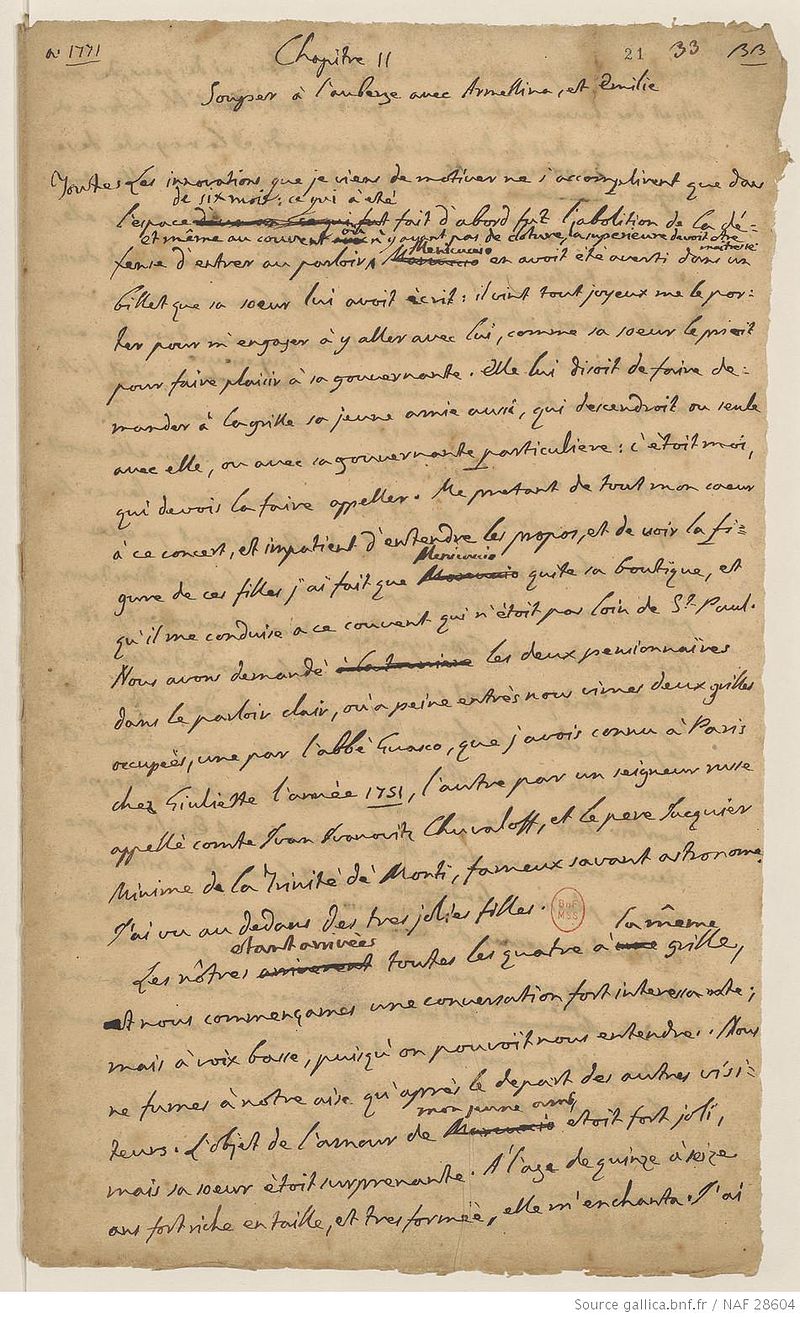 Page from the autograph manuscript of Histoire de ma vie The isolation and boredom of Casanova's last years enabled him to focus without distractions on his Histoire de ma vie, without which his memory would have been considerably diminished, if not blotted out entirely. He began to think about writing his memoirs around 1780 and began in earnest by 1789, as "the only remedy to keep from going mad or dying of grief".[99] The first draft was completed by July 1792, and he spent the next six years revising it. He puts a happy face on his days of loneliness, writing in his work, "I can find no pleasanter pastime than to converse with myself about my own affairs and to provide a most worthy subject for laughter to my well-bred audience."[100] His memoirs were still being compiled at the time of his death, his account having reached only the summer of 1774.[101] A letter by him in 1792 states that he was reconsidering his decision to publish them, believing that his story was despicable and he would make enemies by writing the truth about his affairs, but he decided to proceed, using initials instead of actual names and toning down the strongest passages.[102] He wrote in French instead of Italian because "the French language is more widely known than mine".[103] The memoirs open with: I begin by declaring to my reader that, by everything good or bad that I have done throughout my life, I am sure that I have earned merit or incurred guilt, and that hence I must consider myself a free agent. ... Despite an excellent moral foundation, the inevitable fruit of the divine principles which were rooted in my heart, I was all my life the victim of my senses; I have delighted in going astray and I have constantly lived in error, with no other consolation than that of knowing I have erred. ... My follies are the follies of youth. You will see that I laugh at them, and if you are kind you will laugh at them with me.[104] Casanova wrote about the purpose of his book: I expect the friendship, the esteem, and the gratitude of my readers. Their gratitude, if reading my memoirs will have given instruction and pleasure. Their esteem if, doing me justice, they will have found that I have more virtues than faults; and their friendship as soon as they come to find me deserving of it by the frankness and good faith with which I submit myself to their judgment without in any way disguising what I am.[105] He also advises his readers that they "will not find all my adventures. I have left out those which would have offended the people who played a part in them, for they would cut a sorry figure in them. Even so, there are those who will sometimes think me too indiscreet; I am sorry for it."[106] In the final chapter, the text abruptly breaks off with hints at adventures unrecorded: "Three years later I saw her in Padua, where I resumed my acquaintance with her daughter on far more tender terms."[107] In their original publication, the memoirs were divided into twelve volumes, and the unabridged English translation by Willard R. Trask runs to more than 3,500 pages. Though his chronology is at times confusing and inaccurate, and many of his tales exaggerated, much of his narrative and many details are corroborated by contemporary writings.[108] He has a good ear for dialogue and writes at length about all classes of society.[109] Casanova, for the most part, is candid about his faults, intentions, and motivations, and shares his successes and failures with good humor.[110] The confession is largely devoid of repentance or remorse. He celebrates the senses with his readers, especially regarding music, food, and women. "I have always liked highly seasoned food. ... As for women, I have always found that the one I was in love with smelled good, and the more copious her sweat the sweeter I found it."[111] He mentions over 120 sexual/romantic escapades with women and girls, with several veiled references to male lovers as well.[112][113] He describes his duels and conflicts with scoundrels and officials, his entrapments and his escapes, his schemes and plots, his anguish and his sighs of pleasure. He demonstrates convincingly, "I can say vixi ('I have lived')."[100] The manuscript of Casanova's memoirs was held by his relatives until it was sold to F. A. Brockhaus publishers, and first published in heavily abridged versions in German around 1822, then in French. During World War II, the manuscript survived the Allied bombing of Leipzig. The memoirs were heavily pirated through the ages and have been translated into some twenty languages. Not until 1960 was the entire text published in its original language of French.[114] In 2010 the manuscript was acquired by the National Library of France, which has started digitizing it.[115] |
回想録[編集] 主な記事 生い立ち Histoire de ma vie』の自筆原稿のページ カサノヴァの晩年は孤独で退屈であったため、気が散ることなく回想録に集中することができた。カサノヴァは1780年頃から回想録を書こうと考え始め、 1789年には本格的に書き始めた。彼は孤独な日々を幸せな顔で過ごし、「自分自身のことについて自分自身と会話し、育ちの良い聴衆に笑いの最も価値ある 題材を提供することほど楽しい娯楽はない」[100]と作品に書いている。 [101]1792年の手紙によると、彼は自分の話は卑劣であり、自分の身の上について真実を書くことで敵を作ることになると考え、出版することを考え直 したが、実名の代わりにイニシャルを使い、強い箇所はトーンダウンして出版することを決めた[102]。 回想録はこう始まる: 私は読者に対して、私が生涯を通じて行ったすべての善悪によって、私は功労を得たか罪を負ったかを確信していること、それゆえ私は自分自身を自由意志の持 ち主と考えなければならないことを宣言することから始める。... 私の心に根を下ろした神の原理の必然的な果実である優れた道徳的基盤にもかかわらず、私は生涯、自分の感覚の犠牲者であった。私は道を踏み外すことを喜び とし、常に誤りの中で生きてきた。... 私の愚かさは若さゆえの愚かさだ。もしあなたが親切なら、私と一緒に笑ってくれるだろう[104]。 カサノヴァは自分の本の目的についてこう書いている: 私は読者の友情、尊敬、感謝を期待している。もし私の手記を読むことで、読者に教訓と喜びを与えることができれば、読者からの感謝の念を抱くだろう。そし て、読者が、私が自分のありのままの姿を隠すことなく読者の判断に従う率直さと誠実さによって、私がそれに値する人間であることを知るようになれば、すぐ に彼らの友情が得られるだろう[105]。 彼はまた、読者に「私の冒険のすべてを見つけることはできないだろう。私は、それに参加した人々の気分を害するようなものは省いてきた。それにしても、私 のことを軽率すぎると思う人もいるだろう。 オリジナルの出版では、回想録は12巻に分かれており、ウィラード・R・トラスクによる要約なしの英訳は3,500ページ以上に及ぶ。カサノヴァは、ほと んどの場合、自分の欠点、意図、動機について率直に語り、自分の成功と失敗をユーモアたっぷりに語っている[110]。彼は読者とともに感覚を謳歌し、特 に音楽、食べ物、女性について語る。「私はいつも味付けの濃い料理が好きだった。女性については、私が恋している女性はいつもいい香りがし、彼女の汗が多 ければ多いほど、私はそれを甘いと感じていた」[111]。彼は女性や少女との120以上の性的/恋愛的逃避行について言及し、男性の恋人についても何度 かベールに包まれた言及をしている。彼は「私はヴィクシ(『私は生きてきた』)と言うことができる」と説得力をもって証明している[100]。 カサノヴァの回想録の原稿は、F.A.ブロックハウス出版社に売却されるまで、彼の親族によって保管されていた。第二次世界大戦中、手記は連合軍のライプ ツィヒ爆撃を生き延びた。回顧録は時代を超えて海賊版が出回り、20カ国語に翻訳された。1960年まで、全文が原語であるフランス語で出版されることは なかった[114]。2010年、手記はフランス国立図書館に収蔵され、デジタル化が開始された[115]。 |
| Relationships For Casanova, as well as his local contemporaries of the upper class, love and sex tended to be casual and not endowed with the solemnity characteristic of other Romantic literary works of the 19th century.[116] Flirtations, bedroom games, and short-term liaisons were common among nobles who married for social connections rather than love. 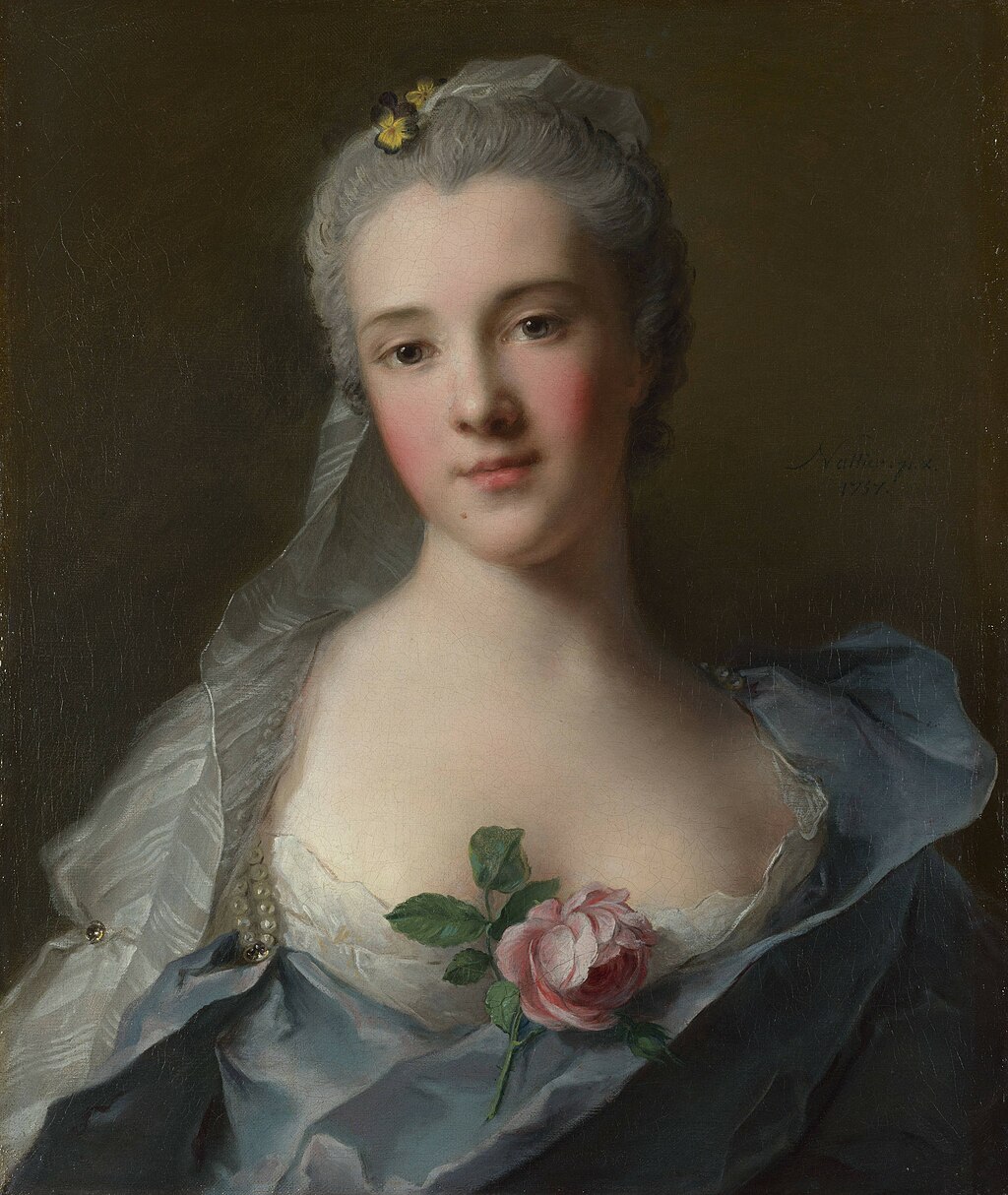 Portrait of Manon Balletti by Jean-Marc Nattier (1757) Multi-faceted and complex, Casanova's personality, as he described it, was dominated by his sensual urges: "Cultivating whatever gave pleasure to my senses was always the chief business of my life; I never found any occupation more important. Feeling that I was born for the sex opposite of mine, I have always loved it and done all that I could to make myself loved by it."[111] He noted that he sometimes used "assurance caps" to prevent impregnating his mistresses.[117] Casanova's ideal liaison had elements beyond sex, including complicated plots, heroes and villains, and gallant outcomes. In a pattern he often repeated, he would discover an attractive woman in trouble with a brutish or jealous lover (Act I); he would ameliorate her difficulty (Act II); she would show her gratitude; he would seduce her; a short exciting affair would ensue (Act III); feeling a loss of ardor or boredom setting in, he would plead his unworthiness and arrange for her marriage or pairing with a worthy man, then exit the scene (Act IV).[118] As William Bolitho points out in Twelve Against the Gods, the secret of Casanova's success with women "had nothing more esoteric in it than [offering] what every woman who respects herself must demand: all that he had, all that he was, with (to set off the lack of legality) the dazzling attraction of the lump sum over what is more regularly doled out in a lifetime of installments."[119] Casanova proclaims, "There is no honest woman with an uncorrupted heart whom a man is not sure of conquering by dint of gratitude. It is one of the surest and shortest means."[120] Alcohol and violence, for him, were not proper tools of seduction.[121] Instead, attentiveness and small favors should be employed to soften a woman's heart, but "a man who makes known his love by words is a fool". Verbal communication is essential—"without speech, the pleasure of love is diminished by at least two-thirds"—but words of love must be implied, not boldly proclaimed.[120] Casanova claimed to value intelligence in a woman: "After all, a beautiful woman without a mind of her own leaves her lover with no resource after he had physically enjoyed her charms." His attitude towards educated women, however, was an unfavorable one: "In a woman learning is out of place; it compromises the essential qualities of her sex ... no scientific discoveries have been made by women ... (which) requires a vigor which the female sex cannot have. But in simple reasoning and in delicacy of feeling we must yield to women."[35] Casanova's actions can be considered by many in modern times to be predatory, despite his own claims to the contrary ("my guiding principle has been never to direct my attack against novices or those whose prejudices were likely to prove an obstacle"), especially since he frequently targeted young, insecure or emotionally exposed women.[122] |
人間関係[編集] カサノヴァや同時代の上流階級の人々にとって、恋愛やセックスは気軽なものであり、19世紀の他のロマン主義文学作品に見られるような厳粛さはなかった [116]。 ジャン=マルク・ナティエによる マノン・バレッティの肖像画(1757年) 多面的で複雑なカサノヴァの性格は、彼が言うように、官能的な衝動に支配されていた: 「自分の感覚に喜びを与えるものを育てることが、常に私の人生の主要な仕事であった。私は自分とは反対の性のために生まれてきたと感じ、常にその性を愛 し、その性から愛されるためにできることはすべてしてきた」[111]。愛人を孕ませないために「保証帽」を使うこともあったと述べている[117]。 カサノヴァの理想的な逢瀬には、複雑な筋書き、英雄と悪役、勇敢な結末など、セックス以外の要素もあった。彼がしばしば繰り返したパターンでは、魅力的な 女性が残忍な、あるいは嫉妬深い恋人とトラブルに陥っているのを発見し(第1幕)、彼は彼女の困難を改善し(第2幕)、彼女は感謝の意を示し、彼は彼女を 誘惑し、短い刺激的な情事が続く(第3幕)、熱情の喪失や退屈を感じると、彼は自分の不甲斐なさを訴え、彼女の結婚やふさわしい男性とのペアを手配し、そ の場を去る(第4幕)。 [118] ウィリアム・ボリソが『神々に抗する12人』の中で指摘しているように、カサノヴァの女性との成功の秘訣は、「自分自身を尊重するすべての女性が要求しな ければならないこと、すなわち、彼が持っているものがすべてである。 「119]カサノヴァはこう宣言している。「男が感謝によって確実に征服できないような、心の汚れていない正直な女はいない。カサノヴァにとって、アル コールと暴力は誘惑の適切な道具ではなかった[121]。その代わり、女性の心を和らげるためには、気配りやささやかな好意を用いるべきだが、「言葉で愛 を知らせる男は愚か者である」。言葉によるコミュニケーションは不可欠であり、「言葉がなければ、愛の喜びは少なくとも3分の2に減少する」-しかし、愛 の言葉は暗示的でなければならず、大胆に宣言してはならない[120]。 カサノヴァは女性の知性を重視すると主張した: 「結局のところ、自分の心を持たない美しい女性は、肉体的に彼女の魅力を楽しんだ後、恋人に何の資源も残さない」。しかし、教養ある女性に対する彼の態度 は好ましくないものだった: 「女性にとって学問は場違いであり、性の本質を損なうものである......女性によって科学的な発見がなされたことはない......(それは)女性に は持ち得ない活力を必要とする。しかし、単純な推理と繊細な感情においては、我々は女性に譲らなければならない」[35]。 カサノヴァの行動は、彼自身の主張とは裏腹に(「私の指導的原則は、初心者や偏見が障害となりそうな人に対して攻撃を向けることはなかった」)、特に彼が 若く、不安定で、感情的にさらけ出された女性を頻繁にターゲットにしていたことから、現代では多くの人が略奪的であると考えることができる[122]。 |
| Gambling Gambling was a common recreation in the social and political circles in which Casanova moved. In his memoirs, Casanova discusses many forms of 18th-century gambling—including lotteries, faro, basset, piquet, biribi, primero, quinze, and whist—and the passion for it among the nobility and the high clergy.[123] Cheats (known as "correctors of fortune") were somewhat more tolerated than today in public casinos and in private games for invited players, and seldom caused affront. Most gamblers were on guard against cheaters and their tricks. Scams of all sorts were common, and Casanova was amused by them.[124] Casanova gambled throughout his adult life, winning and losing large sums. He was tutored by professionals, and he was "instructed in those wise maxims without which games of chance ruin those who participate in them". He was not above occasionally cheating and at times even teamed with professional gamblers for his own profit. Casanova claims that he was "relaxed and smiling when I lost, and I won without covetousness". However, when outrageously duped himself, he could act violently, sometimes calling for a duel.[125] Casanova admits that he was not disciplined enough to be a professional gambler: "I had neither prudence enough to leave off when fortune was adverse, nor sufficient control over myself when I had won."[126] Nor did he like being considered as a professional gambler: "Nothing could ever be adduced by professional gamblers that I was of their infernal clique."[126] Although Casanova at times used gambling tactically and shrewdly—for making quick money, for flirting, making connections, acting gallantly, or proving himself a gentleman among his social superiors—his practice also could be compulsive and reckless, especially during the euphoria of a new sexual affair. "Why did I gamble when I felt the losses so keenly? What made me gamble was avarice. I loved to spend, and my heart bled when I could not do it with money won at cards."[127] |
ギャンブル[編集] ギャンブルは、カサノヴァが身を置いていた社交界や政界では一般的な娯楽であった。カサノヴァは回顧録の中で、宝くじ、ファロ、バセット、ピケ、ビリビ、 プリメロ、クインツェ、ウィストなど、18世紀のギャンブルの様々な形態と、貴族や高位聖職者のギャンブルへの情熱について述べている[123]。ほとん どのギャンブラーは、イカサマやその手口に対して警戒していた。あらゆる種類の詐欺が一般的であり、カサノヴァはそれを面白がっていた[124]。 カサノヴァは大人になってからもギャンブルに興じ、大金を得たり失ったりした。彼はプロの手ほどきを受け、「偶然のゲームが参加する者を破滅させるよう な、賢明な極意を教え込まれた」。カサノヴァは時折イカサマをすることもいとわず、時にはプロのギャンブラーと組んで自分の利益を追求することもあった。 カサノヴァは、「負けたときはリラックスして微笑んでいた。カサノヴァは、自分がプロのギャンブラーになるには十分な規律がなかったことを認めている [125]: 「運が不利になったときに手を引くだけの慎重さも、勝ったときに自分をコントロールする十分な力もなかった」[126]: 「プロのギャンブラーたちからは、私が彼らの邪悪な集団の一員であることを証明することはできなかった」[126]。カサノヴァは、手っ取り早く金を稼ぐ ため、いちゃつくため、人脈を作るため、颯爽と振る舞うため、社会的な上司の間で紳士であることを証明するためなど、戦術的かつ抜け目なくギャンブルを利 用することもあったが、彼のやり方は強迫的で無謀なものであることもあり、特に新しい性的情事に陶酔しているときはそうであった。「損失を痛感しているの に、なぜギャンブルをしたのだろう?私をギャンブルに走らせたのは欲だった。私は浪費するのが好きで、カードで勝った金でそれができないと心が痛んだ」 [127]。 |
| Fame and influence This section has multiple issues. Please help improve it or discuss these issues on the talk page. (Learn how and when to remove these template messages) This section's tone or style may not reflect the encyclopedic tone used on Wikipedia. (August 2022) This section needs additional citations for verification. (August 2022) Casanova was recognized by his contemporaries as an extraordinary person and a man of far-ranging intellect and curiosity.[citation needed] Casanova has been recognized by posterity as one of the foremost chroniclers of his age. He was a true adventurer, traveling across Europe from end to end in search of fortune, seeking out the most prominent people of his time to help his cause.[citation needed] He was a servant of the establishment and equally decadent as his times, but also a participant in secret societies and a seeker of answers beyond the conventional. He was religious, a devout Catholic, and believed in prayer: "Despair kills; prayer dissipates it; and after praying man trusts and acts." Along with prayer he also believed in free will and reason, but clearly did not subscribe to the notion that pleasure-seeking would keep him from heaven.[128] He was, by vocation and avocation, a lawyer, clergyman, military officer, violinist, con man, pimp, gourmand, dancer, businessman, diplomat, spy, politician, medic, mathematician, social philosopher, cabalist, playwright, and writer.[citation needed] He wrote over twenty works, including plays and essays, and many letters. His novel Icosameron is an early work of science fiction.[112] Born of actors, he had a passion for the theater and for an improvised, theatrical life, but with all his talents he frequently succumbed to the quest for pleasure and sex, often avoiding sustained work and established plans, and got himself into trouble when prudent action would have served him better. His true occupation was living largely on his quick wits, steely nerves, luck, social charm, and the money given to him in gratitude and by trickery.[129] Prince Charles de Ligne, who understood Casanova well, and who knew most of the prominent individuals of the age, thought Casanova the most interesting man he had ever met: "there is nothing in the world of which he is not capable." Rounding out the portrait, the Prince also stated: The only things about which he knows nothing are those which he believes himself to be expert: the rules of the dance, the French language, good taste, the way of the world, savoir vivre. It is only his comedies which are not funny, only his philosophical works which lack philosophy—all the rest are filled with it; there is always something weighty, new, piquant, profound. He is a well of knowledge, but he quotes Homer and Horace ad nauseam. His wit and his sallies are like Attic salt. He is sensitive and generous, but displease him in the slightest and he is unpleasant, vindictive, and detestable. He believes in nothing except what is most incredible, being superstitious about everything. He loves and lusts after everything. ... He is proud because he is nothing. ... Never tell him you have heard the story he is going to tell you. ... Never omit to greet him in passing, for the merest trifle will make him your enemy.[130] "Casanova", like "Don Juan", is a long established term in the English language. According to Merriam Webster's Collegiate Dictionary, 11th ed., the noun Casanova means "Lover; esp: a man who is a promiscuous and unscrupulous lover". The first usage of the term in written English was around 1852. References in culture to Casanova are numerous—in books, films, theater, and music. |
名声と影響力[編集] このセクションには複数の問題がある。改善を手伝うか、トークページでこれらの問題について議論してほしい。(このテンプレートメッセージを削除する方法 とタイミングを学ぶ) このセクションの論調や文体は 、 ウィキペディアで使われている百科事典的な論調を 反映していないかもしれない 。(2022年8月) このセクションは検証の ために追加の引用が必要で ある。(2022年8月) カサノヴァは同時代の人々から、非凡な人物であり、幅広い知性と好奇心を持った人物であると認識されていた。彼は真の冒険家であり、幸運を求めてヨーロッ パを端から端まで旅し、その時代の最も著名な人物を探し出しては、自分の大義に協力させた[要出典]。彼は体制に仕え、その時代と同様に退廃的であった が、同時に秘密結社に参加し、既成概念にとらわれない答えの探求者でもあった。彼は信心深く、敬虔なカトリック教徒であり、祈りを信じていた: 「絶望は人を殺すが、祈りは絶望を消し去る。祈りとともに、彼は自由意志と理性も信じていたが、快楽を求めると天国から遠ざかるという考え方には明らかに 賛同していなかった[128]。 彼は天職と職業を問わず、弁護士、聖職者、軍人、ヴァイオリニスト、詐欺師、ポン引き、美食家、ダンサー、実業家、外交官、スパイ、政治家、医学者、数学 者、社会哲学者、陰謀論者、劇作家、作家であった。小説『イコサメロン』は初期のSF作品である[112]。 俳優の子として生まれた彼は、演劇と即興的で演劇的な生活への情熱を抱いていたが、その才能ゆえに快楽とセックスの追求に屈し、持続的な仕事や確立された 計画を避けることが多く、慎重な行動が彼のためになるはずなのにトラブルに巻き込まれることもあった。彼の真の職業は、素早い知恵、冷徹な神経、運、社交 的な魅力、そして恩義や策略によって彼に与えられた金で生活することであった[129]。 カサノヴァをよく理解し、当時の著名人のほとんどを知っていたシャルル・ド・リーニュ公は、カサノヴァをこれまで会った中で最も興味深い人物だと考えてい た: "この世で彼にできないことは何もない"。肖像画の最後に、王子はこうも語っている: カサノヴァが何も知らないのは、自分が専門家だと信じていることだけである。滑稽でないのは彼の喜劇だけであり、哲学に欠けているのは彼の哲学的作品だけ である。彼は知識の宝庫だが、ホメロスや ホレースの言葉を延々と引用している。彼のウィットと軽口はアッティックの塩のようだ。彼は繊細で寛大だが、少しでも気に入らないことがあると、不愉快 で、執念深く、嫌悪感を抱く。信じられないこと以外は何も信じず、あらゆることに迷信深い。あらゆるものを愛し、欲望する。自分が何者でもないことを誇り に思っている。彼が話そうとしていることを聞いたと言ってはならない。... ほんの些細なことで、彼はあなたの敵になるからである[130]。 「カサノバ」は「ドン・ファン」と同様、英語では古くから定着している言葉である。Merriam Webster's Collegiate Dictionary, 11th ed.によれば、名詞Casanovaは「恋人;特に:乱暴で不謹慎な恋人である男」を意味する。英語でこの言葉が最初に使われたのは1852年頃であ る。書籍、映画、演劇、音楽など、カサノヴァに関する文化的な言及は数多い。 |
Works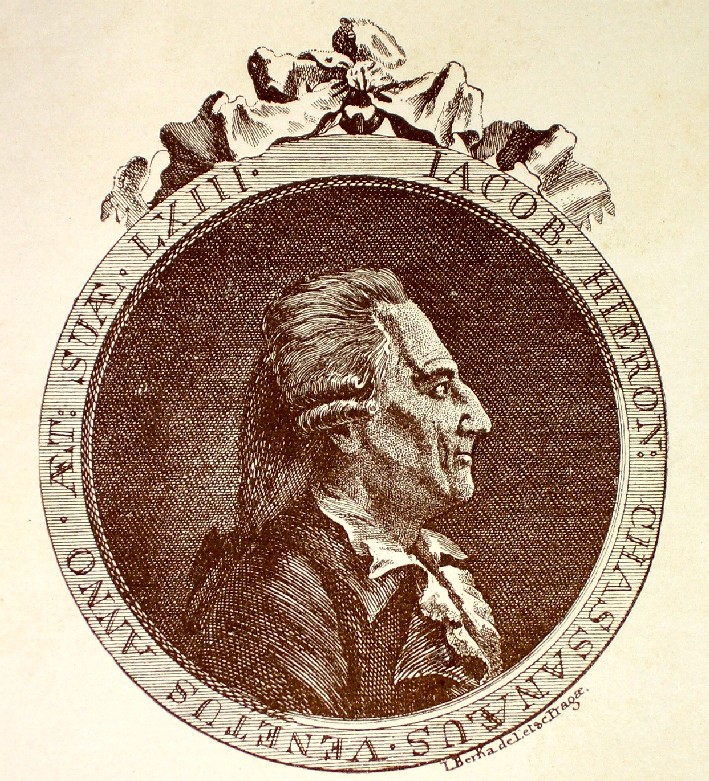 Casanova in 1788 1752 – Zoroastro: Tragedia tradotta dal Francese, da rappresentarsi nel Regio Elettoral Teatro di Dresda, dalla compagnia de' comici italiani in attuale servizio di Sua Maestà nel carnevale dell'anno MDCCLII. Dresden. 1753 – La Moluccheide, o Sia i gemelli rivali. Dresden. 1769 – Confutazione della Storia del Governo Veneto d'Amelot de la Houssaie. Lugano. 1772 – Lana caprina: Epistola di un licantropo. Bologna. 1774 – Istoria delle turbolenze della Polonia. Gorizia. 1775–78 – Dell'Iliade di Omero tradotta in ottava rima. Venice. 1779 – Scrutinio del libro Eloges de M. de Voltaire par différents auteurs. Venice. 1780 – Opuscoli miscellanei (containing Duello a Varsavia and Lettere della nobil donna Silvia Belegno alla nobil donzella Laura Gussoni). Venice. 1780–81 – Le messager de Thalie. Venice. 1782 – Di aneddoti viniziani militari ed amorosi del secolo decimoquarto sotto i dogadi di Giovanni Gradenigo e di Giovanni Dolfin. Venice. 1783 – Né amori né donne, ovvero La stalla ripulita. Venice. 1786 – Soliloque d'un penseur. Prague. 1787 – Icosaméron, ou Histoire d'Édouard et d'Élisabeth qui passèrent quatre-vingts un ans chez les Mégamicres, habitants aborigènes du Protocosme dans l'intérieur de nôtre globe. Prague. 1788 – Histoire de ma fuite des prisons de la République de Venise qu'on appelle les Plombs. Leipzig. 1790 – Solution du probléme deliaque. Dresden. 1790 – Corollaire à la duplication de l'hexaèdre. Dresden. 1790 – Démonstration géometrique de la duplication du cube. Dresden. 1797 – A Léonard Snetlage, docteur en droit de l'Université de Goettingue, Jacques Casanova, docteur en droit de l'Universitè de Padou. Dresden. 1822–29 – First edition of the Histoire de ma vie, in an adapted German translation in 12 volumes, as Aus den Memoiren des Venetianers Jacob Casanova de Seingalt, oder sein Leben, wie er es zu Dux in Böhmen niederschrieb. The first full edition of the original French manuscript was not published until 1960, by Brockhaus (Wiesbaden) and Plon (Paris). |
作品[編集] 1788年のカサノヴァ 1752 - 『ゾロアスター:悲劇』(フランス語訳)、ドレスデン王立劇場で上演される。ドレスデン 1753 - 『ラ・モルチェイデ』、または『サイア・イ・ジェメッリ・ライヴァリ』。ドレスデン。 1769 - ヴェネト州知事アメロ・デ・ラ・ハウゼの歴史に関する協議。ルガーノ。 1772 -ラナ・カプリーナ:ある放蕩者の叙事詩. ボローニャ。 1774 -Istoria delle turbolenze della Polonia. ゴリツィア。 1775-78 -Dell'Iliade di Omero tradotta in ottava rima. ヴェネツィア。 1779年 - ヴォルテール卿の『エローグ』を様々な作家が翻訳する。ヴェネツィア。 1780 -Opuscoli miscellanei(ヴァルサヴィアでの二重唱と、シルヴィア・ベレグノとラウラ・グッソーニの貴婦人の手紙を含む)。ヴェネツィア。 1780-81 -タリーの使者。ヴェネツィア。 1782年 - ジョヴァンニ・グラデニーゴと ジョヴァンニ・ドルフィンの 犬による、10世紀のヴィニツィア軍人と愛人に関する逸話 。ヴェネツィア。 1783 -Né amori né donne, ovvero La stalla ripulita. ヴェネツィア. 1786 -Soliloque d'un penseur. プラハ. 1787 -Icosaméron, ou Histoire d'Édouard et d'Élisabeth quatre qu4-vingts ans passedz les Mégamicres, habitants aborigènes du Protocosme d'intérieur de nôtre globe. プラハ 1788 -Histoire de ma fuite des prrison de la République de Venise qu'on appelle les Plombs. ライプツィヒ。 1790 -難問を解決する。ドレスデン。 1790年 -六角形の複製を作る 。ドレスデン。 1790 -立方体の複製による幾何学的実証。ドレスデン。 1797 -ゲッチュー大学博士レオナール・スネトラージュ、パドゥ大学博士ジャック・カサノヴァ。ドレスデン。 1822-29年 『Histoire de ma vie』の初版が、ドイツ語訳『Aus den Memoiren des Venetianers Jacob Casanova de Seingalt, or sein Leben, wie er es zu Dux in Böhmen niederschrieb』として全12巻で出版される。フランス語原本の初版は、1960年にブロックハウス(ヴィースバーデン)とプロン(パリ)か ら出版された。 |
| Manon Balletti Don Juan Lothario |
マノン・バレッティ ドン・ファン ロサリオ |
| https://en.wikipedia.org/wiki/Giacomo_Casanova |
|
★ 審問:(冒頭の再掲)
(1) 「女たらしドン・ファンは、その悪業のゆえに罰せられるべきか?」
・ 全面的イエス:どうしてか、その理由
・ 部分的イエス/部分的ノー:どうしてか、その理由
・ 全面的ノー:どうしてか、その理由
(2) 女 たらしドン・ファンの歴史は、もはや過去のものか?
・ イエス:だったら、現在の男女のセクシュアリティと「騙しや籠絡」とはどのようなものか?
・ ノー:だったら、現在の男女のセクシュアリティと「騙しや籠絡」は変わっていないことに同意するか?
(3) ドン・ファン的気分にある男性を、逆にカモにする美人局(つつもたせ)を知っているか?
・ イエス:つつもたせとはなにか?
・ ノー:美人局の英語は、Beauty Bureauや Badger gameといいます。
※ 【美人局】女が自分の夫や情夫と共謀して、他の男を姦通に誘い、あわや、というときに共謀の男があらわれて、それを種にその男から金銭などをゆすり取るこ と(コトバンク)
| The badger game is an
extortion scheme or confidence trick in which the victims are tricked
into compromising positions in order to make them vulnerable to
blackmail. Its name is derived from the practice of badger-baiting. The trick was particularly effective in the 19th and earlier 20th century when social attitudes toward adultery were much harsher. A famous person known to have fallen victim of the scheme was the first United States Secretary of the Treasury, Alexander Hamilton, whose adulterous affair with Maria Reynolds was used by her husband to extort money and information from him. The badger game has been featured as a plot device in numerous books, movies and television shows. 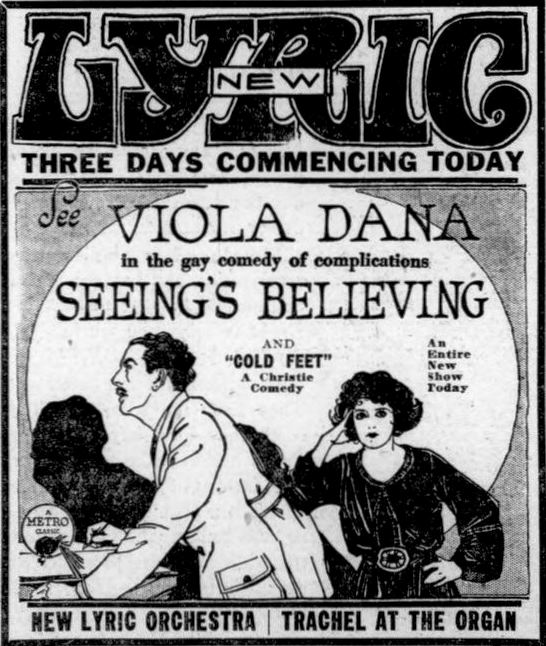 A badger game is often a plot device in American films such as Seeing's Believing (1922). |
アナグマ・ゲームとは、恐喝や
信用詐欺の手口で、被害者を騙して危うい立場に追い込み、恐喝の対象とするものである。その名前は、アナグマを餌にする行為に由来する。 この手口は、不倫に対する社会的態度がより厳しかった19世紀から20世紀初頭にかけて特に効果的だった。この手口の犠牲になった有名人として知られるの が、初代アメリカ合衆国財務長官アレクサンダー・ハミルトンである。彼はマリア・レイノルズとの不倫関係を夫に利用され、彼から金と情報を強要された。 アナグマ・ゲームは、数多くの本や映画、テレビ番組で筋書きとして取り上げられてきた。 アナグマ・ゲームは、『Seeing's Believing』(1922年)などのアメリカ映画でしばしば登場するプロット・デバイスである。 |
| Description In its simplest form, the badger game proceeds thus: a married man begins an extramarital affair. Another man, posing as the other woman's husband or brother, then "discovers" the affair; he then demands money from the man to keep the affair secret. Unknown to the man having the affair, both the woman and the man who demands the money had prearranged the situation and were conspiring against him. The woman may also claim that the sexual encounter was non-consensual and threaten the victim with a rape or sexual harassment charge. Variants of the trick involve luring the victim with the promise of a homosexual act, underage children, child pornography, a bizarre sexual fetish, or some other activity carrying a legal penalty and/or social stigma. In the most typical form of the trick, an attractive woman approaches a man, preferably a lonely married man of considerable financial means from out of town, and entices him to a private place with the intent of maneuvering him into a compromising position, usually sexual. Afterwards, an accomplice blackmails the victim with photographs or similar evidence. Another form involves accusations of professional misconduct. In an example of this form of the trick, a "sick" woman visits a physician, describing symptoms that require her to disrobe for the examination, require the doctor to examine the genitals, or ensure similar scrutiny from the doctor. During the examination an "outraged husband" or "outraged father" enters the room and accuses the doctor of misconduct. The "sick" woman, who is of course part of the deception, takes the side of her accomplice and threatens the doctor with criminal charges or a lawsuit. This form of the badger game was first widely publicized in an article in the August 25, 1930 edition of Time magazine.[1] Non-sexual versions of this trick also exist, particularly among ethnic and religious groups with strong social taboos, for example inducing a Mormon to gamble or drink alcohol in violation of his religious vows, and then demanding money to keep the indulgence secret and thus preserve his reputation.[2][3] |
説明[編集]。 最も単純な形では、アナグマ・ゲームは次のように進行する:既婚男性が婚外恋愛を始める。そして、相手の女性の夫か兄弟を装った別の男が不倫を「発見」 し、不倫を秘密にするために男に金を要求する。不倫をしている男性にはわからないが、女性と金を要求する男性の両方が、この状況を事前に準備し、男性に対 して共謀していたのである。 女性はまた、性的な出会いは合意のないものだったと主張し、被害者をレイプや セクハラで脅すこともある。 この手口のバリエーションには、同性愛行為、未成年の子ども、児童ポルノ、奇妙な性的フェチ、あるいは法的処罰や社会的汚名を伴うその他の行為を約束して 被害者を誘い出すものがある。最も典型的な手口では、魅力的な女性が男性、できれば町外から来た経済的に余裕のある孤独な既婚男性に近づき、通常性的な危 うい立場に誘導する目的で、人目につかない場所に誘い込む。その後、共犯者が写真や同様の証拠で被害者を脅迫する。 もう一つの形態は、仕事上の不正行為を告発するものである。この手口の一例では、「病気の」女性が医師を訪れ、診察のために服を脱ぐ必要がある、医師に性 器を調べる必要がある、あるいは医師から同様の監視を受ける必要がある症状を説明する。診察中に「憤慨した夫」または「憤慨した父親」が部屋に入ってき て、医師の不正行為を非難する。病気の」女性は、もちろん欺瞞の一部であり、共犯者の味方をし、医師を刑事告訴や訴訟で脅す。この形のアナグマ・ゲーム は、『タイム』誌1930年8月25日号の記事で初めて広く知られるようになった[1]。 このトリックの非性的なバージョンも、特に社会的タブーの強い民族や宗教集団の間に存在する。例えば、モルモン教徒が宗教的誓約に反してギャンブルや 飲酒をするように誘導し、その耽溺を秘密にして評判を保つために金銭を要求するようなものである[2][3]。 |
| Clip joint Entrapment Hamilton–Reynolds affair "The Medicine Man" Romance scam |
クリップジョイント エントラップメント ハミルトン-レイノルズ事件 "メディスン・マン" ロマンス詐欺(→結婚詐欺) |
| https://en.wikipedia.org/wiki/Badger_game |
★ ロ マンス・スカム(ロマンス詐欺)→「新宿タワマン殺人 事件」
リ ンク
文 献
そ の他の情報
Copyleft, CC, Mitzub'ixi Quq Chi'j, 1996-2099

☆
 ☆
☆
++
Copyleft,
CC, Mitzub'ixi Quq Chi'j, 1996-2099