感覚の歴史
Sensory history
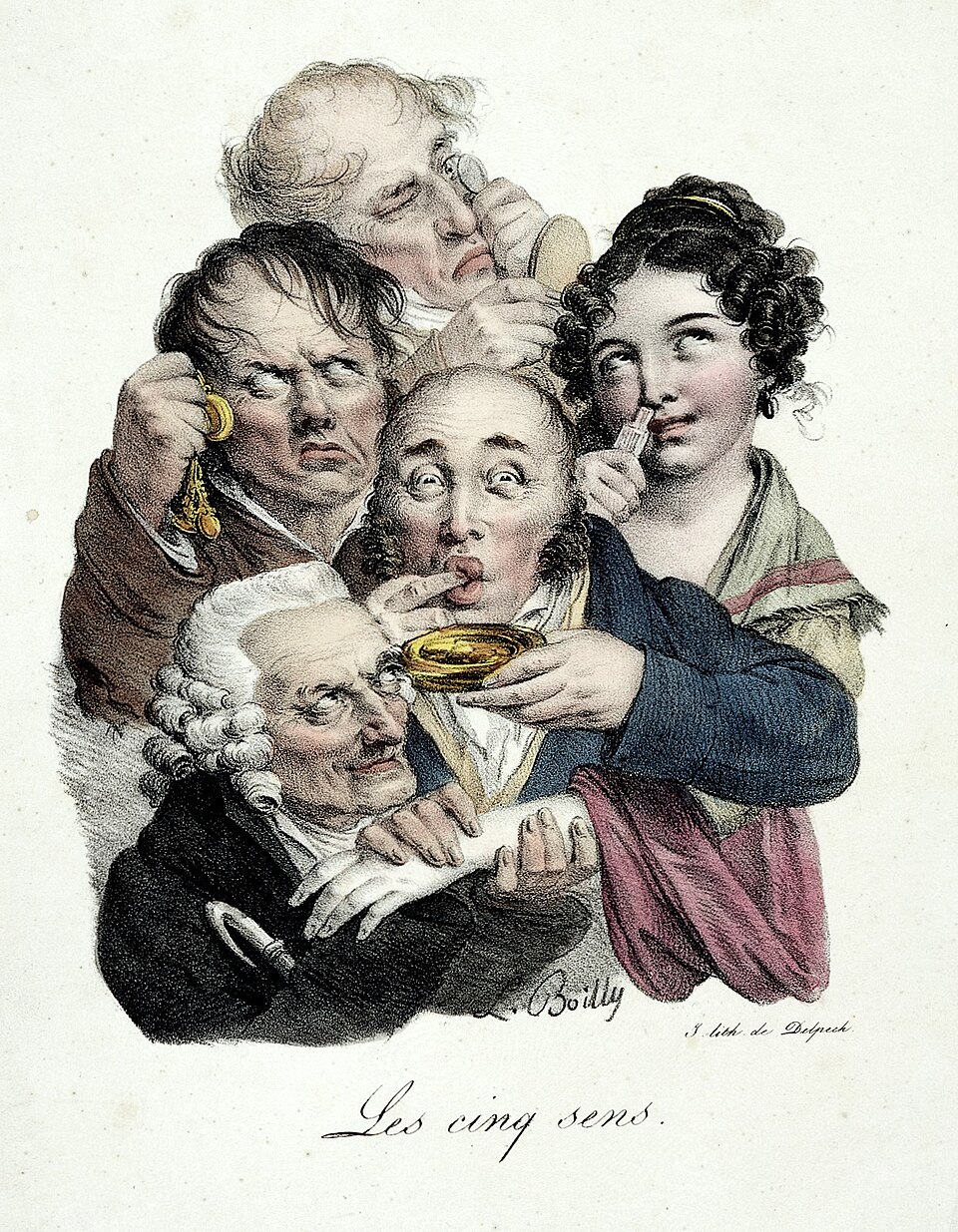
Five
people, each exercising one of the five senses. Coloured lithograph
after L.-L. Boilly.
☆ 感 覚史[Sensory history]とは、過去の感覚概念が果たした役割を検証する学術分野である。これは伝統的な歴史書が感覚体験を真剣な探究対象ではなく、単な る記述技法として扱 う傾向があったことへの反発から発展した。[1] 感覚史の研究は、身体的体験に焦点を当てることで過去への深い理解を伝えようとする。感覚史の最も重要 な提唱者の一人に、アメリカの歴史学者マーク・M・スミスがいる。感覚研究に対する人類学的アプローチは感覚史に顕著な影響を与えてお り、両分野の間で重要な議論と重なりが生じている。[2] 感覚体験の一過性ゆえに、感覚史は研究・記述が困難な主題である。この課題は、感覚史研究に適切な表現手法は何かといった分野内の議論にも反映されている(→「感覚のエスノグラフィー」)。
| Sensory history
is an area of academic study which examines the role conceptions of our
senses have played in the past. It developed partly as a reaction to
the lack of serious attention given to sensory experience in
traditional history books, which often treat sensory experience as a
writing technique rather than a serious avenue of enquiry.[1] Works of
sensory history try to convey a deeper understanding of the past
through an emphasis on physical experiences. One of the most significant proponents of sensory history is the American historian Mark M. Smith. Anthropological approaches to sensory studies have had a notable influence on sensory history and there has been significant discussion and overlap between the two disciplines.[2] The transient nature of sensory experience makes sensory history a difficult topic to study and write about. This challenge is reflected in debate within the field, such as what methods of presentation are appropriate for works of sensory history.[1][3] |
感覚史とは、過去の感覚概念が果たした役割を検証する学術分野である。
これは伝統的な歴史書が感覚体験を真剣な探究対象ではなく、単なる記述技法として扱う傾向があったことへの反発から発展した。[1]
感覚史の研究は、身体的体験に焦点を当てることで過去への深い理解を伝えようとする。 感覚史の最も重要な提唱者の一人に、アメリカの歴史学者マーク・M・スミスがいる。感覚研究に対する人類学的アプローチは感覚史に顕著な影響を与えてお り、両分野の間で重要な議論と重なりが生じている。[2] 感覚体験の一過性ゆえに、感覚史は研究・記述が困難な主題である。この課題は、感覚史研究に適切な表現手法は何かといった分野内の議論にも反映されてい る。[1][3] |
| History Karl Marx drew attention to the possibility of sensory history in The Economic and Philosophic Manuscripts of 1844, in which he stated that "the forming of the five senses is a labour of the entire history of the world down to the present."[4] In 1942 Lucien Febvre, a French historian and one of the founders of the Annales School, called for the history of sensibilities to be examined and so is credited as one of the first historians to consider the senses as a legitimate historical field of study.[5][6][7][8] The development of sensory history has also been influenced by other academic disciplines, such as philosophy and anthropology. The idea that sight is the most important sense of the modern era was particularly argued by philosopher Michel Foucault. Philosophers Marshall McLuhan and Walter J. Ong expanded on this idea in their theory of 'the great divide'. The theory claims that the invention of the printing press caused a fundamental shift in how people used their senses – from hearing being the most important sense, to sight.[1] The concept of the pre-eminence of sight in the modern world, has also prompted a particular focus on the other four senses in works of sensory history in order to readdress this inequality. Anthropologists such as David Howes and Constance Classen have also made significant contributions to the study of sensory history, particularly in regards to the importance of context in sensory histories, through their work within the broader field of sensory studies.[9] Historian Alain Corbin produced one of the first books focussing exclusively on sensory history in 1982, The Foul and the Fragrant: Odor and the French Social Imagination, a discussion on the role of smell in 18th and 19th century France.[9][10] In 1994 George H. Roeder wrote the essay Coming to Our Senses, which claimed that historical studies were still lacking in engagement with the senses, particularly history textbooks.[2] The historian who has most represented sensory history in the 21st century is Mark M. Smith, who has written both a book on the subject of sensory history itself and books which examine historical events through the senses.[1][8][11] |
歴史 カール・マルクスは『1844年経済哲学草稿』において感覚の歴史の可能性に注目した。彼は「五感の形成は、現在に至るまでの世界史全体の労働である」と 述べている。[4] 1942年、フランス史家でありアナル学派の創始者の一人であるリュシアン・フェブルは、感覚の歴史を検証するよう呼びかけた。彼は感覚を正当な歴史研究 分野として考察した最初の歴史家の一人とされる。[5][6][7][8] 感覚史の発展は、哲学や人類学といった他の学問分野からも影響を受けている。視覚が現代において最も重要な感覚であるという考えは、哲学者ミシェル・フー コーによって特に主張された。哲学者マーシャル・マクルーハンとウォルター・J・オングは、この考えを「大いなる分断」理論で展開した。この理論は、印刷 機の発明が人々の感覚の使い方に根本的な変化をもたらしたと主張する。つまり、最も重要な感覚が聴覚から視覚へと移行したのである。近代世界における視覚 の優位性という概念は、この不均衡を再検討するため、感覚史の研究において他の四感覚に特に焦点を当てる契機ともなった。デイヴィッド・ハウズやコンスタ ンス・クラッセンら人類学者も、より広範な感覚研究の分野における活動を通じて、感覚史研究、特に感覚史における文脈の重要性に関する研究に重要な貢献を している。[9] 歴史家アラン・コルバンは1982年、感覚史に専念した最初の著作の一つ『悪臭と芳香:18~19世紀フランスにおける匂いの社会想像』を発表した。これ は18~19世紀フランスにおける嗅覚の役割に関する論考である。[9] [10] 1994年、ジョージ・H・ローダーは『感覚を取り戻す』という論文を発表し、歴史研究、特に歴史教科書が依然として感覚との関わりを欠いていると主張し た。[2] 21世紀において感覚史を最も代表する歴史家はマーク・M・スミスであり、彼は感覚史そのものを主題とした著作と、感覚を通じて歴史的事件を考察する著作 の両方を執筆している。[1][8][11] |
| Method Sensory history is often written because of a significant lack of any examination of the sensory in a particular historical area previously.[12] This means that sensory historians can simply re-examine primary and secondary sources, with a lens for the sensory, in order to support their work.[1] Historian Mark M. Smith refers to sensory history as a 'habit' that can be used across many fields of historical study.[1][13] Historicising the senses is an important concept for sensory historians when conducting research, and this means considering the senses in their historical context while putting aside more modern conceptions of the senses.[1][8] This concept lies at the heart of many sensory histories because if accounts of sensory experience cannot be taken at face-value then a more rigorous examination is required. The idea of historicising the senses is significantly influenced by sensory anthropological studies. Sensory history is a field which lends itself to inter-disciplinary cooperation with fields such as anthropology and media studies. Because sensory history concerns itself with the sensory experiences of individuals, it is linked to the notion of 'bottom up' history, which focusses on the lives of ordinary people throughout history. Inter-sensoriality Inter-sensoriality (also spelt intersensoriality) is a word used by sensory historians to describe one of the goals of sensory history, which is to consider the five senses together and how they work in concert. Works of history which consider the whole inter-sensoriality of a subject aim to provide a more complete and engaging perspective on history. Historians of food, long wedded to an approach that privileged taste (both as a property of individual foods and as a means of social distinction in matters culinary), now give a pride of place to all five senses when analysing goods, dishes, and meals. They also describe how the industrialisation of food production went hand in hand with the ways in which attention to the senses helped invent, formulate, and produce goods like tin-cans, cheeses or convenience foods (tv dinners) that were acceptable and appealing to consumers' eyes, noses, ears, teeth, and tongues. In doing so, they pay special attention to social class, gender, and other organising principles of society. [14] |
方法 感覚史が書かれるのは、特定の歴史領域においてこれまで感覚に関する考察が著しく欠けていたためである。[12] これは感覚史研究者が、自らの研究を支えるために、感覚というレンズを用いて一次資料や二次資料を再検討するだけでよいことを意味する。[1] 歴史家マーク・M・スミスは感覚史を、歴史研究の多くの分野で活用できる「習慣」と呼んでいる。感覚を歴史化する概念は、感覚史研究者が調査を行う上で重 要である。これは感覚を現代的な概念から切り離し、歴史的文脈の中で考察することを意味する[1][8]。感覚体験の記述を表面的に受け取れない場合、よ り厳密な検証が必要となるため、この概念は多くの感覚史研究の中核をなす。感覚を歴史化する考え方は、感覚人類学の研究から大きく影響を受けている。感覚 史は、人類学やメディア研究などの分野との学際的協力に適した領域である。 感覚史は個人の感覚的経験に関わるため、歴史を通じて一般市民の生活に焦点を当てる「ボトムアップ」史観と結びついている。 相互感覚性 相互感覚性(intersensorialityとも表記される)とは、感覚史研究者が感覚史の目的の一つを説明する際に用いる言葉である。それは五感を 一体として捉え、それらがどのように協調して機能するかを考察することである。対象の相互感覚性全体を考慮した歴史研究は、より完全で魅力的な歴史観を提 供することを目指す。食の歴史研究者は、長い間味覚(個々の食品の特性として、また食文化における社会的区別の手段として)を重視するアプローチに固執し てきたが、現在では商品・料理・食事を分析する際、五感すべてを同等に重視するようになった。また彼らは、食品生産の工業化が、感覚への配慮とどのように 連動したかを記述する。その配慮が、消費者の目・鼻・耳・歯・舌に受け入れられ魅力的に映る商品——缶詰、チーズ、あるいはテレビディナーのような即席食 品——の発明・開発・生産を可能にしたのだ。この過程において、彼らは特に社会階級、ジェンダー、その他の社会の組織原理に注意を払っている。[14] |
| Challenges The question of how to present sensory history is a significant challenge.[1][10] Sensory experience is in nature transient, so historians must consider how best to represent and discuss this. A further challenge for sensory historians when conducting sensory history is how to access sensory experiences of the past. Written descriptions of sensory experiences are numerous and often used, but some historians take this further and attempt to recreate past sensory experiences, in the hope that by experiencing it themselves they can better understand the past.[3] In regards to this dilemma, historian Alain Corbin states that the historian is always a "prisoner of language" when investigating the past.[15] |
課題 感覚史をどう提示するかという問題は重大な課題だ。[1][10] 感覚体験は本質的に一時的なものであるため、歴史家はこれをどう表現し議論するのが最善かを考えねばならない。感覚史研究者が感覚史を扱う際のさらなる課 題は、過去の感覚体験にどうアクセスするかだ。感覚体験の記述は文書で数多く残され、よく利用される。しかし一部の歴史家はさらに踏み込み、過去の感覚体 験を再現しようとする。自ら体験することで過去をより深く理解できると期待してのことだ。[3] このジレンマについて、歴史家アラン・コルバンは、歴史家が過去を調査する際には常に「言語の囚人」であると述べている。[15] |
| Debate The method of presentation of sensory history has been a significant topic of debate in the field of sensory history. Historians such as Peter Charles Hoffer place priority upon the communication of their work to their audience.[3] This can involve more creative methods of presentation, such as living museums or interactive exhibitions, in order for the audience to more deeply experience and understand the past. Other historians, such as Mark M. Smith, disagree with this method of presentation, as priority is placed upon the historicity of the senses.[1] Smith contends that how people sense now is fundamentally different from how people sensed in the past, based on factors such as location and context. He argues that presentations of sensory history such as living museums undermine the integrity of sensory history, as they suggest that a person is able to experience the past in the same way that those who lived the experience did, regardless of their fundamentally different contexts and places unnecessary importance on the 'consumption' of the past.[1] However, more recent work by William Tullett has argued that using our senses in the present to engage with sensory reconstructions of the past can be a useful comparative exercise that sheds light on the continuities and differences between contemporary and past sensory experiences.[16] Another significant debate in relation to sensory history is the relevance of the 'great divide' theory, as presented in The Gutenberg Galaxy by Marshall McLuhan, to the study of sensory history. Sensory historians give varying degrees of importance to this theory. |
議論 感覚史の提示方法は、感覚史の分野において重要な議論のテーマとなってきた。ピーター・チャールズ・ホッファーのような歴史家は、自らの研究を聴衆に伝え ることを最優先する[3]。これには、聴衆が過去をより深く体験し理解できるよう、生きている博物館やインタラクティブな展示といった創造的な提示方法が 含まれる。一方、マーク・M・スミスのような他の歴史家は、感覚の歴史性を優先すべきだとし、この提示方法に反対する。[1] スミスは、場所や文脈といった要因に基づき、現代人の感覚のあり方は過去の人々のそれとは根本的に異なると主張する。彼は、生きた博物館のような感覚史の 提示方法は、文脈が根本的に異なるにもかかわらず、現代人が体験した過去を当時の体験者と同じ方法で経験できるかのように示唆し、過去を「消費」すること に不必要な重要性を置くため、感覚史の完全性を損なうと論じる。[1] しかしウィリアム・タレットの近年の研究は、現代の感覚を用いて過去の感覚的再構築と向き合うことが、現代と過去の感覚体験の連続性と異なる点を明らかに する有益な比較演習となり得ると論じている。[16] 感覚史に関連するもう一つの重要な議論は、マーシャル・マクルーハンの『グーテンベルク・ギャラクシー』で提示された「大いなる分断」理論が感覚史研究に どの程度関連するかである。感覚史研究者たちはこの理論に様々な程度の重要性を与えている。 |
| The senses Touch Touch has historically been included as one of the 'lower' senses, that is, not requiring any skill of the mind to be used. German naturalist Lorenz Oken characterised Africans as the uncivilised "skin-man," as opposed to the civilised European "eye-man," thus utilising touch to support racist ideology.[17] As a result of this view of touch as a 'lower' and 'uncivilised' sense, serious historical analysis of the role touch has played in the past was lacking until the end of the 20th century, when interest in sensory history first 'boomed'. Histories of touch naturally lend themselves to a history of sexuality, but touch is also central to histories of Christian practices.[18] For example, in renaissance and early modern England debates ranged from the role of the kiss in Christian practices to the legitimacy of the 'royal touch', which was reputed to heal the sick.[19][20] Additionally, the sense of touch is such an integral part of everyday life and experience that it is not often referred to explicitly in historical sources, and so is an "inferred history" as named by historian Constance Classen.[17] |
感覚 触覚 触覚は歴史的に「低級な」感覚の一つとされてきた。つまり、使用するのに心の技能を必要としないというわけだ。ドイツの自然学者ローレンツ・オーケンは、 アフリカ人を未開の「皮膚人間」と特徴づけ、文明化されたヨーロッパ人の「目人間」と対比させた。こうして触覚を人種差別的なイデオロギーを支えるために 利用したのである。[17] このように触覚が「低級」かつ「未開」の感覚と見なされた結果、20世紀末に感覚史への関心が初めて「ブーム」となるまで、触覚が過去に果たした役割に関 する本格的な歴史的分析は欠如していた。触覚の歴史は当然ながら性史と結びつくが、触覚はキリスト教実践の歴史においても中心的な位置を占める。[18] 例えばルネサンス期および近世イングランドでは、キリスト教的実践における口づけの役割から、病を癒すとされた「王の触診」の正当性まで、幅広い議論が交 わされた。[19][20]さらに触覚は日常生活と経験に深く根ざしているため、歴史資料で明示的に言及されることは稀であり、歴史家コンスタンス・ク ラッセンが名付けた「推論される歴史」に該当する。[17] |
| Hearing One of the first sensory histories dealing with the sense of hearing is Village Bells: Sound and Meaning in the Nineteenth-century French Countryside by Alain Corbin, which examines the meanings embedded in the sound of bells in 19th century French villages.[21] The study of cities, particularly with regards to industrialisation, is a common topic of histories of sound or hearing.[22] For example, the term 'soundscape' often refers to both the sounds of the physical environment inhabited, and how these sounds are perceived, especially in regard to how the soundscapes of certain cities change, and how this change affects its citizens.[23] This necessarily draws upon inter-disciplinary research in the fields of soundscapes, sound studies and urban history.[24] The historian Mark M. Smith has suggested the term "acoustemology" as a title for this field of study. Of particular importance in this topic is the invention of recording methods, which some historians have argued was a pivotal turning point in the history of the sense of hearing and radically changed society's relationship with the sense of hearing. Scholars such as Jonathan Sterne, have offered a critique of this narrative by showing that many new forms of listening associated with recording and playback technologies preceded the invention and popularisation of recorded sound.[25] Additionally, how people's relative perception and sensitivity to sound has changed is of particular interest.[26] The focus of this research has been on the regulation of,[27] campaigning against,[28] and association of social groups with[29] urban noise. |
聴覚 聴覚に関する最初の感覚史の一つは、アラン・コルビンの『村の鐘:19世紀フランス農村における音と意味』である。この著作は19世紀フランス村落におけ る鐘の音に込められた意味を考察している。[21] 都市の研究、特に工業化に関するものは、音や聴覚の歴史において一般的な主題である。例えば「サウンドスケープ」という用語は、居住環境の物理的音響と、 それらの音響の知覚方法、特に特定の都市のサウンドスケープがどのように変化し、その変化が市民にどう影響するかを指すことが多い。これは必然的に、サウ ンドスケープ、音響研究、都市史といった分野の学際的研究を必要とする。[24] 歴史家マーク・M・スミスはこの研究分野の名称として「音響学(acoustemology)」という用語を提案している。このテーマにおいて特に重要な のは録音技術の発明であり、一部の歴史家はこれが聴覚の歴史における決定的な転換点であり、社会と聴覚の関係を根本的に変えたと論じている。ジョナサン・ スターンら研究者は、録音・再生技術に伴う新たな聴取形態の多くが、録音音源の発明・普及以前に存在していたことを示すことで、この通説に異議を唱えてい る[25]。加えて、人々の音に対する相対的な知覚や感受性がどう変化したかも特に注目される点だ。[26] 本研究の焦点は、都市騒音に対する規制[27]、反対運動[28]、および社会集団との関連性[29]にある。 |
| Smell Perfumer Eugène Rimmel stated in the 19th century that "the history of perfume is, in some manner, that of civilisation."[30] Rarely has the sense of smell been given any prominence in the study of history, which partly stems from the difficulty the English language poses in describing olfactory sensations. Aristotle first pointed this out in De Anima, and it is continually seen in the reliance upon words related to flavour when describing smells.[31] A more common description of smells is simply distinguishing whether the smell is pleasurable or not. Smell is historically considered one of the ‘lower’ senses (like touch and taste) as it is linked to animals who often have a keener sense of smell than humans.[32] The sense of smell is also generally considered to be an undervalued sense, particularly in Western societies.[33][34] This perspective also stems somewhat from the philosopher Immanual Kant who stated that it was the "least rewarding" and "most easily dispensable sense."[35] In Alain Corbin's book The Foul and the Fragrant, he argues that the sense of smell is inherently tied to social power, as historically certain groups of people have been rendered as 'lesser' because of lack of hygiene.[36][37] |
匂い 19世紀の調香師ユージェン・リメルは「香水の歴史は、ある意味で文明の歴史である」と述べた[30]。歴史研究において嗅覚が重視されることは稀であ り、その一因は英語が嗅覚的感覚を表現する際に困難を伴う点にある。アリストテレスが『魂について』で最初に指摘したように、匂いを表現する際には味覚に 関連する言葉に依存する傾向が今も続いている[31]。匂いのより一般的な表現は、単にその匂いが快いものか否かを区別することである。嗅覚は歴史的に 「低次」の感覚(触覚や味覚と同様)と見なされてきた。これは、人間よりも鋭い嗅覚を持つ動物と結びつけられてきたためである。[32] 嗅覚はまた、特に西洋社会において過小評価されている感覚と一般に考えられている。[33][34] この見方は、哲学者イマヌエル・カントが「最も報われない」「最も容易に不要とされる感覚」と述べたことにも一部起因している。[35] アラン・コルビンの著書『悪臭と芳香』では、嗅覚は本質的に社会的権力と結びついていると論じられている。歴史的に、衛生状態の悪さゆえに特定の集団が 「劣った存在」と見なされてきたからだ。[36][37] |
| Taste The history of taste is traditionally tied to food history and food studies, however sensory histories of taste attempt to analyse this sense throughout history more broadly and to expand beyond gastronomy.[18] As the sense of taste is intrinsically connected to the act of eating, so the history of taste is necessarily tied to morality and the sin of gluttony, and also therefore the history of the Christian church. Taste is historically considered a lower sense, particularly as it requires physical contact with the subject of the tasting. |
味覚 味覚の歴史は伝統的に食の歴史や食文化研究と結びついている。しかし味覚の感覚史は、この感覚を歴史全体を通じてより広く分析し、美食学の枠を超えて拡張 しようとする試みである。[18] 味覚は本質的に食事行為と結びついているため、味覚の歴史は必然的に道徳や大食いの罪、ひいてはキリスト教会の歴史とも結びついている。味覚は歴史的に低 次の感覚と見なされてきた。特に、味わう対象との物理的接触を必要とする点がその理由である。 |
| Sight Sight has historically been considered one of the 'higher' senses as it is linked to reading and use of the mind. It has also been associated with the higher classes of society whose jobs do not involve manual labour, as opposed to the lower classes who have even been referred to as simply "hands".[38] This is also reflected in the use of the term 'Dark Ages' and the 'Enlightenment' to describe the period of history in which minimal progress was made as opposed to the period when the foundations of modern thought were built.[17] Due to this supposed supremacy, particularly within the sensory hierarchy of the west, there is no dearth of visual analysis in the practice of traditional history writing. Visual sources such as photographs and paintings are frequently utilised as important sources in historical works. In his essay, When Seeing Makes Scents, Mark M. Smith argues that these visual sources can be mined for information about the other four senses in order to gain a more complete understanding of past sensory experiences.[39] |
視覚 視覚は歴史的に「高尚な」感覚の一つと見なされてきた。それは読書や知性の使用と結びついているからだ。また、肉体労働を伴わない職業を持つ社会の上層階 級とも関連付けられてきた。これに対し、下層階級は単に「手」と呼ばれることもあった。[38] この傾向は「暗黒時代」と「啓蒙時代」という用語の用法にも表れている。前者は進歩がほとんど見られなかった歴史的時期を指し、後者は近代思想の基盤が築 かれた時期を指す。[17] このような優越性、特に西洋の感覚階層における優位性ゆえに、伝統的な歴史記述の実践においては視覚的分析が不足することはなかった。写真や絵画といった 視覚資料は、歴史研究において重要な史料として頻繁に活用される。マーク・M・スミスは論文『視覚が意味を成すとき』で、こうした視覚資料から他の四感覚 に関する情報を掘り起こすことで、過去の感覚体験をより包括的に理解できると論じている。[39] |
| Significant works In the ‘boom’ of sensory history during the late 20th and early 21st century, many significant works have been produced within the field of sensory history.[40] Historian Mark M. Smith has written the introductory book Sensory History and a sensory history of the American Civil War in The Smell of Battle and the Taste of Siege. A series of books titled The Cultural History of the Senses surveys the role the five senses has played from antiquity to the modern age through a variety of essays on the subject. Additionally in Empire of the Senses: a Cultural Reader, David Howes has selected essays which represent a large cross-section of the field.[citation needed] For the renewal of food history that goes beyond taste to embrace the other senses, see Vabre, Bruegel, Atkins (2021).[41] |
重要な著作 20世紀末から21世紀初頭にかけての感覚史研究の「ブーム」の中で、感覚史の分野では多くの重要な著作が生み出された。[40] 歴史家マーク・M・スミスは入門書『感覚史』を執筆し、また『戦場の匂いと包囲戦の味わい』においてアメリカ南北戦争の感覚史を扱っている。『感覚の文化 史』と題された一連の書籍は、五感が古代から現代に至るまで果たしてきた役割を、様々な論考を通じて概観している。さらにデイヴィッド・ハウズ編『感覚の 帝国:文化読本』では、この分野の幅広い研究を代表する論考が選ばれている。[出典必要]味覚を超え他の感覚も包含する食の歴史研究の新たな展開について は、ヴァブレ、ブリューゲル、アトキンス(2021)を参照のこと。[41] |
| References 1. Smith, Mark (2007). Sensory History. Berg. ISBN 978-1-84520-415-0. 2. Howes, David (2008). "Can These Dry Bones Live? An Anthropological Approach to the History of the Senses". The Journal of American History. 95 (2): 442–451. doi:10.2307/25095629. JSTOR 25095629. 3. Hoffer, Peter Charles (2008). Sensory Worlds in Early America. Johns Hopkins University Press. ISBN 978-0801873539. 4. Marx, Karl (1932). Economic and Philosophic Manuscripts of 1844. Progress Publishers. 5. Eakin, Emily (2003-12-20). "THINK TANK; History You Can See, Hear, Smell, Touch and Taste". The New York Times. ISSN 0362-4331. Retrieved 2020-06-01. 6. "Making Sense of U.S. History | The American Historian". www.oah.org. Retrieved 2020-06-01. 7. Hacke, Daniela; Musselwhite, Paul (2018). Empire of the Senses: Sensory Practices of Colonialism in Early America. Brill. ISBN 9789004340633. 8. Corbin, Alain (2005). "Charting the Cultural History of the Senses". Empire of the Senses: The Sensual Culture Reader: 128–139. 9. Widdis, Emma (2020). "The Challenges of Sensory History". Kritika: Explorations in Russian and Eurasian History. 21: 199–206. doi:10.1353/kri.2020.0009. S2CID 214071385. 10. Denney, Peter (2011). "Looking Back, Groping Forward: Rethinking Sensory History". Rethinking History: The Journal of Theory and Practice. 15 (4): 601–616. doi:10.1080/13642529.2011.603940. S2CID 143453743. 11. Smith, Mark (2015). The Smell of Battle, The Taste of Siege: A Sensory History of the Civil War. Oxford University Press. ISBN 9780199759989. 12. Reid, Saren Ann (2016). "Sensory history at the water's edge: an historical and cultural analysis of Australian urban waterfronts in Perth and Cairns". {{cite journal}}: Cite journal requires |journal= (help) 13. Smith, Mark (2007). "Producing sense, Consuming sense, Making sense: Perils and Prospects for Sensory History". Journal of Social History. 40 (4): 841–858. doi:10.1353/jsh.2007.0116. S2CID 144268667. 14. Sylvie Vabre, Martin Bruegel, Peter J. Atkins, eds. Food History. A Feast of the Senses in Europe, 1750 to the Present, Oxon/NYC: Routledge, 2021. 15. "Forum: The Senses" (PDF). German History. 32 (2): 256–273. 2014. doi:10.1093/gerhis/ghu034. 16. Tullett, William (2023). Smell and the Past: Noses, Archives, Narratives. London: Bloomsbury Academic. ISBN 978-1-3503-7181-1. Retrieved 12 September 2023. 17. Classen, Constance (2012). The Deepest Sense. University of Illinois Press. ISBN 9780252094408. 18. von Hoffman, Viktoria (2016). From Gluttony to Enlightenment: The World of Taste in Early Modern Europe. University of Illinois Press. ISBN 9780252099083. 19. Moshenska, Joe (2014). Feeling Pleasures: The Sense of Touch in Renaissance England. OUP Oxford. ISBN 20.9780191022036. 20. Brogan, Stephen (2015). The Royal Touch in Early Modern England: Politics, Medicine, and Sin. Boydell & Brewer. ISBN 9780861933372. 21. Corbin, Alain (1999). Village Bells: Sound and Meaning in the Nineteenth-century French Countryside. Macmillan Publishers Limited. ISBN 9780333752807. 22. Mansell, James (2018). "New Histories of the Urban Landscape". Journal of Urban History. 44 (2): 341–348. doi:10.1177/0096144217705648. S2CID 149002877. 23. Hendy, David (2013). Noise: A Human History of Sound and Listening. Ecco. ISBN 9780062283092. 24. Goodale, Greg (2011). Sonic Persuasion: Reading Sound in the Recorded Age. University of Illinois Press. ISBN 9780252093203. 25. Sterne, Jonathan (2003). The Audible Past: Cultural Origins of Sound Reproduction. Durham, NC: Duke University Press. ISBN 978-0-8223-3013-4. Retrieved 12 September 2023. 26. Boutin, Aimee (2015). City of Noise: Sound and Nineteenth-Century Paris. University of Illinois Press. ISBN 9780252097263. 27 Thompson, Emily (2004). The Soundscape of Modernity: Architectural Acoustics and the Culture of Listening in America, 1900-1933. Cambridge, MA: MIT Press. ISBN 9780262701068. 28. Bijsterveld, Karin (2017). Mechanical Sound: Technology, Culture, and Public Problems of Noise in the Twentieth Century. Cambridge, MA: MIT Press. ISBN 9780262534239. 29. Stoever, Jennifer (2015). ""Just Be Quiet Pu-leeze": The New York Amsterdam News Fights the Postwar "Campaign against Noise"". Radical History Review. 121: 145–168. doi:10.1215/01636545-2800013. 30. Reinarz, Jonathan (2014). Past Scents: Historical Perspectives on Smell. University of Illinois Press. ISBN 9780252096020. 31. Johansen, Thomas K. (1996). "Aristotle on the Sense of Smell". Phronesis. 41 (1): 1–19. doi:10.1163/156852896321051765. JSTOR 4182513. 32. Bradley, Mark (2014). Smell and the Ancient Senses. Routledge. ISBN 9781317565819. 33. Elsevier. "Why is the sense of smell undervalued in Western societies?". Elsevier Connect. Retrieved 2020-06-02. 34. Graham, Ruth (29 January 2012). "Smell: the undervalued sense". The Boston Globe. Retrieved 2020-06-02. 35. Feigel, Lara (2006-12-02). "Lara Feigel: The genius in our nostrils". The Guardian. ISSN 0261-3077. Retrieved 2020-06-02. 36. Corbin, Alain (2018). Smell and History: A Reader. West Virginia University Press. 37. Classen, Constance; Howes, David; Synnott, Anthony (2002). Aroma: The Cultural History of Smell. Routledge. ISBN 9781134822409. 38. "The Expanding Field of Sensory Studies – Sensory Studies". Retrieved 2020-06-02. 39. Smith, Mark (2010). "When Seeing Makes Scents". American Art. 24 (3): 12–14. doi:10.1086/658204. JSTOR 10.1086/658204. S2CID 194100305. 40. "Looking Back: The explosion of sensory history | The Psychologist". thepsychologist.bps.org.uk. Retrieved 2020-06-02. 41. Sylvie Vabre, Martin Bruegel, Peter J. Atkins, eds. Food History. A Feast of the Senses in Europe, 1750 to the Present, Oxon/NYC: Routledge, 2021. |
参考文献 1. スミス、マーク(2007)。『感覚の歴史』。バーグ。ISBN 978-1-84520-415-0。 2. ハウズ、デイヴィッド(2008)。「これらの枯れた骨は生き返るか? 感覚の歴史に対する人類学的アプローチ」。『アメリカ歴史学会誌』。95 (2): 442–451. doi:10.2307/25095629. JSTOR 25095629. 3. ホッファー、ピーター・チャールズ (2008). 『初期アメリカにおける感覚の世界』. ジョンズ・ホプキンズ大学出版局. ISBN 978-0801873539. 4. マルクス、カール (1932). 『1844年の経済哲学草稿』. プログレス出版社. 5. イーキン、エミリー (2003-12-20). 「シンクタンク:見て、聞いて、嗅いで、触って、味わえる歴史」. ニューヨーク・タイムズ. ISSN 0362-4331. 2020-06-01 取得. 6. 「米国史を理解する | アメリカ歴史家」. www.oah.org. 2020年6月1日取得. 7. ハッケ, ダニエラ; マッセルホワイト, ポール (2018). 『感覚の帝国:初期アメリカにおける植民地主義の感覚的実践』. ブリル. ISBN 9789004340633. 8. Corbin, Alain (2005). 「感覚の文化史を辿る」. 『感覚の帝国:官能文化読本』: 128–139. 9. Widdis, Emma (2020). 「感覚史の課題」. 『クリティカ:ロシア・ユーラシア史研究』. 21: 199–206. doi:10.1353/kri.2020.0009. S2CID 214071385. 10. デンニー、ピーター(2011)。「振り返り、手探りで前進する:感覚史の再考」。『歴史の再考:理論と実践のジャーナル』。15 (4): 601–616. doi:10.1080/13642529.2011.603940. S2CID 143453743. 11. スミス、マーク (2015). 『戦いの匂い、包囲の味:南北戦争の感覚史』. オックスフォード大学出版局. ISBN 9780199759989. 12. Reid, Saren Ann (2016). 「水辺における感覚史:パースとケアンズのオーストラリア都市ウォーターフロントの歴史的・文化的分析」. {{cite journal}}: Cite journal requires |journal= (help) 13. Smith, Mark (2007). 「感覚の生成、感覚の消費、感覚の形成:感覚の歴史における危険と展望」。社会史ジャーナル。40 (4): 841–858. doi:10.1353/jsh.2007.0116. S2CID 144268667. 14. シルヴィ・ヴァブレ、マーティン・ブリューゲル、ピーター・J・アトキンス編。食の歴史。1750年から現在までのヨーロッパにおける感覚の饗宴、オック スフォード/ニューヨーク:ラウトレッジ、2021年。 15. 「フォーラム:感覚」 (PDF)。ドイツの歴史。32 (2): 256–273. 2014年。doi:10.1093/gerhis/ghu034. 16. Tullett, William (2023). Smell and the Past: Noses, Archives, Narratives. London: Bloomsbury Academic. ISBN 978-1-3503-7181-1. Retrieved 12 September 2023. 17. クラッセン、コンスタンス(2012)。『最も深い感覚』。イリノイ大学出版局。ISBN 9780252094408。 18. フォン・ホフマン、ヴィクトリア(2016)。『大食から啓蒙へ:近世ヨーロッパの味覚世界』。イリノイ大学出版局。ISBN 9780252099083。 19. モシェンスカ、ジョー(2014)。『快楽を感じる:ルネサンス期イングランドにおける触覚』。オックスフォード大学出版局。ISBN 20.9780191022036。 20. ブロガン、スティーブン(2015)。近世イングランドにおける王の触診:政治、医学、そして罪。ボイドル&ブリュワー。ISBN 9780861933372。 21. コルバン、アラン(1999)。村の鐘:19世紀フランス農村における音と意味。マクミラン出版社。ISBN 9780333752807。 22. マンセル、ジェームズ(2018)。「都市景観の新たな歴史」。『都市史ジャーナル』。44巻2号:341–348頁。doi: 10.1177/0096144217705648。S2CID 149002877。 23. ヘンディ、デイヴィッド(2013)。『ノイズ:音と聴くことの人類史』。エッコ。ISBN 9780062283092。 24. グッドール、グレッグ(2011)。『音響的説得:録音時代の音を解読する』。イリノイ大学出版局。ISBN 9780252093203。 25. スターン、ジョナサン(2003)。『聴こえる過去:音響再生の文化的起源』。ノースカロライナ州ダーラム:デューク大学出版局。ISBN 978-0-8223-3013-4。2023年9月12日取得。 26. ブティン、エイミー(2015)。『騒音の都市:音と19世紀パリ』。イリノイ大学出版局。ISBN 9780252097263。 27 トンプソン、エミリー(2004)。『近代性のサウンドスケープ:建築音響学とアメリカの聴取文化、1900-1933』。ケンブリッジ(マサチューセッ ツ州): MIT出版局。ISBN 9780262701068。 28. ビイスターフェルト、カリン(2017)。『機械的音響:20世紀における騒音の技術、文化、公共問題』。ケンブリッジ(マサチューセッツ州): MIT出版局。ISBN 9780262534239。 29. ストエバー、ジェニファー(2015)。「『静かにしてくれよ』:ニューヨーク・アムステルダム・ニュース紙が戦後の『騒音対策運動』と戦った経緯」。 『ラディカル・ヒストリー・レビュー』。121: 145–168。doi:10.1215/01636545-2800013。 30. レイナーツ、ジョナサン (2014). 『過去の香り:匂いの歴史的展望』. イリノイ大学出版. ISBN 9780252096020. 31. ヨハンセン、トーマス K. (1996). 「嗅覚に関するアリストテレス」. Phronesis. 41 (1): 1–19. doi:10.1163/156852896321051765. JSTOR 4182513. 32. ブラッドリー、マーク (2014). 『匂いと古代の感覚』. ラウトレッジ. ISBN 9781317565819. 33. Elsevier. 「なぜ西洋社会では嗅覚が過小評価されているのか?」。Elsevier Connect. 2020年6月2日取得。 34. Graham, Ruth (2012年1月29日). 「嗅覚:過小評価されている感覚」。The Boston Globe. 2020年6月2日取得。 35. ファイゲル、ララ(2006年12月2日)。「ララ・ファイゲル:我々の鼻孔に潜む天才」。ガーディアン。ISSN 0261-3077。2020年6月2日取得。 36. コルバン、アラン(2018)。『匂いと歴史:読本』。ウェストバージニア大学出版局。 37. クラッセン、コンスタンス; ハウズ、デイヴィッド; シノット、アンソニー (2002). 『香り:匂いの文化史』. ラウトレッジ. ISBN 9781134822409. 38. 「拡大する感覚研究の分野 – 感覚研究」. 2020年6月2日取得. 39. スミス、マーク (2010). 「見ることは香りを生む」. American Art. 24 (3): 12–14. doi:10.1086/658204. JSTOR 10.1086/658204. S2CID 194100305. 40. 「振り返って:感覚の歴史の爆発的発展|心理学者」 thepsychologist.bps.org.uk. 2020年6月2日取得。 41. Sylvie Vabre、マーティン・ブリューゲル、ピーター・J・アトキンス編『食の歴史。1750年から現在までのヨーロッパにおける感覚の饗宴』オックスフォー ド/ニューヨーク:ラウトレッジ、2021年。 |
| https://en.wikipedia.org/wiki/Sensory_history |
☆ 感 覚史入門 : なぜプラスチックを「清潔」に感じるのか / 久野愛 [著], 平凡社 , 2025 . - (平凡社新書, 1096)
☆視 覚化する味覚 : 食を彩る資本主義 / 久野愛著, 東京 : 岩波書店 , 2021.11. - (岩波新書 ; 新赤版 1902)
リ ンク
文 献
そ の他の情報
CC

Copyleft,
CC, Mitzub'ixi Quq Chi'j, 1996-2099