Study on Panovsky's "Gothic architecture and scholasticism"


シャルトル大聖堂(Chartres
Cathedral)
パノフスキー『ゴシック建築とスコラ学』研究
Study on Panovsky's "Gothic architecture and scholasticism"
シャルトル大聖堂(Chartres
Cathedral)
池田光穂
テクスト:パノフス キー、アーウィン(Erwin Panofsky)『ゴシック建築 とスコラ学』前川道郎訳、平凡社、1971年(ちくま学芸文庫版あり)(Gothic architecture and scholasticism / by Erwin Panofsky, New York : Meridian Books , 1957[Panofsky_Gothic_1957.pdf])
★はじめに
| The historian cannot
help dividing his material into “periods,” nicely
defined in the _Oxford Dictionary_ as “distinguishable portions of
history.” To be distinguishable, each of these portions has to have a
certain unity; and if the historian wishes to verify this unity instead
of merely presupposing it, he must needs try to discover intrinsic
analogies between such overtly disparate phenomena as the arts,
literature, philosophy, social and political currents, religious
movements, etc. This effort, laudable and even indispensable in itself,
has led to a pursuit of “parallels” the hazards of which are only too
obvious. No man can master more than one fairly limited field; every
man
has to rely on incomplete and often secondary information whenever he
ventures _ultra crepidam_. Few men can resist the temptation of either
ignoring or slightly deflecting such lines as refuse to run parallel,
and even a genuine parallelism does not make us really happy if we
cannot imagine how it came about. Small wonder, then, that another
diffident attempt at correlating Gothic architecture and
Scholasticism[1] is bound to be looked upon with suspicion by both
historians of art and historians of philosophy. |
歴史家は資料を「時代」に区分せざるを得ない。オックスフォード辞典が
「歴史上の区別可能な部分」と明快に定義する通りだ。区別可能であるためには、各部分が一定の統一性を持たねばならない。そして歴史家がこの統一性を単に
前提とするのではなく検証しようとするなら、芸術、文学、哲学、社会・政治的潮流、宗教運動など、表向きはまったく異なる現象の間に内在的な類似性を発見
しようと試みる必要がある。この努力自体は称賛に値し、むしろ不可欠であるにもかかわらず、結果として「類似点」の追求へと導かれ、その危険性は明らかす
ぎるほど明白だ。誰も一つの限られた分野以上を完全に掌握することはできず、誰もが専門外の領域に踏み込む際には、不完全でしばしば二次的な情報に頼らざ
るを得ない。平行線を拒む要素を無視したり、わずかにそらしたりする誘惑に抗える者はほとんどいない。そして真の並行性でさえ、それがいかにして生じたか
を想像できなければ、我々を真に満足させることはない。したがって、ゴシック建築とスコラ哲学[1]を関連付けようとする新たな控えめな試みが、美術史家
と哲学史家の双方から疑いの目で見られるのは当然のことである。 |
| Yet, setting aside for the
moment all intrinsic analogies, there exists
between Gothic architecture and Scholasticism a palpable and hardly
accidental concurrence in the purely factual domain of time and place—a
concurrence so inescapable that the historians of mediaeval philosophy,
uninfluenced by ulterior considerations, have been led to periodize
their material in precisely the same way as do the art historians
theirs. |
しかし、あらゆる本質的な類似性をひとまず脇に置いても、ゴシック建築
とスコラ哲学の間には、時間と場所という純粋に事実的な領域において、明白で偶然とは言い難い一致が存在する。この一致はあまりにも明白なため、中世哲学
史家たちは、他の思惑に左右されることなく、美術史家たちと同じ方法で自らの研究対象を時代区分せざるを得なかったのである。 |
| https://www.fadedpage.com/showbook.php?pid=20200334 |
|
★II
| During the
“concentrated” phase of this astonishingly synchronous
development, viz., in the period between about 1130-40 and about 1270,
we can observe, it seems to me, a connection between Gothic art and
Scholasticism which is more concrete than a mere “parallelism” and yet
more general than those individual (and very important) “influences”
which are inevitably exerted on painters, sculptors, or architects by
erudite advisers. In contrast to a mere parallelism, the connection
which I have in mind is a genuine cause-and-effect relation; but in
contrast to an individual influence, this cause-and-effect relation
comes about by diffusion rather than by direct impact. It comes about
by
the spreading of what may be called, for want of a better term, a
mental
habit—reducing this overworked cliché to its precise Scholastic sense
as
a “principle that regulates the act,” _principium importans ordinem ad
actum_.[7] Such mental habits are at work in all and every
civilization.
All modern writing on history is permeated by the idea of evolution (an
idea the evolution of which needs much more study than it has received
thus far and seems to enter a critical phase right now); and all of us,
without a thorough knowledge of biochemistry or psychoanalysis, speak
with the greatest of ease of vitamin deficiencies, allergies, mother
fixations, and inferiority complexes. |
この驚くべき同時進行の発展の「集中」期、すなわち約1130年から
1140年頃と約1270年頃の間において、ゴシック芸術とスコラ哲学の間には、単なる「並行性」よりも具体的でありながら、学識ある助言者たちが画家や
彫刻家、建築家に必然的に及ぼす個々の(そして非常に重要な)影響よりも普遍的な繋がりが認められると私は考える。「影響」よりも普遍的なものである。単
なる並行性とは異なり、私が念頭に置く関連性は真の因果関係である。しかし個別の影響とは対照的に、この因果関係は直接的な衝撃ではなく拡散によって生じ
る。それは、より適切な用語がないため「精神的習慣」と呼ぶべきものの拡散によって生じる——この使い古された決まり文句を、その厳密なスコラ学的な意
味、すなわち「行為を規制する原理」、_principium importans ordinem ad
actum_[7]に還元する。こうした精神的習慣はあらゆる文明において作用している。現代の歴史に関するあらゆる著作は進化の思想に浸透している(こ
の思想の進化そのものは、これまで以上に研究が必要であり、今まさに決定的な段階に入っているように思われる)。そして我々は皆、生化学や精神分析の深い
知識を持たずとも、ビタミン欠乏症、アレルギー、母への固着、劣等感といった言葉を、ごく自然に口にするのである。 |
| Often it is difficult or
impossible to single out one habit-forming
force from many others and to imagine the channels of transmission.
However, the period from about 1130-40 to about 1270 and the “100-mile
zone around Paris” constitute an exception. In this tight little sphere
Scholasticism possessed what amounted to a monopoly in education. By
and
large, intellectual training shifted from the monastic schools to
institutions urban rather than rural, cosmopolitan rather than
regional,
and, so to speak, only half ecclesiastic: to the cathedral schools, the
universities, and the _studia_ of the new mendicant orders—nearly all
of
them products of the thirteenth century—whose members played an
increasingly important role within the universities themselves. And as
the Scholastic movement, prepared by Benedictine learning and initiated
by Lanfranc and Anselm of Bec, was carried on and brought to fruition
by
the Dominicans and Franciscans, so did the Gothic style, prepared in
Benedictine monasteries and initiated by Suger of St.-Denis, achieve
its
culmination in the great city churches. It is significant that during
the Romanesque period the greatest names in architectural history are
those of Benedictine abbeys, in the High Gothic period those of
cathedrals, and in the Late Gothic periods those of parish churches. |
多くの習慣形成要因の中から一つを特定し、その伝播経路を想像すること
は往々にして困難か不可能である。しかし、1130年から40年頃までの期間から1270年頃まで、そして「パリ周辺百マイル圏」は例外をなす。この狭い
領域において、スコラ哲学は教育における独占状態をほぼ確立していた。概して、知的訓練の場は修道院学校から、農村的ではなく都市的、地域的ではなく国際
的、いわば半ば教会的な機関へと移行した。すなわち大聖堂学校、大学、そして新たな托鉢修道会(そのほとんどが13世紀の産物である)の修道院学校へと
移ったのである。これらの修道会の成員は、大学内部において次第に重要な役割を果たすようになった。ベネディクト会の学問によって準備され、ランフランク
とベックのアンセルムスによって始められたスコラ学運動が、ドミニコ会とフランシスコ会によって継承され結実したように、ベネディクト会修道院で準備さ
れ、サン=ドニのシュジェによって始められたゴシック様式もまた、大都市の教会においてその頂点を迎えたのである。重要なのは、ロマネスク時代には建築史
上の偉大な名所がベネディクト会修道院であり、高ゴシック時代には大聖堂であり、後期ゴシック時代には教区教会であったという事実である。 |
| It is not very probable that the
builders of Gothic structures read
Gilbert de la Porrée or Thomas Aquinas in the original. But they were
exposed to the Scholastic point of view in innumerable other ways,
quite
apart from the fact that their own work automatically brought them into
a working association with those who devised the liturgical and
iconographic programs. They had gone to school; they listened to
sermons; they could attend the public _disputationes de quolibet_
which,
dealing as they did with all imaginable questions of the day, had
developed into social events not unlike our operas, concerts, or public
lectures;[8] and they could come into profitable contact with the
learned on many other occasions. The very fact that neither the natural
sciences nor the humanities nor even mathematics had evolved their
special esoteric methods and terminologies kept the whole of human
knowledge within the range of the normal, non-specialized intellect;
and—perhaps the most important point—the entire social system was
rapidly changing toward an urban professionalism. Not as yet hardened
into the later guild and “Bauhütten” systems, it provided a meeting
ground where the priest and the layman, the poet and the lawyer, the
scholar and the artisan could get together on terms of near-equality.
There appeared the professional, town-dwelling publisher
(_stationarius_, hence our “stationer”), who, more or less strictly
supervised by a university, produced manuscript books _en masse_ with
the aid of hired scribes, together with the bookseller (mentioned from
about 1170), the book-lender, the bookbinder, and the book-illuminator
(by the end of the thirteenth century the _enlumineurs_ already
occupied
a whole street in Paris); the professional, town-dwelling painter,
sculptor, and jeweller; the professional, town-dwelling scholar who,
though usually a cleric, yet devoted the substance of his life to
writing and teaching (hence the words “scholastic” and
“scholasticism”);
and, last but not least, the professional, town-dwelling architect. |
ゴシック建築の建造者たちが、ジルベール・ド・ラ・ポレやトマス・ア
クィナスの原典を読んだとは考えにくい。しかし彼らは、自らの仕事を通じて礼拝用・図像計画を考案する者たちと必然的に協働関係にあった事実はさておき、
無数の他の方法でスコラ哲学の視点に触れていたのだ。彼らは学校に通い、説教を聞き、当時のあらゆる問題を扱う公開討論会「ディスペティューン・デ・クオ
リベット」に参加できた。この討論会は、現代のオペラやコンサート、公開講演に似た社交行事へと発展していた[8]。さらに彼らは、学識者たちと有益な交
流を持つ機会を数多く得ていた。自然科学も人文科学も、数学でさえも、特殊な秘儀的方法や専門用語を発展させていなかったという事実こそが、人間の知識全
体を、通常の、専門化されていない知性の範囲内に留めていたのである。そしておそらく最も重要な点は、社会システム全体が急速に都市的な専門職化へと向
かっていたことだ。後のギルドや「バウヒュッテン」制度のように硬直化していなかったため、司祭と一般市民、詩人と弁護士、学者と職人がほぼ対等な立場で
集う場を提供していた。そこに現れたのは、専門的な町に住む出版業者(_stationarius_、これが我々の「stationer」の語源)であ
り、大学による多かれ少なかれ厳格な監督のもと、雇われた筆記者たちの助けを借りて大量に写本を作成した。同時に、書籍販売業者(約1170年から言及さ
れる)、書籍貸出業者、製本業者、そして写本装飾師も現れた。(13世紀末には、イルミネーターたちはパリで一通りを占めるほどになった)。専門職の町に
住む画家、彫刻家、宝石職人。専門職の町に住む学者。彼らは通常聖職者であったが、人生の大半を執筆と教育に捧げた(ここから「スコラ的」「スコラ主義」
という言葉が生まれた)。そして最後に、専門職の町に住む建築家も忘れてはならない。 |
| This professional
architect—“professional” in contradistinction to the
monastic equivalent of what in modern times is called the gentleman
architect—would rise from the ranks and supervise the work in person.
In
doing so he grew into a man of the world, widely travelled, often well
read, and enjoying a social prestige unequalled before and unsurpassed
since. Freely selected _propter sagacitatem ingenii_, he drew a salary
envied by the lower clergy and would appear at the site, “carrying
gloves and a rod” (_virga_), to give those curt orders that became a
byword in French literature whenever a writer wished to describe a man
who does things well and with superior assurance: “_Par cy me le
taille_.”[9] His portrait would figure together with that of the
founding bishop in the “labyrinths” of the great cathedrals. After
Hugues Libergier, the master of the lost St.-Nicaise in Reims, had died
in 1263, he was accorded the unheard-of honor of being immortalized in
an effigy that shows him not only clad in something like academic garb
but also carrying a model of “his” church—a privilege previously
accorded only to princely donors (fig. 1). And Pierre de
Montereau—indeed the most logical architect who ever lived—is
designated
on his tombstone in St.-Germain-des-Prés as “_Doctor_ Lathomorum”: by
1267, it seems, the architect himself had come to be looked upon as a
kind of Scholastic. |
このプロの建築家──修道院の建築家とは対照的な「プロ」である。現代
で言う紳士建築家にあたる存在だ──は下級職から昇進し、自ら現場を監督した。その過程で彼は世慣れた人物へと成長し、広く旅をし、しばしば博識となり、
かつてなく、またその後も比類のない社会的威信を享受した。その才知ゆえに自由に選ばれた彼は、下級聖職者たちが羨む俸給を得て、現場に現れる際には「手
袋と杖(virga)を携え」、簡潔な命令を下した。この「Par cy me le
taille」という短くも確かな指示は、フランス文学において「物事を完璧に、確固たる自信をもって成し遂げる男」を描く際の代名詞となった。[9]
その肖像は、大聖堂の「迷宮」において、創設司教の肖像と共に描かれることとなった。1263年に、ランスにある失われたサン・ニケーズ教会の建築家、ユ
グ・リベルジェが亡くなった後、彼は、学者のような服を着て、「彼の」教会の模型を携えている姿で不朽の名声を得るという、かつてない名誉を授けられた。
これは、それまで王侯貴族の寄付者にのみ与えられていた特権であった(図1)。そして、ピエール・ド・モンテロは、おそらく史上最も論理的な建築家であ
り、サン・ジェルマン・デ・プレにある彼の墓石には「_Doctor_
Lathomorum」と刻まれている。1267年までに、建築家自身が一種のスコラ学者のように見なされるようになったようだ。 |
| https://www.fadedpage.com/showbook.php?pid=20200334 |
★III
| When asking in what
manner the mental habit induced by Early and High
Scholasticism may have affected the formation of Early and High Gothic
architecture, we shall do well to disregard the notional content of the
doctrine and to concentrate, to borrow a term from the schoolmen
themselves, upon its _modus operandi_. The changing tenets in such
matters as the relation between soul and body or the problem of
universals vs. particulars naturally were reflected in the
representational arts rather than in architecture. True, the architect
lived in close contact with the sculptors, glass painters, wood
carvers,
etc., whose work he studied wherever he went (witness the “Album” of
Villard de Honnecourt), whom he engaged and supervised in his own
enterprises, and to whom he had to transmit an iconographic program
which, we remember, he could work out only in close cooperation with a
scholastic adviser. But in doing all this, he assimilated and conveyed
rather than applied the substance of contemporary thought. What he who
“devised the form of the building while not himself manipulating its
matter”[10] could and did apply, directly and _qua_ architect, was
rather that peculiar method of procedure which must have been the first
thing to impress itself upon the mind of the layman whenever it came in
touch with that of the schoolman. |
初期・後期スコラ哲学によって形成された精神的習慣が、初期・後期ゴ
シック建築の形成にどのような影響を与えたかを問う際には、教義の概念的内容は無視し、スコラ学者自身の用語を借りれば、その「作用様式」に焦点を当てる
のがよい。魂と身体の関係や普遍と個別の問題といった教義の変化は、建築よりも表現芸術に反映されるのが自然であった。確かに建築家は、彫刻家、ステンド
グラス画家、木彫師らと密接に接していた。彼らは建築家が各地で研究した対象であり(ヴィラール・ド・オヌクール『建築図譜』がその証左である)、建築家
が自らの事業に雇い監督した者たちであり、建築家が図像計画を伝達せねばならなかった相手であった。この図像計画は、我々が記憶するように、建築家がスコ
ラ学の助言者と緊密に協力して初めて策定できたものである。しかしこうした活動において、建築家が吸収し伝達したのは、当時の思想の本質を直接適用するの
ではなく、むしろその本質を媒介する役割であった。建築家が「建物の形態を構想しながら、自らその素材を操作することはなかった」[10]という立場にお
いて、建築家として直接かつ本質的に適用できたのは、むしろあの独特の手法であった。この手法こそが、一般人がスコラ学者の思想に触れる際に、まず最初に
心に刻まれるものであったに違いない。 |
| This method of procedure
follows, as every _modus operandi_ does, from a
_modus essendi_;[11] it follows from the very _raison d’être_ of Early
and High Scholasticism, which is to establish the unity of truth. The
men of the twelfth and thirteenth centuries attempted a task not yet
clearly envisaged by their forerunners and ruefully to be abandoned by
their successors, the mystics and the nominalists: the task of writing
a
permanent peace treaty between faith and reason. “Sacred doctrine,”
says
Thomas Aquinas, “makes use of human reason, not to prove faith but to
make clear (_manifestare_) whatever else is set forth in this
doctrine.”[12] This means that human reason can never hope to furnish
direct proof of such articles of faith as the tri-personal structure of
the Trinity, the Incarnation, the temporality of Creation, etc.; but
that it can, and does, elucidate or clarify these articles. |
この方法論は、あらゆる方法論がそうであるように、存在様式から派生す
るものである。すなわち、初期・全盛期のスコラ哲学の存在理由、すなわち真理の統一性を確立するという目的から派生するものである。十二世紀と十三世紀の
人々は、先駆者たちにはまだ明確に構想されておらず、後継者である神秘主義者や名目論者たちによって悔やみつつ放棄されることになる課題に取り組んだ。そ
れは信仰と理性との間に恒久的な平和条約を記すという課題である。トマス・アクィナスは言う。「聖なる教義は人間の理性を用いるが、それは信仰を証明する
ためではなく、この教義に示された他のあらゆる事柄を明らかに(_manifestare_)するためである」[12]。これは、三位一体の三位一体構
造、受肉、創造の時制といった信仰の条項について、人間の理性が直接的な証明を提供することは決して望めないが、これらの条項を解明し、あるいは明確化す
ることは可能であり、実際にそうしていることを意味する。 |
| First, human reason can furnish
direct and complete proof for whatever
can be deduced from principles other than revelation, that is, for all
ethical, physical, and metaphysical tenets including the very
_praeambula fidei_, such as the existence (though not the essence) of
God, which can be proved by an argument from effect to cause.[13]
Second, it can elucidate the content of revelation itself: by argument,
though merely negatively, it can refute all rational objections against
the Articles of Faith—objections that must of necessity be either false
or inconclusive;[14] and positively, though not by argument, it can
supply _similitudines_ which “manifest” the mysteries by way of
analogy,
as when the relation between the Three Persons of the Trinity is
likened
to that between being, knowledge and love in our own mind,[15] or
divine
creation to the work of the human artist.[16] |
第一に、人間の理性は啓示以外の原理から導き出せるあらゆる事柄、すな
わち神の存在(本質ではなく)を含むすべての倫理的・物理的・形而上学的教義、さらには信仰の前提(praeambula
fidei)そのものに対しても、直接的かつ完全な証明を提供しうる。これは結果から原因へという論証によって証明可能である。[13]
第二に、それは啓示そのものの内容を解明し得る。論証によって、たとえ否定的にせよ、信仰条項に対するあらゆる理性的な異議を退け得る。そうした異議は必
然的に誤りか、あるいは決定的でないに違いない。[14]
さらに肯定的には、論証によらずとも、類比によって神秘を「明らかにする」比喩(similitudines)を提供できる。例えば三位一体の三者の関係
が、我々の心における存在・認識・愛の関係に喩えられる場合[15]、あるいは神の創造が人間の芸術家の作品に喩えられる場合[16]がそれにあたる。 |
| _Manifestatio_, then,
elucidation or clarification, is what I would call
the first controlling principle of Early and High Scholasticism.[17]
But
in order to put this principle into operation on the highest possible
plane—elucidation of faith by reason—it had to be applied to reason
itself: if faith had to be “manifested” through a system of thought
complete and self-sufficient within its own limits yet setting itself
apart from the realm of revelation, it became necessary to “manifest”
the completeness, self-sufficiency, and limitedness of the system of
thought. And this could be done only by a scheme of literary
presentation that would elucidate the very processes of reasoning to
the
reader’s imagination just as reasoning was supposed to elucidate the
very nature of faith to his intellect. Hence the much derided
schematism
or formalism of Scholastic writing which reached its climax in the
classic _Summa_[18] with its three requirements of (1) totality
(sufficient enumeration), (2) arrangement according to a system of
homologous parts and parts of parts (sufficient articulation), and (3)
distinctness and deductive cogency (sufficient interrelation)—all this
enhanced by the literary equivalent of Thomas Aquinas’s
_similitudines_:
suggestive terminology, _parallelismus membrorum_, and rhyme. A
well-known instance of the two latter devices—both artistic as well as
mnemonic—is St. Bonaventure’s succinct defense of religious images
which
he declares admissible “_propter simplicium ruditatem, propter
affectuum
tarditatem, propter memoriae labilitatem_.”[19] |
『マニフェスタティオ』、すなわち明示あるいは明瞭化こそが、初期・全
盛期のスコラ哲学における第一の支配原理と呼ぶべきものである。[17]
しかしこの原理を可能な限り高次な次元―すなわち理性による信仰の明示―で機能させるためには、理性そのものに適用せねばならなかった。信仰が、啓示の領
域とは一線を画しつつ、自らの限界内で完結し自足する思考体系を通じて「明示」されねばならないならば、思考体系の完結性・自足性・限界性を「明示」する
ことが必要となったのである。そしてこれは、推論そのものの過程を読者の想像力に明示する文学的提示法によってのみ可能であった。推論が読者の知性に対し
て信仰の本質を明示するとされるのと同様に。故に、スコラ的著作の形式主義や形式主義は嘲笑されながらも、古典的『神学大全』[18]において頂点を極め
た。そこでは三つの要件が求められる:(1) 総体性(十分な列挙)、 (2) 同種部分及び部分の部分による体系的配列(十分な明示)、(3)
明確性と演繹的説得力(十分な相互関係)——これら全てはトマス・アクィナスの『similitudines』に相当する文学的手法——示唆的な用語法、
_parallelismus
membrorum_(比喩的表現)、韻律——によって強化された。後者の二つの手法——芸術的かつ記憶術的——の著名な例は、聖ボナヴェントゥラの宗教
的イメージに関する簡潔な擁護である。彼はこれを「単純な者の未熟さゆえに、感情の鈍さゆえに、記憶の脆弱さゆえに」許容されると宣言している[19]。 |
| We take it for granted that
major works of scholarship, especially
systems of philosophy and doctoral theses, are organized according to a
scheme of division and subdivision, condensable into a table of
contents
or synopsis, where all parts denoted by numbers or letters of the same
class are on the same logical level; so that the same relation of
subordination obtains between, say, sub-section (a), section (1),
chapter (I) and book (A) as does between, say, sub-section (b), section
(5), chapter (IV) and book (C). However, this kind of systematic
articulation was quite unknown until the advent of Scholasticism.[20]
Classical writings (except perhaps for those that consisted of
denumerable items such as collections of short poems or treatises on
mathematics) were merely divided into “books.” When we wish to give
what
we, unsuspecting heirs to Scholasticism, call an exact quotation, we
must either refer to the pages of a printed edition conventionally
accepted as authoritative (as we do with Plato and Aristotle), or to a
scheme introduced by some humanist of the Renaissance as when we quote
a
Vitruvius passage as “VII, I, 3.” |
学術的な主要な著作、特に哲学体系や博士論文は、区分と細分化の体系に
従って構成されていると我々は当然視している。それは目次や概要に凝縮可能であり、同じクラスの数字や文字で示される全ての部分が同じ論理的レベルにあ
る。したがって、例えば小項目(a)、項目(1)、
(1)や書(A)の間にある従属関係が、例えば小節(b)、節(5)、章(IV)、書(C)の間にも同様に成立する。しかし、この種の体系的な区分法は、
スコラ哲学の出現までは全く知られていなかった[20]。古典的な著作(おそらく、短詩集や数学論考など、数え上げられる項目で構成されたものを除く)
は、単に「巻」に分けられていただけである。我々、スコラ哲学の無自覚な継承者たちが「正確な引用」と呼ぶものを示すには、権威あるものと慣例的に認めら
れた印刷版の頁数を参照するか(プラトンやアリストテレスの場合のように)、あるいはルネサンス期の人文主義者が導入した体系を参照しなければならない。
例えばウィトルウィウスの箇所を「VII, I, 3」と引用する場合がそれにあたる。 |
| It was, it seems, not until the
earlier part of the Middle Ages that
“books” were divided into numbered “chapters” the sequence of which did
not, however, imply or reflect a system of logical subordination; and
it
was not until the thirteenth century that the great treatises were
organized according to an overall plan _secundum ordinem
disciplinae_[21] so that the reader is led, step by step, from one
proposition to the other and is always kept informed as to the progress
of this process. The whole is divided into _partes_ which—like the
Second Part of Thomas Aquinas’s _Summa Theologiae_—could be divided
into
smaller _partes_; the _partes_ into _membra_, _quaestiones_ or
_distinctiones_, and these into _articuli_.[22] Within the _articuli_,
the discussion proceeds according to a dialectical scheme involving
further subdivision, and almost every concept is split up into two or
more meanings (_intendi potest dupliciter_, _tripliciter_, etc.)
according to its varying relation to others. On the other hand, a
number
of _membra_, _quaestiones_, or _distinctiones_ are often tied together
into a group. The first of the three _partes_ that constitute Thomas
Aquinas’s _Summa Theologiae_, a veritable orgy both of logic and
Trinitarian symbolism, is an excellent case in point.[23] |
中世の初期に至るまで、「書物」は番号付きの「章」に分けられていたよ
うだが、その順序は論理的な従属関係を暗示したり反映したりするものではなかった。そして13世紀になって初めて、大著は「学問の秩序に従って」[21]
という全体計画に基づいて構成されるようになった。これにより読者は一つの命題から次の命題へと段階的に導かれ、この過程の進捗を常に把握できるように
なったのである。全体は_partes_(部分)に分けられ、トマス・アクィナスの『神学大全』第二部のように、さらに小さな_partes_に分割可能
であった。_partes_は_membra_(構成要素)、_quaestiones_(問題)、あるいは_distinctiones_(区別)に、
これらはさらに_articuli_(論点)に細分された。[22]
アーティクリ内では、議論は弁証法的枠組みに従って進み、さらなる細分化が行われる。ほぼ全ての概念は、他の概念との関連性の差異に応じて、二つ以上の意
味(intendi potest
dupliciter、tripliciterなど)に分割される。一方で、複数の_membra_、_quaestiones_、あるいは
_distinctiones_がしばしば一つのグループにまとめられる。トマス・アクィナスの『神学大全』を構成する三つの_partes_の最初のも
のは、論理学と三位一体の象徴主義の真の饗宴であり、この点における優れた事例である。[23] |
| All this does not mean, of
course, that the Scholastics thought in more
orderly and logical fashion than Plato and Aristotle; but it does mean
that they, in contrast to Plato and Aristotle, felt compelled to make
the orderliness and logic of their thought palpably explicit—that the
principle of _manifestatio_ which determined the direction and scope of
their thinking also controlled its exposition and subjected this
exposition to what may be termed the POSTULATE OF CLARIFICATION FOR
CLARIFICATION’S SAKE. |
もちろん、これらすべてが、スコラ学派がプラトンやアリストテレスより
も秩序正しく論理的な思考をしたという意味ではない。しかし、プラトンやアリストテレスとは対照的に、彼らは自らの思考の秩序と論理を明白に明示せざるを
得なかったという意味である。すなわち、彼らの思考の方向性と範囲を決定した「顕示(manifestatio)」の原理は、その説明も支配し、この説明
を「明瞭化のための明瞭化」とでも呼ぶべき命題に従属させたのである。 |
| https://www.fadedpage.com/showbook.php?pid=20200334 |
★IV
| Within Scholasticism
itself this principle resulted not only in the
explicit unfolding of what, though necessary, might have been allowed
to
remain implicit, but also, occasionally, in the introduction of what
was
not necessary at all, or in the neglect of a natural order of
presentation in favor of an artificial symmetry. In the very Prologue
of
the _Summa Theologiae_, Thomas Aquinas complains, with an eye on his
forerunners, of “the multiplication of useless questions, articles, and
arguments” and of a tendency to present the subject “not according to
the order of the discipline itself but rather according to the
requirements of literary exposition.” However, the passion for
“clarification” imparted itself—quite naturally in view of the
educational monopoly of Scholasticism—to virtually every mind engaged
in
cultural pursuits; it grew into a “mental habit.” |
ス
コラ哲学の内部において、この原則は、必要ではあるが暗黙のうちに留めておくこともできた事柄を明示的に展開させる結果をもたらしただけでなく、時に全く
必要のない事柄を導入したり、自然な提示順序を無視して人為的な対称性を優先させたりする結果にもつながった。トマス・アクィナスは『神学大全』の序文に
おいて、先人たちに目を向けつつ、「無益な疑問、論点、議論の増殖」や、主題を「学問そのものの順序に従わず、むしろ文学的説明の要求に従って」提示する
傾向を嘆いている。しかし「明快化」への情熱は―スコラ哲学が教育を独占していたことを考えれば当然のことながら―文化的活動に従事するほぼ全ての精神に
浸透し、「思考の習慣(メンタル・ハビット)」へと発展した。 |
| Whether we read a treatise on
medicine, a handbook of classical
mythology such as Ridewall’s _Fulgentius Metaforalis_, a political
propaganda sheet, the eulogy of a ruler, or a biography of Ovid,[24] we
always find the same obsession with systematic division and
subdivision,
methodical demonstration, terminology, _parallelismus membrorum_, and
rhyme. Dante’s _Divina Commedia_ is Scholastic, not only in much of its
content but also in its deliberately Trinitarian form.[25] In the _Vita
Nuova_ the poet himself goes out of his way to analyze the tenor of
each
sonnet and _canzone_ by “parts” and “parts of parts” in perfectly
Scholastic fashion, whereas Petrarch, half a century later, was to
conceive of the structure of his songs in terms of euphony rather than
logic. “I thought of changing the order of the four stanzas so that the
first quatrain and the first terzina would have come second and vice
versa,” he remarks of one sonnet, “but I gave it up because then the
fuller sound would have been in the middle and the hollower at the
beginning and the end.”[26] |
医
学の論文であれ、ライドウォールの『フルゲンティウス・メタフォラリス』のような古典神話のハンドブックであれ、政治的な宣伝文書であれ、支配者の讃辞で
あれ、オウィディウスの伝記であれ[24]、体系的な区分と細分化、方法論的な証明、専門用語、_parallelismus
membrorum_(身体の比喩的対応)、韻律への執着が常に共通して見られる。ダンテの『神曲』は、その内容の多くだけでなく、意図的に三位一体の形
をとっている点でも、スコラ哲学的である。[25]『新生』において詩人自身は、各ソネットとカンツォーネの主題を「部分」と「部分の部分」に分解して分
析するという、完全にスコラ的な手法をわざわざ用いている。一方、半世紀後のペトラルカは、論理ではなく音韻美の観点から自身の歌の構造を構想することに
なる。「四つのスタンツの順序を逆転させようかとも考えた。つまり最初の四行連と最初の三行連を二番目に、その逆を」とあるソネットについて彼は述べてい
る。「しかし、そうするとより豊かな響きが中間に集中し、空虚な響きが最初と最後に残ってしまうから、その考えは断念したのだ」[26] |
| What applies to prose and poetry
applies no less emphatically to the
arts. Modern Gestalt psychology, in contrast to the doctrine of the
nineteenth century and very much in harmony with that of the
thirteenth,
“refuses to reserve the capacity of synthesis to the higher faculties
of
the human mind” and stresses “the formative powers of the sensory
processes.” Perception itself is now credited—and I quote—with a kind
of
“intelligence” that “organizes the sensory material under the pattern
of
simple ‘good’ Gestalten” in an “_effort of the organism to assimilate
stimuli to its own organization_”;[27] all of which is the modern way
of
expressing precisely what Thomas Aquinas meant when he wrote: “the
senses delight in things duly proportioned _as in something akin to
them; for, the sense, too, is a kind of reason as is every cognitive
power_” (“_sensus delectantur in rebus debite proportionatis sicut in
sibi similibus; nam et sensus ratio quaedam est, et omnis virtus
cognascitiva_”).[28] |
散
文や詩に当てはまることは、芸術にも同様に強く当てはまる。現代のゲシュタルト心理学は、19世紀の学説とは対照的に、13世紀の学説と非常に調和して、
「統合能力を人間の精神の高次機能に限定することを拒み」、むしろ「感覚過程の形成力を強調する」。知覚そのものが今や——引用する——一種の「知性」を
認められており、それは「刺激を自らの組織に同化しようとする有機体の努力」の中で「単純な『良き』ゲシュタルトのパターンに従って感覚的素材を組織化す
る」のである[27]。これはトマス・アクィナスが次のように記した内容を、現代的に表現したに過ぎない:
「感覚は、適切に比例された事物に、あたかもそれ自体に似たもののように喜びを見出す。なぜなら感覚もまた、あらゆる認知能力と同様に、一種の理性だから
である」(「_sensus delectantur in rebus debite proportionatis sicut in sibi
similibus; nam et sensus ratio quaedam est, et omnis virtus
cognascitiva_」)。 |
| Small wonder, then, that a
mentality which deemed it necessary to make
faith “clearer” by an appeal to reason and to make reason “clearer” by
an appeal to imagination, also felt bound to make imagination “clearer”
by an appeal to the senses. Indirectly, this preoccupation affected
even
philosophical and theological literature in that the intellectual
articulation of the subject matter implies the acoustic articulation of
speech by recurrent phrases, and the visual articulation of the written
page by rubrics, numbers, and paragraphs. Directly, it affected all the
arts. As music became articulated through an exact and systematic
division of time (it was the Paris school of the thirteenth century
that
introduced the mensural notation still in use and still referred to, in
England at least, by the original terms of “breve,” “semibreve,”
“minim,” etc.), so did the visual arts become articulated through an
exact and systematic division of space, resulting in a “clarification
for clarification’s sake” of narrative contexts in the representational
arts, and of functional contexts in architecture. |
だ
から当然のことながら、信仰を理性に訴えて「より明確に」し、理性を想像力に訴えて「より明確に」する必要があると考えた精神は、想像力を感覚に訴えて
「より明確に」せざるを得ないとも感じたのである。間接的には、この傾向は哲学や神学の文献にも影響を及ぼした。主題の知的明瞭化は、反復されるフレーズ
による音声的明瞭化、見出し・行番号・段落による視覚的明瞭化を必然的に伴うからだ。直接的には、あらゆる芸術に影響を与えた。音楽が時間の一貫した体系
的な分割によって体系化されるにつれ(13世紀のパリ楽派が導入した拍子記譜法は現在も使用され、少なくともイギリスでは「全音符」「二分音符」「四分音
符」といった原語で呼ばれている)、視覚芸術も空間の正確かつ体系的な分割によって体系化された。その結果、造形芸術における物語的文脈や建築における機
能的文脈が「明瞭化のための明瞭化」という形で明瞭化されたのである。「ミニム」などといった)正確で体系的な時間分割によって音楽が明示化されたのと同
様に、視覚芸術もまた正確で体系的な空間分割によって明示化され、その結果、具象芸術においては物語的文脈が、建築においては機能的文脈が、「明示化のた
めの明示化」という形で明確化されたのである。 |
| In the field of the
representational arts this might be demonstrated by
an analysis of almost any single figure; but it is still more evident
in
the arrangement of ensembles. Barring such accidents as happened at
Magdeburg or Bamberg, the composition of a High Gothic portal, for
example, tends to be subjected to a strict and fairly standardized
scheme which, in imposing order upon the formal arrangement,
simultaneously clarifies the narrative content. Suffice it to compare
the beautiful but as yet not “clarified” Last Judgement portal of Autun
(fig. 2) with those of Paris or Amiens (fig. 3) where—in spite of an
even greater wealth of motifs—consummate clarity prevails. The tympanum
is sharply divided into three registers (a device unknown in Romanesque
save only such well-motivated exceptions as St.-Ursin-de-Bourges and
Pompierre), the Deësis being separated from the Damned and the Elect,
and these again from the Resurrected. The Apostles, precariously
included in the tympanum at Autun, are placed in the embrasures where
they surmount the twelve Virtues and their counterparts (developed from
the customary heptad by a Scholastically correct subdivision of
Justice)
in such a manner that Fortitude corresponds to St. Peter, the “rock,”
and Charity to St. Paul, the author of _I Corinthians_, 13; and the
Wise
and Foolish Virgins, antetypes of the Elect and the Damned, have been
added in the doorposts by way of a marginal gloss. |
具
象芸術の分野では、ほぼあらゆる単一の人物像を分析することでこれを実証できるだろう。しかし、群像の配置においてはさらに明白である。マクデブルクやバ
ンベルクで起きたような例外を除けば、例えば高ゴシック様式の門扉の構成は、厳格でかなり標準化された様式に従う傾向がある。この様式は形式的な配置に秩
序を課すことで、同時に物語の内容を明快にするのだ。オーテンの美しいがまだ「明確化」されていない最後の審判の門(図2)を、パリやアミアンの門(図
3)と比較すれば十分だ。後者では、モチーフの豊富さがさらに増しているにもかかわらず、完璧な明快さが支配している。ティンパヌムは三つの段に明確に分
割されている(この手法はロマネスク様式では、サン=ウルサン=ド=ブールジュやポンピエールのような正当な例外を除き見られない)。哀願者たちは、罪人
と選ばれた者たちから分離され、さらに復活した者たちからも分離されている。オートンのティンパヌムに危うく収められた使徒たちは、窓枠部分に配置されて
いる。そこでは十二の美徳とその対となる存在(正義をスコラ学的に正確に七つに分割した慣例から発展したもの)の上に位置し、強靭は「岩」である聖ペテロ
に対応し、慈愛はコリントの信徒への手紙一13章の著者である聖パウロに対応している。また、選ばれた者と滅びる者の原型である賢い乙女と愚かな乙女は、
境界注釈として門柱に追加されている。 |
| In painting, we can observe the
process of clarification _in vitro_, so
to speak. We can compare, by an extraordinary chance, a series of
miniatures of about 1250 with their direct models, produced in the
latter half of the eleventh century probably after 1079 and certainly
before 1096 (fig. 4-7).[29] The two best known (fig. 6 and 7) represent
King Philip I conferring privileges and donations, among them the
church
of St.-Samson, upon the Priory of St.-Martin-des-Champs. But where the
Early Romanesque prototype, an unframed pen drawing, shows a jumble of
figures, buildings, and inscriptions, the High Gothic copy is a
carefully organized picture. It pulls the whole together by a frame
(adding, in a new feeling for realism and communal dignity, a
consecration ceremony at the bottom). Neatly segregating the different
elements, it divides the area within the frame into four sharply
delimited fields which correspond to the categories of the King, the
Ecclesiastical Structures, the Episcopate, and the Secular Nobility.
The
two buildings—St.-Martin itself and St.-Samson—are not only brought up
to the same level but also represented in pure side elevation instead
of
being shown in mixed projection. The fact that the dignitaries,
formerly
unattended and uniformly frontalized, are accompanied by some minor
personages and have acquired the faculties of movement and
intercommunication enhances rather than weakens their individual
significance; and the only ecclesiastic who, for good reasons, has
found
his place among the counts and princes, Archdeacon Drogo of Paris, is
clearly set off against them by his chasuble and mitre. |
絵
画では、いわば「試験管内」で明確化のプロセスを観察することができる。非常に幸運なことに、1250年頃の連作の細密画と、その直接のモデルとなった、
おそらく1079年以降、確実に1096年以前に制作された11世紀後半の連作を比較することができる(図4~7)。最もよく知られている 2 点(図
6 および 7)は、フィリップ 1
世が、サン・サンソン教会をはじめとする特権や寄贈を、サン・マルタン・デ・シャン修道院に授ける場面を描いている。しかし、初期ロマネスク様式の原型で
ある、枠のないペン画では、人物、建物、碑文がごちゃ混ぜに描かれているのに対し、高ゴシック様式の複製は、注意深く構成された絵である。枠によって全体
をまとめ(現実主義と共同体の威厳という新しい感覚を加えて、下部に奉献式を追加している)、
異なる要素をきちんと分離し、枠内の領域を、王、教会組織、司教、世俗貴族というカテゴリーに対応する、4つの明確に区切られた分野に分割している。2つ
の建物、すなわちサン・マルタン教会とサン・サンソン教会は、同じ高さに持ち上げられただけでなく、混血の投影で描かれるのではなく、純粋な側面図で表現
されている。以前は付き添いもいない、均一に正面を向いた高官たちが、いくつかの下級人物に付き添われ、動きや相互のコミュニケーションの能力を獲得した
ことは、彼らの個々の重要性を弱めるどころか、むしろ高めている。そして、正当な理由で伯爵や王子たちの間にその地位を見出した唯一の聖職者、パリのドロ
ゴ大司教は、その祭服と司教冠によって、彼らとは明らかに一線を画している。 |
| It was, however, in architecture
that the habit of clarification
achieved its greatest triumphs. As High Scholasticism was governed by
the principle of _manifestatio_, so was High Gothic architecture
dominated—as already observed by Suger—by what may be called the
“principle of transparency.” Pre-Scholasticism had insulated faith from
reason by an impervious barrier much as a Romanesque structure (fig. 8)
conveys the impression of a space determinate and impenetrable, whether
we find ourselves inside or outside the edifice. Mysticism was to drown
reason in faith, and nominalism was to completely disconnect one from
the other; and both these attitudes may be said to find expression in
the Late Gothic hall church. Its barnlike shell encloses an often
wildly
pictorial and always apparently boundless interior (fig. 9) and thus
creates a space determinate and impenetrable from without but
indeterminate and penetrable from within. High Scholastic philosophy,
however, severely limited the sanctuary of faith from the sphere of
rational knowledge yet insisted that the content of this sanctuary
remain clearly discernible. And so did High Gothic architecture delimit
interior volume from exterior space yet insist that it project itself,
as it were, through the encompassing structure (fig. 15 and 16); so
that, for example, the cross section of the nave can be read off from
the façade (fig. 34). |
し
かし、明快化という習慣が最大の成功を収めたのは建築の分野であった。高等スコラ哲学が「顕現の原理」に支配されていたのと同様に、高等ゴシック建築は
——シュジェが既に指摘したように——「透明性の原理」と呼ぶべきものに支配されていたのである。スコラ哲学以前の時代は、ロマネスク建築(図8)が建物
内外を問わず確定的で侵入不可能な空間の印象を与えるように、信仰と理性を隔てる不浸透性の障壁で両者を隔離していた。神秘主義は理性を信仰に溺れさせ、
唯名論は両者を完全に断絶させることを目指した。そしてこれらの姿勢は、後期ゴシック様式のホール教会に表現されていると言える。その納屋のような外殻
は、しばしば奔放な絵画的表現に満ち、常に限りなく広がる内部空間(図9)を包み込み、こうして外部からは確定的で侵入不可能な空間を創り出す一方、内部
からは不確定で浸透可能な空間を形成する。しかし、高位スコラ哲学は、信仰の聖域を理性的な知識の領域から厳しく隔離しつつ、この聖域の内容が明確に認識
可能であるべきだと主張した。同様に、高ゴシック建築も内部空間を外部空間から区別しつつ、包み込む構造を通して自らを投影することを要求した(図15お
よび16)。例えば、身廊の断面図が正面から読み取れるように(図34)。 |
| Like the High Scholastic
_Summa_, the High Gothic cathedral aimed, first
of all, at “totality” and therefore tended to approximate, by synthesis
as well as elimination, one perfect and final solution; we may
therefore
speak of _the_ High Gothic plan or _the_ High Gothic system with much
more confidence than would be possible in any other period. In its
imagery, the High Gothic cathedral sought to embody the whole of
Christian knowledge, theological, moral, natural, and historical, with
everything in its place and that which no longer found its place,
suppressed. In structural design, it similarly sought to synthesize all
major motifs handed down by separate channels and finally achieved an
unparalleled balance between the basilica and the central plan type,
suppressing all elements that might endanger this balance, such as the
crypt, the galleries, and towers other than the two in front. |
高
位スコラ主義の『神学大全』と同様に、高位ゴシック様式の大聖堂は、まず第一に「全体性」を目指した。ゆえに、統合と消去法による排除によって一つの完璧
かつ最終的な解決策に近づこうとした。したがって我々は、他のいかなる時代よりもはるかに確信を持って、高位ゴシック様式の大聖堂計画や高位ゴシック様式
体系について語ることができるのだ。そのイメージにおいて、ゴシック大聖堂はキリスト教の知識全体、すなわち神学的、道徳的、自然的、歴史的な知識を体現
しようとした。あらゆるものがその場所に収まり、もはや居場所を見出せなくなったものは排除されたのである。構造設計においても同様に、別々の経路で受け
継がれてきた主要なモチーフを統合しようとし、最終的にはバシリカ様式と中央集中式の間で比類のない均衡を達成した。この均衡を脅かす可能性のある要素、
例えば地下聖堂、回廊、正面の二基以外の塔などは全て排除されたのである。 |
| The second requirement of
Scholastic writing, “arrangement according to
a system of homologous parts and parts of parts,” is most graphically
expressed in the uniform division and subdivision of the whole
structure. Instead of the Romanesque variety of western and eastern
vaulting forms, often appearing in one and the same building (groin
vaults, rib vaults, barrels, domes, and half-domes), we have the newly
developed rib vault exclusively so that the vaults of even the apse,
the
chapels and the ambulatory no longer differ in kind from those of the
nave and transept (fig. 10 and 11). Since Amiens, rounded surfaces were
entirely eliminated, except, of course, for the webbing of the vaults.
Instead of the contrast that normally existed between tripartite naves
and undivided transepts (or quinquepartite naves and tripartite
transepts) we have tripartition in both cases; and instead of the
disparity (either in size, or in the type of covering, or in both)
between the bays of the high nave and those of the side aisles, we have
the “uniform _travée_,” in which one rib-vaulted central bay connects
with one rib-vaulted aisle bay on either side. The whole is thus
composed of smallest units—one might almost speak of _articuli_—which
are homologous in that they are all triangular in groundplan and in
that
each of these triangles shares its sides with its neighbors. |
ス
コラ的建築の第二の要件である「同種部分及び部分の部分による体系的な配置」は、全体の構造が均一に区分・細分化されることで最も鮮明に表現される。ロマ
ネスク様式の東西の様々なヴォールト形式(クロスヴォールト、リブヴォールト、円筒ヴォールト、ドーム、半ドーム)が、しばしば一つの建物に混在していた
のとは対照的に、新たに開発されたリブヴォールトが独占的に用いられるようになった。その結果、後陣、礼拝堂、回廊のヴォールトでさえ、身廊や翼廊の
ヴォールトと種類が異なることはなくなった(図10および11)。アミアン大聖堂以降、ヴォールトの網目構造を除き、曲面は完全に消去された。三分割され
た身廊と分割されていない翼廊(あるいは五分割の身廊と三分割の翼廊)との間に通常見られた対比は、両者とも三分割構造に統一された。また、中央身廊の区
画と側廊の区画との間の不均衡(大きさ、覆いの種類、あるいはその両方における)に代わって、「均一なトラヴェ」が現れる。これは、リブ・ヴォールトを持
つ中央の区画が、両側のリブ・ヴォールトを持つ側廊の区画とそれぞれ接続する形態である。こうして全体は最小単位——ほぼ「アーティクリ」と呼べるもの
——で構成される。それらはすべて平面図が三角形で、各三角形が隣接する三角形と辺を共有するという点で相同性を持つ。 |
| As a result of this homology we
perceive what corresponds to the
hierarchy of “logical levels” in a well-organized Scholastic treatise.
Dividing the entire structure, as was customary in the period itself,
into three main parts, the nave, the transept, and the chevet (which in
turn comprises the fore-choir and the choir proper), and
distinguishing,
within these parts, between high nave and side-aisles, on the one hand,
and between apse, ambulatory, and hemicycle of chapels, on the other,
we
can observe analogous relations to obtain: first, between each central
bay, the whole of the central nave, and the entire nave, transept or
fore-choir, respectively; second, between each side aisle bay, the
whole
of each side aisle, and the entire nave, transept or fore-choir,
respectively; third, between each sector of the apse, the whole apse,
and the entire choir; fourth, between each section of the ambulatory,
the whole ambulatory and the entire choir; and fifth, between each
chapel, the whole hemicycle of chapels, and the entire choir. |
こ
の同型性によって、我々はよく組織されたスコラ哲学の論文における「論理的階層」に対応するものを認識する。当時の慣例に従い、構造全体を三つの主要部
分、すなわち身廊、翼廊、聖堂後陣(これ自体は前聖歌隊席と聖歌隊席本体から成る)に分割し、これらの部分内で、一方では高身廊と側廊を、他方では後陣、
回廊、礼拝堂の半円形部分とを区別すると、次のような類似関係が得られる:
第一に、各中央ベイと中央身廊全体、および身廊全体・翼廊・前聖歌隊席との間。第二に、各側廊ベイと側廊全体、および身廊全体・翼廊・前聖歌隊席との間。
第三に、後陣の各区画と後陣全体、および聖歌隊席全体との間。第四に、回廊の各区間と回廊全体、および聖歌隊席全体との間。第五に、各礼拝堂と礼拝堂半円
形全体、および聖歌隊席全体との間。 |
| It is not possible here—nor is
it necessary—to describe how this
principle of progressive divisibility (or, to look at it the other way,
multiplicability) increasingly affected the entire edifice down to the
smallest detail. At the height of the development, supports were
divided
and subdivided into main piers, major shafts, minor shafts, and still
minor shafts; the tracery of windows, triforia, and blind arcades into
primary, secondary, and tertiary mullions and profiles; ribs and arches
into a series of moldings (fig. 22). It may be mentioned, however, that
the very principle of homology that controls the whole process implies
and accounts for the relative uniformity which distinguishes the High
Gothic vocabulary from the Romanesque. All parts that are on the same
“logical level”—and this is especially noticeable in those decorative
and representational features which, in architecture, correspond to
Thomas Aquinas’s _similitudines_—came to be conceived of as members of
one class, so that the enormous variety in, for instance, the shape of
canopies, the decoration of socles and archevaults, and, above all, the
form of piers and capitals tended to be suppressed in favor of standard
types admitting only of such variations as would occur in nature among
individuals of one species. Even in the world of fashion the thirteenth
century is distinguished by a reasonableness and uniformity (even as
far
as the difference between masculine and feminine costumes is concerned)
which was equally foreign to the preceding and to the following period.
|
こ
こでは、この漸進的分割性(あるいは逆に言えば、多重性)の原理が、いかにして建築物全体に細部に至るまで影響を及ぼしていったかを述べることは不可能で
あるし、必要でもない。発展の頂点において、支柱は主柱、大柱、小柱、さらに細い柱へと分割され、細分化された。窓の透かし彫り、三連窓、ブラインドアー
ケードは一次、二次、三次の中柱と輪郭へと、リブとアーチは一連のモールディングへと細分化された(図22)。ただし、この全過程を支配する相同性の原理
そのものが、ロマネスク様式と区別されるハイ・ゴシック様式の特徴である相対的な均一性を暗示し、説明している点に言及しておこう。同じ「論理的レベル」
にある全ての要素——これは建築においてトマス・アクィナスの『類比』に対応する装飾的・表現的特徴において特に顕著である——は、一つの分類に属する構
成要素として捉えられるようになった。その結果、例えば
天蓋の形状、台座やアーチヴォルトの装飾、そして何よりも柱と柱頭の形態における膨大な多様性は、標準的な様式に抑え込まれる傾向があった。その標準様式
が許容する変異は、自然界において同一種の個体間に生じる程度のものに限定されたのである。ファッションの世界においても、13世紀は合理性と均一性(男
女の衣装の異なる点に至るまで)によって特徴づけられ、これは前時代にも後世にも同様に存在しなかった。 |
| The theoretically illimited
fractionization of the edifice is limited by
what corresponds to the third requirement of Scholastic writing:
“distinctness and deductive cogency.” According to classic High Gothic
standards the individual elements, while forming an indiscerptible
whole, yet must proclaim their identity by remaining clearly separated
from each other—the shafts from the wall or the core of the pier, the
ribs from their neighbors, all vertical members from their arches; and
there must be an unequivocal correlation between them. We must be able
to tell which element belongs to which, from which results what might
be
called a “postulate of mutual inferability”—not in dimensions, as in
classical architecture, but in conformation. While Late Gothic
permitted, even delighted in, flowing transitions and
interpenetrations,
and loved to defy the rule of correlation by, for instance,
over-membrification of the ceiling and under-membrification of the
supports (fig. 9), the classic style demands that we be able to infer,
not only the interior from the exterior or the shape of the side aisles
from that of the central nave but also, say, the organization of the
whole system from the cross section of one pier. |
建
築物の理論上無限の細分化は、スコラ的記述の第三の要件に相当するものによって制限される。すなわち「明確さと演繹的説得力」である。古典的な高ゴシック
様式基準によれば、個々の要素は不可分の全体を形成しつつも、互いに明確に分離された状態を保つことで自らのアイデンティティを宣言しなければならない。
柱は壁や橋脚のコアから、リブは隣接するリブから、全ての垂直部材はアーチから分離され、それらの間には明確な相関関係が存在する。どの要素がどの構造に
属するかを判別できねばならず、その結果として「相互推論可能性の公理」と呼べるものが生まれる。古典建築における寸法ではなく、形状における相互推論で
ある。後期ゴシック様式は流れるような移行や相互浸透を許容し、むしろ好んだ。天井の部材過剰化や支持体の部材不足化(図9)など、相互相関の法則に挑む
ことを好んだ。古典様式では、外部から内部を、あるいは側廊の形状から中央身廊の形状を推論できるだけでなく、例えば一つの柱の断面から全体の構造体系を
推論できることが求められる。 |
| The last-named instance is
especially instructive. In order to establish
uniformity among all the supports, including those in the _rond-point_
(and also, perhaps, in deference to a latent classicizing impulse), the
builders of the most important structures after Senlis, Noyon, and Sens
had abandoned the compound pier and had sprung the nave arcades from
monocylindrical piers (fig. 18).[30] This, of course, made it
impossible
to “express,” as it were, the superstructure in the conformation of the
supports. In order to accomplish this and yet preserve the now accepted
form, there was invented the _pilier cantonné_, the columnar pier with
four applied colonnettes (fig. 19-21). However, while this type,
adopted
in Chartres, Reims, and Amiens,[31] permitted the “expression” of the
transverse ribs of the nave and side aisles as well as the longitudinal
arches of the nave arcades, it did not permit the “expression” of the
diagonals (fig. 51). The final solution was found (in St.-Denis) by the
resumption of the compound pier, reorganized, however, in such a way
that it “expressed” every feature of a High Gothic superstructure (fig.
22). The inner profile of the nave arches is taken up by a strong
colonnette, their outer profile by a slighter one, the transverse and
diagonal ribs of the nave by three tall shafts (the central one
stronger
than the two others) to which correspond three analogous colonnettes
for
the transverse and diagonal ribs of the side-aisles; and even what
remains of the nave wall—the only element that stubbornly persisted in
being “wall”—is “manifested” in the rectangular, still “mural” core of
the pier itself (fig. 52).[32] |
最
後に挙げた事例は特に示唆に富む。ロン・ポワントを含む全ての支柱に統一性を持たせるため(おそらく潜在的な古典主義的衝動への配慮もあり)、センリス、
ノヨン、サンス以後の主要建築物では複合式橋脚を廃し、単円筒柱から身廊アーケードを直接支える方式を採用した(図18)。[30]
当然ながら、これにより上部の構造を支持体の形状に「表現」することは不可能となった。これを達成しつつ、既に定着した形態を維持するため、四本の柱状小
柱を付加した円柱状柱脚(ピリエ・カンタンヌ)が考案された(図19-21)。しかし、シャルトル、ランス、アミアンで採用されたこの様式[31]は、身
廊と側廊の横方向の肋骨や身廊アーケードの縦方向のアーチを「表現」することは可能であったが、対角線を「表現」することはできなかった(図51)。最終
的な解決策は(サン=ドニで)複合柱の復活によって見出された。ただし、それは再構成され、高ゴシック様式の上部構造のあらゆる特徴を「表現」するように
なっていた(図22)。身廊アーチの内側輪郭は太い小柱が担い、外側輪郭は細い小柱が担う。身廊の横方向リブと斜めリブは三本の細長い柱(中央が両端より
太い)が担い、これに対応して側廊の横方向リブと斜めリブには三本の類似した小柱が配置される。そして身廊壁の残存部分——頑なに「壁」であり続けた唯一
の要素——でさえ、柱そのものの矩形でありながら依然として「壁的」な中核において「顕現」されている(図52)。[32] |
| This is indeed “rationalism.” It
is not quite the rationalism conceived
by Choisy and Viollet-le-Duc,[33] for the compound piers of St.-Denis
have no functional, let alone economic, advantages over the _piliers
cantonnés_ of Reims or Amiens; but neither is it—as Pol Abraham would
have us believe—“illusionism.”[34] From the point of view of the modern
archaeologist this famous quarrel between Pol Abraham and the
functionalists can be settled by the reasonable compromise proposed by
Marcel Aubert and Henri Focillon and, as a matter of fact, already
envisaged by Ernst Gall.[35] |
こ
れは確かに「合理主義」である。ただし、ショワジーやヴィオレ=ル=デュックが構想した合理主義とは少し異なる[33]。サン=ドニの複合柱は、ランスや
アミアンの「ピリエ・カンタノン」と比べて機能的な利点はなく、ましてや経済的優位性もないからだ。しかし、ポール・アブラハムが主張するように「幻想主
義」でもない。[34]
現代の考古学者の視点からすれば、ポール・アブラハムと機能主義者たちのこの有名な論争は、マルセル・オーベールとアンリ・フォシヨンが提案した合理的な
妥協案によって解決できる。実際、エルンスト・ガルは既にこの妥協案を予見していたのである。[35] |
| No doubt Pol Abraham is wrong in
denying the practical value of even
such features as ribs and flying buttresses. The skeleton of
“independently constructed ribs” (_arcus singulariter voluti_),[36]
much
heavier and more robust than their graceful profiles lead us to believe
(fig. 24), did have considerable technical advantages in that it made
it
possible to vault the webs in freehand (which saved much wood and labor
for centering) and to reduce their thickness; for according to
complicated modern calculations, the simple result of which was so well
known, empirically, to the Gothic builders that they took it for
granted
in their writings,[37] an arch twice as thick as another is, _ceteris
paribus_, just twice as strong; which means that ribs do reinforce the
vault. That Gothic vaults have been known to survive when the ribs were
blasted away by artillery fire in World War I does not prove that they
would have survived had they been deprived of their ribs after seven
weeks instead of after seven centuries; for ancient masonry will hold
together by sheer cohesion so that major portions even of the walls may
be seen hanging, as it were, in position after the loss of their
supports (fig. 25).[38] |
ポー
ルのエイブラハムが、肋骨やフライングバットレスといった構造要素の実用的な価値を否定しているのは間違いだ。「独立して構築されたリブ」(_arcus
singulariter
voluti_)[36]の骨格は、その優美な輪郭が思わせるよりもはるかに重厚で頑丈であり(図24)、技術的に大きな利点を持っていた。それは、ウェ
ブをフリーハンドでアーチ状に構築することを可能にし(これにより、型枠用の木材と労力を大幅に節約できた)、その厚みを減らすことができた点にある。複
雑な現代の計算によれば、その単純な結果はゴシック建築家たちに経験的に周知であり、彼らの著作で当然視されていた[37]。つまり、他の要素が同じ条件
下では、厚さが倍のアーチは単純に強度も倍になる。これはリブがヴォールトを補強することを意味する。第一次世界大戦で砲撃によりリブが吹き飛ばされた後
もゴシック式ヴォールトが存続した事例は、7世紀後ではなく7週間後にリブを失った場合に存続したであろうことを証明しない。古代の石積みは純粋な凝集力
によって保持されるため、支持構造を失った後も壁体の大部分が、いわば位置にぶら下がった状態で残存することがある(図25)。 |
| Buttresses and flying buttresses
do counteract the deformative forces
which threaten the stability of every vault.[39] And that the Gothic
masters—excepting only those headstrong Milanese ignoramuses who
blandly
contended that “no thrust upon the buttresses is exerted by vaults with
pointed arches”—were fully aware of this is documented by several texts
and attested to by their very trade expressions such as _contrefort_,
_bouterec_ (hence our “buttress”), _arc-boutant_, or the German
_strebe_
(hence, interestingly enough, the Spanish _estribo_), all of which
denote the function of a thrust or counterthrust.[40] The upper range
of
flying buttresses—subsequently added in Chartres but planned from the
outset in Reims and in most major edifices after that—may well have
been
intended to lend support to the steeper, heavier roofs and, possibly,
to
resist the wind pressure against them.[41] Even tracery has a certain
practical value in that it facilitates the installation and aids the
preservation of glass. |
バッ
トレスとフライングバットレスは、あらゆるヴォールトの安定性を脅かす変形力に対抗する。[39]
そして、ゴシック建築の巨匠たち——「尖頭アーチのヴォールトはバットレスに推力を及ぼさない」と平然と主張した頑固なミラノの無知者たちを除いて——が
この事実を完全に認識していたことは、複数の文献によって裏付けられており、彼らの専門用語である_contrefort_、_bouterec_(これ
が英語の「buttress」の語源)、
_arc-boutant_、あるいはドイツ語の_strebe_(興味深いことに、ここからスペイン語の_estribo_が派生している)といった専
門用語が証明している。これら全てが、推力または反推力の機能を指しているのだ。[40]
飛梁(フライング・バットレス)の上層部——シャルトルでは後付けだが、ランスやその後の主要建築では当初から計画されていた——は、より急峻で重い屋根
を支え、おそらくは屋根にかかる風圧に抵抗する意図で設計された可能性が高い。[41]
透かし彫り(トレーサリー)でさえ、ガラス窓の設置を容易にし、その保存を助けるという点で一定の実用価値を持つ。 |
| On the other hand, it is equally
true that the earliest genuine ribs
appear in connection with heavy groin vaults, where they could not have
been constructed “independently” and thus would neither have saved
centering nor would have had much statical value afterwards (fig. 23
);[42] it is also true that the flying buttresses of Chartres, their
functional importance notwithstanding, appealed to the aesthetic sense
so much so that the master of the beautiful Madonna in the north
transept of Reims Cathedral repeated them, _en miniature_, in the
Madonna’s aedicule (fig. 26 and 27). The admirable architect of
St.-Ouen
in Rouen, whose design most closely approximates the modern standards
of
statical efficiency,[43] managed without an upper range of flying
buttresses. And on no account could there have been any practical
reason
for that elaboration of the buttressing system which transforms it into
a filigree of colonnettes, tabernacles, pinnacles, and tracery (fig. 29
). The largest of all stained glass windows, the west window of
Chartres, has survived seven centuries without any tracery; and that
the
blind tracery applied to solid surfaces has no technical importance
whatsoever goes without saying. |
一
方、最も初期の本物のリブは重い交差ヴォールトと関連して現れることもまた事実である。そこではリブは「独立して」構築され得ず、したがってセンタリング
を節約することもなければ、その後も大きな静的価値を持たなかった(図23)。[42]
また、シャルトル大聖堂のフライングバットレスは、その機能的重要性はさておき、美意識に強く訴えかけるものであった。そのため、ランス大聖堂北翼廊の美
しい聖母像の作者は、その聖母像の小聖堂(図26および27)において、ミニチュア版でこれを再現したのである。ルーアンのサン=トゥアン大聖堂の卓越し
た建築家は、その設計が現代の静的効率基準に最も近い[43]にもかかわらず、上層のフライングバットレスを必要としなかった。そして、バットレス構造を
細柱、聖櫃、尖塔、透かし彫りの細工へと変貌させるような複雑化には、いかなる実用的な理由も存在し得なかった(図29)。世界最大のステンドグラスであ
るシャルトル大聖堂の西窓は、七世紀を経ても透かし彫りなしに現存している。また、固い表面に施されたブラインド・トレーサリーが技術的に全く重要でない
ことは言うまでもない。 |
| However, this whole discussion
is not to the point. With reference to
twelfth and thirteenth century architecture, the alternative, “all is
function—all is illusion,” is as little valid as would be, with
reference to twelfth and thirteenth century philosophy, the alternative
“all is search for truth—all is intellectual gymnastics and oratory.”
The ribs of Caen and Durham, not as yet _singulariter voluti_, began by
saying something before being able to do it. The flying buttresses of
Caen and Durham, still hidden beneath the roofs of the side aisles
(fig.
28), began by doing something before being permitted to say so.
Ultimately, the flying buttress learned to talk, the rib learned to
work, and both learned to proclaim what they were doing in language
more
circumstantial, explicit, and ornate than was necessary for mere
efficiency; and this applies also to the conformation of the piers and
the tracery which had been talking as well as working all the time. |
し
かし、この議論全体は的を外れている。十二世紀と十三世紀の建築に関して言えば、「全ては機能である―全ては幻想である」という見解は、十二世紀と十三世
紀の哲学に関して「全ては真実の探求である―全ては知的な体操と雄弁術である」と言うのと同じくらい妥当性に欠ける。カーンとダラムの肋骨は、まだ特異な
螺旋を描いてはいなかったが、それを実行する前に何かを語り始めた。カーンとダラムのフライングバットレスは、側廊の屋根の下に隠れたまま(図28)、そ
れを語ることを許される前に何かを実行し始めた。結局のところ、フライングバットレスは語ることを学び、リブは働くことを学び、そして両者は、単なる効率
性に必要な以上に、より詳細で明示的かつ華麗な言葉で自らの行為を宣言することを学んだ。これは、常に働きながら同時に語っていた柱の構造やトレーサリー
にも当てはまる。 |
| We are faced neither with
“rationalism” in a purely functionalistic
sense nor with “illusion” in the sense of modern _l’art pour l’art_
aesthetics. We are faced with what may be termed a “visual logic”
illustrative of Thomas Aquinas’s _nam et sensus ratio quaedam est_. A
man imbued with the Scholastic habit would look upon the mode of
architectural presentation, just as he looked upon the mode of literary
presentation, from the point of view of _manifestatio_. He would have
taken it for granted that the primary purpose of the many elements that
compose a cathedral was to ensure stability, just as he took it for
granted that the primary purpose of the many elements that constitute a
_Summa_ was to ensure validity. |
我
々が直面しているのは、純粋に機能主義的な意味での「合理主義」でもなければ、近代的な「芸術のための芸術」美学の意味での「幻想」でもない。我々が直面
しているのは、トマス・アクィナスの『名と感覚は一定の理性を有する』を体現する「視覚的論理」と呼ぶべきものだ。スコラ哲学の習慣に染まった人間は、建
築表現の様式を、文学表現の様式と同様に、_manifestatio_(明示)の観点から見るだろう。彼は、大聖堂を構成する多くの要素の第一の目的が
安定性を確保することであるのと同様に、_Summa_を構成する多くの要素の第一の目的が妥当性を確保することであるのと同様に、当然のこととして受け
入れていただろう。 |
| But he would not have been
satisfied had not the membrification of the
edifice permitted him to re-experience the very processes of
architectural composition just as the membrification of the _Summa_
permitted him to re-experience the very processes of cogitation. To
him,
the panoply of shafts, ribs, buttresses, tracery, pinnacles, and
crockets was a self-analysis and self-explication of architecture much
as the customary apparatus of parts, distinctions, questions, and
articles was, to him, a self-analysis and self-explication of reason.
Where the humanistic mind demanded a maximum of “harmony” (impeccable
diction in writing, impeccable proportion, so sorely missed in Gothic
structures by Vasari,[44] in architecture), the Scholastic mind
demanded
a maximum of explicitness. It accepted and insisted upon a gratuitous
clarification of function through form just as it accepted and insisted
upon a gratuitous clarification of thought through language. |
しかし、建築物の膜構造化が建築構
成のプロセスそのものを再体験させてくれなければ、彼は満足しなかっただろう。まさに『神学大全』の膜構造化が思考のプロセスそのものを再体験させてくれ
たように。彼にとって、柱、リブ、バットレス、トレーサリー、尖塔、クロケットといった建築の諸要素は、建築そのものの自己分析と自己説明であった。それ
は、彼にとって、部分、区別、疑問、条項といった慣習的な装置が、理性の自己分析と自己説明であったのと同様であった。人文主義的思考が「調和」の極致
(ヴァザーリがゴシック建築に欠如と嘆いた[44]、文章における完璧な語法、建築における完璧な比例)を要求したのに対し、スコラ的思考は明示性の極致
を要求した。それは言語による思考の無償的明示を要求したのと同様に、形態による機能の無償的明示を受け入れ、主張したのである。 |
| https://www.fadedpage.com/showbook.php?pid=20200334 |
★V
| To reach its classic
phase the Gothic style needed no more than a
hundred years—from Suger’s St.-Denis to Pierre de Montereau’s; and we
should expect to see this rapid and uniquely concentrated development
proceed with unparalleled consistency and directness. Such, however, is
not the case. Consistent the development is, but it is not direct. On
the contrary, when observing the evolution from the beginning to the
“final solutions,” we receive the impression that it went on almost
after the fashion of a “jumping procession,” taking two steps forward
and then one backward, as though the builders were deliberately placing
obstacles in their own way. And this can be observed not only under
such
adverse financial or geographical conditions as normally produce a
retrogression by default, so to speak, but in monuments of the very
first rank. |
ゴ
シック様式が古典期に達するまでには、スジェのサン=ドニからピエール・ド・モンテローの時代に至るまで、わずか百年の歳月しか必要としなかった。この急
速で類を見ない集中的な発展が、比類なき一貫性と直線性を保って進むと予想されるだろう。しかし実際にはそうではない。発展は一貫しているものの、直線的
ではないのだ。むしろ、始まりの段階から「最終形態」に至る進化を観察すると、まるで「跳躍する行列」のように、二歩前進して一歩後退する様相を呈してい
る。あたかも建築者たちが自ら進んで障害物を設置しているかのようだ。そしてこの現象は、財政的・地理的困難といった、いわば必然的な後退を招く条件下だ
けでなく、最高峰の建造物においても観察されるのである。 |
| The “final” solution of the
general plan was reached, we remember, in a
basilica having a tripartite nave; a transept, likewise tripartite and
distinctly projecting from the nave but merging, as it were, into the
quinquepartite fore-choir; a concentric chevet with ambulatory and
radiating chapels; and only two towers in front (fig. 11 and 16). At
first glance, the natural thing would have been a rectilinear
development starting from St.-Germer and St.-Lucien-de-Beauvais which
anticipate nearly all these features in the early twelfth century.
Instead, we find a dramatic struggle between two contrasting solutions
each of which seems to lead away from the ultimate result. Suger’s
St.-Denis and Sens Cathedral (fig. 12) provided a strictly longitudinal
model, with only two towers in front and the transept either stunted or
entirely omitted—a plan adopted in Notre-Dame of Paris and Mantes, and
still retained in the High Gothic Cathedral of Bourges.[45] As though
in
protest against this, the masters of Laon (fig. 13 and 14)—possibly
swayed by the unique location of their cathedral on the crest of a
hill—reverted to the Germanic idea of a multinomial group with a
projecting, tripartite transept and many towers (as exemplified by the
Cathedral of Tournai), and it took the succeeding generations two more
cathedrals to get rid of the extra towers surmounting the transept and
the crossing. Chartres was planned with no less than nine towers;
Reims,
like Laon itself, with seven (fig. 15); and it was not until Amiens
(fig. 16) that the disposition with only two front towers was
reinstated. |
総
計画の「最終的な」解決策は、我々が記憶するところでは、三部構成の身廊を持つバシリカで達成された。横廊も同様に三部構成で、身廊から明確に突出してい
るが、五部構成の前聖歌隊席へと、いわば融合している。同心円状の後陣には回廊と放射状に並ぶ礼拝堂が設けられ、正面には塔が二基のみである(図11およ
び16)。一見すると、12世紀初頭にこれらの特徴のほとんどを先取りしたサン=ジェルメールやサン=リュシアン=ド=ボーヴェを起点とした直線的な発展
が自然と思われた。ところが実際には、対照的な二つの解決策が劇的な対立を繰り広げ、いずれも最終的な結果から遠ざかる方向へと導かれているように見え
る。スジェのサン=ドニ大聖堂とサンス大聖堂(図12)は厳密な縦長モデルを提供し、正面に塔は二つだけ、翼廊は矮小化されるか完全に省略されていた。こ
の平面図はパリのノートルダム大聖堂やマントで採用され、ブルージュの高ゴシック大聖堂でも維持されている。[45]
これに対する抗議のように、ラオンの建築家たち(図13・14)は——おそらく丘の頂上に位置する大聖堂の特異な立地条件に影響されたのだろう——突出し
た三部構成の翼廊と多数の塔を備えた多塔式群(トゥルネー大聖堂が典型例)というゲルマン的構想に回帰した。その後、世代を重ねて二つの大聖堂を建設する
まで、翼廊と十字架交差部の上に聳える余分な塔を排除することはできなかった。シャルトルは大聖堂に九基もの塔を計画し、ランスはラオンと同様に七基(図
15)を計画した。そしてようやくアミアン(図16)において、正面に二基の塔のみを配置する様式が復活したのである。 |
| Similarly, the “final” solution
of the nave composition (fig. 19-22)
implied, in plan, a succession of uniform, oblong, quadrupartite vaults
and uniform, articulated piers; and, in elevation, a triadic sequence
of
arcades, triforium, and clerestory. Again it would seem that this
solution might have been reached by going ahead, straightforwardly,
from
such early twelfth-century prototypes as St.-Etienne-de-Beauvais or
Lessay in Normandy (fig. 17). Instead, all major structures prior to
Soissons and Chartres sport sixpartite vaults over monocylindrical
piers
(fig. 18) or even revert to the antiquated “alternating system.” Their
elevation shows galleries which, in the most important buildings later
than Noyon, are combined with a triforium (or, as in
Notre-Dame-de-Paris, with the equivalent thereof) into a four-story
arrangement (fig. 18).[46] |
同
様に、身廊の構成の「最終的な」解決策(図 19-22)は、平面図では、均一で長方形の 4
分割の丸天井と、均一で関節のある橋脚が連続していることを意味し、立面図では、アーケード、トリフォリウム、明り取り窓の 3
つが連続していることを意味していた。この解決策も、12 世紀初頭のサン・テティエンヌ・ド・ボーヴェやノルマンディーのレッセイ(図
17)などの原型から、まっすぐに進んだ結果、到達したと思われる。しかし、ソワソンやシャルトル以前の主要な建築物は、単一の円柱状の橋脚の上に 6
分割の丸天井(図
18)を採用しているか、あるいは旧式の「交互システム」に戻っている。その立面図には、ノワイヨンより後の最も重要な建築物では、トリフォリウム(ある
いはノートルダム・ド・パリのようにそれに相当する部分)と組み合わされて 4 階建ての構造になっているギャラリーが描かれている(図
18)。[46] |
| In retrospect, it is easy to see
that what seems to be an arbitrary
deviation from the direct road is in reality an indispensable
prerequisite of the “final” solution. Had it not been for the adoption
of the many-towered group in Laon, no balance would have been achieved
between the longitudinal and the centralizing tendencies, much less a
unification of a fully developed chevet with an equally fully developed
tripartite transept. Had it not been for the adoption of sixpartite
vaults and a four-story elevation, it would not have been possible to
reconcile the ideal of a uniform progression from west to east with the
ideals of transparency and verticalism. In both cases the “final”
solutions were arrived at by the ACCEPTANCE AND ULTIMATE RECONCILIATION
OF CONTRADICTORY POSSIBILITIES.[47] Here we come upon the second
controlling principle of Scholasticism. And if the
first—_manifestatio_—helped us to understand how Classic High Gothic
looks, this second—_concordantia_—may help us to understand how classic
High Gothic came about. |
振
り返ってみれば、直線的な道筋からの恣意的な逸脱に見えるものが、実は「最終的な」解決に不可欠な前提条件であったことは容易に理解できる。ラオンで多塔
式群が採用されなければ、縦方向の傾向と集中化の傾向の均衡は達成されず、ましてや完全に発達した後陣と、同様に完全に発達した三部構成の翼廊の統合など
ありえなかった。六分割ヴォールトと四層構造が採用されなければ、西から東への均一な進展という理想と、透明性と垂直性という理想を調和させることは不可
能だった。いずれの場合も「最終的」解決は、矛盾する可能性の受容と究極的な調和によって到達されたのである。[47]
ここで我々はスコラ哲学の第二の支配原理に遭遇する。第一の原理——_manifestatio(顕現)_——が古典的ハイ・ゴシックの外観を理解する助
けとなったならば、第二の原理——_concordantia(調和)_——は古典的ハイ・ゴシックが如何にして成立したかを理解する助けとなり得る。 |
| All that mediaeval man could
know about divine revelation, and much of
what he held to be true in other respects, was transmitted by the
authorities (_auctoritates_): primarily, by the canonical books of the
Bible which furnished arguments “intrinsic and irrefutable” (_proprie
et
ex necessitate_); secondarily, by the teachings of the Fathers of the
Church, which furnished arguments “intrinsic” though merely “probable,”
and of the “philosophers” which furnished arguments “not intrinsic”
(_extranea_) and merely probable for this very reason.[48] Now, it
could
not escape notice that these authorities, even passages of Scripture
itself, often conflicted with one another. There was no other way out
than to accept them just the same and to interpret and reinterpret them
over and over again until they could be reconciled. This had been done
by theologians from the earliest days. But the problem was not posed as
a matter of principle until Abelard wrote his famous _Sic et Non_,
wherein he showed the authorities, including Scripture, disagreeing on
158 important points—from the initial problem whether or not faith
ought
to seek support in human reason down to such special questions as the
permissibility of suicide (155) or concubinage (124). Such a systematic
collection and confrontation of conflicting authorities had long been a
practice of the canonists; but law, though God-given, was, after all,
man-made. Abelard showed himself very conscious of his boldness in
exposing the “differences or even contradictions” (_ab invicem diversa,
verum etiam invicem adversa_) within the very sources of revelation
when
he wrote that this “would stimulate the reader all the more vigorously
to inquire into the truth the more the authority of Scripture is
extolled.”[49] |
中
世の人間が神の啓示について知り得たこと、そして他の点で真実と信じたことの多くは、権威者たち(_auctoritates_)によって伝えられた。第
一に、聖書の正典書が「本質的かつ反駁不能な」(_proprie et ex
necessitate_)論拠を提供した。次に、教父たちの教えによって伝達された。教父たちは「本質的」ではあるが単なる「可能性」に過ぎない論拠を
提供した。また「哲学者」たちの教えによっても伝達された。哲学者たちは「本質的ではない」(エクストラネア)論拠を提供し、まさにそのために単なる可能
性に過ぎなかった。[48]さて、これらの権威者たち、聖書の一節でさえも、しばしば互いに矛盾していることは見逃せなかった。それ以外の解決策は、それ
らをそのまま受け入れ、調和が取れるまで繰り返し解釈し直すことしかなかった。これは初期の神学者たちによって行われてきた。しかしこの問題が原理として
提起されたのは、アベラールが有名な『是と非』を著して初めてであった。彼はこの書で、聖書を含む権威者たちが158の重要点で意見が分かれていることを
示した。信仰が人間の理性に依拠すべきかという根本問題から、自殺(155)や妾(124)の許容性といった特殊な問題に至るまでである。このように相反
する権威を体系的に収集し対峙させる手法は、カノニストたちによって長年実践されてきた。しかし法は、神から与えられたとはいえ、結局は人間が作ったもの
に過ぎない。アベラールは啓示の源そのものの中に存在する「異なる点、いやむしろ矛盾」(_ab invicem diversa, verum
etiam invicem
adversa_)を暴露する自らの大胆さを強く自覚していた。彼はこう記している。「聖書の権威が称賛されるほど、読者は真実を探求する意欲をさらに強
く刺激されるであろう」と。[49] |
| After having laid down, in his
splendid introduction, the basic
principles of textual criticism (including the possibility of clerical
error in even a Gospel, such as the ascription of a prophesy of
Zacharias to Jeremias in _Matthew_, XXVII, 9), Abelard mischievously
refrained from proposing solutions. But it was inevitable that such
solutions should be worked out, and this procedure became a more and
more important part, perhaps the most important part, of the Scholastic
method. Roger Bacon, shrewdly observing the diverse origins of this
Scholastic method, reduced it to three components: “division into many
parts as do the dialecticians; rhythmical consonances as do the
grammarians; and forced harmonizations (_concordiae violentes_) as used
by the jurists.”[50] |
ア
ベラールは、その見事な序論において、テキスト批評の基本原理(例えば『マタイによる福音書』27章9節におけるザカリアの預言をエレミヤに帰する誤記な
ど、福音書でさえ写本誤りの可能性があること)を提示した後、わざと解決策を提案しなかった。しかし、そうした解決策が考案されるのは必然であり、この手
順はスコラ学の方法においてますます重要な部分、おそらく最も重要な部分となった。ロジャー・ベーコンは、このスコラ的方法の多様な起源を鋭く観察し、そ
れを三つの要素に還元した。「弁証家たちが行うような多くの部分への分割、文法学者たちが行うような韻律的な調和、そして法学者たちが用いるような強引な
調和(_concordiae violentes_)」[50]。 |
| It was this technique of
reconciling the seemingly irreconcilable,
perfected into a fine art through the assimilation of Aristotelian
logic, that determined the form of academic instruction, the ritual of
the public _disputationes de quolibet_ already mentioned, and, above
all, the process of argumentation in the Scholastic writings
themselves.
Every topic (e.g., the content of every _articulus_ in the _Summa
Theologiae_) had to be formulated as a _quaestio_ the discussion of
which begins with the alignment of one set of authorities (_videtur
quod_ . . .) against the other (_sed contra_ . . .), proceeds to the
solution (_respondeo dicendum_ . . .), and is followed by an individual
critique of the arguments rejected (_ad primum_, _ad secundum_,
etc.)—rejected, that is, only insofar as the interpretation, not the
validity, of the authorities is concerned. |
こ
の一見相容れないものを調和させる技法こそが、アリストテレス的論理の吸収を通じて洗練された芸術へと昇華され、学問的指導の形式、既に述べた公開討論
「disputationes de
quolibet」の儀礼、そして何よりもスコラ的著作そのものにおける論証の過程を決定づけたのである。あらゆる主題(例えば『神学大全』の各条項の内
容)は、一つの権威の主張(_sed contra_)と別の権威の主張(_videtur
quod_)を対比させる議論(_quaestio_)として構成されなければならなかった。この議論は、まず両者の主張を並列に提示し(_sed
contra_)、次に解決策を提示し(_respondeo dicendum_)、最後に却下された論拠に対する個別批判(_videtur
quod_)が続くという形式を取った。(videtur quod...)を提示し、次に反対意見(sed
contra...)を述べ、解決策(respondeo dicendum...)へと進み、最後に却下された論拠に対する個別批判(ad
primum、ad
secundumなど)が続く。ここで「却下」とは、権威ある学説の解釈に関する限りにおいてのみ行われるものであり、その有効性自体を否定するものでは
ない。 |
| Needless to say, this principle
was bound to form a mental habit no less
decisive and all-embracing than that of unconditional clarification.
Combative though they were in dealing with each other, the Scholastics
of the twelfth and thirteenth centuries were unanimous in accepting the
authorities and prided themselves on their skill in understanding and
exploiting them rather than on the originality of their own thought.
One
feels the breath of a new era when William of Ockham, whose nominalism
was to cut the ties between reason and faith and who could say: “What
Aristotle thought about this, I don’t care,”[51] goes out of his way to
deny the influence of his most important forerunner, Peter Aureolus.[52] |
言
うまでもなく、この原理は、無条件の明晰性という原理に劣らず決定的で包括的な精神的習慣を形成せざるを得なかった。12世紀から13世紀にかけてのスコ
ラ学派は互いに論争を繰り広げたが、権威を受け入れる点では一致しており、自らの思想の独創性よりも、権威を理解し活用する技量を誇りにしていた。ウィリ
アム・オブ・オッカムが、自らの唯名論によって理性と信仰の絆を断ち切り、「アリストテレスがこれについてどう考えたか、私には関係ない」[51]と述べ
られる人物であるにもかかわらず、自らの最も重要な先駆者であるペテロ・アウレオルの影響をわざわざ否定する[52]とき、新たな時代の息吹を感じ取るこ
とができる。 |
| An attitude similar to that of
High Scholasticism must be presupposed in
the builders of the High Gothic cathedrals. For these architects the
great structures of the past had an _auctoritas_ quite similar to that
which the Fathers had for the schoolmen. Of two apparently
contradictory
motifs, both of them sanctioned by authority, one could not simply be
rejected in favor of the other. They had to be worked through to the
limit and they had to be reconciled in the end; much as a saying of St.
Augustine had ultimately to be reconciled with one of St. Ambrose. And
this, I believe, accounts to some extent for the apparently erratic yet
stubbornly consistent evolution of Early and High Gothic architecture;
it, too, proceeded according to the scheme: _videtur quod—sed
contra—respondeo dicendum_. |
高
ゴシック様式の聖堂を建造した者たちには、高スコラ哲学と同様の態度が前提としてあった。彼ら建築家にとって、過去の偉大な建造物は、教父たちがスコラ学
者にとって持っていた権威と全く似たような権威(アウクトリタス)を有していた。一見矛盾する二つのモチーフが、どちらも権威によって認められている場
合、一方を単に他方のために拒絶することはできなかった。両者を徹底的に検討し、最終的には調和させねばならなかった。聖アウグスティヌスの言葉が、聖ア
ンブロシウスの言葉と最終的に調和させられたのと同様である。そしてこれが、初期ゴシックと後期ゴシック建築の、一見不安定でありながら頑固なまでに一貫
した進化をある程度説明していると思う。この進化もまた、次のような枠組みに従って進んだのだ:_videtur quod—sed
contra—respondeo dicendum_。 |
| I should like to illustrate
this, most cursorily, by three characteristic Gothic “problems”—or, as
we might say, _quaestiones_: the rose window in the west façade, the organization of the wall beneath
the clerestory, and the conformation of the nave piers. |
これを最も簡略に説明するために、三つの特徴的なゴシック建築の「問題」―あるいは、我々が言うところの_quaestiones_―を例示したい。すなわち、西正面のバラ窓、高窓の下部の壁の構成、そして身廊の柱の形状である。 |
| So far as we know, west façades
were pierced by normal windows, and not
by roses, until Suger—perhaps impressed by the magnificent specimen in
the north transept of St.-Etienne in Beauvais—chose to adopt the motif
for the west façade of St.-Denis, superimposing a magnificent _Non_
upon
the _Sic_ of the big window beneath it (fig. 30). The further
development of this innovation was fraught with great difficulties.[53]
If the diameter of the rose remained comparatively small or was even
reduced (as in Senlis), an awkward and “un-Gothic” space of wall was
left on either side as well as underneath. If the rose was enlarged to
approximately the full width of the nave, it tended to conflict with
the
nave vaults when seen from within and required on the exterior as wide
an interval as possible between the buttresses of the façade, thus
uncomfortably diminishing the space available for side portals. Apart
from this, the very concept of an isolated, circular unit conflicted
with the ideals of Gothic taste in general, and with the ideal of a
Gothic façade—adequate representation of the interior—in particular. |
我
々が知る限り、西正面は通常の窓で穿たれており、バラ窓ではなかった。しかしシュジェールは——おそらくボーヴェのサン=テティエンヌ教会北翼廊に見事な
実例に触発されて——サン=ドニ教会の西正面にこのモチーフを採用することを選択した。彼は巨大な窓の下部に位置する「シク」の上に、見事な「ノン」を重
ねたのである(図30)。この革新のさらなる発展には大きな困難が伴った[53]。バラ窓の直径が比較的小さく、あるいは(サンリス大聖堂のように)縮小
された場合、両側および下部に不格好で「ゴシックらしくない」壁面空間が残された。バラ窓を身廊のほぼ全幅まで拡大すると、内部から見た際に身廊のヴォー
ルトと衝突する傾向があり、外部ではファサードのバットレス間に可能な限り広い間隔を必要とした。その結果、側門に割り当てられる空間が不快なほど縮小さ
れた。これとは別に、孤立した円形のユニットという概念そのものが、ゴシック趣味の理想全般、特にゴシック様式のファサードの理想―内部空間を適切に表現
すること―と矛盾していた。 |
| Small wonder that Normandy
and—with a very few exceptions—England
plainly rejected the whole idea and simply enlarged the traditional
window until it filled the available space (while Italy,
characteristically, greeted the rose with enthusiasm because of its _au
fond_ anti-Gothic character).[54] The architects of the Royal Domain
and
Champagne, however, felt bound to accept a motif sanctioned by the
authority of St.-Denis, and it is almost amusing to observe their
perplexities. |
ノー
マンディーと、ごく一部の例外を除いてイングランドがこの考えを完全に拒否し、利用可能な空間を埋めるまで伝統的な窓を単に拡大したのは当然のことである
(一方、イタリアは、その反ゴシック的性格から、特徴的にバラ窓を熱狂的に歓迎した)。しかし、王室領とシャンパーニュの建築家たちは、サン・ドニの権威
によって認可されたモチーフを受け入れる義務があると感じており、彼らの困惑ぶりを見るのはほとんど滑稽である。 |
| The architect of Notre-Dame
(fig. 31) was lucky in that he had a
quinquepartite nave. Courageously though not quite honestly ignoring
this fact, he built a tripartite façade the lateral sections of which
were so wide in comparison to the middle that all problems were easily
solved. The master of Mantes, however, had to make the distance between
the buttresses considerably smaller than the width of the nave (as
small, in fact, as was technically possible); and even then the space
for the side portals was far from ample. The master of Laon, who wanted
both a full-sized rose and generous side portals, resorted to a trick;
he broke the buttresses so that their lower sections, framing the
central portal, are closer together than the upper ones that frame the
rose; and then he concealed the break by the enormous fig-leaf of his
porch (fig. 32). The masters of Amiens, finally, with their
inordinately
slender nave, needed two galleries (one with kings, the other without)
to fill the space between the rose and the portals (fig. 33). |
ノー
トルダム大聖堂の建築家(図31)は、五分割された身廊を持っていた点で幸運だった。この事実を大胆にも、しかし正直とは言えない形で無視し、三分割の正
面を建設した。その側面部分は中央部に比べて非常に広かったため、あらゆる問題が容易に解決されたのである。しかし、マントの建築家は、バットレス間の距
離を身廊の幅よりもかなり小さくせざるを得なかった(実際には技術的に可能な最小限まで小さくした)。それでもなお、側面の門のスペースは十分とは程遠い
ものだった。ラオンの建築家は、本格的なバラ窓と広々とした側門の両方を望んだため、ある手口に頼った。彼は支柱を分割し、中央門を囲む下部支柱を、バラ
窓を囲む上部支柱よりも接近させた。そしてその分割線を、巨大なポーチのひさし(図32)で隠蔽したのである。最後に、アミエンの建築家たちは、過度に細
長い身廊のため、バラ窓と門の間を埋めるのに二つの回廊(一つは王像付き、もう一つはなし)を必要とした(図33)。 |
| It was not until 1240-50 that
the school of Reims, culminating in
St.-Nicaise, discovered the “final” solution (fig. 34 and 35): the rose
was inscribed within the pointed arch of a huge window, thereby
becoming
elastic, as it were. It could be lowered so as not to conflict with the
vaults; the space beneath it could be filled with mullions and glass.
The whole arrangement mirrored the cross section of the nave, and yet
the window remained a window and the rose a rose. For the
window-and-rose combination of St.-Nicaise is not, as might be thought,
a simple enlargement of a bipartite bar-tracery window as seen, for the
first time, in Reims Cathedral (fig. 36). In such a window the circular
element surmounting the openings is not, as is the rose, a centrifugal
but a centripetal form: not a wheel, with spokes radiating from a hub,
but a roundel with cusps converging from a rim. Hugues Libergier could
never have arrived at his solution by merely magnifying a motif already
extant; his is a genuine reconciliation of a _videtur quod_ with a _sed
contra_.[55] |
ラ
ンス派がサン=ニケーズ教会で頂点を極めた「最終的」解決策を見出したのは、1240年から50年頃のことだった(図34および35)。巨大な窓の尖頭
アーチ内にバラ窓を嵌め込むことで、いわば弾力性を与えたのである。これにより、バラ窓はヴォールトと干渉しないよう高さを下げられ、その下部は柱とガラ
スで埋め尽くせるようになった。この配置は身廊の断面を反映しつつ、窓は窓として、バラ窓はバラ窓としての特性を保った。サン=ニケーズの窓とバラ窓の組
み合わせは、当初考えられたように、ランス大聖堂で初めて見られた二分割のバー・トレーサリー窓を単純に拡大したものではない(図36参照)。この種の窓
において開口部上部の円形要素は、バラ窓のように遠心的な形態ではなく求心的な形態である。すなわち、中心から放射状にスポークが伸びる車輪ではなく、縁
から尖頭が収束する円盤である。ユグ・リベルジェは既存のモチーフを単に拡大するだけではこの解決策に到達できなかった。彼の作品は、ある見解
(videtur quod)と反対の見解(sed contra)を真に調和させたものである。[55] |
| Concerning the problem of
organizing the wall beneath the clerestory
(unless this wall was eliminated by genuine, independently lighted
galleries) the Romanesque style had offered, roughly speaking, two
contrasting solutions, one emphasizing the two-dimensional surface and
horizontal continuity, the other depth and vertical articulation. On
the
one hand, the wall could be enlivened by a continuous band of small,
evenly spaced wall arches as in Ste.-Trinité in Caen (fig. 37),
St.-Martin-de-Boscherville, Le Mans, and the churches of the
Cluny-Autun
type; on the other, by a sequence of major arches (mostly two to each
bay and subdivided by colonnettes so as to constitute dead windows, so
to speak) which open onto the roof space above the side aisles as in
Mont-St.-Michel, the narthex of Cluny, Sens (fig. 38), etc. |
高
窓の下の壁をどのように構成するかという問題に関しては(この壁が、独立した照明付きのギャラリーによって排除された場合を除く)、ロマネスク様式は、大
まかに言えば、2つの対照的な解決策を提供していた。1つは、2次元的な表面と水平方向の連続性を強調するものであり、もう1つは、奥行きと垂直方向の構
造を強調するものであった。一方では、カーンのサント・トリニテ教会(図
37)、ル・マンのサン・マーティン・ド・ボシュルヴィル教会、クリュニー・オートン様式教会などに見られるように、壁は、等間隔に配置された小さなアー
チが連続する帯によって活気づけられる。他方では、モン・サン・ミシェル、クルニー、サンの前庭(図
38)などに見られるように、側廊の上の屋根空間に開く一連の大きなアーチ(ほとんどの場合、各ベイに 2
つずつあり、いわばデッドウィンドウを構成するように小柱で細分されている)によって壁を活気づけることもできた。 |
| The genuine triforium,
introduced in Noyon about 1170 (fig. 39), is a
first synthesis of these two types: it combines horizontal continuity
with an emphasis on shadowy depth. But vertical articulation within the
bay was entirely suppressed, and this was bound to be felt all the more
keenly as the clerestory windows had begun to be divided into two
lights. Thus in the choir of St.-Remi at Reims and in
Notre-Dame-en-Vaux
at Châlons-sur-Marne (fig. 40), a shaft or shafts (two in St.-Remi, one
in Châlons) were carried from the lower ledge of the triforium right up
into the clerestory, where they serve as frames for the windows,
trisecting or bisecting the triforium itself. Such a solution was,
however, rejected in Laon (fig. 18) as well as, about the turn of the
century, in Chartres (fig. 41) and Soissons. In these first High Gothic
churches, where galleries were dropped for good and the two lights of
the windows were unified into one bipartite plate-tracery window, the
triforium still—or, rather, again—consists of perfectly equal
interstices separated by perfectly equal colonnettes; horizontal
continuity rules supreme, all the more so because the string courses
overlap the wall shafts. |
ノ
ワイヨンで1170年頃に導入された真のトリフォリウム(図39)は、これら二つの様式を初めて統合したものである。水平方向の連続性と陰影による奥行き
感の強調を併せ持つ。しかし、ベイ(区画)内の垂直方向の区切りは完全に排除され、これは特に明窓が二連窓へと分化しつつあったため、一層強く感じられる
ようになった。こうしてランス大聖堂の聖レミ聖堂やシャロン=シュル=マルヌのノートルダム=アン=ヴォー(図40)では、
1本または複数の柱(サン=レミでは2本、シャロンでは1本)が、トリフォリウムの下縁からクレレストリーまで貫通して建てられ、窓の枠として機能し、ト
リフォリウム自体を3分割または2分割している。しかし、このような解決策はラオン(図18)では採用されず、世紀の変わり目頃にはシャルトル(図41)
やソワソンでも見送られた。これらの初期のハイゴシック様式の教会では、回廊が完全に廃止され、窓の二連の光が単一の二分割されたプレート・トレーサリー
窓に統合されたが、トリフォリウムは依然として、あるいはむしろ再び、完全に等しい間隔で配置された完全に等しい小柱によって区切られた隙間から構成され
ている。水平方向の連続性が支配的であり、それは特に、帯状装飾が壁の柱と重なっているため、より一層顕著である。 |
| A reaction against this
unmitigated horizontalism set in at Reims where
the vertical axis of the triforium bays was emphasized by thickening
the
central colonnettes so that they might correspond to the mullions above
them (fig. 42). This was done so discreetly that the modern visitor is
likely to overlook it. But the master’s colleagues did perceive the
innovation and thought it important: in his sketch of the inner
elevation of Reims Cathedral Villard de Honnecourt so enormously
exaggerated the slightly stouter proportions of the central colonnette
that no one can help noticing it (fig. 43).[56] What had been a mere
hint in Reims became an explicit and emphatic statement in Amiens (fig.
44). Here the triforium bay was actually bisected, as had been the case
in Châlons-sur-Marne and, at an earlier stage of evolution, in Sens: it
was cut apart into two separate units, with the central colonnette
transformed into a clustered pier the main shaft of which connects with
the central mullion of the window. |
こ
の徹底した水平主義への反動がランスで生じた。トリフォリウムのベイにおける垂直軸を強調するため、中央の小さな柱を太くしたのだ。これにより上部の柱間
枠と対応させようとしたのである(図42)。この手法は極めて控えめに施されたため、現代の訪問者は見落としがちだ。しかし、この巨匠の同僚たちはこの革
新を認識し、重要視した。ヴィヤール・ド・オヌクールが作成したランス大聖堂内側立面図では、中央の小さな柱がわずかに太く描かれているが、その誇張があ
まりに顕著なため、誰もが見逃すことはできない(図43)。[56]
ランスではほのめかしに過ぎなかった手法が、アミアンでは明示的かつ強調された表現となった(図44)。ここではトリフォリウムのベイが実際に二分されて
いた。これはシャロン=シュル=マルヌや、より初期の段階ではサンスでも見られた手法である。ベイは二つの独立したユニットに分割され、中央の柱頭は束柱
へと変容し、その主軸は窓の中央柱と連結していた。 |
| However, in doing this, the
masters of Amiens almost negated the whole
idea of the triforium, dividing as they did each bay into two “blind
windows” and transforming the even sequence of colonnettes into an
alternation of members different in kind, viz., colonnettes and
clustered piers. As though to counteract this overemphasis on vertical
articulation, they accelerated the rhythm of the triforium and made it
independent of that of the clerestory. Each of the two “blind windows”
that constitute a triforium bay is divided into three sections, whereas
each of the two lights that constitute a clerestory window is divided
into two. The horizontal element is further stressed by the elaboration
of the lower string course into a band of floral ornament. |
し
かし、この手法によりアミアンの建築家たちはトリフォリウムの本来の概念をほぼ否定した。各ベイを二つの「ブラインド窓」に分割し、均整の取れた小柱の連
続を、小柱と束柱という異なる形態の部材が交互に並ぶ構造へと変質させたのである。この垂直方向の強調に対する反動かのように、彼らはトリフォリウムのリ
ズムを加速させ、明窓のリズムから独立させた。トリフォリウムのベイを構成する二つの「ブラインド窓」はそれぞれ三つの区画に分割される一方、明窓を構成
する二つの開口部はそれぞれ二つに分割される。さらに下部の帯状装飾を花文様で装飾することで、水平方向の要素が強調されている。 |
| It was left to Pierre de
Montereau to say the final _respondeo
dicendum_: as in Soissons and Chartres, the triforium of St.-Denis
(fig.
45) is a continuous sequence of four equal openings, separated by
members of the same species. However—and this is where Amiens comes
in—all of these members are now clustered piers instead of colonnettes,
the one in the center somewhat stronger than the others; and all of
them
are carried up into the quadrupartite window, the central pier by means
of three shafts connecting with the primary mullion, the others by
means
of one shaft connecting with the secondaries. Pierre de Montereau’s
triforium is not only the first to be glazed but also the first to
effect a perfect reconciliation of the _Sic_ of Chartres and Soissons
(or, if you like, Ste.-Trinité-de-Caen and Autun) with the _Non_ of
Amiens (or, if you like, Châlons-sur-Marne and Sens). Now, finally, the
big wall shafts could be carried over the string courses without fear
of
disrupting the horizontal continuity of the triforium; and this brings
us to the last of our “problems,” the conformation of the nave piers. |
ピ
エール・ド・モンテロが最終的な結論を述べた。ソワソンやシャルトルと同様に、サン=ドニのトリフォリウム(図45)は四つの等しい開口部が連続する列で
あり、それらは同じ種類の部材で区切られている。しかし――ここでアミアンが重要な役割を果たす――これらの部材は全て、小柱ではなく束柱として集約され
ている。中央の柱は他よりやや太く、全てが四分割窓へと引き上げられている。中央柱は主柱と連結する三本の柱によって、その他の柱は副柱と連結する一本の
柱によって支えられている。ピエール・ド・モンテロのトリフォリウムは、初めてガラス張りにされただけでなく、シャルトルとソワソンの「あるもの」(ある
いは、好むならカエン・サン=トリニテとオートンの「あるもの」)と、アミアンの「ないもの」(あるいは、好むならシャロン=シュル=マルヌとサンの「な
いもの」)を完全に調和させた最初の例でもある。こうしてついに、大きな壁柱は帯状装飾帯を越えて設置できるようになった。トリフォリウムの水平連続性を
損なう恐れもなく、これが我々の「問題」の最後、すなわち身廊柱の形状へと導くのである。 |
| The earliest genuine _piliers
cantonnés_ occur, so far as I know, in
Chartres Cathedral (begun 1194) where they are, however, not as yet
composed of homogeneous elements—a cylindrical core and cylindrical
colonnettes—but show, in alternation, a combination of a cylindrical
core with octagonal colonnettes and a combination of cylindrical
colonnettes with an octagonal core. This latter motif would seem to
indicate that the master of Chartres was familiar with a movement,
apparently originating in the borderline district between France and
the
Netherlands, which has left its most important traces in the choir of
Canterbury Cathedral. Here William of Sens, _magister operis_ from 1174
to 1178, had almost playfully indulged in inventing all kinds of
variations on a modish theme enthusiastically received in England but
hardly ever utilized in France—the theme of piers in which a core of
light-colored masonry is picturesquely contrasted with completely
detached and monolithic shafts fashioned of darkest marble.[57] He had
produced what may be called a sample card of fancy pier types, and one
of these consisted, like the alternate supports at Chartres, of an
octagonal core and cylindrical shafts (fig. 46, third pier from left;
fig. 54). |
現
存する最古の本物の角柱は、私の知る限りシャルトル大聖堂(1194年着工)に見られる。ただしそこではまだ均質な要素―円柱状の芯と円柱状の小柱―で構
成されておらず、円柱状の芯と八角形の小柱の組み合わせと、円柱状の小柱と八角形の芯の組み合わせが交互に現れている。この後者のモチーフは、シャルトル
の建築主が、フランスとオランダの国境地帯で生まれたと思われる運動に精通していたことを示唆している。この運動は、カンタベリー大聖堂の聖歌隊席に最も
重要な痕跡を残している。ここで、1174年から1178年まで建築監督を務めたサンのウィリアムは、フランスではほとんど利用されなかったが、イングラ
ンドで熱狂的に受け入れられた流行のテーマ——明るい色の石材でできた中核部が、完全に分離した黒大理石の単一柱と絵のように対照をなす柱のテーマ——に
ついて、あらゆる種類のバリエーションをほぼ遊び心で考案したのである。[57]
彼は、いわゆる装飾柱のサンプル帳を作り上げた。その一つは、シャルトル大聖堂の交互に並ぶ柱と同様、八角形の基部と円柱状の柱身から成っていた(図
46、左から3番目の柱;図54)。 |
| The master of Chartres adopted
this idea but developed it in an
altogether different spirit. He retransformed the detached, monolithic
shafts into engaged colonnettes constructed of ordinary masonry; he
substituted in every second pair of piers a cylindrical core for the
octagonal one; and, above all, he employed the _pilier cantonné_, not
as
an interesting variant but as the basic element of the whole system.
And
all the first master of Reims had to do was to eliminate the charming
but not quite logical difference in shape between the colonnettes and
the core. |
シャ
ルトルの巨匠はこの構想を採用したが、全く異なる精神で発展させた。彼は独立した単一石柱を、普通の石積みで作られた嵌め込み式の小柱へと再構築した。八
角形の柱芯を円柱状のものに置き換え、特に重要なのは、ピリエ・カンタネを単なる興味深い変種ではなく、システム全体の基本要素として採用したことだ。そ
してランス大聖堂の初代建築家が成し遂げたのは、柱頭と中核部の形状に存在する、魅力的ではあるが完全には論理的とは言えない差異を排除することだけだっ
た。 |
| In this perfected form, the
_pilier cantonné_ is in itself a _Sic et
Non_ solution in that it shows colonnettes, originally applied only to
angular elements (splayings or piers), in combination with a
cylindrical
nucleus. But as the early type of triforium tended to suppress vertical
articulation in favor of horizontal continuity, so did the early type
of
_pilier cantonné_ tend to remain columnar rather than “mural.” Like a
column, it ended with a capital whereas, in a compound pier, the
colonnettes facing the nave were carried through to the springings of
the vaults. This created problems which gave rise to a zigzag
development similar to that which could be observed in the treatment of
the triforium. |
こ
の完成された形態において、ピリエ・カンタネ自体は「そうであり、そうではない」という解決策である。なぜなら、本来は角部要素(スプレイイングや柱頭)
にのみ用いられていた小柱が、円筒形の核と組み合わされているからだ。しかし初期のトリフォリウムが垂直方向の区切りを抑制し水平連続性を優先したよう
に、初期の角柱も「壁面」的というより柱状のまま残る傾向があった。柱のように、それは柱頭で終わっていた。一方、複合柱では、身廊に面した小柱は、
ヴォールトの起始部まで貫かれていた。これは問題を引き起こし、トリフォリウムの処理に見られるのと同様のジグザグ状の展開を生んだ。 |
| First, since Gothic capitals are
proportioned to the diameter rather
than to the height of their shafts,[58] there came about a combination
of one big capital (that of the nucleus) with four small ones (those of
the colonnettes) only half as high. Second, and more important, the
three—or even five—wall shafts rising into the vaults still started
afresh above the capitals as had been the case when the piers were
monocylindrical, and it became imperative to establish a visible
connection between at least the central wall shaft and what I shall
call
for short the “nave colonnette,” viz., that colonnette of the pier
which
faces the nave and not the side aisle or the neighboring pier. The
master of Chartres sought to achieve this end by omitting the capital
of
the “nave colonnette,” which thus continues up to the base of the
central wall shaft (fig. 47 and 55). Far from pursuing the same course,
the masters of Reims reverted to the earlier form,[59] leaving the
“nave
colonnette” in possession of its capital, and concentrated instead on
the other problem, the inequality of the capitals’ heights. They solved
it by providing each colonnette with two capitals, one superimposed
upon
the other, whose combined heights equalled the height of the pier
capital (fig. 48 and 56).[60] |
第
一に、ゴシック様式の柱頭は柱身の高さではなく直径に比例して作られるため[58]、一つの大きな柱頭(核となる柱頭)と、その半分の高さの小さな柱頭
(小柱の柱頭)四つが組み合わさった。第二に、
さらに重要なのは、ヴォールトへと伸びる三本あるいは五本の壁柱が、柱が単円筒形だった時代と同様に、依然として柱頭の上で新たに始まっていることだ。こ
れにより、少なくとも中央壁柱と、略して「身廊小柱」と呼ぶべき柱の小柱(側廊や隣接する柱ではなく身廊を向いている柱の小柱)との間に、視覚的な繋がり
を確立することが不可欠となった。シャルトルの巨匠はこの目的を達成するため、「身廊小柱」の柱頭を省略した。これにより小柱は中央壁柱の基部まで連続す
る(図47および55)。これとは全く異なる手法を採ったランス大聖堂の建築家たちは、以前の様式に戻り[59]、「身廊小柱」に柱頭を保持させたまま、
代わりに別の問題、すなわち柱頭の高さの不均等性に集中した。彼らは各小柱に二つの柱頭を設け、それらを重ね合わせることで解決した。重ね合わせた高さは
柱脚部の柱頭の高さに等しくなったのである(図48および56)。 |
| Amiens, on the contrary,
reverted to the Chartres type, taking, however,
one step farther in the same direction in that not only the capital of
the “nave colonnette” but also the base of the central wall shaft was
eliminated, so that the “nave colonnette” continues into the central
wall shaft itself, not only into its base as in Chartres (fig. 49 and
57
). The older piers of Beauvais are generally similar to those of
Amiens,
but revert to the pre-Amiens tradition in restoring the base to the
central wall shaft; and this renewed interruption of vertical coherence
is further emphasized by decorative foliage (fig. 58). |
一
方、アミアンはシャルトル様式に回帰したが、さらに一歩進んだ点がある。すなわち「身廊小柱」の柱頭だけでなく、中央壁柱の基部までもが除去されたため、
「身廊小柱」は中央壁柱の基部(シャルトルでは図49および57参照)だけでなく、壁柱本体へと連続しているのだ。ボーヴェの古い柱脚は概ねアミアンのも
のと類似しているが、中央壁柱の基部を復元した点でアミアン以前の伝統に回帰している。この垂直方向の一貫性の断絶は、装飾的な葉模様によってさらに強調
されている(図58)。 |
| Yet, when the choir of Beauvais
was built, the Gordian knot had already
been cut by Pierre de Montereau’s bold revival of the compound pier
which solved all difficulties in that the big pier capital and the
single “nave colonnette” no longer existed (fig. 50 and 59). The three
tall shafts required by the main vaults could be run from the floor
bases to the springings without interruption, cutting right through the
capitals of the nave arcades (fig. 22). However, Pierre de Montereau
endorsed the _Non_ rather than reconciled it with the _Sic_. Wisely
subordinating the minor problem of the pier to the major problem of the
whole system, he chose to sacrifice the columnar principle rather than
to renounce that adequate “representation” of the nave wall by the core
of the pier which has been mentioned (fig. 52). In this case, the
_respondeo dicendum_ was to be spoken by the French-trained master of
Cologne who combined the cylindrical, four-shafted _pilier cantonné_ of
Amiens with the tall, continuous shafts and subsidiary colonnettes of
Pierre de Montereau’s compound pier.[61] But he sacrificed thereby the
logical correspondence between the nave wall and the supports. Seen in
a
diagram, the ground plan of the nave wall again arbitrarily intersects
that of the core of the pier instead of coinciding with it (fig. 53). |
し
かし、ボーヴェの聖歌隊席が建設された頃には、ピエール・ド・モントローによる複合柱の大胆な復活によって、すでに難題は解決されていた。これにより、巨
大な柱頭と単一の「身廊用小柱」は存在しなくなったのである(図50および59)。主ヴォールトに必要な三本の高い柱は、床の土台からスプリングまで途切
れることなく延ばすことができ、身廊アーケードの柱頭部を真っ二つに貫く形となった(図22)。しかしピエール・ド・モンテロは、_Non_(否定形)を
_Sic_(肯定形)と調和させるのではなく、むしろ支持した。柱という小問題を全体のシステムという大問題に従属させる賢明な選択により、彼は柱状原理
を犠牲にすることを選んだ。先に述べたように、柱の芯部が身廊壁を適切に「表現」するという点を放棄せずに済むためである(図52)。この場合、フランス
で修業したケルンの巨匠が「レスポンディオ・ディケンダム」を唱えることになった。彼はアミアンの円筒形四軸「ピリエ・カンタネ」と、ピエール・ド・モン
テロの複合柱が持つ高くて連続した柱身と補助的な小柱を組み合わせたのである[61]。しかしそれによって、身廊壁と支持構造の論理的対応関係を犠牲にし
た。図式的に見ると、身廊壁の平面図は再び、柱の核の平面図と一致せず、恣意的に交差している(図53)。 |
| The gentle reader may feel about
all this as Dr. Watson felt about the
phylogenetic theories of Sherlock Holmes: “It is surely rather
fanciful.” And he may object that the development here sketched amounts
to nothing but a natural evolution after the Hegelian scheme of
“thesis,
antithesis, and synthesis”—a scheme that might fit other processes (for
instance, the development of Quattrocento painting in Florence or even
that of individual artists) just as well as it does the progress from
Early to High Gothic in the heart of France. However, what
distinguishes
the development of French Gothic architecture from comparable phenomena
is, first, its extraordinary consistency; second, the fact that the
principle, _videtur quad, sed contra, respondeo dicendum_, seems to
have
been applied with perfect consciousness. |
読
者の皆様は、このすべてについてワトソン博士がシャーロック・ホームズの系統発生論に対して抱いたのと同じ感想を持つかもしれない。「確かにかなり空想的
だ」と。そして読者は、ここで概説した発展はヘーゲルの「正・反・合」という枠組みに従った自然な進化に過ぎないと反論するかもしれない。この枠組みは、
フランス中心部における初期ゴシックから高ゴシックへの進展と同様に、他の過程(例えばフィレンツェにおけるクアトロチェント絵画の発展、あるいは個々の
芸術家の発展さえも)にも同様に当てはまるかもしれない。しかし、フランス・ゴシック建築の発展を類似の現象と区別する点は、第一にその並外れた一貫性で
あり、第二に「一見そう見えるが、実際には逆である」という原則が、完全な自覚のもとで適用されたように見えるという事実である。 |
| There is one scrap of evidence—well known, to be sure, but not as yet
considered in this particular light—which shows that at least some of
the French thirteenth-century architects did think and act in strictly
Scholastic terms. In Villard de Honnecourt’s “Album” there is to be
found the groundplan of an “ideal” chevet which he and another master,
Pierre de Corbie, had devised, according to the slightly later
inscription, _inter se disputando_ (fig. 60).[62] Here, then, we have
two High Gothic architects discussing a _quaestio_, and a third one
referring to this discussion by the specifically Scholastic term
_disputare_ instead of _colloqui_, _deliberare_, or the like. And what
is the result of this _disputatio_? A chevet which combines, as it were,
all possible _Sics_ with all possible _Nons_. It has a double ambulatory
combined with a continuous hemicycle of fully developed chapels, all
nearly equal in depth. The groundplan of these chapels is alternately
semicircular and—Cistercian fashion—square. And while the square chapels
are vaulted separately, as was the usual thing, the semicircular ones
are vaulted under one keystone with the adjacent sectors of the outer
ambulatory as in Soissons and its derivatives.[63] Here Scholastic
dialectics has driven architectural thinking to a point where it almost
ceased to be architectural. |
一
つの証拠がある。確かに広く知られているが、この特定の観点からはまだ検討されていないものだ。それは少なくとも一部の13世紀フランス建築家が、厳密に
スコラ哲学的な観点で考え行動していたことを示している。ヴィラール・ド・オンヌクールによる『図譜集』には、彼と別の巨匠ピエール・ド・コルビーが考案
した「理想的な」聖堂後陣の平面図が収められている。やや後年の注記によれば、これは両者が互いに議論しながら(図60)考案したものである。[62]
ここに、二人の高ゴシック建築家が_quaestio_(論題)を議論し、第三者がこの議論を_colloqui_(対話)や_deliberare_
(審議)ではなく、特にスコラ哲学用語である_disputare_(論争)という表現で言及している。ではこの「論争」の結果は何か? あらゆる「是」
とあらゆる「非」を併せ持つような聖堂後陣だ。二重回廊と、完全に発達した礼拝堂が連続する半円形回廊が組み合わされ、全ての礼拝堂の奥行きはほぼ等し
い。これらの礼拝堂の平面図は、半円形と——シトー会様式に倣った——正方形が交互に配置されている。そして正方形の礼拝堂は通常通り個別にアーチで覆わ
れている一方、半円形の礼拝堂はソワソンとその派生建築物と同様に、外側の回廊に隣接するセクターと共に一つの頂石の下でアーチで覆われている[63]。
ここでスコラ哲学の弁証法は、建築的思考を建築的であることさえほとんど失う境地へと駆り立てたのである。 |
| https://www.fadedpage.com/showbook.php?pid=20200334 |
★
★( )はちくま文庫版のページ数
| I(9) |
・スコラ哲学の歴史が概説される |
| II(37) |
・上掲に全セクションの原文と邦訳を掲載 |
| III(45) |
・人間理性の完璧な証明(47) ・啓示そのもののなかに人間理性と神の存在を証明することができる(47) ・上掲に全セクションの原文と邦訳を掲載 |
| IV(57) |
・最初のパラグラフの最後にメンタル・ハビットの用語が登場する |
| V(93) |
|
| 図録(125) |
「ゴシックと いう言葉は本来「ゴート人の、ゴート風の」という意味で、12世紀後半から15世紀にかけてのアルプス以北の建築様式であるゴシック建築から来ている。ル ネサンス期のイタリアの文化人が北方の教会建築様式を侮蔑的な意味合いを込めてそう呼んだのが始まりで、その後、中世風の様式を意味する言葉として使われ た。このようなゴシックの定義は初めから曖昧さをはらんだものであり、そのことが後世にゴシックが再解釈され意味が拡大していった要因になったとの指摘も ある」ゴシック)
「建築は「すべての原理をみずからに従属せしめ、これにモニュメンタルな様式を課す」のであ る」(ランベール 1965:15).
「エミール・マール(Émile Mâle, 1862-1954)が象牙彫刻について語ったつぎの言葉は、程度の差こそあれ、ゴシック美術のあらゆる種類の作家たちについてあてはまるといえよう。「彼らの創造した様式は、彼らが生きていた時代の様式にほかならない。彼らは、大芸術(建築)の すべての技法、習慣を忠実に模倣していたにすぎないのだ」」(ランベール 1965:15-16).
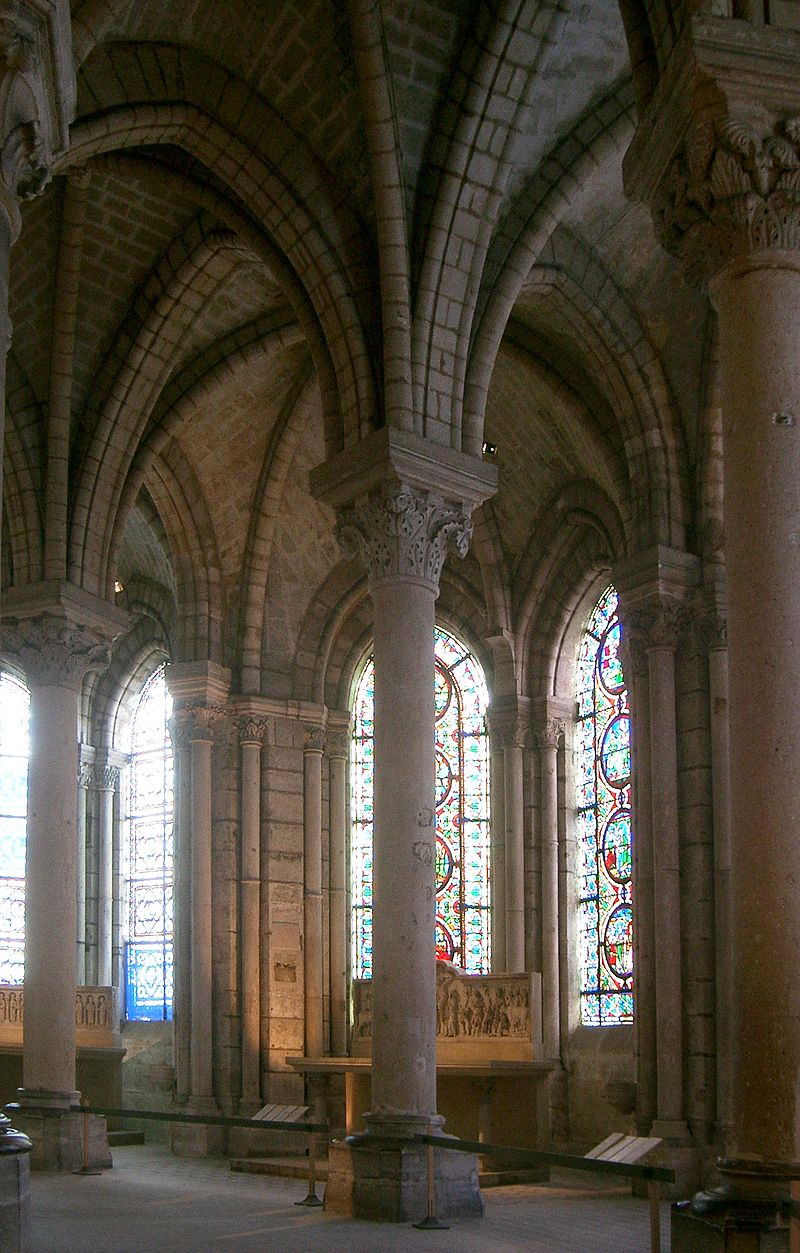
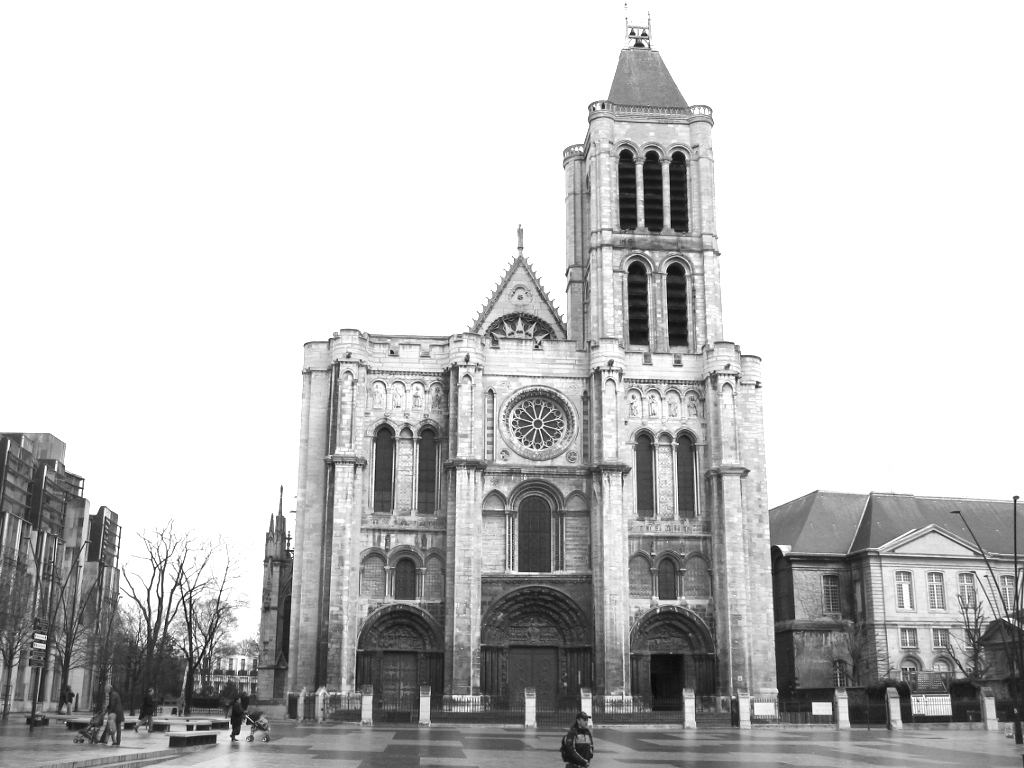
西暦12世紀初頭にシュジェ(Suger,
ca.1081-1151)修道院長が、サン・ドニ修道院の聖堂(Basilique de Saint-Denis)の建築様式(Gothic
architecture)に与えた言葉が「オープス・モデルヌム(opus modernum)」。
サン=ドニ修道院長シュジェールは,1137 年から 1147
年頃まで行われたサン=ドニ修道院付属聖堂の改築作業を指揮した修道院長。シュジェは
「代官として修道院の荘園の経営に携わったシュジェは、1122年に41歳でサン=ドニ修道院の院長となると、修道院の腐敗の一掃に取り組むととも
に、大規模な改修に着手した。1136年には最初のゴシック建築の聖堂であるとされるサン=ドニ大聖堂の建設を開始し、聖堂は1144年6月11日に献堂
された。……シュジェはまた、『ルイ6世伝』『ルイ7世伝』をはじめとする歴史書を著したが、これはフランスの王室による修史事業の発端であり、これ
らは中世フランス史の第1級の史料であると評価」がある:ウィキペディア)。
■エルヴィン・パノフスキー(Erwin Panofsky, 1892-1968)
| Erwin Panofsky (March
30, 1892 – March 14, 1968)[1] was a German-Jewish art historian whose
work represents a high point in the modern academic study of
iconography, including his hugely influential Renaissance and
Renascences in Western Art and his seminal Early Netherlandish
Painting.[2] Panofsky's ideas were highly influential in intellectual history in general,[3] particularly in his use of historical ideas to interpret artworks and vice versa. Many of his books are still in print, including Studies in Iconology: Humanist Themes in the Art of the Renaissance (1939), Meaning in the Visual Arts (1955), and his 1943 study The Life and Art of Albrecht Dürer. His academic career was pursued mostly in the U.S. after the rise of the Nazi regime. |
エ
ルヴィン・パノフスキー(1892年3月30日 -
1968年3月14日)[1]は、ドイツ系ユダヤ人の美術史家である。その業績は、図像学の近代的学術研究における頂点を示すもので、特に『西洋美術にお
けるルネサンスとルネサンス』や画期的な『初期ネーデルラント絵画』など、極めて影響力のある著作を残した。[2] パノフスキーの思想は、知的歴史全般において非常に影響力があった[3]。特に、歴史的概念を用いて芸術作品を解釈し、またその逆を行う手法が顕著であ る。彼の著作の多くは現在も刊行されており、『図像学研究:ルネサンス美術における人文主義的テーマ』(1939年)、『視覚芸術における意味』 (1955年)、1943年の研究書『アルブレヒト・デューラーの生涯と芸術』などが含まれる。ナチス政権の台頭後、彼の学術的活動は主にアメリカで展開 された。 |
| Early life in Germany Early life Panofsky was born on 30 March 1892 in Hanover.[4] His parents, Arnold and Caecilie (Solling) Panofsky, were a rentier mining family from Upper Silesia.[5] Panofsky's cultured Jewish family played a significant role in shaping his career as an art historian. He was immersed in an environment that valued education and cultural refinement from a young age, and was exposed to classical music and literature such as Dante's Divine Comedy, Shakespeare’s sonnets and the works of Johann Wolfgang von Goethe and Gotthold Ephraim Lessing. He did not observe Jewish religious customs as an adult, but he remained proud of his heritage, sharing stories of his grandfather, a renowned Talmud scholar.[6] |
ドイツでの幼少期 幼少期 パノフスキーは1892年3月30日、ハノーファーで生まれた。[4] 両親のアーノルドとツェーツィーリエ(旧姓ゾーリング)・パノフスキーは、上シレジア出身の鉱山所有者で、地代収入で生計を立てていた。[5] パノフスキーの教養あるユダヤ人家庭は、美術史家としての彼のキャリア形成に重要な役割を果たした。彼は幼い頃から教育と文化的教養を重んじる環境に浸 り、ダンテの『神曲』、シェイクスピアのソネット、ヨハン・ヴォルフガング・フォン・ゲーテやゴットホルト・エフライム・レッシングの作品といった古典音 楽や文学に触れた。成人後はユダヤ教の宗教的慣習を守らなかったが、著名なタルムード学者であった祖父の話を共有するなど、自らのルーツを誇りに思ってい た。[6] |
| College life He received his Abitur in 1910 at the Joachimsthal Gymnasium.[7] These years were particularly influential, as he believed the humanistic education he received there was fundamental to his scholarly achievements.[6] He entered Berlin University as a law student.[8] During his first semester, he attended a lecture by Wilhelm Vöge on Albrecht Dürer and discovered an interest in art history.[9] During his studies, he attended courses by the art historians Heinrich Wölfflin, Edmund Hildebrandt, Karl Voll, Carl Frey, Werner Weisbach and Adolph Goldschmidt.[10] When he was 19, he joined a competition held by the Grimm Foundation and won an award from it.[8] The subject had been set by Wölfflin and Goldschmidt, who assessed the work submitted. Panofsky's essay was entitled Dürer's Theory of Art, Primarily as it Relates to Italian Theory. A part of the paper was submitted as his doctoral dissertation at the University of Freiburg.[10] The dissertation was published in 1915 as Die theoretische Kunstlehre Albrecht Dürers (Dürer's Art Theory).[11] After a riding accident, Panofsky was exempted from military service during World War I. In the spring of 1917, he was considered fit for duty on the home front and was assigned government positions in Kassel and then Berlin, where he was responsible for distributing coal to civilians. He was demobilized in January 1919.[12] |
大学生活 彼は1910年にヨアヒムスタール・ギムナジウムでアビトゥアを取得した。[7] この時期は特に影響が深く、そこで受けた人文教育が自身の学術的業績の基盤となったと彼は考えていた。[6] 彼はベルリン大学に法学の学生として入学した。[8] 最初の学期に、ヴィルヘルム・フェーゲによるアルブレヒト・デューラーに関する講義を受講し、美術史への興味を見出した。[9] 在学中、彼は美術史家ハインリヒ・ヴェルフリン、エドムント・ヒルデブラント、カール・フォル、カール・フライ、ヴェルナー・ヴァイスバッハ、アドルフ・ ゴルドシュミットの講義を受講した。[10] 19歳の時、グリム財団主催のコンクールに参加し、同財団から賞を受賞した。[8] 課題はヴェルフリンとゴルドシュミットによって設定され、提出作品は両者によって審査された。パノフスキーの論文題目は『デューラーの芸術理論、主にイタ リア理論との関係において』であった。この論文の一部はフライブルク大学での博士論文として提出された[10]。博士論文は1915年に『アルブレヒト・ デューラーの芸術理論』として出版された。[11] 乗馬事故の後、パノフスキーは第一次世界大戦中の兵役を免除された。1917年春、彼は国内勤務に適格と認められ、カッセル、次いでベルリンで政府職に就 いた。ベルリンでは民間人への石炭配給を担当した。1919年1月に復員した。[12] |
| Teaching in German In December 1918, while working in Berlin, Panofsky applied for habilitation at the University of Heidelberg, proposing to submit either his 1915 expanded Dürers Kunsttheorie vornehmlich in ihrem Verhältnis zur Kunsttheorie der Italiener or Der Westbau des Doms zu Minden.[12][13] He withdrew the application in March 1919 due to unexplained circumstances. By August 1919, he shifted focus to the University of Tübingen but never finalized the thesis. Following Gustav Pauli's invitation in December 1919 to teach art history at the University of Hamburg, Panofsky agreed on the condition of simultaneously pursuing habilitation. By March 11, 1920, he formally submitted the completed first section of his study on Michelangelo’s stylistic development to the university’s Faculty of Philosophy and later, he will complete the second part at the end of the year. Pauli, reviewing the thesis by March 20, privately advised Panofsky to secure housing in Hamburg, anticipating a favorable outcome. Despite Panofsky’s concerns over a three-month administrative silence, the evaluation process advanced: Pauli submitted his endorsement to the habilitation committee on May 10, 1920, and by June 3, committee members Max Lenz, Ernst Cassirer and Otto Lauffer had unanimously approved the application. The Faculty of Philosophy ratified the decision on June 19, scheduling Panofsky's Probevorlesung [de] (″trial lecture″) for July 3, 1920. Titled Die Entwicklung der Proportionslehre als Abbild der Stilentwicklung,[14] the lecture successfully concluded his habilitation, granting him the venia legendi and securing his position at Hamburg.[12]During this period, one of his early works was Idea: Ein Beitrag zur Begriffsgeschichte der älteren Kunstheorie (1924; translated into English as Idea: A Concept in Art Theory),[15] based on the ideas of Ernst Cassirer.[16] However, shortly after his successful habilitation in July 1920, the manuscript vanished under unclear circumstances. Though on July 3, 1920, based on letter to Dora Panofsky, his wife at that time revealed plans to revise the text suggesting the work was still in his possession. Yet, by 1964, when Egon Verheyen inquired about the thesis after encountering its citation in an article by Gert van der Osten, Panofsky confirmed its loss, stating, “The original manuscript is lost”.[12] It is assumed that the manuscript was lost after he moved his remaining belongings from Germany in 1943/44. Gerda Panofsky was unable to locate it, possibly because Ludwig Heinrich Heydenreich, who had studied under Panofsky, was in possession of the manuscript from 1946 to 1970, and brought it to Zentralinstitut für Kunstgeschichte, where the manuscript was found in its basement.[17] In the Süddeutsche Zeitung, Willibald Sauerländer shed some light on the question of whether Heydenreich shared his recovery of the manuscript or not: "Panofsky has historically distanced himself from his early writings on Michelangelo, as he tired of the subject, and," according to Sauerländer "developed a professional conflict with Austro-Hungarian art historian Johannes Wilde, who accused Panofsky of not crediting him with ideas gleaned from a conversation they had about Michelangelo drawings. Perhaps Panofsky didn't care about the whereabouts of his lost work and Heydenreich was not malicious in keeping it a secret ... but questions still remain."[18] Then, the original 1920 manuscript of Panofsky's Habilitationsschrift, his second dissertation, which is titled Die Gestaltungsprinzipien Michelangelos, besonders in ihrem Verhältnis zu denen Raffaels ("The Composition Principles of Michelangelo, particularly in their relation to those of Raphael"), was found in August 2012 by art historian Stephan Klingen.[17][19] The manuscript is published as book on 2014 with Gerda as the editor.[20] |
ドイツ語での教育 1918年12月、ベルリンで勤務中、パノフスキーはハイデルベルク大学にハビリテーション申請を行った。提出論文として、1915年に拡張した『デュー ラーの芸術理論、特にイタリア人芸術理論との関係において』か『ミンデン大聖堂の西翼』のいずれかを提案した[12][13]。彼は1919年3月、説明 のない事情により申請を取り下げた。1919年8月までに、彼はチュービンゲン大学に焦点を移したが、論文は完成しなかった。1919年12月、グスタ フ・パウリからハンブルク大学で美術史を教えるよう招かれたパノフスキーは、ハビリテーションを同時に進める条件で承諾した。1920年3月11日まで に、ミケランジェロの様式的発展に関する研究の第1部を正式に同大学哲学部に提出し、第2部は年末までに完成させる予定だった。パウリは3月20日までに 論文を審査し、好結果を予期してパノフスキーにハンブルクでの住居確保を私的に助言した。パノフスキーが3ヶ月間の行政上の沈黙を懸念したにもかかわら ず、審査は進展した。パウリは1920年5月10日にハビリタツィオン委員会へ推薦書を提出し、6月3日までに委員のマックス・レンツ、エルンスト・カッ シラー、オットー・ラウファーが満場一致で申請を承認した。哲学学部は6月19日にこの決定を承認し、パノフスキーの試講 (Probevorlesung)を1920年7月3日に設定した。題名『比例論の発展としての様式発展の反映』(Die Entwicklung der Proportionslehre als Abbild der Stilentwicklung)[14]とされたこの講義は、彼のハビリタツィオンを成功裏に終結させ、教鞭許可(venia legendi)を授与するとともにハンブルクでの地位を確固たるものとした。[12]この時期に彼が執筆した初期著作の一つが『イデア:古代美術理論の 概念史への一考察』(1924年、英訳題『Idea: A Concept in Art Theory』)[15]であり、これはエルンスト・カッシラーの思想に基づいていた[16]。 しかし1920年7月のハビリタツィオン成功直後、原稿は不明な状況下で消失した。1920年7月3日付のドーラ・パノフスキー宛ての手紙によれば、当時 の妻は原稿を所持していることを示唆する改訂計画を明かしていた。しかし1964年、エゴン・フェルヘイエンがゲルト・ファン・デル・オーステンの論文で 引用された本論文について問い合わせた際、パノフスキーは「原稿は紛失した」と確認している。[12] 原稿は1943/44年にドイツから残存財産を移送した後に紛失したと推測される。ゲルダ・パノフスキーは原稿を発見できなかったが、これはパノフスキー の教え子であったルートヴィヒ・ハインリヒ・ハイデンライヒが1946年から1970年まで原稿を所持し、中央美術史研究所 (Zentralinstitut für Kunstgeschichte)に持ち込んだためである。同研究所の地下室で原稿は発見された。[17] 『南ドイツ新聞』において、ヴィリバルト・ザウアーレンダーは、ハイデンライヒが原稿発見の事実を共有したかどうかについて、次のように述べている: 「パノフスキーはミケランジェロに関する初期の著作から歴史的に距離を置いていた。彼はこの主題に飽きていたのだ」とザウアーレンダーは述べ、「オースト リア=ハンガリー帝国の美術史家ヨハネス・ヴィルデとの専門的な対立が生じた。ヴィルデはパノフスキーが、ミケランジェロの素描について交わした会話から 得たアイデアを自分に帰属させていないと非難したのだ」と続けた。 |
| Teaching in United States Period before permanently moved to United States Panofsky has already expressed interest in visiting America as early as 1929 on his correspondence with Fritz Saxl, and in 1930, he was invited by New York University (NYU) to serve as a Visiting Professor by recommendation from Goldschmidt . At that time, NYU's College of Fine Arts, which would later become the Institute of Fine Arts, was in the process of establishing America's first graduate department for art-historical research. By his participation, he helped Richard Offner and Walter William Spencer Cook to shape the department. Then, Panofsky was scheduled to teach during the Fall term of 1931-32, offering graduate-level courses along with a series of public lectures, all delivered in English.[21] During this first visit, Panofsky immersed himself in the scholarly environment of the East Coast, strengthening and expanding his American connections. He reconnected with Paul Sachs at Harvard delivering a lecture at the Fogg Museum. Panofsky had previously met Sachs in 1927 when Sachs visited Hamburg to inspect Aby Warburg’s Institute. He also visited Charles Rufus Morey, Alfred Barr, William J. Ivins and was introduced by Edward Warburg to a wealthy New York elite. Panofsky usually gave lectures at weekly salons hosted by Josephine Porter Boardman Crane which acquainted him with prominent figures such as the Rockefellers and the Straus family of Macy’s Department Store. This network will be beneficial when he later lost his position in Hamburg. [21] Following the success of his initial visit, Panofsky was considered for a return to the College of Fine Arts at NYU the following year. He managed to secure two additional twelve-week lecture courses for the spring of 1933 at the Metropolitan Museum of Art. Upon his return to America, Panofsky worked as an itinerant art historian, delivering lectures across the East Coast. With Adolf Hitler's appointment as Chancellor shortly after his arrival in New York, Panofsky expressed to Margaret Scolari Barr his relief at being in America, rather than witnessing the unfolding political crisis in Germany.[22] Although initially allowed to spend alternate terms in Hamburg and New York City, Panofsky’s appointment in Hamburg was terminated in 1933 after the Nazis came to power.[23] This dismissal was due to his Jewish background.[24] Panofsky faced limited employment opportunities outside of Germany, and the College of Fine Arts, due to a lack of funds, had not planned to invite him back after his spring lectureship. Cook could only offer Panofsky a single lecture course for the following year. With no immediate job prospects in America, Panofsky returned to his family in Hamburg, where conditions remained relatively safe at the time. Without teaching duties, he concentrated on his research and traveled to Belgium and France, including a visit to Henri Focillon, to explore future employment possibilities. Panofsky returned to New York in January 1934 to fulfill a temporary commitment to Cook and NYU, while Dora and their two young sons stayed in Hamburg.[25] Overwhelmed by his teaching and administrative duties at NYU, Panofsky lamented the lack of time for his own research and the prioritization of monetary concerns over scholarly pursuits. He expressed frustration to Margaret Barr about his extensive workload, including organizing syllabi, correcting test papers, and conducting numerous lectures and consultations. Although he appreciated Walter Cook's efforts in securing his position, he was critical of Cook's scholarly status and uncomfortable relying on financial support from New York's high society. Panofsky's dissatisfaction was further highlighted in a letter to Gertrud Bing, where he criticized the use of his seminar for NYU's publicity without his consent. Panofsky's first choice after 1933 was not to settle in America but to secure a position with the Warburg Library in London, which was central to his humanistic scholarship. Despite his efforts, those involved with the Library decided to help more disadvantaged exiled scholars.[26] His early visits were financially motivated, as his NYU salary sustained his family’s rent in Hamburg—a fact he disclosed to Walter Friedländer. In a letter to Margaret Barr, he criticized American life as culturally “sterile” and critiqued U.S. academia: while he praised some Princeton graduate students, he derided NYU students as “stupid and ignorant.” During his 1934 return to NYU, his lectures were simplified for a paying public audience, leaving him feeling like a “workhorse.”[27] NYU and Princeton University collaborated to provide him with paid work for two years. Cook secure a two-year Visiting Professorship for Panofsky at NYU in the fall of 1934 with a salary of $6000, while Morey arranged housing and schooling for Panofsky's family in Princeton in exchange for his teaching in the Department of Art and Archaeology. By this point, Panofsky had resolved never to return to Germany and was committed to establishing a permanent life in the United States.[28]He finally secured a permanent position at the Institute for Advanced Study (IAS) in April 1935. The IAS, founded by Abraham Flexner in 1930, was unique in its mission to emphasize research and advanced teaching without the burden of administrative duties or introductory teaching responsibilities, which aligned with Panofsky's needs. Panofsky was recommended for a faculty position by Morey. Flexner offered Panofsky a generous salary of $10,000, allowing him to continue his collaboration with Morey at Princeton and utilize Morey's established Index of Christian Art.[29] During his stay in America, he became part of the Kahler-Kreis which consisted of Erich Kahler acquaintances,[30] American Academy of Arts and Sciences,[31] the American Philosophical Society,[32] the British Academy. In 1936 he was awarded his first Honorary Doctorate, by Utrecht University in the Netherlands, which was facilitated by his friendship with the Utrecht professor Willem Vogelsang.[citation needed] In 1954 he became foreign member of the Royal Netherlands Academy of Arts and Sciences.[33] In 1962 he received the Haskins Medal of The Medieval Academy of America. In 1947–1948 Panofsky was the Charles Eliot Norton professor at Harvard University; the lectures later became Early Netherlandish Painting. He became particularly well known for his studies of symbols and iconography in art. First in a 1934 article, then in his Early Netherlandish Painting (1953), Panofsky was the first to interpret Jan van Eyck's Arnolfini Portrait (1934) as not only a depiction of a wedding ceremony, but also a visual contract testifying to the act of marriage. Panofsky identifies a plethora of hidden symbols that all point to the sacrament of marriage. In recent years, this conclusion has been challenged, but Panofsky's work with what he called "hidden" or "disguised" symbolism is still very much influential in the study and understanding of Northern Renaissance art. Similarly, in his monograph on Dürer, Panofsky gives lengthy "symbolic" analyses of the prints Knight, Death, and the Devil and Melencolia I, the former based on Erasmus's Handbook of a Christian Knight. Panofsky was known to be a friend with physicists Wolfgang Pauli and Albert Einstein. His younger son, Wolfgang K. H. Panofsky, became a renowned physicist who specialized in particle accelerators. His elder son, Hans A. Panofsky, was "an atmospheric scientist who taught at Pennsylvania State University for 30 years and who was credited with several advances in the study of meteorology".[34] As Wolfgang Panofsky related, his father used to call his sons "meine beiden Klempner" ("my two plumbers"). William S. Heckscher was a student, fellow emigre, and close friend. In 1973 he was succeeded at Princeton by Irving Lavin. Erwin Panofsky has been recognized as both a "highly distinguished" professor at the Institute for Advanced Study, Princeton, New Jersey, and in Jeffrey Chipps' biography of the subject as "the most influential art historian of the twentieth century".[35] In 1999, the new "Panofsky Lane", in that Institute's faculty housing complex, was named in his honor.[36] |
アメリカでの教職 アメリカへの永住移住前の時期 パノフスキーは1929年、フリッツ・ザクスルとの書簡で早くもアメリカ訪問への関心を示しており、1930年にはゴールドシュミットの推薦によりニュー ヨーク大学(NYU)から客員教授として招かれた。当時、後に美術研究所となるNYU美術学部は、アメリカ初の美術史研究大学院課程を設立する過程にあっ た。パノフスキーの参加により、リチャード・オフナーとウォルター・ウィリアム・スペンサー・クックは同学科の基盤整備を進めた。その後パノフスキーは 1931-32年秋学期に教鞭を執る予定で、大学院レベル講座と一般向け公開講義シリーズを英語で担当した[21]。 この初訪問でパノフスキーは東海岸の学術環境に没頭し、アメリカでの人脈を強化・拡大した。ハーバード大学フォッグ美術館での講演でポール・ザックスと再 会している。パノフスキーは1927年、アビー・ヴァールブルク研究所視察のためハンブルクを訪れたザックスと既に面識があった。またチャールズ・ルー ファス・モリー、アルフレッド・バー、ウィリアム・J・アイヴィンスを訪問し、エドワード・ヴァールブルクを通じてニューヨークの富裕層エリートにも紹介 された。パノフスキーは通常、ジョセフィン・ポーター・ボードマン・クレインが主催する週例サロンで講演を行い、そこでロックフェラー家やメイシーズ百貨 店のストラウス家といった著名人と知り合った。この人脈は、後にハンブルクでの職を失った際に役立つことになる。[21] 初訪問の成功を受けて、パノフスキーは翌年ニューヨーク大学美術学部への復帰が検討された。彼は1933年春、メトロポリタン美術館でさらに2つの12週 間講義コースを確保することに成功した。アメリカ帰国後、パノフスキーは巡回美術史家として東海岸各地で講演を行った。ニューヨーク到着直後にアドルフ・ ヒトラーが首相に任命されると、パノフスキーはマーガレット・スコラリ・バーに対し、ドイツで政治危機が進行するのを目撃せずにアメリカにいられる安堵を 表明した。[22] 当初はハンブルクとニューヨークを交互に過ごすことが認められていたが、ナチス政権発足後の1933年、パノフスキーのハンブルクでの職は解雇された [23]。この解雇は彼のユダヤ人としての出自が原因であった[24]。パノフスキーはドイツ国外での就職機会が限られており、美術大学も資金不足のた め、春の講義終了後の再招聘を計画していなかった。クックは翌年度、パノフスキーに単発講義コースしか提供できなかった。アメリカでの就職の見通しが立た なかったため、パノフスキーは当時比較的安全だったハンブルクの家族のもとへ戻った。教職から解放された彼は研究に専念し、ベルギーやフランスへ渡り、ア ンリ・フォシヨンを訪ねるなどして将来の就職先を探った。パノフスキーは1934年1月、クックとNYUへの一時的な約束を果たすためニューヨークに戻っ た。一方、ドーラと二人の幼い息子はハンブルクに残った。[25] NYUでの教育と管理業務に圧倒されたパノフスキーは、自身の研究に割く時間の不足と、学術的追求よりも金銭的懸念が優先される現状を嘆いた。彼はマーガ レット・バーに対し、シラバスの作成、試験問題の添削、数多くの講義や相談対応など膨大な業務量への不満を吐露した。ウォルター・クックが自身の職を得た 努力には感謝しつつも、クックの学問的地位には批判的であり、ニューヨーク上流社会からの経済的支援に依存することに違和感を抱いていた。パノフスキーの 不満はゲルトルート・ビング宛ての手紙でさらに顕著になった。彼は自身の許可なくNYUの宣伝に自身のセミナーが利用されたことを批判したのである。 1933年以降のパノフスキーの第一希望はアメリカに定住することではなく、彼の人文主義的学問の中核をなすロンドン・ウォーバーグ図書館での職を得るこ とだった。彼の努力にもかかわらず、図書館関係者はより不利な立場の亡命学者たちを助けることを決めた。[26] 初期の渡米は経済的動機によるもので、NYUの給与がハンブルクでの家族の家賃を支えていた——この事実を彼はウォルター・フリードレンダーに明かしてい る。マーガレット・バーへの書簡では、アメリカの生活を文化的に「不毛」と批判し、米国学界を糾弾した。プリンストン大学の大学院生を称賛する一方で、 NYUの学生を「愚かで無知」と嘲笑したのである。1934年にNYUに戻った際、彼の講義は有料の一般聴衆向けに簡略化され、彼は「働き馬」のように感 じた[27]。NYUとプリンストン大学は協力し、彼に2年間の有給職を提供した。クックは1934年秋、パノフスキーにNYUでの2年間の客員教授職 (年俸6000ドル)を確保した。一方モレイは、パノフスキーが美術考古学部で教鞭をとる見返りとして、プリンストンでの家族向け住居と教育を手配した。 この時点でパノフスキーはドイツへの帰国を決して望まず、米国での永住を固く決意していた。[28]彼はついに1935年4月、高等研究所(IAS)での 常勤職を獲得した。1930年にアブラハム・フレクナーが設立したIASは、管理業務や初等教育の負担なく研究と高度な教育を重視するという使命において 特異であり、パノフスキーの必要性に合致していた。パノフスキーはモレイの推薦で教員職を得た。フレクナーは年俸1万ドルという高給を提示し、これにより パノフスキーはプリンストン大学でモレイとの共同研究を継続し、モレイが構築した『キリスト教美術索引』を活用することが可能となった。[29] アメリカ滞在中、彼はエーリッヒ・カーラーの知人らで構成されるカーラー・クライス[30]、アメリカ芸術科学アカデミー[31]、アメリカ哲学会 [32]、英国学士院の活動に参加した。1936年にはオランダのユトレヒト大学から初の名誉博士号を授与された。これはユトレヒト大学のウィレム・フォ ゲルサング教授との親交が契機となった。[出典必要] 1954年にはオランダ王立芸術科学アカデミーの外国人会員となった[33]。1962年にはアメリカ中世学会のハスキンズ・メダルを受賞した。1947 年から1948年にかけて、パノフスキーはハーバード大学のチャールズ・エリオット・ノートン教授を務め、その講義は後に『初期ネーデルラント絵画』とし て出版された。 彼は特に美術における象徴と図像学の研究で広く知られるようになった。1934年の論文で初めて、そして1953年の『初期ネーデルラント絵画』におい て、パノフスキーはヤン・ファン・エイクの『アルノルフィーニの肖像』(1934年)を単なる結婚式の描写ではなく、婚姻行為を証明する視覚的契約として 解釈した最初の人物である。パノフスキーは結婚の秘跡を指し示す数多くの隠された象徴を特定した。近年この結論は疑問視されているが、彼が「隠された」あ るいは「偽装された」象徴主義と呼んだ手法は、北欧ルネサンス美術の研究と理解において今なお非常に影響力を持っている。同様に、デューラーに関する単行 本において、パノフスキーは版画『騎士、死、悪魔』と『メランコリアI』について長大な「象徴的」分析を行っている。前者はエラスムスの『キリスト教騎士 の手引書』に基づいている。 パノフスキーは物理学者ヴォルフガング・パウリやアルバート・アインシュタインと親交があったことで知られている。彼の次男ヴォルフガング・K・H・パノ フスキーは粒子加速器を専門とする著名な物理学者となった。長男ハンス・A・パノフスキーは「ペンシルベニア州立大学で30年間教鞭を執った大気科学者で あり、気象学研究における数々の進歩に貢献したと評価されている」。[34] ヴォルフガング・パノフスキーが語ったところでは、父は息子たちを「マイネ・バイデン・クレンプナー(私の二人の配管工)」と呼んでいた。ウィリアム・ S・ヘックスチャーは弟子であり、同じ亡命者であり、親しい友人であった。1973年、プリンストン大学の後任にはアーヴィング・ラヴィンが就任した。 アーウィン・パノフスキーは、ニュージャージー州プリンストンにある高等研究所において「極めて著名な」教授として、またジェフリー・チップスによる伝記 では「20世紀で最も影響力のある美術史家」として認められている。[35] 1999年、同研究所の教員住宅団地に新設された「パノフスキー・レーン」は、彼の名誉を称えて命名された。[36] |
| Iconology Panofsky was the most eminent representative of iconology, a method of studying the history of art created by Aby Warburg and his disciples at the Warburg Institute in Hamburg. There, a personal and professional friendship linked him to Fritz Saxl in collaboration with whom he produced a large part of his work. Panofsky made important contributions to the study of iconography and iconology, including his interpretation of Jan van Eyck's Arnolfini Portrait (1434). Three strata of subject matter or meaning In his book Studies in Iconology, first published in 1939, he details his idea of three levels of art-historical understanding:[37] Primary or natural subject matter: The most basic level of understanding, this stratum consists of perception of the work's pure form. Take, for example, a painting of the Last Supper. If we stopped at this first stratum, such a picture could only be perceived as a painting of 13 men seated at a table. This first level is the most basic understanding of a work, devoid of any added cultural knowledge. Secondary or conventional subject matter (iconography): This stratum goes a step further and brings to the comparison of cultural and iconographic knowledge. For example, a Western viewer would understand that the painting of 13 men around a table would represent the Last Supper. Similarly, a representation of a haloed man with a lion could be interpreted as a depiction of St. Mark. Tertiary or intrinsic meaning or content (iconology): This level takes into account personal, technical, and cultural history into the understanding of a work. It looks at art not as an isolated incident, but as the product of an historical environment. Working in this stratum, the art historian can ask questions like "why did the artist choose to represent The Last Supper in this way?" or "Why was St. Mark such an important saint to the patron of this work?" Essentially, this last stratum is a synthesis; it is the art historian asking "what does it all mean?" For Panofsky, it was important to consider all three strata as one examines Renaissance art. Irving Lavin says "it was this insistence on, and search for, meaning — especially in places where no one suspected there was any — that led Panofsky to understand art, as no previous historian had, as an intellectual endeavor on a par with the traditional liberal arts."[38] The method of iconology, which had developed following Erwin Panofsky, has been critically discussed since the mid-1950s, in part also strongly (Otto Pächt, Svetlana Alpers). However, among the critics, no one has found a model of interpretation that could completely replace that of Panofsky.[39] As regards the interpretation of Christian art, that Panofsky researched throughout his life, the iconographic interest in texts as possible sources remains important, because the meaning of Christian images and architecture is closely linked to the content of biblical, liturgical and theological texts, which were usually considered authoritative by most patrons, artists and viewers.[40] Style and the Film Medium In his 1936 essay "Style and Medium in the Motion Pictures",[41] republished by Lavin in 1995 (Three Essays on Style), Panofsky seeks to describe the visual symptoms endemic" to the medium of film.[42] |
図像学 パノフスキーは図像学の最も著名な代表者であった。図像学とは、アビー・ヴァールブルクとその弟子たちがハンブルクのヴァールブルク研究所で創始した美術 史研究の方法である。同研究所において、パノフスキーはフリッツ・ザクスルと個人的かつ職業的な友情で結ばれ、共同で研究を進め、その業績の大半を生み出 した。  パノフスキーは、ヤン・ファン・エイクの『アルノルフィーニの肖像』(1434年)の解釈を含め、図像学と図像論の研究に重要な貢献をした。 主題または意味の三つの層 1939年に初版が刊行された著書『図像論研究』において、彼は美術史的理解の三つのレベルに関する自身の考えを詳述している: [37] 一次的または自然主題:最も基礎的な理解層であり、作品の純粋な形態の知覚から成る。例えば『最後の晩餐』の絵画を考えよう。この第一層で止まれば、その 絵は単に食卓を囲む13人の男たちの絵画としてしか認識されない。この第一層は文化的知識を一切加味しない、作品に対する最も基礎的な理解である。 二次的または慣習的な主題(図像学):この層では一歩進んで、文化的・図像学的知識の比較が行われる。例えば西洋の鑑賞者は、食卓を囲む13人の男たちの 絵が「最後の晩餐」を表していると理解する。同様に、光輪を戴いた男と獅子の描写は聖マルコの表現と解釈されうる。 第三層:内在の意味・内容(図像学):この層では、作品の理解に個人的・技術的・文化的背景を考慮する。芸術を孤立した事象ではなく、歴史的環境の産物と して捉えるのだ。この層で活動する美術史家は、「なぜ芸術家は最後の晩餐をこの方法で表現したのか?」や「なぜこの作品の依頼主にとって聖マルコがそれほ ど重要な聖人だったのか?」といった問いを投げかける。本質的に、この最上層は統合であり、美術史家が「全体として何を意味するのか?」と問う段階であ る。 パノフスキーにとって、ルネサンス美術を考察する際にはこれら三つの層を全て考慮することが重要であった。アーヴィング・ラヴィンは「特に誰も意味の存在 を疑わなかった領域において、意味への執着と探求こそが、パノフスキーを従来の歴史家とは異なり、美術を伝統的な教養学問と同等の知的営みとして理解する に至らせた」と述べている[38]。 エルヴィン・パノフスキーに続いて発展した図像学の方法論は、1950年代半ば以降、批判的に議論されてきた。その批判は時に激しいものもあった(オッ トー・ペヒト、スヴェトラーナ・アルパーズ)。しかし、批判者たちの間でも、パノフスキーの解釈モデルを完全に置き換え得る新たな解釈モデルを見出した者 はいない。[39] パノフスキーが生涯をかけて研究したキリスト教美術の解釈に関しては、テキストを潜在的な情報源として捉える図像学的関心は依然として重要である。なぜな らキリスト教美術や建築の意味は、聖書・典礼・神学のテキストの内容と密接に結びついており、それらのテキストは通常、ほとんどのパトロン・芸術家・鑑賞 者によって権威あるものと見なされていたからだ。[40] 様式と映画媒体 1936年の論文「映画における様式と媒体」[41](ラヴィンにより1995年に再刊『様式に関する三つの論文』所収)において、パノフスキーは映画媒 体に固有の視覚的症状を記述しようとしている。[42] |
| Legacy In 2016, the Zentralinstitut für Kunstgeschichte (Central Institute for Art History) in Munich founded the "Panofsky-Professur" (Panofsky Professorship). The first professors have been Victor Stoichita (2016), Gauvin Alexander Bailey (2017), Caroline van Eck (2018), and Olivier Bonfait (2019).[43] His work has greatly influenced the theory of taste developed by French sociologist Pierre Bourdieu, in books such as The Rules of Art and Distinction. In particular, Bourdieu first adapted his notion of habitus from Panofsky's Gothic Architecture and Scholasticism,[3][44] having earlier translated the work into French. |
遺産 2016年、ミュンヘンのZentralinstitut für Kunstgeschichte(中央美術史研究所)は「Panofsky-Professur」(パノフスキー教授職)を設立した。最初の教授は、ヴィ クトル・ストイチタ(2016年)、ゴーヴァン・アレクサンダー・ベイリー(2017年)、キャロライン・ヴァン・エック(2018年)、オリヴィエ・ボ ンフェ(2019年)である。[43] 彼の研究は、フランスの社会学者ピエール・ブルデューが『芸術の法則』や『区別』などの著書で展開した趣味の理論に大きな影響を与えた。特に、ブルデュー は、パノフスキーの『ゴシック建築とスコラ哲学』からハビトゥスの概念を初めて採用した[3][44]。彼は以前、この著作をフランス語に翻訳していた。 |
| Works A first comprehensive bibliography on the writings of Erwin Panofsky was published in the Festschrift edited by Millard Meiss in 1961.[45] Almost all texts are accessible online, see references. Idea: A Concept in Art Theory (1924)[46] Perspective as Symbolic Form (1927).[47] Lectures held at the Warburg Institute in Hamburg, 1924–25. Studies in Iconology (1939)[48] The Life and Art of Albrecht Dürer (1943)[49] Abbot Suger on the Abbey Church of St.-Denis and Its Art Treasures, edited, translated, and annotated by Erwin Panofsky (1946).[50] Based on the Norman Wait Harris lectures delivered at Northwestern University in 1938. Updated 2nd edition by Gerda Panofsky-Soergel (1979)[51] Gothic Architecture and Scholasticism (1951)[52] Early Netherlandish Painting: Its Origins and Character (1953).[53] Based on the 1947–48 Charles Eliot Norton Lectures. Meaning in the Visual Arts. Papers in and on Art History (1955)[54] Pandora's Box: the Changing Aspects of a Mythical Symbol (1956), with Dora Panofsky[55] Renaissance and Renascences in Western Art (1960)[56] Tomb Sculpture: Its Changing Aspects from Ancient Egypt to Bernini (1964), with H. W. Janson[57] Saturn and Melancholy: Studies in the History of Natural Philosophy, Religion, and Art (1964), with Raymond Klibansky and Fritz Saxl[58] Problems in Titian, Mostly Iconographic (1969)[59] The Wrightsman Lectures of the New York University Institute of Fine Arts delivered at the Metropolitan Museum of Art. Posthumous Three Essays on Style (1995):[60] "What Is Baroque?" (prev. unpubl.), "Style and Medium in the Motion Pictures" (1936, as "On Movies", rev. in 1947), "The Ideological Antecedents of the Rolls-Royce Radiator" (1963). Edited and introduced by Irving Lavin, with a memoir by William S. Heckscher. "The Mouse That Michelangelo Failed to Carve" (1964)[61] "Carmina Latina" (2018), edited with introduction and short annotations by Gereon Becht-Jördens[62] |
著作 エルヴィン・パノフスキーの著作に関する最初の包括的な書誌は、1961年にミラード・マイスが編集した記念論文集で発表された。[45] ほぼ全てのテキストはオンラインで閲覧可能である。参考文献を参照のこと。 『観念:美術理論における概念』(1924年) [46] 象徴形式としての遠近法(1927年)。[47] 1924年から1925年にかけて、ハンブルクのウォーバーグ研究所で行われた講義。 図像学の研究(1939年)[48] アルブレヒト・デューラーの生涯と芸術(1943年) [49] 『サン・ドニ修道院教会とその美術品について、シュジェ修道院長』アーウィン・パノフスキー編集、翻訳、注釈(1946年)。[50] 1938年にノースウェスタン大学で行われたノーマン・ウェイト・ハリスの講義に基づく。 ゲルダ・パノフスキー・ゼルゲルによる第2版更新(1979年) [51] ゴシック建築とスコラ哲学(1951年)[52] 初期ネーデルラント絵画:その起源と特徴(1953年)。[53] 1947年から1948年にかけてのチャールズ・エリオット・ノートン講義に基づく。 視覚芸術における意味。美術史に関する論文(1955年)[54] パンドラの箱:神話的象徴の変遷(1956年)、ドーラ・パノフスキーとの共著[55] 西洋美術におけるルネサンスと再生(1960年)[56] 墓碑彫刻:古代エジプトからベルニーニまでの変遷(1964年)、H・W・ヤンソンとの共著[57] 『サターンと憂鬱:自然哲学・宗教・美術史の研究』(1964年)、レイモンド・クリバンスキー、フリッツ・ザクスと共著[58] 『ティツィアーノに関する諸問題、主に図像学的な観点から』(1969年)[59]ニューヨーク大学美術研究所ライトマン記念講演(メトロポリタン美術館 にて発表) 死後刊行 『様式に関する三つの論考』(1995年)[60]:「バロックとは何か?」(未発表原稿)、「映画における様式と媒体」(1936年「映画について」と して発表、1947年改訂)、「ロールスロイス・ラジエーターのイデオロギー的先駆者たち」 (1963年)。アーヴィング・ラヴィンによる編集・序文、ウィリアム・S・ヘックスチャーによる追悼文付き。 「ミケランジェロが彫刻に失敗したネズミ」(1964年)[61] 「カルミナ・ラティーナ」(2018年)、ゲレオン・ベヒト=ヨルデンスによる編集・序文・短注釈付き[62] |
| References Notes 01. "Erwin Panofsky – Dictionary of Art Historians". arthistorians.info. Archived from the original on March 3, 2020. Retrieved March 25, 2016. Shone, Richard and Stonard, John-Paul, eds. The Books That Shaped Art History, chapter 7. London: Thames & Hudson, 2013. Chartier, Roger. Cultural History, pp. 23–24 (from Intellectual History and the History of ″Mentalités″). Ithaca: Cornell University Press, 1988 Gombrich, Ernst H. (1968). "Erwin Panofsky (30th March 1892–14th March 1968)". The Burlington Magazine. 110 (783): 356–360. ISSN 0007-6287. JSTOR 875619. Wakeman, John (1980). "Erwin Panofsky". World Authors, 1970–1975. New York: H. W. Wilson. p. 626. ISBN 978-0-8242-0641-3. Keenan, Daniel (2014). Kultur and Acculturation: Erwin Panofsky in the United States of America (PDF). University of Glasgow. p. 30. Kraus, Elisabeth (1999). Die Familie Mosse: deutsch-jüdisches Bürgertum im 19. und 20. Jahrhundert (in German). C. H. Beck. p. 553. ISBN 978-3-406-44694-8. Waal, Henri van de (1972). In Memoriam Erwin Panofsky: March 30, 1892 – March 14, 1968 (PDF) (in Dutch). Noord-Hollandsche Uitgevers Maatschappij. 10. Landauer, Carl Hollis (1984). The Survival of Antiquity: The German Years of the Warburg Institute (dissertation). Yale University. p. 229. Panofsky, Erwin (2020). Michelangelo's Design Principles, Particularly in Relation to Those of Raphael. Princeton University Press. pp. XLIII–XLLIVI. ISBN 978-0-691-16526-4. Freedberg, David; Wedepohl, Claudia (April 1, 2024). Aby Warburg 150: Work, Legacy, Promise. Walter de Gruyter. p. 260. ISBN 978-3-11-072577-3. Nitschke-Joseph, Uta (June 11, 2013). "A Fortuitous Discovery – An Early Manuscript by Erwin Panofsky Reappears in Munich". Princeton: Institute for Advanced Study. Retrieved January 18, 2025. Panofsky, Erwin (2018) [1920 (Reprint 1968)], Koetschau, Karl (ed.), "Der Westbau des Doms zu Minden", Repertorium für Kunstwissenschaft (in German), vol. 42, Berlin/Leipzig: De Gruyter, pp. 51–77, ISBN 978-3-11-144242-6, retrieved January 23, 2025 Panofsky, Erwin (1921). "Die Entwicklung der Proportionslehre als Abbild der Stilentwicklung". Monatshefte für Kunstwissenschaft. 14 (2): 188–219. ISSN 0863-5811. JSTOR 24496352. Panofsky, Erwin (1924). Idea: ein Beitrag zur Begriffsgeschichte der älteren Kunsttheorie (PDF) (in German). Teubner. Diebitz, Stefan (January 8, 2009). "Ernst Cassirer: Eidos und Eidolon. Das Problem des Schönen und der Kunst in Platons Dialogen. Erwin Panofsky: Idea. Ein Beitrag zur Begriffsgeschichte der älteren Kunsttheorie. Hrsg. und mit einem Nachwort von John Michael Krois. Philo-Fine-Arts" (Review). Portal Kunstgeschichte (in German). Retrieved February 9, 2025. Voss, Julia (August 31, 2012). "Sensationelle Entdeckung in München: Der Fund im Panzerschrank". FAZ.NET (in German). Archived from the original on November 23, 2012. Retrieved January 31, 2025. "International News Digest". Artforum. September 26, 2012. Archived from the original on November 30, 2012. Retrieved January 26, 2025. "Entdecker der Panofsky-Schrift im Gespräch: "Die jüngsten Funde haben unser Wissen bereichert"" (in German). Frankfurter Allgemeine Zeitung. August 31, 2012. Retrieved January 27, 2025. 20. Panofsky, Erwin (2014). Panofsky, Gerda (ed.). Die Gestaltungsprincipien Michelangelos, besonders in ihrem Verhältnis zu denen Raffaels: Aus dem Nachlass (in German). De Gruyter. doi:10.1515/9783110310474. ISBN 978-3-11-031047-4. Keenan 2014, p. 50. Keenan 2014, p. 52-53. A Commemorative Gathering for Erwin Panofsky at the Institute of Fine Arts New York University... New York university Institute of fine arts. 1968. p. 5. Keenan 2014, p. 2. Keenan 2014, p. 53-54. Keenan 2014, p. 56-58. Keenan 2014, p. 54-55. Keenan 2014, p. 58-60. Keenan 2014, p. 62-65. 30. Furlan, Stefano (2024). "The Smile of Mnemosyne: John Wheeler between the History of Science and Arts". Scientia. Rivista della Società Italiana di Storia della Scienza: 41. doi:10.61010/2974-9433-202301-004. "Erwin Panofsky". American Academy of Arts & Sciences. February 9, 2023. Retrieved April 14, 2023. "APS Member History". search.amphilsoc.org. Retrieved April 14, 2023. "Erwin Panofsky (1892–1968)". Royal Netherlands Academy of Arts and Sciences. Archived from the original on March 3, 2020. Retrieved July 26, 2015. "Hans A. Panofsky, 70, Scientist". New York Times. March 11, 1988. Retrieved January 25, 2017. Jeffrey Chipps Smith, Introduction in Erwin Panofsky "The Life and Art of Albrecht Durer", Princeton University Press, Princeton, 2005, p.XXVII) "Streets at the Institute". Institute for Advanced Study. Retrieved January 25, 2017. Panofsky, Erwin. Studies in Iconology: Humanistic Themes in the Art of the Renaissance. New York: Harper & Row, 1972. pp. 5–9. Lavin, Irving. "Panofsky's History of Art" in Meaning in the Visual Arts: Views from the Outside. Princeton: Institute for Advanced Study, 1995. p. 6. Dieter Wuttke (2017). "Erwin Panofsky (1892–1968)". In: Colum Hourihane (ed.). The Routledge Companion to Medieval Iconography, London/New York: Routledge, pp. 105–122, here p. 119. 40. Ralf van Bühren, and Maciej Jan Jasiński (2024). The invisible divine in the history of art. Is Erwin Panofsky (1892–1968) still relevant for decoding Christian iconography?, in Church, Communication and Culture 9, pp. 1-36, here pp. 1-4, 9, 23, 28. "Style and Medium in the Motion Pictures" online (PDF) on Monoskop.org, or doi:10.5040/9781628928983.CH-004. Lavin, Irving (1995). Introduction. Three Essays on Style. By Panofsky, Erwin. Irving Lavin (ed.). Cambridge, Massachusetts: The MIT Press. p. 3. ISBN 978-0262661034. "Panofsky Lecture — Zentralinstitut für Kunstgeschichte". Review Archived April 9, 2009, at the Wayback Machine of Holsinger, The Premodern Condition, in Bryn Mawr Review of Comparative Literature 6:1 (Winter 2007). Meiss, Millard, ed. (1961). Essays in Honor of Erwin Panofsky. De artibus opuscula. Vol. XL.I (of 2). New York University Press. pp. XIII–XXI. Panofsky, Erwin (1968). Idea: A Concept in Art Theory. Harper & Row. ISBN 9780064300490. Panofsky, Erwin (1991). Perspective as Symbolic Form (PDF). Translated by Christopher S. Wood. Zone Books. ISBN 9780942299526. Panofsky, Erwin (1939). Studies in Iconology. New York: Oxford University Press. ISBN 978-0-06-430025-4. Erwin Panofsky (1955) [1943]. The Life and Art of Albrecht Dürer (PDF). Princeton, NJ: Princeton University Press. ISBN 0-691-00303-3. 50. Suger (1946). Panofsky, Erwin (ed.). Abbot Suger on the Abbey Church of St.-Denis and Its Art Treasures. Princeton University Press. Gerda Panofsky-Soergel; Erwin Panofsky, eds. (1979). Abbot Suger on the Abbey Church of St.-Denis and Its Art Treasures (2nd, updated ed.). Princeton University Press. ISBN 0-691-00314-9. This revised edition incorporates the additions and corrections recorded by Erwin Panofsky until the time of his death in 1968. Gerda Panofsky-Soergel has updated the commentary in the light of new material, and the bibliography that she has prepared reflects the scholarship on St.-Denis in the last three decades. She has obtained some additional and more recent photographs, and the illustrations include a new ground plan and a new section of the chevet of the Abbey Church, both drawn under the supervision of Sumner McKnight Crosby. Panofsky, Erwin (1957) [1951]. Gothic Architecture and Scholasticism. New York: Meridian Books. ISBN 978-0-529-02092-5. Panofsky, Erwin (1958) [1953]. Early Netherlandish Painting, Its Origins and Character: Text. Harvard University Press. Panofsky, Erwin (1955). Meaning in the Visual Arts. Doubleday. ISBN 9780226645513. Panofsky, Dora; Panofsky, Erwin (1956). Pandora's Box: The Changing Aspects of a Mythical Symbol. Pantheon Books. ISBN 9780691018249. Panofsky, Erwin (1965) [1960]. Renaissance and Renascences in Western Art. Uppsala: Almqvist & Wiksell. Panofsky, Erwin; Janson, Horst W. (1964). Tomb Sculpture: Four Lectures on Its Changing Aspects from Ancient Egypt to Bernini. Abrams. Klinbansky, Raymond; Panofsky, Erwin; Saxl, Fritz (1979) [1964]. Saturn and Melancholy: Studies in the History of Natural Philosophy, Religion, and Art. Nedeln, Liechtenstein: Kraus Reprint. Panofsky, Erwin (1969). Problems in Titian, mostly iconographic. New York University Press. ISBN 9780714813257. 60. Panofsky, Erwin (1995). Irving Lavin (ed.). Three Essays on Style. Cambridge (Mass.) and London: MIT Press. ISBN 0-262-16151-6. "The Mouse That Michelangelo Failed to Carve" (PDF). Essays in Memory of Karl Lehmann. New York: Institute of Fine Arts, New York University. 1964. pp. 242–255. 62. In: Gereon Becht-Jördens (Ed.): Ewig die Liebe allein. Erwin Panofsky, der sich auch Pan nennt. Lateinische Gedichte gesammelt, revidiert, berichtigt und mit einigen knappen Anmerkungen versehen. Mit Einleitung in lateinischer und deutscher Sprache sowie deutschen Versübertragungen. Königshausn & Neumann, ISBN 978-3-8260-6260-5 (in Latin and German). Bibliographical sources |
参考文献 注記 01. 「アーウィン・パノフスキー – 美術史家辞典」. arthistorians.info. 2020年3月3日時点のオリジナルからアーカイブ. 2016年3月25日閲覧. ショーン、リチャードとストーナード、ジョン=ポール編『美術史を形作った本』第7章。ロンドン:テムズ&ハドソン、2013年。 シャルティエ、ロジェ『文化史』23-24頁(『知の歴史と「メンタリティ」の歴史』より)。イサカ:コーネル大学出版局、1988年 ゴンブリッチ、エルンスト H. (1968). 「アーウィン・パノフスキー (1892年3月30日 - 1968年3月14日)」. バーリントン・マガジン. 110 (783): 356–360. ISSN 0007-6287. JSTOR 875619. ウェイクマン、ジョン (1980). 「アーウィン・パノフスキー」. 『世界の作家、1970-1975』. ニューヨーク: H. W. ウィルソン. p. 626. ISBN 978-0-8242-0641-3. キーナン、ダニエル (2014). 『文化と文化の同化:アメリカ合衆国におけるアーウィン・パノフスキー』 (PDF). グラスゴー大学. p. 30. クラウス、エリザベート (1999). 『モッセ家:19 世紀および 20 世紀のドイツ系ユダヤ人ブルジョアジー』 (ドイツ語). C. H. ベック. p. 553. ISBN 978-3-406-44694-8. ワール、ヘンリ・ファン・デ(1972年)。『追悼 エルヴィン・パノフスキー:1892年3月30日 – 1968年3月14日』(PDF)(オランダ語)。ノールド・ホラント出版社。 10. ランダウアー、カール・ホリス(1984)。『古代の存続:ヴァールブルク研究所のドイツ時代』(博士論文)。イェール大学。229頁。 パノフスキー、エルヴィン(2020)。『ミケランジェロのデザイン原理、特にラファエロのそれとの関係において』。プリンストン大学出版局。 XLIII–XLLIVI頁。ISBN 978-0-691-16526-4。 フリードバーグ、デイヴィッド;ヴェデポール、クラウディア(2024年4月1日)。『アビー・ヴァールブルク150:業績、遺産、約束』。ヴァルター・ デ・グリュイター。p. 260。ISBN 978-3-11-072577-3。 ニッチケ=ヨーゼフ、ウタ(2013年6月11日)。「偶然の発見 ― ミュンヘンで再発見されたエルヴィン・パノフスキーの初期原稿」。プリンストン:高等研究所。2025年1月18日閲覧。 パノフスキー、エルヴィン(2018年)[1920年(1968年再版)]、ケーチャウ、カール(編)、「ミンデン大聖堂の西棟」、『美術科学レパートリ ウム』(ドイツ語)、第42巻、ベルリン/ライプツィヒ:デ・グリュイター、51–77頁、 ISBN 978-3-11-144242-6, 2025年1月23日閲覧 パノフスキー, エルヴィン (1921). 「比例論の発展としての様式発展の反映」. 『月刊美術科学』. 14 (2): 188–219. ISSN 0863-5811. JSTOR 24496352. パノフスキー, エルヴィン (1924). 『イデア:古代美術理論の概念史への一考察』(PDF) (ドイツ語). テューブナー社. ディビッツ, シュテファン (2009年1月8日). 「エルンスト・カッシラー:イードスとエイドロン。プラトン対話篇における美と芸術の問題。エルヴィン・パノフスキー:イデア。古代美術理論の概念史への 一考察。ジョン・マイケル・クロイス編、あとがき付。フィロ・ファイン・アーツ」(書評)。『Portal Kunstgeschichte』(ドイツ語)。2025年2月9日閲覧。 フォス、ユリア(2012年8月31日)。「ミュンヘンでのセンセーショナルな発見:金庫室での発見」。FAZ.NET(ドイツ語)。2012年11月 23日にオリジナルからアーカイブ。2025年1月31日に閲覧。 「国際ニュースダイジェスト」。アートフォーラム。2012年9月26日。2012年11月30日にオリジナルからアーカイブされた。2025年1月26 日に取得。 「パノフスキー文書発見者との対話:『最近の発見は我々の知識を豊かにした』」(ドイツ語)。フランクフルター・アルゲマイネ・ツァイトゥング。2012 年8月31日。2025年1月27日に取得。 20. パノフスキー, エルヴィン (2014). パノフスキー, ゲルダ (編). 『ミケランジェロの構成原理、特にラファエロのそれとの関係について:遺稿より』(ドイツ語). デ・グリュイター. doi:10.1515/9783110310474. ISBN 978-3-11-031047-4. キーナン 2014, p. 50. キーナン 2014, p. 52-53. ニューヨーク大学美術研究所におけるエルヴィン・パノフスキー記念集会... ニューヨーク大学美術研究所. 1968. p. 5. キーナン 2014, p. 2. キーナン 2014, p. 53-54. キーナン 2014, p. 56-58. キーナン 2014, p. 54-55. キーナン 2014, p. 58-60. キーナン 2014, p. 62-65. 30. フルラン, ステファノ (2024). 「ムネモシュネの微笑み:科学史と芸術の狭間におけるジョン・ウィーラー」. Scientia. Rivista della Società Italiana di Storia della Scienza: 41. doi:10.61010/2974-9433-202301-004. 「アーウィン・パノフスキー」. アメリカ芸術科学アカデミー. 2023年2月9日. 2023年4月14日閲覧. 「APS会員歴」. search.amphilsoc.org. 2023年4月14日閲覧. 「アーウィン・パノフスキー(1892–1968)」。オランダ王立芸術科学アカデミー。2020年3月3日時点のオリジナルからアーカイブ。2015年 7月26日閲覧。 「ハンス・A・パノフスキー、70歳、科学者」。ニューヨーク・タイムズ紙。1988年3月11日。2017年1月25日閲覧。 ジェフリー・チップス・スミス、序文『エルヴィン・パノフスキー「アルブレヒト・デューラーの生涯と芸術」』プリンストン大学出版局、プリンストン、 2005年、p.XXVII) 「研究所内の通り」。高等研究所。2017年1月25日閲覧。 パノフスキー、アーウィン。『図像学研究:ルネサンス美術における人文主義的テーマ』。ニューヨーク:ハーパー&ロウ、1972年。5-9頁。 ラヴィン、アーヴィング。「パノフスキーの美術史」『視覚芸術における意味:外部からの視点』所収。プリンストン:高等研究所、1995年。6頁。 ディーター・ヴットケ(2017)。「エルヴィン・パノフスキー(1892–1968)」。『中世図像学のラウトリッジ・コンパニオン』所収、コロン・ホ ウリヘイン編。ロンドン/ニューヨーク:ラウトリッジ、105–122頁、ここでは119頁。 40. ラルフ・ファン・ビューレン、マチェイ・ヤン・ヤシンスキ(2024)。『美術史における不可視の神性。キリスト教図像学の解読においてエルヴィン・パノ フスキー(1892–1968)は依然として関連性を持つか?』、『教会、コミュニケーション、文化』第9号、pp. 1-36、ここではpp. 1-4, 9, 23, 28。 「映画における様式と媒体」オンライン版(PDF)Monoskop.org 掲載、または doi:10.5040/9781628928983.CH-004。 ラヴィン、アーヴィング(1995)。序文。『様式に関する三つの論考』。エルヴィン・パノフスキー著。アーヴィング・ラヴィン編。マサチューセッツ州ケ ンブリッジ:MITプレス。p. 3. ISBN 978-0262661034. 「パノフスキー記念講演 — 中央美術史研究所」 レビュー(2009年4月9日ウェイバックマシンにアーカイブ)ホルシンガー『前近代的状況』に対する批評、『ブリンマー比較文学レビュー』6:1 (2007年冬号)。 マイス、ミラード編(1961)。『エルヴィン・パノフスキーに捧げる論文集』。デ・アルティブス・オプスクラ。第XL巻第I部(全2巻)。ニューヨーク 大学出版局。pp. XIII–XXI。 パノフスキー、アーウィン(1968)。『イデア:美術理論における概念』。ハーパー&ロウ。ISBN 9780064300490。 パノフスキー、アーウィン(1991)。『象徴的形式としての遠近法』(PDF)。クリストファー・S・ウッド訳。ゾーン・ブックス。ISBN 9780942299526。 パノフスキー、エルヴィン(1939)。『図像学研究』。ニューヨーク:オックスフォード大学出版局。ISBN 978-0-06-430025-4。 エルヴィン・パノフスキー(1955)[1943]。『アルブレヒト・デューラーの生涯と芸術』(PDF)。ニュージャージー州プリンストン:プリンスト ン大学出版局。ISBN 0-691-00303-3。 50. シュジェ (1946). パノフスキー, エルヴィン (編). 『シュジェ修道院長によるサン=ドニ修道院教会とその美術品について』. プリンストン大学出版局. ゲルダ・パノフスキー=ゼルゲル; エルヴィン・パノフスキー, 編 (1979). 『シュジェ修道院長によるサン=ドニ修道院教会とその美術品』(第2版、改訂版)。プリンストン大学出版局。ISBN 0-691-00314-9。この改訂版には、エルヴィン・パノフスキーが1968年に死去するまでに記録した追加事項と修正が盛り込まれている。ゲル ダ・パノフスキー=ゼルゲルは新たな資料に基づき解説を更新し、彼女が作成した参考文献リストは過去30年間のサン=ドニに関する学術研究を反映してい る。彼女は追加のより新しい写真を入手し、図版には新たな平面図と聖堂後陣の新たな断面図が含まれており、いずれもサムナー・マックナイト・クロスビーの 監修のもとで描かれたものである。 パノフスキー、エルヴィン(1957年)[1951年]。『ゴシック建築とスコラ哲学』ニューヨーク:メリディアン・ブックス。ISBN 978-0-529-02092-5。 パノフスキー、エルヴィン(1958年)[1953年]。『初期ネーデルラント絵画、その起源と特徴:テキスト』ハーバード大学出版局。 パノフスキー、アーウィン(1955年)。『視覚芸術における意味』。ダブデイル社。ISBN 9780226645513。 パノフスキー、ドーラ;パノフスキー、アーウィン(1956年)。『パンドラの箱:神話的象徴の変容する様相』。パンテオン・ブックス。ISBN 9780691018249。 パノフスキー、エルヴィン(1965)[1960]。『西洋美術におけるルネサンスと再生』。ウプサラ:アルムクヴィスト&ヴィクセル。 パノフスキー、エルヴィン;ヤンソン、ホルスト・W.(1964)。墓碑彫刻:古代エジプトからベルニーニまでの変遷に関する四つの講義。エイブラムス 社。 クリンバンスキー、レイモンド;パノフスキー、エルヴィン;ザックスル、フリッツ(1979年)[1964年]。土星と憂鬱:自然哲学、宗教、芸術の歴史 に関する研究。ネデルン、リヒテンシュタイン:クラウス・リプリント社。 パノフスキー、アーウィン (1969)。『ティツィアーノの問題、主に図像学に関するもの』。ニューヨーク大学出版。ISBN 9780714813257。 60. パノフスキー、アーウィン (1995)。アーヴィング・ラヴィン (編)。『様式に関する三つのエッセイ』。ケンブリッジ (マサチューセッツ州) およびロンドン:MIT 出版。ISBN 0-262-16151-6。 「ミケランジェロが彫刻に失敗したネズミ」 (PDF)。カール・レーマンを追悼するエッセイ。ニューヨーク:ニューヨーク大学美術研究所。1964年。242-255 ページ。 62. ゲレオン・ベクト=ヨルデンス (編):『永遠の愛だけ』。アーウィン・パノフスキー、別名パン。ラテン語の詩を収集、改訂、修正し、いくつかの簡潔な注釈を付記。ラテン語とドイツ語に よる序文、およびドイツ語訳を付記。ケーニヒスハウス&ノイマン、ISBN 978-3-8260-6260-5(ラテン語およびドイツ語)。 |
| Bibliographical sources Bühren, Ralf van, and Maciej Jan Jasiński, The invisible divine in the history of art. Is Erwin Panofsky (1892–1968) still relevant for decoding Christian iconography?. In Church, Communication and Culture 9 (2024), pp. 1–36. DOI:10.1080/23753234.2024.2322546. Holly, Michael Ann, Panofsky and the Foundations of Art History, Ithaca, Cornell University Press, (1985) Ferretti, Sylvia, Cassirer, Panofsky, Warburg: Symbol, Art, and History, New Haven, Yale University Press, (1989) Lavin, Irving, editor, Meaning in the Visual Arts: View from the Outside. A Centennial Commemoration of Erwin Panofsky (1892–1968), Princeton, Institute for Advanced Study, (1995) Panofsky, Erwin, and Irving Lavin (Ed.), Three essays on style, Cambridge, MA, MIT Press, (1995) Panofsky, Erwin. Archived March 3, 2020, at the Wayback Machine in the Dictionary of Art Historians, Lee Sorensen, ed. Wuttke, Dieter (Ed.), Erwin Panofsky. Korrespondenz, Wiesbaden, Harrassowitz, (2001–2011) |
参考文献 ビューレン、ラルフ・ファン、マチェイ・ヤン・ヤシンスキー著『美術史における不可視の神性。エルヴィン・パノフスキー(1892–1968)はキリスト 教図像学の解読に今なお有用か?』『教会、コミュニケーション、文化』第9号(2024年)、1–36頁。DOI: 10.1080/23753234.2024.2322546. ホリー、マイケル・アン著『パノフスキーと美術史の基礎』コーネル大学出版局、イサカ、(1985) フェレッティ、シルヴィア著『カッシラー、パノフスキー、ヴァールブルク:象徴、芸術、歴史』イェール大学出版局、ニューヘイブン、 (1989) ラヴィン、アーヴィング編、『視覚芸術における意味:外部からの視点。エルヴィン・パノフスキー(1892–1968)生誕100周年記念』、プリンスト ン、高等研究所、(1995) パノフスキー、エルヴィン、アーヴィング・ラヴィン編、『様式に関する三つの論文』、マサチューセッツ州ケンブリッジ、MIT出版局、 (1995) パノフスキー、アーウィン。2020年3月3日ウェイバックマシンにアーカイブ。美術史家辞典、リー・ソレンセン編。 ヴットケ、ディーター(編)、アーウィン・パノフスキー。書簡集、ヴィースバーデン、ハラソヴィッツ、(2001–2011) |
| https://en.wikipedia.org/wiki/Erwin_Panofsky |
■パノフスキー(Erwin Panofsky, 1892-1968)略歴

1892 ドイツ・ハノーファーの wealthy Jewish Silesian mining familyに生まれる
1910 receiving his Abitur in 1910 at the Joachimsthalsches Gymnasium
1910-1914 he studied
law, philosophy, philology, and art history in Freiburg, Munich, and
Berlin, where he heard lectures by the art historian Margarete Bieber,
who was filling in for Georg Loeschcke.
1914 フライブルグ大学より哲学博士号
While Panofsky was
taking courses at Freiburg University, a slightly older student, Kurt
Badt, took him to hear a lecture by the founder of the art history
department, Wilhelm Vöge, under whom he wrote his dissertation in 1914.
His topic, Dürer's artistic theory Dürers Kunsttheorie: vornehmlich in
ihrem Verhaltnis zur Kunsttheorie der Italiener was published the
following year in Berlin as Die Theoretische Kunstlehre Albrecht
Dürers. Because of a horse-riding accident, Panofsky was exempted from
military service during World War I, using the time to attend the
seminars of the medievalist Adolph Goldschmidt in Berlin.
1919 息子、ヴォルフガング・クルト・ヘルマ
ン・パノフスキー(Wolfgang
Kurt Hermann Panofsky, 1919-2007)生まれる。
1923 『デューラーのメランコリア:起源と類型 の史的考察』(F・ザクスルとの共著)
1924 『イデア』——『イデア:美と芸術の理論
のために』 伊藤博明・富松保文訳、平凡社ライブラリー、2004年
1926 ハンブルク大学で美術史の正教授。エルン スト・カッシーラ(Ernst Cassirer, 1874-1945)やアビ・ワーブルグ[ヴァールブルク、他にウォーバーグなど](Aby Moritz Warburg, 1866-1929)との親交を深める。
1927 『〈象徴形式〉としての遠近法』 木田元監訳、哲学書房、1993年 新装版2003年/筑摩書房〈ちくま学芸文庫〉、2009年
1931 ニューヨーク大学の客員教授
1933 ユダヤ人公職追放を機にアメリカの市民権 獲得を決意
1934 プリンストン高等研究所
1939 『イコノロジー研究』(→"Iconology")
1943 『アルブレヒト・デューラー』/エリー・ ランベール(エミール・ベルラの偽名にて)『ゴシック美術』ラルース発行
1951 『ゴシック建築とスコラ哲学』
1953 『初 期ネーデルラント絵画』Early Netherlandish painting : its origins and character
1958 ジャン・ジェンペル『カテドラルを建てた
人びと』Les batisseurs de cathédrales, per Jean Gimpel, 1958
1964 プリンストン高等研究所退所
1964 『墓の彫刻
古代エジプトからベルニーニに至る変遷』
1968 プリンストンで死去。
***(afterlife of his works)***
1971 『視覚芸術の意味』 中森義宗ほか訳、岩崎美術社〈美術名著選書〉、1971年、新版1981年/『イコノロジー研究 ルネサンス美術における人文主義の諸テーマ』 浅野徹・阿天坊耀ほか2名訳、美術出版社、1971年、新版1987年/筑摩書房〈ちくま学芸文庫〉(上下)、2002年
1973 『ルネサンスの春』 中森義宗・清水忠訳、思索社、1973年、新版1984年、新思索社(新装版)、2006年
1975 『パンドラの箱 — 神話の一象徴の変貌』 ドラ・パノフスキーと共著、阿天坊耀ほか訳、美術出版社、1975年/『パンドラの函 − 変貌する一神話的象徴をめぐって』 尾崎彰宏ほか訳、法政大学出版局・叢書ウニベルシタス、2002年
1984 『アルブレヒト・デューラー 生涯と芸 術』 中森義宗ほか訳、日貿出版社、1984年
1987 『ゴシック建築とスコラ哲学』 前川道郎訳、平凡社〈ヴァールブルクコレクション〉、1987年/筑摩書房〈ちくま学芸文庫〉、2001年
1991 『土星とメランコリー』 田中英道監訳、晶文社、1991年。フリッツ・ザクスル/レイモンド・クリバンスキーとの共著
1993 『〈象徴形式〉としての遠近法』 木田元監訳、哲学書房、1993年 新装版2003年/筑摩書房〈ちくま学芸文庫〉、2009年
1994 『芸術学の根本問題』 細井雄介訳、中央公論美術出版、1994年
1996 『墓の彫刻 — 死にたち向かった精神の様態』 若桑みどり監訳、哲学書房、1996年
2001 『初期ネーデルラント絵画 — その起源と性格』 勝國興ほか訳、中央公論美術出版、2001年
2005 『ティツィアーノの諸問題 −
純粋絵画とイコノロジーへの眺望』 織田春樹訳、言叢社、2005年
【用語集】
章立て:パノフスキー、アーウィン『ゴシック建築 とスコラ学』——各章にはタイトルがなくローマ数字の番号のみ。
関連情報
クリ フォード・ギアーツのコメント
「北フランスのシャルトルの聖堂は石とガラスででき ている。しかしたんなる石とガラスではなく、それはゴシック建築の大寺院である。しかもたんなる大寺院ではなく、特定の時代に特定の社会の特定の構成員に よって建てられた特定の大寺院である。その意味するところを理解し、それが何であるかを認識するためには、石やガラスの属性以上に、また大寺院に共通なも のより以上に知らねばならぬことがある。すなわち、私の意見では最も重要な点であるが、神・人間・建物の関係に関する特殊な概念もまた理解する必要があ る。それらの概念が寺院の建設を統御したのだから、その結果、寺院がそれらの概念を具体的に表現しているのである。人間についても同様であ り、人間もまた 一人残らず文化的所産なのである」(文化の解釈学(I)86- 87)。
"Chartres is made of
stone and glass. But it is not just stone and glass; it is a cathedral,
and not only a cathedral, but a particular cathedral built at a
particular time by certain members of a particular society. To
understand what it means, to perceive it for what it is, you need to
know rather more than the generic properties of stone and glass and
rather more than what is common to all cathedrals. You need to
understand also --- and, in my opinion, most critically --- the
specific concepts of the relations among God, man, and architecture
hat, since they have governed its creation, it consequently
embodies.
It is no different with men: they,
too, every last one of them, are
cultural artifacts"(Geertz 1973:50-51).
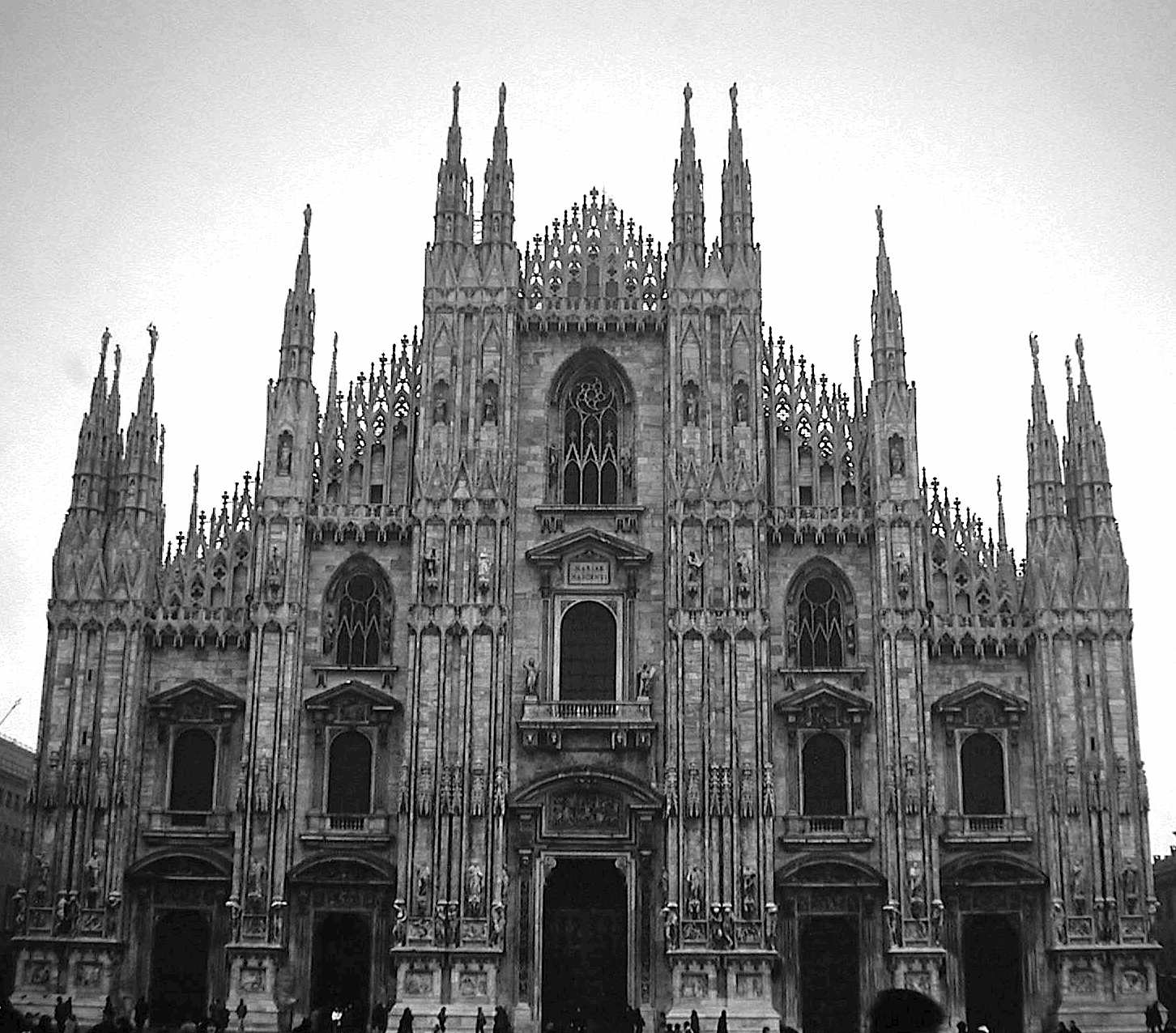
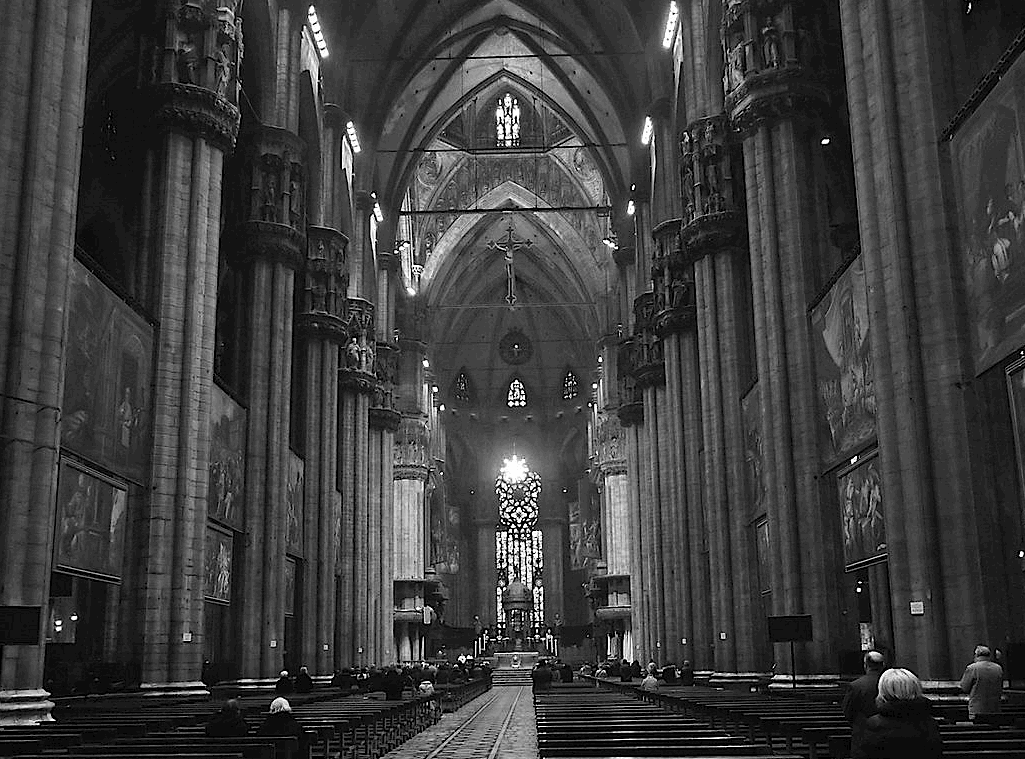
ゴシック(ゴチック)建築で著名なミラノ大聖堂(Duomo di Milano)
リンク
文献
Do not paste, but [re]think this message for all undergraduate students!!!
アミアン大聖堂のプラン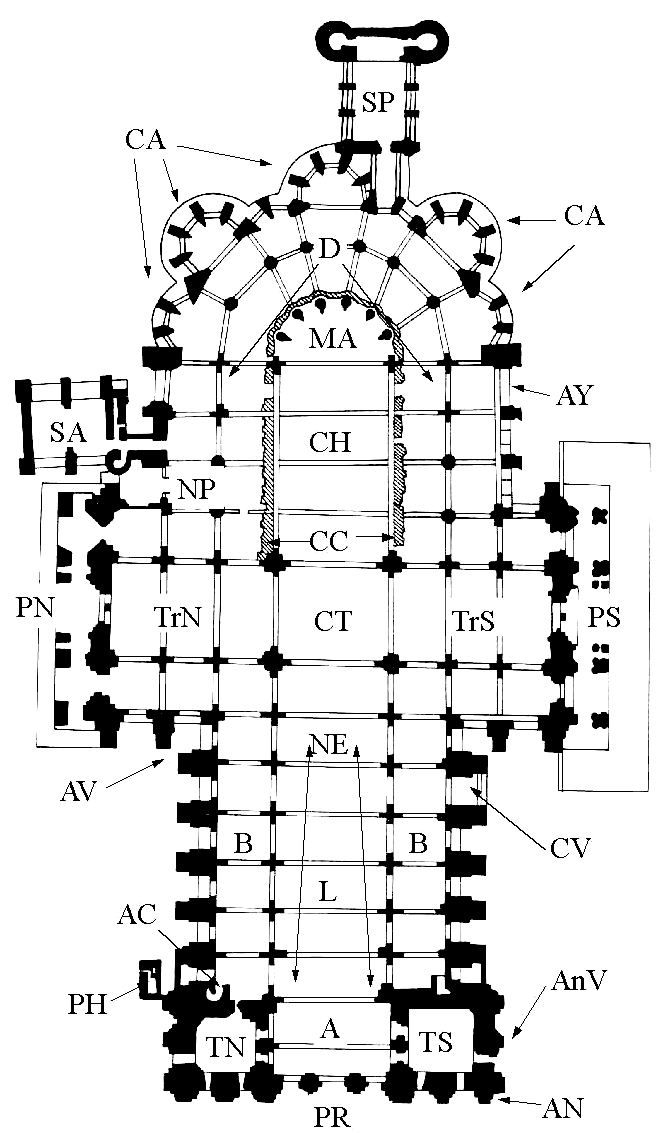
CA:放射状祭室(訳語は辻佐保子による)(ランベール 1965:15)
D:周歩廊
MA:内陣
CH:側進側
TrN:翼
PS:南外陣
PN:北外陣
CT:交叉部
PR:西正面
++
Copyleft,
CC, Mitzub'ixi Quq Chi'j, 1996-2099