我々はどこから来たのか? 我々は何者か?我々はどこへ行くのか?
Where Do We Come From? What Are We? Where Are We Going?
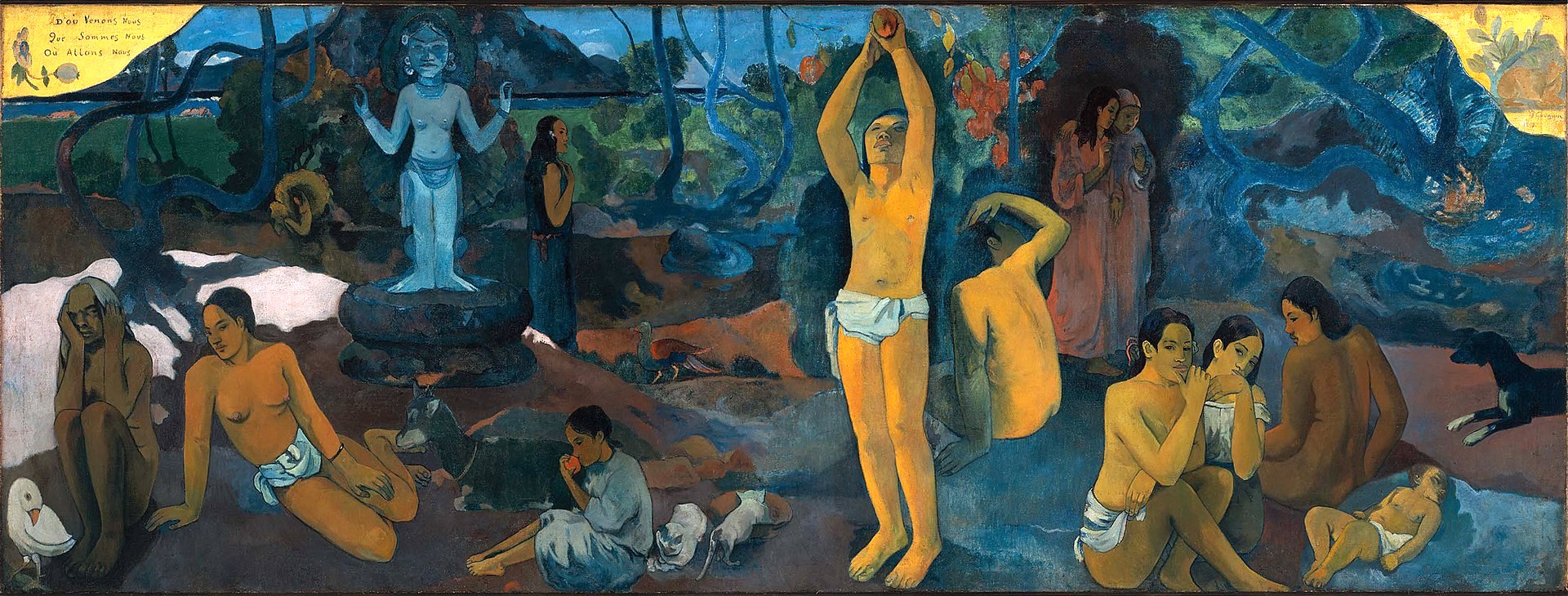
解説:池田光穂
我々はどこから来たのか? 我々は何者か?我々はどこへ行くのか?
Where Do We Come From? What Are We? Where Are We Going?
解説:池田光穂
★『我々はどこから来たのか?我々は何者か?我々はどこへ行くのか』 (フランス語:D'ou venons-nous ? Que sommes-nous ? Où allons-nous ? )は、フランスの画家ポール・ゴーギャンが1897年から98年にかけて描いた絵画である。タヒチで制作され、マサチューセッツ州ボストン美術館に所蔵さ れている。ゴーギャンの傑作とされ、「福音書のテーマに匹敵する哲学的作品」とされている[1]。 この絵は、その謎めいた主題と雰囲気で注目されている。ゴーギャンがこの作品を制作する際に経験した個人的な葛藤がこのような特質を生んだとする学者もい る[2]。ポスト印象派の先駆者であるゴーギャンのスタイルを際立たせている。 フリゾーは1913年頃にこの作品をギャルリー・バルバザンジュに売却し、同ギャルリーは1920年以前にこの作品をノルウェーの船主で美術コレクターの ヨルゲン・ブレダー・スタングに売却した[no]。彼は1935年にアルフレッド・ゴールドを通じてこの絵を売却し、1936年にニューヨークのマリー・ ハリマン・ギャラリーが購入した。1936年4月16日、ボストン美術館がマリー・ハリマン・ギャラリーから購入した。
| Where Do We Come
From? What Are We? Where Are We Going? (French: D'où venons-nous ? Que
sommes-nous ? Où allons-nous ?) is an 1897–98 painting by French artist
Paul Gauguin. The painting was created in Tahiti and is in the Museum
of Fine Arts in Boston, Massachusetts. Viewed as a masterpiece by
Gauguin, the painting is considered "a philosophical work comparable to
the themes of the Gospels".[1] The painting is notable for its enigmatic subject and atmosphere. Some scholars have attributed these qualities to personal conflicts that Gauguin experienced while creating this artwork.[2] It is an accentuation of Gauguin's trailblazing Post-Impressionistic style. Frizeau sold the painting around 1913 to Galerie Barbazanges, which sold it before 1920 to the Norwegian ship owner and art collector Jørgen Breder Stang [no]. He sold the painting via Alfred Gold in 1935, and it was bought by the Marie Harriman Gallery in New York City in 1936. The Museum of Fine Arts, Boston, acquired it from the Marie Harriman Gallery on 16 April 1936. |
我々はどこから来たのか?我々は何者か?我々はどこへ行くのか』(フラ
ンス語:D'ou venons-nous ? Que sommes-nous ? Où allons-nous ?
)は、フランスの画家ポール・ゴーギャンが1897年から98年にかけて描いた絵画である。タヒチで制作され、マサチューセッツ州ボストン美術館に所蔵さ
れている。ゴーギャンの傑作とされ、「福音書のテーマに匹敵する哲学的作品」とされている[1]。 この絵は、その謎めいた主題と雰囲気で注目されている。ゴーギャンがこの作品を制作する際に経験した個人的な葛藤がこのような特質を生んだとする学者もい る[2]。ポスト印象派の先駆者であるゴーギャンのスタイルを際立たせている。 フリゾーは1913年頃にこの作品をギャルリー・バルバザンジュに売却し、同ギャルリーは1920年以前にこの作品をノルウェーの船主で美術コレクターの ヨルゲン・ブレダー・スタングに売却した[no]。彼は1935年にアルフレッド・ゴールドを通じてこの絵を売却し、1936年にニューヨークのマリー・ ハリマン・ギャラリーが購入した。1936年4月16日、ボストン美術館がマリー・ハリマン・ギャラリーから購入した。 |
| Background Gauguin had been a student at the Petit Séminaire de La Chapelle-Saint-Mesmin, just outside Orléans, from the age of eleven to the age of sixteen. His studies there included a class in Catholic liturgy; the teacher for this class was the Bishop of Orléans, Félix-Antoine-Philibert Dupanloup. Dupanloup had devised his own catechism for students to lead them toward proper spiritual reflections on the nature of life. The three fundamental questions in this catechism were "where does humanity come from?" "where is it going to?", and "how does humanity proceed?" Although in later life Gauguin was vociferously anticlerical, these questions from Dupanloup's catechism had lodged in his mind, and "where?" became the key question that Gauguin asked in his art.[3][4] Looking for a society more simple and elemental than that of his native France, Gauguin left for Tahiti in 1891. In addition to several other paintings that express his highly individualistic mythology, he completed this painting in 1897. During the process of creating this painting, Gauguin experienced several difficult events in his personal life. He suffered from medical conditions including eczema, syphilis, and conjunctivitis. He faced financial challenges, and going into debt. He was also informed about the death of his daughter from Copenhagen. From one of many letters to his friend, Daniel de Monfreid, Gauguin disclosed his plan to commit suicide in December 1897.[1] Before he did, however, he wanted to paint a large canvas that would be known as the grand culmination of his thoughts. Following the completion of Where Do We Come From? What Are We? Where Are We Going? Gauguin made a suicide attempt with arsenic.[5] |
背景 ゴーギャンは、11歳から16歳までオルレアン郊外にあるラ・シャペル・サン・メスマン小セミナールで学んでいた。このクラスの教師はオルレアン司教の フェリックス=アントワーヌ=フィリベール・デュパンルーであった。デュパンルーは、生徒たちを人生の本質についての正しい精神的考察へと導くために、独 自のカテキズムを考案した。このカテキズムの3つの基本的な問いは、「人類はどこから来たのか?「人類はどこへ向かうのか」、そして「人類はどのように進 むのか」である。後年、ゴーギャンは激しく反宗教的な態度をとったが、デュパンルーのカテキズムのこれらの問いは彼の心に留まり、「どこへ?」がゴーギャ ンの芸術における重要な問いとなった[3][4]。 母国フランスよりも素朴で本質的な社会を求めたゴーギャンは、1891年にタヒチへと旅立った。彼の極めて個性的な神話を表現した他の数点の絵画に加え、 1897年にこの絵を完成させた。この絵の制作中、ゴーギャンは個人的な生活の中でいくつかの困難な出来事を経験した。湿疹、梅毒、結膜炎などの病気で苦 悩した。経済的な困難にも直面し、借金を抱えた。コペンハーゲンから娘の死も知らされた。友人ダニエル・ド・モンフリードに宛てた多くの手紙の中から、 ゴーギャンは1897年12月に自殺する計画を明かした[1]。しかし、その前に、彼は自分の思いの壮大な集大成として知られる大きなキャンバスを描きた いと考えていた。 我々はどこから来たのか?我々は何者か?我々はどこへ行くのか?を完成させたあとに、ゴーギャンはヒ素による自殺未遂を起こした[5]。 |
Details and analysis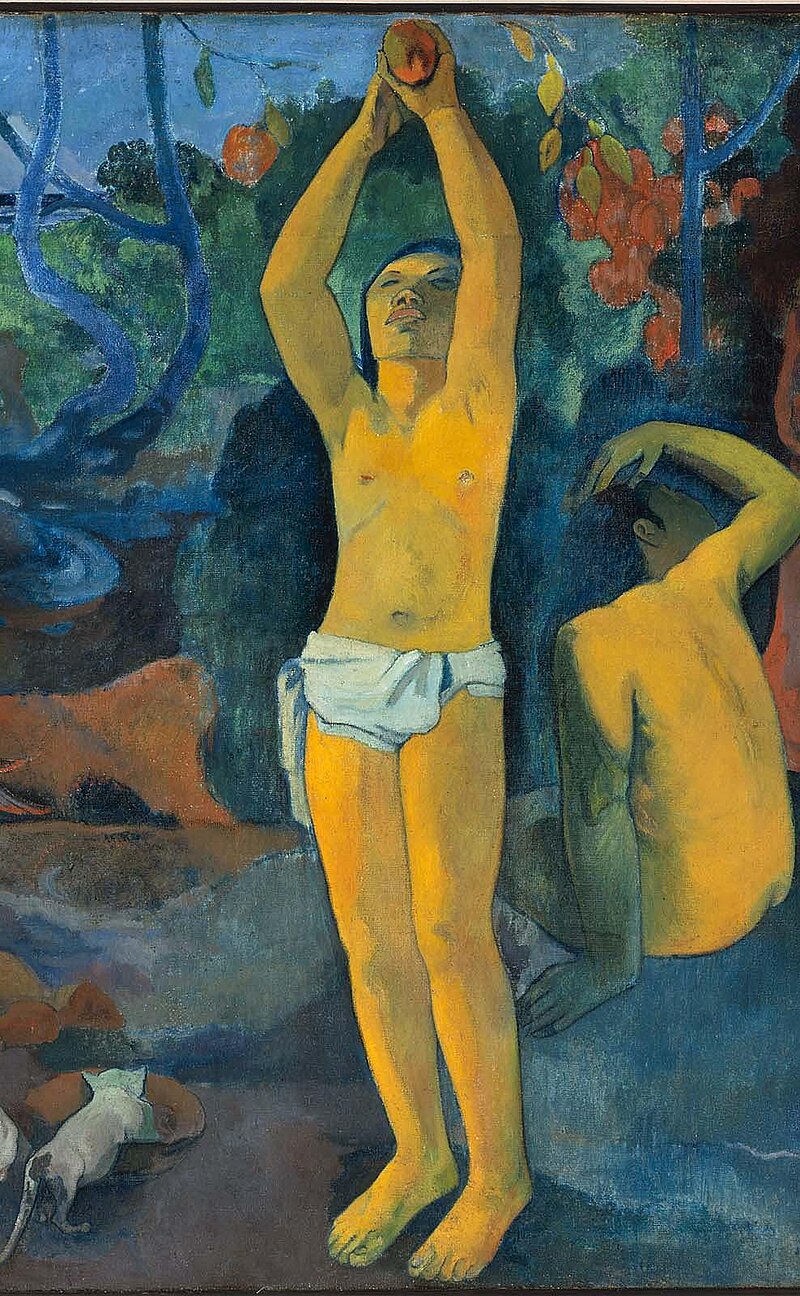 [6] Eve-like figure picking a fruit 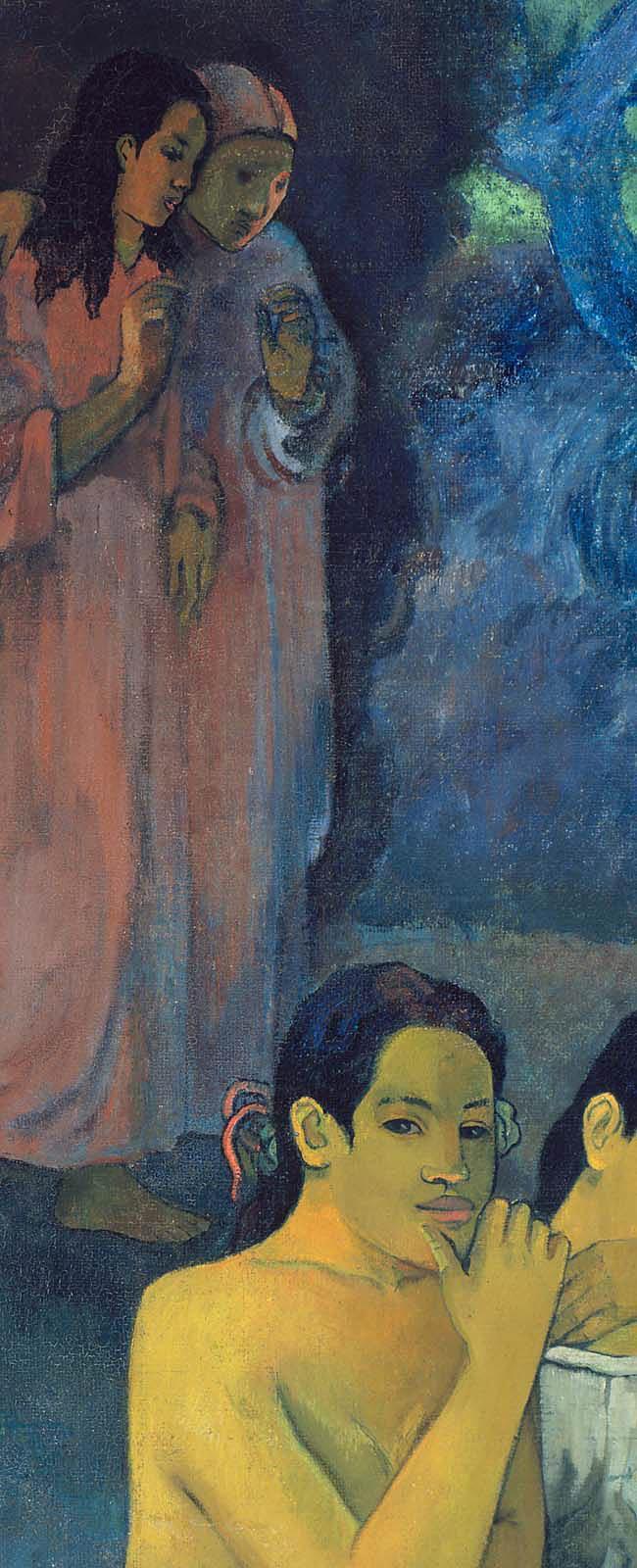 [6] Two sorrowful women walking The three major groups in the painting reflect the overall themes presented in the title. The three crouched women with a sleeping child on the right represent the beginning of life; the middle group symbolizes the daily existence of young adulthood; in the final group, according to the artist, "an old woman approaching death appears reconciled and resigned to her thoughts"; at her feet, "a strange white bird...represents the futility of words" or "the uselessness of vain words".[7] Together, the painting from right to left suggests the cycle of "birth-sin-death".[1] Outside of this cycle of life, there is a blue figure. The blue idol in the background represents what Gauguin described as "the Beyond." Gauguin approaches the life cycle from a feminine perspective. The girl surrounded by kittens demonstrates the purity of "girlhood". The figure in the center is placed in a "Garden of Eden motif"; she is picking fruits from a tree. Gauguin intended to represent this woman as a sin, like the allegory of Eve. Maternity is represented through the figures that surround the baby. Along with the motherhood of a woman's life, Gauguin also displays the idea of "domestic submission" through the bracelet and collar worn by the mature woman on the left and the white goat, respectively. Finally, the state of seniority can be seen through the old woman on the left.[1] Near the blissful people are two sorrowful women by a tree who stand in contrast with their surroundings. In front of these women is a crouched figure who lifts her arm. The three women have been interpreted by one scholar as representing the contrast between enlightenment and “superstitious, irrational, even barbaric traditions”.[8] The painting also includes several inscriptions. Gauguin inscribed the original French title in the upper left corner: D'où Venons Nous / Que Sommes Nous / Où Allons Nous. The inscription the artist wrote on his canvas has no question mark, no dash, and all words are capitalized. In the upper right corner, he signed and dated the painting: P. Gauguin / 1897.[9] |
詳細と分析 [6] 園の果実を摘むエバのような姿 [6] 悲しげに歩く二人の女性 この絵の三つの主要なグループは、題名に示された全体的な主題を反映している。 右側の眠る子供を抱く三人のしゃがんだ女性は生命の始まりを表す。中央のグループは若年成人の日常的存在を象徴する。最後のグループでは、作者によれば 「死に近づく老婆は自らの思いに和解し諦観しているように見える」。彼女の足元には「奇妙な白い鳥…言葉の無益さ」あるいは「虚しい言葉の無意味さ」を表 す。[7] 絵画全体は右から左へ「誕生-罪-死」の循環を示唆している。[1] この生命の循環の外側に、青い人影が存在する。背景の青い偶像はゴーギャンが「彼岸」と表現したものを表している。 ゴーギャンは女性の視点から生命の循環を描く。子猫に囲まれた少女は「少女時代」の純粋さを示す。中央の人物は「エデンの園」のモチーフに配置され、木か ら果実を摘んでいる。この女性をエバの寓話のように「罪」として表現するのがゴーギャンの意図だ。母性は、赤ん坊を取り囲む人物像を通じて表現されてい る。女性の生涯における母性に加え、ゴーギャンは左側の成熟した女性が身につける腕輪と首輪、そして白い山羊を通じて「家庭内服従」の概念も示している。 最後に、左側の老婆を通じて老齢の状態が表現されている。[1] 幸福な人民の近くには、木陰に立つ二人の悲しげな女性が周囲と対照をなしている。彼女たちの前には、腕を上げるしゃがんだ姿がいる。この三人の女性は、ある学者によって「啓蒙」と「迷信的で非合理、野蛮な伝統」との対比を表すと解釈されている。[8] この絵画にはいくつかの銘文も含まれている。ゴーギャンは左上隅に原題となるフランス語の題名を記した:D'où Venons Nous / Que Sommes Nous / Où Allons Nous(我らはどこより来たり / 我らは何者か / 我らはどこへ行く)。画家がキャンバスに記した銘文には疑問符もダッシュもなく、全ての単語が大文字で書かれている。右上隅には署名と制作年が記されてい る:P. Gauguin / 1897。[9] |
| Style The painting is an accentuation of Gauguin's trailblazing Post-Impressionistic style; his art stressed the vivid use of colors and thick brushstrokes, while it aimed to convey an emotional or expressionistic strength. It emerged in conjunction with other avant-garde movements of the twentieth century, including Cubism and Fauvism. |
スタイル この絵画はゴーギャンの先駆的なポスト印象派のスタイルを強調している。彼の芸術は鮮やかな色彩と厚い筆致を重視し、感情的あるいは表現主義的な強さを伝えることを目指した。それはキュビズムやフォーヴィスムを含む、20世紀の他の前衛芸術運動と並行して現れた。 |
| Reception and provenance In 1898, Gauguin sent the painting to Georges-Daniel de Monfreid in Paris. Monfreid passed it to Ambroise Vollard along with eight other thematically related pictures shipped earlier. They went on view at the Galerie Vollard from November 17 to December 10 1898.[10] The exhibition was a success, although D'où Venons Nous? received mixed reviews. Charles Morice [fr] unsuccessfully tried to raise funds to purchase the painting on behalf of France. Gabriel Frizeau [fr] purchased the painting from Vollard for 2,500 francs in 1901.[11] Subsequently, Frizeau sold the painting around 1913 to Galerie Barbazanges, which sold it before 1920 to the Norwegian ship owner and art collector Jørgen Breder Stang [no]. He sold the painting via Alfred Gold in 1935, and it was bought by the Marie Harriman Gallery in New York City in 1936. The Museum of Fine Arts, Boston, acquired it from the Marie Harriman Gallery on 16 April 1936.[9] |
受容と来歴 1898年、ゴーギャンはこの絵をパリのジョルジュ=ダニエル・ド・モンフレイに送った。モンフレイはこれをアンブロワーズ・ヴォラールに渡し、以前に送 られた他の8点の関連作品と共に展示した。これらは1898年11月17日から12月10日までヴォラール画廊で公開された[10]。展覧会は成功した が、『我らはどこより来るのか?』は混血の評価だった。 シャルル・モリスはフランスを代表してこの絵を購入するための資金調達を試みたが失敗した。ガブリエル・フリゾーは1901年にヴォラールから2,500フランでこの絵を購入した。[11] その後、フリゾーは1913年頃にこの作品をバルバザンジュ画廊に売却した。同画廊は1920年以前にノルウェーの船主で美術収集家であるヨルゲン・ブレ デル・スタン[no]に売却した。スタンは1935年にアルフレッド・ゴールドを通じてこの作品を売却し、1936年にニューヨーク市のマリー・ハリマン 画廊が購入した。ボストン美術館は1936年4月16日、マリー・ハリマン・ギャラリーからこの作品を購入した。 |
| Critics and Gauguin Critics thought of Paul Gauguin as one of the major artists of the time, but they were unsure about the artist's intentions in this work. Thadée Natanson of La Revue Blanche expressed confusion over its meaning, describing it as "obscure".[12] The critic André Fontainas of the Mercure de France acknowledged grudging respect for the work but thought the allegory would be impenetrable without the inscription, and compared the painting to Inter artes et naturam (Between Art and Nature) of Pierre Puvis de Chavannes. Although Gauguin appreciated the works of Puvis, he wanted to differentiate his works from “the great master of decorative painting”.[citation needed] He explained to Fontainas that the objectives of Puvis's works were predetermined and could be conveyed in words; he believed his works consist of a great "pictorial language of feelings".[13] Gauguin believed that his paintings had abstract, inexplicable qualities that could not be expressed in literary terms. 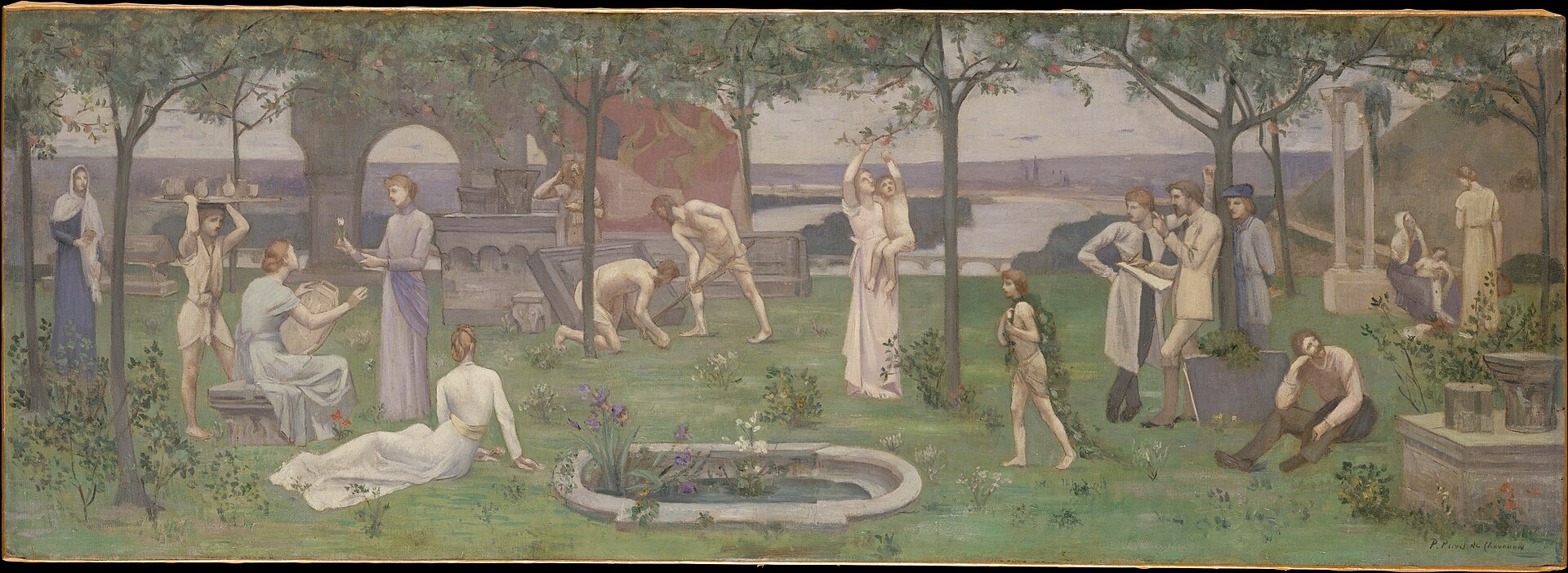 Pierre Puvis de Chavannes's Inter artes et naturam |
批評家とゴーギャン 批評家たちはポール・ゴーギャンを当時の主要な芸術家の一人と見なしていたが、この作品における芸術家の意図については確信が持てなかった。『ラ・レヴュー・ブランシュ』のタディー・ナタンソンはその意味について困惑を表明し、「不明瞭」と評した。[12] 『メルキュール・ド・フランス』誌の批評家アンドレ・フォンタナは、この作品に対して渋々ながら敬意を認めつつも、碑文なしでは寓意を理解できないだろうと指摘し、ピエール・ピュヴィス・ド・シャヴァンヌの『芸術と自然の間』と比較した。 ゴーギャンはピュヴィスの作品を評価していたが、自身の作品を「装飾絵画の巨匠」とは一線を画すものにしたかった。[出典必要] 彼はフォンテーナに、ピュヴィスの作品の目的は予め決められており言葉で伝えられると説明した。自身の作品は偉大な「感情の絵画言語」で構成されていると 信じていた。[13] ゴーギャンは、自身の絵画には文学的な言葉では表現できない抽象的で不可解な性質があると確信していた。 ピエール・ピュヴィス・ド・シャヴァンヌ『芸術と自然の間』 |
| References and sources References 1. Anderson (1967) p. 238. 2. Rousseau (1959) p. 22. 3. Gayford (2006) pp. 99-100. 4. Stuckey (2001) p. 129. 5. Gibson, Michael (1993). Paul Gauguin. New York: Rizzoli. p. 23. ISBN 0-8478-1737-7. Retrieved 1 June 2024. 6. Where Do We Come From? What Are We? Where Are We Going?, Museum of Fine Arts, Boston. 7. Boime (2008) p. 140. 8. Dorra (2007) p. 256. 9. Where Do We Come From? What Are We? Where Are We Going?, Museum of Fine Arts, Boston. Retrieved 23 February 2015. 10. Boyle-Turner (2007) p. 175. 11. Thomson (1987) pp. 198-200. 12. Boyle-Turner (2007) p. 177. 13. Shackelford (2004) p. 183. |
参考文献および情報源 参考文献 1. アンダーソン (1967) p. 238。 2. ルソー (1959) p. 22。 3. ゲイフォード (2006) pp. 99-100。 4. スタッキー (2001) p. 129。 5. ギブソン、マイケル (1993)。ポール・ゴーギャン。ニューヨーク:リッツォーリ。p. 23。ISBN 0-8478-1737-7。2024年6月1日取得。 6. 私たちはどこから来たのか?私たちは何者なのか?私たちはどこへ行くのか?ボストン美術館。 7. ボイム (2008) p. 140。 8. ドーラ (2007) p. 256。 9. 私たちはどこから来たのか?私たちは何者なのか?私たちはどこへ行くのか?ボストン美術館。2015年2月23日取得。 10. ボイル・ターナー (2007) p. 175。 11. トムソン (1987) pp. 198-200。 12. ボイル・ターナー (2007) p. 177。 13. シャックルフォード (2004) p. 183。 |
| Sources Andersen, Wayne V. “Gauguin and a Peruvian Mummy.” Burlington Magazine 109, no. 769 (1967): 238–43. Boime, Albert (2008). Revelation of Modernism: Responses to the Cultural Crisis in Fin-de-Siécle. University of Missouri Press, ISBN 9780826266255 Boyle-Turner, Caroline. Current Issues in 19th-Century Art. Zwolle: Amsterdam: Waanders; Van Gogh Museum, 2007. Dorra, Henri. The Symbolism of Paul Gauguin: Erotica, Exotica, and the Great Dilemmas of Humanity. Berkeley: University of California Press, 2007. Gayford, Martin. (2006). The Yellow House: Van Gogh, Gauguin, and Nine Turbulent Weeks in Arles, London: Penguin Books, ISBN 0-670-91497-5. Mathews, Nancy Mowll (2001). Paul Gauguin: An Erotic Life. New Haven, Connecticut: Yale University Press, ISBN 0-300-09109-5 Rousseau, Theodore. Gauguin: Paintings, Drawings, Prints, Sculpture. Art Institute of Chicago, 1959. Shackelford, George T. M., Frèches-Thory, Claire, Galeries nationales du Grand Palais, and Museum of Fine Arts, Boston. Gauguin Tahiti. Boston, MA: MFA Publications, 2004. Stuckey, Charles. "Gauguin Inside Art" in Eric M. Zafran, ed., Gauguin's Nirvana: Painters at Le Pouldu 1889-90. Wadsworth Atheneum Museum of Art, Hartford in association with Yale University Press, 2001, ISBN 0300089546. Thomson, Belinda (1987). Gauguin. London: Thames and Hudson. ISBN 0-500-20220-6. |
出典 アンダーセン、ウェイン・V. 「ゴーギャンとペルーのミイラ」『バーリントン・マガジン』109巻769号(1967年)、238-243頁。 ボイム、アルバート (2008)。『モダニズムの啓示:世紀末の文化的危機への対応』 ミズーリ大学出版、ISBN 9780826266255 ボイル・ターナー、キャロライン。『19 世紀美術の現在の課題』 ズウォレ:アムステルダム:ワアンダース、ファン・ゴッホ美術館、2007 年。 ドッラ、アンリ。ポール・ゴーギャンの象徴主義:エロティカ、エキゾチカ、そして人類の大きなジレンマ。バークレー:カリフォルニア大学出版、2007年。 ゲイフォード、マーティン。(2006)。黄色い家:ヴァン・ゴッホ、ゴーギャン、そしてアルルでの9週間の激動、ロンドン:ペンギンブックス、ISBN 0-670-91497-5。 マシューズ、ナンシー・モウル(2001)。ポール・ゴーギャン:エロティックな人生。コネチカット州ニューヘイブン:イェール大学出版、ISBN 0-300-09109-5 ルソー、セオドア。ゴーギャン:絵画、素描、版画、彫刻。シカゴ美術館、1959年。 シャックルフォード、ジョージ・T・M、 フレッシュ=トリー、クレール、グラン・パレ国立美術館、ボストン美術館共著。『ゴーギャン・タヒチ』。マサチューセッツ州ボストン:MFA出版、2004年。 スタッキー、チャールズ。「芸術の中のゴーギャン」『ゴーギャンの涅槃:1889-90年ル・プルデュの画家たち』エリック・M・ザフラン編。ワズワース・アテネウム美術館(ハートフォード)とイェール大学出版局の共同出版、2001年、ISBN 0300089546。 トムソン、ベリンダ(1987)。『ゴーギャン』。ロンドン:テムズ・アンド・ハドソン。ISBN 0-500-20220-6。 |
| Further reading Rewald, John (1956; revised 1978). History of Post-Impressionism: From Van Gogh to Gauguin, London: Secker & Warburg. Rewald, John. (1946) History of Impressionism. Shackelford, George T. M. (2013). Paul Gauguin: Where Do We Come From? What are We? Where are We Going?. Boston: Museum of Fine Arts, MFA Publications. "Text adapted from 'Trouble in Paradise,' by George T. M. Shackelford, in Gauguin, Cézanne, Matisse: Visions of Arcadia, © 2012 by Philadelphia Museum of Art". |
追加文献(さらに読む) レワルド、ジョン(1956年;改訂1978年)。『ポスト印象派の歴史:ヴァン・ゴッホからゴーギャンまで』、ロンドン:セッカー&ワーバーグ。 レワルド、ジョン(1946年)。『印象派の歴史』。 シャッケルフォード、ジョージ・T・M(2013年)。ポール・ゴーギャン:我々はどこから来たのか?我々は何者か?我々はどこへ向かうのか?ボストン: 美術館出版部。「本文はジョージ・T・M・シャックルフォード著『楽園の異変』より転載。収録誌『ゴーギャン、セザンヌ、マティス:アルカディアの幻 影』、フィラデルフィア美術館著作権所有(2012年)」 |
| https://x.gd/JVLAc |
リンク
文献
その他の情報
Copyleft, CC, Mitzub'ixi Quq Chi'j, 1996-2099