規範性
Normativity
★規範性(normativity)とはなにか?
規範性[Normativity]とは、人々が
どう行動すべきか、何を信じるべきか、何を価値あると考えるべきかの基準に関わる。これは、物事がどうあるべきか、あるいは個人が何をしてもよいのか、し
なければならないのか、してはならないのかを規定する規則や判断、概念の性質である。規範的主張は「喫煙すべきではない」といった、あるべき状態を表現す
る。これに対し「昨日は喫煙した」といった現状を述べる記述的主張とは対照的である。規範性は意思決定、結果の評価、他者への批判、行動の正当化など、多
くの日常的活動を形作る。
研究者らは様々な規範性の類型を論じる。実践的規範性は「何をすべきか」を、理論的規範性は「何を信じるべきか」を扱う。義務的規範性は「許されること・
要求されること・禁じられること」を、評価的規範性は規範的評価の根底にある価値を扱う。客観的規範性は個人的な見解に依存しない要求を含む。これに対し
主観的規範性は主観的視点に相対的な基準を扱う。規範的評価は、関連する全ての側面を考慮する「総合的判断」とは異なり、特定の側面のみを考慮する部分的
なものである場合、「部分的規範性」と呼ばれる。その他の区別は、道徳的・社会的・法的・言語的規範など、評価の対象領域に基づく。これらのカテゴリーは
重複する場合があり、これら全てが真の規範性の形態であるか否かについては学問的な意見の相違がある。
規範性の本質と源泉については様々な理論が提唱されている。現実主義者は、何が正しいか間違っているかについての客観的事実が存在すると主張するが、この
見解は反現実主義者によって否定される。自然主義者と非自然主義者は、規範的事実が自然科学が研究する経験的領域の一部であるか否かを論じている。規範的
判断が真偽を持つか否かについては、認知主義者と非認知主義者が論争する。還元主義者は非規範的概念で規範的概念を説明しようとするが、原始主義者はこれ
を不可能と否定する。規範性が究極的に理由に根ざすか価値に根ざすかについては、理由本位説と価値本位説が対立する。その他の理論は規範性の権威的効力、
心との関係、規範的知識の源泉を扱う。
規範的現象を研究する学問領域は複数存在する。哲学においては、倫理学が実践的規範性を、認識論が理論的規範性を扱う。心理学は規範的認知、すなわち規範
がどのように学習され、実践され、制裁されるかを検証する。社会学と人類学は、共同体の行動を規制し文化間で差異を持つ共有・強制される規則としての社会
規範を分析する。言語学は正しい言語使用の基準を、法学は法制度の正当性を扱う。その他の関連分野には経済学、医学、神経科学が含まれる(→「規範性の4タイプ」)。
| Normativity
concerns
the standards of what people ought to do, believe, or value. It is a
quality of rules, judgments, or concepts that prescribe how things
should be or what individuals may, must, or must not do. Normative
claims express what ought to be the case, such as "you should not
smoke". They contrast with descriptive claims about what is the case,
such as "you smoked yesterday". Normativity shapes many everyday
activities, such as decision-making, evaluating outcomes, criticizing
others, and justifying actions. Researchers discuss many types of normativity. Practical normativity is about what to do, while theoretical normativity concerns what to believe. Deontic normativity deals with what is allowed, required, or forbidden, whereas evaluative normativity addresses the values underlying normative assessments. Objective normativity encompasses requirements that do not depend on personal views, in contrast to subjective normativity, which is about standards relative to subjective perspectives. A normative assessment is pro tanto if it is partial by only taking certain aspects into account, unlike all-things-considered judgments, which factor in all relevant aspects. Other distinctions are based on the domain of assessment, such as moral, social, legal, and linguistic norms. Some categories may overlap, and there are academic disagreements about whether all these types are genuine forms of normativity. Various theories about the nature and sources of normativity have been proposed. Realists assert that there are objective facts about what is right and wrong, a view rejected by anti-realists. Naturalists and non-naturalists discuss whether normative facts are part of the empirical domain studied by the natural sciences. Cognitivists and non-cognitivists debate whether normative judgments can be true or false. Reductionists seek to explain normative concepts through non-normative ones, while primitivists deny that this is possible. Reason-based and value-based views disagree about whether normativity is ultimately grounded in reasons or values. Other theories address the authoritative force of normativity, its relation to the mind, and the sources of normative knowledge. Several fields of inquiry study normative phenomena. In philosophy, ethics addresses practical normativity while epistemology deals with theoretical normativity. Psychology examines normative cognitions or how norms are learned, practiced, and sanctioned. Sociology and anthropology analyze social norms as shared and enforced rules that regulate communal behavior and vary across cultures. Linguistics deals with standards of correct language use, while law addresses the legitimacy of legal systems. Other related fields include economics, medicine, and neuroscience. |
規範性[Normativity]とは、人々が
どう行動すべきか、何を信じるべきか、何を価値ある
と考えるべきかの基準に関わる。これは、物事がどうあるべきか、あるいは個人が何をしてもよいのか、しなければならないのか、してはならないのかを規定す
る規則や判断、概念の性質である。規範的主張は「喫煙すべきではない」といった、あるべき状態を表現する。これに対し「昨日は喫煙した」といった現状を述
べる記述的主張とは対照的である。規範性は意思決定、結果の評価、他者への批判、行動の正当化など、多くの日常的活動を形作る。 研究者らは様々な規範性の類型を論じる。実践的規範性は「何をすべきか」を、理論的規範性は「何を信じるべきか」を扱う。義務的規範性は「許されること・ 要求されること・禁じられること」を、評価的規範性は規範的評価の根底にある価値を扱う。客観的規範性は個人的な見解に依存しない要求を含む。これに対し 主観的規範性は主観的視点に相対的な基準を扱う。規範的評価は、関連する全ての側面を考慮する「総合的判断」とは異なり、特定の側面のみを考慮する部分的 なものである場合、「部分的規範性」と呼ばれる。その他の区別は、道徳的・社会的・法的・言語的規範など、評価の対象領域に基づく。これらのカテゴリーは 重複する場合があり、これら全てが真の規範性の形態であるか否かについては学問的な意見の相違がある。 規範性の本質と源泉については様々な理論が提唱されている。現実主義者は、何が正しいか間違っているかについての客観的事実が存在すると主張するが、この 見解は反現実主義者によって否定される。自然主義者と非自然主義者は、規範的事実が自然科学が研究する経験的領域の一部であるか否かを論じている。規範的 判断が真偽を持つか否かについては、認知主義者と非認知主義者が論争する。還元主義者は非規範的概念で規範的概念を説明しようとするが、原始主義者はこれ を不可能と否定する。規範性が究極的に理由に根ざすか価値に根ざすかについては、理由本位説と価値本位説が対立する。その他の理論は規範性の権威的効力、 心との関係、規範的知識の源泉を扱う。 規範的現象を研究する学問領域は複数存在する。哲学においては、倫理学が実践的規範性を、認識論が理論的規範性を扱う。心理学は規範的認知、すなわち規範 がどのように学習され、実践され、制裁されるかを検証する。社会学と人類学は、共同体の行動を規制し文化間で差異を持つ共有・強制される規則としての社会 規範を分析する。言語学は正しい言語使用の基準を、法学は法制度の正当性を扱う。その他の関連分野には経済学、医学、神経科学が含まれる。 |
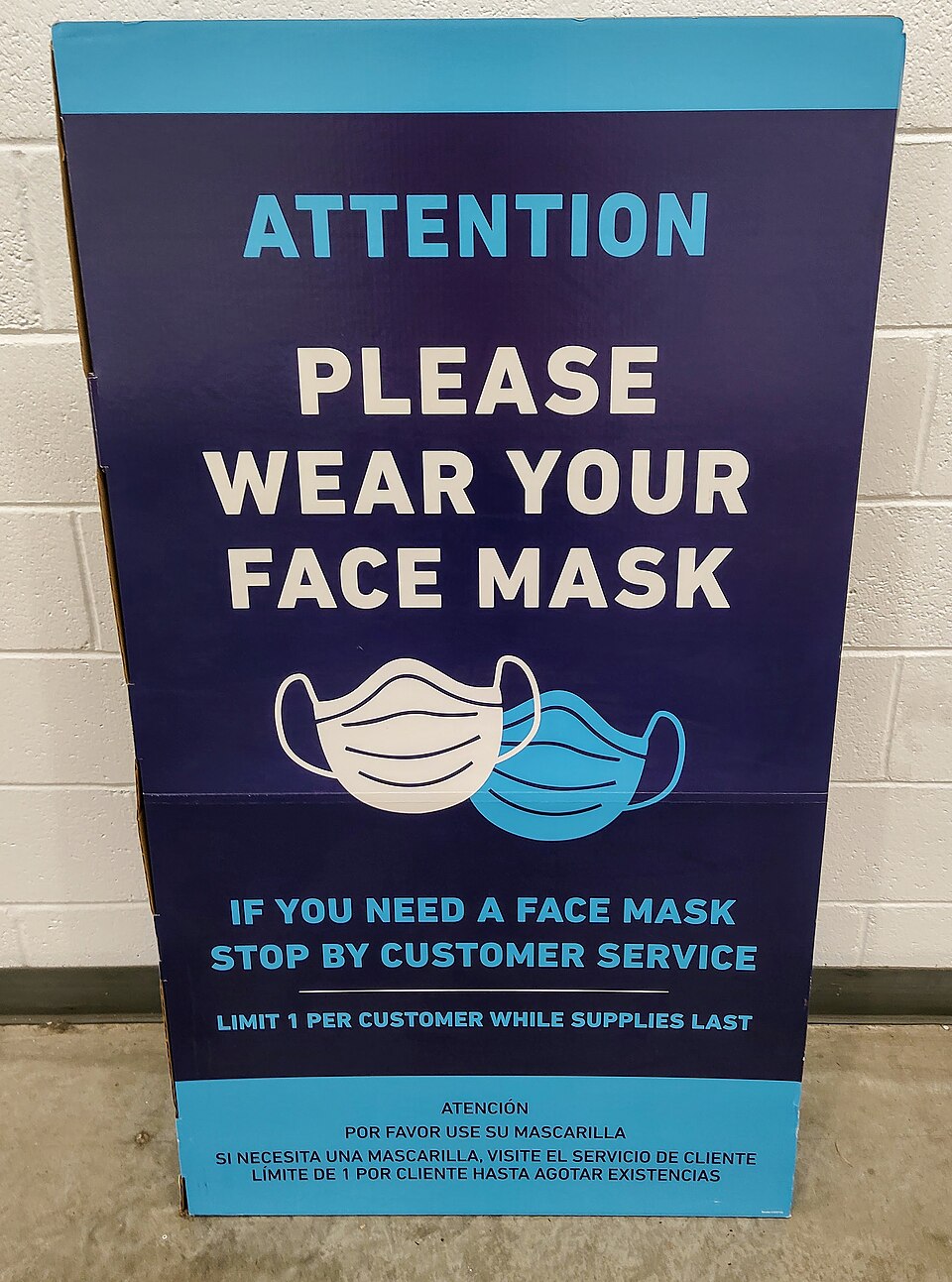
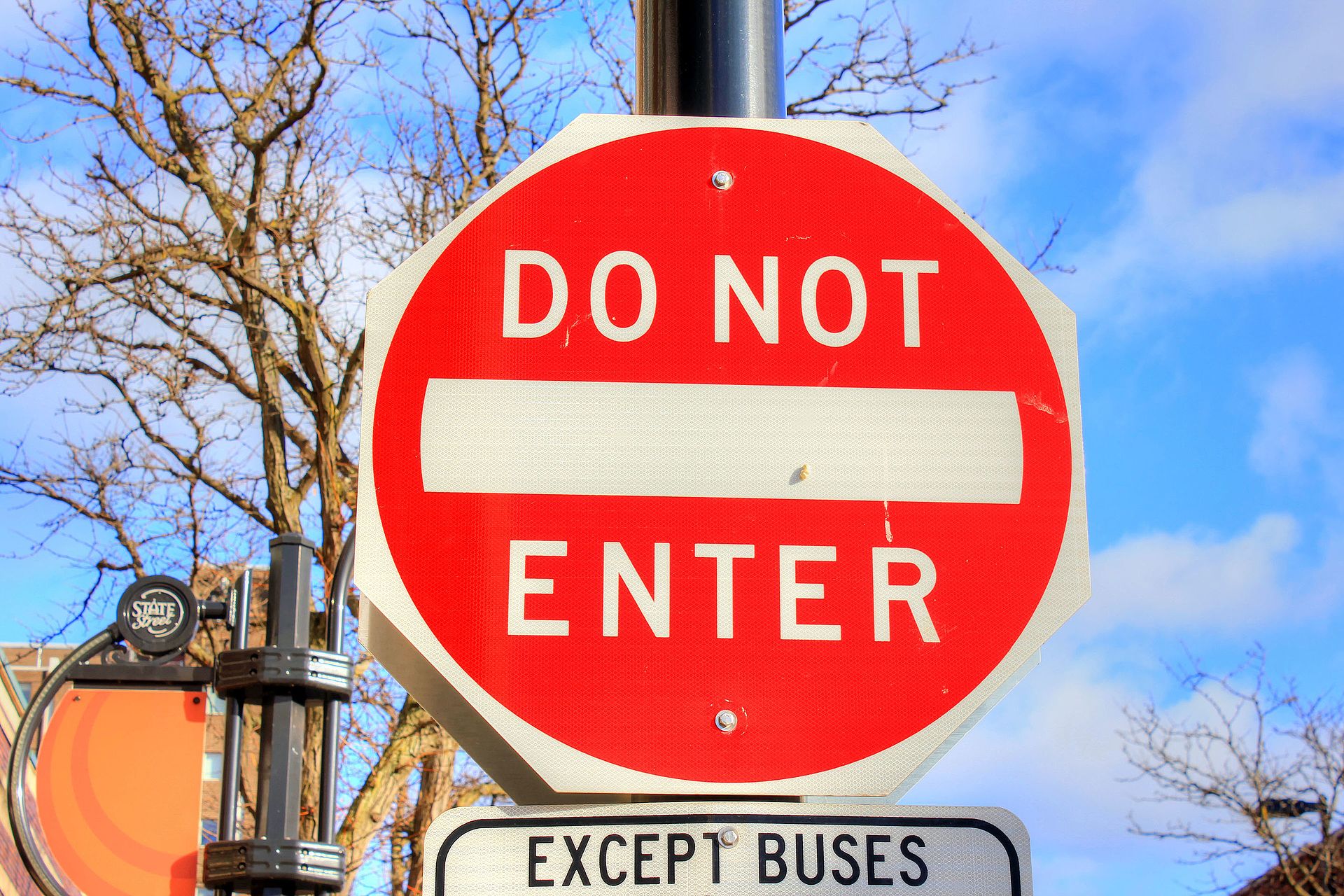
| Definition Photo of a sign saying "ATTENTION PLEASE WEAR YOUR FACE MASK" Photo of a sign saying "DO NOT ENTER" Some norms require specific actions, such as putting on a face mask, while others prohibit certain behavior, like entering a restricted area.[1] Normativity is a quality of concepts, judgments, or principles that prescribe how things ought to be. As a feature of everything that should be, it encompasses the standards or reasons that guide or justify actions and beliefs.[2] In a slightly different sense, normativity can also refer to the capacity to establish and modify norms.[3] Normative statements contrast with descriptive statements, which report what is the case rather than what should be the case. For example, the sentence "you should not smoke" is normative because it expresses a norm and prescribes a course of action. The sentence "you smoked yesterday", by contrast, is descriptive since it merely states a fact.[4][a] Normativity is a pervasive phenomenon in everyday life that occurs when evaluating or criticizing others and when attempting to justify one's own actions. Similarly, it is involved in practical deliberation when deciding what to do next and in theoretical reasoning when assessing whether the available evidence supports a belief. Normativity is relevant to many domains, including morality, law, politics, language, and the human sciences.[6] Philosophers debate whether it is a unified phenomenon[b] that applies equally to all of these cases or a heterogeneous collection of related ideas whose precise definition varies with context and domain.[8] Normative claims can be analyzed in terms of their content, such as a rule that should be followed, and the authority or normative force they carry. For example, some normative reasons merely favor one course of action over another, while others strictly demand a specific conduct. In either case, a normative reason does not coerce compliance: individuals may act otherwise out of ignorance or against their better judgment. Accordingly, there can be a difference between what a person desires or intends and what they normatively should do.[9] Normativity is closely related to norms, understood as general principles of how individuals should act or think. However, the term norm also has meanings not directly related to normativity. For example, a statistical norm is a statement about what is typical or average, such as the average height of adult men, without implying that things should be this way. Similarly, normativity is distinguished from mere regularities or common practices, such as a habit of eating dinner at a particular time.[10] There are many normative concepts, such as right and wrong, good and bad, rational and irrational, justified and unjustified, and permitted and obligated.[11] The word normativity originates in the Latin term norma, meaning 'rule' or 'pattern'. It gave rise to the French word normatif, which entered English as the term normative in the 19th century. The word normativity was coined in the 1930s as a technical term in academic discourse.[12] The study of normativity has its roots in antiquity as discussions of different types of normative requirements. Plato (428–348 BCE) and Aristotle (384–322 BCE) examined the norms of moral conduct and the good life, as well as standards of knowledge and reasoning.[13] In modern philosophy, David Hume (1711–1776) investigated the contrast between normative and non-normative phenomena, arguing that one cannot deduce what ought to be from what is, a contrast later pursued by G. E. Moore (1873–1958).[14] Immanuel Kant (1724–1804) analyzed the normative domains of theoretical knowledge, practical morality, and aesthetic judgment. By raising the question of their underlying unity, he inspired subsequent philosophers to seek systematic principles grounding and connecting these domains.[15] Edmund Husserl (1859–1938) in the 1930s and Georges Canguilhem (1904–1995) in the 1940s introduced normativity as a technical term for the power of creating and changing norms, with Husserl focusing on the realm of ideas while Canguilhem explored functional norms and pathologies of organisms.[16] Diverse theories of the nature, sources, unity, and reality of normative phenomena were later developed by J. L. Mackie (1917–1981), T. M. Scanlon (1940–present), Derek Parfit (1942–2017), Simon Blackburn (1944–present), and Christine Korsgaard (1952–present).[17] |
定義 「注意:マスクを着用してください」と書かれた看板の写真 「立入禁止」と書かれた看板の写真 ある規範はマスクの着用といった特定の行動を要求し、別の規範は立入禁止区域への進入といった特定の行為を禁止する。[1] 規範性とは、物事がどうあるべきかを規定する概念、判断、または原則の性質である。あるべき姿の特性として、行動や信念を導き正当化する基準や理由を含 む。[2] やや異なる意味では、規範性を規範を確立・修正する能力を指す場合もある。[3] 規範的記述は記述的記述と対比される。記述的記述は「あるべき姿」ではなく「現状」を報告する。「喫煙すべきでない」という文は規範的である。規範を表明 し行動方針を指示するからだ。これに対し「昨日は喫煙した」という文は、単に事実を述べる記述的文である。[4][a] 規範性は日常生活に遍在する現象であり、他者を評価・批判する際や自らの行動を正当化しようとする際に生じる。同様に、次に何をすべきかを決定する実践的 な熟議や、入手可能な証拠が信念を支持するかを評価する理論的な推論にも関与する。規範性は道徳、法、政治、言語、人間科学など多くの領域に関連してい る。[6] 哲学者たちは、これがこれら全ての事例に等しく適用される統一的な現象なのか[b]、それとも文脈や領域によって正確な定義が異なる関連概念の異質な集合 なのかを議論している。[8] 規範的主張は、従うべき規則といった内容や、それらが持つ権威・規範的強制力という観点から分析できる。例えば、ある規範的理由は単に一つの行動方針を他 より推奨するに過ぎないが、別のものは特定の行動を厳格に要求する。いずれの場合も、規範的理由は従順を強制しない:個人は無知や良識に反して異なる行動 を取る可能性がある。したがって、人が望むことや意図することと、規範的にすべきこととの間には差異が生じうる。[9] 規範性は、個人がどう行動し考えるべきかの一般的原則として理解される規範と密接に関連している。しかし規範という用語は、規範性と直接関係のない意味も 持つ。例えば統計的規範とは、成人男性の平均身長のように、典型的なものや平均的なものについての記述であり、物事がそうあるべきだという含意はない。同 様に、規範性は単なる規則性や慣習、例えば特定の時間に夕食をとる習慣などとは区別される。[10] 正しい・間違っている、良い・悪い、合理的・非合理的、正当化される・正当化されない、許される・義務付けられるなど、多くの規範的概念が存在する。 [11] 規範性(normativity)という言葉は、ラテン語のnorma(規則・規範)に由来する。これがフランス語のnormatifを生み、19世紀に 英語のnormativeとして導入された。規範性という言葉は1930年代に学術的言説における専門用語として造語された。[12] 規範性の研究は古代に遡り、異なる規範的要請に関する議論が起源である。プラトン(紀元前428-348年)とアリストテレス(紀元前384-322年) は、道徳的行動や善き人生の規範、知識と推論の基準を考察した。[13] 近代哲学では、デイヴィッド・ヒューム(1711–1776)が規範的現象と非規範的現象の対比を調査し、「あるべきことはあるがままから導き出せない」 と主張した。この対比は後にG・E・ムーア(1873–1958)によって追求された。[14] イマヌエル・カント(1724–1804)は、理論的知識、実践的道徳、美的判断という規範的領域を分析した。それらの根底にある統一性を問うことで、後 世の哲学者たちにこれらの領域を基盤とし結びつける体系的な原理の探求を促した。[15] 1930年代のエドムント・フッサール(1859-1938)と1940年代のジョルジュ・カンギレム(1904-1995)は、規範を創造し変化させる 力を表す専門用語として規範性を導入した。フッサールは観念の領域に焦点を当て、カンギレムは生物の機能的規範と病態を探求した。[16] 規範的現象の性質、源泉、統一性、現実性に関する多様な理論は、後に J. L. マッキー(1917-1981)、T. M. スカンモン(1940-現在)、デレク・パーフィット(1942-2017)、サイモン・ブラックバーン(1944-現在)、クリスティン・コースガード (1952-現在)によって展開された。[17] |
| Types Several types of normativity are discussed in the academic literature distinguished by domain, content, authority, or perspective.[18] Some distinctions may overlap or may be combined to form more specific subtypes. There are theoretical disagreements about whether only some types are genuine forms of normativity and whether some kinds are more fundamental than others.[19] Practical and theoretical Practical normativity addresses conduct or what people should decide, intend, and do. It is interested in the standards of right action and the reasons that favor one course of action over another. It contrasts with theoretical or epistemic normativity, which governs how people should think or what they should believe. Theoretical normativity concerns mental states and belief-formation processes related to truth and knowledge. For example, the sentence "she should stop drinking" belongs to practical normativity, whereas the sentence "he should not believe the rumor without evidence" belongs to theoretical normativity.[20] These two types are often studied separately, with the field of ethics focusing on the practical side and the field of epistemology focusing on the theoretical side. Nonetheless, there are many parallels and interactions.[21] For example, beliefs may influence what should be done, as when someone should buy eggs because they intend to bake a cake and believe that eggs are required. Similarly, practical consequences can influence belief norms. For instance, a person may be justified to believe that their bank is open on Saturday if it concerns a minor matter, but not if they risk losing their house by missing a mortgage payment.[22] In some cases, practical and theoretical normativity may conflict, raising the question of how or whether this type of dilemma can be resolved. For example, if there is strong evidence in favor of adopting a negative opinion about a friend, theoretical normativity may require doing so while practical normativity rooted in friendship may demand granting them the benefit of doubt. Similar dilemmas can arise in cases where violating epistemic norms by believing a falsehood has positive practical consequences.[23] Deontic and evaluative Deontic normativity covers norms that directly apply to right thought and action. These norms are action-guiding by telling individuals what to do and demanding certain forms of conduct, expressed through concepts such as right, wrong, obligation, and permission. Evaluative normativity, by contrast, is about values or what is good.[c] It describes what is worthy of approval, expressed through concepts such as good, bad, praiseworthy, and virtuous.[25][d] These two forms of normativity are closely related and often overlap, as when an action is right because it is good or has good consequences. However, they are not identical and can come apart. For instance, some value considerations cannot guide actions because they are beyond anyone's control.[27] Several theories of the relation between deontic and evaluative normativity have been suggested, including the idea that one is more fundamental and can be used to define the other.[28] Understood in a narrow sense, normativity is sometimes limited to deontic normativity.[29] Objective and subjective A requirement is objectively normative if it applies to a person regardless of what the person believes or knows about it. Subjective normativity, by contrast, encompasses information-relative demands that depend on the individual's perspective and the information available to them.[30][e] Objective and subjective normativity overlap when a person objectively should do something and at the same time subjectively believes that they should do it. However, they can come apart if the individual lacks or has false information, which can lead to actions with unintended bad consequences. This is the case in a scenario where all available evidence suggests that a pill would cure a patient's disease, although the pill is, in truth, deadly for this particular patient. In this case, the patient should take the pill in a subjective sense but not in an objective sense.[32] Various academic debates address the relation between the two forms of normativity and whether both are equally fundamental and authoritative.[33] Pro tanto and all-things-considered 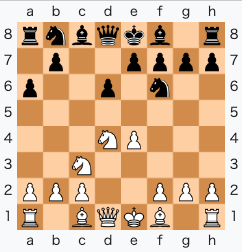 a8 black rookb8 black knightc8 black bishopd8 black queene8 black kingf8 black bishoph8 black rookb7 black pawne7 black pawnf7 black pawng7 black pawnh7 black pawna6 black pawnd6 black pawnf6 black knightd4 white knighte4 white pawnc3 white knighta2 white pawnb2 white pawnc2 white pawnf2 white pawng2 white pawnh2 white pawna1 white rookc1 white bishopd1 white queene1 white kingf1 white bishoph1 white rook The rules of games like chess have formal normativity: they prescribe which moves are allowed or prohibited but their normative authority exists only relative to the game and can be overridden by other considerations.[34] A normative reason is pro tanto if it favors an action or state in a certain respect or from a specific perspective. For example, if a joke is funny, then this is a pro tanto reason for telling it. However, pro tanto reasons are limited considerations that do not take everything into account and can be defeated by other reasons. If the joke would offend someone, this is a separate pro tanto reason for not telling it. Normative all-things-considered assessments, by contrast, take all relevant factors into account. They weigh all advantages and disadvantages and prescribe an action or state as a conclusive judgment not limited to domain-specific considerations.[35] A closely related distinction is between formal and robust normativity, also discussed as generic and authoritative normativity. Formal normativity arises from any standards or norms relative to which a mistake can be made. It is a pervasive phenomenon in everyday life, encompassing domains such as law, linguistic conventions, table manners, and games. For example, the rules of chess belong to formal normativity, like the prescription that pawns may move forward but not backward. The normative authority of this type of formal standard typically depends on context and can be overridden by other considerations. Robust normativity, by contrast, carries genuine normative force independent of contingent frameworks.[34] Others Various types of normativity are distinguished by the domain to which they belong. For example, moral normativity concerns duties, rights, and moral obligations as well as standards of praise and blame. It is closely related to legal normativity, which covers the authority of the legal system, and political normativity, which encompasses the exercise of political power. Linguistic normativity, another type, is about following linguistic conventions, such as the rules of grammar. Similarly, rational normativity governs the standards of correct reasoning.[36] Instrumental normativity encompasses normative requirements that depend on external goals. For example, if a person should attend a concert, then they should make the necessary preparations, such as buying a ticket. In such cases, there is an end or a goal that should be achieved, and the required means of implementation in some sense inherit the normative force attached to the goal.[37] Instrumental normativity is closely related to hypothetical normative requirements, which depend on the desires or intentions of a person. The normative force of categorical requirements, by contrast, applies independently of what an individual wants.[38] A similar distinction is between necessary norms, which apply equally to any situation, and contingent norms, which apply only to specific circumstances or contexts. For example, region-specific laws against smoking in bars are contingent norms.[39]  Photo of a female doctor with white hair and glasses Agent-relative normative requirements can arise from a person's social role, such as responsibilities of medical professionals.[40] Agent-relative normativity encompasses requirements that in some sense depend on and affect a specific person but not others. It may arise from the particular social role of a person, such as standards or expectations associated with being a teacher, doctor, or mother. Previous behavior can also be a source of agent-relative normativity, like when someone should do something because they made a promise. Agent-relative normativity contrasts with agent-neutral normativity, which applies equally to everyone.[40] Another distinction is between constitutive and regulative norms. Constitutive norms are part of the definition of a specific activity. For example, the constitutive norms of soccer determine what counts as a goal and how players may interact with the ball. People who do not follow constitutive norms of an activity are not engaged in this activity. Regulative norms are commands, prohibitions, or permissions about how people should behave, and violating them is a type of mistake.[41] There are different normative statuses corresponding to whether something is obligatory, prohibited, or permitted. In some cases, it may also be possible to do more than is normatively required, a state known as supererogation.[42] The concepts used to express normative status can be either thin or thick. Thin normative concepts express a purely normative assessment without any additional information, such as the terms ought, should, right, and wrong. Thick normative concepts include descriptive information beyond a purely normative evaluation. For instance, the terms courageous, kind, brutal, and callous not only give a normative judgment but also convey information about character and emotional quality. They typically explain why or in what sense the normative assessment applies.[43] |
類型 学術文献では、領域、内容、権威、または視点によって区別されるいくつかの規範性の類型が議論されている。[18] いくつかの区別は重複したり、より具体的な亜類型を形成するために組み合わされたりする場合がある。どの類型だけが真の規範性の形態であるか、あるいはあ る種類が他の種類よりもより基本的であるかについては、理論的な意見の相違がある。[19] 実践的規範性と理論的規範性 実践的規範性は、行動や人々が決定し、意図し、行うべき事柄を扱う。正しい行動の基準や、ある行動方針を別のものより支持する理由に関心を持つ。これは、 人々がどう考えるべきか、何を信じるべきかを規定する理論的規範性(認識論的規範性)とは対照的である。理論的規範性は、真偽や知識に関連する心的状態や 信念形成過程に関わる。例えば、「彼女は飲酒をやめるべきだ」という文は実践的規範性に属し、「証拠なしに噂を信じるべきではない」という文は理論的規範 性に属する。[20] この二種類はしばしば別々に研究され、倫理学の分野は実践的側面に、認識論の分野は理論的側面に焦点を当てる。とはいえ、多くの類似点と相互作用が存在す る。例えば、信念は行動規範に影響を与えることがある。ケーキを焼くために卵が必要だと信じている人が卵を買うべきだと考える場合がそれだ。同様に、実践 的な結果が信念規範に影響を与えることもある。例えば、些細な用件なら銀行が土曜日に開いていると信じることは正当化されるが、住宅ローンを滞納して家を 失うリスクがある場合には正当化されない。 場合によっては、実践的規範性と理論的規範性が衝突し、この種のジレンマをどう解決すべきか、あるいは解決可能か否かという問題が生じる。例えば、友人に 対する否定的な見解を採用すべき強い証拠がある場合、理論的規範性はそれを要求する一方、友情に基づく実践的規範性は疑わしきは罰せずの態度を要求するか もしれない。虚偽を信じることで認識的規範に違反する行為が、肯定的な実践的結果をもたらす場合にも同様のジレンマが生じうる。[23] 義務的規範性と評価的規範性 義務的規範性は、正しい思考と行動に直接適用される規範を扱う。これらの規範は、正しい・間違っている・義務・許可といった概念を通じて、個人に何をすべ きかを指示し、特定の行動様式を要求することで行動を導く。これに対し、評価的規範性は価値や善悪に関するものである[c]。それは称賛に値するものを記 述し、「善」「悪」「称賛に値する」「徳ある」といった概念を通じて表現される[25][d]。 この二つの規範性の形態は密接に関連し、しばしば重なり合う。例えば、ある行為が善であるか、あるいは善の結果をもたらすゆえに正しいとされる場合がそれ である。しかし、それらは同一ではなく、分離しうる。例えば、ある価値判断は誰の制御も及ばないため、行動の指針となり得ない。[27]義務的規範性と評 価的規範性の関係については、一方がより根本的で他方を定義し得るという考え方を含め、複数の理論が提案されている。[28]狭義に理解される規範性は、 時に義務的規範性に限定される。[29] 客観性と主体性 ある要求が、個人の信念や知識に関係なく適用される場合、それは客観的に規範的である。対照的に、主体的規範性は、個人の視点や入手可能な情報に依存す る、情報相対的な要求を含む。[30][e] 客観的規範性と主観的規範性は、人が客観的にすべきことと、同時に主観的にすべきと信じることとが一致する時に重なる。しかし、個人が情報を欠いていたり 誤った情報を持っていたりすると、意図しない悪い結果を招く行動につながる可能性があり、両者は分離しうる。例えば、入手可能な全ての証拠が薬が患者の病 気を治すと示唆しているにもかかわらず、実際にはその特定の患者にとって致命的であるという状況がこれに当たる。この場合、患者は主体的には錠剤を服用す べきだが、客観的にはそうではない。[32] 両規範性の関係や、両者が同等に基本的かつ権威的であるか否かについては、様々な学術的議論が存在する。[33] プロ・タントと総合的考慮 a8 黒ルークb8 黒ナイトc8 黒ビショップd8 黒クイーンe8 黒キングf8 白ビショップh8 白ルークb7 黒ポーンe7 黒ポーンf7 黒ポーンg7 黒ポーンh7 黒ポーンa6 黒ポーンd6 黒ポーンf6 黒ナイトd4 白ナイトe4 白ポーンc3 白ナイトa2 白ポーンb2 白ポーンc2 白ポーンf2 白ポーンg2 白ポーンh2白ポーンa1白ルークc1白ビショップd1白クイーンe1白キングf1白ビショップh1白ルーク チェスのようなゲームのルールには形式的な規範性がある。つまり、どの手が許されるか禁止されるかを規定するが、その規範的権威はゲームに対してのみ相対 的に存在し、他の考慮事項によって覆される可能性がある。[34] 規範的理由が「ある点において」有効であるとは、特定の観点や特定の視点から、ある行動や状態を支持することを意味する。例えば、ジョークが面白いなら、 それはそれを言う「ある点において」有効な理由となる。しかし、プロ・タントの理由は限定的な考慮事項であり、あらゆる要素を考慮するわけではなく、他の 理由によって覆される可能性がある。その冗談が誰かを不快にさせるなら、それは冗談を言わないための別のプロ・タントの理由となる。これに対し、規範的な 総合的評価は、関連する全ての要素を考慮に入れる。全ての利点と欠点を秤にかけ、領域固有の考慮事項に限定されない決定的な判断として行動や状態を規定す る。[35] 密接に関連する区別として、形式的規範性と強固な規範性がある。これは一般的規範性と権威的規範性としても議論される。形式的規範性は、誤りが生じ得るあ らゆる基準や規範から生じる。これは法律、言語慣習、テーブルマナー、ゲームなどの領域を含む、日常生活に遍在する現象である。例えばチェスのルールは、 ポーンは前進できるが後退できないという規定と同様に、形式的規範性に属する。この種の形式的基準の規範的権威は通常、文脈に依存し、他の考慮事項によっ て覆される可能性がある。これに対し、強固な規範性は、偶発的な枠組みに依存しない真の規範的効力を有する。[34] その他 様々な種類の規範性は、それらが属する領域によって区別される。例えば、道徳的規範性は義務、権利、道徳的責務、そして賞賛や非難の基準に関わる。これは 法制度の権威を扱う法的規範性や、政治的権力行使を包含する政治的規範性と密接に関連している。言語的規範性は文法規則など言語慣習の遵守に関するもので ある。同様に、合理的規範性は正しい推論の基準を規定する。[36] 手段の規範性は、外部の目的に依存する規範的要請を含む。例えば、コンサートに行くべきなら、チケット購入などの準備をすべきだ。こうした場合、達成すべ き目的や目標が存在し、その達成に必要な手段はある意味で目的に付随する規範的効力を継承する。[37] 手段の規範性は、個人の欲望や意図に依存する仮説的規範的要請と密接に関連している。これに対し、カテゴリー的要請の規範的効力は、個人の意思とは独立し て適用される。[38] 同様の区別として、あらゆる状況に等しく適用される必然的規範と、特定の状況や文脈にのみ適用される偶発的規範がある。例えば、バーでの喫煙を禁止する地 域固有の法律は偶発的規範である。[39] 白髪で眼鏡をかけた女性医師の写真 行為者相対的規範的要請は、医療専門職の責任など、個人の社会的役割から生じうる。[40] 行為者相対的規範性は、特定の人物に依存し影響を与えるが他者には適用されない要請を含む。教師、医師、母親であることに関連する基準や期待など、個人の 特定の社会的役割から生じうる。過去の行動も行為者相対的規範性の源泉となり得る。例えば、約束したから行動すべきという場合だ。行為者相対的規範性は、 誰にでも等しく適用される行為者中立的規範性と対比される。[40] 別の区別として、構成的規範と規制的規範がある。構成的規範は特定の活動の定義の一部だ。例えばサッカーの構成的規範は、何が得点となるか、選手がボール とどう関わるかを決める。活動の構成的規範に従わない者は、その活動に従事していないことになる。規制的規範は、人々がどう振る舞うべきかについての命 令、禁止、許可であり、これを破ることは一種の間違いだ。[41] 規範の地位には、義務的、禁止的、許容的といった異なる種類がある。場合によっては、規範的に要求される以上のことを行うことも可能であり、この状態は超 義務的行為と呼ばれる。[42] 規範の地位を表現する概念は、薄い概念と厚い概念に分けられる。薄い規範的概念は、「~すべき」「~であるべき」「正しい」「間違っている」といった用語 のように、追加情報なしに純粋に規範的評価を表現する。厚い規範概念は、純粋な規範的評価を超えた記述的情報を含む。例えば「勇気ある」「親切」「残忍」 「冷酷」といった用語は、規範的判断を示すだけでなく、性格や感情的性質に関する情報も伝える。これらは通常、規範的評価がなぜ、あるいはどのような意味 で適用されるかを説明するものである。[43] |
| Theories Various theories of the nature and sources of normativity have been proposed. They seek to determine what all forms of normativity have in common, how normative requirements arise, and what grounds their authority.[44] Theories further aim to explain how normative ideas motivate actions and how their demands are justified.[45] Some address what normative statements mean (semantics) or how people can know about them (epistemology), while others address their underlying reality (metaphysics).[46] Certain theories are mutually exclusive, meaning that if one is true, the other has to be false. Others provide complementary accounts that can be combined without contradiction. The study of the nature and sources of normativity across domains, such as ethics, epistemology, and law, is called meta-normative theory.[47] Realism and anti-realism Normative realism is the view that there are objective normative facts about what is right and wrong, similar to physical facts about the weight and shape of objects. Normative realists typically hold that normative sentences can be true or false and that at least some are true. They further emphasize that their truth depends on objective facts, i.e., that it is not just a matter of opinions, feelings, or intentions, but that truth is grounded in mind-independent reality. Anti-realists deny that normativity is a substantial or fundamental feature of reality.[48] There are intermediate positions without a universally accepted terminology. For example, the view that normativity is real but subjective does not belong to realism in a narrow sense but may be included under a broader understanding of the term.[49] Realist theories are divided into naturalism and non-naturalism. Naturalists argue that normative features are part of the natural world, meaning that there is no essential difference between normative facts and the empirical facts studied by the natural sciences. Non-naturalists assert that normative facts belong to a distinct part of reality. This outlook is often combined with the ideas that one cannot deduce normative sentences from empirical sentences, that empirical observation alone cannot reveal normative facts, and that a distinct source of knowledge, such as rational intuition, is required.[50] Realism is typically paired with cognitivism, a view about the meaning of normative sentences. Cognitivists assert that normative claims represent what the world is like and have truth values. Non-cognitivists reject the idea that normative sentences can be true or false. They usually accept that normative language has some form of meaning and have proposed several ways to explain its meaning without representation and truth values. Expressivism is one such proposal arguing that normative language is used to express personal attitudes and emotions. According to one version of expressivism, to say that an action is wrong means that the speaker dislikes the action, similar to yelling "Boo!" as a sign of disapproval. Non-cognitivism is primarily associated with anti-realism, but it is also possible to combine cognitivism with anti-realism. For example, error theory holds that normative statements have truth values and that all of them are false because there are no normative facts.[51] A key topic in the debate between realists and anti-realists concerns the distinctive character of normative facts, leading critics to describe normativity as an odd or "queer" phenomenon. They assert that irreducible prescriptions would be mysterious entities that are not easily integrated into a scientific worldview. A similar objection focuses on knowledge of normative facts and suggests that how people acquire and justify normative beliefs is equally odd and undermines their credibility. Supporters of realism hold that normative facts are required to explain experiences and practices associated with normativity. For instance, claims about what should be are typically formulated like claims about what is, indicating that the former can be true or false just like the latter. Another line of support maintains that when people disagree and argue about normative judgments, they implicitly assume the existence of an underlying truth since there would be no genuine disagreement otherwise.[52] |
理論 規範性の本質と源泉に関する様々な理論が提唱されてきた。それらは、あらゆる形態の規範性に共通する要素、規範的要請がどのように生じるか、そしてその権 威の根拠を明らかにしようとするものである。[44] さらに理論は、規範的観念がどのように行動を促すか、またその要求がどのように正当化されるかを説明することを目指す。[45] 規範的命題の意味(意味論)や、人々がそれらをいかに知り得るか(認識論)を扱う理論もあれば、その根底にある現実(形而上学)を扱う理論もある。 [46] 特定の理論は互いに排他的であり、一方が真ならば他方は偽となる。また、矛盾なく組み合わせ可能な補完的な説明を提供する理論もある。倫理学、認識論、法 学など様々な領域における規範性の本質と源泉を研究する学問は、メタ規範理論と呼ばれる。[47] 現実主義と非現実主義 規範的現実主義とは、物体の重量や形状に関する物理的事実と同様に、何が正しく何が間違っているかについての客観的な規範的事実が存在するという見解であ る。規範的実在論者は通常、規範的命題が真偽を持ち、少なくとも一部は真であると主張する。さらに、その真偽は客観的事実、すなわち単なる意見・感情・意 図の問題ではなく、心から独立した現実に根ざしていると強調する。反実在論者は、規範性が現実の本質的・根本的特徴であることを否定する[48]。普遍的 に受け入れられた用語のない中間的立場も存在する。例えば、規範性が実在するが主体的なものであるという見解は、狭義の現実主義には属さないが、より広義 の現実主義の理解には含まれる可能性がある。[49] 現実主義理論は自然主義と非自然主義に分けられる。自然主義者は、規範的特徴は自然世界の一部であり、規範的事実と自然科学が研究する経験的事実との間に 本質的な差異はないと主張する。非自然主義者は、規範的事実は現実の別個の領域に属すると主張する。この見解はしばしば、経験的命題から規範的命題を導出 できないこと、経験的観察だけでは規範的事実を明らかにできないこと、理性的な直観のような別個の知識源が必要であることといった考えと結びつく。 [50] 現実主義は通常、規範的命題の意味に関する見解である認知主義と組み合わされる。認知主義者は、規範的主張が世界のあり様を表し、真偽値を持つと主張す る。非認知主義者は、規範文が真偽を持つという考えを拒否する。彼らは通常、規範言語が何らかの意味を持つことを認めつつ、表象や真偽値なしにその意味を 説明する複数の方法を提案してきた。表現主義はその一例であり、規範言語は個人的な態度や感情を表現するために用いられると論じる。ある表現主義の立場に よれば、ある行為が間違っていると述べることは、話者がその行為を嫌悪していることを意味する。これは非難の印として「ブー!」と叫ぶことに似ている。非 認知主義は主に反実在論と結びついているが、認知主義と反実在論を組み合わせることも可能だ。例えば誤謬説は、規範的命題は真偽値を持ち、規範的事実が存 在しないためそれら全てが偽であると主張する。[51] 実在論者と反実在論者の論争における核心的課題は、規範的事実の特異性にあり、批判者は規範性を奇妙あるいは「クィア」な現象と描写する。彼らは、還元不 能な規範的命題は科学的世界観に容易に統合できない神秘的な実体だと主張する。同様の異議は規範的事実の認識に焦点を当て、人々が規範的信念を獲得し正当 化する方法が同様に奇妙であり、その信頼性を損なうと示唆する。現実主義の支持者は、規範性に関連する経験や実践を説明するには規範的事実が必要だと主張 する。例えば「あるべきこと」に関する主張は、通常「あること」に関する主張と同様に表現される。これは前者が後者と同様に真偽を持つことを示唆してい る。別の支持論は、人々が規範的判断について意見が分かれ議論する際、暗黙のうちに基盤となる真実の存在を前提としていると主張する。さもなければ真の意 見の相違は生じ得ないからだ。[52] |
| Primitivism and reductionism Closely related to the realism debate is the distinction between primitivism and reductionism. Primitivism, also called normativism, argues that normative concepts or facts are fundamental. This means that they cannot be defined in non-normative terms or clarified without circularity.[53] Quietist realism combines primitivism with realism: it accepts the existence of moral phenomena but denies that any substantive explanation is possible. Instead of developing a positive account of the nature of normativity, it defends realism indirectly by diagnosing mistakes that lead philosophers to adopt anti-realism.[54] Primitivism is typically embraced by non-naturalists to emphasize the autonomy of the normative domain from scientific explanation. However, naturalist primitivism is also possible as the view that normativity is accessible through natural investigation but not analyzable in terms of other natural phenomena.[55] Primitivism contrasts with reductionism, which seeks to explain normative concepts through non-normative ones. Reductionists do not outright deny the existence of normativity but hold that it is not something entirely novel or mysterious since it can be analyzed through unproblematic and well-understood concepts. Reductionism often takes the form of naturalism by seeking to show how empirical features, such as mental attitudes studied by psychologists, form the foundation of normativity.[56] In a slightly weaker sense, reduction can also mean that one type of normative concept or fact is explained through another, such as conceptual analyses that define what ought to be in terms of reasons, values, or goals.[57] The discussion between primitivism and reductionism is closely related to the is–ought problem—the question of whether one can deduce what ought to be from what is. For example, if a pro-life advocate uses scientific facts about fertilization to prove that abortion is wrong, they attempt to derive a normative conclusion from descriptive premises. It is controversial whether this type of proof can be valid in principle. Critics argue that normative knowledge belongs to a different domain than descriptive knowledge, meaning that empirical data cannot directly justify moral principles. According to them, people formulate invalid arguments, termed naturalistic fallacies, if they ignore these boundaries.[58] |
原始主義と還元主義 現実主義論争と密接に関連する概念が、原始主義と還元主義の区別である。原始主義(規範主義とも呼ばれる)は、規範的概念や規範的事実が根本的であると主 張する。これは、それらが非規範的用語で定義できず、循環論法なしには明確化できないことを意味する。[53] 静観的現実主義は原始主義と現実主義を組み合わせる:道徳的現象の存在は認めるが、実質的な説明は不可能だと否定する。規範性の本質について積極的な説明 を展開する代わりに、反実在論を採用する哲学者の誤りを診断することで、間接的に実在論を擁護するのだ[54]。非自然主義者は通常、科学的説明からの規 範領域の自律性を強調するために原始主義を採用する。しかし、規範性は自然的調査を通じてアクセス可能だが、他の自然現象の用語では分析できないとする見 解として、自然主義的原始主義も可能である[55]。 プリミティヴィズムは、規範的概念を非規範的概念を通じて説明しようとする還元主義とは対照的である。還元主義者は規範性の存在を完全に否定するわけでは ないが、問題なくよく理解された概念を通じて分析可能であるため、規範性が全く新規で神秘的なものではないと主張する。還元主義はしばしば自然主義の形を 取り、心理学者によって研究される心的態度などの経験的特徴が、いかにして規範性の基盤を形成するかを示そうとする。[56] やや弱い意味では、還元とはある種の規範的概念や事実が別の概念によって説明されることも指す。例えば、あるべき状態を理由・価値・目標の観点から定義す る概念分析がこれに当たる。[57] プリミティヴィズムと還元主義の議論は、あるべき状態をある状態から導出できるかという「あるべき問題」と密接に関連している。例えば、生命尊重論者が受 精に関する科学的事実を用いて中絶の不正を証明しようとする場合、記述的前提から規範的結論を導出しようとしている。この種の証明が原理的に有効かどうか は議論の余地がある。批判派は、規範的知識は記述的知識とは異なる領域に属すると主張する。つまり、経験的データは道徳的原則を直接正当化できないという のだ。彼らによれば、この境界を無視すれば「自然主義的誤謬」と呼ばれる無効な議論を構築することになる。[58] |
Reason-based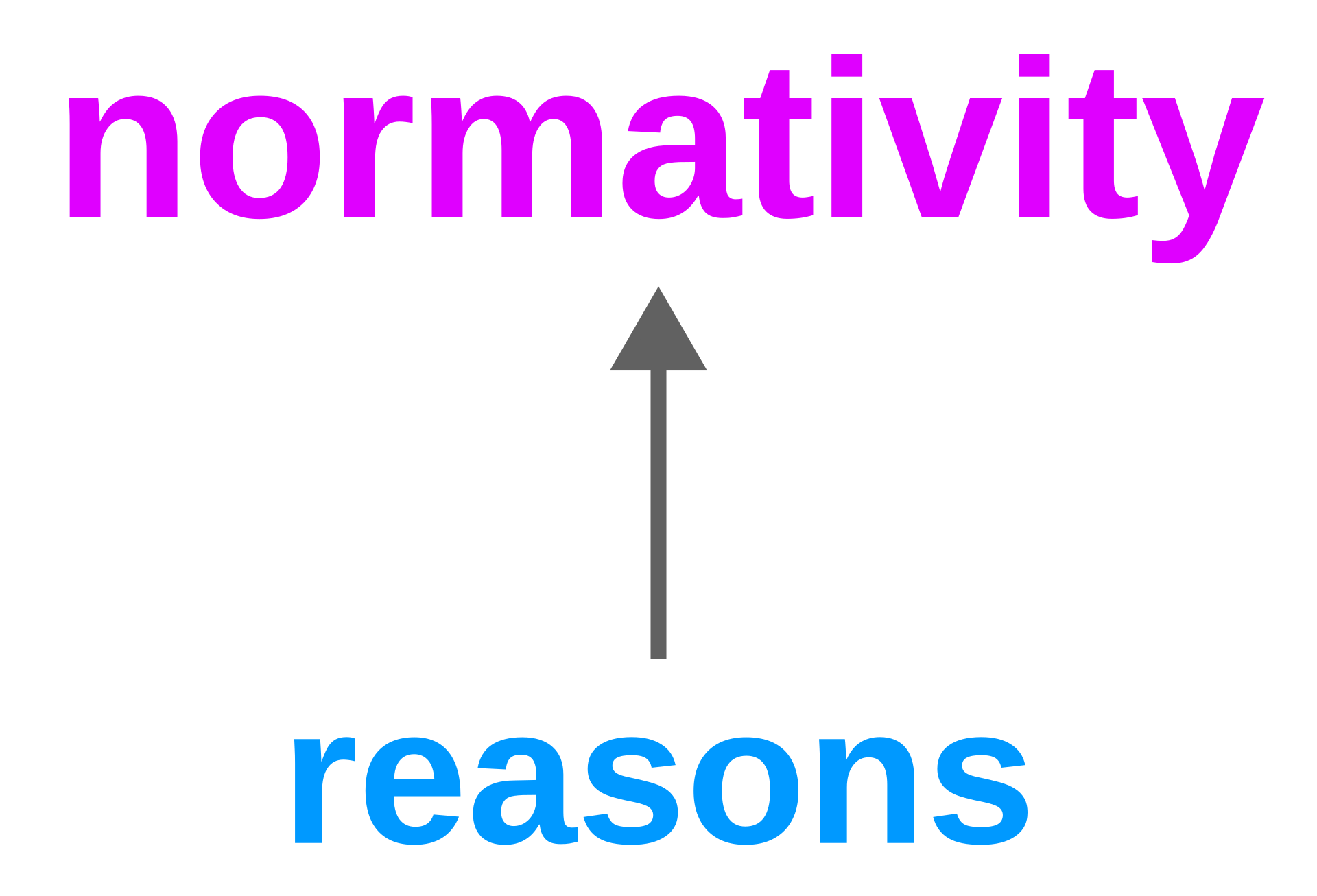 Diagram with the texts "normativity" and "reasons" and an arrow between them Reason-based theories explain normativity in terms of reasons.[59] Reason-based theories, sometimes called reasons first accounts, explain normativity in terms of reasons. This approach reduces other normative concepts, such as ought, should, right, and wrong, to facts about reasons.[f] For example, saying that someone ought to learn swimming may be interpreted as saying that there is an adequate or decisive reason to do so. Reasons are often treated as relational entities that connect a ground, such as the risk of drowning, to an appropriate response or state, such as learning to swim.[59] Normative reasons vary in strength: not all are sufficiently strong to fully justify a course of action and they may be counterbalanced by other reasons. Accordingly, reason-based theories typically focus on the balance of reasons or argue that a sufficient or decisive reason determines the overall normative demand.[61][g] Reason-based accounts are primarily interested in normative reasons, which are distinguished from motivating reasons. From a forward-looking perspective, a motivating reason is a mental state that causes a person to act in a certain way. From a backward-looking perspective, a motivating reason explains why the person acted as they did. A normative reason, by contrast, is a fact or consideration that favors one course of action over another. It justifies what should or should not be done, regardless of whether a person responds to it. Motivating and normative reasons can overlap if a person's motivational state aligns with what normative reasons require, but they can come apart. For example, if someone falsely believes that their partner is unfaithful, there may be a motivating reason to punish them but no normative reason.[63] Many reason-based accounts aim to provide a unified explanation of different types of normativity, like practical normativity about what to do and theoretical normativity about what to believe. One proposed unification argues that both types are about following reasons: reasons that favor a course of action in the practical case and reasons that support a belief in the theoretical case.[64] Some reason-based accounts also seek to define values through reasons. For instance, the buck-passing account of goodness explains evaluative normativity in terms of reasons. It maintains that something is good if its features provide adequate reasons to have a positive attitude toward it, such as a favorable feeling, emotion, and desire.[65] Closely connected to reason-based accounts is the idea that normativity can be defined by focusing on how it guides reasoning and action without directly relying on the notion of reasons. For example, Ralph Wedgwood suggests that a concept is normative if it sets standards of what to think and do.[66] Internalism and externalism A central debate about the nature of reasons is between internalism and externalism.[67] Internalism is the view that normative reasons depend in some sense on the psychology of a person so that the individual can, at least in principle, be motivated by them. This does not mean that the person is actually motivated. It typically has a weaker requirement: the person would be motivated under the right conditions, for instance, upon proper reflection. Internalists highlight the psychological connection between reasons and action, arguing that a fact or consideration cannot become a normative reason without this link.[68] Externalists accept that there is a psychological connection in some cases but deny that it is essential. For them, it is conceivable that a person is required to do something even if it is impossible for them to become motivated to do it. A central source of disagreement between internalism and externalism comes from moral absolutism, the view that some actions are wrong for anyone, independent of personal motivations and desires. For example, a moral absolutist may argue that Hitler's order to commit genocide was wrong in principle, independent of Hitler's psychology. While this outlook is compatible with externalism, it conflicts with internalism, which maintains that normative requirements must be able to guide actions.[69] |
理由=理性に基づく 「規範性」と「理由(リーズン=理性)」のテキストと、その間に矢印がある図 理由に基づく理論は、規範性を理由の観点から説明する。[59] 理由に基づく理論(理由第一主義とも呼ばれる)は、規範性を理由によって説明する。このアプローチは、「~すべき」「~であるべき」「正しい」「間違って いる」といった他の規範的概念を、理由に関する事実に還元する。[f] 例えば、「誰かが泳ぎを学ぶべきだ」と言うことは、「そうするに足る、あるいは決定的な理由がある」と言うこととして解釈されうる。理由はしばしば、溺れ る危険性といった根拠と、泳ぎを学ぶといった適切な対応や状態とを結びつける関係性を持つ実体として扱われる。[59] 規範的理由は強さに差がある:全てが行動方針を完全に正当化するほど十分に強いわけではなく、他の理由によって相殺されることもある。したがって、理由に 基づく理論は通常、理由のバランスに焦点を当てたり、十分あるいは決定的な理由が全体的な規範的要求を決定すると主張したりする。[61] [g] 理由に基づく説明は主に規範的理由に関心を持つ。これは動機付け理由とは区別される。将来を見据えた視点では、動機付け理由は人が特定の行動をとるように 促す心的状態である。過去を振り返る視点では、動機付け理由は人がなぜそうした行動をとったかを説明する。対照的に、規範的理由は一つの行動方針を他のも のより支持する事実や考慮事項である。それは、人がそれに応答するか否かに関わらず、何をすべきか、あるいはすべきでないかを正当化する。動機付けの理由 と規範的理由は、人の動機付け状態が規範的理由の要求と一致する場合に重なりうるが、分離することもある。例えば、誰かがパートナーの不貞を誤って信じて いる場合、その人を罰する動機付けの理由はあっても、規範的理由は存在しないかもしれない。[63] 多くの理由に基づく説明は、異なる種類の規範性(例えば、何をすべきかに関する実践的規範性と、何を信じるべきかに関する理論的規範性)を統一的に説明し ようとする。一つの統合案は、両者が理由に従うことに関わるとしている:実践的ケースでは行動方針を支持する理由が、理論的ケースでは信念を支える理由が それにあたる。[64] 理由に基づく説明の中には、理由を通じて価値を定義しようとするものもある。例えば、善の責任転嫁説は、評価的規範性を理由によって説明する。何かが善で あるとは、その特徴がそれに対する肯定的態度(好意的な感情、情緒、欲求など)を持つための十分な理由を提供するときだと主張する。[65] 理由に基づく説明と密接に関連するのは、規範性が理由の概念に直接依存せず、推論や行動をいかに導くかに焦点を当てることで定義できるという考えだ。例え ばラルフ・ウェッジウッドは、ある概念が何を考え何をすべきかの基準を設定する場合、それは規範的だと示唆している。[66] 内部主義と外部主義 理由の本質に関する中心的な論争は、内部主義と外部主義の間で行われている。[67] 内部主義とは、規範的理由がある意味で個人の心理に依存し、少なくとも原理的には個人がそれに動機づけられるという見解である。これは実際に動機づけられ ることを意味しない。通常、より弱い要件を伴う:適切な条件下、例えば適切な考察を経て、その人は動機づけられるだろうというものである。内部主義者は理 由と行動の心理的関連性を強調し、この結びつきなしに事実や考慮事項が規範的理由になり得ないと主張する。[68] 外部主義者は、心理的関連性が一部の事例では存在することを認めつつも、それが本質的ではないと否定する。彼らによれば、たとえ行動への動機付けが不可能 であっても、ある行為が要求される状況は考え得る。 |
Value-based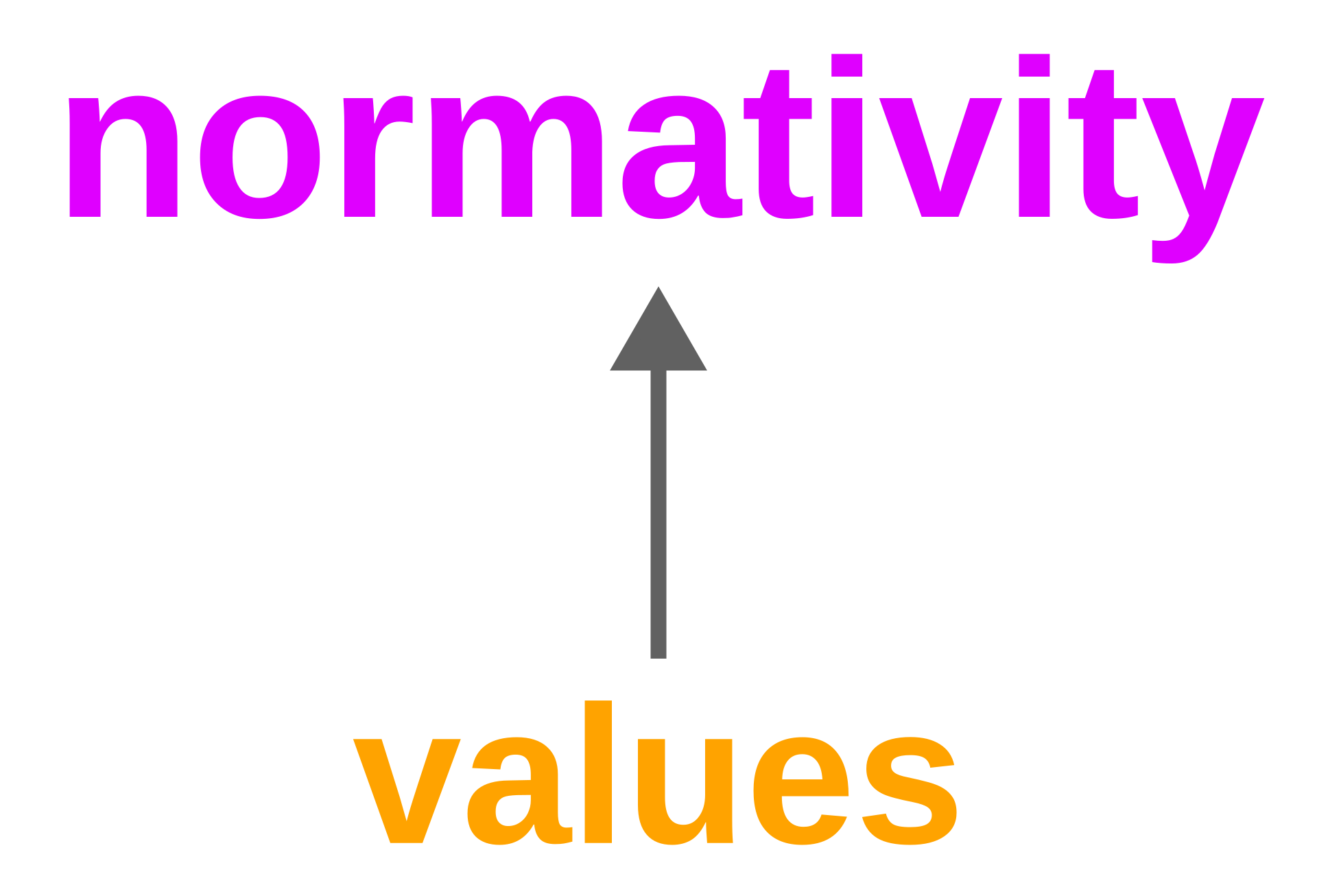 Diagram with the texts "normativity" and "values" and an arrow between them Value-based theories explain normativity in terms of values.[70] Value-based theories, also called value-first accounts, assert that normativity is ultimately grounded in values. They hold that values are fundamental and reduce other normative concepts to evaluative facts. The idea underlying this approach is that something should be done or ought to be the case because it is valuable or brings about values in some form.[70] Several value-based theories have been proposed. Consequentialism, a theory of practical normativity, asserts that an action is right if it brings about the best consequences. According to this view, the normative status of an action depends on the values of its consequences compared to the outcomes of alternative actions.[71] Not all value-based theories rely on the idea that the sum of values should be maximized.[72] For example, according to Joseph Raz's proposal, values provide reasons for what to do, and normativity is about compliance with all relevant reasons rather than value-maximization.[73] A different approach, advanced by Judith Jarvis Thomson, suggests that value standards of virtues and defects govern normative standards of correctness.[74] In the field of theoretical normativity, epistemic instrumentalism is the idea that standards of belief and justification are ultimately about epistemic values, such as truth, which act as cognitive goals.[75] |
価値に基づく 「規範性」と「価値」のテキストと、その間に矢印がある図 価値に基づく理論は、規範性を価値の観点から説明する。[70] 価値に基づく理論、別名価値優先説は、規範性が究極的には価値に根ざしていると主張する。それらは価値が根本的であり、他の規範的概念を評価的事実に還元 すると考える。このアプローチの根底にある考え方は、何かを行うべきである、あるいはそうあるべきである理由は、それが価値を持つか、何らかの形で価値を もたらすからだというものである。[70] いくつかの価値に基づく理論が提案されている。実践的規範性の理論である帰結主義は、行動が最良の結果をもたらすならば正しいと主張する。この見解によれ ば、行為の規範的地位は、代替行為の結果と比較したその帰結の価値に依存する[71]。全ての価値基盤理論が価値の総和を最大化すべきという考えに依拠す るわけではない[72]。例えばジョセフ・ラズの提案によれば、価値は「何をすべきか」の理由を提供し、規範性は価値最大化ではなく、全ての関連する理由 への順守に関わる。[73] ジュディス・ジャービス・トムソンが提唱する異なるアプローチでは、美徳と欠陥の価値基準が正しさの規範的基準を支配するとされる。[74] 理論的規範性の分野では、認識的功利主義とは、信念と正当化の基準が究極的には、認知的目標として機能する真実性などの認識的価値に関わるという考え方で ある。[75] |
| Other theories Normative formalism asserts that normativity is merely a formal feature of rules and norms. In this sense, any rule that calls for something is equally normative, including rules of games, social conventions, and moral imperatives. This view does not distinguish between unimportant or empty rules, which people may freely ignore, and robust or authoritative rules, which have genuine normative authority.[76] Objectualism and conceptualism disagree about the kinds of entities that have normative properties. Objectualism asserts that normativity applies to worldly objects or states of affairs, a view typically combined with realism. Conceptualism argues that normativity is primarily found in the realm of thought as an aspect of concepts or ideas. It is more closely associated with anti-realism.[77] According to one proposal, mental phenomena are inherently normative, meaning that standards of correctness govern how they function, like justification and rationality as standards of beliefs.[78]  Photo of a woman wearing glasses and sitting at a table with a microphone Christine Korsgaard's work examines theories of the sources of normativity.[79] Constructivism, a related perspective, suggests that normativity depends on the mind and is ultimately a product of the will. It asserts that norms arise and acquire authoritative force because of the fundamental principles of how people deliberate about courses of action, make decisions, and commit themselves. For example, Christine Korsgaard argues that certain universal principles act as sources of normativity because they apply to all practical agents, similar to Immanuel Kant's categorical imperative, and that an individual cannot be a practical agent if they do not follow these principles.[79] Korsgaard categorizes historical theories of the sources of normativity into voluntarism, realism, reflective endorsement, and appeal to autonomy. Voluntarism grounds normativity in commands by a legitimate authority, such as God or a political ruler. Realism asserts that evaluative or normative facts have fundamental and mind-independent existence. The reflective endorsement view grounds normativity in human nature as norms that humans naturally desire, endorse, or uphold. The appeal to authority is a form of constructivism that interprets norms as fundamental laws of the will that are embedded in autonomous agents who have authority over themselves.[80] Epistemological theories explore how knowledge of normative statements is possible. Intuitionism holds that humans have a special cognitive ability to rationally grasp some normative statements directly as self-evident truths, similar to the immediate insight into certain mathematical principles.[81] Other approaches see empirical observation as the source of normative knowledge or argue for coherentism, according to which normative beliefs mutually support each other by forming part of a coherent web of beliefs.[82] Philosophers question whether there is fundamentally only a single normative property that can explain all normative phenomena. An alternative view suggests that normativity encompasses a family of properties that express related but distinct aspects but cannot be unified.[83] The theory of perspectivism[h] uses this idea to explain the diversity of theories and the deep disagreements between them. It suggests that the term normativity is ambiguous by referring to several connected phenomena. This view proposes that theorists sometimes talk about distinct phenomena, meaning that they do not really disagree but merely address different questions under the same label.[85] Universalism is the view that some normative standards apply equally to everyone, regardless of their culture. It contrasts with cultural relativism, which asserts that normative requirements are culture-dependent. According to this view, the standards of right and wrong vary between societies and must be judged relative to culture-specific contexts without universal or transcultural standards.[86] |
その他の理論 規範的形式主義は、規範性が規則や規範の単なる形式的特徴に過ぎないと主張する。この意味では、何かを要求するあらゆる規則は等しく規範的であり、ゲーム の規則、社会的慣習、道徳的義務も含まれる。この見解は、人々が自由に無視できる重要でない規則や空虚な規則と、真の規範的権威を持つ強固な規則や権威あ る規則との区別をしない。[76] 対象論と概念論は、規範的性質を持つ実体の種類について意見が分かれる。対象論は、規範性が世俗的な対象や事象の状態に適用されると主張し、この見解は通 常、実在論と結びつく。概念主義は、規範性が主に思考の領域、すなわち概念や観念の一側面として存在すると言う。これは反実在論とより密接に関連してい る。[77]ある提案によれば、精神的現象は本質的に規範的であり、つまり正当性や合理性といった信念の基準のように、正しさの基準がその機能方法を支配 する。[78] 眼鏡をかけた女性がマイクを前に机に座っている写真 クリスティン・コルスガードの研究は規範性の源泉に関する理論を検証している[79]。 関連する視点である構成主義は、規範性が精神に依存し、究極的には意志の産物であると示唆する。規範は、人々が行動方針について熟議し、決定を下し、自ら をコミットする根本原理ゆえに生じ、権威的な力を獲得すると主張する。例えばクリスティン・コルスガードは、特定の普遍的原理が規範性の源泉として機能す ると論じる。それらはイマヌエル・カントの定言命法のように全ての行為主体に適用され、これらの原理に従わない者は行為主体となり得ないという。[79] コルスガードは規範性の源泉に関する歴史的理論を、意志主義、現実主義、反省的承認、自律性への訴えに分類する。意志主義は、神や政治的支配者といった正 当な権威による命令に規範性を基盤づける。現実主義は、評価的・規範的事実が心を超越した根本的実在を持つと主張する。反省的承認論は、規範を人間が自然 に欲求し、支持し、維持する規範として人間性に基盤づける。権威への訴えは、自律的行為者(自己に対する権威を持つ主体)に内在する意志の根本法則として 規範を解釈する構成主義の一形態である。[80] 認識論的理論は、規範的命題の知識が如何にして可能かを探究する。直観主義は、人間が特定の数学原理への直観的洞察と同様に、一部の規範的命題を自明の真 理として直接的に理性的に把握する特殊な認知能力を有すると主張する。[81] 他のアプローチは、経験的観察を規範的知識の源泉と見なすか、あるいは規範的信念が相互に支え合う一貫性主義を主張する。これによれば、規範的信念は一貫 した信念の網の一部を形成することで相互に支え合う。[82] 哲学者たちは、全ての規範的現象を説明し得る根本的に単一の規範的性質が存在するかどうかを問う。別の見解は、規範性が関連しつつも異なる側面を表現する 性質の集合を包含するが、それらを統一することはできないと示唆する。[83] 視点主義[h]はこの考えを用いて、理論の多様性と理論間の深い対立を説明する。規範性という用語は複数の関連現象を指すため曖昧であると示唆する。この 見解によれば、理論家たちは時に異なる現象について語っており、実際には意見が対立しているのではなく、同じラベルの下で異なる問題に取り組んでいるに過 ぎない。[85] 普遍主義とは、規範的基準の一部が文化に関係なく全ての人に等しく適用されるという見解である。これは規範的要求が文化依存的だと主張する文化相対主義と 対比される。この見解によれば、善悪の基準は社会間で異なり、普遍的または超文化的な基準なしに、文化固有の文脈に対して相対的に判断されなければならな い。[86] |
| In various fields Philosophy Many branches of philosophy are interested in normativity. Ethics examines practical normativity, with its subfields focusing on distinct aspects. Normative ethics studies general standards of right behavior, such as the utilitarian maxim of promoting the greatest happiness for the greatest number. Applied ethics explores normative requirements in specific domains, like business practices and the treatment of animals. Meta-ethics investigates the assumptions underlying normative assessments, including whether moral judgments can be objectively true.[87] Political philosophy, a related field, considers the norms and values guiding political action.[i] It examines which uses of political power are legitimate and compares political ideologies describing desirable social arrangements, such as liberalism, socialism, conservatism, and anarchism.[89] Epistemology deals with theoretical normativity. It studies the sources of knowledge, norms of justification, and standards of belief formation.[90] It overlaps with the philosophy of mind, which is interested in the normativity of mental phenomena covering beliefs and other psychological processes, such as desires, feelings, and intentions. Among other things, it seeks to discern under what conditions a particular mental state is appropriate, such as norms of rationality.[91] Logic, another connected discipline, studies the standards of correct reasoning and argumentation. It examines rules of inference, such as modus ponens, and fallacies, which fall short of the norms of good reasoning, such as false dilemmas.[92] It includes deontic logic, a framework for the logical analysis of obligations and permissions.[93] |
様々な分野において 哲学 哲学の多くの分野は規範性に関心を持つ。倫理学は実践的規範性を検討し、その下位分野は異なる側面に焦点を当てる。規範倫理学は、最大多数の最大幸福を促 進するという功利主義の格律など、正しい行動の一般的な基準を研究する。応用倫理学は、ビジネス慣行や動物の扱いといった特定の領域における規範的要件を 探求する。メタ倫理学は、道徳的判断が客観的に真となり得るかを含め、規範的評価の根底にある前提を調査する。[87] 関連分野である政治哲学は、政治行動を導く規範と価値を考察する。[i] 政治権力のどの行使が正当かを探究し、リベラリズム、社会主義、保守主義、アナキズムなど、望ましい社会秩序を記述するイデオロギーを比較する。[89] 認識論は理論的規範性を扱う。知識の源泉、正当化の規範、信念形成の基準を研究する。[90] これは心の哲学と重なり、信念や欲望・感情・意図などの心理的過程を含む精神的現象の規範性に興味を持つ。とりわけ、特定の精神的状態が適切な条件(合理 性の規範など)を見極めようとする。[91] 論理学は関連する別の分野であり、正しい推論と議論の基準を研究する。推論規則(例えばモダスポネンシス)や、良質な推論の規範に満たない誤謬(例えば偽 のジレンマ)を検証する。[92] 義務と許可の論理的分析の枠組みである義務論的論理学を含む。[93] |
| Psychology Norm psychology examines normative cognition, which encompasses psychological processes involved in learning, following, and enforcing norms. Norms in this context are social rules, often informal and context-dependent, specifying what people may, must, or must not do. They can be learned explicitly through mentoring or implicitly through observation and inference. Once acquired, norms guide behavior and act as evaluative standards. Additionally, they motivate individuals to teach them to others and punish violations.[94][j] Some normative cognitions are automatic and unconscious, while others are controlled and conscious. Researchers debate how the rules underlying a norm are stored in the mind, for instance, whether they are always internalized as explicit representations. Another academic discussion is about whether normative cognition is limited to specific mental domains. The alternative view suggests that it is associated with a general cognitive ability, making it relevant to most psychological processes. Psychologists further study what motivates normative behavior. Some proposals suggest intrinsic motivation, meaning that individuals uphold norms because they value a standard for its own sake. Others propose extrinsic motivation, arguing that the core motives come from external benefits associated with norm-guided behavior.[96] Evolutionary approaches seek to explain why normative cognition developed and how it confers adaptive advantages. Researchers typically focus on the pervasive social nature of humans and the role of norms in organizing and coordinating group behavior, resolving conflicts, and transmitting skills, such as tool use.[97] Developmental psychologists examine the natural tendency of humans to learn norms: by the ages of three to five, children typically grasp basic norms and also enforce them on others.[98] Moral psychology, another subfield, focuses on the empirical investigation of moral norms and related phenomena, such as altruism, moral emotions, and virtues.[99] Researchers also debate whether non-human animals are capable of normative cognition. Suggested examples include patterns of social conformity in chimpanzees and dominance hierarchies.[100] |
心理学 規範心理学は規範的認知を研究する。これは規範を学び、従い、強制する心理的プロセスを含む。この文脈での規範とは、人々が何をしてもよいのか、しなけれ ばならないのか、あるいはしてはならないのかを規定する社会的ルールであり、しばしば非公式で文脈依存的である。規範は指導を通じて明示的に、あるいは観 察と推論を通じて暗黙的に学習される。一度獲得された規範は行動を導き、評価基準として機能する。さらに、規範は個人に他者への規範伝達や違反行為への制 裁を促す動機となる。[94][j] 規範的認知には自動的・無意識的なものと、制御的・意識的なものがある。規範の基盤となる規則がどのように心に保存されるか、例えば常に明示的表象として 内面化されるのかについては研究者の間で議論がある。別の学術的議論は、規範的認知が特定の精神的領域に限定されるかどうかについてである。対立する見解 は、それが一般的な認知能力と関連しており、ほとんどの心理的プロセスに関連すると示唆している。心理学者はさらに、規範的行動を動機づけるものを研究し ている。いくつかの提案は内発的動機付けを示唆しており、つまり個人が規範を支持するのは、その基準自体を価値あるものと考えているからだという。他の提 案は外発的動機付けを提唱し、核心的な動機は規範に基づく行動に関連する外部的な利益から生じると主張している。[96] 進化論的アプローチは、規範的認知がなぜ発達したのか、そしてそれがどのように適応的優位性をもたらすのかを説明しようとする。研究者は通常、人間の普遍 的な社会的性質と、集団行動の組織化・調整、紛争解決、道具使用などの技能伝達における規範の役割に焦点を当てる。[97] 発達心理学者は、人間が規範を学ぶ自然な傾向を検証する。3歳から5歳までに、子供は通常、基本的な規範を理解し、他者に対してもそれを強制するようにな る。[98] 別の分科である道徳心理学は、利他主義、道徳的感情、美徳といった道徳規範と関連現象の実証的研究に焦点を当てる。[99] 研究者らは非人間動物が規範的認知能力を持つか否かも議論している。例として挙げられるのはチンパンジーの社会的同調パターンや支配階層である。 [100] |
| Sociology and anthropology Photo of people waiting in line at a train station Social norms are rules about how to behave in social contexts, such as waiting in a line instead of cutting to the front.[101] Sociology and anthropology examine norms as in-group phenomena that reflect shared expectations and play a central role in communal life. Social norms are rules about how to behave in social contexts. Some encourage certain behaviors, like the injunction to be honest, whereas others discourage a particular conduct, like the prohibition against stealing.[102] Social scientists distinguish norms from values since norms are typically enforced through material or symbolic punishments and rewards, such as fines or expressions of approval. They further differentiate norms from attitudes since norms are in-group phenomena that members widely accept, reflecting dominant attitudes shared by many individuals.[103] Group acceptance and enforcement also distinguish norms from mere regularities of behavior. Researchers examine social norms on various levels, ranging from particular subcultures to entire societies.[104] Some norms are enforced through centralized institutions, while others are maintained informally through interpersonal mechanisms.[105] Social norms play a role in many social sciences, and are of particular interest to anthropology and sociology. The exact characterization of norms varies with the field of inquiry. For example, cultural anthropologists emphasize the practical dimension, understanding norms as shared practices, while cognitive anthropologists focus on psychological aspects, characterizing norms as mental representations.[106] Social norms are found in every culture, but their exact content is historically contingent and differs from society to society, such as rules regarding sexual conduct prior to marriage.[107] Despite the variability, researchers observe universal patterns for how norms are passed on to others, children in particular, as an aspect of socialization. These patterns include steady and consistent repetition to build habits, general evaluative assessments of the learner, and the use of strong emotions to enforce those habits, often negative ones through some form of punishment.[108] Social norms can promote coordination within societies and make the behavior of others more predictable. However, not all norms are beneficial, and they can include harmful practices that discriminate against minorities or encourage dangerous behavior.[109] |
社会学と人類学 駅で列に並ぶ人々の写真 社会的規範とは、列に並んで割り込まないといった、社会的状況における行動のルールである[101]。 社会学と人類学は、規範を共同体内の現象として考察する。規範は共有された期待を反映し、共同生活において中心的な役割を果たす。社会規範とは、社会的文 脈における行動のルールである。ある規範は特定の行動を奨励する(例えば「正直であれ」という戒め)。一方で他の規範は特定の行為を抑制する(例えば窃盗 の禁止)。[102] 社会科学者は規範と価値観を区別する。規範は通常、罰金や称賛といった物質的・象徴的な罰則や報酬によって強制されるからだ。さらに規範は態度とも区別さ れる。規範は集団内現象であり、多くの個人が共有する支配的態度を反映して広く受け入れられるからだ[103]。集団による受容と強制は、単なる行動の規 則性と規範を区別する要素でもある。研究者は特定のサブカルチャーから社会全体に至る様々なレベルで社会規範を分析する[104]。規範には中央集権的機 関によって強制されるものもあれば、非公式な対人メカニズムによって維持されるものもある。[105] 社会規範は多くの社会科学で役割を果たし、特に人類学や社会学の関心事である。規範の正確な特徴付けは研究分野によって異なる。例えば文化人類学者は実践 的側面を重視し、規範を共有された慣行として理解する一方、認知人類学者は心理的側面に焦点を当て、規範を心的表象として特徴づける。[106] 社会的規範はあらゆる文化に見られるが、その具体的な内容は歴史的に依存し、社会ごとに異なる。例えば結婚前の性的行動に関する規則などがそうだ。 [107] この多様性にもかかわらず、研究者は規範が他者、特に子供に伝達される方法に普遍的なパターンを観察している。これは社会化の一側面である。こうしたパ ターンには、習慣形成のための持続的かつ一貫した反復、学習者に対する一般的な評価的判断、そして習慣を強化するための強い感情の活用が含まれる。後者で は、何らかの罰を通じて否定的な感情が用いられることが多い。[108] 社会規範は社会内の協調を促進し、他者の行動をより予測可能にする。しかし、全ての規範が有益なわけではなく、少数派を差別する有害な慣行や危険な行動を 助長するものも存在する。[109] |
Linguistics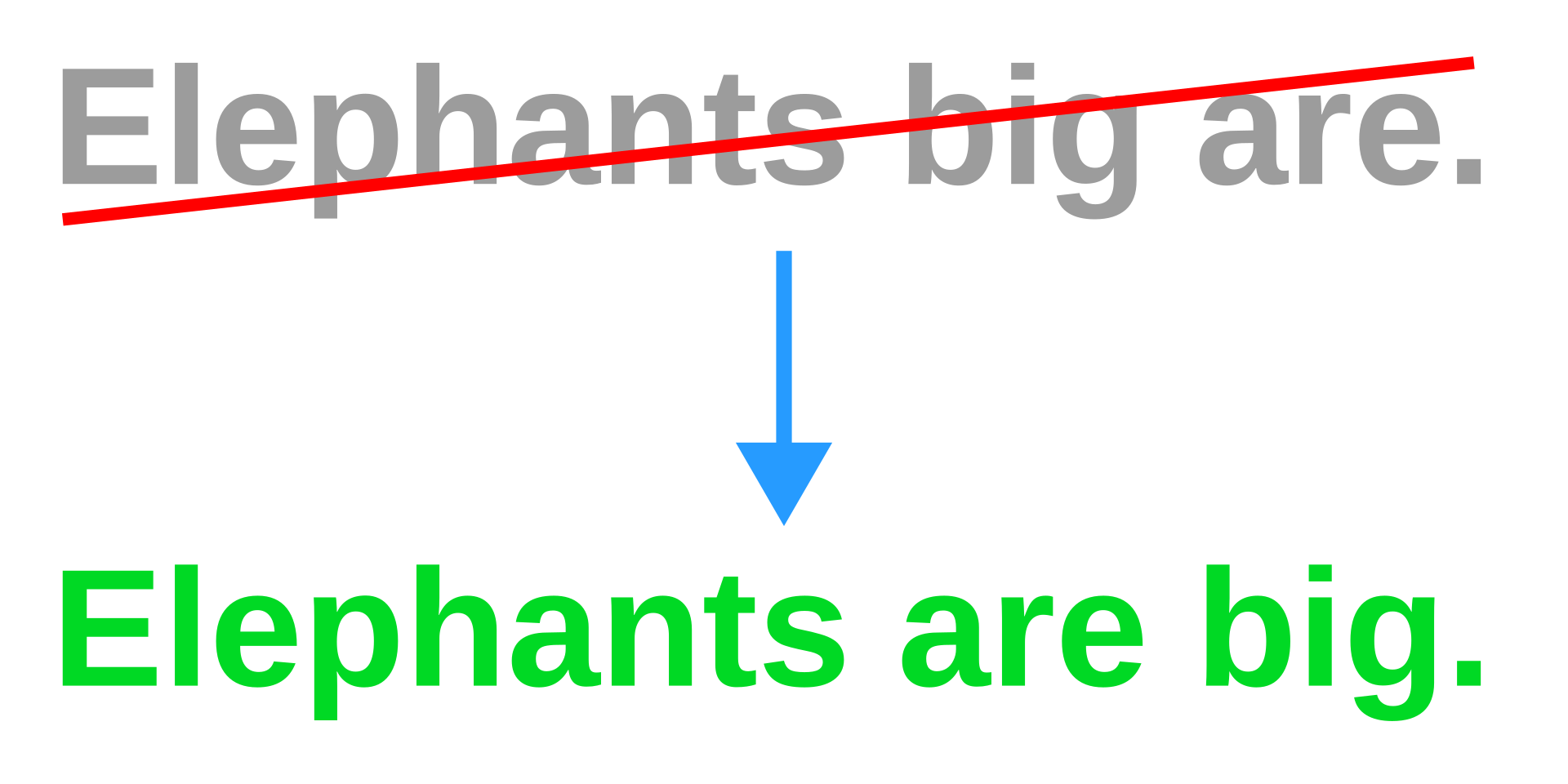 Diagram with a crossed-out sentence "Elephants big are.", an arrow, and the sentence "Elephants are big." Linguistic norms are standards of language use, such as grammatical rules of how words may be combined to form sentences.[110] Linguistic norms are conventional patterns or standards of correctness about language use in a speech community. Some govern the right pronunciation of words, while others address grammatical rules of how words may be combined to form sentences. Semantic norms guide the associations of meanings with words and larger expressions. There are also context-dependent conventions about word choice, such as levels of formality when addressing superiors. Some norms apply to all speakers of a language, while others are only shared by specific subgroups, such as regional dialects. Localized conventions can mark group boundaries and reinforce group identity. Linguistic norms may change over time as communities evolve.[110] Some linguistic norms govern patterns that speakers naturally acquire and use, such as forming plurals in English with the suffix -s. Others are idealized patterns that may not reflect actual practice, like the traditional injunction against ending English sentences with a preposition. Norms also depend on the modality of communication. The standards of spoken language are more flexible, and ill-formed expressions may nonetheless be understood through shared context. The standards of written language, by contrast, are typically stricter, partly because a shared context is not always available to guide reader interpretation.[111] Native speakers learn and employ many norms effortlessly without being aware of the exact rules they are following. They can form correct expressions and detect deviations but may not be able to provide an explicit definition of the underlying rules. Accordingly, compliance with linguistic norms arises less from conscious or intentional rule-following and more from an implicit sensitivity shaped by habit and reactions to deviant behavior.[112] Since communicating ideas is a central aspect of language, one source of linguistic normativity comes from the goal of being understood by following established conventions.[113] Several more specific theories of the underlying normative mechanisms have been suggested. One proposal, developed by John Searle, asserts that language is about communicating mental states, such as beliefs, desires, and intentions. According to this view, linguistic norms are required to make this possible.[114] |
言語学 「象は大きい」という文に×印が付き、矢印と「象は大きい」という文が書かれた図 言語規範とは、言葉がどのように組み合わされて文を形成するかといった文法規則など、言語使用の基準である。[110] 言語規範とは、言語共同体における言語使用の正しさに関する慣習的なパターンや基準である。単語の正しい発音を規定するものもあれば、単語を組み合わせて 文を形成する文法規則を扱うものもある。意味規範は、単語やより大きな表現に対する意味の関連付けを導く。また、目上の人への呼びかけにおける形式性のレ ベルなど、文脈に依存する語彙選択の慣習も存在する。規範の中には、言語の全話者に適用されるものもあれば、特定の下位集団(地域方言など)にのみ共有さ れるものもある。地域的な慣習は集団の境界を示すとともに、集団のアイデンティティを強化する。言語規範は、共同体の進化に伴い時間とともに変化する可能 性がある。[110] 言語規範の中には、話者が自然に習得し使用するパターンを規定するものもある。例えば英語で複数形を形成する際の-s接尾辞の使用などだ。他方、英語の文 を前置詞で終わらせてはならないという伝統的な戒めのように、実際の実践を反映しない理想化されたパターンもある。規範はコミュニケーションの様式にも依 存する。話し言葉の基準はより柔軟で、不適切な表現でも共有された文脈を通じて理解されることがある。対照的に、書き言葉の基準は通常より厳格である。こ れは、読者の解釈を導く共有文脈が常に存在するわけではないことも一因だ。[111] 母語話者は、従っている正確な規則を意識することなく、多くの規範を自然に学び、使用する。彼らは正しい表現を形成し、逸脱を検出できるが、その基盤とな る規則の明確な定義を提供できない場合がある。したがって、言語規範への順守は、意識的または意図的な規則遵守というより、習慣と逸脱行為への反応によっ て形成された暗黙の感受性から生じる。[112] 言語の核心的側面が思想の伝達である以上、言語規範性の源泉の一つは、確立された慣習に従うことで理解されるという目標にある。[113] 基盤となる規範的メカニズムに関するより具体的な理論がいくつか提案されている。ジョン・サールが展開した一つの提案は、言語が信念・欲求・意図といった 心的状態の伝達を目的としていると主張する。この見解によれば、言語規範はその実現に不可欠である。[114] |
| Law Normativity plays a central role in the field of law, governing the legal framework of institutional rules that regulate social behavior. Legal theorists and philosophers of law study the nature, authority, and justification of laws, examining how laws provide reasons for actions and how transgressions justify sanctions.[115] According to natural law theory, laws are meant to embody universal moral principles that reflect human nature. This view assumes that there is some kind of higher law—a natural or moral law—and holds that human-made laws are legitimate only insofar as they embody this natural law. Accordingly, the normative force of laws has its roots in moral standards that exist independently of any particular legal system, culture, or society.[116] Legal positivism, by contrast, understands laws as human conventions. It examines how laws are created, practiced, and applied to particular cases. On this view, laws are social or institutional facts that depend on the recognition and actions of the officials who implement them. Moral considerations can influence these processes, but legal positivists deny that they are an essential part. Accordingly, some laws may not be moral, and the legal question of whether a rule counts as a valid law is distinct from the moral question of whether the rule should be followed.[117] |
法 規範性は法分野において中心的な役割を果たし、社会的行動を規制する制度的規則の法的枠組みを支配する。法理論家や法哲学者は、法の性質、権威、正当性を 研究し、法が行動の理由をいかに提供し、違反が制裁をいかに正当化するかを検討する。[115] 自然法理論によれば、法は人間の本性を反映する普遍的な道徳原則を体現することを意図している。この見解は、ある種のより高い法——自然法あるいは道徳法 ——が存在すると仮定し、人間が作った法は、この自然法を体現する範囲でのみ正当であると主張する。したがって、法の規範的効力は、特定の法体系、文化、 社会とは独立して存在する道徳的基準に根ざしている。[116] これに対し、法実証主義は法を人間の慣習として理解する。この立場では、法律がどのように制定され、運用され、個別の事例に適用されるかを検証する。この 見解によれば、法律はそれを実施する当局者の認識と行動に依存する社会的・制度的事実である。道徳的考慮がこれらの過程に影響を与えることはあるが、法実 証主義者はそれが本質的な要素ではないと否定する。したがって、一部の法律は道徳的でない可能性があり、ある規則が有効な法律として認められるかという法 的問題は、その規則に従うべきかという道徳的問題とは区別される。[117] |
| Other fields Although economics is primarily a descriptive science of the production, distribution, and consumption of commodities, some of its areas deal with normative issues. Normative economics is a subfield dedicated to prescriptive analysis by examining ideals or standards of economic activities. One such standard is efficiency, which evaluates and compares economic arrangements based on the quantity of resources required to achieve a desired goal. Equity, another ideal, is about the distribution of costs and benefits, seeking to ensure an equal and fair treatment of all individuals engaged in economic activities.[118] Normative economics includes welfare economics, which evaluates processes and policies based on their contribution to social well-being.[119] Normative economics contrasts with positive economics, which focuses on empirical description and explanation of economic phenomena.[120][k] In the field of medicine, standards of correctness govern the distinction between health and pathology. They can be understood as functional norms of how an organism and its parts should work. Philosophers of medicine debate whether the norms governing health and pathology can be grounded in scientific facts. According to naturalism, diseases, such as cancer, can be defined as biological dysfunctions in value-neutral terms. Normativists, by contrast, argue that diseases are essentially bad in some respect, meaning that only deviations with bad consequences, such as reduced well-being, count as diseases. A closely related view argues that the evaluative standards of good and bad or the distinction between health and pathology depend on social conventions that vary across times and cultures. For instance, homosexuality was historically considered a disease by medical professionals, a view that changed in the 20th century.[122] Neuroscientists study how brain processes produce normative cognitions. For example, they explore the brain areas and neural activities linked to the feeling of guilt after having done something wrong. They also compare responses associated with different types of normativity, like the contrast between social norms and moral imperatives.[123] While some fields of inquiry have normative phenomena as a topic, normativity is also relevant to descriptive sciences that investigate non-normative phenomena. One reason is that they adhere to standards distinguishing good from bad research. Accordingly, their theories and arguments are expected to satisfy principles such as internal coherence, validity, objectivity, empirical justification, and the scientific method.[124] |
その他の分野 経済学は主に商品の生産、分配、消費を記述する科学であるが、その一部は規範的問題を扱う。規範経済学は経済活動の理想や基準を検証することで規範的分析 を行う専門分野である。効率性はその基準の一つであり、望ましい目標達成に必要な資源量に基づいて経済的仕組みを評価・比較する。公平性という別の理想 は、費用と便益の分配に関するもので、経済活動に関わる全ての個人に対する平等かつ公正な扱いを確保しようとするものである[118]。規範経済学には福 祉経済学も含まれ、これは社会的幸福への貢献度に基づいてプロセスや政策を評価する[119]。規範経済学は、経済現象の経験的記述と説明に焦点を当てる 実証経済学と対比される[120][k]。 医学の分野では、正しさの基準が健康と病理の区別を規定する。これらは生物とその構成要素がどう機能すべきかという機能的規範として理解できる。医学哲学 者たちは、健康と病理を規定する規範が科学的事実に基づいて確立できるかどうかを論じている。自然主義によれば、癌などの疾病は価値中立的な用語で生物学 的機能不全として定義できる。これに対し規範主義者は、疾病は本質的に何らかの点で悪いものであり、幸福度の低下といった悪い結果を伴う逸脱のみが疾病と して数えられると主張する。密接に関連する見解では、善悪の評価基準や健康と病理の区別は、時代や文化によって異なる社会的慣習に依存するとされる。例え ば同性愛は、歴史的に医療専門家によって疾病と見なされていたが、この見解は20世紀に変化した。[122] 神経科学者は、脳の処理が規範的認知をどう生み出すかを研究する。例えば、何か悪いことをした後の罪悪感に関連する脳領域や神経活動を解明する。また、社 会規範と道徳的義務といった異なる規範性の類型に伴う反応を比較する。[123] 規範的現象を主題とする研究分野がある一方で、規範性は非規範的現象を調査する記述科学にも関連する。その理由の一つは、これらの科学が良質な研究とそう でない研究を区別する基準に従うからだ。したがって、それらの理論や議論は、内部整合性、妥当性、客観性、経験的正当性、科学的方法といった原則を満たす ことが求められる。[124] |
| References Notes a. Philosophers debate the precise relation between normative and descriptive claims. Some proposals deny that there is a strict distinction and define normativity in terms of non-normative phenomena.[5] b. For example, reason-first theories of normativity provide a unified account, arguing that normativity means that there is a reason to do or think something.[7] Self-interested evaluative norms, such as a person looking out for what is primarily good for them, belong to the subfield of prudential normativity.[24] According to one interpretation, evaluative normativity is attitude-guiding by prescribing how people should feel or evaluate.[26] Several subtypes of subjective normativity have been proposed based on the kind of information-relevance involved, for instance, whether it depends on any belief, only on reasonable beliefs, or on available evidence.[31] Reason fundamentalism, a closely related view, asserts that reasons are the most fundamental normative concepts and cannot be explained through other concepts.[60] Philosophers debate to what extent the awareness of reasons is primarily receptive as a sensitivity to considerations rather than an active or spontaneous endorsement.[62] The term perspectivism is also used in a slightly different sense for the theory that normative requirements are not absolute or universal for everyone but depend on the perspective of the individual.[84] Political philosophy differs in this respect from political science, which focuses on empirical description.[88] Understood in the widest sense, psychological normativity is not limited to cognitions that explicitly address normative issues: there are implicit norms governing the appropriateness of many or all mental states. For example, anger or grief are appropriate responses to some circumstances but not others, and the degree of an emotional response can also be adequate or excessive.[95] k. Additionally, economists sometimes rely in their models on normative theories of decisions or rational choices, which discuss the norms of good or ideal decisions.[121] |
参考文献 注釈 a. 規範的主張と記述的主張の正確な関係については、哲学者の間で議論がある。厳密な区別は存在せず、非規範的現象に基づいて規範性を定義する提案もある。 [5] b. 例えば、理由第一の規範性理論は統一的な説明を提供する。規範性とは、何かを行う、あるいは考える理由が存在することを意味すると主張する。[7] 自己利益に基づく評価的規範、例えば主に自己にとって有益なものを求める行為は、実用的な規範性の分野に属する。[24] ある解釈によれば、評価的規範性は、人々がどう感じるべきか、どう評価すべきかを規定することで態度を導くものである。[26] 主体性には、関与する情報の関連性の種類(例えば、いかなる信念にも依存するか、合理的な信念のみに依存するか、利用可能な証拠に依存するか)に基づい て、いくつかの亜種が提案されている。[31] 密接に関連する見解である理由原理主義は、理由が最も根本的な規範的概念であり、他の概念を通じて説明できないと主張する。[60] 哲学者たちは、理由の認識が、積極的・自発的な支持というよりも、考慮事項に対する感受性として主に受容的である程度について議論している。[62] 「視点主義」という用語は、規範的要請が絶対的・普遍的なものではなく、個人の視点に依存するという理論を指す、やや異なる意味でも用いられる。[84] 政治哲学はこの点で、経験的記述に焦点を当てる政治学とは異なる。[88] 最も広い意味で理解される心理的規範性は、規範的問題を明示的に扱う認知に限定されない。多くの、あるいは全ての精神的状態の適切性を規定する暗黙の規範 が存在する。例えば、怒りや悲しみは特定の状況では適切な反応だが、他の状況ではそうではない。感情的反応の程度もまた、適切である場合もあれば過剰であ る場合もある。[95] k. さらに、経済学者はモデルにおいて、良き決断や理想的な決断の規範を論じる規範的決定理論や合理的選択理論に依拠することがある。[121] |
| Citations 1. Kelly, Westra & Setman 2025, Lead section Copp & Morton 2022, Lead section Dancy 2000, pp. vii–viii McHugh, Way & Whiting 2018, pp. 1–2 Debru 2011, pp. 1–2 Dancy 2000, pp. vii–viii McHugh, Way & Whiting 2018, pp. 1–2 Debru 2011, p. 4 O'Neill 1996, pp. xi–xii Dancy 2000, pp. vii–viii McHugh, Way & Whiting 2018, pp. 1–2 Darwall 2001, Lead section Debru 2011, pp. 1–2 Dancy 2000, pp. viii McHugh, Way & Whiting 2018, pp. 1–2, 8–9 Skorupski 2007, pp. 247–248 Dancy 2000, pp. vii–viii McHugh, Way & Whiting 2018, pp. 1–2, 8–9 Finlay 2019, pp. 187–188 Dancy 2000, pp. xvi–xv O'Neill 1996, pp. xi–xv 10. Becker & Becker 2001, p. 1242 Wedgwood 2013, § Senses of 'Normative' Wedgwood 2013, § Normative Concepts Turner 2010, pp. 1–2 Debru 2011, pp. 1–2 OED staff 2025 MW staff 2025 MW staff 1991, p. 321 Korsgaard 1996, pp. 2–4 Kraut 2022, Lead section, § 11. The Historical Socrates: Early, Middle, and Late Dialogues Shields 2023, Lead section, § 4.1 Logic, § 12. Happiness and Political Association Brinkmann 2019, pp. 193–194 Schurz 2013, pp. 1–4 Sayre-McCord 2023, § 4. Is/Ought and the Open Question Argument Brinkmann 2019, pp. 190–191 Gorodeisky 2019, pp. 86–89 Pollok 2017, pp. 1–4, 18–19 Rouse 2016, pp. 547–548 Debru 2011, pp. 1–3 Wedgwood 2007, pp. 3–4, 22, 276 Wedgwood 2013, § Normative Concepts Copp & Morton 2022, Lead section Finlay 2019, pp. 187–188 Wedgwood 2007, pp. 118–119 Sepielli 2018, pp. 784–785 Wedgwood 2013, § Normative Concepts McHugh, Way & Whiting 2018, pp. 1–2 Reisner 2018, pp. 221–222 McPherson 2018, § Introduction McHugh, Way & Whiting 2018, pp. 1–2 McHugh, Way & Whiting 2018, pp. 2–3, 7–8 Kauppinen 2023, Lead section, § 2. Why Epistemic and Practical Reasons For Belief Don't Combine Crisp 2018, pp. 800–801 Copp & Morton 2022, Lead section Dancy 2000, pp. vii–viii Copp & Morton 2022, Lead section Orsi 2015, pp. 6–7 Hurka 2006, pp. 357–358 Wedgwood 2013, § Normative Concepts Copp & Morton 2022, Lead section Dancy 2000, pp. vii–viii Skorupski 2007, pp. 247–248 Wedgwood 2013, § Normative Concepts Wedgwood 2007, pp. 118–119 Sepielli 2018, pp. 784–785 Sepielli 2012, pp. 46–48 Sepielli 2012, pp. 46–48 Wedgwood 2013, § Normative Concepts Wedgwood 2007, pp. 118–119 Sepielli 2018, pp. 784–785 Sepielli 2018, pp. 784–786 Finlay 2019, pp. 204–205 McPherson 2018, § 2. Practical Normativity: Clarifying the Issue Kauppinen 2023, § 1. Formal and Authoritative Normativity Baker 2017, pp. 568–569 Alvarez & Way 2024, § 2. Normative Reasons Wedgwood 2013, § Normative Concepts Becker & Becker 2001, pp. 1242–1244 Glüer, Wikforss & Ganapini 2024, Lead section Debru 2011, pp. 1–2 Way 2010, pp. 1057–1058 Kiesewetter 2015, pp. 921–922 Finlay 2019, p. 211 McHugh, Way & Whiting 2018, pp. 13–14 Copp & Morton 2022, § 4.6 Explaining Normativity via Categorical requirements Baker 2017, pp. 576–577 Bykvist 2018, pp. 821–824 O'Neill 1996, pp. xiii–xiv Baker 2017, pp. 575–576 Aarnio 2012, pp. 65–66 McNamara & Van De Putte 2022, § 1.2 The Traditional Scheme and the Modal Analogies Belzer 1998, § 1. Standard Deontic Logic (SDL) Heyd 2019, Lead section Wedgwood 2013, § Normative Concepts Kirchin 2013, § Introduction Skorupski 2007, pp. 265–266 Wedgwood 2013, § Normative Concepts Finlay 2019, pp. 187–188 Korsgaard 1996, pp. 7–8, 12–14, 18–20 O'Neill 1996, pp. xi–xiii Korsgaard 1996, pp. 12–14 Wedgwood 2007, pp. vii, 1–2 Finlay 2019, pp. 187–188 Wedgwood 2013, § Normative Concepts Boghossian & Peacocke 2025, pp. 3–4 Copp & Morton 2022, § 3. Can Normativity Be Given a Naturalistic Explanation? Copp & Morton 2022, § 3. Can Normativity Be Given a Naturalistic Explanation? Oddie 2013, Lead section, § Are Value Claims Truth Evaluable?, § Value Realism by Degrees: a Flow Chart Copp & Morton 2022, § 3. Can Normativity Be Given a Naturalistic Explanation? Lutz 2023, Lead section, § 1. What Is Moral Naturalism? Ridge 2019, Lead section Copp & Morton 2022, § 1.1 Concept vs. World, § 2. Are There Any Normative Facts At All? – Error Theory, § 3.2 Normative Realism, 3.4.1 Anti-realist Conceptualism: Non-cognitivist Expressivism Jackson 2000, pp. 102–103 Skorupski 2000, pp. 116–117 Finlay 2019, pp. 191–193 Copp & Morton 2022, § 2. Are There Any Normative Facts At All? – Error Theory Boghossian & Peacocke 2025, pp. 4–7 Sayre-McCord 2023a, Lead section, § 1. Moral Disagreement Turner 2010, pp. 1–2, 9, 14–15 Wedgwood 2013, § Theories of Normative Concepts, § Normativity and Morality Turner 2010, p. 8 Copp & Morton 2022, § 3. Can Normativity Be Given a Naturalistic Explanation? Wedgwood 2007, pp. 4, 7–8 Wedgwood 2013, § Theories of Normative Concepts, § Normativity and Morality Copp & Morton 2022, § 3. Can Normativity Be Given a Naturalistic Explanation? Turner 2010, pp. 12–13 Wolf & Koons 2016, pp. xvi–xvii, 61–62 Copp & Morton 2022, § 3. Can Normativity Be Given a Naturalistic Explanation? Wedgwood 2013, § Theories of Normative Concepts King 2025, pp. 137–138 Star 2018, pp. 3–4 Schurz 2013, pp. 1–4 Sayre-McCord 2023, § 4. Is/Ought and the Open Question Argument Sinclair 2019, pp. 1–2 Dancy 2000, pp. vii–x Wallace 2012, pp. 18–20 Wedgwood 2013, § Normative Concepts Skorupski 2007, pp. 247–249 Star 2018, pp. 1–4 Star 2018, pp. 6–7 Skorupski 2007, pp. 251–253 Stratton-Lake 2018, pp. 275–279 Dancy 2000, pp. viii–ix Dancy 2000, pp. xii–xv Alvarez & Way 2024, Lead section, § 2. Normative Reasons, § 3. Motivating (and Explanatory) Reasons McNaughton & Rawling 2018, pp. 171–173 Star 2018, pp. 1–3 Dancy 2000, pp. vii–viii Schroeder 2018, pp. 46–48 Star 2018, pp. 6 Stratton-Lake 2018, pp. 275–276, 283–284 Debru 2011, pp. 4–5 Wedgwood 2007, pp. 6, 9, 82 Star 2018, pp. 3–4 Star 2018, pp. 3, 5–6 Paakkunainen 2018, pp. 143–144 Paakkunainen 2018, pp. 143–144 Finlay & Schroeder 2017, Lead section, § 1. Preliminaries Debru 2011, pp. 4–5 Paakkunainen 2018, pp. 143–150 Finlay & Schroeder 2017, Lead section, § 1. Preliminaries Debru 2011, pp. 4–5 Harman 2011, pp. 435–436, 440–441 Heuer 2022, pp. 1–4, 7–9, 16 Wedgwood 2013, § The Normativity of Morality Sinnott-Armstrong 2023, Lead section Haines, Lead section Hooker 2023, § 1. Utilitarianism Heuer 2022, pp. 7 Heuer 2022, pp. 1–4, 7–9, 16 Raz 2022, pp. 127–128 Harman 2011, pp. 435–441 Thomson 2008, pp. 1–2, 83–86 Côté-Bouchard 2021, pp. 5455–5456 Lockard 2013, pp. 1701–1702 Copp & Morton 2022, § 3. Can Normativity Be Given a Naturalistic Explanation? Finlay 2019, pp. 204–205 Baker 2017, pp. 568–569 Copp & Morton 2022, § 3. Can Normativity Be Given a Naturalistic Explanation? Copp 2024, pp. 31–34, 44–46 Wedgwood 2007, pp. vii, 2, 153–154 Kriegel 2010, pp. 185–186 Wallace 2012, pp. 18–22 Bagnoli 2024, Lead section O'Neill 1996, pp. xii–xv Korsgaard 1996, pp. 18–20 Debru 2011, p. 6 Boghossian & Peacocke 2025, pp. 4–6 Wedgwood 2007, pp. 8–9, 225–226 Wedgwood 2007, pp. 8–9, 233 Copp & Morton 2022, § 3. Can Normativity Be Given a Naturalistic Explanation? McHugh, Way & Whiting 2018, p. 6 Finlay 2019, pp. 187–189, 207–208, 215–216 Wedgwood 2018, pp. 23–29 Tilley 1998, pp. 272–274 Caney 2005, pp. 3–4, 25–26 Plant 1998, § 1. Universalism in Political Philosophy Dittmer, § 1. Applied Ethics as Distinct from Normative Ethics and Metaethic Norman 2005, p. 622 Nagel 2006, Lead section McHugh, Way & Whiting 2018, pp. 1–2 Wolff 2006, pp. 2–3 Wolff 2006, pp. 1–3 Moseley, Lead section, § 3. Political Schools of Thought Miller 1998, Lead section, § Political institutions and ideologies McHugh, Way & Whiting 2018, pp. 1–2 Crumley II 2009, p. 16 Carter & Littlejohn 2021, § Introduction: 1. What Is Epistemology? Zangwill 2010, pp. 21–22 Bayne 2021, pp. 50, 103, 227, 260 Steinberger 2022, Lead section, § 1. The normative status of what? Hintikka 2019, Lead section, § Nature and varieties of logic Belzer 1998, Lead section, § 1. Standard Deontic Logic (SDL) Kelly, Westra & Setman 2025, Lead section, § 1. Cognitive-Evolutionary Approach to Norms, 2.2 The Ontogeny of Normative Cognition Heyes 2024, pp. 12–13 Birch 2021, § The Skill Hypothesis Glock 2018, pp. 714 Brinkmann 2019, pp. 193–194, 199–200 Wedgwood 2007, pp. vii, 2, 153–154 Kriegel 2010, pp. 185–186 Kelly, Westra & Setman 2025, 1.2 The Architecture of Normative Cognition Kelly, Westra & Setman 2025, Lead section, § 1. Cognitive-Evolutionary Approach to Norms Birch 2021, § The Skill Hypothesis Machery & Mallon 2010, pp. 36–37 Kelly, Westra & Setman 2025, 2.2 The Ontogeny of Normative Cognition Glock 2018, pp. 714 Debru 2011, p. 5 Kelly, Westra & Setman 2025, 3.1 Normative Cognition and Moral Psychology Doris et al. 2020, Lead section, § 1. Introduction: What is Moral Psychology? Kelly, Westra & Setman 2025, 2.3 Normative Cognition in Nonhuman Animals Roughley & Bayertz 2019, pp. 38–40 Fagundes 2017, pp. 1179–1180 Horne 2018 Dandaneau 2007, pp. 3229–3232 Fischer & Niedenzu 2022, pp. 1–2 Benard 2008, pp. 536–538 Dandaneau 2007, pp. 3229–3232 Roughley 2019, pp. 16–19 Horne 2018 Brinkmann 2019, pp. 193–194 Horne 2018 Roughley & Bayertz 2019, pp. 38–40 Fischer & Niedenzu 2022, pp. 1–2 Horne 2018 Brinkmann 2019, pp. 189–190 Brinkmann 2019, pp. 193–194 Roughley & Bayertz 2019, pp. 40–41 Benard 2008, pp. 536–538 Roughley & Bayertz 2019, pp. 41–42 Dandaneau 2007, pp. 3229–3232 Roughley 2019, pp. 29–33 Gross 2006, pp. 698–701 Bowerman 2006, pp. 701–703 Bowerman 2006, pp. 701–703 Roughley 2019, pp. 29–33 Turner 2010, pp. 18–19 Roughley 2019, pp. 33–35 Giudice 2024, pp. 1–6 Giudice 2024, pp. 1–6 Himma, "Natural Law", Lead section, § 1. Two Kinds of Natural Law Theory Green & Adams 2025, Lead section, § 1. Development and Influence, § 2. The Existence and Sources of Law Himma, "Legal Positivism", Lead section, § 2. The Separability Thesis Black, Hashimzade & Myles 2009 Fleurbaey 2023, Lead section, § 1. Economics and Ethics Hausman 2010, pp. 321–322, 324–325, 327 Mishan 2008, § Lead section Fleurbaey 2023, § 1.1 Positive vs. Normative Economics Briggs 2023, Lead section Buchak 2022, Lead section Elliott 2019, pp. 755–756 Debru 2011, pp. 1–2, 6–7 Kingma 2025, pp. 49–50, 54–55, 61–62 Chadwick 2025, pp. 17–18, 21–22 123. Debru 2011, pp. 4–5 Hirstein 2022, pp. 327–329 12. Brinkmann 2019, pp. 192–193 |
引用 1. ケリー、ウェストラ、セットマン 2025、リードセクション コップ&モートン 2022、リードセクション ダンシー 2000、vii-viii ページ マクヒュー、ウェイ、ホワイティング 2018、1-2 ページ デブル 2011、1-2 ページ ダンシー 2000、vii-viii ページ マクヒュー、ウェイ、ワイティング 2018、1-2 ページ デブル 2011、4 ページ オニール 1996、xi-xii ページ ダンシー 2000、vii-viii ページ マクヒュー、ウェイ、ホイティング 2018、1-2 ページ ダーウォール 2001、リードセクション デブル 2011、1-2 ページ ダンシー 2000、viii ページ McHugh、Way、Whiting 2018、1-2、8-9 ページ Skorupski 2007、247-248 ページ Dancy 2000、vii-viii ページ McHugh、Way、Whiting 2018、1-2、8-9 ページ フィンレイ 2019、187-188 ページ ダンシー 2000、xvi-xv ページ オニール 1996、xi-xv ページ 10. ベッカー&ベッカー 2001、1242 ページ ウェッジウッド 2013、§「規範的」の意味 ウェッジウッド 2013、§規範的概念 ターナー 2010、pp. 1–2 デブル 2011、pp. 1–2 OED スタッフ 2025 MW スタッフ 2025 MW スタッフ 1991、p. 321 Korsgaard 1996、2-4 ページ Kraut 2022、リードセクション、§ 11. 歴史上のソクラテス:初期、中期、後期の対話 Shields 2023、リードセクション、§ 4.1 論理学、§ 12. 幸福と政治的連合 Brinkmann 2019、193-194 ページ シュルツ 2013, pp. 1–4 セイヤー=マッコード 2023, § 4. 実在/べき論と開放問題の議論 ブリンクマン 2019, pp. 190–191 ゴロデイスキー 2019, pp. 86–89 ポロック 2017、1-4 ページ、18-19 ページ ラウス 2016、547-548 ページ デブル 2011、1-3 ページ ウェッジウッド 2007、3-4、22、276 ページ ウェッジウッド 2013、§ 規範的概念 コップ&モートン 2022、リードセクション フィンレイ 2019、187-188 ページ ウェッジウッド 2007、118-119 ページ Sepielli 2018、784-785 ページ Wedgwood 2013、§ 規範的概念 McHugh、Way、Whiting 2018、1-2 ページ Reisner 2018、221-222 ページ マクファーソン 2018、§ 序論 マクヒュー、ウェイ、ホイティング 2018、1-2 ページ マクヒュー、ウェイ、ホイティング 2018、2-3 ページ、7-8 ページ カウピネン 2023、リードセクション、§ 2. 認識的理由と実践的理由が組み合わされない理由 Crisp 2018、800-801 ページ Copp & Morton 2022、リードセクション Dancy 2000、vii-viii ページ Copp & Morton 2022、リードセクション Orsi 2015、6-7 ページ Hurka 2006、357-358 ページ Wedgwood 2013、§ 規範的概念 Copp & Morton 2022、リードセクション Dancy 2000、vii-viii ページ Skorupski 2007、247-248 ページ ウェッジウッド 2013、規範的概念 ウェッジウッド 2007、118-119 ページ セピエリ 2018、784-785 ページ セピエリ 2012、46-48 ページ セピエリ 2012、46-48 ページ ウェッジウッド 2013, § 規範的概念 ウェッジウッド 2007, pp. 118–119 セピエリ 2018, pp. 784–785 セピエリ 2018, pp. 784–786 フィンレイ 2019, pp. 204–205 マクファーソン 2018, § 2. 実践的規範性:問題の明確化 カウピネン 2023, § 1. 形式的かつ権威的な規範性 ベイカー 2017, pp. 568–569 アルバレス&ウェイ 2024, § 2. 規範的理由 ウェッジウッド 2013, § 規範的概念 ベッカー&ベッカー 2001, pp. 1242–1244 グリューアー、ウィクフォルス&ガナピニ 2024, リードセクション デブル 2011, pp. 1–2 ウェイ 2010, pp. 1057–1058 Kiesewetter 2015、921-922 ページ Finlay 2019、211 ページ McHugh、Way、Whiting 2018、13-14 ページ Copp & Morton 2022、§ 4.6 規範性をカテゴリー要件で説明する ベイカー 2017、576-577 ページ ビークヴィスト 2018、821-824 ページ オニール 1996、xiii-xiv ページ ベイカー 2017、575-576 ページ アーニオ 2012、65-66 ページ マクナマラ&ヴァン・デ・パット 2022、§ 1.2 伝統的なスキームと様相の類推 ベルツァー 1998、§ 1. 標準的義務論理(SDL ヘイド 2019、リードセクション ウェッジウッド 2013、§ 規範的概念 カーチン 2013、§ 序論 Skorupski 2007、265-266 ページ Wedgwood 2013、§ 規範的概念 Finlay 2019、187-188 ページ Korsgaard 1996、7-8、12-14、18-20 ページ オニール 1996、xi–xiii ページ コースガード 1996、12–14 ページ ウェッジウッド 2007、vii、1–2 ページ フィンレイ 2019、187–188 ページ ウェッジウッド 2013、§ 規範的概念 ボゴシアン&ピーコック 2025、pp. 3–4 コップ&モートン 2022、§ 3. 規範性は自然主義的な説明が可能か? Copp & Morton 2022、§ 3. 規範性は自然主義的な説明が可能か? Oddie 2013、リードセクション、§ 価値主張は真偽評価可能か?、§ 段階的価値現実主義:フローチャート Copp & Morton 2022、§ 3. 規範性は自然主義的な説明が可能か? Lutz 2023、リードセクション、§ 1. 道徳的自然主義とは何か? Ridge 2019、リードセクション Copp & Morton 2022、§ 1.1 概念対世界、§ 2. 規範的事実はまったく存在しないのか?– 誤謬説、§ 3.2 規範的現実主義、3.4.1 反現実主義的概念主義:非認知主義的表現主義 Jackson 2000、102–103 ページ Skorupski 2000、116–117 ページ Finlay 2019、191–193 ページ コップ&モートン 2022、§ 2. 規範的事実はまったく存在しないのか?– 誤謬説 ボゴシアン&ピーコック 2025、4-7 ページ セイヤー=マッコード 2023a、リードセクション、§ 1. 道徳的意見の相違 ターナー 2010、1-2、9、14-15 ページ ウェッジウッド 2013、§ 規範的概念の理論、§ 規範性と道徳 ターナー 2010、p. 8 コップ&モートン 2022、§ 3. 規範性は自然主義的な説明が可能か? ウェッジウッド 2007、pp. 4、7–8 ウェッジウッド 2013、§ 規範的概念の理論、§ 規範性と道徳 コップ&モートン 2022、§ 3. 規範性は自然主義的な説明が可能か? ターナー 2010、12-13 ページ ウルフ&クーンズ 2016、xvi-xvii、61-62 ページ コップ&モートン 2022、§ 3. 規範性は自然主義的な説明が可能か? ウェッジウッド 2013、§ 規範的概念の理論 キング 2025、137-138 ページ スター 2018、3-4 ページ シュルツ 2013、1-4 ページ セイヤー=マッコード 2023、§ 4. あるべき姿と現実の姿、そして未解決の問題に関する議論 シンクレア 2019、pp. 1–2 ダンシー 2000、pp. vii–x ウォレス 2012、pp. 18–20 ウェッジウッド 2013、§ 規範的概念 スコルプスキ 2007, pp. 247–249 スター 2018, pp. 1–4 スター 2018, pp. 6–7 スコルプスキ 2007, pp. 251–253 ストラットン=レイク 2018, pp. 275–279 ダンシー 2000, pp. viii–ix ダンシー 2000, pp. xii–xv アルバレス&ウェイ 2024, 序論, § 2. 規範的理由, § 3. 動機付け(及び説明的)理由 マクノートン&ローリング 2018, pp. 171–173 スター 2018, pp. 1–3 ダンシー 2000, pp. vii–viii シュレーダー 2018, pp. 46–48 スター 2018, pp. 6 ストラットン=レイク 2018, pp. 275–276, 283–284 デブル 2011, pp. 4–5 ウェッジウッド 2007, pp. 6, 9, 82 スター 2018, pp. 3–4 スター 2018, pp. 3, 5–6 パークーナイネン 2018, pp. 143–144 Paakkunainen 2018、143-144 ページ Finlay & Schroeder 2017、リードセクション、§ 1. 予備知識 Debru 2011、4-5 ページ Paakkunainen 2018、143-150 ページ フィンレイ&シュローダー 2017、リードセクション、§ 1. 予備知識 デブル 2011、4-5 ページ ハーマン 2011、435-436 ページ、440-441 ページ ホイヤー 2022、1-4 ページ、7-9 ページ、16 ページ ウェッジウッド 2013、§ 道徳の規範性 シノット・アームストロング 2023、リードセクション ヘインズ、リードセクション フッカー 2023、§ 1. 功利主義 ホイヤー 2022、7 ページ ホイヤー 2022、1-4 ページ、7-9 ページ、16 ページ Raz 2022、127-128 ページ ハーマン 2011、435-441 ページ トムソン 2008、1-2 ページ、83-86 ページ コテ・ブシャール 2021、5455-5456 ページ ロックアード 2013、1701-1702 ページ コップ&モートン 2022、§ 3. 規範性は自然主義的な説明が可能か? フィンレイ 2019、204-205 ページ ベイカー 2017、568-569 ページ コップ&モートン 2022、§ 3. 規範性は自然主義的な説明が可能か? コップ 2024、31-34 ページ、44-46 ページ ウェッジウッド 2007、vii、2、153-154 ページ クリーゲル 2010、185-186 ページ ウォレス 2012、18-22 ページ バニョーリ 2024、リードセクション オニール 1996、xii-xv ページ コースガード 1996、18-20 ページ デブル 2011、6 ページ Boghossian & Peacocke 2025、4-6 ページ Wedgwood 2007、8-9 ページ、225-226 ページ Wedgwood 2007、8-9 ページ、233 ページ Copp & Morton 2022、§ 3. 規範性は自然主義的な説明が可能か? McHugh、Way、Whiting 2018、6 ページ Finlay 2019、187-189、207-208、215-216 ページ Wedgwood 2018、23-29 ページ Tilley 1998、272-274 ページ Caney 2005、3-4 ページ、25-26 ページ Plant 1998、§ 1。政治哲学における普遍主義 Dittmer、§ 1。規範倫理学およびメタ倫理学とは区別される応用倫理学 ノーマン 2005、622 ページ ネーゲル 2006、リードセクション マクヒュー、ウェイ、ワイティング 2018、1-2 ページ ウォルフ 2006、2-3 ページ ウォルフ 2006、1-3 ページ モーズリー、リードセクション、§ 3. 政治思想の学派 ミラー 1998、リードセクション、§ 政治制度とイデオロギー マクヒュー、ウェイ、ワイティング 2018、1-2 ページ クラムリー II 2009、16 ページ カーター&リトルジョン 2021、§ 序論:1. 認識論とは何か? ザンウィル 2010、21-22 ページ ベイン 2021、50、103、227、260 ページ スタインバーガー 2022、リードセクション、§ 1. 何の規範的ステータスか? ヒンティッカ 2019、リードセクション、§ 論理の性質と種類 ベルツァー 1998、リードセクション、§ 1. 標準的義務論理(SDL) Kelly, Westra & Setman 2025, リードセクション, § 1. 規範に対する認知進化論的アプローチ, 2.2 規範的認知の個体発生 Heyes 2024, pp. 12–13 Birch 2021, § スキル仮説 Glock 2018, pp. 714 Brinkmann 2019, pp. 193–194, 199–200 Wedgwood 2007, pp. vii, 2, 153–154 Kriegel 2010, pp. 185–186 ケリー、ウェストラ、セットマン 2025, 1.2 規範的認知の構造 ケリー、ウェストラ、セットマン 2025, 序論, § 1. 規範に対する認知進化論的アプローチ バーチ 2021, § スキル仮説 マシェリー&マロン 2010, pp. 36–37 Kelly, Westra & Setman 2025, 2.2 規範的認知の個体発生 Glock 2018, pp. 714 Debru 2011, p. 5 Kelly, Westra & Setman 2025, 3.1 規範的認知と道徳心理学 ドリスら 2020, 序論, § 1. 導入:道徳心理学とは何か? ケリー、ウェストラ&セットマン 2025, 2.3 非人間動物における規範的認知 ラフリー&バイエルツ 2019, pp. 38–40 ファグンデス 2017, pp. 1179–1180 ホーン 2018 ダンダノー 2007, pp. 3229–3232 フィッシャー&ニーデンツ 2022, pp. 1–2 ベナード 2008, pp. 536–538 ダンダノー 2007, pp. 3229–3232 ラフリー 2019, pp. 16–19 ホーン 2018 ブリンクマン 2019, pp. 193–194 ホーン 2018 ラフリー&バイエルツ 2019, pp. 38–40 フィッシャー&ニーデンツゥ 2022, pp. 1–2 ホーン 2018 ブリンクマン 2019, pp. 189–190 ブリンクマン 2019, pp. 193–194 ラフリー&バイエルツ 2019, pp. 40–41 ベナール 2008, pp. 536–538 ラフリー&バイエルツ 2019, pp. 41–42 ダンダノー 2007, pp. 3229–3232 ラフリー 2019、29-33 ページ グロス 2006、698-701 ページ バウアーマン 2006、701-703 ページ バウアーマン 2006、701-703 ページ ラフリー 2019、29-33 ページ ターナー 2010、18-19 ページ ラフリー 2019、33-35 ページ ジュディチェ 2024、1-6 ページ ジュディチェ 2024、1-6 ページ Himma、「自然法」、リードセクション、§ 1。2 種類の自然法理論 Green & Adams 2025、リードセクション、§ 1。発展と影響、§ 2。法律の存在と源泉 Himma、「法的実証主義」、リードセクション、§ 2。分離可能性説 Black、Hashimzade & Myles 2009 フルールベイ 2023、リードセクション、§ 1。経済学と倫理 ハウスマン 2010、321-322、324-325、327 ページ ミシャン 2008、§ リードセクション フルールベイ 2023、§ 1.1 実証経済学と規範経済学 ブリッグス 2023、リードセクション ブチャック 2022、リードセクション エリオット 2019、755-756 ページ デブル 2011、1-2 ページ、6-7 ページ キングマ 2025、49-50 ページ、54-55 ページ、61-62 ページ チャドウィック 2025、17-18 ページ、21-22 ページ 123. デブル 2011、4-5 ページ ハースタイン 2022、327-329 ページ 12. ブリンクマン 2019、192-193 ページ |
| Sources Aarnio, Aulis (2012). The Rational as Reasonable: A Treatise on Legal Justification. D. Reidel Publishing Company. ISBN 978-94-009-4700-9. Alvarez, Maria; Way, Jonathan (2024). "Reasons for Action: Justification, Motivation, Explanation". The Stanford Encyclopedia of Philosophy. Metaphysics Research Lab, Stanford University. Retrieved 19 October 2025. Bagnoli, Carla (2024). "Constructivism in Metaethics". The Stanford Encyclopedia of Philosophy. Metaphysics Research Lab, Stanford University. Retrieved 23 October 2025. Baker, Derek (2017). "The Varieties of Normativity". In McPherson, Tristram; Plunkett, David (eds.). The Routledge Handbook of Metaethics (1 ed.). Routledge. pp. 567–581. doi:10.4324/9781315213217-37. ISBN 978-1-315-21321-7. Bayne, Tim (2021). Philosophy of Mind: An Introduction. Routledge. ISBN 978-1-000-47106-9. Becker, Lawrence C.; Becker, Charlotte B., eds. (2001). Encyclopedia Of Ethics (Second ed.). Routledge. ISBN 0-415-93672-1. Belzer, Marvin (1998). "Deontic Logic". Routledge Encyclopedia of Philosophy. Routledge. Archived from the original on January 7, 2024. Retrieved 7 January 2024. Benard, Stephen (2008). "Norms". In Darity, William A. (ed.). International Encyclopedia of the Social Sciences. Vol. 5 (2nd ed.). The Gale Group. pp. 536–538. ISBN 0-02-865965-1. Birch, Jonathan (2021). "Toolmaking and the evolution of normative cognition". Biology & Philosophy. 36 (1). doi:10.1007/s10539-020-09777-9. Black, John; Hashimzade, Nigar; Myles, Gareth (2009). "Normative Economics". A Dictionary of Economics (3rd ed.). Oxford University Press. ISBN 9780199237043. Boghossian, Paul; Peacocke, Christopher (2025). "Normative Realism: An Introduction to the Issues". In Boghossian, Paul; Peacocke, Christopher (eds.). New Essays on Normative Realism (1 ed.). Oxford University PressOxford. pp. 1–16. doi:10.1093/9780198915140.003.0001. ISBN 978-0-19-891514-0. Bowerman, S. (2006). "Norms And Correctness". In Brown, Keith (ed.). Encyclopedia Of Language And Linguistics (2nd ed.). Elsevier. pp. 701–703. ISBN 9780080547848. Briggs, R. A. (2023). "Normative Theories of Rational Choice: Expected Utility". The Stanford Encyclopedia of Philosophy. Metaphysics Research Lab, Stanford University. Retrieved 13 October 2025. Brinkmann, Svend (2019). "Normativity in Psychology and the Social Sciences: Questions of Universality". In Valsiner, Jaan (ed.). Social Philosophy of Science for the Social Sciences. Springer International Publishing. pp. 189–201. doi:10.1007/978-3-030-33099-6_11. ISBN 978-3-030-33098-9. Buchak, Lara (2022). "Normative Theories of Rational Choice: Rivals to Expected Utility". The Stanford Encyclopedia of Philosophy. Metaphysics Research Lab, Stanford University. Retrieved 13 October 2025. Bykvist, Krister (2018). "35. Agent-Relative and Agent-Neutral Reasons". In Star, Daniel (ed.). The Oxford Handbook of Reasons and Normativity. Oxford University Press. pp. 821–838. doi:10.1093/oxfordhb/9780199657889.013.36. ISBN 978-0-19-965788-9. Caney, Simon (2005). Justice Beyond Borders. Oxford University Press. ISBN 978-0-19-829350-7. Carter, J. Adam; Littlejohn, Clayton (2021). This Is Epistemology: An Introduction. John Wiley & Sons. ISBN 978-1-119-68034-5. Chadwick, Ruth (2025). "Normality as Convention and as Scientific Fact". In Schramme, Thomas; Walker, Mary Jean (eds.). Handbook of the Philosophy of Medicine. Springer Netherlands. pp. 17–28. doi:10.1007/978-94-024-2252-8_9. ISBN 978-94-024-2251-1. Copp, David (2024). Ethical Naturalism and the Problem of Normativity. Oxford University Press. ISBN 978-0-19-760158-7. Copp, David; Morton, Justin (2022). "Normativity in Metaethics". The Stanford Encyclopedia of Philosophy. Metaphysics Research Lab, Stanford University. Retrieved 13 October 2025. Côté-Bouchard, Charles (2021). "Two types of epistemic instrumentalism". Synthese. 198 (6): 5455–5475. doi:10.1007/s11229-019-02415-2. Crisp, Roger (2018). "34. Prudential and Moral Reasons". In Star, Daniel (ed.). The Oxford Handbook of Reasons and Normativity. Oxford University Press. pp. 800–820. doi:10.1093/oxfordhb/9780199657889.013.35. ISBN 978-0-19-965788-9. Crumley II, Jack S. (2009). An Introduction to Epistemology (2 ed.). Broadview Press. ISBN 978-1-77048-156-5. Dancy, Jonathan (2000). "Editor's Introduction". In Dancy, Jonathan (ed.). Normativity. Blackwell Publishers. pp. vii–xv. ISBN 0-631-22041-0. Dandaneau, Steven P. (2007). "Norms". In Ritzer, George (ed.). The Blackwell Encyclopedia Of Sociology. Blackwell Publishing. pp. 3229–3232. ISBN 978-1-4051-2433-1. Darwall, Stephen (2001). "Normativity". Routledge Encyclopedia of Philosophy. Routledge. doi:10.4324/9780415249126-L135-1. ISBN 978-0-415-25069-6. Debru, Claude (2011). "The Concept of Normativity from Philosophy to Medicine: An Overview". Medicine Studies. 3 (1): 1–7. doi:10.1007/s12376-011-0056-6. Dittmer, Joel. "Ethics, Applied". Internet Encyclopedia of Philosophy. Archived from the original on June 1, 2023. Retrieved 23 December 2023. Doris, John; Stich, Stephen; Phillips, Jonathan; Walmsley, Lachlan (2020). "Moral Psychology: Empirical Approaches". The Stanford Encyclopedia of Philosophy. Metaphysics Research Lab, Stanford University. Retrieved 29 October 2025. Elliott, Edward (2019). "Normative Decision Theory". Analysis. 79 (4): 755–772. doi:10.1093/analys/anz059. Fagundes, David (2017). "The Social Norms of Waiting in Line". Law & Social Inquiry. 42 (04): 1179–1207. doi:10.1111/lsi.12256. Finlay, Stephen (2019). "Defining Normativity". In Plunkett, David; Shapiro, Scott J.; Toh, Kevin (eds.). Dimensions of Normativity (1 ed.). Oxford University Press. pp. 187–220. doi:10.1093/oso/9780190640408.003.0009. ISBN 978-0-19-064040-8. Finlay, Stephen; Schroeder, Mark (2017). "Reasons for Action: Internal vs. External". The Stanford Encyclopedia of Philosophy. Metaphysics Research Lab, Stanford University. Retrieved 24 October 2025. Fischer, Joachim; Niedenzu, Heinz-Jürgen (2022). "Anthropology and Sociology of Normativities". Österreichische Zeitschrift für Soziologie. 46 (S1). doi:10.1007/s11614-022-00494-z. Fleurbaey, Marc (2023). "Normative Economics and Economic Justice". The Stanford Encyclopedia of Philosophy. Metaphysics Research Lab, Stanford University. Retrieved 13 October 2025. Giudice, Michael (2024). The Normativity of Law. Cambridge University Press. ISBN 9781009209854. Glock, Hans-Johann (2018). "Critical Note: Language and Learning from the 4E Perspective;". In Newen, Albert; Bruin, Leon De; Gallagher, Shaun (eds.). The Oxford Handbook of 4E Cognition. Oxford University Press. pp. 707–719. ISBN 978-0-19-105435-8. Glüer, Kathrin; Wikforss, Åsa; Ganapini, Marianna (2024). "The Normativity of Meaning and Content". The Stanford Encyclopedia of Philosophy. Metaphysics Research Lab, Stanford University. Retrieved 13 October 2025. Gorodeisky, Keren (2019). "Unity in Variety: Theoretical, Practical, and Aesthetic Reason in Kant". In Gentry, Gerad; Pollok, Konstantin (eds.). The Imagination in German Idealism and Romanticism. Cambridge University Press. pp. 86–106. ISBN 978-1-107-19770-1. Green, Leslie; Adams, Thomas (2025). "Legal Positivism". The Stanford Encyclopedia of Philosophy. Metaphysics Research Lab, Stanford University. Retrieved 1 November 2025. Gross, S. (2006). "Normativity". In Brown, Keith (ed.). Encyclopedia Of Language And Linguistics (2nd ed.). Elsevier. pp. 698–701. ISBN 9780080547848. Haines, William. "Consequentialism and Utilitarianism". Internet Encyclopedia of Philosophy. Archived from the original on December 24, 2023. Retrieved 28 December 2023. Harman, Gilbert (2011). "Judith Jarvis Thomson's Normativity". Philosophical Studies. 154 (3): 435–441. doi:10.1007/s11098-011-9737-y. Hausman, Daniel M. (2010). "Hedonism and Welfare Economics". Economics and Philosophy. 26 (3): 321–344. doi:10.1017/S0266267110000398. Heuer, Ulrike (2022). "Introduction". In Heuer, Ulrike (ed.). The Roots of Normativity. Oxford University Press. ISBN 978-0-19-284700-3. Heyd, David (2019). "Supererogation". The Stanford Encyclopedia of Philosophy. Metaphysics Research Lab, Stanford University. Archived from the original on February 19, 2024. Retrieved 7 January 2024. Heyes, Cecilia (2024). "Rethinking Norm Psychology". Perspectives on Psychological Science. 19 (1): 12–38. doi:10.1177/17456916221112075. Himma, Kenneth Einar. "Legal Positivism". Internet Encyclopedia of Philosophy. Retrieved 1 November 2025. Himma, Kenneth Einar. "Natural Law". Internet Encyclopedia of Philosophy. Retrieved 1 November 2025. Hintikka, Jaakko J. (2019). "Philosophy of logic". Encyclopædia Britannica. Archived from the original on 28 April 2015. Retrieved 21 November 2021. Hirstein, William (2022). "Neuroscience and Normativity: How Knowledge of the Brain Offers a Deeper Understanding of Moral and Legal Responsibility". Criminal Law and Philosophy. 16 (2): 327–351. doi:10.1007/s11572-021-09600-w. Hooker, Brad (2023). "Rule Consequentialism". The Stanford Encyclopedia of Philosophy. Metaphysics Research Lab, Stanford University. Archived from the original on February 1, 2024. Retrieved 29 December 2023. Horne, Christine (2018). "Norms". Oxford Bibliographies Online. Oxford University Press. doi:10.1093/obo/9780199756384-0091. Retrieved 29 October 2025. Hurka, Thomas (2006). "13. Value Theory". In Copp, David (ed.). The Oxford Handbook of Ethical Theory. Oxford University Press. pp. 357–379. ISBN 978-0-19-514779-7. Jackson, Frank (2000). "5. Non-Cognitivism, Normativity, Belief". In Dancy, Jonathan (ed.). Normativity. Blackwell Publishers. pp. 100–115. ISBN 0-631-22041-0. Kauppinen, Antti (2023). "The Epistemic vs. the Practical". In Shafer-Landau, Russ (ed.). Oxford Studies in Metaethics. Vol. 18 (1 ed.). Oxford University Press. pp. 137–162. doi:10.1093/oso/9780198884699.003.0007. ISBN 978-0-19-888469-9. Kelly, Daniel; Westra, Evan; Setman, Stephen (2025). "The Psychology of Normative Cognition". The Stanford Encyclopedia of Philosophy. Metaphysics Research Lab, Stanford University. Retrieved 13 October 2025. Kiesewetter, Benjamin (2015). "Instrumental Normativity: In Defense of the Transmission Principle". Ethics. 125 (4): 921–946. doi:10.1086/680911. King, Alex (2025). "Normative-to-Normative Reducitonism and the Case of Aesthetics". In Kirchin, Simon (ed.). The Future of Normativity. Oxford University Press. pp. 137–158. ISBN 978-0-19-892775-4. Kingma, Elselijn (2025). "Disease as Scientific and as Value-Laden Concept". In Schramme, Thomas; Walker, Mary Jean (eds.). Handbook of the Philosophy of Medicine. Springer Netherlands. pp. 45–68. doi:10.1007/978-94-024-2252-8_75. ISBN 978-94-024-2251-1. Kirchin, Simon (2013). "Thick and Thin Concepts". International Encyclopedia of Ethics. John Wiley & Sons, Ltd. doi:10.1002/9781444367072.wbiee262. ISBN 978-1-4443-6707-2. Korsgaard, Christine (1996). O'Neill, Onora (ed.). The Sources of Normativity. Cambridge University Press. ISBN 978-0-521-55960-7. Kraut, Richard (2022). "Plato". The Stanford Encyclopedia of Philosophy. Metaphysics Research Lab, Stanford University. Retrieved 4 November 2025. Kriegel, Uriah (2010). "Intentionality and Normativity". Philosophical Issues. 20 (1): 185–208. doi:10.1111/j.1533-6077.2010.00182.x. Lockard, Matthew (2013). "Epistemic instrumentalism". Synthese. 190 (9): 1701–1718. doi:10.1007/s11229-011-9932-6. Lutz, Matthew (2023). "Moral Naturalism". The Stanford Encyclopedia of Philosophy. Metaphysics Research Lab, Stanford University. Archived from the original on October 2, 2019. Retrieved 20 December 2023. Machery, Edouard; Mallon, Ron (2010). "Evolution of Morality". In Doris, John M. (ed.). The Moral Psychology Handbook. Oxford University Press. pp. 3–46. ISBN 978-0-19-157687-4. McHugh, Conor; Way, Jonathan; Whiting, Daniel (2018). "Introduction". In McHugh, Conor; Way, Jonathan; Whiting, Daniel (eds.). Normativity: Epistemic and Practical. Oxford University Press. pp. 1–11. ISBN 978-0-19-875870-9. McNamara, Paul; Van De Putte, Frederik (2022). "Deontic Logic". The Stanford Encyclopedia of Philosophy. Metaphysics Research Lab, Stanford University. Archived from the original on February 1, 2024. Retrieved 7 January 2024. McNaughton, David; Rawling, Piers (2018). "7. Motivating Reasons and Normative Reasons". In Star, Daniel (ed.). The Oxford Handbook of Reasons and Normativity. Oxford University Press. pp. 171–196. doi:10.1093/oxfordhb/9780199657889.013.8. ISBN 978-0-19-965788-9. McPherson, Tristram (2018). "Explaining Practical Normativity". Topoi. 37 (4): 621–630. doi:10.1007/s11245-016-9442-8. Miller, David (1998). "Political Philosophy". In Craig, Edward (ed.). Routledge Encyclopedia of Philosophy. Routledge. doi:10.4324/9780415249126-S099-1. ISBN 978-0-415-07310-3. Mishan, E. J. (2008). "Welfare Economics". International Encyclopedia of the Social Sciences (2nd ed.). Macmillan. ISBN 978-0-02-865965-7. Moseley, Alexander. "Political Philosophy: Methodology". Internet Encyclopedia of Philosophy. Retrieved 6 April 2025. MW staff (1991). The Merriam-Webster New Book Of Word Histories. Merriam-Webster Incorporated. ISBN 9780877796039. MW staff (2025). "Normative". Merriam-Webster Dictionary. Merriam-Webster. Retrieved 16 October 2025. Nagel, Thomas (2006). "Ethics". In Borchert, Donald (ed.). Encyclopedia of Philosophy (2 ed.). Macmillan. ISBN 978-0-02-865790-5. Archived from the original on August 24, 2018. Retrieved January 7, 2024. Norman, Richard (2005). "Moral Philosophy, History of". In Honderich, Ted (ed.). The Oxford Companion to Philosophy. Oxford University Press. ISBN 978-0-19-926479-7. Archived from the original on January 29, 2021. Retrieved December 19, 2023. O'Neill, Onora (1996). "Introduction". In O'Neill, Onora (ed.). The Sources of Normativity. Cambridge University Press. ISBN 978-0-521-55960-7. Oddie, Graham (2013). "Value Realism". The International Encyclopedia of Ethics (1st ed.). Wiley. doi:10.1002/9781444367072.wbiee588. ISBN 978-1-4051-8641-4. OED staff (2025). "Normativity, n.". Oxford English Dictionary (3rd ed.). Oxford University Press. Orsi, Francesco (2015). Value Theory. Bloomsbury Publishing. ISBN 978-1-4725-2408-9. Paakkunainen, Hille (2018). "6. Internalism and Externalism about Reasons". In Star, Daniel (ed.). The Oxford Handbook of Reasons and Normativity. Oxford University Press. pp. 143–170. doi:10.1093/oxfordhb/9780199657889.013.7. ISBN 978-0-19-965788-9. Plant, Raymond (1998). "Political Philosophy, Nature of". Routledge Encyclopedia of Philosophy. Routledge. doi:10.4324/9780415249126-S044-1. ISBN 978-0-415-25069-6. Retrieved 3 May 2025. Pollok, Konstantin (2017). Kant's Theory of Normativity: Exploring the Space of Reason. Cambridge University Press. ISBN 978-1-108-11647-3. Raz, Joseph (2022). Heuer, Ulrike (ed.). The Roots of Normativity. Oxford University Press. ISBN 978-0-19-284700-3. Reisner, Andrew (2018). "11. Two Theses about the Distinctness of Practical and Theoretical Normativity Get access Arrow". In McHugh, Conor; Way, Jonathan; Whiting, Daniel (eds.). Normativity: Epistemic and Practical. Vol. 1. Oxford University Press. pp. 221–240. doi:10.1093/oso/9780198758709.003.0012. ISBN 978-0-19-875870-9. Ridge, Michael (2019). "Moral Non-Naturalism". The Stanford Encyclopedia of Philosophy. Metaphysics Research Lab, Stanford University. Archived from the original on 24 February 2024. Retrieved 20 December 2023. Roughley, Neil (2019). "Might We Be Essentially Normative Animals?". In Roughley, Neil; Bayertz, Kurt (eds.). The Normative Animal?: On the Anthropological Significance of Social, Moral, and Linguistic Norms. Oxford University Press. pp. 3–37. ISBN 978-0-19-084646-6. Roughley, Neil; Bayertz, Kurt (2019). "On Social, Moral, and Linguistic Norms: The Contributions to This Volume". In Roughley, Neil; Bayertz, Kurt (eds.). The Normative Animal?: On the Anthropological Significance of Social, Moral, and Linguistic Norms. Oxford University Press. pp. 38–64. ISBN 978-0-19-084646-6. Rouse, Joseph (2016). "Normativity". In Kiverstein, Julian (ed.). The Routledge Handbook of Philosophy of the Social Mind (1st ed.). Routledge. pp. 545–561. ISBN 9781315530178. Sayre-McCord, Geoff (2023). "Metaethics". The Stanford Encyclopedia of Philosophy. Metaphysics Research Lab, Stanford University. Retrieved 3 November 2025. Sayre-McCord, Geoff (2023a). "Moral Realism". The Stanford Encyclopedia of Philosophy. Metaphysics Research Lab, Stanford University. Retrieved 26 October 2025. Schroeder, Mark (2018). "2. The Unity of Reasons". In Star, Daniel (ed.). The Oxford Handbook of Reasons and Normativity. Oxford University Press. pp. 46–66. doi:10.1093/oxfordhb/9780199657889.013.2. ISBN 978-0-19-965788-9. Schurz, G. (2013). The Is-Ought Problem: An Investigation in Philosophical Logic. Springer Science & Business Media. ISBN 978-94-017-3375-5. Sepielli, Andrew (2012). "Subjective Normativity and Action Guidance". In Timmons, Mark (ed.). Oxford Studies in Normative Ethics. Vol. 2. Oxford University Press. pp. 45–73. ISBN 978-0-19-966296-8. Sepielli, Andrew (2018). "33. Subjective And Objective Reasons". In Star, Daniel (ed.). The Oxford Handbook of Reasons and Normativity. Oxford University Press. pp. 784–799. doi:10.1093/oxfordhb/9780199657889.013.34. ISBN 978-0-19-965788-9. Shields, Christopher (2023). "Aristotle". The Stanford Encyclopedia of Philosophy. Metaphysics Research Lab, Stanford University. Retrieved 4 November 2025. Sinclair, Neil (2019). "Introduction". In Sinclair, Neil (ed.). The Naturalistic Fallacy. Cambridge University Press. pp. 1–8. ISBN 978-1-107-16879-4. Sinnott-Armstrong, Walter (2023). "Consequentialism". The Stanford Encyclopedia of Philosophy. Metaphysics Research Lab, Stanford University. Archived from the original on June 18, 2023. Retrieved 28 December 2023. Skorupski, John (2000). "6. Irrealist Cognitivism". In Dancy, Jonathan (ed.). Normativity. Blackwell Publishers. pp. 116–140. ISBN 0-631-22041-0. Skorupski, John (2007). "What is Normativity?". Disputatio. 2 (23): 247–269. doi:10.2478/disp-2007-0012. Star, Daniel (2018). "Introduction". In Star, Daniel (ed.). The Oxford Handbook of Reasons and Normativity. Oxford University Press. pp. 1–20. doi:10.1093/oxfordhb/9780199657889.013.1. ISBN 978-0-19-965788-9. Steinberger, Florian (2022). "The Normative Status of Logic". The Stanford Encyclopedia of Philosophy. Metaphysics Research Lab, Stanford University. Retrieved 3 November 2025. Stratton-Lake, Philip (2018). "Reasons Fundamentalism and Value". In Star, Daniel (ed.). The Oxford Handbook of Reasons and Normativity. Oxford University Press. pp. 275–296. doi:10.1093/oxfordhb/9780199657889.013.13. ISBN 978-0-19-965788-9. Thomson, Judith Jarvis (2008). Normativity. Carus Publishing Company. ISBN 978-0-8126-9951-7. Tilley, John J. (1998). "The Problem for Normative Cultural Relativism". Ratio Juris. 11 (3): 272–290. doi:10.1111/1467-9337.00091. Turner, Stephen P. (2010). Explaining the Normative. Polity Press. ISBN 978-0-7456-4255-0. Wallace, R. Jay (2012). "Constructivism about Normativity: Some Pitfalls". In Lenman, James; Shemmer, Yonatan (eds.). Constructivism in Practical Philosophy. Oxford University Press. pp. 18–39. doi:10.1093/acprof:oso/9780199609833.003.0002. ISBN 978-0-19-960983-3. Way, Jonathan (2010). "The Normativity of Rationality". Philosophy Compass. 5 (12): 1057–1068. doi:10.1111/j.1747-9991.2010.00357.x. Wedgwood, Ralph (2007). The Nature of Normativity. Oxford University Press. ISBN 978-0-19-925131-5. Wedgwood, Ralph (2013). "Normativity". International Encyclopedia of Ethics. John Wiley & Sons, Ltd. doi:10.1002/9781444367072.wbiee150. ISBN 978-1-4443-6707-2. Wedgwood, Ralph (2018). "1. The Unity of Normativity". In Star, Daniel (ed.). The Oxford Handbook of Reasons and Normativity. Oxford University Press. pp. 23–45. doi:10.1093/oxfordhb/9780199657889.013.2. ISBN 978-0-19-965788-9. Wolf, Michael P.; Koons, Jeremy Randel (2016). The Normative and the Natural. Springer. ISBN 978-3-319-33687-9. Wolff, Jonathan (2006). An Introduction to Political Philosophy. Oxford University Press. ISBN 978-0-19-929609-5. Zangwill, Nick (2010). "Normativity and The Metaphysics of Mind". Australasian Journal of Philosophy. 88 (1): 21–39. doi:10.1080/00048400902739610. |
出典 アーニオ、アウリス(2012)。『合理的であることとしての合理的:法的正当化に関する論考』。D. ライデル出版。ISBN 978-94-009-4700-9。 アルバレス、マリア;ウェイ、ジョナサン(2024)。「行動の理由:正当化、動機付け、説明」。『スタンフォード哲学百科事典』。スタンフォード大学形 而上学研究所. 2025年10月19日閲覧. バニョーリ, カーラ (2024). 「メタ倫理学における構成主義」. 『スタンフォード哲学百科事典』. スタンフォード大学形而上学研究所. 2025年10月23日閲覧. ベイカー, デレク (2017). 「規範性の多様性」. マクファーソン, トリストラム; プランケット, デイヴィッド (編). 『メタ倫理学のルートレッジ・ハンドブック』 (第1版). ルートレッジ. pp. 567–581. doi:10.4324/9781315213217-37. ISBN 978-1-315-21321-7. ベイン, ティム (2021). 『心の哲学入門』. ラウトレッジ. ISBN 978-1-000-47106-9. ベッカー, ローレンス・C.; ベッカー, シャーロット・B., 編 (2001). 『倫理学百科事典』 (第2版). ラウトレッジ. ISBN 0-415-93672-1. ベルザー, マーヴィン (1998). 「義務論的論理学」. 『ラウトレッジ哲学百科事典』. ラウトレッジ. 2024年1月7日時点のオリジナルからアーカイブ. 2024年1月7日閲覧. ベナード、スティーブン(2008)。「規範」。ウィリアム・A・ダリティ編『国際社会科学百科事典』第5巻(第2版)。ゲイル・グループ。536- 538頁。ISBN 0-02-865965-1。 バーチ、ジョナサン(2021)。「道具作りと規範的認知の進化」。『生物学と哲学』。36巻(1号)。doi:10.1007/s10539-020- 09777-9。 ブラック、ジョン;ハシムザデ、ニガル;マイルズ、ガレス(2009)。「規範経済学」『経済学辞典(第3版)』オックスフォード大学出版局。ISBN 9780199237043。 ボゴシアン、ポール;ピーコック、クリストファー(2025)。「規範的現実主義:問題への導入」。ボゴシアン、ポール;ピーコック、クリストファー (編)。『規範的現実主義に関する新たな論考』(第1版)。オックスフォード大学出版局オックスフォード。pp. 1–16。doi:10.1093/9780198915140.003.0001。ISBN 978-0-19-891514-0。 バウアーマン、S.(2006)。「規範と正しさ」. ブラウン, キース (編). 『言語と言語学の百科事典』(第2版). エルゼビア. pp. 701–703. ISBN 9780080547848. Briggs, R. A. (2023). 「合理的選択の規範理論:期待効用」. 『スタンフォード哲学百科事典』. スタンフォード大学形而上学研究所. 2025年10月13日閲覧. Brinkmann, Svend (2019). 「心理学と社会科学における規範性:普遍性の問題」. Valsiner, Jaan (編). 社会科学のための科学の社会哲学. スプリンガー・インターナショナル・パブリッシング. pp. 189–201. doi:10.1007/978-3-030-33099-6_11. ISBN 978-3-030-33098-9. ブチャック、ララ(2022)。「合理的選択の規範理論:期待効用への対抗理論」。『スタンフォード哲学百科事典』。スタンフォード大学形而上学研究所。 2025年10月13日閲覧。 Bykvist, Krister (2018). 「35. 主体相対的理由と主体中立的理由」. Star, Daniel (編). 『オックスフォード・ハンドブック:理由と規範性』. オックスフォード大学出版局. pp. 821–838. doi:10.1093/oxfordhb/9780199657889.013.36. ISBN 978-0-19-965788-9. Caney, Simon (2005). 『国境を越えた正義』. Oxford University Press. ISBN 978-0-19-829350-7. カーター、J・アダム; リトルジョン、クレイトン (2021). 『これが認識論だ:入門』. ジョン・ワイリー・アンド・サンズ. ISBN 978-1-119-68034-5. チャドウィック、ルース (2025). 「慣習としての正常性と科学的事実としての正常性」. シュラム、トーマス; ウォーカー、メアリー・ジーン (編). 『医学哲学ハンドブック』. スプリンガー・ネザーランズ. pp. 17–28. doi:10.1007/978-94-024-2252-8_9. ISBN 978-94-024-2251-1. コップ、 デイヴィッド(2024)。『倫理的自然主義と規範性の問題』。オックスフォード大学出版局。ISBN 978-0-19-760158-7。 コップ、デイヴィッド;モートン、ジャスティン(2022)。「メタ倫理学における規範性」。スタンフォード哲学百科事典。スタンフォード大学形而上学研 究所。2025年10月13日取得。 Côté-Bouchard, Charles (2021). 「2 種類の認識論的功利主義」. Synthese. 198 (6): 5455–5475. doi:10.1007/s11229-019-02415-2. クリスプ、ロジャー(2018)。「34. 慎重的理由と道徳的理由」。スター、ダニエル(編)。『オックスフォード・ハンドブック:理由と規範性』。オックスフォード大学出版局。800–820 頁。doi:10.1093/oxfordhb/9780199657889.013.35。ISBN 978-0-19-965788-9。 クラムリー II、ジャック・S. (2009). 『認識論入門』 (第2版). ブロードビュー・プレス. ISBN 978-1-77048-156-5。 ダンシー、ジョナサン (2000). 「編集者による序文」. ダンシー、ジョナサン(編)。『規範性』。ブラックウェル出版社。vii–xv頁。ISBN 0-631-22041-0。 ダンダノー、スティーブン・P.(2007)。「規範」。リッツァー、ジョージ(編)。『ブラックウェル社会学事典』。ブラックウェル出版。pp. 3229–3232。ISBN 978-1-4051-2433-1。 ダーウォール、スティーブン(2001)。「規範性」. 『ラウトレッジ哲学百科事典』. ラウトレッジ. doi:10.4324/9780415249126-L135-1. ISBN 978-0-415-25069-6. デブル, クロード (2011). 「哲学から医学への規範性の概念:概観」. 『医学研究』. 3 (1): 1–7. doi:10.1007/s12376-011-0056-6. ディットマー、ジョエル。「倫理、応用」。インターネット哲学百科事典。2023年6月1日にオリジナルからアーカイブ。2023年12月23日に取得。 ドリス、ジョン;スティッチ、スティーブン;フィリップス、ジョナサン;ウォルムズリー、ラクラン (2020)。「道徳心理学:経験的アプローチ」。スタンフォード哲学百科事典。スタンフォード大学形而上学研究所。2025年10月29日に取得。 エリオット、エドワード (2019). 「規範的決定理論」. 分析. 79 (4): 755–772. doi:10.1093/analys/anz059. ファグンデス、デビッド (2017). 「列に並ぶという社会的規範」. 法律と社会調査. 42 (04): 1179–1207. doi:10.1111/lsi.12256. フィンレイ、スティーブン (2019). 「規範性の定義」. プランケット、デビッド; シャピロ、スコット J.; トー、ケビン (編) 『規範性の次元』(第1版)。オックスフォード大学出版局。pp. 187–220。doi:10.1093/oso/9780190640408.003.0009。ISBN 978-0-19-064040-8。 フィンレイ、スティーブン;シュレーダー、マーク (2017). 「行動の理由:内的 vs 外的」. 『スタンフォード哲学百科事典』. スタンフォード大学形而上学研究所. 2025年10月24日閲覧. フィッシャー、ヨアヒム;ニーデンツゥ、ハインツ=ユルゲン (2022). 「規範性の社会学と人類学」. 『オーストリア社会学雑誌』. 46 (S1). doi:10.1007/s11614-022-00494-z. フルールベイ、マーク (2023). 「規範経済学と経済的正義」. 『スタンフォード哲学百科事典』. スタンフォード大学形而上学研究所. 2025年10月13日閲覧. ジュディチェ、マイケル(2024)。『法の規範性』。ケンブリッジ大学出版局。ISBN 9781009209854。 グロック、ハンス=ヨハン(2018)。「批判的注記:4Eの視点から見た言語と学習」 . In ニューエン, アルベルト; ブルイン, レオン・デ; ギャラガー, ショーン (編). 『4E認知のオックスフォード・ハンドブック』. オックスフォード大学出版局. pp. 707–719. ISBN 978-0-19-105435-8. グリューアー, カトリン; ヴィクフォルス, アサ; ガナピニ, マリアンナ (2024). 「意味と内容の規範性」. 『スタンフォード哲学百科事典』. スタンフォード大学形而上学研究所. 2025年10月13日閲覧. ゴロデイスキー, ケレン (2019). 「多様性の中の統一性:カントにおける理論的、実践的、美的理性」ジェラード・ジェントリー、コンスタンティン・ポロック編『ドイツ観念論とロマン主義に おける想像力』ケンブリッジ大学出版局、86–106頁。ISBN 978-1-107-19770-1。 レスリー・グリーン、トーマス・アダムズ (2025). 「法実証主義」. 『スタンフォード哲学百科事典』. スタンフォード大学形而上学研究所. 2025年11月1日取得. グロス, S. (2006). 「規範性」. ブラウン, キース (編). 『言語と言語学事典』 (第2版). エルゼビア. pp. 698–701. ISBN 9780080547848。 ヘインズ、ウィリアム。「帰結主義と功利主義」。インターネット哲学百科事典。2023年12月24日にオリジナルからアーカイブ。2023年12月28 日取得。 ハーマン、ギルバート (2011)。「ジュディス・ジャービス・トムソンの規範性」。Philosophical Studies. 154 (3): 435–441. doi:10.1007/s11098-011-9737-y. Hausman, Daniel M. (2010). 「快楽主義と福祉経済学」. Economics and Philosophy. 26 (3): 321–344. doi:10.1017/S0266267110000398. ホイヤー、ウルリケ (2022). 「序論」. ホイヤー、ウルリケ (編). 規範性の根源. オックスフォード大学出版局. ISBN 978-0-19-284700-3. ヘイド, デイヴィッド (2019). 「超義務」. スタンフォード哲学百科事典. スタンフォード大学形而上学研究所. 2024年2月19日時点のオリジナルからアーカイブ. 2024年1月7日閲覧. ヘイズ、セシリア(2024)。「規範心理学の再考」。『心理科学の展望』。19巻1号:12–38頁。doi: 10.1177/17456916221112075。 ヒマ、ケネス・アイナー。「法的実証主義」。インターネット哲学百科事典。2025年11月1日取得。 ヒマ、ケネス・アイナー。「自然法」。インターネット哲学百科事典。2025年11月1日取得。 ヒンティッカ、ヤッコ・J. (2019). 「論理学の哲学」。ブリタニカ百科事典。2015年4月28日オリジナルからアーカイブ。2021年11月21日取得。 ハーステイン、ウィリアム(2022)。「神経科学と規範性:脳の知識が道徳的・法的責任の深い理解をいかに提供するか」。『刑法と哲学』。16巻2号: 327–351頁。doi:10.1007/s11572-021-09600-w. フッカー、ブラッド (2023). 「規則帰結主義」. 『スタンフォード哲学百科事典』. スタンフォード大学形而上学研究所. 2024年2月1日時点のオリジナルからアーカイブ. 2023年12月29日閲覧. ホーン、クリスティン (2018). 「規範」. 『オックスフォード・バイオリグラフィーズ・オンライン』. オックスフォード大学出版局. doi:10.1093/obo/9780199756384-0091. 2025年10月29日閲覧. フルカ, トーマス (2006). 「13. 価値理論」. コップ, デイヴィッド (編). 『オックスフォード倫理理論ハンドブック』. オックスフォード大学出版局. pp. 357–379. ISBN 978-0-19-514779-7. ジャクソン, フランク (2000). 「5. 非認知主義、規範性、信念」. ダンシー、ジョナサン(編)。『規範性』。ブラックウェル出版社。100–115頁。ISBN 0-631-22041-0。 カウピネン、アンティ(2023)。「認識論的対実践的」。シェイファー=ランダウ、ラス(編)。『オックスフォード・メタ倫理学研究』。第18巻(第1 版)。オックスフォード大学出版局。pp. 137–162。doi:10.1093/oso/9780198884699.003.0007。ISBN 978-0-19-888469-9。 ケリー、ダニエル;ウェストラ、エヴァン;セットマン、スティーブン(2025)。「規範的認知の心理学」. 『スタンフォード哲学百科事典』. スタンフォード大学形而上学研究所. 2025年10月13日閲覧. Kiesewetter, Benjamin (2015). 「手段的規範性:伝達原理の擁護」. 『倫理学』. 125巻(4号): 921–946頁. doi:10.1086/680911. キング、アレックス (2025). 「規範的還元主義と美学の事例」. キルチン、サイモン (編). 『規範性の未来』. オックスフォード大学出版局. pp. 137–158. ISBN 978-0-19-892775-4. キングマ、エルセライン(2025)。「科学的概念としての疾病と価値判断を伴う概念としての疾病」。シュラム、トーマス;ウォーカー、メアリー・ジーン (編)。『医学哲学ハンドブック』。スプリンガー・オランダ. pp. 45–68. doi:10.1007/978-94-024-2252-8_75. ISBN 978-94-024-2251-1. キルチン, サイモン (2013). 「厚い概念と薄い概念」。国際倫理百科事典。ジョン・ワイリー・アンド・サンズ社。doi: 10.1002/9781444367072.wbiee262。ISBN 978-1-4443-6707-2。 Korsgaard, Christine (1996).オニール、オノラ(編)。規範性の源泉。ケンブリッジ大学出版局。ISBN 978-0-521-55960-7。 クラウト、リチャード(2022)。「プラトン」。スタンフォード哲学百科事典。スタンフォード大学形而上学研究所。2025年11月4日取得。 クリーゲル、ウリア(2010)。「意図主義と規範性」。哲学的問題。20 (1): 185–208. doi:10.1111/j.1533-6077.2010.00182.x. ロックアード、マシュー(2013)。「認識論的道具主義」。シンテーゼ。190巻9号:1701–1718頁。doi:10.1007/s11229- 011-9932-6。 ルッツ、マシュー(2023)。「道徳的自然主義」。スタンフォード哲学百科事典。スタンフォード大学形而上学研究所。2019年10月2日時点のオリジ ナルからアーカイブ。2023年12月20日閲覧。 マシェリー、エドゥアール; マロン、ロン (2010). 「道徳の進化」. ジョン・M・ドリス (編). 『道徳心理学ハンドブック』. オックスフォード大学出版局. pp. 3–46. ISBN 978-0-19-157687-4. マクヒュー、コナー; ウェイ、ジョナサン; ホイティング、ダニエル (2018). 「序論」. マクヒュー、コナー; ウェイ、ジョナサン; ホイティング、ダニエル (編). 『規範性:認識論的および実践的』. オックスフォード大学出版局。pp. 1–11。ISBN 978-0-19-875870-9。 マクナマラ、ポール;ヴァン・デ・プッテ、フレデリック(2022)。「義務論的論理」。『スタンフォード哲学百科事典』。スタンフォード大学形而上学研 究所。2024年2月1日にオリジナルからアーカイブ。2024年1月7日取得。 マクノートン、デイヴィッド; ロールズ、ピアーズ (2018). 「7. 動機付けの理由と規範的理由」. スター、ダニエル (編). 『オックスフォード・ハンドブック:理由と規範性』. オックスフォード大学出版局. pp. 171–196. doi:10.1093/oxfordhb/9780199657889.013.8. ISBN 978-0-19-965788-9. マクファーソン、トリストラム(2018)。「実践的規範性の説明」。トポイ。37 (4): 621–630。doi:10.1007/s11245-016-9442-8。 ミラー、デイヴィッド(1998)。「政治哲学」。クレイグ、エドワード(編) 。ラウトレッジ哲学百科事典。ラウトレッジ。doi:10.4324/9780415249126-S099-1。ISBN 978-0-415-07310-3。 ミシャン、E. J. (2008)。「福祉経済学」。国際社会科学百科事典(第 2 版)。マクミラン。ISBN 978-0-02-865965-7。 モーズリー、アレクサンダー。「政治哲学:方法論」。インターネット哲学百科事典。2025年4月6日取得。 MWスタッフ (1991)。『メリアム・ウェブスター新語源辞典』。メリアム・ウェブスター社。ISBN 9780877796039。 MWスタッフ(2025)。「規範的」。メリアム・ウェブスター辞書。メリアム・ウェブスター。2025年10月16日取得。 ネーゲル、トーマス(2006)。「倫理」。ボルチャート、ドナルド(編)。哲学百科事典(第2版)。マクミラン。ISBN 978-0-02-865790-5。2018年8月24日にオリジナルからアーカイブ。2024年1月7日に取得。 ノーマン、リチャード (2005). 「道徳哲学、その歴史」. ホンデリッチ、テッド (編). 『オックスフォード哲学事典』. オックスフォード大学出版局. ISBN 978-0-19-926479-7. 2021年1月29日にオリジナルからアーカイブ。2023年12月19日に取得。 オニール、オノラ (1996). 「序論」. オニール、オノラ (編). 『規範性の源泉』. ケンブリッジ大学出版局. ISBN 978-0-521-55960-7. オディ、グラハム (2013). 「価値リアリズム」. 『国際倫理百科事典』 (第 1 版). ワイリー. doi:10.1002/9781444367072.wbiee588. ISBN 978-1-4051-8641-4. OEDスタッフ(2025年)。「規範性、名詞」。『オックスフォード英語辞典』(第3版)。オックスフォード大学出版局。 オルシ、フランチェスコ(2015年)。『価値理論』。ブルームズベリー出版。ISBN 978-1-4725-2408-9。 パークナイネン、ヒレ(2018年)。「6. 理由に関する内部主義と外部主義」。スター、ダニエル(編)。『オックスフォード・ハンドブック:理由と規範性』。オックスフォード大学出版局。pp. 143–170。doi:10.1093/oxfordhb/9780199657889.013.7。ISBN 978-0-19-965788-9。 プラント、レイモンド (1998). 「政治哲学、その本質」. 『ラウトレッジ哲学百科事典』. ラウトレッジ. doi:10.4324/9780415249126-S044-1. ISBN 978-0-415-25069-6. 2025年5月3日取得. ポロック、コンスタンティン (2017). カントの規範性理論:理性の空間を探求する. ケンブリッジ大学出版局. ISBN 978-1-108-11647-3. ラズ、ジョセフ (2022). ヒューアー、ウルリケ (編). 規範性の根源. オックスフォード大学出版局. ISBN 978-0-19-284700-3。 ライスナー、アンドルー(2018)。「11. 実践的規範性と理論的規範性の明確性に関する 2 つの論文 アクセスを得る 矢印」。マクヒュー、コナー、ウェイ、ジョナサン、ホワイティング、ダニエル(編) 規範性:認識論的および実践的。第 1 巻。オックスフォード大学出版局。221-240 ページ。doi:10.1093/oso/9780198758709.003.0012。ISBN 978-0-19-875870-9。 リッジ、マイケル (2019). 「道徳的非自然主義」. 『スタンフォード哲学百科事典』. スタンフォード大学形而上学研究所. 2024年2月24日時点のオリジナルからアーカイブ. 2023年12月20日閲覧. ラフリー、ニール (2019). 「我々は本質的に規範的な動物なのか?」. ラフリー、ニール; バイエルツ、クルト(編)。『規範的な動物か?:社会的・道徳的・言語的規範の人類学的意義について』。オックスフォード大学出版局。3–37頁。 ISBN 978-0-19-084646-6。 ラフリー、ニール; バイエルツ、クルト (2019). 「社会的・道徳的・言語的規範について:本書への寄稿」. ニール・ラフリー、クルト・バイエルツ編『規範的な動物か?:社会的・道徳的・言語的規範の人類学的意義について』オックスフォード大学出版局. pp. 38–64. ISBN 978-0-19-084646-6. ラウス、ジョセフ (2016). 「規範性」. キヴァースタイン、ジュリアン (編). 『社会的心の哲学:ラウトレッジ・ハンドブック』 (第1版). ラウトレッジ. pp. 545–561. ISBN 9781315530178. セイヤー=マッコード、ジェフ (2023). 「メタ倫理学」. 『スタンフォード哲学百科事典』. スタンフォード大学形而上学研究所. 2025年11月3日取得. セイヤー=マッコード, ジェフ (2023a). 「道徳的現実主義」. 『スタンフォード哲学百科事典』. スタンフォード大学形而上学研究所. 2025年10月26日取得. シュレーダー, マーク (2018). 「2. 理由の統一性」 . In スター, ダニエル (編). 『オックスフォード・ハンドブック:理由と規範性』. オックスフォード大学出版局. pp. 46–66. doi:10.1093/oxfordhb/9780199657889.013.2. ISBN 978-0-19-965788-9. シュルツ, G. (2013). 『あるべき問題:哲学的論理学における調査』 スプリンガー・サイエンス&ビジネス・メディア。ISBN 978-94-017-3375-5。 セピエリ、アンドルー (2012). 「主観的規範性と行動指針」 ティモンズ、マーク(編)。規範倫理学のオックスフォード研究。第 2 巻。オックスフォード大学出版局。45-73 ページ。ISBN 978-0-19-966296-8。 セピエリ、アンドルー(2018)。「33. 主観的および客観的理由」。スター、ダニエル(編)。理由と規範性のオックスフォード・ハンドブック。オックスフォード大学出版局。784-799 ページ。doi:10.1093/oxfordhb/9780199657889.013.34。ISBN 978-0-19-965788-9。 シールド、クリストファー (2023)。「アリストテレス」。スタンフォード哲学百科事典。スタンフォード大学形而上学研究所。2025年11月4日取得。 シンクレア、ニール (2019). 「序論」. シンクレア、ニール (編). 『自然主義的誤謬』. ケンブリッジ大学出版局. pp. 1–8. ISBN 978-1-107-16879-4. Sinnott-Armstrong, Walter (2023). 「帰結主義」. 『スタンフォード哲学百科事典』. スタンフォード大学形而上学研究所. 2023年6月18日時点のオリジナルからアーカイブ. 2023年12月28日取得. Skorupski, John (2000). 「6. 非現実主義的認知主義」. Dancy, Jonathan (編). 『規範性』. Blackwell Publishers. pp. 116–140. ISBN 0-631-22041-0. Skorupski, John (2007). 「規範性とは何か?」『ディスパティオ』2巻23号: 247–269頁. doi:10.2478/disp-2007-0012. スター, ダニエル (2018). 「序論」. スター, ダニエル (編). 『オックスフォード・ハンドブック:理由と規範性』. オックスフォード大学出版局. pp. 1–20. doi:10.1093/oxfordhb/9780199657889.013.1. ISBN 978-0-19-965788-9. スタインバーガー、フロリアン (2022). 「論理の規範的地位」. スタンフォード哲学百科事典. スタンフォード大学形而上学研究所. 2025年11月3日取得。 ストラットン・レイク、フィリップ(2018)。「理由の原理主義と価値」。スター、ダニエル(編)。『オックスフォード理由と規範性ハンドブック』。 オックスフォード大学出版局。275-296ページ。doi:10.1093/oxfordhb/9780199657889.013.13. ISBN 978-0-19-965788-9。 トムソン、ジュディス・ジャービス (2008)。『規範性』。カーラス出版。ISBN 978-0-8126-9951-7。 Tilley, John J. (1998). 「規範的文化相対主義の問題」. Ratio Juris. 11 (3): 272–290. doi:10.1111/1467-9337.00091. ターナー、スティーブン P. (2010). 『規範性を説明すること』. ポリティ・プレス. ISBN 978-0-7456-4255-0. ウォレス、R. ジェイ (2012). 「規範性に関する構成主義:いくつかの落とし穴」. レンマン、ジェームズ; シェマー、ヨナタン (編) 『実践哲学における構成主義』オックスフォード大学出版局、18-39 ページ。doi:10.1093/acprof:oso/9780199609833.003.0002。ISBN 978-0-19-960983-3。 ウェイ、ジョナサン (2010)。「合理性の規範性」. 『フィロソフィー・コンパス』. 5 (12): 1057–1068. doi:10.1111/j.1747-9991.2010.00357.x. ウェッジウッド, ラルフ (2007). 『規範性の本質』. オックスフォード大学出版局. ISBN 978-0-19-925131-5。 ウェッジウッド、ラルフ(2013)。「規範性」。『国際倫理百科事典』。ジョン・ワイリー・アンド・サンズ社。doi: 10.1002/9781444367072.wbiee150。ISBN 978-1-4443-6707-2。 ウェッジウッド、ラルフ(2018)。「1. 規範性の統一性」。スター、ダニエル(編)。『オックスフォード・ハンドブック:理由と規範性』。オックスフォード大学出版局。pp. 23–45. doi:10.1093/oxfordhb/9780199657889.013.2. ISBN 978-0-19-965788-9. ウルフ、マイケル・P.;クーンズ、ジェレミー・ランデル(2016年)。規範性と自然性。スプリンガー。ISBN 978-3-319-33687-9。 ウォルフ、ジョナサン(2006)。政治哲学入門。オックスフォード大学出版局。ISBN 978-0-19-929609-5。 ザンウィル、ニック(2010)。「規範性と心の形而上学」。『オーストラレーシアン哲学ジャーナル』。88巻1号:21–39頁。doi: 10.1080/00048400902739610。 |
| https://en.wikipedia.org/wiki/Normativity |
★
★規範的(normative)とは一般的に、評価基準に関することを意味する。規範性(Normativity)とは、人間社会において、ある行動や結果を良いもの、望まし いも の、許容されるものとして指定し、他の行動や結果を悪いもの、望ましくないもの、許容されないものとして指定する現象のことである。この意 味での規範と は、行動や結果を評価したり判断したりするための基準を意味する。「規範的」とは、やや紛らわしいが、記述的な基準に関連するという意味で使われることも ある。この意味で、規範は評価的なものではなく、行動や結果を判断するための根拠となるものでもなく、単に行動や結果に関する事実や観察であり、判断を伴 わない。科学、法律、哲学の研究者の多くは、「規範的」という用語の使用を評価的な意味に限定し、行動や結果の記述を肯定的、記述的、予測的、経験的と呼 ぼうとしている。
規範性の4タイプについて考える。すなわち、主意主義、実在論、反省的認証、ならびに自律で ある(コースガード 2005:21-23)。
| 主意主義 | voluntarianism |
・ホッブス ・プーフェンドルフ |
| 実在論 |
realism |
・サムエル・クラーク ・procedual moral realism ・substantial moral realism ・トーマス・ネーゲル |
| 反省的認証 |
reflective endosement |
・反省にもとづく認証 ・デイヴィッド・ヒューム(Human Nature の1巻の末尾のペシミズムと、第三巻の末尾の自信に満ちた記述の退避)(コースガード 2005:71) ・バーナード・ウィリアム ・ジョン・スチュアート・ミル |
| 自律 |
autonomy |
・道徳的義務 |
Christine Korsgaard's work examines theories of the sources of
normativity.
◎義務とアイデンティティの倫理学 : 規範性の源泉 / クリスティーン・コースガード著 ; G.A.コーエン [ほか論評] ; オノラ・オニール編 ; 寺田俊郎 [ほか] 訳、岩波書店 , 2005.
* 序論 卓越と義務—西洋形而上学のごく簡潔な歴史(紀元前三八七年から紀元一八八七年まで)
*第1講 規範性の問い
* 第2講 反省に基づく認証
* 第3講 反省の権威
* 第4講 価値の起源と義務の範囲
* 第5講 理性。人間性、道徳法則
* 第6講 道徳とアイデンティティ
* 第7講 普遍性と反省する自己
* 第8講 歴史、道徳反省のテスト
* 第9講 回答
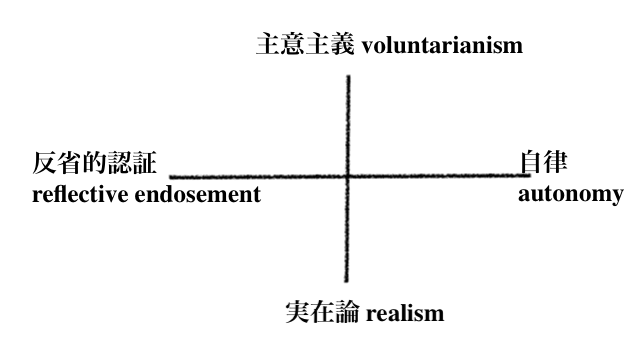
規範的(Normative)
| Normative
generally means relating to an evaluative standard. Normativity is the
phenomenon in human societies of designating some actions or outcomes
as good, desirable, or permissible, and others as bad, undesirable, or
impermissible. A norm in this sense means a standard for evaluating or
making judgments about behavior or outcomes. "Normative" is sometimes
also used, somewhat confusingly, to mean relating to a descriptive
standard: doing what is normally done or what most others are expected
to do in practice. In this sense a norm is not evaluative, a basis for
judging behavior or outcomes; it is simply a fact or observation about
behavior or outcomes, without judgment. Many researchers in science,
law, and philosophy try to restrict the use of the term "normative" to
the evaluative sense and refer to the description of behavior and
outcomes as positive, descriptive, predictive, or empirical.[1][2] Normative has specialised meanings in different academic disciplines such as philosophy, social sciences, and law. In most contexts, normative means 'relating to an evaluation or value judgment.' Normative propositions tend to evaluate some object or some course of action. Normative content differs from descriptive content.[3] Though philosophers disagree about how normativity should be understood; it has become increasingly common to understand normative claims as claims about reasons.[4] As Derek Parfit explains: We can have reasons to believe something, to do something, to have some desire or aim, and to have many other attitudes and emotions, such as fear, regret, and hope. Reasons are given by facts, such as the fact that someone's finger-prints are on some gun, or that calling an ambulance would save someone's life. It is hard to explain the concept of a reason, or what the phrase 'a reason' means. Facts give us reasons, we might say, when they count in favour of our having some attitude, or our acting in some way. But 'counts in favour of' means roughly 'gives a reason for'. The concept of a reason is best explained by example. One example is the thought that we always have a reason to want to avoid being in agony.[5] |
規範的とは一般的に、評価基準に関することを意味する。規範性
(Normativity)とは、人間社会において、ある行動や結果を良いもの、望ましいもの、許容されるものとして指定し、他の行動や結果を悪いもの、
望ましくないもの、許容されないものとして指定する現象のことである。この意味での規範とは、行動や結果を評価したり判断したりするための基準を意味す
る。「規範的」とは、やや紛らわしいが、記述的な基準に関連するという意味で使われることもある。この意味で、規範は評価的なものではなく、行動や結果を
判断するための根拠となるものでもなく、単に行動や結果に関する事実や観察であり、判断を伴わない。科学、法律、哲学の研究者の多くは、「規範的」という
用語の使用を評価的な意味に限定し、行動や結果の記述を肯定的、記述的、予測的、経験的と呼ぼうとしている[1][2]。 規範的とは、哲学、社会科学、法学など、さまざまな学問分野において特殊な意味を持つ。ほとんどの文脈では、規範的とは「評価や価値判断に関連する」とい う意味である。規範的な命題は、何らかの対象や行動方針を評価する傾向がある。規範的な内容は記述的な内容とは異なる[3]。 哲学者たちは規範性をどのように理解すべきかについて意見を異にしているが、規範的主張を理由についての主張として理解することが一般的になってきている [4]: 私たちは何かを信じる理由、何かをする理由、何らかの願望や目的を持つ理由、そして恐怖、後悔、希望といった多くの態度や感情を持つ理由を持つことができ る。例えば、ある銃に誰かの指紋がついているとか、救急車を呼べば誰かの命が助かるとか。理由という概念、あるいは「理由」という言葉の意味を説明するの は難しい。事実が私たちに理由を与えてくれるのは、私たちが何らかの態度を取ったり、何らかの行動を取ったりすることを支持してくれる場合だと言えるかも しれない。しかし、「賛成に値する」とは、おおよそ「理由を与える」という意味である。理由という概念は、例を挙げて説明するのが一番わかりやすい。一例 として、私たちは常に苦悩を避けたいと思う理由があると考えることができる[5]。 |
| Philosophy Main article: Ethics In philosophy, normative theory aims to make moral judgements on events, focusing on preserving something they deem as morally good, or preventing a change for the worse.[6] The theory has its origins in Greece.[7] Normative statements of such a type make claims about how institutions should or ought to be designed, how to value them, which things are good or bad, and which actions are right or wrong.[8] Claims are usually contrasted with positive (i.e. descriptive, explanatory, or constative) claims when describing types of theories, beliefs, or propositions. Positive statements are (purportedly) factual, empirical statements that attempt to describe reality.[citation needed] For example, "children should eat vegetables", and "those who would sacrifice liberty for security deserve neither" are philosophically normative claims. On the other hand, "vegetables contain a relatively high proportion of vitamins", and "a common consequence of sacrificing liberty for security is a loss of both" are positive claims. Whether a statement is philosophically normative is logically independent of whether it is verified, verifiable, or popularly held. There are several schools of thought regarding the status of philosophically normative statements and whether they can be rationally discussed or defended. Among these schools are the tradition of practical reason extending from Aristotle through Kant to Habermas, which asserts that they can, and the tradition of emotivism, which maintains that they are merely expressions of emotions and have no cognitive content. There is large debate in philosophy surrounding whether one can get a normative statement of such a type from an empirical one (i.e. whether one can get an 'ought' from an 'is', or a 'value' from a 'fact'). Aristotle is one scholar who believed that one could in fact get an ought from an is. He believed that the universe was teleological and that everything in it has a purpose. To explain why something is a certain way, Aristotle believed one could simply say that it is trying to be what it ought to be.[9] On the contrary, David Hume believed one cannot get an ought from an is because no matter how much one thinks something ought to be a certain way it will not change the way it is. Despite this, Hume used empirical experimental methods whilst looking at the philosophically normative. Similar to this was Kames, who also used the study of facts and the objective to discover a correct system of morals.[10] The assumption that 'is' can lead to 'ought' is an important component of the philosophy of Roy Bhaskar.[11] Philosophically normative statements and norms, as well as their meanings, are an integral part of human life. They are fundamental for prioritizing goals and organizing and planning. Thought, belief, emotion, and action are the basis of much ethical and political discourse; indeed, normativity of such a type is arguably the key feature distinguishing ethical and political discourse from other discourses (such as natural science).[citation needed] Much modern moral/ethical philosophy takes as its starting point the apparent variance between peoples and cultures regarding the ways they define what is considered to be appropriate/desirable/praiseworthy/valuable/good etc. (In other words, variance in how individuals, groups and societies define what is in accordance with their philosophically normative standards.) This has led philosophers such as A.J. Ayer and J.L. Mackie (for different reasons and in different ways) to cast doubt on the meaningfulness of normative statements of such a type. However, other philosophers, such as Christine Korsgaard, have argued for a source of philosophically normative value which is independent of individuals' subjective morality and which consequently attains (a lesser or greater degree of) objectivity.[12] |
哲学 主な記事 倫理学 哲学において規範的理論は、道徳的に善とみなされるものを維持すること、または悪い方向への変化を防ぐことに焦点を当て、出来事に対して道徳的判断を下す ことを目的としている[6]。 [このようなタイプの規範的言明は、制度がどのように設計されるべきか、または設計されるべきか、どのように評価すべきか、どのような物事が良いか悪い か、どのような行為が正しいか間違っているかについて主張する[8]。肯定的主張とは、現実を記述しようとする(と称する)事実的で経験的な主張である [要出典]。 例えば、「子どもは野菜を食べるべきだ」、「安全のために自由を犠牲にしようとする者は、そのどちらにも値しない」は、哲学的に規範的な主張である。一 方、「野菜は比較的高い割合でビタミンを含む」、「安全保障のために自由を犠牲にすることの一般的な帰結は、両方を失うことである」というのは肯定的な主 張である。ある声明が哲学的に規範的であるかどうかは、それが検証可能であるかどうか、一般に信じられているかどうかとは論理的に無関係である。 哲学的に規範的な主張の位置づけや、それが合理的に議論・擁護できるかどうかについては、いくつかの学派がある。アリストテレスからカント、ハーバーマス に至る実践理性の伝統は、規範的言明は理性的であると主張し、感情主義の伝統は、規範的言明は単なる感情の表現であり、認知的内容を持たないと主張する。 哲学の世界では、経験的なものからこのようなタイプの規範的言明を得ることができるかどうか(すなわち、「ある」から「べき」を得ることができるかどう か、「事実」から「価値」を得ることができるかどうか)をめぐって大きな議論がある。アリストテレスは、「あるもの」から「あるべきもの」を見出すことが できると考えた学者の一人である。彼は、宇宙は目的論的であり、宇宙に存在するすべてのものには目的があると信じていた。反対に、デイヴィッド・ヒューム は、あるものがあるべき姿であるべきだといくら考えても、その姿は変わらないので、あるものからあるべき姿は得られないと考えていた。にもかかわらず、 ヒュームは哲学的に規範的なものを見る一方で、経験的な実験方法を用いた。これと類似していたのがケイムズであり、彼もまた正しい道徳体系を発見するため に事実と目的の研究を用いていた[10]。 哲学的に規範となる声明や規範、そしてそれらの意味は、人間の生活に不可欠なものである。それらは目標に優先順位をつけ、組織化し、計画するための基本で ある。思考、信念、感情、行動は多くの倫理的・政治的言説の基礎であり、実際、このようなタイプの規範性は、倫理的・政治的言説を他の言説(自然科学な ど)と区別する重要な特徴であることは間違いない[要出典]。 現代の道徳/倫理哲学の多くは、何が適切/望ましい/賞賛に値する/価値ある/善であるなどと考えられているかを定義する方法に関する、民族や文化間の明 らかな差異を出発点としている(言い換えれば、個人、集団、社会が、哲学的に規範となる基準に従って何があるかを定義する方法における差異である)。この ため、A.J.エイヤーやJ.L.マッキーといった哲学者たちは、(それぞれ異なる理由や方法で)このようなタイプの規範的言明の意味性に疑問を投げかけ てきた。しかしながら、クリスティン・コルスガードのような他の哲学者は、哲学的に規範的な価値の源泉を主張しており、それは個人の主観的な道徳性から独 立しており、その結果(多少なりとも)客観性を獲得している[12]。 |
| Social sciences In the social sciences, the term "normative" has broadly the same meaning as its usage in philosophy, but may also relate, in a sociological context, to the role of cultural 'norms'; the shared values or institutions that structural functionalists regard as constitutive of the social structure and social cohesion. These values and units of socialization thus act to encourage or enforce social activity and outcomes that ought to (with respect to the norms implicit in those structures) occur, while discouraging or preventing social activity that ought not occur. That is, they promote social activity that is socially valued (see philosophy above). While there are always anomalies in social activity (typically described as "crime" or anti-social behaviour, see also normality (behavior)) the normative effects of popularly endorsed beliefs (such as "family values" or "common sense") push most social activity towards a generally homogeneous set. From such reasoning, however, functionalism shares an affinity with ideological conservatism. Normative economics deals with questions of what sort of economic policies should be pursued, in order to achieve desired (that is, valued) economic outcomes. |
社会科学 社会科学において「規範的」という用語は、哲学における用法とほぼ同じ意味を持つが、社会学的な文脈では、文化的な「規範」の役割、すなわち構造機能主義 者が社会構造や社会的結束を構成するものとみなす共有の価値観や制度に関係することもある。このような価値観や社会化の単位は、(その構造に内在する規範 に照らして)起こるべき社会活動や成果を奨励したり強制したりする一方で、起こるべきでない社会活動を抑制したり防止したりする。つまり、社会的に評価さ れる社会活動を促進するのである(上記の哲学を参照)。社会活動には常に異常が存在するが(典型的には「犯罪」や反社会的行動として表現される。しかし、 このような推論から、機能主義はイデオロギー的保守主義と親和性を共有している。 規範的経済学は、望ましい(つまり価値ある)経済的成果を達成するために、どのような経済政策を追求すべきかという問題を扱う。 |
| Politics See also: Political philosophy The use of normativity and normative theory in the study of politics has been questioned, particularly since the rise in popularity of logical positivism. It has been suggested by some that normative theory is not appropriate to be used in the study of politics, because of its value based nature, and a positive, value neutral approach should be taken instead, applying theory to what is, not to what ought to be.[13] Others have argued, however, that to abandon the use of normative theory in politics is misguided, if not pointless, as not only is normative theory more than a projection of a theorist's views and values, but also this theory provides important contributions to political debate.[14] Pietrzyk-Reeves discussed the idea that political science can never truly be value free, and so to not use normative theory is not entirely helpful. Furthermore, perhaps the normative dimension political study has is what separates it from many branches of social sciences.[13] |
政治 こちらも参照: 政治哲学 特に論理実証主義が台頭して以来、政治学研究において規範性や規範理論を用いることに疑問が投げかけられてきた。規範理論はその価値観に基づく性質から、 政治学研究に用いるのは適切ではなく、代わりに肯定的で価値中立的なアプローチを取るべきであり、あるべきものではなく、あるべきものに理論を適用すべき であるとする意見もある[13]。 [13]しかし、規範理論は理論家の見解や価値観の投影以上のものであるだけでなく、この理論は政治的議論に重要な貢献を提供するものでもあるため、政治 における規範理論の使用を放棄することは、無意味ではないにせよ、見当違いであると主張する者もいる[14]。さらに、おそらく政治学が持つ規範的な側面 こそが、社会科学の多くの分野と政治学を隔てるものである[13]。 |
| International relations In the academic discipline of International relations, Smith, Baylis & Owens in the Introduction to their 2008 [15] book make the case that the normative position or normative theory is to make the world a better place and that this theoretical worldview aims to do so by being aware of implicit assumptions and explicit assumptions that constitute a non-normative position, and align or position the normative towards the loci of other key socio-political theories such as political liberalism, Marxism, political constructivism, political realism, political idealism and political globalization. |
国際関係論 国際関係論という学問分野では、スミス、ベイリス、オーエンズの2008年の著書[15]の序論で、規範的立場や規範的理論は世界をより良い場所にするこ とであり、この理論的世界観は、非規範的立場を構成する暗黙の前提や明示的前提を意識することによってそうすることを目的とし、政治的自由主義、マルクス 主義、政治的構成主義、政治的現実主義、政治的理想主義、政治的グローバリゼーションといった他の主要な社会政治理論の位置づけに規範的立場を合わせる、 あるいは位置づけるものであるとしている。 |
| Law See also: Normative jurisprudence In law, as an academic discipline, the term "normative" is used to describe the way something ought to be done according to a value position. As such, normative arguments can be conflicting, insofar as different values can be inconsistent with one another. For example, from one normative value position the purpose of the criminal process may be to repress crime. From another value position, the purpose of the criminal justice system could be to protect individuals from the moral harm of wrongful conviction. |
法律 こちらもご覧ください: 規範的法学 学問分野である法学において、「規範的」という用語は、ある価値観に従って何かを行うべきであるということを表すのに使われる。そのため、異なる価値観が 互いに矛盾する可能性がある限り、規範的な主張は矛盾する可能性がある。例えば、ある規範的価値観の立場からすれば、刑事手続きの目的は犯罪を抑圧するこ とかもしれない。別の価値観の立場からすれば、刑事司法制度の目的は、冤罪による道義的被害から個人を守ることかもしれない。 |
| Standards documents The CEN-CENELEC Internal Regulations describe "normative" as applying to a document or element "that provides rules, guidelines or characteristics for activities or their results" which are mandatory.[16] Normative elements are defined in International Organization for Standardization Directives Part 2 as "elements that describe the scope of the document, and which set out provisions".[17] Provisions include "requirements", which are criteria that must be fulfilled and cannot be deviated from, and "recommendations" and "statements", which are not necessary to comply with. |
規格文書 CEN-CENELEC内部規則では,"規範的 "とは,"活動又はその結果に対する規則,指針又は特性を提供する "文書又は要素に適用され,強制的であると説明している[16]。 規範的要素は,国際標準化機構指令第 2 部において,「文書の範囲を記述し,規定を定める要素」と定義されている[17]。規定には,満たさなければならず逸脱できない基準である「要求事項」 と,遵守する必要のない「勧告」及び「声明」が含まれる。 |
| Conformity Decision theory Economics Hypothesis Is-ought problem Linguistic prescription Norm (philosophy) Normative economics Normative ethics Normative science Philosophy of law Political science Scientific method Value |
適合性 意思決定理論 経済学 仮説 イズ・オート問題 言語的処方 規範(哲学) 規範的経済学 規範倫理学 規範科学 法哲学 政治学 科学的方法 価値観 |
| https://en.wikipedia.org/wiki/Normativity |
リンク
文献
その他の情報

Copyleft,
CC, Mitzub'ixi Quq Chi'j, 1996-2099