デジタル化
digitization
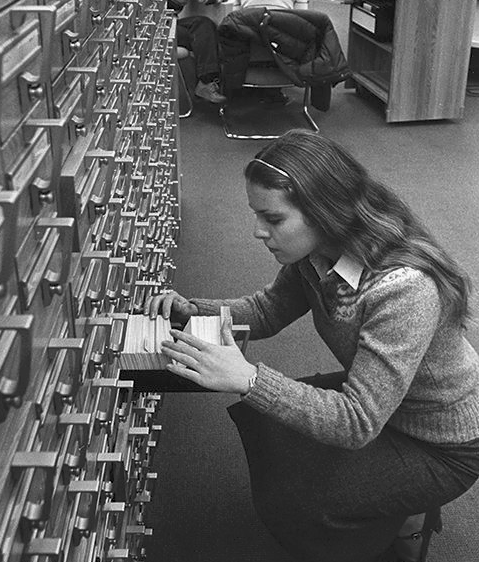

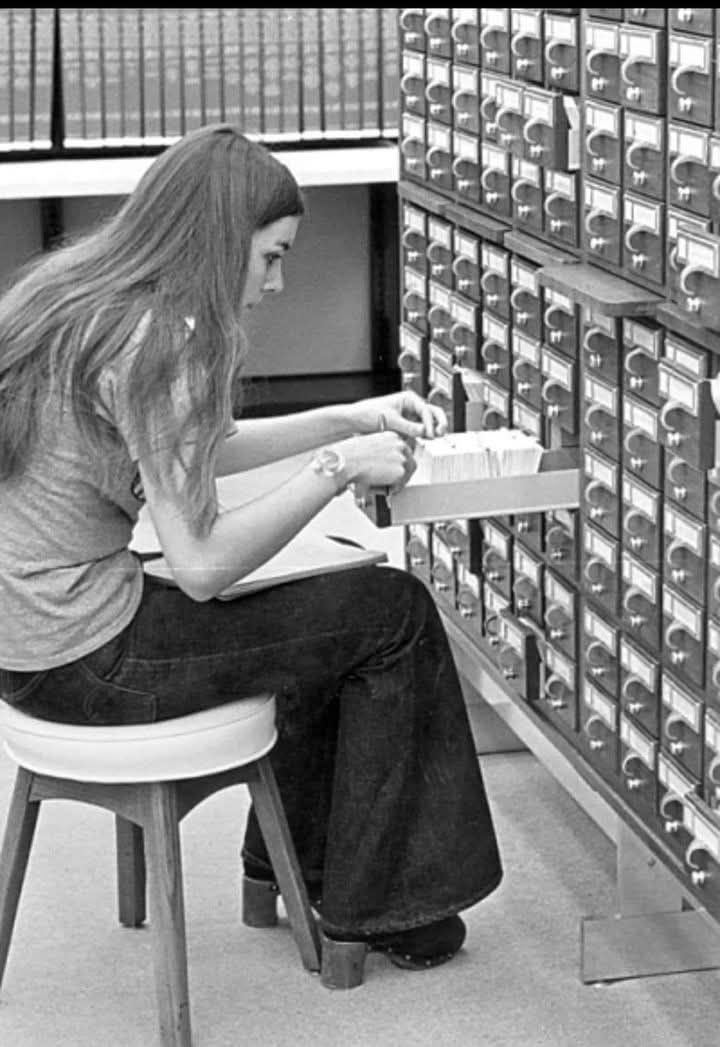
デジタル化
digitization
★このページは「デジタル化で図書館はなくなるか?」のスピンオフ版である。デジタル化のウィキペディアの記事の翻訳の部分だけが共通である。
☆さて、じゃあ、デジタル化[Digitization]とはなにか?| Digitization is
the
process of converting information into a digital (i.e.
computer-readable) format.[1][2] The result is the representation of an
object, image, sound, document, or signal (usually an analog signal)
obtained by generating a series of numbers that describe a discrete set
of points or samples.[3] The result is called digital representation
or, more specifically, a digital image, for the object, and digital
form, for the signal. In modern practice, the digitized data is in the
form of binary numbers, which facilitates processing by digital
computers and other operations, but digitizing simply means "the
conversion of analog source material into a numerical format"; the
decimal or any other number system can be used instead.[4] Digitization is of crucial importance to data processing, storage, and transmission, because it "allows information of all kinds in all formats to be carried with the same efficiency and also intermingled."[5] Though analog data is typically more stable, digital data has the potential to be more easily shared and accessed and, in theory, can be propagated indefinitely without generation loss, provided it is migrated to new, stable formats as needed.[6] This potential has led to institutional digitization projects designed to improve access and the rapid growth of the digital preservation field.[7] Sometimes digitization and digital preservation are mistaken for the same thing. They are different, but digitization is often a vital first step in digital preservation.[8] Libraries, archives, museums, and other memory institutions digitize items to preserve fragile materials and create more access points for patrons.[9] Doing this creates challenges for information professionals and solutions can be as varied as the institutions that implement them.[10] Some analog materials, such as audio and video tapes, are nearing the end of their life cycle, and it is important to digitize them before equipment obsolescence and media deterioration makes the data irretrievable.[11] There are challenges and implications surrounding digitization including time, cost, cultural history concerns, and creating an equitable platform for historically marginalized voices.[12] Many digitizing institutions develop their own solutions to these challenges.[9] Mass digitization projects have had mixed results over the years, but some institutions have had success even if not in the traditional Google Books model.[13] Although e-books have undermined the sales of their printed counterparts, a study from 2017 indicated that the two cater to different audiences and use-cases.[14] In a study of over 1400 university students it was found that physical literature is more apt for intense studies while e-books provide a superior experience for leisurely reading.[14] Technological changes can happen often and quickly, so digitization standards are difficult to keep updated. Professionals in the field can attend conferences and join organizations and working groups to keep their knowledge current and add to the conversation.[15] |
デジタル化とは、情報をデジタル(すなわちコンピュータが読み取れる)
形式に変換する過程である。[1][2]
その結果、対象物、画像、音声、文書、あるいは信号(通常はアナログ信号)を、離散的な点やサンプルの集合を記述する一連の数値を生成することで表現す
る。[3]
この結果を、対象物についてはデジタル表現、より具体的にはデジタル画像と呼び、信号についてはデジタル形式と呼ぶ。現代の実践では、デジタル化された
データは二進数の形式をとっており、これはデジタルコンピュータによる処理やその他の操作を容易にする。しかし、デジタル化とは単に「アナログのソース素
材を数値形式に変換すること」を意味する。十進法やその他の数体系を使用することも可能である。[4] デジタル化はデータ処理・保存・伝送において極めて重要である。あらゆる形式のあらゆる情報を「同等の効率で伝送し、混在させる」ことを可能にするから だ。[5] アナログデータは一般的に安定性が高いが、デジタルデータは共有やアクセスが容易であり、理論上は必要な際に新しい安定した形式へ移行すれば、世代損失な く無限に伝播できる可能性を秘めている。[6] この可能性が、アクセス改善を目的とした組織的なデジタル化プロジェクトや、デジタル保存分野の急速な発展を促している。[7] デジタル化とデジタル保存は同一視されることがある。両者は異なるが、デジタル化はデジタル保存における重要な第一歩となることが多い。[8] 図書館、公文書館、博物館などの記憶機関は、脆弱な資料を保存し利用者のアクセスポイントを増やすために資料をデジタル化する。[9] これにより情報専門家は課題に直面し、解決策はそれを実施する機関ごとに多様である。[10] オーディオテープやビデオテープなどのアナログ資料は寿命の終わりに近づいており、機器の陳腐化や媒体の劣化によってデータが復元不能になる前にデジタル 化することが重要だ。[11] デジタル化には時間、コスト、文化的歴史への配慮、歴史的に周縁化された声のための公平なプラットフォーム構築といった課題と影響が伴う。[12] 多くのデジタル化機関はこれらの課題に対して独自の解決策を開発している。[9] 大規模デジタル化プロジェクトは長年にわたり成果がハイブッドであったが、従来のGoogle Booksモデルとは異なる手法で成功を収めた機関もある。[13]電子書籍は紙書籍の販売を脅かしてきたが、2017年の研究によれば、両者は異なる読 者層と利用シーンに対応している。[14] 大学生1400人以上を対象とした調査では、集中的な学習には物理的な書籍が適している一方、電子書籍は気楽な読書において優れた体験を提供することが判 明した。[14] 技術変化は頻繁かつ急速に起こるため、デジタル化の基準を常に最新の状態に保つのは困難だ。この分野の専門家は、会議に参加したり組織・ワーキンググルー プに加わったりすることで、知識を更新し議論に貢献できる。[15] |
| Process The term digitization is often used when diverse forms of information, such as an object, text, sound, image, or voice, are converted into a single binary code. The core of the process is the compromise between the capturing device and the player device so that the rendered result represents the original source with the most possible fidelity, and the advantage of digitization is the speed and accuracy in which this form of information can be transmitted with no degradation compared with analog information. Digital information exists as one of two digits, either 0 or 1. These are known as bits (a contraction of binary digits) and the sequences of 0s and 1s that constitute information are called bytes.[16] Analog signals are continuously variable, both in the number of possible values of the signal at a given time, as well as in the number of points in the signal in a given period of time. However, digital signals are discrete in both of those respects – generally a finite sequence of integers – therefore a digitization can, in practical terms, only ever be an approximation of the signal it represents. Digitization occurs in two parts: Discretization The reading of an analog signal A, and, at regular time intervals (frequency), sampling the value of the signal at the point. Each such reading is called a sample and may be considered to have infinite precision at this stage; Quantization Samples are rounded to a fixed set of numbers (such as integers), a process known as quantization. In general, these can occur at the same time, though they are conceptually distinct. A series of digital integers can be transformed into an analog output that approximates the original analog signal. Such a transformation is called a digital-to-analog conversion. The sampling rate and the number of bits used to represent the integers combine to determine how close such an approximation to the analog signal a digitization will be. |
プロセス デジタル化という用語は、物体、テキスト、音声、画像、声など多様な形態の情報が一つの二進コードに変換される際に頻繁に使われる。このプロセスの核心 は、キャプチャ装置と再生装置の間の妥協点にある。これにより、再現された結果が可能な限り忠実に元のソースを表現する。デジタル化の利点は、この形態の 情報がアナログ情報と比較して劣化することなく、高速かつ正確に伝送できる点にある。 デジタル情報は0または1の二進数で存在する。これらはビット(バイナリ・ディジットの略)と呼ばれ、情報を構成する0と1の列はバイトと呼ばれる。 [16] アナログ信号は、特定の時点における信号の可能な値の数、および特定の時間間隔における信号のポイント数の両方で連続的に変化する。しかし、デジタル信号 はこれらの点で離散的である——一般に有限の整数の列である——したがって、デジタル化は実用上、それが表す信号の近似値でしかない。 デジタル化は二段階で起こる: 離散化 アナログ信号Aを読み取り、一定時間間隔(周波数)で信号の値をサンプリングする。各読み取り値はサンプルと呼ばれ、この段階では無限の精度を持つと見な せる。 量子化 サンプルを固定された数値群(整数など)に丸める。この過程を量子化と呼ぶ。 一般に、これらは同時に発生し得るが、概念的には別物である。 一連のデジタル整数は、元のアナログ信号に近似したアナログ出力に変換され得る。このような変換はデジタル・アナログ変換と呼ばれる。サンプリングレート と整数を表現するために使用されるビット数が組み合わさり、デジタル化がアナログ信号にどれほど近似するかを決定する。 |
Examples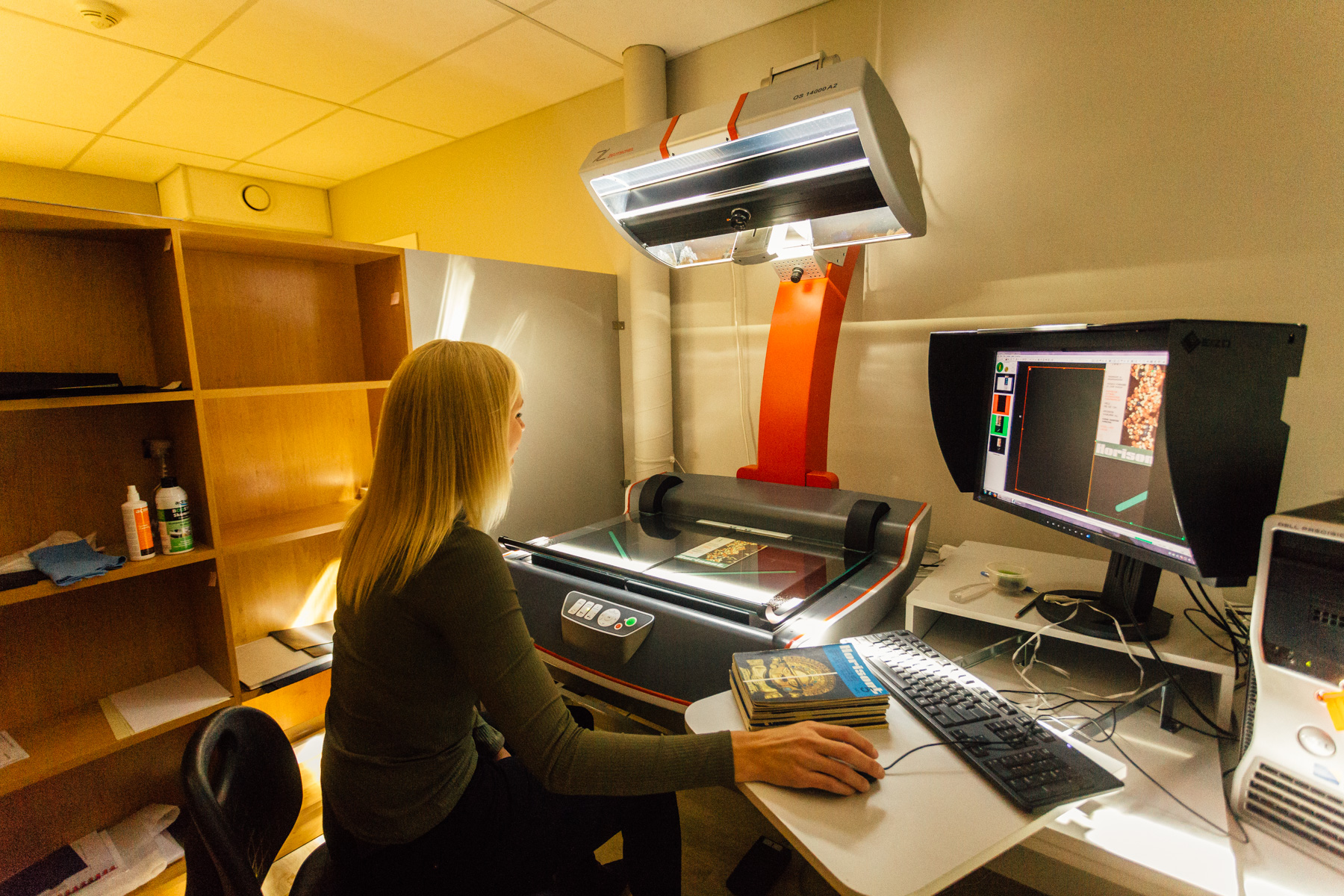 Digitization of the first number of Estonian popular science magazine Horisont published in January 1967 The term is used to describe, for example, the scanning of analog sources (such as printed photos or taped videos) into computers for editing, 3D scanning that creates 3D modeling of an object's surface, and audio (where sampling rate is often measured in kilohertz) and texture map transformations. In this last case, as in normal photos, the sampling rate refers to the resolution of the image, often measured in pixels per inch. Digitizing is the primary way of storing images in a form suitable for transmission and computer processing, whether scanned from two-dimensional analog originals or captured using an image sensor-equipped device such as a digital camera, tomographical instrument such as a CAT scanner, or acquiring precise dimensions from a real-world object, such as a car, using a 3D scanning device.[17] Digitizing is central to making digital representations of geographical features, using raster or vector images, in a geographic information system, i.e., the creation of electronic maps, either from various geographical and satellite imaging (raster) or by digitizing traditional paper maps or graphs (vector).[citation needed] "Digitization" is also used to describe the process of populating databases with files or data. While this usage is technically inaccurate, it originates with the previously proper use of the term to describe that part of the process involving digitization of analog sources, such as printed pictures and brochures, before uploading to target databases.[3] Digitizing may also be used in the field of apparel, where an image may be recreated with the help of embroidery digitizing software tools and saved as embroidery machine code. This machine code is fed into an embroidery machine and applied to the fabric. The most supported format is DST file. Apparel companies also digitize clothing patterns.[citation needed][18] |
例 1967年1月に発行されたエストニアの科学雑誌『ホリゾン』創刊号のデジタル化 この用語は、例えばアナログ媒体(印刷写真やテープ録画など)を編集用にコンピュータへスキャンすること、物体表面の3Dモデルを作成する3Dスキャン、 音声(サンプリングレートはキロヘルツで測定されることが多い)やテクスチャマップ変換などを指す。最後のケースでは、通常の写真と同様にサンプリング レートは画像の解像度(ピクセル/インチで測定されることが多い)を意味する。 デジタル化は、画像を伝送やコンピュータ処理に適した形式で保存する主要な方法である。これは、二次元のアナログ原版からスキャンする場合も、デジタルカ メラやCATスキャナーなどの画像センサー搭載装置で撮影する場合も、3Dスキャナー装置を用いて自動車などの実物から精密な寸法を取得する場合も同様で ある。[17] 地理情報システム(GIS)において、ラスター画像やベクター画像を用いた地理的特徴のデジタル表現を作成する中心的な手法がデジタル化である。すなわ ち、様々な地理的・衛星画像(ラスター)からの電子地図作成、あるいは従来の紙地図や図表のデジタル化(ベクター)を指す。[出典が必要] 「デジタル化」は、データベースにファイルやデータを入力するプロセスを指す場合にも用いられる。この用法は技術的には不正確だが、その起源は、印刷され た写真やパンフレットなどのアナログソースをデジタル化し、対象データベースへアップロードするプロセスの一部を記述するために、以前に適切に使用されて いた用語に由来する。[3] デジタル化はアパレル分野でも用いられる。刺繍デジタル化ソフトウェアツールを用いて画像を再現し、刺繍機用コードとして保存する。この機械コードを刺繍 機に送り、布地に適用する。最も広くサポートされている形式はDSTファイルである。アパレル企業は衣服の型紙もデジタル化する。[出典必要][18] |
| History 1957 The Standards Electronic Automatic Computer (SEAC) was invented.[19] That same year, Russell Kirsch used a rotating drum scanner and photomultiplier connected to SEAC to create the first digital image (176x176 pixels) from a photo of his infant son.[20][21] This image was stored in SEAC memory via a staticizer and viewed via a cathode ray oscilloscope.[22][21] 1971 Invention of Charge-Coupled Devices that made conversion from analog data to a digital format easy.[19] 1986 work started on the JPEG format.[19] 1990s Libraries began scanning collections to provide access via the world wide web.[13] |
歴史 1957年 標準電子自動計算機(SEAC)が発明された。[19] 同年、ラッセル・カーシュはSEACに接続した回転ドラムスキャナーと光電子増倍管を用いて、生後間もない息子の写真から最初のデジタル画像(176× 176ピクセル)を作成した。[20][21] この画像はスタティサイザーを介してSEACのメモリに保存され、陰極線オシロスコープで表示された。[22][21] 1971年 アナログデータをデジタル形式へ容易に変換する電荷結合素子(CCD)が発明された。[19] 1986年 JPEG形式の開発が始まった。[19] 1990年代 図書館が所蔵資料をスキャンし、ワールドワイドウェブ経由でのアクセス提供を開始した。[13] |
| Analog signals to digital Analog signals are continuous electrical signals; digital signals are non-continuous. Analog signals can be converted to digital signals by using an analog-to-digital converter.[23] The process of converting analog to digital consists of two parts: sampling and quantizing. Sampling measures wave amplitudes at regular intervals, splits them along the vertical axis, and assigns them a numerical value, while quantizing looks for measurements that are between binary values and rounds them up or down.[24] Nearly all recorded music has been digitized, and about 12 percent of the 500,000+ movies listed on the Internet Movie Database are digitized and were released on DVD.[25][26] Digitization of home movies, slides, and photographs is a popular method of preserving and sharing personal multimedia. Slides and photographs may be scanned quickly using an image scanner, but analog video requires a video tape player to be connected to a computer while the item plays in real time.[27][28] Slides can be digitized quicker with a slide scanner such as the Nikon Coolscan 5000ED.[29] Another example of digitization is the VisualAudio process developed by the Swiss Fonoteca Nazionale in Lugano, by scanning a high resolution photograph of a record, they are able to extract and reconstruct the sound from the processed image.[30] Digitization of analog tapes before they degrade, or after damage has already occurred, can rescue the only copies of local and traditional cultural music for future generations to study and enjoy.[31][32] |
アナログ信号からデジタル信号へ アナログ信号は連続的な電気信号であり、デジタル信号は非連続的である。アナログ信号はアナログ-デジタル変換器を用いてデジタル信号に変換できる。 [23] アナログからデジタルへの変換プロセスは、サンプリングと量子化の二段階で構成される。サンプリングは波の振幅を一定間隔で測定し、それらを縦軸に沿って 分割して数値を割り当てる。一方、量子化は二進値の間の測定値を探し、切り上げまたは切り捨てを行う。[24] ほぼ全ての録音音楽はデジタル化されており、インターネット・ムービー・データベースに登録されている50万本以上の映画のうち約12%がデジタル化さ れ、DVDでリリースされている。[25][26] 家庭用映画、スライド、写真のデジタル化は、人格の個人的マルチメディアを保存・共有する一般的な方法だ。スライドや写真はイメージスキャナーで素早くス キャンできるが、アナログビデオは再生中にビデオテーププレイヤーをコンピューターに接続する必要がある。[27][28] スライドはニコンクールスキャン5000EDのようなスライドスキャナーでより迅速にデジタル化できる。[29] デジタル化の別の例として、ルガーノのスイス国立音声資料館が開発したビジュアルオーディオ処理がある。レコードの高解像度写真をスキャンすることで、処 理された画像から音を抽出し再構築できる。[30] アナログテープが劣化する前、あるいは損傷が発生した後にデジタル化することは、地域や伝統的な文化音楽の唯一のコピーを救い、将来の世代が研究し楽しむ ことを可能にする。[31][32] |
| Analog texts to digital Main article: Book digitization Further information: Text digitizing projects 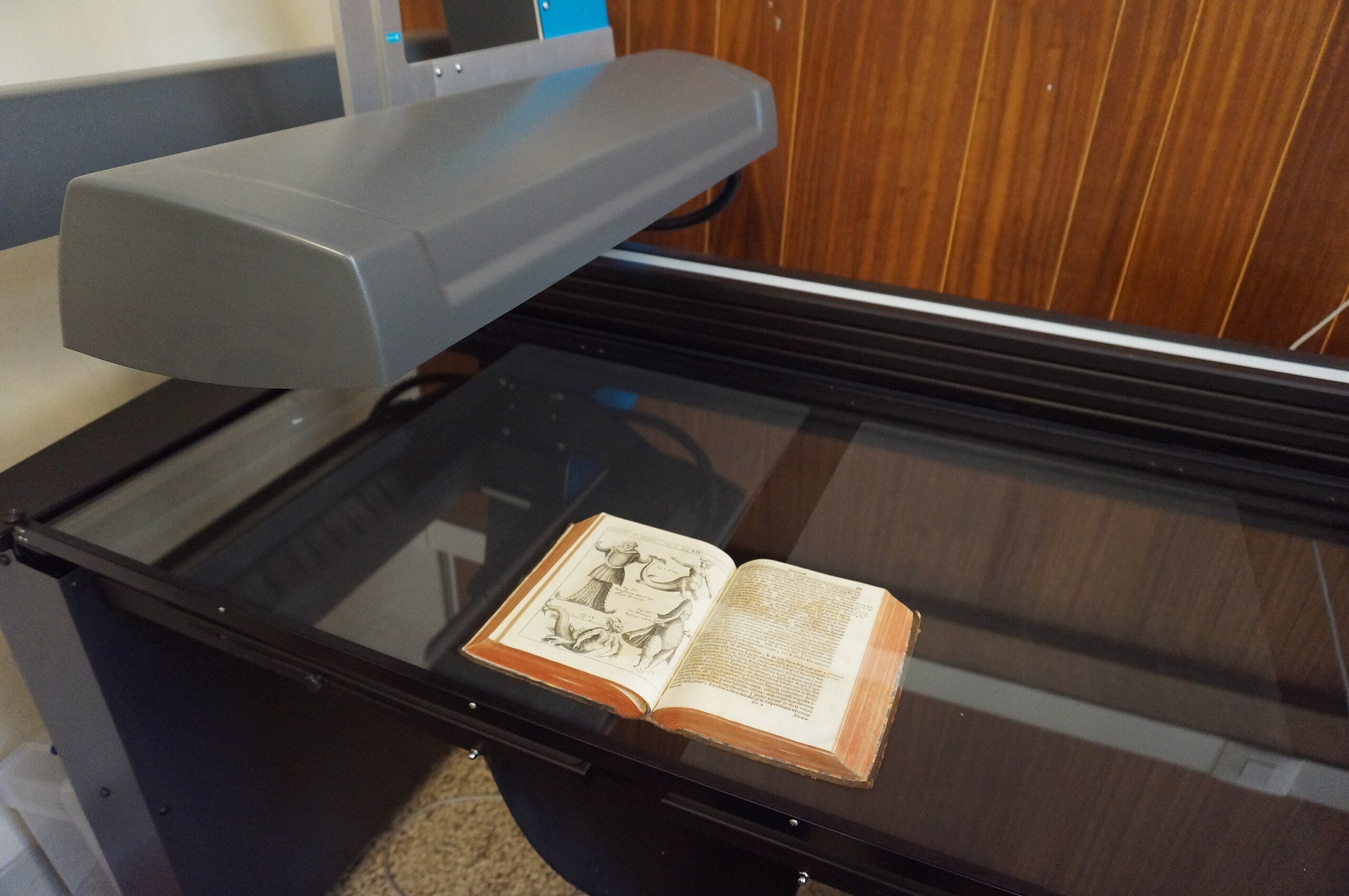 Image of a rare book in a book scanner where it will be digitized. Book scanner in the digitization lab at the University of Liège, Belgium Academic and public libraries, foundations, and private companies like Google are scanning older print books and applying optical character recognition (OCR) technologies so they can be keyword searched, but as of 2006, only about 1 in 20 texts had been digitized.[3][33] Librarians and archivists are working to increase this statistic and in 2019 began digitizing 480,000 books published between 1923 and 1964 that had entered the public domain.[34] Unpublished manuscripts and other rare papers and documents housed in special collections are being digitized by libraries and archives, but backlogs often slow this process and keep materials with enduring historical and research value hidden from most users (see digital libraries).[35] Digitization has not completely replaced other archival imaging options, such as microfilming which is still used by institutions such as the National Archives and Records Administration (NARA) to provide preservation and access to these resources.[36][37] While digital versions of analog texts can potentially be accessed from anywhere in the world, they are not as stable as most print materials or manuscripts and are unlikely to be accessible decades from now without further preservation efforts, while many books manuscripts and scrolls have already been around for centuries.[31] However, for some materials that have been damaged by water, insects, or catastrophes, digitization might be the only option for continued use.[31] |
アナログ文書からデジタルへ 主な記事: 書籍のデジタル化 詳細情報: 文書デジタル化プロジェクト デジタル化される書物スキャナー内の希少書籍の画像。 ベルギー・リエージュ大学デジタル化ラボの書籍スキャナー 学術図書館や公共図書館、財団、Googleのような民間企業が古い印刷書籍をスキャンし、光学式文字認識(OCR)技術を適用してキーワード検索を可能 にしている。しかし2006年時点で、デジタル化されたテキストは全体の約20分の1に過ぎなかった。[3][33] 図書館員や記録管理者はこの比率を高めるため活動しており、2019年には1923年から1964年に出版されパブリックドメインとなった48万冊の書籍 のデジタル化を開始した。[34] 特別コレクションに収蔵される未発表原稿やその他の稀覯文書も図書館や公文書館によってデジタル化されているが、処理遅延が頻発し、永続的な歴史的・研究 的価値を持つ資料が多くの利用者から隠されたままである(デジタル図書館参照)。[35] デジタル化は他のアーカイブ画像化手法を完全に置き換えてはいない。例えば国立公文書記録管理局(NARA)のような機関では、保存とアクセス提供のため マイクロフィルム化が依然として用いられている。[36][37] アナログ文書のデジタル版は世界中どこからでもアクセス可能だが、ほとんどの印刷物や原稿ほど安定しておらず、追加の保存努力なしでは数十年後には利用で きなくなる可能性が高い。一方、多くの書籍・原稿・巻物は既に数世紀にわたって現存している。[31] ただし、水害・虫害・災害で損傷した資料については、継続的な利用手段としてデジタル化が唯一の選択肢となる場合もある。[31] |
| Library preservation Main article: Preservation (library and archival science) 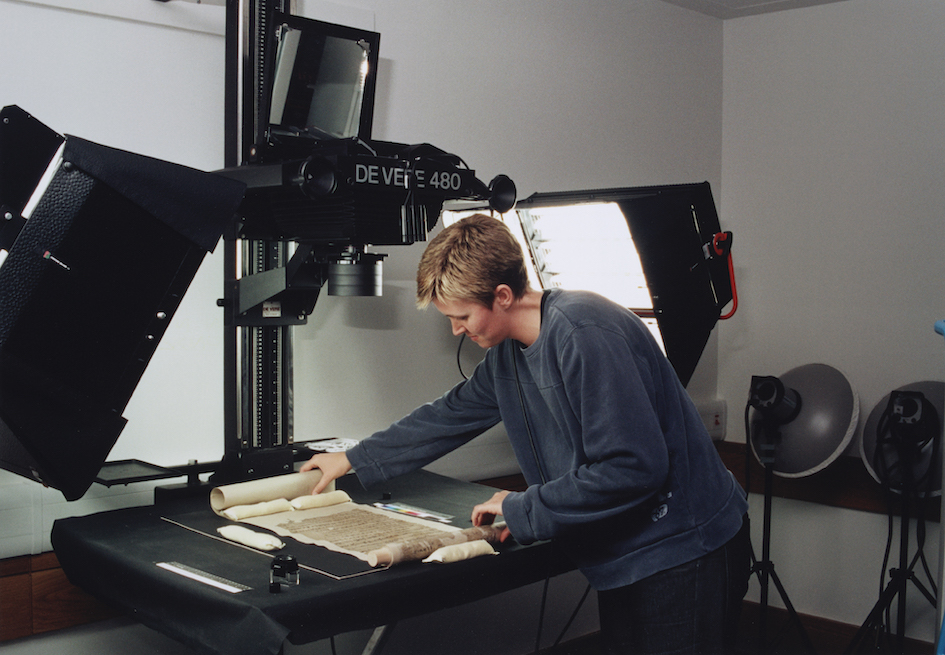 Digitization at the British Library of a Dunhuang manuscript for the International Dunhuang Project In the context of libraries, archives, and museums, digitization is a means of creating digital surrogates of analog materials, such as books, newspapers, microfilm and videotapes, offers a variety of benefits, including increasing access, especially for patrons at a distance; contributing to collection development, through collaborative initiatives; enhancing the potential for research and education; and supporting preservation activities.[38] Digitization can provide a means of preserving the content of the materials by creating an accessible facsimile of the object in order to put less strain on already fragile originals. For sounds, digitization of legacy analog recordings is essential insurance against technological obsolescence.[39] A fundamental aspect of planning digitization projects is to ensure that the digital files themselves are preserved and remain accessible;[40] the term "digital preservation," in its most basic sense, refers to an array of activities undertaken to maintain access to digital materials over time.[41] The prevalent Brittle Books issue facing libraries across the world is being addressed with a digital solution for long term book preservation.[42] Since the mid-1800s, books were printed on wood-pulp paper, which turns acidic as it decays. Deterioration may advance to a point where a book is completely unusable. In theory, if these widely circulated titles are not treated with de-acidification processes, the materials upon those acid pages will be lost. As digital technology evolves, it is increasingly preferred as a method of preserving these materials, mainly because it can provide easier access points and significantly reduce the need for physical storage space. Cambridge University Library is working on the Cambridge Digital Library, which will initially contain digitised versions of many of its most important works relating to science and religion. These include examples such as Isaac Newton's personally annotated first edition of his Philosophiæ Naturalis Principia Mathematica[43] as well as college notebooks[44][45] and other papers,[46] and some Islamic manuscripts such as a Quran[47] from Tipu Sahib's library. Google, Inc. has taken steps towards attempting to digitize every title with "Google Book Search".[48] While some academic libraries have been contracted by the service, issues of copyright law violations threaten to derail the project.[49] However, it does provide – at the very least – an online consortium for libraries to exchange information and for researchers to search for titles as well as review the materials. |
図書館保存 主な記事: 保存(図書館・記録保存学) 国際敦煌プロジェクトのための大英図書館における敦煌写本のデジタル化 図書館、公文書館、博物館の文脈において、デジタル化とは書籍、新聞、マイクロフィルム、ビデオテープなどのアナログ資料のデジタル代替物を作成する手段 である。これには様々な利点がある。具体的には、遠隔地の利用者を含むアクセス機会の拡大、共同事業を通じたコレクション開発への貢献、研究・教育の可能 性の向上、保存活動の支援などが挙げられる。[38] デジタル化は、既に脆弱な原本への負担を軽減するため、資料の内容を保存する手段として、アクセス可能な複製物を作成する。音声資料においては、旧式のア ナログ録音のデジタル化は、技術的陳腐化に対する必須の保険となる。[39] デジタル化プロジェクト計画の根本的な側面は、デジタルファイルそのものの保存と継続的なアクセス可能性を確保することである。[40] 「デジタル保存」という用語は、最も基本的な意味で、デジタル資料へのアクセスを長期にわたり維持するための一連の活動を指す。[41] 世界中の図書館が直面する脆性書籍問題には、長期的な書籍保存のためのデジタルソリューションが導入されている。[42] 1800年代半ば以降、書籍は木材パルプ紙に印刷されてきたが、この紙は劣化するにつれて酸性化する。劣化が進むと書籍は完全に使用不能となる。理論上、 こうした広く流通した書籍が脱酸処理を施されなければ、酸性化した紙面に記録された資料は失われる。デジタル技術が進化するにつれ、これらの資料保存方法 としてますます好まれるようになっている。主な理由は、より容易なアクセスポイントを提供でき、物理的な保管スペースの必要性を大幅に削減できる点にあ る。 ケンブリッジ大学図書館は「ケンブリッジ・デジタル図書館」の構築を進めており、当初は科学と宗教に関連する最も重要な著作の多くをデジタル化したバー ジョンを収蔵する予定だ。これには、アイザック・ニュートンが個人的な注釈を加えた『自然哲学の数学的原理』初版[43]や、大学時代のノート[44] [45]、その他の論文[46]、ティプー・サーヒブ図書館所蔵のクルアーン[47]などのイスラム写本が含まれる。 グーグル社は「Googleブック検索」で全ての書籍のデジタル化を試みている[48]。一部の学術図書館はこのサービスと契約しているが、著作権法違反 の問題がプロジェクトの頓挫を招く恐れがある[49]。しかし少なくとも、図書館間の情報交換や研究者の書籍検索・資料閲覧のためのオンライン共同体を提 供している。 |
| Digitization versus digital
preservation Main article: Digital preservation Digitizing something is not the same as digitally preserving it.[8] To digitize something is to create a digital surrogate (copy or format) of an existing analog item (book, photograph, or record) and is often described as converting it from analog to digital, however both copies remain.[4][50] An example would be scanning a photograph and having the original piece in a photo album and a digital copy saved to a computer. This is essentially the first step in digital preservation which is to maintain the digital copy over a long period of time and making sure it remains authentic and accessible.[51][8][6] Digitization is done once with the technology currently available, while digital preservation is more complicated because technology changes so quickly that a once popular storage format may become obsolete before it breaks.[6] An example is a 5 1/4" floppy drive, computers are no longer made with them and obtaining the hardware to convert a file stored on 5 1/4" floppy disc can be expensive. To combat this risk, equipment must be upgraded as newer technology becomes affordable (about 2 to 5 years), but before older technology becomes unobtainable (about 5 to 10 years).[52][6] Digital preservation can also apply to born-digital material, such as a Microsoft Word document or a social media post.[53] In contrast, digitization only applies exclusively to analog materials. Born-digital materials present a unique challenge to digital preservation not only due to technological obsolescence but also because of the inherently unstable nature of digital storage and maintenance.[6] Most websites last between 2.5 and 5 years, depending on the purpose for which they were designed.[54] The Library of Congress provides numerous resources and tips for individuals looking to practice digitization and digital preservation for their personal collections.[55] |
デジタル化とデジタル保存の違い 主な記事: デジタル保存 何かをデジタル化することは、それをデジタル保存することとは異なる。[8] デジタル化とは、既存のアナログ資料(書籍、写真、レコードなど)のデジタル代替物(複製またはフォーマット)を作成することであり、アナログからデジタ ルへの変換と説明されることが多い。ただし、両方の複製は残存する。[4][50] 例として、写真をスキャンし、原本をフォトアルバムに保管しつつ、デジタルコピーをコンピューターに保存する場合が挙げられる。これは本質的にデジタル保 存の第一段階であり、デジタルコピーを長期間維持し、その真正性とアクセス可能性を確保することを目的とする。[51][8][6] デジタル化は現時点で利用可能な技術を用いて一度だけ行われる。一方、デジタル保存はより複雑だ。技術が急速に変化するため、かつて主流だった保存形式が 故障する前に陳腐化してしまう可能性があるからだ。[6] 例として5.25インチフロッピードライブが挙げられる。現在ではこのドライブを搭載したコンピュータは製造されておらず、5.25インチフロッピーディ スクに保存されたファイルを変換するためのハードウェアを入手するには高額な費用がかかる。このリスクに対処するには、新しい技術が手頃な価格になった時 点(約2~5年)で機器をアップグレードし、古い技術が入手不可能になる前(約5~10年)に実施する必要がある。[52][6] デジタル保存は、Microsoft Word文書やソーシャルメディア投稿などの生まれながらのデジタル資料にも適用される。[53] 対照的に、デジタル化はアナログ資料にのみ適用される。生まれながらのデジタル資料は、技術的陳腐化だけでなく、デジタル保存・維持管理が本質的に不安定 である点からも、デジタル保存にとって特有の課題をもたらす。[6] ほとんどのウェブサイトは、設計目的によって2.5年から5年程度しか存続しない。[54] 米国議会図書館は、個人的コレクションのデジタル化とデジタル保存を実践しようとする個人向けに、数多くのリソースとヒントを提供している。[55] |
| Digital reformatting Digital reformatting is the process of converting analog materials into a digital format as a surrogate of the original. The digital surrogates perform a preservation function by reducing or eliminating the use of the original. Digital reformatting is guided by established best practices to ensure that materials are being converted at the highest quality. Digital reformatting at the Library of Congress The Library of Congress has been actively reformatting materials for its American Memory project and developed best standards and practices pertaining to book handling during the digitization process, scanning resolutions, and preferred file formats.[56] Some of these standards are: The use of ISO 16067-1 and ISO 16067-2 standards for resolution requirements. Recommended 400 ppi resolution for OCR'ed printed text. The use of 24-bit color when color is an important attribute of a document. The use of the scanning device's maximum resolution for digitally reproducing photographs TIFF as the standard file format. Attachment of descriptive, structural, and technical metadata to all digitized documents. A list of archival standards for digital preservation can be found on the ARL website.[57] The Library of Congress has constituted a Preservation Digital Reformatting Program.[58] The Three main components of the program include: Selection Criteria for digital reformatting Digital reformatting principles and specifications Life cycle management of LC digital data |
デジタル再フォーマット デジタル再フォーマットとは、アナログ資料を原本の代替物としてデジタル形式に変換するプロセスである。デジタル代替物は原本の使用を減らすか、消去法に よる排除によって保存機能を果たす。デジタル再フォーマットは確立されたベストプラクティスに基づき、資料が最高品質で変換されることを保証する。 米国議会図書館におけるデジタル再フォーマット 米国議会図書館は「アメリカン・メモリー」プロジェクト向けに資料の再フォーマットを積極的に推進し、デジタル化プロセスにおける書籍の取り扱い、スキャ ン解像度、推奨ファイル形式に関する標準とベストプラクティスを確立した[56]。主な基準は以下の通りである: 解像度要件としてISO 16067-1およびISO 16067-2規格を採用する。 OCR処理された印刷テキストには400ppi解像度を推奨。 文書の重要な属性として色が関わる場合、24ビットカラーを使用。 写真デジタル複製にはスキャナーの最大解像度を使用。 標準ファイル形式としてTIFFを採用。 全てのデジタル化文書に記述的・構造的・技術的メタデータを添付すること。 デジタル保存に関するアーカイブ基準の一覧はARLウェブサイトで確認できる。[57] 米国議会図書館は保存用デジタル再フォーマットプログラムを構築した。[58] このプログラムの主要3要素は以下の通りである: デジタル再フォーマットの選定基準 デジタル再フォーマットの原則と仕様 議会図書館デジタルデータのライフサイクル管理 |
| Audio digitization and
reformatting Audio media offers a rich source of historic ethnographic information, with the earliest forms of recorded sound dating back to 1890.[59] According to the International Association of Sound and Audiovisual Archives (IASA), these sources of audio data, as well as the aging technologies used to play them back, are in imminent danger of permanent loss due to degradation and obsolescence.[60] These primary sources are called "carriers" and exist in a variety of formats, including wax cylinders, magnetic tape, and flat discs of grooved media, among others. Some formats are susceptible to more severe, or quicker, degradation than others. For instance, lacquer discs suffer from delamination. Analog tape may deteriorate due to sticky shed syndrome.[61] 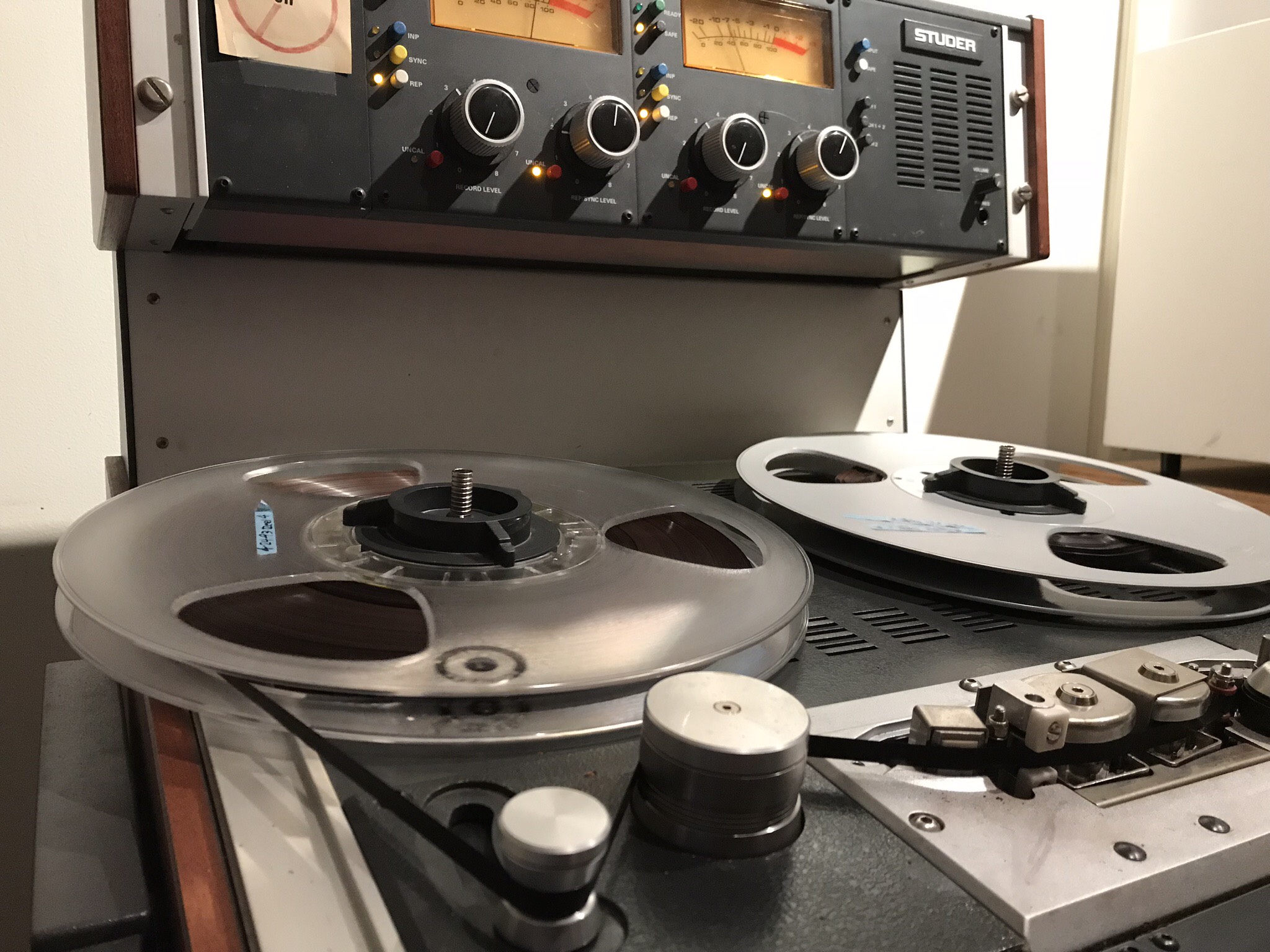 1/4" analog tape being played back on a Studer A810 tape machine for digitization at Smithsonian Folkways Recordings Archival workflow and file standardization have been developed to minimize loss of information from the original carrier to the resulting digital file as digitization is underway. For most at-risk formats (magnetic tape, grooved cylinders, etc.), a similar workflow can be observed. Examination of the source carrier will help determine what, if any, steps need to be taken to repair material prior to transfer. A similar inspection must be undertaken for the playback machines. If satisfactory conditions are met for both carrier and playback machine, the transfer can take place, moderated by an analog-to-digital converter.[62] The digital signal is then represented visually for the transfer engineer by a digital audio workstation, like Audacity, WaveLab, or Pro Tools. Reference access copies can be made at smaller sample rates. For archival purposes, it is standard to transfer at a sample rate of 96 kHz and a bit depth of 24 bits per channel.[59] |
音声のデジタル化と再フォーマット 音声メディアは歴史的民族誌情報の豊富な源であり、録音された音の最も初期の形態は1890年にまで遡る。[59] 国際音声・視聴覚アーカイブ協会(IASA)によれば、これらの音声データ源と、それらを再生するために使用される老朽化した技術は、劣化と陳腐化により 恒久的な喪失の差し迫った危険にさらされている。[60] これらの一次資料は「媒体」と呼ばれ、蝋管、磁気テープ、溝付きメディアの平型ディスクなど多様な形式で存在する。一部の形式は他よりも深刻な劣化、ある いは急速な劣化を受けやすい。例えば、ラッカー盤は剥離に苦悩する。アナログテープはスティッキー・シェッド症候群により劣化する可能性がある。[61] スミソニアン・フォークウェイズ・レコーディングスにおけるデジタル化作業中、スタダーA810テープマシンで再生される1/4インチアナログテープ デジタル化作業中、原資料媒体から生成されるデジタルファイルへの情報損失を最小限に抑えるため、アーカイブワークフローとファイル標準化が確立されてい る。リスクの高い媒体(磁気テープ、溝付きシリンダーなど)の大半では、同様のワークフローが適用される。ソース媒体の検査により、転送前に修復が必要な 箇所があるかどうかを判断する。再生機器についても同様の点検が必須である。媒体と再生機器の両方が良好な状態であれば、アナログ-デジタル変換器を介し て転送を実施できる。[62] デジタル信号は、Audacity、WaveLab、Pro Toolsなどのデジタルオーディオワークステーションによって転送技術者に視覚的に提示される。参照用アクセスコピーはより低いサンプリングレートで作 成可能である。保存目的では、チャンネルあたり96kHzのサンプリングレートと24ビットのビット深度での転送が標準である。[59] |
| Challenges Many libraries, archives, museums, and other memory institutions, struggle with catching up and staying current regarding digitization and the expectation that everything should already be online.[63][64] The time spent planning, doing the work, and processing the digital files along with the expense and fragility of some materials are some of the most common. Time spent Digitization is a time-consuming process, even more so when the condition or format of the analog resources requires special handling.[65] Deciding what part of a collection to digitize can sometimes take longer than digitizing it in its entirety.[66] Each digitization project is unique and workflows for one will be different from every other project that goes through the process, so time must be spent thoroughly studying and planning each one to create the best plan for the materials and the intended audience.[67] Expense Cost of equipment, staff time, metadata creation, and digital storage media make large scale digitization of collections expensive for all types of cultural institutions.[68] Ideally, all institutions want their digital copies to have the best image quality so a high-quality copy can be maintained over time.[68] In the mid-long term, digital storage would be regarded as the more expensive part to maintain the digital archives due to the increasing number of scanning requests.[69] However, smaller institutions may not be able to afford such equipment or manpower, which limits how much material can be digitized, so archivists and librarians must know what their patrons need and prioritize digitization of those items.[70] To help the information institutions to better decide the archives worth of digitization, Casablancas and other researchers used a proposed model to investigate the impact of different digitization strategies on the decrease in access requests in the archival and library reading rooms.[69] Often the cost of time and expertise involved with describing materials and adding metadata is more than the digitization process.[31] Fragility of materials Some materials, such as brittle books, are so fragile that undergoing the process of digitization could damage them irreparably.[66][70] Despite potential damage, one reason for digitizing fragile materials is because they are so heavily used that creating a digital surrogate will help preserve the original copy long past its expected lifetime and increase access to the item.[9] Copyright Copyright is not only a problem faced by projects like Google Books, but by institutions that may need to contact private citizens or institutions mentioned in archival documents for permission to scan the items for digital collections.[68] It can be time consuming to make sure all potential copyright holders have given permission, but if copyright cannot be determined or cleared, it may be necessary to restrict even digital materials to in library use.[31][68] |
課題 多くの図書館、公文書館、博物館、その他の記憶機関は、デジタル化と「全てが既にオンラインであるべき」という期待に追いつき、最新状態を維持することに 苦労している。[63][64] 計画立案、作業実施、デジタルファイルの処理に要する時間、ならびに費用や一部の資料の脆弱性が最も一般的な課題である。 かかる時間 デジタル化は時間のかかる作業であり、アナログ資料の状態や形式が特別な取り扱いを必要とする場合にはなおさらである。[65] コレクションのどの部分をデジタル化するかを決めるのに、全体をデジタル化するよりも長い時間がかかることもある。[66] 各デジタル化プロジェクトは独自性があり、ワークフローは他のプロジェクトと異なるため、資料と対象ユーザーに最適な計画を立てるには、各プロジェクトを 徹底的に調査・計画する時間が必要だ。[67] 費用 機器費、人件費、メタデータ作成費、デジタル保存媒体費などにより、あらゆる文化機関にとってコレクションの大規模デジタル化は高額となる。[68] 理想的には、全ての機関はデジタル複製に最高の画質を求めており、高品質な複製を長期にわたり維持したいと考えている。[68] 中長期的には、スキャン依頼の増加に伴い、デジタルアーカイブ維持においてデジタルストレージがより高コストな要素と見なされるだろう。[69] しかし小規模機関では、こうした設備や人的資源を確保できず、デジタル化可能な資料量が制限される。そのため、記録管理者と図書館員は利用者のニーズを把 握し、優先的にデジタル化すべき資料を選定しなければならない。[70] 情報機関がデジタル化に値する資料をより適切に判断できるよう、カサブランカスら研究者は提案モデルを用いて、異なるデジタル化戦略がアーカイブや図書館 閲覧室へのアクセス要求減少に与える影響を調査した。[69] 資料の記述やメタデータ追加に要する時間と専門知識のコストは、デジタル化プロセス自体よりも高い場合が多い。[31] 資料の脆弱性 脆化した書籍など一部の資料は極めて脆弱であり、デジタル化プロセス自体が修復不能な損傷を引き起こす可能性がある。[66][70] 損傷リスクがあるにもかかわらず、脆弱な資料をデジタル化する理由の一つは、利用頻度が極めて高いため、デジタル代替資料を作成することで原本の寿命を大 幅に超えて保存し、資料へのアクセスを拡大できる点にある。[9] 著作権 著作権問題はGoogle Booksのようなプロジェクトだけでなく、デジタルコレクション化のためアーカイブ資料に記載された個人・機関にスキャン許可を求める必要がある機関に も存在する。[68] 全ての潜在的な著作権者から許可を得るには時間がかかるが、著作権の帰属が不明確または権利処理が完了しない場合、デジタル資料であっても館内利用に制限 せざるを得ない。[31][68] |
| Solutions Institutions can make digitization more cost-effective by planning before a project begins, including outlining what they hope to accomplish and the minimum amount of equipment, time, and effort that can meet those goals.[9] If a budget needs more money to cover the cost of equipment or staff, an institution might investigate if grants are available.[9][68] Collaboration Collaborations between institutions have the potential to save money on equipment, staff, and training as individual members share their equipment, manpower, and skills rather than pay outside organizations to provide these services.[10] Collaborations with donors can build long-term support of current and future digitization projects.[71][64] Outsourcing Outsourcing can be an option if an institution does not want to invest in equipment but since most vendors require an inventory and basic metadata for materials, this is not an option for institutions hoping to digitize without processing.[64][68] Non-traditional staffing Many institutions have the option of using volunteers, student employees, or temporary employees on projects. While this saves on staffing costs, it can add costs elsewhere such as on training or having to re-scan items due to poor quality.[64][72] MPLP One way to save time and resources is by using the More Product, Less Process (MPLP) method to digitize materials while they are being processed.[63] Since GLAM (Galleries, Libraries, Archives, and Museums) institutions are already committed to preserving analog materials from special collections, digital access copies do not need to be high-resolution preservation copies, just good enough to provide access to rare materials.[66] Sometimes institutions can get by with 300 dpi JPGs rather than a 600 dpi TIFF for images, and a 300 dpi grayscale scan of a document rather than a color one at 600 dpi.[68][73] |
解決策 機関は、プロジェクト開始前に計画を立てることでデジタル化をより費用対効果の高いものにできる。具体的には、達成したい目標と、それらの目標を達成する ために必要な最小限の設備、時間、労力を明確にすることだ。[9] 設備やスタッフの費用を賄うために予算の追加が必要なら、助成金の利用可能性を調査する手もある。[9][68] 協力 機関間の協力は、個々のメンバーが外部組織にサービス提供を依頼する代わりに、設備・人材・技能を共有することで、設備・人員・研修の費用削減につながる 可能性がある。[10] 寄贈者との協力は、現在および将来のデジタル化プロジェクトに対する長期的な支援を構築できる。[71] [64] 外部委託 機材への投資を望まない機関にとって外部委託は選択肢となり得る。ただし、ほとんどのベンダーが資料の在庫リストと基本メタデータを要求するため、前処理 なしでのデジタル化を目指す機関には適さない。[64][68] 非伝統的人員配置 多くの機関では、プロジェクトにボランティア、学生従業員、臨時従業員を活用する選択肢がある。人件費は削減できるが、訓練費用や品質不良による再スキャ ン費用など、他のコストが発生する可能性がある。[64][72] MPLP 時間と資源を節約する一つの方法は、資料を処理しながらデジタル化する「より多くの製品、より少ないプロセス(MPLP)」手法を用いることだ。[63] GLAM(美術館・図書館・公文書館・博物館)機関は既に特別コレクションのアナログ資料保存に取り組んでいるため、デジタルアクセス用コピーは高解像度 の保存用コピーである必要はなく、希少資料へのアクセスを提供するのに十分な品質でよい。[66] 機関によっては、画像に600dpiのTIFFではなく300dpiのJPGで済ませたり、文書に600dpiのカラースキャンではなく300dpiのグ レースケールスキャンで対応できる場合もある。[68][73] |
| Digitizing marginalized voices Digitization can be used to highlight voices of historically marginalized peoples and add them to the greater body of knowledge. Many projects, some community archives created by members of those groups, are doing this in a way that supports the people, values their input and collaboration, and gives them a sense of ownership of the collection.[74][12] Examples of projects are Gi-gikinomaage-min and the South Asian American Digital Archive (SAADA). Gi-gikinomaage-min Gi-gikinomaage-min is Anishinaabemowin for "We are all teachers" and its main purpose is "to document the history of Native Americans in Grand Rapids, Michigan."[75] It combines new audio and video oral histories with digitized flyers, posters, and newsletters from Grand Valley State University's analog collections.[75] Although not entirely a newly digitized project, what was created also added item-level metadata to enhance context. At the start, collaboration between several university departments and the Native American population was deemed important and remained strong throughout the project.[75] SAADA The South Asian American Digital Archive (SAADA) has no physical building, is entirely digital and everything is handled by volunteers.[76] This archive was started by Michelle Caswell and Samip Mallick and collects a broad variety of materials "created by or about people residing in the United States who trace their heritage to Bangladesh, Bhutan, India, Maldives, Nepal, Pakistan, Sri Lanka, and the many South Asian diaspora communities across the globe."[76] (Caswell, 2015, 2). The collection of digitized items includes private, government, and university held materials.[76] Black Campus Movement Collection (BCM) Kent State University began its BCM collection when it acquired the papers of African American alumnus Lafayette Tolliver, which included about 1,000 photographs that chronicled the black student experience at Kent State from 1968-1971.[12] The collection continues to add materials from the 1960s up to and including the current student body and several oral histories have been added since it debuted.[12] When digitizing the items, it was necessary to work with alumni to create descriptions for the images. This collaboration created changes in local controlled vocabularies the libraries used to create metadata for the images.[12] |
周縁化された声のデジタル化 デジタル化は、歴史的に周縁化された人々の声を浮き彫りにし、知識の体系に加える手段となり得る。多くのプロジェクト、特にそれらのグループメンバーに よって作成されたコミュニティアーカイブは、人々を支援し、彼らの意見や協力を尊重し、コレクションへの所有意識を持たせる形でこれを実践している。 [74][12] プロジェクトの例としては、ギギキノマアゲミンや南アジア系アメリカ人デジタルアーカイブ(SAADA)が挙げられる。 ギギキノマーミン ギギキノマーミンはアニーシナベ語で「我々は皆教師である」を意味し、その主目的は「ミシガン州グランドラピッズにおける先住民の歴史を記録すること」で ある。[75] グランドバレー州立大学のアナログコレクションからデジタル化されたチラシ、ポスター、ニュースレターと、新たに収録した音声・動画による口述歴史を組み 合わせている。[75] 完全に新規デジタル化プロジェクトではないが、作成されたものには文脈強化のためのアイテムレベルメタデータも追加された。当初から、複数の大学部門と先 住民コミュニティとの連携が重要視され、プロジェクト全体を通じて強固に維持された。[75] SAADA 南アジア系アメリカ人デジタルアーカイブ(SAADA)は物理的な建物を持たず、完全にデジタルで運営され、全てがボランティアによって管理されている。 [76] このアーカイブはミシェル・キャズウェルとサミップ・マリックによって開始され、「バングラデシュ、ブータン、インド、モルディブ、ネパール、パキスタ ン、スリランカにルーツを持ち、世界中の南アジア系ディアスポラコミュニティに居住する人々によって作成された、あるいはそれらに関する」多様な資料を収 集している。[76](キャズウェル、2015年、2頁)。デジタル化された資料の収集には、個人、政府、大学が所蔵する資料が含まれる。[76] ブラック・キャンパス・ムーブメント・コレクション(BCM) ケント州立大学は、アフリカ系アメリカ人卒業生ラファイエット・トリバーの文書を取得した際にBCMコレクションを開始した。この文書には、1968年か ら1971年にかけてケント州立大学における黒人学生の経験を記録した約1,000枚の写真が含まれていた。[12] このコレクションは1960年代から現在の学生団体に至る資料を継続的に追加しており、公開以降複数のオーラルヒストリーも加わっている。[12] 資料のデジタル化にあたっては、画像の説明文作成のために卒業生との協働が必要であった。この共同作業により、図書館が画像のメタデータ作成に使用する ローカル管理語彙に改訂が生じた。[12] |
| Mass digitization Main article: Mass digitization The expectation that everything should be online has led to mass digitization practices, but it is an ongoing process with obstacles that have led to alternatives.[66] As new technology makes automated scanning of materials safer for materials and decreases need for cropping and de-skewing, mass digitization should be able to increase.[66] Obstacles Digitization can be a physically slow process involving selection and preparation of collections that can take years if materials need to be compared for completeness or are vulnerable to damage.[77] Price of specialized equipment, storage costs, website maintenance, quality control, and retrieval system limitations all add to the problems of working on a large scale.[77] Data privacy and security Digitization presents significant challenges related to data privacy and security.[78] As organizations increasingly depend on electronic databases and information systems, their vulnerability to security threats also rises.[79] The risk of data loss rises and cyberattacks can result in significant financial losses and damage the company's reputation .[79] Therefore, there is a need for better cybersecurity measures and protection of data security and privacy to decrease the risks associated with digitization.[79] Successes Digitization on demand Scanning materials as users ask for them, provides copies for others to use and cuts down on repeated copying of popular items. If one part of a folder, document, or book is asked for, scanning the entire object can save time in the future by already having the material access if someone else needs the material.[66][77] Digitizing on demand can increase volume because time spent on selection and prep has been used on scanning instead.[77] Google Books From the start, Google has concentrated on text rather than images or special collections.[77] Although criticized in the past for poor image quality, selection practices, and lacking long-term preservation plans, their focus on quantity over quality has enabled Google to digitize more books than other digitizers.[66][77] |
大量デジタル化 詳細記事: 大量デジタル化 あらゆるものがオンライン化されるべきだという期待が大量デジタル化の実践をもたらしたが、これは継続的なプロセスであり、障害が存在するため代替手段が 生まれている。[66] 新技術により資料の自動スキャンが安全になり、トリミングや歪み補正の必要性が減るにつれ、大量デジタル化は拡大可能となるはずだ。[66] 障害 デジタル化は物理的に遅いプロセスとなり得る。資料の完全性を比較する必要がある場合や損傷を受けやすい場合、コレクションの選定と準備に数年を要する可 能性がある。[77] 専用機器の価格、保管コスト、ウェブサイト維持費、品質管理、検索システムの制限が、大規模作業の問題を増幅させる。[77] データプライバシーとセキュリティ デジタル化はデータプライバシーとセキュリティに関連する重大な課題を提示する。[78] 組織が電子データベースや情報システムへの依存度を高めるにつれ、セキュリティ脅威に対する脆弱性も増大する。[79] データ損失のリスクが高まり、サイバー攻撃は多大な経済的損失をもたらし、企業の評判を損なう可能性がある。[79] したがって、デジタル化に伴うリスクを低減するため、より優れたサイバーセキュリティ対策とデータセキュリティ・プライバシー保護が必要である。[79] 成功事例 オンデマンドでのデジタル化 利用者の要求に応じて資料をスキャンすることで、他の利用者もコピーを利用でき、人気資料の繰り返し複写を減らせる。フォルダー・文書・書籍の一部が要求 された場合、対象物を全てスキャンしておけば、将来別の利用者が必要とした際に既に資料が利用可能であり、時間を節約できる。[66][77] オンデマンドでのデジタル化は、選別や準備に費やす時間をスキャン作業に充てられるため、処理量を増やせる。[77] Google Books Googleは当初から画像や特殊コレクションではなくテキストに注力してきた。[77] 画質や選定方法、長期保存計画の欠如で批判された過去はあるが、質より量を重視した方針により、Googleは他のデジタル化事業者を上回る数の書籍をデ ジタル化できた。[66][77] |
| Standards Digitization is not a static field and standards change with new technology, so it is up to digitization managers to stay current with new developments.[15] Although each digitization project is different, common standards in formats, metadata, quality, naming, and file storage should be used to give the best chance of interoperability and patron access.[80] As digitization is often the first step in digital preservation, questions about how to handle digital files should be addressed in institutional standards.[7] A standard for still images adapted from the Smithsonian digitization standards might include the following:[81] 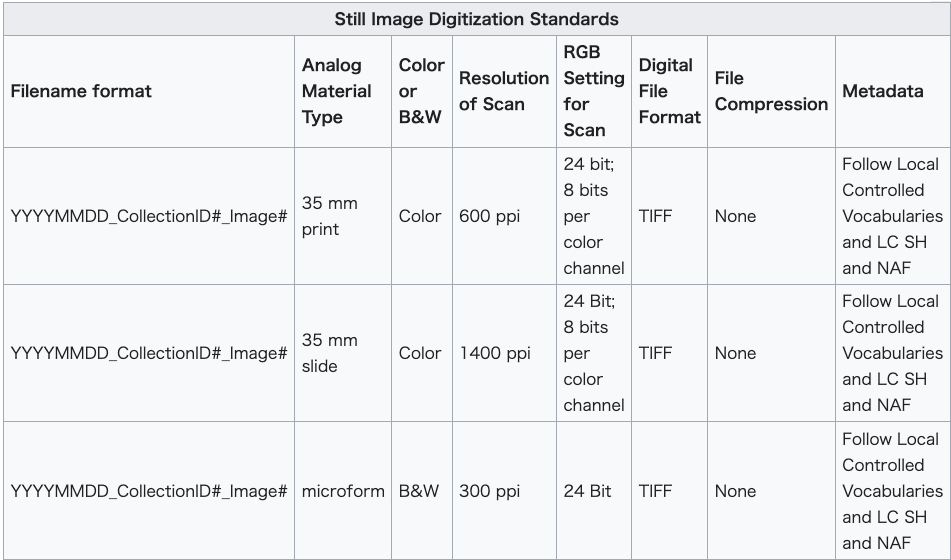 Resources to create local standards are available from the Society of American Archivists, the Smithsonian, and the Northeast Document Conservation Center.[82][81][15] |
基準 デジタル化は静的な分野ではなく、基準は新技術と共に変化する。したがって、デジタル化管理者は新たな動向を常に把握しておく必要がある。[15] 各デジタル化プロジェクトは異なるが、相互運用性と利用者のアクセスを最大限に確保するため、フォーマット、メタデータ、品質、命名規則、ファイル保存に 関する共通基準を用いるべきだ。[80] デジタル化はデジタル保存の第一歩となることが多いため、デジタルファイルの取り扱いに関する問題は機関の標準で対処すべきである。[7] スミソニアンのデジタル化標準を基にした静止画像の標準には、以下のような項目が含まれる可能性がある。[81] 地域基準を作成するための資料は、アメリカ記録管理協会、スミソニアン、および北東文書保存センターから入手できる。[82][81][15] |
| Implications Cultural heritage concerns Digitization of community archives by indigenous and other marginalized people has led to traditional memory institutions reassessing how they digitize and handle objects in their collections that may have ties to these groups.[74] The topics they are rethinking are varied and include how items are chosen for digitization projects, what metadata to use to convey proper context to be retrievable by the groups they represent, and whether an item should be accessed by the world or just those who the groups originally intended to have access, such as elders.[74] Many navigate these concerns by collaborating with the communities they seek to represent through their digitized collections.[74] |
影響 文化遺産に関する懸念 先住民やその他の周縁化された人々による地域アーカイブのデジタル化は、伝統的な記憶機関に、これらの集団と関連する可能性のある所蔵品のデジタル化や取 り扱い方法を見直すきっかけを与えた。[74] 再考されている課題は多岐にわたり、デジタル化プロジェクトの対象選定方法、対象集団が適切に検索可能な文脈を伝えるためのメタデータ仕様、そして資料へ のアクセス権限を全世界に開放すべきか、あるいは長老など当初の意図された対象集団のみに限定すべきかといった問題が含まれる。[74] 多くの機関は、デジタル化コレクションを通じて表現しようとするコミュニティと協働することで、こうした懸念に対処している。[74] |
| Lean philosophy icon This section does not cite any sources. Please help improve this section by adding citations to reliable sources. Unsourced material may be challenged and removed. (March 2023) (Learn how and when to remove this message) The broad use of internet and the increasing popularity of lean philosophy has also increased the use and meaning of "digitizing" to describe improvements in the efficiency of organizational processes. Lean philosophy refers to the approach which considers any use of time and resources, which does not lead directly to creating a product, as waste and therefore a target for elimination. This will often involve some kind of Lean process in order to simplify process activities, with the aim of implementing new "lean and mean" processes by digitizing data and activities. Digitization can help to eliminate time waste by introducing wider access to data, or by the implementation of enterprise resource planning systems. Fiction Works of science-fiction often include the term digitize as the act of transforming people into digital signals and sending them into digital technology. When that happens, the people disappear from the real world and appear in a virtual world (as featured in the cult film Tron, the animated series Code: Lyoko, or the late 1980s live-action series Captain Power and the Soldiers of the Future). In the video game Beyond Good & Evil, the protagonist's holographic friend digitizes the player's inventory items. One Super Friends cartoon episode showed Wonder Woman and Jayna freeing the world's men (including the male super heroes) onto computer tape by the female villainess Medula.[83] Mind uploading Main article: Mind uploading Mind uploading is the (as of 2023) speculative process of copying a human mind into a digital computer so it can be emulated there. This would require some form of advanced brain scan far more detailed than what is currently possible. |
リーン哲学 icon この節は出典を明記していない。信頼できる出典を追加して、この節を改善してほしい。出典のない記述は削除される可能性がある。(2023年3月)(この メッセージの削除方法と時期について) インターネットの広範な利用とリーン哲学の普及に伴い、「デジタル化」という言葉は組織プロセスの効率化を説明する際に、その使用頻度と意味合いを増して いる。リーン哲学とは、製品創出に直接つながらない時間や資源の使い方を無駄と見なし、排除の対象とする考え方である。これには往々にして、プロセス活動 を簡素化する何らかのリーン手法が伴い、データや活動をデジタル化することで新たな「無駄のない効率的な」プロセスを実現することを目指す。デジタル化 は、データへのアクセス拡大や基幹業務システム(ERP)の導入を通じて、時間の浪費を削減するのに役立つ。 フィクション SF作品では、人間をデジタル信号に変換しデジタル技術へ送り込む行為を「デジタル化」と呼ぶことが多い。この場合、人間は現実世界から消え、仮想世界に 現れる(カルト映画『トロン』、アニメシリーズ『コード:リョーコ』、1980年代後半の実写シリーズ『キャプテン・パワー』などで描かれている)。ビデ オゲーム『ビヨンド・グッド&イービル』では、主人公のホログラムの友人がプレイヤーの所持品をデジタル化する。アニメ『スーパーフレンズ』のエピソード では、ワンダーウーマンとジェイナが、悪役メデュラによって世界の男性(男性スーパーヒーローを含む)をコンピュータテープに閉じ込められた状態から解放 する。[83] マインドアップローディング 詳細記事: マインドアップローディング マインドアップローディングとは(2023年現在)、人間の精神をデジタルコンピュータにコピーし、そこでエミュレートする(再現する)という仮説上のプ ロセスである。これには、現在可能なものよりはるかに詳細な、何らかの高度な脳スキャン技術が必要となる。 |
| Book scanning Digital audio Digital library Economics of digitization ENUMERATE Fourth Industrial Revolution Frame grabber Newspaper digitization Optical character recognition Raster to vector Scannebago |
書籍スキャン デジタルオーディオ デジタルライブラリ デジタル化の経済性 列挙する 第四次産業革命 フレームグラバー 新聞のデジタル化 光学式文字認識 ラスターからベクターへ スキャネバゴ |
| References |
https://en.wikipedia.org/wiki/Digitization |
| Anderson, Cokie G.; Maxwell,
David C, Starting a Digitization Center, Chandos Publishing, 2004, ISBN
978-1843340737 Bulow, Anna; Ahmon, Jess, Preparing Collections for Digitization, Facet Publishing, 2010, ISBN 978-1856047111 Perrin, Joy, "Digitization of Flat Media: Principles and Practices", Rowman & Littlefield Publishers, 2015, ISBN 978-1442258099 Piepenburg, Scott, "Digitizing Audiovisual and Nonprint Materials: the Innovative Librarian's Guide", Libraries Unlimited, 2015, ISBN 978-1440837807 Robinson, Peter, Digitization of Primary Textual Sources, Office for Humanities Communication, 1993, ISBN 978-1897791059 S Ross; I Anderson; C Duffy; M Economou; A Gow; P McKinney; R Sharp; The NINCH Working Group on Best Practices, Guide to Good Practice in the Digital Representation and Management of Cultural Heritage Materials, Washington DC: NINCH, 2002. Speranski, V. Challenges in AV Digitization and Digital Preservation 'The Library of Congress National Recording Preservation Plan' |
アンダーソン、コキー G.、マクスウェル、デビッド
C.、『デジタル化センターの立ち上げ』、チャンドス出版、2004 年、ISBN 978-1843340737 ブルー、アンナ、アーモン、ジェス、『デジタル化のためのコレクションの準備』、ファセット出版、2010 年、ISBN 978-1856047111 ペリン、ジョイ、「フラットメディアのデジタル化:原則と実践」、Rowman & Littlefield Publishers、2015年、ISBN 978-1442258099 Piepenburg, Scott, 「視聴覚資料および非印刷資料のデジタル化:革新的な図書館員のためのガイド」, Libraries Unlimited, 2015, ISBN 978-1440837807 Robinson, Peter, 「一次資料のデジタル化」, Office for Humanities Communication, 1993, ISBN 978-1897791059 S・ロス、I・アンダーソン、C・ダフィー、M・エコノムー、A・ガウ、P・マッキニー、R・シャープ、NINCH ベストプラクティスワーキンググループ、『文化遺産資料のデジタル表現と管理におけるグッドプラクティスガイド』、ワシントン DC:NINCH、2002 年。 スペランスキー、V. 視聴覚資料のデジタル化とデジタル保存における課題 「米国議会図書館の全国録音保存計画」 |
| https://en.wikipedia.org/wiki/Digitization |
リンク
文献
その他の情報
pictures: left: unknown. right: La Biblitec@
Copyleft, CC, Mitzub'ixi Quq Chi'j, 1996-2099
Do not paste, but [Re]Think our message for all undergraduate students!!!
摩利支天
+ +
+

Copyleft,
CC, Mitzub'ixi Quq Chi'j, 1996-2099