メアリー・ダグラス
Mary Douglas, 1921-2007
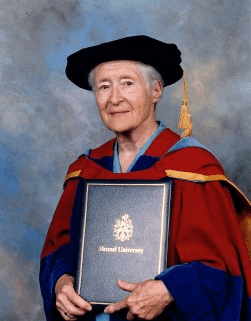
メアリー・ダグラス
Mary Douglas, 1921-2007
メアリー・ダグラス(Mary Douglas)はイギリスの社会人類学者。オッ クスフォードで学位を取った後は、ロンドン大学ユニヴァーシティ・カレッジで長く教鞭をとった。ベルギー領(1908-1960)だったザイール(現在のコンゴ民主共和国)のレレ族(Lele people)での民族誌『カサイのレレ族』研究が有 名。『汚穢と禁忌』『象徴としての身体』の公刊以降は、そこで論じられたデュルケーム社会学をベースに、バジル・バーンスティン(Basil Bernstein, 1924-2000)の言語コード論をとりい れ、共同体(社会)と個人の関係の類型などの比較研究を通して、グリッドと グループの理論の研究に勤しむ。ユニヴァーシティ・カレッジ退職後の、ラッセ ル・セイジ財団文化調査部長の就任期は3年と短かったものの、社会人類学と文化人類学の対話について専心し、北米を中心に英国以外の人類学徒の育成に貢献 した。また、消費やリスク概念など西洋近代の独自の合理的な概念を行動とは捉えずに、個人と社会の関係の形式という先の図式的な独特の比較社会論、西洋近 代起源の概念や行動も人間の普遍的で共通の性格をもつという観点から、社会/文化人類学がそれらの現象の分析に大いに役立つことを、みずからの事例研究を 通して明らかにした。
ダグラスの生涯の仕事から重要なことを3つあげると
すると、1)レレ人社会におけるセンザンコウ儀礼の指摘、2)旧約聖書レビ記における禁忌の体系に関する該博な考察、3)社会制度や個人の行動と社会のタ
イプの関係に関するグリッドとグループの理論、ということになるだろうか。そして、この3つは、彼女の人類学理論においては統一した像を今なお保ってい
る。
ダグラスの議論は、過度の一般化があり、さまざまな 反証によりその有効性に限界があるという批判者がいるが、そのような批判者たちは、それに対する代案を提出していない点で、有効な批判をおこなっていると は私(池田)は思えない。現代社会のさまざまな問題に対して「まず個人と社会の関係のパターン」を抽出するダグラスのモデルは「考え議論するのに適してい る」というこ とは間違いないだろう。もし彼女の議論に独特の特徴があるとすれば、それは議論の内容というよりも、グリッドとグループというシンプルな図式で統一的に問 題が解決できるというオッカム的な信念、さまざまな現代社会の問題に取り組む 衰えることのない情熱、非西洋の人たちよりも優れているという西洋人の信念の解体、まさに晩年のアインシュタインの知的営為に似たような統一理論への夢を 最後まで捨てなかったことであろう。
| Dame Mary Douglas,
DBE FBA (25 March 1921 – 16 May 2007) was a British anthropologist,
known for her writings on human culture, symbolism and risk, whose area
of speciality was social anthropology. Douglas was considered a
follower of Émile Durkheim and a proponent of structuralist analysis,
with a strong interest in comparative religion.[1][2] |
デイム[爵位]・メアリー・ダグラス(1921年3月25日 -
2007年5月16日)は、英国の人類学者である。人間の文化、象徴性、リスクに関する著作で知られ、専門分野は社会人類学であった。ダグラスはエミー
ル・デュルケームの追随者と見なされ、構造主義的分析の提唱者であり、比較宗教に強い関心を抱いていた。 |
| Biography She was born as Margaret Mary Tew in Sanremo, Italy, to Gilbert and Phyllis (née Twomey) Tew. Her father, Gilbert Tew, was a member of the Indian Civil Service serving in Burma, as was her maternal grandfather, Sir Daniel Twomey, who retired as the Chief Judge of the Chief Court of Lower Burma. Her mother was a devout Roman Catholic, and Mary and her younger sister, Patricia, were raised in that faith. After their mother's death, the sisters were raised by their maternal grandparents and attended the Roman Catholic Sacred Heart Convent in Roehampton. Mary went on to study at St. Anne's College, Oxford, from 1939 to 1943; there she was influenced by E. E. Evans-Pritchard. She graduated with a second-class degree.[3] She worked in the British Colonial Office, where she encountered many social anthropologists.[4] In 1946, Douglas returned to Oxford to take a "conversion" course in anthropology and registered for the doctorate in anthropology in 1949. She studied with M. N. Srinivas as well as E. E. Evans-Pritchard. In 1949 she did field work with the Lele people in what was then the Belgian Congo; this took her to village life in the region between the Kasai River and the Loange River, where the Lele lived on the edge of what had previously been the Kuba Kingdom. Ultimately, a civil war prevented her from continuing her fieldwork, but nevertheless, this led to Douglas' first publication, The Lele of the Kasai, published in 1963. In the early 1950s, she completed her doctorate and married James Douglas. Like her, he was a Catholic and had been born into a colonial family (in Simla, while his father served in the Indian army). They had three children. She taught at University College London, where she remained for around 25 years, becoming Professor of Social Anthropology. Her reputation was established by her most celebrated book, Purity and Danger (1966). She wrote The World of Goods (1978) with an econometrist, Baron Isherwood, which was considered a pioneering work on economic anthropology. She co-authored with Aaron Wildavsky a book on risk and danger. They used the cultural theory of risk to explore how and why social groups disregard some dangers but identify others as risks that require mitigating action.[5] She taught and wrote in the United States for 11 years. She published on such subjects as risk analysis and the environment, consumption and welfare economics, and food and ritual, all increasingly cited outside anthropology circles. After four years (1977–81) as Foundation Research Professor of Cultural Studies at the Russell Sage Foundation in New York, she moved to Northwestern University as Avalon Professor of the Humanities with a remit to link the studies of theology and anthropology, and spent three years at Princeton University. She received an honorary doctorate from the Faculty of Humanities at Uppsala University, Sweden in 1986.[6] In 1988 she returned to Britain, where she gave the Gifford Lectures in 1989. In 1989 she was elected a Fellow of the British Academy. She became a Commander of the Order of the British Empire (CBE) in 1992, and was appointed Dame Commander of the Order of the British Empire (DBE) in the Queen's New Year's Honours List published on 30 December 2006. She died on 16 May 2007 in London, aged 86, from complications of cancer, survived by her three children. Her husband died in 2004. In 2002 a twelve volume edition of her "Collected work" was published by Routledge.[7] |
伝記 彼女はマーガレット・メアリー・テューとして、イタリアのサンレモでギルバートとフィリス(旧姓トゥーミー)・テューの間に生まれた。父ギルバート・ テューはビルマで勤務するインド行政官であり、母方の祖父サー・ダニエル・トゥーミーも同様にビルマ行政官で、下ビルマ最高裁判所の首席判事を退任した人 物であった。母親は敬虔なカトリック教徒であり、メアリーと妹のパトリシアはその信仰の中で育った。母親の死後、姉妹は母方の祖父母に育てられ、ローハン プトンのカトリック系聖心修道院に通った。メアリーは1939年から1943年までオックスフォードのセント・アンズ・カレッジで学び、そこでE. E. エヴァンズ=プリチャードの影響を受けた。彼女は二級学位を取得して卒業した。 彼女は英国植民地省で働き、そこで多くの社会人類学者と出会った。1946年、ダグラスはオックスフォードに戻り、人類学の「転換」コースを受講し、 1949 年に人類学の博士課程に登録した。彼女はM. N. スリニヴァスとE. E. エヴァンズ=プリチャードに師事した。1949 年には、当時ベルギー領コンゴだった地域でレレ族のフィールドワークを行った。この調査で、カサイ川とロアンジュ川の間の地域、かつてクバ王国があった地 域の端っこで暮らすレレ族の村での生活に触れた。結局、内戦によってフィールドワークは中断されたが、それでもダグラスは1963年に最初の著作『カサイ のレレ族』を出版した。 1950年代初頭、彼女は博士号を取得し、ジェームズ・ダグラスと結婚した。夫も彼女と同じくカトリック教徒で、植民地時代の家庭(父親がインド軍に勤務 していたシムラー)に生まれた。夫妻には三人の子が生まれた。彼女はロンドン大学ユニバーシティ・カレッジで教鞭をとり、約25年間在籍して社会人類学の 教授となった。 彼女の評価を確立したのは、最も著名な著作『純粋と危険』(1966年)である。 彼女は計量経済学者バロン・イシャーウッドと共著で『商品の世界』(1978年)を執筆し、これは経済人類学の先駆的著作とみなされた。アーロン・ワイル ダフスキーとの共著ではリスクと危険性について論じた。両者は文化的リスク理論を用い、社会集団が特定の危険を無視する一方で、他の危険を軽減すべきリス クと認識する理由と過程を考察した。 彼女は11年間アメリカで教鞭を執り執筆活動を行った。リスク分析と環境、消費と福祉経済学、食と儀礼といった主題に関する著作を発表し、いずれも人類学 界外での引用が増加した。1977年から1981年までニューヨークのラッセル・セージ財団で文化研究の財団研究教授を務めた後、ノースウェスタン大学に 移り、神学と人類学の研究を結びつける使命を帯びたアバロン人文教授に就任した。その後3年間をプリンストン大学で過ごした。1986年にはスウェーデ ン・ウプサラ大学人文科学部より名誉博士号を授与された[6]。1988年に英国へ帰国し、1989年にはギフォード講義を行った。 1989年には英国学士院フェローに選出された。1992年に大英帝国勲章コマンドール(CBE)を受章し、2006年12月30日発表の女王新年叙勲リ ストでデイム・コマンダー(DBE)に任命された。2007年5月16日、ロンドンにて癌の合併症により86歳で死去。3人の子が生存している。夫は 2004年に死去した。 2002年、ラウトレッジ社より12巻からなる「全集」が刊行された。[7] |
| Contributions to anthropology Fieldwork and Ethnography: The Lele of the Kasai When Mary Douglas started her fieldwork in the late 1940s in the Belgian Congo, British social anthropology was a small elite discipline dominated by men who, as Edmund Leach caustically commented, saw themselves as gentlemen scholars.[8] Entry to this elite club involved undertaking intense ethnographic fieldwork following the model developed by Bronislaw Malinowski in the Trobriand Island. Edmund Leach described this approach to anthropology as ‘butterfly collecting’,[9] it was a way of recording ‘Other Cultures’[10] before they were overwhelmed by European political, religious and cultural institutions. Underpinning this approach was a paradox, social anthropologists worked alongside colonial officials, indeed their safety could depend on the intervention of such officials yet, in their accounts of these other cultures, such colonial interventions were conspicuous by their absence. For example in his ethnography of the Nuer in Southern Sudan,[11] Evans-Pritchard omits to mention that the Nuer were in conflict with the British Colonial authorities in Khartoum who sent planes to intimidate them and even bomb their cattle.[12] For the most part, Mary Douglas’s ethnography of the Lele hand cultivators who lived in the forests of South Western Belgian Congo,[13] follows the conventional pattern of contemporary ethnographies. Working in the structural function tradition[14] in which the anthropologist seeks to identify the key structures and institutions and examines how they work to maintain society, Douglas explored how the Lele maintained social stability when there was no apparent authority, no leaders with legitimate power. Douglas described a society in which older men collectively controlled key resources, women, cult membership and knowledge of divination and sorcery. Younger men were dependent on these older men but in time took their places. The tensions between these groups were kept under control by potential and actual accusations of sorcery. Older men were careful not cause offence and avoid accusations of sorcery and younger men could use sorcery accusations to blame their older relatives for their misfortunes. Douglas’s ethnography differed from conventional ethnographies. In particular it was written in the past tense. Conventionally ethnographies were written in the present tense; an attempt to record and preserve a reality that was destined to disappear. Douglas explicitly acknowledged and examined the ways in which colonial authorities were changing the Lele. For example she noted that Belgian colonial authorities had outlawed the poison ordeal. This was an important mechanism that limited the number of sorcery accusations as both the accuser and accused had to take the poison and one was expected to die; either the guilty sorcerer or the false accuser. When Douglas[15] returned to Kasai in the 1987 she found major changes in social and religious relationships. Many younger Lele had taken advantage of European education and had migrated to the capital, Kinshasa where they thrived as professionals, entrepreneurs or catholic priests. Those older people who remained in the villages and retained allegiances to traditional beliefs, were by the 1980s experiencing economic hardship. Younger urban Lele were adopting Christianity. This changed the nature of sorcery accusations which were increasingly used as a way for young Lele priests to attack and destroy traditional religion through the purging of older sorcerers and their sinful practices. There were public purges of sorcerers and ‘Those who were suspected of sorcery were beaten and burned until they confessed’.[16] |
人類学への貢献 フィールドワークと民族誌:カサイ地方のレレ族 1940年代後半、メアリー・ダグラスがベルギー領コンゴでフィールドワークを始めた頃、英国の社会人類学は男性中心の小さなエリート学問だった。エドマ ンド・リーチが辛辣に指摘したように、彼らは自らを紳士学者と見なしていた[8]。このエリート集団に入るには、トロブリアンド諸島でブロニスワフ・マリ ノフスキーが確立したモデルに従い、徹底的な民族誌的フィールドワークを行う必要があった。エドマンド・リーチは、この人類学へのアプローチを「蝶の採 集」と表現した[9]。それは、ヨーロッパの政治、宗教、文化の制度に圧倒される前に、「他者文化」[10]を記録する手段だった。このアプローチの根底 には、ある逆説があった。社会人類学者は植民地当局者と協力し、その安全は当局者の介入にかかっていたにもかかわらず、他者文化に関する彼らの記述では、 そのような植民地当局者の介入はまったく言及されていなかったのだ。例えば、南スーダンのヌエル族に関する民族誌[11]の中で、エヴァンズ=プリチャー ドは、ヌエル族が、彼らを威嚇するために飛行機を送り込み、さらには彼らの家畜に爆弾を投下したハルツームの英国植民地当局と対立していたことを言及して いない[12]。 メアリー・ダグラスの、ベルギー領コンゴ南西部の森林地帯に住んでいたレレ族の手耕農民に関する民族誌[13] は、その大部分が、当時の民族誌の従来のパターンに従っている。人類学者が重要な構造や制度を特定し、それらが社会を維持するためにどのように機能してい るかを調べるという構造機能主義の伝統[14] に従って、ダグラスは、明らかな権威も、正当な権力を持つ指導者もいない状況において、レレ族がどのように社会の安定を維持していたかを探求した。ダグラ スは、年長男性が共同で主要資源、女性、宗教的集団への所属、占いや魔術の知識を支配する社会を描いた。若い男性は年長者に依存しながらも、やがてその地 位を引き継ぐ。これらの集団間の緊張は、邪術の嫌疑(潜在的・実際の)によって制御されていた。年長者は邪術の嫌疑を招かないよう慎重に行動し、若い男性 は不幸の原因を年長者の邪術のせいにすることができた。 ダグラスの民族誌は従来の民族誌とは異なっていた。特に過去形で記述されていた点が特徴だ。従来の民族誌は現在形で書かれ、消えゆく現実を記録・保存しよ うとする試みであった。ダグラスは植民地当局がレレ族を変容させている実態を明示的に認識し、検証した。例えば彼女は、ベルギー植民地当局が毒の試練を禁 止したことを記している。これは邪術告発の数を制限する重要な仕組みだった。告発者と被告人の双方が毒を飲み、有罪の邪術師か虚偽の告発者のいずれかが死 ぬと予想されていたからだ。 ダグラス[15]が1987年にカサイに戻った時、社会関係と宗教関係に大きな変化が見られた。多くの若いレレ族はヨーロッパ式教育を活用し、首都キン シャサへ移住していた。そこで彼らは専門家、起業家、カトリック司祭として成功を収めていた。村に残り伝統的信仰への忠誠を保った年配の人民は、1980 年代までに経済的苦境に陥っていた。都市部の若いレレ族はキリスト教を受け入れ始めた。これにより邪術告発の性質が変化し、若いレレ族の司祭たちが年配の 邪術師とその罪深い慣習を排除することで、伝統宗教を攻撃し破壊する手段として告発が利用されるようになった。邪術師の公的な粛清が行われ、「魔術の疑い をかけられた者は自白するまで殴打され、焼かれた」のである[16]。 |
| Purity and Danger (1966) Douglas' book Purity and Danger (first published 1966) is an analysis of the concepts of ritual purity and pollution in different societies and times to construct a general concept on how ritual purity is established, and is considered a key text in social anthropology. The text is renowned for its passionate defense of both ritual and purity during a time when the very concept of defilement was treated with disdain.[17] Purity and Danger is most notable for demonstrating the comparative nature of her reflexions. In contrast to Claude Lévi-Strauss, who takes a structuralist approach, Douglas seeks to demonstrate how peoples' classifications play a role in determining what is considered abnormal and their treatment of it. Douglas insists on the importance of understanding the concept of pollution and ritual purity by comparing our own understandings and rituals to "primitive" rituals. Purity in European and "primitive" societies Douglas states that "primitive" societies are classified as those that do not recognize a distinction between being pure and being unclean. For western societies, there exists a clear distinction between what is dirty and what is considered holy. Therefore, Sacred rules are thus merely rules hedging divinity off, and uncleanness is the two-way danger of contact with divinity.[18] For primitive societies, the ideas of taboo and holiness are personified by the notions of friendly or unfriendly deities; there exists a separation because objects, people, or places are associated with either good or bad deities. For this uncleanness to be transmitted, material contact must occur; being in physical contact with an object considered as unclean allows for the transmission of uncleanness to the body. A distinction to be made with Christianity, for example, would be that the uncleanness would pass not onto the body itself, but the spirit. Douglas emphasizes that in order to fully comprehend other societies understanding of taboo and sacred, one must first understand one's own.[19] The notion of "dirt" Douglas dismantles a common euro-centric misconception that rituals and rites for cleanliness were devised with hygiene or sanitation as its goals. The avoidance of pork in Islam is often considered as having a hygienic basis, or that incense was used to mask body odors rather than symbolizing the ascending smoke of sacrifice. For Douglas, there exists a clear distinction between recognizing the side-benefits of ritual actions and considering them as a whole and sufficient explanation for ritual actions.[20] Furthermore, Douglas recognized that there exists a strong resemblance between European rituals and primitive rituals in principle, omitting the differing foundations that separate European rituals based on hygiene and primitive ones on symbolism, European rituals of cleanness seek to kill off germs, whereas primitive rituals of cleanness seek to ward off spirits. However, Douglas states that it is not enough to limit the differentiation between European rituals and primitive ritual to simply hygienic benefits. She claims that the modern conception of dirt is synonymous with the knowledge of germs and bacteria; It is difficult to think of dirt except in the context of pathogenicity.[20] If one removes the notions of bacteria and hygiene from the concept of dirt, all that remains is the symbolism of dirt; The product of a systematic order and classification of matter.[20] Dirt as disorder in the symbolic structure Douglas then proceeds to establish the notion that humans have a tendency to structure objects and situations around them into schema, well-organized systems.[21] The older people become, the more confidence and experiences they establish into their structures. Ideally, the more consistent an experience is within a structure, the more confidence an individual will place on that experience. As a result, when an individual encounters facts or tendencies that disrupt the structure, they will largely ignore it. What is deemed impure are objects or phenomena that do not correspond with the pre-existing social or symbolic structure.[22] Douglas associates dirt as a form of disruption to order, therefore it must be excluded in order to maintain the integrity of the system. The Abomination of Leviticus Mary Douglas is also known for her interpretation of the book of Leviticus, in the chapter The Abomination of Leviticus in Purity and Danger, in which she analyses the dietary laws of Leviticus II through a structuralist and symbolist point of view, and for her role in creating the Cultural Theory of risk. In The Abomination of Leviticus she states that the dietary laws were not based on medical materialism, but rather social boundaries, deeming that what is pure and impure is a way for a society to structure human experiences. At heart, what matters is using themes such as purity, separation and defilement to bring about order and structure to unorganized experiences. In Leviticus II, when categorizing which animals are authorized to be consumed, the pig is prohibited because while it has cloven feet like cows or goats, it does not produce milk, making it an anomaly within the structure of the world, hence its exclusion from the structure and its categorization as an impure animal.[23] |
純粋と危険(1966年) ダグラスの著書『純粋と危険』(初版1966年)は、異なる社会や時代における儀礼的純粋と穢れの概念を分析し、儀礼的純粋が如何に確立されるかについて の普遍的概念を構築したもので、社会人類学における重要文献とされる。この著作は、穢れという概念そのものが軽蔑されていた時代に、儀式と純粋の両方を熱 烈に擁護したことで知られる。[17] 『純潔と危険』の最大の特徴は、その考察が比較的性質を持つことを示したことだ。構造主義的アプローチを取るクロード・レヴィ=ストロースとは対照的に、 ダグラスは人民の分類体系が、何が異常と見なされ、それがどう扱われるかを決定する上で如何に役割を果たすかを示そうとした。ダグラスは、我々の理解や儀 礼を「原始的」儀礼と比較することで、穢れと儀礼的純潔の概念を理解することの重要性を主張する。 ヨーロッパ社会と「原始的」社会における清浄 ダグラスは「原始的」社会とは、清浄と不浄の区別を認識しない社会と分類すると述べる。西洋社会においては、汚れたものと神聖と見なされるものの間に明確な区別が存在する。したがって、 神聖な規則は単に神性を隔離する規則に過ぎず、不浄とは神性との接触による双方向の危険である。[18] 原始社会において、タブーと神聖性の概念は友好的な神々や敵対的な神々の観念によって擬人化される。物体、人々、場所が善なる神々か悪なる神々と結びつい ているため、分離が存在するのだ。この不浄が伝染するためには、物質的な接触が起きなければならない。不浄と見なされる物体に物理的に触れることで、不浄 が身体に伝染するのだ。例えばキリスト教との相違点は、不浄が身体そのものではなく精神に移るとされることだ。ダグラスは強調する。他社会のタブーと神聖 の理解を完全に把握するには、まず自文化の理解が不可欠だと。[19] 「汚れ」の概念 ダグラスは、清浄のための儀礼や儀礼が衛生や公衆衛生を目的として考案されたという、よくあるヨーロッパ中心主義的な誤解を解体する。イスラム教における 豚肉の忌避は、しばしば衛生的な根拠を持つと考えられたり、香は犠牲の煙が昇ることを象徴するのではなく、体臭を隠すために使われたとされたりする。ダグ ラスにとって、儀礼行為の副次的な利点を認識することと、それらを儀礼行為の全体的かつ十分な説明と見なすことの間には、明確な区別がある。[20] さらにダグラスは、衛生に基づくヨーロッパの儀礼と象徴性に基づく原始的儀礼を分かつ基盤の異なる点を抜きにしても、両者の原理には強い類似性があると認 めた。すなわち、ヨーロッパの清浄儀礼は病原菌を殺すことを目指すのに対し、原始的清浄儀礼は精霊を追い払うことを目指す。しかしダグラスは、ヨーロッパ の儀礼と原始的儀礼の差異を衛生上の利益に限定するのは不十分だと述べる。彼女は、現代の汚れ概念は細菌や病原体の知識と同義であると主張する。 病原性という文脈以外で汚れを考えるのは難しい。[20] もし汚れ概念から細菌や衛生の観念を除去すれば、残るのは汚れの象徴性だけである。 物質の体系的な秩序と分類の産物。[20] 象徴構造における無秩序としての汚れ ダグラスはさらに、人間が周囲の物体や状況を体系的な枠組み、つまり整然としたシステムに構造化する傾向を持つという概念を確立する。[21] 年齢を重ねるほど、人民は自らの構造体系に確信と経験を積み重ねていく。理想的には、ある構造内で経験がより一貫しているほど、個人はその経験に確信を持 つようになる。結果として、個人が構造を乱す事実や傾向に遭遇すると、それをほぼ無視する。不浄と見なされるのは、既存の社会的・象徴的構造に対応しない 物体や現象である。[22] ダグラスは汚れを秩序への破壊形態と関連付け、システムの完全性を維持するためには排除されねばならないと論じる。 レビ記の忌むべきもの メアリー・ダグラスは『清浄と危険』の「レビ記の忌むべきもの」の章におけるレビ記の解釈でも知られる。同章では構造主義的・象徴主義的観点からレビ記第 2章の食物規定を分析し、リスクの文化理論構築への貢献も評価されている。『レビ記の忌むべきもの』において、彼女は食の律法が医学的実証主義に基づくも のではなく、むしろ社会的境界に基づくものであり、清浄と不浄の区別が社会が人間の経験を構造化する方法であると述べている。本質的に重要なのは、清浄、 分離、穢れといったテーマを用いて、無秩序な経験に秩序と構造をもたらすことである。『レビ記II』において、食用が許可される動物を分類する際、豚は禁 止されている。牛や山羊のように蹄が分かれているにもかかわらず、乳を出さないため、世界の構造における異常と見なされ、構造から排除され不浄な動物とし て分類されるのである。[23] |
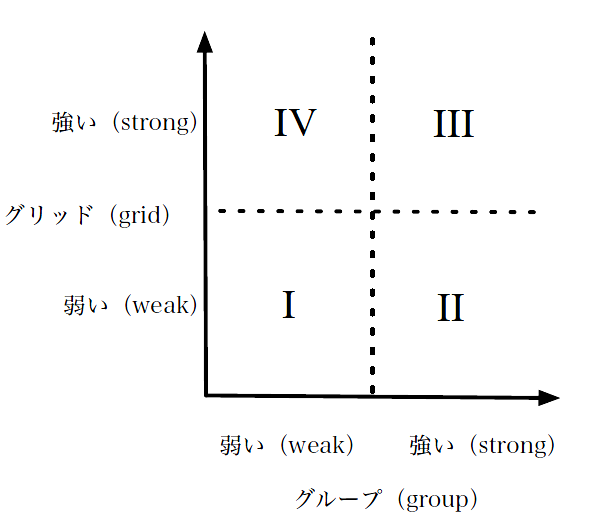
| Natural Symbols (1970) In Natural Symbols (first published 1970), Douglas introduced the interrelated concepts of "group" (how clearly defined an individual's social position is as inside or outside a bounded social group) and "grid" (how clearly defined an individual's social role is within networks of social privileges, claims and obligations).[24] The group-grid pattern was to be refined and redeployed in laying the foundations of Cultural Theory. |
自然の象徴(1970年) 『自然の象徴』(初版1970年)において、ダグラスは相互に関連する二つの概念を導入した。「集団」概念(個人が境界のある社会集団の内側か外側か、そ の社会的立場がどれほど明確に定義されているか)と「グリッド」概念(社会的特権・権利・義務のネットワーク内で、個人の社会的役割がどれほど明確に定義 されているか)である。[24] この集団-グリッドのパターンは、文化理論の基礎を築く過程で洗練され、再展開されることとなった。 |
| Contributions to the study of misfortune, risk and blame Blaming individuals for using supernatural power to cause misfortune: witchcraft and sorcery accusation Douglas developed the insights of her Oxford supervisor, Evans-Pritchard. In his classic study of the ways in which the Azande responded to events that caused misfortune such as illness or death.[25] Evans-Pritchard observed that while the Azande were aware of the technical causes of such events, they attributed the social consequences (the harm) to human agency in the form of witchcraft. Mary Douglas, in her fieldwork observed that the Lele blamed sorcerers for their misfortunes.[15] Younger Lele men who had limited access to resources could counteract their dependence on the elders who controlled social, economic and political resources with accusations of sorcery. Thus younger men attributed their various misfortunes to their older relatives who were members of and had access to the knowledge of religious cults and the economic benefits of such membership. In 1968, when Evans-Pritchard retired from the Chair of Social Anthropology at Oxford, the learned society which he founded in 1946, the Association of Social Anthropologists decided to hold a conference in his honour. Since it was just over 30 years since the publication of Evans-Pritchard's Witchcraft Among the Azande, the ASA invited Mary Douglas to organise a conference focusing on witchcraft.[26] Douglas brought together anthropologists and historians who explored the ways in which accusations of the use of supernatural powers by individuals were used to explain misfortune and allocate blame in different part of the globe and in different historical periods. |
不幸、リスク、非難の研究への貢献 超自然的な力を使って不幸をもたらしたとして個人を非難すること:妖術や邪術の告発 ダグラスは、オックスフォード大学の指導教官であるエヴァンズ=プリチャードの洞察を発展させた。プリチャードは、病気や死などの不幸をもたらす出来事に 対してアザンデ族がどのように対応するかを研究した古典的な研究を行っている[25]。エヴァンズ=プリチャードは、アザンデ族はそうした出来事の技術的 な原因を認識していたものの、その社会的結果(害)は妖術という形で人間の行為に起因すると考えていたと観察した。メアリー・ダグラスは、フィールドワー クの中で、レレ族が自分たちの不幸を邪術師たちのせいにしていると観察した。資源へのアクセスが限られていた若いレレ族の男性は、社会、経済、政治的な資 源を支配する長老たちへの依存を、邪術の告発によって打ち消すことができた。こうして若い男性たちは、宗教的カルトの成員であり、その知識と、その成員で あることによって得られる経済的利益にアクセスできる年配の親族たちに、自分たちのさまざまな不幸の原因があるとしたのである。 1968年、エヴァンズ=プリチャードがオックスフォード大学の社会人類学教授を退任したとき、1946年に彼が設立した学術団体である社会人類学者協会 は、彼を称える会議を開催することを決めた。エヴァンズ=プリチャードの『アザンデの妖術』が刊行されてから 30 年余りが経過していたため、ASA はメアリー・ダグラスに、妖術に焦点を当てた会議の開催を依頼した[26]。ダグラスは、世界各地や異なる歴史的時代において、個人が超自然的な力を使っ たという告発が、不幸の説明や責任の帰属にどのように利用されてきたかを研究する人類学者や歴史学者たちを集めた。 |
| Religion, sin and the allocation of blame When Douglas revisited the Lele in the 1987 she observed important changes in the blaming system.[15] Many younger Lele had taken advantage of colonial education and had migrated to the capital, Kinshasa where they thrived as professionals, entrepreneurs and Catholic priests. Older Lele, who remained in the villages, were by the 1980s experiencing economic hardship. While the older Lele retained allegiance to traditional beliefs and practices, younger Lele increasingly adopted Christianity. These changes led to a major change in blaming. Rather than being part of traditional religion and part of a balancing act between generations, sorcery accusation became a tool used by young Lele priests to attack and destroy traditional religion through purging the older sorcerers and their sinful practices.[27] Mary Douglas also used historical anthropology to explore the ways in which the concept of sin was used to explain misfortune and allocate blame. She examined the ways in which leprosy was linked to sin and used in 12th century Europe to allocate blame and protect from threats to the social order. The disease ‘was associated with sin, it was a chastisement by the hand of God’.[28] |
宗教、罪、そして責任の帰属 ダグラスが1987年にレレ族を再訪した際、彼女は非難システムに重要な変化を観察した[15]。多くの若いレレ族は植民地時代の教育を活用し、首都キン シャサへ移住していた。そこで彼らは専門家、起業家、カトリック司祭として成功を収めていた。村に残った年配のレレ族は、1980年代までに経済的苦境に 陥っていた。年配のレレ族は伝統的な信仰と慣習への忠誠を保っていたが、若い世代は次第にキリスト教を受け入れた。こうした変化は非難の在り方に大きな変 革をもたらした。邪術の告発は、もはや伝統宗教の一部でも、世代間の均衡を図る手段でもなくなった。若いレレ族の司祭たちが、年配の邪術師とその罪深い慣 習を一掃することで、伝統宗教を攻撃し破壊するための道具となったのである。[27] メアリー・ダグラスも歴史人類学を用いて、不幸の説明や責任の帰属に罪の概念がどのように利用されたかを考察した。彼女は12世紀ヨーロッパにおいて、ハ ンセン病が罪と結びつけられ、責任の帰属や社会秩序への脅威からの保護に利用された様相を検証した。この病気は「罪と関連づけられ、神の手による懲罰」と されたのである。[28] |
| Modernity and risk: a new way of allocating blame Douglas observed that in contemporary societies in the global North, risk has, for the most part, replaced witchcraft/sorcery and sin as the explanation for misfortune.[29] Risk appears to be a very different sort of concept to witchcraft and sin, it is secular and based on rationality while both witchcraft and sin are grounded in the belief in supernatural powers. However, Douglas argues that they perform the same function, they explain and allocate responsibility for misfortune to human agents. In the case of sin, the sinful individual has failed to heed warnings about their sinful behaviour and there is divine retribution. In the case of risk, the accountable individual has failed to properly assess and mitigate the risk and should be publicly named and shamed for this failure. While the concept of an accident, a random chance event, exists in contemporary society, there is strong pressure to ascribe all misfortune to human error, especially by those who have suffered its direct consequences. As the sociologist, Judith Green notes disasters and tragedies ‘are [by definition] the outcome of poorly managed risks, rather than the inevitable misfortunes that we all suffer from time-to-time’.[30] This is perhaps most evident in public inquiries, state sanctioned investigations into existential misfortunes. Those individuals blamed in such Inquiries may see themselves as scapegoats sacrificed because they failed to prevent an event that they could not have predicted. Sharon Shoesmith, the former Islington Director of Education and Children’s Social Care, was sacked and blamed for the death of ‘Baby P’. In her account of events, Shoesmith argued that modern society’s inability to accept that some risks are unavoidable, and the fact that in the wake of a scandal a political and media feeding frenzy will not abate until someone is ‘named, blamed and shamed’, create huge challenges for those who work within particularly salient, sensitive and arguably invidious parts of the public sector.[31] |
近代性とリスク:新たな責任帰属の方法 ダグラスによれば、現代のグローバル・ノース社会では、不幸の原因説明としてリスクが、ほとんどの場合、妖術や罪に取って代わっているという。[29] リスクは妖術や罪とは根本的に異なる概念である。魔術や罪が超自然的な力への信仰に基づくのに対し、リスクは世俗的で合理性に立脚している。しかしダグラ スは、これらが同じ機能を果たすと主張する。すなわち不幸の原因を説明し、その責任を人間に帰属させるのだ。罪の場合、罪深い個人が自らの罪深い行為に対 する警告を無視した結果、神の報いがある。リスクの場合、責任ある個人がリスクを適切に評価・軽減できず、この失敗に対して公に名指しされ恥をかくべき だ。 現代社会には事故という概念、つまり偶然の出来事という概念は存在するが、あらゆる不幸を人為的過失に帰する強い圧力がある。特にその直接的な苦悩を受け た者たちからそうされる。社会学者ジュディス・グリーンが指摘するように、災害や悲劇は「定義上、管理不行き届きのリスクの結果であって、我々が時折被る 避けられない不幸ではない」のである。[30] この傾向は公的調査、すなわち国家が認可した重大事故の調査において最も顕著だ。こうした調査で非難される個人は、予測不可能な事象を防げなかった犠牲者 として自らを位置づける場合がある。シャロン・シューズミス(元イズリントン区教育・児童福祉局長)は「ベイビーP」死亡事件の責任を問われ解雇された。 シュースミスは事件の経緯を説明する中で、現代社会が「避けられないリスクの存在」を受け入れられないこと、そしてスキャンダル発生後には政治とメディア の餌食となる騒ぎが「誰かを名指しし、非難し、恥をかかせる」まで収まらないことが、公共部門の中でも特に注目されやすく、敏感で、おそらくは不当な扱い を受けやすい分野で働く者たちに巨大な課題を突きつけていると主張した。[31] |
| Collections During her lifetime Douglas deposted her archive with Northwestern University, Evanston, Illinois.[32] The collection includes biographical material in addition to research papers.[32] In 2007 University College London acquired an additional collection of Douglas' work, which spans 43 boxes, as a gift.[33] The archive includes offprints, correspondence and working papers.[33] |
コレクション ダグラスは生前に、イリノイ州エバンストンのノースウェスタン大学に自分のアーカイブを寄託した[32]。このコレクションには、研究論文に加えて、伝記資料も含まれている[32]。 2007年、ユニバーシティ・カレッジ・ロンドンは、43箱に及ぶダグラスの作品の追加コレクションを寄贈として取得した[33]。このアーカイブには、別刷、書簡、作業用紙などが含まれている[33]。 |
| Works Peoples of the Lake Nyasa Region (1950) as Mary Tew The Lele of the Kasai (1963) Purity and Danger: An Analysis of Concepts of Pollution and Taboo (1966) "Pollution", in International Encyclopedia of the Social Sciences, edited by David L. Sills and Robert K. Merton (New York, Macmillan Co. and the Free Press, 1968). Natural Symbols: Explorations in Cosmology (1970) (John Desmond Bernal Prize for 1995) Implicit Meanings: Essays in Anthropology (1975).[34] The World of Goods: towards an anthropology of consumption (1979) with Baron Isherwood Evans-Pritchard (Fontana Modern Masters, 1980) Risk and Culture (1980) with Aaron Wildavsky In the Active Voice (1982) How Institutions Think (1986) Missing persons: a critique of the social sciences (1988) with Steven Ney Risk and Blame: Essays in Cultural Theory (London: Routledge, 1992). In the Wilderness: The Doctrine of Defilement in the Book of Numbers (1993) Thought styles: Critical essays on good taste (1996) Leviticus as Literature (1999) Jacob's Tears: The Priestly Work of Reconciliation (2004) Thinking in Circles (2007) Editorial work Witchcraft Confessions and Accusations, ed. by M. Douglas (Tavistock, 1970). Rules and Meanings. The Anthropology of Everyday Knowledge: Selected Readings, ed. by M. Douglas (Penguin Books, 1973). Constructive Drinking: Perspectives on Drink from Anthropology, ed. by M. Douglas (1987) |
著作 『ニャサ湖地域の人民』(1950年)メアリー・テュー名義 『カサイのレレ族』(1963年) 『純潔と危険:汚染とタブーの概念の分析』(1966年) (1966) 「汚染」、『国際社会科学百科事典』所収、デイヴィッド・L・シルズ、ロバート・K・マートン編(ニューヨーク、マクミラン社およびフリープレス、1968年)。 『自然の象徴:宇宙論の探求』(1970年)(1995年ジョン・デズモンド・バーナル賞受賞) 暗黙の意味:人類学のエッセイ(1975年)。 商品の世界:消費の人類学に向けて(1979年)バロン・イッシャーウッドと共著 エヴァンズ=プリチャード(フォンタナ・モダン・マスターズ、1980年 リスクと文化(1980年)アーロン・ワイルダフスキーと共著 能動態で(1982年 制度はどのように考えるか(1986年 行方不明な人格:社会科学の批判(1988年、スティーブン・ネイとの共著 リスクと非難:文化理論のエッセイ(ロンドン:ラウトレッジ、1992年 荒野で:民数記における穢れの教義(1993年 思考様式:良識に関する批判的エッセイ (1996年) レビ記を文学として(1999年) ヤコブの涙:和解の祭司的業(2004年) 円環的思考(2007年) 編集作業 妖術裁判の自白と告発、M.ダグラス編(タヴィストック、1970年)。 規則と意味。日常知識の人類学:選集、M.ダグラス編(ペンギンブックス、1973年)。 建設的な飲酒:人類学から見た飲酒の視点、M.ダグラス編(1987年) |
| Risk perception Cultural Theory of risk Sacred contagion |
リスクの認識 リスクの文化理論 聖なる伝染 |
| References 1. Fardon, Richard (2018). Immortality yet? Or, the permanence of Mary Douglas. Anthropology Today, 34.4, August, 23–26. 2. Martin, Douglas (22 May 2007). "Dame Mary Douglas, 86, a Wide-Ranging Anthropologist, Is Dead". The New York Times. 3. "Douglas [née Tew], Dame (Margaret) Mary (1921–2007), social anthropologist | Oxford Dictionary of National Biography". Oxford Dictionary of National Biography (online ed.). Oxford University Press. 2004. doi:10.1093/ref:odnb/98779. Retrieved 20 May 2019. (Subscription, Wikipedia Library access or UK public library membership required.) 4. Fardon, Richard (17 May 2007). "Dame Mary Douglas". The Guardian. ISSN 0261-3077. Retrieved 10 December 2016. 5. Douglas, M. & Wildavsky, A. B. (1982). Risk and Culture: An essay on the selection of technical and environmental dangers. Berkeley: University of California Press 6. "Honorary doctorates - Uppsala University, Sweden". Uu.se. Retrieved 31 July 2018. 7. Douglas M., Collected works (12 vols.) 2002, London: Routledge (3168 Pages), ISBN 9780415283977 8. Leach, E. (1984) Glimpses of the unmentionable in the history of British Social Anthropology, Annual Review of Anthropology, 13, 1-23 9. Leach, E. (1984) Glimpses of the unmentionable in the history of British Social Anthropology, Annual Review of Anthropology, 13, 1-23 10. Beattie, J. (1964) Other Cultures: Aims, Methods and Achievements in Social Anthropology, New York: The Free Press 11. Evans-Pritchard, E.E. (1940) The Nuer: A Description of the Modes of Livelihood and Political Institutions of a Nilotic People, Oxford: Clarendon Press 12. Johnson, D.H. (1982) Evans-Pritchard, the Nuer, and the Sudan Political Service, African Affairs, 81(323): 231-246 13. Douglas, M. (1963) The Lele of the Kasai, London: International African Institute 14. Beattie, J. (1964) Other Cultures: Aims, Methods and Achievements in Social Anthropology, New York: The Free Press, Chapter 4 Explanation in Social Anthropology: Social Function and Social Structure 15. Douglas, M. (1999) Sorcery Accusations Unleashed: The Lele Revisited, 1987, Africa: Journal of the International African Institute, 69, 2, 177-193 16. Douglas, M. (1999) Sorcery Accusations Unleashed: The Lele Revisited, 1987, Africa: Journal of the International African Institute, 69, 2, p. 185 17. Petersen, Anders Klostergaard (2008). "Purity, Sacrifice, and the Temple: Symbolism and Supersessionism in the Study of Ancient Judaism". Journal for the Study of Judaism. 39 (1): 113–115. doi:10.1163/157006308x258050. ISSN 0047-2212. 18. Douglas, Mary (29 August 2003). Purity and Danger : An Analysis of Concepts of Pollution and Taboo. Routledge. p. 8. ISBN 978-1-134-43823-5. OCLC 1100437432. 19. Douglas, Mary (29 August 2003). Purity and Danger: An Analysis of Concepts of Pollution and Taboo. Routledge. ISBN 978-1-134-43823-5. OCLC 1100437432. 20. Douglas, Mary (2003). Purity and Danger: An Analysis of Concepts of Pollution and Taboo. Routledge. p. 36. ISBN 978-1-134-43823-5. OCLC 1100437432. 21. Boskovic, Aleksandar (2016). "A very personal anthropology of Mary Douglas". Anthropological Notebooks. 22: 119–123. 22. Duschinsky, Robbie (December 2013). "The politics of purity". Thesis Eleven. 119 (1): 63–77. doi:10.1177/0725513613511321. ISSN 0725-5136. S2CID 144036269. 23. Lemos, T.M. (2009). "The Universal and the Particular: Mary Douglas and the Politics of Impurity". The Journal of Religion. 89 (2): 236–251. doi:10.1086/596070. JSTOR 10.1086/596070. S2CID 155116101. 24. "Diagram of Theory: Douglas and Wildavsky's Grid/Group Typology of Worldviews". Dustin S. Stoltz. Retrieved 10 December 2016. 25. Evans-Pritchard, E. E. (1937). Witchcraft, oracles and magic among the Azande. Oxford: The Clarendon Press. 26. Douglas, M. (1970) Editor’s Preface, in M. Douglas (ed.) Witchcraft Confessions and Accusations, London and New York: Tavistock, pp. xi-xii 27. Douglas, M. (1999) Sorcery Accusations Unleashed: The Lele Revisited, 1987, Africa: Journal of the International African Institute, 69, 2, 177-193, p. 185 28. . Douglas, M. (1991) Witchcraft and Leprosy: Two Strategies of Exclusion, Man, New Series, 26(4): 723-736 29. Douglas, M. (1990) Risk as a Forensic Resource, Daedalus, 119(4): 1-16 30 Green, J. (1999) ‘From accidents to risk: public health and preventable injury’, Health, Risk & Society, 1(1): 25–39, p.25 31. Shoesmith, S. 2023. ‘Positive Accountability: From Naming, Shaming and Blaming to Lesson Learning’ in Flinders, M. and Monaghan, C. eds. (2023). Questions of Accountability, London: Hart, pp. 229-25 32. "Collection: Mary Douglas (1921-2007) Papers | Archival and Manuscript Collections". findingaids.library.northwestern.edu. Retrieved 30 May 2025. 33. UCL Special Collections. "Douglas Papers". UCL Archives Catalogue. Retrieved 30 May 2025. 34. The essay "Jokes" was reprinted in Rethinking Popular Culture: Contemporary Perspectives in Cultural Studies, edited by Chandra Mukerji and Michael Schudson (1991), 291–310. |
参考文献 1. ファードン、リチャード (2018)。不滅か?あるいは、メアリー・ダグラスの永続性。Anthropology Today、34.4、8月、23-26。 2. マーティン、ダグラス (2007年5月22日)。「86歳、幅広い人類学者、デイム・メアリー・ダグラスが死去」。ニューヨーク・タイムズ。 3. 「ダグラス(旧姓テュー)、デイム(マーガレット)メアリー(1921-2007)、社会人類学者|オックスフォード国民伝記大辞典」。「オックスフォー ド国民伝記大辞典」(オンライン版)。オックスフォード大学出版局。2004年。doi:10.1093/ref:odnb/98779。2019年5月 20日取得。(購読、ウィキペディア図書館アクセス、または英国公共図書館会員資格が必要) 4. ファードン、リチャード(2007年5月17日)。「デイム・メアリー・ダグラス」。ガーディアン。ISSN 0261-3077。2016年12月10日取得。 5. Douglas, M. & Wildavsky, A. B. (1982). 『リスクと文化:技術的・環境的危険の選択に関するエッセイ』. バークレー:カリフォルニア大学出版局 6. 「名誉博士号 - スウェーデン、ウプサラ大学」. Uu.se. 2018年7月31日閲覧。 7. ダグラス M. 編『全集』(全12巻)2002年、ロンドン:ラウトリッジ(3168ページ)、ISBN 9780415283977 8. リーチ E. (1984) 「英国社会人類学史における言及を避けられた事象の一瞥」『人類学年次レビュー』13号、1-23頁 9. リーチ、E. (1984) 英国社会人類学の歴史における口に出せない事柄の一瞥、人類学年次レビュー、13、1-23 10. ビーティー、J. (1964) 他の文化:社会人類学の目的、方法、成果、ニューヨーク:フリープレス 11. エヴァンズ=プリチャード、E.E. (1940) 『ヌエル族:ナイル川流域の民族の生活様式と政治制度に関する記述』、オックスフォード:クラレンドン・プレス 12. ジョンソン、D.H. (1982) 「エヴァンズ=プリチャード、ヌエル族、そしてスーダン政治局」、『アフリカ問題』、81(323): 231-246 13. ダグラス、M. (1963) 『カサイのレレ族』、ロンドン:国際アフリカ研究所 14. ビーティー、J. (1964) 『他の文化:社会人類学の目的、方法、成果』、ニューヨーク:フリープレス、第 4 章「社会人類学における説明:社会的機能と社会構造」 15. ダグラス, M. (1999) 『解き放たれた邪術告発:レレ族再訪』, 1987年, 『アフリカ』: 国際アフリカ研究所紀要, 69, 2, 177-193 16. Douglas, M. (1999) 解き放たれた邪術告発:レレ族再訪、1987年、アフリカ:国際アフリカ研究所紀要、69巻2号、185頁 17. Petersen, Anders Klostergaard (2008). 「純潔、犠牲、そして神殿:古代ユダヤ教研究における象徴性と超克思想」『ユダヤ教研究ジャーナル』39巻1号、113–115頁。doi: 10.1163/157006308x258050。ISSN 0047-2212。 18. ダグラス、メアリー(2003年8月29日)。『清浄と危険:汚染とタブーの概念分析』。ラウトレッジ。8頁。ISBN 978-1-134-43823-5。OCLC 1100437432。 19. ダグラス、メアリー(2003年8月29日)。『純潔と危険:汚染とタブーの概念の分析』. Routledge. ISBN 978-1-134-43823-5. OCLC 1100437432. 20. Douglas, Mary (2003). 『純潔と危険:汚染とタブーの概念の分析』. Routledge. p. 36. ISBN 978-1-134-43823-5。OCLC 1100437432。 21. ボスコヴィッチ、アレクサンダル(2016)。「メアリー・ダグラスの非常に個人的な人類学」。『人類学ノートブック』。22: 119–123。 22. デュシンスキー、ロビー(2013年12月)。「純潔の政治学」。『テシス・イレブン』119巻1号:63–77頁。doi:10.1177/0725513613511321。ISSN 0725-5136。S2CID 144036269。 23. レモス、T.M.(2009)。「普遍と個別:メアリー・ダグラスと不浄の政治学」。『宗教ジャーナル』。89 (2): 236–251。doi:10.1086/596070. JSTOR 10.1086/596070. S2CID 155116101. 24. 「理論の図式:ダグラスとワイルダフスキーによる世界観のグリッド/グループ類型論」。ダスティン・S・ストルツ。2016年12月10日取得。 25. エヴァンズ=プリチャード、E. E. (1937). 『アザンデ族の妖術、神託、呪術』 オックスフォード:クレアンドン・プレス。 26. ダグラス、M. (1970) 編集者序文、M. ダグラス (編) 『魔術の告白と告発』 ロンドンおよびニューヨーク:タヴィストック、xi-xii ページ 27. Douglas, M. (1999) 解き放たれた邪術の告発:1987年のレレ族再訪、アフリカ:国際アフリカ研究所ジャーナル、69、2、177-193、p. 185 28. ダグラス, M. (1991) 『妖術とハンセン病:二つの排除戦略』, 『マン』新シリーズ, 26(4): 723-736 29. ダグラス, M. (1990) 『法医学的資源としてのリスク』, 『ダイダロス』, 119(4): 1-16 30 グリーン, J. (1999) 「事故からリスクへ:公衆衛生と予防可能な傷害」、『健康・リスク・社会』1(1): 25–39, p.25 31. シューズミス, S. 2023. 「積極的説明責任:名指し・恥辱・非難から教訓の学習へ」、『説明責任の問題』フリンダース, M. とモナハン, C. 編 (2023). 『説明責任の問題』ロンドン:ハート社、pp. 229-25 32. 「コレクション:メアリー・ダグラス(1921-2007)文書|アーカイブ及び原稿コレクション」findingaids.library.northwestern.edu. 2025年5月30日閲覧。 33. UCL特別コレクション。「ダグラス文書」。UCLアーカイブ目録。2025年5月30日取得。 34. 論文「ジョーク」は、チャンドラ・ムケルジとマイケル・シュッドソン編『ポピュラー・カルチャーの再考:文化研究における現代的視点』(1991年)291–310頁に再録された。 |
| Sources Richard Fardon, Mary Douglas: an Intellectual Biography (1999) Richard Fardon (2020). « Mary Douglas, mémoire(s) d'un biographe », in BEROSE - International Encyclopaedia of the Histories of Anthropology, Paris. Richard Fardon (2020). « L'immortalité, déjà ? Ou la postérité de Mary Douglas », in BEROSE - International Encyclopaedia of the Histories of Anthropology, Paris. |
出典 リチャード・ファードン『メアリー・ダグラス:知的伝記』(1999年) リチャード・ファードン(2020年)「メアリー・ダグラス、伝記作家の記憶」、『BEROSE - 人類学史国際百科事典』所収、パリ。 リチャード・ファードン(2020年)。「不滅、すでに? あるいはメアリー・ダグラスの後世への影響」、『BEROSE - 人類学史国際百科事典』、パリ。 |
| https://en.wikipedia.org/wiki/Mary_Douglas |

■年譜
1921 3月25日イタリアのサン・レモ(San
Remo)生まれ。母フィリス・トゥワミィ(Phillis Towmey, 1900-1933)、父ギルバート・テゥ(Gilbert Tew,
1884-1951)の長女として。父ギルバートはビルマでのインド高等文官(Indian Civil Service,
ICS)の帰任の途中で、母はサンレモで出産した。次女、妹にパトリシア(Patricia)とともに、母の実家のデボン州トットネス(Totnes,
Devon)に住まう。なお、パトリシアは後年メアリーの著書『暗黙の意味』(1975)論集の動物の挿し絵を描いたことでも知られる(Fardon
1999:105)。
1933 母の死をきっかけに、南西ロ ンドンのローハンプトン(Roehampton)にあったカソリック修道院(聖心修道院 Sacred Heart Convent)の寄宿生(boarder)になる。母の死後は、母方の祖父Daniel Twomey (1864–1935)につき、祖父は彼女を慈しむようになるが、修道院時代の彼女の心の安定を形成したと思われる。
1939 オックスフォード大学聖アン学院(St. Anne's College, Oxford)入学。PPE(哲学政治学経済学)専攻。
1943 オックスフォード大学卒業。戦時動員とし て植民省に入省(〜1947年)。
1946 オックスフォード大学大学院 (conversion course)、スリニヴァス=M. N. Srinivas (1916-199)とE. E. Evans-Pritchard(1902-1973)に学ぶ(後者は学部時代からのメンター):オックスフォードの社会人類学コースの再建 (1945〜)
1948 オックスフォード大学学士
(Bachelor of Science in Anthropology)
1949-1951, 1953. ベルギー領コンゴ※でバンツー系 農民のレレ(族) の調査、※現在のコンゴ民主共和国
1950 帰国後、オックスフォード大学講師
1950 Mary Tew,
Peoples of the Lake Nyasa region, International African Institute, 1950
1951 ロンドン大学ユニヴァーシティ・カレッジ に移籍(職位不詳)その後、四半世紀在籍することになる。ジェームズ・A・T・ダグラスと結婚(ダグラス氏は、カソリック教徒で、彼の父はインドのシム ラー(Simla)でインド駐留軍の軍人だった。また保守党調査部門の職にあり、メアリーの政治的スタンス=ユーモアもあるが左翼革新派には批判的で非妥 協的な立場を保持した、に多大なる影響を与えた。)。2人の間には、Janet, James and Philip の子供がいた。
1953 オックスフォード大学哲学博士号:『カサ イのレレ族の社会構造の研究』
1953 レレのフィールドワーク(追加調査)
1956 Bloomsbury に自宅を構える
1957 「私は、レレ族の食物における回避の理由
を明らかにしようとする研究が挫折したので、彼等の宇宙観のモデルを造って動物による象徴体系に近づこうとする作業を開始したのあり、このことはすでに報
告した通りである(1957)」(ダグラス 2009:383)
1961 Congo : tribes & parties / Daniel Biebuyck & Mary Douglas,Royal Anthropological Institute (1961)
1963 ロンドン大学ユニヴァーシティ・カレッジ 講 師(Reader):Douglas' second publication, The Lele of the Kasai,
レレ社会は母系制で長老制。一妻多夫婚(polyandry)。センザンコウを使っ
た複雑な婚姻儀礼をおこなう。今後はその後、内戦を伴うようになり、フィールドワークが困難に。レレのセンザンコウの儀礼は、彼女の儀礼理論にとって重要
なテーマになるが、彼女の民族誌家よりも人類学理論家としては名声を馳せた。
1966 Purity and danger : an analysis of concepts of pollution and taboo / Mary Douglas,Routledge & K Paul (1966)/Praeger (1966)(→日本語版は「汚穢と禁忌」で1972年。ただしい邦訳タイトルは「清浄と危険:汚染とタブーの概念の分析について」である)。この『清浄 と危険』は、彼女のもっとも有名な著作となる。
『清浄と危険』における中心的なテーゼは、人間の普 遍的な分類(方法や思考)のひとつに「清浄と汚穢」という基本的な峻別があり、これは儀礼的な峻別として著名であるばかりでなく、近代衛生学における清潔 の概念形成にも影響を与えている。このような二元論の意識を峻別にし強化するのは、その境界の越境という逸脱(=異常、アノマリー)である。レレの人たち の間でセンザンコウが崇められ同時に危険視されると同様に、(普段は食べることが禁じられている)この動物を儀礼の日には食されることがあるのは、そのよ うな逸脱性をもつ両義的な存在であるからと解釈される。そのような逸脱はつねに人びとに恐怖と不快感をもたらし、また逸脱行為をタブーとみなす。
卑近な例で考えてみよう。日本語においては「相応し い場所」に置かれない事物は、逸脱とみなされる。たとえば、食卓に置かれたトイレのスリッパを見ると我々は、それがおろしたてのもの(=清潔で無菌)で あっても不快感をもたらすし、トイレのスリッパを履いて、食事をする食卓は、それを知る者たちにとっては非常に落ち着かなくなる。
1969 Man in Africa /
edited by Mary Douglas and Phyllis M. Kaberry, Tavistock Publications
(1969)
1970 ロンドン大学ユニヴァーシティ・カレッジ 教授(〜1977)
1970 Natural symbols : explorations in cosmology / Mary Douglas,Penguin (1970)/Pantheon Books (1970)(→日本語版は「象徴としての身体 : コスモロジーの探究」として江河徹ほか訳で、紀伊國屋書店, 1983年)
複雑なシンボリズムを支えるベストな社会(紐帯の度
合い)とはどのような形態を取り得るのか?をグリッドとグループの
強度違いの組み合わせで説明した。
1971 エセックス大学から招聘されて、The world of goods : towards an anthropology of consumptionの骨子となる講義(ペンギン・レクチャーズ)をおこなう。
1971-1997 コンゴ民主共和国(1978年 まではザイール)でのフィールドワークを再開。
1972 汚穢と禁忌 / メアリ・ダグラス著 ; 塚本利明訳,思潮社 (1972)
1973 Rules and meanings : the anthropology of everyday knowledge : selected readings / edited by Mary Douglas, Penguin Education (1973)
1975 Implicit meanings : essays in anthropology / Mary Douglas,Routledge & Paul (1975)
■Part 1 The Implicit
Introduction 3
1 Social and Religious Symbolism of the Lele 9
2 Animals in Lele Religious Symbolism 27
3 Pollution 47
4 Couvade and Menstruation The Relevance
of Tribal Studies 60
5 Heathen Darkness 73
6 Do Dogs Laugh ? A Cross-cultural Approach to
Body Symbolism 83
7 Jokes 90
Part 2 Critical Essays
Introduction 117
8 If the Dogon... 124
9 The Healing Rite 142
10 The Meaning of Myth 153
1 1 Humans Speak 173
12 Louis Dumont's Structural Analysis 181
13 The Authenticity of Castaneda 193
Part 3 The a priori in Nature
Introduction 203
14 In the Nature of Things 210
75 Environments at Risk 230
16 Deciphering a Meal 249
17 Self-evidence 276
Index 319 - Implicit Meanings, 1975
1976 撮影の肖像:https://goo.gl/t4ZlFe
1977 ロンドン大学ユニヴァーシティ・カレッジ 退職、同大学名誉教授
1977 ラッセル・セイジ財団文化調査部長(- 1981)Foundation Research Professor of Cultural Studies at the Russell Sage Foundation in New York(https://www.russellsage.org/)
1978 The world of goods : towards an anthropology of consumption / Mary Douglas and Baron Isherwood(→日本語版は「儀礼としての消費 : 財と消費の経済人類学」として浅田彰・佐和隆光訳で新曜社より1984年) The World of Goods (1978)
消費研究の古典。消費は儀礼的行為であり、コミュニ
ケーション行為であるという説明。
1978 The illustrated golden bough / [by] Sir James George Frazer,Macmillan (1978)(→日本語版は「図説金枝篇」として、東京書籍,1994年)
1980 Evans-Pritchard /
Mary Douglas,Fontana (1980)/Viking Press (1980)/Harvester Press (1980)
1981-1985 ノースウェスタン大学教授 (Avalon Professor of the Humanities)
1982 Essays in the sociology of perception / edited by Mary Douglas,Routledge & Kegan Paul, published in co-operation with the Russell Sage Foundation (1982)
1982 In the active voice / Mary Douglas,Routledge & K. Paul (1982)
1982 Risk and culture : an essay on the selection of technical and environmental dangers / Mary Douglas and Aaron Wildavsky,University of California Press (1983)
環境運動グループのリスク認識に関する分析研究:
"It is mostly about the ecological sects of modern times, obsessed with
the risks of power plants or the evils of environmental pollution –
with purity and danger, for short. Some such groups fall apart almost
at once, while others serenely continue untroubled by schism.
Perceptions of purity, community border, evil and authority are invoked
to explain the differences. There is more about risk in the book she
has just published, Risk Acceptability according to the Social
Sciences. It chiefly addresses our present pressing problems of how to
think and act about catastrophic danger. It is most powerfully against
the idea that disagreements arise from conflicts of vested interest. Institutions and modes of formation create
the chasms of misunderstanding and confrontation. Nor is this some
accident, some byproduct, for the institutions are both constituted by
beliefs and define the beliefs of their members." - Ian Hacking
(1986)
1983 Religion and America : spiritual life in a secular age / Mary Douglas, Steven Tipton editors ; introduction by Robert N. Bellah,Beacon Press (1983)
1984 Food in the social
order : studies of food and festivities in three American communities /
Mary Douglas, editor,Russell Sage Foundation (1984)
1983?-1986 プリンストン大学
1985 Risk acceptability
according to the social sciences / by Mary Douglas,Russell Sage
Foundation (1985)
1986 ウプサラ大学人文学部名誉博士号
1986 How institutions think / Mary Douglas,Syracuse University Press (1986)
"Douglas forewarns us
that institutions do not think independently, nor do they have
purposes, nor do they build themselves. As we construct our
institutions, we are squeezing each other’s ideas into a common shape
in order to prove their legitimacy by sheer numbers. She admonishes us
not to take comfort in the thought that primitives may think through
institutions, but moderns decide on important issues individually. Our legitimated institutions make major
decisions, and these decisions always involve ethical principles."
- Source: goodreads.com
"That thought takes us
close to the originating book: namely, the present work that Douglas
says she wishes she could have written at the start. ‘Half of our task
is to demonstrate [the] cognitive process at the foundation of the
social order. The other half of our task is to demonstrate that the
individual’s most elementary cognitive process depends on social
institutions.’ That is the agenda for Chapter Four (eight pages!), but
also, when generalised a little, for the book as a whole. The earlier
books were also about why and how people band together and are bonded
into social units. The explanations tended to be in terms of practices
or rituals of enforced separation, where outsiders are made out as
dirty or as dirt, to be counteracted by cleansing. That idea is in no
way abandoned now. But the talk of purity and danger suggests that
groups form themselves in terms of values (pollution being evil). Now
we move back; it is beliefs, not values that work the trick. So we are
offered a theory of epistemologies, not moralities."- Ian Hacking
(1986)
1988 11月20日アメリカ人類学連合第87回
大会で特別講演(distinguished lecture)をおこなう。演題はTHE HOTEL KWILU: A MODEL OF
MODELS、で、この内容は後に Risk and blame(1992)
の最終章に収載される。
1989 英国帰国
1989 The Gifford Lectures;英国アカデミー会員(Fellow of the British Academy)に選出される。
1992 大英帝国勲章(Commander of the Order of the British Empire, CBE)
1992 Risk and blame :
essays in cultural theory / Mary Douglas,Routledge
(1992)(この書物の献辞はジェームズ・ダグラス氏にむけられている)
1993 撮影の肖像:https://goo.gl/3z0qcN
1994 ロンドン大学ユニヴァーシティ・カレッジ 特別 教授(distinguished fellowship)
1996 Thought styles : critical essays on good taste / Mary Douglas,Sage (1996)
1998 (with Steven Ney) Missing Persons: a critique of the social sciences. Berkeley : University of California Press.
"The Western cultural consensus based on the
ideas of free markets and individualism has led many social scientists
to consider poverty as a personal experience, a deprivation of material
things, and a failure of just distribution. Mary Douglas and
Steven Ney find this dominant tradition of social thought about poverty
and well-being to be full of
contradictions. They argue that the root cause is the
impoverished idea of the human person inherited through two centuries
of intellectual history, and that two
principles, the idea of the solipsist self and the idea of objectivity,
cause most of the contradictions.
Douglas and Ney state that Economic
Man, from its semitechnical niche in eighteenth-century economic
theory, has taken over the realms of psychology, consumption, public
assistance, political science, and philosophy. They say that by
distorting the statistical data presented for policy analysis, the
ideas of the solipsist self and objectivity indeed often protect a
political bias. The authors propose to correct this by revising the
current model of the person. Taking cultural bias into account and
giving full play to political dissent, they restore the 'persons' who
have been missing from the social science debates. Drawing from
anthropology, economics, political science, and sociology, the authors
set forth a fundamental critique of the social sciences. Their book
will find a wide audience among social scientists and will also
interest anyone engaged in current discussions of poverty. This book is
a copublication with the Russell Sage Foundation." - Source:
Publisher's site.
1999 Taboo, truth, and religion / Franz Baermann Steiner ; with a memoir by Mary Douglas,Berghahn Books (1999)
1999 Comment pensent les institutions ; suivi de, La connaissaince de soi ; et, Il n'y a pas de don gratuit / Mary Douglas,Découverte : M.A.U.S.S. (1999)
1999 Richard Fardon,
Mary Douglas : an intellectual biography, Routledge.
2000 Leviticus as literature / Mary Douglas,Oxford University Press (2000)
"This first full-scale
account of Leviticus by a world renowned anthropologist presents the
biblical work as a literary masterpiece. Seen in an anthropological
perspective Leviticus has a mystical structure which plots the book
into three parts corresponding to the three parts of the desert
tabernacle, both corresponding to the parts of Mount Sinai. This
completely new reading transforms the interpretation of the purity
laws. The pig and other forbidden animals are not abhorrent, they
command the same respect due to all God's creatures. Boldly challenging
several traditions of Bible criticism, Mary Douglas claims that
Leviticus is not the narrow doctrine of a crabbed professional
priesthood but a powerful intellectual statement about a religion which
emphasizes God's justice and compassion." - Nielsen BookData, cited
from CiNii-BA46728852
2002 The gift : the
form and reason for exchange in archaic societies / Marcel Mauss ; with
a foreword by Mary Douglas,Routledge (2002)
2003 Collected works / Mary Douglas,Routledge (2003)
2003 Food in the social order : studies of food and festivities in three American communities / Mary Dougla,Routledge (2003)
2003 Constructive
drinking : perspectives on drink from anthropology / Mary
Douglas,Routledge (2003)
2004 夫James Douglas氏死去
2004 Witchcraft
confessions and accusations / edited by Mary Douglas, Routledge
(2004)
2004 Jacob's tears :
the priestly work of reconciliation / Mary Douglas, Oxford University
Press
2006 12月30日女王のQueen's New Year's Honours Listにノミネートされ、Dame の称号がつく。
2007 5月16日、86歳で永眠。
2007 Thinking in circles : an essay on ring composition / Mary Douglas, Yale University Press (2007)
2013 A very personal method : anthropological writings drawn from life / Mary Douglas ; edited by Richard Fardon,Sage, 2013
"The range of Mary Douglas's interests had few parallels amongst the leading social anthropologists of the 20th century. Although inspired by the classics of the discipline of anthropology, her theories were idiosyncratic and her applications of them never predictable. By bringing together writings in different genres that she composed over the entirety of her career, this volume demonstrates her distinctive style of thought and expression. The topics she addressed ranged freely between family and friends, the demands of domestic routine, her belonging to the Roman Catholic Church, and cultural similarities and differences on a global scale. In her method and style, as much as in her explicit arguments, Mary Douglas constantly invited her readers to reflect on the inextricable intertwining of the personal and the theoretical in her thought. More than any previous collection of Mary Douglas's work, A Very Personal Method reveals a mind restlessly reworking her enduring preoccupations and finding echoes of them in the new concerns she continued to draw from life. Mary Douglas was one of the most widely read social anthropologists of the 20th Century. She is celebrated both as a literary stylist and an anthropological thinker who challenged common presuppositions and understandings of religion, economy and society. As a cornerstone of modernism in social anthropology, and a precursor of 21st Century interdisciplinarity, her work remains highly influential both within and outside the social sciences. Richard Fardon is Mary Douglas's Literary Executor and Head of the Doctoral School and Professor of West African Anthropology at SOAS, University of London, UK"
「メアリー・ダグラスの関心領域の広さは、20世紀
を代表する社会人類学者の中でも類例が少ない。人類学という学問の古典に影響を受けながらも、彼女の理論は特異であり、その応用は決して予測可能なもので
はなかった。本書は、彼女がそのキャリアの全期間を通じて執筆したさまざまなジャンルの著作を一冊にまとめることで、彼女の独特な思考と表現のスタイルを
示すものである。彼女が取り上げたトピックは、家族と友人の間、家庭内の日常生活の要求、ローマ・カトリック教会への帰属、世界規模での文化的な類似点と
相違点など、多岐にわたる。メアリー・ダグラスは、その明確な主張と同様に、その方法とスタイルにおいても、彼女の思想における個人的なものと理論的なも
のの表裏一体の絡み合いについて、常に読者に考察を促していた。メアリー・ダグラスのこれまでのどの著作集よりも、『A Very Personal
Method』(邦題『非常に個人的な方法』)は、彼女が永続的な関心事を休むことなく練り直し、人生から引き出され続けた新たな関心事の中にその反響を
見出していたことを明らかにしている。メアリー・ダグラスは、20世紀で最も広く読まれた社会人類学者のひとりである。彼女は文学者としても、宗教、経
済、社会についての一般的な前提や理解に挑戦した人類学的思想家としても称賛されている。社会人類学におけるモダニズムの礎石として、また21世紀の学際
性の先駆者として、彼女の作品は社会科学の内外に大きな影響力を持ち続けている。リチャード・ファードンは、メアリー・ダグラスの文学執行者であり、英国
ロンドン大学SOASの博士課程主任兼西アフリカ人類学教授。」
both from Nielsen
BookData, cited from http://ci.nii.ac.jp/ncid/BB12410678
+++
■Her Biography
| "She was born as
Margaret Mary Tew in San Remo, Italy, to Gilbert and Phyllis (née
Twomey) Tew. Her father was in the British colonial service. Her mother
was a devout Roman Catholic, and Mary and her younger sister, Patricia,
were raised in that faith. After their mother's death, the sisters were
raised by their maternal grandparents and attended the Roman Catholic
Sacred Heart Convent in Roehampton. Mary went on to study at St. Anne's
College, Oxford, from 1939 to 1943; there she was influenced by E. E.
Evans-Pritchard... "She worked in the British Colonial Office, here she encountered many social anthropologists.[2] In 1946, Douglas returned to Oxford to take a "conversion" course in anthropology and registered for the doctorate in anthropology in 1949. She studied with M. N. Srinivas as well as E. E. Evans-Pritchard. In 1949 she did field work with the Lele people in what was then the Belgian Congo; this took her to village life in the region between the Kasai River and the Loange River, where the Lele lived on the edge of what had previously been the Kuba Kingdom. Ultimately, a civil war prevented her from continuing her fieldwork, but nevertheless, this led to Douglas' first publication, The Lele of the Kasai, published in 1963... "In the early 1950s, she completed her doctorate and married James Douglas. Like her, he was a Catholic and had been born into a colonial family (in Simla, while his father served in the Indian army). They would have three children. She taught at University College, London, where she remained for around 25 years, becoming Professor of Social Anthropology." "Her reputation was established by her most celebrated book, Purity and Danger (1966)." "She wrote The World of Goods (1978) with an econometrician, Baron Isherwood, which was considered a pioneering work on economic anthropology." "She taught and wrote in the United States for 11 years. She published on such subjects as risk analysis and the environment, consumption and welfare economics, and food and ritual, all increasingly cited outside anthropology circles. After four years (1977–81) as Foundation Research Professor of Cultural Studies at the Russell Sage Foundation in New York, she moved to Northwestern University as Avalon Professor of the Humanities with a remit to link the studies of theology and anthropology, and spent three years at Princeton University. She received an honorary doctorate from the Faculty of Humanities at Uppsala University, Sweden in 1986.[3] In 1988 she returned to Britain, where she gave the Gifford Lectures in 1989." "In 1989 she was elected a Fellow of the British Academy. She became a Commander of the Order of the British Empire (CBE) in 1992, and was appointed Dame Commander of the Order of the British Empire (DBE) in the Queen's New Year's Honours List published on 30 December 2006. She died on 16 May 2007 in London, aged 86, from complications of cancer, survived by her three children. Her husband died in 2004." above all sentences from Wikipedia, "Mary Douglas, 1921-2007" |
「彼女はイタリアのサンレモで、ギルバート・テューとフィリス(旧姓
トゥーミー)・テューの間にマーガレット・メアリー・テューとして生まれた。父親は英国植民地時代の軍人だった。母親は敬虔なローマ・カトリック教徒で、
メアリーと妹のパトリシアはその信仰に育てられた。母の死後、姉妹は母方の祖父母に育てられ、ローハンプトンにあるローマ・カトリックの聖心修道院に通っ
た。メアリーは1939年から1943年までオックスフォードのセント・アンズ・カレッジで学び、そこでE・E・エヴァンス=プリチャードに影響を受け
た。 「1946年、ダグラスはオックスフォードに戻り、人類学の「転換」コースを受講し、1949年に人類学の博士号を取得した。彼女はM.N.スリニヴァス やE.E.エヴァンス=プリチャードに師事した。1949年、彼女は当時ベルギー領だったコンゴのレレ族のフィールドワークに参加し、カサイ川とロアン ジェ川に挟まれた地域の村落生活を見学した。結局、内戦によってフィールドワークを続けることはできなかったが、それでもダグラスは1963年に『カサイ のレレ』を出版した。 「1950年代初頭、彼女は博士号を取得し、ジェームズ・ダグラスと結婚した。彼女と同じくカトリック教徒で、植民地時代の家庭に生まれた(父親がインド 軍に従軍していた間、シムラで)。二人の間には3人の子供が生まれた。彼女はロンドンのユニヴァーシティ・カレッジで教鞭をとり、約25年間在籍して社会 人類学の教授となった。 彼女の名声は、最も有名な著書『純潔と危険』(1966年)によって確立された。 "彼女は計量経済学者のイシャーウッド男爵と『財の世界』(1978年)を著し、経済人類学の先駆的著作とされた。" 「彼女は11年間アメリカで教鞭をとり、執筆活動も行った。リスク分析と環境、消費と福祉経済学、食と儀式などのテーマで出版し、人類学以外の分野でも引 用されるようになった。1977年から81年までの4年間、ニューヨークのラッセル・セイジ財団で文化研究の財団研究教授を務めた後、神学と人類学の研究 を結びつけることを使命とするアヴァロン人文科学教授としてノースウェスタン大学に移り、プリンストン大学にも3年間在籍した。1986年にはスウェーデ ンのウプサラ大学人文学部から名誉博士号を授与された[3]。1988年に英国に戻り、1989年にはギフォード講演を行った。 「1989年、彼女は英国アカデミーのフェローに選出された。1992年に大英帝国勲章コマンダー(CBE)となり、2006年12月30日に発表された 女王の新年の栄誉リストで大英帝国勲章デイム・コマンダー(DBE)に任命された。2007年5月16日、癌の合併症により86歳でロンドンにて死去。夫 は2004年に死去。" 以上、Wikipedia, "Mary Douglas, 1921-2007" より引用。 |
| アンソロベース(http:
//www.anthrobase.com/)での解説は1行にすぎない。 "British anthropologist; studied under Evans-Pritchard. Developed a form of structuralism, emphasizing the problems of impure, intermediate (anomalous) states and categories. She later did pioneering work on consumption." |
「イギリスの人類学者。エバンス=プリチャードに師事。構造主義の一形態を発展させ、不純で中間的な(異常な)状態やカテゴリーの問題を強調した。後に消 費に関する先駆的な研究を行う |
■メアリー・ダグラスの本学における所蔵(2017 年4月1日現在)
■メア リー・ダグラス『カサイのレレ族』1963の研究ノート
章立て(ウィキ「The Lele of
the Kasai」から抽出した)
■「清浄と危険」(邦題名『汚穢と禁忌』Purity and Danger, 1966)入門
「清浄なるものがなりたつためには、汚れたものが対
極になければならないことを執拗に追求した論考である。同一の系として構造や権力の中心が成立するためには、その対極に反秩序的なものが文化的に定義され
なければならないことが主張される。その操作は、暖味なもの、両義的なもの、多義的な現実から、反秩序がえぐりだされることを通じて進められる」(小野澤
1998:306)。
章立て
レビ記における嫌忌では、当該の食物禁忌の3つの 説が論難される。つまり、(1)戒律=恣意説、(2)寓意説、(3)異教的慣習禁止説、である(小野澤 1998:308)。
ダグラスの理論は、小野澤によると、ロバートソン=
スミス、から、デュルケームに継承された集合表象の社会的拘束性を主張した、理論の流れに属するものであるとみているようだ。ロバートソン=スミスを受け
継いだ、フレイザーは、後者の呪術論(共感呪術)において、穢れ(汚染=汚穢)や呪
術の本質への理解が妨げられたと、ダグラスは考える。
グリッドとは「他者と関連づける自己の強さの度合 い、つまり人びとに押し付けられる分類体系の総量のこと」。グループとは「境界をもった社会単位の経験の度合い、つまり人びとを相互に紐帯させる力のこ と」この2つの強弱で構成されるマトリクスのなかに、さまざまな社会のあり方(メンバー間の紐帯や信頼関係からなりたつ表象)と構成員の身体観が分類され るとした。
■ナチュラル・シンボルズ(1970)[→グリッドとグループについて、より]
■「商品の世界」(1979)の章立て:儀礼として の消費 : 財と消費の経済人類学
章立て
■ Risk and Blame, 1992 の章立て
★境界侵犯 : その詩学と政治学, ピーター・ストリブラス, アロン・ホワイト著 ; 本橋哲也訳, ありな書房 1995.3/ The politics and poetics of transgression. Peter Stallybrass and Allon White. Cornell University Press 1986. [pdf]
リンク
文献
その他の情報

Copyleft, CC, Mitzub'ixi Quq Chi'j, 1996-2099
++
Copyleft,
CC, Mitzub'ixi Quq Chi'j, 1996-2099