身体なき器官
Organs without Bodies
☆ジジェクの『身体なき器官』(2004)は、アントナン・アルトーの1947年戯曲「神の裁きに終止符を打つ("Pour en finir avec le jugement de dieu")」に登場し、のちにドゥルーズ『意味の論理学』(1969)や『資本主義と分裂症』(アンチオイディプス[1972]、 千のプラトー[1980])に登場する「器官なき身体」のパロディ表現である。ジジェクは『身体なき器官』を通して、ドゥルーズが、ガタリにより政治化さ れていることに焦点化して、政治抜きのドゥルーズを、政治の観点から批判的論じる。形而上学における身体の一般的な抽象概念[3]と精神分析における無意 識を基盤として、ドゥルーズとガタリは「器官なき身体」を次のように理論化した。精神病や統合失調症に おける意識的・無意識的な幻想は、身体の潜在的な形態と機能を表現しており、それらは身体の解放を要求する。身体の恒常性維持プロセスの現実とは、身体が 自らの組織化によって、さらに言えば器官によって制限されていることである。器官なき身体には三種類がある。身体が達成したものに応じて、空虚な身体、充 満した身体、そして癌化した身体である。
☆
(ヘーゲル以外の)すべての哲学者の「おかまを掘る=肛門性交する=無原罪の御宿り=哲学史を実践する(98)」——これ自身はドゥルーズの用語(訳書
p.98, Deleuze, Negotiations,
p.6——『記号と事件』p.14)——を、ドゥールズの肛門にむけて掘ることの哲学的意義(解説
p.432-433)。これはヘーゲルを批判して止まないドゥルーズを(力づくで)批判して、ヘーゲルの肛門を取り戻すジジェクの実践と言うべきか?(解
説 432-433)
| "For those who
thought they could by-pass Deleuze as well for the most passionate
Deleuzians, Organs Without Bodies will be a major revelation. By
placing Deleuze into proximity with his great antipodes--Hegel and
Lacan--Zizek endows Deleuze's tireless elaboration of the processes of
differentiation and becoming in all spheres of life with an entirely
new degree of conceptual clarity and political urgency. Through his
deep engagement with the logic of Deleuze's project, Zizek opens up new
possibilities of thought beyond the terms of the current political
debates on globalization, democratization, war on terror. Once again,
Zizek has produced an utterly timely and radically untimely
meditation." -- Eric Santner, author of On the Psychotheology of
Everday Life: Reflections on Freud and Rosenzweig "With all his ususal humor and invention, Zizek-- the acknowledged master of the 180 degree turn -- here takes a trip into "enemy" territory to deliver Deleuze of a marvelously rebellious child, one that seriously challenges Deleuze's other progeny with a surprising but convincing bid for succession. Those who thought Deleuze's forward march into the future would follow a straight path are forced to rethink their stance. From now on all readings of Deleuze will have to take a detour through this important -- even necessary -- book." -- Joan Copjec, author of Imagine There's No Woman "Even Mr. Zizek's most devoted fans sometimes wonder if he would do them a favor by not writing a book this month. Anyone feeling guilty for not yet having read Organs Without Bodies: On Deleuize and Consequences , published by Routledge in December, may instead want to consult Mr. Zizek's essay on Gilles Deleuze (the philospher of "schizoanalysis) in the winter issue of Critical Inquiry." -- Chronicle of Higher Education "As a writer, Slavoj Zizek can translate difficult philosophical positions in a succinct way while maintaining its original force and insight....And so, Organs without Bodies is a provocative and important book for Deleuzians because it successfully opens a reading of Deleuze that is anti-conventional and moves against the current....What all this points to is how Zizek is an unconventional thinker with radical and originary insight. This makes Organs without Bodies a worthwhile and necessary read." --Robert Ramos, Metapsychology Online |
ドゥルーズを回避できると考えた者にも、最も熱心なドゥルーズ主義者に
も、『器官なき身体』は重大な啓示となるだろう。ジジェクはドゥルーズを、その偉大な対極者であるヘーゲルとラカンに近接させることで、ドゥルーズがあら
ゆる生命の領域における差異化と生成のプロセスについて執拗に展開した考察に、全く新たな概念的明晰さと政治的緊急性を付与する。ドゥルーズのプロジェク
トの論理への深い関与を通じて、ジジェクはグローバリゼーション、民主化、テロとの戦いといった現在の政治的議論の枠組みを超えた新たな思考の可能性を開
く。再びジジェクは、極めて時宜を得た、そして根本的に時代遅れな思索を生み出したのだ。」――エリック・サントナー(『日常生活の精神神学について:フ
ロイトとローゼンツヴァイクに関する考察』著者) ジジェクは、彼特有のユーモアと独創性を存分に発揮し、180度転換の達人として知られる彼が、ここでは「敵」の領域に足を踏み入れ、驚くほ ど反抗的な子供としてのドゥルーズを提示する。この子供は、ドゥルーズの他の子孫たちに真剣な挑戦を突きつけ、驚くべきが説得力のある後継者としての主張 を展開する。ドゥルーズの未来への前進が一直線に進むと信じていた者たちは、自らの立場を再考せざるを得なくなる。今後、ドゥルーズを読む際には、この重 要で必要不可欠な書物を経由せざるを得なくなるだろう」――ジョアン・コプジェック(『女がいなかったら』著者) 「ジジェク氏の熱心なファンでさえ、今月は本を書かないでほしいと思うことがある。まだ『器官なき身体』を読んでいないことに罪悪感を抱いているなら、 『オルガンス・ウィズアウト・ボディーズ:ドゥルーズと帰結』をまだ読んでいないことに罪悪感を抱いているなら、代わりに『クリティカル・インクワイア リー』冬号に掲載されたジジェク氏のジル・ドゥルーズ(「スキゾ分析」の哲学者)に関する論考を参照した方がよいだろう。」――『高等教育クロニクル』 「作家として、スラヴォイ・ジジェクは難解な哲学的立場を簡潔に翻訳しつつ、その本来の力と洞察を維持できる…… したがって『器官なき身体』は、反伝統的で主流に逆らうドゥルーズ解釈を成功裏に提示した点で、ドゥルーズ派にとって挑発的かつ重要な書物だ。……これら 全てが示すのは、ジジェクが急進的かつ根源的な洞察を持つ型破りな思想家であるということだ。この点が『器官なき身体』を価値ある必読の書にしている。」 ――ロバート・ラモス(メタサイコロジー・オンライン) |
| In this deliciously polemical
work, a giant of cultural theory immerses himself in the ideas of a
giant of French thought. In his inimical style, Zizek links Deleuze's
work with both Oedipus and Hegel, figures from whom the French
philosopher distanced himself. Zizek turns some Deleuzian concepts
around in order to explore the 'organs without bodies' in such films as
Fight Club and the works of Hitchcock. Finally, he attacks what he sees
as the 'radical chic' Deleuzians, arguing that such projects turn
Deleuze into an ideologist of today's 'digital capitalism'. With his
brilliant energy and fearless argumentation, Zizek sets out to restore
a truer, more radical Deleuze than the one we thought we knew. |
この痛快な論争作において、文化理論の巨人はフランス思想の巨人の思想
に没入する。ジジェクは独特のスタイルで、ドゥルーズの思想を、彼が距離を置いたオイディプスとヘーゲルの両者と結びつける。ジジェクはドゥルーズの概念
を逆転させ、『ファイト・クラブ』やヒッチコック作品に見られる「身体なき器官」を探求する。最後に、彼は「ラディカル・シック」なドゥルーズ主義者と見
なす者たちを攻撃し、そうした試みがドゥルーズを現代の「デジタル資本主義」のイデオロギー家へと変質させていると論じる。その鮮烈なエネルギーと恐れを
知らない論証をもって、ジジェクは我々が知っていたと思っていたものよりも、より真実でよりラディカルなドゥルーズを復元しようと試みるのだ。 |
| Organs
without Bodies: On Deleuze and Consequences (Routledge Classics) |
|
| Body without organs |
器官(臓器)なき身体 |
| The body without organs
(or BwO; French: corps sans organes or CsO)[1] is a fuzzy concept used
in the work of French philosophers Gilles Deleuze and Félix Guattari.
The concept describes the unregulated potential of a body—not
necessarily human[2]—without organizational structures imposed on its
constituent parts, operating freely. The term, first used by French
writer Antonin Artaud, appeared in his 1947 play To Have Done With the
Judgment of God. Deleuze later adapted it in his 1969 book The Logic of
Sense, and ambiguously expanded upon it in collaboration with Guattari
in both volumes of their work Capitalism and Schizophrenia (1972 and
1980). Building on the general abstract notion of the body in metaphysics,[3] and on the unconscious in psychoanalysis, Deleuze and Guattari theorized that since the conscious and unconscious fantasies in psychosis and schizophrenia express potential forms and functions of the body that demand it to be liberated, the reality of the homeostatic process of the body is that it is limited by its organization and more so by its organs. There are three types of the body without organs; the empty, the full, and the cancerous, according to what the body has achieved.[4] |
器官なき
身体(BwO;仏語: corps sans organes または
CsO)[1]は、フランスの哲学者ジル・ドゥルーズとフェリックス・ガタリの著作で用いられる曖昧な概念である。この概念は、構成要素に組織的構造が強
制されていない身体(必ずしも人間とは限らない[2])が自由に作用する、規制されない潜在性を指す。この用語は、フランスの作家アントナン・アルトーが
1947年の戯曲『神の審判を終わらせるために』で初めて使用した。ドゥルーズは後に1969年の著書『感覚の論理』でこれを採用し、ガタリとの共著『資
本主義と統合失調症』(1972年および1980年刊行)の両巻において曖昧に展開した。 形而上学における身体の一般的な抽象概念[3]と精神分析における無意識を基盤として、ドゥルーズとガタリは次のように理論化した。精神病や統合失調症に おける意識的・無意識的な幻想は、身体の潜在的な形態と機能を表現しており、それらは身体の解放を要求する。身体の恒常性維持プロセスの現実とは、身体が 自らの組織化によって、さらに言えば器官によって制限されていることである。器官なき身体には三種類がある。身体が達成したものに応じて、空虚な身体、充 満した身体、そして癌化した身体である[4]。 |
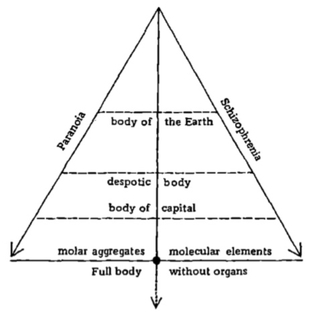 A schizoanalytical diagram of the social dynamic of the body without organs, from Anti-Oedipus. |
『アンチ・オイディプス』より、器官なき身体の社会的動態に関する分裂分析図。 |
| Background The phrase "body without organs" was first used by the French writer Antonin Artaud in his 1947 text for a play, To Have Done With the Judgment of God. Referring to his ideal for man as a philosophical subject, he wrote in its epilogue that "When you will have made him a body without organs, then you will have delivered him from all his automatic reactions and restored him to his true freedom."[5] Artaud is regarded as having viewed the body as an impermanent, composite image of actions inflicted upon a vulnerable and repressive physical structure; in a 1933 letter, he wrote that bodies should be understood only as "provisional stratifications of states of life".[6] Deleuze reinterpreted the term in The Logic of Sense, inspired both by Artaud's text and the work of psychotherapist Gisela Pankow;[7] here, he conceptualized the body without organs in the context of psychoanalysis, observing that the practice as it existed refused the thorough creation of BwOs.[8] In Deleuze's early formulations of the concept, the body without organs was based in the symptoms related to schizophrenia, such as glossolalia where syllables are formlessly uttered and intoned in sets as if they were words.[9] For Deleuze, glossolalia transforms words from having instrumental value, where words have literal meaning, to "values which are exclusively tonic [relating to speech] and not written", creating—in the case of language—lingual and verbal bodies without organs.[10] |
背景 「器官なき身体」という表現は、フランスの作家アントナン・アルトーが1947年の戯曲『神の審判を終わらせるために』で初めて用いた。哲学的主体として の理想的人間像を指して、彼はエピローグでこう記している。「彼を器官なき身体に作り上げた時、お前は彼をあらゆる自動的反応から解放し、真の自由へと還 すことになる」 [5] アルトーは身体を、脆弱かつ抑圧的な物理的構造に課せられた行為の、一時的で複合的なイメージと見なしていたとされる。1933年の書簡では、身体は「生 命状態の暫定的な層化」としてのみ理解されるべきだと記している。[6] ドゥルーズは『感覚の論理学』において、アルトーのテキストと精神療法士ギゼラ・パンコウの著作の両方に触発され、この概念を再解釈した[7]。ここで彼 は精神分析の文脈において器官なき身体を概念化し、当時存在した実践が器官なき身体の徹底的な創造を拒んでいたと指摘した。[8] デリューズによるこの概念の初期の定式化では、器官なき身体は統合失調症に関連する症状、例えば無秩序な音節が言葉であるかのように発声され、セットとし て詠唱される異言現象(glossolalia)に基づいて構築されていた。[9] デリューズにとって、グロッソラリアは言葉を「文字通りの意味を持つ道具的価値」から「書かれることなく、純粋に発声的な価値」へと変容させる。言語の場 合、それは器官なき言語的身体と器官なき言語的身体を生み出すのである。[10] |
Usage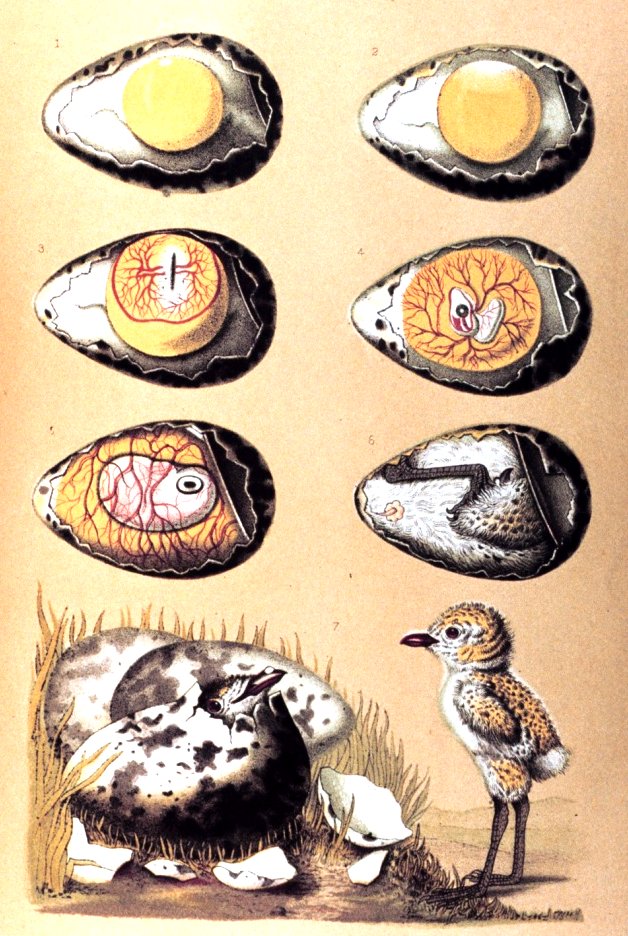 Eight drawings showing the development of an egg, hatching, and an emerged chick The development of a bird egg; the egg is a prominent figure of the body without organs in Capitalism and Schizophrenia. The concept of the body without organs was mainly defined by Deleuze and Guattari in Capitalism and Schizophrenia.[11] In both volumes, Anti-Oedipus and A Thousand Plateaus, the abstract body is defined as a self-regulating process—created by the relation between an abstract machine and a machinic assemblage—that maintains itself through processes of homeostasis and simultaneously limits the possible activities of its constituent parts, or organs.[12] The body without organs is the sum total intensive and affective activity of the full potential for the body and its constituent parts.[13] Deleuze and Guattari presume, in a continuation from Samuel Butler's radical departure from vitalism in "Darwin among the Machines", that since all organisms have some sort of abstract inclination or desire—in the case of nonhuman life such as plants and animals, their genetic instincts variably control what actions they take—the body without organs is the inevitable, unconstrained manifestation of those inclinations or desires that may take upon unprecedented forms.[14] The concept of the body that the body without organs refers to inherits elements from both the concept of substance proposed by Baruch Spinoza and the concept of "intensive magnitude" in Immanuel Kant's Critique of Pure Reason, wherein it is defined not by closed and determinate activity but by cohesion through affective potential.[15] A body without organs can consist of many different actions that approach an unattainable goal, many of which are the activities of assemblages that people unconsciously create and are always engaged in;[16] to become a body without organs, one must dispose of stratification (the classification of constituent parts into groups), and instead give way to what Deleuze and Guattari described as an immanent "becoming" of pure intensity.[17] The body without organs is not necessarily coupled with the eradication of stratification, but rather encourages the creation of a "smooth space", immanently transforming the body beyond its existing categorization.[18] The bodies—not merely physical but intensive—of schizophrenics, drug addicts, and hypochondriacs are examples they give of bodies without organs, but they caution against replicating their actions; people should not seek out their negative experiences, which are "catatonicized" and "vitrified".[16] While these examples are said to have abandoned stratification, they never intensified, which makes their bodies without organs vulnerable to re-stratification.[17] They classify bodies without organs into three categories:[A] The empty BwO is chaotic and undifferentiated because it undergoes destratification without intensification; the full BwO is a "plane of consistency" because it is both destratified and intensified, which allows it to enter new relationships; meanwhile, the cancerous BwO is too stratified and becomes "majoritarian", having predetermined objectives that eliminate the body's potential.[20] Two important examples of the body without organs relate to eggs.[21] As a bird egg develops, it is nothing but the dispersion of protein gradients, which have varying intensities and have no apparent structure; for Deleuze and Guattari, a bird egg is an instance of life "before the formation of the strata", since changes in the qualitative elements of the egg will emerge as a changed organism.[21] Relatedly, in the Dogon culture, there is a belief in an egg that encompasses the universe,[21] where the universe is an "intensive spatium" (an intensive interior), similar to a bird egg.[22] According to Deleuze and Guattari, the Dogon egg is an intensive body, crossed with several zig-zagging lines of vibration, changing its shape as it develops without being compartmentalized through organs.[23] Ambiguity The body without organs remains one of Deleuze and Guattari's more ambiguous concepts and terms;[24] over the course of their careers, the term changed in meaning and was used synonymously with others, such as the plane of immanence. Deleuze and Guattari were unsure whether they referred to the same concept when using the term;[25] scholars of Deleuze and Guattari have also expressed "little to no agreement" on the term, according to philosopher Ian Buchanan.[26] |
使用法 卵の発育、孵化、そして孵化したヒナの過程を示す八枚の図 鳥の卵の発育;この卵は『資本主義と統合失調症』において器官なき身体の顕著な形象である。 器官なき身体の概念は、主にドゥルーズとガタリが『資本主義と統合失調症』において定義したものである[11]。『アンチ・オイディプス』と『千の平原』 の両巻において、抽象的身体は、抽象機械と機械的集合体の関係によって創出される自己調整プロセスとして定義される。このプロセスは恒常性維持を通じて自 己を保ちつつ、同時にその構成部分、すなわち器官の可能な活動を制限する。器官なき身体とは、身体とその構成要素が持つ全潜在能力の集積的・情動的活動の 総和である[13]。 ドゥルーズとガタリは、サミュエル・バトラーが『機械の中のダーウィン』で生命論から急進的に離脱した流れを継承し、あらゆる有機体が何らかの抽象的な傾 向や欲望を持つこと——植物や動物といった非人間的生命の場合、その遺伝的本能が取る行動を可変的に制御する——を前提とする。したがって器官なき身体と は、それらの傾向や欲望が制約を受けずに必然的に現れる形態であり、それは前例のない形をとる可能性を秘めている。[14] 器官なき身体が指す身体概念は、バルーフ・スピノザが提唱した実体概念と、イマヌエル・カントの『純粋理性批判』における「強度」概念の両方から要素を継 承している。そこでは、閉じた確定的な活動によってではなく、情動的可能性による凝集によって定義される。[15] 器官なき身体は、達成不可能な目標に向かう異なる行為から成り得る。その多くは、人々が無意識に創り出し常に従事している集合体の活動である。[16] 器官なき身体となるには、階層化(構成要素のグループ分け)を放棄し、代わりにドゥルーズとガタリが「純粋な強度」の内在的「生成」と表現した状態へ移行 しなければならない。[17] 器官なき身体は階層化の根絶と必ずしも結びつかない。むしろ「滑らかな空間」の創出を促し、既存の分類を超越して身体を内在的に変容させる. [18] 統合失調症患者、薬物依存者、心気症患者の身体——単なる物理的ではなく強度的な身体——は、彼らが提示する器官なき身体の例である。しかし彼らは、その 行動を模倣することには警戒を促す。人々は彼らの否定的体験——「硬直化」され「ガラス化」されたもの——を追い求めるべきではない。[16] これらの例は階層化を放棄したと言われるが、決して強化されなかったため、器官なき身体は再階層化の危険に晒されている。[17] 彼らは器官なき身体を三つに分類する:[A] 空虚な器官なき身体は、強化を伴わない分層解除を経験するため混沌として未分化である。充実した器官なき身体は「一貫性の平面」であり、分層解除と強化の 両方を経て新たな関係性へ移行する。一方、癌化した器官なき身体は過度に分層化され「多数派的」となり、身体の可能性を排除する予め定められた目的を持 つ。[20] 器官なき身体の重要な二例は卵に関連している。[21] 鳥の卵が発達する過程では、それは強度が変化し明らかな構造を持たないタンパク質濃度の分散に過ぎない。ドゥルーズとガタリにとって鳥の卵は「層の形成以 前の」生命の事例であり、卵の質的要素の変化が変容した有機体として現れるからである。[21] 関連して、ドゴン族の文化には宇宙を包含する卵の信仰がある[21]。そこでの宇宙は鳥の卵と同様の「集中的空間」(集中的内部)である[22]。ドゥ ルーズとガタリによれば、ドゴンの卵は集中的身体であり、幾筋ものジグザグ状の振動線が交差し、器官による区画化なしに発達するにつれて形状を変える。 [23] 曖昧性 器官なき身体は、ドゥルーズとガタリの概念・用語の中でも特に曖昧なもののひとつであり続ける[24]。彼らのキャリアを通じて、この用語の意味は変化 し、内在性の平面など他の用語と同義的に用いられた。ドゥルーズとガタリ自身、この用語を使用する際、同じ概念を指しているか確信が持てなかった [25]。哲学者イアン・ブキャナンによれば、ドゥルーズ・ガタリ研究者間でもこの用語について「合意はほとんど、あるいは全く見られない」という [26]。 |
| Interpretations Nick Land English philosopher Nick Land, who was reliant on the work of Deleuze and Guattari in his theoretical work of the 1990s, used the concept of the body without organs in relation to his "cybergothic" reinterpretation of continental philosophy. In his philosophy, the body without organs is defined by Land (alongside Deleuze and Guattari in Anti-Oedipus) as a model of death with an infinite capacity for dispersion of its elements. For instance, in the conclusion of his 1993 essay "Art as Insurrection", he writes: The body without organs is [...] at once [a] material abstraction, and the concretely hypostasized differential terrain which is nothing other than what is instantaneously shared by difference. The body without organs is pure surface, because it is the mere coherence of differential web, but it is also the source of depth [...][27] Similarly, in his 1995 essay "Cybergothic", Land identified the body without organs as a concept in the lineage of representations of "death as time-in-itself"—or "degree 0" of an intensive continuum—within which experiential time is a profusion of indeterminate states, corresponding both to the schizophrenic consciousness and to the dissipation of matter through death; this lineage also includes Spinoza's substance, Kant's "pure apperception", Sigmund Freud's death drives, and most notably, American novelist William Gibson's notion of cyberspace.[28] |
解釈 ニック・ランド 1990年代の理論的著作においてドゥルーズとガタリの思想に依拠した英国の哲学者ニック・ランドは、大陸哲学の「サイバーゴシック的」再解釈に関連して 「器官なき身体」の概念を用いた。ランドの哲学において、器官なき身体は(ドゥルーズとガタリの『アンチ・オイディプス』と同様に)その要素を無限に分散 させる能力を持つ死のモデルとして定義される。例えば、1993年の論文「反乱としての芸術」の結論部で彼はこう記している: 器官なき身体とは[…]物質的抽象であると同時に、差異によって瞬間的に共有されるものに他ならない、具体的に実体化された差異の地形である。器官なき身 体は純粋な表面である。なぜなら差異の網の単なる連関に過ぎないからだ。しかしそれは同時に深みの源泉でもある[…][27] 同様に、1995年の論文「サイバーゴシック」において、ランドは器官なき身体を「時間そのものとしての死」―あるいは集中的連続体の「度数0」―の表象 の系譜に属する概念と位置づけた。この系譜では、経験的時間とは不定状態の過剰であり、それは統合失調症的意識と死による物質の散逸の両方に対応する。こ の系譜にはスピノザの実体、カントの「純粋自覚」、ジークムント・フロイトの死の欲動、そして特にアメリカ人小説家ウィリアム・ギブソンのサイバースペー ス概念も含まれる。[28] |
| Desiring-production Plane of immanence Substance theory |
欲求の生成 内在性の平面 実体論 |
| Notes A. These categories were developed in A Thousand Plateaus.[19] Citations 1. Demers 2006, p. 166. 2. Clark 2012, p. 199. 3. Goodman 2010, pp. 100–102. 4. Markula 2006, pp. 38–42. 5. Bazzano 2021, p. 295; Brenner 2021, p. 42. 6. Murphy 2015. 7. Bazzano 2021, p. 295; Colombat 1991, p. 13; Whitlock 2020, p. 517. 8. Whitlock 2020, pp. 518, 520. 9. Whitlock 2020, pp. 517–518. 10. Whitlock 2020, p. 517. 11. Brenner 2021, p. 42. 12. Smith 2018, pp. 106–107. 13. Fox 2011, p. 361. 14. Fox 2011, pp. 360–361. 15. Goodman 2010, p. 102. 16. Markula 2006, p. 38. 17. Markula 2006, p. 40. 18. Markula 2006, p. 42. 19. Holland 2008, pp. 76–77. 20. Albertsen & Diken 2006, pp. 231–232; Clark 2012, p. 203. 21. Adkins 2015, p. 102. 22. Adkins 2015, pp. 101–102. 23. Leston 2015, p. 372. 24. Buchanan 2015, p. 25; Carrier 1998, p. 189; Kaufman 2004, p. 658; Smith 2018, p. 106. 25. Buchanan 2015, p. 25. 26. Buchanan 2015, p. 26. 27. Land 2011, pp. 171–172. 28. Land 2011, pp. 369–370. |
注 A. これらのカテゴリーは『千のプラトー』で展開されたものである。 引用 1. Demers 2006, p. 166. 2. Clark 2012, p. 199. 3. グッドマン 2010、100-102 ページ。 4. マルクラ 2006、38-42 ページ。 5. バザノ 2021、295 ページ、ブレナー 2021、42 ページ。 6. マーフィー 2015。 7. バザノ 2021、295 ページ、コロンバ 1991、13 ページ、ウィットロック 2020、517 ページ。 8. ウィットロック 2020、518、520 ページ。 9. ウィットロック 2020、517-518 ページ。 10. ウィットロック 2020、517 ページ。 11. ブレナー 2021、42 ページ。 12. スミス 2018、106-107 ページ。 13. フォックス 2011、361 ページ。 14. フォックス 2011、360-361 ページ。 15. グッドマン 2010、102 ページ。 16. マルクラ 2006、38 ページ。 17. マルクラ 2006、40 ページ。 18. マルクラ 2006、42 ページ。 19. ホランド 2008、76-77 ページ。 20. Albertsen & Diken 2006、231-232 ページ、Clark 2012、203 ページ。 21. Adkins 2015、102 ページ。 22. Adkins 2015、101-102 ページ。 23. レストン 2015, p. 372. 24. ブキャナン 2015, p. 25; キャリヤー 1998, p. 189; カウフマン 2004, p. 658; スミス 2018, p. 106. 25. ブキャナン 2015, p. 25. 26. ブキャナン 2015, p. 26。 27. ランド 2011, pp. 171–172。 28. ランド 2011, pp. 369–370。 |
| Bibliography Adkins, Brent (2015). Deleuze and Guattari's A thousand plateaus: A critical introduction and guide. Edinburgh University Press. ISBN 9780748686452. Albertsen, Niels; Diken, Bülent (2006). "Society with/out organs". In Fuglsang, Martin; Sørensen, Bent Meier (eds.). Deleuze and the social. Edinburgh University Press. ISBN 9780748620920. Bazzano, Manu (3 July 2021). "The body-without-organs: A user's manual". European Journal of Psychotherapy & Counselling. 23 (3): 289–303. doi:10.1080/13642537.2021.1961833. S2CID 238794978. Brenner, Leon S. (2021). "Is the autistic body a body without organs?". In McLaughlin, Becky R.; Daffron, Eric (eds.). The body in theory: Essays after Lacan and Foucault. Jefferson, North Carolina: McFarland. ISBN 9781476678559. Buchanan, Ian (2015). "The 'structural necessity' of the body without organs". In Buchanan, Ian; Matts, Tim; Tynan, Aidan (eds.). Deleuze and the schizoanalysis of literature. London: Bloomsbury. ISBN 9781472529633. Carrier, Ronald M. (May 1998). "The ontological significance of Deleuze and Guattari's concept of the body without organs". Journal of the British Society for Phenomenology. 29 (2): 189–206. doi:10.1080/00071773.1998.11665445. Clark, Vanessa (16 April 2012). "Art practice as possible worlds". International Journal of Child, Youth and Family Studies. 3 (2–3): 198. doi:10.18357/ijcyfs32-3201210866. Colombat, André Pierre (1991). "A thousand trails to work with Deleuze". SubStance. 20 (3): 10–23. doi:10.2307/3685176. ISSN 0049-2426. JSTOR 3685176. Demers, Jason (August 2006). "Re-membering the body without organs". Angelaki. 11 (2): 153–168. doi:10.1080/09697250601029333. S2CID 144031891. Fox, Nick J (December 2011). "The ill-health assemblage: Beyond the body-with-organs" (PDF). Health Sociology Review. 20 (4): 359–371. doi:10.5172/hesr.2011.20.4.359. S2CID 144369239. Goodman, Steve (2010). Sonic Warfare: Sound, Affect, and the Ecology of Fear. MIT Press. ISBN 978-0-262-01347-5. Holland, Eugene W. (2008). "Schizoanalysis, nomadology, fascism". In Buchanan, Ian; Thoburn, Nicholas (eds.). Deleuze and politics. Edinburgh University Press. ISBN 9780748632879. Kaufman, Eleanor (2004). "Betraying well". Criticism. 46 (4): 651–659. doi:10.1353/crt.2005.0016. ISSN 0011-1589. JSTOR 23127250. S2CID 258105122. Land, Nick (2011). Brassier, Ray; Mackay, Robin (eds.). Fanged Noumena: Collected Writings 1987-2007. MIT Press; Urbanomic. ISBN 9780955308789. Leston, Robert (2015). "Deleuze, Haraway, and the radical democracy of desire". Configurations. 23 (3): 355–376. doi:10.1353/con.2015.0023. S2CID 146714920. Markula, Pirkko (February 2006). "Deleuze and the body without organs: Disreading the fit feminine identity". Journal of Sport and Social Issues. 30 (1): 29–44. doi:10.1177/0193723505282469. S2CID 144934352. Murphy, Jay (2015). "The Artaud effect". CTheory (Theorizing 21C). Smith, Daniel (March 2018). "What is the body without organs? Machine and organism in Deleuze and Guattari". Continental Philosophy Review. 51 (1): 95–110. doi:10.1007/s11007-016-9406-0. S2CID 254800444. Whitlock, Matthew G. (2020). "The wrong side out with(out) God: An autopsy of the body without organs". Deleuze and Guattari Studies. 14 (3): 507–532. doi:10.3366/dlgs.2020.0414. S2CID 225487537. |
参考文献 Adkins, Brent (2015). Deleuze and ガタリ's A thousand plateaus: A critical introduction and guide. Edinburgh University Press. ISBN 9780748686452. Albertsen, Niels; Diken, Bülent (2006). 「器官のある/ない社会」. Fuglsang, Martin; Sørensen, Bent Meier (eds.) 編. 『ドゥルーズと社会』. エディンバラ大学出版局. ISBN 9780748620920. Bazzano, Manu (2021年7月3日). 「器官なき身体:ユーザーマニュアル」。European Journal of Psychotherapy & Counselling(ヨーロッパ心理療法・カウンセリングジャーナル)。23 (3): 289–303. doi:10.1080/13642537.2021.1961833. S2CID 238794978. ブレナー、レオン・S.(2021)。「自閉症の身体は器官なき身体か?」。マクラフリン、ベッキー・R.;ダフロン、エリック(編)。『理論における身 体:ラカンとフーコー以後のエッセイ』。ノースカロライナ州ジェファーソン:マクファーランド。ISBN 9781476678559。 ブキャナン、イアン(2015)。「器官なき身体の『構造的必然性』」。ブキャナン、イアン;マット、ティム;タイナン、エイダン(編)。『ドゥルーズと文学のスキゾ分析』。ロンドン:ブルームズベリー。ISBN 9781472529633。 キャリヤー、ロナルド・M.(1998年5月)。「ドゥルーズとガタリの器官なき身体概念の存在論的意義」。『英国現象学会誌』。29巻2号:189–206頁。doi:10.1080/00071773.1998.11665445。 クラーク、ヴァネッサ(2012年4月16日)。「可能世界としての芸術実践」。『国際児童・青少年・家族研究ジャーナル』。3巻2-3号:198頁。doi:10.18357/ijcyfs32-3201210866。 コロンバ、アンドレ・ピエール(1991年)。「ドゥルーズと働く千の道」。『サブスタンス』。20巻3号:10–23頁。doi:10.2307/3685176。ISSN 0049-2426。JSTOR 3685176。 デマーズ、ジェイソン (2006年8月)。「器官なき身体の再構成」。『アンジェラキ』。11巻2号:153–168頁。doi:10.1080/09697250601029333。S2CID 144031891。 フォックス、ニック・J(2011年12月)。「健康不良の集合体:臓器のある身体を超えて」 (PDF). Health Sociology Review. 20 (4): 359–371. doi:10.5172/hesr.2011.20.4.359. S2CID 144369239. グッドマン、スティーブ (2010). ソニック・ウォーフェア:音、感情、そして恐怖の生態学。MIT Press。ISBN 978-0-262-01347-5。 Holland, Eugene W. (2008). 「スキゾ分析、ノマドロジー、ファシズム」 Buchanan, Ian; Thoburn, Nicholas (eds.) Deleuze and politics. Edinburgh University Press. ISBN 9780748632879。 カウフマン、エレノア (2004)。「よく裏切る」。批評。46 (4): 651–659。doi:10.1353/crt.2005.0016。ISSN 0011-1589。JSTOR 23127250. S2CID 258105122. ランド、ニック(2011)。ブラッシエ、レイ;マッケイ、ロビン(編)。『牙あるイデア:1987-2007年 著作集』MITプレス;アーバノミック。ISBN 9780955308789。 レストン、ロバート(2015)。「ドゥルーズ、ハラウェイ、そして欲望の急進的民主主義」。『コンフィギュレーションズ』。23巻3号:355–376頁。doi:10.1353/con.2015.0023。S2CID 146714920。 マルクラ、ピルッコ(2006年2月)。「ドゥルーズと器官なき身体:適合的な女性的アイデンティティの誤読」。Journal of Sport and Social Issues. 30 (1): 29–44. doi:10.1177/0193723505282469. S2CID 144934352. マーフィー、ジェイ(2015)。「アルトー効果」。CTheory(21世紀の理論化)。 スミス、ダニエル(2018年3月)。「器官なき身体とは何か?ドゥルーズとガタリにおける機械と有機体」。大陸哲学レビュー。51 (1): 95–110. doi:10.1007/s11007-016-9406-0. S2CID 254800444. ホイットロック、マシュー G. (2020). 「神を伴わない(あるいは伴わない)裏返し:器官なき身体の解剖」『ドゥルーズ・ガタリ研究』14巻3号:507–532頁。doi:10.3366/dlgs.2020.0414。S2CID 225487537。 |
| https://en.wikipedia.org/wiki/Body_without_organs |
☆以下、読書メモ(訳書のページ数)
リ ンク
文 献
そ の他の情報
CC
Copyleft,
CC, Mitzub'ixi Quq Chi'j, 1996-2099